
The edition pictured is the more recent reissue of the book. My own paperback copy is too tattered to share; I do need to replace it, as it’s one to keep and re-read.
Land Below the Wind by Agnes Newton Keith ~ 1939. This edition: MacFadden, 1964. Paperback. 270 pages.
My rating: 9/10
I do enjoy an interesting memoir, and, having read several of Agnes Newton Keith’s later accounts of an eventful life, namely Three Came Home (a description of Agnes Keith’s three years in a Japanese prison camp in Borneo with her husband and young son, 1942-45) and Bare Feet in the Palace (everyday and political doings in the Philippines, where her husband worked for the U.N. Food and Agriculture Organization, 1953-56), I have long been on the lookout for her first literary accomplishment, this worldwide bestseller, Land Below the Wind.
I was particularly interested in this memoir because Agnes Keith credits it with helping save her son’s life while in the prison camp in Borneo. The book had been translated into Japanese prior to the war, and the commandant of the camp had read it and greatly enjoyed it, apparently appreciating Agnes Keith’s favourable descriptions of the Asian world. He would occasionally call Agnes into his office and chat with her on things literary, rewarding her with treats for young George – a biscuit, a banana, and on at least one occasion medical supplies normally unavailable to the internees. For this she was labelled a “collaborator” by some of her fellow internees; In Three Came Home, Keith justifies her conciliatory attitude to the Japanese officers as doing the best she could to ensure the survival of her child. So I was rather curious as to what the appeal of Land Below the Wind was, to see what chord it might have struck which was strong enough to influence a prison camp overseer some years later.
Land Below the Wind is indeed a most readable and a happily positive book, a description of Agnes’ introduction to life as the wife of a British civil servant in then-North Borneo (now known as Sabah) in the 1930s, when that country, “seven days by steamer from Singapore and Hong Kong”, was a British Protectorate, and Harry Keith its Conservator of Forests and Director of Agriculture, a position he had already held for ten years when he brought his new American wife out to the tropics with him. After four years living and travelling in North Borneo, one of only twenty or so European women attached to the seventy or so European men in the North Borneo Civil Service (men were not permitted to marry until they had served eight years in their posting, which accounts for the disparity in numbers of the sexes) Agnes published this book, and it became an immediate bestseller, after winning the coveted Atlantic Monthly $5000 Prize for Best Non-Fiction book published in 1939.
The book is entrancing, certainly because of the descriptions of the local residents, the tropical surroundings, the native flora and fauna, and also for its gentle mocking of the delicate social structure built up around the Protectorate bureaucrats and their spouses and unspoken rules of etiquette.
In Sandakan there is a game played with visiting cards. Every married woman has a small card box with her name lettered on it, planted at the entrance to her garden path. Spiders and lizards live in this box and in the wet season a very small snake, so care must be taken in opening the door not to snap off the end of the lizard’s tail or flatten the snake in the hinge. At intervals, among the lizard’s droppings, if you remember to open the box, various cards will appear. These you scrutinize, forget about, and some days later find under the ash tray. You then disinter your own and husband’s cards, stealthily approach the friend’s card box, and offer a return sacrifice to his lizards. The rule as to who drops the first card is as mystifying and inexplicable as the use of a subjunctive clause, and I have never really understood either of them. The rule has something to do with the sex, length of domicile, and matrimonial alliances of the parties involved, but the whole thing is best enjoyed if regarded as a game. The really important rule is to remember that when calling on the person you should not meet him in the flesh.
Sometimes newcomers do not understand about this game, or play it with a different set of rules in the outer world from which they come. this creates an impasse in social relations, for not until the first round of cards can people meet in person. The impasse continues until someone quietly hands the newcomer a printed slip containing the laws of the Medes, the Persians, and the Game of Cards.
North Borneo in the 1930s was a very active place, with lots going on, and constant coming and going both throughout the countryside and to the various islands, and frequent contact with the “outside” world, but there was still enough “first contact” type experience within living memory to give the Europeans the thrill of realizing that their immediate predecessors, instead of being matter-of-factly greeted by the natives as just another lot of government officials, might well have perished under mysterious and tragic circumstances. This was, after all, a country where head-hunters had stalked the hills only a generation ago. People still occasionally disappeared without a trace, and there were corners of the jungle not yet penetrated by Europeans, where traditional culture presumably survived in isolated pockets.
Agnes Newton Keith plays down the Noble White Man and Backwards-and-Possibly-Scary Native scenario, except where to make a point about White Man’s attitudes (good and bad) and fundamental dependence on the good nature of their Native co-workers, fellow officials, and yes, servants and jungle guides and local shopkeepers and business owners. For its era, an even-minded account of life in a relatively newly colonized land, of course from the point of view of one of the colonizers.
An enjoyable book, and though I could easily go on, I will stop here. Agnes Newton Keith was an interesting woman and an accomplished writer, and I enjoy reading her for her sense of humour, readiness to criticize herself when she pulls a real bloomer, and for her deep appreciation and vibrant descriptions of the places she finds herself occupying, whether North Borneo government villa or prison camp grass hut. Good stuff.







 Leaves & Pages
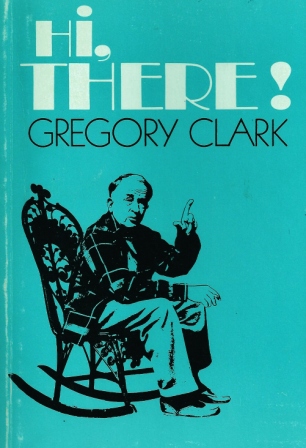
Review: War Stories by Gregory Clark
Posted in 1960s, Canadian Book Challenge #7, Read in 2013, tagged Canadian, Canadian Book Challenge 7, Gregory Clark, Memoir, Social Commentary, Vintage, War, War Correspondence, War Stories, World War I, World War II on November 9, 2013| 2 Comments »
My rating: 8/10
Born in 1892 in Toronto, Ontario, Gregory Clark was of perfect age to fight in the Great War, heading to Europe in 1916, at the age of twenty-four. Clark entered the fray as a lieutenant, and exited a major. In the trenches and out of them – Clark received the Military Cross for “conspicuous gallantry” at Vimy Ridge – the young man remembered what he had witnessed, the horror and the gallantry and the moments of respite and delight, to be shared later with his audience of newspaper readers as he took up journalism in the post-war years.
Too old to take active part in World War II, Gregory Clark none the less went overseas once again and pushed his way into the thick of the action, fulfilling a role as a front-line war correspondent, and receiving an Order of the British Empire for his services. Again, his experiences found their way into his short, chatty periodical articles published in the following decades. Clark’s son Murray was killed in action in 1944 while serving with the Regina Rifles, but there is no mention of that personal loss here in War Stories; Clark keeps that particular emotion well buried.
War Stories contains a selection of thirty-eight anecdotes, three to five pages in length, about a wide array of Gregory Clark’s personal experiences. Though the tone throughout is upbeat and frequently humorous – War Stories won the Leacock award for humour in 1965, which rather surprises me, for funny as these anecdotes sometimes are, there is a sombre tone always present – Clark makes it very clear what his opinions are as to the brutality of what the soldiers and civilians went through.
These stories laud the bravery (and the frequent giddy foolishness) of the farm boys and office clerks and travelling salesmen who find themselves caught up in circumstances beyond their most vivid nightmares, fated to kill and, frequently, be horribly maimed, and wastefully killed, merely because of the circumstance of the time of their birth. Something I noticed is that there is not much sympathy shown here for the soldiers of the “other side”; Clark’s thoughts are ever for his own, and he was reportedly a fiercely protective officer of the men under his charge.
All is not muck and death and destruction though. Interludes of inactivity brought forth pranks and hi-jinks, while there were times of repose behind the lines, time for memorable meals and quiet conversation, and musings on what was going to come after, if there was going to be an after.
An appropriate book for this Remembrance Day weekend, this time of sober reflection. Clark reports the realities, but he persists as well in highlighting the lighter moments, the bits of sanity in a world of war.
A good read.
And a much more eloquent review of this book, well worth a click-over, may be found at Canus Humorous.
Read Full Post »