Posts Tagged ‘Vintage Fiction’

k mary roberts rinehart p

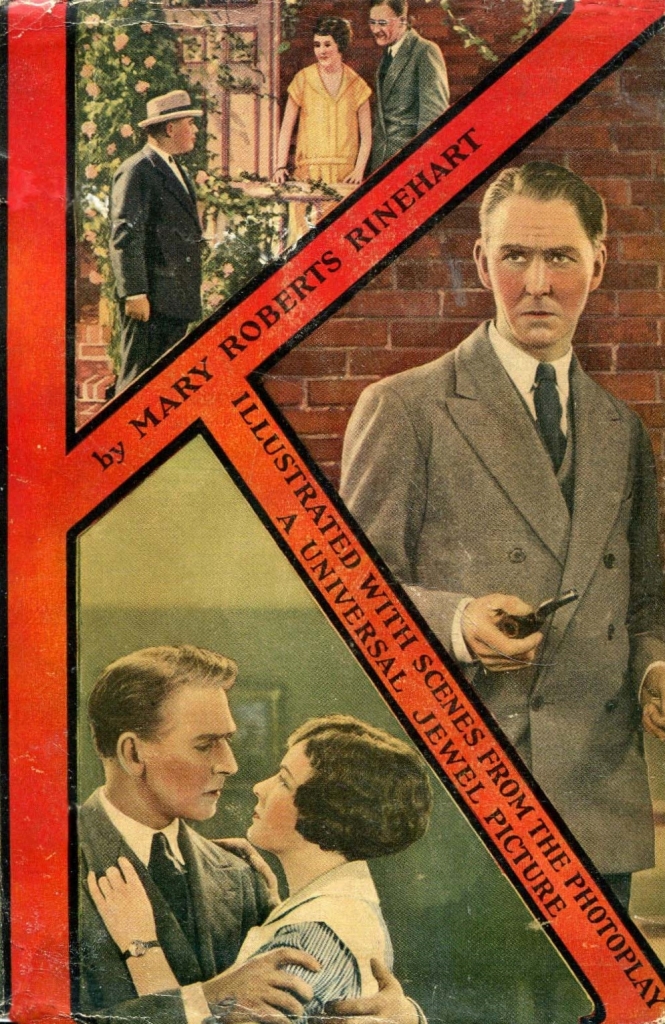
This is not my personal copy, but the dust jacket of an older edition. Apparently “K” was made into a movie at one point.

“K” by Mary Roberts Rinehart ~ 1914. This edition: Blakiston 1944. Hardcover. 407 pages.

My rating: 6.5/10

A melodramatic and exceedingly improbable story of an absolutely perfect heroine – beautiful, morally upright, self-sacrificing, pure through and through – you know the type! – and her three lovers. First is youthful and impetuous Joe, followed by brilliant (and fickle) young surgeon Max, and ultimately (somehow I doubt this will be a spoiler; especially as the cover pictured here completely gives it away) the mysterious “K”.

This vintage read was surprisingly good, considering the ridiculous storyline. The author has a lot to say about roles of women, the roles of marriage and child-bearing in female self-fulfillment, and the hypocrisy of society to those caught out in wrongdoing – the unmarried mother, the bastard child, the alcoholic rich man – and how each is viewed and sometimes excused merely on the basis of social status. How does that old song go? “It’s the same the whole world over, It’s the poor what gets the blame, It’s the rich what gets the pleasure, Ain’t that a blooming’ shame?”

Here we have a lovely young eighteen-year-old girl, Sidney, who decides to turn her back on marriage as offered by the infatuated Joe, and to make a career as a nurse. She is accepted as a probationer, and immediately falls head-over-heels in love with Doctor Max, a brilliant young surgeon whom she has known since childhood, but who has never realized what a lush young thing Sidney is until she pops up under his nose in nurse’s garb. Max is notoriously a lady’s man, with another love interest on the side, so the relationship seems questionable from the start, but Sidney succumbs (partially) to Max’s passionate advances. Her virtue remains intact, however, and she is saved from herself by the intervention of dark horse “K”.

K. Le Moyne – he never gives a first name – shows up one evening at Sidney’s mother’s house to rent a room, and though he is tenaciously reticent about his past, his quiet charm and readiness to help out with a myriad of domestic situations – from nurturing a pet ground squirrel to helping with the cooking – makes him the friend of all.

But what is K hiding? And why does Max reel in shock when the two men finally meet? What are they discussing behind closed doors on their subsequent nightly meetings? Did Sidney really mix up her medications and poison that pathetic young patient? Why is her superior Carlotta (incidentally Max’s main squeeze before Sidney’s entry) so alternately friendly and harsh to Sidney? And where did Joe get that gun?

See? Told you it was melodrama!

The cast of supporting characters is almost more interesting than the interconnected love triangles (quadrangles?) of the main protagonists.

Here we have a couple of middle-aged lovers, one a cook and the other a deaf-and dumb book salesman, communicating by notes to each other as they sit out each evening on the back steps. Another middle-aged spinster goes off to live in sin with a man whose wife is languishing in a mental home; her decision to put herself beyond society’s pale by her last-chance clutching at love is most sympathetically portrayed.

A young woman marries beneath herself socially, to a man with a drinking problem and a history of amorous dalliances; she knows this before she marries, and she knows she doesn’t truly love her husband-to-be, but she goes ahead anyway, to repent at leisure. (Subtext: Is marriage really such a socially desirable state that an intelligent well-off young woman will willingly enter into a questionably wise bond, particularly if love is not there?)

Dr. Ed, Dr. Max’s elder brother, is an old-school practical doctor in contrast to his younger brother’s cutting edge cleverness as a specialized surgeon. Dr. Ed, wiping his scalpel on his pant leg (sterilization dulls the edge, he maintains), proudly admires his brother’s accomplishments, and regards the sacrifice of his own career, his own never-attained wife and family as a worthy price to pay for his brother’s success. Dr. Ed has never married and has spent every penny he’s earned supporting his brilliant brother through medical school; his role in the story is as sort of a benevolent father figure, dispersing wisdom and keeping a high moral standard as an example to his friends and neighbours.

Sidney’s Aunt Harriet is one of my favourites. Long the drab neighbourhood seamstress, Harriet pursues a long-held ambition to design clothes for the local haut monde, and after borrowing money to set herself up, eventually makes it to Paris, from whence she sends engraved circulars to the customers eagerly awaiting her return. I absolutely loved the glimpses of practical yet creative Harriet getting dress-designing inspiration from crocuses in snow, or the colours of the early morning city sunrise. A happy spinster, Harriet, illustrating an independent womanhood and its rewards, in a world which still maintains that marriage and motherhood is a female’s highest calling.

Mary Roberts Rinehart was an exceedingly prolific writer of dramatic novels and mysteries, and a well-known feminist of her time. In “K”, her views on the rights of women come through loud and clear, though mixed rather oddly with this very traditional romance. She does allow her heroine to complete her goal to become a fully fledged nurse, though marriage awaits at the end of her qualification. I rather wonder what the after-story would turn out to be?

Read Full Post »

Three unrelated novels which share the common theme of adolescent girls coping as best they can with circumstances beyond their control. Frost in May and The World My Wilderness are undeniably much stronger and deeper novels than In Spite of All Terror, which, though competently written, fits more appropriately into the “juvenile historical fiction” category, but I’ve grouped them together here.

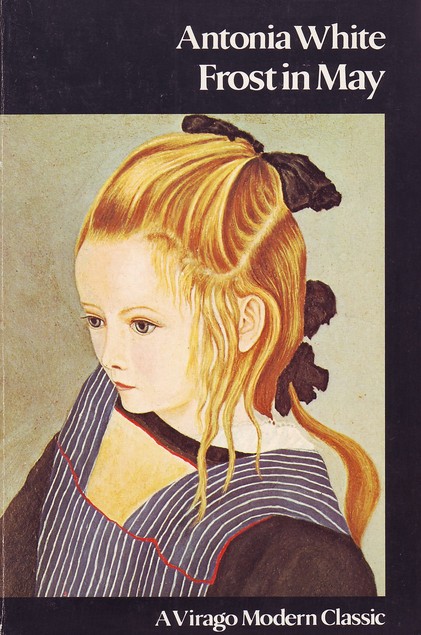
frost in may antonia whiteFrost in May by Antonia White ~ 1933.

This edition: Virago, 1981. Introduction by Elizabeth Bowen, 1948. Softcover. ISBN: 0-919630-36-7. 221 pages.

My rating: 8/10

I have known Antonia White as the gifted translator of a number of Colette’s novels, but I hadn’t realized she was an author in her own right until Frost in May crossed my path in an always-worth-examining green-covered Virago edition.

The novel is autobiographical fiction, based on the author’s childhood experiences attending convent school, and was the first in an eventual series of four books following the same character from her ninth through twenty-third year. Following Frost in May are The Lost Traveller, The Sugar House, and Beyond the Glass, and together they give an account of Antonia White’s formative years, and the emotional turmoil which shaped her adult life. The “transgression” in Frost in May which resulted in the fictional Nanda being expelled from convent school is a genuine event, and the real Antonia was marked for life by it.

It is 1908, and nine-year-old Fernanda – Nanda – Grey is being sent to The Convent of the Five Wounds in London in order to immerse her fully in her new life as a dedicated Catholic child; her father’s conversion several years earlier and his fervent seeking after ways to prove his devotion to his new faith have overflowed into Nanda’s life. She worships her father and seeks to please him in every detail of her life, and though she is understandably wary of this new experience, she is prepared to embrace her life among the nuns with eager dedication, as much for his sake as for her own.

Her experience at first is beyond strange to her; being in some ways better than she had anticipated, but also frequently much more harsh. The strict hierarchy of boarding school life is exacerbated by the dictatorial conduct of the nuns. A few are gentle and benign, though even in the kindest the stern core of duty prevents too much softness from showing, several are judgemental, demanding, and deeply sarcastic, seeming to set their young charges up for continual failure, all in aid of “breaking their worldly spirit” in order to prepare them to fully bow down to God.

Nanda tries her best to fit into this new culture, and gets along quite well, though she is continually haunted by feelings of deep inadequacy, both because of her lowly status as a mere convert to the faith rather than a “born” Roman Catholic, and because of her lack of social status among the many wealthy and aristocratic students.

As the years go by, Nanda makes several close friends, though the nuns forbid “particular friendships”, and is well on her way to forming her own ideas as to her adopted religion and her personal relationship with it, when a tragic misunderstanding loses her both her place in the convent community and the love and respect of her adored father.

The novel is a cutting exposé of the hypocrisies of several of the main characters, including Nanda’s demanding father, and her vaguely inefficient mother, and the effect of those hypocrisies on the sensitive and deeply feeling Nanda. She faithfully seeks to please her superiors and to adapt to their wishes and demands, while continually mulling over her own place in the world, and the contradictions she observes.

Very well written, and provides a fascinating account of life in a particular type of convent school. Suitable for competent youthful readers, perhaps early teens and older, but definitely would be most appreciated by those old enough to look back on their own formative years and relate Nanda’s experiences to their own.

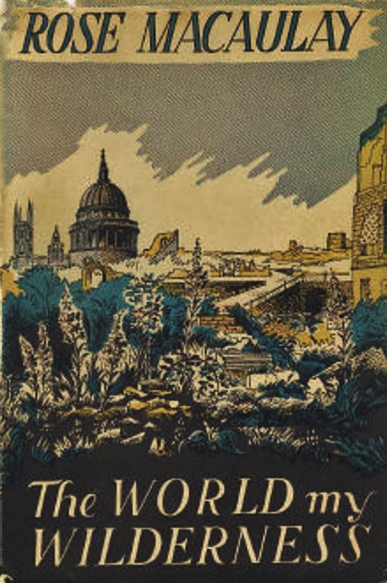
the world my wilderness dj rose macaulayThe World My Wilderness by Rose Macaulay ~ 1950.

This edition: Collins, 1950. Hardcover. 253 pages.

My rating: 9.5/10

This fabulous novel deserves more than the rudimentary review I am giving it here; I do believe it is one of the most beautifully written of all I’ve read so far this year. Rose Macaulay lets herself go with lushly vivid descriptions of the world just after the war. The bombed-our ruins of London are depicted in detailed clarity, and almost take precedence over the activities of the human characters, who move through their devastated physical habitat in a state of dazed shock from the brutalities they have seen and survived.

This is a bleakly realistic depiction of the aftermath of World War II and its effect on an expatriate teenager and her divided family, split between France and England. It moved me deeply, though the characters frequently acted in obviously fictional ways. What the author has to say about the effects of war on those who survived it is believably real.

17-year-old Barbary Denison is an English girl who has been raised for many years in France under the custody of her divorced mother and French stepfather. Under the confusion of the German Occupation, Barbary has run wild and has not-so-secretly joined up with an adolescent branch of the resistance – she and her younger half-brother have lived the lives of semi-feral children, and have witnessed and taken part in activities much too old for their tender years. After the war ends, Barbary’s stepfather is mysteriously drowned in the ocean near the family villa; possibly in retaliation for his unenthusiastic but undeniable cooperation with the Germans. Barbary’s mother, a hedonistic artist much more in love with her second husband than anyone fully realizes, emotionally draws away from her children, though Barbary in particular worships her mother with fervent dedication. When it is suggested that Barbary return to England to live with her father, her mother acquiesces with what seems like relief.

The culture shock which Barbary faces in post-war London society is sudden and severe. Her upper-class father has remarried and has a young son; Barbary views her stepmother with scorn and refuses to take any sort of interest in her younger half-brother. Her aunt and cousins are at first amused at her brusqueness and mildly sympathetic – they too have suffered in the war – but Barbary’s sullen refusal to adapt soon turns sympathy into bare tolerance. Barbary falls in with a group of young men who are living a precarious life amongst the bombed-out houses; they survive by petty thefts and view the London police as bitter enemies to be evaded at every turn. Barbary finds in this ragged outlaw world an echo of her wartime life in France, and she enters into a tenuous relationship with these new companions, hiding her activities from her father under guise of studying at the Slade School of Art. He in turn is unwilling to dig too deeply into his daughter’s private life, feeling that giving her space and time will ultimately win her affection.

Tragedy strikes, and Barbary is found out; the consequences of her double life and the bringing together of her estranged parents lead to unexpected revelations, though the reader has had inklings all along of secrets too terrible to be told.

I’ve described this novel as “bleak”, but don’t let that put you off. It’s definitely a worthwhile read, and Rose Macaulay’s satirical wit is in fine working order here. If you liked Crewe Train, or The Towers of Trebizond (which I’ve just finished – very good indeed!) you will be thrilled with The World My Wilderness.

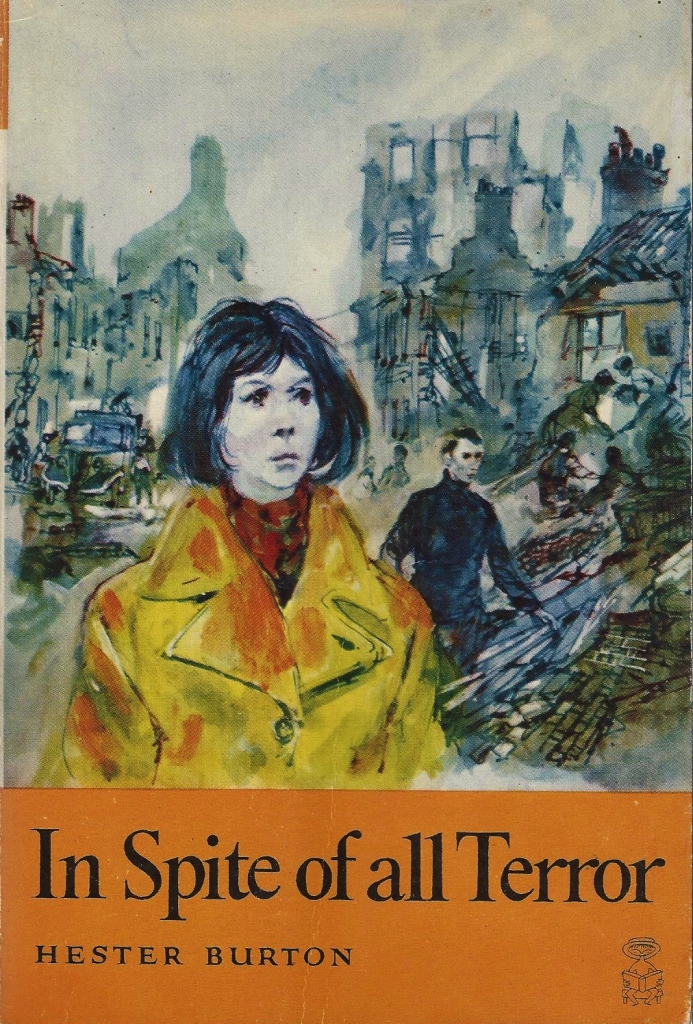
in spite of all terror hester burton 001In Spite of All Terror by Hester Burton ~ 1968.

This edition: Oxford University Press, 1970. Softcover. ISBN: 19-272011-2. 150 pages.

My rating: 7.5/10

This next novel is a slight thing compared to the two that preceded it in this post, but it has its merits as well, as a piece of memorable historical fiction. The author has based the story on her own recollections of 1940, when she was a was a 27-year-old Oxford-educated school teacher watching the evacuation of thousands of schoolchildren to the English countryside in preparation for the anticipated bombing of London.

Child of the slums, orphaned fifteen-year-old Liz Hawtin is a scholarship student at a girls’ grammar school; her evacuation in 1939 to the village of Chiddingford is a welcome development, as it spells her escape from the cold and critical aunt who has reluctantly taken on her sister-in-law’s child.

Taken into an aristocratic family, Liz realizes that her own intellectual ability, which is seen as so superior and is so deeply resented by Aunt Ag back in Nile Street, is no more than mediocre compared to the standard set by the intellectual and accomplished Bruton family. Recovering from that humbling hit to her self-esteem, Liz slowly becomes an accepted and valued member of the family, and gains self-confidence and renewed ambition as she is introduced to the greater world beyond her narrow London bounds.

The climactic event of the novel is the evacuation of the Dunkirk soldiers, which Liz experiences from the English side of the Channel. The episodes concerning Dunkirk from the viewpoint of one of the Bruton sons, and descriptions of the Blitz in London are what makes this slightly clichéd book stand out; the scenes are well-described and memorable.

Reading this book, I realize yet again what a wonderful thing well-written juvenile historical fiction can be. For though we all know the basic facts of events such as Dunkirk, it is the creative retellings we read in the impressionable days of our youth which bring so many of these events to life, opening up our minds to future exploration of history both through “adult” fiction and through first person accounts which perhaps are a bit too frank and detailed for a youthful audience.

I also appreciated the author’s refusal to neatly tidy up Liz’s story at the end of the book; we see her poised at the start of the next year in her life, on New Year’s Eve on the brink of 1941, knowing full well that what comes next may be far more challenging than the year she has just come through.

Hester Burton wrote eighteen novels, mostly historical fiction for youth, and she was noted for her meticulous research and her undeniable story-telling abilities. In Spite of All Terror was her sixth book. A vintage author to keep an eye out for if you have history-savvy teens, and for yourself as well. This was a fast read at only 150 pages, but despite its not-too-bothersome flaws (it was a bit too neat and tidy on occasion) it kept me interested all the way through, with abundant period detail adding value to the tale.

Read Full Post »

sapphira and the slave girl willa catherSapphira and the Slave Girl by Willa Cather ~ 1940. This edition: Knopf, 1940. Hardcover. 295 pages.

My rating: 7.5/10

This book passed the ultimate reading test last weekend. I picked it up while browsing the treasure trove of vintage books at the very recently opened (a year or so ago) Pulp Fiction Coffee House & Robbie’s Rare Books right downtown on Pandosy Street in Kelowna, British Columbia. I settled down with Sapphira and an excellent coffee mocha, and then I read and read and read. The place was busy; the conversation levels loud; I was a at tiny, tippy, table-for-one and it wasn’t exactly what one would consider prime reading conditions, but it didn’t matter. The story won out.

When Sapphira Dodderidge Colbert first moved out to Back Creek Valley with her score of slaves, she was not warmly received.  In that out-of-the-way, thinly settled district between Winchester and Romney, not a single family had ever owned more than four or five negroes.  This was due partly to poverty–the people were very poor.  Much of the land was still wild forest, and lumber was so plentiful that it brought no price at all.  The settlers who had come over from Pennsylvania did not believe in slavery, and they owned no negroes.  Mrs. Colbert had gradually reduced her force of slaves, selling them back into Loudoun County, whither they were glad to return.

Sapphira Colbert is now in her late fifties, and she and her husband Henry Colbert have lived in Back Creek Valley for thirty years. Between them they have built up a modestly successful business in a notoriously poor region; Henry is the flour miller. Sapphira herself is of modestly aristocratic stock; her mother was born in England, and Sapphira’s family heirlooms furnishing her house and her own finicky attention to “proper” speech and deportment set her apart from most of her neighbours. For the last five years Sapphira has been wheelchair bound; she suffers from dropsy and suffers even more from the loss of her physical freedom, though she still rules her household and keeps a keen eye on the mill and Henry’s doings there.

And Sapphira has recently not liked what she is seeing. One of her most-favoured slaves is pretty and intelligent Nancy, the half-white daughter of Till and granddaughter of Jezebel; the third generation of a family line owned by the Dodderidge family. Sapphira has made something of a pet of Nancy, keeping her as a personal servant and giving her trinkets and pretty clothes, but recently she has turned on the bemused girl, lashing out at her verbally and physically. Nancy has no idea why her beloved mistress has turned against her, but everyone else on the place has an opinion on the matter.

Nancy has been in the habit of cleaning Henry Colbert’s bedroom over at the mill – Henry and Sapphira lead very separate lives, and no longer share their marriage bed – and has started bringing Henry small nosegays of flowers, which she leaves in his room. The two have recently been seen in earnest conversation, and Sapphira, viewing Nancy’s lushly blossoming adolescent figure with a cynical eye, suspects that her husband and her slave girl are up to something even more intimate in the hours of the night.

She is mistaken, though. The relationship between Nancy and Henry is innocent through and through. Henry views Nancy as a pure young girl, and himself as her paternal protector. It has never crossed his mind to look at her in a sexual way, and she herself is  vehemently virginal, shuddering at the thought of sex with anyone, least of all her fatherly patron.

Henry is a noble character, of a sternly righteous Lutheran heritage; the thought of slave ownership is anathema to him, and only his vast respect for his wife has made it possible for him to keep quiet about what he sees as a fundamentally wrong practice. It is pre-Civil War Virginia, though, and marriage laws are such that Sapphira is unable to sell her property – including her slaves – without her husband’s permission. She has made her intention of selling Nancy clear to Henry, and he has categorically refused to allow such a thing, believing that Sapphira owes her slaves a permanent benevolent protection, adding fuel to the fire of Sapphira’s suspicion. So Nancy continues to receive sharp words and sharp cuffs, while Sapphira muses on other ways to revenge herself on her two supposed betrayers.

How Sapphira plots her revenge, and how Nancy is able at last to escape her wrath is the storyline which runs through the book, though there is a lot more going on here too, and numerous cleverly drawn characters besides the three key players.

Willa Cather tells her story in a spare, clean style, mincing no words whatsoever. As a matter of fact, the frequent colloquial language made me wonder rather why this novel has not suffered the same criticism as Mark Twain’s Huckleberry Finn has recently received; Sapphira, her compatriots and the narrator herself have no problem with calling anyone a “yellow girl” (for the half-white Nancy) or a “darkie”; “nigger” is an everyday expression and is used abundantly throughout.

Perhaps it is the overall theme, a critique of the practice of slave ownership, and an ongoing discussion of moral obligations, which has made it less of an issue? Or maybe the book is just that much more obscure that publicity has so far escaped it. In any event, it is there, and slightly shocking to a modern day reader; I did find myself glancing around to see if anyone was reading over my shoulder, and I angled the book to prevent a casual glance from catching the potentially offending words.

An excellent read, which kept me engaged even through the increasing melodrama, and Nancy’s continual jittering vapours. Sapphira as the key antagonist is cold and calculating, and we are very cognizant of her manipulative ways, but we are also given a chance to see behind the façade, to glimpse her fears and insecurities and internal conflicts, as well as those of every other major character.

In Sapphira and the Slave Girl, Willa Cather lives up to her reputation as a brilliant writer and a keen observer of American culture and personal history.

Read Full Post »

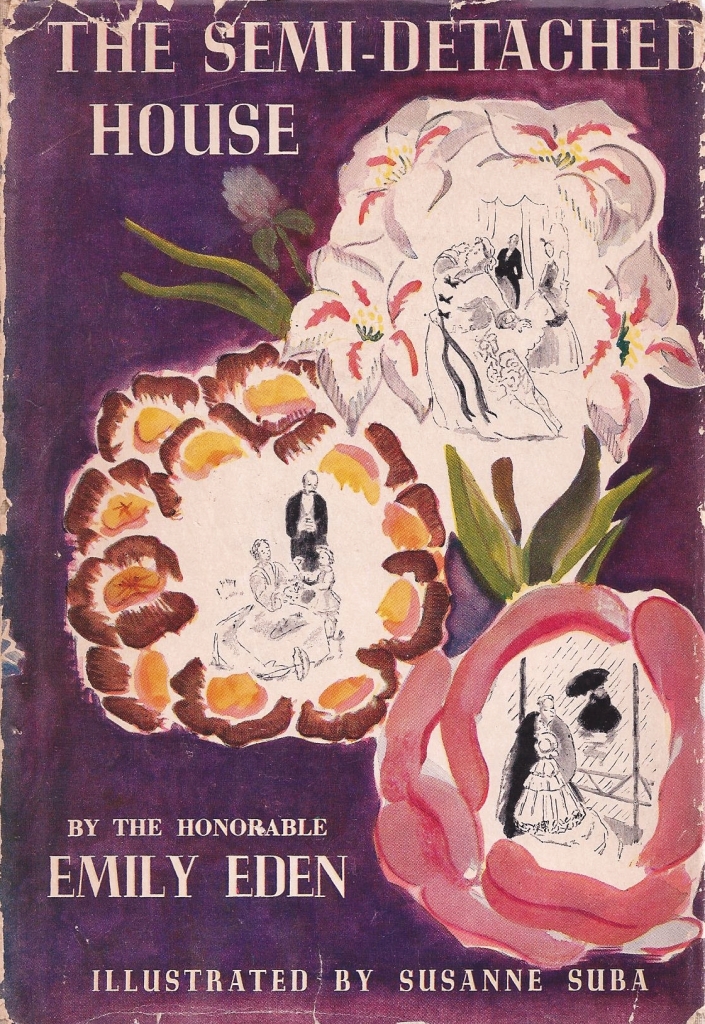
the semi-detached house emily eden 001The Semi-Detached House by Emily Eden ~ 1859.

This edition: Houghton Mifflin, 1948. Illustrated by Susanne Suba. Hardcover. 216 pages.

My rating: 6.5/10

An aristocratic young Lady Chester, Blanche to her intimates, just eighteen and married six months, is bemoaning her husband’s three-month diplomatic assignment in Germany. She has discovered that she is in an “interesting” state of health, and she thinks her husband’s timing could be ever so much better. As well, Lord Chester has taken the advice of Blanche’s doctor and has packed her off to the depths of the suburbs (Dulham), to Pleasance Court, which is in itself quite all right, being a properly fashionable address, but for the smaller semi-detached dwelling at the rear, residence of the decidedly middle-class Hopkinson family. Blanche is a mass of nerves, anticipating all the worst, and dreading meeting her undoubtedly “common” neighbours.

Just across the shared wall, the Hopkinsons are equally as flustered. Rumour has it that the young socialite moving in next door is either the estranged wife of a member of the nobility, or perhaps (shocked hisses) his chère amie. The very respectable Mrs. Hopkinson has barred her shutters, and intends to cut her new neighbour dead.

Luckily both households make a happy acquaintance and quickly become the best of friends, for this is a very friendly novel of manners, and though the gossip flows freely the gossipers are most well-intentioned.

Emily Eden (“The Honorable Emily Eden” as my 1948 edition proudly proclaims) was a great admirer of her predecessor Jane Austen, and deliberately styled her several domestic novels after that literary mentor. Parallels certainly exist, but Emily Eden’s work has a distinctive voice of its own, being gently satirical and full of humorous situations of a time several decades past that of Jane Austen’s fictional world.

A cheerfully fluffy romp, with just the lightest touches of seriousness here and there, and more than a little snobbishness towards the social climbers seeking to scrape acquaintance with the fashionable Chesters. There are love affairs to be sorted out, and the spanking new marriage to be fully settled into, not to mention the excitement of the impending arrival of Blanche’s addition to the English aristocracy.

Nice glimpse at a world familiar to those of us fond of Miss Austen and her compatriots, written by someone who was familiar at first hand with the life described so vivaciously here.

Another novel, The Semi-Attached Couple, preceded this one, and both are succinctly reviewed by Desperate Reader, and by Redeeming Qualities, among others.

The full text of The Semi-Detached House is online for your reading pleasure here, and both novels are available in a Virago double edition as well, though that may now be out of print.
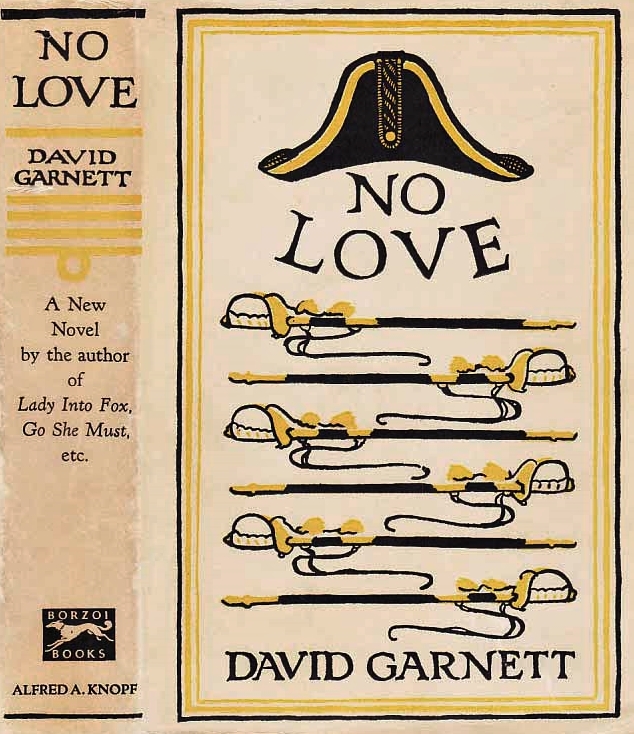
no love david garnett djNo Love by David Garnett ~ 1929.

This edition: Chatto & Windus, 1929. Hardcover. 275 pages.

My rating: 8/10.

What an unexpected and sophisticated novel this one was. I have never read David Garnett before, though of course I have heard quite a lot about Lady Into Fox (which I’m intending to read next year for the Century of Books project) and I now anticipate that reading with even more pleasure, as I  was quite pleased with what I read here. I did an online search to see if I could come up with any other reviews of No Love, but have so far drawn a complete blank, which leaves me rather disappointed. Surely someone else has found this novel worthy of discussion? If you have reviewed it yourself, or know of any others who have, I would be greatly interested to read your thoughts.

When in 1885 Roger Lydiate, the second son of the Bishop of Warrington, and himself a young curate, became engaged to Miss Cross, the marriage was looked on with almost universal disapprobation.

Alice Cross was a very emancipated girl; she was the daughter of the great paleontologist, Norman Cross, the notorious freethinker and friend of Huxley’s, who had poisoned himself deliberately when he was dying of cancer. The poor girl idolised her father’s memory, had been known to justify his suicide in public, and openly maintained, not only the non-existence of God, the non-existence of the human soul, and a rational and mechanistic theory of human consciousness, but also carried the war into the enemy’s country by declaring with her favourite poet Lucretius

Tantum religio potuit suadere malorum.

It was her view, constantly expressed, that it was religion alone that had always prevented the advancement and enlightenment of mankind, that all wars and pestilences could be traced to religious causes, and that but for a mistaken belief in God, mankind would already be living in a condition of almost unimaginable material bliss and moral elevation.

She was, they all said, no wife for a clergyman.

Despite Alice’s “unsuitability”, she and Roger were deeply in love, and they did indeed marry, with Roger ultimately abandoning his curateship and declaring himself an atheist. The Bishop let it be known that he was cutting young Roger out of his will, but what was never known was that he was deeply sympathetic to the young couple, and had quietly given the young bride an astounding ten thousand pounds as a wedding gift.

With this unlooked-for nest egg, the young couple purchased a small island near Chichester, on which was an extensive fruit farm, and settled down to a rural life, and to establishing a home and a new way of life.

There is no happiness and excitement in the lives of a married couple greater than the period when they are choosing themselves a house and moving into it; it is a time far happier than the wedding night or than when children come. A house brings no agony with it; its beauties can be seen at once, whilst both physical love and the children it begets, need time for their beauty to unfold.

Roger and Alice were well suited to each other and their rural occupation, and in time two children were born to them, Mabel and Benedict. Life on the Island proceeded peacefully, until one day in late October, 1897, when Roger rescued a stranded party of boaters and offered them hospitality for the night. These proved to be a certain prominent naval man, Admiral Keltie, his beautiful wife, and their young son Simon, and as the two families felt a certain stirring of mutual attraction, it soon came about that the Kelties purchased a building lot on the island and proceeded to construct a mansion, while between the two families a friendship of sorts developed.

That friendship was soon mixed with a good dose of unspoken jealousy, as the Lydiates see at first hand the extravagance of the wealthy Kelties, and as both husbands cast admiring eyes on the attractions of their neighbour’s spouses. Roger is appreciative of Mrs. Keltie’s cold beauty and brittle wit, while the Admiral is moved by Alice’s obvious intelligence, her deeply passionate nature, and a certain earth-mother quality she exudes.

Simon and Benedict make friends as well, though as they grow up they grow apart, with Simon moving in much more exalted circles, and Benedict going his own quiet way, though the two reconnect time and time again, their meetings often marking the episodes of this narrative.

The novel focusses most strongly on the Lydiate family, and its description of their lives and the changes in their moods and attitudes as the Kelties come and go is beautifully wrought. The years pass, and the Great War sweeps both sons away, but the families remain tenuously connected, however, as Simon and Benedict both have fallen in love with the same woman, and her decision on which one to marry has far-reaching consequences to both families.

This novel appeals on numerous levels, as an exercise in story-telling, as a commentary on the social mores of the time, and as a broader examination of the nature of many different kinds of love. Nicely done, David Garnett. I am looking forward to seeking out and reading more by this author in the years to come.

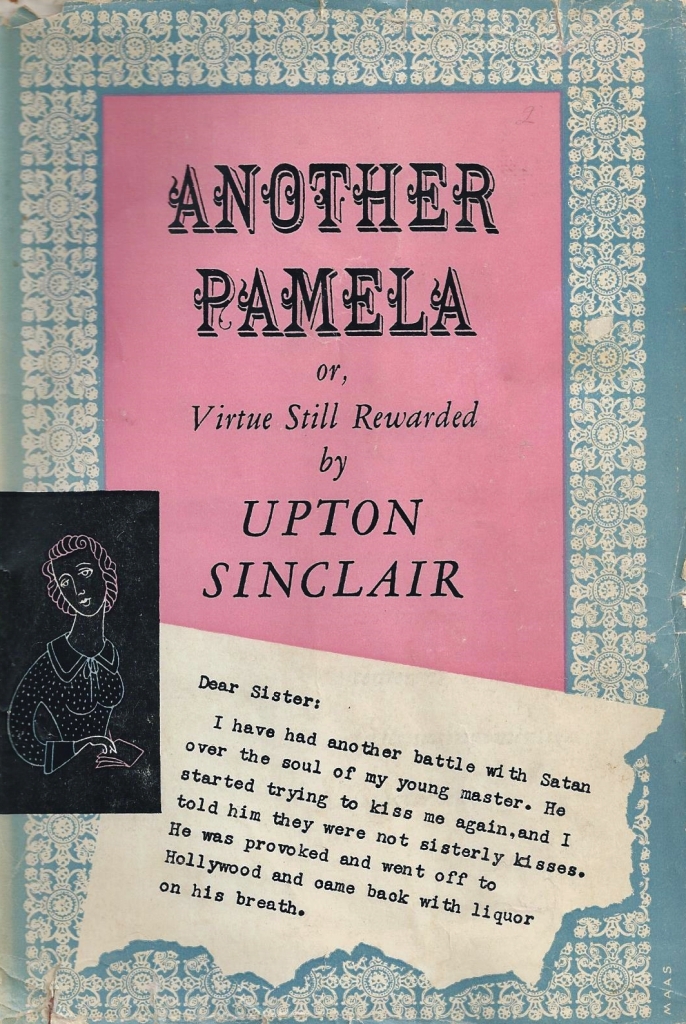
another pamela upton sinclair 001Another Pamela or, Virtue Still Rewarded by Upton Sinclair ~ 1950.

This edition: Viking Press, 1950. Hardcover. 314 pages.

My rating: 7.5/10

And now for something completely different, we move forward in time and to another continent, to this satirical look at social mores in 20th Century California.

Somehow in my travels I have acquired not one but two copies of this slightly obscure novel, a foray into light literature by the famously passionate social activist and best-selling author, Upton Sinclair, perhaps best known for his consciousness-raising, dramatic novel The Jungle.

Having never read Samuel Richardson’s bestselling 1740 epistolary novel, Pamela, about an English serving girl’s trials, tribulations and eventual marriage to the nobleman who tenaciously attempts her seduction, I wasn’t quite sure if I would fully appreciate Upton Sinclair’s parody of the same. It turned out not to matter, as Sinclair helpfully includes generous quotations from the original, having his own heroine read the original as part of her personal development, as she struggles with her own would-be seducer, and the dictates of her conscience and religious upbringing.

Published in 1950, the action of the story is set some years earlier, in the years of the Roaring Twenties, when the fabulously rich of America gave full rein to their imaginative excesses.

The modern Pamela is a child of the early 1900s, being a deeply naïve and (of course!) absolutely lovely young maiden raised in rural poverty in California. She is discovered by a wealthy patroness whose car has broken down in the area of young Pamela’s farm. Upon conversing with Pamela and learning that she is a Seventh Day Adventist with no objection to working on a Sunday (as long as she has Saturday free to devote to her devotions), Mrs. Harris impulsively decides to try the girl out as a parlour maid in her luxurious home, Casa Grande, near Los Angeles.

Pamela is quite naturally overwhelmed by this change in her affairs. Grateful to be able to be sending her pay home to help out her desperately poor family, she is most loquacious in her letters, describing her situation and the other servants and tradespeople she works with, and, increasingly, as she rises in the household hierarchy, the doings of Mrs. Harris herself, who is a lady of many enthusiasms, the main one being the promotion of a rather eclectic form of communism, tweaked to allow for the great disparity between the Harris millions and the theoretical rights of the downtrodden to full equality. (As long as Mrs Harris is not asked to give up her personal comforts, that is.)

And there of course is a “young nobleman” of sorts, one Charles, Mrs Harris’s nephew, a playboy of epic proportions who is completely dependent on his besotted aunt for funds. The Young Master, as Pamela describes him in her letters home, has many vices, not the least of which is his excessive consumption of alcohol, and when Mrs. Harris notices his glances at the lovely Pamela, she encourages the girl to give in to Charles’ pressing invitations to dining out and sightseeing, hoping that this new interest will wean Charles from the demon bottle. (She conveniently turns a blind eye to the possible corruption of her protégé’s morals.)

Charles is decidedly forthcoming; Pamela resists, using her prim and rigid religion as her shield and weapon. Do I need to tell you what happens? Not really, as the title gives the ending away, and as this is a happily satirical tale, we know that Pamela’s eventual fall will be well cushioned.

An enjoyable diversion of a book, with Sinclair getting his digs in at a huge array of social types, all in good fun, with abundant sugar coating the truthful pill within. I wonder if this deserves a “hidden gem” designation? I rather think it does, and I think some of you might find it worthy of a read if you come across it in your travels; it’s an amusingly Americana-ish thing.

Read Full Post »
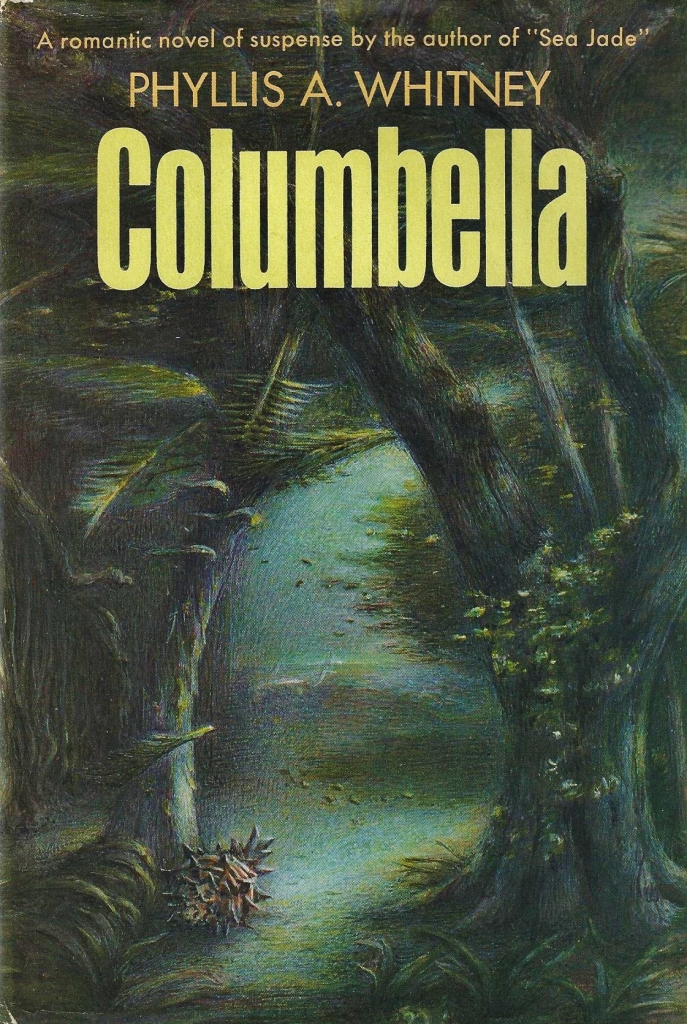
columbella phyllis a whitney 001Columbella by Phyllis A. Whitney ~ 1966. This edition: Doubleday, 1966. Hardcover. 246 pages.

My rating: 3/10

Oh, why did I read this? It was so disappointing. And I have had prior experience with this author – see here  – and went in fully cognizant of what I was about to experience. All I can say then is that hope springs eternal. And that my hope was dashed. Oh, woe!

But don’t you like the mysterious cover illustration, and doesn’t this flyleaf blurb sound promising, for a lightly diverting romantic-suspense thriller type thing?

That was a night of gold and red, with torches flaming on the hilltop and the lights of Charlotte Amalie fanning out around the harbor below. A night of water lily and sweet-smelling cereus. The night of the shell…

Jessica Abbott, fleeing her own past, finds herself the center of a whirlpool of conflict at Hampden House, high on its cliff in the Virgin Islands. She is confronted by Catherine Drew, a woman whose sole purpose is to torment and destroy. Catherine is the wife of a vital, driven man, Kingdon Drew-toward whom Jessica is irresistible drawn. Jessica must defy the beautiful, self-indulgent Catherine, who likes to affect the name of a shell – Columbella. She must fight for the very future of another woman’s child. Above all, she must find the strength to help the man she loves escape the trap Catherine has set for him. Yet each day Catherine seems to mock her in a new way – and win. Until the night of the shell…

Always, the brilliant island sun shines over Hampden House in St. Thomas and over Caprice, the plantation in St. Croix that is crumbling to eerie ruin, guarded by its unicorns. Always the threat of a hurricane looms over this exotic setting, where the past still affects the present.

So. Our lovely heroine Jessica has just lost her own sweet-faced, soft-voiced, utterly poisonous, insidiously controlling mother, and she is seeking to escape her own demons by taking on the role of companion-governess to yet another emotionally-abused girl, the teenage daughter of an architect and the aforementioned Catherine. Jessica falls in love with the hunky, broody Kingdon at first sight, and he himself is overcome with passion for her, which he manfully tamps down until it breaks free of its straining bonds. Lots of scenes of overt jealousy (on Catherine’s part) and apparent dislike (on Kingdon’s part only, for Jessica openly fawns on her employer from the get go) before the two lovers fall into each other’s arms. But there is still that pesky wife…

The final solution is of course a convenient demise – poor Catherine-Columbella! With Kingdon as main suspect, but of course he gets off the hook, thanks to a convenient confession by the true killer, who then is dealt with by the Hand of God (tree falling in a storm, crushing said murderer) and allowing everything to Work Out For The Best.

The best bits in the book were in the details. The setting, St. Thomas in the Virgin Islands, is enthusiastically described, and there are nice touches of verisimilitude in the discussion of the shell-collecting business and the preparation of the specimens for sale.

But the scenarios and the characters – wow! Can something be described as both flat and melodramatic at the same time? If so, our writer has pulled it off. And the passion between Kingdon and Jessica was blush-inducing indeed, but not because of its explicit nature. No, because it was so agonizingly clichéd. I was embarrassed at myself for willingly reading such schlock.

I want to like Phyllis Whitney so very, very much. She has such a promising back story as a writer, and she very obviously goes about her stuff with the best will in the world. She was a bestselling writer in her time, and much beloved by her devoted readers. So I may continue in my occasional investigations of her oeuvre, hoping to find a semi-precious gem or two amidst the very prolific sparkly bits of her vast body of work.

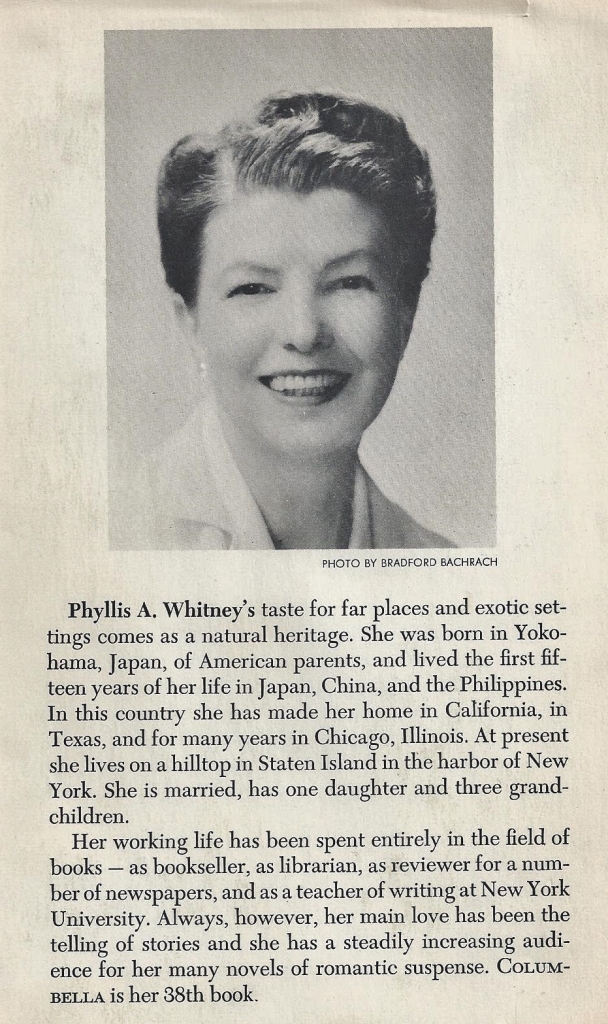
phyllis a whitney bio back dj columbella 001

Read Full Post »

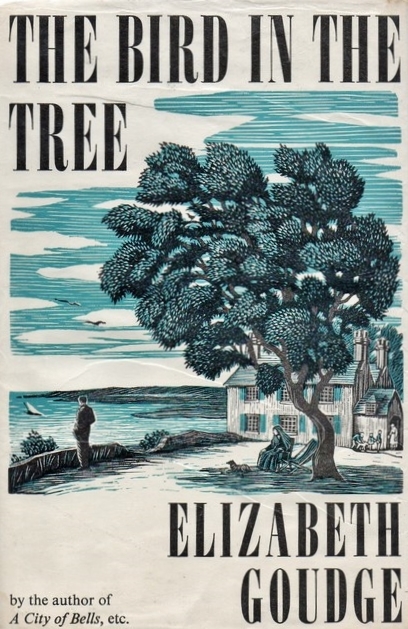
the bird in the tree elizabeth goudgeThe Bird in the Tree by Elizabeth Goudge ~ 1940. This edition: Coronet, 1990. Paperback. ISBN: 0-340-02683-9. 256 pages.

My rating: 6/10

This is the first book of what was to become the well-known “Eliots of Damerosehay” trilogy; three novels centered around a (mostly) artistic and intellectual upper-class family before and just after the World War II years. The setting of the ancient ship-building village in Hampshire, the real-life Buckler’s Hard referred to as Fairhaven, or “The Hard”, consisting of Big Village and Little Village, is lovingly drawn from life. The houses so eloquently described in the books as to be characters in their own right – Damerosehay, and, in the second book, the Herb O’Grace,  were fabricated by the author from memories of similar places important to her in her own retreat from the world to recuperate from her own emotional breakdown following the long illness and traumatic death of her beloved father, which prefaced the writing of this novel.

Visitors to Damerosehay, had they but known it, could have told just how much the children liked them by the particular spot at which they were met upon arrival. If the visitor was definitely disliked the children paid no attention to him until Ellen had forcibly thrust them into their best clothes and pushed them through the drawing-room door at about the hour of five; when they extended limp paws in salutation, replied in polite monosyllables to inquiries as to their well-being, and then stood in a depressed row staring at the carpet, beautiful to behold but no more alive than three Della Robbia cherubs modelled out of plaster. If, on the other hand, they tolerated the visitor, they would go so far as to meet him at the front door and ask if he had bought them anything. If they liked him they would go to the gate at the end of the wood and wave encouragingly as he came towards them. But if they loved him, if he were one of the inner circle, they would go right through the village, taking the dogs with them, and along the coast road to the corner by the cornfield, and when they saw the beloved approaching they would yell like all the fiends of hell let loose for the afternoon…

And as the story opens, the approaching visitor is very well beloved indeed. It is David, grandson of the matriarch of the country home Damerosehay, Lucilla Eliot, and the children referred to are his three young cousins, Ben, Tommy and Caroline, who are living with their grandmother in Hampshire while their father is in India and their mother in London.

As well as gifts for the children, David comes on this visit with some disquieting news for his grandmother. He has fallen in love with the children’s mother, his own aunt-by-marriage Nadine, who has just obtained a divorce from Lucilla’s son George. David and Nadine, despite the vaguely incestuous awkwardness of their relationship and the five year difference in their ages (Nadine is thirty; David twenty-five) propose to marry, and David has screwed up his courage to confront Lucilla with the decision as unalterable.

Lucilla cannot agree; she still hopes that Nadine and George will reunite, and she is utterly appalled at the thought of the trauma which the children will undergo, in particular the sensitive and sickly Ben, who worships his older cousin as well as his absent father; his mother’s proposed marriage will shatter Ben’s fragile peace, and Lucilla refuses to countenance such a thing.

Lucilla fits the pattern of benignant family matriarch wonderfully well. She is a woman of strong personal attractiveness, being both physically beautiful and deeply invested in the interests of her extended family. She had, years ago when the child David was orphaned shortly after the Great War, purchased Damerosehay and built it up as a place of refuge to her children and grandchildren to retreat to for emotional and spiritual healing from the stresses of their workaday lives. And, like all matriarchs, she frequently feels as though she knows best in every situation, regardless of what her family wishes for themselves. So Lucilla sets out to make David and Nadine see the errors of their ways, and to knit together the unravelling family bonds.

Damerosehay itself has a fascinating history, and it is through the discovery of the details of the lives of those who have resided there before the Eliots that Lucilla finds support for her passionate defense of the virtues of loyalty and higher responsibility – to family and God, and to community and society – which she presses upon both David and Nadine as of higher importance than personal happiness.

Elizabeth Goudge was a loquacious describer of both people and places, and her sincere nature-worship and delight in the beauties of the rural world come through loud and clear in this novel. The descriptive passages, though frequently gushing, do paint clear and evocative pictures of the Hampshire countryside and village worlds; her descriptions of the people in her stories are equally well drawn.

If the story has one major fault – and it does have many small ones, too – it is that the conclusion is very obviously contrived and owes much too much to convenient discovery of old manuscripts and vaguely supernatural occurrences including a mysterious blue bird and a phantom mother and child. Capping things off is a well-placed storm and rescue-by-rowboat of an old family retainer with a key part to play in the background tale of Damerosehay’s earlier inhabitants, and its mysterious carved drawing-room mantelpiece, which exerts a strangely compelling influence on everyone who enters the room.

This whole concluding episode is sentimentally melodramatic, and not particularly convincing, unless one accepts the extra-special specialness of the Eliots’ collective hypersensitivity to atmosphere, which selectively is a trait shared among the main characters, in particular Lucilla, David and Ben. And in this case, Nadine, who is temporarily allotted the same sensitivity in order to allow her to benefit from Damerosehay’s special atmosphere. (In later books she goes back to being herself, to my great relief, as she is a breath of sensible, sarcastic fresh air among the dreamy Eliots she finds herself saddled with as in-laws. I personally wish frequently to give David a good hard shake when he starts maundering poetically on in his actor’s way.)

The story has its merits, chief of which is its introduction of the very winsome Eliot children and its value as a back story to the even more sentimental but completely endearing Pilgrim’s Inn, the second book of the trilogy, which is one of my secret comfort reads when I need some moral pepping up. I also greatly enjoy Lucilla’s two adult children who are always steadily there in the background. Saintly Hilary, living in bachelor squalor in the local vicarage, and overworked and underappreciated Margaret, with no fashion sense, plain looks, and little talent for doing things as Lucilla would wish them done in the house, but with a secret life in her glorious garden, both give a refreshing breath of reality to the rarefied Damerosehay atmosphere.

If I seem to be damning this story with faint praise, I do wish to add that I am very fond of Elizabeth Goudge’s novels, and read them through on as regular basis, so my criticisms are those of an old, occasionally querulous, but ultimately well-meaning friend. This is not one of my favourites, but it is very readable despite my quibbles, particularly in context with the two companion books which follow.

This novel has been cursed with a wide array of hideous covers, so instead of sharing the actual Coronet illustration on my edition’s cover I am cheating a bit and using a much more lovely vintage cover, which sadly is inaccurate as to its depiction of Damerosehay overlooking the sea. In the book, the house is set in a sheltered place, set among walled gardens, and separated from the sea by an ancient oak wood. But let that pass; it will suffice.


Read Full Post »

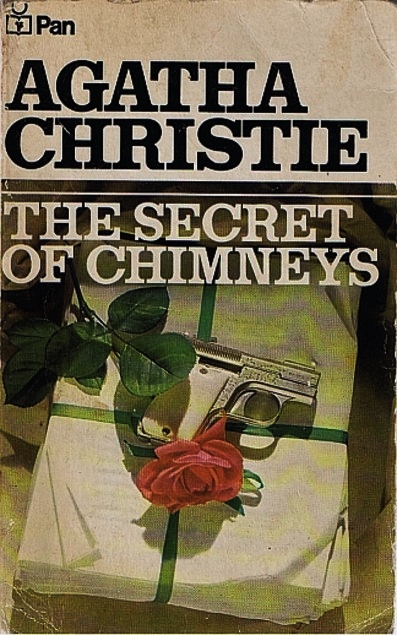
the secret of chimneys agatha christie 1The Secret of Chimneys by Agatha Christie ~ 1925. This edition: Pan, 1968. Paperback. 223 pages.

My rating: 6/10

Setting: Briefly in Africa, with most of the action taking place in the stately English country house, “Chimneys”.

Detection by: SUPERINTENDENT BATTLE of Scotland Yard and various international colleagues; ANTHONY CADE and several aristocratic acquaintances.

Final Body Count: 3 in this narrative; more in the background story.

Method(s) of Death: SINGLE PISTOL SHOT x 3

100 Word Plot Summary:

Anthony Cade, international adventurer, comes into a double commission to deliver a politically sensitive Herzoslovakian manuscript of memoirs and a bundle of blackmailing letters to England. Both appear to be in high demand and swap hands several times; two men are shot, and the diplomatic and aristocratic guests at stately country home “Chimneys” are embroiled in multiple mysteries. Hidden identities, a violent revolutionary society, an accomplished jewel thief, a fabulous diamond, coded letters, secret passages and misleading clues… Can anyone be trusted? Is anyone really who they appear to be? And who does beautiful young widow Virginia Revel really love?

*****

The dead bodies are a side plot to this thriller, written, one suspects, with tongue firmly in cheek. What with a butler named Tredwell, an Inspector Badgworthy, and a bumbling politician, one George Lomax – not to mention a stay at the posh Blitz Hotel in London – the author appears to have been having a lot of innocent fun with this one. Another thriller versus an out-and-out murder mystery, for though we have a number of violently killed bodies by the end of the saga, the other players view the deceased with cold speculation versus shocked emotion.

What a busy plot it is, too. Political intrigue and revolution in fictional Balkan state Herzoslovakia! A commoner queen brutally massacred by a mob along with her royal spouse; a missing prince (or two?); sensitive political memoirs; an aristocratic Englishwoman’s blackmailing letters; a master jewel thief and a missing diamond of fabulous worth; untold reserves of oil (in Herzoslovakia) just waiting for development; several bullet-riddled corpses of swarthy foreigners; and a stately English country home much used to hosting diplomatic gatherings. Drop in several lovely ladies of impeccable breeding and soothing manner, and a thrillingly handsome young man just off the boat from Africa acting as courier to the papers in question, and stir well.

Moments of truly humorous farcical writing made me smile with delight, but this was tempered by the many jaw-dropping racial slurs. These were aimed at everyone under the sun not a true-blue upper-class Conservative Brit, but were extra heavy regarding those of Jewish heritage, as well as the broadly categorized Balkan/Italian/swarthily foreign “dagos” of various nationalities who do all of the heavy lifting in the background story.

Did I enjoy this story? Well yes, I did, in a general sense. It had its moments. But very much a product of its time. Very vintage.

I’m more than ready to move on from this rather ridiculous romp. What about a cozy village murder mystery? Luckily the next one up is just that, The Murder of Roger Ackroyd.

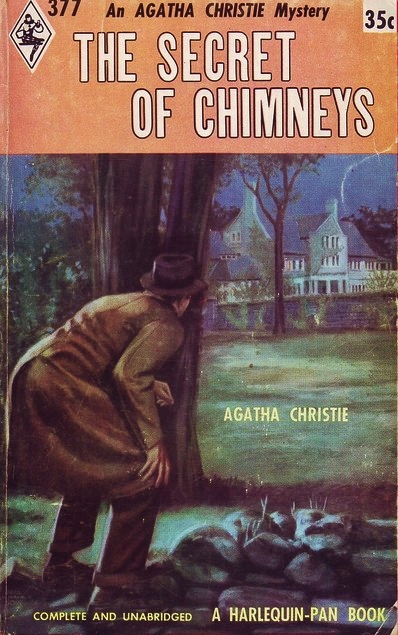
The cover gallery for The Secret of Chimneys is respectably diverse, and perhaps just a little bit misleading on occasion. Let’s take a look…

Second-string male lead Bill Eversleigh and the lovely Virginia Revel investigate midnight noises in the libray at Chimneys. Take note of the traditional weapon for confronting country house burglars - a fireplace poker, and Mrs. Revel's frothy negligée.

This first edition cover features second-string male lead Bill Eversleigh and the lovely Virginia Revel investigating midnight noises in the library at Chimneys. Take note of the traditional weapon for confronting country house burglars – a fireplace poker – and Mrs. Revel’s frothy negligée.

Our possible hero Anthony Cade, one would assume, and his first glimpse of Chimneys. A shot in the night is heard!

Our possible hero Anthony Cade, one would assume, and his first glimpse of Chimneys. A shot is heard in the night!

Something appears to be bothering the beautiful woman - is this Virginia? Could it be the menacing blood-red hand, the calling card of a murderous secret society?? "No comment" on the diamond and the rose.

Something appears to be bothering the beautiful woman on this cover – is this Virginia? And what could it be?! Perhaps the menacing blood-red hand, calling card of a murderous secret society?? “No comment” on the diamond and the rose.

Ah - here we have a classic cover containing key story elements, and a clue or two.

Ah – here we have a classic cover containing key story elements, and a clue or two. Nice composition.

This French cover is possibly my favourite, in a purely eye-catching sense. But I'm rather confused as to who this ghostly woman is supposed to be. The deceased Queen Varaga, perhaps? And is she holding a bouquet of roses? Hmmm...

This French cover is possibly my favourite, in a purely eye-catching sense. But I’m rather confused as to who this ghostly woman is supposed to be. The deceased Queen Varaga, perhaps? And is she holding a rose? Hmmm…

Read Full Post »

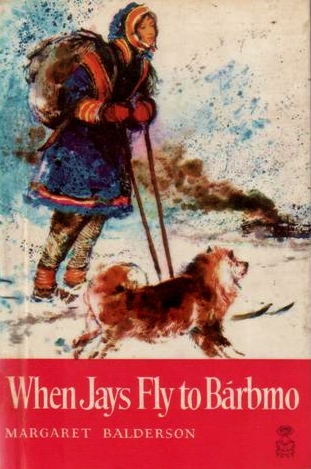
when jays fly to barbmo margaret baldersonWhen Jays Fly to Bárbmo by Margaret Balderson ~ 1968. This edition: Oxford University Press, 1970. Softcover. ISBN: 19-272010-4. 220 pages.

My rating: 8.5/10

Bárbmo is the mystical place in Lapland folklore where the migrating birds fly away to; some never go there, like the jays. The riddle of the intriguing title is made clear in the final pages of this engrossing historical fiction novel.

Fourteen-year-old Ingeborg lives on the remote Norwegian island of Draugoy, where her family household, consisting of her widowed father, an aunt, and elderly hired help Per (an obviously troubled man with a mysterious past), eke out a precarious but modestly comfortable living through farming and fishing. But even their small and isolated society is about to feel the effects of events in the greater world. It is 1940, and Hitler’s troops are advancing through Europe and into neutral Norway, with an aim to annex Norway’s ice-free shipping ports and to ensure crucial supplies of iron ore from Sweden which was handled through the Norwegian shipping system.

Norway falls under German control without much resistance; the royal family and the government escape to England to form a government-in-exile for the next five years; thousands of young Norwegian men begin to filter out of their homeland to train with Allied forces in other parts of Europe, and in Scotland and England; and as the years turn over even the farthest settlements are occupied by troops of the Wehrmacht.

This is the greater historical background to Ingeborg’s story, and against it the more detailed personal events of the novel take place. Our young heroine struggles with her place in her family, fiercely resenting her aunt’s attempts at turning her into a “proper” Norwegian housewife; Ingeborg would rather be out roaming the woods with her dog Benne, or out in the barn with the animals, or sitting with Per and badgering him for tales of his travels. Her father treats her with deep love but yet with a patronizing attitude, never letting Ingeborg forget that she will never be a part of his man’s world. He refuses to discuss her mother with her; there is some great mystery there which all of the adults skirt meticulously around, as if protecting Ingeborg from something which will harm her.

Being a properly traditional bildungsroman, Ingeborg tenaciously discovers the secrets of her origin. She faces and overcomes the loss of everything she holds dear, and in the end discovers who she really is and where she really belongs.

This novel is short and aimed at a juvenile audience, so by necessity glosses over large periods of time and merely hints at some events, but the author pauses at perfectly timed intervals to go into the exquisite details of Ingeborg’s inner and outer lives; the novel is beautifully written. The horrors of war are unflinchingly discussed; the evils of the Nazi regime and the atrocities surrounding the scorched earth policy of the retreat from northern Norway are tellingly depicted.

If there is any weakness to this story, it is that the realities spoken of – the historical facts – are so brutal as to be almost unbelievable, making accompanying research a necessity – heads up to those using this novel as part of a social studies/history curriculum.  Some details of the story are also perhaps a bit too lightly touched on, but appropriately so for the intended youthful audience.

But don’t overdo the background research; let the story tell itself, because it is first and foremost just that, a personal story of a quest for self-understanding. The dramatic events which unfold are viewed through a single set of eyes, that of the young narrator.

The seasons of the Scandinavian northland, the months without sun, the joy of returning daylight, the nomadic travels of the reindeer-herding Laplanders and their yearly brief relationship with the farmers and fishermen of the summer ranges are all wonderfully depicted.

This novel received the Children’s Book of the Year Award in 1969 in the author’s native Australia, and was a runner-up for the UK’s 1968 Carnegie Medal. It is also something of a one-of for the author. From the quality of the writing I had hoped to find some similar later works, but nothing comes to light except for a few light fictions for younger children published in the early 1970s.

A snippet of biography found online explains the author’s familiarity with the setting of her story, and her obvious passion for the sharing of the brutal experiences of the rural Norwegians during the German occupation.

Australian children’s book author Margaret Balderson first made a name for herself with When Jays Fly to Bárbmo, a coming-of-age story about Ingeborg, a Norwegian girl who experiences the German invasion of Norway during World War II. The fear of invasion, and then its traumatic reality, provoke the young woman into a soul-searching quest to validate her own personal identity. This debut novel won awards across the English-speaking world.

Balderson was born and raised in Australia, but in 1963 she left for Europe. She settled for two years in Norway, where she worked in the winters and explored the countryside in the brief northern summers. In the Arctic nation, according to Twentieth-Century Children’s Writers contributor H. M. Saxby, “she experienced in a deeply personal way the innate rhythms of that land as expressed through its seasons. In particular, the Dark Time of the long Arctic winter became for her symbolic of an oppression of spirit which evaporates with the miracle of each spring.” Balderson’s experience of that cycle is reflected in Ingeborg’s life, as she passes through the darkness of living under occupation and emerges into freedom and adulthood.

A grand example of a “living book” which will be of interest to homeschool families and history teachers. I would say that it is suitable for ages 10 or so to adult. Highly recommended.

My edition is the OUP softcover, published in 1970, and it is graced by a wonderful cover illustration by one of my very favourite literary artists, Victor Ambrus. The first chapter heading is also illustrated, but sadly the rest of the volume is without decoration. I wonder if the original edition has more pictures? If so, I would love to get my hands on one…

Read Full Post »

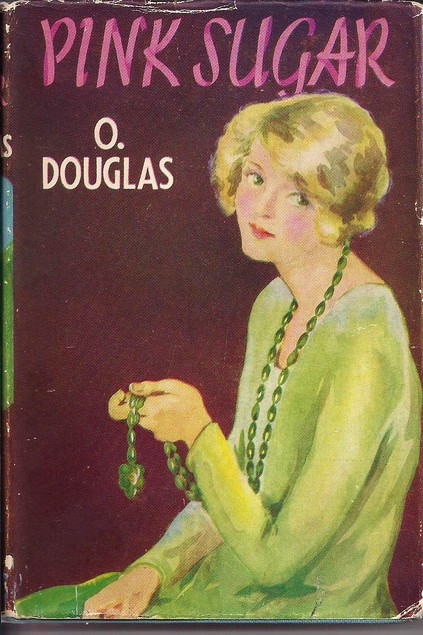
pink sugar o douglas anna buchanPink Sugar by O. Douglas ~ 1924. This edition: Hodder and Stoughton, 1936. Hardcover. 312 pages.

My rating: 7.5/10

A rather sweet book, but not mawkishly so in the way the title suggests. I wasn’t sure what to expect from this one, but I came away feeling beautifully contented, in an “all’s right in that fictional world” sort of way. The heroine sorted herself out nicely, and we have high hopes for her future if she can just retain that hard-won sensibility to the absurdity of playing Lady Bountiful to an oblivious populace!

I guess I should backtrack a bit, and summarize the plot for those of you not already familiar with this gentle novel.

“Spinster without encumbrances” Kirsty Gilmour is thirty and a free woman for the first time in her life, after the recent death of her stepmother, a woman described as “sweet and friendly and quite intolerable”. The second Lady Gilmour was an absolutely selfish creature whom Kirsty has stuck with from charitable impulse and deep inner goodness – Kirsty is the inheritor of her late father’s fortune, and has financially supported and accompanied her stepmother through that woman’s preferred social whirl in the years since Sir Gilmour’s death.

Kirsty’s older friend, Blanche Cunningham, reminisces about the unregretted Lady Gilmour.

Thinking of Lady Gilmour, Blanche was conscious again of the hot wave of dislike that had so often engulfed her when she had come across that lady in life. She remembered the baby-blue eyes, the appealing ways, the smooth sweet voice that could say such cruel things, the too red lips, the faint scent of violets that had clung to all of her possessions, the carefully thought out details of all she wore, her endless insistent care of herself and her own comfort, her absolute carelessness as to the feelings of others…

‘Kirsty,’ Blanche laid her hand on her friend’s arm. ‘However did you stand it all those years? What an intolerable woman she was!’

Kirsty sat looking in front of her.

‘She’s dead,’ was all she said.

‘Well,’ Mrs. Cunningham retorted briskly, ‘being dead doesn’t make people any nicer, does it?’

Now, freed of the superficial social whirl, Kirsty has joyously fled to the country, her true emotional habitat and the place of her birth, to the Borders of Scotland, to the little village of Muirburn, just outside of Priorsford.  (O. Douglas aficionados will recognize the reference.) Here she has rented a house, “Little Phantasy”, on the grounds of a larger estate. The manor house itself, rather quaintly named “Phantasy”,  is the abode of curmudgeonly bachelor Colonel Home, forty-ish and set in his ways, by all accounts. Kirsty doesn’t expect to see much of him, and is rather glad of that.

Kirsty has decided that she will now embrace the country life, and that she will devote herself, in true “good spinsterish” fashion, to “living for others”. Sensible Blanche rolls her eyes at this, and tells Kirsty not to be silly, but Kirsty means this in the very best way, taking under her wing as soon as possible a number of  dependents. First comes elderly Aunt Fanny, mild and gentle and perpetually knitting, and then the three motherless children of Blanche’s sister, for an extended rural stay while their recently widowed father travels abroad “to forget his grief”.

Kirsty’s foray into country life is not as smooth as anticipated, and she soon finds that people don’t necessarily like to be “lived for”; some of her most well-meant patronages are soundly snubbed, but there is enough encouragement that she soldiers on. Her tenacity and truly well-meaning sweet nature win over the most resentful of those around her. Kirsty was initially viewed as a frivolous bit of a thing, merely playing at enjoying her new role as householder and surrogate mother to the adorable Barbara and Specky, and the wickedly appealing “Bad” Bill, but as the months go by it is apparent that Kirsty’s innate inner goodness and staunch Scottish good sense will see her settled down and competently filling an important niche in Muirburn society, though not the role that she initially saw herself in.

There are some lovely character portraits in this appealing tale, and I will pass you along to several other reviewers, who also found much to admire in this pleasing novel. Please visit and read these excellent reviews, if you are at all intrigued by what I have said above. (And browse around the blogs a bit while you’re there – there are many more authors and titles highlighted worthy of rediscovery!)

The Book Trunk – Pink Sugar

Letters From a Hill Farm – Pink Sugar

I Prefer Reading – Pink Sugar

Pink Sugar was republished by Greyladies in 2009, and though that edition appears to be currently out of print, it should still be fairly easy to acquire through the second hand book trade. The novel was very popular in its day – my own copy is a vintage 1936 edition, stating that it is the twenty-first printing – so there are many still circulating around at reasonable prices.

Read Full Post »

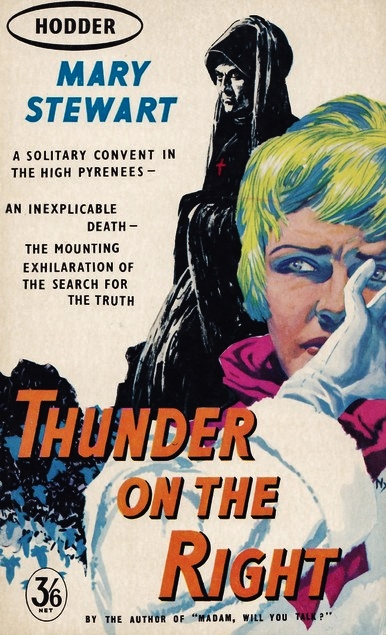
thunder on the right mary stewart 1Thunder on the Right by Mary Stewart ~ 1957. This edition: Hodder Paperbacks (Coronet), 1974. Paperback. ISBN: 0-340-02219-1. 255 pages.

My rating: 4/10

Omigosh. This book. Words (almost) fail me. 110% gothic romance, and absolutely bizarre in plot and execution. Luckily I’ve been on something of a Mary Stewart binge recently, and this came along as book number six; if it was number one or two I doubt I would have had the heart to continue.

I try my hardest, in reviewing anything in the mystery-suspense line, to not include any spoilers, but, in this case, all bets are off. Consider yourself forewarned!

This one starts off promisingly enough. Jennifer Silver, 22-year-old daughter of the Bullen Professor of Music at Oxford, is ethereally lovely (of course!) and rather at loose ends, despite recent years at art school. She sits in the dining room of her hotel in the French Pyrenees, tucking into a most delectable-sounding repast. She is thrilled to be in France again – she has visited in the past – and is looking forward with anticipation to her planned reunion with her half-French older cousin, who, widowed not long after her marriage, is convalescing from a recent illness in a nearby convent. More than merely convalescing; Gillian has sought solace in religion, and is thinking of becoming a nun, much to Jennifer’s not-so-secret dismay. But something isn’t quite right in a larger sense, and Jennifer sits and mulls over her cousin’s situation with increasing unease. Why have her chatty letters suddenly stopped? Tomorrow Jennifer will be going to the Convent of Notre-Dame-des-Orages to meet Gillian, but she’s not quite sure what she’ll find. (Cue foreboding music. Oh, and a love theme, for here appears a prince on a white charger. Figuratively speaking. The real horse shows up later.)

For who should appear but a figure from Jennifer’s past. Up pops handsome Stephen Masefield, an old student of Professor Silver’s.  Jennifer has dallied with Stephen in Oxford days, and he has long cherished a secret passion for the lovely Jenny despite her mother’s brusque dismissal of his courtship, all unbeknownst to the innocent maiden. Stephen comes with an intriguing past, and is dashingly handsome despite his slight limp from an old war wound (this is all taking place post World War II, in the mid 1950s or thereabouts) as well as exceedingly talented, both in music and as a skilled amateur artist.

Lots of details, yes, I know. But every single one of them matters in the upcoming narrative, for this is an exceedingly busy story, chock full of details affecting details, and coincidences and lucky (or unlucky) juxtapositions of people and events. I’ll cut to the chase, if I may, and give the barest outline of the action to follow.

Jennifer goes to the convent, meets a sinister Spanish nun dressed in a silken habit and sporting a flashing ruby-encrusted cross, and is informed that her cousin was indeed in residence, but that she has died and is buried in the convent graveyard. Something about an automobile accident, and crawling up to the convent gates after midnight, and devoted nursing and a sudden decline… Jennifer is in shock and visits the grave, where a glimpse of a bouquet of gentians sets off a train of speculation in her mind. Perhaps Gillian is still alive, and a mystery woman is buried in her place…?!

Beware the nun! An older paperback cover which captures the mood so very well.

Beware the nun! An older paperback cover which captures the mood so very well.

The plot convolutes on its merry way, involving a rare form of colour blindness (Gillian would not have been able to identify gentians as her favourite flower – she cannot distinguish blue), a beautiful young novice who nursed Gillian, a stunningly gorgeous local youth dashing about on a wicked stallion, the aforementioned sinister Spanish nun, the extremely old, kind and blind Mother Superior who is unaware of the fact that the Spanish nun, her bursar, is filling the convent with war-looted treasures (solid gold fittings, altar pieces by El Greco, jewelled statues, etcetera), a local smuggler in cahoots with said nun, a vitally crucial letter found tucked behind a picture – this coincidence put me off the story early on – absolutely contrived! – midnight forays by everyone generally ending in eavesdropping on startling conversations, a mystery woman in a mountain cottage, multiple thunderstorms (“thunder on the right” – aha!), a landslide, a flash flood, a slender rock bridge over a ravine, the heroine’s habit of delicately fainting at crucial moments, Stephen’s multiple heroic accomplishments – mastering the wild stallion! hand-to-hand combat skills! great kissing! – on and on and on we go.

The girl in the mountain hut is Gillian; the little novice goes off with her handsome horseman; the evil nun and the smuggler meet their comeuppances; the woman buried in the nunnery garden is the criminal alluded to in casual conversation early in the story. Jennifer is passionately kissed not only by her dashing swain, but by the testosterone-drenched smuggler, who manages to keep his carnal urges on a high boil even while fleeing for his life when the predictable dénouement occurs.

Moments of lovely writing – Mary Stewart does excel at her descriptions – and snippets of humour here and there did not make up for the messy, too-busy, coincidence-heavy plot. Jennifer is the most unbelievable of all of the Mary Stewart heroines I’ve met so far – the others have been very likeable – and I found her utterly annoying. The whole thing was too full of heaving bosoms – can even a nun have a heaving bosom? Well, yes, apparently – and surging stallions and heavily gothic settings.  Too much!

I have been soothing myself with a return to sedate O. Douglas, and am now reading Eliza for Common with relief. Thunder on the Right has rattled me badly, coming as it did after Mary Stewart’s rather more excellent My Brother Michael, which I have yet to review. I liked that one a whole lot more.

Thunder on the Right was apparently the author’s least favourite of her novels, and I can see why. Here are her own words, courtesy of the excellent Mary Stewart Novels website:

From Contemporary Authors, Vol. 1, 1967

Ms. Stewart once claimed Thunder on the Right as her least favorite novel. “I detest that book. I’m ashamed of it, and I’d like to see it drowned beyond recovery. It’s overwritten. It was actually the second book I wrote, and for some strange reason I went overboard, splurged with adjectives, all colored purple.”

I’m glad I read it, though, if only to contrast with the rest of the author’s works. It is indeed interesting to see her development as a writer over the course of her career. I’m only read six of the novels so far, and I’m definitely seeing a pattern of evolution. Very interesting. I intend to continue to explore the vividly painted, action-packed worlds of Mary Stewart, though I may have to take a bit of a break to regain my equilibrium after this latest foray.

Read Full Post »

« Newer Posts - Older Posts »