Posts Tagged ‘Vintage Fiction’


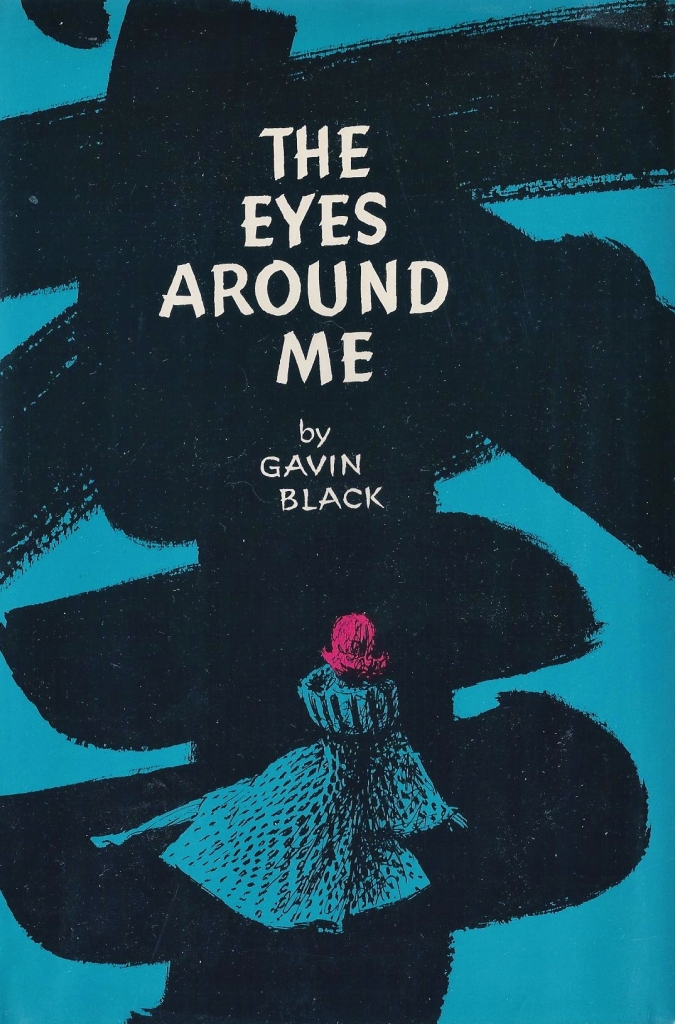
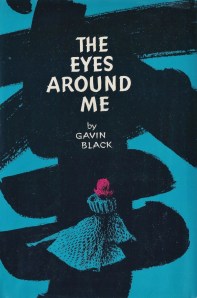
the eyes around me gavin black 001The Eyes Around Me by Gavin Black ~ 1964. This edition: Harper & Row, 1964. Hardcover. 216 pages.

My rating: 8.5/10

Okay, why have I never come across this writer before? This murder mystery novel set in Red-era Hong Kong was pretty darned fabulous. Instant fan, I am. Now I must track down more…

From his obituary notice in The Independent, August 6, 1998:

Oswald Wynd was a modest man who had little to be modest about. As Gavin Black he wrote superior and literate thrillers – school of Stevenson and Buchan – which were at the same time witty and clever, and moved at a by no means gentlemanly pace…

A “superior and literate thriller” describes this fast-paced novel exceedingly well.

Middle-aged, recently divorced, lush living Scottish shortbread heiress Ella Bain lives in Hong Kong, in a lavish seaside mansion. An outside staircase to her bedroom allows her to receive gentleman callers without offending the sensibilities of old family retainer Kirsty, and by all reports it is a well-used piece of domestic architecture.

Ella is loud, she drinks too much, and though she has proven herself an astute businesswoman, enlarging her already substantial fortune by her occasional managerial visits back to the family factory in Scotland, she occasionally raises eyebrows by her larger than life actions. Long-time platonic friend Paul Harris views Ella with sometimes-exasperated affection; he has turned down her marriage proposal, but remains in Ella’s will as her chief beneficiary, cutting out Ella’s only brother Angus, who enjoys a fortune of his own.

So when Ella is found dead in her bed on New Year’s Day morning by Paul, who squired Ella about town the night before and stayed over at her house, both the police and the intimately entwined Hong Kong society crowd look at Paul with more than a little speculation.

Paul Harris, wealthy in his own right through a series of past speculations and questionably legal activities which I shan’t reveal to you here, resents the assumption that he murdered his friend, and sets out on a quest to clear his name.

This is a vividly atmospheric mystery novel, with a finely detailed setting and memorable (if occasionally rather unlikely) characters. One forgives the over-the-topness because the thing is so gloriously well written for this type of light fiction; Oswald Wynd/Gavin Black spins an exceedingly readable tale.

Paul Harris comes across as a greatly  improved version of Ian Fleming’s James Bond. Paul is suave, fast on his feet, good in a fight, exceedingly attractive and attracted to gorgeous women, and (one feels) truly a good guy at heart, despite his somewhat shady backstory. The arrogance which emanates from his fictional counterpart Bond is completely missing; one likes Paul Harris, despite our doubt that he is now a purely lily-white boy, gone all straight and narrow.

I guessed the murderer with surprising ease; I foretold the romantic clinch at the end; as a mystery the thing is decidedly clichéd and predictable, but despite these drawbacks I greatly liked this book.

The author wrote a rather respectable number of novels and thrillers, most set in Asia. I am keen to follow up on my introduction to Paul Harris, who apparently features in all of the Gavin Black-authored thrillers; the Oswald Wynd novels sound intriguing, too, if perhaps a bit “deeper” in theme.

1977’s The Ginger Tree was made into a well-received Masterpiece Theatre 4-part miniseries, and Wynd’s depiction of cross-cultural and mixed race relationships is spoken of very highly in reviews.

For future investigation:

As Oswald Wynd:

  • Black Fountains (1947) (1st novel, winner of $20,000 Doubleday prize for fiction)
  • Red Sun South (1948)
  • Friend of the Family (1949)
  • The Stubborn Flower (1949)
  • When Ape is King (1949) (Wynd’s lone speculative fiction, very rare )
  • The Gentle Pirate (1951)
  • Stars in the Heather (1956)
  • Moon of the Tiger (1958)
  • Summer Can’t Last (1960)
  • Death, the Red Flower (1965)
  • Walk Softly, Men Praying (1967)
  • Sumatra Seven Zero (1968)
  • The Hawser Pirates (1970)
  • The Forty Days (1972)
  • The Ginger Tree (1977)

As Gavin Black:

  • Suddenly at Singapore (1961)
  • The Devil Came on Sunday (1961)
  • Dead Man Calling (1962)
  • A Walk in the Long Dark Night (1962)
  • A Dragon for Christmas (1963)
  • The Eyes around Me (1964)
  • You Want to Die, Johnny? (1966)
  • A Wind of Death (1967)
  • The Cold Jungle (1969)
  • A Time for Pirates (1971)
  • The Bitter Tea (1972)
  • The Golden Cockatrice (1974)
  • A Big Wind for Summer (aka Gale Force) (1975)
  • A Moon for Killers (aka Killer Moon) (1976)
  • Night Run from Java (1979)
  • The Blazing Air (1981)
  • The Fatal Shadow (1983)
  • A Path for Serpents (1991)

Read Full Post »

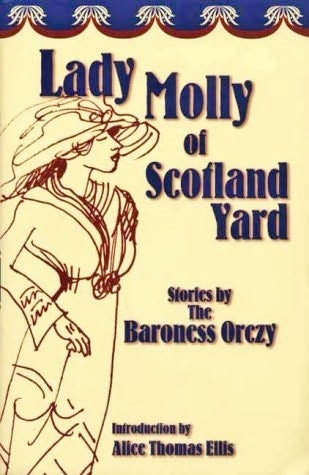
lady molly of scotland yard baroness orczyLady Molly of Scotland Yard by The Baroness Orczy ~ 1910. This edition: Facsimile of the 1912 edition, The Akadine Press, 1999. Softcover. ISBN: 1-888173-97-1. 344 pages.

My rating: Hmmm. Though doubtless a good example of period fiction and an early precursor to the detective-story genre which so abundantly flourished in the decades after Lady Molly’s publication, for actual reading experience the book was not quite as fabulous as I had hoped.

A perhaps overly generous 5/10 is all I can bring myself to award it right now, though it is the sort of thing one might well become fond of on a re-read for reasons quite unrelated to literary (or detective puzzle) merit. (Or then again, maybe not!)

We meet Lady Molly, in The Ninescore Mystery, first chapter of Lady Molly of Scotland Yard, courtesy Project Gutenberg:

Well, you know, some say she is the daughter of a duke, others that she was born in the gutter, and that the handle has been soldered on to her name in order to give her style and influence.

I could say a lot, of course, but “my lips are sealed,” as the poets say. All through her successful career at the Yard she honoured me with her friendship and confidence, but when she took me in partnership, as it were, she made me promise that I would never breathe a word of her private life, and this I swore on my Bible oath–“wish I may die,” and all the rest of it.

Yes, we always called her “my lady,” from the moment that she was put at the head of our section; and the chief called her “Lady Molly” in our presence. We of the Female Department are dreadfully snubbed by the men, though don’t tell me that women have not ten times as much intuition as the blundering and sterner sex; my firm belief is that we shouldn’t have half so many undetected crimes if some of the so-called mysteries were put to the test of feminine investigation.

Do you suppose for a moment, for instance, that the truth about that extraordinary case at Ninescore would ever have come to light if the men alone had had the handling of it? Would any man have taken so bold a risk as Lady Molly did when–But I am anticipating.

Let me go back to that memorable morning when she came into my room in a wild state of agitation.

“The chief says I may go down to Ninescore if I like, Mary,” she said in a voice all a-quiver with excitement.

“You!” I ejaculated. “What for?”

“What for–what for?” she repeated eagerly. “Mary, don’t you understand? It is the chance I have been waiting for–the chance of a lifetime? They are all desperate about the case up at the Yard; the public is furious, and columns of sarcastic letters appear in the daily press. None of our men know what to do; they are at their wits’ end, and so this morning I went to the chief–”

“Yes?” I queried eagerly, for she had suddenly ceased speaking.

“Well, never mind now how I did it–I will tell you all about it on the way, for we have just got time to catch the 11 a.m. down to Canterbury. The chief says I may go, and that I may take whom I like with me. He suggested one of the men, but somehow I feel that this is woman’s work, and I’d rather have you, Mary, than anyone. We will go over the preliminaries of the case together in the train, as I don’t suppose that you have got them at your fingers’ ends yet, and you have only just got time to put a few things together and meet me at Charing Cross booking-office in time for that 11.0 sharp.”

She was off before I could ask her any more questions, and anyhow I was too flabbergasted to say much. A murder case in the hands of the Female Department! Such a thing had been unheard of until now. But I was all excitement, too, and you may be sure I was at the station in good time.

Holmes to Lady Molly’s Watson (the comparison is inevitable and apt) is our narrator Mary, who started out as Lady Molly’s maid in the days-gone-by continually referred to with much innuendo and mysterious “But I mustn’t talk about that!”

Now Mary and Lady Molly are members of the female division of Scotland Yard’s investigative force, though Mary still seems to be fulfilling many of her old duties in regard to her mistress, as well as some new ones. Messy and boring (and possibly dangerous) investigation to be done – well, let’s send Mary! Though to be fair Lady Molly puts herself in discomfort occasionally. (Very occasionally.) Most of her detecting seems to be done Hercule Poirot/Nero Wolfe style, from the comfort of an armchair while exercising her own Great Big Brain.

My biggest beef: the class distinctions so blatantly demonstrated throughout. Lady Molly is exceedingly high handed with her inferiors (that would be just about everyone she meets, works with and “investigates”) and meek Mary obviously feels that this is just the way it should be. And Lady Molly never explains; she merely orders, and her “partners” (usually Mary, but on occasion fawning members of The Force) scuttle off, sure in their belief that Lady Molly’s womanly (and aristocratic) intuition will bring a solution to the problem of the moment.

There is also a secret reason Lady Molly took up her profession at Scotland Yard; the big reveal happens in the last chapter, with Mary at last spilling all the beans she was forbidden to display previously.

Well, this allows me to tick off 1910 in the Century of Books, and also to satisfy my curiosity as to what Lady Molly was all about; I’ve occasionally seen her referenced in discussions of Golden Age women’s detective fiction; I need wonder no more.

Tasha Brandstatter’s Review echoes my feelings.

As does Stewartry – grand review.

The Wikipedia entry discusses the plot of the first few chapters in vivid, spoiler-laden detail.

And here’s the whole thing on Project Gutenberg.

Read Full Post »

I need to get some of this towering stack of books-to-be-discussed thinned out; my desk is way too crowded; no place to park the teacup! (And my spouse, coming in last night to “borrow” the computer, made comment on the situation and then graciously offered to shelve them for me – which though a sweet gesture is not necessarily a good thing, as he puts things in strange places. Our filing systems differ. 😉 )Time for a few round-up posts, I think.

Where to start? How to group these? Let’s see…

How about this trio of not necessarily bad books, but ones which could have been better. Definitely readable, but not top notch. (My personal responses only, dependent entirely on my mood at the reading moment – yours could be so much different, so please forgive me if I cold-shoulder one of your favourites.)

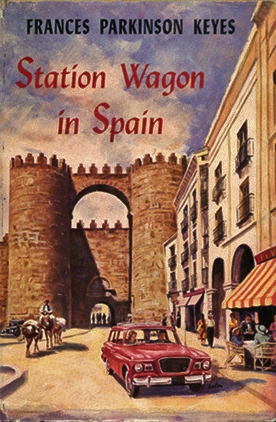
station wagon in spain frances parkinson keyesStation Wagon in Spain by Frances Parkinson Keyes ~ 1959. This edition: Farrar, Straus and Cudahy, 1959. Hardcover. 224 pages.

My rating: 5/10

I’ve occasionally flirted with Keyes, because her books have such potentially interesting premises, but I invariably come away sighing. And sadly this concoction is no exception. The very best thing about it was the nine-page author’s foreword, in which she relates her own experiences travelling with her friend Kitty in immediately post-war Italy, France and Spain in 1946, with a rickety American station wagon loaded with relief supplies for an evacuated convent of Bendictine nuns.

Utterly fascinating – “Tell me more!” was my response – but no, Keyes blithely dismisses her own experiences and instead embarks on this rather creatively imagined fictional tale, which starts off reasonably well but soon bogs down in a morass of excessive detail and complicated plotting.

In brief(ish):

A young university professor unexpectedly inherits a large fortune, and, while mulling over his sudden change in situation and his deeply elemental boredom with his life to this point, receives a version of the infamous “Spanish Prisoner” letter in the mail. This one is purportedly from a real Spanish prisoner, and – how handy! – Lambert just happens to be a fluent Spanish speaker himself. Knowing full well that the letter is a scam, he feels that a diversion is in order, so he takes a sabbatical year from his teaching job, packs up his newly purchased big red convertible station wagon, says a dismissive good-bye to the young woman who has been scheming (well beknownst to Lambert) to marry him, and heads off to Spain.

The plot thickens, as Lambert immediately falls in with a luscious adventuress and carries on an intense shipboard flirtation. “Coincidences” start to fall together thick and fast. There does, to Lambert’s great glee, appear to be a genuine prisoner of sorts associated with the fabricated scenario – an impoverished Duke incarcerated in a private sanatorium. Who happens to have a lovely, virginal daughter who could not possibly be involved in any nefarious dealings…

The whole thing is rather bogged down in too much detail. There are long pages of explanation on all sorts of side-issues, as if the author is dead keen on the education of her readers as much as on their entertainment. The plottings of the wicked conspirators get rather see-through and slightly ridiculous early on, and the inevitable romance is just too predictable to be satisfying. (A pox on “love at first sight”, I emphatically say. At least in this situation.)

Moments of excellence; chapters of blah blah blah. Rated at 5/10 because I did willingly carry through to the end, despite my ever-increasing feelings of annoyance that the author would make such a messy job of such a promising plot, and turn her quite likeable protagonist into a bit of a blustering egoist. Points off, too, for the sweetly yielding female love interest (the new one in Spain, not the abandoned American, though she also pops up in Europe to add some more kinks to the tale) and the “unspoken communion of two passionate souls.” Ick!

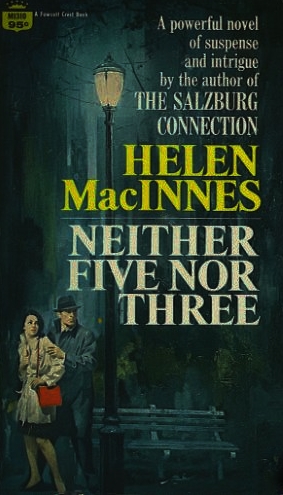
neither five nor three helen macinnes paperback fawcettNeither Five nor Three by Helen MacInnes ~ 1951. This edition: Fawcett Crest, circa late 1960s. Paperback. 320 pages.

My rating: 6/10

Set in post-World War II New York.

I found myself rather taken aback by this story. While many of Helen MacInnes’ books demonstrate her strong stance on capital-C Communism (it’s 100% bad) this one takes that fixation to a whole new level. Instead of clean-cut English/American heroes and heroines flitting about the shadows of war-torn European cities, it’s all about the insidious influence of underground Commies on the home front (in this case America) after World War II, and it comes across as being deeply paranoid, viewed from half a century in the future.

The love story is utterly predicable and really rather sweet; the two lovers are likeable enough and I found myself in general wishing them well; but the anti-Red plotline pushed me past my comfort level into the “Really? Really?” territory. Even taking era-appropriateness into account. So black; so white. Shades of grey are evidence of weakness, on both sides.

MacInnes’ Commies are supremely well organized; they have infiltrated the American publishing industry and are placing their pawns very cleverly in order to slant the perceptions of readers in favour of the political left. Head honchos from the main office (as it were) in Europe undertake clandestine inspirational (and disciplinary) visits to American “party cells”; new recruits are jollied along until they are too deeply enmeshed to easily escape; then the gloves come off and any attempt to back away from participation or to “inform” is punishable by carefully engineered public disgrace, or, just possibly, sudden death. (Cue foreboding music…)

Definitely a Cold War period piece, which was received with warm approval by readers and reviewers of its time.

Excerpted from the March, 1951 Kirkus Review:

This is the most important book Helen MacInnes has done … absorbing and challenging from first page to last, as the devious methods of Communist penetration into the fields of public relations are revealed, and the terrifying network of Communist affiliation is convincingly recorded. Rona Metford is engaged to Scott Ettley, a journalist whose loyalties are torn between his mounting commitment to “the party” and his yearning for a normal course of love and marriage. Into this situation comes Paul Haydn, just returned to New York from a very hush-hush assignment in Europe and finding that his love for Rona, which he thought was a thing of the past, is still very much alive. The checkered course of love is traced against the background of gradually unfolding ramifications of the violence and falsity of Communist activities in the heart of the world they think they know…

I personally found the political bits verging on hysteria, and while there was an occasional authorial attempt made to balance the viewpoints by pondering why Clean Young Americans might be seduced to the Red Side, once they went too far they were brutally written off and became completely expendable, in the most ultimate way.

A precursor to MacInnes’ more “traditional” (i.e., European-set and action-packed) espionage stories which were to follow, blending an ideological plotline with a stereotypical together/torn asunder/together again romantic tale, with vaguely unsatisfying results.

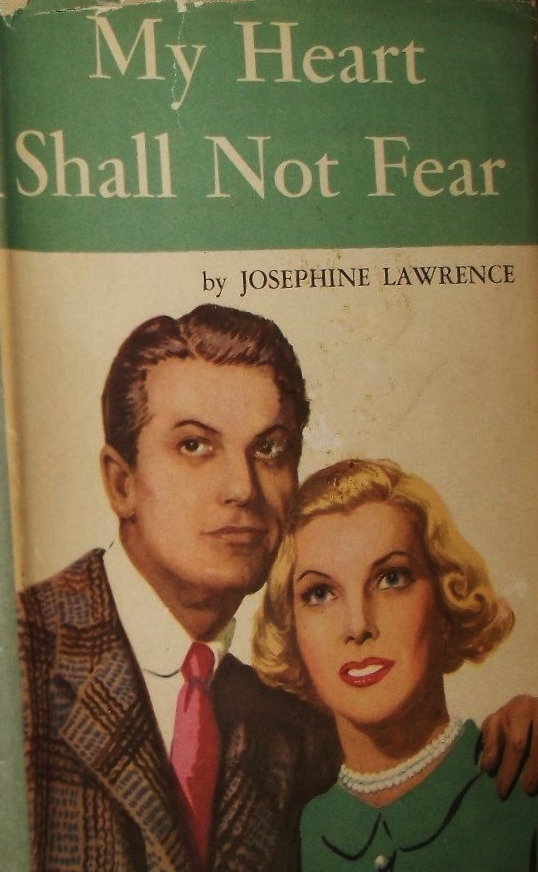
my heart shall not fear josephine lawrenceMy Heart Shall Not Fear by Josephine Lawrence ~ 1949. This edition: Peoples Book Club, 1950. Hardcover. 285 pages.

 
My rating: 5/10

Now on to this much more obscure book, also set, as is Neither Five Nor Three, in immediately post World War II America.

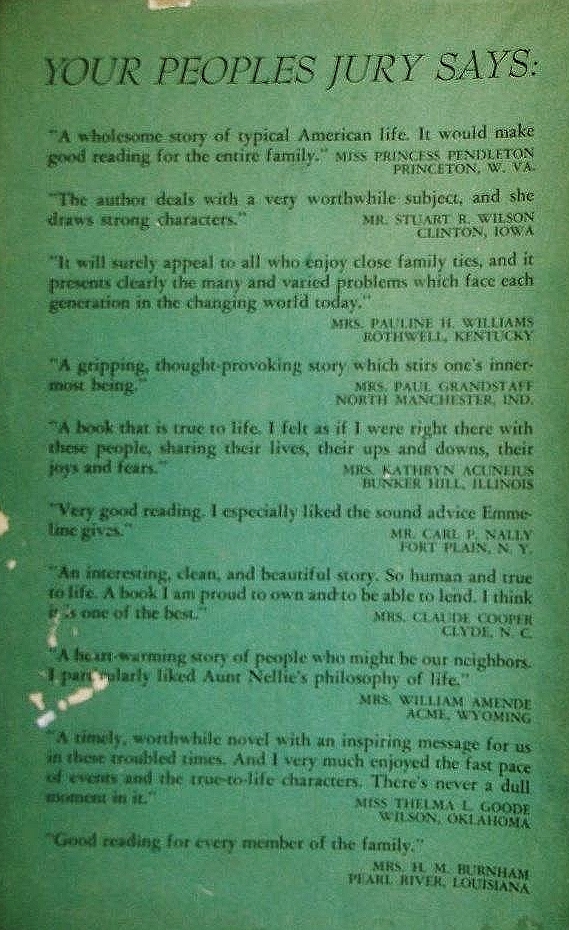
Touted as “inspirational” and a “wholesome depiction of family life” in its back-cover promotional blurbs, this earnest novel left me unsatisfied and vaguely uneasy, mostly because of its troubling (to a reader of today) depiction of women’s societal roles in its era.

If I could pin down one thing which bothered me the most, it would be the author’s apparent insistence that female martyrdom is by and large a good thing, as long as it is carried out in a modest manner. The woman who takes a hit for her family, quietly and uncomplainingly, is to be greatly admired. To be fair, this also applies in a lesser degree to men, but is more strongly expected of the “weaker” sex, the men not being subjected to such ironclad standards of societal behaviour.

There is an ambitious cast of characters, including an older couple who sacrifice their much-deserved peaceful retirement to share their home with three not-long-married sons recently discharged from the armed forces, a young married woman who has recently had a baby and who is eager to leave the hospital and settle into a new apartment (which she can’t really afford, seeing that her husband has borrowed a vast sum of money in order to bail out his own ne’er-do-well father), another new mother who is not married and who resists the good-intentioned bullying of a social aid worker to give her child up for adoption, and a young childless woman who is obviously dying of an unspecified ailment – most likely cancer – but is surrounded by a cloud of silence as no one in her circle dares to put into words the obvious, as well as numerous others.

One of the odder and most troubling scenarios is that of one of the young couples separating. The husband has decided that he has tied himself down to his childhood sweetheart mistakenly, and he announces that he is leaving to “enjoy his freedom” while he is still young. The heartbroken wife refuses to argue or present herself as unfairly forsaken, gives her departing spouse the car that she has worked for and purchased with her own money, and even runs out to purchase new underclothes for her deserter as a gesture of undying wifely devotion.

The husband sneaks into the house to pack when his wife is out, and scorns his mother’s pleas to reconsider his actions. (This is one of the couples living with the elderly parents.) The young wife is left dependent for a home upon her in-laws, who are deeply shamed by their son’s behaviour. The deserted wife, by meekly accepting her bleak fate, is gently pitied and openly admired by the other characters for her forbearance. She herself quietly says that she hopes her man will eventually return. All I could think was, “Hey, sister, take back those car keys and tell that lout you married in good faith to find his own transport to ‘finding himself.’ And don’t you dare be here waiting for him when and if he crawls back home!”

Josephine Lawrence was a highly prolific writer of both children’s books (100-ish)  and adult novels (30+) who was well known and dependably popular in her time. Born in 1889, her work was published from the 1920s through the 1960s. She no doubt struck a chord with woman readers looking for a fictional validation of their own sometimes difficult lives, but if this novel is typical, her work is tremendously dated. Josephine Lawrence seems to be almost forgotten today.

I did enjoy the period detail in this story, and the ease with which the author kept her multiple strands interweaving without tangling. I disliked the pedestrian aspects of her style – it is very workaday prose – and the droning overtone of “womanly nobility is achieved through silent suffering/womanly strength is measured by her fortitude in the face of adversity.” I suppose there is some general merit to this idea as broadly applied to both sexes, but in this case I found it something of a downer when applied so strongly to my particular gender.

I’d gladly read another of Lawrence’s books if it came to me easily, but she is not a writer I will be deliberately seeking out.

A sampling of readers' comments.

A sampling of readers’ comments, My Heart Shall Not Fear.

Read Full Post »

the houses in between reprint society howard spring 1951 001The Houses in Between by Howard Spring ~ 1951. This edition: The Reprint Society, 1954. Hardcover. 568 pages.

My rating: After some deliberation, I cannot honestly give this less than a 10/10. This ambitious novel certainly has some flaws, but the overall reading experience, to me at this point in my life, was utterly satisfying.

A week or so ago I posted a quick teaser about this novel, and I am happy to report that it more than fulfilled its promise. It took me quite a long time to work my way through it, both because of general busy-ness in my real life, and my reluctance to rush through the book. Fine print, thin pages, and rather intense content made it crucial to be able to really concentrate; it was not a particularly “easy” read, though I did find it completely engaging.

On her third birthday, May 1, 1851, young Sarah Rainborough visits the newly-opened Crystal Palace in London, and the experience so impresses her that it becomes her earliest vivid memory, to be referenced throughout the rest of her long life.

I am not going to share many more plot details than this, as the story was most rewarding to me as I read with no prior knowledge as to where it was all going to go, and there were some surprising developments.

Written in the first person as an autobiography, with Sarah starting to record her life in her later years and the tone very much one of “looking back”, there are of course many references to future events, interweaving Sarah’s past and present and going off into short tangents here and there. Sarah’s fictional life covers ninety-nine years of a history-rich century, and though as a member of the upper middle class our narrator is cushioned from the harshest realities of her time, she is fully aware – at least in retrospect – of what is going on all around her.

The strongest part of the book to my mind was the portion regarding the Great War. The author, using his character’s voice, is bitterly sincere in condemnation of the brutal destruction of an entire generation of the best and brightest of England’s –  and Europe’s – young men, and the impact of their loss on the structure of society as a whole, and on the families and individuals left behind.

Part social commentary and part good old-fashioned family drama – Sarah’s personal life and the lives of her family members are chock full of incident, some spilling over into positive melodrama – the book is by and large very well paced and beautifully balanced between fiction and history.

Here is the author’s foreword, which tells of his intentions. I must say that I thought he pulled it off rather well.

the houses in between howard spring author's foreword 001

Howard Spring made a commendably good job of voicing his narrator; occasionally it felt a tiny bit forced, but in general he drew me in and kept me engaged. The latter chapters, covering Sarah’s extreme old age, were particularly believable, as the narrator is shown to be letting herself go a bit, both in her recording of the current phase of her life, and in her relationships to the people around her, as she deliberately eliminates strong emotional feelings regarding her descendants and looks more and more inward, preserving her energies for herself.

An author whom I shall be exploring in the future. I very much liked what he did here, though no doubt some of the appeal of this book is in that it describes the long life of a rather ordinary woman, and I am myself in a reflective mood regarding the life of my own mother, who died just over a month ago at the venerable age of eighty-nine, a decade less than our fictional Sarah’s, but still impressive, when one considers the societal changes that occurred in her (my mother’s) life as well.

Well done.

For more reviews:

The Goodreads page has several succinct and accurate reviews by readers.

Reading 1900-1950 has a detailed review, with excerpts, as well as links to reviews of several other of the author’s novels.

Read Full Post »

This is a re-post of a review written several years ago. I have just re-read the book, due to its mention by a commenter looking for an excerpt. While I was not able to identify the mentioned passage, I did appreciate the quest, as it made me read extra carefully and ponder what I was reading.

I thought I might be moved to revise this older post, and I have indeed gone through it and tweaked it a very little bit, but in general I have to say that my thoughts on MacInnes’ Friends and Lovers haven’t changed this time around. If anything, I found the hero’s angst-ridden inner dialogue even less sympathetic, and the heroine’s pandering to his fixations on her acceptable behaviour even more tiresome.

This time round I was very much on the lookout for character development, to see if young semi-star-crossed lovers David and Penny appreciably matured and grew emotionally through the course of the tale. They did to a degree, but not to the point I would have liked to have seen, all things considered. We are asked by the author to sympathize throughout with the obstacles put in the place of the young lovers, and we do, but I found myself longing for an epiphany of sorts from either or both in regards to the whole “trust” factor. Penny seems in some ways to be able to better deal emotionally with the ongoing separation than David; his agitation at the thought of Penny’s contact with – gasp! – other men (even strictly socially) is rather disturbing.

David seems like he would continue to be jealous, moody and high maintenance as the years further progress; the ending scene, romantic though it was, left me fearing for this fictional couple’s longer term happiness. I wonder how Penny will respond to the feminist consciousness-raising just a few decades down the road. Will she pick up the strands of her life (the talent as an artist, for example) so easily abandoned in the throes of young passionate love when the middle-age years come and those inevitable thoughts of “what might have been” start to float to the surface of the mind?

And what will the war years bring, with the changing and expanding societally-acceptable roles of women?

Ah, well. We’ll never know. Frozen in time these two will have to remain. Interesting to speculate, though.
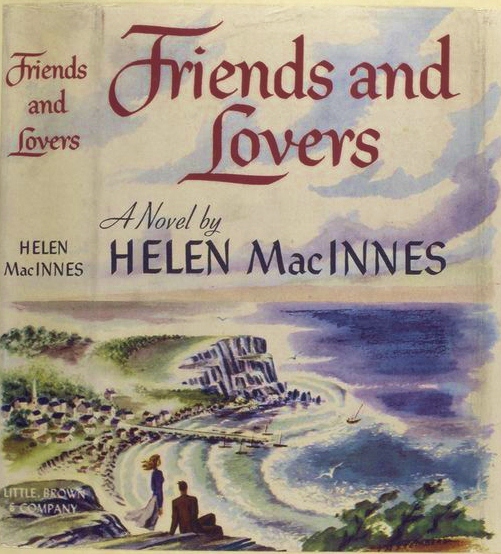
macinnes friends lovers djFriends and Lovers by Helen MacInnes ~ 1947. This edition: Little, Brown & Co., 1947. Hardcover. 367 pages.

My rating: 6/10.

*****

I met this author, figuratively speaking, one long, hot teenage summer in the 1970s. With the high school library closed to me and everything else in print in the house already devoured, I was desperate for something new to read. I was half-heartedly digging through boxes of old Reader’s Digests in our sultry attic when I found a stash of  hardcovers packed away in a pile of string-tied cardboard boxes, relics of my mother’s previous life in California before her marriage and relocation to the interior of British Columbia.

Mother was born in 1925, and, as a lifelong avid reader, collected as many titles as she could with her limited budget as a single “working girl”, a career which spanned almost 20 years before a late-for-the-time marriage at age 36.  A browse through her collection was a snapshot of middle class bestsellers of the 1950s and 1960s, when my mother did the majority of her book buying. If I made a list of authors I’ve been introduced to through my mother’s personal library, Helen MacInnes would be solidly on there.

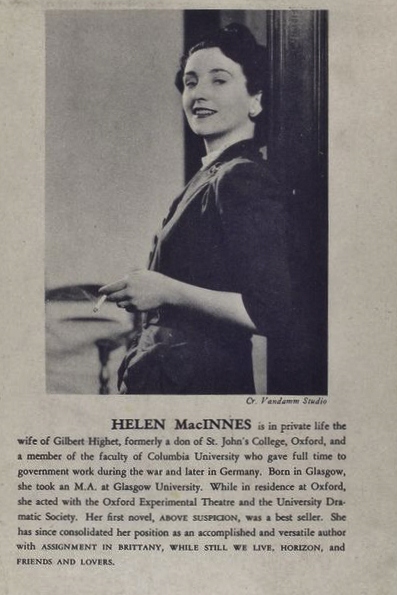
Best known for her suspenseful espionage thrillers set in World War II and the Cold War, Helen MacInnes also wrote several romance novels, Friends and Lovers in 1947, and Rest and Be Thankful in 1949.

The latter title was one on my mother’s shelf, and I read it and quite enjoyed it in a mild way, so when high school resumed in September and I came across another MacInnes title in our well-stocked school library, Above Suspicion, I added it to my sign-out stack. Already a fan of Eric Ambler and John LeCarre,  the political thriller immediately appealed, and Helen MacInnes was added to my mental  “authors to look out for” list.

Over the years I eventually read most of MacInnes’ titles, with varying degrees of interest and enjoyment. At her best she wrote a gripping, fast-paced, suspenseful story that held my interest well; occasionally I found my attention straying. When I recently came across Friends and Lovers, I picked it up and leafed through it, trying to remember if I had previously encountered it. The title was familiar, but darned if I could remember the storyline – never a good sign! When I started reading, I knew immediately that at some point I had read the book, but I had absolutely no memory of the plot. Was this a spy novel? A romance? A few chapters in I concluded that it was a pure romance, albeit one that attempted to address some larger issues.

David Bosworth is an academically brilliant though financially struggling student entering his last year of studies at Oxford in the early 1930s. In Scotland for the summer, employed as a tutor with a wealthy family, he meets 18-year-old Penelope (Penny) Lorrimer and, rather to his dismay, falls in love at first sight. He had always thought that intellect could govern emotion; his feelings for Penny turn this long-held theory on its head, and, when it becomes apparent that Penny has been similarly smitten, a clandestine relationship ensues.
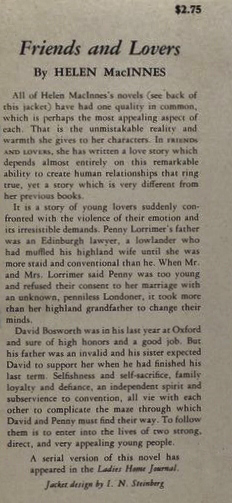
David is the sole prospective support of a troubled family. His widowed father, seriously injured in the Great War, is a helpless invalid on a small pension. His sister Margaret, who has some talent as a pianist, refuses to take on a paying job to help support her father and herself, as she feels her musical training towards a career as a concert pianist is too important to compromise.

David has financed his own university education by attaining a series of scholarships; now with his degree in sight he is agonizing over his future and his family responsibilities. A wife and family of his own have no place in his plans, and Margaret, once she realizes David’s attraction to Penny, is openly resentful of what she sees as a threat to her own future reliance on David’s earning power. David, emotionally fastidious, refuses to entertain the notion of a relationship other than marriage with the woman of his choice; his emotional and sexual frustration are frankly and sympathetically described by MacInnes.

Penny is also faced with family opposition to the relationship. Her well-off, upper-middle-class parents are and suspicious of the designs of a financially struggling university student on their daughter. A romantic entanglement is unthought of; a marriage even more ridiculous to consider – David will obviously be in no position to support a wife of Penny’s background “in the style to which she is accustomed” for quite some years, if ever. The only reason Penny is not out-and-out forbidden to see more of David is that the idea of her seeing anything in him is so ridiculous to her parents that he is dismissed as a momentary indiscretion, not deemed worthy of further notice by Penny as well as themselves.

Penny manages to get to London to study at the Slade Art School; David visits her on his free Sundays and the relationship progresses through its many difficulties to its inevitable conclusion.

Did I like this novel? Yes, and no.

It was very much a period piece in its portrayal of the two main characters. David, to my modern-day sensibilities, is much too chauvinistic and jealous to be admirable; Penny is much too ready to conform to David’s masculine expectations. Stepping back from that knee-jerk reaction to their fictional personalities, I realize it is a bit unfair to judge them by present-day standards. As products of their environment, possibly drawn from real-life characters, (I have read that this may indeed be a semi-autobiographical story, as the two protagonists resemble MacInnes and her husband in many key ways), David and Penny do seem generally believable, if a mite annoying at times, in their stereotypical behaviour.

Their friends and families were never given as much attention in character development throughout as they could have been, a definite flaw in this novel. Things tend to fall into place a little too neatly on occasion; Penny’s throwing off of her family’s protective embrace and her establishment as a gainfully employed London working girl comes out as a bit too pat and good to be true; David is offered opportunity after wonderful opportunity and enjoys a great luxury of choice as to his own working future; one sometimes wonders what all the fuss and angst is about.

A big point in favour is the discussion of attitudes in England towards the Great War veterans. MacInnes lets her very definite political opinions (liberal, anti-fascist) show throughout. The brooding situation of the “Germany problem” is well-portrayed. The story is set in the 1930s but was written and published in the 1940s, so the author’s portrayal of the characters’ apprehensions as to their and their country’s future must certainly have been influenced by the author’s own pre-World War II experiences and thoughts. Overall an interesting glimpse into the time, written by someone who lived what she wrote about.

Absolutely honest personal opinion: One of Helen MacInnes’ weaker novels. I much prefer Rest and Be Thankful, the other of her “pure romances”, which I regularly re-read.  It also discusses the after-effects of war and subsequent political attitudes, and is a stronger, more cohesive story overall with much better character development and a strong vein of humour, something I feel Friends and Lovers generally lacks. Friends and Lovers often feels forced, as if the author were rather abstracted while writing it; given the times it was written in, I will forgive her that but it does show in the final result.

Would I recommend it? Yes, with reservations. I will keep it on my shelves as a re-read, though for far in the future; no hurry! Has merit as a vintage novel, but not a favourite.

Read Full Post »
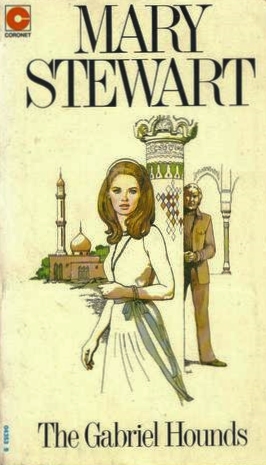
the gabriel hounds coronet mary stewartThe Gabriel Hounds by Mary Stewart ~ 1967. This edition: Coronet, 1974. Paperback. ISBN: 0-340-04353-9. 256 pages.

Oh. My. Goodness. This was utterly over-the-top, and if it had been written by anyone lesser (say Phyllis A. Whitney) I would have savagely panned it. But I’ve now embraced this author fully, and therefore completely forgave her the bizarre plot and the very weird and unlikely “drugging” scenes. (And the slightly ick-inducing cousinly love.)

Drum roll, please (or you may substitute the snarl of an accelerating Porsche engine here) …

My rating: 9.5/10

Loved it.

Okay, this isn’t even going to be a “proper” review, because I want you to come to it with no idea of where the plot would go, like I did. I will instead throw out these teasers. This story contains:

  • A lovely, unapologetically wealthy, 22-year-old sophisticated world traveller as the heroine.
  • An eccentric old lady who has completely channeled Lady Hester Stanhope and has created her own legend in a decaying Lebanese castle.
  • A ne’er-do-well young Englishman, handsome and intelligent but fatally weak-willed, who has gotten into a situation very much over his head; perks being the privilege of enjoying the favours of a dusky local maiden and galloping about the countryside on a beautiful Arab horse, accompanied by two gorgeous saluki hounds.
  • A scene in which the heroine unwittingly (???) smokes three “marihuana” cigarettes and only succumbs to their “self-will erasing effect” until the end of the third one, after which she is unable to walk and is carried away giggling.
  • A dastardly villain who eventually confesses absolutely EVERYTHING in a long, rambling monologue.
  • A handsome young man who can scale steep cliffs (and crumbling castle walls) without benefit of climbing gear, and who (bonus feature!) drives a white Porsche 911 S with utter aplomb and finesse.
  • Oh, and a fabulously unique and valuable ruby ring, which no one of the evil-doers seems to be able to recognize for what it is. (Among other priceless heirlooms which they casually dismiss and bundle away as “junk”. Hmmm, not quite as sophisticated as all that, then, these out-for-the-main-chance types.)

There. How can one resist all of that? And there’s more. Oh yes, much, much more!

Enjoy!

Couldn't find a white Porsche 911 S, but here's a 1966 in an elegant shade of sand, suitably posed against a Mediterranean-looking setting. How'd you like to tootle about the Levant driving this?

Couldn’t find a white 1966 Porsche 911 S, but here’s one in an elegant shade of cream, suitably posed against a Mediterranean-looking setting. How’d you like to tootle about the Levant driving this?


Read Full Post »

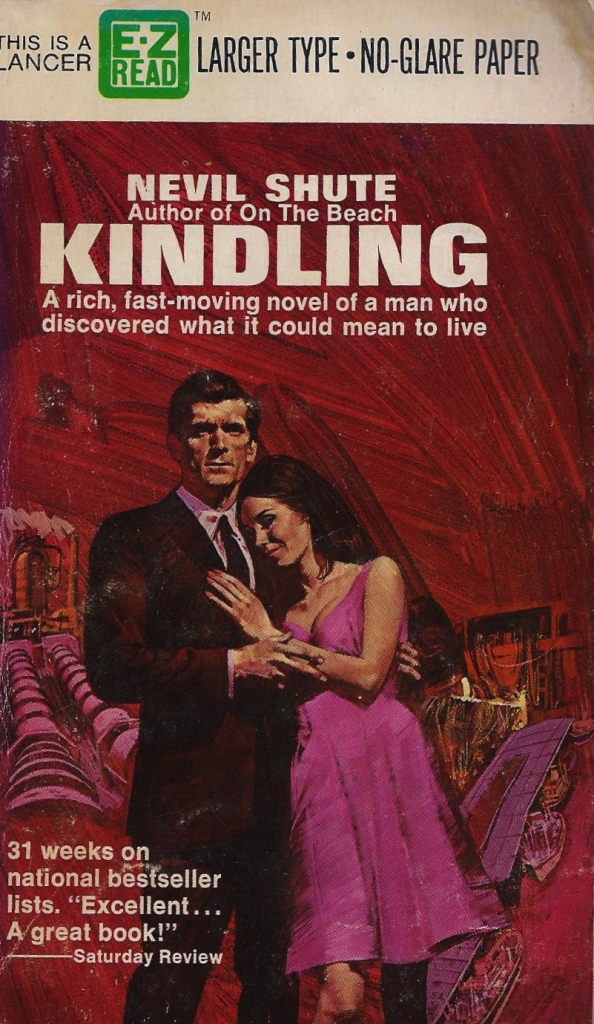
kindling nevil shute 001Kindling by Nevil Shute ~ 1938. Original British title: Ruined City. This American edition: Lancer, 1967. Paperback. 319 pages.

My rating: 6.5/10

I’m starting to fall out of the routine of posting, what with springtime’s long days and the utter luxury of being able to spend long hours out in the garden. The sabbatical year is going well, aside from the anticipated pinch of much less cash flow.

(For those of you who don’t know my back story, I generally operate a small specialty plant nursery and this year have shut up shop in order to refocus and take care of some outstanding personal farm and garden jobs which can only be properly tackled in the spring. I’m starting to think two years off might be even better, as there is no way I’ll get everything on The List finished this time round…)

Well, I’ve still been reading, though at a slower rate, and mostly in bed at night, so I notice I’ve been gravitating towards slighter novels, the kind one can finish off in an evening or two. No complicated sagas in the springtime! The brain is much too full of other stuff to make sense of anything too challenging.

Which makes Nevil Shute quite a good choice, as one can’t call books such as this last read, Kindling, at all complex. If anything, it was a bit too simplified, and I found myself occasionally annoyed at how briefly the author touched on some major plot developments, and how he introduced some promising characters and then dropped them cold, never to be seen again.

It is the mid-1930s, in England, and the long agony of the worldwide financial depression is grinding away at the status quo. It has even started affecting the very wealthy business class, who are, by and large, dealing fairly well with the money market difficulties, though those lower in the hierarchy are losing their grip.

Competently keeping his feet at the top of a shifting pile of lesser men, we have the successful, middle-aged merchant banker, Henry Warren, who deftly keeps in order a whole puppet show of various enterprises, handling staid English investors and dramatic Balkan politicians with absolutely level-headed aplomb. This involves frequent long nights in London, and many trips abroad, and Henry seems never to be home at the same time his wife is, what with the two of them leading fully separate lives and only meeting infrequently when their respective circles of activity brush against each other.

Serious problems are brewing, and not only on the home front, though things there have imploded with a sullen bang. Mrs. Warren has become romantically involved with a wealthy Arab sheik, and the gossip has surpassed the whisper stage. Henry is reluctantly forced to take notice, especially when he finds himself staying at the same French hotel as his wife and her lover. A divorce is the inevitable solution, after Henry’s ultimatum of a new sort of arrangement of reduced jet-setting and poshly-cushioned rural solitude for his wife is spiritedly rejected.

Henry sets his lawyers to work getting his divorce tidied up, and goes back to his wheeling and dealing, pausing only briefly to mull over the reasons behind the failure of his marriage. The major thing being, he concludes, that his wife’s financial independence has made it too easy for her to neglect the homemaking aspect of things. When a wife is dependent upon her husband financially, Henry muses, she has much more incentive to dedicate herself to her job, which is the home and family, while the husband’s half of the deal is to provide the money and the house.

He always felt helpless in his dealings with Elise. In most marriages, he thought, the economic tie must make things easier: the wife had her job for which she drew her pay; she could not lightly give it up. Both husband and wife then had to work, he in the office and she in the home. With Elise it was different. She had her own money – plenty of it; a dissolution of their marriage would mean no material loss to her, no unavoidable discomfort. She was not dependent on her job for her security, therefore she took it lightly…

But though he seems to recover quite quickly from the shock of the failure of his marriage, Henry Warren is riding for a fall. His overworked physique is about to let him down, and when it does, it is in quite an unexpected way. Henry ends up an incoherent patient in an overcrowded hospital in a depressed small city which has lost its only industry, that of a shipyard, some five years before. He is assumed to be an indigent wanderer, and, once he has recovered from abdominal surgery, he plays along with the charade, for he has become interested in how desperate the straits are of an entire community of unemployed men, and of how the progression of their loss of hope has affected them and their families.

If only one could bring back industry to the town, he muses…

What follows is a description of how Henry Warren manages to arrange financing to reopen the shipyard, which requires some intricate and not-quite-above-board dealings with the afore-mentioned Balkan politicians, and some at-home clever negotiations to bring some British investors into the deal.

But Henry has let his emotion in this case override his common sense, and has resorted, for the very first time in his financial career, to some shady practices which won’t stand up to investigation. And he has inadvertently made an enemy, who is in possession of a damning set of documents…

Of course there is a love interest, this time a properly womanly woman, the utter opposite of the ex-Mrs. Warren, who has departed the scene to live with her “black” paramour.

One of the sticky bits in this novel, even greater than the casual sexism, was the offhand racism exhibited throughout. The Arab lover is referred quite commonly as being “black”, and “a n*gger”, and Henry notes the “swarthiness” and the “olive texture” of Prince Ali Said’s skin, which “darkens to brown” – one would assume with a hidden blush? – when Henry lightly insults him. And the Jews in Henry’s circle get much the same treatment, though here and there one is given the nod as a “good man” despite his Jewishness and the associated stereotypes of appearance and behaviour this implies.

This aspect of Shute’s writing, even given its “era expectedness”, was a hurdle I had to crawl labouriously over, but once I made up my mind to go on, I found myself quite taken up in the story of Henry Warren’s new obsession, that of the rehabilitation of a town and its population. Henry puts the philanthropic desires of his heart before the sensible qualms of his brain, and in stepping out of bounds in a completely uncharacteristic way, makes himself an unlikely hero.

I mostly bought into it, and though the author’s philosophical soapbox was evident throughout, he told an engaging enough tale that I was held until it was all told out. Not much in the way of nuances here; we are told throughout exactly how we are expected to react and think, and I found myself meekly following Shute’s direction, though I gave myself a little shake when it was all over, to get myself tuned back in to the here-and-now.

I think “vintage” is an apt summation of the experience as a whole. The details of the financial planning are rather intriguing, being based on Nevil Shute’s own involvement in establishing a pre-war aircraft factory, which was, after many set-backs, successful.

One final note, and this on the cover. The story is set in the 1930s, and there are no passionate embraces with lightly clad women within. Henry Warren’s post-marital love affair is carried out with the strictest decorum, and though he does associate with an exotic Corsican dancer during some of his Balkan scheming, that relationship is apparently quite platonic. So the cover art is mostly imaginary, and obviously designed to catch the eye of the jaded businessman, who is (I suspect) the intended audience for Shute’s masculine romances.


Read Full Post »

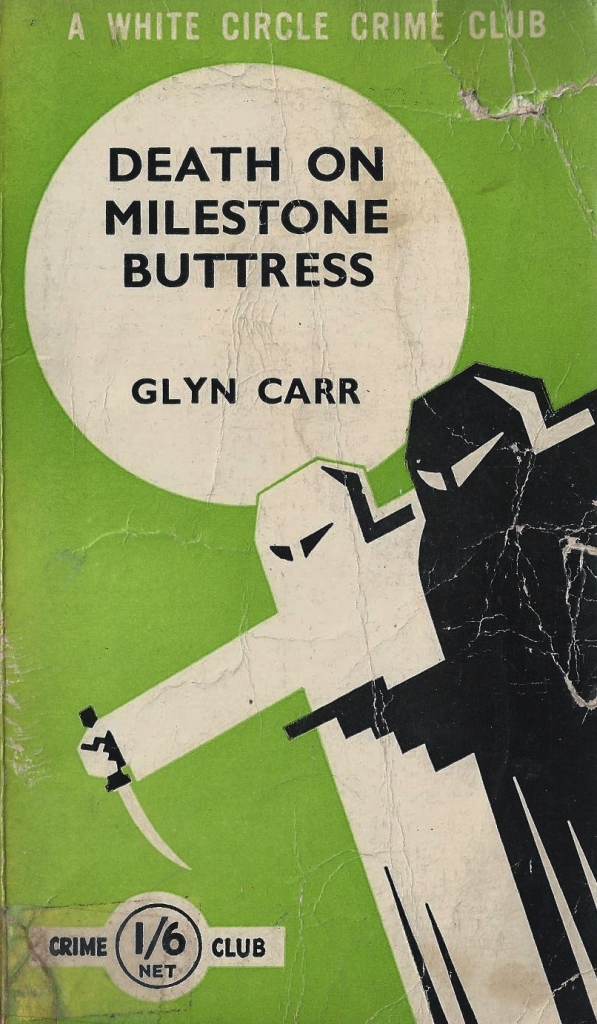
death on milestone buttress glyn carr 001Death on Milestone Buttress by Glyn Carr ~ 1951. This edition: The Crime Club, 1951. Paperback. 256 pages.

Provenance: Quesnel Family Thrift Store, October 2013. Previous book owner: Rebecca Lund, who enthusiastically rubber-stamped her name and address on all of her books, in numerous places. I know this because I have acquired a large number of them over the past few years; we obviously share a similar taste in books.

Or perhaps shared is more correct; I strongly suspect that Ms. Lund has passed on and that her books were subsequently donated to the thrift store; there do seem to be an awful lot of them, and they do look like they were carefully collected over a number of years by a dedicated reader. (Note to self: write codicil in will regarding which favourite second hand bookseller shall be the recipient of my own collection…)

My rating: 4.95/10 – I can’t quite put this at a 5 on my personal “enjoyment level” rating scale, and while it’s a very much okay specimen of its genre it’s not quite special enough to inspire me to seek out any more by this author.

Though perhaps I dismiss Glyn Carr too soon; he did go on to write fourteen more mysteries starring his stately, erudite and multi-talented Shakespearian actor/mountaineer amateur detective, Abercrombie Lewker.

Here’s the rundown on the plot, courtesy Rue Morgue Press, which has recently republished this vintage mystery, among many others. Check out their website – what a treasure trove of information on the genre! Rue Morgue Press republishes obscurish vintage mystery novels, and also deals in used copies of rare and out-of-print detective fiction.

Abercrombie (“Filthy”) Lewker was looking forward to a fortnight of climbing in Wales after a grueling season touring England with his Shakespearean company. Young Hilary Bourne thought the fresh air would be a pleasant change from her dreary job at the bank, as well as a chance to renew her acquaintance with a certain young scientist. Neither one expected this bucolic outing to turn deadly, but when one of their party is killed in an apparent accident during what should have been an easy climb on the Milestone Buttress, Filthy and Hilary turn detective. Nearly every member of the climbing party had reason to hate the victim, but each one also had an alibi for the time of the murder. Working as a team, Filthy and Hilary retrace the route of the fatal climb before returning to their lodgings where, in the grand tradition of Nero Wolfe, Filthy confronts the suspects and points his finger at the only person who could have committed the crime. Filled with climbing details sure to appeal to both expert climbers and armchair mountaineers alike, Death on Milestone Buttress was published in England in 1951, the first of fifteen detective novels in which Abercrombie Lewker outwitted murderers on peaks scattered around the globe.

And while we’re over cribbing info from the Rue Morgue Press site, here’s a snippet of their Glyn Carr Author Biography. (Much expanded on the site – please click through to read the rest.)

If you look upon a mountain climb as taking place in a large, open-air locked room, then Showell Styles was right to choose Glyn Carr as his pseudonym for fifteen detective novels featuring Abercrombie Lewker, all of which concern murders committed among the crags and slopes of peaks scattered around the world. There’s no doubt that John Dickson Carr, the king of the locked room mystery, would have agreed that Styles managed to find a way to lock the door of a room that had no walls and only the sky for a ceiling. In fact, it was while Styles was climbing a pitch on the classic Milestone Buttress on Tryfan in Wales that it struck him “how easy it would be to arrange an undetectable murder in that place, and by way of experiment I worked out the system and wove a thinnish plot around it.”

That book was, of course, Death on Milestone Buttress

So – what am I going to say about this fairly standard issue mystery tale? Perhaps I’ll just note some likes and dislikes, and leave it at that.

I liked:

  • The characterizations of both of the leading characters, Shakespearian actor Abercrombie Lewker and bank “calculating machine operator” Hilary Bourne. Both are nicely presented and sympathetically portrayed, though as the book progresses it is Hilary who stays much more real, while Lewker becomes a parody of the Hercule Poirot/Nero Wolfe type of detective, easily analyzing esoteric information with his great big superior brain, as it were. Though he is much more active physically than both of his fictional counterparts, being an accomplished amateur climber despite his less than boyish figure.
  • The mountaineering details and the descriptions of the Welsh setting, which seemed sincere and plausible.
  • The parody-like period setting, with the several sincere Communists being viewed by their acquaintances as slightly eccentric, mostly harmless, and generally rather figures of fun. The scientists who also play main roles (one is eventually the murderee) are of course working on a Great Big (not very secret) Secret Project, which when completed will apparently be The Weapon To Beat The Atomic Bomb. Quite ridiculous, the whole thing, and it rather felt like that was intentional. In any event, that’s how I viewed it, and it helped me make it through even when I found the complications of the plot rather uphill going.

I disliked:

  • The grotesque attempts at slang and dialect which were completely incomprehensible and too over-the-top, even given that the speakers of the garbled dialogue were generally meant to be figures of fun.
  • The predictability of the plot. I guessed the murderer very early on, and the red herrings provided were small and not particularly enticing.
  • The absolute unlikableness of the murderee. He had no redeeming traits whatsoever, except for his intellectual abilities as a scientist. No one cries when he dies. (Not for his loss, anyway. Though there are tears because of the multiple situations created by his death.) Created by the writer to be blithely killed off, one rather feels.
  • The love affair between Hilary and one of her fellow vacationers – absolutely meh.
  • The whole “smarter than the police” thing. Lewker takes on the mantle of Nemesis without official sanction, and all of the other players meekly fall into order without a whisper of protest. Including the murderer, who then goes on to an über-predictable end, with detective story justice thus being served with no boring paperwork to fill out or tedious trials to sit through

And that is all I have to say about Death on Milestone Buttress. Here is a rather more even-handed discussion on the Dust and Corruption blog, worth taking a look at.

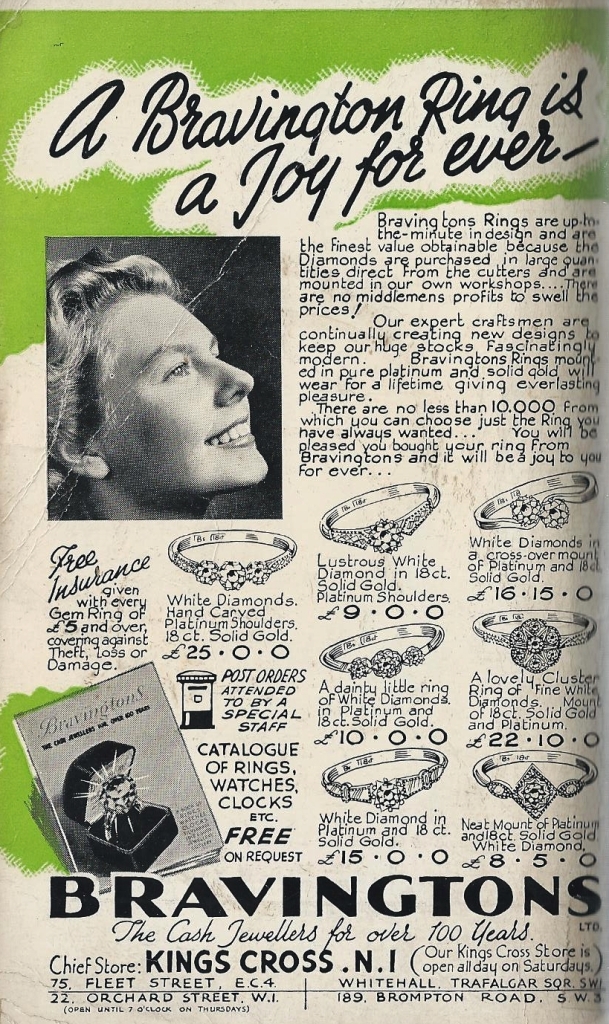
Oh – there was one more thing. Check out the back cover of my paperback, which features yet more rocks, these with gold and platinum settings. How’s this for period appeal? Check out the ad copy, and those prices!

death on milestone buttress glyn carr back cover advert 001

Read Full Post »

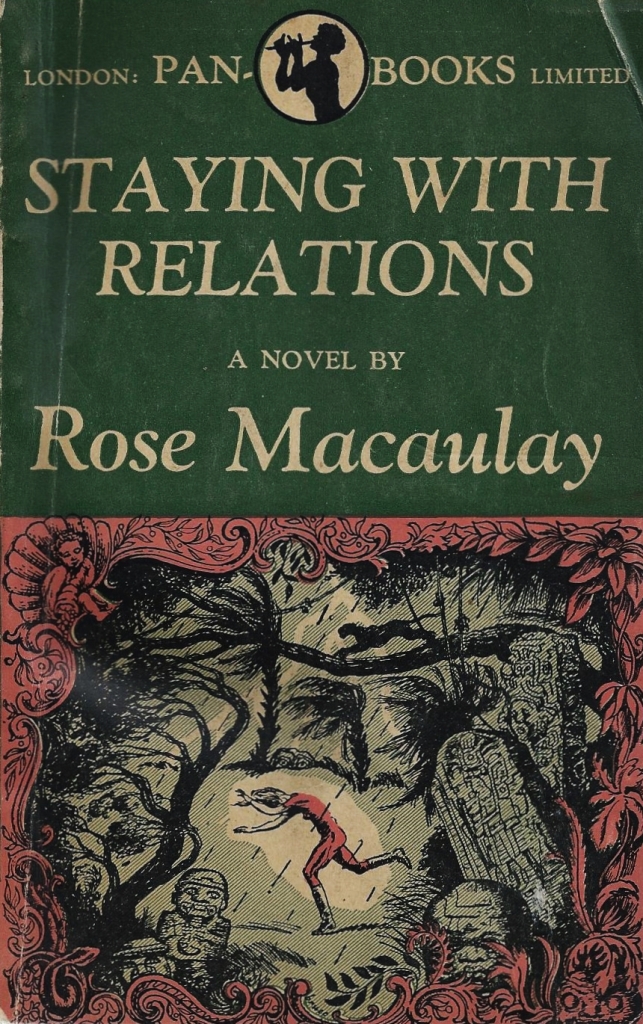
staying with relations rose macaulay 001Staying with Relations by Rose Macaulay ~ 1930. This edition: Pan, 1947. Paperback. 224 pages

Provenance: The Book Man, Chilliwack, February 2014.

My rating: 7/10

What did I just read?

My fourth encounter with the brilliant but unsettling fiction of Rose Macaulay – the others so far being Crewe Train, The Towers of Trebizond, and The World My Wilderness.

Of these, The World My Wilderness was closest to being a “plausible” story; the others were decidedly surreal. One cannot apparently read Macaulay on complacent auto-pilot; she takes a straightforward narrative and gives it the occasional twist sideways, just enough to catch the reader off guard.

Un-credited poem, one would then assume to be by Rose Macaulay herself, on frontispiece page.

Un-credited poem, which I assume to be by Rose Macaulay herself, on frontispiece page.

Among other disconnects from reality on this latest addition to my small Macaulay collection, it was the mention of tigers in the Central American jungle that caused me my greatest bemusement. I could handle all of the other scenarios – the luxuriantly roccoco villa built upon an ancient Mayan temple/Spanish monastery, the sophisticated love lives of the family of English step-brothers, -sisters and cousins living lives of lazy pleasure financed by their older relations, the American con-man with his uncanny knowledge of hidden treasure and his bizarre plot to attain such – but the tigers threw me off my stride.

At first I thought they were merely hypothetical tigers, and that the man referencing them was harking back to years spent in India, but they popped up again (figuratively speaking), apparently as a threat as “real” as the stalking jaguars which lurk in the overgrown Guatemalan forest. Had to stop and do a bit of research, it bothered me so much, and no, there do not appear to be actual tigers endemic to this region of the world. Such a relief! – I thought not, but there was that tiny bit of niggling doubt…

Okay, I’m going off on a strange tangent. Well, perhaps rightly so. This is a rather odd and slightly unsatisfactory tale.

It starts off conventionally enough. This is what the back cover of my old Pan paperback says:

Staying with Relations is about a family who live in a baroque, Maya mansion in the heart of the Central American forest. A young woman novelist goes from England to visit her relatives in Guatemala. Theft, kidnapping and hunting for treasure left there long ago by Spanish priests occur. There is an earthquake; a girl is lost in the jungle while escaping from kidnappers; unexpected aspects of the characters of the dramatis personae emerge. Rose Macaulay has enjoyed in this book the three pleasures of relating adventures, describing exotic scenery, and writing about people…She wrote this book largely as compensation for not having, in a tour of Central America, reached Guatemala and seen its ancient temples buried in jungle…

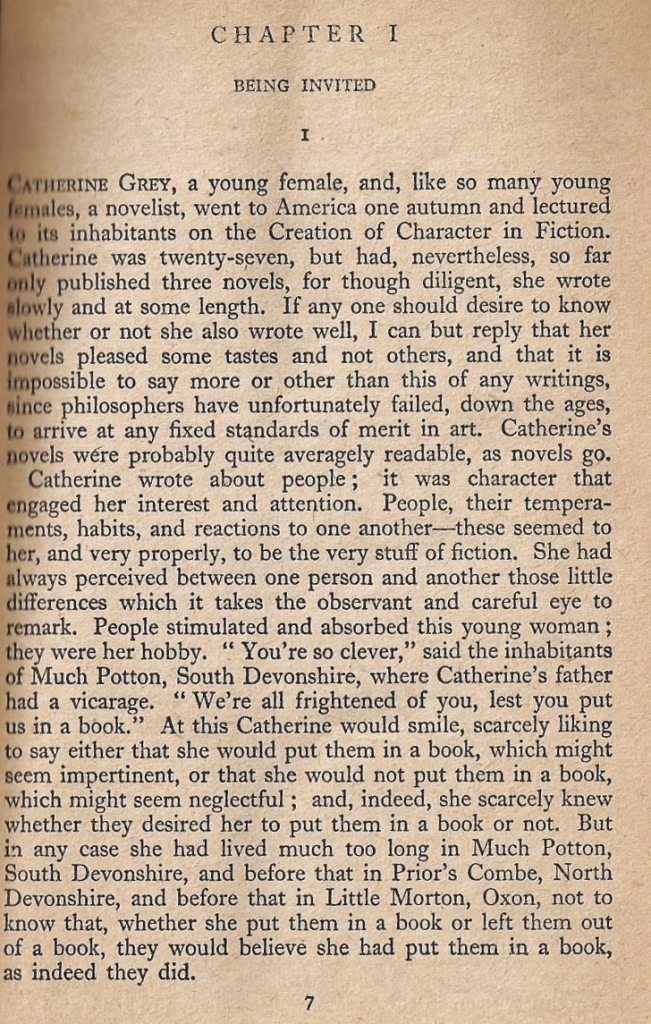
Macaulay dips her pen deeply into the satirical ink well; she jabs away at herself as much as at her invented characters, being continually cutting about the phenomenon of the English woman novelist and her apparently universal habits. Well, the writer should know.

staying with relations rose macaulay excerpt 001 (2)

Once we get this sort of thing out of the way, the novel proceeds on its way detailing the adventures of the not particularly sympathetic cast of characters. Though Catherine-the-lady-novelist at first seems to be the main character, with the action viewed through her eyes, the point-of-view increasingly shifts until we realize, with something of a shock, that we don’t really know any of these people at all. And certainly not Catherine!

As Macaulay puts her puppets through their paces, one strains to see what her intent is; what is she really going on about? And I wish I could say that I figured this out for myself, but I must give credit elsewhere. It was a comment by Simon at Stuck in a Book , in a discussion of The World My Wilderness, that clicked on the light:

‘Reliable’ is just another word for ‘consistent’, really, and Macaulay does seem to write in a consistently dry, almost satirical style, pursuing a similar theme in each novel – albeit a theme so broad that she could have written two thousand novels and never needed to approach it from the same angle twice.  It is dangerous to summarise thus (and others may have said this before me…) but I believe Macaulay’s broad theme across her novels is: ‘What does it mean to be civilised?’

Once one views the novel with this thought in mind, it all begins to make much more sense. Macaulay is continually discussing, both by the dialogue of her characters and her scene setting, the difference between the “barbarians” and the “civilized” folk. No conclusion is committed to, but the concept of “civilization” trumps all of the other scurryings to and fro which make up the conventional skeleton of the story.

I enjoyed this book as much as one can when one feels as if the author is speaking rather over one’s head. As a dramatic fiction it is as unnervingly just off normal in the same way as something like Evelyn Waugh’s satirical novel The Loved One is, or his slyly funny Decline and Fall. (Though Waugh is rather more accessible, in my opinion; Macaulay can be downright obscure, giving her readers very little help at all.)

I should probably quit now, having not really talked about the plot or any of the details of the story, and digging myself deeper with every sentence into a situation which I am going to have a hard crawling back out of. A veritable tiger-pit of a post, as it were!

For those who are already Macaulay aficionados, Staying with Relations will be a most interesting read. But I wouldn’t start here for my first introduction to this unique novelist. Perhaps try Crewe Train instead; it is just as satirically twisted but there are less characters to keep track off, and a more clearly defined heroine. Who is also, now that I come to think of it, “staying with relations”…


Read Full Post »

beowulf bryher 001Beowulf by Bryher ~ 1948. This edition: Pantheon, 1956. Hardcover. 201 pages.

Provenance: Purchased (via ABE) from Powell’s Books, Portland, Oregon – March 2014.

My rating: 9.5/10

This is a beautifully framed and constructed capture of a brief and bleak moment in time, focussing on a few ordinary people over a few short days in the midst of World War II’s London Blitz.

Selina Tippett, for twenty years a paid companion to a series of querulous old ladies, had at long last achieved her dream, that of operating a comforting teashop supplying nourishing and delicious refreshments to those most in need of a peaceful break in their stressful lives. For seven years the Warming Pan has been a haven for the harried housewives, elderly shoppers and frazzled governesses of this small corner of London, but times are increasingly difficult, and Selina is in a state of quiet desperation.

The bombs rain down, and her loyal customers are quietly fading away, either through the dismal fate of sudden death from the sky, or the more insidious process of quiet evacuation to the countryside. The Warming Pan’s once abundant selection of teacakes has dwindled to a mere shadow of past glories as rationing is in full force; Selena has just been informed that she may no longer buy fresh eggs for her baking, and she is ineligible for powdered eggs because she has never used them before and hence has no entitlement to a rationed allowance. The rent is months overdue; Selina receives each day’s post with trepidation, expecting an eviction notice. What will the future bring…?

Selina’s partner Angelina refuses to share Selina’s concerns. Girded for battle with her strong sense of righteousness, Angelina goes forth daily to enthusiastically do battle with the bureaucracy of the Food Ministry and her wide circle of provision merchants. In her free hours, Angelina is an aficionado of various evening courses; she is a keen autodidact and fierce feminist with a special interest in improving the position of women in society.

When Angelina brings home a hideous plaster statue of a  bulldog – christened “Beowulf” in a gesture of symbolic nose-thumbing at the disturbers of England’s peace – Selina tries to hide her inner anger at the fact that it was paid for with money intended for the gas bill and the fishmonger. But as Selina’s sense of foreboding increases hour by hour, fate is preparing a climactic solution (of sorts) to her most urgent problems…

Much more than a simply linear narrative, this novel is a spiral series of vignettes, all connected at the centre to the Warming Pan and the people who cross its threshold and find refuge within its threatened walls.

Short but quite perfect; an excellent reading experience. Though the subject matter is desperately sad, the novel is quietly and genuinely humorous, and not at all depressing.

Half a point lost because I wanted more, and the ending solved a key problem just a little too neatly.

Bryher was the pen-name of British novelist and poet Annie Winifred Ellerman. A keen historian and amateur archeologist (as well as the daughter of “England’s wealthiest man”, shipping magnate John Ellerman), she wrote a number of well-researched, well-written and well-reviewed historical novels focussing on various periods in England’s history, such as The Fourteenth of October (the year of 1066), and The Player’s Boy (Beaumont and Fletcher at the end of the Elizabethan period). She also dabbled in writing science fiction in 1965’s Visa for Avalon, and was well known for her strongly eclectic interests and her steadfast support of the literary and creative arts.

An author very much worthy of further investigation.

Read Full Post »

« Newer Posts - Older Posts »