Posts Tagged ‘Social Commentary’

war stories gregory clarkWar Stories by Gregory Clark ~ 1964. This edition: Ryerson Press, 1968. Softcover. ISBN: 0-7700-6027-7. 171 pages.

My rating: 8/10

Born in 1892 in Toronto, Ontario, Gregory Clark was of perfect age to fight in the Great War, heading to Europe in 1916, at the age of twenty-four. Clark entered the fray as a lieutenant, and exited a major. In the trenches and out of them – Clark received the Military Cross for “conspicuous gallantry” at Vimy Ridge – the young man remembered what he had witnessed, the horror and the gallantry and the moments of respite and delight, to be shared later with his audience of newspaper readers as he took up journalism in the post-war years.

Too old to take active part in World War II, Gregory Clark none the less went overseas once again and pushed his way into the thick of the action, fulfilling a role as a front-line war correspondent, and receiving an Order of the British Empire for his services. Again, his experiences found their way into his short, chatty periodical articles published in the following decades. Clark’s son Murray was killed in action in 1944 while serving with the Regina Rifles, but there is no mention of that personal loss here in War Stories; Clark keeps that particular emotion well buried.

War Stories contains a selection of thirty-eight anecdotes, three to five pages in length, about a wide array of Gregory Clark’s personal experiences. Though the tone throughout  is upbeat and frequently humorous – War Stories won the Leacock award for humour in 1965, which rather surprises me, for funny as these anecdotes sometimes are, there is a sombre tone always present – Clark makes it very clear what his opinions are as to the brutality of what the soldiers and civilians went through.

These stories laud the bravery (and the frequent giddy foolishness) of the farm boys and office clerks and travelling salesmen who find themselves caught up in circumstances beyond their most vivid nightmares, fated to kill and, frequently, be horribly maimed, and wastefully killed, merely because of the circumstance of the time of their birth. Something I noticed is that there is not much sympathy shown here for the soldiers of the “other side”; Clark’s thoughts are ever for his own, and he was reportedly a fiercely protective officer of the men under his charge.

All is not muck and death and destruction though. Interludes of inactivity brought forth pranks and hi-jinks, while there were times of repose behind the lines, time for memorable meals and quiet conversation, and musings on what was going to come after, if there was going to be an after.

An appropriate book for this Remembrance Day weekend, this time of sober reflection. Clark reports the realities, but he persists as well in highlighting the lighter moments, the bits of sanity in a world of war.

A good read.

And a much more eloquent review of this book, well worth a click-over, may be found at Canus Humorous.

Read Full Post »

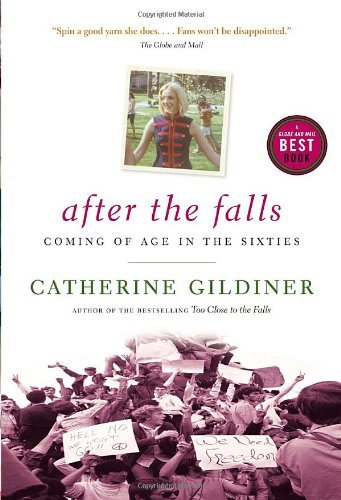
after the falls catherine gildinerAfter the Falls: Coming of Age in the Sixties by Catherine Gildiner ~ 2009. This edition: Vintage, 2010. Softcover. ISBN: 978-0-307-39823-9. 344 pages.

My rating: 8.5/10

Wow. That was unexpected. I was tidying up some books I’d casually piled on a corner of the couch, sorting out already-read from want-to-read, and I leafed through After the Falls to refresh my memory as to how urgently I wanted to read it, or if it could be put on the maybe-someday pile.

It caught me.

Suddenly I was sitting down, and reading away like a mad thing. Clean-up abandoned, outside chores abandoned, and it’s a good thing the roast was already in the oven or cooking my family’s evening meal would have been abandoned, too. It grew dark. I switched on my reading lamp. I read this thing right through to the end. My afternoon was completely lost. Abandoned pell mell, while I lost myself in a book.

My seduction by After the Falls was so unexpected because I knew when I purchased it that it was a sequel to an earlier volume of memoir by Catherine Gildiner, Too Close to the Falls. I had a vague little plan to get the first book and read it, and then continue on with the second if the first one was indeed as great as everyone seemed to think it was. I wasn’t really thinking about it too much; I’m fairly immune to mainstream rave reviews, having been disappointed by banality too many times.

After the Falls is not banal. It is over-the-top, frequently jaw-dropping (“Did she just say that? Did she really do that?” How much of this is fictionalized???!”), and funny and sarcastic and joyful and heart-breaking and occasionally awkward and sometimes vague as major incidents are brushed over with a single sentence or two (this, the occasional vagueness and awkwardness, lost the 1.5 points in my personal ratings system), and rather contrived here and there, but never no mind those last few criticisms. It is a very readable book, and I happily recommend it. And I’ve elevated the need-to-buy status of the first installment to high on the list, and, having learned that a third volume is coming soon, have earmarked it as a buy immediately book.

So now you’re all wondering – those few of you who haven’t already ridden this particular train – what the darned book is about. Well, the internet is seething with reviews (mostly favourable) so I will cheat this morning and steal the flyleaf blurb. (Must address all the chores I neglected yesterday; must cut this short!) It’s a tiny bit inaccurate – do these blurb writers read the whole thing? or do they just ask for the high points? – but it condenses things reasonably well.

When Cathy McClure is thirteen years old, her parents make the bold decision to move to suburban Buffalo in hopes that it will help Cathy focus on her studies and stay out of trouble. But “normal” has never been Cathy’s forte, and leaving Niagara Falls and Catholic school behind does nothing to quell her spirited nature. As the 1960s dramatically unfold, Cathy takes on many personas — cheerleader, vandal, HoJo hostess, civil rights demonstrator — with the same gusto she exhibited as a child working split shifts in her father’s pharmacy. But when tragedy strikes, it is her role as daughter that proves to be most challenging.

Actually that’s a very lame flyleaf blurb. It doesn’t at all catch the spirit of the memoir. Here’s a much better blurb, from Publisher’s Weekly, November 2010:

At age 12, Gildiner and her family moved from their Niagara Falls home to a Buffalo suburb, leaving behind a family business, smalltown contentment, and the rebellious childhood chronicled in her first memoir, Too Close to the Falls. While her uprooted parents struggle to adjust, Gildiner stumbles in making new friends and edging into puberty. Her restlessness and a fundamentally outspoken and argumentative nature regularly catapult her further than simple teenage trouble, and she frequently fails at the standard American girlhood, often with comic results. The conflicts between the narrator’s individuality and conformity propel her into her first relationship at the same time that the seismic shifts in American society, culture, and politics hit home with ever-increasing force. On the page as in life, comedy, tragedy, and elegy live right on top of each other, and as with most remarkable memoirs, the straightforward, honest voice and perspective are steady even in the most painful moments.

And I’ll link the author’s website, so you can look around there.

Cathy McClure Gildiner – After the Falls

And here is what my blog friend Jenny had to say: Reading the End: After the Falls. Everything she says, I agree with. But I think you should read Chapter 4, because it explains an awful lot about how the memoirist relates to men from that point forward.

The writer also has a blog, Gildiner’s Gospel, which made me late for bed last night, as it was as compulsively readable as her words on paper. Check it out!

One last thing. The memoir is set in the United States, and at the time she writes about, Catherine was an American citizen. She moved to Canada some forty years ago, though, and reports that she is firmly entrenched in Ontario. In my mind she unquestionably deserves the “Canadian” tag I’ve given her.

Highly recommended.
Read Full Post »

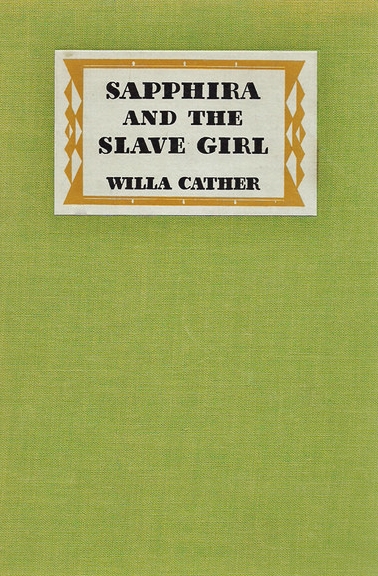
sapphira and the slave girl willa catherSapphira and the Slave Girl by Willa Cather ~ 1940. This edition: Knopf, 1940. Hardcover. 295 pages.

My rating: 7.5/10

This book passed the ultimate reading test last weekend. I picked it up while browsing the treasure trove of vintage books at the very recently opened (a year or so ago) Pulp Fiction Coffee House & Robbie’s Rare Books right downtown on Pandosy Street in Kelowna, British Columbia. I settled down with Sapphira and an excellent coffee mocha, and then I read and read and read. The place was busy; the conversation levels loud; I was a at tiny, tippy, table-for-one and it wasn’t exactly what one would consider prime reading conditions, but it didn’t matter. The story won out.

When Sapphira Dodderidge Colbert first moved out to Back Creek Valley with her score of slaves, she was not warmly received.  In that out-of-the-way, thinly settled district between Winchester and Romney, not a single family had ever owned more than four or five negroes.  This was due partly to poverty–the people were very poor.  Much of the land was still wild forest, and lumber was so plentiful that it brought no price at all.  The settlers who had come over from Pennsylvania did not believe in slavery, and they owned no negroes.  Mrs. Colbert had gradually reduced her force of slaves, selling them back into Loudoun County, whither they were glad to return.

Sapphira Colbert is now in her late fifties, and she and her husband Henry Colbert have lived in Back Creek Valley for thirty years. Between them they have built up a modestly successful business in a notoriously poor region; Henry is the flour miller. Sapphira herself is of modestly aristocratic stock; her mother was born in England, and Sapphira’s family heirlooms furnishing her house and her own finicky attention to “proper” speech and deportment set her apart from most of her neighbours. For the last five years Sapphira has been wheelchair bound; she suffers from dropsy and suffers even more from the loss of her physical freedom, though she still rules her household and keeps a keen eye on the mill and Henry’s doings there.

And Sapphira has recently not liked what she is seeing. One of her most-favoured slaves is pretty and intelligent Nancy, the half-white daughter of Till and granddaughter of Jezebel; the third generation of a family line owned by the Dodderidge family. Sapphira has made something of a pet of Nancy, keeping her as a personal servant and giving her trinkets and pretty clothes, but recently she has turned on the bemused girl, lashing out at her verbally and physically. Nancy has no idea why her beloved mistress has turned against her, but everyone else on the place has an opinion on the matter.

Nancy has been in the habit of cleaning Henry Colbert’s bedroom over at the mill – Henry and Sapphira lead very separate lives, and no longer share their marriage bed – and has started bringing Henry small nosegays of flowers, which she leaves in his room. The two have recently been seen in earnest conversation, and Sapphira, viewing Nancy’s lushly blossoming adolescent figure with a cynical eye, suspects that her husband and her slave girl are up to something even more intimate in the hours of the night.

She is mistaken, though. The relationship between Nancy and Henry is innocent through and through. Henry views Nancy as a pure young girl, and himself as her paternal protector. It has never crossed his mind to look at her in a sexual way, and she herself is  vehemently virginal, shuddering at the thought of sex with anyone, least of all her fatherly patron.

Henry is a noble character, of a sternly righteous Lutheran heritage; the thought of slave ownership is anathema to him, and only his vast respect for his wife has made it possible for him to keep quiet about what he sees as a fundamentally wrong practice. It is pre-Civil War Virginia, though, and marriage laws are such that Sapphira is unable to sell her property – including her slaves – without her husband’s permission. She has made her intention of selling Nancy clear to Henry, and he has categorically refused to allow such a thing, believing that Sapphira owes her slaves a permanent benevolent protection, adding fuel to the fire of Sapphira’s suspicion. So Nancy continues to receive sharp words and sharp cuffs, while Sapphira muses on other ways to revenge herself on her two supposed betrayers.

How Sapphira plots her revenge, and how Nancy is able at last to escape her wrath is the storyline which runs through the book, though there is a lot more going on here too, and numerous cleverly drawn characters besides the three key players.

Willa Cather tells her story in a spare, clean style, mincing no words whatsoever. As a matter of fact, the frequent colloquial language made me wonder rather why this novel has not suffered the same criticism as Mark Twain’s Huckleberry Finn has recently received; Sapphira, her compatriots and the narrator herself have no problem with calling anyone a “yellow girl” (for the half-white Nancy) or a “darkie”; “nigger” is an everyday expression and is used abundantly throughout.

Perhaps it is the overall theme, a critique of the practice of slave ownership, and an ongoing discussion of moral obligations, which has made it less of an issue? Or maybe the book is just that much more obscure that publicity has so far escaped it. In any event, it is there, and slightly shocking to a modern day reader; I did find myself glancing around to see if anyone was reading over my shoulder, and I angled the book to prevent a casual glance from catching the potentially offending words.

An excellent read, which kept me engaged even through the increasing melodrama, and Nancy’s continual jittering vapours. Sapphira as the key antagonist is cold and calculating, and we are very cognizant of her manipulative ways, but we are also given a chance to see behind the façade, to glimpse her fears and insecurities and internal conflicts, as well as those of every other major character.

In Sapphira and the Slave Girl, Willa Cather lives up to her reputation as a brilliant writer and a keen observer of American culture and personal history.

Read Full Post »

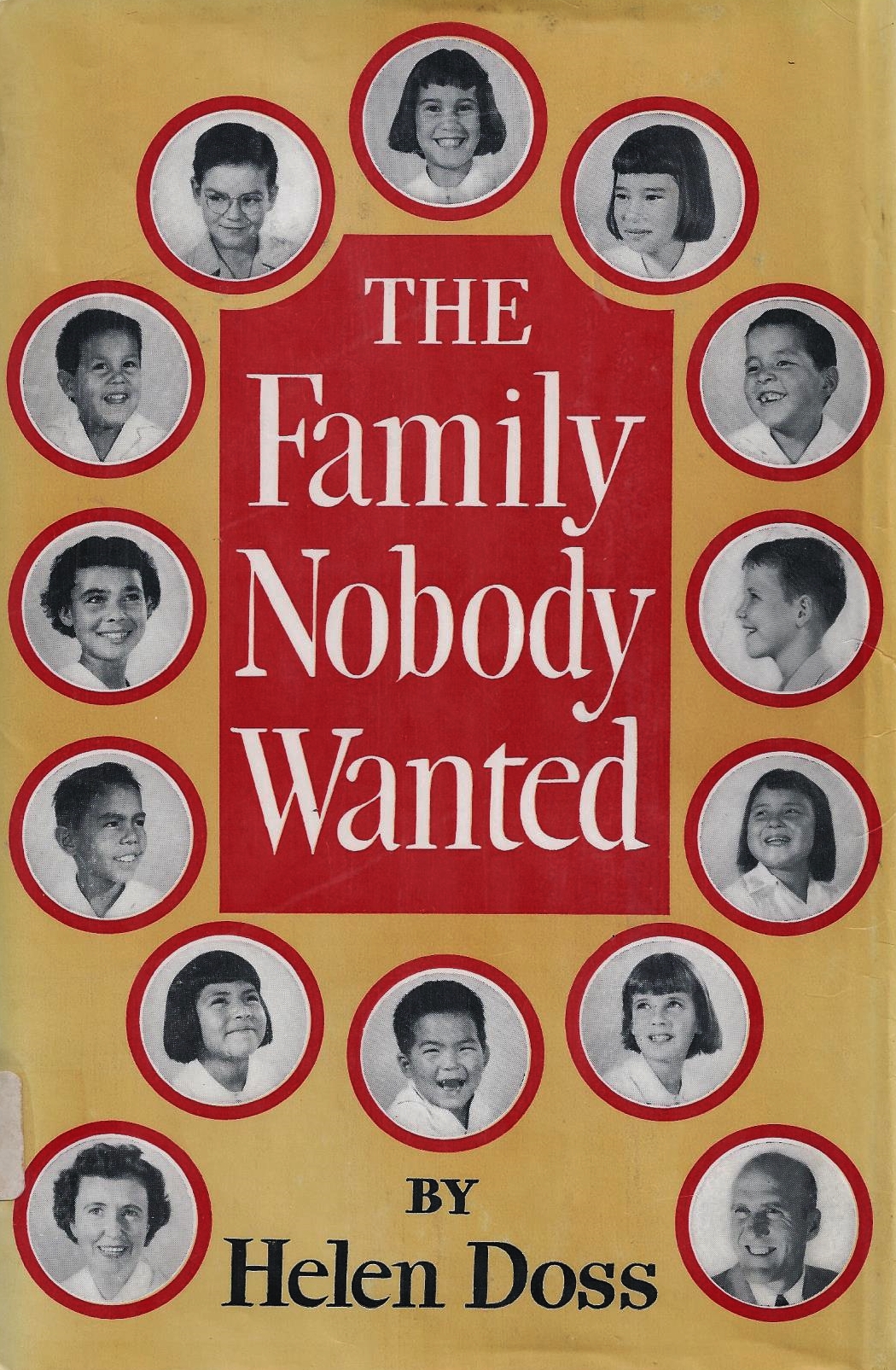
the family nobody wanted doss 1 001The Family Nobody Wanted by Helen Doss ~ 1954. This edition: Little, Brown & Company, 23rd printing. Hardcover. 267 pages.

My rating: 6/10

Well, this was an interesting read, and I’m still trying to decide what my personal reactions really are.

On the surface it is a simple feel-good memoir about a young childless couple adopting twelve children in the 1940s and 1950s, but there are deeper currents to the tale, especially from a half-century later perspective. In particular, there is a damning sub-text of racial intolerance which is very much a part of why and how this family came together.

I didn’t yearn for a career, or maids, or a fur coat, or a trip to Europe. All in the world I wanted was a happy, normal little family. Perhaps, if God could arrange it, Carl and I could have a boy first, and after that, a little girl.

God didn’t arrange it.

In fact, as our doctor regretfully informed us, Carl and I couldn’t have any children of our own. No children, no sticky fingerprints on the woodwork, no childish tears and laughter, no small beds in the other bedroom. Just barren, empty years, stretching aimlessly into a lonely future…

So Helen’s husband Carl, driven to distraction by his wife’s continual bemoaning of her barren future, suggests that they adopt a baby. Helen loves the idea, and the two optimistically prepare a room and trot off to the nearest orphanage, where they learn that it isn’t quite as simple as all that. Most of the babies in the orphanage were simply not available, being only in temporary care, or waiting for relations to take them in, and the adoption agencies which are the next resort are not particularly helpful either. Helen and Carl are informed that waiting lists are years long, and that each baby must match its potential parents perfectly in ethnic makeup and family background. And of course the parents must be financially stable, as well as sterling characters in all other aspects.

Carl and Helen are sure their characters are good, but the money thing is definitely an issue, and the waiting list situation seems cruelly stressful. So they set aside their ideas of forming a family and instead decide to pursue other interests. Both enroll in college, Helen to study literature and writing, and Carl to pursue a long-held dream to become a Methodist minister. And then, miraculously, one more attempt at adoption through an agency results in a beautiful blue-eyed baby boy. Helen is ecstatic; Carl more reserved. They can barely feed themselves, so this new addition is a challenge in more ways than one.

Young Donny thrives and grows, and all is well for a while, until Helen starts to brood over the loneliness of the only child. “If only he could have a little sister…” But another child is an impossibility, declares everyone they contact. “Just be happy you managed to get the one.” Unless, of course, they would consider a mixed race child. Lots of those were languishing in adoptive limbo, and, three years after Donny’s adoption, Filipino-Chinese-English-French Laura joins the family. And, only two months later, frail and sickly Susan, undesirable because of her weak constitution and a tumorous red birthmark on her face.

Helen is still thrilled, though she finds three children something of a challenge, but all three thrive, and Helen starts thinking again. Maybe just one more, a brother for Donny…

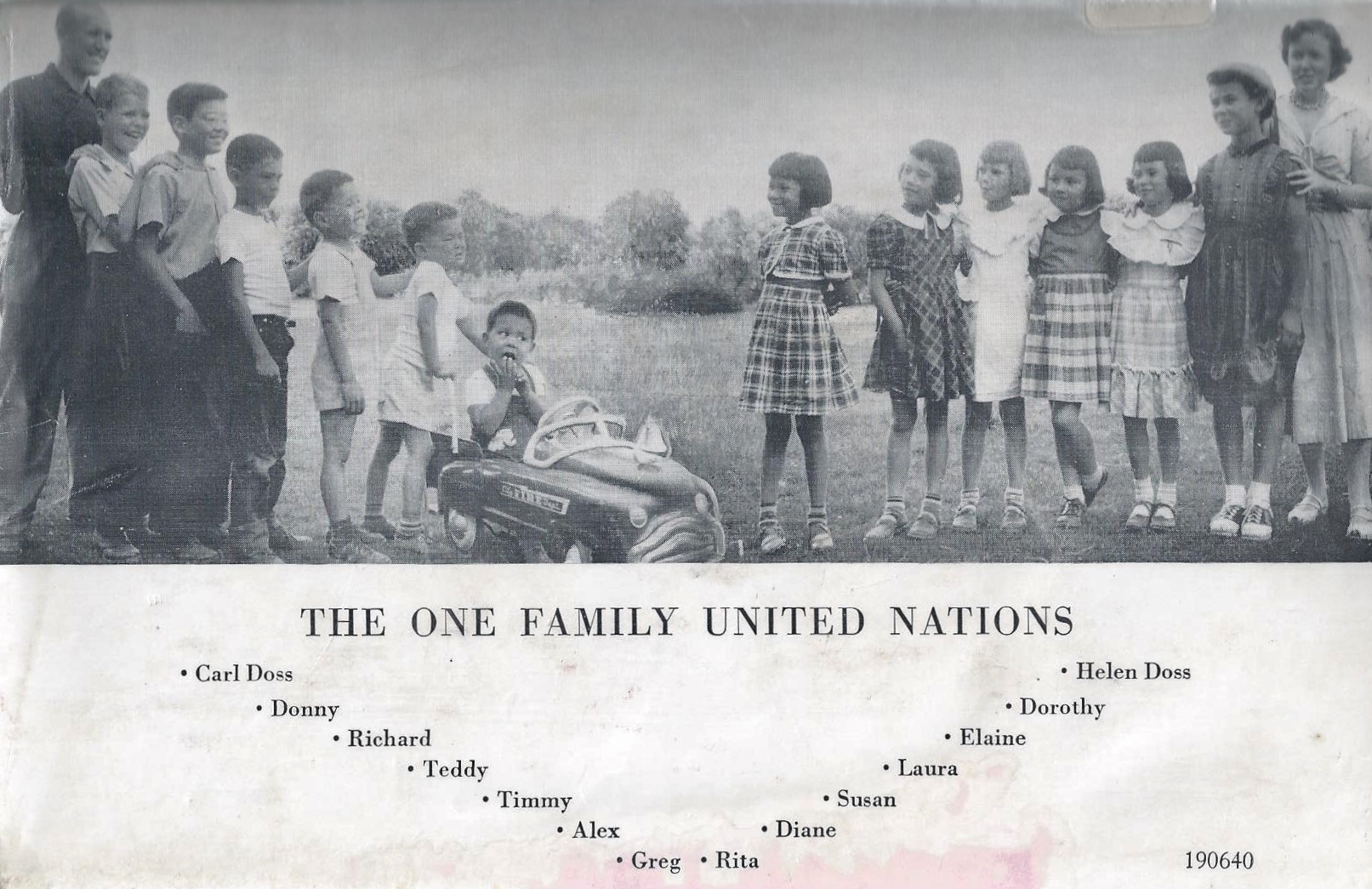
Eventually, with increasingly strident resistance from Carl, Helen collects a round dozen of children, six boys and six girls. She writes about the family’s experiences, and the tragedy of mixed race children being seen as undesirable by families otherwise desperate to adopt a baby; even though the Filipino, Chinese, Korean, Japanese, Malayan, Burmese, Spanish, French and American Indian children she and Carl eventually acquire are accepted by family and neighbours, a constant refrain is “As least they aren’t Negro!” Carl and Helen do attempt to adopt a part-black child from a German orphanage, child of black American GI father and a German mother, but the transaction is strangled by red tape; their families and friends are loudly vocal in their relief, and one of the most passionate chapters in the book strongly condemns this attitude, and addresses the degrees of racism inherent in American society, and its effect on innocent children along with its part in much greater societal ills.

Helen and Carl come across as truly sincere in their attitudes that colour means nothing, and that human is human; Helen starts writing articles about their “United Nations” family, and the Dosses catch popular attention, being interviewed, photographed and featured on radio and television, as a kind of shining example of American acceptance and tolerance, though in reality the very existence of their family group has come about through blatant American racial discrimination. These are, after all, the children that nobody wanted.

the family nobody wanted helen doss 2 001

The book ends only twelve years after that first baby, Donny, is adopted, and the tone is happily optimistic, but there are undertones that perhaps all may not be so well in future. Carl is a reluctant participant in the continual enlargement of the Doss family, though he is very willing to tout its benefits for interviewers; Helen persists in collecting children in the face of Carl’s outright “No more” plea, time and time again. The news that the Doss marriage ends in divorce in 1966, twelve years after the publishing of this bestselling book, comes as no surprise, though it is sad; one hopes that the children – some at that time well into adulthood, one must admit –  weathered their family breakup with a minimum of trauma, though one doubts that would completely be the case.

Knowing several cross-culturally adopted children who now, as adults, are seeking diligently to reconnect with their birth parents’ heritage, I wonder what happened to those twelve children as they grew up, and what they each personally made of their inclusion in this unique family, and of the publicity which their parents’ outspoken willingness to discuss their adoptive choices attracted.

I do think, both from the tone of Helen Doss’s memoir, and from other reports on the Doss family I read on the internet, that their intentions were, once they started adopting, only the best. And, also, I do tend to think that children deserve a loving family versus being institutionalized, and that if the only fit possible is cross-cultural, so be it. If it were more widely accepted (as it wasn’t in the 1940s and 1950s) then at least the “novelty factor” would not be such an issue.

I’ve tagged this post with a “religion” designation, because it is also very apparent that Helen and Carl Doss were motivated in a great part by their Christian faith. Carl Doss is quoted as saying that

…The whole idea of Christianity is radical (a)nd the whole idea of democracy is radical.  Think how really it is to say that all men are created equal, and that all men are brothers – and that the individual is important!

Conflicted as Carl seems to be by his wife’s acquisition of child after child, once they are brought into the family he apparently embraces his fatherhood fully, being as full of latent paternal affection as he is of “radical” Christian ideals.

A thought-provoking memoir, and, as I said, a bit uncomfortable to consider more deeply, given that a whole lot must have been left out. Though I was interested and pleased to see that Helen Doss was very frank about her own motivations of needing children to “complete” her idea of true womanly fulfillment; the ideal of a happy, multi-racial family group seemed to develop as her circumstances changed.

I did my usual look-around the web, and was interested to see how highly this book was rated on Goodreads; a large number of people apparently read and loved it in their school years; the reviews are by and large quite glowing.

It is very readable, and provides a truly fascinating (though superficial) glimpse into the mid-20th Century’s social dilemmas and attitudes towards both adoption and racial and interracial societal division lines. It is also frequently very funny; Helen Doss’s anecdotes of her children’s doing are downright adorable, and well targeted at the sentimental readers who have obviously embraced it as a “sweet tale”. It is a sweet tale; it is also an indictment of the bitter evils of racial discrimination; and a strong advocate of true Christian behaviour; and a revealing portrait of a marriage not without deep personal conflicts, despite its publically positive façade.

For more on the Doss family, these links will be good starting points.

Helen Doss – Obituary

Adoption Topics – The Family Nobody Wanted

Read Full Post »

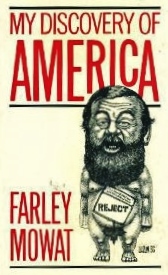
my discovery of america farley mowatMy Discovery of America by Farley Mowat ~ 1985. This edition: McClelland and Stewart, 1985. Hardcover. ISBN: 0-7710-6624-4. 125 pages.

My rating: 6/10.

High marks for tackling this topic with such eloquent vigour, tweaked downward for the increasingly bombastic posturings of the author, which led me to a sneaking small sympathy for his unwary opponents. As I read I could envision the froth forming at the Mowat’s mouth, perhaps dribbling down his legendary beard, too, as he raved on and on and on. (The conciliatory last chapter, where he thanks his many supporters in the U.S.A., did seem a bit calmer, and appropriately sincere.)

Oh – adding another point back on for that first chapter, in which Mowat describes his airport encounter with the Forces of American Evil, a.k.a. the INS: Immigration and Naturalization Services of the United States of America. It was a truly funny piece of writing, and for this I will forgive the annoyance Mowat so often inspires in me by his ego-driven blusterings, which, in this instance, had plenty of justification.

Okay, here’s the story. On April 23, 1985, as Mowat was setting out on a trip to the West Coast of the U.S.A. on a joint lecture/promotion tour for his just-released Sea of Slaughter (a passionate indictment of the human-caused ecological devastation of the Atlantic shores of North America), he was escorted off the plane as it sat on the tarmac, and notified that he was persona non grata in the U.S.A. Forever and for always. And no, we can’t tell you why, sir. Just go away now, sir.

Mowat storms out of the airport terminal and into the arms of his publisher, where he is met with a shared indignation exceeding even his own. “This is war!” (or words to that effect) cries Jack McClelland, and a press deluge begins, spurred on by the very recent “Irish Eyes are Smiling” Reagan-Mulroney love-fest, and assurances by both leaders that the U.S.A. and Canada are dear, dear friends.

Why does the mighty United States feel that wolf-, whale- and generally nature-loving Mr. Mowat is a security threat? And why do the words “Commie sympathiser” keep coming up, though no one will let Mowat or anyone else take a look at his secret file, the one that led to its abrupt barring from the neighbouring country?

It seems that there is a McCarthy-era law on the books, the McCarran–Walter Act, which allows such arbitrary barring on the most microscopic past “offenses”, such as visiting the USSR (which Mowat had done some  fifteen years earlier, to research his book Sibir), and – oh! that little incident in which Mr. Mowat reported a desire to shoot his .22 rifle at U.S. Air Force planes carrying (possibly) atomic warheads across Newfoundland air space…

125 pages later, not much has changed, except that Mowat is offered a “parole” to allow him a one-time entry into the U.S.A., which he scornfully turns down, “parole” implying some sort of wrong-doing.

In this post-9/11time of ever more stringent border examinations, and many more arbitrary black-listings for undisclosed reasons – “security risk” being the handy catch-all phrase – Mowat’s prior experience sounds sadly like something we’ve all heard before.

Mowat’s horrified indignation echoes so many others; his response was the one every wronged citizen dreams of pulling off. Lucky for Mr. Mowat that his celebrity and many connections allowed him to speak out so vibrantly without losing his livelihood or credibility, a real problem for so many others in the same position, as Mowat points out, and which is one of the reasons he puts forward for his strident rebuttal to his black-list barring.

An interesting read, and with chilling parallels to the situation today between the countries on both sides of the world’s longest – but for how much longer? – undefended border. The razor wire, both literal and figurative, is persistently going up.

Here, FYI, is a very partial list, courtesy Wikipedia and therefore including the related links, of some of the public figures joining Farley Mowat on the McCarran-Walter exclusion list, before its amendment (but not its dismantlement) in 1990:

Read Full Post »

« Newer Posts