Posts Tagged ‘Romance’

Hosted by Gudrun’s Tights (Seeking the Good in Literature and Life), Mary Stewart Reading Week is now underway.

Pick up an old favourite or a new-to-you novel by the venerable Mary Stewart (truly venerable, as she’s turning 97 tomorrow – Tuesday, September 17th), and share your thoughts with everyone by posting and/or linking HERE .

Read Full Post »

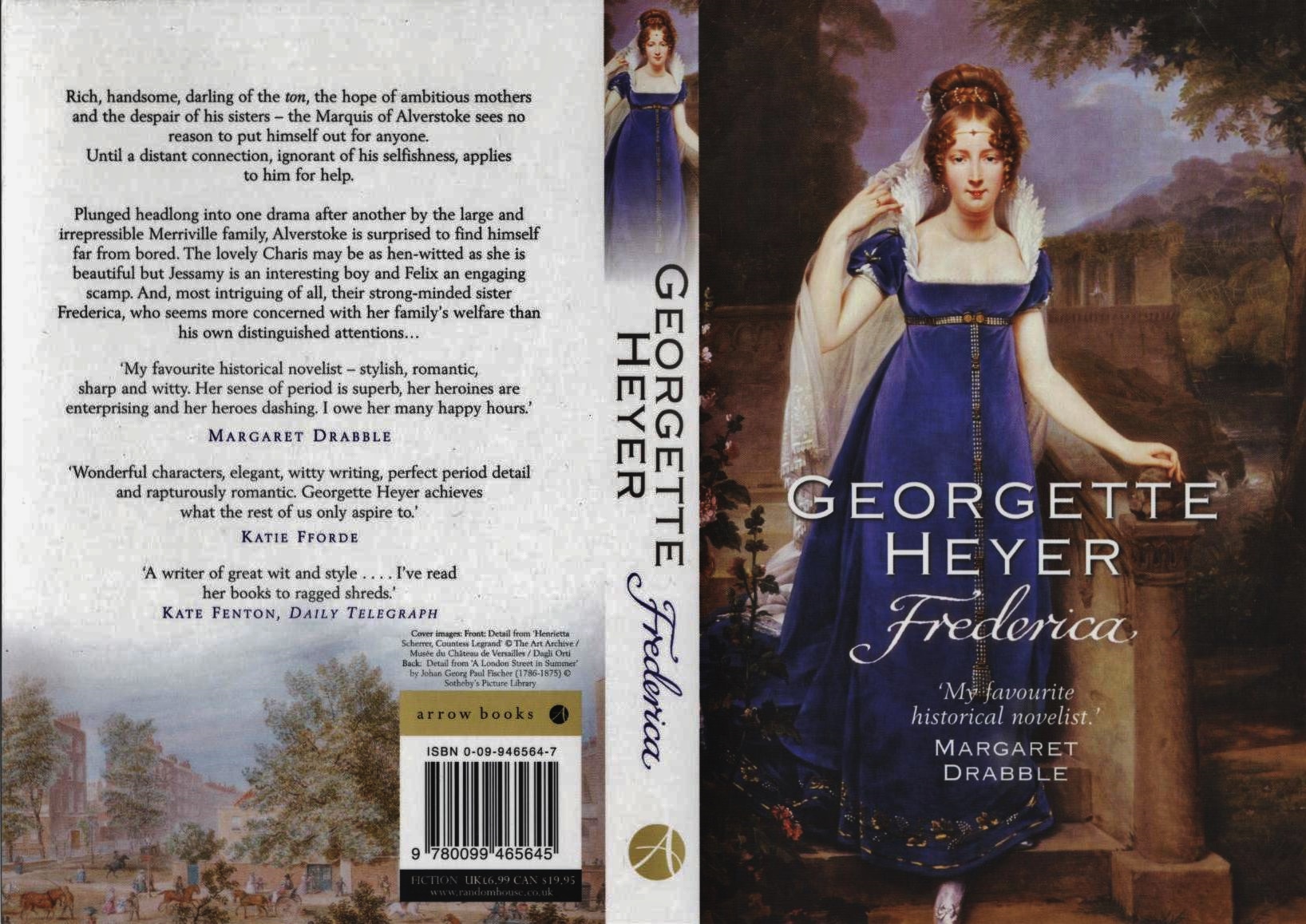
frederica georgette heyer 1Frederica by Georgette Heyer ~ 1965. This edition: Pan, 1968. Paperback. ISBN: 330-20272-3. 330 pages.

My rating: 7.5/10.

This is my fifth ever Georgette Heyer “Regency Romance” title. After bowing to so many recommendations to give the author a try, I must say that I am thoroughly enjoying my explorations of her work. Frederica was, I believe, Heyer’s twenty-ninth Regency novel, in a writing career spanning fifty years, in which she produced a very respectable sixty-plus novels and mystery thrillers.

Here, in Heyer’s own words, is the rather tongue-in-cheek blurb she wrote for the pre-publication promotion of Frederica, at the insistence of her publisher. By this time, in the mid 1960s, the author was a reliable producer of “a book a year”, with a strong contingent of devoted fans clamouring for more.

This book, written in Miss Heyer’s lightest vein, is the story of the adventures in Regency London of the Merriville family: Frederica, riding the whirlwind and directing the storm; Harry, rusticated from Oxford and embarking with enthusiasm on the more perilous amusements pursued by young gentlemen of ton; the divine Charis, too tenderhearted to discourage the advances of her numerous suitors; Jessamy, destined for the Church, and wavering, in adolescent style, between excessive virtue and a natural exuberance of spirits; and Felix, a schoolboy with a passion for scientific experiments. In Frederica, Miss Heyer has created one of her most engaging heroines; and in the Marquis of Alverstoke, a bored cynic who becomes involved in all the imbroglios of a lively family, a hero whose sense of humour makes him an excellent foil for Frederica.

The storyline is as simple as can be. It involves that tried and true pursuit, the husband hunt, and of course its equally vital counterpart, the quest for an acceptable wife.

Frederica, eldest in a family of five recently-orphaned siblings, has, at the advanced age of twenty-four, cheerfully accepted that she is destined for a life of happy spinsterhood. With her oldest brother, Harry, several years her junior, off at Oxford, Frederica is concentrating her energies on her nineteen-year-old sister Charis, who is an adorable young lady, being sweet-natured (though not overly bright), and stunningly beautiful. The little snag is that though the Merrivilles were left with a reasonably adequate income after their late father’s demise, the otherwise desirable Charis will not have much of a marriage portion to accompany her lovely self into a marriage; Frederica is determined to introduce her sister into the highest society and provide her with a chance to attract a high-born (and wealthy) suitor who may overlook her (relative) poverty.

Frederica petitions a remote cousin, Vernon, Marquis of Alverstoke, to sponsor Charis for her London season. Lord Alverstoke, a confirmed cynic and a slightly notorious rake – though forgiven all by fashionable London society out of respect for his massive fortune – is initially dismissive of Frederica’s suggestion, but she so charms him with her candour and sense of humour that he unexpectedly relents and decides to don the mantle of guardian of the Merriville menage for a while, mostly, he tells himself, because his interest in the lovely Charis – a direct competitor in the marriage market to their own daughters – will annoy his snobbish and critical sisters.

Charis does indeed cause a sensation with her loveliness and good nature; suitors reliably materialize, and the story meanders on its way. And we all know who Lord Alverstoke ultimately falls for, don’t we? Though the object of his reluctant devotion remains oblivious, which gives opportunity for the reader to sigh romantically over the reformed rake’s newly awakened and, for the first time in his life, truly heartfelt passion, which – of course! – he cannot share with the woman of his desires, as she shows no signs of reciprocation and would doubtless laugh off any advance…

This novel does rather go on; Georgette Heyer was going through a bout of serious ill health while it was being written and readied for publication, and she stated that though she would have liked to have edited it more strongly and decreased its length, her publisher’s and public’s demands overwhelmed her and she let Frederica go into print as it stood.

It works, though. The characters are interesting, and the dialogue is – overused but apt description – sparkling. The situations Frederica and her two youngest brothers, earnest Jessamy and rambunctious Felix, get themselves into are enjoyably humorous. The period detail is absolutely delicious, and I loved the passing descriptions of dress which Heyer provides, speaking to her readers as though they too were intimately familiar with the fashions of the time period. She informs, but never preaches; this is the type of historical fiction I like the very best. The readers must stretch to take it all in, but the writer assumes her audience is perfectly capable of doing so, and the story moves right along.

Of particular interest were the references to the technological inventions of the day. I was most intrigued by the mention of

… Maillardet’s Automaton … this marvel was a musical lady, who was advertised, rather alarmingly, to perform most of the functions of animal life, and to play sixteen airs upon an organised pianoforte, by the actual pressure of the fingers…

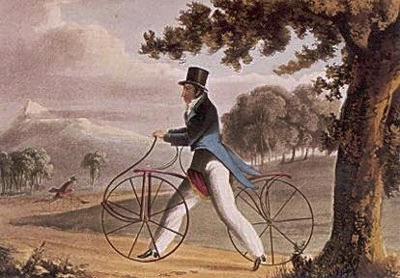
frederica georgette heyer pedestrian curricleAlso the Pedestrian Curricle, a kind of pedal-less precursor to the bicycle, upon which one of the Merriville boys, in company with a steep hill and a canine companion – the boisterous pseudo-“Baluchistan Hound” Lufra –  comes to grief. And then of course there is the ballooning episode which concludes the story with such drama.

A most enjoyable diversion, was cheerful and overwhelmingly good-natured Frederica – book and heroine both – and I savoured every page.

It lost a few points on my personal ratings scale by the rather overdone drama of the ending, which I thought was just a bit over-the-top, is such a criticism can be levelled at a book of this genre.

Looking forward to my next foray in Georgette Heyer’s meticulously depicted Regency world, and to meeting yet more of her dashing heroes and clever heroines.

In the meantime, here are some of the covers for Frederica which struck my fancy as I poked about the internet investigating other reviews, of which there are many, most exceedingly enthusiastic.

I liked this cover; it has a decided "period" appeal.

I liked this cover; it has a decided “period” appeal.

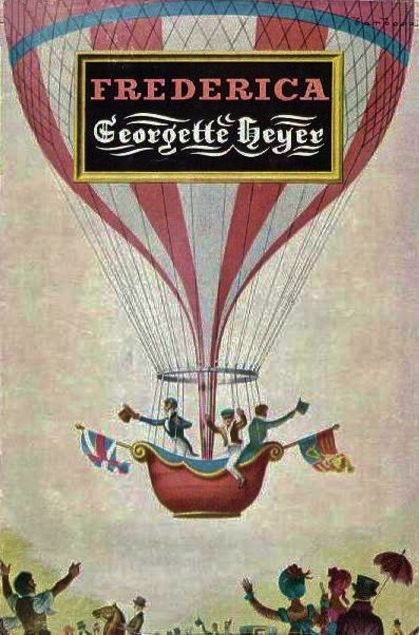
And this one, focussed on the dramatic balloon episode which brings the tale to a fitting conclusion.

And this one, focussed on the dramatic balloon episode which brings the tale to a fitting conclusion.

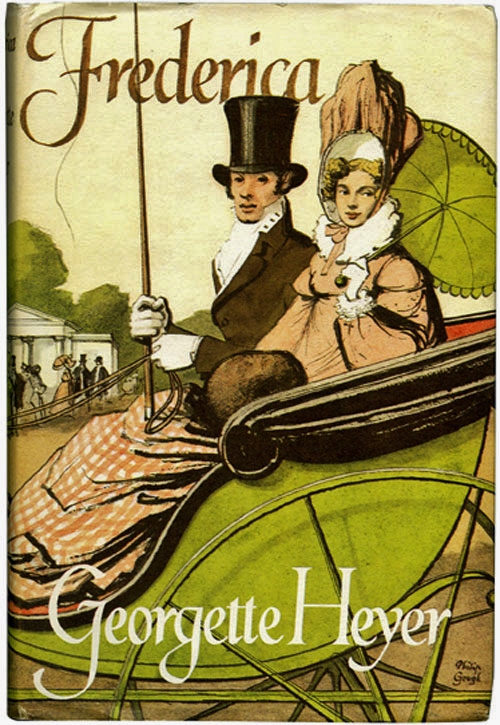
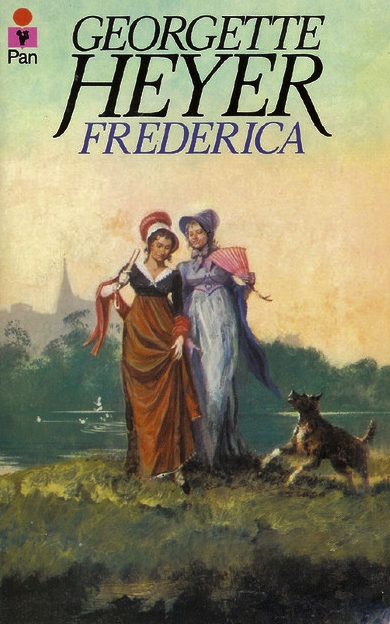
And here we have Frederica and Charis, accompanied by their beloved Lufra. I'm not quite sure about that fan, though; would it have been employed in such a way on a daytime stroll in a London park?

And here we have Frederica and Charis, accompanied by their beloved Lufra. I’m not quite sure about that fan, though; would it have been employed in such a way on a daytime stroll in a London park?

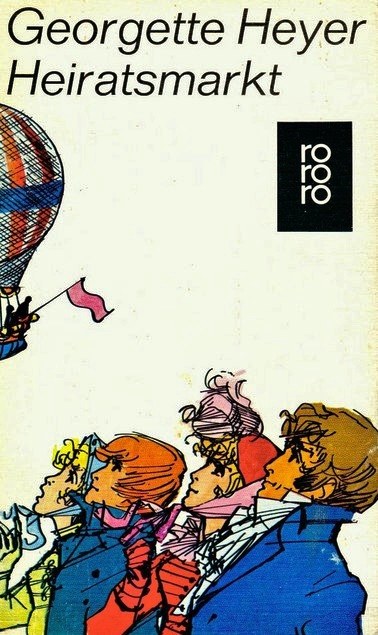
Here's a German cover which caught my eye. (Georgette Heyer was apparently very popular in Germany.)  I really like the strong colours and simplicity of the pen-and-ink treatment of this poster-like illustration.

Here’s a German cover which caught my eye. (Georgette Heyer was apparently very popular in Germany.) I really like the strong colours and the striking simplicity of the pen-and-ink treatment of this poster-like illustration. (“Heiratsmarkt” translates to “Marriage Market”.)

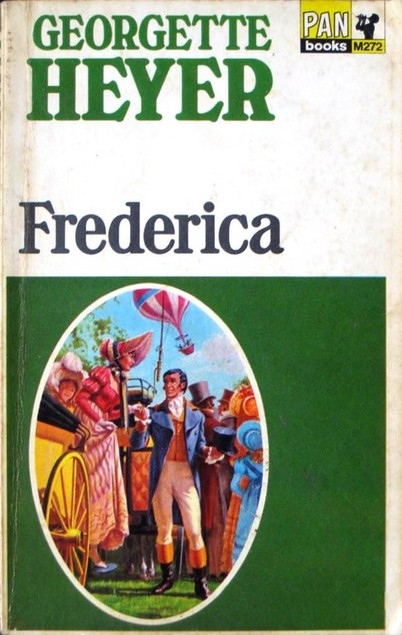
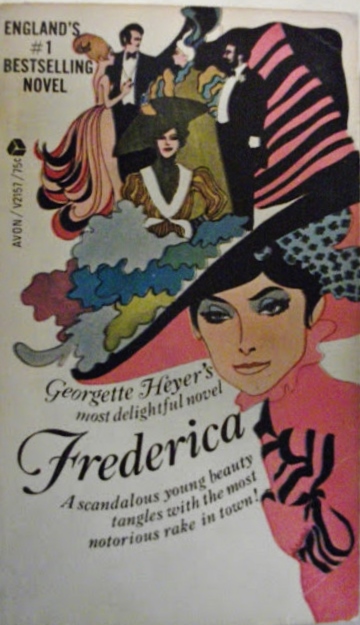
This one is absolutely bizarre, a triumph of misguided misrepresentation.  Who are these people, and why have they strayed from a 1960s costume party onto the cover of a well-mannered Regency-period romance?!

This one is absolutely bizarre, a triumph of misguided misrepresentation. Who are these people, and why have they strayed from a 1960s costume party onto the cover of a well-mannered Regency-period romance?! And who is the “scandalous young beauty” so prominently mentioned? Egads! Did the illustrator read the book? Methinks…NOT.

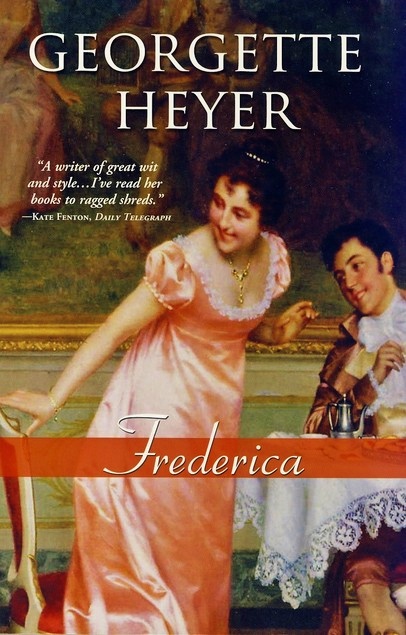
A more current cover from a recent re-release. This one captures the happy tone of the novel wonderfully well, though the featured female does not really fit my mental picture of Frederica herself.

A more current cover from a recent re-release in 2009. This one captures the happy tone of the novel wonderfully well, though the featured female does not really fit my mental picture of Frederica herself.

And here is the most recent cover, from 2011. Again, not my mental image of Frederica, but a lovely cover nonetheless.

And here is the most recent cover, from 2011. Again, not my mental image of Frederica, but a lovely cover nonetheless.

Read Full Post »

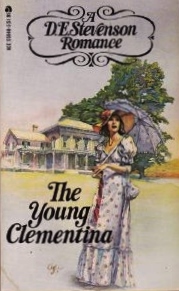
the young clementina d e stevensonThe Young Clementina by D.E. Stevenson ~ 1935. Original/alternate titles: Divorced From Reality and Miss Dean’s Dilemma. This edition: ACE, 1975. Paperback: 0-441-95048-5. 320 pages.

My rating: 9/10.

Completely met expectations, up to and including the blush-inducing ending, which lost the story its single “you’ve got to be kidding!” point. Golly, D.E. Stevenson often bobbles in those last few pages, doesn’t she?!

Well, really, the ending’s not that bad. Just…hmm…maybe just a little bit rushed? And a little too good to be true? But hey! – that’s why I’ve come to quite adore D.E. Stevenson. This story in particular is escape literature at its delicious, romantic, improbable, suspend-your-disbelief for hundreds of pages, period-piece-vintage best.

Okay, here’s a brief overview of the set-up of this novel. It’s very nicely done indeed; one of the author’s melodramatic (versus her more placid and thoughtful) minor masterpieces.

I wonder how a hermit would feel if he had spent twelve years in his cell and were called back to the world to take up the burden of life with its griefs and worries and fears; if he had passed through the fire of rebellion and achieved resignation; if his flesh had been purged by sleepless nights and his mind had found the anodyne of daily work. Would he feel afraid of the world, afraid of the pain awaiting him, afraid of his own inadequacy to deal with his fellow men after his long, long years of solitude? Would he refuse to listen when the world called, when his conscience whispered that his duty lay outside his cell, or would he gird up his loins and go forth, somewhat reluctantly, into the world which had turned its back upon him for twelve years?

My mythical hermit is standing at the parting of the ways, and so am I. Two roads are open to me, one lonely but well known, peaceful and uneventful; the other full of dangers and difficulties which I cannot foresee…

Our narrator is middle-aged Charlotte Dean, inhabitor of a dreary London flat, efficient and self-effacing librarian at a quiet geographical library – repository of “any book that adds to the geographical knowledge of the world” – recluse from that very world. Her only friend, aside from her kind employer, Mr. Wentworth, and her dedicated charwoman, Mrs. Cope, is her diary, in which she records her daily doings as she has done from childhood.

Ah, childhood. Happy days, indeed, when Charlotte was the beloved child of the Parsonage in green and flowery rural Hinkleton, running wild with her bosom friend, Garth Wisdon, equally beloved child of the Manor. Charlotte and Garth were inseparable, and their friendship was not at all disturbed by the advent of Charlotte’s small sister, Clementina – “Kitty”, as she was soon named. Not then, not in childhood. But as the years passed and friendship ripened to something deeper, Kitty had her part to play in the dissolution of the bonds that held Charlotte and Garth together…

The Great War tore Garth away from Hinkleton, and upon his return it is, unexpectedly, Kitty who becomes the new lady of the Manor, while Charlotte remains at home to care for her failing father, and then creeps off to London when his death leaves her alone and penniless.

For some strange reason Charlotte and Kitty are no longer the close friends that they were in childhood, and Garth openly sneers at his once-beloved “Char”. She meets them only occasionally, and so is rather surprised to be asked to act as godmother to her young niece Clementina  – named after her vivacious mother – and to visit at Hinkleton Manor for the occasion. But Garth is still dismissive and sarcastic, and Kitty disturbingly self-centered and complaining, so Charlotte returns to her quiet life with no thought but to regain her hard-won peace of mind, and to leave the dead past buried.

Then, twelve years after her flight to London, Charlotte’s world is turned topsy-turvy by the dramatic re-entry of Kitty into her life, and she faces the dilemma referred to at the start of the story…

For another look at the story, and an enthusiastic recommendation, a visit to Fleur Fisher‘s review will be in order.

I greatly enjoyed this grandly melodramatic and deeply romantic tale. Most engaging and deeply readable, and for that I’ll even forgive the rushed and too, too predictable “surprise” ending, my one perennial gripe with this author’s style. She builds up her story wonderfully well, rockets it along in fine style, and then chops it off with a hurried ending, almost every single time. Grrr. (And do please ignore this complaint; it’s a very minor one, and in no way puts me off reading these books with genuine enjoyment.)

I can see why this novel is so highly thought of by D.E. Stevenson devotees; she’s in fine form throughout. I do believe this one has just been re-released on July 2, 2013, so it should be readily available, just in time for your summer reading pleasure. Here’s the Amazon.com link, which includes an excerpt of the first chapter.

And I’ll say once more, this is a very vintage romance, written in the 1930s, with all of the expected clichés. It is, perhaps, even a bit old-fashioned for its time; it rather reads like something out of the closing years of the century before. With that in mind, enjoy!

Read Full Post »

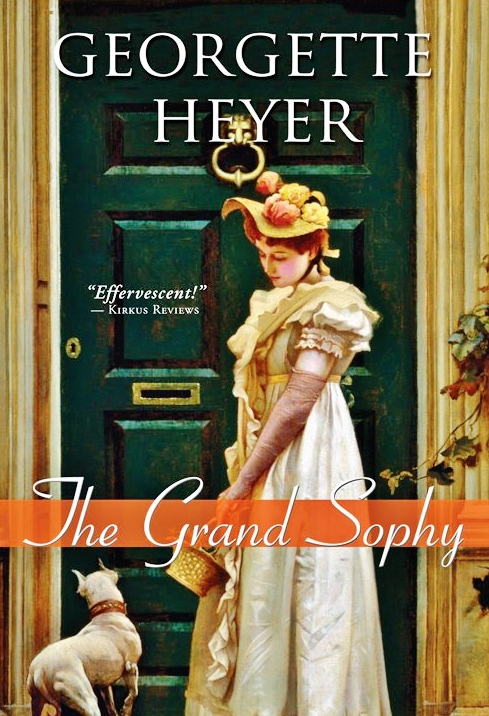
the grand sophy georgette heyerWell, I’ve finally done it. Georgette Heyer has been praised so often and so enthusiastically by so many of the book bloggers whose recommendations I have come to look forward to as decidedly reliable that I have taken the plunge.

I don’t really “do” romance novels as such, though of course most of the books I read incorporate some sort of romance, whether it be traditional male and female or some other sort of love affair (and by this I mean any sort of relationship – platonic friendships are love affairs, as are parent-child relationships, and all of the individuals emotionally invested in some way, whether it be with an idea, an occupation, a house, a garden, a country, a way of life… it’s all about passion and feelings and, yes, “romance” of some sort, isn’t it?)

(And did I just digress? Yes, I think I did!)

Anyway, bodice rippers in the good old Harlequin tradition aren’t really my thing, and the undoubted fact that Georgette Heyer has been republished by Harlequin – I have here on my desk a just-purchased (but as yet unread) copy of The Quiet Gentleman, Harlequin, 2006, with a publisher’s list of other Heyers in the back – was not a point in favor. I’d also read several of Heyer’s mystery stories – she famously wrote one romance novel and one mystery novel each year during a period of financial necessity – and found them no more than mildly diverting. But then there were all those Jane Austen comparisons, and the chatter about her being a seriously underrated writer, and all those comments about her undoubted mastery of her chosen literary period – England’s Regency era, the first few decades of the 19th Century – and all of the lavish praise in the blogosphere…

So I made the decision to give Heyer one more try. Pulling up her name on the library catalogue, I was impressed to see that there was a reasonably large selection of titles, arguing a current popularity (my present public library is very quick to cull and has very few older books in the stacks), some of which I remembered as having received glowing reviews from my blogging peers. Home came Sylvester and The Grand Sophy, as well as a third which appealed because of the plot description on the back, but which I haven’t yet read, Black Sheep. I’m a bit Heyer-saturated at the moment, after reading the first two almost back-to-back, but will definitely be reading the third book well within my alloted three weeks before it needs to be turned back in.

In other words, I liked these. A lot.

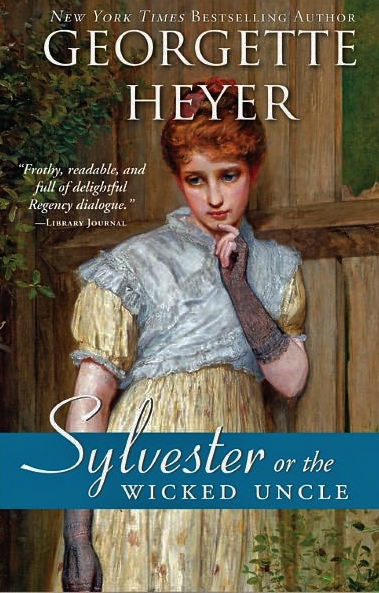
Sylvester: or the Wicked Uncle by Georgette Heyer ~ 1957. This edition: Sourcebooks, 2011. Softcover. ISBN: 978-1-4022-3880-2. 386 pages.sylvester or the wicked uncle georgette heyer
My rating: 9/10.

This story is an absolute hoot. It has everything. Misunderstood heroine – check. Highly intelligent and of an unconventional attractiveness, of course – check. Wicked stepmother – check. Fabulously handsome, wealthy and aristocratic love interest – check. Initial misunderstanding by chief couple and instant dislike of each other – check. Endless complications before true love finds its way – check.

It’s basically Pride and Prejudice with the added bonus of a botched kidnapping (literally), a surreal trip to France, and horses.

You know what? I’m going to stop right here and refer you over to this absolutely excellent blog post by Claire at Captive Reader. It’s the one that convinced me to give this author a go, and the post says absolutely everything I would like to. Anything I could come up with this morning would be a pale shadow of what Claire has said so well. (I am horribly pressed for writing time these days, but cannot let this book pass without a mention. It was so much fun!)

The Captive Reader – Sylvester or the Wicked Uncle

Sylvester more than met my own expectations. The point it lost was right at the very end; I thought the final romantic scene wasn’t quite up to the standard of the rest of the story. But endings are notoriously difficult, and it wasn’t terribly bad or anything. Just not quite… something

But all in all, a very enjoyable read. Great introduction to this author; I’m won over.

*****
the grand sophy yestermorrow georgette heyerThe Grand Sophy by Georgette Heyer ~ 1950. This edition: Yestermorrow, 1998. No ISBN found. 347 pages.

My rating: 9/10.

Gosh, where to start? Let’s see how good my condensation skills are this morning!

Sir Horace Stanton-Lacy, world-roaming diplomat, drops in on his aristocratic sister Lady Ombersley for a brief visit while en route from Lisbon to Brazil. After racing through the polite preliminaries (Sir Horace is excessively focussed on getting right to the point with the least amount of fuss and trouble to his self-indulged self) the object of his detour becomes apparent.

Could he possibly leave his (motherless) twenty-year-old daughter Sophy with her dear aunt? Brazil, in the early 1800s, is rather rough in places, and even careless Sir Horace has qualms about its suitability for an upper-class English girl’s place of residence, even under the auspices of her important Papa. Sophy – “Dear little soul: not an ounce of vice in her!” exclaims said Papa – is as good as “out”, though the formalities of a Court presentation have been unavoidably omitted, what with living on the Continent and all – and will be a lovely companion for her cousin Cecilia. And while she’s here, dear sister, Sir Horace goes on to say, how about fixing her up with a suitable husband? I’m sure you can manage to arrange that for me…

Lady Ombersley is shocked into agreement, and Sir Horace disappears as quickly as he came, leaving with a promise that Sophy shall be welcomed into the bosom of her extended family. The family, as far as I can remember – there’s a lot of characters in this hectic novel – consists of Lord and Lady Ombersley, their eldest son Charles Rivenhall – who is by way of being head of the family, financially speaking, as he is his recently deceased wealthy grandfather’s heir as Lord Ombersley is an incorrigible gambler who has virtually impoverished his own estate – sober Charles is busy doing damage control while his father continues his dissipated lifestyle on a much more modest scale – the beautiful aforementioned Cecilia, a younger brother, Hubert, at Oxford, another, Theodore, at Eton, and young sisters Amabel and Gertrude.

Sophy shows up quite soon, and far from being the meek and gentle niece and cousin the family was expecting, turns out to be positively Amazonian, a self-assured and shockingly outspoken young lady, looking on her English sojourn as something of an amusing lark, though she’s agreeable to being introduced to some interesting and suitable young men on matrimonial approval, as it were. She throws the household into a turmoil it has never known before, and soon it becomes apparent that Sophy is a born manager of other people for their own good, and that in her staid cousins she has found much scope for her personal hobby.

Charles is engaged to the most prim and proper Eugenia Wraxton, who is looking forward to her upcoming marriage and increase in social status with smug self-satisfaction; it soon becomes apparent that cousin Sophy does not meet with her approval, and Eugenia’s true nature as a sly, prying, manipulative scold is thereby revealed, though Charles appears blind to this, at least initially.

Cecilia has been presented with a suitable young nobleman, Lord Charlbury, as a potential spouse, but has instead become infatuated with Adonis-like Augustus Fawnhope, an aspiring poet. (He instantly reminded me of none other than P.G. Wodehouse’s Madeleine Basset, of “the stars are God’s daisy-chain” fame; subsequent events merely strengthened that comparison.) Hubert has gotten himself embroiled in gambling debts – shades of the paternal situation – and is too terrified to confess to his older brother, and has instead gotten into the clutches of an evil moneylender.

The younger children, luckily, are not much in need of sorting out, so Sophy busies herself with rearranging Charles’, Cecilia’s and Hubert’s lives for them.

Charles is immediately resistant to his lively cousin’s attempts to “manage” his family; he cleaves to the unpleasant Eugenia with commendable loyalty, but cracks soon appear in his iron-hard facade. Eugenia is quickly driven to open criticism of Sophy’s lack of propriety; Sophy seems to delight in shocking and annoying Eugenia; Sophy is marvelously clever at pushing all of Charles’ buttons, and seems to come out ahead in each of their encounters; her and Charles’ continued verbal sparring (and shared love of horses) gives the alert reader the key to the eventual outcome of that particular triangle of personalities!

Cecilia and her poet are all over each other, while Lord Charlbury mopes in the his lonely corner (he’s recovering from the indignity of having had the mumps at a crucial time in the progression of his courtship of Cecilia.) Sophy takes those three in hand as well, giving Lord Charlbury instruction on how best to woo his reluctant prospective spouse, and eventually exposing Augustus Fawnhope’s deep ineffectualness to the no-longer-quite-so-besotted Cecilia.

Hubert’s moneylender is confronted with aplomb, in a scene which received some negative press in the blog world for its deeply stereotypical depiction of a Shylock-like Jewish character. (See here for a fascinating and extended discussion of racial stereotyping in literature, centered on The Grand Sophy, and widening to Heyer in general, then bringing in Agatha Christie, Ngaio Marsh and Dorothy L. Sayers as well; the many comments following this post are thought-provoking; the whole exchange is well worth reading.)

This workaday plot summary leaves out the sparkling dialogue and the deep humour which infuses every page of this lively historical romance; it’s a grand read for a dull day; perfect escape literature, and not to be taken too, too seriously, I think. An amusing romp, with the bonus of being meticulously researched and full of era-correct dialogue, descriptions of food, dress, and the social world of upper classes of post-Waterloo England. If you appreciate Jane Austen and Thackeray’s Vanity Fair, you’ll find much to admire in Georgette Heyer’s detailed and very funny take-offs of the time.

As with Sylvester, The Grand Sophy was a whole lot of fun. More so, really – it is almost antic in its multitude of plot twists, turns and tangles, where Sylvester maintained a certain dignity even in its most absurd moments. But Sophy lost its point in the same place, right at the end. It was a good ending, a proper ending, with loads of predictability and a few (small) surprises, but there was something just a tiny bit rushed over how everything tied itself up so quickly, as if the author, with finish line in view, had pushed herself into one last full-speed-ahead dash of writing. But, as with Sylvester, not a big issue, and easy to forgive.

And I did forgive the author her moneylender; I mulled this over quite a bit, and have held back this review to consider how deeply I wanted to address this issue. I have come down on the side of letting it go in the interests of era-correctness. Yes, the book was published post-World War II, when the horrors of the Holocaust were well-known and fresh in memory, but the treatment of the character in question was completely in line with the 19th Century world it depicted. And The Grand Sophy is something of a parody in its treatment of all of its characters; I don’t believe we are meant to take any of them all that seriously. If one wants to be offended, there’s a lot of scope for that in more than the Jewish moneylender episode. I choose not to be offended, though I see where the offense lies, and will leave it at that. (At least for now. This is a topic which is never really dormant, whether reading vintage or contemporary fiction.)

At the end of the day, I must say that I enjoyed these books, and I’m looking forward to encountering more of Heyer’s delicious romances, but I suspect that they are best taken one at a time, as a sort of self-indulgent literary “rich dessert”; nice as an occasional treat but not really suitable for daily fare!

Read Full Post »

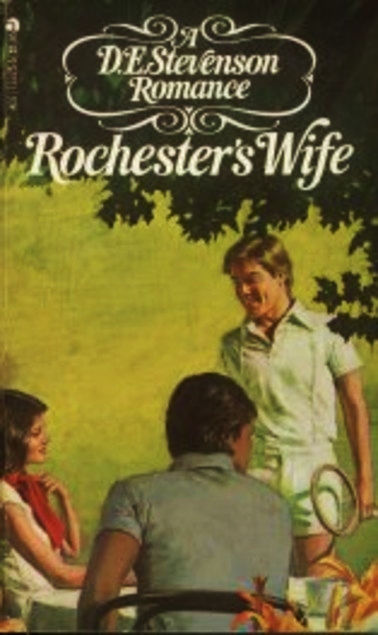
rochester's wife d.e. stevensonRochester’s Wife by D.E. Stevenson ~ 1940. This edition: Ace, circa 1970s. Paperback. ISBN: 978-0441733255. 335 pages.

My rating: 5/10.

*****

This is one of the “secondary” D.E. Stevensons, and, I believe, a “stand-alone” book, as none of the characters seem to reappear in any of the other stories. Though published in 1940, the time frame is pre-W.W. II, as there are only a few references to the “situation in Europe”, and, though the atmosphere is cloudy with foreboding, the focus is on the troubles of the individual characters, versus those of the wider world.

Young (in his late twenties) Dr. Kit Stone has returned to England after four years of travelling round the world seeking adventure. He had long cherished the ambition to become a sailor, but his (widowed) physician father had pressured him into studying medicine instead, with a view to taking over the family practice. The elder Dr. Stone died just as the younger Dr. Stone qualified, and the practice was instead sold, with the proceeds being split between the family’s two sons. The elder brother, Henry, had gone into business as a successful stockbroker and invested his share accordingly, while Kit, suddenly at loose ends, has decided to see something of the world.

Kit’s travels are touched on continually throughout the novel, and sound quite fascinating in and of themselves. He’s been in China, “looking for the war”, and has seen more of it than he had planned for. There is a reference, near the end of the book, to his standing in a marketplace when a shell fragment kills a mother and baby standing next to him; he is “spattered with their blood”, and there is a statement that he has seen quite a lot of blood in his travels. Strong stuff for this mild romance! Another incident, which has more bearing on the eventual plotline, is that Kit has had experience with diagnosing and treating a case of insanity while in America. One would rather like a full itinerary of his wanderings; he seems to have covered quite a lot of ground!

So now Kit is back in England, and though he still feels that he can’t bear to be “tied down”, he allows his brother to persuade him to try out steady employment for a while. Henry’s business partner, Jack Rochester, lives in the village of Minfield, just out of London. Jack’s wife, Mardie, is good friends with the elderly village doctor, who is getting overwhelmed with the demands of his practice, and when she hears of Henry’s brother’s sudden return, puts forward the idea that perhaps Kit might be interested in a position as assistant to the Minfield practice.

So Kit, rather reluctantly, agrees to try out life in an English village. Dr. Peabody welcomes him with gruff suspicion, which we (and Kit) immediately see as merely hiding hte proverbial heart of gold. The Peabody household consists of the elderly doctor, his bitter spinster daughter Ethel, and a grandson, precocious (and exceedingly likeable)young Jem, who is living in England for the “healthy climate” while his parents reside in Ceylon on a tea plantation. They are soon joined by another daughter, Dolly, recently married and, unbeknownst to her family, newly pregnant. Her husband, stationed in Malta, has asked her to stay in England because of her pregnancy, and Dolly’s reluctance to share this news with all and sundry has led to some speculation that perhaps her marriage is already in trouble, because otherwise why wouldn’t she be following her spouse?! Dolly and Ethel are the classic bickering sisters, and their feuding and continual cutting comments to each other add a lot of spice to this rather pedestrian tale.

The heart of the novel is an (apparently) doomed love triangle between Kit, the absolutely beautiful, charming and saintly Mrs. Rochester (Mardie), and her high-strung husband, Jack. Kit is immediately smitten with Mardie; Mardie is deeply in love with Jack; Jack depends on Mardie for emotional support as he deals with his stressful job, and much is made of how happy Mardie and Jack were in the first year or two of their marriage, though now, in year three, things are rather more difficult.

As young Dr. Stone is absorbed into the Minfield world, all seems to be going well with the “settling down” process, but for the unrequited love bit. Kit yearns for his unavailable love, and we start to see little hints that perhaps his passion isn’t exactly unappreciated and unreturned, but of course, there is that rather prominent husband in the picture. Jack, however, is showing signs of what could be charitably described as nervous tension; his personality is deteriorating by the day, and Kit and Dr. Peabody are soon looking up the characteristics of “insanity” in their medical books, and talking of bringing in a specialist.

The ending of this tale is a bit sloppy and unlikely, though everyone ends up neatly paired and with problems happily solved. I’m sorry to say that this is not one of D.E. Stevenson’s better efforts among those I’ve read so far, though there are many diverting situations throughout the book, mostly concerning secondary characters. We have the relationship between the Peabody sisters, young Jem with his brilliant talent for mimicry, an elderly Scottish housekeeper, Hoony, and her illegitimate grandson, Wattie, and, off in the background, the very happy marriage between Henry and his rather liberated wife, Mabel, who dabbles in the stock market quite successfully on her own, with her husband’s proud approval. The relationship between the two brothers, Kit and Henry, is nicely portrayed as well. They do seem a likeable family, with reassuringly human flaws fully recognized and easily forgiven by the reader.

A reasonably decent read, though I found myself groaning and figuratively smacking hand to forehead occasionally, especially regarding the whole “insanity” thing, and the remarkable (!) scenario the author has dreamt up for its resolution. Definitely worth reading as part of the D.E. Stevenson canon, though I’m afraid I closed the book and said farewell to the characters with a feeling more of relief than reluctance!

rochester's wife d.e. stevenson daylily detail 001And I must say something about the dreadful paperback cover. (Cover illustrations being, as some of you may have gathered by my continual harping on the subject, something of an issue with me.) Why, oh why do publishing companies insist on putting “current” illustrations on books set in past times? The characters illustrated on the Ace cover are obviously from the 1970s in dress and hairstyle; I cringe when I look at it. The only thing that that I found attractive (and here is the hort in me speaking) is the rather lovely inclusion of a border of tall orange daylilies (probably Hemerocallis fulva ‘Europa’ from the looks of them), in the foreground of the trio of tennis players and extending around the back of the cover.

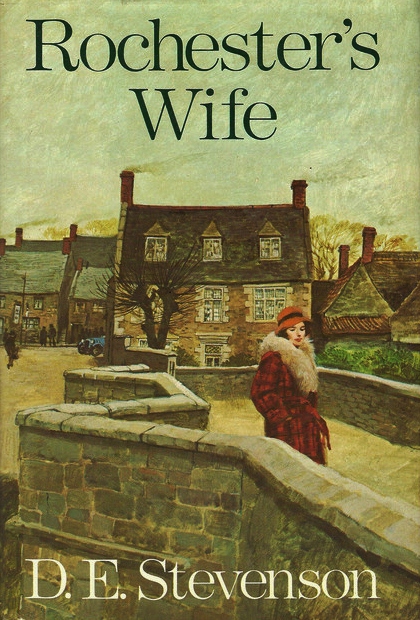
Much more appropriate is this other coverrochester's wife hc dj d.e. stevenson, which captures the mood and setting exceedingly well.

I am coming to the end of my personal stash of D.E. Stevensons, and the more I read of her the more eager I am to go on with building the collection. It’s going to be an expensive year, I fear. Even the tired old paperbacks are seriously overpriced, but I’m afraid I’m now hooked and will be playing the seeking game to the full extent that my pocketbook allows.

Part of the fun is the glorious awfulness of some of Stevenson’s scenarios – I just now have realized I’ve made no mention of the Jane Eyre references in this particular novel – nothing subtle about that, is there?!

D.E. Stevenson. When she is good, she is very, very good, but when she is bad … maybe she’s even more interesting!

Read Full Post »
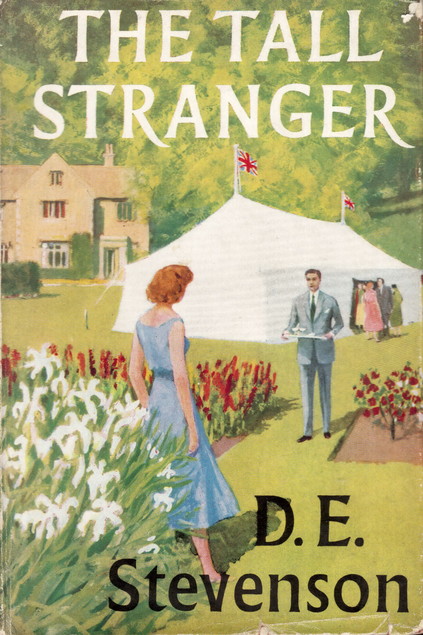
Tthe tall stranger d e stevenson hc djhe Tall Stranger by D.E. Stevenson ~ 1957. This edition: Ace, 1978. Paperback. ISBN: 0-441-79621-4. 252 pages. (Note: This is not the cover of the paperback, but of the original hardcover dustjacket. The Ace paperback illustration is quite a different thing! I will spare you it.)

My rating: 8/10.

Yes, it’s a very high rating for what is basically a “fluff” book, but it was what I needed last night, after a very trying day (condensed version – an unexpected visit to the vet with our 13-year-old dog and $2000 in emergency surgery fees, prognosis a guarded “fair”, upgraded to “good” when it was apparent that she handled the surgery very well indeed, all things considered) and it (the story) made me forget our combined woes for a bit, and made me happy. Maybe I should even put it up a point or two more for that!

Postscript – the dog is back home and looking most happy to be here; though rather sore and stiff after her internal surgery. Feeling optimistic this morning that all will be well with her for at least the near future, because, realistically, at 13, the inevitable final parting is not all that far away. This is the dreadful bit about sharing your home and heart with pets…

*****

This is one of D.E. Stevenson’s minor romantic novels which doesn’t get much press – I don’t think I’ve ever read anything about it at all. And probably for good reason – it’s a slight little thing, and the characters are nothing if not “stock”. But I loved it!

So here we have two roommates in a London flat. Barbara – Barbie – works for an interior decorating firm, while Nell is a secretary to a doctor. As the story opens, Barbie is in hospital with a mysterious virus, exceedingly ill. To cut a long story short, she recovers, due to timely intervention by Nell’s employer, and the loving care of Barbie’s Aunt Amalie and her companion-housekeeper Miss Penney.

Now toss in a charming but shifty love interest for Barbie, Aunt Amalie’s handsome stepson Edward, and a mysterious “tall stranger” met briefly at a crowded wedding. Relocate the action to a rather shabby castle on the Scottish border, garnish with a lovable child (and one not quite so immediately lovable), various charming clients-cum-friends, a basket of kittens, a dramatic storm and a rescue from an island, another love interest for Nell (looks aren’t everything in a man, you know), and there you go. One trials-and-tribulations-overcome-with-a-very-happy-ending double (quadruple?) romance.

Not very realistic, but lovely to escape into. Nicely done, Dorothy Emily!

I promised myself I’d just post and run with this one, because it’s really not the material for any sort of deep analysis, but I feel like sharing this snippet from midway through, because of course spring is, by the calendar at least, here; my life (and nursery greenhouse) is full of plants and my mind is full of gardening plans, and I too have a fondness for, but, sadly, no luck with, the lovely willow gentian.

The garden was now at its best; wistaria rioted over the south wall, its branches bowed down with their weight of blossom, and the willow-gentian in its cool shady spot was beginning to come into flower. Soon the little bushes with their slender stems would bear narrow bells of deep blue flowers, and the corner of the garden where they grew would look like a pool of blue water. Amalie was very fond of these gentians, she had grown them herself from a few seeds gathered on a visit to Switzerland. She had been told that they would not grow here in the Cotswolds but they had liked their new home and had thriven and multiplied under her care.

Amalie was in no hurry for them to flower. She would have held back the garden if she could … for, as each plant flowered and faded, she knew that it was gone for a whole year. The longest day was long past … Next year was such a long time to wait … all through the dead winter. Summer days passed too quickly, thought Amalie, and then she thought, but there are still the chrysanthemums to come and the dahlias and the proud upstanding gladioli and the gold of the ripe corn in the garvest fields and the flames ofthe autumn leaves!

The years do pass so swiftly, as do the days of the garden and the moments of each flower’s particular glory, but (apt thought with Easter coming and all) there is at least the eternal resurrection of plant life each year to look forward to. For every thing there is a season, if you’ll forgive the overused but most appropriate quotation, though (increasingly, it seems with the passing years) the season in question is often too brief. Would I freeze time if I could? Perhaps occasionally…

I’m going to my sister’s 50th birthday party today, so please forgive my rather angsty ramblings. Half a century. No matter how casual we are about joking that 50 is the new 40, it’s a slightly sobering milestone!

gentiana asclepiadeae hf 2013 x

Read Full Post »
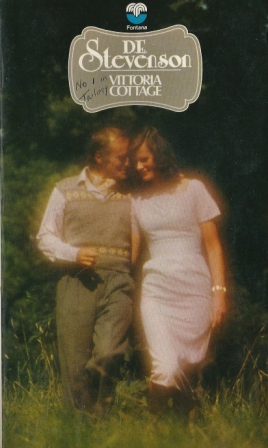
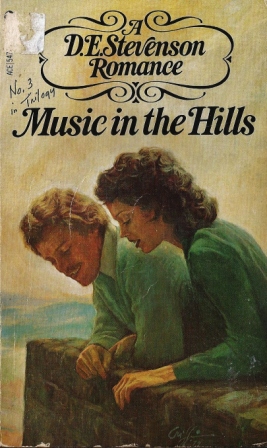
I’m going to review these together. They were both quite wonderful, so much so that, pressed for time as I am this week, I cannot let them pass onto the “have read” list without mention. In my opinion, this trilogy, Vittoria Cottage, Music in the Hills, and Shoulder the Sky, have the Miss Buncle books beat all hollow. Good stuff! I can see these going on my treasured keeper shelf.

Please try to ignore the desperately ugly covers on these re-released paperback editions. I find them quite embarrassingly inappropriate to the content, which, while “romantic” enough to please the most sentimental, is not cloyingly so as these would lead one to believe. I had some explaining to do to family members who saw me reading these – “What the heck is that?! You’re slipping, old girl …!”

*****

vittoria cottage d e stevensonVittoria Cottage by D.E. Stevenson ~ 1949. This edition: Collins-Fontana, 1974. Paperback. ISBN: 0-00-613-444-0. 191 pages.

My rating: 8.5/10.

Middle-aged Caroline Dering has just been widowed, and, aside from her genuine and seemly sorrow at the death of someone who has shared her life for many years, she is not at all steeped in sorrow. Her lately departed spouse, Arnold Dering, was of a complaining and perpetually malcontented disposition. While  his wife and three children were accepting of his character – Caroline thought that he always meant well, and suspected that at rare moments Arnold recognized and truly regretted his deep pessimism – but by and large enjoyed themselves much more in his absence.

The scene is set for what is to become a series of three novels by descriptions of the village of Ashbridge and the far from cottage-like Vittoria Cottage, ancestral home of the Derings. Though she has merely “married into” the local family, Caroline fits into the local hierarchy almost immediately, and by and large leads a deeply contented life, caring for her children, volunteering for various worthy causes, keeping house and gardening. The children are all grown up, with James away in Malaya, and lovely but discontented Leda (she takes after her father in full) and boisterous Bobbie making their way out into the larger world from the safe haven of their village nest.

To-day Caroline Dering was not working in her garden. She had taken a basket and gone up the road to the gravel-pit to pick blackberries. There was a thicket of brambles, there, and Caroline knew it well. Every year she made this pilgrimage and every year she returned with her harvest of big, black, juicy berries to make into jelly and to bottle for the winter. It was curious (thought Caroline, as she began her task) how the years seemed to telescope when you looked back. Surely there were less than three hundred and sixty-five days between each picking! She remembered the first time she had come. She and Arnold had come together – they had just returned from their honeymoon and settled at Vittoria Cottage – but Arnold had not enjoyed picking blackberries, he had got a thorn in his finger and had torn his trousers on a wild-rose bush and he had suggested that in future they should employ some of the village children to undertake the task. After that Caroline had come alone until James was old enough to help … and then the little girls had joined the party and blackberrying had become an event, a yearly picnic, which took place, weather permitting, upon James’s birthday.

Now, once again, Caroline came alone. The girls had other things to do and Caroline had no use for reluctant assistants. Next year … would James be here? And if he were here would he want to come and pick blackberries on his birthday?

World War II has been over for several years, but England is still very much in coping and recovery mode. Society is fast changing into some sort of new normal, and though things are steadily improving, there is still food and fuel rationing, and a strong atmosphere of “making do”, which makes for some quite fascinating scenarios as we progress through the book and look over Caroline’s shoulder as she goes about her days.

Life in Ashbridge gets suddenly quite interesting with the arrival of the mysterious Mr. Shepperton, who is apparently very reluctant to discuss his past, and who arouses even more suspicion because he appears to have no old belongings or clothing, a real rarity at that place and time, immediately post-war – “everything new!” the village gossips whisper with raised eyebrows.

Caroline’s lovely younger sister Harriet, a successful actress ducking away to her sister’s home for a respite from a difficult and failed recent stage production in London, brings some ex-urban dash and sparkle to village gatherings, and with the unexpectedly sudden return of James from Malaya, and the trials and tribulations of Leda and her fiancé Derek, the local squire’s son, there is plenty of scope for complications, dilemmas, surprises and sometimes unexpected resolutions.

I thought the characters were very well drawn and (mostly) very believable. Caroline is our heroine, but she is not a perfect person by a long shot; her flaws are well on display, but we forgive her them because she is ultimately exceedingly likeable, as is her sister and most of the other players in this excellent domestic drama. It ends quite abruptly, but this served merely to make me keen to get my hands on the next episode in this extended tale, which I was fortunate enough to acquire along with its sister novels recently.

On to Music in the Hills.

________________________________________

Music in the Hills by D.E. Stevenson ~ 1950. This edition: Ace Books, circa 1970. Paperback. ISBN: 0-441-54725-7. 282 pages.music in the hills d e stevenson

My rating: 8/10.

Having more or less settled the fates of Caroline Dering and her sister Harriet Fane in the previous novel, Vittoria Cottage, this next one follows Caroline’s son James, who, at loose ends after his military service and several years spent “chasing terrorists” in Malaya, is looking towards his future.

Deeply in love with his childhood companion Rhoda, he is struggling with her rejection of his marriage proposal. While we suspect that she is in love with James in her own way, Rhoda fears that, as a rising professional painter, marriage would spell the end of her career goals, and that she would be a discontented wife as well as a poorer artist, having to split her focus between two roles, doing neither well.

James takes it very well, all things considered, and hies himself off to the community of Drumburly in Scotland, where he has been invited by his aunt and uncle to reside at the remote Mureth House, a prosperous sheep farm. Jock and Mamie Johnstone have no children of their own, and are hoping that their nephew might be interested enough in farming life to take over Mureth some day. James has always cherished a desire to be a farmer himself, so the situation looks like a success all around; the story follows some of James’s apprenticeship and details the day-to-day occupations of a hill farmer of mid-2oth century Scotland; quite nicely detailed and striking true in the telling.

We have sheep rustlers and romantic entanglements and, of course, more than a few misunderstandings between various parties, all neatly tidied up as the story progresses. Perhaps not as strong a narrative as the preceding Vittoria Cottage, but definitely engaging. I enjoyed it greatly.

The characterizations of the local inhabitants are often well drawn; we all know people just like these.

I’m looking through the book for a snippet to share with you, but am finding nothing really suitable – everything is so enmeshed with the  rest of the story that to take a bit out of context would do it no justice, so you’ll have to take my word for it that this is a well-written post-war domestic drama, with much to recommend it as escape reading in our hectic modern age.

Music in the Hills is followed by a third book to form a trilogy, Shoulder the Sky, also published as Winter and Rough Weather. I’d read this one some months ago, liked it a lot, and reviewed it here: Shoulder the Sky

Reading this trilogy has made me into a confirmed D.E. Stevenson fan. This is good stuff, for which I am ready to forgive some of the less than stellar output by this writer. She definitely had highs and lows in her output, but the Vittoria Cottage trilogy is quite decently lofty.

Read Full Post »
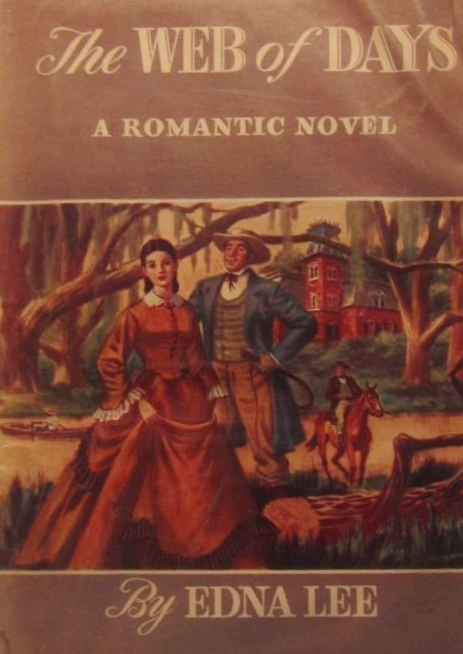
the web of days edna leeThe Web of Days by Edna Lee ~ 1947. This edition: D. Appleton-Century, 1947. Hardcover. 1st edition. 276 pages.

My rating: 3/10. The 3 points is for, um,  something.

Let’s see, now.

The best I can come up with is that it was engaging in that I read it to the end, hoping for some sort of unpredictable plot twist to crank it up a notch. (Sadly, that never happened.)

*****

Every once in a while I read a real clunker, which serves to remind me that all vintage books are not really worth saving.

The Web of Days was mesmerizing in its awfulness; I read it cover to cover, with increasing queasiness. Like the proverbial train wreck, I just couldn’t look away.

In a phrase: Melodramatic Gothic Southern Romance.

Prim, virginal, stunningly beautiful Yankee governess Hester Snow is engaged by the master of the derelict Georgia plantation called Seven Chimneys to care for his young son. The boy’s mother is a hopeless alcoholic, and Miss Snow finds the plantation to be an absolute disaster – the house is filthy, the servants sullen, and the master’s wife and mother viciously scornful of the new governess’s insistence on tidying up and tackling jobs for herself.

Hester immediately sets about fixing everything. Single-handedly she whips the house servants (ex-slaves, as this story takes place just after the end of the American Civil War, in Georgia) into shape, tames her sullen young charge, Rupert, and attempts to save the self-destructive mistress, Lorelie, from herself. She catches the attention of every man who sees her, from the riverboat captain who has delivered her to her new home, to the master of the Seven Chimneys plantation himself, Saint Clair LeGrand. More importantly, she has herself fallen in love with Saint Clair’s estranged half-brother, Roi LeGrand, who gallops in and out of the story on his fiery steed, Sans Foix.

Lorelie conveniently wanders out into the swamp and drowns herself one night, leaving the field open for Hester to marry the new widower, which she promptly does. Roi gallops in, chews on the scenery for a bit, and gallops off, leaving Hester deeply embroiled in a deep dark situation wherein her new husband schemes against her and attempts to engineer the death of young Rupert. It’s all to do with inheritances and such; Hester was assigned under the late Lorelie’s will the care of Seven Chimneys and Rupert, cutting out Saint Clair. (It’s complicated.)

Hester resurrects the plantation by master-minding a return to profitable farming; she also gets pregnant and eventually gives birth to young David, Saint Clair’s son, but widely suspected by all, including Saint Clair, to be Roi’s child. The plot sickens, er, thickens, ending in the violent demise of Saint Clair and the reunion of Hester and true love Roi. (That’s the condensed version. Now you won’t have to read the book! You may thank me for saving you that.)

As an orphan tumbling about in the world trying to make her own way, one would think Hester Snow would be a somewhat sympathetic character, but author Edna Lee has created an absolutely unlikable protagonist, whom I increasingly despised as the book progressed.

My biggest “queasy-making” issue was that the character Hester Snow is viciously misogynistic towards to the many black characters she encounters; I couldn’t help but wonder if this was a reflection of the author’s personal feelings as well. She (Hester Snow) is also very full of herself; self-confidence is an admirable trait, but add to it deep smugness and ruthless ambition, and you get a Scarlett O’Hara-type figure, but with less likeability. Scarlett had her moments where the reader could “get” why she was like she was and sympathize somewhat with her attempts to maintain control of her own life in an unkind world, but I’m afraid Hester never inspired such a feeling in me, much as I wanted her to.

The writing style itself is rather interesting, in that it is has a very nineteenth century feel to it in the phrasing. If deliberate, this is a good conceit on the part of the author, as the story is written in first person narration by Hester Snow herself, and the voice sounds authentic. There’s a fair bit of bodice-rippingly bad sex in a 1940’s style, in that we never really get a description of the act itself, just the prologue and epilogue; the velvet stage curtain swishes shut at the bedroom door.

A real period piece, but “of an inferior period, m’lord”, to paraphrase Bunter in one of the Lord Peter Wimsey tales – a quotation which I adore and use much too much.

Debating the fate of this book, I’m tempted to chuck it onto the giveaway pile, but while doing an internet search on the author I see she has several other “bestsellers” of her time which receive a fair bit of discussion: The Southerners, The Queen Bee, and All That Heaven Allows, among others. The Queen Bee was made into a 1955 film starring Joan Crawford, while All that Heaven Allows was made into a 1955 film starring Jane Wyman and Rock Hudson. (1955 was a good year for Edna Lee, apparently.) Both received a fair bit of popular, if not critical, acclaim, which just goes to show I’m not sure what – maybe that melodrama sells?!

I may tackle Edna Lee again in future. It was an interesting experience, and greatly highlighted the excellence of much of my other vintage reading in comparison to The Web of Days‘s deeply schlocky shlockiness.

Read Full Post »

hometown angel reita lambertHometown Angel by Reita Lambert ~ 1940. This edition: Triangle Books, 1942. Hardcover. 272 pages.

My rating: 8/10 – To be taken with a grain of salt, please – this rating merely reflects my opinion of this story’s merits among others of its narrow genre – vintage American light romantic fiction.

*****

Handsome, urbane Gerry Miles, a modestly successful short story writer and aspiring novelist, and the deeply devoted beau of moderately successful and keenly aspiring stage actress Lola Leighton, is waiting at the train station in New York City for an unkown-to-him girl. Eudoxia Abbott is Lola’s old school friend from way back in rural Ohio, and is on a first-ever visit to the big city. Gerry’s been detailed to waylay Miss Abbott and let her know, tactfully of course, that Lola is in no position to act as hostess to a little country bunny, no matter what their prior close relationship.

Gerry surprises himself by being immediately quite taken with Eudoxia – Doxie – who shows herself to be self-possessed and sensible – as well as a pretty little thing – but he rembers his instructions and rather shamefacedly fulfills his commission, telling Doxie that Lola is so exceedingly busy with auditions and rehearsals that she’ll have no time for shepherding Doxie around New York, but that there are some good hotels nearby. But first a quick visit to dear Lola is in order, before Doxie finds herself on her own.

The bitter truth is that Lola is on her uppers, and is too ashamed to admit it to Doxie. Her last play has folded and she’s now jobless in the harsh city. Her chosen profession has no place for losers, and Lola’s getting desperate. A play that she thinks would be perfect for her has made the rounds, but no producer wants to touch it – it’s a bit of a dud, if truth be told, though all Lola can see is her potentially glorious starring role as the titular “Linda”. She’s got one last call out to a prospective backer, and the last thing she wants to do is to waste her time showing Doxie about; Lola can’t afford to feed herself at this point, let alone sponsor a non-theatrical friend temporarily in town.

When Gerry and Doxie arrive at Lola’s apartment, she’s made a supreme effort and appears perfectly poised and beautifully dressed (in a costume left over from a stage production), with newspaper clippings of glowing reviews from her two-plays-back success scattered carelessly about, and a profusion of flowers she’s somehow cadged from the reluctant florist to whom she already owes a huge debt.

“Golly, Lola, you’re living such a glamorous life! I always knew you’d be a famous actress!” gushes admiring Doxie, and Lola basks happily in the uncritical praise, while remembering to maintain her noncommittal attitude towards Doxie’s visit.

Lola is just edging Doxie out the door to seek that hotel room when Doxie blurts out her own big news. She’s just inherited a handsome sum of money from her recently deceased foster grandfather back home, and this trip to the city is by way of being a celebratory binge.

Lola freezes for just a moment, then effusively turns on the charm. Why, darling Doxie must stay with her! Why is silly old Gerry suggesting an impersonal hotel room in a strange city, when Lola just happens to have an empty couch? Why, if it makes Doxie feel better, she can contribute to expenses with a modest boarding fee, but goodness! – what’s mere money between friends?! “Darling, you must stay with me!”

Gerry, speechless at the about-face, meekly goes along with Lola’s change of heart, but can’t help but wonder if Lola’s motives aren’t just a mite self-serving. He secretly decides to keep an eye on innocent Doxie and keep her from being too badly fleeced by his egotistical girlfriend.

Gerry has few illusions as to Lola’s hyper-ambitious nature. He’s been proposing marriage for some time now, asking her to give up the stage, but Lola insists that she needs one more hit play first, so she can walk away from the stage on a high note. She just needs the right opportunity, the perfect starring role. But as far as Gerry’s concerned, a continued run of unemployment will drive Lola into his arms, so he’s not too upset about her failure in getting Linda into production.

Well, predictably enough, Doxie is almost immediately buffaloed into backing Linda, and she embraces her new role as a theatrical “angel” with gusto. Gerry, a bit stunned by Lola’s rapid grasp of this unlooked-for opportunity and her immediate willingness to part her old friend from her nest egg, lurks around predicting doom and gloom, and sharing his conflicted concerns with his friend Nigel Tucker, a wealthy and cynical party boy with a casual interest in the theatre. Nigel was at first condescendingly kind to, and then increasingly taken with this fresh little number from the wilds of Ohio; Gerry is initially relieved at Nigel’s protective stance towards Doxie, but then starts to wonder why he feels almost, well, jealous of Nigel and Doxie’s growing closeness. But there’s no reason for jealousy, because Gerry loves Lola! And if Doxie ends up broke, the happy solution would be a marriage to immensely rich Nigel. Right? Right. Okay then, no worries.

As the Linda rehearsals progress and the off-Broadway opening approaches, it is evident to everyone except Lola and Doxie that the play is indeed a right royal mess. Gerry and Nigel are becoming increasingly short with each other as Doxie gushes on about her newly fledged theatrical enthusiasms to both of them, and they both realize what a disastrous effect Linda‘s coming almost-certain flop will have on her – not to mention Lola’s – psyche.

Tension builds, the tangle gets more tangly, and Gerry attempts to deny his growing romantic feelings for Doxie by pressuring Lola into a formal engagement. Lola brushes him off again and again, and insists on setting her sights higher by the day, envisioning a trip to Hollywood once Linda brings her the inevitable (she is convinced) critics’ applause and her long-deserved artistic success.

Up, down, around and around the four main characters chase each other – much drama plays out on and off stage, until the very end when (almost) everyone reshuffles their attachments and priorities and ends up where they really wanted to be in the first place.

*****

This is a true light romance – “pure eiderdown” as a Kirkus reviewer called another of this author’s fluffy creations. Effortless to read, deeply predictable, and surprisingly enjoyable, despite the inner groans of readerly despair at the frequent sheer obtuseness of the characters. The author also isn’t taking any of this too seriously, and she plays her characters freely upon her own little stage, with a wink and a nod to the audience. The result is, as I’ve just said, fluff, but fluff is welcome occasionally, to lighten the mix.

Lambert herself was modest in her literary claims, and did not pretend her works were anything other than for sheer amusement, her own and her readers’. If that was her criteria for success, this story succeeds. Though the characters are almost universally one-dimensional, and occasionally ill-behaved, they are reasonably well drawn, and the sweet and innocent nice-girl heroine has us on her side from start to finish. (I still think she ended up with the wrong man, though. Though I knew it wouldn’t happen, I willed her to take the one who truly appreciated her the most.)

Reita Lambert was a prolific writer of her time, and apparently quite well-known, though I wasn’t familiar with her before I researched her work after reading Hometown Angel. She wrote hundreds of short stories for the popular magazines of the 1910s through the 1940s, as well as a number of successful novels, among them Beauty Incorporated, Lines to a Lady, Yesterday’s Daughter, They Who Have, Right to the Heart, and others. Lambert also wrote stage and screen plays, and was involved in New York’s theatre scene. She was married to American composer Arthur Nevin, who had a successful career of his own in composing operatic scores based on American Indian folklore; his work was particularly well received in Germany in the pre-WW I years of the 20th Century.

Hometown Angel certainly demonstrates Lambert’s easy familiarity with the theatre scene, and her portraits of the various Theatrical Types of the time are well drawn and amusing. She definitely keeps a humorous eyebrow cocked in this book. I quite enjoyed this read, and would gladly tackle another, though, as I’ve said in other contexts, it would have to come to me easily and affordably. The few Reita Lamberts available through ABE seem rather high-priced for the non-literary popular fiction that they are, and I suspect at those prices would be of most interest to collectors of  the vintage light romantic fiction genre versus the casual reader.

Read Full Post »

the enchanted april elizabeth von arnim 001The Enchanted April by Elizabeth von Arnim ~ 1922. This edition: Simon & Schuster, 1992. Afterword by Terrence de Vere White. Paperback. ISBN: 0-671-86864-0. 316 pages.

My rating: 6/10. I’ve now read this twice, plus watched the lush 1992 movie. Still my least favourite von Arnim, of the three I’ve read.

The others:

*****

I guess the thing to remember with this one, and the thing I had to keep reminding myself of, was that this fluffy little tale is supposed to be a romantic comedy. Or is it? Away from the comical sunniness there are pockets of dark shadow. The decided element of genuine sadness in the four heroines’ circumstances, especially during the first part of the book, jarred with the eventual descent of the tale into musical comedy style farce.

I honestly could not get a true sense of which goal the author was aiming at. There are certainly times when an author, especially one of proven calibre of Elizabeth von Arnim, can successfully blend serious social commentary, light satire, and downright silliness, but I don’t feel that von Arnim pulled it off in this case.

I realize that this book has a tremendously strong following, and I will temper my criticism to say that it was a decent enough read for its genre, which I’m pegging at romantic comedy. Or perhaps serio-comedy? It wasn’t ultimately at all dark, though there were clues early on that it might go that way. If anything, I wish the author would spent more time in the darkness with her creations. I’d have liked her to maintain the initial tone set with the first sensitive depictions of the emotionally troubled lives of Lotty Wilkins and Rose Arbuthnot, which made their yearning for an obligation-free (and husband-less) month in the Italian sun so moving. And the solitary Mrs. Fisher and Lady Caroline – what were the real back stories there? It didn’t feel like we ever really got a handle on those, making their eventual epiphanies on the terraces of San Salvatore contrived to the extreme.

The Enchanted April felt to me to be just a little bit off; I was never quite able to close my inner critic’s eyes enough to wholeheartedly accept the inconsistencies and silly situations of the plot, though many sections of the book were immensely enjoyable to read, despite the cringe-engendering gushings of Lotty once she’s crossed the Italian border. “Tub of love”? Oh, Elizabeth! I wish you’d spared me that!

*****

It began in a Woman’s Club in London on a February afternoon – an uncomfortable club, and a miserable afternoon – when Mrs. Wilkins, who had come down from Hampstead to shop and had lunched at her club, took up The Times from the table in the smoking-room, and running her listless eye down the Agony Column saw this:

To Those Who Appreciate Wistaria and Sunshine.  Small mediaeval Italian Castle on the shores of the Mediterranean to be Let furnished for the month of April.  Necessary servants remain. Z, Box 1000, The Times.

That was its conception; yet, as in the case of many another, the conceiver was unaware of it at the moment.

So entirely unaware was Mrs. Wilkins that her April for that year had then and there been settled for her that she dropped the newspaper with a gesture that was both irritated and resigned, and went over to the window and stared drearily out at the dripping street.

Not for her were mediaeval castles, even those that are specially described as small.  Not for her the shores in April of the Mediterranean, and the wisteria and sunshine.  Such delights were only for the rich.  Yet the advertisement had been addressed to persons who appreciate these things, so that it had been, anyhow addressed too to her, for she certainly appreciated them; more than anybody knew; more than she had ever told.  But she was poor.

***

She turned away from the window with the same gesture of mingled irritation and resignation with which she had laid down The Times, and crossed the room towards the door with the intention of getting her mackintosh and umbrella and fighting her way into one of the overcrowded omnibuses and going to Shoolbred’s on her way home and buying some soles for Mellersh’s dinner – Mellersh was difficult with fish and liked only soles, except salmon – when she beheld Mrs. Arbuthnot, a woman she knew by sight as also living in Hampstead and belonging to the club, sitting at the table in the middle of the room on which the newspapers and magazines were kept, absorbed, in her turn, in the first page of The Times.

Mrs. Wilkins stops and strikes up a conversation with Mrs. Arbuthnot, and as they delicately sound each other out on the desirability of an Italian escapade, the small germ of an idea begins to form. Mrs. Wilkins has a small “nest egg” of ninety pounds; Mrs. Arbuthnot, though she doesn’t come right out and say it, is well-supplied with money by her husband, though she feels guilty about spending it on anything but “good works” – Mrs. Arbuthnot is a devotee of charities for the poor. Eventually the two decide to go ahead and contact the castle’s owner; they also advertise for two more women to share in the holiday, and when only two people respond, the party is made up.

So off to the small castle of San Salvatore in Italy go:

  • Mrs. Wilkins (Lotty) – seeking respite from her scornful husband, Mellersh, who feels that his wife has not exactly improved in the years since their marriage, and is becoming more odd and shy by the day, to the detriment to his flourishing occupation as a popular solicitor.
  • Mrs. Arbuthnot (Rose) – privately despairing that the love she and her husband once felt for each other is long gone, as they cannot agree on moral issues. Mr. Arbuthnot is the best-selling author (under a pseudonym) of salacious biographies of kings’ mistresses; Mrs. Arbuthnot is deeply religious and feels that she is being supported by “dirty” money, hence her many charitable works and contributions to the poor, as a form of penance.
  • Mrs. Fisher – an elderly wealthy widow, who is convinced that the world is a much more inferior place now than when she was a girl. Her father was a friend of many great literary men – Carlyle, Matthew Arnold, Tennyson and the like – and she seeks a place of repose where she can sit alone without worrying about household cares, and remember the glorious past.
  • Lady Caroline Dester  – an extremely lovely, not-too-young socialite (though she’s the “baby” of the party, at twenty-eight) whose only current desire is to have a rest for a month far away from the demands of people who all want something from her – to look at her and talk to her, ask her for things and talk to her, and expect some sort of gracious response. Poor jaded Lady Caroline is at a point in her life where she has some serious decisions to make, including whether she is going to accept an important marriage proposal. A month among innocuous women who will not bother her will be a respite from her frantically hectic life.

As the four settle into their temporary holiday home and work out their relationships with their fellow escapees, they find that the glories of lovely San Salvatore are impacting their very souls in ways which no one could have anticipated.

Lotty spontaneously decides to invite her husband to join the party; Mr. Arbuthnot, ardently pursuing Lady Caroline, unexpectedly arrives without realizing his wife is in residence – Lotty and Rose had both been deliberately vague about their destination to their spouses; San Salvatore’s owner, Mr. Briggs, under the misconception that the gentle Mrs. Arbuthnot is a widow, and rather infatuated with her since their meeting to arrange the renting of the castle, decides to drop in for a “casual” visit. Needless to say, things begin to happen.

If you’ve not yet read the book, stop here. The next bit is addressed to those who’ve already experienced The Enchanted April, so if you haven’t you will be lost among the references. There also may be spoilers!

*****

Things I Really Didn’t Like About This Book:

  • The gushing tone once the magic of the romantic setting started doing its work. “Tub of love” – ack! Made me quiver all over, and not in a happy way, people.
  • The parody of the Italian servants. Was that really necessary? It wasn’t that funny.
  • Mellersh’s reason for joining the party was understandable (hoping to get up close and personal to high society Lady Caroline), but it bothered me a whole big bunch that his attitude towards his wife changed so drastically once he saw on what good terms she was with Lady C. Did she have no other qualities than as a “connection” to someone he was wanting to snag as a client? And his “cute” habit of fondly pulling her ears – oh, please. That was just lame. Ugh. Lotty, oh, Lotty – your poor dear thing – words fail me.
  • Frederick (Mr. Arbuthnot) – gee, where to start? He stumbled into the mix because he was pursuing another woman. Ding ding ding – that was more warning bells going off.
  • Mr. Briggs – wow – the epitome of shallow. He was instantly infatuated with Rose way back in London for her Madonna-like aura and appearance; one glimpse at the even more lovely Lady Caroline and he dropped allegiance to Rose in a heartbeat and transferred over to her companion.
  • Lady Caroline herself. Let’s see. Strange man you’ve never met before falls in love with your profile, so you decide to marry him, though one of the main reasons for your month-long Italian retreat is to mull over a proposal from another man, who now gets wiped off the list of spousal possibilities with nary a backward glance. Umm, okay. That was a deeply thought out decision, and a great thing to base your future happiness on. (Don’t lose your looks, Lady C.)
  • My biggest issue was how the author pushed the whole “pairing off” scenario so strongly. The husbands were all impressed by their new, improved wives. In Frederick’s case, I forgive him fairly easily, as Rose was the one being rather unreasonable in their relationship. But Mellersh is still a jerk. And a deep-dyed snob, and manipulative. Why couldn’t he change? And Lady Caroline and Briggs – maybe just a wee bit contrived? Just maybe? I couldn’t really get any sort of reading on why Briggs would be a grand catch, unless  of course you call hereditary castle ownership an accomplishment.

Things I Quite Liked About This Book:

  • The initial premise, about the escape from dreary London to an enchanted Italian castle. This is probably why this book has garnered its fandom. Oh yes, take me with you!
  • The character portraits of the four leading ladies were a lot of fun. Lotty, so shy and repressed, and so quick to respond to the magic of San Salvatore and blossom into confidence and warmth. Rose, so sincerely good, but so quick on the draw to respond to Mrs. Fisher’s bossy way of assuming hostess status. I loved the mealtime scenes with the counter-offers of passing the goodies and pouring the tea. Mrs. Fisher was so selfishly self-assured – her initial snobbish audaciousness was a treat to eavesdrop on. Lady Caroline – oh, poor lady! – so be so continually misunderstood because of the elegant shape of your face and the melodious sounds of your voice! (Though I felt like she perhaps should have been spanked more as a child, or at least told “no” occasionally by her adoring family; it might have improved her entitled attitude.)
  • The word pictures of the settings, from the dreary London women’s club to glorious San Salvatore. I could easily picture the sequence of bloom and the fragrances wafting about the terraced gardens, though I suspect a reader with less horticultural experience might not get the full picture; it’s basically a listing of flowers. Unless you know nicotiana, or jasmine, or stocks, how could you imagine the glories of their evening aromas? It felt very much like the castle bits were written from life, sitting on the terraces and taking notes, which turned out to be the case, according to the afterword. Elizabeth von Arnim based San Salvatore on a very real Portofino castello, which she had rented with a friend as an April of 1921 writer’s retreat.
  • The happy ending. I know, I know – I moaned on about that aspect earlier. But I did appreciate that both of the troubled marriages were given new life. (I’m all for happy marriages, though not for either spouse being continually downtrodden or repressed to “make it work”.) And of course the new Mrs. Briggs can always invite her friends back to the castle for immersion in the Tub of Love when reality sets in too harshly once again!

Well, there’s my take on this most popular and perennially in-print (and on-stage – it’s an exceedingly popular play among amateur theatrical companies, too) von Arnim. I’m still very much looking forward to reading the rest of her novels, an enjoyment which will I anticipate will stretch ahead for the next few years as I slowly track them all down. No library borrowings here; I’m intending to purchase them all sight unseen, because I’m confident that they will be worthy of owning, even if bits of them occasionally annoy!

Read Full Post »

« Newer Posts