Dear Phyllis A. Whitney: I’ve given you so three good chances, with Seven Tears For Apollo (1963), Sea Jade (1964) and Columbella (1966), and I must say I have found you lacking. One last chance was a just-abandoned attempt to read 1991’s Woman Without a Past, with me thinking that perhaps several more decades of writing experience might result in something more to my taste.
I regret to say that this hasn’t proven to be the case. I made it to mid-way in the book, but was at last defeated by the psychic cat (“Miss Kitty” – how blandly lame is that?!), the old black “servant” (described as such by P.A.W.) speaking the author’s conception of “black person Southern dialect” (while all the white Southerners appear to be speaking “normal” English), the secret letter hidden behind the tail of the wooden rocking horse (what an appropriate place, I caught myself thinking, because the plot was fast degenerating into, well, you know…), and the absolutely flatness of the writing. Fingernails on the chalkboard of my mind. Screeeeech.
That’s it. Phyllis is being top-shelfed. And possibly set to be purged, despite sentimental feelings about ridding myself of my late mother’s books. Rosamund Pilcher is on the probation shelf, too, as is Maeve Binchy. And Catherine Cookson. Helen Forrester should be getting worried, too. Joanna Trollope, you might want to keep a lowish profile; the last few of yours I read left me thinking you’ve worn out all of your best Aga Saga scenarios.
My husband says that Miss Read should join these others in exile, but I have an inexplicably deep affection for Dora Saint’s pleasantly innocuous stories, so those aren’t even up for debate.
Absolutely sacred.
So there.
Darling.
Where was I?
Oh, yes. Norah Lofts.
Because while I was trying to read Phyllis Whitney, I was concurrently actually reading and hugely enjoying yet another gorgeously dark domestic drama by Norah Lofts. (See The Little Wax Doll (1960) and Lovers All Untrue (1970).)
Norah writes big, shiny, sparkling rings around plodding Phyllis.
Sorry, Phyllis.
You lose.
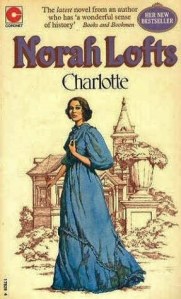 Charlotte by Norah Lofts ~ 1972. American title: Out of the Dark. This edition: Coronet, 1973. Paperback. ISBN: 0-340-17826-4. 254 pages.
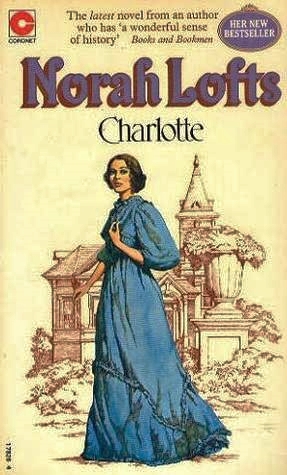
My rating: 9.5/10
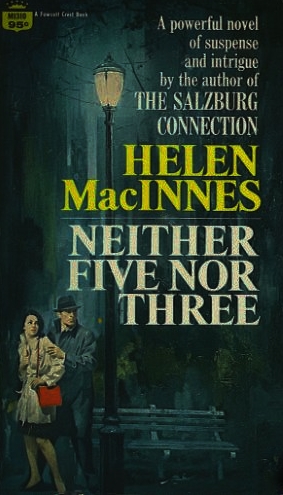
The author notes that this story was inspired by the notorious real life situation of an English teenager, 16-year-old Constance Kent, who in 1860 was accused of the brutal murder of her young stepbrother.
Though the scenario in the first section of the book borrows heavily from the historical case, Norah Lofts states in her beginning Author’s Note that:
The characters…are my own; and whereas those who write factually about a crime – especially one never satisfactorily solved – can only speculate about the motives and, indeed, the identity of the murderer, the writer of fiction, dealing in a more plastic medium, is able to say: This is how it happened.
Part Two owes nothing to the Case of Constance Kent. Incredible as it may seem, it is based on a first-hand account of a school in which my sister once tried to teach, a mere forty years ago. Here again the characters are my own; but I did not invent the oil-stove that was carried up and down…
This is a dark little tale, of deep injustice done to the innocent by those who should have been the most concerned with their protection. Our author puts her titular heroine through a grueling ordeal which stretches on for years, before allowing a resolution (of sorts) which (possibly) rewards her (and our) quietly righteous perseverance.
How much should I tell about the plot? My impulse is to keep it fairly quiet, as this sort of story rewards readerly discovery. I’ve already given out some of the major points, which are indeed no secret, and are revealed very early on.
16-year-old Charlotte Cornwall, her younger brother Thomas, and older twin sisters Adelaide and Victoria live with their father, stepmother and young half-brother Vincent in outwardly respectable but secretly straitened circumstances. The first Mrs. Cornwall was possessed of a large private income; this came to a halt upon her tragic (and questionably natural) death some years earlier; the twins and Charlotte are to inherit their mother’s money when they each turn 21, under the terms of their maternal grandfather’s will.
Money concerns are just part of the unspoken tension in the Cornwall household; the second Mrs. Cornwall, who was previously the children’s nanny, is deeply jealous of her gentle predecessor’s lasting influence. Her own small son is the apple of her maternal eye, and she is again pregnant, leading to a situation of history repeating itself as Mr. Cornwall’s attention is caught by the latest nursemaid who has replaced her mistress in the household hierarchy in more ways than one.
When four-year-old Vincent is discovered gruesomely murdered, his body hidden in the muck heap in the stable yard, suspicion is directed at a nebulous night time prowler, but soon evidence comes to light which leads back into the heart of the family, and ultimately straight to Charlotte. But several people in the household know the real story of what happened that dreadful night. Surely the truth will come out; surely the culprit or culprits will confess, to save an innocent who is being wrongly accused…
Nope. Charlotte is completely sold up the creek, and by a person (or persons) who should have been willing to protect her at their own expense.
Charlotte’s youth and social status and some inconsistencies in the evidence lead to her acquittal, but her trials aren’t yet over. Not by a long shot. Seeking to escape a situation made increasingly unbearable by the dark stain on her name and her stepmother’s increasing hatred, Charlotte takes a position in a country girl’s school as an assistant mistress, a situation which at first appears to be a welcome refuge, but which soon puts her into still more nightmarish situation, as the school’s headmistress exploits her knowledge of Charlotte’s past to her own advantage…
Just when things are darkest, a gleam of hope appears, and our heroine at last has a chance to clear her name. But will she turn against the real murderer(s), once she discovers the true story of her betrayal?
Well, I guess you’ll just have to read it yourself to find out.
Multiple characters, multiple story strands, all beautifully handled and full of fabulous period detail. What I’ve divulged above is the briefest overview of this richly written noir tale.
Charlotte is most competently plotted and presented; a deeply engaging read of the chillingly almost-plausible sort. Abundant wry humour, too. Despite its grim theme, this is not at all a depressing read; I frequently found myself chuckling quietly to myself as the author sends up various stereotypes and scenarios with perfect comic timing, and without quite crossing the line into farce.
Thank you, Norah.
You had me just a tiny bit worried for most of the book; I wasn’t sure where we were going for quite some time there. Good job on stringing the reader along!
Oh – the half point docked was for several not very veiled homosexual side stories. Those felt possibly just the tiniest bit mean-spirited, just vaguely “off”. But possibly they weren’t meant to be, and were intended more in the nature of ironic natural revenge? Maybe? However, I felt these were a bit too similar to the Sudden Evil Lesbian who shows up to wield retribution in Lovers All Untrue – too unnaturally manufactured; even in such a highly fictionalized thing such as Charlotte turns out to be.











 Leaves & Pages
Indian Vignettes: Mercy, Pity, Peace and Love by Rumer and Jon Godden
Posted in 1950s, 1980s, Century of Books - 2014, Godden, Rumer, Poetry, Read in 2014, Short Stories, tagged Century of Books 2014, Godden, Rumer, India, Jon Godden, Mercy, Peace and Love, Pity, Poetry, Short Stories, Social Commentary on July 28, 2014| 5 Comments »
My rating: I have somewhat mixed feelings about this collection of stories mostly by Rumer, because so many are already included in her 1957 collection, Mooltiki, and reading Mercy, Pity, Peace and Love felt very much like déjà vu all over again. But then I got to the very few (four out of fifteen) stories by Rumer’s sister Jon, and those were good enough to still my pangs of annoyance. To be fair, all of these short stories are actually very good, and if you haven’t read the rather obscure Mooltiki, you will be coming to them with fresh and appreciative eyes.
I think in this case I will award the collection as a whole a most respectable 8/10. (Along with the recycled stories, the two also-repeated poems made me knock it back a half point; Rumer Godden was a much more accomplished prose writer; her poems are just “not quite” for me; something just a bit jarring with the phrasing, I think.)
The intent of the collection is to celebrate the India that the Godden sisters knew and loved; they spent most of their childhood years in India, and significant amounts of their adult lives there as well. Rumer and Jon also collaborated on a beautifully written joint childhood memoir, Two Under the Indian Sun, which I read with pleasure some years ago.
Reader Alert! This is the same book as Indian Dust. Both were published in 1989, but Mercy, Pity, Peace and Love is the American title, from Macmillan, with Indian Dust the British title, from Macmillan. I had recently ordered Indian Dust, thinking it was another collection of stories, and was greatly disappointed to find it was identical to the one I already owned, under the Mercy, Pity title.
But life-plans may go horribly awry; Dhandu’s does not follow its anticipated path; in an ironic ending, which I somehow found reminiscent of W.W. Jacob’s The Monkey’s Paw, the field stays with Dhandu but is forever lost to his son.
An anecdote concerning a series of encounters with a minor craftsman, who proves to be representative of a vast class of Indian society balanced on the knife edge of survival.
Another anecdote, this time by Jon, telling of an encounter with a neighbour’s pet monkey, and the chain of events set off by its biting the author. Fascinating glimpse into the pet-owning culture of upper middle class Calcutta, where Jon was part of a mixed Anglo and Indian community.
Sister Malone, the nun in charge of a charity hospital in Calcutta, is unshaken by the horrible sufferings all around her and does great good with her nursing abilities, but her continual effort to share her religious faith with those she heals goes unheeded. One day Sister Malone meets a man who has truly put all of his trust in God, but she cannot reconcile this with her own conception of what faith should be.
Heart-rending short description of a valiant pet bird and its sad fate.
A modest seamstress is offered a once-in-a-lifetime chance to make her fortune.
A Bhramini Hindu student, who has travelled abroad to study in England, visits Paris with a friend and is forced to examine the role of compromise in the formation of his own developing character.
… … …
A young Kashmiri hunter, longing for winter to be over, thinks of his time the previous year among the high mountains hunting ibex.
The long process of acquiring – or rather, being led into buying by a master salesman – a beautiful Persian carpet. Beautifully observed; gently humorous.
A vignette of a young nomad riding up the mountain to fetch his unseen new wife. Sensitive and poignant.
An orphan boy,
finds his place in the world through his care of a black ram lamb.
Miss Passano is disgusted by her fellow humans, and meditates upon a world without them, where only she would remain, in service to the animals she so greatly loves.
Ganesh Dey attempts to write on these concepts – Mercy, Pity, Peace and Love – for his doctoral thesis. A gently ironical and emotionally powerful story, possibly the best of the collection in its summation of the contradictions of human nature and how we actually treat each other versus how we view our relationships and interactions.
Read Full Post »