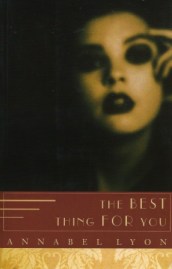
the best thing for you annabel lyon 001The Best Thing for You by Annabel Lyon ~ 2004. This edition: McClelland & Stewart, 2004. Softcover. ISBN: 0-7710-5397-5. 322 pages.

My rating: 10/10

Annabel Lyon is absolutely fearless in where she’s willing to go with these novellas, and there wasn’t a single jarring note anywhere. I am in awe.

I liked this collection in the same way I liked her high-profile Giller and Governor General’s Award nominee, and Rogers Writers’ Trust Fiction Prize winner, 2009’s The Golden Mean – sometimes I was deeply disturbed – and occasionally almost offended – by the images she conjured up, but I never, ever – even briefly – looked away. She kept me fully engaged the whole breathless trip.

This woman can write, people. If you haven’t already, you need to check her out.

Highly recommended.

*****

The Best Thing For You is a collection of three novellas. This is a form which I don’t see used much any more, but in this case it works wonderfully well, allowing an ambitious complexity of content and keeping the pace fast without the inevitable fluctuation in energy which occurs in a longer novel.

All three stories are set in Vancouver, British Columbia, the home of the author. The first two are set in contemporary times and the third is set during the ending days of World War II; the celebration triggered by the announcement of the end of the war plays an important part in the narrative.

Be prepared to pace yourself when reading through this one. Each novella deserves as much attention as a novel would; I found that I stopped cold after each one and only was able to turn my full attention to the next after digesting what I’d read for a few days. I wouldn’t recommend reading these in one fell swoop; I personally would have found that overwhelming. This is a collection that deserves – demands! – the reader’s full attention.

  • No Fun – A conventional enough narrative about a respectable middle class family, mother a doctor, father a university professor, well-adjusted, perfectly normal teenage son in high school. That’s the surface picture. When the son is involved (possibly? probably?) and criminally charged in connection with the brutal beating of a mentally handicapped man, the picture perfect impression dissolves into a dramatically realistic portrait of three people in personal crisis. As the mother of a teen boy myself, this novella (cliché alert!) touched me deeply in a very personal way. It made me smile in recognition, it frequently made me laugh, and it made me feel less alone in my occasional confused dismay at what our beautiful babies evolve into without our maternal permission (damn it anyway!) Lyons gets it so very right; how does she do that? The portrait of a marriage going on behind the issues brought about by the child is exceedingly well drawn as well.
  • The Goldberg Metronome – a young couple find a mysterious package taped to the pipes under the bathroom sink in their newly rented apartment. In it is a midnight blue, broken antique metronome. The story of the metronome’s history interweaves with the stories of the lives of the people it has joined tenuously in a thread of possession, passion, desire and loss. Gorgeous story.
  • The Best Thing For You – The strongest (of a strong three) and most elaborately plotted (of a beautifully complex three) of these novellas. A discontented young married woman involves a teenage delivery boy first in an adulterous affair and then in something much deeper and darker. Another teenager in the periphery of the events becomes deeply involved in a very different way. Cleverly noir, I thought as I read; I was vindicated in this assessment by reading in an interview here that film noir was indeed Lyon’s inspiration for the story:

I like film noir, and was interested in creating a femme fatale who’s both less and more than she seems.  Anna is a black-eyed adulteress who murders her husband for his life insurance, but she’s also bookish and melancholy and doesn’t really enjoy sex with her lover.  She’s also curious.  That’s one of her defining characteristics for me.  She doesn’t want to close her eyes and act as though everything’s all right when clearly–as a young woman with little formal education, no job, and no prospects, who is perceived basically as a sexually precocious child by everyone around her–her life looks quite grim.  She doesn’t want to play along, to pretend.  She wants to confront.

I guess the tone of the novella came about because I was constantly thinking about film.  I tried to keep the action quite external, to start scenes in the middle, to cut, to use dialogue in the slightly stylized manner of movies from the forties, and also to convey a sense of black and white through the prose yet with a complexity of texture that is a hallmark of some of the great movies from that era.

Again, here’s the interview link: Book Clubs. ca. Short, but well worth a read after you’ve enjoyed the collection. It added another dimension to my respect for the depth and general excellence of this author’s work.

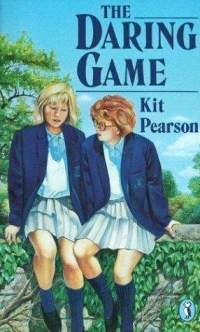
the daring game kit pearsonThe Daring Game by Kit Pearson ~ 1986. This edition: Puffin(Penguin), 1987. Paperback, ISBN: 0-14-031932-8. 225 pages.

My rating: 6.5/10. Rather pedestrian writing, but a decent “school story” with a strongly depicted Canadian setting. The intended audience would likely be preteen girls.

*****

Eleven-year-old Elizabeth – Eliza – Chapman has always dreamed of going to boarding school. She’s been reading English school stories for years, and thinks that wearing a uniform, living in a dormitory, and eluding Matron while having midnight feasts would be much more exciting than going to her boring old Edmonton day school. Her parents’ transfer to Toronto for a year seems like a grand opportunity to fulfill her dream. After much persuasion, Eliza is enrolled in Vancouver’s Ashdown Academy for her Grade Seven year, and with only a minor bout of homesickness enters into communal life with great enthusiasm.

Her fellow roommates are a widely varied lot: prim and bossy Pam, meek and gentle Jean, friendly Carrie and rambunctious, unpopular Helen. Alternately horrified by and attracted to Helen, Eliza finds herself drawn into a friendship which will have some serious consequences before the year is out. The “Daring Game” of the title is invented by Helen, and though some of the dares are simple enough to carry out, the last one goes very wrong and embroils Eliza in an impossible dilemma: stand up for a friend, or tell strict the Headmistress, Miss Tavistock, what is going on.

This was B.C. librarian and veteran kidlit author Kit Pearson’s first novel, and was inspired by her own teenage years at a Vancouver private school. It’s a decent enough middle grade novel, though my own daughter set it aside after the first chapter when I brought it home for her to read during her own Grade Seven year. I read it then and wasn’t terribly enthralled either, and this second reading for the purposes of writing this review (and possibly culling the book from our shelves) hasn’t really changed my mind.

Published in 1986, but set in 1964, The Daring Game attempts to reflect the scene of twenty years earlier, and though all the references are indeed correct, perhaps not enough time had passed to make it truly interesting from a historical point of view. The characters and the situations are competently presented, but this novel remained, to my mind, rather unexceptional from first page to last. Eliza goes through all the motions, but at the end of the story I found I was more than ready to bit her an easy farewell with nary a thought about what was to come next for her.

Kit Pearson has gone on to write a number of other well-regarded juvenile novels, including  the “Guests of War” trilogy involving British children sent to Canada during World War II: The Sky is Falling, Looking at the Moon, and The Lights Go On Again, which I’ve dipped into but not read in their entirety, and a time travel story, Awake and Dreaming, which I read and enjoyed. She’s an author worth keeping in mind if you have middle grade readers looking for something with strong Canadian content and thoughtfully (but not graphically depicted) challenging situations.

While I’m not tremendously enthusiastic about The Daring Game, I will give it a mild “okay”. Worth a try; might be just what your own young reader is looking for. I’m not quite ready to pitch it yet – see why our shelves are groaning! – but will try to read a few other titles by this author before deciding if she’s indeed a general “keeper”. The B.C. connection makes it hard to be heartless, though Pearson’s titles are abundant in local libraries and bookstores, and should be easy to find for the forseeable future even if I relinquish ownership of my personal copies.

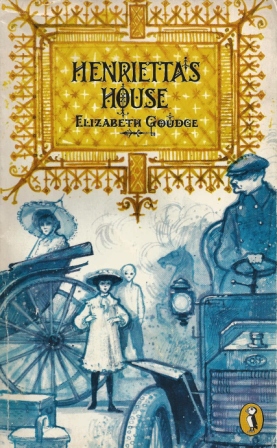
henrietta's house elizabeth goudge 001Henrietta’s House by Elizabeth Goudge ~ 1942Alternate American title: The Blue Hills. This edition: Puffin (Penguin), 1972. Illustrated by Anthony Maitland. Paperback. ISBN: 0-1403.0520-3. 191 pages.

My rating: 8.5/10. I’ve been playing amidst the juvenilia these past few days, and last night settled in to read this much-anticipated slender story. No surprises here, but no disappointments, either. Elizabeth Goudge lets herself go in full imaginative flight in this gentle and beautifully written juvenile adventure/fairy tale/moralistic tale.

Contains elements of her other two better-known juveniles, The Little White Horse, and especially Linnets and Valerians. Best approached with a willingness to surrender disbelief and just go with it! The usual Goudge theological and philosophical debate is present, but in this case makes more sense and is easier to digest than in some of her other books; two statues/church carvings, a laughing imp and a crying child, appear and reappear as analogies to the “mockery of Providence and the cringing human soul”, which sounds rather deep but which makes complete sense as one works one’s way through this multi-layered story.

This is a less common Goudge title, and I went to some trouble to acquire it. I suspect it is much more abundant in British used bookshops and libraries; used paperback copies on ABE start at $20 (with shipping) and hardcovers climb steeply into the $60s and $70s.

A must-read for the Goudge collector; one to share with a bookish child who is open to a good old-fashioned story. The fictional children are gloriously real, all expected flaws and faults fully present, though they are supremely fortunate in the adults in their lives!

This edition has extremely well drawn pen-and-ink illustrations by Anthony Maitland; I’d love to find this in a larger hardcover one day.

*****
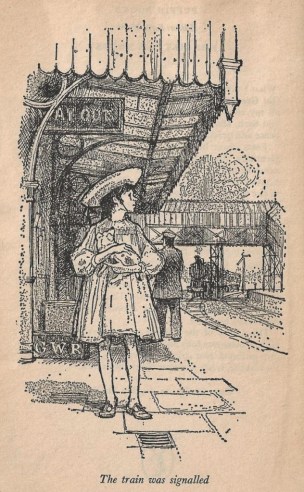
henrietta's house elizabeth goudge 5 001Young Henrietta, first introduced in The City of Bells as a poet’s daughter living with her adopted family in the cathedral city of Torminster – her father is alive and well, but is off roaming the world unencumbered by such prosaic details such as the housing, feeding and clothing of his offspring – is waiting on the railway platform for her beloved companion, Hugh Anthony, to return from his first term at boarding school.

Hugh`s birthday is impending, and a gala rural picnic is planned; what happens on the way to the picnic is told, in vivid detail, in this novel.

The birthday party leaves Torminster in five different equipages, and due to their varying rates of speed, soon lose sight of each other. Only one arrives at the designated rendezvous; the other four parties take the long way round and have some strange adventures before everyone finds each other in a completely unplanned-for common destination. Several extra guests add an unexpected dimension.

And that’s all I’m going to tell you, as the details of the adventures and the reference of the title are best discovered by the reader. Because this is, as the author declares at the close, a fairy tale, everything works out perfectly and a happy ending for all is assured.

Elizabeth Goudge is not for everyone, but if you’ve been exposed and find that she has “taken”, you will appreciate this slightly fantastical outing. A prior acquaintance with the characters (who also appear in The City of Bells and The Sister of the Angels) will add to your appreciation, but is not at all necessary; the story works beautifully as a stand-alone as well.henrietta's house elizabeth goudge 1 001
*****

I am here including a slightly edited review of Henrietta’s House from the Elizabeth Goudge Society website, which gives some background information on the author and the inspiration for the book. This is best read after reading the novel, so the references will make sense.

The dedication reads: ” For Dorothy Pope. There were once two little girls, and one had fair hair and lived in the Cathedral Close of Torminster and the other had dark hair and lived in the Blue Hills above the city, and they were friends. And now that they are grown up they are still friends, and the one who lived in Torminster dedicates this book to the one who lived in the Blue Hills, because it was she who saw the White Fishes in the cave. ”

The fair-haired child who lived in the city is obviously Elizabeth herself, and her friend Dorothy the template for Henrietta. I find it comforting to think that they remained in contact throughout their lives. It is an indication of Elizabeth’s loyalty and commitment. Elizabeth herself says that she never revisited any of the places she lived in because she wanted to remember them how they had been and not how they had become. So perhaps they corresponded with each other as she did with so many friends and admirers, a habit inherited from her Father.

It is a gentle story, a sequel to Sister of Angels and City of Bells, a tapestry woven with words around the charm of an Edwardian summer, when, as Elizabeth says “this story is set at the beginning of the present century, and in those days the world was often silent and sleepy, and not the bustling, noisy place that it is today.” (She is of course referring to the 20th century and not the 21st.)

In 1941 as the story was being written, British troops were fighting in the desert against Rommel, the Germans were taking on the might of Russia and the Americans were about to enter the war after the massacre at Pearl Harbour. A gloomy time, with no end of the war in sight and on the home front the introduction of clothes rationing. What better place and time to escape to than the opulence of Wells in a time before either World Wars had blighted her generation’s life.

The story starts with Henrietta waiting on the platform for Hugh Anthony to return for the holidays from boarding school ending their first separation from each other, and chronicles the delights of a summer in the countryside surrounding the tiny city where Elizabeth lived out the first few years of her life.

It contains many of her childhood memories from the way that hat elastic hurts the chin, to stately picnics in the hills. The story is as pedestrian as the procession of carts that convey the party to the picnic, and therein lies its charm. We are not hurried on to the next piece of drama, but have time to observe that “(t)he canterbury bells, and sweet williams, the roses and the sweet peas, the delphiniums and the syringa were a blaze of colour and scent in the gardens and all the birds were singing.”

Hills for Elizabeth were, as for so many of us, a place of heightened spirituality. They house the gods, myths and legends. They are the place of the solitary, the Hermit, the Wise Man. We ascend above the valleys and plains of every day life and looking back and down are able to see the bigger picture, to view where we have come from and how far we have travelled to get here: “Looking back he could see the great grey rock of the Cathedral and the old twisted roofs of Torminster, dwarfed by distance into a toy town that a child might have played with, and looking ahead, far up against the sky, he could see the blue hills growing in power and might as they drew nearer to them. He felt for a moment gripped between the grey rock of the Cathedral and the grandeur of the hills, two mighty things that time did not touch.”

All of the people invited on Hugh Anthony’s birthday picnic end up getting “lost”.  None of them with the exception of Grandmother’s party arrive at their preordained destination. But all of them are enriched by their experiences, they all attain something vital to their well-being, even if, like the Dean, they didn’t at first know that this was necessary.
henrietta's house elizabeth goudge 2 001

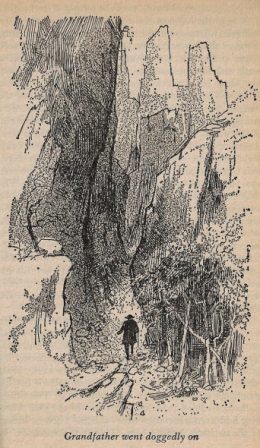
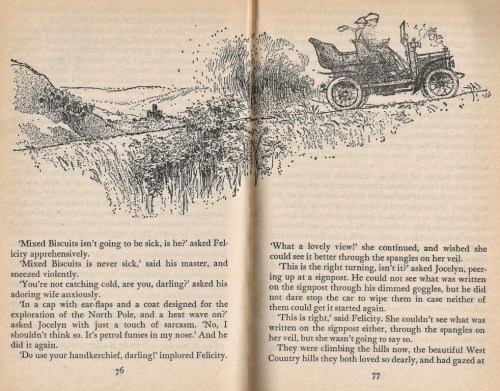
The Dean recaptures his innocence and love of his fellow man, Hugh Anthony loses some of his pride and arrogance. Grandfather rescues another soul in distress, Jocelyn and Felicity lose their car and find fairy land, and Henrietta, well – Henrietta finds her heart’s desire.

The strange figures sitting on top of the gateposts are explained as they come from the Cathedral at Wells and must have captured the young Elizabeth’s imagination. The explanation of their meaning given in the story by Henrietta’s Grandfather sounds as if it had originally been told to Elizabeth by her father. “Replicas of those two figures in the chantry in the south choir aisle … the cringing human soul and the mockery of Providence.” Elizabeth herself was to call her future Devonshire home Providence Cottage, so the Symbology obviously stuck with her.

I thought at first that the caves Elizabeth writes about so vividly were the ones at Wookey Hole, especially as the Old Man in the ruined house could have been a metaphor for the Witch of Wookey. with his wax figurines and pins. But there are no recorded sightings of cave fish in Wookey, and the caves themselves weren’t open to the public in the time that Elizabeth lived here.
henrietta's house elizabeth goudge 3 001

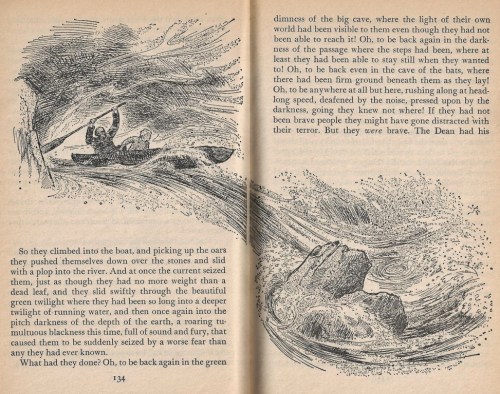
Cheddar gorge however is close and one of the caves there is actually called the Cathedral cave for its stunning similarity to a cathedral interior. I love the idea of being able to look up inside rabbit burrows and see the rabbits looking back at you in astonishment, a picture an imaginative child would conjure up. Cheddar too has its underground river complete with little rowing boat, its vast system of unseen caves riddling the Mendip hills like a honeycomb.

I have been unable to find the fish, all sources telling me that the lead content in the water, (the hills have been mined for lead since before the Romans arrived,) is too high for fish to survive. So maybe, the fish were flashes of light reflected back by a carried lamp, a code between friends for a shared magical experience. But I like to think the girls saw them on that long ago Edwardian afternoon. “Look!” cried Hugh Anthony excitedly, kneeling beside the still, inky pool, “There are white fishes here. Quite white. Like Ghosts.” The Dean put his oil lamp on the ground and knelt beside him and together they watched fascinated as the strange white shapes swam round and round in the black water, their ghostly bodies rippling back and forth as though they were weaving some never-ending pattern upon the black loom of the water.”

The story was written at a time when the bells of all the churches and cathedrals of England were silenced, only to be rung in a time of national emergency. They were to signal the devastating news that we had been invaded by Germany. How people must have dreaded the thought of hearing them ring. It would have been an especial sadness for Elizabeth, whose life so far had been lived and to a large extent regulated by the bells of the cathedrals her father worked in. No wonder she wanted to transport herself and her readership back to a time of innocence, when the bells would have rung out for worship and celebration as they were intended to be.
Tthere you are joanne taylorhere You Are by Joanne Taylor ~ 2004. This edition: Tundra Books, 2004. Softcover. ISBN: 0-88776-658-7. 199 pages.

My rating: 4.5/10. Well researched and competently written, but missing that special spark.

*****

Almost-twelve-year-old Jeannie Shaw lives with her family in the Margaree Valley of Cape Breton, Nova Scotia in 1952. School is about to start, and this year Jeannie hopes and prays that there will be a friend for her, another girl who she can walk with and talk with, share secrets and dreams with; someone to heal the deep loneliness that Jeannie has had for far too long.

There are several other girls at Jeannie’s small rural school, but they are a grade older and as far as they are concerned that year or two might well be a century. Word is out that a new family has arrived, with a child Jeannie’s age; but to her dismay the longed for girl turns out to be just another boy.

Jeannie and Cap Parker get off very much on the wrong foot together, a situation made worse by their sharing of the same desk in school. And things at home aren’t going well either. Jeannie’s pesky four-year-old sister Pearl is always getting into her things, and their pregnant mother merely pleads for peace and quiet rather than administering any sort of punishment to Pearl.

When Pearl and her small friend Ella disappear while being in Jeannie’s care, she reluctantly finds herself grateful for Cap’s quick wits and good nature in dealing with the days of uncertainty which follow.

While this was a book which tried really hard, it just never really got off the ground for me. The characters were one-dimensional and predictable in all of their thoughts and actions. A certain success was achieved in the description of the time and setting: 1952 in a peaceful, beautiful, rural Cape Breton Valley. Little historical snippets are distributed throughout.  A few horses still share the roads with cars in this peacefully backwoods part of the world; Cap’s father died in World War II, and Jeannie’s father is a returned veteran; the polio epidemic is widely known and deeply dreaded, and is a key part of an incompletely developed plot twist.

There is not enough historical content to make this a proper historical fiction, or enough character development to make this a satisfactory personality-driven novel; the climax is artificially sustained and unrealistically resolved. A very cookie cutter story, imposed on a potentially unique setting.

This is not so much a bad juvenile novel as it is a disappointing one, at least to this reader. I felt it was missing that elusive spark which truly brings a story to life.

This appears to be a minority opinion. There You Are was nominated for the Canadian Library Association’s Children’s Book of the Year Award for 2005, and was a finalist for the 2005/2006 Hackmatack Award, an Atlantic Canadian “Children’s Choice” award.

An acceptable story for the target audience of eight to twelve suggested by the publisher’s promotional blurb, but not recommended by me with any sort of enthusiasm, though Jeannie’s situation will likely garner some sympathy from younger, less critical readers.

Purchased at a recent library book sale, and going back into circulation to try for another home; it’s just been placed gently in the giveaway box.

the cutters bess streeter aldrichThe Cutters by Bess Streeter Aldrich ~ 1922. This edition: Grosset & Dunlap, 1926. Hardcover. 276 pages.

My rating: 7.5/10

This novel bookends Mother Mason; both are episodic individual and family portraits; I read them back to back and there were decided similarities of style and content, though each book has enough variation to keep things fresh.

I rated Mother Mason higher; though The Cutters is a charming read as well. However, in this novel, the morals in the little stories within are laid on with a much broader brush.

Motherhood, Home, Family – yes – we understand their importance, dear author, to the fabric of a happy nation, but the insistence that these are the only things which bring fulfillment to a womanly heart jars a bit with our modern-day emancipated female reality!

A tiny bit preachy, and very much a period piece; most obvious perhaps in the chapter on alternative ways of child discipline which ends with the family’s mother soundly thrashing her two naughty sons, with the author’s blatant assumption that this will meet with her readers’ full approval!

*****

This novel depicts a short period in the life of the Cutter family of the fictional small town of Meadows in an unspecified mid-western U.S. state. Father Ed, a successful lawyer; Nell, a busy hausfrau; 12-year-old Josephine; Craig and Nicolas, 7 and 9; baby Leonard; and mild matriarch Grandma Cutter make up the seven points of the Cutter family star.

The time is the early years of the 1920s; the shadows of the coming Depression are faint but ominously lurking. The Cutters struggle financially, and much of Nell’s part of the narrative is driven by her wistful yearnings for things which she can’t quite afford. Her husband teases her with a running joke about champagne tastes on a beer budget; Nell inwardly bristles while admitting to herself that this is indeed one of her personal Waterloos.

The incidents which make up the book are mild and domestically based for the most part. A wealthy client and his wife come to stay for  a few days, throwing the Cutter household into turmoil top to bottom; The Woman’s Club invites a speaker on “Perfect Parenthood, or Trained Motherhood”, whose ideas Nell tries to emulate with less than stellar success; a decision to take a family “dream vacation” reveals some surprising preferences; Josephine’s schoolgirl crush disrupts her young world; Nell’s ambitions for a newer, better, bigger house look like they will finally be realized; Grandma Cutter looks forward to a reunion with all of her far-flung sons; Nell enters a contest to try to win some “easy money”.

Likeable characters; relatable situations, a lot of humour and some very wise words coming from unexpected quarters – Aldrich is truly in fine form here. She bobbles a bit with the last chapter, which jumps ahead several years to the time of Josephine’s wedding, and hurriedly fills us in on how everyone else is turning out. Aldrich didn’t need to do that; she could have left us in the here and now, and it would have been just fine, but I suspect she couldn’t quite resist tidying things up.

Though not quite up to its predecessor, Mother Mason, The Cutters is an ideal nostalgic comfort read. I liked it a lot.

Mother Mason by Bess Streeter Aldrich ~ 1916. This edition: Grosset & Dunlap, 1924. Hardcover. 269 pages.

My rating: 9/10. What a sweet book! A fast-reading pick-me-up, full of gentle humour and most likeable characters.

Reminiscent of Lucy Maud Montgomery’s early stories, in the very best way.

*****

Molly Mason sits down at her bedroom dressing table, feeling very much fat, fifty-two and fidgety. She can’t quite put her finger on the reason, though. Her life has evolved along pleasant lines; from humble beginnings her husband has progressed from clerkdom to bank president over the decades of their happy marriage. Molly’s five children, eleven-year-old Junior, sixteen-year-old Eleanor, twenty-one year old Marcia, twenty-two-year-old Katherine, and twenty-five-year-old Bob, are healthy, bright and brimful of fire and ambition in their various very individual ways. A girlhood friend, fallen on hard times, lives in as companion and paid household help; the two get along famously well. Her marriage is deeply happy in a quiet, contented way; her husband doesn’t say much but he’s always ready to support her when needed and obviously loves Molly deeply though undemonstratively.

A happy home life, no money worries, a respected social position, lots of useful and generally pleasant work to occupy her time and energy – what could possibly be causing Molly’s middle-aged angst? Could it be the constant demands on her time both in the family and the community? Complimentary though the people around her are of her constant contributions, Molly is tired of always being the dependable one without whom things just can’t seem to happen. She can’t help herself, though she knows she has a darned good life – right now she feels like running away.

So she does.

Upon her return from several days in the city, which she has spent in a hotel, dining out, visiting the theatre and art gallery and, very briefly, having a tiny bit of dental work done – her erstwhile reason for the trip, misrepresented by Molly as more complicated than it actually is to buy her the time away – she is greeted with a long list of the occasions she was supposed to preside over in her absence; they’ve all been rescheduled so she wouldn’t miss a single one. To do her credit, Molly Mason sees the humour, and ruefully laughs.

This is an example of the mild adventures described in this book. Each chapter follows a member of the Mason household as they face their particular challenges and find a happy resolution.

This is an appealingly written, cleverly humorous domestic drama. It may sound ho-hum described like that, but I found that I enjoyed it greatly. Bess Streeter Aldrich tends to deal with extended flashbacks and rushed narrative to get her characters from the start to the finish of their lives within the period of her books; this book is an exception. It is very much in the here and now, with all activity narrated in the present tense. And it works exceedingly well; a similar approach might have addressed some of the flaws in certain of her other books, which I felt packed too much time-gone-by into too small a narrative package.

A feel-good book, easily polished off in an evening or two. I would recommend it for the L.M. Montgomery fan, or anyone else needing a fictionally gentle trip back in time to an absolutely decent American small town, just post World War I.

The copyright date in this book, 1916, disagrees with the publishing date found elsewhere, usually 1924, which is the latest publication date in my edition, following 1916, 1918, 1919 and 1920; I then discovered that some of these chapters originally appeared as magazine stories, which would explain the episodic nature of the book.

canada-reads-2013-panelists-books

Last night, with great self-congratulatory brouhaha, CBC Radio host Jian Ghomeshi introduced the Canada Reads 2013 Shortlist and celebrity panelists. This is an event I’ve watched (well, more accurately, listened to) with mild interest the last few years, but never really embraced.

I confess that I am in general deeply cynical about prizes awarded by popular vote, which is the whole premise of this literary “event”, but this year the shortlist picks seem more intriguing to me than some in the past, so I’ve set myself a personal goal of reading and reviewing all five of them. This will also tie in nicely with my participation in 6th Annual Canadian Book Challenge , hosted by John Mutford of The Book Mine Set .

I may also explore among the picks in the Long List, though I have no intentions of reading all of them. We’ll see what happens. This list will find a home in my library bag, for those days when inspiration needs a little push. I’ve already read a few (a very few) of the picks, though mostly before this blog materialized. I may re-read and review. Or not! Leaving myself wide open here.

This year Canada Reads has a regional theme, which doesn’t really work in my opinion, as there are only five extremely broad regions and geographically and philosophically I think there is more variance in truly regional Canadian literature than these limited categories allow. But no one asked me, so I guess I need to go with it.

Here’s our Long List:

B.C. & Yukon:

The Prairies and North:

Ontario:

Quebec:

Atlantic Canada:

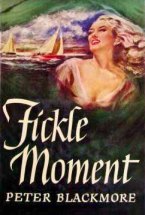
Fickle Moment by Peter Blackmore ~ 1948. This edition: G.P. Putnam’s Sons, 1948. Hardcover. 244 pages.

My rating: 7/10. The epitome of light reading; pure vintage fluff. A nice diversion from the snow whirling round outside!

*****

Elizabeth Portal rather smugly contemplates her thirtieth season as the leading star in the Watermouth Regis amateur operatic and dramatic society. She’s aging marvelously well, looks more youthful than her undeniable fifty, and only an unkind person would raise an eyebrow at Elizabeth’s coming performance as schoolgirl Yum-Yum in The Mikado. But when the other two of the Three Little Maids are Elizabeth’s daughters  Louise and Anna, more than a few sarcastic smiles are hidden behind politely shielding hands.

No matter – Elizabeth is on top of the world. Her eldest daughter, Anna, is about to marry the Watermouth Regis mayor, one Hubert Briggs, a man of varied experience: one-time jockey now turned respected undertaker after a riding accident ended his turf career and sent him back to take over the family business. People like Hubert, hence his election to the mayor’s chair; he’s unremittingly cheerful, and the funerals he presides over rocket right along, a relic (people whisper with a wink) of his sporting career and fondness for speed. Anna’s a bit of a drooper, true, but maybe marriage will pep her up?

Louise already has plenty of pep. A gorgeous young woman with a passion for tennis and swimming, Louise has attracted many admiring glances but so far has not returned the masculine attention of the local swains with anything other than polite amusement. Louise is ripe for love, ready to fall for the right man, who so far hasn’t appeared on her horizon. Or has he?

One day a rather battered sailboat, the Ayacanora, appears from nowhere and anchors just off the Portal’s private beach. Aboard is dashing sailor Richard Hardy, taking a break from his round the world voyaging, hoping to replenish stores and maybe engage in a little amorous relaxation. Lovely Louise swims by, and Richard’s interest is definitely aroused, especially when Louise glances back in her turn. Could something be about to happen?

Young Charlie Rogers, employed under the Portal patriarch Henry’s supervision at the Watermouth Regis town treasurer’s office, shows up to play the piano for the female Portals’ rehearsals. It has suddenly occurred to him that the questions his prospective employer asked him about his piano playing abilities were not so random after all. Charlie sees Louise, and fireworks go off inside his modestly manly heart. But could such a strong and vibrant girl ever look with even the remotest interest on an unathletic, sensitive and insecure (though undeniably good-looking) junior clerk?

Well, I’m thinking you can guess the answers to all of those, and I’m betting you’d be getting them all right. Shake these all together, add a generous handful of eccentric aristocrats and comic townspeople and ex-chorus girls and snobby upper-middle-class matrons, and here you have the ingredients to make a happy few hours reading.

The comeuppance of Elizabeth and the romantic flowering of Louise, plus the side stories of a nicely varied group of secondary characters makes for a narrative which dashes along at a very good pace indeed.

This one was picked up on a whim for the Gilbert and Sullivan quotation on the frontispiece: “Fickle moment, prithee stay!” Having a weakness for Penzancian pirates and Lord High Executioners and the rest of the G and S panoply of characters, my interest was piqued, especially when a closer investigation revealed a publishing date of 1948 and a Wodehousian sparkle of dialogue within.

I must say, if you’re not a devotee of The Mikado, you may find many of the scenes mildly confusing, but if you are, you will snicker along with the townspeople of Watermouth Regis at Elizabeth’s dramatic excesses.

Peter Blackmore was obviously a theatre lover, which assumption was confirmed when I researched him after reading this book and discovered that he was quite a well-known playwright and film screenwriter in the 1940s, 50s and 60s. Fickle Moment also appeared in dramatic form as a play called The Blue Goose, and a play called Miranda, featuring a captivating mermaid being paraded about in a bath chair as an invalid, was made into a very successful comedy movie, detailed here. Most intriguing!

I’d never heard of Peter Blackmore before, but you can bet your sea boots I’ll be watching for his name now. Though I somehow doubt I’ll soon come across another of Blackmore’s books at such a ridiculously low price – 25¢ at the local Salvation Army’s bargain book sale. Perhaps it will average out the next one I just might have to seek out online at a probably much richer price!

I’ll be looking for Miranda on film through the regional library system; this is just the thing that our wonderful librarians like to acquire and share. Please let me know if any of you are familiar with Blackmore; I’m really interested now, and the internet is strangely uninformative, save for the playwright designation, a few Miranda discussions, his dates – 1909 to 1984, and his British nationality.

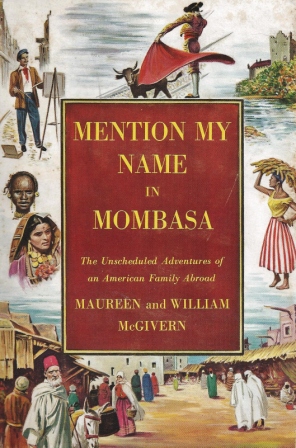
Mention My Name in Mombasa: The Unscheduled Adventures of an American Family Abroad by Maureen Daly McGivern & William McGivern ~ 1958. This edition: Dodd, Mead & Co., 1958. First Edition. Hardcover. 312 pages.

My rating: 7/10.

*****

This is a most interesting read; a travel memoir with a very 1950s’ feel – not surprising, seeing as it is a 1950s’ book! I enjoyed it.

The authors were literary figures of their time, and the travels herein described were, it seems from a few comments here and there, both to fulfill a personal desire for wanderlust and to collect material for future books, including this one.

If the name Maureen Daly rings a bell, it is most likely because of her extremely successful young adult novel, Seventeenth Summer, written when the author was herself just seventeen, and published in 1942. Some years later we find Maureen married to fellow writer William McGivern, a successful writer of crime-mystery novels (The Big Heat, Rogue Cop, war novel Soldiers of ’44, and almost 20 more) and film and television scriptwriter (Kojak, Adam-12, and Ben Casey, among others). They had their two children along, 6-year-old Megan and 2-year-old Patrick, when they left New York on New Year’s Eve to travel to Paris, the start of their extended travels.

Long, detailed and quite enthralling chapters describe the scenery, culture and especially the unique individuals the McGiverns came into contact with. The tone is a mixture of worldly-wise (but never condescending), travel guide (but merely to lay out the scene), and very 1950s’ American superiority (but innocent of bluster so therefore non-jarring – at least for the most part). The McGiverns were very eager to give credit where it was due regarding the superior aspects of their temporary homes and tourist destinations, which included Paris, and then a stay in the tiny fishing village of Torremolinos near Málaga, Spain, just on the verge of its discovery and development as a winter-tourist hotspot.

Then come several chapters on Spanish bullfighting, bullfighters and the ranches which raise and train the bulls. The tone here is journalistically non-judgemental much of the time; I never did get a grasp of whether the McGiverns were fully behind the “sport”, though from the farcical descriptions of a number of stereotypical bullfight aficionados which graces one of the chapters, I suspect they had marginally more sympathy for the bovine members of that elite yet widely populist pastime.

Next is a short visit (and hence a short chapter) in Gibraltar, where the McGiverns are rather disappointed in the elusiveness of the famous apes. On to Iceland, and a very travel-guide chapter this is, with loads of facts thrown at the reader, interspersed with short vignettes of some of the US Army families living on the vast NATO air base, and native Icelanders who opened their homes to our travellers.

Then comes the most memorable chapter of the book. During World War II, William had served as a US Army gunner in the European campaign, and his platoon had ended up entrenched on the mountainside near the tiny Belgian village of Fraipont, where the local people showed such generosity and warmth to their American allies that William had long planned to return in more peaceful times. Just over ten years later that sentimental visit took place, with the villagers overjoyed to recognize William and welcome his family. A poignant reminder that the war was not all that far in the past when this pilgrimage took place.

Back to Spain, and then a four-day voyage to the Canary Islands, a visit which seems not to have quite met the high expectations of the romance of the name. On to Morocco, where the McGiverns have several pleasant surprises regarding the locals, and then to Nigeria, on the cusp of independence as a full member of the British Commonwealth, after decades of colonial occupation.

A safari to Abadjan on the Ivory Coast and then to Fort Lamy in Chad doesn’t quite go as expected, but there are compensations in the people who the McGiverns meet as they wait for their travel visas to gain approval from the local bureaucracy. This does not happen, so back to Spain, through France, Belgium, and over to Ireland, where the Daly family is waiting to welcome their wayward relative and her family for an extended visit. Several months in Dublin follow, and then the trip is wound up, with a return to New York over a year after the original departure.

In this book there is a strong sense of how good it is to be an American at this point in history, and how welcome the traveller from the U.S.A. both feels and is made to feel; the McGiverns travel in their French-bought Citroën plastered with American flags fore and aft, and seldom seem to meet with a cold shoulder. Quite a change in the ensuing fifty years!

This is a fine book, and a literary time capsule of the post-war era, before things started to go wrong for the U.S.A., politically speaking.

I suspect it may be hard to come by (I ordered mine for a rather large sum from an online rare book dealer, for the Maureen Daly connection) but if your library happens to have a copy hidden in the stacks, or if you chance upon it in a used book store, it is well worth delving into.

Greetings, faithful blog followers. It has ocurred to me, now that this blog has become a part of my life and I feel no urge to quit on it just yet, that I should tag my posts with the year I read the books, what with a whole new year coming up and all.

I’m not sure if retagging/editing posts sends them back out into the world to those of you subscribed via email, but if it does, just a heads up that you might be getting lots of duplicate posts. I think I will start at the beginning with my edits, so if these do start to come your way, just delete as the spirit moves you.

(Didn’t want anyone to think that I am hitting a super-productive streak or anything!)