monkey beach eden robinsonMonkey Beach by Eden Robinson ~ 2000. This edition: Vintage Canada, 2001. Softcover. ISBN: 0676973221. 377 pages.

My rating: 9.5/10.

Fabulous writer, this Eden Robinson.

Part of the time (most of the time) the words flow effortlessly and reading them is like riding the crest of a perfect wave; occasionally the reader is tumbled out of complacence and, gasping a bit from the shock, needs to go back over what has just been read, to readjust to what’s just been thrown at you.

This would have been a solid 10, but I docked the half point because the story fell into cliché right near the end, after brilliantly flouting expectations most of the way through.

Picking snippets at random from the first page of a Google search on Monkey Beach yields these comments: “(C)ombines both joy and tragedy in a harrowing yet restrained story of grief and survival…”; “(F)illed with intense landscapes…”; “(A)ddresses issues related to race, historic oppression, and the clash between cultures in a coming-of-age ghost story…”; “(A) story about childhood, family, loss, grief and life on a 21st century Native-Canadian reserve…”

Ooh, sounds all deep and Can-Lit dark, doesn’t it? But the story transcends these sound-bite assessments. Already at the bottom of the first page I couldn’t look away; I read eagerly to the end (flagging just a little when the author stubbed her toe on the possible-but-slightly-contrived reason for her brother’s motivations regarding that trip out onto the ocean); completely accepted the rather vague ending scenario (who’s really alive? dead? what does it all mean?); and eagerly pressed it into my husband’s hands: “You must read this book!” (And he did, and he loved it, too.)

A surprisingly funny and, yes, cheerful (in places) sort of book for all of the tragedies it describes.

The internet is seething with reviews on this one; I missed it when it first came out, but apparently it was a Giller Prize finalist and a Governor General’s Award finalist in 2000. It apparently made quite a stir, and in the thirteen years since first publication has become a Can-Lit high school/college standard; likely because (cynicism alert!) of its First Nations author, characters, and themes. And (of course!) because it’s a well-written and cleverly complex tale; lots of room for exploration, and the generation of many words of student “analysis”.

I was going to give you a quickie overview, but instead I’m about to cheat big time and refer you to the Canadian Literature Quarterly of Spring 2001, to the article Beauty and Substance by Jennifer Andrews, which nicely sums things up.

Eden Robinson’s Giller-Prize nominated Monkey Beach … [creates] a darkly comic narrative about the life of Lisamarie Hill, a woman who returns to memories of her childhood and adolescence in order to cope with the disappearance of her brother, Jimmy. Robinson, a mixed-blood Haisla and Heiltsuk woman raised near the Haisla village of Kitamaat, has previously published a collection of short stories, Traplines (1996), that won the Winifred Holtby Prize, the Prism International Prize for Short Fiction, and was selected as a New York Times Notable Book of the Year. Like Robinson, the protagonist, Lisamarie—named after Elvis Presley’s daughter—negotiates various worlds while growing up in Kitamaat. She moves between the eclectically traditional ways of her grandmother, Ma-ma-moo, who educates Lisamarie by sharing her passion for television soap operas and teaching her the Haisla language, and the New World activism of her Uncle Mick. A complex web of contradictions, Mick is a survivor of the residential school system, a Native activist who once belonged to the American Indian Movement, a nomad who can never rest, and an Elvis fan whose passion for the “King” knows no bounds. He offers another dimension of experience to Lisamarie by encouraging her to express herself politically. After losing both Mick and Ma-ma-moo, Lisamarie must figure out a way to put her life back together and come to terms with these ghosts from her past.

The novel traces Lisamarie’s journey to discover the fate of her brother, a boat ride that gives her the time and space to recount her story. The narrative is rooted in the beauty and mystery of place, particularly Monkey Beach, a site of family outings and rumoured sasquatch sightings. Robinson’s ability to evoke characters through dialogue and create vivid images of the community, coupled with her awareness of the intricate links between individuals and the land they live on gives the novel a richly layered texture that conveys the significance of Lisamarie’s mixed-blood heritage (Haisla, Heiltsuk, and European). Although the structure of the novel suspends the immediate action of the story, a risky strategy, Robinson’s narrative weaves together multiple plot lines with subtlety and grace, delicately responding to readers’ desire to know the fate of Lisamarie’s brother and the need to recount her past. Moreover, the comic aspects of the novel provide a wonderful counterbalance to the bleakness of Lisamarie’s life, particularly when she ends up living on the streets of East Vancouver. Robinson creates a novel in which humour may lighten the moment but irony ensures that the full weight of tribal histories of colonization and genocide remains a potent force in the text. This is one case in which beauty and substance join together, creating a novel that delivers what it promises.

What else can I add? If you come across this book, pick it up and start reading. If it hooks you, go on. Its early promise holds up remarkably well.

Then, when you’ve read it, check out the author biography and interview at B.C. Book World.
the road past altamont gabrielle roy 001The Road Past Altamont by Gabrielle Roy ~ 1966. Published in French as La Route d’Altamont. This edition: New Canadian Library, 1976. Translated and with an Introduction by Joyce Marshall. Paperback. ISBN: 0-7710-9229-6. 146 pages.

My rating: 10/10.

It has been a while since I read much of Gabrielle Roy, but my recent discovery of Enchanted Summer reminded me of how much I enjoyed her writing in summers long past. For to me Gabrielle Roy is best read in summer, on those sunny days that invariably follow the solstice; something about her delicacy of expression and lightness of touch belongs to the stillness of summer afternoons, and to times of repose in green shade.

I came to The Road Past Altamont with high hopes; they were met in full. And, too, very personal feelings were stirred by these anecdotes of generations of (mostly) women, and their ways of dealing with the passing of time and the separation of the generations in a very real sense, as my own almost-grown children are poised for their journeys into the wider world, and my own elderly mother for her withdrawal from it.

The Road Past Altamont is an assemblage of four connected, chronologically ordered short stories, or, rather, vignettes. The central character is Christine, youngest daughter of a Manitoban francophone family. Readers of Gabrielle Roy will remember Christine from Street of Riches, in which she is the narrator of a similar collection of vignettes. Christine is an autobiographical character, based on Gabrielle Roy, and Christine’s memories and responses are, one must therefore speculate, Gabrielle’s.

In the first story in The Road Past Altamont, My Almighty Grandmother, six-year-old Christine is sent, at her grandmother’s request, to visit for part of the summer in a rural Manitoba village. Christine is at first sulky and reluctant, informing Grandmother upon arrival that, “I’m going to be bored here…I’m sure of it. It’s written in the sky.” Grandmother takes up the challenge at once, and Christine, though she does frequently succumb to the lassitude of hot summer afternoons, ends up with a strong love and admiration for her still-capable grandmother, who is slowly being relegated to the status of “poor old Mémère” by the rest of her large family of descendants. To Christine’s amazed delight, Grandmother makes her a doll from odds and ends, scraps of cloth, leather and yarn; even weaving a tiny hat. While the two work, Grandmother muses on the ironies of growing old.

“That is what life is, if you want to know… a mountain made of housework. It’s a good thing you don’t see it at the outset; if you did you mightn’t risk it, you’d balk. But the mountain only shows itself as you climb it. Not only that, no matter how much housework you do in your life, just as much remains for those who come after you. Life is work that’s never finished. And in spite of that, when you’re shoved into a corner to rest, not knowing what to do with your ten fingers, do you know what happens? Well, you’re bored to death; you may even miss the housework. Can you make anything out of that?”

… She grumbled on so that I dozed, leaning against her knees, my doll in my arms, and saw my grandmother storm into Paradise with a great many things to complain about. In my dream God the Father, with his great beard and stern expression, yielded his place to Grandmother, with her keen, shrewd, far-seeing eyes. From now on it would be she, seated in the clouds, who would take care of the world, set up wise and just laws. Now all would be well for the poor people on earth.

For a long time I was haunted by the idea that it could not possibly be a man who made the world. But perhaps an old woman with extremely capable hands.

In The Old Man and the Child, Christine is a few years older. Grandmother has died, and Christine’s deep unhappiness about losing her is salved by her new acquaintance with an elderly neighbour several streets over from her own. Monsieur Sainte-Hilaire sees Christine fall while walking gingerly on her newest passion, a pair of stilts; he picks her up and dusts her off and sends her on her way buoyed by his admiration for her tenacity and agility. Christine basks in his admiration; the two become close friends. As the hot, hot summer proceeds – one of the hottest and driest in living memory – Monsieur Saint-Hilaire and Christine hatch a plan together, a visit to the great inland ocean, Lake Winnipeg, which Christine has never seen, and which the old man yearns for, having spent much time beside it in his long-ago youth. Against her better judgement, Christine’s mother gives permission for the long day’s excursion.

At length the old man asked me, “Are you happy?”

I was undoubtedly happier than I had ever been before, but, as if it were too great, this unknown joy held me in a state of intense astonishment. I learned later on, of course, that this is the very essence of joy, this astonished delight, this sense of revelation at once so simple, so natural, and yet so great that one doesn’t quite know what to say of it, except, “Ah, so this is it.”

All my preparations had been useless; everything surpassed my expectations, this great sky, half cloudy and half sunlit, this incredible crescent of beach, the water, above all its boundless expanse, which to my land-dweller’s eyes, accustomed to parched horizons, must have seemed somewhat wasteful, trained as we were to hoard water. I could not get over it. Have I, moreover, ever got over it? Does one ever, fundamentally, get over a great lake?

In The Move, Christine is eleven, and has made unlikely friends with Florence, whose father, among his other odd jobs, often works as a mover, driving a team of horses and a huge cart, trundling the sad possessions of the poor of the city from one dismal home to another. At this time the team of horses is itself becoming an anomaly, as technology has largely replaced them with the internal combustion engine. Christine is fascinated by concept of moving house; she has never personally experienced it, other than the temporary removals of holidays and such.

To take one’s furniture and belongings, to abandon a place, close a door behind one forever, say good-by to a neighbourhood, this was an adventure of which I knew nothing; and it was probably the sheer force of my efforts to picture it to myself that made it seem so daring, heroic and exalted in my eyes.

“Aren’t we ever going to move?” I used to ask Maman.

“I certainly hope not,” she would say. “By the grace of God and the long patience of your father, we are solidly established at last. I only hope it is forever.”

She told me that to her no sight in the world could be more heartbreaking, more poignant even, than a house moving.

“For a while,” she said, “it’s as if you were related to the nomads, those poor souls who slip along the surface of existence, putting their roots down nowhere. You no longer have a roof over your head. Yes indeed, for a few hours at least, it’s as if you were drifting on the stream of life.”

Poor Mother! Her objections and comparisons only strengthened my strange hankering. To drift on the stream of life! To be like the nomads! To wander through the world! There was nothing in any of this that did not seem to me like complete felicity.

Since I myself could not move, I wished to be present at someone else’s moving and see what it was all about…

Christine sneaks away early one morning to accompany Florence and her father on one of their jobs; she comes home devastated; it is not the joyful experience she had imagined. Mourning to her mother that the view from the seat of the wagon is not as she had imagined it to be, Maman realizes with dismay that Christine is one of the yearning ones; one who will always be looking for new horizons…

“You too then!” she said. “You too will have the family disease, departure sickness. What a calamity!”

Then, hiding my face against her breast, she began to croon me a sort of song, without melody and almost without words.

“Poor you,” she intoned. “Ah, poor you! What is to become of you!”

It is so much more heart-rending to be the one left than the one leaving, and Maman struggles mightily with the pain of desertion when Christine, now a young woman, breaks it to her that she is about to embark on her long-desired travels, to go to Europe, to explore the greater world. The Road Past Altamont, the last story in the book, is the most delicately poignant, as Christine and Maman drive together across the prairie to visit relatives on the outskirts of the Pembina Hills, the only “mountains” in southern Manitoba. Maman yearns for the hills, but as there is no road into them, she fears she will never walk among them, so when Christine inadvertently take a wrong turn, “just past the village of Altamont”, and ends up in the gentle mountains, her mother’s joy is overwhelming. However, on a return trip, they cannot find the road again, and soon Christine will be gone…

Maman was perhaps close to admitting that she felt herself to be too old to lose me, but there is a time when one can bear to see one’s children go away but after that it is truly as if the last rag of youth were being taken away from us and all the lamps put out. She was too proud to hold me at this price. But how insensitive my lack of assurance made me. I wanted my mother to let me go with a light heart and predict nothing but happy things for me…

Christine goes away, accompanied in her memory by all of the women in her family that came before her, and her mother encourages her in her travels, sharing her own small stories and dreamed-of destinations, which Christine has moved so far beyond. It is only in later years, looking back on that drive together towards the elusive hills, that Christine realizes how gracious her mother was in hiding her own deep pain and in opening her arms wide to let her youngest daughter freely go, unrebuked and encouraged on her way.

*****

A lovely book, and, for me, a timely one. The sensitivity of her observations is surely what has made Gabrielle Roy such a beloved author; her visions hold a lasting appeal, and something of comfort, too, across our varied experiences and all the years between our times.

glimpses of the moon edith wharton 001The Glimpses of the Moon by Edith Wharton ~ 1922. This edition: Signet, 2000. Introduction by Regina Barreca. Paperback. ISBN: 0-451-52668-6. 252 pages.

My rating: 6/10.

This one started out very well, but I felt it lost steam as it went on, and the ending was, in my opinion, more than slightly weak. But it’s decidedly readable, especially if one is interested in comparing it to the much stronger The House of Mirth, with which it shares some common themes, though the author takes her characters in a different direction, and the tone of The Glimpses of the Moon frequently approaches farce.

I’m going to give you a transcription of the opening page and a general overview – SPOILER ALERT: the ending is divulged – before sending you off to visit several other more thoughtful reviews, both of which much more fully reference The Glimpses of the Moon in relation to The House of Mirth.

*****

It’s been many years since I read Edith Wharton’s tragic American Lit classic, The House of Mirth, but I retain enough memory of it to be able to say that The Glimpses of the Moon is, in comparison, one of Wharton’s minor novels. Coming to it with that initial expectation, I asked myself how it appealed to me as a stand-alone novel. If I had never read any of Edith Wharton’s Big Important Novels, and had picked this one up cold, what would I think? So I won’t be comparing Susy Lansing to Lily Bart, obvious counterparts though they may be.

Here’s the set-up. A young couple is on their honeymoon, and as they linger in the moonlight reflecting off Lake Como, their thoughts are not so much on each other as on their great good fortune in being there at all…

It rose for them—their honey-moon—over the waters of a lake so famed as the scene of romantic raptures that they were rather proud of not having been afraid to choose it as the setting of their own.

“It required a total lack of humour, or as great a gift for it as ours, to risk the experiment,” Susy Lansing opined, as they hung over the inevitable marble balustrade and watched their tutelary orb roll its magic carpet across the waters to their feet.

“Yes—or the loan of Strefford’s villa,” her husband emended, glancing upward through the branches at a long low patch of paleness to which the moonlight was beginning to give the form of a white house-front.

“Oh, come – when we’d five to choose from. At least if you count the Chicago flat.”

“So we had—you wonder!” He laid his hand on hers, and his touch renewed the sense of marvelling exultation which the deliberate survey of their adventure always roused in her…. It was characteristic that she merely added, in her steady laughing tone: “Or, not counting the flat—for I hate to brag—just consider the others: Violet Melrose’s place at Versailles, your aunt’s villa at Monte Carlo—and a moor!”

She was conscious of throwing in the moor tentatively, and yet with a somewhat exaggerated emphasis, as if to make sure that he shouldn’t accuse her of slurring it over. But he seemed to have no desire to do so. “Poor old Fred!” he merely remarked; and she breathed out carelessly: “Oh, well—”

His hand still lay on hers, and for a long interval, while they stood silent in the enveloping loveliness of the night, she was aware only of the warm current running from palm to palm, as the moonlight below them drew its line of magic from shore to shore.

Nick Lansing spoke at last. “Versailles in May would have been impossible: all our Paris crowd would have run us down within twenty-four hours. And Monte Carlo is ruled out because it’s exactly the kind of place everybody expected us to go. So—with all respect to you—it wasn’t much of a mental strain to decide on Como.”

His wife instantly challenged this belittling of her capacity. “It took a good deal of argument to convince you that we could face the ridicule of Como!”

“Well, I should have preferred something in a lower key; at least I thought I should till we got here. Now I see that this place is idiotic unless one is perfectly happy; and that then it’s – as good as any other.”

She sighed out a blissful assent. “And I must say that Streffy has done things to a turn. Even the cigars—who do you suppose gave him those cigars?” She added thoughtfully: “You’ll miss them when we have to go.”

“Oh, I say, don’t let’s talk to-night about going. Aren’t we outside of time and space…? Smell that guinea-a-bottle stuff over there: what is it? Stephanotis?”

“Y-yes…. I suppose so. Or gardenias…. Oh, the fire-flies! Look…there, against that splash of moonlight on the water. Apples of silver in a net-work of gold….” They leaned together, one flesh from shoulder to finger-tips, their eyes held by the snared glitter of the ripples.

“I could bear,” Lansing remarked, “even a nightingale at this moment….”

A faint gurgle shook the magnolias behind them, and a long liquid whisper answered it from the thicket of laurel above their heads.

“It’s a little late in the year for them: they’re ending just as we begin.”

Susy laughed. “I hope when our turn comes we shall say good-bye to each other as sweetly.”

It was in her husband’s mind to answer: “They’re not saying good-bye, but only settling down to family cares.” But as this did not happen to be in his plan, or in Susy’s, he merely echoed her laugh and pressed her closer.

The spring night drew them into its deepening embrace. The ripples of the lake had gradually widened and faded into a silken smoothness, and high above the mountains the moon was turning from gold to white in a sky powdered with vanishing stars. Across the lake the lights of a little town went out, one after another, and the distant shore became a floating blackness. A breeze that rose and sank brushed their faces with the scents of the garden; once it blew out over the water a great white moth like a drifting magnolia petal. The nightingales had paused and the trickle of the fountain behind the house grew suddenly insistent.

When Susy spoke it was in a voice languid with visions. “I have been thinking,” she said, “that we ought to be able to make it last at least a year longer.”

Her husband received the remark without any sign of surprise or disapprobation; his answer showed that he not only understood her, but had been inwardly following the same train of thought.

“You mean,” he enquired after a pause, “without counting your grandmother’s pearls?”

“Yes—without the pearls.”

He pondered a while, and then rejoined in a tender whisper: “Tell me again just how.”

the glimpses of the moon edith wharton 2For Nick and Susy are wallowing in borrowed luxury, on borrowed time, and their future consists of one big question mark. Both of them are as poor as church mice, and the last person each should have married was the other, according to the mores of the wealthy social circle they have been delicately moving in, charming parasites tolerated because of their physical attractiveness and gift for amusing repartee. But Susy and Nick have, most unwisely, fallen in love with each other, and when Susy comes up with a plan to enjoy the best of both worlds – to marry her impoverished counterpart and to continue to enjoy the decadent lifestyle which her wealthier contacts have accustomed her to – they take the leap together. And for a while it seems to be working…

Charming her rich friends with the novelty of a poor marriage, Susy has asked outright for cash in lieu of wedding presents, and has let it be known that she and Nick will be most grateful for loaned accommodation. They are set up for a good year or so, if they’re very careful, thinks Susy, with their main expenses being the tips on departure from each borrowed villa or chalet to their borrowed servants – whose salaries are, of course, paid by the owners of these lavish residences. And during that year they will indulge themselves in the luxury of each other’s most desirable company. Nick, an aspiring writer, will perhaps be able to finish the manuscript which will launch him on a successful and lucrative authorial career, and if this works as planned the two will be set. If the worst happens, and Nick’s plans go awry, the two have agreed that they will take whatever better opportunities arise – ie. a new (and, as it goes without saying, wealthier) romantic partner – and amicably part ways to allow each other to take advantage of the new situation.

Though Nick comes across as being the more passive partner in this sophisticated relationship, he is as complicit as Susy in viewing their joint reliance on the generosity of others as his due, so his moral qualms when Susy pops a few things into her luggage on departure from the Italian villa – such as the marvelous cigars mentioned in the excerpt – seem rather ingenious. But Nick insists on maintaining a moral high ground just a little more elevated than Susy’s, and, when Susy allows herself to be part of a marital deception at their next place of residence, the fragile marriage disintegrates, and Nick and Susy go their separate ways, each finding a convenient patron-slash-potential new spouse to sponge off of while their lawyers start the separation proceedings.

But absence does, in this case, make the heart grow fonder, and the two find themselves yearning for what they briefly experienced, a meeting of minds and a true affection for each other. After various heart rendings the two come together again, this time with much more likelihood of making it work, after Nick’s book has been accepted (for he’s been working on it all this time, in his bedroom on the yacht on which he’s been cruising) and Susy’s surprising embrace of domestic life (she’s bizarrely ended up as the temporary caretaker of five lovable children).

I just couldn’t quite swallow Susy’s about face, from self-indulgent, entitled, and materialistic to meek and domestically minded, all in the space of a few months. And the ending chapter, well, it was pure sentimental dribble. Susy, Nick, and the five children Susy is still shepherding around, off for a second honeymoon. Too cute for words, and almost toss-it-across-the-room disappointing. (But I didn’t, because the majority of the book was rather captivating, and Susy’s scheming kept me interested, to see what she would come up with next.)

There are a few little twists and kinks which display the reliably cynical Edith Wharton hand, but by and large this is simply a mildly melodramatic and slightly farcical relationship drama. If updated from the jazz-age Europe of the perennially cruising American expatriates – the jetsetters of their time – it could well be one of those lavish Rich People summer bestsellers so popular in their stereotyped glory today. The Glimpses of the Moon has also been recently (2010) turned into a “comedic romantic musical”, so there you go! Can’t quite imagine the iconic The House of Mirth being so treated…

Still, an interesting read, which kept me amused for several summer afternoons. I did just unearth my copy of The House of Mirth, but I’m not sure if I’m quite in the mood to face the tragedy of poor, self-doomed Lily Bart quite yet; I need to rest a bit, mentally speaking, from this other aspect of Edith Wharton’s authorial oeuvre.

Here are the other reviews promised at the beginning of the post, each rather more scholarly and wise than mine. Enjoy!

His Futile Preoccupations – Guy Savage Reviews Glimpses of the Moon

Seeing the World Through Books –  Mary Whipple Reviews Glimpses of the Moon

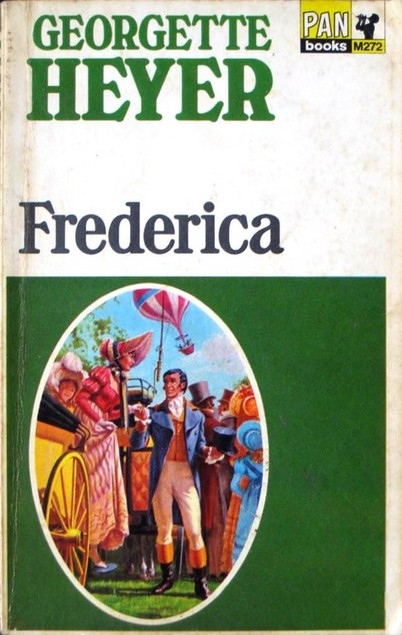
frederica georgette heyer 1Frederica by Georgette Heyer ~ 1965. This edition: Pan, 1968. Paperback. ISBN: 330-20272-3. 330 pages.

My rating: 7.5/10.

This is my fifth ever Georgette Heyer “Regency Romance” title. After bowing to so many recommendations to give the author a try, I must say that I am thoroughly enjoying my explorations of her work. Frederica was, I believe, Heyer’s twenty-ninth Regency novel, in a writing career spanning fifty years, in which she produced a very respectable sixty-plus novels and mystery thrillers.

Here, in Heyer’s own words, is the rather tongue-in-cheek blurb she wrote for the pre-publication promotion of Frederica, at the insistence of her publisher. By this time, in the mid 1960s, the author was a reliable producer of “a book a year”, with a strong contingent of devoted fans clamouring for more.

This book, written in Miss Heyer’s lightest vein, is the story of the adventures in Regency London of the Merriville family: Frederica, riding the whirlwind and directing the storm; Harry, rusticated from Oxford and embarking with enthusiasm on the more perilous amusements pursued by young gentlemen of ton; the divine Charis, too tenderhearted to discourage the advances of her numerous suitors; Jessamy, destined for the Church, and wavering, in adolescent style, between excessive virtue and a natural exuberance of spirits; and Felix, a schoolboy with a passion for scientific experiments. In Frederica, Miss Heyer has created one of her most engaging heroines; and in the Marquis of Alverstoke, a bored cynic who becomes involved in all the imbroglios of a lively family, a hero whose sense of humour makes him an excellent foil for Frederica.

The storyline is as simple as can be. It involves that tried and true pursuit, the husband hunt, and of course its equally vital counterpart, the quest for an acceptable wife.

Frederica, eldest in a family of five recently-orphaned siblings, has, at the advanced age of twenty-four, cheerfully accepted that she is destined for a life of happy spinsterhood. With her oldest brother, Harry, several years her junior, off at Oxford, Frederica is concentrating her energies on her nineteen-year-old sister Charis, who is an adorable young lady, being sweet-natured (though not overly bright), and stunningly beautiful. The little snag is that though the Merrivilles were left with a reasonably adequate income after their late father’s demise, the otherwise desirable Charis will not have much of a marriage portion to accompany her lovely self into a marriage; Frederica is determined to introduce her sister into the highest society and provide her with a chance to attract a high-born (and wealthy) suitor who may overlook her (relative) poverty.

Frederica petitions a remote cousin, Vernon, Marquis of Alverstoke, to sponsor Charis for her London season. Lord Alverstoke, a confirmed cynic and a slightly notorious rake – though forgiven all by fashionable London society out of respect for his massive fortune – is initially dismissive of Frederica’s suggestion, but she so charms him with her candour and sense of humour that he unexpectedly relents and decides to don the mantle of guardian of the Merriville menage for a while, mostly, he tells himself, because his interest in the lovely Charis – a direct competitor in the marriage market to their own daughters – will annoy his snobbish and critical sisters.

Charis does indeed cause a sensation with her loveliness and good nature; suitors reliably materialize, and the story meanders on its way. And we all know who Lord Alverstoke ultimately falls for, don’t we? Though the object of his reluctant devotion remains oblivious, which gives opportunity for the reader to sigh romantically over the reformed rake’s newly awakened and, for the first time in his life, truly heartfelt passion, which – of course! – he cannot share with the woman of his desires, as she shows no signs of reciprocation and would doubtless laugh off any advance…

This novel does rather go on; Georgette Heyer was going through a bout of serious ill health while it was being written and readied for publication, and she stated that though she would have liked to have edited it more strongly and decreased its length, her publisher’s and public’s demands overwhelmed her and she let Frederica go into print as it stood.

It works, though. The characters are interesting, and the dialogue is – overused but apt description – sparkling. The situations Frederica and her two youngest brothers, earnest Jessamy and rambunctious Felix, get themselves into are enjoyably humorous. The period detail is absolutely delicious, and I loved the passing descriptions of dress which Heyer provides, speaking to her readers as though they too were intimately familiar with the fashions of the time period. She informs, but never preaches; this is the type of historical fiction I like the very best. The readers must stretch to take it all in, but the writer assumes her audience is perfectly capable of doing so, and the story moves right along.

Of particular interest were the references to the technological inventions of the day. I was most intrigued by the mention of

… Maillardet’s Automaton … this marvel was a musical lady, who was advertised, rather alarmingly, to perform most of the functions of animal life, and to play sixteen airs upon an organised pianoforte, by the actual pressure of the fingers…

frederica georgette heyer pedestrian curricleAlso the Pedestrian Curricle, a kind of pedal-less precursor to the bicycle, upon which one of the Merriville boys, in company with a steep hill and a canine companion – the boisterous pseudo-“Baluchistan Hound” Lufra –  comes to grief. And then of course there is the ballooning episode which concludes the story with such drama.

A most enjoyable diversion, was cheerful and overwhelmingly good-natured Frederica – book and heroine both – and I savoured every page.

It lost a few points on my personal ratings scale by the rather overdone drama of the ending, which I thought was just a bit over-the-top, is such a criticism can be levelled at a book of this genre.

Looking forward to my next foray in Georgette Heyer’s meticulously depicted Regency world, and to meeting yet more of her dashing heroes and clever heroines.

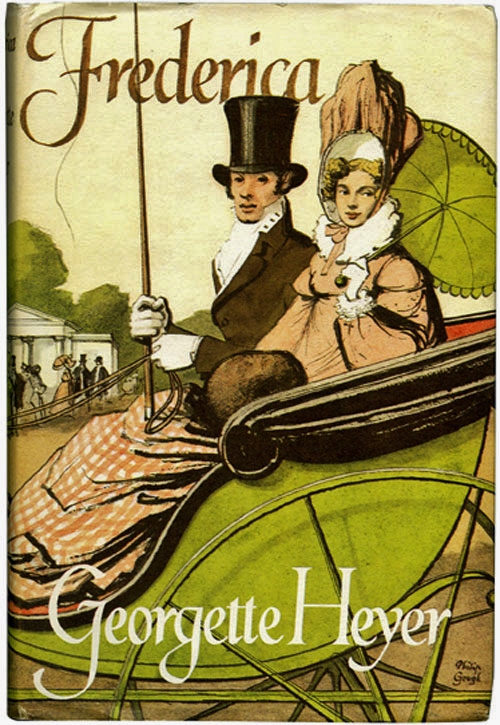
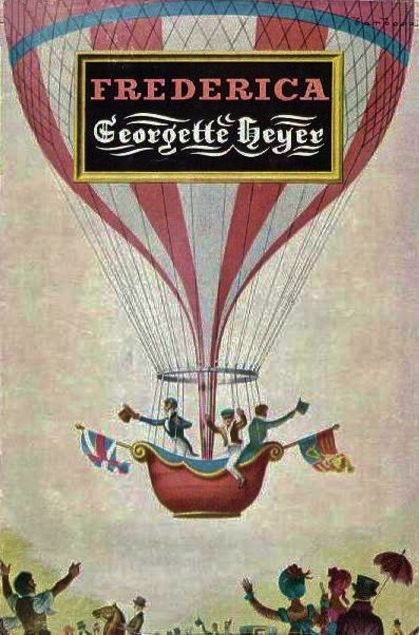
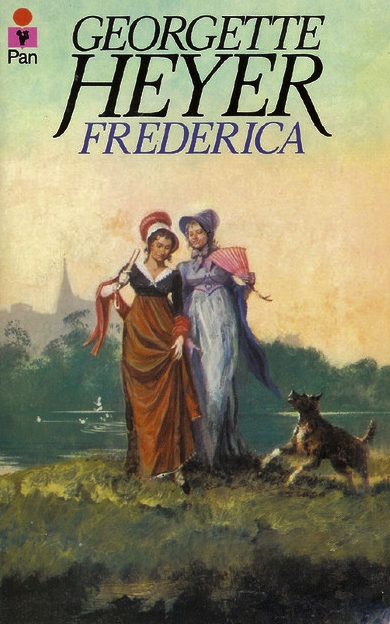
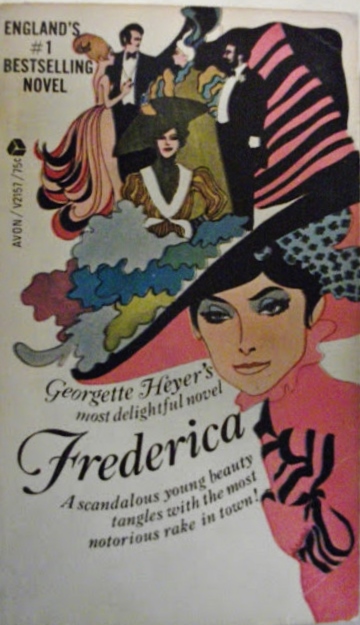
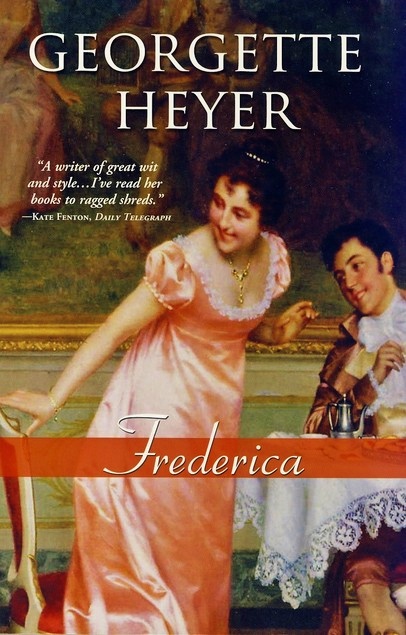
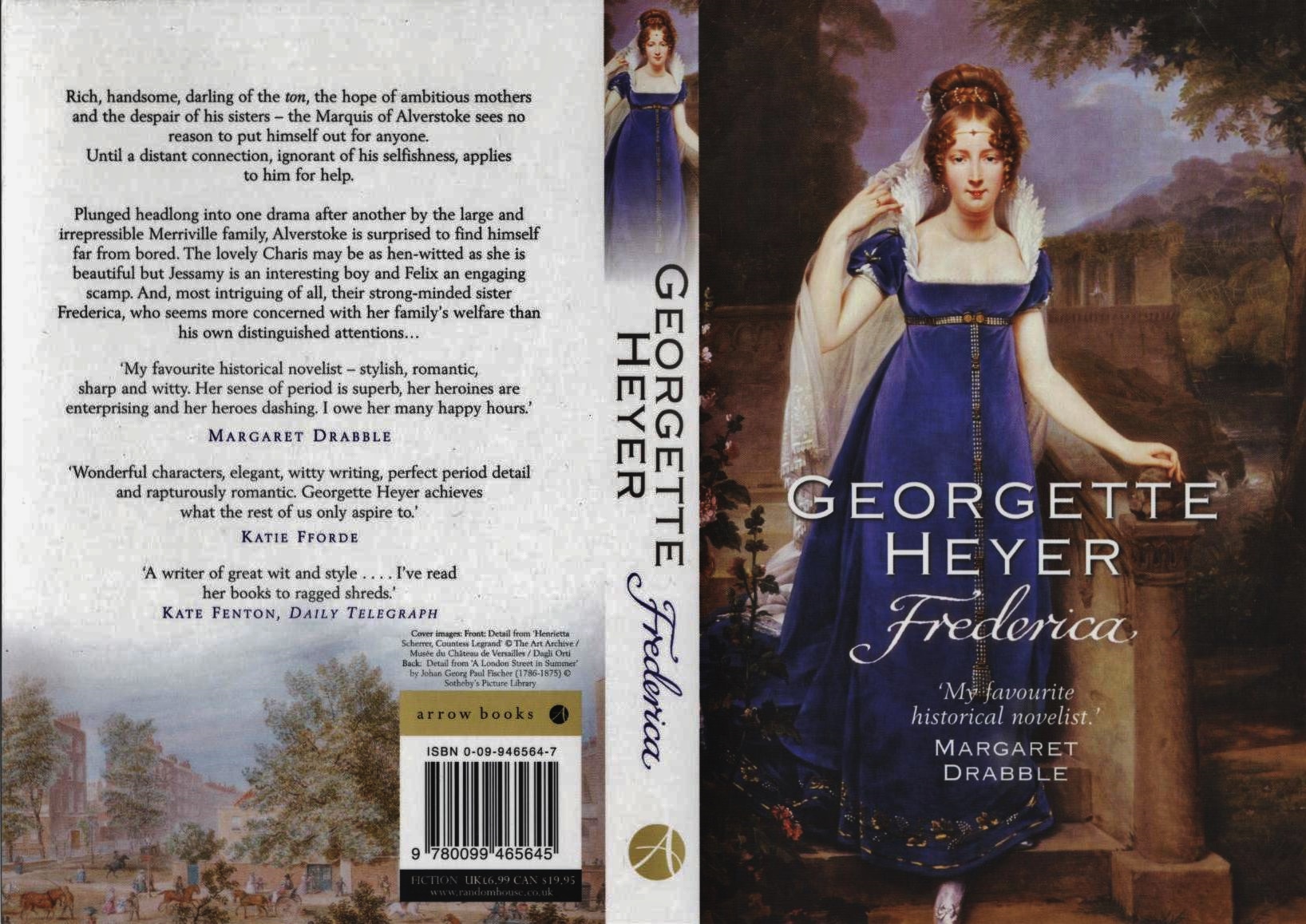
In the meantime, here are some of the covers for Frederica which struck my fancy as I poked about the internet investigating other reviews, of which there are many, most exceedingly enthusiastic.

I liked this cover; it has a decided "period" appeal.

I liked this cover; it has a decided “period” appeal.

And this one, focussed on the dramatic balloon episode which brings the tale to a fitting conclusion.

And this one, focussed on the dramatic balloon episode which brings the tale to a fitting conclusion.

And here we have Frederica and Charis, accompanied by their beloved Lufra. I'm not quite sure about that fan, though; would it have been employed in such a way on a daytime stroll in a London park?

And here we have Frederica and Charis, accompanied by their beloved Lufra. I’m not quite sure about that fan, though; would it have been employed in such a way on a daytime stroll in a London park?

Here's a German cover which caught my eye. (Georgette Heyer was apparently very popular in Germany.)  I really like the strong colours and simplicity of the pen-and-ink treatment of this poster-like illustration.

Here’s a German cover which caught my eye. (Georgette Heyer was apparently very popular in Germany.) I really like the strong colours and the striking simplicity of the pen-and-ink treatment of this poster-like illustration. (“Heiratsmarkt” translates to “Marriage Market”.)

This one is absolutely bizarre, a triumph of misguided misrepresentation.  Who are these people, and why have they strayed from a 1960s costume party onto the cover of a well-mannered Regency-period romance?!

This one is absolutely bizarre, a triumph of misguided misrepresentation. Who are these people, and why have they strayed from a 1960s costume party onto the cover of a well-mannered Regency-period romance?! And who is the “scandalous young beauty” so prominently mentioned? Egads! Did the illustrator read the book? Methinks…NOT.

A more current cover from a recent re-release. This one captures the happy tone of the novel wonderfully well, though the featured female does not really fit my mental picture of Frederica herself.

A more current cover from a recent re-release in 2009. This one captures the happy tone of the novel wonderfully well, though the featured female does not really fit my mental picture of Frederica herself.

And here is the most recent cover, from 2011. Again, not my mental image of Frederica, but a lovely cover nonetheless.

And here is the most recent cover, from 2011. Again, not my mental image of Frederica, but a lovely cover nonetheless.

hazel rye vera bill cleaver 001Hazel Rye by Vera and Bill Cleaver ~ 1983. This edition: Harper Trophy, 1985. Softcover. ISBN: 0-06-440156-1. 178 pages.

My rating: 5/10.

A short novel published for the older elementary school ages – it says so right there on the back cover – ages 10 to 12 – and please don’t get me started on such narrowly prescriptive recommendations! Useful as these are to teachers and librarians when “targeting” the books they select for their students, I often wonder how many readers miss out on reading truly diverting and worthwhile stories because they are past the “age limit” so prominently displayed.

Not that I am suggesting that this particular novel is a masterpiece. Far from it. Hazel Rye is a slight novel, one of those “relationship”-slash-“issues”-slash-“problem” tales so common in elementary school libraries. The idea, it seems, is to make sure that any particular problem a child might be facing in his or her life can be eased by referring said child to a book featuring a similar situation. Want to be a football star but didn’t make the team? Here, read this. Being bullied at school because you’re fat/thin/gay/gawky/smart/slow? Super popular but still unhappy because your friends are all so shallow? Adopted and having issues with it? Foster kid? Mom and Dad divorcing?  Pregnant? Big brother dying of AIDS? Best friend dying of cancer? Mother dying of cancer? YOU’RE dying of cancer? You name it, there’s a story that addresses it, usually with a Big Helpful Conclusion of some sort to help the reader cope with the issue by learning that even though bad stuff happens, he/she is not alone.

All of the above being great topics to drive a novel, but so terribly often the storytelling gets lost in the shuffle, what with The Issue taking precedence. The characters exist merely to mouth the words; they’re frequently merely the framework The Issue gets draped over;  we never get to know them, let alone form any sort of personal relationship with them.

What I’m aiming at with my opinionated dismissal of so much well-meaning but misses-its-mark-as-good-fiction juvenile literature is to say that though this particular book fits into the category of an “issues” book, it’s just a little bit different, and it works well as a purely enjoyable read. It also seems aimed at perhaps a more mature audience than that stated on the cover, or maybe I should say “likely to be appreciated by”, rather than aimed at. For Hazel Rye – the book as well as the character – is a bit out of the ordinary.

The titular protagonist is an eleven-year-old girl living in a small community surrounded by orange groves in central Florida. Hazel’s Big Obvious Issue is that she’s slow in school; we find out on the first page that she’s just flunked sixth grade, and though she pretends not to mind all of the evidence points to a sorely bruised psyche.

Hazel’s eighteen-year-old brother Donnie has just been married; he lives nearby and is doing just fine taxi-driving; Hazel holds his financial success in high regard and likes to think that she too could do as well in a few years, once this bothersome school time is over; Donnie dropped out at sixteen and no one seems too concerned about it. Her mother is a fragile hypochondriac, too involved in her woes to take much interest in housekeeping, let alone mothering her daughter. As the story starts, Ona Rye is about to leave for a prolonged visit to her family in Tennessee.  The parental mantle in the household rests firmly on the shoulders of Hazel’s father, Millard, a hard-working and successful carpentry contractor. He and Hazel are not just father-and-daughter but also very close friends – “buddies” – with occasional bouts of flash-in-the-pan violent squabbles to keep things interesting between them. It was after one of these arguments that Millard transferred ownership of his small, neglected orange grove to Hazel, to woo back her attention and affection by an important gift.

Hazel rather likes the idea of being a property owner, though she’s not much interested in the farming aspect of things – too much work, and Hazel is all about taking things as easy as possible – and when an itinerant, fatherless family shows up asking to rent the rundown shack in Hazel’s grove, she enters into an agreement with the Poole family to let them live in her grove in return for young Felder Poole’s assistance in bringing the damaged trees back into production.

Felder Poole is close in age to Hazel, but aside from this similarity he is everything that she is not. Extremely bright, fond of all sorts of learning, he is an accomplished autodidact with a talent and propensity for making things grow. Hazel is at first suspicious and then enthralled with Felder’s plans for the grove; she becomes fascinated with the whole Poole ménage, much to her father’s dismay.

For Millard Rye’s Great Big Issue – which is really part and parcel of Hazel’s Great Big Issue, too – is that he is so emotionally attached to his daughter that he can’t bear to share her with anyone else. As Hazel’s horizons widen with the entry of Felder and the rest of the Pooles into her life, she is continually confronted with her father’s veiled but genuinely deep jealousy, and rather than being flattered by his attachment to her as she has been in the past, is beginning to see that this is an emotionally unhealthy situation for the both of them.

Let me hasten to say that Millard’s interest in Hazel is purely filial; there is no shadow of anything improper in his attachment to her; Millard is also deeply attached to his “nervous” wife Ona, and yearns for her happiness, indulging her in every way possible, hence his willingness to send her off to her parents to regain her fragile equilibrium while Millard and Hazel keep the home fires burning. She’s definitely coming back; whatever the Ryes’ other issues, a permanently split and unhappy family life does not appear to be among them.

As Hazel becomes more and more interested in the orange grove, and in the inner workings of the happy, loving, poor-but-ambitious Poole family, she is moved to change her own life in various ways. The sudden and unexpected resolution of the story rather surprised me, as did Hazel’s reaction to it; a welcome situation for this old cynic where this particular juvenile genre is concerned. Actually, I shouldn’t say “resolution”, as there really isn’t one; Hazel is left poised for her next step as the curtain closes on this brief period in her life.

The language in the book, coming from a third person perspective, is unusual and unique, using what I can only assume is a local Florida dialect and its very distinctive phraseology. Husband-and-wife writing team Vera and Bill Cleaver already had a respectable number of well-reviewed juvenile novels to their credit when they came up with Hazel Rye, and regional emphasis and use of dialect was one of their specialities. (You may find the authors’ names familiar if you were in grade school in the 1970s, as their award-winning Appalachian novel, Where the Lilies Bloom, was ubiquitous in libraries and frequently used for novel study classes. I read it way back then, and remember it vaguely but with admiration; I will be seeking it out for an adult re-read.)

Hazel Rye pleased me. Though it belongs in a genre I frequently hold up to scorn, I happily admit that it was a gently diverting read. The serious themes – the “issues” – were treated with respect and common sense, and the book was jam-packed with good nature and understated humour. A novel perhaps best appreciated by more mature readers than the target identified by the publishers; I would think a lot of the more enjoyable aspects of the language and scenarios would fly right over the head of the typical grade-schooler, and the plot itself isn’t really strong enough to be memorable, among so many other books with much more dramatic storylines.

I wouldn’t suggest that anyone rush out an acquire this one – it’s a very minor story in a read-once-and-move-on sort of way – but if you or your bookish adolescent come across it in your library travels, I’d say that you should give it a go.

river for my sidewalk gilean douglas 001River for My Sidewalk by Gilean Douglas ~ 1953. Originally published under the pseudonym Grant Madison. This edition: Sono Nis Press, 1984. Softcover. ISBN: 0-919203-41-8. 132 pages.

My rating: 7/10, after some consideration. Some of these short anecdotes and essays are solid 10s, some are not.

I’ve been slightly sidelined with a minor virus these past few days, and the upside is that while I’m just feeling sub-par enough to take a break from most of my more strenuous everyday chores, I’m perfectly able to putter about in the garden, do some gentle weeding, tomato-staking and pruning, watering, and definitely take advantage of the down time to read and type. So, having ambitiously started a number of reviews, I may just get a few more than usual launched in the next day or so. Or perhaps I’ll take advantage of the WordPress feature which allows us to schedule posts for future dates, something I’ve never yet had to do, as there is definitely no backlog of things ready to share! If anything, I frequently post before all of the final tweaking is done, catching typos and awkward phrasings after I’ve hit the “Publish” button. Luckily there is an “Edit” feature, too…

I picked up this particular book at The Final Chapter in Prince George last week, while browsing the excellent Canadiana section. Being rather partial to memoirs in general and British Columbia rural and wilderness settings and history in particular, River for My Sidewalk‘s back cover blurbs pretty well guaranteed my purchase.

About the Author

Gilean Douglas has been a newspaper reporter, copywriter, editor, columnist and, throughout and still, a freelancer. Her work has appeared in numerous periodicals both here and abroad, including Chatelaine, Saturday Evening Post, Canadian Business, Audubon, the New York Times and, by actual count, 144 other periodicals. She has five volumes of poetry to her name, one of light verse, and three nonfiction titles. Four of her poems were set to music and published by Schirmers and others received choral settings and have been performed at [various venues] and in concert. She edited Modern Pioneers for the B.C. Women’s Institute after holding local, district, provincial and national office in that organization.

Gilean Douglas now [in 1984] resides on Cortes Island, where she is a Weather Observer with Environment Canada (receiving four awards for her work) and a Search and Rescue Agent. In her spare time she raises plants, produce, and bulbs.

About the Book

Gilean Douglas spent close to a decade living alone in a small wilderness cabin in the Cascade mountains. River for My Sidewalk, first edition, was originally published…in October of 1953, under the male pseudonym of Grant Madison. The reading public of that time would have doubted the authenticity of a woman managing in the circumstances described. But Gilean Douglas did more than manage, she thrived in the isolation and completeness that solitude brings. Well before the days of liberated females, Ms. Douglas chose, lived, survived, and savoured a self-sufficient existence in an area that is still considered wild and inaccessible. Her story is timeless and the observations are lyrically clear…

Gilean Douglas: Naturalist, feminist, farmer, poet, author.

Gilean Douglas: Naturalist, feminist, farmer, poet, author.

Well, I’d never heard of the woman myself, but who could resist finding out more? And, after reading River for My Sidewalk, I did just that. What an absolutely fascinating woman Gilean Douglas must have been! And not just fascinating, but, for all of her quirks and her unhappy history with husbands, apparently much admired and beloved by her friends and neighbours. Here is an excerpt from a longer biography in B.C. Bookworld:

Gilean Douglas, author of River for My Sidewalk (1953), was a female Thoreau of Canada. A loner from a well-to-do family, she retreated to wilderness cabins and became an environmentalist before the word existed, leaving four marriages behind her.

Gilean Douglas, born in Toronto in 1900, was orphaned at age 16 and soon became a reporter. She travelled extensively prior to her arrival in B.C. in 1938 where she first lived in a cabin on the Coquihalla River. She then moved to an abandoned miner’s shack on the Teal River near Duncan, B.C. “It was the great moment of my life when I waded the Teal River,” she wrote, “with my packboard on my back and stood at last on my own ground. I can never describe the feeling that surged up inside me then. . . I felt kinship in everything around me, and the long city years of noise and faces were just fading photographs.” Subsisting mainly on produce from her garden, Douglas began to write about her adventures but could not find acceptance as a woman writing about outdoor life. Adopting the male pseudonym Grant Madison did the trick—and she published River For My Sidewalk, her best-known book.

Gilean Douglas continued to use her male name until 1983 when she revealed herself in a Vancouver Sun interview. Douglas next moved to Cortes Island, near Campbell River. “I have spoken many times of ‘my land’ and ‘my property’, but how foolish it would be of me to believe that I possessed something which cannot be possessed,” she once wrote. Along with seven poetry books, she produced two more meditative memoirs, Silence is My Homeland: Life on Teal River (1978) and The Protected Place (1979). The latter describes life on her 140-acre homestead on Cortes Island where she was employed as an Environment Canada weather observer and a Search and Rescue agent. Her cottage was situated at Channel Rock on Uganda Pass. For nine years she served as the Cortes representative on the Comox-Strathcona Regional Board. Gilean Douglas also contributed a nature column called “Nature Rambles” to the Victoria Daily Colonist (which became the Times Colonist in 1980) for 31 years, from 1961 to 1992, a longevity for a B.C. columnist that places in her in the company of Eric Nicol and Arthur Mayse. She died on Cortes Island in 1993.

And for a much longer and much more detailed biography, Andrea Lebowitz’s well-researched and fascinating article, Narratives of Coming Home: Gilean Douglas and Nature Writing, is a must-read.

Well, this is all well and good, but how does River for My Sidewalk measure up to its author’s infinitely intriguing promise?

I must say that I had high expectations, just from reading the cover material and from my quick perusal of the contents before I purchased the book. And I did enjoy reading it, though it went in a little different direction than I had anticipated.

Something about the tone of the narrative voice struck me as a little bit odd, and occasionally forced, and it wasn’t until I twigged to the fact that the author was carefully phrasing her passages to make the book appear as if it were written by a man that the penny dropped. I had started out assuming that the reader was aware that the writer was indeed a woman, and once I revised this assumption and allowed for the time of writing and publication, the late 1940s and early 1950s, the rather coy slant was understandable, and therefore much more acceptable.

Gilean Douglas writes in a strongly opinionated manner. She lays down the law as she sees it, unapologetically critical of mankind’s abuse of nature, and eloquently defensive of the way in which she has chosen to retreat from the mainstream world. She never condemns the city dweller as such, acknowledging that it would be an impossibility for all to strive for her type of lifestyle, but she has little patience for the squeamish and feeble-hearted visitor to the bush who quails at the thought of coming across a cougar or bear, or of crossing a river on an open cable car, or of hiking miles for a casual neighbourly visit.

Much of the book is an enthusiastic tribute to the natural world, phrased in glowing and effusive tones. Possibly just a little too glowing and effusive? The style frequently seems a bit dated even for the time of writing, being perhaps more typical of the century before; it reminds me of those rather stilted memoirs one frequently comes across hiding behind ornate covers in the antique books section of the better second hand book stores.

Example:

The day is my friend. I meet it with outstretched hand and use every moment of it to the utmost. Sitting in the house I have partially built I eat the food which I have grown for myself. I have tried to learn everything there is to know about the trees, flowers, birds, animals, insects and rocks which are all around me. It has taken me years and will take more years, but I feel that every grain of such knowledge brings me closer to the great harvest of the universe.

The night is my love. Dusk comes with the benediction  of the thrush and the darkening of river water. The clearing is all shadow and the forest dim with mystery. The shade climbs higher and higher up the mountains which ring my valley, leaving only the peaks crested with sunlight. Everything becomes slower and more silent as the dusk deepens into night. Then stars burn silver in the sky and sometimes the moon sails a midnight sea to a port beyond the tall evergreens of Home Wood. This has been the way of night in the wilderness for untold eons. How few living now have ever known it as I do! Campers, fishermen, hunters come in here bringing their shouts and drinking and luxuries. They go home to boast of their wilderness adventures, but all they take away is a paste jewel in a plastic setting.

And then there are the passages like these:

Spring has swept away the last patch of her snow with her green-twigged broom and hung out the clouds to bleach…

and

When burning … fir and hemlock have their swan song of beauty… as needles become rosettes of flame which shimmer and fade along the twigs, transforming each one into a garland for some fire queen’s shining hair…

But for all the occasionally purple prose there is much beautifully phrased and sincerely presented, as Gilean Douglas documents the thoughts of her long solitudes. I buried all my qualms when I read this:

We are all strangers here, but no one more so than the person who is out of step with the time. If you are that person you will be understood – and then only imperfectly – by just one or two of all those you know and perhaps by none at all. To the others you will always be suspect. The timid will be afraid o be seen with you; the bold will say they cannot be bothered with anyone who is more interested in the future of the world than in whether today’s market is going up or the price of tomorrow’s whisky going down.

Most of this ostracism will bother you very little for there is nothing you like better than quietness and privacy. But not every moment of your life. In books you can find the comradeship and understanding you are denied by living men, but even so you are hungry for a good heart-to-heart talk with someone who comprehends you intellectually and emotionally. If you are lucky you will come across one or two people with whom you can exchange ideas, and if you are luckier still you will marry one of them…

…[An] urgent sense of the shortness of life, perhaps more than anything else, distinguishes the man out of step with his time from his fellow beings. He sees time wasting everywhere around him and he is disgusted and alarmed. He knows that it is all wrong; that life is precious and should be used for precious things. Not that he believes in all work and no play, but simply that his idea of play differs from the bridging, gossiping, clock-watching, pulp-reading average. To him play is a change of occupation – perhaps from writing to splitting wood – while relaxation is letting go completely in sleep, laughter or lying on a summer hill watching the clouds drift over and “growing soul”…

An unusual and admirable woman, this Gilean Douglas, and one whom I will be seeking to acquaint myself with more deeply through her other writings. Apparently the two 1970s memoirs are not quite so gushing, and are more contemporary in tone, though they are not as well known (relatively speaking) as River for My Sidewalk.

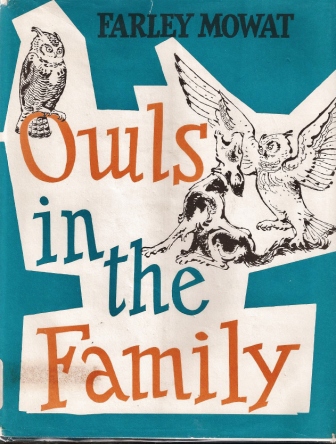
owls in the family farley mowat 001Owls in the Family by Farley Mowat ~ 1961. This edition: Little, Brown & Co., 14th printing. Illustrated by Robert Frankenberg. Hardcover. 107 pages.

My rating: 5/10 as an adult re-read; easily an 8/10 for a juvenile Can-Lit read-alone or read-aloud.

My kids swear I read this to them out loud way back in the murky depths of time; I can’t say that I remember doing so, but we read a lot of books together, so there’s a strong possibility that they are correct. They also say that they loved it, so…? (That has to stand for some sort of a recommendation!)

School teachers love this one, too. Just go ahead and Google “Owls in the Family novel studies”, and then stand back. Generations of Canadian school children have “done” and are still “doing” this slightly fanciful tale, ostensibly about young Farley’s true experiences as a Saskatchewan schoolboy.

Are you catching a slightly cynical tone to my words? I am sad to say that I have something of a love-hate relationship with Farley Mowat. I truly enjoy some of his fictions, and happily read and re-read his famous Lost in the Barrens and The Curse of the Viking Grave all through grade school, though luckily I dodged ever having to do a novel study on either of these; I read them purely for pleasure. But as the years went on, and I became more and more aware of the Canadian literary scene in a much broader sense, I often came across Mowat (in print) laying down the law and making grand pronouncements upon this, that and the other, which in itself is not all that offensive, but for his strident dismissals of other opinions than his own. Grand Old Man of Canadian letters as he may have become, but he is not universally loved in his home country. See this article in Up Here magazine, Farley Mowat: Liar or Saint?, for an interesting discussion of the Mowat paradox.

All of this aside, in looking at his juvenile fiction, Owls in the Family may well be his most beloved and widely read work, perhaps because of its suitability as a read-alone for novice readers, and its affectionate portrayal of an idealized mid-20th Century boyhood on the Canadian prairies.

The gist of the book is that at some point in his youth, the narrator, one Billy (widely accepted to be a stand-in for Farley himself, though why the renaming, none can tell), along with his friends Bruce and Murray, decide that they would like to capture and raise a young Great Horned Owl as a pet. They wander out into the cottonwood groves, find an owls’ nest, and, after a farcical encounter with the mother owl while accompanying one of their teachers on an attempt to photograph the nest and the owlets, conveniently acquire one of the fledglings when a storm knocks the nest down a day or two later.

The boys take their find to Billy’s house, where the young owl, named Wol after Christopher Robin’s companion in the Pooh books, joins an existing menagerie of various creatures such as gophers and white rats. Wol settles in to become one of the family, and is soon joined by a companion, the smaller and much more meek Weeps, rescued by Billy from certain death by torture by two other boys.

Several chapters of various adventures are described – canoeing on the slough, a pet parade gone hilariously awry, various encounters with unsuspecting individuals whom the owls universally upset and oust – until the story’s sudden ending with Billy and his family moving away, leaving the owls under Bruce’s care.

Perhaps I’ve become too cynical in my middle-aged years, but I’m afraid a lot of the humour didn’t raise much more than a reluctant smile this time around. Robbing birds’ nests, shooting crows, finding the neighbour’s cat dead in Wol’s claws – these are examples of the anecdotes we are asked to smile at. A less critical readership will no doubt take it all in stride.

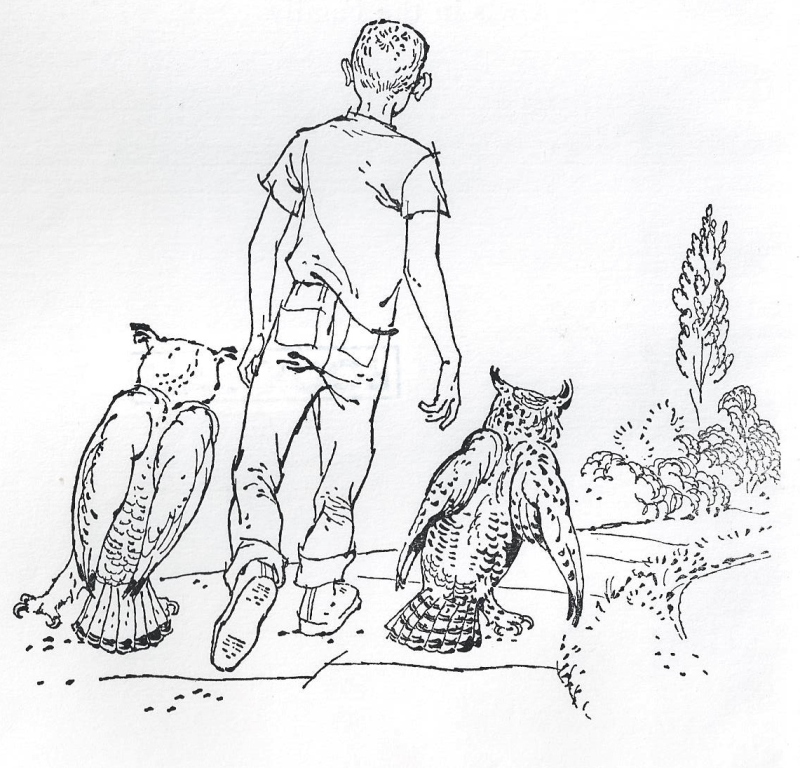
From Farley Mowat's 'Owls in the Family' frontispiece; illustration by Robert Frankenberg.

From Farley Mowat’s ‘Owls in the Family’ frontispiece; illustration by Robert Frankenberg.

The illustrations by Robert Frankenberg are gloriously typical of the best juvenile books of the era, and it is well worth seeking out a copy with the original artwork if sharing this with a young reader, or, for that matter, reading it for yourself. Eleven short chapters and just over one hundred pages make this a fast and easy read-aloud; one could easily knock back three or four chapters at a sitting. Suitable for all ages, as long as one is prepared to discuss some of the more questionable events (no longer perhaps seen as harmless amusement) referred to in the previous paragraph.

I would hesitate to inflict this upon children in the nature of a “novel study”, but it does make an interesting casual read, capturing as it does a very Canadian place in a now long-ago time. Recommended, with the stated personal reservations.

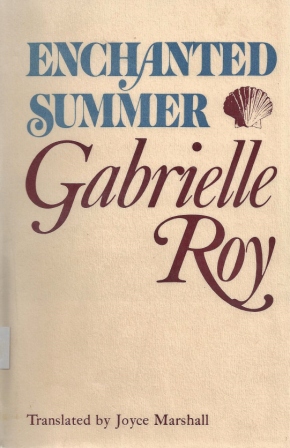
enchanted summer gabrielle roy 2 001Enchanted Summer by Gabrielle Roy ~ 1972. Published in French as Cet été qui chantait. This edition: McClelland and Stewart, 1976. Translated by Joyce Marshall. Hardcover. ISBN: 0-7710-7832-5. 125 pages.

My rating: 8/10.

This is a slight and delicate compilation of short (some very short) vignettes written by the esteemed francophone author during one of her summers residing in a little house she had purchased in 1957 in the rural village Petite-Rivière-Saint-François, Charlevoix County, Quebec.

People come and go throughout Gabrielle’s summer; her husband Marcel Carbotte, various acquaintances from far and wide, her local friends, and, most frequently, her closest neighbours, Berthe and Aimé, with whom she peaceably shared a fenceline.

Many of the vignettes are fragmentary glimpses of nature and landscape, snapshots of a moment captured in words. Gabrielle and Berthe walk along the railroad line to a small pool inhabited by a responsive bullfrog, Monsieur Toong; Gabrielle ponders the wild garden which grows on an uncultivated bit of farmland; the intellectual capabilities of Aimé’s placid cows are considered; the gentle life of  Jeannot the crow is captured in words as he sways in the wild cherry tree, and his sad fate is documented.

Wildflowers, birds, domestic animals are all considered and watched with interest and the author’s observations are gently and humorously related to the reader. The beauty of the landscape is frequently detailed, and the sights, sounds and fragrances of what seems to be a time of great peace and contentment; even the occasional storm does not break the mood of repose. These summers by the river were Gabrielle’s time of retreat and (relative) solitude, in which she refreshed herself from the busy social life of her winter residence in Quebec City, and from the cares of her family – two ailing sisters in Manitoba were often visited – and a time of concentrated writing.

Most of these small stories are centered on animals, but the two most poignant, and to my mind the most memorable, involve people.

Elderly cousin Martine comes for a two weeks’ visit in the country; living in a small city apartment and frail to the point of immobility, she longs for a glimpse of the river of her childhood. One day, without telling Martine’s sons what they are planning, Berthe and Gabrielle laboriously support and carry her down to the river, where for a while she revisits her long lost youth.

For my part, the more I looked at her the more I was reminded of those pilgrims of the Ganges in Benares, whom one sees with loincloths tucked up, frighteningly thin but their faces illuminated with fervour…

…Suddenly, barefoot on the rim of the summer sky, she began to ask questions – doubtless the only ones that matter.

“Why do we live? What are we sent to do on this earth? Why do we suffer so and feel lonely? What are we waiting for? What is at the end of it all? Eh? Eh?”

Her tone was not sorrowful. Troubled perhaps at the beginning. But gradually it became confident. As if, though she didn’t quite know the answer, she already senses that it was good. And she was content at last that she had lived…

And, in a remembrance of a long-ago month as a substitute teacher in a very small, poor, rural Manitoba settlement, Gabrielle recounts her visit to the house of one of the school pupils, who has just died of T.B. The other schoolchildren, who have been apathetic towards their temporary teacher, unbend as they tell her about the sadly fated Yolande. With sudden inspiration, Gabrielle suggests they pick the wild roses growing in the clearing outside Yolande’s cabin, to give tribute to their friend.

On our return we pulled them gently apart and scattered petals over the dead child. Soon only her face emerged from the pink drift. Then – how could this be? – it looked a little less forlorn.

The children formed a ring around their schoolmate and said of her without the bitter sadness of the morning, “She must have got to heaven by this time.”

Or, “She must be happy now.”

I listened to them, already consoling themselves as best they could for being alive.

But why, oh why, did the memory of that dead child seek me out today in the very midst of the summer that sang?

Was it brought to me just now by the wind with the scent of roses?

A scent I have not much liked since the long ago June when I went to the poorest of villages – to acquire, as they say, experience.

As I said early on, this is a slight and quickly read memoir, but one that has a decided charm and a strong sense of atmosphere and place. Very well suited to a peaceful summer afternoon read, preferably in the shade of your own particular tree, with birdsong and dancing shadows for counterpoint.

hostages to fortune elizabeth cambridge 001Hostages to Fortune by Elizabeth Cambridge ~ 1933. This edition: Jonathan Cape, 1933. Hardcover. 304 pages.

My rating: 10/10. Not only met but exceeded all of my expectations.

He that hath wife and children hath given hostages to fortune; for they are impediments to great enterprises, either of virtue or mischief.

~Francis Bacon

I loved this book on so many levels; I suspect it will be high on my “most memorable books of 2013” list. Not only is it beautifully written, but the themes of marriage, motherhood and personal fulfillment struck very close to home; I couldn’t help but recognize many parallels with my own experience, which (of course!) is not unique, as Elizabeth Cambridge so eloquently demonstrates.

*****

Catherine lay still. Through the slats of the blind she could see the hard white light of early morning; the bars were like a ladder. Black, white, white, black … was the white the rungs of the ladder or was it the space between? A white ladder or a black ladder?

Water splashed. The voice of the newcomer, hoarse and uncertain, rose and fell, broken by deep, sobbing breaths.

A girl. An anti-climax. A girl … after all that! Oh well, William would be pleased. A ‘nice little girl’. That was nurse, standing up for another woman.

‘Can I see her?’

‘Not yet. I’m just giving her a bath.”

Catherine closed her eyes. She wondered if being born hurt as much as giving birth. Somebody pulled up the blind and opened the window. Instantly the room filled with the smell of slaked dust. It had been raining in the night, but the morning was windless, damp, and fresh. An early tram clashed and rattled down the hill, the overhead wires sang as it passed. Out in the Sound a tug hooted. The tide must be falling now … all down the coast over miles of brown rocks, the gulls screaming in the pale June morning.

A girl. But who wanted girls, now, in the middle of a war? Catherine had never believed in the equality of the sexes. Women simply did not have the same chance as men. Nature had seen to that. If you wanted to produce a human being at all, it was common sense to want to produce the kind of human being that was going to have the best time.

Best time? The expression was the wrong one. Surely? What did she mean by the best time?

… She opened her eyes. Nurse was standing over her, the baby held upright against her shoulder, like the bambino on a Della Robbia plaque.

Catherine stared. So that was her baby. Baby? Babies were sleepy, amorphous, unconvincing and ugly. This creature was not amorphous, it was not even ugly. It stared at life with bright, unwinking eyes. Its underlip was thrust out, tremulous, indignant.

‘My word,’ Catherine thought. ‘That’s not a baby. It’s a person.’

And with that delicate little epiphany, the stage is set for the years to come of Catherine’s motherhood. The girl child, Audrey, is eventually followed by two more siblings, Adam and Bill, and through it all, the tedious business of ministering to infant needs, the small heartaches and exquisite joys of mothering toddlers, small children, increasingly independent and opinionated school children, teenagers, Catherine finds herself secure in that attitude, that these are, above all, persons, not merely extensions of herself or William, though of course there are glimpses of genetic imprint which for a moment here or there stand out and give sharp pause.

This is an episodic novel in which “nothing ever happens”, but it is a beautifully observed and documented series of vignettes of family life, with a view to the broader scene in which it is set. It reminded me most strongly of another book that has a similar tone and an equally well-depicted mother, Margery Sharp’s 1935 novel Four Gardens, another hidden gem of a book which I wish would receive the same attention from modern re-publishers of almost-lost small literary treasures.

These women are, of course, more than “just mothers”, but their maternity is an inescapable part of their lives, and though it does not define them, it forms their lives in various unforeseen ways, and their emotional and intellectual responses to their motherhood are well worth considering. Elizabeth Cambridge’s Hostages is said to be semi-autobiographical; Margery Sharp was childless; but both writers have identified and played upon a strong chord of shared experience which resonates with me, a person (and mother) of several generations later, living in a very different time and place.

I am having a hard time putting into words the deep appeal this book had for me; not only regarding the subject matter but how strongly the author’s voice came through. I will therefore leave it, at least for now, with a strong recommendation, and links to other reviews.

Hostages to Fortune is extremely readable, frequently very amusing, thoroughly thought-provoking, and occasionally poignant. An excellent book. Other readers agree; I don’t believe I’ve seen a single negative review.

Here is an excerpt from Claire at The Captive Reader‘s post. Please click over and read the whole review; she says much more.

Cambridge gives us a very ordinary, unremarkable story about ordinary, unremarkable people, just trying to do their best as they move through the years.  The focus is primarily on Catherine, mother and wife, who begins as a not unusually selfish young woman, concerned with her writing aspirations and her husband and, eventually, her babies.

…(S)howing a … mature marriage, I was incredibly impressed by the portrait of Catherine and William’s union through the years.  The novel begins during the First World War, with Catherine giving birth to Audrey while William is away.  When he returns, invalided out, they settle in the country and William begins his stressful work as the local doctor.  With William running about the countryside at all hours and Catherine struggling to manage at home with first one, then two, then three children, both spend the early years of their marriage frazzled, pressed for time, patience, and money.  They go through phases where they don’t particularly like one another, where they can’t even remember what they used to like about the other, where they question why they ever thought marriage was a good idea.  But, in the end, they are partners and, however distant they may have felt over the years, they shared the same vision and values.  They can respect the work the other has done over the years and, year by year, that brings them closer together…

…(T)his is truly a novel about parenting, about the limits of control.  Catherine’s greatest struggle is learning that she cannot give her children everything she’d dreamed or planned for them.  That she must “not grab nor claim, nor try to insist on what they do and what they are.”  There comes a point where, if you’re going to keep them close and on good terms, you have to let go rather than attempt to orchestrate their lives for them.  And you have to resign yourself to the fact that the fates they chose for themselves will be different than the ones you planned for and that they will potentially achieve much less than what they’re capable of…

Hostages to Fortune is a thoughtful novel full of well drawn characters and relationships, presented with admirable simplicity.  I was so taken with it, was so easily able to relate to not just Catherine but also William and their children, that I’d say it is now probably one of my favourite Persephones…

And a few more links:

A Window to My Soul – Hostages to Fortune

Heavenali – Hostages to Fortune

Fervent thanks to Persephone Press for re-publishing this novel. Here’s hoping that many more forgotten books which still speak to us today will continue to be brought back into circulation, and to garner the attention which they so richly deserve.

the young clementina d e stevensonThe Young Clementina by D.E. Stevenson ~ 1935. Original/alternate titles: Divorced From Reality and Miss Dean’s Dilemma. This edition: ACE, 1975. Paperback: 0-441-95048-5. 320 pages.

My rating: 9/10.

Completely met expectations, up to and including the blush-inducing ending, which lost the story its single “you’ve got to be kidding!” point. Golly, D.E. Stevenson often bobbles in those last few pages, doesn’t she?!

Well, really, the ending’s not that bad. Just…hmm…maybe just a little bit rushed? And a little too good to be true? But hey! – that’s why I’ve come to quite adore D.E. Stevenson. This story in particular is escape literature at its delicious, romantic, improbable, suspend-your-disbelief for hundreds of pages, period-piece-vintage best.

Okay, here’s a brief overview of the set-up of this novel. It’s very nicely done indeed; one of the author’s melodramatic (versus her more placid and thoughtful) minor masterpieces.

I wonder how a hermit would feel if he had spent twelve years in his cell and were called back to the world to take up the burden of life with its griefs and worries and fears; if he had passed through the fire of rebellion and achieved resignation; if his flesh had been purged by sleepless nights and his mind had found the anodyne of daily work. Would he feel afraid of the world, afraid of the pain awaiting him, afraid of his own inadequacy to deal with his fellow men after his long, long years of solitude? Would he refuse to listen when the world called, when his conscience whispered that his duty lay outside his cell, or would he gird up his loins and go forth, somewhat reluctantly, into the world which had turned its back upon him for twelve years?

My mythical hermit is standing at the parting of the ways, and so am I. Two roads are open to me, one lonely but well known, peaceful and uneventful; the other full of dangers and difficulties which I cannot foresee…

Our narrator is middle-aged Charlotte Dean, inhabitor of a dreary London flat, efficient and self-effacing librarian at a quiet geographical library – repository of “any book that adds to the geographical knowledge of the world” – recluse from that very world. Her only friend, aside from her kind employer, Mr. Wentworth, and her dedicated charwoman, Mrs. Cope, is her diary, in which she records her daily doings as she has done from childhood.

Ah, childhood. Happy days, indeed, when Charlotte was the beloved child of the Parsonage in green and flowery rural Hinkleton, running wild with her bosom friend, Garth Wisdon, equally beloved child of the Manor. Charlotte and Garth were inseparable, and their friendship was not at all disturbed by the advent of Charlotte’s small sister, Clementina – “Kitty”, as she was soon named. Not then, not in childhood. But as the years passed and friendship ripened to something deeper, Kitty had her part to play in the dissolution of the bonds that held Charlotte and Garth together…

The Great War tore Garth away from Hinkleton, and upon his return it is, unexpectedly, Kitty who becomes the new lady of the Manor, while Charlotte remains at home to care for her failing father, and then creeps off to London when his death leaves her alone and penniless.

For some strange reason Charlotte and Kitty are no longer the close friends that they were in childhood, and Garth openly sneers at his once-beloved “Char”. She meets them only occasionally, and so is rather surprised to be asked to act as godmother to her young niece Clementina  – named after her vivacious mother – and to visit at Hinkleton Manor for the occasion. But Garth is still dismissive and sarcastic, and Kitty disturbingly self-centered and complaining, so Charlotte returns to her quiet life with no thought but to regain her hard-won peace of mind, and to leave the dead past buried.

Then, twelve years after her flight to London, Charlotte’s world is turned topsy-turvy by the dramatic re-entry of Kitty into her life, and she faces the dilemma referred to at the start of the story…

For another look at the story, and an enthusiastic recommendation, a visit to Fleur Fisher‘s review will be in order.

I greatly enjoyed this grandly melodramatic and deeply romantic tale. Most engaging and deeply readable, and for that I’ll even forgive the rushed and too, too predictable “surprise” ending, my one perennial gripe with this author’s style. She builds up her story wonderfully well, rockets it along in fine style, and then chops it off with a hurried ending, almost every single time. Grrr. (And do please ignore this complaint; it’s a very minor one, and in no way puts me off reading these books with genuine enjoyment.)

I can see why this novel is so highly thought of by D.E. Stevenson devotees; she’s in fine form throughout. I do believe this one has just been re-released on July 2, 2013, so it should be readily available, just in time for your summer reading pleasure. Here’s the Amazon.com link, which includes an excerpt of the first chapter.

And I’ll say once more, this is a very vintage romance, written in the 1930s, with all of the expected clichés. It is, perhaps, even a bit old-fashioned for its time; it rather reads like something out of the closing years of the century before. With that in mind, enjoy!