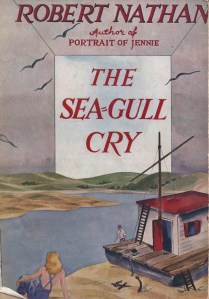
 The Sea-Gull Cry by Robert Nathan ~ 1942. This edition: Knopf, 1942. Softcover, with French flaps. First edition. 214 pages.

My rating: 3/10
A short, lightweight novella by the onetime-popular Robert Nathan. I confess that I have in the past read and quite enjoyed his most famous publication, 1940’s Portrait of Jennie (see condensed spoiler-laden précis here), but The Sea-Gull Cry is infinitely more sentimental, and, to be brutally honest, not particularly memorable, either in plot or in execution.
Nineteen-year-old Louisa and her seven-year-old brother Jeri are refugees newly in America, from war-torn Poland via England. Children of an English mother and a Polish nobleman, they are in reality a countess and count, but the family castle has been bombed, leaving their mother interned forever in its rubble, while Papa has perished defending his country against the evil German invaders.
Louisa and Jeri are bravely making a new sort of life for themselves. Desiring to get out of the crowded American city they arrived at some short time ago, they have taken their refugee relief money and are looking for a place to live along the seaside for the summer. They make it to Cape Cod, where they fall in with a gruff-mannered but hearts-of-gold older couple, the Baghots, who rent them an abandoned scow beached on an isolated stretch of sand.
Onto this strip of sand precipitously arrives one “Smith”, a jaded, middle-aged history teacher, (and a not very experienced sailor), who has just purchased an old sloop with the view to cruising up and down the coast for the summer, to escape from the stress of his unsatisfying job and the pervasive gloom of the situation in Europe. (The story is set just before American entry into World War II.)
Smith is caught up in a squall and violently beaches his boat, putting an end to his summer plans. But when he meets lovely Louisa he is immediately smitten; even more so when she pops out of her faded blue overalls to swim in a teeny tiny homemade bikini. Smith feels that maybe life isn’t so dull after all…but wait…why would Louisa look at a man old enough to be her father…?
Maybe because she is seeking something of a father-substitute, a romantically-older man?
It takes them a few chapters to get it all worked out, chapters in which small Jeri provides a side plot as he fights with the local children, makes friends with the Baghots’ young niece Meg, and has a brush with death as he sets out to sea with Meg on an old raft, seeking to sail back to Europe to rescue “the children” from the conflict.
Aw, how sweet.
Sure.
A little of that goes a very long way, and luckily this was a lightning fast read, being presented by the publisher with a large font, immense margins, and thick paper. It clocks in at 214 pages, but could probably quite happily fit onto 50 or so. (One speculates therefore that this was before any sort of wartime paper restrictions hit the American publishing market.)
That’s it; that’s the story; well whitewashed with slosh.
I don’t quite get Robert Nathan’s obvious popularity in his time, because this was pretty sub-par stuff in the great scheme of literature-of-the time, unless it was as a writer of escape-lit-light for the stressed-out housewives of the 1940s and 50s. The Sea-Gull’s Cry seems the sort of thing that would be found serialized in the Good Housekeeping type of magazine of the day.
A contemporary review by Rose Feld of The New York Times had this to say:
‘The Sea-Gull Cry’ tells a tale that will hold you until the last page is turned. It will hold you because of Nathan’s rare art of drawing you into his own mood of tender contemplation of human beings and because you cannot let them go until you know what happens to them… And you will decide that this is more than a tender little love story exquisitely written; that it is a tale of exile and valor and spiritual rebellion that has more than surface significance.
I suspect I am myself a bit too jaded and cynical to really appreciate this sort of fiction; I find myself lifting an eyebrow when I read these other quotes by the author himself regarding his authorial motivation:
What I really want is to give comfort to people in this wilderness of death and trouble. And to myself, too. So, when I can, I take the poison and hate out of my books; but I hate, just the same. I hate violence, and tyranny, and vulgarity. I hate despair and destruction, and the writers who insist that that is all there is, there isn’t anything else.
and
It seems to me that I have always wanted to say the same things in my books: that life is one, that mystery is all around us, that yesterday, today and tomorrow are all spread out in the pattern of eternity, together, and that although love may wear many faces in the incomprehensible panorama of time, in the heart that loves it is always the same.
Fair enough; Nathan’s readers obviously responded to his style.
As you can see from my brutal rating, I didn’t.














 Leaves & Pages
Indian Vignettes: Mercy, Pity, Peace and Love by Rumer and Jon Godden
July 28, 2014 by leavesandpages
My rating: I have somewhat mixed feelings about this collection of stories mostly by Rumer, because so many are already included in her 1957 collection, Mooltiki, and reading Mercy, Pity, Peace and Love felt very much like déjà vu all over again. But then I got to the very few (four out of fifteen) stories by Rumer’s sister Jon, and those were good enough to still my pangs of annoyance. To be fair, all of these short stories are actually very good, and if you haven’t read the rather obscure Mooltiki, you will be coming to them with fresh and appreciative eyes.
I think in this case I will award the collection as a whole a most respectable 8/10. (Along with the recycled stories, the two also-repeated poems made me knock it back a half point; Rumer Godden was a much more accomplished prose writer; her poems are just “not quite” for me; something just a bit jarring with the phrasing, I think.)
The intent of the collection is to celebrate the India that the Godden sisters knew and loved; they spent most of their childhood years in India, and significant amounts of their adult lives there as well. Rumer and Jon also collaborated on a beautifully written joint childhood memoir, Two Under the Indian Sun, which I read with pleasure some years ago.
Reader Alert! This is the same book as Indian Dust. Both were published in 1989, but Mercy, Pity, Peace and Love is the American title, from Macmillan, with Indian Dust the British title, from Macmillan. I had recently ordered Indian Dust, thinking it was another collection of stories, and was greatly disappointed to find it was identical to the one I already owned, under the Mercy, Pity title.
But life-plans may go horribly awry; Dhandu’s does not follow its anticipated path; in an ironic ending, which I somehow found reminiscent of W.W. Jacob’s The Monkey’s Paw, the field stays with Dhandu but is forever lost to his son.
An anecdote concerning a series of encounters with a minor craftsman, who proves to be representative of a vast class of Indian society balanced on the knife edge of survival.
Another anecdote, this time by Jon, telling of an encounter with a neighbour’s pet monkey, and the chain of events set off by its biting the author. Fascinating glimpse into the pet-owning culture of upper middle class Calcutta, where Jon was part of a mixed Anglo and Indian community.
Sister Malone, the nun in charge of a charity hospital in Calcutta, is unshaken by the horrible sufferings all around her and does great good with her nursing abilities, but her continual effort to share her religious faith with those she heals goes unheeded. One day Sister Malone meets a man who has truly put all of his trust in God, but she cannot reconcile this with her own conception of what faith should be.
Heart-rending short description of a valiant pet bird and its sad fate.
A modest seamstress is offered a once-in-a-lifetime chance to make her fortune.
A Bhramini Hindu student, who has travelled abroad to study in England, visits Paris with a friend and is forced to examine the role of compromise in the formation of his own developing character.
… … …
A young Kashmiri hunter, longing for winter to be over, thinks of his time the previous year among the high mountains hunting ibex.
The long process of acquiring – or rather, being led into buying by a master salesman – a beautiful Persian carpet. Beautifully observed; gently humorous.
A vignette of a young nomad riding up the mountain to fetch his unseen new wife. Sensitive and poignant.
An orphan boy,
finds his place in the world through his care of a black ram lamb.
Miss Passano is disgusted by her fellow humans, and meditates upon a world without them, where only she would remain, in service to the animals she so greatly loves.
Ganesh Dey attempts to write on these concepts – Mercy, Pity, Peace and Love – for his doctoral thesis. A gently ironical and emotionally powerful story, possibly the best of the collection in its summation of the contradictions of human nature and how we actually treat each other versus how we view our relationships and interactions.
Posted in 1950s, 1980s, Century of Books - 2014, Godden, Rumer, Poetry, Read in 2014, Short Stories | Tagged Century of Books 2014, Godden, Rumer, India, Jon Godden, Mercy, Peace and Love, Pity, Poetry, Short Stories, Social Commentary | 5 Comments »