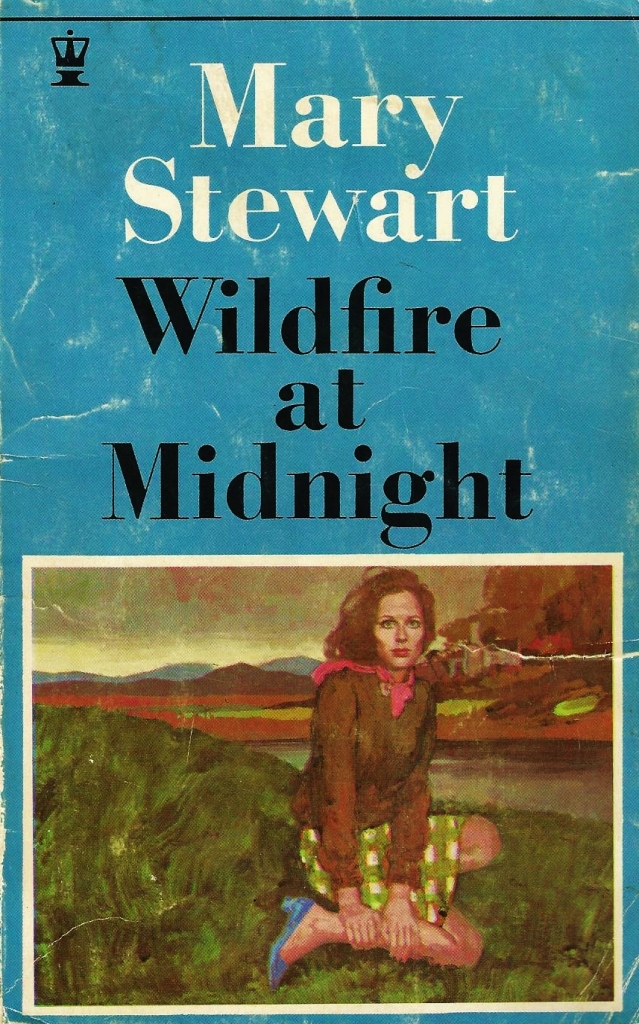
 Wildfire at Midnight by Mary Stewart ~ 1956. This edition: Hodder, 1970. Paperback. ISBN: 0-340-01945-X. 224 pages.
My rating: 6/10
From the dust jacket of the original edition, 1956:
Most people came to the Isle of Skye to climb the jagged peaks of Blaven or fish the many sparkling streams. Gianetta Brooke came to forget Nicholas Drury—the husband she had painfully divorced. The discovery that Nicholas numbered among the guests at the small inn was the first sign that hers was not to be a typical holiday . . .
Then Gianetta learned that on the treacherous slopes of Blaven, murder had been done . . . and although she had missed the first act of an eerie, unearthly crime, the murderer was to strike again and again before the finale was enacted on the mist-laden mountain—a finale that has Gianetta face-to-face with a madman.
My thought early on while reading Wildfire at Midnight, my fourth recent Mary Stewart read, was “Well here’s something a bit different!” This one is not so much a romance as an out-and-out suspense thriller/murder mystery. Not one, but three people meet their very unpleasant demises in this dark little tale of misplaced devotion. What romance is included is sketchy at best, and telegraphed broadly from very early on.
Beautiful London model Gianetta Drury – Janet, to her intimates – is feeling in need of a break from her busy life. It’s spring of 1953, and the city is getting ready for Queen Elizabeth II’s Coronation ceremony, and, as the excitement builds, so does Janet’s stress. Her career is at its peak; she hobnobs with the rich and famous on a daily basis; life is a constant whirl – but all she really wants is to get away from it all, to relax in some country peace and quiet, far from those who recognize her lovely face.
So off she hies herself to the remote and beautiful Isle of Skye in Scotland, to what she thinks will be a restful retreat. Tea and scones by a glowing peat fire, gentle walks in the heather, gazing at the mountains in the mild Scottish mist…
Ha! You just know this isn’t going to work out as planned, especially when the first person Janet meets as she checks into her hotel is a prominent actress, one Marcia Maling, settled in complete with luxurious convertible and handsome chauffeur. An assortment of fishermen and amateur climbers are also in residence, including famous mountaineer Ronald Beagle, and, to top it off, who should wander in but Janet’s ex. Nicholas Drury, a celebrated author, is visiting Skye to gather local colour for his next bestseller. He is sulkily broody and exceedingly handsome, and Janet’s heart skips a beat when she sees him again, though both pretend to be strangers to each other for the benefit of their fellow guests.
Tension is in the air, and Janet is very tuned in to it, though she is shocked to discover that one of the reasons for the brittle atmosphere is the unsolved murder of a local teenager on her eighteenth birthday just a week or two earlier. The young woman was found with her throat slit on a roaring bonfire halfway up the looming local mountain, Blaven, and though there is a likely suspect, there has been no arrest. (Not yet.)
Two more gruesome murders are on the horizon, with every person in the hotel soon becoming suspect; Janet’s dreamy retreat is now a living nightmare. Who can she really trust? And why is Nicholas taunting her so constantly, and popping up when least expected?
As usual, the physical setting of the story is described with vivid detail. Another nice touch is the ongoing radio broadcasts of Coronation preparations and updates of the ongoing attempt to climb Mount Everest playing in the background; the mountaineers in the group are glued to the radio, and massive bonfire piles are being built to fire on Coronation eve…
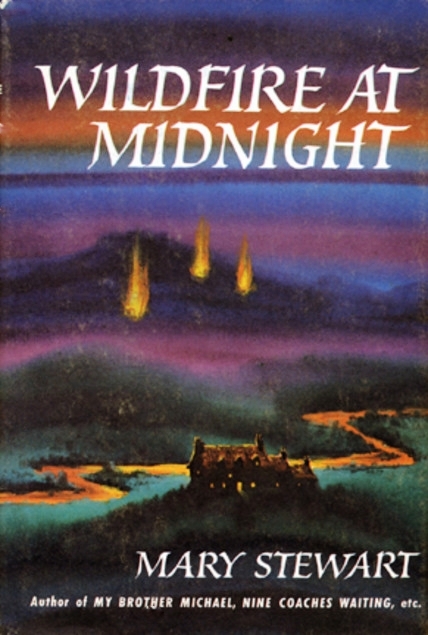
Wildfire at Midnight – dust jacket illustration, first edition, 1956. Isn’t this great? Much more mood-inducing and appropriate than the various depictions of the scantily clad heroine which most succeeding covers feature.
Here’s my summing-up opinion on Wildfire at Midnight.
While it started off well, and has its moments of deep appeal, the superficial characterizations of every single one of the characters – including our heroine – made this an ultimately less-than-completely-stellar read. The first murder was shocking; the second decidedly unexpected; and the third de trop – just too much to believe. (Plus I really liked that third victim!) And the heroine keeps wandering about in a downright silly manner, considering that there’s a diabolical killer at large. She wanders out alone, or with this gentleman or that into remote corners of the glen, just asking for something nasty to happen.
And it does.
The predictable final chase scene involves both a quivering bog and a craggy mountainside, plus bonus blinding mist. The unmasked murderer is totally creepy (and I guessed the identity correctly), but the far-fetched motive is tissue thin.
Well, acceptable reading for a drizzly October evening, and it was decidedly atmospheric throughout. A keeper, for sure, but of the “so bad it’s good” variety! Definitely dated, this very vintage one, but with some merits too, mostly regarding the fabulous depiction of place, and the real-life events playing out in the background, which become the most believable part of the fictional tale. I loved the image of the characters gathered ’round the radio, waiting for news of the Everest attempt, while their own safe little world is under threat from an unknown assassin!
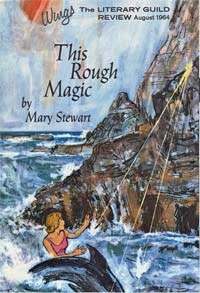
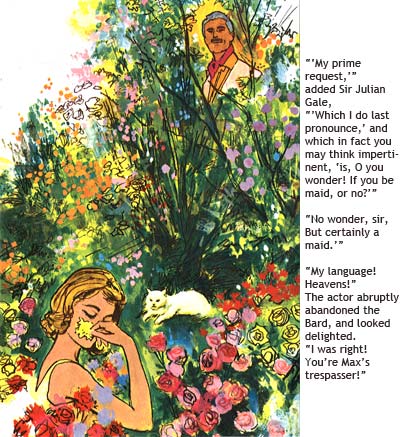
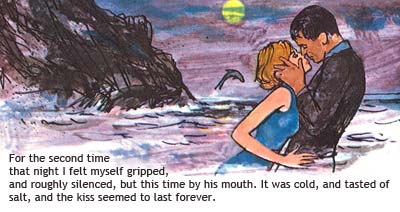
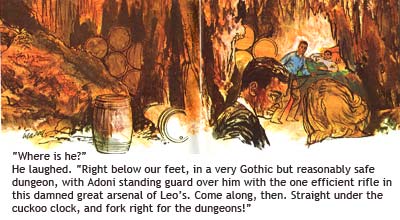
And here’s a rather grand review, including an excerpt from the story:








 Leaves & Pages
Review: The Family Nobody Wanted by Helen Doss
Posted in 1950s, Read in 2013, tagged Biography, Memoir, Religion, Social Commentary, Vintage on September 6, 2013| 16 Comments »
My rating: 6/10
Well, this was an interesting read, and I’m still trying to decide what my personal reactions really are.
On the surface it is a simple feel-good memoir about a young childless couple adopting twelve children in the 1940s and 1950s, but there are deeper currents to the tale, especially from a half-century later perspective. In particular, there is a damning sub-text of racial intolerance which is very much a part of why and how this family came together.
So Helen’s husband Carl, driven to distraction by his wife’s continual bemoaning of her barren future, suggests that they adopt a baby. Helen loves the idea, and the two optimistically prepare a room and trot off to the nearest orphanage, where they learn that it isn’t quite as simple as all that. Most of the babies in the orphanage were simply not available, being only in temporary care, or waiting for relations to take them in, and the adoption agencies which are the next resort are not particularly helpful either. Helen and Carl are informed that waiting lists are years long, and that each baby must match its potential parents perfectly in ethnic makeup and family background. And of course the parents must be financially stable, as well as sterling characters in all other aspects.
Carl and Helen are sure their characters are good, but the money thing is definitely an issue, and the waiting list situation seems cruelly stressful. So they set aside their ideas of forming a family and instead decide to pursue other interests. Both enroll in college, Helen to study literature and writing, and Carl to pursue a long-held dream to become a Methodist minister. And then, miraculously, one more attempt at adoption through an agency results in a beautiful blue-eyed baby boy. Helen is ecstatic; Carl more reserved. They can barely feed themselves, so this new addition is a challenge in more ways than one.
Young Donny thrives and grows, and all is well for a while, until Helen starts to brood over the loneliness of the only child. “If only he could have a little sister…” But another child is an impossibility, declares everyone they contact. “Just be happy you managed to get the one.” Unless, of course, they would consider a mixed race child. Lots of those were languishing in adoptive limbo, and, three years after Donny’s adoption, Filipino-Chinese-English-French Laura joins the family. And, only two months later, frail and sickly Susan, undesirable because of her weak constitution and a tumorous red birthmark on her face.
Helen is still thrilled, though she finds three children something of a challenge, but all three thrive, and Helen starts thinking again. Maybe just one more, a brother for Donny…
Eventually, with increasingly strident resistance from Carl, Helen collects a round dozen of children, six boys and six girls. She writes about the family’s experiences, and the tragedy of mixed race children being seen as undesirable by families otherwise desperate to adopt a baby; even though the Filipino, Chinese, Korean, Japanese, Malayan, Burmese, Spanish, French and American Indian children she and Carl eventually acquire are accepted by family and neighbours, a constant refrain is “As least they aren’t Negro!” Carl and Helen do attempt to adopt a part-black child from a German orphanage, child of black American GI father and a German mother, but the transaction is strangled by red tape; their families and friends are loudly vocal in their relief, and one of the most passionate chapters in the book strongly condemns this attitude, and addresses the degrees of racism inherent in American society, and its effect on innocent children along with its part in much greater societal ills.
Helen and Carl come across as truly sincere in their attitudes that colour means nothing, and that human is human; Helen starts writing articles about their “United Nations” family, and the Dosses catch popular attention, being interviewed, photographed and featured on radio and television, as a kind of shining example of American acceptance and tolerance, though in reality the very existence of their family group has come about through blatant American racial discrimination. These are, after all, the children that nobody wanted.
The book ends only twelve years after that first baby, Donny, is adopted, and the tone is happily optimistic, but there are undertones that perhaps all may not be so well in future. Carl is a reluctant participant in the continual enlargement of the Doss family, though he is very willing to tout its benefits for interviewers; Helen persists in collecting children in the face of Carl’s outright “No more” plea, time and time again. The news that the Doss marriage ends in divorce in 1966, twelve years after the publishing of this bestselling book, comes as no surprise, though it is sad; one hopes that the children – some at that time well into adulthood, one must admit – weathered their family breakup with a minimum of trauma, though one doubts that would completely be the case.
Knowing several cross-culturally adopted children who now, as adults, are seeking diligently to reconnect with their birth parents’ heritage, I wonder what happened to those twelve children as they grew up, and what they each personally made of their inclusion in this unique family, and of the publicity which their parents’ outspoken willingness to discuss their adoptive choices attracted.
I do think, both from the tone of Helen Doss’s memoir, and from other reports on the Doss family I read on the internet, that their intentions were, once they started adopting, only the best. And, also, I do tend to think that children deserve a loving family versus being institutionalized, and that if the only fit possible is cross-cultural, so be it. If it were more widely accepted (as it wasn’t in the 1940s and 1950s) then at least the “novelty factor” would not be such an issue.
I’ve tagged this post with a “religion” designation, because it is also very apparent that Helen and Carl Doss were motivated in a great part by their Christian faith. Carl Doss is quoted as saying that
Conflicted as Carl seems to be by his wife’s acquisition of child after child, once they are brought into the family he apparently embraces his fatherhood fully, being as full of latent paternal affection as he is of “radical” Christian ideals.
A thought-provoking memoir, and, as I said, a bit uncomfortable to consider more deeply, given that a whole lot must have been left out. Though I was interested and pleased to see that Helen Doss was very frank about her own motivations of needing children to “complete” her idea of true womanly fulfillment; the ideal of a happy, multi-racial family group seemed to develop as her circumstances changed.
I did my usual look-around the web, and was interested to see how highly this book was rated on Goodreads; a large number of people apparently read and loved it in their school years; the reviews are by and large quite glowing.
It is very readable, and provides a truly fascinating (though superficial) glimpse into the mid-20th Century’s social dilemmas and attitudes towards both adoption and racial and interracial societal division lines. It is also frequently very funny; Helen Doss’s anecdotes of her children’s doing are downright adorable, and well targeted at the sentimental readers who have obviously embraced it as a “sweet tale”. It is a sweet tale; it is also an indictment of the bitter evils of racial discrimination; and a strong advocate of true Christian behaviour; and a revealing portrait of a marriage not without deep personal conflicts, despite its publically positive façade.
For more on the Doss family, these links will be good starting points.
Helen Doss – Obituary
Adoption Topics – The Family Nobody Wanted
Read Full Post »