Archive for the ‘Read in 2013’ Category

war stories gregory clarkWar Stories by Gregory Clark ~ 1964. This edition: Ryerson Press, 1968. Softcover. ISBN: 0-7700-6027-7. 171 pages.

My rating: 8/10

Born in 1892 in Toronto, Ontario, Gregory Clark was of perfect age to fight in the Great War, heading to Europe in 1916, at the age of twenty-four. Clark entered the fray as a lieutenant, and exited a major. In the trenches and out of them – Clark received the Military Cross for “conspicuous gallantry” at Vimy Ridge – the young man remembered what he had witnessed, the horror and the gallantry and the moments of respite and delight, to be shared later with his audience of newspaper readers as he took up journalism in the post-war years.

Too old to take active part in World War II, Gregory Clark none the less went overseas once again and pushed his way into the thick of the action, fulfilling a role as a front-line war correspondent, and receiving an Order of the British Empire for his services. Again, his experiences found their way into his short, chatty periodical articles published in the following decades. Clark’s son Murray was killed in action in 1944 while serving with the Regina Rifles, but there is no mention of that personal loss here in War Stories; Clark keeps that particular emotion well buried.

War Stories contains a selection of thirty-eight anecdotes, three to five pages in length, about a wide array of Gregory Clark’s personal experiences. Though the tone throughout  is upbeat and frequently humorous – War Stories won the Leacock award for humour in 1965, which rather surprises me, for funny as these anecdotes sometimes are, there is a sombre tone always present – Clark makes it very clear what his opinions are as to the brutality of what the soldiers and civilians went through.

These stories laud the bravery (and the frequent giddy foolishness) of the farm boys and office clerks and travelling salesmen who find themselves caught up in circumstances beyond their most vivid nightmares, fated to kill and, frequently, be horribly maimed, and wastefully killed, merely because of the circumstance of the time of their birth. Something I noticed is that there is not much sympathy shown here for the soldiers of the “other side”; Clark’s thoughts are ever for his own, and he was reportedly a fiercely protective officer of the men under his charge.

All is not muck and death and destruction though. Interludes of inactivity brought forth pranks and hi-jinks, while there were times of repose behind the lines, time for memorable meals and quiet conversation, and musings on what was going to come after, if there was going to be an after.

An appropriate book for this Remembrance Day weekend, this time of sober reflection. Clark reports the realities, but he persists as well in highlighting the lighter moments, the bits of sanity in a world of war.

A good read.

And a much more eloquent review of this book, well worth a click-over, may be found at Canus Humorous.

Read Full Post »

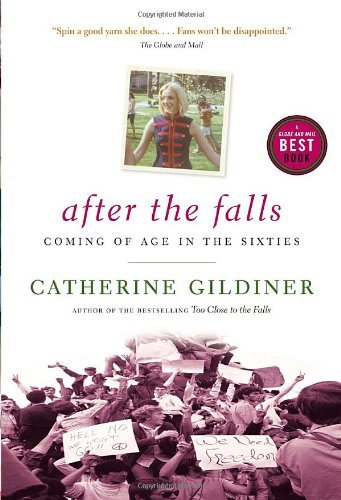
after the falls catherine gildinerAfter the Falls: Coming of Age in the Sixties by Catherine Gildiner ~ 2009. This edition: Vintage, 2010. Softcover. ISBN: 978-0-307-39823-9. 344 pages.

My rating: 8.5/10

Wow. That was unexpected. I was tidying up some books I’d casually piled on a corner of the couch, sorting out already-read from want-to-read, and I leafed through After the Falls to refresh my memory as to how urgently I wanted to read it, or if it could be put on the maybe-someday pile.

It caught me.

Suddenly I was sitting down, and reading away like a mad thing. Clean-up abandoned, outside chores abandoned, and it’s a good thing the roast was already in the oven or cooking my family’s evening meal would have been abandoned, too. It grew dark. I switched on my reading lamp. I read this thing right through to the end. My afternoon was completely lost. Abandoned pell mell, while I lost myself in a book.

My seduction by After the Falls was so unexpected because I knew when I purchased it that it was a sequel to an earlier volume of memoir by Catherine Gildiner, Too Close to the Falls. I had a vague little plan to get the first book and read it, and then continue on with the second if the first one was indeed as great as everyone seemed to think it was. I wasn’t really thinking about it too much; I’m fairly immune to mainstream rave reviews, having been disappointed by banality too many times.

After the Falls is not banal. It is over-the-top, frequently jaw-dropping (“Did she just say that? Did she really do that?” How much of this is fictionalized???!”), and funny and sarcastic and joyful and heart-breaking and occasionally awkward and sometimes vague as major incidents are brushed over with a single sentence or two (this, the occasional vagueness and awkwardness, lost the 1.5 points in my personal ratings system), and rather contrived here and there, but never no mind those last few criticisms. It is a very readable book, and I happily recommend it. And I’ve elevated the need-to-buy status of the first installment to high on the list, and, having learned that a third volume is coming soon, have earmarked it as a buy immediately book.

So now you’re all wondering – those few of you who haven’t already ridden this particular train – what the darned book is about. Well, the internet is seething with reviews (mostly favourable) so I will cheat this morning and steal the flyleaf blurb. (Must address all the chores I neglected yesterday; must cut this short!) It’s a tiny bit inaccurate – do these blurb writers read the whole thing? or do they just ask for the high points? – but it condenses things reasonably well.

When Cathy McClure is thirteen years old, her parents make the bold decision to move to suburban Buffalo in hopes that it will help Cathy focus on her studies and stay out of trouble. But “normal” has never been Cathy’s forte, and leaving Niagara Falls and Catholic school behind does nothing to quell her spirited nature. As the 1960s dramatically unfold, Cathy takes on many personas — cheerleader, vandal, HoJo hostess, civil rights demonstrator — with the same gusto she exhibited as a child working split shifts in her father’s pharmacy. But when tragedy strikes, it is her role as daughter that proves to be most challenging.

Actually that’s a very lame flyleaf blurb. It doesn’t at all catch the spirit of the memoir. Here’s a much better blurb, from Publisher’s Weekly, November 2010:

At age 12, Gildiner and her family moved from their Niagara Falls home to a Buffalo suburb, leaving behind a family business, smalltown contentment, and the rebellious childhood chronicled in her first memoir, Too Close to the Falls. While her uprooted parents struggle to adjust, Gildiner stumbles in making new friends and edging into puberty. Her restlessness and a fundamentally outspoken and argumentative nature regularly catapult her further than simple teenage trouble, and she frequently fails at the standard American girlhood, often with comic results. The conflicts between the narrator’s individuality and conformity propel her into her first relationship at the same time that the seismic shifts in American society, culture, and politics hit home with ever-increasing force. On the page as in life, comedy, tragedy, and elegy live right on top of each other, and as with most remarkable memoirs, the straightforward, honest voice and perspective are steady even in the most painful moments.

And I’ll link the author’s website, so you can look around there.

Cathy McClure Gildiner – After the Falls

And here is what my blog friend Jenny had to say: Reading the End: After the Falls. Everything she says, I agree with. But I think you should read Chapter 4, because it explains an awful lot about how the memoirist relates to men from that point forward.

The writer also has a blog, Gildiner’s Gospel, which made me late for bed last night, as it was as compulsively readable as her words on paper. Check it out!

One last thing. The memoir is set in the United States, and at the time she writes about, Catherine was an American citizen. She moved to Canada some forty years ago, though, and reports that she is firmly entrenched in Ontario. In my mind she unquestionably deserves the “Canadian” tag I’ve given her.

Highly recommended.

Read Full Post »

I’m still playing a bit of catch-up with reviews of books I’ve read throughout the year, and didn’t write about right away, but which I want to talk about before I tuck them away. Tonight I’m going to zip off some short reviews of some short easy books, the kind one can read quickly through in a few hours. Lit-light, for those times when you need something undemandingly different from your own possibly bothersome real world.

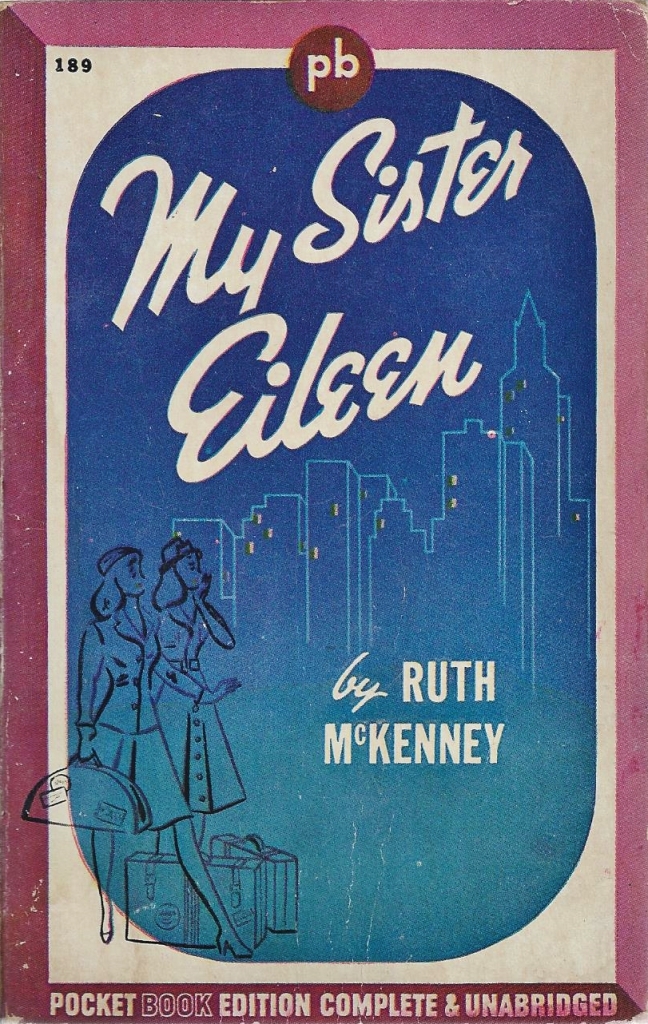
my sister eileen ruth mckenney 001My Sister Eileen by Ruth McKenney ~ 1938.

This edition: Pocket Books, 1942. Paperback. 142 pages.

My rating: 7.5/10

This frothy memoir was found among the stacks and stacks of vintage Pocket Books at Kelowna’s Pulp Fiction/Robbie Rare Books. The author was new to me, but a bit of internet research showed that she was a well-known journalist in the 1930s, 40s and 50s, with a sideline in humorous memoir, novel and travel writing. This very book, My Sister Eileen, as much about Ruth as it about her younger sister, is a an absolutely charming autobiographical account of growing up in Indiana and then Ohio, and of the two sisters going off to try their luck in New York City. The memoir caught the attention of the public, and it brought its author popular success, being made first into a Broadway play, then into a movie, and finally, in 1953,  into a very successful – 500 + performances – musical, Wonderful Town, starring Rosalind Russell, with music by Leonard Bernstein. A long way from Ohio, oh yes indeed.

I’m not much for laughing out loud while reading, but Ruth McKenney triggered more than a few giggles, as she and Eileen adventure together through their young girlhood, watching much-too-adult movies from behind the brims of their hats, failing dismally at piano and elocution lessons, being traumatized by summer camp, learning how not to swim with the Red Cross, and having a life-altering encounter with Noel Coward. A French pen pal brings romance into Ruth’s life, or so she supposes. She’s not quite sure because no one can translate his handwriting. First jobs give much scope for both girls broadening their horizons, and while Ruth does well for herself on the staff of a newspaper – printer’s devil at fourteen and onward and upward from there – Eileen struggles with the finer points of waiting tables at a posh tea room. Dreadfully dire beaux, a rather more happy (though short) encounter with Randolph Churchill, in America on a lecture tour, and a shipful of Brazilian future-admirals bring romance in the sisters’ lives.

My only complaint is that this sparkling little book is much too short. But there appear to be others, continuing the story, which I may well be searching out, though they are in much shorter supply than this bestselling first installment.

In later years Ruth McKenney’s life was to take a tragic turn. Her beloved sister was killed in an automobile accident only four days before the stage play inspired by her opened on Broadway, and on Ruth’s 44th birthday her husband committed suicide. She stopped writing, and faded into obscurity. A 2003 interview with Ruth’s daughter, Eileen Bransten, was published in the The New York Times, and gives a brief but lovingly poignant character portrait of this talented and ultimately unlucky woman.

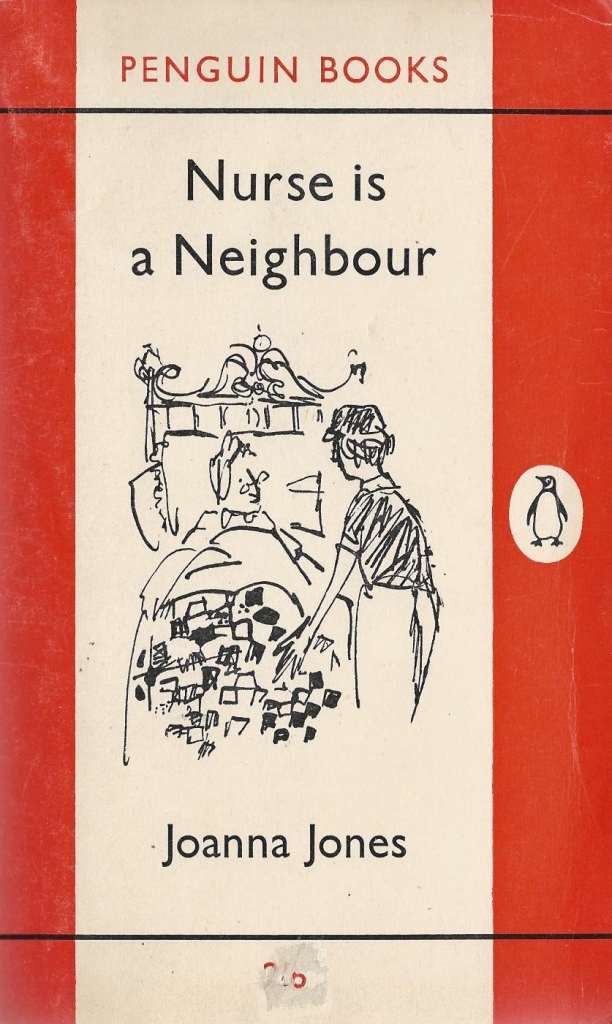
nurse is a neighbour joanna jonesNurse is a Neighbour by Joanna Jones ~ 1958.

This edition: Penguin, 1961. Paperback. 159 pages.

My rating: 5.5/10.

Crossing the pond to England, we hear from a rural district nurse, Joanna Jones, who tells of her work with a wryly sarcastic tone more than a little reminiscent of Monica Dickens at her most scathing. While not up to Dickens’ stellar level for this type of memoir, the writing here is competent enough to make this a smooth and easy read, and the details of Nurse Joanna’s life prompt us to forgive her frequently critical comments of all those around her.

Joanna has taken over her posting from a long-time Nurse Merrick, who is now well into her eighties, but still active and alert and very much keeping an eye on her young replacement. Nurse Merrick is not beyond giving some good advice when she thinks it needed, and Joanna tries to bear this in good grace, though it obviously rankles just a little now and again. Joanna also brings along to her cottage her elderly mother who is suffering from what seems to possibly be Alzheimer’s Disease (though the term is never used, I’m supposing that it was not in common usage in the 1950s), a progressive dementia which complicates Joanna’s life immensely, though she appears to cope with grace, humour, and much patience.

A very short, very anecdotal memoir, and an interesting glimpse into the state of British health care just as the National Health Program was being implemented; the protests of doctors and not a few patients as to the unwarranted interference of The State into the state of their medical care is rather familiar what with the United States’ “Obamacare” making the news these days.

Nurse is a Neighbour is quite readable, but I thought it was just missing that elusive special appeal which would make it a must-read. Joanna Jones wrote a second book of memoirs, Nurse on the District, and her books were the basis of a now-forgotten 1963 comedy film, Nurse on Wheels. Neither calls out to me for urgent investigation.

So if I wouldn’t go so far as to recommend this book as worthy of seeking out, I will repeat that it was a pleasant short read for a cold autumn afternoon’s tea break, in to warm up after digging in the garden and raking leaves.

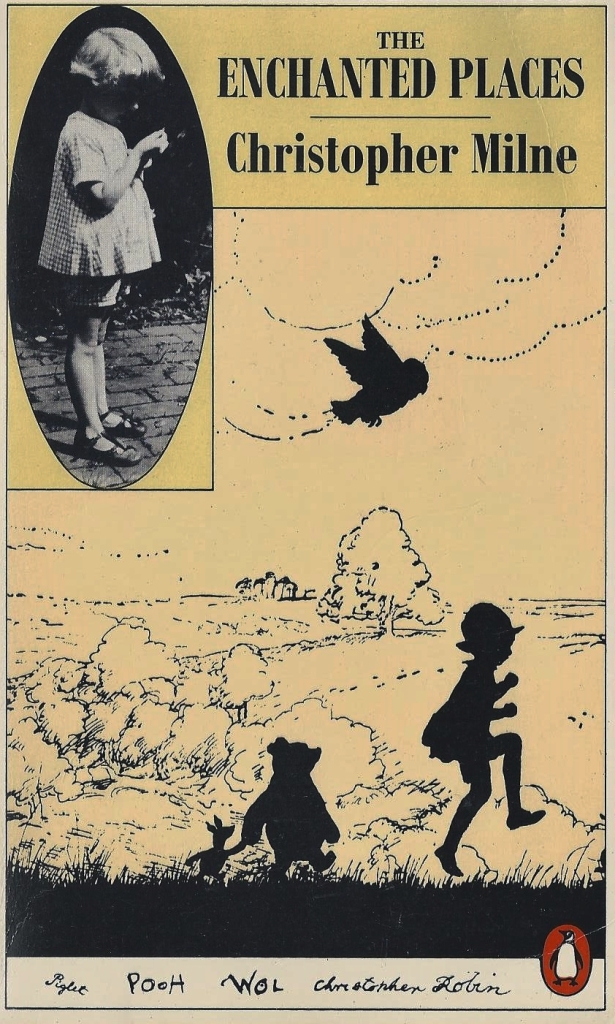
the enchanted places christopher milne 001The Enchanted Places by Christopher Milne ~ 1974.

This edition: Penguin, 1976. Paperback. ISBN: 0-14-003449-8. 183 pages.

My rating: 7/10.

I completely missed Winnie-the-Pooh in my own childhood; I can’t recall even being aware of such a character, though I’m sure A.A. Milne’s classic was readily available even in our rural British Columbia ranching community. Early childhood reading consisted mostly of a vast quantities of fairy tales, and of course the ubiquitous Little Golden Books. Beatrix Potter was just barely represented by a single non-Warne edition which consisted of Potter’s immortal text, but someone else’s dreadfully inadequate illustrations. I loved that one for the story alone – oh, brave, foolish Peter! –  and even today could probably reel off the entire thing from memory. But definitely no Pooh, in any way, shape or form.

I remedied that with my own children, of course, but Pooh never really took hold. Grilling them just now as to early childhood favourites, they mentioned Richard Scarry, the Dr. Seuss books, Beatrix Potter (hurray!) and, my daughter’s absolute favourite for a long, long period of her toddlerhood, The Poky Little Puppy. They do remember Pooh, but not with anything like dedicated fondness. Interesting.

Oh well, moving on, then. I myself do remember the Christopher Robin stories from that time of endless reading aloud, and I definitely appreciated the world of the Hundred Acre Wood, so when this memoir by the real Christopher Robin crossed my path, I read it with genuine curiousity.

In this slender volume (I found out later it is but the first of three, the following ones being The Path Through the Trees and The Hollow on the Hill, taking Christopher Milne into his adult years) the memoirist seeks to provide a sort of

…(C)ompanion to the Pooh books. In the first chapters I have attempted a picture of the Milne family life, the family life that both inspired and was subsequently inspired by the books…

For it is very evident from reading Christopher’s reminiscences that his life was indeed greatly influenced by his becoming a very well-known public figure indeed. His parents sought to shelter him from much of the publicity which his fictional counterpart attracted, but Christopher tells of his uneasy awareness that the fatherly gaze was often a bit too analytical for comfort, and then there was that rather awkward provision of new toys with an eye to story development possibilities…

The early half of the book was very much concerned with descriptions of the physical places which inspired the Pooh stories, and I must say that my interest faltered here and there, not being a true-blue devotee, but as Christopher (the real Christopher) grows up and begins to venture out into the broader world, the narrative becomes much more interesting, in an introspective, self-examining sort of way.

A.A. Milne, from Christopher’s restrained yet gently fond description of his father, seems to have been a man with a certain amount of reserve, a certain at-a-distance quality with his young child. He expressed his interest and attention through his writing rather than with much hands-on attention, and one gets the idea that Christopher in later years was very aware of how this had formed his own rather buttoned-up personality. An alone and one would think an occasionally lonely child, was young Christopher. And vaguely troubling is his mother’s insistence on the long locks and feminine attire; she was sorely disappointed that he had not been born a girl, reports Milne, and he muses about her motivations and their effect on his acceptance by his young peers.

I finished this memoir feeling just a little melancholy for that long-ago child’s sake, though it is comforting to see that he did manage to move on and break away from the heavy-though-benevolent burden of his past. I will be looking for the next two memoirs, to find out, in best story-telling tradition, “what happened next.” And, for my upcoming Century of Books, I intend to revisit Pooh himself, with his real-life owner’s story in mind.

Read Full Post »

Three unrelated novels which share the common theme of adolescent girls coping as best they can with circumstances beyond their control. Frost in May and The World My Wilderness are undeniably much stronger and deeper novels than In Spite of All Terror, which, though competently written, fits more appropriately into the “juvenile historical fiction” category, but I’ve grouped them together here.

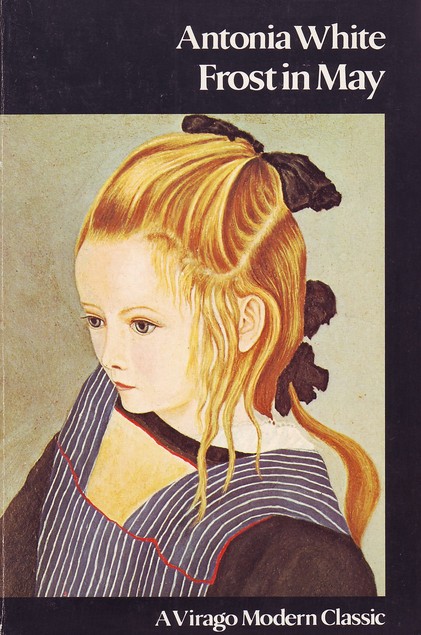
frost in may antonia whiteFrost in May by Antonia White ~ 1933.

This edition: Virago, 1981. Introduction by Elizabeth Bowen, 1948. Softcover. ISBN: 0-919630-36-7. 221 pages.

My rating: 8/10

I have known Antonia White as the gifted translator of a number of Colette’s novels, but I hadn’t realized she was an author in her own right until Frost in May crossed my path in an always-worth-examining green-covered Virago edition.

The novel is autobiographical fiction, based on the author’s childhood experiences attending convent school, and was the first in an eventual series of four books following the same character from her ninth through twenty-third year. Following Frost in May are The Lost Traveller, The Sugar House, and Beyond the Glass, and together they give an account of Antonia White’s formative years, and the emotional turmoil which shaped her adult life. The “transgression” in Frost in May which resulted in the fictional Nanda being expelled from convent school is a genuine event, and the real Antonia was marked for life by it.

It is 1908, and nine-year-old Fernanda – Nanda – Grey is being sent to The Convent of the Five Wounds in London in order to immerse her fully in her new life as a dedicated Catholic child; her father’s conversion several years earlier and his fervent seeking after ways to prove his devotion to his new faith have overflowed into Nanda’s life. She worships her father and seeks to please him in every detail of her life, and though she is understandably wary of this new experience, she is prepared to embrace her life among the nuns with eager dedication, as much for his sake as for her own.

Her experience at first is beyond strange to her; being in some ways better than she had anticipated, but also frequently much more harsh. The strict hierarchy of boarding school life is exacerbated by the dictatorial conduct of the nuns. A few are gentle and benign, though even in the kindest the stern core of duty prevents too much softness from showing, several are judgemental, demanding, and deeply sarcastic, seeming to set their young charges up for continual failure, all in aid of “breaking their worldly spirit” in order to prepare them to fully bow down to God.

Nanda tries her best to fit into this new culture, and gets along quite well, though she is continually haunted by feelings of deep inadequacy, both because of her lowly status as a mere convert to the faith rather than a “born” Roman Catholic, and because of her lack of social status among the many wealthy and aristocratic students.

As the years go by, Nanda makes several close friends, though the nuns forbid “particular friendships”, and is well on her way to forming her own ideas as to her adopted religion and her personal relationship with it, when a tragic misunderstanding loses her both her place in the convent community and the love and respect of her adored father.

The novel is a cutting exposé of the hypocrisies of several of the main characters, including Nanda’s demanding father, and her vaguely inefficient mother, and the effect of those hypocrisies on the sensitive and deeply feeling Nanda. She faithfully seeks to please her superiors and to adapt to their wishes and demands, while continually mulling over her own place in the world, and the contradictions she observes.

Very well written, and provides a fascinating account of life in a particular type of convent school. Suitable for competent youthful readers, perhaps early teens and older, but definitely would be most appreciated by those old enough to look back on their own formative years and relate Nanda’s experiences to their own.

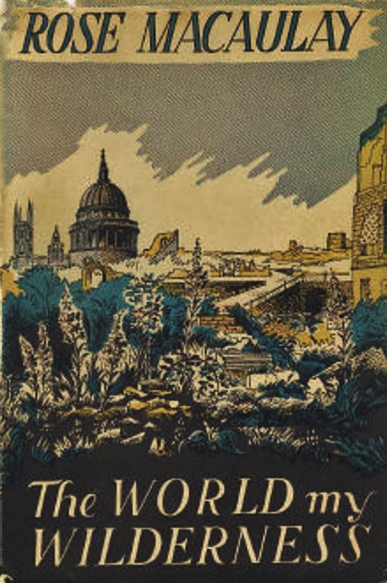
the world my wilderness dj rose macaulayThe World My Wilderness by Rose Macaulay ~ 1950.

This edition: Collins, 1950. Hardcover. 253 pages.

My rating: 9.5/10

This fabulous novel deserves more than the rudimentary review I am giving it here; I do believe it is one of the most beautifully written of all I’ve read so far this year. Rose Macaulay lets herself go with lushly vivid descriptions of the world just after the war. The bombed-our ruins of London are depicted in detailed clarity, and almost take precedence over the activities of the human characters, who move through their devastated physical habitat in a state of dazed shock from the brutalities they have seen and survived.

This is a bleakly realistic depiction of the aftermath of World War II and its effect on an expatriate teenager and her divided family, split between France and England. It moved me deeply, though the characters frequently acted in obviously fictional ways. What the author has to say about the effects of war on those who survived it is believably real.

17-year-old Barbary Denison is an English girl who has been raised for many years in France under the custody of her divorced mother and French stepfather. Under the confusion of the German Occupation, Barbary has run wild and has not-so-secretly joined up with an adolescent branch of the resistance – she and her younger half-brother have lived the lives of semi-feral children, and have witnessed and taken part in activities much too old for their tender years. After the war ends, Barbary’s stepfather is mysteriously drowned in the ocean near the family villa; possibly in retaliation for his unenthusiastic but undeniable cooperation with the Germans. Barbary’s mother, a hedonistic artist much more in love with her second husband than anyone fully realizes, emotionally draws away from her children, though Barbary in particular worships her mother with fervent dedication. When it is suggested that Barbary return to England to live with her father, her mother acquiesces with what seems like relief.

The culture shock which Barbary faces in post-war London society is sudden and severe. Her upper-class father has remarried and has a young son; Barbary views her stepmother with scorn and refuses to take any sort of interest in her younger half-brother. Her aunt and cousins are at first amused at her brusqueness and mildly sympathetic – they too have suffered in the war – but Barbary’s sullen refusal to adapt soon turns sympathy into bare tolerance. Barbary falls in with a group of young men who are living a precarious life amongst the bombed-out houses; they survive by petty thefts and view the London police as bitter enemies to be evaded at every turn. Barbary finds in this ragged outlaw world an echo of her wartime life in France, and she enters into a tenuous relationship with these new companions, hiding her activities from her father under guise of studying at the Slade School of Art. He in turn is unwilling to dig too deeply into his daughter’s private life, feeling that giving her space and time will ultimately win her affection.

Tragedy strikes, and Barbary is found out; the consequences of her double life and the bringing together of her estranged parents lead to unexpected revelations, though the reader has had inklings all along of secrets too terrible to be told.

I’ve described this novel as “bleak”, but don’t let that put you off. It’s definitely a worthwhile read, and Rose Macaulay’s satirical wit is in fine working order here. If you liked Crewe Train, or The Towers of Trebizond (which I’ve just finished – very good indeed!) you will be thrilled with The World My Wilderness.

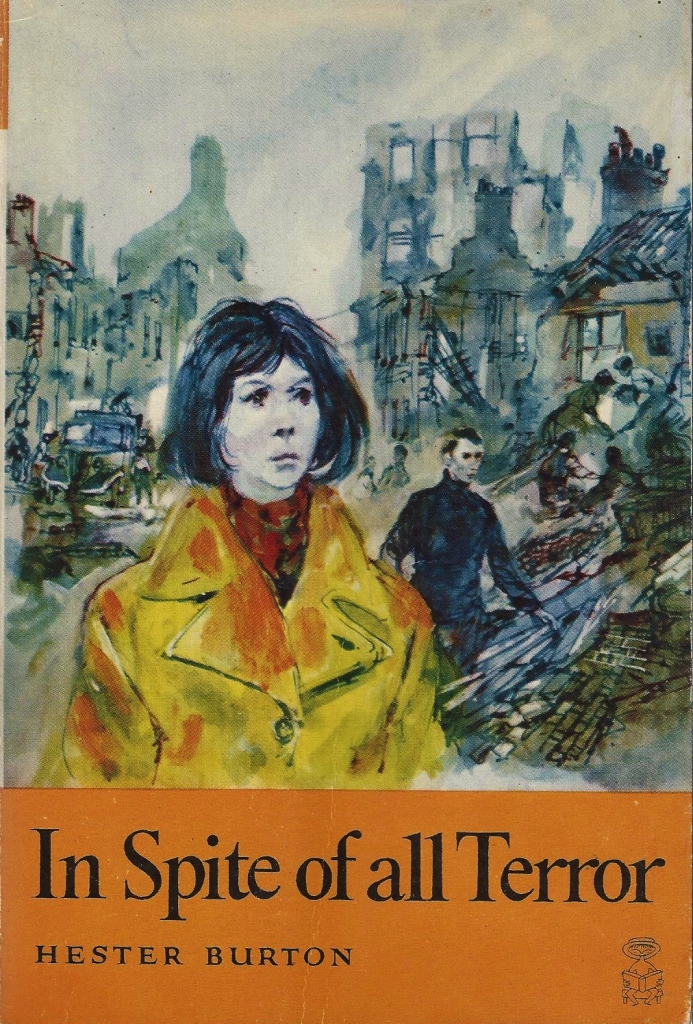
in spite of all terror hester burton 001In Spite of All Terror by Hester Burton ~ 1968.

This edition: Oxford University Press, 1970. Softcover. ISBN: 19-272011-2. 150 pages.

My rating: 7.5/10

This next novel is a slight thing compared to the two that preceded it in this post, but it has its merits as well, as a piece of memorable historical fiction. The author has based the story on her own recollections of 1940, when she was a was a 27-year-old Oxford-educated school teacher watching the evacuation of thousands of schoolchildren to the English countryside in preparation for the anticipated bombing of London.

Child of the slums, orphaned fifteen-year-old Liz Hawtin is a scholarship student at a girls’ grammar school; her evacuation in 1939 to the village of Chiddingford is a welcome development, as it spells her escape from the cold and critical aunt who has reluctantly taken on her sister-in-law’s child.

Taken into an aristocratic family, Liz realizes that her own intellectual ability, which is seen as so superior and is so deeply resented by Aunt Ag back in Nile Street, is no more than mediocre compared to the standard set by the intellectual and accomplished Bruton family. Recovering from that humbling hit to her self-esteem, Liz slowly becomes an accepted and valued member of the family, and gains self-confidence and renewed ambition as she is introduced to the greater world beyond her narrow London bounds.

The climactic event of the novel is the evacuation of the Dunkirk soldiers, which Liz experiences from the English side of the Channel. The episodes concerning Dunkirk from the viewpoint of one of the Bruton sons, and descriptions of the Blitz in London are what makes this slightly clichéd book stand out; the scenes are well-described and memorable.

Reading this book, I realize yet again what a wonderful thing well-written juvenile historical fiction can be. For though we all know the basic facts of events such as Dunkirk, it is the creative retellings we read in the impressionable days of our youth which bring so many of these events to life, opening up our minds to future exploration of history both through “adult” fiction and through first person accounts which perhaps are a bit too frank and detailed for a youthful audience.

I also appreciated the author’s refusal to neatly tidy up Liz’s story at the end of the book; we see her poised at the start of the next year in her life, on New Year’s Eve on the brink of 1941, knowing full well that what comes next may be far more challenging than the year she has just come through.

Hester Burton wrote eighteen novels, mostly historical fiction for youth, and she was noted for her meticulous research and her undeniable story-telling abilities. In Spite of All Terror was her sixth book. A vintage author to keep an eye out for if you have history-savvy teens, and for yourself as well. This was a fast read at only 150 pages, but despite its not-too-bothersome flaws (it was a bit too neat and tidy on occasion) it kept me interested all the way through, with abundant period detail adding value to the tale.

Read Full Post »

sapphira and the slave girl willa catherSapphira and the Slave Girl by Willa Cather ~ 1940. This edition: Knopf, 1940. Hardcover. 295 pages.

My rating: 7.5/10

This book passed the ultimate reading test last weekend. I picked it up while browsing the treasure trove of vintage books at the very recently opened (a year or so ago) Pulp Fiction Coffee House & Robbie’s Rare Books right downtown on Pandosy Street in Kelowna, British Columbia. I settled down with Sapphira and an excellent coffee mocha, and then I read and read and read. The place was busy; the conversation levels loud; I was a at tiny, tippy, table-for-one and it wasn’t exactly what one would consider prime reading conditions, but it didn’t matter. The story won out.

When Sapphira Dodderidge Colbert first moved out to Back Creek Valley with her score of slaves, she was not warmly received.  In that out-of-the-way, thinly settled district between Winchester and Romney, not a single family had ever owned more than four or five negroes.  This was due partly to poverty–the people were very poor.  Much of the land was still wild forest, and lumber was so plentiful that it brought no price at all.  The settlers who had come over from Pennsylvania did not believe in slavery, and they owned no negroes.  Mrs. Colbert had gradually reduced her force of slaves, selling them back into Loudoun County, whither they were glad to return.

Sapphira Colbert is now in her late fifties, and she and her husband Henry Colbert have lived in Back Creek Valley for thirty years. Between them they have built up a modestly successful business in a notoriously poor region; Henry is the flour miller. Sapphira herself is of modestly aristocratic stock; her mother was born in England, and Sapphira’s family heirlooms furnishing her house and her own finicky attention to “proper” speech and deportment set her apart from most of her neighbours. For the last five years Sapphira has been wheelchair bound; she suffers from dropsy and suffers even more from the loss of her physical freedom, though she still rules her household and keeps a keen eye on the mill and Henry’s doings there.

And Sapphira has recently not liked what she is seeing. One of her most-favoured slaves is pretty and intelligent Nancy, the half-white daughter of Till and granddaughter of Jezebel; the third generation of a family line owned by the Dodderidge family. Sapphira has made something of a pet of Nancy, keeping her as a personal servant and giving her trinkets and pretty clothes, but recently she has turned on the bemused girl, lashing out at her verbally and physically. Nancy has no idea why her beloved mistress has turned against her, but everyone else on the place has an opinion on the matter.

Nancy has been in the habit of cleaning Henry Colbert’s bedroom over at the mill – Henry and Sapphira lead very separate lives, and no longer share their marriage bed – and has started bringing Henry small nosegays of flowers, which she leaves in his room. The two have recently been seen in earnest conversation, and Sapphira, viewing Nancy’s lushly blossoming adolescent figure with a cynical eye, suspects that her husband and her slave girl are up to something even more intimate in the hours of the night.

She is mistaken, though. The relationship between Nancy and Henry is innocent through and through. Henry views Nancy as a pure young girl, and himself as her paternal protector. It has never crossed his mind to look at her in a sexual way, and she herself is  vehemently virginal, shuddering at the thought of sex with anyone, least of all her fatherly patron.

Henry is a noble character, of a sternly righteous Lutheran heritage; the thought of slave ownership is anathema to him, and only his vast respect for his wife has made it possible for him to keep quiet about what he sees as a fundamentally wrong practice. It is pre-Civil War Virginia, though, and marriage laws are such that Sapphira is unable to sell her property – including her slaves – without her husband’s permission. She has made her intention of selling Nancy clear to Henry, and he has categorically refused to allow such a thing, believing that Sapphira owes her slaves a permanent benevolent protection, adding fuel to the fire of Sapphira’s suspicion. So Nancy continues to receive sharp words and sharp cuffs, while Sapphira muses on other ways to revenge herself on her two supposed betrayers.

How Sapphira plots her revenge, and how Nancy is able at last to escape her wrath is the storyline which runs through the book, though there is a lot more going on here too, and numerous cleverly drawn characters besides the three key players.

Willa Cather tells her story in a spare, clean style, mincing no words whatsoever. As a matter of fact, the frequent colloquial language made me wonder rather why this novel has not suffered the same criticism as Mark Twain’s Huckleberry Finn has recently received; Sapphira, her compatriots and the narrator herself have no problem with calling anyone a “yellow girl” (for the half-white Nancy) or a “darkie”; “nigger” is an everyday expression and is used abundantly throughout.

Perhaps it is the overall theme, a critique of the practice of slave ownership, and an ongoing discussion of moral obligations, which has made it less of an issue? Or maybe the book is just that much more obscure that publicity has so far escaped it. In any event, it is there, and slightly shocking to a modern day reader; I did find myself glancing around to see if anyone was reading over my shoulder, and I angled the book to prevent a casual glance from catching the potentially offending words.

An excellent read, which kept me engaged even through the increasing melodrama, and Nancy’s continual jittering vapours. Sapphira as the key antagonist is cold and calculating, and we are very cognizant of her manipulative ways, but we are also given a chance to see behind the façade, to glimpse her fears and insecurities and internal conflicts, as well as those of every other major character.

In Sapphira and the Slave Girl, Willa Cather lives up to her reputation as a brilliant writer and a keen observer of American culture and personal history.

Read Full Post »

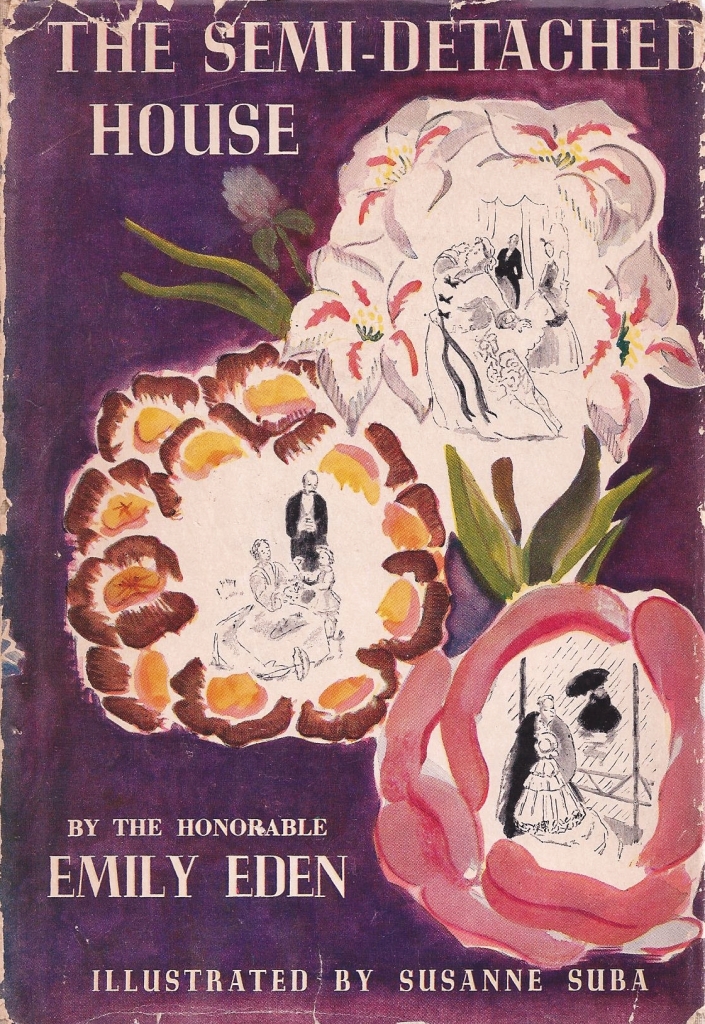
the semi-detached house emily eden 001The Semi-Detached House by Emily Eden ~ 1859.

This edition: Houghton Mifflin, 1948. Illustrated by Susanne Suba. Hardcover. 216 pages.

My rating: 6.5/10

An aristocratic young Lady Chester, Blanche to her intimates, just eighteen and married six months, is bemoaning her husband’s three-month diplomatic assignment in Germany. She has discovered that she is in an “interesting” state of health, and she thinks her husband’s timing could be ever so much better. As well, Lord Chester has taken the advice of Blanche’s doctor and has packed her off to the depths of the suburbs (Dulham), to Pleasance Court, which is in itself quite all right, being a properly fashionable address, but for the smaller semi-detached dwelling at the rear, residence of the decidedly middle-class Hopkinson family. Blanche is a mass of nerves, anticipating all the worst, and dreading meeting her undoubtedly “common” neighbours.

Just across the shared wall, the Hopkinsons are equally as flustered. Rumour has it that the young socialite moving in next door is either the estranged wife of a member of the nobility, or perhaps (shocked hisses) his chère amie. The very respectable Mrs. Hopkinson has barred her shutters, and intends to cut her new neighbour dead.

Luckily both households make a happy acquaintance and quickly become the best of friends, for this is a very friendly novel of manners, and though the gossip flows freely the gossipers are most well-intentioned.

Emily Eden (“The Honorable Emily Eden” as my 1948 edition proudly proclaims) was a great admirer of her predecessor Jane Austen, and deliberately styled her several domestic novels after that literary mentor. Parallels certainly exist, but Emily Eden’s work has a distinctive voice of its own, being gently satirical and full of humorous situations of a time several decades past that of Jane Austen’s fictional world.

A cheerfully fluffy romp, with just the lightest touches of seriousness here and there, and more than a little snobbishness towards the social climbers seeking to scrape acquaintance with the fashionable Chesters. There are love affairs to be sorted out, and the spanking new marriage to be fully settled into, not to mention the excitement of the impending arrival of Blanche’s addition to the English aristocracy.

Nice glimpse at a world familiar to those of us fond of Miss Austen and her compatriots, written by someone who was familiar at first hand with the life described so vivaciously here.

Another novel, The Semi-Attached Couple, preceded this one, and both are succinctly reviewed by Desperate Reader, and by Redeeming Qualities, among others.

The full text of The Semi-Detached House is online for your reading pleasure here, and both novels are available in a Virago double edition as well, though that may now be out of print.
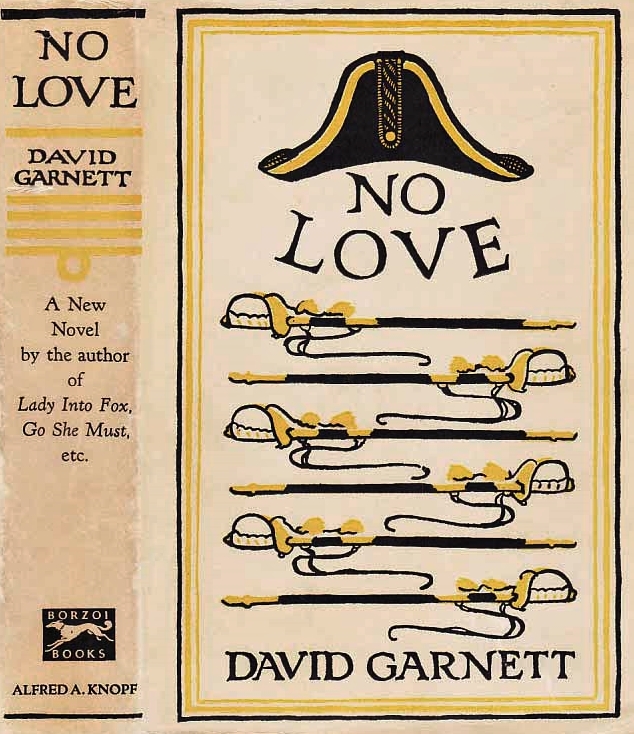
no love david garnett djNo Love by David Garnett ~ 1929.

This edition: Chatto & Windus, 1929. Hardcover. 275 pages.

My rating: 8/10.

What an unexpected and sophisticated novel this one was. I have never read David Garnett before, though of course I have heard quite a lot about Lady Into Fox (which I’m intending to read next year for the Century of Books project) and I now anticipate that reading with even more pleasure, as I  was quite pleased with what I read here. I did an online search to see if I could come up with any other reviews of No Love, but have so far drawn a complete blank, which leaves me rather disappointed. Surely someone else has found this novel worthy of discussion? If you have reviewed it yourself, or know of any others who have, I would be greatly interested to read your thoughts.

When in 1885 Roger Lydiate, the second son of the Bishop of Warrington, and himself a young curate, became engaged to Miss Cross, the marriage was looked on with almost universal disapprobation.

Alice Cross was a very emancipated girl; she was the daughter of the great paleontologist, Norman Cross, the notorious freethinker and friend of Huxley’s, who had poisoned himself deliberately when he was dying of cancer. The poor girl idolised her father’s memory, had been known to justify his suicide in public, and openly maintained, not only the non-existence of God, the non-existence of the human soul, and a rational and mechanistic theory of human consciousness, but also carried the war into the enemy’s country by declaring with her favourite poet Lucretius

Tantum religio potuit suadere malorum.

It was her view, constantly expressed, that it was religion alone that had always prevented the advancement and enlightenment of mankind, that all wars and pestilences could be traced to religious causes, and that but for a mistaken belief in God, mankind would already be living in a condition of almost unimaginable material bliss and moral elevation.

She was, they all said, no wife for a clergyman.

Despite Alice’s “unsuitability”, she and Roger were deeply in love, and they did indeed marry, with Roger ultimately abandoning his curateship and declaring himself an atheist. The Bishop let it be known that he was cutting young Roger out of his will, but what was never known was that he was deeply sympathetic to the young couple, and had quietly given the young bride an astounding ten thousand pounds as a wedding gift.

With this unlooked-for nest egg, the young couple purchased a small island near Chichester, on which was an extensive fruit farm, and settled down to a rural life, and to establishing a home and a new way of life.

There is no happiness and excitement in the lives of a married couple greater than the period when they are choosing themselves a house and moving into it; it is a time far happier than the wedding night or than when children come. A house brings no agony with it; its beauties can be seen at once, whilst both physical love and the children it begets, need time for their beauty to unfold.

Roger and Alice were well suited to each other and their rural occupation, and in time two children were born to them, Mabel and Benedict. Life on the Island proceeded peacefully, until one day in late October, 1897, when Roger rescued a stranded party of boaters and offered them hospitality for the night. These proved to be a certain prominent naval man, Admiral Keltie, his beautiful wife, and their young son Simon, and as the two families felt a certain stirring of mutual attraction, it soon came about that the Kelties purchased a building lot on the island and proceeded to construct a mansion, while between the two families a friendship of sorts developed.

That friendship was soon mixed with a good dose of unspoken jealousy, as the Lydiates see at first hand the extravagance of the wealthy Kelties, and as both husbands cast admiring eyes on the attractions of their neighbour’s spouses. Roger is appreciative of Mrs. Keltie’s cold beauty and brittle wit, while the Admiral is moved by Alice’s obvious intelligence, her deeply passionate nature, and a certain earth-mother quality she exudes.

Simon and Benedict make friends as well, though as they grow up they grow apart, with Simon moving in much more exalted circles, and Benedict going his own quiet way, though the two reconnect time and time again, their meetings often marking the episodes of this narrative.

The novel focusses most strongly on the Lydiate family, and its description of their lives and the changes in their moods and attitudes as the Kelties come and go is beautifully wrought. The years pass, and the Great War sweeps both sons away, but the families remain tenuously connected, however, as Simon and Benedict both have fallen in love with the same woman, and her decision on which one to marry has far-reaching consequences to both families.

This novel appeals on numerous levels, as an exercise in story-telling, as a commentary on the social mores of the time, and as a broader examination of the nature of many different kinds of love. Nicely done, David Garnett. I am looking forward to seeking out and reading more by this author in the years to come.

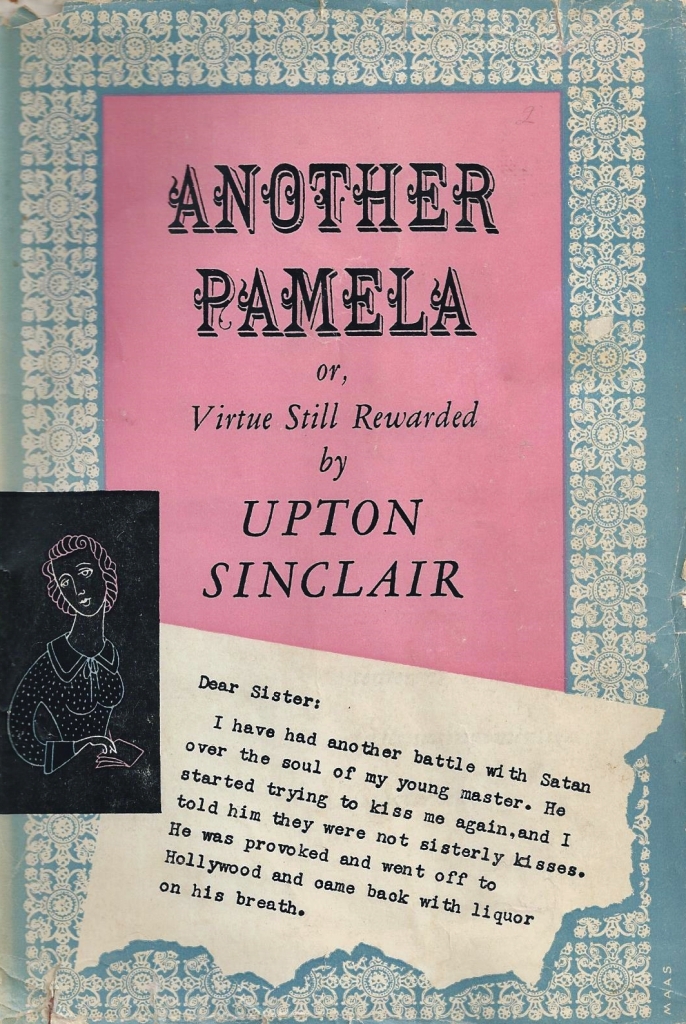
another pamela upton sinclair 001Another Pamela or, Virtue Still Rewarded by Upton Sinclair ~ 1950.

This edition: Viking Press, 1950. Hardcover. 314 pages.

My rating: 7.5/10

And now for something completely different, we move forward in time and to another continent, to this satirical look at social mores in 20th Century California.

Somehow in my travels I have acquired not one but two copies of this slightly obscure novel, a foray into light literature by the famously passionate social activist and best-selling author, Upton Sinclair, perhaps best known for his consciousness-raising, dramatic novel The Jungle.

Having never read Samuel Richardson’s bestselling 1740 epistolary novel, Pamela, about an English serving girl’s trials, tribulations and eventual marriage to the nobleman who tenaciously attempts her seduction, I wasn’t quite sure if I would fully appreciate Upton Sinclair’s parody of the same. It turned out not to matter, as Sinclair helpfully includes generous quotations from the original, having his own heroine read the original as part of her personal development, as she struggles with her own would-be seducer, and the dictates of her conscience and religious upbringing.

Published in 1950, the action of the story is set some years earlier, in the years of the Roaring Twenties, when the fabulously rich of America gave full rein to their imaginative excesses.

The modern Pamela is a child of the early 1900s, being a deeply naïve and (of course!) absolutely lovely young maiden raised in rural poverty in California. She is discovered by a wealthy patroness whose car has broken down in the area of young Pamela’s farm. Upon conversing with Pamela and learning that she is a Seventh Day Adventist with no objection to working on a Sunday (as long as she has Saturday free to devote to her devotions), Mrs. Harris impulsively decides to try the girl out as a parlour maid in her luxurious home, Casa Grande, near Los Angeles.

Pamela is quite naturally overwhelmed by this change in her affairs. Grateful to be able to be sending her pay home to help out her desperately poor family, she is most loquacious in her letters, describing her situation and the other servants and tradespeople she works with, and, increasingly, as she rises in the household hierarchy, the doings of Mrs. Harris herself, who is a lady of many enthusiasms, the main one being the promotion of a rather eclectic form of communism, tweaked to allow for the great disparity between the Harris millions and the theoretical rights of the downtrodden to full equality. (As long as Mrs Harris is not asked to give up her personal comforts, that is.)

And there of course is a “young nobleman” of sorts, one Charles, Mrs Harris’s nephew, a playboy of epic proportions who is completely dependent on his besotted aunt for funds. The Young Master, as Pamela describes him in her letters home, has many vices, not the least of which is his excessive consumption of alcohol, and when Mrs. Harris notices his glances at the lovely Pamela, she encourages the girl to give in to Charles’ pressing invitations to dining out and sightseeing, hoping that this new interest will wean Charles from the demon bottle. (She conveniently turns a blind eye to the possible corruption of her protégé’s morals.)

Charles is decidedly forthcoming; Pamela resists, using her prim and rigid religion as her shield and weapon. Do I need to tell you what happens? Not really, as the title gives the ending away, and as this is a happily satirical tale, we know that Pamela’s eventual fall will be well cushioned.

An enjoyable diversion of a book, with Sinclair getting his digs in at a huge array of social types, all in good fun, with abundant sugar coating the truthful pill within. I wonder if this deserves a “hidden gem” designation? I rather think it does, and I think some of you might find it worthy of a read if you come across it in your travels; it’s an amusingly Americana-ish thing.

Read Full Post »
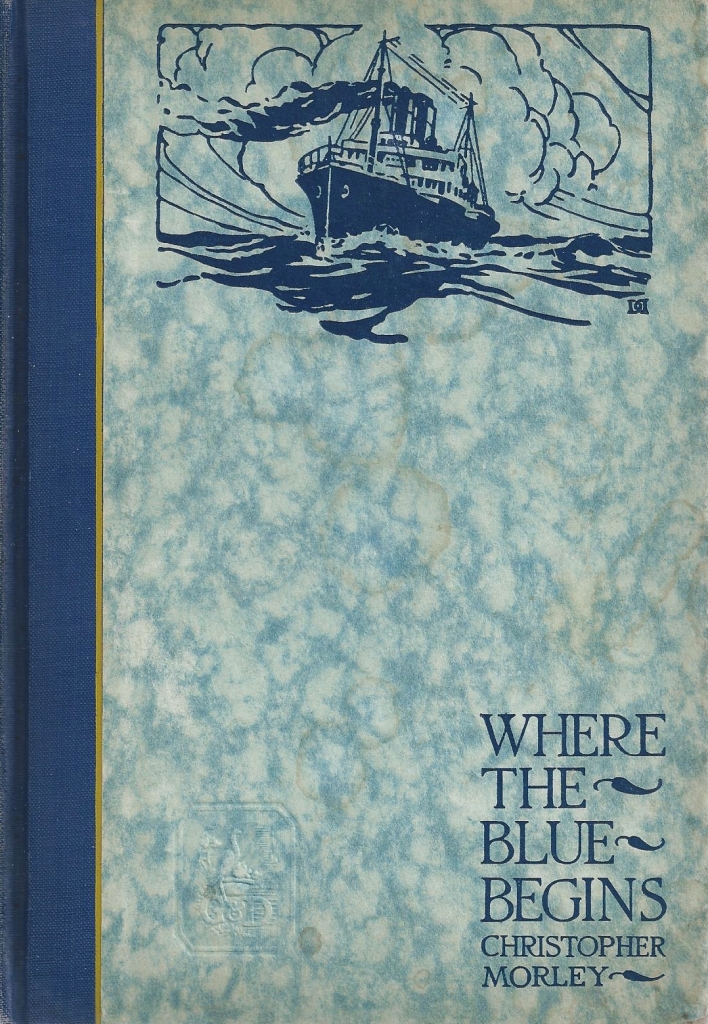
where the blue begins christopher morley cover 001Where the Blue Begins by Christopher Morley ~ 1922. This edition: Grosset & Dunlap, 1934. Hardcover. 215 pages.

My rating: 6.5/10

“I am not free—
And it may be
Life is too tight around my shins;
For, unlike you,
I can’t break through
A truant where the blue begins.

“Out of the very element
Of bondage, that here holds me pent,
I’ll make my furious sonnet:
I’ll turn my noose
To tightrope use
And madly dance upon it.

“So I will take
My leash, and make
A wilder and more subtle fleeing
And I shall be
More escapading and more free
Than you have ever dreamed of being!”

It took my two tries to get this one finished, as I kept putting it aside for other things more immediately pressing, but finished it is, and what an odd – and oddly diverting – story it was.

It starts off predictably enough. Here we have a decently prosperous, almost middle-aged bachelor, one Gissing, whose private income is just sufficient to allow him a life of leisure, with a country house staffed by a manservant, and scope for mild entertainment and some local travelling.

Gissing lived alone (except for his Japanese butler) in a little house in the country, in that woodland suburb region called the Canine Estates. He lived comfortably and thoughtfully, as bachelors often do. He came of a respectable family, who had always conducted themselves calmly and without too much argument. They had bequeathed him just enough income to live on cheerfully, without display but without having to do addition and subtraction at the end of the month and then tear up the paper lest Fuji (the butler) should see it.

He had no responsibilities, not even a motor car, for his tastes were surprisingly simple. If he happened to be spending an evening at the country club, and a rainstorm came down, he did not worry about getting home. He would sit by the fire and chuckle to see the married members creep away one by one. He would get out his pipe and sleep that night at the club, after telephoning Fuji not to sit up for him. When he felt like it he used to read in bed, and even smoke in bed. When he went to town to the theatre, he would spend the night at a hotel to avoid the fatigue of the long ride on the 11:44 train. He chose a different hotel each time, so that it was always an Adventure. He had a great deal of fun.

But having fun is not quite the same as being happy…

Gissing is occasionally disturbed by vague yet compelling yearnings to see and understand his purpose in the world. What’s it all about, and what should we do with it, this thing called “Life”? What’s over the next horizon, “where the blue begins”?

Gissing was increasingly disturbed. Even his seizures of joy, which came as he strolled in the smooth spring air and sniffed the wild, vigorous aroma of the woodland earth, were troublesome because he did not know why he was so glad. Every morning it seemed to him that life was about to exhibit some delicious crisis in which the meaning and excellence of all things would plainly appear. He sang in the bathtub. Daily it became more difficult to maintain that decorum which Fuji expected. He felt that his life was being wasted. He wondered what ought to be done about it.

Casting about the April countryside, Gissing one night comes upon three abandoned infants, and his immediate impulse is to take them home and raise them as his own. This he successfully does, and in the turmoil of surrogate fatherhood his larger questions for the moment are answered, until Fuji rebels, gives notice, and leaves Gissing to manage on his own.

Consternation! What to do now? It’s suddenly all too much! Luckily there is motherly Mrs. Spaniel, Gissing’s laundress, who can be persuaded to give over her other duties and come to care for the children, allowing Gissing some breathing space once again. And once he has time to collect his thoughts, his mind returns to its original track. What’s out there? What is it all about?

Leaving Mrs. Spaniel in charge, Gissing departs for the city, in order to further explore his possible destiny. There he finds employment as a floorwalker in a large department store, and through his superior intellect and with a goodly dose of bravado, he soon rises to the position of store manager. But though this is financially rewarding, Gissing’s spiritual life is still unfulfilled, and he abandons his position, breaking the heart of his elderly sponsor as he goes.

A stint as a lay reader in a church follows, and a promising romance with the appealing and prosperous Miss Airedale seems for a while to still Gissing’s wandering soul, but this too comes to naught, and he runs away to sea, a stowaway on the steamship Pomerania, where he is discovered and adopted by the gruff Captain Scottie, a fellow deep thinker and theological debater. Gissing rises to Staff-Captain, and despite having no previous knowledge of seamanship, proceeds to steer the ship at will, following his whims, to the mute distress of the helpless crew.

He himself had fallen into a kind of tranced felicity, in which these questions no longer had other than an ingenious interest. His heart was drowned in the engulfing blue. As they made their southing, wind and weather seemed to fall astern, the sun poured with a more golden candour. He stood at the wheel in a tranquil reverie, blithely steering toward some bright belly of cloud that had caught his fancy. Mr. Pointer shook his head when he glanced surreptitiously at the steering recorder, a device that noted graphically every movement of the rudder with a view to promoting economical helmsmanship. Indeed Gissing’s course, as logged on the chart, surprised even himself, so that he forbade the officers taking their noon observations. When Mr. Pointer said something about isobars, the staff-captain replied serenely that he did not expect to find any polar bears in these latitudes.

As crew and passengers grow increasingly restive, Gissing eliminates them by one bold move, and sails on alone, until he reaches an intriguing landfall, whereupon all his questions are at last answered.

Now, if you’ve read this far, you may be noticing a certain theme with the names and all. For the characters are indeed all canine. This is the world as we know it, but it is peopled entirely with anthropomorphized dogs. They walk on two legs, wear clothes, drive motorcars, dwell in houses, but the canine instinct continually makes itself known. Aromas madden these creatures; they occasionally tear off their clothes and run madly through the countryside, to return apologetically to their dwellings when the mood passes. They snap and snarl when taunted, and the pack instinct is strongly present, as Gissing finds to his discomfort when he falls afoul of a church congregation and must flee madly from their sharp white teeth, escaping through the Sunday-peaceful countryside until refuge presents itself in an unattended steamroller, with bizarrely hilarious results.

It’s beyond weird, this whole conceit, but it works surprisingly well, and Morley is obviously enjoying himself thoroughly the whole way through this very odd book.  It was a bestseller in its time, and was produced in numerous editions. And yes, this is the Christopher Morley of The Haunted Bookshop and Parnassus on Wheels, and if I was expecting something along those lines when I first picked up Where the Blue Begins, I was soon shaken out of my complacency.

Here it is, if you want to read it yourself, courtesy of the ever-helpful Project Gutenberg.

And here is a quite recent review, at Flayrah, which gives a good overview, though it contains some spoilers.

Amazing what one finds in the dusty vintage stacks!

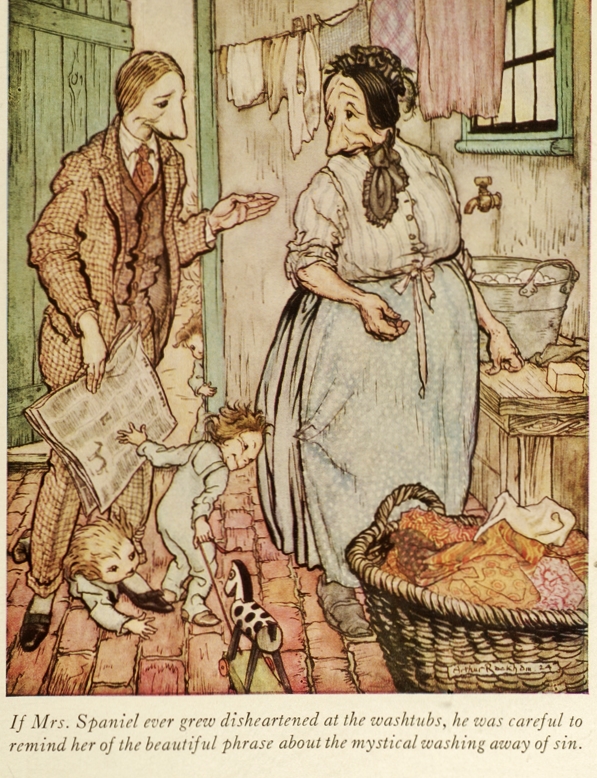
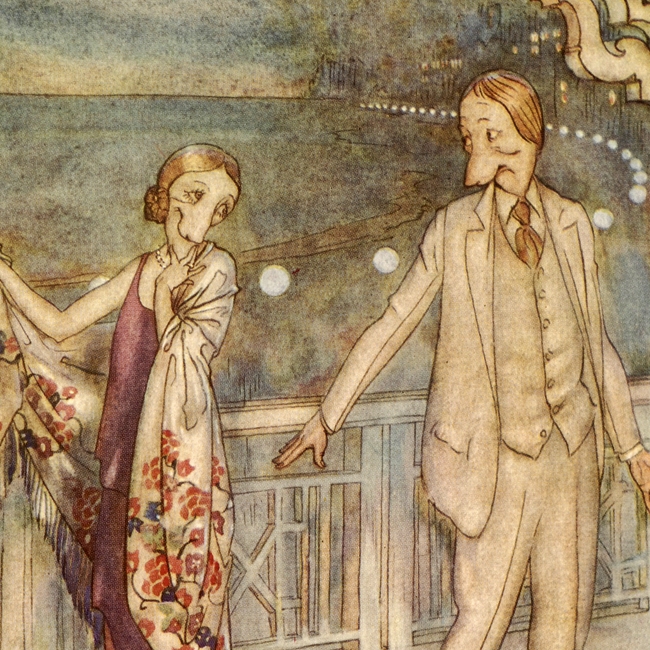
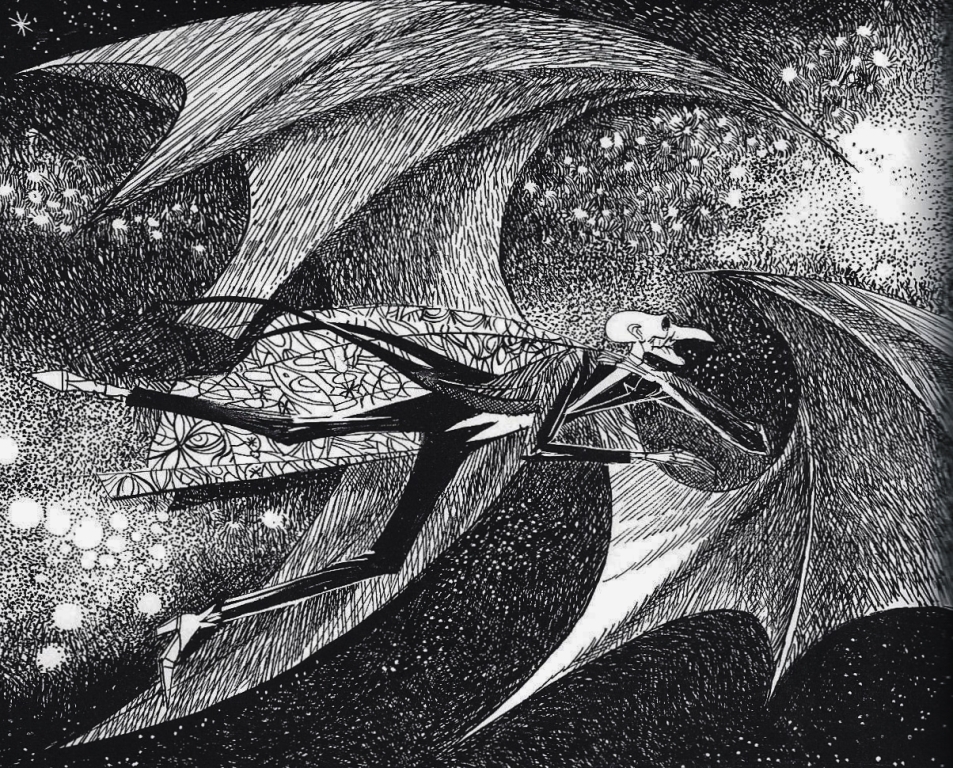
Here are several examples of the Arthur Rackham illustrations, made for a very rare limited edition printing. Rackham’s vision of the characters is rather disturbingly creepy, I think, but I’m not really sure how I see them myself, so can’t be too critical!

Gissing, the patient Mrs. Spaniel, and the puppies.

Gissing, the patient Mrs. Spaniel, and the puppies.

The enchanting Miss Airedale flirts with Our Hero.

The enchanting Miss Airedale flirts with Our Hero.

Read Full Post »

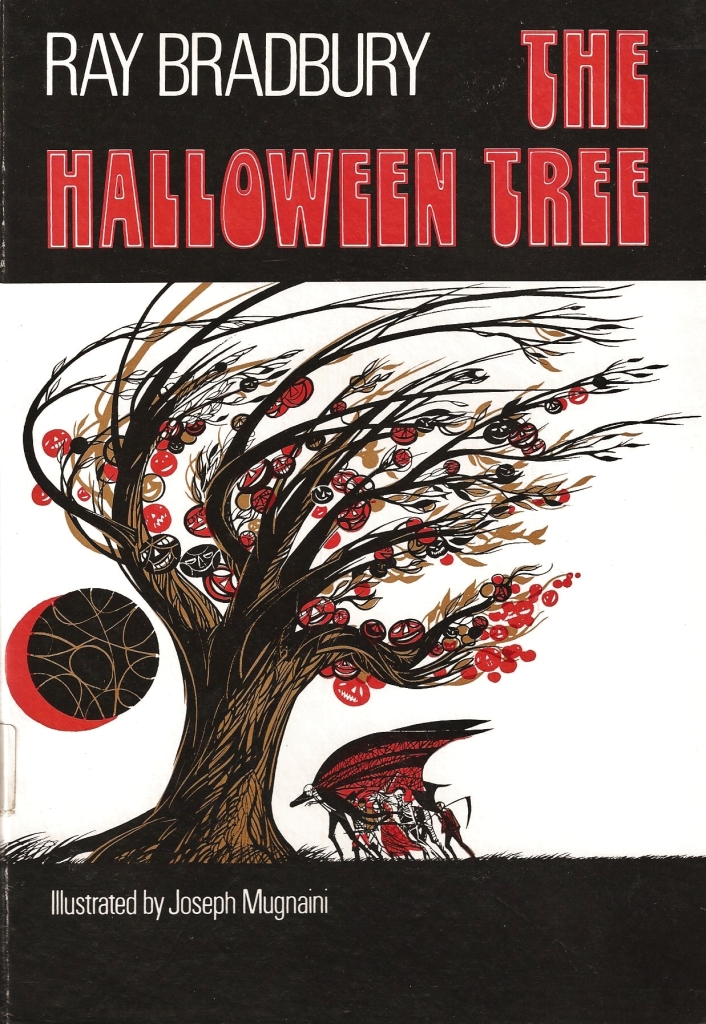
the halloween tree ray bradbury cover 001The Halloween Tree by Ray Bradbury ~ 1972. This edition: Knopf, 1972. Illustrated by Joseph Mugnaini. Hardcover. ISBN: 0-394-92409-6. 145 pages.

My rating: 6.5/10

Blink your eyes and a year has passed by. Weren’t we just here, on All Hallow’s Eve? And here we are again…

Last night I went out to the car and brought in the bags of Hallowe’en candy stashed in the trunk. Many years of experience have taught me the folly of allowing it into the house too early, and numerous times I have had to buy it twice. For once it is in, all bets are off, and unless I can package it up into bags intended for neighbourhood trick-or-treaters immediately, the odds are high that some wee child will get shortchanged of his or her full share of sugar.

We live at the end of a sparsely populated rural road, and no one ever makes it this far, so part of our Hallowe’en tradition since moving here twenty-some years ago has been to take our contribution to a neighbour’s place mid-way along the traditional route. For Hallowe’en in the country is a bit different than in town. No walking is involved (though one legendary year a few intrepid teens did go on horseback) – the distances are too great. Our usual route was a 15 miles round trip, with 12 houses visited, and those houses would strive to outdo each other in creativity and quantity of goodies for the “neighbour kids” who knocked on the door.

Homemade popcorn balls, full size bags of chips, cans of pop, store-bought candy by the bagful, pickles (yes, pickles – “witch’s fingers”, don’t you know?!), and pomegranate halves (“Because they just look so weird”) and just-roasted pumpkin seeds – what a glorious haul! At each house a prolonged visit, as the costumed ones are made to sing for their treats, spun around to examine their get-ups, photographed and congratulated on their creativity and sent on their way. It’s a very big deal around here, where everybody knows everybody, and usually can predict to the exact number how many children will be showing up – a phenomenal 18 (!) last year. Until our own kids passed that elusive milestone (mid-teenish) when the dress-up thrill began to pale, it was one of our family’s favourite nights of the year.

This year, after a few seasons of non-observance of the night, the now-independently-mobile (driver’s licences and a car) teens are talking of going into town to take part in a “zombie walk”, and costume makings are all over the kitchen table, so I guess they’re not too old for it after all, though the whole concept of the zombie thing leaves their parents a bit bemused. We will be joining up for a bonfire and fireworks once it gets dark, hosted by some of our in-town relations, so it promises to be an pleasurable evening.

All of this digression out of the way, I will now turn to the original purpose of this post, which is to talk a little bit about a book. Twizzlers and Rockets and a few mini Mars Bars at hand, I’m ready to go. Let’s see what my sugar-fueled morning brain can come up with to say about the book I searched out last night as an appropriate Hallowe’en read.

It was a small town by a small river and a small lake in a small northern part of a Midwest state. There wasn’t so much wilderness around you couldn’t see the town. But on the other hand there wasn’t so much town you couldn’t see and feel and touch and smell the wilderness. The town was full of trees. And dry grass and dead flowers now that autumn was here. And full of fences to walk on and sidewalks to skate on and a large ravine to tumble in and yell across. And the town was full of…

Boys.
And it was the afternoon of Halloween.
And all the houses shut against a cool wind.
And the town was full of cold sunlight.
But suddenly, the day was gone.
Night came out from under each tree and spread.

Behind the doors of all the houses there was a scurry of mouse feet, muted cries, flickerings of light.

Behind one door, Tom Skelton, aged thirteen, stopped and listened.

The wind outside nested in each tree, prowled the sidewalks in invisible treads like unseen cats.

Tom Skelton shivered. Anyone could see that the wind was a special wind this night, and the darkness took on a special feel because it was All Hallows’ Eve. Everything seemed cut from soft black velvet or gold or orange velvet. Smoke panted up out of a thousand chimneys like the plumes of funeral parades. From kitchen windows drifted two pumpkin smells: gourds being cut, pies being baked.

Tom Skelton is ready to take part in this night of nights. Playing on his fortunate last name, he’s decked himself out in bones, white stitched on black, and he’s keen to get going, as are his friends.

Wham. Eight front doors banged shut.

Eight boys made a series of beautiful leaps over flowerpots, rails, dead ferns, bushes, landing on their own dry-starched front lawns. Galloping, rushing, they seized a final sheet, adjusted a last mask, tugged at  strange mushroom capos or wigs, shouting at the way the wind took them along, helped their running; glad of the wind, or cursing boy curses as masks fell off or hung sideways or stuffed up their noses with a muslin smell like a dog’s hot breath…

But wait! Shouldn’t there be nine of them? Who is missing?

One is not there, and as they run to the missing Pipkin’s house an awful foreboding forms in each boyish heart. What could be wrong?

Pipkin appears, pale and sad, moving like an old man. Not feeling well at all. But still keen to join in. “You go ahead. I’ll catch you up.”

Agreeing to rendezvous in the ravine, at the House of the Haunts (brrr!) the boys scatter into the night.

And when they get there, still no Pipkin.

…They stood at last by a crumbling wall, looking up and up and still farther up at the great tombyard top of the old house. For that’s what it seemed. The high mountain peak of the mansion was littered with what looked like black bones or iron rods, and enough chimneys to choke out smoke signals from three dozen fires on sooty hearths hidden far below in dim bowels of this monster place. With so many chimneys, the roof seemed a vast cemetery, each chimney signifying the burial place of some old god of fire or enchantress of steam, smoke, and firefly spark. Even as they watched, a kind of bleak exhalation of soot breathed up out of some four dozen flues, darkening the sky still more, and putting out some few stars.

And towering over the house, an amazing, stupendous, fabulous tree.

And it was such a tree as they had never seen in all their lives.

It stood in the middle of a vast yard behind the terribly strange house. And this tree rose up some hundred feet in the air, taller than the high roofs and full and round and well branched, and covered all over with rich assortments of red and brown and yellow autumn leaves. [And] the Tree was hung with a variety of pumpkins of every shape and size and a number of tints and hues of smoky yellow or bright orange.

“A pumpkin tree,” someone said.

“No,” said Tom.

The wind blew among the high branches and tossed their bright burdens, softly.

“A Halloween Tree,” said Tom.

And he was right.

And out of a pile of leaves below the tree arises a huge man in dark clothes, a menacing and laughing man, intoning something about “tricks Tricks TRICKS,” and before they know it the eight boys are being whisked off on a fantastical journey into the past, to glimpse the origins of Halloween, and to try to pin down the elusive Pipkin, who seem always to be just a little beyond them, a faint and ghostly presence.

the halloween tree ray bradbury illustration 1 001

I have to admit that right here, page 33, is where Ray Bradbury rather lost me. I completely bought into the nostalgic Halloween night magic of the house and the tree and the boys and the thrills of their adolescent nocturnal glories, but once their shape-shifting, darkly mysterious host materialized and whisked them off into a time travel journey, the magic thinned and the bones of the Teachable Moment shone through.

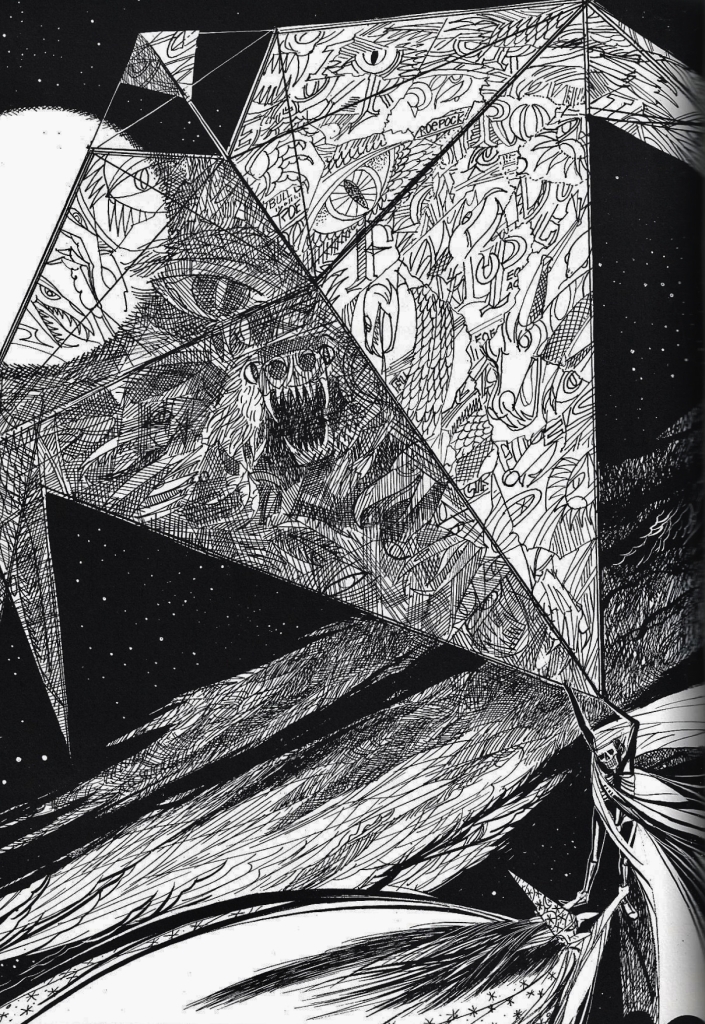
For this is a journey back to learn about the origins of Halloween, and the boys first build a kite out of a barn’s wall worth of tattered circus posters which carries them out into the night sky and beyond. The author is grandly creative in this bit, and admittedly throughout; the strength of the book is definitely in the imagery, if not in the highly contrived plot.

the halloween tree ray bradbury illustration 3 001

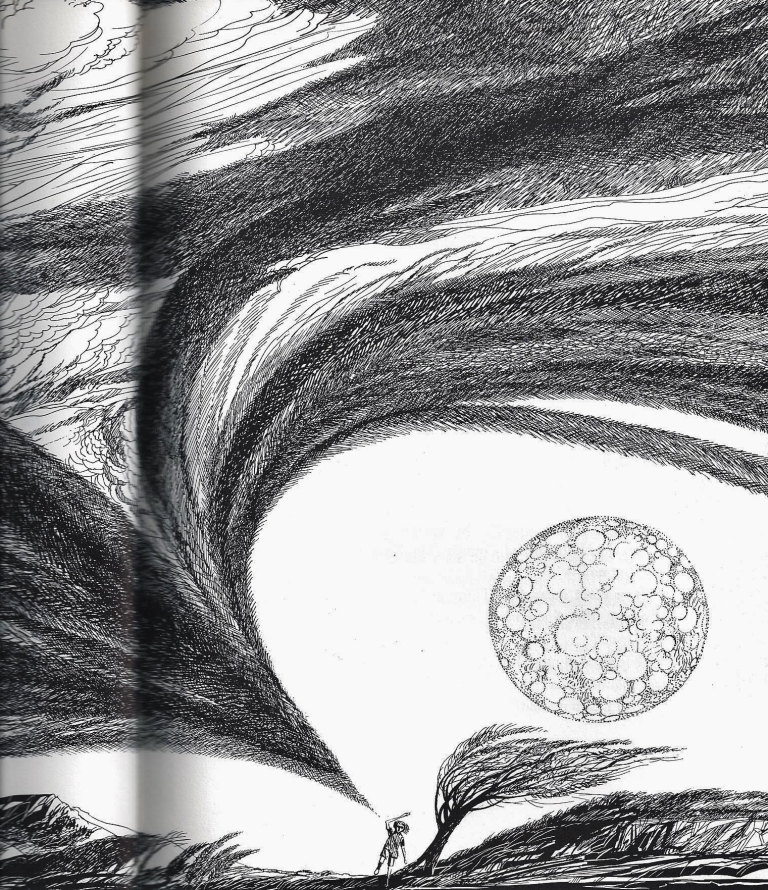
Off they all go to visit ancient Egypt, when the pyramids were new, and then to glimpse Night of the Souls rites in Greece and Rome. They have a seriously creepy encounter with scythe-wielding Samhain in Druidic times, watch the Romans fall the sacred groves, and the Roman golden images turn into Christian icons. A witch’s gathering attended by flying broomstick is next, merging into a visit to Notre Dame Cathedral and its fantastical gargoyles, one of which appears to be the missing Pipkin, turned to stone. Nice bit here with the wind and the rain allowing the stone creatures to speak.

Finally to the Day of the Dead in Mexico, into the graveyards and down into the Catacombs, where the eight boys are given a chance to finally save their elusive friend, but at a potentially terrible cost. Needless to say, they do the expected thing, and find themselves whisked back home, where they learn that Pipkin has indeed had a brush with death (appendicitis) but has had an operation, and has rallied wonderfully well.

Midnight strikes. All return to their homes, and the night turns quiet as the candle blames wink out on the Halloween Tree.

the halloween tree ray bradbury illustration 2 001

That felt really rushed. A whirlwind tour with too many stops.

I have mixed emotions about this short novel, this juvenile fable, this ode to youth and to the magic of an idealized Halloween.

Bradbury returns to his personal childhood world of white-picket-fence, small-town, mid-West America; his characters are those perennially adolescent boys just on the verge of the thing that comes next. Their world is ultimately clean, decent, safe and secure; the dark places are there, but there is always a refuge, and the light always triumphs in the end. Fair enough, but one can’t help but feel a bit uneasy, that there’s something missing from the scene, or maybe that there’s something more going on than we get to see. Where are the dark places in your world, dear reader, and what place of safety have you to look forward to?

Exactly.

The time travel bits are a bit too handy, a bit too contrived, a bit too screenplay-ready. Aha! And there’s the twist. This story was first conceived as just that, a screenplay for an animated movie, in 1969. That project fell through, and Bradbury dusted it off and turned it into this narrative work a few years later. This explains a lot, the abrupt switching from scene to scene, and the rushed and hyper-active speed of travel throughout. It would make a good movie, and in 1993 Bradbury helped Hanna-Barbera bring the story to the screen, winning an Emmy Award in 1994 for the project. ( I haven’t seen the 1993 film, but I am mildly curious about it now.)

An evocative juvenile novel, with interest for the adult reader in the beautifully written descriptive passages found throughout, if one can wade through the “Gee whiz!” kidspeak and the absolutely dire rhyming bits scattered throughout. (Poetry obviously is not one of Bradbury’s strengths, at least not here.) I’m not quite sure how present day youth would view this one; I suspect the dreamily imaginative ones would find much to like, but it also has a very vintage feel, perhaps too much so to appeal to the majority.

So there it is: a Halloween book review on the day itself.

Cheers, all.

Oh, and the morning candy was most tasty, but I think I’m good now for another year! 😉

Read Full Post »

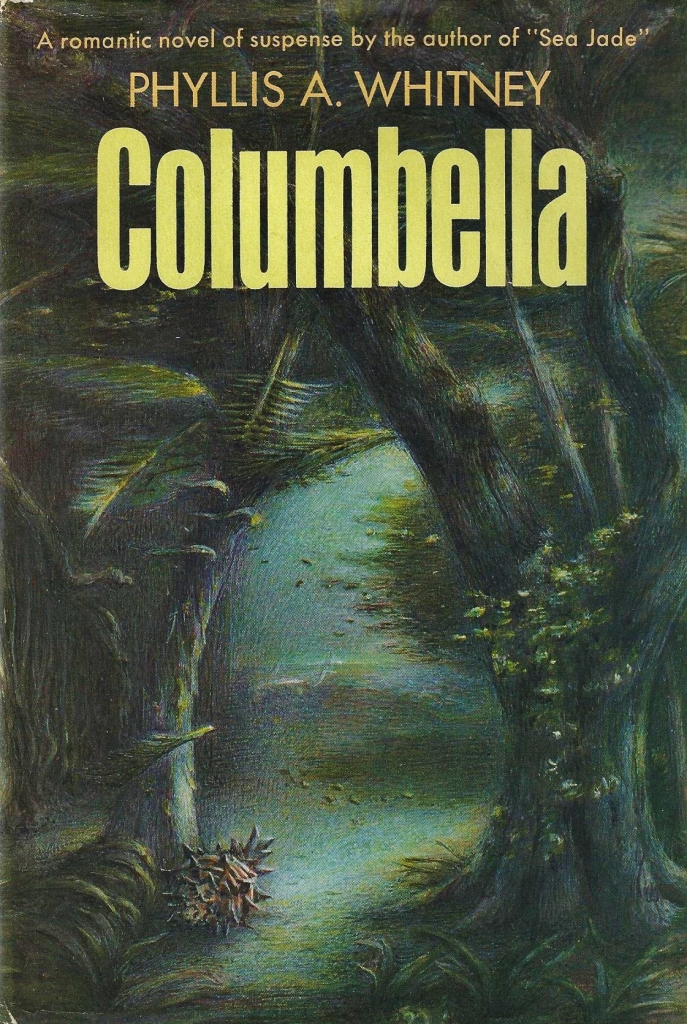
columbella phyllis a whitney 001Columbella by Phyllis A. Whitney ~ 1966. This edition: Doubleday, 1966. Hardcover. 246 pages.

My rating: 3/10

Oh, why did I read this? It was so disappointing. And I have had prior experience with this author – see here  – and went in fully cognizant of what I was about to experience. All I can say then is that hope springs eternal. And that my hope was dashed. Oh, woe!

But don’t you like the mysterious cover illustration, and doesn’t this flyleaf blurb sound promising, for a lightly diverting romantic-suspense thriller type thing?

That was a night of gold and red, with torches flaming on the hilltop and the lights of Charlotte Amalie fanning out around the harbor below. A night of water lily and sweet-smelling cereus. The night of the shell…

Jessica Abbott, fleeing her own past, finds herself the center of a whirlpool of conflict at Hampden House, high on its cliff in the Virgin Islands. She is confronted by Catherine Drew, a woman whose sole purpose is to torment and destroy. Catherine is the wife of a vital, driven man, Kingdon Drew-toward whom Jessica is irresistible drawn. Jessica must defy the beautiful, self-indulgent Catherine, who likes to affect the name of a shell – Columbella. She must fight for the very future of another woman’s child. Above all, she must find the strength to help the man she loves escape the trap Catherine has set for him. Yet each day Catherine seems to mock her in a new way – and win. Until the night of the shell…

Always, the brilliant island sun shines over Hampden House in St. Thomas and over Caprice, the plantation in St. Croix that is crumbling to eerie ruin, guarded by its unicorns. Always the threat of a hurricane looms over this exotic setting, where the past still affects the present.

So. Our lovely heroine Jessica has just lost her own sweet-faced, soft-voiced, utterly poisonous, insidiously controlling mother, and she is seeking to escape her own demons by taking on the role of companion-governess to yet another emotionally-abused girl, the teenage daughter of an architect and the aforementioned Catherine. Jessica falls in love with the hunky, broody Kingdon at first sight, and he himself is overcome with passion for her, which he manfully tamps down until it breaks free of its straining bonds. Lots of scenes of overt jealousy (on Catherine’s part) and apparent dislike (on Kingdon’s part only, for Jessica openly fawns on her employer from the get go) before the two lovers fall into each other’s arms. But there is still that pesky wife…

The final solution is of course a convenient demise – poor Catherine-Columbella! With Kingdon as main suspect, but of course he gets off the hook, thanks to a convenient confession by the true killer, who then is dealt with by the Hand of God (tree falling in a storm, crushing said murderer) and allowing everything to Work Out For The Best.

The best bits in the book were in the details. The setting, St. Thomas in the Virgin Islands, is enthusiastically described, and there are nice touches of verisimilitude in the discussion of the shell-collecting business and the preparation of the specimens for sale.

But the scenarios and the characters – wow! Can something be described as both flat and melodramatic at the same time? If so, our writer has pulled it off. And the passion between Kingdon and Jessica was blush-inducing indeed, but not because of its explicit nature. No, because it was so agonizingly clichéd. I was embarrassed at myself for willingly reading such schlock.

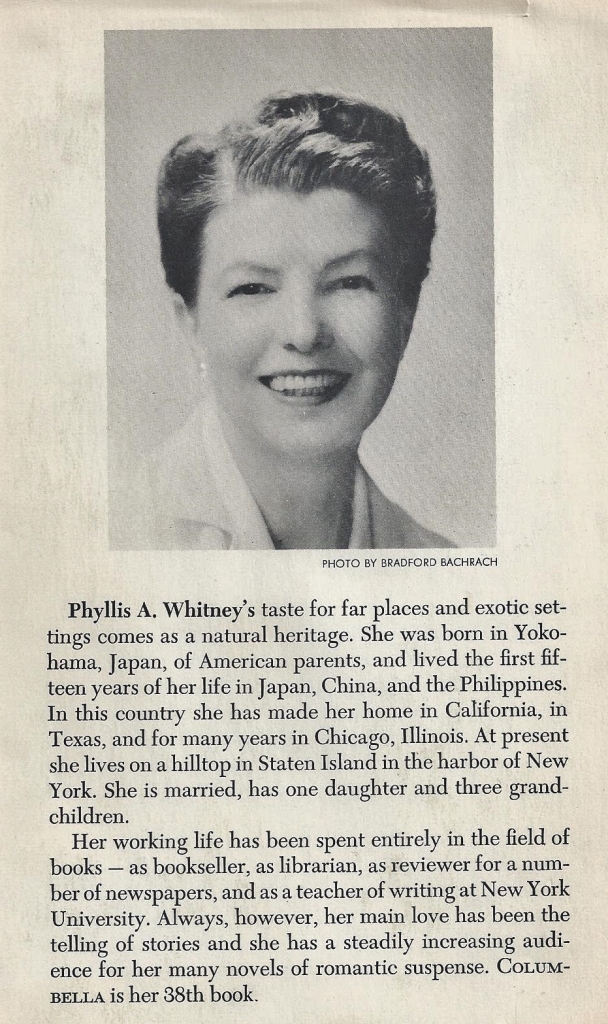
I want to like Phyllis Whitney so very, very much. She has such a promising back story as a writer, and she very obviously goes about her stuff with the best will in the world. She was a bestselling writer in her time, and much beloved by her devoted readers. So I may continue in my occasional investigations of her oeuvre, hoping to find a semi-precious gem or two amidst the very prolific sparkly bits of her vast body of work.

phyllis a whitney bio back dj columbella 001

Read Full Post »

the innocent traveller ethel wilsonThe Innocent Traveller by Ethel Wilson ~ 1949. This edition: New Canadian Library, 1982. Paperback. ISBN: 0-7710-9316-0. 277 pages.

My rating: 9/10

Every once in a while a book comes along which, unexpectedly, completely delights me. The Innocent Traveller is one such novel.

There’s not much in the way of drama in this joyfully written book, but it struck a chord of shared experience and of common humanity in its delicious narrative of the irrepressible Topaz. Always witty and occasionally poignant, the tale spans a full century of one woman’s life, and simultaneously gives a lightly drawn but absolutely fascinating portrait of the times she moved through, and of the society of her peers.

From the Author’s Note:

This is the story – part truth and part invention – of a lively woman who lived for a hundred years and died triumphant in Vancouver and is nearly forgotten after her small commotion of living.

The metaphors are not mixed. The drop of water, the bird, the water-glider, the dancer, the wind on the canal, and Topaz, are all different and all the same…

E.W.
Vancouver
British Columbia
1947

Our story – Topaz’s story –  begins in the 1840s,  in a respectable and prosperous London house, at dinner with the family (and important dinner guest) all decorously present.

Far away at the end of the table sat Father, the kind, handsome and provident man. At this end sat Mother, her crinoline spread abroad. On Mother’s right was Mr. Matthew Arnold. On each side of the table the warned children ate their food gravely, all except Topaz, on Mother’s left. Topaz, who could not be squelched, was perched there on top of two cushions, as innocent as a poached egg. Mother sat gracious, fatigued, heavy behind the majestic crinoline with the last and fatal child.

Topaz in a few moments makes the expected scene and ends the evening under the table amongst the trouser legs and skirts of her elders; poor Mother is indeed doomed, perishing along with her “last and fatal” baby within the next 48 hours. After a suitable period of mourning, Father remarries in order to provide a suitable mother and guide for his large family, choosing his late wife’s sister Jane as replacement and new helpmeet.

Stepmother is absorbed into the Edgeworth family, and life goes on. We watch the brothers and sisters blossom, go forth into the world, marry, have children, and flourish (or decline into early death) each in their turn, and we return again and again to take a look at little Topaz, who, still innocent of deliberate intent to speak out of turn, does indeed manage to do so continuously.

Boarding school, an unfulfilled love affair, travels with her older siblings, and the long gentle transition into adult, then middle-aged daughter-at-home with elderly parents; through this all Topaz burbles as irrepressibly as a forest spring. Stepmother dies, and Topaz finds herself in control of the household, and sadly at a loss. Others step in, as always, and Topaz goes back to her comfortable niche as universal companion to all, talking her way through her days, greeting each new thing with cries of alarm or delight (mostly delight); persisting in her perennial girlishness until she finds herself at fifty, Mother, Stepmother and Father now all gone, at last on her own.

Now this could go very badly indeed, but luckily (for Topaz) the Victorian custom of family looking after family is one the Edgeworths faithfully and automatically practice, and Topaz is absorbed into a new family grouping, one which will see her out to the end of her days. She moves, along with her elder widowed sister Annie and her unmarried cousin Rachel, across the Atlantic to Canada, via sea journey and long train trip, all the way to Vancouver, where Annie’s sons welcome the three adventurers, “whose years added up to over one hundred and fifty”, and helped them to establish a new home.

Topaz embraces her new life with typical enthusiasm, and we follow her for the last five decades of her life until her peaceful ending, a full century after her birth.

Ethel Wilson writes this semi-biographical tale with a very personal touch – she appears just a little over half way in in the person of recently orphaned eight-year-old Rose, born in South Africa to English parents – Annie’s son and daughter-in-law. Annie, Rachel and Topaz warmly enfold this fourth person into their world, and subsequently raise her in to womanhood in her turn.

Through the fabulous social and scientific changes of the turning of the nineteenth into the twentieth century, through two world wars and the stunning growth of the colonial city of Vancouver and change after change after change, Topaz remains the same, endlessly curious, endlessly outspoken, endlessly optimistic and reaching for the next adventure. Her death is sad but not tragic; her memory persists in those whose lives she fluttered in to and out of.

Lovingly written, with warm humour and an unsentimentally analytical eye, this is a lovely ode to an individual and a family, and an absolute joy to read.

Read Full Post »

« Newer Posts - Older Posts »