Archive for the ‘Read in 2013’ Category

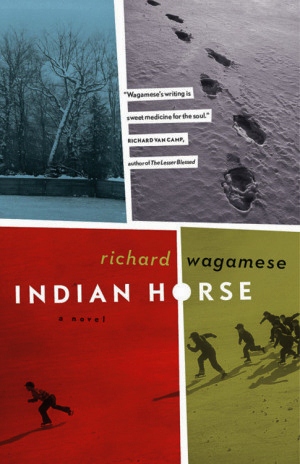
indian horse richard wagameseIndian Horse by Richard Wagamese ~ 2012. This edition: Douglas & McIntyre, 2012. Softcover. ISBN: 978-1-55365-402-5. 221 pages.

My rating: 7.5/10.

*****

Saul Indian Horse, a young Ojibway man in his thirties, has hit rock bottom and is crawling back up. He’s in a detox program after spending six weeks in hospital after collapsing in alcohol-induced tremors on a Winnipeg street. Part of the rehabilitation is bringing out old memories to get to the root of the issues behind the addictions, so Saul is writing down the story of his life.

Going back, waaaaay back, Saul starts with the anecdote about his great-grandfather which led to the family name.

The Ojibway were not people of the horse. Our land existed as an untamed thing, lakes, rivers, bogs and marshes surrounded by citadels of bush and rock and the labyrinthine weave of country. We had no need of maps to understand it. We were people of the manitous. The beings that shared our time and place were lynx, wolf, wolverine, bear, crane, eagle, sturgeon, deer, moose. The horse was a spirit dog meant to run in open places. There was no word for it in the old talk when my great-grandfather brought one back from Manitoba.

The traditional life of Saul’s immediate ancestors is changing, and the horse becomes a treasured and useful part of the tribal economy, pulling trees out of the bush to be floated down the river to the mill where they could be sold for cash, a necessity in the evolving way of things.

The negative side of progress is being felt as well. Children are being rounded up and forcibly taken away to mysterious locations where they are taught the ways of the Zhaunagush, the white people. The residential schools. Some – many – do not return. Those that find their way back are changed beyond comprehension of their parents and grandparents, and many, when they have children in their own turn, are emphatic in their fear of losing their own children to the schools. Saul’s parents were both residential school students, and the family  is constantly on the lookout for the floatplanes and motorboats carrying the armed white men intent on collecting the native children.

Despite their wariness, Saul’s sister Rachel is taken, and his brother Benjamin. Rachel never returns, but Benjamin runs away and finds his way home, though he is so sick from TB that he soon dies. The tragedy of finding and then losing their beloved son is too much for Saul’s parents. Against Grandmother’s pleas, they bundle up Benjamin’s body and set out by canoe to take him to the Catholic priest for “proper burial”.  Saul will never see them again.

Saul is only eight, and helpless to interfere. He and Grandmother are left behind, and as winter sets in and the parents do not return, are faced with a choice: stay in the bush and die during the winter, or travel out to the closest town, where there are relatives who will take them in.

Tragedy follows on tragedy, and Saul is eventually bereft of his grandmother as well; she freezes to death while sheltering Saul with her body. Saul is found and rescued, and is sent to “the school”, the regional Catholic residential school, where he joins the other traumatized native children who are in a state of walking apathy as everything they know is stripped away, and they are forcibly remade into “good, obedient, educated Christians.”

Saul already knows how to read and write in English, as his father had taught him from old schoolbooks, so that culture shock is minimized for him. But he desperately misses his family, and carries within him a core of grief that cannot be healed. Like most of the other children, Saul soon adapts to survival mode, learning how to avoid drawing attention to himself and cooperating in all demands made upon him.

A young priest joins the school the same year Saul is brought there, and his enthusiasm for the game of hockey brings interest and opportunity to the group of boys showing interest and ability. Saul is fascinated by the game, though he is considered too young to play. He sweeps the ice in the mornings, and surreptitiously teaches himself to skate and stick-handle, using to0-big skates stuffed with newspaper and frozen horse turds for pucks.

Of course, Saul is a natural. His progression is predictable, though fraught with emotional and physical challenges. Saul eventually gets too good for the Indian League, and is scouted, reaches Toronto, and plays for a top junior league team. Then it all blows up, as the stress of the constant racism – both brutally blatant and thinly veiled – he comes up against, and his deeply hidden bitterness about his tragic family and cultural losses finally push him over the edge.

*****

Richard Wagamese is an excellent writer, with an easy facility for words. I blazed through Indian Horse in one evening, willingly abandoning myself to Saul’s story. I’m not at all a hockey fan, and the description of this novel as a “hockey story” put me off much more than the residential school angle. My reluctance was needless; the saga of Saul did not require any stretch to understand in any of its elements.

I wonder if both the details of the game of hockey and the horrors of the residential schools are so ingrained into our combined Canadian psyches that we now immediately “get” the references? And does this therefore cushion the impact of a book detailing the atrocities done to First Nations people to a mere cultural reference, even when the author is most obviously a member of that cruelly wronged racial group?

For though I understood the points that the author was trying to wake us up on, I didn’t feel shocked. Nothing he brought up surprised me; the story of Saul is not unique, at least in the residential school survivor aspect. The hockey prodigy bit was where I had to stretch my “willing suspension of disbelief.” The kid was just a bit too awesome and magical through his whole short career. After a while his awesomeness, quite frankly, rather bored me. And then when he snaps, he beats up guys much bigger and stronger than he is, from sheer force of his rage. Yeah, okay. Fair enough. Next.

Wagamese himself says, about Indian Horse:

I think it is wonderful to be included in the top five [of Canada Reads 2013], mostly because it was Canadian readers who got me to the regional finalists and it shows me that they embraced a book that had a very dark, harrowing and hard theme.

I think it gives the opportunity for more clarity for the impact of residential schools on people, not only for the survivors themselves but the inter-generational impact on the children of the survivors. It allows Canadians the opportunity to have an emotional reaction to the story because it’s very direct and deliberately underwritten. It would have been really easy to go over the top and make it even more bleak and harrowing than it is, but my intention wasn’t to shock anybody or to cause anybody anger or anxiety.

The novel definitely didn’t feel over the top to me, though the atrocities are sprinkled liberally throughout. I guess what I’m feeling right now is that I should feel more “anger and anxiety.” What does it say about me, about our societal callousness, that stories such as this, even though fictional, do not stir us in a much deeper way?

Or maybe it’s just me.

I suspect this novel will do exceedingly well in the Canada Reads debates, both official and among the nation’s readers, because the topic is just so darned “politically correct”, especially with all of the recent “Idle No More” protests and rallies. I’m guessing that a collective “white guilt” will soften any criticism as to whether the book actually excels as a novel, a story.

It’s definitely engaging, and thought-provoking, and representative of an important Canadian issue, though I am not convinced it is better than the other four Canada Reads 2013 choices in being chosen as the book all Canadians should read. I’ll have more to say on that once I finish reading the five picks. I’m halfway through book number three. Not done with discussing this one quite yet!
Read Full Post »

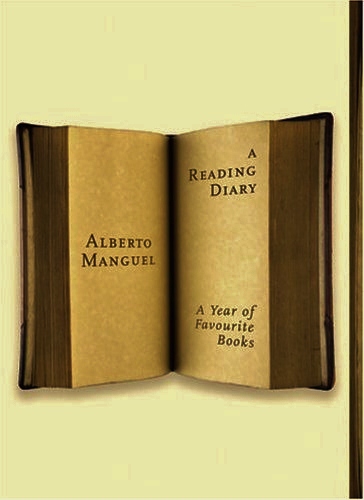
a reading diary alberto manguelA Reading Diary: A Year of Favourite Books by Alberto Manguel ~ 2004. This edition: Knopf, 2004. Hardcover. ISBN: 0-676-97590-9. 253 pages.

My rating: After a certain amount of consideration, 7.5/10.

Now this is a book about books which I would be happy to have on the keeper shelf. It caught my eye during a library browse, and, after standing in the aisle and reading most of the entry regarding Kipling’s Kim, I decided it was worth an even deeper investigation. I was not disappointed.

Alberto Manguel is an Argentine-born writer, anthologist, editor, and translator. He spent his early years in Israel, where his father served as the Argentine ambassador, then back to Argentina, and, once his schooling was completed, working and living in England, France and Tahiti. He moved to Canada in 1982, eventually acquiring Canadian citizenship, though he continues to travel widely, and also maintains a home in rural France.

A Reading Diary is a vanity project of sorts, but a worthwhile one. It consists of the jottings kept over the course of a year as Manguel rereads some of his most treasured books.

It occurred to me that, rereading a book a month, I might complete, in a year, something between a personal diary and a commonplace book: a volume of notes, reflections, impressions of travel, sketches of friends, of events public and private, all elicited by my reading. I made a list of what the chosen books would be. It seemed important, for the sake of balance, that there should be a little of everything. (Since I’m nothing if not an eclectic reader, this wasn’t too difficult to accomplish.)

What has resulted is a book rich with references both everyday and arcane, from the note that the cat is nestled in a towel-lined box looking out at the rain, to the mention of the death of a friend and a reflection on the transience of all things dear to us, to the sombre discussion of the tragedy of the World Trade Centre destruction only a few years earlier, and the subsequent war in Iraq, to warm memories of golden childhood hours spent reading some of the same books that feature in this Diary.

The books chosen are:

  • June ~ The Invention of Morel by Adolfo Bioy Casares
  • July ~ The Island of Dr. Moreau by H.G. Wells
  • August ~ Kim by Rudyard Kipling
  • September ~ Memoirs from Beyond the Grave by François-René de Chateaubriand
  • October ~ The Sign of Four by Sir Arthur Conan Doyle
  • November ~ Elective Affinities by Johann Wolfgang von Goethe
  • December ~ The Wind in the Willows by Kenneth Grahame
  • January ~ Don Quixote by Miguel de Cervantes
  • February ~ The Tartar Steppe by Dino Buzzati
  • March ~ The Pillow-Book by Sei Shonagon
  • April ~ Surfacing by Margaret Atwood
  • May ~ The Posthumous Memoirs of Brás Cubas by Joaquim Maria Machado de Assis

Having only read a few of the books on the list – The Island of Dr. Moreau, Kim, The Sign of Four, The Wind in the Willows, and Don Quixote –  I wondered if I would be completely lost trying to read the chapters concerning the ones new to me, several of which I had never heard of before. As it turned out, this was not at all the case. A Reading Diary is not about the books as much as it is about the thoughts and connections they trigger. Manguel has such a broad experience and so much to say that everything he comes up with is fascinating even though one strains to fit it into the context of a book one hasn’t read.

Open this book up anywhere at random and perfectly crafted snippets of prose rise from the page. Here are some completely random samples.

Perhaps, in order for a book to attract us, it must establish between our experience and that of the fiction – between the two imaginations, ours and that on the page – a link of coincidences.

A brilliant touch: the woman who stains Kim’s skin to darken his colour “for protection” in the great Game (thereby changing his outer identity) is blind.

Contentment requires a certain lack of curiousity.

I feel uncomfortable having other people’s books at home. I want either to steal them or to return them immediately. There is something of the visitor who outstays his welcome in borrowed books. Reading them and knowing that they don’t belong to me gives me the feeling of something unfinished, half-enjoyed. This is also true of library books.

Brilliant sunshine, crisp cold. My neighbour comes over with a gift of fresh eggs and stays for twenty minutes discussing the conflict in Iraq. How strange for an Iraqi farmer half a world away, if he were to know that his fate is the subject of conversation here, in a small, almost invisible French village.

A few days after the tragedy, I heard of someone who had been trapped that morning inside a bookstore close to the World Trade Center. Since there was nothing to do but wait for the dust to settle, he kept on browsing through the books, in the midst of the sirens and the screams. Chateaubriand notes that, during the chaos of the French Revolution, a Breton poet just arrived in Paris asked to be taken on a tour of Versailles. “There are people,” Chateaubriand comments, “who, while empires collapse, visit fountains and gardens.”

My only disappointment, and the reason the book lost a few points with me, is the degree to which Alberto Manguel magnificently name-drops and occasionally pontificates on how dismally uneducated the hoi polloi is compared to him and his intellectually elite cronies. As he makes little effort to pander to those of a less broad experience, I think he might also have left out the occasional thinly veiled sneering. The book will ultimately find its own audience, though its readers may not all be quite what Manguel expects. I must admit my own feelings were bruised by a comment (which I did not bookmark and now, quickly browsing, cannot find) regarding the ignorance of those who only read in English. That would certainly be me, and how many others?

This one complaint aside, A Reading Diary is a fascinating glimpse into the mind of a deeply intellectual book lover, and a prolific and eclectic writer and reader.

Read Full Post »

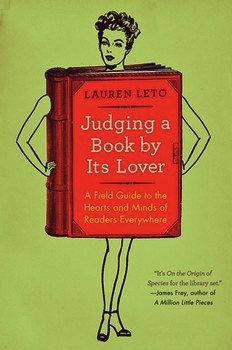
judging book by its lover lauren letoJudging a Book by Its Lover: A Field Guide to the Hearts and Minds of Readers Everywhere by Lauren Leto ~ 2012. This edition: Harper, 2012. Softcover. ISBN: 978-0-06-207014-2. 269 pages.

My rating: 4/10.

Quick verdict: Glad I didn’t buy this. Mildly diverting, but not a keeper.

The author is (apparently) a popular blogger. Fair enough. The chapters would indeed make fine blog posts. Read ’em and forget ’em. (Not that I would extend that attitude to those of you, my marvelous readers, who are also fellow bloggers. No, no, no! But blog posts are, by the very nature of the venue, rather in-the-moment, are they not?)

*****

I was going to condemn this novelty project by calling it pure fluff or something equally dismissive, but fellow-reader compassion for the author, an undoubted book lover, stays my hand. I’m mostly just glad I got this one from the library. It was mildly humorous in a pleasantly snarky way and I did frequently smile. Some sweetly tart anecdotes about a childhood of reading and a gentle ode to her book-loving grandparents enriched the whole.

I easily made it to the end, though I tuned out some at the mention of and rants about authors I’d never even heard of. Who the heck is Susan Wiggs? Chuck Klosterman? Augusten Burroughs?

The publisher is pushing this one with the following:

Want to impress the hot stranger at the bar who asks for your take on Infinite Jest? Dying to shut up the blowhard in front of you who’s pontificating on Cormac McCarthy’s “recurring road narratives”? Having difficulty keeping Francine Prose and Annie Proulx straight?

For all those overwhelmed readers who need to get a firm grip on the relentless onslaught of must-read books to stay on top of the inevitable conversations that swirl around them, Lauren Leto’s Judging a Book by Its Lover is manna from literary heaven! A hilarious send-up of–and inspired homage to–the passionate and peculiar world of book culture, this guide to literary debate leaves no reader or author unscathed, at once adoring and skewering everyone from Jonathan Franzen to Ayn Rand to Dostoyevsky and the people who read them.

Not a particularly broad field of authors covered within, I found, but the author did her best with her limited years of reading experience, for she’s a youngish bright young thing – I quickly googled her and found a reference to her being twenty-four in 2010 – and obviously feels most at home among the American bestseller and college reading list standards.

And that’s all the time I’m going to spend on this one. Should be in abundant supply in the used book stores in the next year or two, as all of the readers who’ve received this for Christmas of 2012 purge their shelves.

Read Full Post »

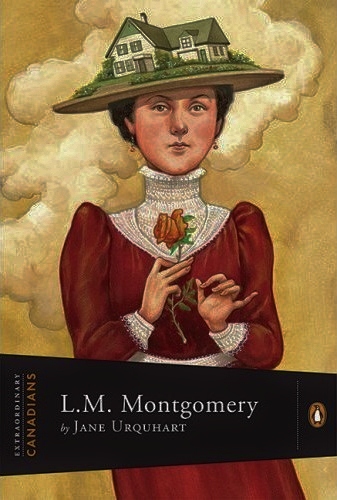
l m montgomery jane urquhartL.M. Montgomery by Jane Urquhart ~ 2009. This edition: Penguin Canada, 2009. Hardcover. ISBN: 978-0-670-06675-9. 161 pages.

My rating: 7.5/10.

A slender little biography which hits most of the high points of L.M. Montgomery’s life and career. Perhaps better as an overview or an introduction versus a definitive exploration of this Canadian literary figure.

A good addition to the many works about this iconic writer. Already familiar with the story of Montgomery’s life, I must say that the most interesting bits, to me, were where the author (Urquhart) writes about Montgomery’s influence on her own development as a writer.

Even if you have read other L.M. Montgomery biographies, Urquhart’s covers the same material in a very readable way, with a dash of creative flair.

*****

In the green master bedroom of a mock-Tudor house in the west end of the grey city of Toronto, a woman in late middle age lies dying, her pale arms almost as white as the sheet on which they are resting. It is April 24, 1942. Her failing body seems to her increasingly heavy, as if pulled by a great weight deeper and deeper into the flesh of the mattress. Outside, the air itself is weighted, saturated with the moisture of seasonal rain. Seeping into the room is the faintly discernible sound of the swollen river as it follows the path of the Humber Valley. The trees beyond the leaded windows have only just begun to show signs of spring.

In spite of what is about to happen, nothing in this room suggests struggle or discomfort: every cell of the woman’s body seems not so much in rebellion against life as dissolving into death, the way the rain outside her door is willingly dissolving into the earth…

The author almost lost me with her opening paragraphs. Urquhart’s biography of Lucy Maud Montgomery had received high praise when it was released several years ago as part of Penguin Canada’s 18-volume Extraordinary Canadians series, but this decidedly fictional opening shook me. Was this merely another “creative biography”? How on earth could Jane Urquhart have known any of these details, unless there somewhere exists a hyper-accurate account of Montgomery’s deathbed? There are no footnotes or references provided to suggest that this is the case.

The account of the expiration of Montgomery, and of her thoughts as she lies dying – the scene goes on for 9 pages – is purely speculative. Beautifully written, of course – it is Urquhart – but fiction.

Though the deathbed passages were pure fabrication, things improved considerably a bit further in. Though she never completely abandoned her occasional creative interpretations of Montgomery’s inner thoughts, those references became increasingly more plausible as Urquhart tells us of her reading of Montgomery’s diaries; we can more easily believe that the actual voice of Montgomery influenced Urquhart.

As I continued reading the biography, I appreciated the difficult task the author of it had taken on, to sort out the facts from the fictions of the life of this complicated, deeply troubled, rather tragically fated woman.

Urquhart cites Montgomery’s loss of her mother as a toddler, her cheerless upbringing by stoic grandparents, a dismal marriage to mentally disturbed husband, and beloved but disappointing children as reasons for her (Montgomery’s) continual efforts at reinvention of her own self through her personal writing. Montgomery’s diaries are known to have been continually edited and rewritten by the author as she progressed through her own life, which, though by no means devoid of joyful occurrences, close friends, and other good things, was so much less rosy than the fictional lives she created for her heroines.

Urquhart is a positively biassed – if occasionally “creative” – biographer in that she obviously admires her subject, and sympathizes with her, and seeks to understand what made her tick.

In spite of countless romantic references to moonlight and starlight in her fiction, and to rooms warmly lit by lamplight and by candlelight, it was shadow, not radiance, that most often claimed her once the sun had set. Her seeming addiction to detailing sunsets and twilights in her writing, if it sprang from anything at all beyond a poetic convention, may have come from a desire to hold on to the fading light. After the sunset came total, wide-awake darkness.

After my shaky initial start, I settled comfortably into reading the book, mentally sorting out the plums of fact from the lovely fictional bits and the author’s very interesting personal anecdotes. It was an enjoyable combination, but I would hesitate to rely on it as my only source of information on L.M. Montgomery’s life. It seems that Urquhart frequently assumes that the reader is already familiar with Montgomery’s body of work beyond the iconic Anne of Green Gables and its array of sequels; it assumes we are familiar with the era and the atmosphere in which the author lived and worked.

Keeping all of these things in mind, I would cheerfully recommend the book for those curious about L.M. Montgomery, and where she was “coming from” when she was crafting her overwhelmingly optimistic stories and novels. Montgomery’s truth, it turns out, is much darker and more compelling than her many fictions.

Read Full Post »

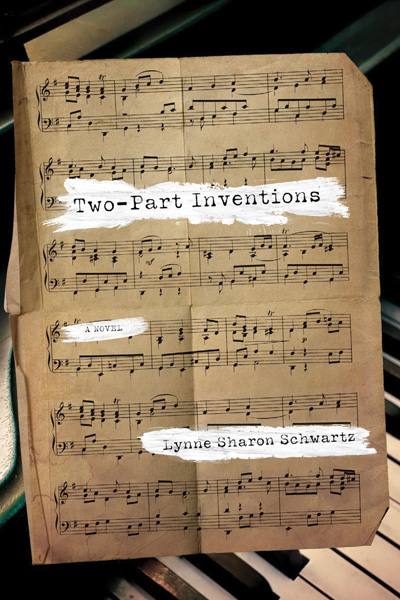
Two-Part-Inventions1Two-Part Inventions by Lynne Sharon Schwartz ~ 2012. This edition: Counterpoint, 2012. Hardcover. ISBN: 978-1-61902-015-3. 277 pages.

My rating: 8/10.

An interesting book. Deeply engaging, though just a bit cold and clinical in style, to match, perhaps, the deeply bottled up hangups of the main protagonists, pianist Suzanne Markon and her recording engineer husband, Phillip. The title is indicative of the contents, in numerous ways.

I liked it.

*****

As those of you who’ve been following my postings will already know, I’m presently very actively involved with preparing for our annual Regional Performing Arts Festival, which starts in early March. And though I didn’t mindfully consider the performing arts theme when I picked up this book, it was perhaps a Freudian impulse which prompted my plucking it from the display rack of New Releases at my last library visit.

That, and my remembrance of hearing good things about the book and the author. My impulse was rewarded; I’m glad I read the book, both because it was an engaging if rather sombre literary diversion from my mind-boggling pile of Festival paperwork, and because it has introduced me to an author I’d like to spend some more time with.

I’ve promised myself some personal catch-up time this morning to complete several blog reviews which have been simmering on the back burner, as it were, so I’m going to try to keep things short and to the point, especially in the case of those books which are recent and not at all obscure. The internet abounds with reviews for these books already, many of them so well-written that I am adding little to the conversation that is already taking place.

*****

The high piercing wail reached him even before he got to the front door. so jarring that he dropped his keys on the flagstones. The wail sounded like a small creature being tortured, a bird, maybe. A demented form of birdsong. But there was no pause for breath or change in tone, no hint of sputtering life. The shriek kept up at that bizarrely high pitch, the far end of the keyboard, while he fumbled at the door and finally rushed inside, dropping his briefcase and laptop on the shelf in the front hall.

Where was she? It couldn’t be Suzanne. It wasn’t a human sound. He followed it through the living room, past the grand piano with open sheets of music – Bartók, Poulenc, Stravinsky, he registered automatically – and into the kitchen, where billows of steam seethed and rose in clumps from the red teapot, already forming cloudy patches on the tiles behind it. He tripped over her body, stretched out flat on the floor, on her back. She looked like a ballerina who falls back in a firm, elegant line, confident that her cavalier will be there to break her fall and propel her on to her next step. But no one had been there to catch her. Before he knelt to see if Suzanne was still breathing, he stepped over her to turn off the flame under the screeching pot.

But Suzanne is not breathing. As her husband Phillip discovers in the next few moments, she is, though still warm – as Phillip discovers as he caresses her hands and face – finally, irretrievably dead.

The story that follows is the dual portrait of two ambitious and talented people, yoked together in a relationship that transcends mere marriage. Suzanne and Phillip are both damaged souls who find a certain respite in each other’s company since their first meeting in high school. Their love is certainly passionate, at least at first, but a longer acquaintance reveals the core of ice in the heart of each, which ultimately will determine their twinned fates.

Suzanne has been a brilliant pianist since an early age, something of a child prodigy. After a chance encounter with an eccentric neighbour leads to a musical mentorship and a stint at Juilliard, it seems that the concert hall is Suzanne’s undoubted destination. She suffers, however, from crippling stage fright, which worsens with every succeeding engagement, to her bitter dismay. For though she loves her music for itself, for the deep emotional need it fulfills in her life, what she desires even more is the adulation of an audience, the continual reassurance that she is indeed a worthy person, that she is “real”.

Phillip, musically gifted though not to the degree that Suzanne is, has built himself a succesful career in the recording industry, and from the first is Suzanne’s most passionate promoter. He sees his wife’s true talent, and has lofty ambitions for her performing career. As she chokes on performance after performance, and as word of her inability to pull off a concert hall quality presentation spreads, her choice of venues narrows to the most prosaic, to her deep inner shame, and to Phillip’s obvious despair.

The bookings were in smaller and smaller places: a party for a volunteer ambulance squad; a benefit for a local Little League team held in a high school gymnasium for an audience of unwilling teenagers and their teachers; once, a ticket to her recital was the reward at a silent auction for a nursery school. But the panic didn’t change, and this she could not get used to…

…This must stop, she thought…She’d tell Phil she needed a break She knew what his arguments would be, and his ceaseless encouragement, which was beginning to cause her mild nausea… “Why don’t you give it up?” she said to him once …There was no need to explain what she meant. He looked at her with a stunned face. He was holding a container of milk, about to pour some, and he put it down because his hand shook. “Give it up? This is what we planned from the very beginning. Things are moving along. All you need is patience. Do you want to waste your God-given talent?”

God-given. She’d never expected to hear a word like that from him. If anything, the talent had begun to feel demonic…

Soon Suzanne has given up completely, and has slid into a passive acceptance of her failure. She becomes reclusive, spending her days watching television while Phillip is at work, and preparing elaborate meals for him as she seeks to fulfill her creativity by concentrating on cooking. She still practices daily, and teaches a few students, but she refuses to perform for an audience. And now she has a legitimate excuse; she is pregnant.

But even in this Suzanne and Phillip are about to face a heartbreaking disappointment. The pregnancy ends in a miscarriage and in Suzanne’s inability to conceive again. She drifts even further into her introspectively passive state of acceptance. Phillip is bemused and disappointed, but his own career is steadily becoming more successful; he now owns a recording studio, and is turning out highly regarding classical music CDS. His performers are thrilled with how their work sounds in the recorded form, Better, in fact, than they thought it would while they were playing.

For Phillip has started tinkering with the possibilities of cutting and splicing and layering the recorded music, and though he insists to himself that he is merely augmenting the recordings to what they should sound like, the practice is gaining a hold on him, especially as no-one seems to notice. So one day he suggests that Suzanne might want to produce a CD of her own, playing privately in the recording studio, with no audience to cause her to freeze up …

*****

There is so much more going on in this novel than I’ve included above. We have an intriguing love triangle (or two), a tragic childhood accident which allows the character in question (Phillip) to justify his questionable moral behaviour, complicated family relationships and deeply complex friendships, and an endless array of intensely focussed (and sometimes slightly warped) creatively gifted people pursuing their various deeply personal goals.

The success that Phillip eventually engineers for Suzanne was inspired by, as the author discusses in her Author’s Note, by the real life example of pianist Joyce Hatto, whose sudden blaze of glory via stunning recordings of “her” works were found to be highly engineered by her husband.

From the flyleaf:

Two-Part Inventions begins when Suzanne, a widely-admired pianist, dies suddenly of a stroke. In the midst of his grief, her record-producer husband, Phillip, becomes deeply agitated: Suzanne’s reputation is based on a fraud which is about to be exposed in the classical music world. Phillip has built a career for his wife by altering her CDs using portions from recordings of other pianists. Syncing the alterations seamlessly, he has created a wide repertoire of flawless music with Suzanne getting sole credit.

In this psychological novel set in New York City, (the) author … guides the reader through a flawed marriage and calculated career. Beginning with Suzanne’s death and moving backwards in time, Schwartz examines Suzanne’s early years as a musical prodigy, her education at Juilliard, her life with Phillip and her unusual career, while contemplating the nature of truth, marriage, and the inner demon of thwarted ambition.

A sombre psychological novel describes this one well. There were occasional flat spots, though definitely not enough to mar the narrative. The overall tone, in my opinion, stylistically fits its characters quite perfectly.

Definitely an author worthy of further exploration: Lynne Sharon Schwartz

Read Full Post »

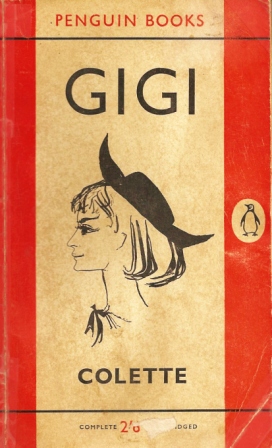
gigi colette 001Gigi by Colette ~ 1944. This edition: Penguin, circa 1958. Translated by Roger Senhouse, 1952. Paperback. Penguin #1313 – also contains The Cat, translated by Antonia White. Total pages: 157. Gigi ends on page 57.

My rating: 10/10.

Because it is Colette, of course! And perhaps one of the most readable and least dark of her works. It even has what one might classify as a happy ending – a rarity in most of the novels and short stories of this unflinching recorder of the blissful agonies of all sorts of love.

Well, blissful as climax of Gigi’s short saga may be, I have no great hopes for her long-term joy. But that is mere speculation; perhaps I will say more about that later.

Gigi exists only in the short pages of this novella and the brief moments of her acquaintance which we are given must be our only consideration here. The “what ifs”, though enticing to formulate, are pointless.

I so often tell myself that as I read Colette – “Just go with it – don’t speculate and don’t give advice!”  Most of her characters are so obviously doomed, and so often by their own actions and refusals to let good sense overrule the physical desires and infatuations of the moment. Awful warnings, really, of the consequences of letting heart rule over head. And just as often, head over heart. No one is ever an out-and-out winner at the game of love in Colette’s complicated amorous world; there are always regrets.

Colette’s works read to me like delicate social satires. They are full of beautifully described vignettes and moments of time and thought and action (or inaction) noted by a deeply sensitive and sensuously aware observer. Frequently voyeuristic and occasionally deeply erotic, Colette’s works represent a certain stereotype of the “French novel”. There are always melancholy shadows lurking behind the most brightly depicted moments of teasing, banter, flirtation, and the inevitable love-making.

But enough of that train of thought.

Here we are with the deliciously portrayed schoolgirl Gilberte – Gigi – and her circumscribed world of women, all victims – no, that is not the correct term – let us say products – in some way or another of their own passions and planning (or lack thereof), and of course of the circumstances into which they were born, or in some cases thrust, and in other cases achieved by sheer force of will and personality.

*****

Who here has not seen a stage or film version of this book? Anyone? Or am I wildly waving my hand all alone?

After catching glimpses over the years of Maurice Chevalier’s wink, wink, nudge, nudge ode to “leetle girls” (Quick, lock up your daughters!) I mentally swore off ever watching the immensely popular musical based on the story.

Though Audrey Hepburn was a lovely woman and a fine actress, she does not look at all to me, in the theatrical stills I’ve seen of her in the role of the 1954 Anita Loos Broadway play, like the Gigi described in the original novella. Colette herself apparently chose Miss Hepburn to play the part in the stage production after glimpsing the young dancer-actress walking through a hotel lobby, but her physical appearance, petite, gamine, dark-eyed and brunette, is just so opposite in comparison to the description of Gigi as a tall, rosy-cheeked, blue-eyed blonde.

Lesley Caron was cast in the Lerner and Loewe film, and she fits the physical description of Gigi much more closely.

Here are glimpses of the original Gigi from throughout the story:

… with the heron-like legs of a girl of fifteen … the perfect oval shape of her knee-caps … a slender calf and high-arched instep … ash-blonde ringlets … sleek ripples of finely kept hair which fell just below Gilbert’s shoulders … cockle-shells of fair hair … eyes of a lovely dark blue, the colour of glistening slate … tall … snub-nosed … pink cheek with a single freckle, curved lashes, a mouth unaware of its power, a heavy mass of ash-gold hair, and a neck as straight as a column, strong, hardly feminine, all of a piece, innocent of jewellery …

The year is 1899, the setting Paris. Young Gilberte lives with her mother and grandmother in a modest establishment in a quiet residential area of the city. Grandmother – Madame Alvarez – and Great-Aunt Alicia are the twin matriarchs overseeing the small family of four, and it is implied that the main source of their joint sustenance is the careful investments of the two sisters, who were successful courtesans of their time.

Madame Alvarez had taken the name of a Spanish lover now dead, and accordingly had acquired a creamy complexion, an ample bust, and hair lustrous with brillantine. She used too white a powder, her heavy cheeks had begun to draw down her lower eyelids a little, and so eventually she took to calling herself Inez. Her unchartered family pursued their fixed orbit around her. Her unmarried daughter Andrée, forsaken by Gilbert’s father, now preferred the sober life of a second-lead singer in a State-controlled theatre to the fitful opulence of a life of gallantry. Aunt Alicia – none of her admirers, it seemed, had even mentioned marriage – lived alone, on an income she pretended was modest. The family had a high opinion of Alicia’s judgement, and of her jewels.

Andrée is gently scorned by her mother and aunt, as having failed to uphold the family traditions; they continually make little digs about her discarded “chances” and lack of “ambition”, though it is also apparent that this is a very closely bonded family, showing a seamlessly glossy surface to the world, regardless of the minor frictions of domestic life and familial bickering.

Gigi herself leads a conventional enough life, attending school and coming home with a satchel of homework every afternoon, though she is discouraged from associating too closely with the other schoolgirls on a personal level; Madame Alvarez quite obviously feels that her household is at least a notch or two above the common folk who lead drearily “respectable” lives, though she bridles at the implication that her past career has not been exactly respectable in its turn. The wealth of her “sponsors” has obviously raised her occupation beyond reproach.

The two older women are watching Gilberte with keen eyes, and they are finding her a much better prospect to follow in the family footsteps than now-faded Andrée ever was. The grooming process has been continual, and has picked up intensity as Gigi approaches her sixteenth birthday. Gigi herself is aware of her elders’ history and rather meekly goes along with her “education”, though we soon see that she has a decidedly childish naivety about her own future, though she accepts the premise that it will be centered around the “pleasing” of men.

The only man currently in Gigi’s world is Gaston Lachaille, the exceedingly rich son of one of Madame Alvarez’s old lovers, who has been accustomed to visiting the household whenever he wishes a momentary retreat from his glittering life of yachts, gambling at Monte Carlo, and a succession of volatile mistresses.

He has just been jilted, amongst a blaze of publicity, by his latest amour, and he is more than grateful to settle in for a cup of chamomile tea and a game of cards with Gigi, who has grown up knowing Gaston on terms of the greatest familiarity; she calls him Uncle Gaston. At thirty-three he has as yet shown no signs of wishing to marry; when it becomes apparent that his attention has been suddenly piqued by Gigi’s budding womanhood, Madame Alvarez and Aunt Alicia put their heads together to discuss the possibilities – in veiled terms, of course – of Gigi perhaps becoming his next romantic experience. Under the most iron-clad of arrangements, of course – a girl must be careful of her future …

*****

All morals aside – though now in middle age I am much more aware of the questionable motives of Gigi’s adult caregivers than I was when I first read Gigi as a teenager – only her mother appears to have qualms about seeing Gigi step into a courtesan’s high-heeled shoes – this is a delectable froth of a story, and a little classic of its type.

Shades of Colette’s Claudine in Paris, another schoolgirl-older man romance, though Gigi in this case stops short of the many complications Claudine encounters after her own virginal romance is consummated.

Gigi, one of Colette’s last works, was written in 1942, at the height of the Nazi occupation of Paris. Colette, bedridden with the excruciating arthritis which was to plague her until her death in 1954, and shaken by the arrest and internment of her third husband in a concentration camp, may understandably have been glad to return to an earlier and happier time when she created this last memorable gamine heroine.

Read Full Post »

the strangers next door edith iglauerThe Strangers Next Door by Edith Iglauer ~ 1991. This edition: Harbour Publishing, 1991. Hardcover. ISBN: 1-55017-054-6. 303 pages.

My rating: 10/10 for her subjects – every one truly fascinating. Discounted heavily for the writing style, which I found frequently rather flat. I’m going to give this one a 7.5/10 overall. 10 for content, 5 for style. Worth a look; maybe you’ll find her easier reading than I did. Her topics are worth exploring.

Would I re-read it? Sure, bits and pieces of it. I wouldn’t tackle it cover to cover again, though. Once was enough for many of the articles, though I’m glad I read what Iglauer had to say. I find her prose hard to absorb – it certainly doesn’t “flow”, being more earnest than sparkling – and it’s a lot of work maintaining concentration, though she covers her subjects extremely thoroughly.

I hesitate to say too thoroughly, because I do believe that her tenacious peering into the heart of each of her topics is what enables her to include so many esoteric and absolutely fascinating details. I do wish that she had just a little more flair in her delivery, though.

Edith Iglauer was alive and well – though showing her age a wee bit, at 93 – and still actively writing the occasional article for Geist magazine in 2012. She was living in her own home with her third husband Frank on the B.C. Coast. Here is a vignette featuring Edith and Frank, by Ted Bishop. An inspiring note: Edith and Frank’s combined age was 189 at the time of the article, and they were both very much “with it” in every conceivable way, barring a few physical infirmities related to their age, like bad knees and failing hearing.

*****

Edith Iglauer is an American journalist with a long and varied history of being present during some very interesting times indeed. Born in Ohio in 1917, she decided while in college that she wanted to become a journalist, and persistently pursued that goal until she achieved it. Unable to stomach the requirements of a newspaper reporter’s job – she jibbed at inquiring of grieving parents as to how they felt about their young son’s tragic death earlier the same day – she was advised that free-lance writing might be her forte. Over the next fifty years Edith pursued interesting stories and people, meticulously researching them and becoming intimately familiar with every aspect of her subjects. Her work was published in leading periodicals of the time, such as The New Yorker, Harper’s, Christian Science Monitor, The Atlantic Monthly, Maclean’s, and many others.

The Strangers Next Door is a retrospective look at her long career, including excerpts from key articles and also her books, with added reflections as to how she came to write the pieces, and anecdotes about her subjects.

Several successful and well regarded books grew out of her articles and experiences, most with Canadian settings and themes. Edith travelled widely through Canada, found the country fascinating, and made her home permanently in British Columbia in the early 1970s, though she retained her American citizenship.

From the Introduction to The Strangers Next Door:

Looking over the pieces I have written, I realize that I have been like someone with family in two countries, attempting to acquaint them with one another. I am not just an American journalist writing in Canada for Americans, but a Canadian journalist writing about America for Canadan as well. Both countries, I have discoverd, still regard their neighbors across our common border as “the strangers next door”, and like any concerned relative, I want them to know and respect one another as much as I do.

The Strangers Next Door covers a broad range of topics.

From the 1940s, articles on:

  • Marian Anderson
  • Working in the radio-newsroom of the Office of War Information in Washington, D.C., which included weekly chats with Eleanor Roosevelt.
  • A posting as a post-World War II correspondent in Yugoslavia, during the rise of Marshal Tito
  • The UN Builds Its Home, 1947

From the 1960s, 70s and 80s:

  • The Mounted Men – an indepth look at the training of police horses and mounted policemen in New York City, 1962. (My favourite article in this book.)
  • The Biggest Foundation, 1972. The building of the World Trade Centre complex in New York.
  • Inuit Journey, 1963-1979. The development of Inuit co-operatives for the production and marketing of arts and handicrafts.
  • Baker Lake Art, 1964. A unique style of Inuit art from a remote corner of the Northwest Territories.
  • The Beautiful Day, 1966. A biographical short story inspired by Edith’s father’s death, published in The New Yorker.
  • Denison’s Ice Road, 1975. The article about the men and machines involved in winter-time road building and trucking across a frozen Arctic lake which grew into a bestselling book, and the inspiration for the current “reality” television series, Ice Road Truckers.
  • Don Snowden, 1929-1984. The detailed obituary of a man who worked to alleviate the poverty and hardships faced by Canadian Inuit peoples by helping them develop and profit from their unique skills and knowledge.
  • Prime Minister, 1969. A first-hand look at what makes Pierre Trudeau tick. Eight days travelling with the Prime Minister and countless hours of background research and interviews resulted in this indepth Profile.
  • The Strangers Next Door, 1973. An essay about Canada, for American readers.
  • “Capi” Blanchet. The mysterious author, M. Wylie Blanchet, of a British Columbia classic, the memoir The Curve of Time is researched and profiled for The Rainforest Chronicles # 8.
  • Seven Stones, 1979. A profile of British Columbia architect Arthur Erickson, the man who planned the University of British Columbia campus, and so many more unique structures . This grew into the 1981 book of the same title.
  • Hubert Evans, 1980. Another profile, this one of the esteemed B.C. writer and poet.
  • Bill Reid, 1982. A profile on the iconic Haida carver and goldsmith.
  • Bella Coola, 1975. Anecdotes of a visit to the fjord-side village, unlikely gem of the BC coast.
  • Fishing with John, 1987. An excerpt from the book. In 1974 Edith met and eventually married BC commercial fisherman John Daly. Their happy partnership ended with John’s sudden death only four years later. Fishing with John is Edith’s memorial, started while John was alive as a book about the salmon fishing way of life on the BC coast, and eventually becoming a personal saga.

Read Full Post »

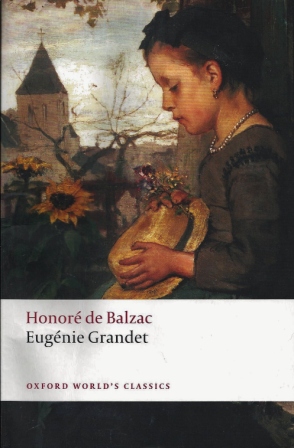
eugenie grandet honore de balzac 001Eugénie Grandet by Honoré de Balzac ~ 1833. This edition: Oxford University Press, 2009. Translated by Sylvia Raphael. Introduction & Notes by Christopher Prendergast. Softcover. ISBN: 978-0-19-955589-5. 192 pages.

My rating: 9/10.

It is difficult to know how to “rate” a book such as Eugénie Grandet, as its status as an early 19th Century “classic” places it in a category of its own when compared to more contemporary books. I ended up judging it against others of a similar era which I am familiar with, such as works by Dickens, Thackeray, Dumas, and, of course, several of Balzac’s other novels in his ambitious “Human Comedy”.

*****

Eugénie Grandet is a short novel, almost a novella, and the action, such as it is, is limited to the four walls of a gloomy stone house in the French village of Saumur, inhabited by the Grandet family: the elderly Monsieur Grandet, his wife Madame Grandet, their only daughter, Eugénie, in her early twenties as the story begins, and their sole servant, Nanon.

The Grandets live in seemingly straightened circumstances. Their house is decaying around them, they subsist on a restricted diet of only the cheapest provisions, with sugar doled out bit by bit, and the table graced only by unsaleable spoiled fruit and sour wine from the Grandet farms and vineyards. Firewood is doled out stick by stick, and the inhabitants of the house huddle around a shared tallow candle in the evening; their clothes and shoes are worn until threadbare.

The reality however, is that Monsieur Grandet is exceedingly wealthy. By a series of lucky inheritances, a marriage which brought a substantial dowry, clever investments and very shrewd trading, he has purchased numerous estates which were seized from their dispossessed noble owners after the recent Revolution. The income from these properties is immediately profitably reinvested, or else converted to gold, which Monsieur Grandet, a former cask and barrel maker, seals up in wooden chests and stores away in his walled-up “office” in the center of the old stone house.

His wife, daughter, and servant, completely subservient to the soft-spoken but cunningly manipulative family patriarch, never question their situation but meekly go about their daily routines, gratefully accepting the few coins which occasionally are doled out – and promptly “borrowed” back – for “extras”. The villagers around them, however, are fully aware of the extent of the Grandet fortunes, and there is something of a competition underway to see who will be the fortunate man to storm the stone walls, marry the beautiful and devout Eugénie, and eventually inherit the riches.

Monsieur Grandet is well aware of this situation, and plays it to his best advantage, in particular by acquiring the unpaid services of the local lawyer and banker – possessed respectively of an eligible nephew and son –  who each hopes that his marital candidate will win out. Imagine the universal dismay among the families with their eyes on the Grandet fortune when an unexpected youing man suddenly arrives who immediately displaces both of the local swains, at least in Eugénie’s eyes. (Her father has secret ambitions for his daughter which involve neither local candidate.) Eugénie’s cousin Charles has been sent to visit his uncle in the country, as, it soon becomes apparent, to get him safely out of the way while his father – Monsieur Grandet’s brother – declares bankruptcy and then proceeds to kill himself, leaving Charles doubly bereft and dishonoured.

Eugénie promptly falls deeply in love with her handsome cousin, who, after sombrely considering his change in fortune, and realizing that his Parisian mistress must be parted from, returns Eugénie’s professions of love with willing good grace. Monsieur Grandet has an inkling of this infatuation, but he doesn’t worry about it at all, instead arranging to remove Charles from the family circle by buying him a passage to Nantes, where Charles will be able to find occupation as a trader to the Indies, and hopefully work his way back into solvency on his own.

Before Charles departs, he and Eugénie swear undying love to each other, and Eugénie, without her father’s knowledge, gives Charles her priceless dowry of gold coins to help him in his endeavours.

Much drama erupts when Monsieur Grandet discovers that his meek daughter has gone ahead and developed some ideas of her own; the subsequent events prove Eugénie to be as strong-willed as her father, though motivated by kinder emotions than ever that corrupt old miser has ever experienced.

In case you are not familiar with how this little domestic drama plays out, I will leave you right there, mid-story. It is well worth reading for yourself to discover how it all ends, though there are really no surprises, unless it is to see how wonderfully well Eugénie’s character holds up under her many woes.

Eugénie Grandet is still a most diverting read a good century and a half after its original publication. The character portrait of Monsieur Grandet is decidedly the strongest of the novel, despite the title featuring Eugénie; she is rather one-dimensional, but ultimately comes out of the drama with all flags flying, showing a purity of character as rare and precious as her father’s beloved gold.

Monsieur Grandet is one of the most gloriously “tight” of all the fictional misers I’ve yet encountered. Clever, adaptive, deeply cunning and immensely avaricious, he struggles to force himself to act decently to his wife, daughter and the truly unique and admirable Nanon, but he is continually undone by his greed. His last action before he dies is to grasp at the priest’s gleaming crucifix as the last rites are performed; we have no doubt as to his eternal destination, though the devout prayers of his daughter may at least gain him a respite in Purgatory!

*****

This book is the my first entry into the Around the World in 12 Books Challenge – 2013, hosted by Shannon at Giraffe Days .

This is my first time participating in this Challenge, and I noticed just now when I went to the site to include the link in this post that there are some questions included to help guide our reviews. I haven’t addressed any of these in my review of Eugénie Grandet, so I’ll answer them now instead. (This feels a bit like a school assignment! But not in a bad way at all. Let’s see … )

1. What did you learn about the country’s culture, history etc. from reading this book? Any new insights, any shifts in your perception, or did it align with what you knew/understood already?

I didn’t learn anything new about France from my reading of Eugénie Grandet, but it did make me mull over the aftereffects of the French Revolution of the 1790s on the general population; the Revolution’s destruction of the French aristocratic classes cleared the way for the rising Bourgeoisie, the shopkeepers, farmers and tradespeople who took advantage of the changing political climate to attain never-before-possible social and economic status. The book has a detailed description of how post-Revolutionary fortunes were made and how the properties of the nobles changed hands in the ensuing social turmoil.

2. How did land, geography, flora and fauna feature in the book? Did it have a distinct feel that helped you visualise and made you feel like you were there, or was the story more focused on plot?

The novel was decidedly plot-focussed, but there are detailed descriptions of the house in the rural village of Saumur where most of the story’s action takes place. There are also descriptions of the flora of the overgrown Grandet garden which allow us to envision the setting of Eugénie and Charles’ surreptitious courtship. I found that I could visualize the physical setting of Eugénie Grandet with great clarity from the “word pictures” drawn by the author.

3. Did the story make you want to visit/revisit the country, or explore it in a new way if you live there already; did it make you want to read more stories set in the country?

The story, being set almost two centuries before the present time, does not lead me to expect a similar world being present in these contemporary days, but the descriptions were very evocative of what one might still discover in isolated French villages. Reading the novel did leave me with a curiousity to discover a little more about the setting, and to perhaps find some pictures of the vineyards of the Loire. I would love the opportunity to visit rural France, though I can’t say that this novel either strengthened or lessened that desire – it merely confirmed for me how fascinating such a visit would be on so many levels – historical, literary and personal. I am looking forward to reading more of Balzac’s stories set in a similar time, to reacquaint myself with and widen my experience of his very entertaining Human Comedy.

Read Full Post »

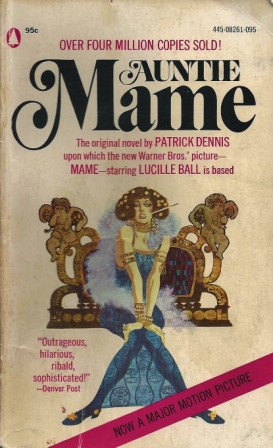
auntie mame patrick dennis 001Auntie Mame by Patrick Dennis ~ 1955. This edition: Popular Library, circa 1974. Paperback. ISBN: 445-08261-095. 254 pages.

My rating: 8/10.

It is what it is – a blissfully easy-to-read, unapologetically American social comedy, with enough perfectly timed, backhanded slaps at social snobbery, racism and anti-Semitism to redeem it from total silliness.

*****

I don’t know quite where she came from, but Auntie Mame appeared one day in a stack of old paperback books I was sorting and putting away. I gave her a rather scornful glance – she was, after all, ensconced between tatty covers emblazoned with movie tie-in headlines, never a particularly endearing feature – and popped her into a box with a bunch of other “maybe someday” books. But not long afterwards she showed up on my night table, brought into the bedroom by (of course) a man, who’d been looking for a diversion, found her intriguing and decided to experience her lavish charms more intimately. After he’d finished with Mame, he left her there to work her charm on me.

“Well, darling,” she whispered to me with a we’re-all-girls-in-here-together-now intonation, “how about it? Don’t you want to find out what Auntie Mame is all about?”

So I read her.

Hotcha!

*****

I’m guessing almost everyone’s either seen one of the two movies based on this 1955 bestseller – the 1958 Rosalind Russell vehicle (pretty darned good), and the 1974 Lucille Ball effort (pretty darned bad) – or one of the countless stage adaptations, or read the actual book itself – printed and reprinted numberless times, most lately in, I believe, 2001. That’s a good half-century of popularity, and I think it’s safe to state that Auntie Mame has a decidedly secure place well up in the top end of the American pop culture archive.

Does she deserve it?

Well, yes, I rather think she does. She’s a deeply lovable creation – with that lovableness outshining her undeniable glamour and her bizarre goings-on as the key reason for my re-reading her spicy “biography” every so often, whenever Mame winningly works herself up to the top of the book stacks, like cream rising to the top of an old-fashioned bottle of milk.

Here’s the basic outline, for those of you who’ve so far been blissfully unaware of the existence of Auntie Mame and her impressionable young nephew, Patrick.

Orphaned at the age of ten in 1929, the very much fictional* Patrick Dennis is sent to live with his wealthy and gloriously extroverted aunt, who is presently holding court (apt term) in a lavish apartment at 3 Beekman Place in Manhattan.

*The author published this book under this pseudonym in order to add verisimilitude to the “memoir” form; after the novel’s success, the pseudonym was maintained for most of the author’s future writings. Edward Tanner is the real name of the author – actually, Edward Everett Tanner III. Mame was inspired by, but was not an accurate depiction of, the author’s real-life aunt, Marion Tanner. Edward Tanner also wrote under the pseudonym “Virginia Rowans”.

Mame welcomes her “own little love” with open arms, and Patrick returns that affection immediately and instinctively, despite his father’s rather foreboding words while making his will the year prior to his sudden demise.

…My father read his will to me in a shaky voice. He said that my Aunt Mame was a very peculiar woman and that to be left in her hands was a fate that he wouldn’t wish a dog, but that beggars couldn’t be choosers and Auntie Mame was my only living relative.

Despite the deathbed wishes of Patrick’s father for his son to receive a conservative upbringing, Mame craftily dodges the stodgy school which Patrick’s trustee, the estimable but strictly conventional Mr. Babcock, has chosen. Instead Patrick ends up in a very avant-garde establishment distinguished by its policy of complete nudity for all, students and staff – and absolute lack of any inhibitions, or actual academic teaching. Mr. Babcock’s visit as the students and their adult mentors are role-playing a school of spawning salmon puts a quick end to the experiment, and lands Patrick in that dreaded boarding school, far away from the influence of his aunt, whom Mr. Babcock regards as the epitome of evil decadence from that moment forward.

Luckily Patrick’s education had already received something of a unorthodox but most useful boost from his aunt’s insistence, from his very first day with her, of Patrick’s carrying a pad of paper with him and writing down any unfamiliar words for future explanation.

I spent that first summer in New York trotting around after Auntie Mame with my vocabulary pad, having Little Morning Chats every afternoon, and being seen and not heard at her literary teas, salons and cocktail parties.

They used a lot of new words, too, and I acquired quite a vocabulary by the end of the summer. I still have some of the vocabulary sheets of odd information picked up at Auntie Mame’s soirees. One, dated July 14, 1929, features such random terms as: Bastille Day, Lesbian, Hotsy-Totsy Club, gang war, Id, daiquiri – although I didn’t sell it properly – relativity, free love, Oedipus complex – another one I misspelled – mobile, stinko – and from here on my spelling went wild – narcissistic, Biarritz, psychoneurotic, Shönberg, and nymphomaniac. Auntie Mame explained all the words she thought I ought to know and then made me put them into sentences which I practiced with Ito, while he did his Japanese flower arrangements and giggled.

Once Patrick is incarcerated in conventional school, his visits to Auntie Mame are restricted to occasional weekends and the holidays. No matter, though, as the two are already bound by a strong and abiding love which will see them through the most outrageous of Mame’s excesses and the rapid ups and downs of her changing fortunes and continual reinventions of herself.

Mame’s fortune is decimated by the Stock Market Crash of October 29, 1929, and she hits the lowest point, financially speaking, of her life, ending up selling roller skates (ineptly) in Macy’s department store, before being rescued at the 11th hour by a wealthy Deep Southern white knight, Beauregard Jackson Pickett Burnside, who sweeps her of her feet and sets her up for the rest of her life, leaving her a seriously large fortune when he dies rather tragically only a few years into the marriage.

Mame sincerely mourns Beau, but continues on her merry way charming and being charmed, and enjoying the attentions both platonic and amorous of a huge range of people, including at one point one of Patrick’s college friends – Mame refuses to let a little thing like age difference stand in the way of her relationships of any sort.

Patrick drifts in and out of Mame’s circle, observing and pithily commenting on her friends and latest fads, which range from the oriental stylings of their first meeting to the Southern belle of the Beau years, to literary pseudo-Irish tweed and brogues, to war-time Friend of England sponsoring some truly horrible Cockney refugee children in a Colonial mansion which they promptly completely destroy.

Patrick falls in and out of numerous relationships on his own, from gold-digging waitress Bubbles, to über-snobbish fiance Gloria Upson, to a poverty-stricken but determinedly aristocratic trio of blue-blooded and stunningly beautiful sisters. He finally finds true love, marries and produces a son of his own, only to have Mame swish in sari-bedecked and trailing a pet swami during her Indian reincarnation period, to carry her latest “little love” off to the orient, thus bringing our tale full circle.

*****

Undeniably funny – though I never did “laugh out loud” as many reviewers report themselves doing – this satirical tale is as full of barbs as a porcupine is of quills. The author uses his humorous platform to trot out his very decided views on the state of middle class American mores, while amusing us with his bitchy delivery – there’s a decidedly contemporary feel to a lot of the humour, despite the book being well into its sixth decade by now.

“Risque” is a word not often used today, but it applies in full force to Auntie Mame – the book and the character. Inhibitions – pshaw! If it feels good and doesn’t harm anyone, go for it! is the credo Mame lives by, and Patrick slips into that attitude easily, though prudishness occasionally rears its head in his case. The innuendo throughout is frequently gloriously bawdy, though there are a few groaningly bad double entendres, as when Patrick reports on his first social occasion at Auntie Mame’s, as an still-innocent ten-year-old. (Needed information: Norah is Patrick’s Irish nurse, and Ito is Mame’s Japanese houseman; Prohibition is in full swing.)

One lady with red hair said that she spent an hour a day on the Couch with her doctor and that he charged her twenty-five dollars every time she came. Norah led me to another part of the room.

The little Japanese man gave Norah a glass and said it was right off the boat and Norah said she wasn’t used to spirits – even though she was always telling me about seeing ghosts and haunts – but this time she’d take a drop of the creature. She seemed to be feeling very happy all of a sudden. And in a little while she asked Ito to give her another Nip.

Oh. My. Goodness. That was pretty dire, Mr. Dennis/Tanner. Had to read this bit twice to make sure I’d seen it correctly. Groan. How many desperately bad puns did the author cram into these few sentences? I think I counted six.

Luckily most of the jibes aren’t quite so deeply awful, but in the interests of full disclosure the prospective reader should be warned of these types of things!

To sum up, I do ultimately enjoy this gloriously campy period piece. Yes, it’s chock full of period-typical stereotypes and attitudes towards women and “foreigners”, but that doesn’t bother me one whit in this one – it’s an innocently era-correct sort of prejudice, and there’s enough social awareness going on of the greater evils in the world of the time to excuse the bits which would be politically incorrect if written today.

It’s a refreshingly easy read, too, as I think I mentioned earlier, and has a very American type of blatantly outrageous humour which appeals in its own way as much as the typically lower key, straight-faced British literary wit does. You do need to pay a certain amount of attention while reading to catch all the nuances, but Auntie Mame romps along at such a good pace that drowsing off in her company is not a danger at all.

(And I’m glad to report that I didn’t use the term “madcap” once in this review. Ha! Points for me!)

Read Full Post »

Tthe joyful delaneys hugh walpolehe Joyful Delaneys by Hugh Walpole ~ 1938. This edition: Doubleday, Doran & Co., 1940. Hardcover. 401 pages.

My rating: 9.5/10.

Lost the half point because of the too-convenient wrap up of the ending. A very minor complaint!

What an enthralling read this was. Much better than expected.

*****

2013 is going to be  good reading year, if this omen is correct. The very first 2013 book, an ancient copy of one of Hugh Walpole’s London novels, The Joyful Delaneys, has been lurking on the edges of my awareness for at least ten years, possibly more. It was purchased at a library book sale, and its tattered condition, many interior stamps – Tulameen and Princeton had enthusiastic librarians! – and dog-eared and marked pages testify to its one-time popularity. This copy at least has been very well read.

Just not by me, until the last few days. The Joyful Delaneys was one of the lonely oddities left behind after my recent tidying of the bedroom bookshelves –  books which are sometimes the sole representatives of their author’s literary line in my collection, books I’m not quite sure about – stay or go? – will I really read this one again? – and books I haven’t read yet, but truly mean to, someday…

On January 1st, 2013, I finally picked up The Joyful Delaneys with the stern instruction to myself to just read this already and decide once and for all if it’s a keeper or a pass-along. Settling down with a mood of grim purpose to that self-imposed task, I was immediately surprised by the very first lines:

‘Happy New Year!’ Fred Delaney said, standing in the doorway and smiling at the in-no-way beautiful person of Mr. Munden.

He had switched on the electric light, and the illumination revealed Patrick Munden lying half in, half out of the bedclothes. No, he was not beautiful, his thin pointed face unshaven, his black hair spread about the pillow, his lean body protected from the cold by pyjamas, grey with blood-red stripes, by no means so fresh as they should be. The light pressed on Munden’s eyes and he opened them, stared wildly about him, then, cursing, buried his face in the pillow.

‘Happy New Year!’ Delaney said again.

‘What the hell–‘

Promising, no? And the serendipitous timing! A book opening with New Years Day, being read by me on New Years Day! A complete and utter unplanned coincidence. Surrendering to the moment, I settled down to my suddenly-not-so-tedious-seeming read. And was rewarded by its general excellence, much more so than I deserved for my previous neglect. Why, oh why, hadn’t I read this one earlier?!

Here’s a bit more, continuing the snippet from the first page.

‘Eight-thirty. You asked me as a special favour to call you.’

Munden raised his head and stared at Delaney. It was not a bad-looking face. The blue eyes were good, the forehead broad and clear, the chin finely pointed. He looked clever and peevish and hungry. He stretched himself, his open pyjama jacket showing a chest skeletonic and hairy. He rubbed his eyes with a hairy wrist.

‘Oh, it’s you, is it? Let me sleep, can’t you?’

Delaney watched him with genial good temper.

‘I’m doing you a favour. You said last night it would be the greatest of your life. You have to see the editor of something or other at ten sharp.’

‘He can go to hell. Turn the light off and let me sleep.’

‘You said I was to drag you out of bed if necessary–that your whole life depended on your getting there at ten.’

‘Well, it doesn’t. Let me sleep, can’t you?’

‘All right. But I’ll leave the light on . . .’

‘No, don’t go.’ Munden sat up, blinking. ‘How damnably fresh you look! It’s revolting. You were up till three, I don’t doubt–‘

‘I was,’ Delaney said cheerfully. ‘I don’t need a lot of sleep.’

‘Well, I do. . . . Oh, blast! Why did I ever tell you anything about it?’

‘You were very serious. Most earnest. You said you must begin the New Year properly.’

‘Speaking of which, can you lend me a fiver?’ Munden asked. ‘Only for a week.’

‘Afraid I haven’t got such a thing,’ Delaney said, laughing.

‘Hang it all, I paid you the rent only a week ago–‘

‘Thanks very much. But those are the terms, you know. If you don’t pay you go. Although we’d hate to lose you.’

Munden sighed.

‘Look in the trousers, old man, will you? They’re hanging over the chair. See if there’s anything there.’

Delaney looked in the trousers and found half a crown, some coppers, a lipstick and a half-filled packet of cigarettes. He laid these things on the dressing-table.

‘You don’t use lipstick, I hope, Patrick?’

‘No, of course not. What do you think I am? How much is there?’

‘Two and ninepence halfpenny.’

‘I’ll make them advance something on the two articles. You wouldn’t like to buy a Chrysler, would you?’

‘A Chrysler? Whatever for?’

‘It’s a marvellous bargain. Ponsonby’s only had it a year and simply not used it at all. He’d let you have it for one-fifty and I’d get a commission.’

Delaney laughed. ‘We go round in our Morris–just as we always have–same old family, same old Morris.’

Munden looked at him with curiosity. ‘I don’t understand you, Fred. You own this house; every bit of it is let to people who pay their rent. You’re none of you what I’d call extravagant and yet you never have any cash.’ He stared resentfully. He went on: ‘You’re a horrid sight–so cheerful and clean and bright. You’re all like that. I ought to hate the lot of you. So unintellectual too. You never read a book, have horrible bourgeois politics, believe in things, in England, beautiful virginal girls, Dickens, cricket, football. . . . Oh, God! You’re vile! I don’t know why I go on living here.’

*****

It seems like I’ve recently been reading authors who have been quite taken with T.S. Eliot – most recently Rumer Godden (in Take Three Tenses: A Fugue in Time) and Diana Wynne Jones (in Fire and Hemlock); here is a third. Hugh Walpole begins this beguiling novel with this quotation from Eliot’s The Rock:

When the Stranger says: ‘What is the meaning of this city ?
Do you huddle close together because you love each other?’
What will you answer? ‘We all dwell together
To make money from each other’? or ‘This is a community’?
And the Stranger will depart and return to the desert.
O my soul, be prepared for the coming of the Stranger,
Be prepared for him who knows how to ask questions.

The answer, ultimately, is that the community wins over commerce, at least in this one instance, at least for a while. But there is a lot of ground to cover before this satisfactory state of affairs comes to pass.

The Delaneys – Frederick and Meg, and grown children Stephen and Kitty – are the financially struggling owners of one of the last houses in their corner of London’s Mayfair – Shepherd Market – which has not been pulled down and built over or converted into modern flats. The house has been in the family two hundred and fifty years; this year, 1934, looks very much like it will see the Delaneys rousted from residence at last.

A precarious existence is made possible by the renting of rooms to a number of similarly situated people – the random waifs and strays, the elderly and the dispossessed of the former upper classes who are now very much down on their luck. A pair of the Delaney tenants, Dodie and ‘Smoke’ Pullet, have exhausted every financial avenue, and are preparing to give notice. Smoke mulls over his bleak future possibilities with Fred, including that of the ultimate escape – suicide.

‘You’ve no idea, old boy, of the kind of life that Dodie and I’ve been leading in the last year. We’ve cadged deliberately on everybody we know. We’ve angled for meals, been everywhere and anywhere with the chance of getting something for nothing. We’ve spent days and nights with the most awful people to be safe for food and drink. It can’t go on for ever…

…Unless something happened Smoke would do just as he said. And perhaps it would be the best thing for him. That was the real problem at the heart of the trouble. There was no place in this present world for the Smoke Pullets unless there was a World War again–then they would be admirable.

Before 1914 they had played a very necessary part; they were a real need in English life and had been so for centuries. They had been the Squire and the Squire’s son; some property, possibly a seat in Parliament, beneficent, tyrannical, understanding in their country community, conforming, traditional, safe and sound. So it had been since the Wars of the Roses; from Agincourt 1415, say, until Serajevo 1914. And now, within the space of twenty years, they had become only a burden, and a wearisome burden at that. There was no future of any kind for Smoke and he without a leg which he had lost in the service of his country. Probably a nice gas-oven would be the best thing.

But Fred Delaney can’t stay grim for long. Along with the pervasive background atmosphere of despair there are plenty of opportunities for love and laughter. He and Meg have long enjoyed what might be termed an “open” marriage, though Meg has not taken advantage of her freedom as her spouse most definitely has. The two deeply and truly love each other, but Fred has indulged his physical desires for other women regularly through the years. Meg knows this, and has made her peace with it, and now at long last is in her turn preparing to indulge in a little fling with an old flame from her youth who has re-entered her life, and who has confessed a lifelong infatuation with Meg, despite his own married state.

Fred is currently pursuing a beautiful though frigid socialite; Kitty makes the acquaintance of a young man clerking in an antique shop; Stephen falls in love with the sixteen-year-old daughter of a dissipated gambler. 1934 promises to be an emotionally charged year in the tight-knit Delaney family enclave, even before their house woes escalate, which they soon do.

Hugh Walpole skilfully weaves together these story strands and half a dozen others into this increasingly absorbing saga. His characters step off the page in living, breathing colour; his descriptions are better than photographs, including as they do sounds and smells and tastes and emotions as well as vivid visual descriptions; he skilfully plays on our feelings by including us as benign fellow voyeurs sharing a god’s-eye view of his fantastical world.

Why has Walpole fallen out of favour? (Or has he? I don’t hear his name much, or see his works in the second-hand book shops.)

I’ve only read a few other things by him, a book I’ve owned for some time, which I’ve just re-read, and which I’m intending to review in the next day or two, Hans Frost, plus a book of short stories which I can’t recall seeing around recently (must be packed away) called A Head in Green Bronze. Hugh Walpole wrote so many more!

The Joyful Delaneys was very, very good. Amusing, thought-provoking, wonderfully evocative of the time and place. I was completely absorbed in the story, much to my surprise. I quite literally growled at any interruption of my rare reading times these past two days, and even sent the teens off to town in my precious car last night, with movie, snack and gas money liberally provided, so I could have a few hours of peace and quiet to finish the book off, even though I had to put aside some “real” work to do so.

Anybody who will name a fictional dachshund “Endless” has my full approval. Hugh Walpole definitely goes onto the 2013 look-for list.

One last note: the dustjacket image above is not from my own copy. Mine is a faded, stained and threadbare, green cloth-bound volume. I couldn’t bring myself to scan it – it’s too terribly tired.

Read Full Post »

« Newer Posts