Archive for the ‘Century of Books – 2014’ Category

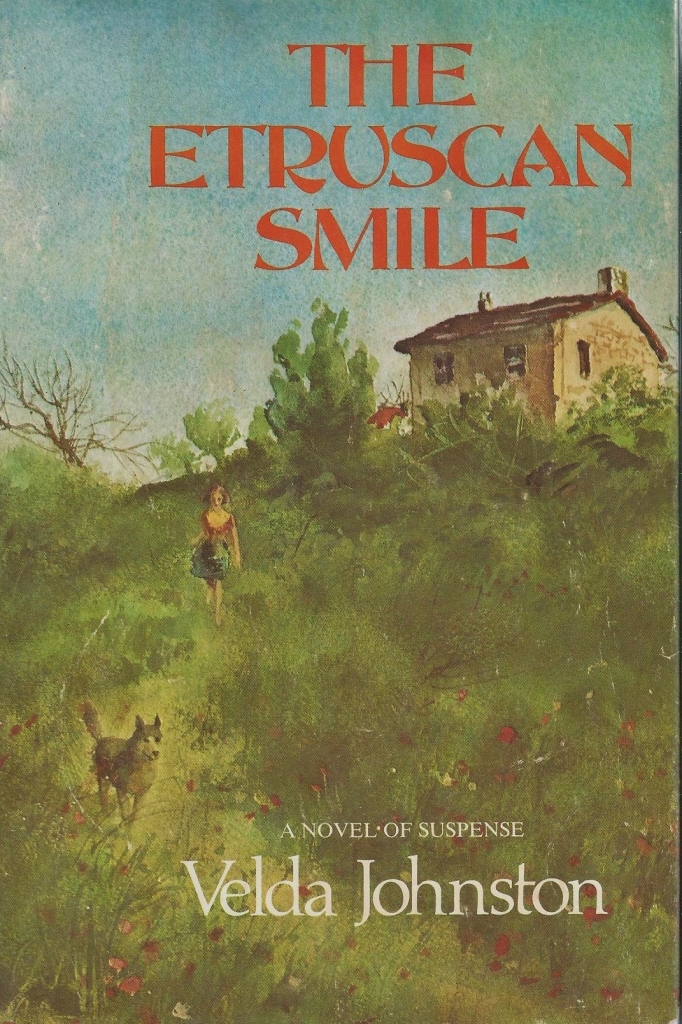
Tthe etruscan smile velda johnston 001he Etruscan Smile by Velda Johnston ~ 1977. This edition: Dodd, Mead & Co., 1977. Hardcover. 181 pages.
My rating: 6/10

I had read several of Velda Johnston’s mildly thrilling and sometimes simplistic “novels of suspense” before, so had tempered my expectations for The Etruscan Smile accordingly.

1975’s A Room with Dark Mirrors generally pleased me; the period detail of the heroine’s stewardess career and the doesn’t-miss-a-beat flow of the story kept me engaged enough to award it a thumbs-up and a 5.5 rating.

The Girl on the Beach, 1987, felt rather more awkward in plot and style; the author was a quite venerable 75 years old when it was published, and I theorized that perhaps she feeling rather tired of the whole writing-a-book thing. I panned the Beach Girl badly, mentioned that I was almost ready to cross Velda Johnston off my “light reading” list, and gave her a dismissive rating of 4.

Two years have passed, and the memory of my disappointing second encounter with the author has faded; enough so that when I came across this novel recently I was moved to give her another chance. And I am happy that I did; The Etruscan Smile was nicely done for its sort of thing, and reading it was no hardship at all.

A perfect sort of book for a waiting room sojourn; engaging but not challenging. It rocketed right along, and handed me a few surprises in the way of plotting that I wasn’t expecting, though I’m not quite sure that these worked out story-wise all that well. I did give the writer points for creativity; I could tell where she was going and the big picture she was attempting to embroider, even if she dropped her threads a bit here and there.

Mary Stewart this soundly second-rank writer isn’t, though there are bits here and there which remind me favourably of Stewart’s style. Our heroine is nicely independent and capable; but she does end up in the arms of a man, and one that she hasn’t known terribly long or particularly well – a favourite Mary Stewart closing scenario. Those brushes with death do tend to speed along romantic acquaintanceship, is all I can assume.

And I found this much more readable than anything I’ve experienced by Phyllis A. Whitney (see my last post, wherein I hand poor Phyllis her walking papers out of my personal book collection), though Velda Johnston was nowhere near as prolific or (apparently) as popular. Still, she (Velda) did manage to produce something like 35 romantic suspense novels, and so far out of the three I’ve read two have been acceptable; she’s now back on my list of promising minor writers, though I won’t be searching her out specially or paying more than bargain basement prices for any more of her books that I come across in my travels.

So – the actual storyline of The Etruscan Smile. Here it is, such as it is.

Samantha Develin has flown to Italy from New York, accompanied by her devoted German Shepherd, Caesar. Samantha has just learned that her older sister,  Althea, an accomplished artist who has gained a certain reputation as a painter-to-watch, has unaccountably vanished from the small rented farmhouse she has been living in for the past several years. No one seems to know where Althea has gone; the assumption is that she is off with a man; but Samantha immediately finds some clues that her beloved sister may not have planned her departure in a typical fashion.

A dashing Italian count – an old flame of Althea’s – appears out of the blue and puts himself rather unexpectedly at Samantha’s service. Another of Althea’s ex-lovers, an English archeologist, living close by, makes himself conspicuous by his continued presence, zipping in silently on his bicycle at the oddest hours of day and night.

These two men in particular and, to a lesser degree, everyone else she questions regarding Althea’s recent activities are rather cagy and evasive; everyone obviously knows something that they’re not divulging to Althea’s little sister. But what?

Samantha persists in her quest to track down her sister, and she soon comes to sense that perhaps something rather final has happened to Althea, though there is no evidence to support an act of violence or misadventure. Samantha must revisit her own past to unravel the tangled web which her sister had become bound up in; what she discovers is more bizarre than she (or we) could ever have imagined…

A hidden statue of an ancient Etruscan goddess plays an important role in the quest for Althea and the climactic scene; kudos to the author for not doing the expected with that particular clichéd suspense novel scenario. And kudos as well for not making everything all sunshine and light and picturesque Italian travelogue; there are some darkish situations in this short novel which add a certain depth to what could have been pure fluff. And the dog was a nice touch, and well portrayed. (Total super-dog; too good to be true, really. Hint: one may require a Kleenex near the end.)

An adequately engaging story to while away an hour or two on a summer afternoon; a long lunch hour today was sufficient to polish this one off. I must confess that the strongest impulse I felt upon completion was to revisit one of Mary Stewart’s Greek novels, to enjoy the next level up in this particular cozy-escape-lit genre.

 

Read Full Post »

Dear Phyllis A. Whitney: I’ve given you so three good chances, with Seven Tears For Apollo (1963), Sea Jade (1964) and Columbella (1966), and I must say I have found you lacking. One last chance was a just-abandoned attempt to read 1991’s Woman Without a Past, with me thinking that perhaps several more decades of writing experience might result in something more to my taste.

I regret to say that this hasn’t proven to be the case. I made it to mid-way in the book, but was at last defeated by the psychic cat (“Miss Kitty” – how blandly lame is that?!), the old black “servant” (described as such by P.A.W.) speaking the author’s conception of “black person Southern dialect” (while all the white Southerners appear to be speaking “normal” English), the secret letter hidden behind the tail of the wooden rocking horse (what an appropriate place, I caught myself thinking, because the plot was fast degenerating into, well, you know…), and the absolutely flatness of the writing. Fingernails on the chalkboard of my mind. Screeeeech.

That’s it. Phyllis is being top-shelfed. And possibly set to be purged, despite sentimental feelings about ridding myself of my late mother’s books. Rosamund Pilcher is on the probation shelf, too, as is Maeve Binchy. And Catherine Cookson. Helen Forrester should be getting worried, too. Joanna Trollope, you might want to keep a lowish profile; the last few of yours I read left me thinking you’ve worn out all of your best Aga Saga scenarios.

My husband says that Miss Read should join these others in exile, but I have an inexplicably deep affection for Dora Saint’s pleasantly innocuous stories, so those aren’t even up for debate.

Absolutely sacred.

So there.

Darling.

Where was I?

Oh, yes. Norah Lofts.

Because while I was trying to read Phyllis Whitney, I was concurrently actually reading and hugely enjoying yet another gorgeously dark domestic drama by Norah Lofts. (See The Little Wax Doll  (1960) and Lovers All Untrue (1970).)

Norah writes big, shiny, sparkling rings around plodding Phyllis.

Sorry, Phyllis.

You lose.

charlotte norah lofts out of the dark 1972Charlotte by Norah Lofts ~ 1972. American title: Out of the Dark. This edition: Coronet, 1973. Paperback. ISBN: 0-340-17826-4. 254 pages.

My rating: 9.5/10

The author notes that this story was inspired by the notorious real life situation of an English teenager, 16-year-old Constance Kent, who in 1860 was accused of the brutal murder of her young stepbrother.

Though the scenario in the first section of the book borrows heavily from the historical case, Norah Lofts states in her beginning Author’s Note that:

The characters…are my own; and whereas those who write factually about a crime – especially one never satisfactorily solved – can only speculate about the motives and, indeed, the identity of the murderer, the writer of fiction, dealing in a more plastic medium, is able to say: This is how it happened.

Part Two owes nothing to the Case of Constance Kent. Incredible as it may seem, it is based on a first-hand account of a school in which my sister once tried to teach, a mere forty years ago. Here again the characters are my own; but I did not invent the oil-stove that was carried up and down…

This is a dark little tale, of deep injustice done to the innocent by those who should have been the most concerned with their protection. Our author puts her titular heroine through a grueling ordeal which stretches on for years, before allowing a resolution (of sorts) which (possibly) rewards her (and our) quietly righteous perseverance.

How much should I tell about the plot? My impulse is to keep it fairly quiet, as this sort of story rewards readerly discovery. I’ve already given out some of the major points, which are indeed no secret, and are revealed very early on.

16-year-old Charlotte Cornwall, her younger brother Thomas, and older twin sisters Adelaide and Victoria live with their father, stepmother and young half-brother Vincent in outwardly respectable but secretly straitened circumstances. The first Mrs. Cornwall was possessed of a large private income; this came to a halt upon her tragic (and questionably natural) death some years earlier; the twins and Charlotte are to inherit their mother’s money when they each turn 21, under the terms of their maternal grandfather’s will.

Money concerns are just part of the unspoken tension in the Cornwall household; the second Mrs. Cornwall, who was previously the children’s nanny, is deeply jealous of her gentle predecessor’s lasting influence. Her own small son is the apple of her maternal eye, and she is again pregnant, leading to a situation of history repeating itself as Mr. Cornwall’s attention is caught by the latest nursemaid who has replaced her mistress in the household hierarchy in more ways than one.

When four-year-old Vincent is discovered gruesomely murdered, his body hidden in the muck heap in the stable yard, suspicion is directed at a nebulous night time prowler, but soon evidence comes to light which leads back into the heart of the family, and ultimately straight to Charlotte. But several people in the household know the real story of what happened that dreadful night. Surely the truth will come out; surely the culprit or culprits will confess, to save an innocent who is being wrongly accused…

Nope. Charlotte is completely sold up the creek, and by a person (or persons) who should have been willing to protect her at their own expense.

Charlotte’s youth and social status and some inconsistencies in the evidence lead to her acquittal, but her trials aren’t yet over. Not by a long shot. Seeking to escape a situation made increasingly unbearable by the dark stain on her name and her stepmother’s increasing hatred, Charlotte takes a position in a country girl’s school as an assistant mistress, a situation which at first appears to be a welcome refuge, but which soon puts her into still more nightmarish situation, as the school’s headmistress exploits her knowledge of Charlotte’s past to her own advantage…

Just when things are darkest, a gleam of hope appears, and our heroine at last has a chance to clear her name. But will she turn against the real murderer(s), once she discovers the true story of her betrayal?

Well, I guess you’ll just have to read it yourself to find out.

Multiple characters, multiple story strands, all beautifully handled and full of fabulous period detail. What I’ve divulged above is the briefest overview of this richly written noir tale.

Charlotte is most competently plotted and presented; a deeply engaging read of the chillingly almost-plausible sort. Abundant wry humour, too. Despite its grim theme, this is not at all a depressing read; I frequently found myself chuckling quietly to myself as the author sends up various stereotypes and scenarios with perfect comic timing, and without quite crossing the line into farce.

Thank you, Norah.

You had me just a tiny bit worried for most of the book; I wasn’t sure where we were going for quite some time there. Good job on stringing the reader along!

Oh – the half point docked was for several not very veiled homosexual side stories. Those felt possibly just the tiniest bit mean-spirited, just vaguely “off”. But possibly they weren’t meant to be, and were intended more in the nature of ironic natural revenge? Maybe? However, I felt these were a bit too similar to the Sudden Evil Lesbian who shows up to wield retribution in Lovers All Untrue – too unnaturally manufactured; even in such a highly fictionalized thing such as Charlotte turns out to be.


Read Full Post »

the sea-gull cry robert nathan 001The Sea-Gull Cry by Robert Nathan ~ 1942. This edition: Knopf, 1942. Softcover, with French flaps. First edition. 214 pages.

My rating: 3/10

A short, lightweight novella by the onetime-popular Robert Nathan. I confess that I have in the past read and quite enjoyed his most famous publication, 1940’s Portrait of Jennie (see condensed spoiler-laden précis here), but The Sea-Gull Cry is infinitely more sentimental, and, to be brutally honest, not particularly memorable, either in plot or in execution.

Nineteen-year-old Louisa and her seven-year-old brother Jeri are refugees newly in America, from war-torn Poland via England. Children of an English mother and a Polish nobleman, they are in reality a countess and count, but the family castle has been bombed, leaving their mother interned forever in its rubble, while Papa has perished defending his country against the evil German invaders.

Louisa and Jeri are bravely making a new sort of life for themselves. Desiring to get out of the crowded American city they arrived at some short time ago, they have taken their refugee relief money and are looking for a place to live along the seaside for the summer. They make it to Cape Cod, where they fall in with a gruff-mannered but hearts-of-gold older couple, the Baghots, who rent them an abandoned scow beached on an isolated stretch of sand.

Onto this strip of sand precipitously arrives one “Smith”, a jaded, middle-aged history teacher, (and a not very experienced sailor), who has just purchased an old sloop with the view to cruising up and down the coast for the summer, to escape from the stress of his unsatisfying job and the pervasive gloom of the situation in Europe. (The story is set just before American entry into World War II.)

Smith is caught up in a squall and violently beaches his boat, putting an end to his summer plans. But when he meets lovely Louisa he is immediately smitten; even more so when she pops out of her faded blue overalls to swim in a teeny tiny homemade bikini. Smith feels that maybe life isn’t so dull after all…but wait…why would Louisa look at a man old enough to be her father…?

Maybe because she is seeking something of a father-substitute, a romantically-older man?

It takes them a few chapters to get it all worked out, chapters in which small Jeri provides a side plot as he fights with the local children, makes friends with the Baghots’ young niece Meg, and has a brush with death as he sets out to sea with Meg on an old raft, seeking to sail back to Europe to rescue “the children” from the conflict.

Aw, how sweet.

Sure.

A little of that goes a very long way, and luckily this was a lightning fast read, being presented by the publisher with a large font, immense margins, and thick paper. It clocks in at 214 pages, but could probably quite happily fit onto 50 or so. (One speculates therefore that this was before any sort of wartime paper restrictions hit the American publishing market.)

That’s it; that’s the story; well whitewashed with slosh.

I don’t quite get Robert Nathan’s obvious popularity in his time, because this was pretty sub-par stuff in the great scheme of literature-of-the time, unless it was as a writer of escape-lit-light for the stressed-out housewives of the 1940s and 50s. The Sea-Gull’s Cry seems the sort of thing that would be found serialized in the Good Housekeeping type of magazine of the day.

A contemporary review by Rose Feld of The New York Times had this to say:

‘The Sea-Gull Cry’ tells a tale that will hold you until the last page is turned. It will hold you because of Nathan’s rare art of drawing you into his own mood of tender contemplation of human beings and because you cannot let them go until you know what happens to them… And you will decide that this is more than a tender little love story exquisitely written; that it is a tale of exile and valor and spiritual rebellion that has more than surface significance.

I suspect I am myself a bit too jaded and cynical to really appreciate this sort of fiction; I find myself lifting an eyebrow when I read these other quotes by the author himself regarding his authorial motivation:

What I really want is to give comfort to people in this wilderness of death and trouble. And to myself, too. So, when I can, I take the poison and hate out of my books; but I hate, just the same. I hate violence, and tyranny, and vulgarity. I hate despair and destruction, and the writers who insist that that is all there is, there isn’t anything else.

and

It seems to me that I have always wanted to say the same things in my books: that life is one, that mystery is all around us, that yesterday, today and tomorrow are all spread out in the pattern of eternity, together, and that although love may wear many faces in the incomprehensible panorama of time, in the heart that loves it is always the same.

Fair enough; Nathan’s readers obviously responded to his style.

As you can see from my brutal rating, I didn’t.


Read Full Post »


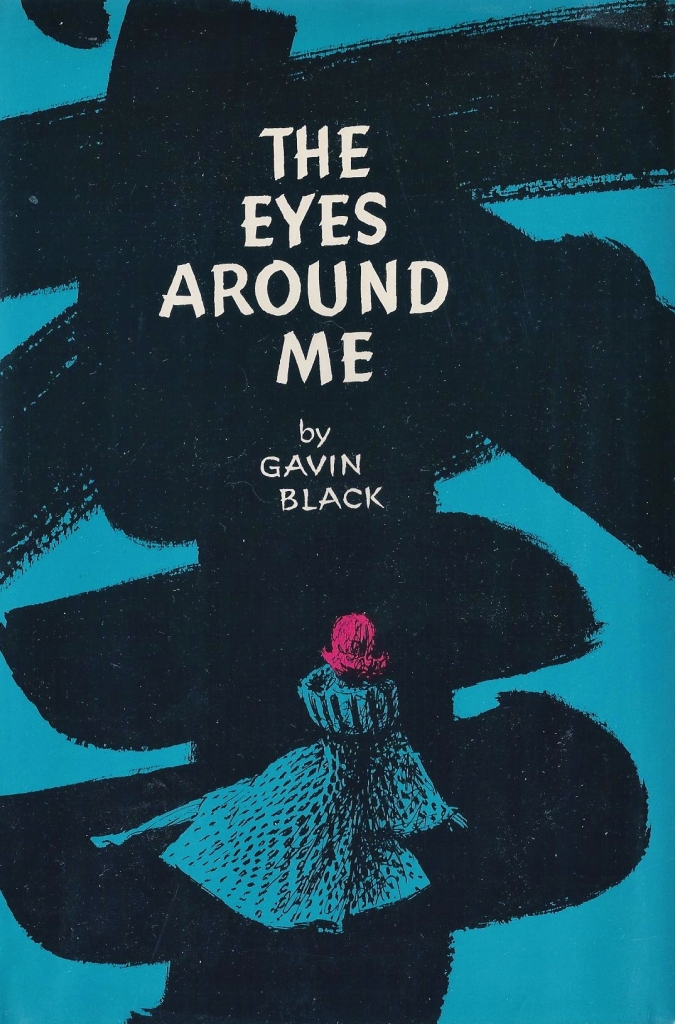
the eyes around me gavin black 001The Eyes Around Me by Gavin Black ~ 1964. This edition: Harper & Row, 1964. Hardcover. 216 pages.

My rating: 8.5/10

Okay, why have I never come across this writer before? This murder mystery novel set in Red-era Hong Kong was pretty darned fabulous. Instant fan, I am. Now I must track down more…

From his obituary notice in The Independent, August 6, 1998:

Oswald Wynd was a modest man who had little to be modest about. As Gavin Black he wrote superior and literate thrillers – school of Stevenson and Buchan – which were at the same time witty and clever, and moved at a by no means gentlemanly pace…

A “superior and literate thriller” describes this fast-paced novel exceedingly well.

Middle-aged, recently divorced, lush living Scottish shortbread heiress Ella Bain lives in Hong Kong, in a lavish seaside mansion. An outside staircase to her bedroom allows her to receive gentleman callers without offending the sensibilities of old family retainer Kirsty, and by all reports it is a well-used piece of domestic architecture.

Ella is loud, she drinks too much, and though she has proven herself an astute businesswoman, enlarging her already substantial fortune by her occasional managerial visits back to the family factory in Scotland, she occasionally raises eyebrows by her larger than life actions. Long-time platonic friend Paul Harris views Ella with sometimes-exasperated affection; he has turned down her marriage proposal, but remains in Ella’s will as her chief beneficiary, cutting out Ella’s only brother Angus, who enjoys a fortune of his own.

So when Ella is found dead in her bed on New Year’s Day morning by Paul, who squired Ella about town the night before and stayed over at her house, both the police and the intimately entwined Hong Kong society crowd look at Paul with more than a little speculation.

Paul Harris, wealthy in his own right through a series of past speculations and questionably legal activities which I shan’t reveal to you here, resents the assumption that he murdered his friend, and sets out on a quest to clear his name.

This is a vividly atmospheric mystery novel, with a finely detailed setting and memorable (if occasionally rather unlikely) characters. One forgives the over-the-topness because the thing is so gloriously well written for this type of light fiction; Oswald Wynd/Gavin Black spins an exceedingly readable tale.

Paul Harris comes across as a greatly  improved version of Ian Fleming’s James Bond. Paul is suave, fast on his feet, good in a fight, exceedingly attractive and attracted to gorgeous women, and (one feels) truly a good guy at heart, despite his somewhat shady backstory. The arrogance which emanates from his fictional counterpart Bond is completely missing; one likes Paul Harris, despite our doubt that he is now a purely lily-white boy, gone all straight and narrow.

I guessed the murderer with surprising ease; I foretold the romantic clinch at the end; as a mystery the thing is decidedly clichéd and predictable, but despite these drawbacks I greatly liked this book.

The author wrote a rather respectable number of novels and thrillers, most set in Asia. I am keen to follow up on my introduction to Paul Harris, who apparently features in all of the Gavin Black-authored thrillers; the Oswald Wynd novels sound intriguing, too, if perhaps a bit “deeper” in theme.

1977’s The Ginger Tree was made into a well-received Masterpiece Theatre 4-part miniseries, and Wynd’s depiction of cross-cultural and mixed race relationships is spoken of very highly in reviews.

For future investigation:

As Oswald Wynd:

  • Black Fountains (1947) (1st novel, winner of $20,000 Doubleday prize for fiction)
  • Red Sun South (1948)
  • Friend of the Family (1949)
  • The Stubborn Flower (1949)
  • When Ape is King (1949) (Wynd’s lone speculative fiction, very rare )
  • The Gentle Pirate (1951)
  • Stars in the Heather (1956)
  • Moon of the Tiger (1958)
  • Summer Can’t Last (1960)
  • Death, the Red Flower (1965)
  • Walk Softly, Men Praying (1967)
  • Sumatra Seven Zero (1968)
  • The Hawser Pirates (1970)
  • The Forty Days (1972)
  • The Ginger Tree (1977)

As Gavin Black:

  • Suddenly at Singapore (1961)
  • The Devil Came on Sunday (1961)
  • Dead Man Calling (1962)
  • A Walk in the Long Dark Night (1962)
  • A Dragon for Christmas (1963)
  • The Eyes around Me (1964)
  • You Want to Die, Johnny? (1966)
  • A Wind of Death (1967)
  • The Cold Jungle (1969)
  • A Time for Pirates (1971)
  • The Bitter Tea (1972)
  • The Golden Cockatrice (1974)
  • A Big Wind for Summer (aka Gale Force) (1975)
  • A Moon for Killers (aka Killer Moon) (1976)
  • Night Run from Java (1979)
  • The Blazing Air (1981)
  • The Fatal Shadow (1983)
  • A Path for Serpents (1991)

Read Full Post »

As fleeting as poppy flowers, these too-fast-gone summer days...

As fleeting as poppy flowers, these too-fast-gone summer days…

Flipping the pages on the calendars this morning, several days past the turn into August, and rather in shock that we are in the eighth month of the year. What happened? Where did the time go?!

Looking over my Century of Books Project list of completed reads, it occurs to me that I may have to buckle down and do some more strategic reading to fill in some of the yawning gaps, namely those in the last three decades of my century, which I decided would cover the years 1900 to 1999. To date I have been reading largely at whim, with oodles of “double-up” years. It’s been fun, but now I need to get serious. 😉

By the numbers:

  • Years read and reviewed: 56/100
  • “Extra” books read/reviewed: 28
  • Grand total to date of Century reviews: 84
  • Century years left: 44
  • Months of 2014 left: 5/12
  • Books-per-month I need to read and review to meet my goal: 9-ish

I do have some qualifiers already read but not yet reviewed, which I haven’t counted, so the last number is not quite as scary as it could be. Though I have just completed my first re-read of the century, too much time having passed since the original reading to allow for a good post. (The Little Straw Wife, by Margaret Belle Houston, first read way back in February.)

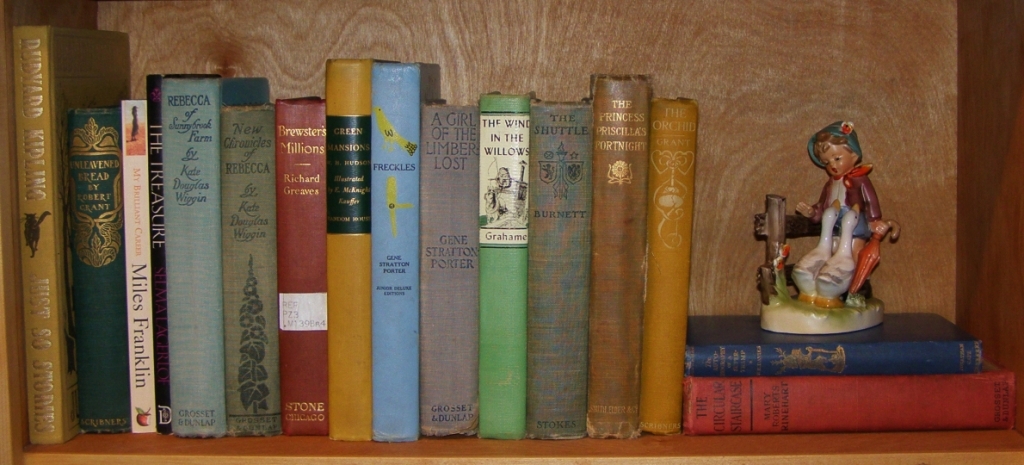
And here they are - the first decade books, minus (The Wonderful Adventures of) Nils, who is unaccountably missing (maybe off on another adventure?) and is represented by the pseudo-Hummel boy-with-geese.

And here they are – the first decade books, minus (The Wonderful Adventures of) Nils, who is unaccountably missing (maybe off on another adventure?) and is represented by the pseudo-Hummel boy-with-geese.

I’ve finished one decade of the Century, 1900-1909, and a mostly pleasant one it was, too. A nice mix of classic children’s stories and vintage bestsellers and completely new-to-me discoveries. Here’s the briefly annotated list. (Scroll down for my “best” and “worst” awards.)

  • 1900 ~ Unleavened Bread by Robert Grant ~ My rating: 8/10. A self-centered, humourless and hypocritical woman claws her way to the society position she claims to be hers by right of birth. An interesting American novel which foreshadows similar works by Sinclair Lewis.
  • 1901 ~  My Brilliant Career by Miles Franklin ~ My rating: 8.5/10. Teenage Sybylla struggles against an unkind fate, is wooed, and rejects conventional relationships with men, all set against the blazing background of Australia’s drought-stricken bush in New South Wales.
  • 1902 ~ Just So Stories by Rudyard Kipling ~ My rating: 7.5/10. A collection on fables explaining how things got the way they are: the Whale with his baleen throat, the Camel with his hump, and the Alphabet’s origin, among others. Some are wonderful for reading out loud to the young ones, others are best enjoyed as interesting period pieces. Good reading for the adults of the family, if you are at all a Kipling aficionado
  • 1903 ~ Rebecca of Sunnybrook Farm by Kate Douglas Wiggin ~ My rating: 7.5/10. The classic juvenile novel about an eleven-year-old girl coming to live with two strict spinster aunts.
  • 1904 ~ The Treasure by Selma Lagerlöf  ~ My rating: 10/10.  An excellent short novella about love and revenge. A 16th Century Scandinavian winter setting and ghosts. Brrr.
  • 1905 ~ The Princess Priscilla’s Fortnight  by Elizabeth von Arnim ~ My rating: 7.5/10. German Princess Priscilla escapes the courtly life with her elderly friend, the palace librarian. The two set up house in rural England, but soon run into unplanned-for difficulties. A witty light farce with a mildly predictable moral.
  • 1906 ~ The Shuttle by Frances Hodgson Burnett ~ My rating: 8.5/10. A gorgeous gothic thriller/romance following the varied adventures of two wealthy American sisters as they travel to England ten years apart. Gentle Rosy marries a wicked nobleman; ten years later her younger sister Betty mounts a rescue mission.
  • 1907 ~  New Chronicles of Rebecca by Kate Douglas Wiggin ~ My rating: 6.5/10. Further details on Riverboro life, with eventual strong hints as to the ongoing evolution of the relationship between Rebecca and much-older “friend” Adam Ladd.
  • 1908 ~ The Circular Staircase by Mary Roberts Rinehart ~ My rating: 5.5/10. Super-confusing and not very mysterious American country house mystery, salvaged somewhat by the amusing narrator, a middle-aged, opinionated, self-described spinster, Miss Rachel Innes. A classic of crime fiction which I’m happy to have ticked off the list, but this reading will likely do me for many years to come. Though I am still keen to read more of MRR’s mysteries; they are definitely enjoyable as well as slightly annoying.
  • 1909 ~ A Girl of the Limberlost by Gene Stratton-Porter ~ My rating: 6/10. Downtrodden but plucky half-orphan Elnora roams the Limberlost Swamp hunting leaves and bugs to finance her higher education.

And the bonus books:

  • 1903 ~ Also: Brewster’s Millions by Richard Greaves aka George Barr McCutcheon ~ My rating: 7.5/10. A young man inherits two fortunes, but under strange conditions. He must spend one million dollars – without divulging the existence of the second legacy, and under strict conditions – in order to inherit seven million. Needless to say, his friends think he has gone mad, and much hilarity ensues as they try to save Monty Brewster from himself.
  • 1904 ~ Also: Green Mansions by W.H. Hudson ~ My rating: 3.5/10. Thousands loved this when it was first published. One hundred and ten years later, I am less than impressed. An Amazonian jungle romantic tragedy between an aristocratic Venezuelan hiding out from the consequences of a failed political coup, and a mysterious “bird girl” who guards her section of the forest against all intruders.
  • 1904 ~ Also: Freckles by Gene Stratton-Porter ~ My rating: 7.5/10. One-handed but plucky orphan Freckles wins hearts, vanquishes evildoers, and wins love while employed as a timber guard in the Limberlost Swamp.
  • 1905 ~ Also: The Orchid by Robert Grant ~ My rating: 6.5/10. A socialite sells her child to her first husband to finance her second marriage.
  • 1906 ~ Also: The Wonderful Adventures of Nils by Selma Lagerlof ~ My rating: 10/10. An appealing vintage children’s classic. Swedish farm boy Nils is transformed for his misdeeds into elf-size, and is now able to understand the speech of animals. His quest for redemption and a way to break the curse carries him over Sweden on the back of the farm’s white gander. A marvelous read-aloud, standing up well over a hundred years after its original publication.
  • 1908 ~ Also: The Autobiography of a Super-Tramp by W.H. Davies ~ My rating: 9/10. The famous poet’s early years as a tramp in Britain and North America.
  • 1908 ~ Also: The Wind in the Willows by Kenneth Grahame ~ My rating: 10/10. Rat and Mole “messing about in boats”; Toad getting up to no good in his dreadfully large motorcar; Badger coming to everyone’s rescue; absolute bookish delight for adults and children alike.

Top 3 “I know I’ll read it again” Books:

  1. Unleavened Bread by Robert Grant ~ 1900.
  2. Rebecca of Sunnybrook Farm by Kate Douglas Wiggin ~ 1903.
  3. The Princess Priscilla’s Fortnight  by Elizabeth von Arnim  ~ 1905.

Melodrama Award:

  1. A Girl of the Limberlost by Gene Stratton-Porter ~ 1909, tied with Green Mansions by W.H. Hudson ~ 1904.
  2. Runner Up: Freckles by Gene Stratton-Porter ~ 1904.

Hidden Gem Award:

  1. The Autobiography of a Super-Tramp by W.H. Davies ~ 1908, tied with My Brilliant Career by Miles Franklin ~ 1901.
  2. Runner Up: The Treasure by Selma Lagerlof ~ 1904.

Great Big Disappointment:

  1. Green Mansions by W.H. Hudson ~ 1904.

Read Full Post »

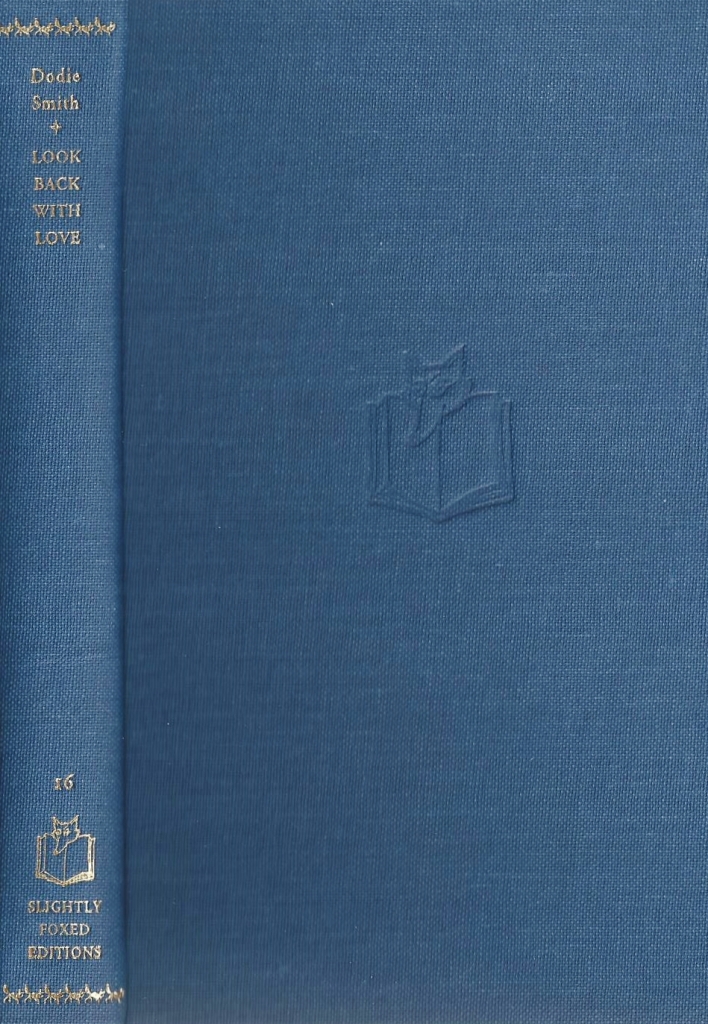
look back with love cover slightly foxed dodie smith 001Look Back with Love: A Manchester Childhood by Dodie Smith ~ 1974. This edition: Slightly Foxed, 2011. Hardcover. ISBN: 978-1-906562-30-4. 272 pages.

My rating: An easy 10/10. A pleasure first page to last.

This post should be extremely easy to write, as it is merely meant to be an enthusiastic recommendation of two things.

First and foremost, this stellar memoir by Dodie Smith (I capture the Castle, The Hundred and One Dalmations), detailing with immense good humour her childhood days in Manchester, when she lived with her widowed mother in a series of family homes.

Before reading this book I had come across several excellent and detailed reviews which inspired my search-and-purchase. I shall not attempt to add to their number, but instead will encourage you to follow these links to the several posts which led to this happy acquisition.

Geranium Cat’s Bookshelf  – a wonderful review, with generous quotes from the text.

Simon’s Stuck-in-a-Book post is disarmingly chatty and wholly enthusiastic.

And from Elaine at Random Jottings, this excellent advice:

I beg you, please do get hold of a copy. If you are feeling miserable, it will cheer you up, if you are feeling ill (as I was when it arrived) it will make you feel better and, if you are already well and happy, it will make you even more so.

Sheer and utter delight from start to finish.  I will end as I started. This is a lovely lovely lovely book.

Yes, indeed.

Which leads me to the second recommendation I have for everyone, which is of a bookseller.

Look Back in Love in the original being fairly scarce and rather highly priced when found, the book I have in hand is a beautifully produced reprint from Slightly Foxed Editions, who specialize in (among other things) “pocket hardback reissues of classic memoirs.”

Take a good look at their list of offerings. I’ve read enough of these to be able to say that whoever is searching out these memoirs to republish has a keen eye for an excellent read. Well done, Slightly Foxed! If I’m ever in London my bookish pilgrimage will include their store (either before or after a sure-to-be-costly visit to Persephone – how can one possibly choose?!) to bow down at the source (as it were) of some of the best-chosen and best-produced vintage reprints currently available.

While not exactly cheap – a postpaid copy to Canada set me back a rather sobering £19, or about $35 Canadian dollars – I justified the cost with the thought that I was supporting a most worthwhile enterprise.

My Slightly Foxed edition is a joy to handle and to read, being compact and neatly cloth bound with a handy ribbon marker, a text block of smooth, creamy paper, and a nicely legible font. My only regret is that it does not contain the photographs included in the original edition; I love the inclusion of photos in memoirs as it adds so much to be able to see the characters and places referred to. But Dodie Smith’s words give such a wonderfully clear picture of both people and surroundings that one can envision the scenes perfectly well without visual aids.

I was so very pleased with this first volume of Dodie Smith’s memoirs – which takes her to the age of fourteen – that I have just tracked down and ordered the middle two volumes of the remaining three autobiographical books, Look Back with Mixed Feelings, and Look Back with Astonishment. I had already acquired Look Back with Gratitude, the last of the four, and though I have leafed through it with anticipation I am being stern with myself and will be saving it to read last, to maintain a chronological order.

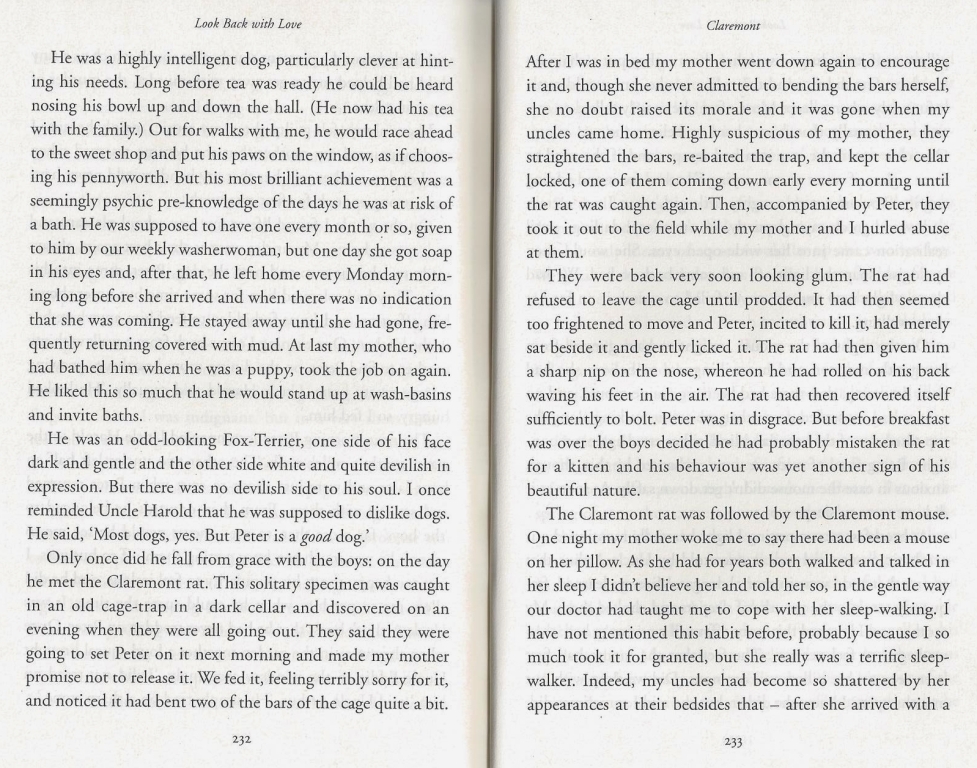
And here, to further pique your interest (those few of you who haven’t already discovered this gem for yourselves) is a random page scan. Open this book anywhere and similar anecdotes abound. Even out of context, isn’t this a joy?

Click to enlarge for ease of reading.

(Click to enlarge for ease of reading.)

Read Full Post »

lady molly of scotland yard baroness orczyLady Molly of Scotland Yard by The Baroness Orczy ~ 1910. This edition: Facsimile of the 1912 edition, The Akadine Press, 1999. Softcover. ISBN: 1-888173-97-1. 344 pages.

My rating: Hmmm. Though doubtless a good example of period fiction and an early precursor to the detective-story genre which so abundantly flourished in the decades after Lady Molly’s publication, for actual reading experience the book was not quite as fabulous as I had hoped.

A perhaps overly generous 5/10 is all I can bring myself to award it right now, though it is the sort of thing one might well become fond of on a re-read for reasons quite unrelated to literary (or detective puzzle) merit. (Or then again, maybe not!)

We meet Lady Molly, in The Ninescore Mystery, first chapter of Lady Molly of Scotland Yard, courtesy Project Gutenberg:

Well, you know, some say she is the daughter of a duke, others that she was born in the gutter, and that the handle has been soldered on to her name in order to give her style and influence.

I could say a lot, of course, but “my lips are sealed,” as the poets say. All through her successful career at the Yard she honoured me with her friendship and confidence, but when she took me in partnership, as it were, she made me promise that I would never breathe a word of her private life, and this I swore on my Bible oath–“wish I may die,” and all the rest of it.

Yes, we always called her “my lady,” from the moment that she was put at the head of our section; and the chief called her “Lady Molly” in our presence. We of the Female Department are dreadfully snubbed by the men, though don’t tell me that women have not ten times as much intuition as the blundering and sterner sex; my firm belief is that we shouldn’t have half so many undetected crimes if some of the so-called mysteries were put to the test of feminine investigation.

Do you suppose for a moment, for instance, that the truth about that extraordinary case at Ninescore would ever have come to light if the men alone had had the handling of it? Would any man have taken so bold a risk as Lady Molly did when–But I am anticipating.

Let me go back to that memorable morning when she came into my room in a wild state of agitation.

“The chief says I may go down to Ninescore if I like, Mary,” she said in a voice all a-quiver with excitement.

“You!” I ejaculated. “What for?”

“What for–what for?” she repeated eagerly. “Mary, don’t you understand? It is the chance I have been waiting for–the chance of a lifetime? They are all desperate about the case up at the Yard; the public is furious, and columns of sarcastic letters appear in the daily press. None of our men know what to do; they are at their wits’ end, and so this morning I went to the chief–”

“Yes?” I queried eagerly, for she had suddenly ceased speaking.

“Well, never mind now how I did it–I will tell you all about it on the way, for we have just got time to catch the 11 a.m. down to Canterbury. The chief says I may go, and that I may take whom I like with me. He suggested one of the men, but somehow I feel that this is woman’s work, and I’d rather have you, Mary, than anyone. We will go over the preliminaries of the case together in the train, as I don’t suppose that you have got them at your fingers’ ends yet, and you have only just got time to put a few things together and meet me at Charing Cross booking-office in time for that 11.0 sharp.”

She was off before I could ask her any more questions, and anyhow I was too flabbergasted to say much. A murder case in the hands of the Female Department! Such a thing had been unheard of until now. But I was all excitement, too, and you may be sure I was at the station in good time.

Holmes to Lady Molly’s Watson (the comparison is inevitable and apt) is our narrator Mary, who started out as Lady Molly’s maid in the days-gone-by continually referred to with much innuendo and mysterious “But I mustn’t talk about that!”

Now Mary and Lady Molly are members of the female division of Scotland Yard’s investigative force, though Mary still seems to be fulfilling many of her old duties in regard to her mistress, as well as some new ones. Messy and boring (and possibly dangerous) investigation to be done – well, let’s send Mary! Though to be fair Lady Molly puts herself in discomfort occasionally. (Very occasionally.) Most of her detecting seems to be done Hercule Poirot/Nero Wolfe style, from the comfort of an armchair while exercising her own Great Big Brain.

My biggest beef: the class distinctions so blatantly demonstrated throughout. Lady Molly is exceedingly high handed with her inferiors (that would be just about everyone she meets, works with and “investigates”) and meek Mary obviously feels that this is just the way it should be. And Lady Molly never explains; she merely orders, and her “partners” (usually Mary, but on occasion fawning members of The Force) scuttle off, sure in their belief that Lady Molly’s womanly (and aristocratic) intuition will bring a solution to the problem of the moment.

There is also a secret reason Lady Molly took up her profession at Scotland Yard; the big reveal happens in the last chapter, with Mary at last spilling all the beans she was forbidden to display previously.

Well, this allows me to tick off 1910 in the Century of Books, and also to satisfy my curiosity as to what Lady Molly was all about; I’ve occasionally seen her referenced in discussions of Golden Age women’s detective fiction; I need wonder no more.

Tasha Brandstatter’s Review echoes my feelings.

As does Stewartry – grand review.

The Wikipedia entry discusses the plot of the first few chapters in vivid, spoiler-laden detail.

And here’s the whole thing on Project Gutenberg.

Read Full Post »

mercy pity peace and love jon rumer goddenMercy, Pity, Peace and Love: Stories by Rumer and Jon Godden ~ 1989. This edition: Quill, William Morrow, 1989. Paperback. ISBN: 0-688-10965-9. 160 pages. Also published as Indian Dust in the U.K., Macmillan, 1989, with identical format and content.

My rating: I have somewhat mixed feelings about this collection of stories mostly by Rumer, because so many are already included in her 1957 collection, Mooltiki, and reading Mercy, Pity, Peace and Love felt very much like déjà vu all over again. But then I got to the very few (four out of fifteen) stories by Rumer’s sister Jon, and those were good enough to still my pangs of annoyance. To be fair, all of these short stories are actually very good, and if you haven’t read the rather obscure Mooltiki, you will be coming to them with fresh and appreciative eyes.

I think in this case I will award the collection as a whole a most respectable 8/10. (Along with the recycled stories, the two also-repeated poems made me knock it back a half point; Rumer Godden was a much more accomplished prose writer; her poems are just “not quite” for me; something just a bit jarring with the phrasing, I think.)

The intent of the collection is to celebrate the India that the Godden sisters knew and loved; they spent most of their childhood years in India, and significant amounts of their adult lives there as well. Rumer and Jon also collaborated on a beautifully written joint childhood memoir, Two Under the Indian Sun, which I read with pleasure some years ago.

Reader Alert! This is the same book as Indian Dust. Both were published in 1989, but Mercy, Pity, Peace and Love is the American title, from Macmillan, with Indian Dust the British title, from Macmillan. I had recently ordered Indian Dust, thinking it was another collection of stories, and was greatly disappointed to find it was identical to the one I already owned, under the Mercy, Pity title.

  • Bengal River by Rumer Godden – a poem – from Mooltiki. First stanza is the best.
Nothing can mollify the sky,
the river knows
only its weight and solitude, and heat, sun-tempered cold,
and emptiness and birds; a boat; trees; fine white sand,
and deltas of cool mud; porpoises; crocodiles;
and rafts of floating hyacinth; pools and water-whirls
and, nurtured in blue mussel shells, the sunset river pearls…
                                                                                                            … … …
  • Possession – by Rumer Godden – from Mooltiki.

The rice field lay farthest from the village, nearest the road. On all sides the plain unrolled in the sun with a pattern of white clouds, white pampas grass in autumn and white paddy birds, and glimpses of sky-reflecting water from the jheels or shallow pools. The sky met the horizon evenly all the way round in the flatness of the plain, an immense weight of sky above the little field, but the old peasant Dhandu did not look at the sky, he looked at his field; he did not know that it was little; to him it was the whole world. He would take his small son Narayan by the wrist and walk with him and say, ‘This field belonged to my grandfather and your great-grandfather; to my father and your grandfather; it is mine, it will be yours.’

But life-plans may go horribly awry; Dhandu’s does not follow its anticipated path; in an ironic ending, which I somehow found reminiscent of W.W. Jacob’s The Monkey’s Paw, the field stays with Dhandu but is forever lost to his son.

  • Rahmin – by Rumer Godden – new to this collection.

An anecdote concerning a series of encounters with a minor craftsman, who proves to be representative of a vast class of Indian society balanced on the knife edge of survival.

  • Monkey – by Jon Godden

Another anecdote, this time by Jon, telling of an encounter with a neighbour’s pet monkey, and the chain of events set off by its biting the author. Fascinating glimpse into the pet-owning culture of upper middle class Calcutta, where Jon was part of a mixed Anglo and Indian community.

  • Sister Malone and the Obstinate Manby Rumer Godden – from Mooltiki.

Sister Malone, the nun in charge of a charity hospital in Calcutta, is unshaken by the horrible sufferings all around her and does great good with her nursing abilities, but her continual effort to share her religious faith with those she heals goes unheeded. One day Sister Malone meets a man who has truly put all of his trust in God, but she cannot reconcile this with her own conception of what faith should be.

  • The Grey Budgerigar – by Jon Godden

Heart-rending short description of a valiant pet bird and its sad fate.

  • Children of Aloysius – by Rumer Godden – new to this collection.

A modest seamstress is offered a once-in-a-lifetime chance to make her fortune.

  • The Oyster – by Rumer Godden – from Mooltiki.

A Bhramini Hindu student, who has travelled abroad to study in England, visits Paris with a friend and is forced to examine the role of compromise in the formation of his own developing character.

  • Kashmiri Winter – by Rumer Godden – a poem – from Mooltiki.
Big Sister, Hungry Sister and the Greedy Dwarf of Ice,
these are forty days of winter, then twenty and then ten…

   … … …

  • The Wild Duck – by Rumer Godden – from Mooltiki.

A young Kashmiri hunter, longing for winter to be over, thinks of his time the previous year among the high mountains hunting ibex.

  • The Carpet – by Jon Godden

The long process of acquiring – or rather, being led into buying by a master salesman – a beautiful Persian carpet. Beautifully observed; gently humorous.

  • Red Doe – by Rumer Godden – from Mooltiki.

A vignette of a young nomad riding up the mountain to fetch his unseen new wife. Sensitive and poignant.

  • The Little Black Ram – by Rumer Godden – from Mooltiki.

An orphan boy,

… a young thief, a bully, noisy, quarrelsome and turbulent, against everyone with everyone against him…

finds his place in the world through his care of a black ram lamb.

  • Miss Passano – by Jon Godden

Miss Passano is disgusted by her fellow humans, and meditates upon a world without them, where only she would remain, in service to the animals she so greatly loves.

  • Mercy, Pity, Peace and Love – by Rumer Godden – new to this collection

Ganesh Dey attempts to write on these concepts – Mercy, Pity, Peace and Love – for his doctoral thesis. A gently ironical and emotionally powerful story, possibly the best of the collection in its summation of the contradictions of human nature and how we actually treat each other versus how we view our relationships and interactions.

Read Full Post »

I need to get some of this towering stack of books-to-be-discussed thinned out; my desk is way too crowded; no place to park the teacup! (And my spouse, coming in last night to “borrow” the computer, made comment on the situation and then graciously offered to shelve them for me – which though a sweet gesture is not necessarily a good thing, as he puts things in strange places. Our filing systems differ. 😉 )Time for a few round-up posts, I think.

Where to start? How to group these? Let’s see…

How about this trio of not necessarily bad books, but ones which could have been better. Definitely readable, but not top notch. (My personal responses only, dependent entirely on my mood at the reading moment – yours could be so much different, so please forgive me if I cold-shoulder one of your favourites.)

station wagon in spain frances parkinson keyesStation Wagon in Spain by Frances Parkinson Keyes ~ 1959. This edition: Farrar, Straus and Cudahy, 1959. Hardcover. 224 pages.

My rating: 5/10

I’ve occasionally flirted with Keyes, because her books have such potentially interesting premises, but I invariably come away sighing. And sadly this concoction is no exception. The very best thing about it was the nine-page author’s foreword, in which she relates her own experiences travelling with her friend Kitty in immediately post-war Italy, France and Spain in 1946, with a rickety American station wagon loaded with relief supplies for an evacuated convent of Bendictine nuns.

Utterly fascinating – “Tell me more!” was my response – but no, Keyes blithely dismisses her own experiences and instead embarks on this rather creatively imagined fictional tale, which starts off reasonably well but soon bogs down in a morass of excessive detail and complicated plotting.

In brief(ish):

A young university professor unexpectedly inherits a large fortune, and, while mulling over his sudden change in situation and his deeply elemental boredom with his life to this point, receives a version of the infamous “Spanish Prisoner” letter in the mail. This one is purportedly from a real Spanish prisoner, and – how handy! – Lambert just happens to be a fluent Spanish speaker himself. Knowing full well that the letter is a scam, he feels that a diversion is in order, so he takes a sabbatical year from his teaching job, packs up his newly purchased big red convertible station wagon, says a dismissive good-bye to the young woman who has been scheming (well beknownst to Lambert) to marry him, and heads off to Spain.

The plot thickens, as Lambert immediately falls in with a luscious adventuress and carries on an intense shipboard flirtation. “Coincidences” start to fall together thick and fast. There does, to Lambert’s great glee, appear to be a genuine prisoner of sorts associated with the fabricated scenario – an impoverished Duke incarcerated in a private sanatorium. Who happens to have a lovely, virginal daughter who could not possibly be involved in any nefarious dealings…

The whole thing is rather bogged down in too much detail. There are long pages of explanation on all sorts of side-issues, as if the author is dead keen on the education of her readers as much as on their entertainment. The plottings of the wicked conspirators get rather see-through and slightly ridiculous early on, and the inevitable romance is just too predictable to be satisfying. (A pox on “love at first sight”, I emphatically say. At least in this situation.)

Moments of excellence; chapters of blah blah blah. Rated at 5/10 because I did willingly carry through to the end, despite my ever-increasing feelings of annoyance that the author would make such a messy job of such a promising plot, and turn her quite likeable protagonist into a bit of a blustering egoist. Points off, too, for the sweetly yielding female love interest (the new one in Spain, not the abandoned American, though she also pops up in Europe to add some more kinks to the tale) and the “unspoken communion of two passionate souls.” Ick!

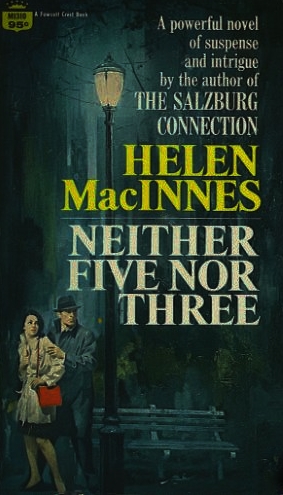
neither five nor three helen macinnes paperback fawcettNeither Five nor Three by Helen MacInnes ~ 1951. This edition: Fawcett Crest, circa late 1960s. Paperback. 320 pages.

My rating: 6/10

Set in post-World War II New York.

I found myself rather taken aback by this story. While many of Helen MacInnes’ books demonstrate her strong stance on capital-C Communism (it’s 100% bad) this one takes that fixation to a whole new level. Instead of clean-cut English/American heroes and heroines flitting about the shadows of war-torn European cities, it’s all about the insidious influence of underground Commies on the home front (in this case America) after World War II, and it comes across as being deeply paranoid, viewed from half a century in the future.

The love story is utterly predicable and really rather sweet; the two lovers are likeable enough and I found myself in general wishing them well; but the anti-Red plotline pushed me past my comfort level into the “Really? Really?” territory. Even taking era-appropriateness into account. So black; so white. Shades of grey are evidence of weakness, on both sides.

MacInnes’ Commies are supremely well organized; they have infiltrated the American publishing industry and are placing their pawns very cleverly in order to slant the perceptions of readers in favour of the political left. Head honchos from the main office (as it were) in Europe undertake clandestine inspirational (and disciplinary) visits to American “party cells”; new recruits are jollied along until they are too deeply enmeshed to easily escape; then the gloves come off and any attempt to back away from participation or to “inform” is punishable by carefully engineered public disgrace, or, just possibly, sudden death. (Cue foreboding music…)

Definitely a Cold War period piece, which was received with warm approval by readers and reviewers of its time.

Excerpted from the March, 1951 Kirkus Review:

This is the most important book Helen MacInnes has done … absorbing and challenging from first page to last, as the devious methods of Communist penetration into the fields of public relations are revealed, and the terrifying network of Communist affiliation is convincingly recorded. Rona Metford is engaged to Scott Ettley, a journalist whose loyalties are torn between his mounting commitment to “the party” and his yearning for a normal course of love and marriage. Into this situation comes Paul Haydn, just returned to New York from a very hush-hush assignment in Europe and finding that his love for Rona, which he thought was a thing of the past, is still very much alive. The checkered course of love is traced against the background of gradually unfolding ramifications of the violence and falsity of Communist activities in the heart of the world they think they know…

I personally found the political bits verging on hysteria, and while there was an occasional authorial attempt made to balance the viewpoints by pondering why Clean Young Americans might be seduced to the Red Side, once they went too far they were brutally written off and became completely expendable, in the most ultimate way.

A precursor to MacInnes’ more “traditional” (i.e., European-set and action-packed) espionage stories which were to follow, blending an ideological plotline with a stereotypical together/torn asunder/together again romantic tale, with vaguely unsatisfying results.

my heart shall not fear josephine lawrenceMy Heart Shall Not Fear by Josephine Lawrence ~ 1949. This edition: Peoples Book Club, 1950. Hardcover. 285 pages.

 
My rating: 5/10

Now on to this much more obscure book, also set, as is Neither Five Nor Three, in immediately post World War II America.

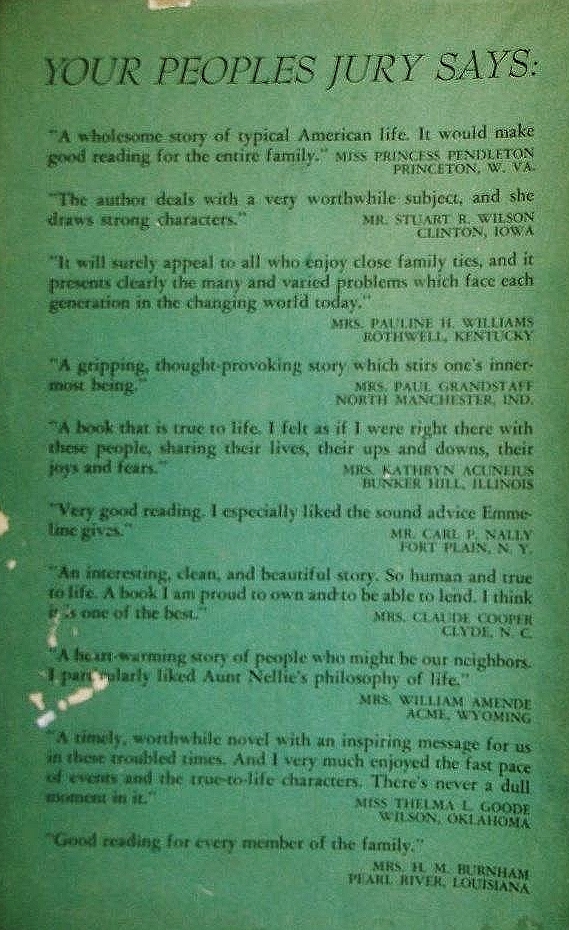
Touted as “inspirational” and a “wholesome depiction of family life” in its back-cover promotional blurbs, this earnest novel left me unsatisfied and vaguely uneasy, mostly because of its troubling (to a reader of today) depiction of women’s societal roles in its era.

If I could pin down one thing which bothered me the most, it would be the author’s apparent insistence that female martyrdom is by and large a good thing, as long as it is carried out in a modest manner. The woman who takes a hit for her family, quietly and uncomplainingly, is to be greatly admired. To be fair, this also applies in a lesser degree to men, but is more strongly expected of the “weaker” sex, the men not being subjected to such ironclad standards of societal behaviour.

There is an ambitious cast of characters, including an older couple who sacrifice their much-deserved peaceful retirement to share their home with three not-long-married sons recently discharged from the armed forces, a young married woman who has recently had a baby and who is eager to leave the hospital and settle into a new apartment (which she can’t really afford, seeing that her husband has borrowed a vast sum of money in order to bail out his own ne’er-do-well father), another new mother who is not married and who resists the good-intentioned bullying of a social aid worker to give her child up for adoption, and a young childless woman who is obviously dying of an unspecified ailment – most likely cancer – but is surrounded by a cloud of silence as no one in her circle dares to put into words the obvious, as well as numerous others.

One of the odder and most troubling scenarios is that of one of the young couples separating. The husband has decided that he has tied himself down to his childhood sweetheart mistakenly, and he announces that he is leaving to “enjoy his freedom” while he is still young. The heartbroken wife refuses to argue or present herself as unfairly forsaken, gives her departing spouse the car that she has worked for and purchased with her own money, and even runs out to purchase new underclothes for her deserter as a gesture of undying wifely devotion.

The husband sneaks into the house to pack when his wife is out, and scorns his mother’s pleas to reconsider his actions. (This is one of the couples living with the elderly parents.) The young wife is left dependent for a home upon her in-laws, who are deeply shamed by their son’s behaviour. The deserted wife, by meekly accepting her bleak fate, is gently pitied and openly admired by the other characters for her forbearance. She herself quietly says that she hopes her man will eventually return. All I could think was, “Hey, sister, take back those car keys and tell that lout you married in good faith to find his own transport to ‘finding himself.’ And don’t you dare be here waiting for him when and if he crawls back home!”

Josephine Lawrence was a highly prolific writer of both children’s books (100-ish)  and adult novels (30+) who was well known and dependably popular in her time. Born in 1889, her work was published from the 1920s through the 1960s. She no doubt struck a chord with woman readers looking for a fictional validation of their own sometimes difficult lives, but if this novel is typical, her work is tremendously dated. Josephine Lawrence seems to be almost forgotten today.

I did enjoy the period detail in this story, and the ease with which the author kept her multiple strands interweaving without tangling. I disliked the pedestrian aspects of her style – it is very workaday prose – and the droning overtone of “womanly nobility is achieved through silent suffering/womanly strength is measured by her fortitude in the face of adversity.” I suppose there is some general merit to this idea as broadly applied to both sexes, but in this case I found it something of a downer when applied so strongly to my particular gender.

I’d gladly read another of Lawrence’s books if it came to me easily, but she is not a writer I will be deliberately seeking out.

A sampling of readers' comments.

A sampling of readers’ comments, My Heart Shall Not Fear.

Read Full Post »

ellison wonderland signet 1974 harlan ellison 001Ellison Wonderland by Harlan Ellison ~ 1962. This edition: Signet, 1974. Paperback. 178 pages.

My rating: Collectively, I think maybe 7/10. The individual stories vary in their appeal. In general, I like the dark twisters better than the emotion-tugging ones. Perhaps I’ll stick some ratings on them below.

Tripping back in time to long ago teen reading days when I happily dabbled in science fiction, starting with Ray Bradbury’s fantastical Martian Chronicles – the entry level drug, as it were – and soon moving on to Robert A. Heinlein’s The Moon is a Harsh Mistress and others of its ilk, and, finally, discovering the more than slightly twisted short stories of the ever-angry Harlan Ellison.

Rounding up potential reading for the Century of Books, I pulled this collection of early pulp shorts by Ellison from my son’s bookshelf. He (my son, not Ellison, of course) has taken over my collection of vintage sci-fi, and if I want to time travel the genre I need to make a special effort to go out to the cabin, stand on a rickety old kitchen chair and ascend to the top bunk bed (no ladder – my son and his friends being athletic and bounding types), and, kneeling gingerly amongst the flotsam and jetsam which finds its way to that mostly uninhabited space, go through the book shelves stacked high with a varied collection of  (forgive the lazy stereotype) “guy books” – loads of falling-apart World’s Best Sci-Fi collections, most of Heinlein’s output, John Steinbeck, Hammond Innes, Alistair MacLean, Nicholas Monsarrat, John le Carre, Ian Fleming, John Christopher, Bertrand R. Brinley, Robert Ludlum, Michael Crichton – you get the drift.

Leafing through the dusty Harlan Ellison paperbacks, I waffled between Shatterday, Stalking the Nightmare, Gentleman Junkie, I Have No Mouth, and I Must Scream… and then I settled on this one, as rather less strident than some of the others. The 1974 reissue also has the bonus of introductory commentary by the author to each of the sixteen stories, always a fascinating addition to such collections, adding context to these otherwise rather innocuous “pulp mag” shorts.

When Harlan Ellison is good, he is very, very good, but when he is bad… well, you know the rest of that little nursery rhyme tag. A few of these stories are highly memorable; the rest, maybe not so much. But still something of a must-read collection for the vintage speculative fiction/sci-fi buff.

  • Introduction: The Man on the Mushroom – 1974 – Ellison describes the events surrounding the first publication of this collection in 1962, and the utter financial and emotional destitution attendant upon his migration from Chicago to Hollywood, California, and the exceedingly welcome publisher’s cheque which validated his writerly ambitions.
  • Commuter’s Problem – 1957 – “Thing” was all I could call it, and it had a million tentacles. An ordinary guy living in modest suburbia is vaguely troubled by the not-quite-normal functioning (including the weird garden plant referred to in the first-sentence quote) of the household next door. And then one day the absent-minded morning commute goes on a stop too far. Much too far…  Spoiler: Earth is just a suburb. Good for a chuckle: 7/10
  • Do-It-Yourself – 1961 – Madge retina-printed her identity on the receipt, fished in her apron for a coin, and came up with a thirty-center. It’s amazing what one can purchase by mail order. Like a no-fail, do-it-yourself murder kit. Watch out, loutish husband Carl. (But maybe Carl reads the same back-of-the-magazine ads himself…) Brilliant. This sort of thing is why I keep Harlan on the shelf: 10/10
  • The Silver Corridor – 1956 – “We can’t be responsible for death or disfigurement, you know,” reminded the duelsmaster. Two opinionated academics take their elemental disagreement with each other to the next level, in a literal battle of the minds. Cleverly imagined: 10/10
  • All the Sounds of Fear – 1962 – “Give me some light!” The ultimate Method Actor goes too far. Interesting concept: 5/10
  • Gnomebody – 1956 – Did you ever feel your nose running and you wanted to wipe it, but you couldn’t? A teenage social misfit meets his magical counterpart. Nice twist at ending which I totally didn’t see coming: 7/10
  • The Sky is Burning – 1958 – They came flaming down out of a lemon sky, and the first day, ten thousand died. Intergalactic lemmings, with a bleak message for Earth. Brrr: 7/10
  • Mealtime – 1958 – While the ship Circe burned its way like some eternal Roman Candle  through the surrounding dark of forever… Homo superior? The crew of a far-roving Catalog Ship mapping the planets of unknown stars gets an unnerving comeuppance. This little story has a sting in its tail, but it felt a bit awkward in execution: 5/10
  • The Very Last Day of a Good Woman –  1958 – Finally, he knew the world was going to end. Arthur Fulbright knows the future, and doesn’t want to die a virgin. Multiple things going on here, rather darkly. Kind of icky: 5/10
  • Battlefield – 1958 – The first needle of the “day” came over Copernicus Sector at 0545…and seven seconds. Earthly conflicts are now fought out on the moon, with clinical accuracy of elimination of opponents. The combatants commute to and fro, sharing the same shuttles and getting together to socialize in their downtime, for “peace on Earth” is well-maintained. An eerie tale, all too chillingly possible, one feels: 10/10
  • Deal From the Bottom – 1960 – There was really quite a simple reason for Maxim Hirt’s presence in the death cell. A condemned man sells his soul to the devil for a reprieve. Too bad Maxim has always been a bungler… Okay, I laughed: 7/10
  • The Wind Beyond the Mountains – 1958 – Wummel saw the shining thing come down. The crew of a planetary exploration mission need to find a justification to keep their jobs from being cut. Maybe a live specimen from a strange small planet will help? This one didn’t quite get off the ground, in my opinion, though it had its moments: 4/10
  • Back to the Drawing Boards – 1958 – Perhaps it was inevitable, and perhaps it was only a natural result of the twisted eugenics that produced Leon Packett. Robotics expert Packett is screwed over by his employers. Revenge is inevitable. Beware compound interest! 7/10
  • Nothing for My Noon Meal – 1958 –  There was a patch of Fluhs growing out beyond the spikes, and I tried to cultivate them, and bring them around, but somehow they weren’t drawing enough, and they died off before they could mature. Marooned on a small, barren planet, with his wife’s body entombed in their broken spaceship, a lone man is succoured by oxygen-producing native plants. A chance at escape presents itself; can he bring himself to leave this place he once called Hell? Awkwardly poignant: 4/10
  • Hadj – 1956 – It had taken almost a year to elect Herber. The Masters of the Universe show up and order an envoy from Earth, but at the end of the long journey to the home world, a humiliating slap-down awaits. A four-page snippet of a story, saved from readerly dismissal by being wryly funny: 6/10
  • Rain, Rain, Go Away – 1956 – Sometimes I wish I were a duck, mused Hobert Krouse. Trapped in a dismal job, in a perpetually rain-drenched city, Hobert occasionally intones the childhood incantation, with generally successful results. But then one day it is “the other day”… and Hobert finds himself in a bit of a situation. We leave him surreally floating: 5/10
  • In Lonely Lands – 1958 – Pederson knew night was falling over Sytris Major; blind, still he knew that the Martian night had arrived; the harp crickets had come out. Coming to Mars to live out his few remaining years, Pederson at last finds a kindred spirit who eases his troubled soul. Flirting with the stickily sentimental here, Harlan. Not one of my favourites of this collection; too gosh-darn poignantly sweet: 4/10


Read Full Post »

« Newer Posts - Older Posts »