Archive for the ‘1940s’ Category

“So, read any good books lately?” my friend cheerfully asked me yesterday when we were playing catch-up on personal news at the first Farmers’ Market of the season. “I’ve noticed you haven’t been posting on the blog for quite a while.”

I hung my head in bibliophilic shame, and dissembled not very cleverly. “Well, so busy, you know. And I’ve been doing a lot of re-reading. Hard to focus this time of year, what with the garden and all. You know, so busy!”

To be absolutely honest, it’s about the normal state of busy (which translates to quite well occupied indeed), but the book blog has indeed slipped into the neglected category on the want-to-do list, and that makes me most unhappy, because I do truly like rambling on about what obscure gems (or otherwise) I’ve just dragged home from my latest book-hunting excursion.

The sad thing is that I am sitting here and not remembering what I’ve been reading – it’s all lost in the fog of that part of my brain. Wait, the mist is parting… (Aided by a pass through the house and an examination of the main reading spots.)

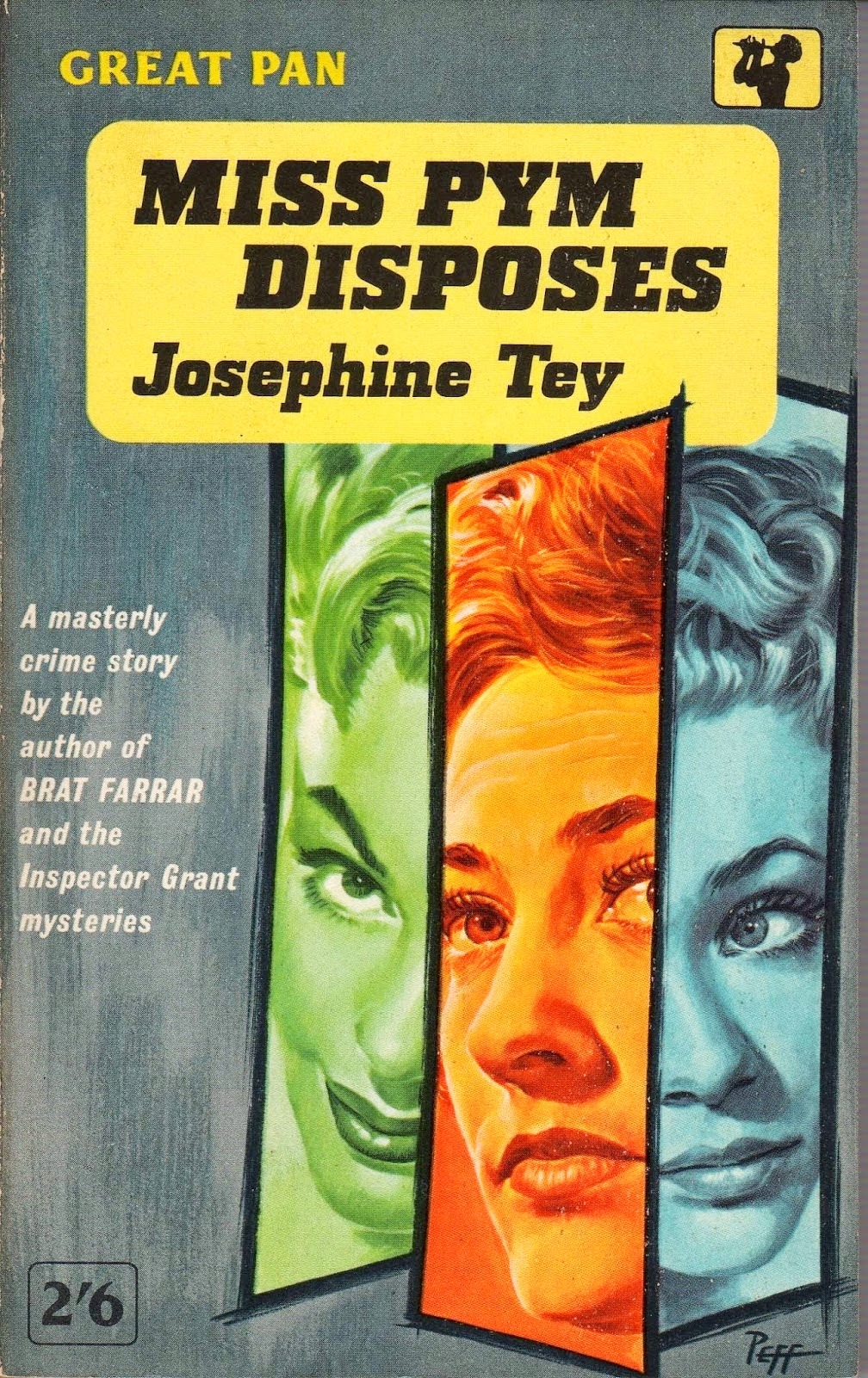
miss pym disposes josephine tey 1946 pan coverFirst off, the book in hand at present, Miss Pym Disposes by Josephine Tey  (1946). My ???th time reading, as Tey is a fixture on the favourites shelf. Miss Pym, amateur psychologist and unexpectedly bestselling author, visits an old school friend’s “physical training” college, and finds herself observing much more than mere gymnastics. A quietly humorous mystery story which works just as well as a “proper” novel, as do all of Tey’s too-few puzzle tales.  The details are wonderful. I haven’t yet properly reviewed Miss Pym Disposes, but I have previously said a few things about Pym’s first novel, The Man in the Queue (1929), and her later “double life” suspense novel, To Love and Be Wise (1950). As with everything by Josephine Tey, highly recommended. Late Golden Age mystery fiction at its very best.

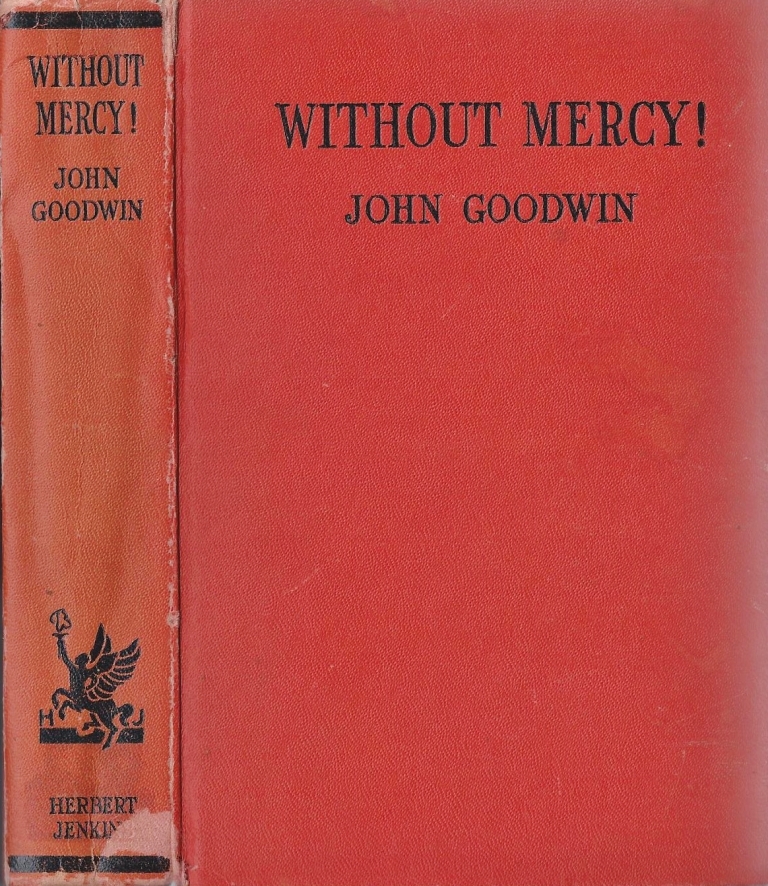
without mercy john goodwin 1920 001Without Mercy: The Story of a Mother’s Vengeance by John Goodwin (1920). This old thriller was pretty bad, but I did read it cover to cover, so it must have had some redeeming qualities. Its sheer melodrama kept me interested enough to follow the improbable twists and turns right up to the satisfyingly clichéd ending.  A beautiful virgin falls into hands of evil men in the South American jungle, is stripped naked and lashed with whips until point of death and then (by implication) raped, or at least threatened with rape. Fast forward some years, to the meeting of the ex-virgin and her chief assaulter, both now moving in London’s high society. Cue emotional confrontations, kidnappings, financial and political skulduggery, a barge on the Thames full of high explosives (BOOM!!!), incredible rescues (numerous), and a generous sloshing of chloroform (refer back to kidnappings: in aid of.) Eventually (page 300 or thereabouts) the bad dude gets his fatal comeuppance: “You have a revolver; you know what to do with it, Sir X. I will give you an hour to settle your affairs and write out a full confession before revealing all to the authorities!” (Or words to that effect.) The hero gets the lovely girl: “Go forward, children, and drink deep of the cup of Life. For me, at last, there is peace.” (Direct quote.) I think we could safely call this a period piece, and gently change the subject. Promotional note facing title page:

WHAT THIS STORY IS ABOUT

Mrs. Garth is the head of the last of the great private banks, Garth, Garth and Trelawnes. She has a genius for finance, and is also a great personage in the social world.

Madame Vampire, the director of Gordon’s Limited, the notorious moneylenders, is also a power; but not for good.

No one suspects the truth, that Mrs. Garth and Madame Vampire are one and the same woman.

Sir Melmouth Craven, of the sinister Sternberg Syndicate, desires to marry Mrs. Garth’s beautiful daughter, Margaret. He is humiliated, and determines to be revenged upon the mother versus the daughter.

The story is full of thrilling situations and exciting incidents.

Indeed.

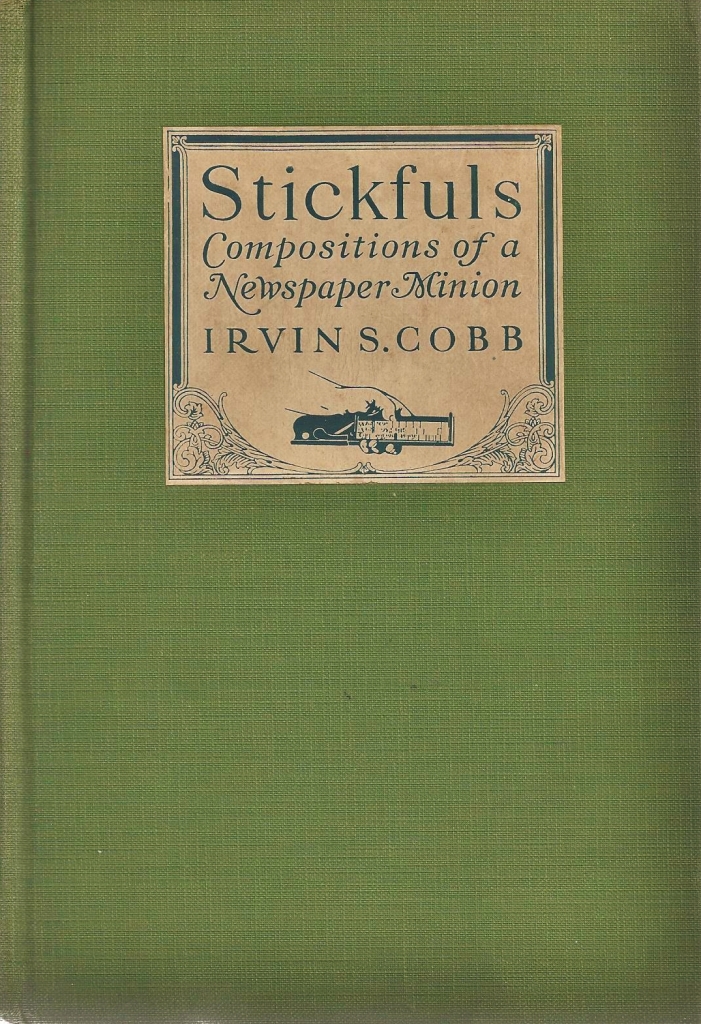
stickfuls irvin s cobb 1923 001Now for something rather different. Stickfuls: Compositions of a Newspaper Minion by Irvin S. Cobb (1923). (Later editions bear the title Myself – To Date.) This was a very enjoyable read, being the autobiographical account of the writer’s youth and early years making his way in journalism. Wryly humorous, self-revealingly honest, sometimes poignant, and always opinionated, this is a quietly glowing example of what memoir can be. I had no idea who Irvin S. Cobb was when I picked this book up last year in one of Vancouver’s overflowing used and rare book emporiums, Lawrence Books on the corner of Dunbar and West 41st (situated conveniently en route between the UBC Botanical Garden and Van Dusen Botanical Garden – fellow bookish horts take note), but a few moments browsing between its green linen covers convinced me to add it to my armful of vintage treasures. Now that I have made Mr. Cobb’s acquaintance, I find myself inclined to keep an eye open for some of his other writings, which I am sure will be very readable, if Stickfuls is a typical sample of this man’s smooth and clean prose.

A Wikipedia page details Cobb’s exceedingly full life and productive career. A very condensed summation:

Irvin Shrewsbury Cobb (June 23, 1876 – March 11, 1944) was an American author, humorist, editor and columnist from Paducah, Kentucky who relocated to New York during 1904, living there for the remainder of his life. He wrote for the New York World, Joseph Pulitzer’s newspaper, as the highest paid staff reporter in the United States.

Cobb also wrote more than 60 books and 300 short stories. Some of his works were adapted for silent movies. Several of his Judge Priest short stories were adapted for two feature films during the 1930s directed by John Ford.

That’s all for this morning, but now that I’ve broken the long silence I hope to get back into the habit of posting a bit more frequently.

Off to dig a few more post holes on the horribly steep hillside – a rather daunting but sorely overdue project, replacing a very tired split-rail Russell fence with something rather more sheep- and farm-dog-proof, to keep the critters properly confined.

Cheerio! And happy Sunday.


Read Full Post »

Right now I envy single-minded people who accomplish their tasks with minimal fuss. My own default mode this spring seems to have settled into doing “many things haphazardly” versus “one thing well”. And the poor book blog has suffered for it. The longer I put off posting the harder it is to sit down and focus. It doesn’t help that I’ve reorganized my little office area to place my desk beside the windows overlooking the garden and the bird feeders, with the river rolling along most picturesquely and distractingly in the background.

My devoted dog has taken to settling himself down on the garden path where he can make maximum eye contact with me whenever I glance outside. If I turn my head his way, he perks his ears and cocks his head and looks meaningfully towards the porch door, and if I so much as change position in my office chair he leaps to his feet, plumy tail waving madly – “Marvelous! She’s coming out!!” If I turn back to the computer screen he stands there hopefully, tail wagging slower and slower, until at last he gives up (for the time being) and subsides back into his canine version of Patience-on-a-monument, head resting on paws, eyebrows furrowed just a bit, eyes patiently pleading. Needless to say, one can only disappoint the poor fellow so many times before giving in and going out, and then it’s all over for any thought of working up a book post.

"Just look into my eyes...You are starting to feel an overwhelming urge to come outside....You will stop in the porch and fill your pockets with dog treats..."

“Just look into my eyes…You are starting to feel an overwhelming urge to come outside….You will stop briefly in the porch and fill your pockets with dog treats…”

This misty, moisty morning the dog in question is sprawled out blocking my office doorway, peacefully sleeping and occasionally twitching in his doggy dreams, all the while quietly emanating a faint but persistent aroma of Springtime Barnyard, reminding me why I don’t particularly hold with Big Fluffy Farm Dogs In The House, no matter how sweet their personality is.

Well, as I appear to be trapped here for a bit, perhaps I should take advantage of the temporary quiet in my world to slap up a blog entry of sorts.

First book on the stack, here we go.

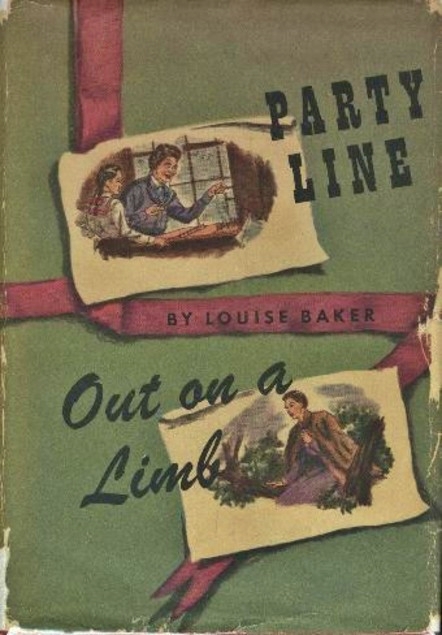
party line out on a limb louise baker djOut on a Limb/Party Line by Louise Baker ~ 1945/1946 ~This edition: Peoples Book Club, circa 1946. Hardcover. 376 pages.

My rating: 8.5/10 for the 2-book compilation, for sheer nostalgic enjoyment.

A good-natured pair of days-of-my-youth memoirs by Louise Baker published in an omnibus version. The first, Party Line, centers around the personality of a small California town’s telephone switchboard operator, Miss Elmira Jordan.

It was like putting oneself in the arms of a comfortable providence to relax in Miss Elmira’s efficiency.

Telephones were something of a luxury in Mayfield and their installation was limited enough for one operator to handle the exchange. That power behind the communication system was Miss Elmira Jordan, an aging spinster who loved her work. She regarded her profession as a calling – no pun intended. Had she been so inclined, Miss Elmira could have resigned her job and, with a few threatening letters to launch the enterprise, retired to a luxurious life of blackmail. But nothing so base as avarice would have uprooted her from her stool at the Bell Telephone Company…

Miss Elmira has her finger on the pulse of Mayfield, and her story is intertwined with that of all of the other inhabitants of this microcosm of 1920s-30s American small town culture. Mostly amusing and occasionally genuinely poignant. The author pens a loving memoir of a person and a place – and, incidentally, her own young self – without lapsing into sentimentality.

And as you will see if you read on, there was a fair bit left out in this memoir concerning the writer herself, no doubt to allow the main focus to remain on Miss Elmira.

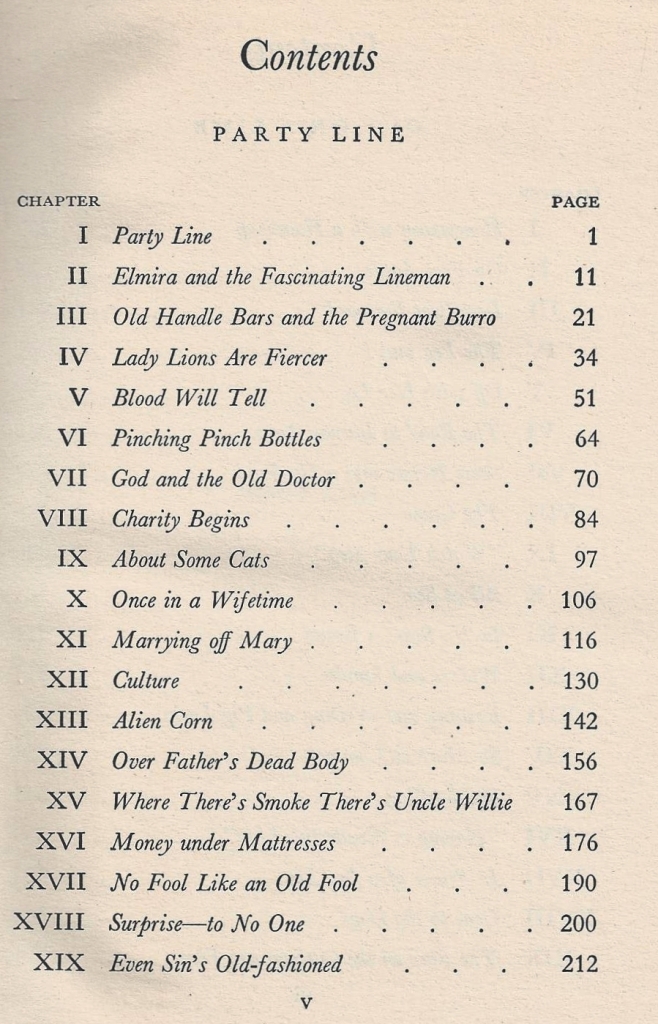
Here’s a peek at the Table of Contents. If you find this at all intriguing, this book is for you.

party line table contents louise baker 001

The second memoir comes as a bit of a shock, detailing as it does on the very first page a major life-changing event in the author’s personal history, not even hinted at in Party Line.

From Out on a Limb: (Click the highlighted link to take you to an online version.)

I became a minor celebrity in my home town at the precocious age of eight. This distinction was not bestowed on me because I was a bright little trick like Joel Kupperman, nor because I could play the piano like a velvet-pantalooned prodigy. I was, to keep the record straight, a decidedly normal and thoroughly untalented child. I wasn’t even pretty. My paternal grandmother, in fact, often pointed out that I was the plainest girl in three generations of our family, and she had a photograph album full of tintypes to prove it. She hoped that I’d at least be good, but I didn’t achieve my fame because of my virtue either. My memorable record in the annals of the town was the result of mere accident.

Completely against parental advice, I took an unauthorized spin on a neighbor boy’s bicycle. It was a shiny red vehicle that I admired inordinately but thoroughly misunderstood. I couldn’t even reach the pedals. However, I started a perilous descent of a hill, yelling with giddy excitement. At the bottom, I swung around a corner where I entangled myself and bicycle with an oncoming automobile. As part, apparently, of an ordained pattern, the car was piloted by a woman who was just learning to drive. Her ignorance and mine combined to victimize me.

A crowd gathered. Strong arms lifted me. I had a momentary horrified clarity during which I screamed “Mama!” as I got what proved to be a farewell glimpse of my right leg…

Yes indeed, Louise Baker was a child amputee due to the aforementioned 1917 accident, and her penning of this particular memoir was apparently commissioned by the US government to provide inspiration for combat-injured World War II soldiers as they began to return to “normal” life.

Kirkus in 1946 sums it up:

A debonair autobiographical account of a girl with one foot in the grave, of the particular problems of a uniped which in no way kept her from leading a round life. She was eight when she lost her leg, and acquired 17 dolls and a spoiled disposition which was spanked out of her when she returned from the hospital. Despite her handicap she managed to roller skate, swim, play tennis; she went to Europe alone, married, briefly, a professor, reported for several newspapers, taught, and eventually met the right man and went to Arizona. There she wrote Party Line (1945). This is a humorous and good humored approach to a loss which was only physically crippling. The book should have much to hearten amputees, without the more obviously inspirational quality of Betsey Barton’s And Now To Live Again.

Baker’s account of life as a “uniped” borders on just a bit too perky and positive, but she points out the negative aspects of her physical state often enough to keep it real. For example, a unique sort of pitfall in Louise’s young adult social life was the persistent appearance of men who were attracted to her because of her amputation; these “amputee devotees” are apparently not as rare as one would think, and the phenomenon is a recognized “disability fetish”. Who knew?!

Louise Baker wrote at least one more fictionalized memoir, 1953’s Snips and Snails, an account of life as a dorm matron at an exclusive Arizona boys’ school.

These memoirs were easy reading, with enough substance backing up the playful tone to justify tucking this book onto the keeper shelf, alongside similar personal accounts by Betty MacDonald and Rosemary Taylor.


Read Full Post »

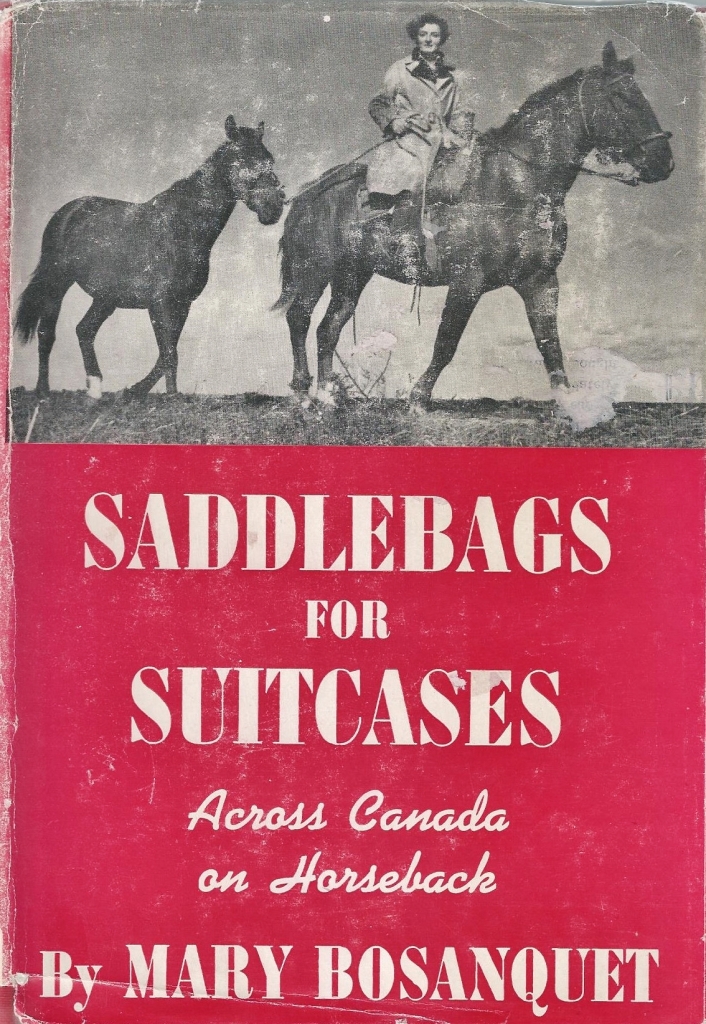
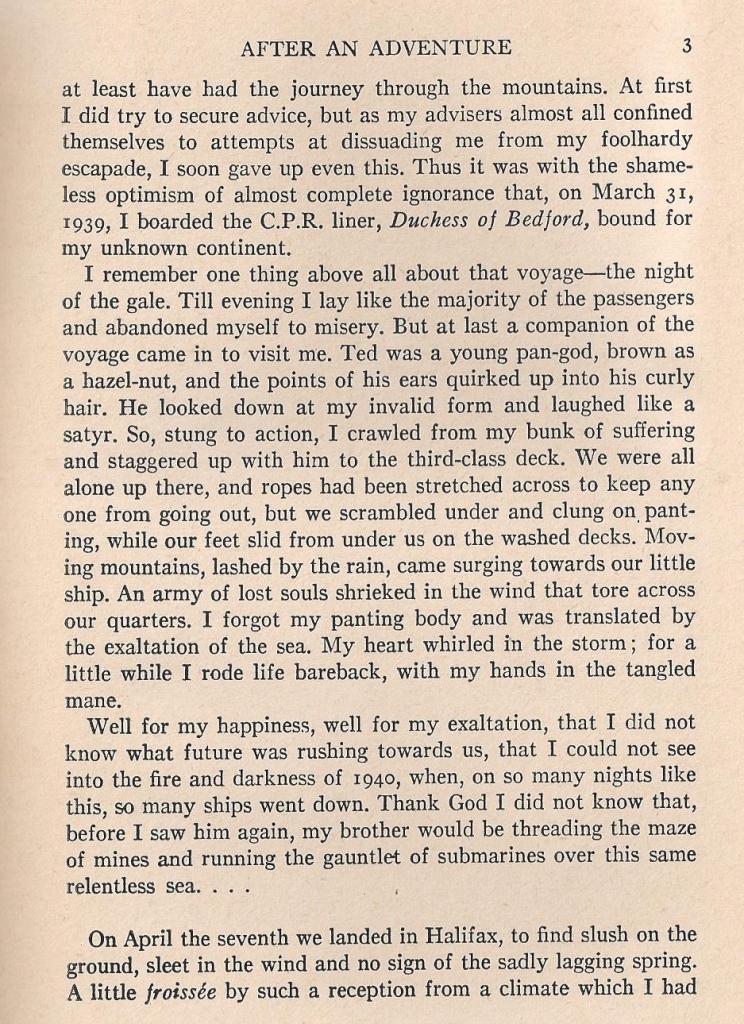
saddlebags for suitcases mary bosanquet 1942 001Saddlebags for Suitcases: Across Canada on Horseback by Mary Bosanquet ~ 1942. This edition: McClelland and Stewart, 1942, 4th printing. Hardcover. 247 pages.

My rating: 9/10

Every year the Rotary Club in a nearby small city holds a massive, week-long book sale. Every year I come away with boxes of books, and out of these boxes there always emerges at least one or two hidden gems. This year that designation goes, hands down, to this unexpected find.

In 1939 a young Englishwoman in her early 20s had an unusual idea, and, being of a straightforward nature and having a methodical sort of mind, set about to see if she could bring the thought into reality.

With the coming war looming on the near horizon, Mary Bosquanet, daughter of a diplomatic family (her father, Vivian Bosanquet, was the British Consul-General in Frankfurt from 1924 to 1932), decided that the time was ripe for a grand enterprise, a heroic self-imposed adventure, to be undertaken before the world erupted once again into widespread conflict. It would be something to remember in the dark days to follow.

Perhaps inspired by the accounts of Aimé Tschiffely, who from 1925 to 1928 made a 10,000 mile horseback journey from Buenos Aires to New York City, Mary Bosanquet, a lifelong horsewoman and an accomplished rider, decided to try for a relatively more modest but still astoundingly ambitious solo horseback ride: right across Canada from Vancouver heading East.

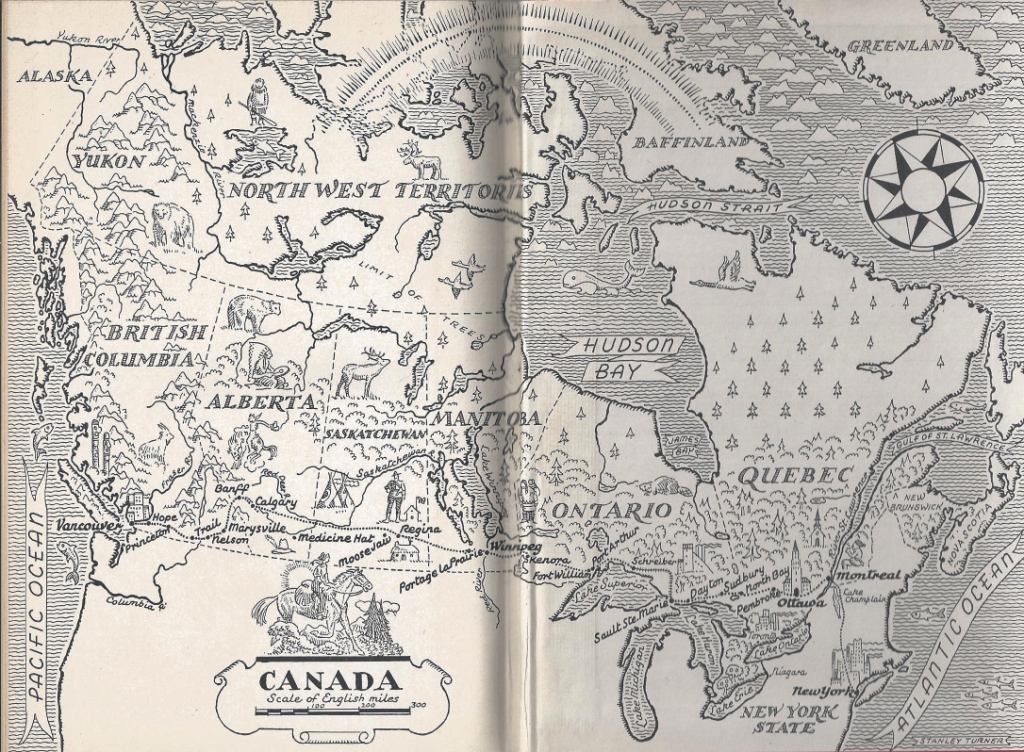
Mary and her horses Timothy and Jonty achieved the goal, covering an estimated 3800 miles of horse trail, back road, and highway in eighteen months. Of this time, the winter of 1939-40 was spent hosted by a farm family in Ontario. Mary then continued on to Montreal, and then rode south to New York City, where she set sail back to England, to do her part in the war which had indeed broken out shortly after she embarked upon her ride.

map endpapers saddlebags to s bosanquet 001

The trek was not without setbacks. Mary’s first horse, Timothy, chosen from the working herd of the legendary Douglas Lake Ranch near Kamloops, B.C., started showing symptoms of chronic lameness during the challenging Rocky Mountain crossing from B.C. to Alberta. In Calgary Mary acquired another horse, Jonty, to spell Timothy off, and the trio made it to Ontario together, where Timothy was given an honourable retirement from the trek, finding a less strenuous home where his duties required merely short jaunts versus the pounding day-after-day demands of the long-distance journey. Mary continued on Jonty, and the two rode into New York City on a November day in 1940, escorted by an honour guard of mounted policemen, through Harlem, the Bronx, Central Park and into the Mounted Police Barracks.

Mary herself was injured several times during the ride, first breaking her wrist and later seriously fracturing her arm when she and Jonty were enjoying a wild springtime gallop which ended disastrously when the horse stumbled and Mary was thrown against a tree.

She was the recipient of much attention from newspaper reporters as the trek proceeded, was surprised by several offers of marriage from smitten cowboys, attended the Calgary Stampede and was inspired by the displays there to try out bronc riding herself with reasonably successful results, for though she was unseated several times she felt she had figured out the stick-to-the-horse technique quite nicely, learning through doing, as it were. During the later stage of her journey Mary even visited the Dionne quintuplets, and her wry commentary on that experience is a fascinating glimpse at that particular social phenomenon.

During her winter in Ontario, Mary was astounded to learn that she had been publically labelled as a German spy by the very newspapers which had initially applauded her enterprise. Apparently her unlikely undertaking combined with her frequent picture taking and her fluency in German (remember that she spent a number of years in Germany as the British Consul-General’s daughter) were suddenly seen as highly suspicious. Mary lived those slanders down, but one can tell that the slurs stung; she was already agonizing about not being “home” to help out with the war effort, and she debated ending the trek and heading back to England immediately. Encouraged by friends and family to continue, Mary did so, but ended the Canadian odyssey in Montreal, heading from there into the United States, to New York City, and thence home.

Mary kept a journal throughout the trip, though frequently weeks would pass between entries, for she was in a constant state of physical exhaustion while on the road, and writing up the day’s travels was not a priority. Enough was noted to make a fascinating framework for this account, and Mary’s personal musings embellish the exceedingly realistic account of travelling on horseback, finding a place to settle each night (Mary preferred asking for accommodation at farms and homesteads along the way; occasionally she slept under the stars) and the challenges of feeding both herself and her two horses.

She pulled the enterprise off with a budget of eighty English pounds – the equivalent of about £5000 today, or $9500 Canadian dollars, and, needless to say, relied greatly on the kindness of strangers throughout the trip. (My husband, after reading the book, joked that Mary should be the patron saint of today’s couch surfing travellers – finding constant free or very cheap accommodation for herself plus two equine companions was something of a noteworthy accomplishment all on its own, in his opinion. I hadn’t quite seen it that way, but I quite agree!)

I greatly enjoyed Mary Bosanquet’s account of her journey. She has a self-deprecating but never meek voice, a healthy sense of humour, and strong opinions ably defended. I liked her a whole lot by the end of her journey, enough so that I have sought out and ordered her two later memoirs, 1947’s Journey into a Picture, concerning her post-war social work with the YMCA in Italy after her return from Canada, and 1962’s The Man on the Island, an account of a year spent in Oxford.

Saddlebags for Suitcases is, in general, very competently written, but it has amateurish moments throughout, such as the author’s insistence on sharing her attempts at poetry, which, though adding to the charm of this from-the-heart memoir, also bring forth the lifted eyebrow, because to be quite brutally honest she’s not really much of a poet, except in the talented schoolgirl sense. There are great gaps in the narrative as well – and understandably so! – for one day of riding through Saskatchewan is surely much like another.

I loved the early chapters describing the travels through British Columbia, and the journey through the mountains following trails which have now become the Hope-Princeton highway. The changes between then and now are quite astounding; B.C. readers will love the contrast between the still-rural Fraser Valley of the 1930s and today’s overflow-from-Vancouver smog-shrouded sprawl.

The book is a marvelous bit of Canadiana, and a very telling piece of World War II memorabilia, though the action takes place far from the site of the actual conflict.

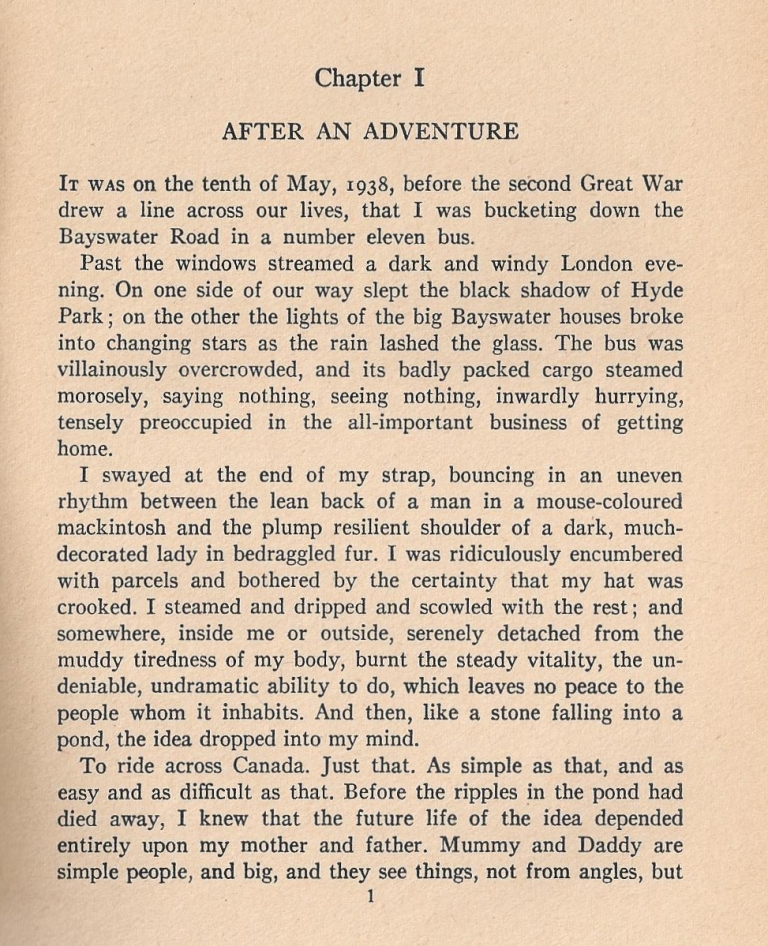
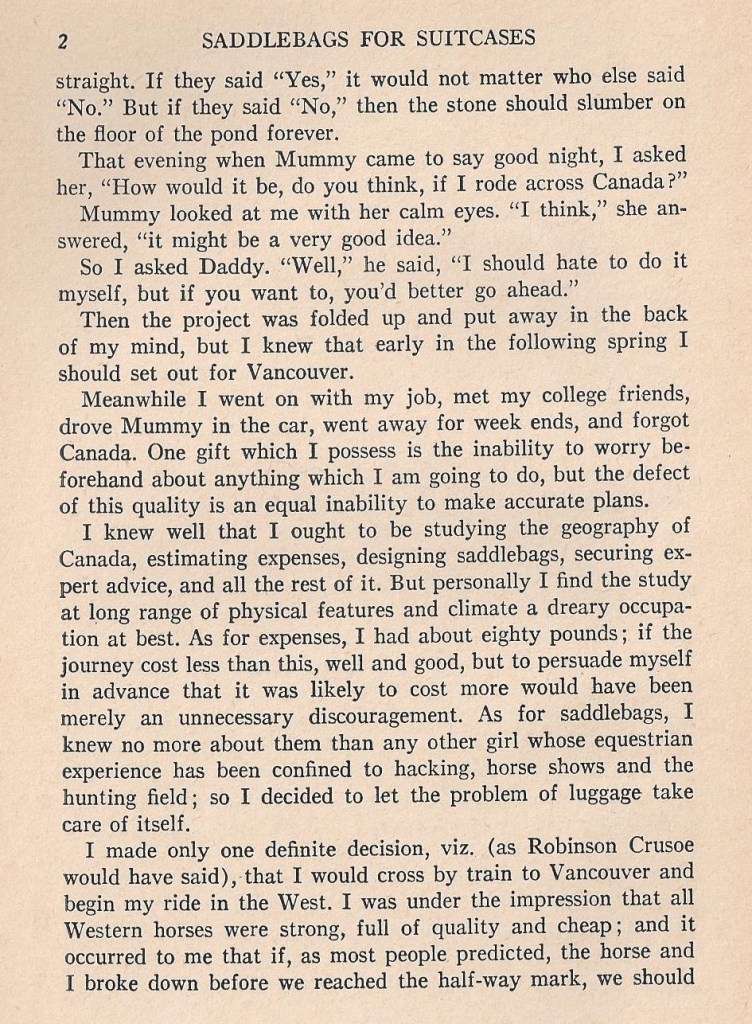
Here are the first  three pages, for those who think this might be a diverting read. The book is in good supply on ABE, and is available as a print-on-demand book through the Long Riders’ Guild publishing division.

saddlebags mary bosanquet pg 1 001saddlebags mary bosanquet pg 2 001saddlebags mary bosanquet pg 3 001 (2)

Read Full Post »

Queen Anne's Lace - end of summer - two years ago at White Rock, B.C.

Queen Anne’s Lace – end of summer – two years ago at White Rock Beach, B.C. Seems like that particular road trip happened only just yesterday… insert desired cliché about the ever-more-swift passage of time here…only four more months of this particular year left now – where did it go?!


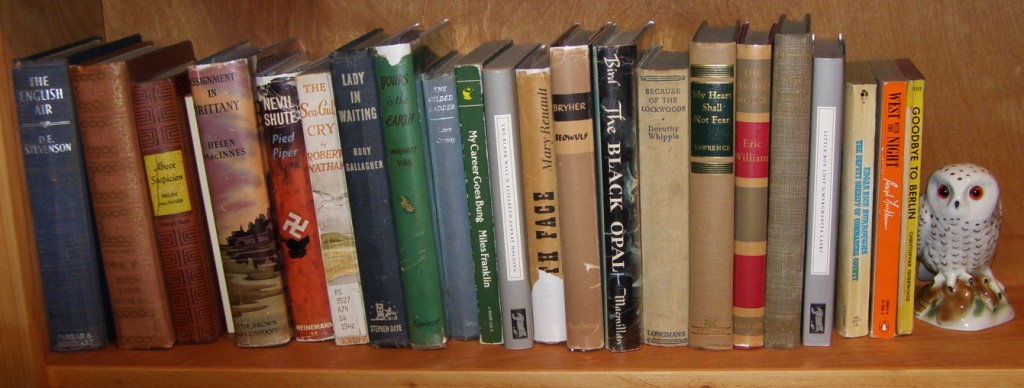
This second completed decade in my 2014 Century of Books Project consists of books which are, predictably because of the era, either directly concerned with World War II, or refer to it as an off-stage plot element. Only two make no reference to it at all, namely Edgar Rice Burroughs’ The Deputy Sheriff of Comanche County (published in 1940 as pulp magazine serial – pure entertainment), and Miles Franklin’s My Career Goes Bung (written several decades before its 1946 publication.)

There were so many books to choose from in reading for this decade; the difficulty was not in finding likely candidates but in deciding which ones to set aside. As it is I have doubled up (and in some cases tripled and quadrupled) on many of the years; I have had to say firmly to myself: “No more!”

Digression alert! Regarding the ratings out of 10 – these are merely a reflection of my personal response to what I am reading, and how satisfying an experience it turns out to be for me. The ratings in no way represent “literary merit”, for Hugh Walpole’s novel The Blind Man’s House, rated below at 5.5, is decidedly superior in every literary sense to D.E. Stevenson’s The English Air (9) and Crooked Adam (6.5). But I expected more from Walpole, and his relatively lesser rating means merely that I didn’t feel that my readerly desires were fully satisfied compared to how well they they could have been from a writer of his calibre. Not meaning to pick on Hugh Walpole, and to audaciously celebrate D.E. Stevenson – merely using them for examples as they are handily first on the list.

Now we may proceed. 🙂

I’ve again highlighted a few as worthy of extra notice – scroll down to the bottom for another award lists.

???????????????????????????????

And here they are, in their (mostly) tattered and well-read glory.

1940 ~ The English Air by D.E. Stevenson ~ A half-German, half-English young man visits England in the year before the start of World War II. Is his visit strictly social, or something more sinister? A rather low-key storyline compared to 1942’s super-dramatic Crooked Adam, but quite lovely in its character portraits. (9/10)

1941 ~ The Blind Man’s House by Hugh Walpole ~ A complex psychological drama concerning the effects of the blindness of  Sir Julius Cromwell on his wife, his friend, and the many characters who make up the Cromwell household and social circle. I thought it reminiscent of Lady Chatterley’s Lover, though – I hasten to add – without the “John Thomas” scenes. Walpole’s Ladyship doesn’t indulge in such extra-marital escapades. (5.5/10)

1942 ~ Crooked Adam by D.E. Stevenson ~ Schoolmaster Adam Southey, refused entry into the Services due to a childhood injury, instead proves his patriotism by chasing down Nazi spies in the wilds of Scotland. Highly contrived, and hugely unlikely, but a good example of a “Hurray for our side!” wartime entertainment. (6.5/10)

1943 ~ Lady in Waiting by Rory Gallagher ~ A frothy and light satire about an upper-middle-class American pregnancy, with few of the details spared. Vintage Mommy-Lit, in other words, and really rather fun in its own way, though the relentlessly chirpy voice of the narrator occasionally has me wanting to (temporarily, not fatally) smother her with one of her voluminous pregnancy smocks. (6.5/10)

1944 ~ Yours is the Earth by Margaret Vail ~ Non-fiction/personal account. A sober yet impassioned personal account of an American woman’s wartime experience in France. Married to a member of the French upper class and left alone to care for their young daughter and the family estates when he is interned by the German forces, Margaret must decide for herself how to proceed, which she does with steadfast resolve and an immense contempt for the enemy race. (10/10)

1945 ~ The Gilded Ladder by Laura Conway ~ A formulaic historical fiction/domestic drama about a social climbing Victorian and her musically adept young niece. By the prolific author Dorothy Phoebe Ansle, who published 100 novels between the 1920s and 1980s, under various pseudonyms including Laura Conway and Hebe Elsna. Well-written for its genre but ultimately forgettable. (5/10)

1946 ~ My Career Goes Bung by Miles Franklin ~ Another version of My Brilliant Career’s Sybylla rants against the misunderstanding her teenage bestseller has attracted, as she finds her way into and out of Sydney literary society. Published several decades after its completion, and a bit dated in its references, but nonetheless a diverting read with a gloriously full-of-herself heroine. (9/10)

1947 ~ The Blank Wall by Elisabeth Sanxay Holding ~ A cleanly written noir novel centered on a devoted mother’s protection of her teenage daughter from a blackmailer after an inconvenient man turns up very dead. (9.5/10)

1948 ~ North Face by Mary Renault ~ A gloomy post-World War II novel concerning the emotional traumas of Neil and Ellen, and their coming to terms with their tragic pasts and gleam-of-hope futures. A rock climbing theme prevails, all Freudian and symbolic. (6/10)

1949 ~ The Wooden Horse by Eric Williams ~ Non-fiction/personal account. A clever and dangerous escape from Stalag Luft III is described by one of the participants. Enthralling! (8.5/10)

And the “bonus” books:

1940 ~ The Deputy Sheriff of Comanche County by Edgar Rice Burroughs ~ The epitome of pulp “western” fiction, by the creator of the immortal Tarzan. Wrongly accused of the murder of his romantic interest’s father, rancher/deputy sheriff Buck Mason seeks the real killer while visiting a dude ranch disguised as an Eastern polo player. He sorts everything out, nails the real villains, and finds true love. Did we ever doubt the outcome?! (4/10)

1941 ~ Above Suspicion by Helen MacInnes ~ An Oxford don and his wife undertake a secret spying mission in Europe as the clouds of war gather overhead. (8.5/10)

1942 ~ Assignment in Brittany by Helen MacInnes ~ An English officer is sent to Brittany on a spying mission, with the lucky coincidence of being able to masquerade as a convenient double who was evacuated to England at Dunkirk. Much drama and a fair bit of bloodshed. (9/10)

1942 ~ Pied Piper by Nevil Shute ~ Shute’s fast-moving and exceedingly likeable propaganda novel, starring a stoic elderly Englishman rescuing an eclectic group of endangered children from Nazi-occupied France in the early years of World War II. Not very believable, perhaps, but a good yarn nonetheless. (9.5/10)

1942 ~ The Sea-Gull Cry by Robert Nathan ~ An über-light novella concerning a winsome pair of Anglo-Polish war refugees shoehorned into a dreadfully upbeat formula romance between the eldest sibling, 19-year-old Louisa, and a middle-aged history professor, Smith. The 7-year-old brother Jeri provides cuteness and pathos. (3/10)

1942 ~ West with the Night by Beryl Markham ~ A slightly uneven but overall excellent memoir telling of the author’s youth in Africa and her experiences training racehorses and later learning to fly small planes. Beryl eventually became the first person to solo-fly the Atlantic from East to West. An amazing woman; a very readable personal account of her earlier days. (9.5/10)

1945 ~ Goodbye to Berlin by Christopher Isherwood ~ A series of linked episodes gleaned from Isherwood’s own experiences in mid-wars Berlin, 1930-33. Utterly chilling from our historical perspective; utterly fascinating for the character portraits the author produces. This is the “I am a camera book”, and one of those character portraits is off the now-ubiquitous Sally Bowles. (Made famous by Liza Minnelli, and now a staple turn in every small town triple-threat dreamer’s stage-struck repertoire.) (10/10)

 1946 ~ The Sudden Guest by Christopher La Farge ~ A bitter, deeply egotistical elderly woman copes with a rising hurricane at her Rhode Island summer home and mulls over the differences between now and the last great storm only a few years earlier. Perhaps a metaphor for American and her stance regarding world politics of the time? (7/10)

 1948 ~ Beowulf by Bryher (Annie Winifred Ellerman) ~ A London teashop in the Blitz is at the heart of this linked series of vignettes and character portraits. This is fantastic, in a beautifully subfusc way. A writer to explore further. (9.5/10)

1949 ~ The Black Opal by Dorothy Maywood Bird ~ A sweetly charming period piece aimed at the teen girl set of its day. Laurel heads off to co-ed college and mixes her studies with a full social life, the acquisition of a beau, and the solving of an old murder mystery. Pure fluff; great fun! (6/10)

1949 ~ Because of the Lockwoods by Dorothy Whipple ~ The tale of two families and their unequal relationship, due in large part to a secret wrong perpetrated by the father of one family upon the widowed mother of the other. (9/10)

1949 ~ Little Boy Lost by Marghanita Laski ~ Verging just the tiniest bit on bathos is this suspenseful tale of an English officer returning to France immediately after the end of WW II to seek for the little boy he saw only once as a newborn baby, child of a tragically brief wartime marriage with a French Resistance worker. (7.5/10)

1949 ~ My Heart Shall Not Fear by Josephine Lawrence ~ A complicated domestic drama following a number of characters through times of challenge in post-World War II America. Domesticity and the roles of women are key features here. The writing is nothing special, but acceptable; the plot has moments of interest but the author tends to over-emphasize her key points, driving them home with a sledgehammer – a certain lack of finesse. (5/10)

 Most Beautiful Writing Award:

  1. West with the Night by Beryl Markham ~ 1942
  2. Goodbye to Berlin by Christopher Isherwood  ~ 1945

Marshmallow Award (for purest fluff):

  1. The Deputy Sheriff of Comanche County by Edgar Rice Burroughs ~ 1940
  2. The Black Opal by Dorothy Maywood Bird ~ 1949
  3. Lady in Waiting by Rory Gallagher ~ 1943

Don’t-Expect-Many-Smiles Award:

  1. The Sudden Guest by Christopher La Farge  ~ 1946
  2. The Blank Wall by Elisabeth Sanxay Holding ~ 1947
  3. North Face by Mary Renault ~ 1948

Sturdy British Manhood (Fictional) Award:

  1. Crooked Adam by D.E. Stevenson ~ 1942

Karma-is-Grand Award:

  1. Because of the Lockwoods by Dorothy Whipple ~ 1949

Waste-of-Precious-Reading-Time Award:

  1. The Sea-Gull Cry by Robert Nathan  ~ 1942

Read Full Post »

I’m pushing forward with the Century of Books project and am attempting to clear the decks  – or would that be the desk? – for the next four and a half months’ strategic reading and reviewing, so these four books from the last month or two are getting the mini-review treatment. All deserve full posts of their own; I may well revisit them in future years. Though in the case of the three most well-known, Christopher Isherwood’s Goodbye to Berlin, Beryl Markham’s West with the Night, and Marganita Laski’s Little Boy Lost, there has already been abundant discussion regarding their merits and literary and historical context. I might just concentrate my future efforts on the most obscure of these particular four, Christopher La Farge’s The Sudden Guest, which I have earmarked for a definite re-read.
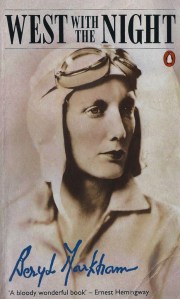
west with the night beryl markham 1942West With the Night by Beryl Markham ~ 1942. This edition: Penguin, 1988. Paperback. ISBN: 0-14-011539-0. 257 pages.

My rating: 9.5/10

In a word: Lyrical

Beryl Markham was born in England and moved to Kenya with her parents when she was 4 years old. Her mother soon had enough of colonial life and returned to England. Small Beryl remained with her father, and grew up in a largely masculine atmosphere made up of her father’s aristocratic compatriots, visiting big game hunters, and the native farm workers and independent tribesmen.

A highly skilled horsewoman, Beryl became a licensed racehorse trainer in Nairobi at the age of 17, after her father’s farm was wiped out during a severe drought, and he gave her the choice of accompanying him to South America for a fresh start, or staying in Africa to go it alone.

Beryl chose Africa, this time and, ultimately, forever more, dying there in 1986 at the age of 84, still staunchly independent, still very much on her game.

Beryl Markham was introduced to flying by her friend and mentor Tom Black, and took to the air with the same innate skill as she dealt with horses. She eventually concentrated strictly on flying, working as a contract pilot in East Africa, and hobnobbing with the famous (notorious?) aristocratic expatriates making homes and lives in Kenya during the 1920s and 30s, including Karen Blixen, Karen’s lover Denys Finch-Hatton (whom Beryl had her own affair with), Baron Blixen himself (Beryl was his pilot during scouting trips for wild game), and others of that large-living “set”.

In 1936 Beryl set out to attempt a solo flight over the Atlantic, from England to New York. She only just made it across, as an iced-up fuel line forced her crash landing in a bog on Cape Breton. The semi-successful attempt brought Beryl Markham much fame; she continued on with her flying career, though she ended her days once again training African racehorses.

In 1942 West with the Night was published, to much acclaim. It is a memoir made up of chapter-length vignettes of Beryl’s childhood and her experiences with horses, and, most beautifully described, her experiences in the air, including an account of the Atlantic flight. The language is both elegant and heartfelt; I used the term “lyrical” to sum up this book, and that is exactly what this is. Really a stellar piece of work.

There has been much speculation as to who really wrote this book. Many have theorized that Beryl had at least some help with it. Her third husband, Raoul Schumacher, was a journalist who also worked as a ghostwriter; the noted aviator and writer Antoine de Saint Exupéry, another of Beryl’s lovers, had a similar writing style. No one knows for sure, as Beryl firmly maintained that the work was completely her own, though her compatriots were stunned when the book came out as they had never known Beryl to be anything of a writer, and she never produced anything after 1942’s West with the Night.

No matter. This is an elegant bit of memoir, well worth reading for the beauty of its prose, and for the portrait it paints of its twin subjects: the truly unique Beryl Markham and her lifelong strongest love, Africa.
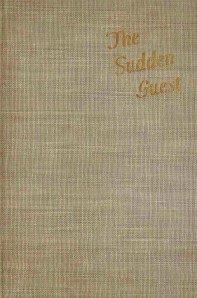
sudden guest christopher la farge 1946 001The Sudden Guest by Christopher La Farge ~ 1946. This edition: Coward-McCann, 1946. Hardcover. 250 pages.

My rating: 7/10 for this first encounter, quite likely to be raised on a re-read.

In a phrase: Bitter musings of a self-centered spinster

Oh, golly, where to start with this one. I can’t quite remember where I got it; likely from Baker Books in Hope, B.C. I remember leafing through it in a bookstore, hesitating, and then deciding it was worth a gamble. Another small triumph of bookish good luck, as it is an intriguing thing, and well worth reading.

It is autumn of 1944, and sixty-year-old Miss Leckton maintains a summer house on the  Rhode Island shore; her primary home is her New York apartment. Living alone except for a middle-aged married couple who caretake for her, and a daily housekeeper, Miss Leckton has much time to spend in introspection, and what a lot of self-centered opinions she has assembled, to be sure.

Miss Leckton is supremely selfish and egotistical. She has cast off her closest relative, her niece Leah, due to Leah’s engagement to a young Jewish man. For Miss Leckton hates the Jews. (She muses that Hitler, for all his undoubted faults, has the right idea about suppressing them.)  She doesn’t think much of the Negroes, either, which makes thing a tiny bit awkward as her resident married couple, the Potters, are black. The local Rhode Islanders are beneath her notice, mere country bumpkins. One actually has a hard time identifying whom exactly Miss Leckton identifies with herself; she is that uncommon creature, “an island unto herself”, to paraphrase John Donne, who doesn’t appear to want or need anyone, and is steadfast in her self-superiority to everyone around her.

Now a hurricane is reported to be blowing in , and Miss Leckton is reluctantly preparing to batten down the hatches, so to speak, though she persists in thinking that the radio reports are over-hysterical. For hasn’t Rhode Island just barely recovered from a brutal storm, the hurricane of 1938? Another just wouldn’t be fair…

I will turn you over to the Kirkus review of 1946, which is quite a good summation of the style of The Sudden Guest, though the comparison to Rumer Godden’s Take Three Tenses is not entirely accurate, in my opinion. There are enough similarities in technique to let it stand, though.

An absorbing and compelling story — a psychological study of a selfish, ingrown old woman, who has to live through two hurricanes on the Rhode Island shore to learn that life demands human participation. La Farge has done a superb tour de force-it isn’t really a novel, though it has the ingredients, and he has used the technique of Rumer Godden’s Take Three Tenses – the story is told as a fugue. With the two storms (1938 and 1944) as protagonists, he telescopes two experiences, as Miss Leckton, vainly attempting to preserve a way of life that has no validity today, relives the invasion of uninvited guests in the earlier storm, in bitter contrast to her utter aloneness in this one. The thread of personalities that hold the pattern is her conflict with her young niece, who forces her out of her outmoded approach to life into a real world. There is a muted quality of suspended action in the present in strong contrast to the pace of memory in the past, with the motif of the storms accenting the drama.

I searched online for more mention of this unusual and well-written novel and found a really good review, including a creative analysis of what Christopher La Farge was really going on about – the American isolationism prior to the U.S.A.’s entry into World War II, and, to a lesser degree, Miss Leckton’s denial of her own “homoerotic feelings”. Check it out, at Relative Esoterica.
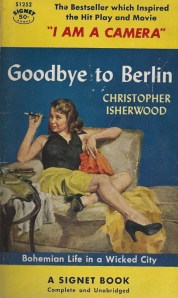
Check out this vintage cover: "Bohemian Life in a Wicked City"

Check out this vintage cover: “Bohemian Life in a Wicked City”

Goodbye to Berlin by Christopher Isherwood ~ 1945. This edition: Signet, 1956. Paperback. 168 pages.

My rating: 10/10

A Berlin Diary (Autumn 1930)

From my window, the deep solemn massive street. Cellar-shops where the lamps burn all day, under the shadow of top-heavy balconied façades, dirty plaster frontages embossed with scrollwork and heraldic devices. The whole district is like this: street leading into street of houses like shabby monumental safes crammed with tarnished valuables and second-hand furniture of a bankrupt middle class.

I am a camera with its shutter open, quite passive, recording, not thinking. Recording the man shaving at the window opposite and the woman in the kimono washing her hair. Some day, all this will have to be developed, carefully printed, fixed…

Oh gosh. This was so good. So very, very good.

Why haven’t I read this before?

Perhaps because I have always associated it with the stage and film musicals titled, variously, I am a Camera and Cabaret (cue Liza Minnelli) which were inspired by the book, or rather by one episode early on featuring teenage not-very-good nightclub singer Sally Bowles and her apparent intention of sleeping with every man she comes across whom she thinks might possibly become a permanent patron.

But this book goes far beyond the tale of Sally Bowles, memorable though she is with her young-old jaded naivety and her chipped green nail polish and her heart-rending abortion scene.

Christopher Isherwood has fictionalized his own experience as an aspiring writer in 1930s’ Germany, where he made a sketchy sort of living teaching English to respectable young ladies while spending his free time hanging out with (and observing and recording the goings-on of) the artsy crowd and the cabaret performers and patrons of Berlin’s hectically gay (in every sense of both words) theatre and entertainment district.

Goodbye to Berlin is superbly written, deeply melancholy at its core, and only occasionally sexy. It’s a rather cerebral thing, thoughtful as well as charming and deeply disturbing, picturing as it does Berlin between the wars and the numerous characters doomed to all sorts of sad fates – at their own  hands as much as through falling afoul of the Nazi street patrollers.

Am I making Goodbye to Berlin seem gloomy? I hope not, because it isn’t. It is poignant, it is funny, it is occasionally tragic, but it is never dull, never gloomy. And Isherwood’s Sally Bowles – who is really something of a bit player in Goodbye to Berlin, appearing only in one episode of these linked vignettes – is a much different creature than that portrayed on stage and film.

The internet is seething with reviews of Goodbye to Berlin, if this very meager description makes you curious for more.

Christopher Isherwood, I apologize for my previous neglect. And I’m going to read much more by you in the future. This was excellent.

A must-read.

(Says me.)
little boy lost marghanita laski 1949 001Little Boy Lost by Marghanita Laski ~ 1949. This edition: Persephone Books, 2001. Afterword by Anne Sebba. Softcover. ISBN: 1-903155-177. 230 pages.

My rating: 7.5/10

My feeling after reading: Conflicted

I had such high hopes for this novel, and for the most part they were met, but there was just a little something that didn’t sit quite right. Perhaps it was the ending, which I will not foreclose, merely to say that I thought the author could have held back the final episode which provides “proof” of the identity/non-identity of the lost child. It felt superfluous, as if Laski did not trust the reader decide for oneself what the “truth” was. Or, perhaps, to go forward not quite sure of that identity. Knowing one way or the other changed everything, to me, and oddly lessened the impact of what had gone on before.

Most mysterious I am sure this musing seems to those of you who have not already read this novel; those who have will know what I am going on about.

In the early days of World War II a British officer marries a Frenchwoman. A child is born, the Englishman must leave; the child and his mother stay in France. In 1942 the child’s mother, who is working with the Resistance, is killed by the Gestapo. The child is supposed to have been taken to safety by another young woman; on Christmas Day of 1943 the father learns that his son has been somehow lost; no one knows where the baby has been taken.

In 1945, with the war finally over, the father returns to France to seek out his child, whom he remembers only as a newborn infant. A child has been located who may be the lost John – “Jean” – but how can one be sure?

Well written, with nicely-maintained suspense and enough verisimilitude in the reactions of would-be father and might-be son to keep one fully engaged. I will need to re-read this one; perhaps I will come to feel that the author’s approach to the ending is artistically good, though my response this first time round was wary.

Interesting review here, at Stuck-in-a-Book; be sure to read the comments. No spoilers, which is beautifully courteous of everyone. 🙂 I must admit that my own easily-suppressed tears were those of annoyance at the last few lines, as I thought they weakened what had gone before.

But on the other hand…

You will just have to read it for yourself. And you really don’t want to know the ending before you read it; the suspense is what makes this one work so well.


Read Full Post »
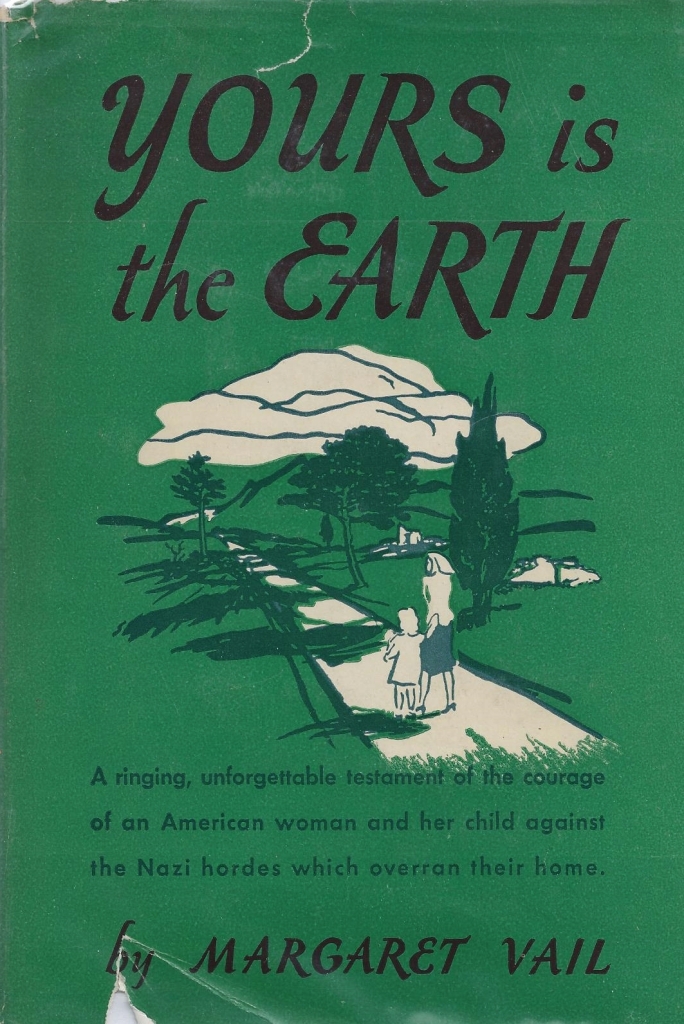
yours is the earth margaret vail 1944 dj front 001Yours is the Earth by Margaret Vail ~ 1944. This edition: Lippincott, 1944. Hardcover. 287 pages.

My rating: 10/10

Provenance: The Final Chapter, 1157A 3rd Ave., Prince George, B.C. – I have never walked out of this smallish but well-organized, eclectically stocked, jam-packed used book store empty-handed. If you’re ever in P.G., it’s very much worth a visit and a browse.

Yours is the Earth was a last-minute impulse buy earlier this year, a small triumph of instinct and luck over economy. As you can see, the cover isn’t terribly compelling – the “ringing, unforgettable testament of courage” and “Nazi hordes” references leading one to think that this may not be particularly well written, and perhaps slightly overwrought in tone.

If you think that (as I did) you’d be wrong; this is a remarkable work. It is very competently written for this sort of personal account, and though the author is exceedingly opinionated; she is never, ever hysterical or mawkish.

A compelling document of its time; very highly recommended for those interested in World War II and the German occupation of France. Yours is the Earth gives a unique perspective to what it was like to live in occupied France from a person of relative wealth, high social standing and, due to her American citizenship, considerable privilege with the German forces in the early war years, before the United States entered the conflict.

Margaret Vail was an American married to an aristocratic French landowner, Robert de Launay (“de Vigny” in the memoir; pseudonyms are used throughout, as the book was published while the war was still going on), and Margaret and Robert’s courtship and marriage is a fascinating story all on its own which is detailed in the early part of this book.

Robert was interned early in the German invasion; Margaret’s single-minded goals in the subsequent years were to secure the release and repatriation of her husband, to keep herself and her small daughter safe, and to preserve the family estates in as good a condition as possible. These last two were successful; the first never attained, which no doubt accounts for the occasionally bitter tone which permeates this memoir.

The memoir ends with several years of war yet to go; Robert is still in prison camp in Germany, and Margaret and her four-year-old daughter do leave France via a heroic alpine trek across the Pyrenees, as she has left her departure too late to be able to cross the French border in safety; American troops have been sent to participate in the invasion of North Africa and Americans still remaining in occupied France are being interned. Margaret and small Rose-Hélène spent the remaining war years in the United States, where Margaret wrote and published Yours is the Earth.

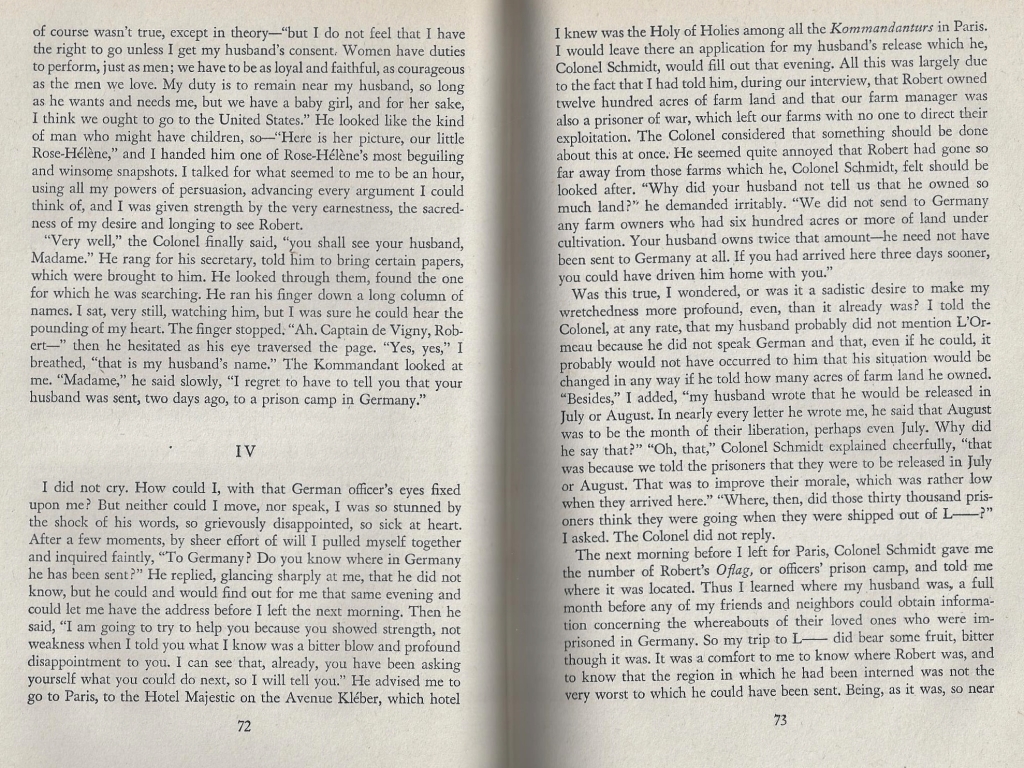
Here is an excerpt from Yours is the Earth. (Click on the image to enlarge it for reading.)

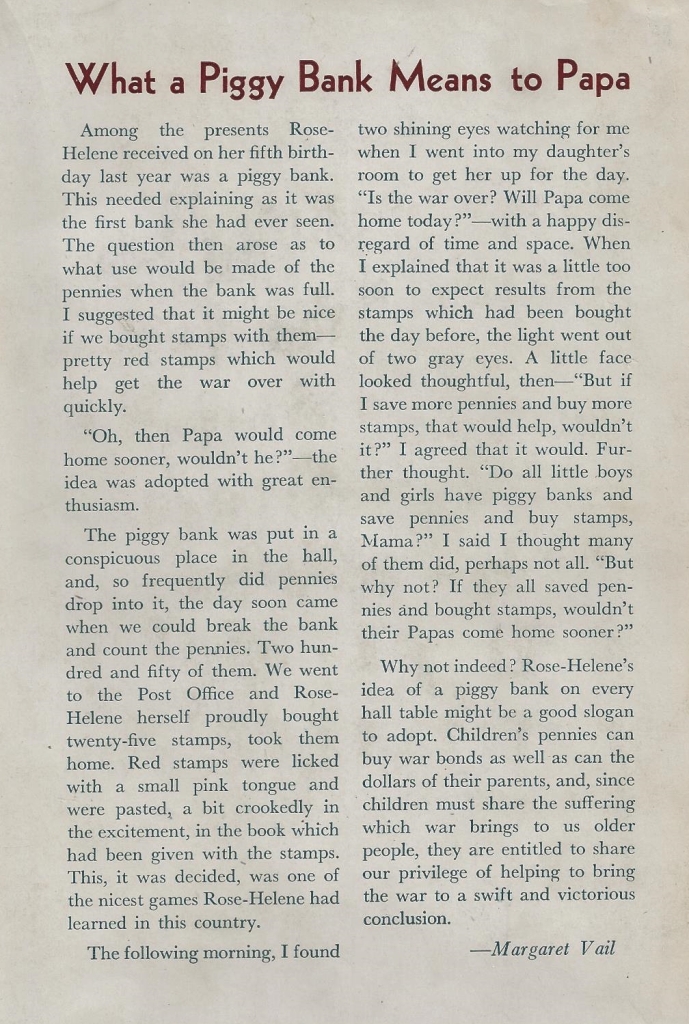
yours is the earth excerpt margaret vail 1944 001

Margaret’s hatred of the German race as a whole is utterly implacable, and this comes through loud and clear, though she does give the tiniest nod of grace to a German doctor who has occasion to treat her at one point.

The reader can frequently see the writer making what feels like a conscious effort to maintain an even-handed tone, making this something of a deliberately unemotional account, with Margaret reporting on her own harrowed feelings with analytical coolness and distance. This, to me, is the book’s one slight weakness. On the few occasions where she unbends and lets herself go she became a much more sympathetic narrator, and I cared much more deeply for her personal tribulations and her worries for her family.

I was very curious as to what the eventual outcome of Robert’s internment was to be, and I did find a snippet of information concerning the family’s post-war situation on the blog of a woman who corresponded with Margaret Vail for some years. Lindsley Rinard’s blog Literature and Life has several posts, here and here, concerning Margaret Vail’s memoir and Robert’s return.

Robert was released after five years in prison camp. Margaret and Rose-Hélène returned to France in time to greet him upon his return, and the family settled down on the family estate to put their lives back in order after the terrible disruption of the war.

In the great scheme of things and in comparison of what many others went through, one feels that these people were in general rather fortunate. As I have already said, this is a unique perspective not often seen, an account of someone who was placed in a rather good way to deal with the occupation of one’s homeland by a hostile force. Margaret Vail seized every advantage she could identify in her efforts to keep herself and her loved ones secure, though she never resorted to anything like “collaboration”, as so many others were moved by circumstances to do.

yours is the earth margaret vail 1944 back cover war bonds appea 001

From the back cover of the dust jacket of “Yours is the Earth”, a War Bonds appeal.


Read Full Post »

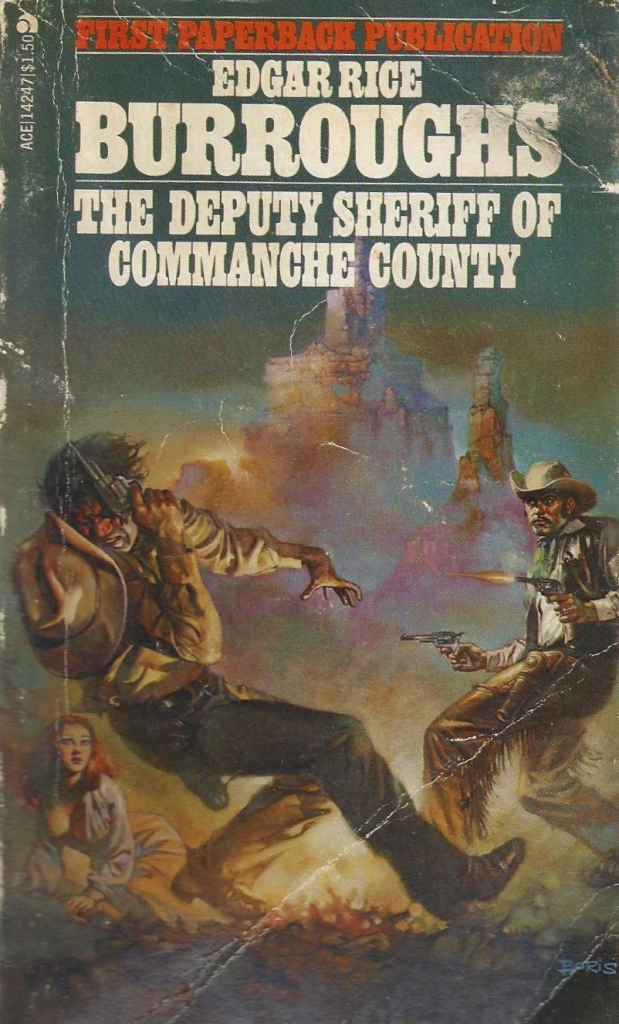
the deputy sheriff of comanche county ace paperback edgar rice b 001The Deputy Sheriff of Comanche County by Edgar Rice Burroughs ~ 1940. This edition: Ace, circa 1970. Paperback. 312 pages.

My rating: 3/10. Hmm, nope, I’d better revise that, because its camp value makes it paradoxically enjoyable, in an so-bad-you-can’t-look-away way. So how about a 4/10. (I’m feeling very generous today.)

Provenance: Total impulse buy, 25 cents at the Williams Lake Sally Ann just a few days ago. Picked it up, put it down, turned away, and then, as I was leaving, my hand reached out of its own volition and snatched it quickly. (Couldn’t leave empty-handed, could I? Gave the clerk a loonie for it, too, because a quarter just seemed so cheap somehow. So I guess it really cost a whole dollar.)

A few blazingly hot afternoons ago, I joined my husband for a mid-day lunch and reading break out under the shady apple tree, and he glanced over at my book and did a complete double take.

What are you reading now?! And why? Is that another one of those Century things?”

Well, that would be a western pulp novel by Edgar Rice Burroughs. Yes, the Tarzan guy. And no, it’s not really a Century book, because its year, 1940, is already filled with D.E. Stevenson’s The English Air, but hey! – an extra book isn’t such a bad thing, and this one is short and not at all demanding on the readerly intellect. And if Zane Grey’s Riders of the Purple Sage receives representation among my Century reads for its cultural significance to American popular literature, can’t I make the same argument in favour the at-least-just-as-culturally-significant Burroughs?

Of course I can.

Who killed Ole Gunderstrom? The evidence seemed to point to Buck Mason. And when Buck went into hiding soon after, there was no doubt in anyone’s mind. But Buck knew he was innocent- now he was going to have to prove it.

Gunderstrom lay asleep on a cot against one of the cabin walls. A man was crossing the room stealthily with a long-barreled Colt in his hands.

The intruder could see the cot and the outlines of the blur that was the sleeper upon it: but he did not see the boot in his path, and half stumbled as he stepped on it.

Gunderstrom awoke and sat up. “‘Buck Mason! ” he exclaimed. A t the same time he reached for the gun beside him. There was a flash in the dark; the silence was split by the report of a pistol and Ole Gunderstrom slumped back upon his blanket.

Poor Ole is dead, a bullet in his head, and for no apparent reason – his shack is not disarranged as if robbery were the motive, though Ole is filthy rich and lives in squalid simplicity merely through personal eccentricity. Rumour has it that he has gold buried here and there in his several dwelling places, but no one appears to have stopped to look either before or after plugging the old curmudgeon.

Then the sheriff’s office receives a mysterious phone call accusing the deputy sheriff – one Buck Mason – of the crime, and local gossip soon finds several motives. Wasn’t Buck deeply in love with Ole’s lovely daughter Olga, and didn’t Ole send her off to an Eastern boarding school to remove her from the rough company of the local cowboys? And wasn’t there a property dispute, with Ole having fenced in a hundred acres of Buck’s land, and didn’t Buck state his intentions of reclaiming it and planting it to alfalfa? And wasn’t Buck seen leaving Ole’s shack the evening before the discovery of Ole’s body?

So when Buck vanishes after performing his own forensic examination of the crime scene, it doesn’t look good for the innocence of the deputy, and a warrant is made out for his arrest.

Meanwhile, on a dude ranch in Arizona, a bumbling, over-dressed, claiming-to-be-a-polo-player fellow shows up suddenly, to the annoyance of the ranch’s owner, the surly Cory Blaine. Cory and his cowboys have a lot of fun sneering at the clothing and deportment of “Bruce Marvel”; but the female guests take a second look, for my goodness! – isn’t Bruce quite a hunk of manflesh, tight English riding breeches showing off his muscular thighs and all.

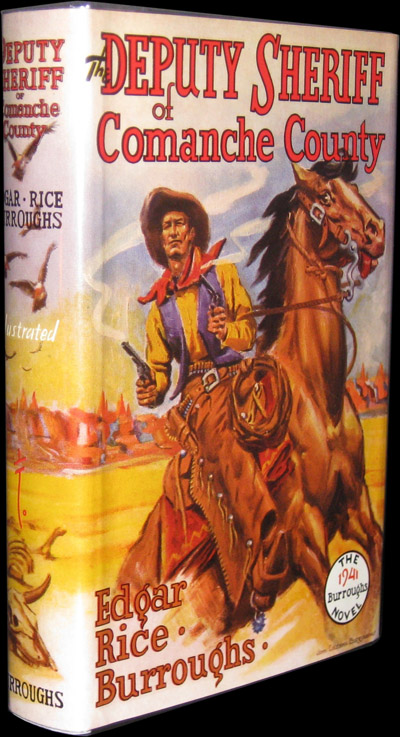
First edition cover of "The Deputy Sheriff of Comanche County"

First edition cover of “The Deputy Sheriff of Comanche County”

Cutting to the chase: Bruce is Buck in disguise. He suspects Cory of the murder of Ole and is collecting evidence to prove it, which Cory obligingly supplies, having completely blown off “Bruce” as a lightweight posturer. But when Bruce/Buck transfers his affections from his old love Olga (who also shows up at the ranch – won’t get into detail – too complicated) to one of the lady-dudes, Kay White, Cory sees red, for he has marked beautiful and wealthy Kay as his own, despite her cagy avoidance of his romantic advances.

Much riding about the country then ensues, and a kidnapping and all sorts of he-man shenanigans, ending with Bruce stripping off his Eastern disguise and coming out six-guns a-blazing as his true self: the sharp-shooting, bad-man-killing Buck. He single-handedly rescues lovely Kay from the bad guys, fatally plugs several of them with his trusty pistols, and presents the solution to the crime, which I’m a little vague on even this soon after finishing this wonderfully pulpy tale. Something about double-crossing on a rustled cattle deal or something. Ole was a bit of a slimeball, it appears, and quite possibly deserved his demise at the hands of his erstwhile cohorts.

Oh, I referenced Vogue up in the post heading. I guess I should clarify that. Apparently Buck, way back before Ole’s murder, has set about on a program of self-improvement to bring himself up to the lovely Olga’s social level.

The book that he was reading he had taken from a cupboard, the door of which was secured by a padlock, for the sad truth was that Mason was ashamed of his library and of his reading. He would have hated to have had any of his cronies discover his weakness, for the things that he read were not of the cow country. They included a correspondence course in English, a number of the classics which the course had recommended, magazines devoted to golf, polo, yachting, and a voluminous book on etiquette; but perhaps the thing that caused him the greatest mental perturbation in anticipation of its discovery by his candid, joke-loving friends was a file of the magazine Vogue.

No one knew that Buck Mason pored over these books and magazines whenever he had a leisure moment; in fact, no one suspected that he possessed them; and he would have died rather than to have explained why he did so…

This “not of the cow country” reading program allowed Buck to pull off his Bruce masquerade, and also made him appear as desirably well-cultured in the eyes of luscious Kay, so it was all to the good. I thought it was rather a sweet touch, the rough cowboy seeking to improve himself in secret, and look how wonderfully he was rewarded!

The “notching of the gun” thing is the author’s nod to shoot-’em-up cowboy mythology; Buck adds notches for the fellows he’s killed to the guns he’s inherited from his dad. (Eddie is one of the bad guys, the youngest just-gone-wrong of the gang; Buck spares his life in the end.)

As he (Buck) ceased speaking he drew a large pocket knife from his overalls and opened one of the blades. Then he drew one of his forty-fours, the wooden grip of which bore many notches, the edges of which were rounded and smooth and polished by the use of many years. As Eddie watched him, fascinated, Marvel cut two new notches below the older ones.

“Them’s Bryam and Mart?” asked the prisoner.

Marvel nodded. “And there’s room for some more yet, Eddie,” he said.

“You make all them?” asked Eddie.

“No,” replied Marvel. “These guns were my father’s.”

“He must have been a bad man from way back,” commented Eddie in frank admiration.

“He weren’t nuthin’ of the kind,” replied Bruce. “He was a sheriff’.”

“Oh!” said Eddie.

Burroughs’ style is a thing of joy to the modern reader; he happily references the whole thesaurus and then some in decorating his galloping prose. This was one of my favourite passages. Note the use of “revivify” and ” verdue” (surely that last is meant to be “verdure”?) among the rest.

The horses moved forward eagerly now and with vitality renewed by anticipation of the opportunity of quenching their thirst in the near
future. The change in the spirits of their mounts seemed also to revivify the riders; so that it was with much lighter hearts that the three rode on beneath the pitiless rays of an Arizona sun, Marvel giving Baldy his head in the knowledge that the animal’s instinct would lead it unerringly to the nearest water.

Ahead of them stretched what appeared to be an unbroken expanse of rolling brush land, lying arid and uninviting in the shimmering heat of
the morning.

Presently there broke upon Marvel’s vision the scene for which he had been waiting, the picture of which he had been carrying in his memory since boyhood–a large, bowl-like depression, in the bottom of which green verdue proclaimed the presence of the element that might mean the difference between life and death to them.

Edgar Rice Burroughs was a fascinating literary character. He produced well over a hundred sensational novels, and was one of the first writers to incorporate himself and trademark his name. Famous primarily for his invention of Tarzan, he also dreamt up several sci-fi worlds (namely the John Carter of Mars and Pellucidar series) and branched out into overwrought Westerns such as The Deputy Sheriff. His biography as presented on the website link at the beginning of this paragraph is well worth reading; what a story his own life made!

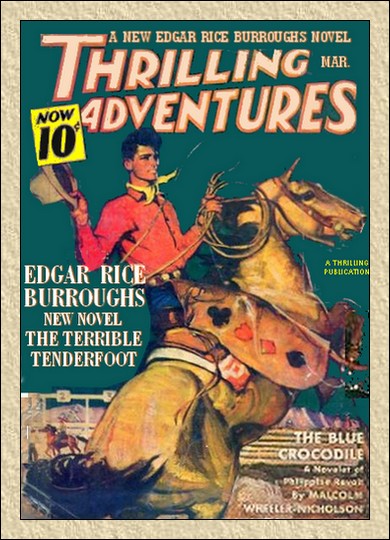
The Deputy Sheriff Of Comanche County first appeared as a serial in Thrilling Adventures magazine in 1940, under the title The Terrible Tenderfoot.

You may read it yourself here, if you so desire: The Deputy Sheriff of Comanche County on Project Gutenberg

0500231h-01

Read Full Post »

the sea-gull cry robert nathan 001The Sea-Gull Cry by Robert Nathan ~ 1942. This edition: Knopf, 1942. Softcover, with French flaps. First edition. 214 pages.

My rating: 3/10

A short, lightweight novella by the onetime-popular Robert Nathan. I confess that I have in the past read and quite enjoyed his most famous publication, 1940’s Portrait of Jennie (see condensed spoiler-laden précis here), but The Sea-Gull Cry is infinitely more sentimental, and, to be brutally honest, not particularly memorable, either in plot or in execution.

Nineteen-year-old Louisa and her seven-year-old brother Jeri are refugees newly in America, from war-torn Poland via England. Children of an English mother and a Polish nobleman, they are in reality a countess and count, but the family castle has been bombed, leaving their mother interned forever in its rubble, while Papa has perished defending his country against the evil German invaders.

Louisa and Jeri are bravely making a new sort of life for themselves. Desiring to get out of the crowded American city they arrived at some short time ago, they have taken their refugee relief money and are looking for a place to live along the seaside for the summer. They make it to Cape Cod, where they fall in with a gruff-mannered but hearts-of-gold older couple, the Baghots, who rent them an abandoned scow beached on an isolated stretch of sand.

Onto this strip of sand precipitously arrives one “Smith”, a jaded, middle-aged history teacher, (and a not very experienced sailor), who has just purchased an old sloop with the view to cruising up and down the coast for the summer, to escape from the stress of his unsatisfying job and the pervasive gloom of the situation in Europe. (The story is set just before American entry into World War II.)

Smith is caught up in a squall and violently beaches his boat, putting an end to his summer plans. But when he meets lovely Louisa he is immediately smitten; even more so when she pops out of her faded blue overalls to swim in a teeny tiny homemade bikini. Smith feels that maybe life isn’t so dull after all…but wait…why would Louisa look at a man old enough to be her father…?

Maybe because she is seeking something of a father-substitute, a romantically-older man?

It takes them a few chapters to get it all worked out, chapters in which small Jeri provides a side plot as he fights with the local children, makes friends with the Baghots’ young niece Meg, and has a brush with death as he sets out to sea with Meg on an old raft, seeking to sail back to Europe to rescue “the children” from the conflict.

Aw, how sweet.

Sure.

A little of that goes a very long way, and luckily this was a lightning fast read, being presented by the publisher with a large font, immense margins, and thick paper. It clocks in at 214 pages, but could probably quite happily fit onto 50 or so. (One speculates therefore that this was before any sort of wartime paper restrictions hit the American publishing market.)

That’s it; that’s the story; well whitewashed with slosh.

I don’t quite get Robert Nathan’s obvious popularity in his time, because this was pretty sub-par stuff in the great scheme of literature-of-the time, unless it was as a writer of escape-lit-light for the stressed-out housewives of the 1940s and 50s. The Sea-Gull’s Cry seems the sort of thing that would be found serialized in the Good Housekeeping type of magazine of the day.

A contemporary review by Rose Feld of The New York Times had this to say:

‘The Sea-Gull Cry’ tells a tale that will hold you until the last page is turned. It will hold you because of Nathan’s rare art of drawing you into his own mood of tender contemplation of human beings and because you cannot let them go until you know what happens to them… And you will decide that this is more than a tender little love story exquisitely written; that it is a tale of exile and valor and spiritual rebellion that has more than surface significance.

I suspect I am myself a bit too jaded and cynical to really appreciate this sort of fiction; I find myself lifting an eyebrow when I read these other quotes by the author himself regarding his authorial motivation:

What I really want is to give comfort to people in this wilderness of death and trouble. And to myself, too. So, when I can, I take the poison and hate out of my books; but I hate, just the same. I hate violence, and tyranny, and vulgarity. I hate despair and destruction, and the writers who insist that that is all there is, there isn’t anything else.

and

It seems to me that I have always wanted to say the same things in my books: that life is one, that mystery is all around us, that yesterday, today and tomorrow are all spread out in the pattern of eternity, together, and that although love may wear many faces in the incomprehensible panorama of time, in the heart that loves it is always the same.

Fair enough; Nathan’s readers obviously responded to his style.

As you can see from my brutal rating, I didn’t.


Read Full Post »

I need to get some of this towering stack of books-to-be-discussed thinned out; my desk is way too crowded; no place to park the teacup! (And my spouse, coming in last night to “borrow” the computer, made comment on the situation and then graciously offered to shelve them for me – which though a sweet gesture is not necessarily a good thing, as he puts things in strange places. Our filing systems differ. 😉 )Time for a few round-up posts, I think.

Where to start? How to group these? Let’s see…

How about this trio of not necessarily bad books, but ones which could have been better. Definitely readable, but not top notch. (My personal responses only, dependent entirely on my mood at the reading moment – yours could be so much different, so please forgive me if I cold-shoulder one of your favourites.)

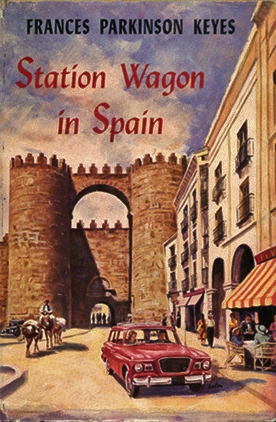
station wagon in spain frances parkinson keyesStation Wagon in Spain by Frances Parkinson Keyes ~ 1959. This edition: Farrar, Straus and Cudahy, 1959. Hardcover. 224 pages.

My rating: 5/10

I’ve occasionally flirted with Keyes, because her books have such potentially interesting premises, but I invariably come away sighing. And sadly this concoction is no exception. The very best thing about it was the nine-page author’s foreword, in which she relates her own experiences travelling with her friend Kitty in immediately post-war Italy, France and Spain in 1946, with a rickety American station wagon loaded with relief supplies for an evacuated convent of Bendictine nuns.

Utterly fascinating – “Tell me more!” was my response – but no, Keyes blithely dismisses her own experiences and instead embarks on this rather creatively imagined fictional tale, which starts off reasonably well but soon bogs down in a morass of excessive detail and complicated plotting.

In brief(ish):

A young university professor unexpectedly inherits a large fortune, and, while mulling over his sudden change in situation and his deeply elemental boredom with his life to this point, receives a version of the infamous “Spanish Prisoner” letter in the mail. This one is purportedly from a real Spanish prisoner, and – how handy! – Lambert just happens to be a fluent Spanish speaker himself. Knowing full well that the letter is a scam, he feels that a diversion is in order, so he takes a sabbatical year from his teaching job, packs up his newly purchased big red convertible station wagon, says a dismissive good-bye to the young woman who has been scheming (well beknownst to Lambert) to marry him, and heads off to Spain.

The plot thickens, as Lambert immediately falls in with a luscious adventuress and carries on an intense shipboard flirtation. “Coincidences” start to fall together thick and fast. There does, to Lambert’s great glee, appear to be a genuine prisoner of sorts associated with the fabricated scenario – an impoverished Duke incarcerated in a private sanatorium. Who happens to have a lovely, virginal daughter who could not possibly be involved in any nefarious dealings…

The whole thing is rather bogged down in too much detail. There are long pages of explanation on all sorts of side-issues, as if the author is dead keen on the education of her readers as much as on their entertainment. The plottings of the wicked conspirators get rather see-through and slightly ridiculous early on, and the inevitable romance is just too predictable to be satisfying. (A pox on “love at first sight”, I emphatically say. At least in this situation.)

Moments of excellence; chapters of blah blah blah. Rated at 5/10 because I did willingly carry through to the end, despite my ever-increasing feelings of annoyance that the author would make such a messy job of such a promising plot, and turn her quite likeable protagonist into a bit of a blustering egoist. Points off, too, for the sweetly yielding female love interest (the new one in Spain, not the abandoned American, though she also pops up in Europe to add some more kinks to the tale) and the “unspoken communion of two passionate souls.” Ick!

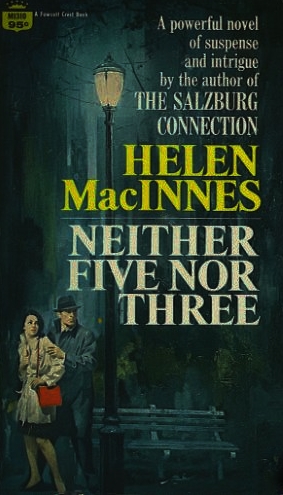
neither five nor three helen macinnes paperback fawcettNeither Five nor Three by Helen MacInnes ~ 1951. This edition: Fawcett Crest, circa late 1960s. Paperback. 320 pages.

My rating: 6/10

Set in post-World War II New York.

I found myself rather taken aback by this story. While many of Helen MacInnes’ books demonstrate her strong stance on capital-C Communism (it’s 100% bad) this one takes that fixation to a whole new level. Instead of clean-cut English/American heroes and heroines flitting about the shadows of war-torn European cities, it’s all about the insidious influence of underground Commies on the home front (in this case America) after World War II, and it comes across as being deeply paranoid, viewed from half a century in the future.

The love story is utterly predicable and really rather sweet; the two lovers are likeable enough and I found myself in general wishing them well; but the anti-Red plotline pushed me past my comfort level into the “Really? Really?” territory. Even taking era-appropriateness into account. So black; so white. Shades of grey are evidence of weakness, on both sides.

MacInnes’ Commies are supremely well organized; they have infiltrated the American publishing industry and are placing their pawns very cleverly in order to slant the perceptions of readers in favour of the political left. Head honchos from the main office (as it were) in Europe undertake clandestine inspirational (and disciplinary) visits to American “party cells”; new recruits are jollied along until they are too deeply enmeshed to easily escape; then the gloves come off and any attempt to back away from participation or to “inform” is punishable by carefully engineered public disgrace, or, just possibly, sudden death. (Cue foreboding music…)

Definitely a Cold War period piece, which was received with warm approval by readers and reviewers of its time.

Excerpted from the March, 1951 Kirkus Review:

This is the most important book Helen MacInnes has done … absorbing and challenging from first page to last, as the devious methods of Communist penetration into the fields of public relations are revealed, and the terrifying network of Communist affiliation is convincingly recorded. Rona Metford is engaged to Scott Ettley, a journalist whose loyalties are torn between his mounting commitment to “the party” and his yearning for a normal course of love and marriage. Into this situation comes Paul Haydn, just returned to New York from a very hush-hush assignment in Europe and finding that his love for Rona, which he thought was a thing of the past, is still very much alive. The checkered course of love is traced against the background of gradually unfolding ramifications of the violence and falsity of Communist activities in the heart of the world they think they know…

I personally found the political bits verging on hysteria, and while there was an occasional authorial attempt made to balance the viewpoints by pondering why Clean Young Americans might be seduced to the Red Side, once they went too far they were brutally written off and became completely expendable, in the most ultimate way.

A precursor to MacInnes’ more “traditional” (i.e., European-set and action-packed) espionage stories which were to follow, blending an ideological plotline with a stereotypical together/torn asunder/together again romantic tale, with vaguely unsatisfying results.

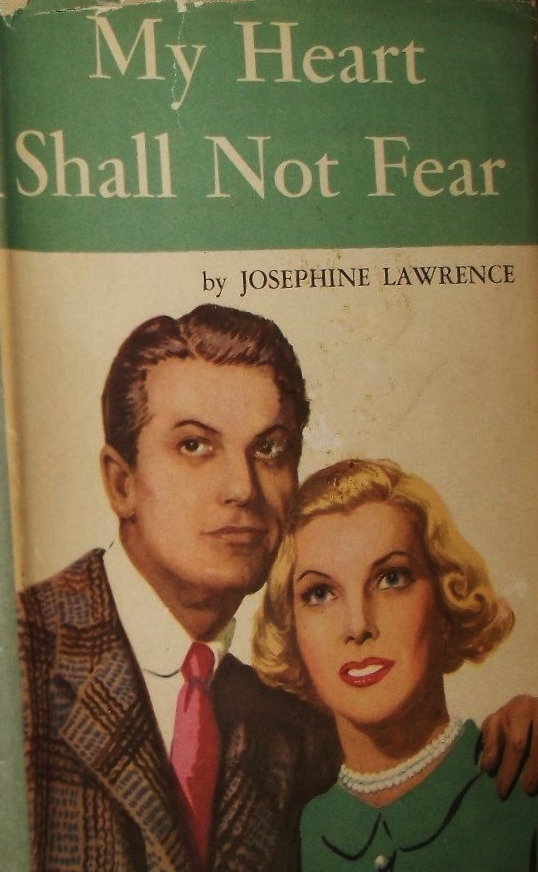
my heart shall not fear josephine lawrenceMy Heart Shall Not Fear by Josephine Lawrence ~ 1949. This edition: Peoples Book Club, 1950. Hardcover. 285 pages.

 
My rating: 5/10

Now on to this much more obscure book, also set, as is Neither Five Nor Three, in immediately post World War II America.

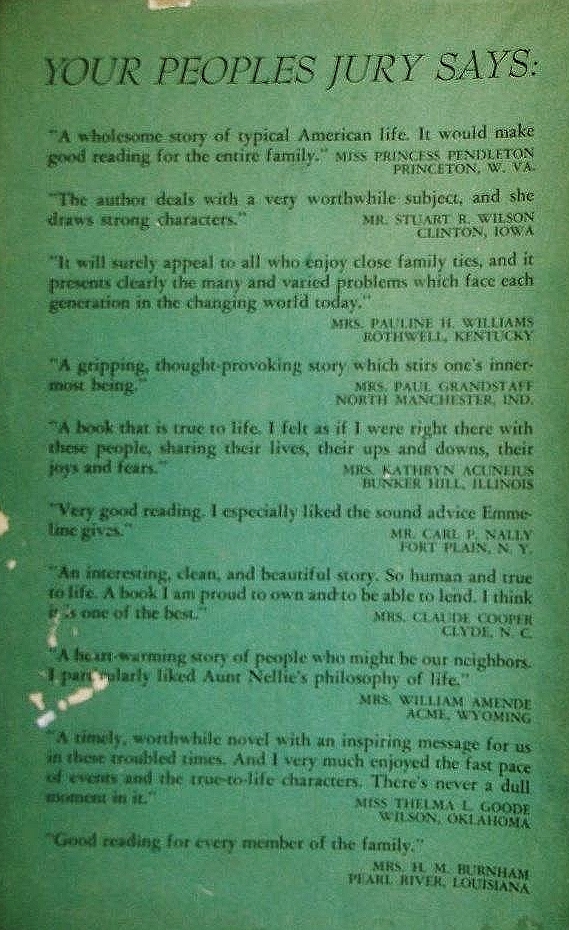
Touted as “inspirational” and a “wholesome depiction of family life” in its back-cover promotional blurbs, this earnest novel left me unsatisfied and vaguely uneasy, mostly because of its troubling (to a reader of today) depiction of women’s societal roles in its era.

If I could pin down one thing which bothered me the most, it would be the author’s apparent insistence that female martyrdom is by and large a good thing, as long as it is carried out in a modest manner. The woman who takes a hit for her family, quietly and uncomplainingly, is to be greatly admired. To be fair, this also applies in a lesser degree to men, but is more strongly expected of the “weaker” sex, the men not being subjected to such ironclad standards of societal behaviour.

There is an ambitious cast of characters, including an older couple who sacrifice their much-deserved peaceful retirement to share their home with three not-long-married sons recently discharged from the armed forces, a young married woman who has recently had a baby and who is eager to leave the hospital and settle into a new apartment (which she can’t really afford, seeing that her husband has borrowed a vast sum of money in order to bail out his own ne’er-do-well father), another new mother who is not married and who resists the good-intentioned bullying of a social aid worker to give her child up for adoption, and a young childless woman who is obviously dying of an unspecified ailment – most likely cancer – but is surrounded by a cloud of silence as no one in her circle dares to put into words the obvious, as well as numerous others.

One of the odder and most troubling scenarios is that of one of the young couples separating. The husband has decided that he has tied himself down to his childhood sweetheart mistakenly, and he announces that he is leaving to “enjoy his freedom” while he is still young. The heartbroken wife refuses to argue or present herself as unfairly forsaken, gives her departing spouse the car that she has worked for and purchased with her own money, and even runs out to purchase new underclothes for her deserter as a gesture of undying wifely devotion.

The husband sneaks into the house to pack when his wife is out, and scorns his mother’s pleas to reconsider his actions. (This is one of the couples living with the elderly parents.) The young wife is left dependent for a home upon her in-laws, who are deeply shamed by their son’s behaviour. The deserted wife, by meekly accepting her bleak fate, is gently pitied and openly admired by the other characters for her forbearance. She herself quietly says that she hopes her man will eventually return. All I could think was, “Hey, sister, take back those car keys and tell that lout you married in good faith to find his own transport to ‘finding himself.’ And don’t you dare be here waiting for him when and if he crawls back home!”

Josephine Lawrence was a highly prolific writer of both children’s books (100-ish)  and adult novels (30+) who was well known and dependably popular in her time. Born in 1889, her work was published from the 1920s through the 1960s. She no doubt struck a chord with woman readers looking for a fictional validation of their own sometimes difficult lives, but if this novel is typical, her work is tremendously dated. Josephine Lawrence seems to be almost forgotten today.

I did enjoy the period detail in this story, and the ease with which the author kept her multiple strands interweaving without tangling. I disliked the pedestrian aspects of her style – it is very workaday prose – and the droning overtone of “womanly nobility is achieved through silent suffering/womanly strength is measured by her fortitude in the face of adversity.” I suppose there is some general merit to this idea as broadly applied to both sexes, but in this case I found it something of a downer when applied so strongly to my particular gender.

I’d gladly read another of Lawrence’s books if it came to me easily, but she is not a writer I will be deliberately seeking out.

A sampling of readers' comments.

A sampling of readers’ comments, My Heart Shall Not Fear.

Read Full Post »

This is a re-post of a review written several years ago. I have just re-read the book, due to its mention by a commenter looking for an excerpt. While I was not able to identify the mentioned passage, I did appreciate the quest, as it made me read extra carefully and ponder what I was reading.

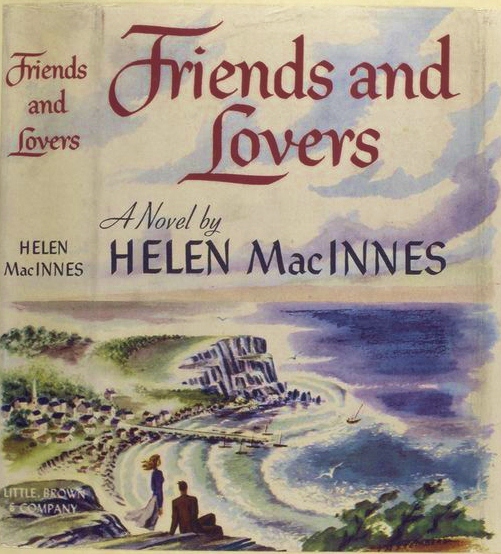
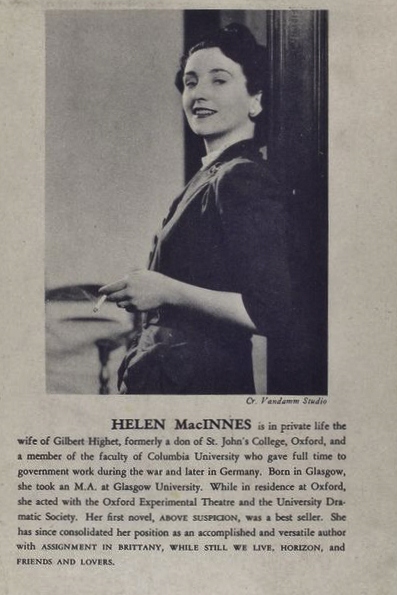
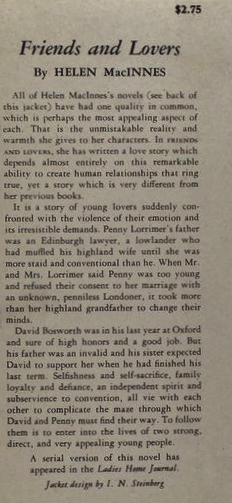
I thought I might be moved to revise this older post, and I have indeed gone through it and tweaked it a very little bit, but in general I have to say that my thoughts on MacInnes’ Friends and Lovers haven’t changed this time around. If anything, I found the hero’s angst-ridden inner dialogue even less sympathetic, and the heroine’s pandering to his fixations on her acceptable behaviour even more tiresome.

This time round I was very much on the lookout for character development, to see if young semi-star-crossed lovers David and Penny appreciably matured and grew emotionally through the course of the tale. They did to a degree, but not to the point I would have liked to have seen, all things considered. We are asked by the author to sympathize throughout with the obstacles put in the place of the young lovers, and we do, but I found myself longing for an epiphany of sorts from either or both in regards to the whole “trust” factor. Penny seems in some ways to be able to better deal emotionally with the ongoing separation than David; his agitation at the thought of Penny’s contact with – gasp! – other men (even strictly socially) is rather disturbing.

David seems like he would continue to be jealous, moody and high maintenance as the years further progress; the ending scene, romantic though it was, left me fearing for this fictional couple’s longer term happiness. I wonder how Penny will respond to the feminist consciousness-raising just a few decades down the road. Will she pick up the strands of her life (the talent as an artist, for example) so easily abandoned in the throes of young passionate love when the middle-age years come and those inevitable thoughts of “what might have been” start to float to the surface of the mind?

And what will the war years bring, with the changing and expanding societally-acceptable roles of women?

Ah, well. We’ll never know. Frozen in time these two will have to remain. Interesting to speculate, though.

macinnes friends lovers djFriends and Lovers by Helen MacInnes ~ 1947. This edition: Little, Brown & Co., 1947. Hardcover. 367 pages.

My rating: 6/10.

*****

I met this author, figuratively speaking, one long, hot teenage summer in the 1970s. With the high school library closed to me and everything else in print in the house already devoured, I was desperate for something new to read. I was half-heartedly digging through boxes of old Reader’s Digests in our sultry attic when I found a stash of  hardcovers packed away in a pile of string-tied cardboard boxes, relics of my mother’s previous life in California before her marriage and relocation to the interior of British Columbia.

Mother was born in 1925, and, as a lifelong avid reader, collected as many titles as she could with her limited budget as a single “working girl”, a career which spanned almost 20 years before a late-for-the-time marriage at age 36.  A browse through her collection was a snapshot of middle class bestsellers of the 1950s and 1960s, when my mother did the majority of her book buying. If I made a list of authors I’ve been introduced to through my mother’s personal library, Helen MacInnes would be solidly on there.

Best known for her suspenseful espionage thrillers set in World War II and the Cold War, Helen MacInnes also wrote several romance novels, Friends and Lovers in 1947, and Rest and Be Thankful in 1949.

The latter title was one on my mother’s shelf, and I read it and quite enjoyed it in a mild way, so when high school resumed in September and I came across another MacInnes title in our well-stocked school library, Above Suspicion, I added it to my sign-out stack. Already a fan of Eric Ambler and John LeCarre,  the political thriller immediately appealed, and Helen MacInnes was added to my mental  “authors to look out for” list.

Over the years I eventually read most of MacInnes’ titles, with varying degrees of interest and enjoyment. At her best she wrote a gripping, fast-paced, suspenseful story that held my interest well; occasionally I found my attention straying. When I recently came across Friends and Lovers, I picked it up and leafed through it, trying to remember if I had previously encountered it. The title was familiar, but darned if I could remember the storyline – never a good sign! When I started reading, I knew immediately that at some point I had read the book, but I had absolutely no memory of the plot. Was this a spy novel? A romance? A few chapters in I concluded that it was a pure romance, albeit one that attempted to address some larger issues.

David Bosworth is an academically brilliant though financially struggling student entering his last year of studies at Oxford in the early 1930s. In Scotland for the summer, employed as a tutor with a wealthy family, he meets 18-year-old Penelope (Penny) Lorrimer and, rather to his dismay, falls in love at first sight. He had always thought that intellect could govern emotion; his feelings for Penny turn this long-held theory on its head, and, when it becomes apparent that Penny has been similarly smitten, a clandestine relationship ensues.

David is the sole prospective support of a troubled family. His widowed father, seriously injured in the Great War, is a helpless invalid on a small pension. His sister Margaret, who has some talent as a pianist, refuses to take on a paying job to help support her father and herself, as she feels her musical training towards a career as a concert pianist is too important to compromise.

David has financed his own university education by attaining a series of scholarships; now with his degree in sight he is agonizing over his future and his family responsibilities. A wife and family of his own have no place in his plans, and Margaret, once she realizes David’s attraction to Penny, is openly resentful of what she sees as a threat to her own future reliance on David’s earning power. David, emotionally fastidious, refuses to entertain the notion of a relationship other than marriage with the woman of his choice; his emotional and sexual frustration are frankly and sympathetically described by MacInnes.

Penny is also faced with family opposition to the relationship. Her well-off, upper-middle-class parents are and suspicious of the designs of a financially struggling university student on their daughter. A romantic entanglement is unthought of; a marriage even more ridiculous to consider – David will obviously be in no position to support a wife of Penny’s background “in the style to which she is accustomed” for quite some years, if ever. The only reason Penny is not out-and-out forbidden to see more of David is that the idea of her seeing anything in him is so ridiculous to her parents that he is dismissed as a momentary indiscretion, not deemed worthy of further notice by Penny as well as themselves.

Penny manages to get to London to study at the Slade Art School; David visits her on his free Sundays and the relationship progresses through its many difficulties to its inevitable conclusion.

Did I like this novel? Yes, and no.

It was very much a period piece in its portrayal of the two main characters. David, to my modern-day sensibilities, is much too chauvinistic and jealous to be admirable; Penny is much too ready to conform to David’s masculine expectations. Stepping back from that knee-jerk reaction to their fictional personalities, I realize it is a bit unfair to judge them by present-day standards. As products of their environment, possibly drawn from real-life characters, (I have read that this may indeed be a semi-autobiographical story, as the two protagonists resemble MacInnes and her husband in many key ways), David and Penny do seem generally believable, if a mite annoying at times, in their stereotypical behaviour.

Their friends and families were never given as much attention in character development throughout as they could have been, a definite flaw in this novel. Things tend to fall into place a little too neatly on occasion; Penny’s throwing off of her family’s protective embrace and her establishment as a gainfully employed London working girl comes out as a bit too pat and good to be true; David is offered opportunity after wonderful opportunity and enjoys a great luxury of choice as to his own working future; one sometimes wonders what all the fuss and angst is about.

A big point in favour is the discussion of attitudes in England towards the Great War veterans. MacInnes lets her very definite political opinions (liberal, anti-fascist) show throughout. The brooding situation of the “Germany problem” is well-portrayed. The story is set in the 1930s but was written and published in the 1940s, so the author’s portrayal of the characters’ apprehensions as to their and their country’s future must certainly have been influenced by the author’s own pre-World War II experiences and thoughts. Overall an interesting glimpse into the time, written by someone who lived what she wrote about.

Absolutely honest personal opinion: One of Helen MacInnes’ weaker novels. I much prefer Rest and Be Thankful, the other of her “pure romances”, which I regularly re-read.  It also discusses the after-effects of war and subsequent political attitudes, and is a stronger, more cohesive story overall with much better character development and a strong vein of humour, something I feel Friends and Lovers generally lacks. Friends and Lovers often feels forced, as if the author were rather abstracted while writing it; given the times it was written in, I will forgive her that but it does show in the final result.

Would I recommend it? Yes, with reservations. I will keep it on my shelves as a re-read, though for far in the future; no hurry! Has merit as a vintage novel, but not a favourite.

Read Full Post »

« Newer Posts - Older Posts »