Archive for the ‘1930s’ Category

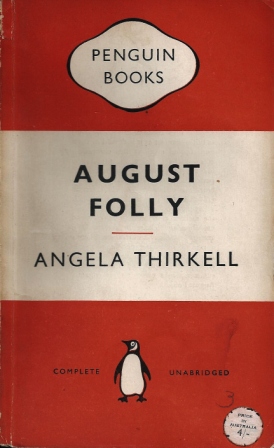
August Folly by Angela Thirkell ~ 1936. This edition: Penguin, 1954. Paperback. 250 pages.

My rating: 7.5/10. Possibly subject to move a bit higher after I’ve had a chance to mull it over more deeply, and have read some more of the author’s other books. Not bad at all, nicely diverting, but it didn’t immediately GRAB me. I have a feeling these might grow on one, though. We’ll see. I’m open to the possibility. I quite enjoy the hunt for obscurish vintage books, as long as there is a reasonable possibility of success, both in finding the quarry, and in finding it worth the trouble once it has been captured.

I have been watching for Thirkell for years in my rambles – as you may have gathered by now I am a used-book enthusiast – but this is the first one I’ve ever stumbled upon. Obviously not terribly popular in our region of B.C.! Must see what the library system offers, now that I’ve dipped my toe in and found the water temptingly warm. Or I could just be brave and go ahead and order some more from the various vendors on Abe, though some of the prices made me gasp a bit when I browsed them this morning, on spec as it were.

*****

Like D.E. Stevenson, whom I’d never even heard of in pre-book-blog-reading days, Angela Thirkell has a deeply devoted following among lovers of the vintage “middlebrow” genre. I’d also read a certain number of negative reviews – “shallow”, “fluff”, “just couldn’t get into them”, “you know the author just whipped these off for the income and rather despised her readers, don’t you?” – stuff like that. So I was cautiously optimistic.

Well, I’ve finally gotten my hands on a Thirkell to sample for myself, and with mixed (but rather high, as the fans decidedly outweighed the critics in blog world)expectations I carefully delved in. Carefully, because the old Penguin I now possess has had a long career already and is gently but persistently shedding pages, as old Penguins are wont to do. It’s been around. The price sticker on the front is from Australia, and inside the front cover the original bookseller has rubber stamped “Angus & Robertson, Melbourne”. It’s now a long way from home, here in the northern interior of British Columbia.

I was initially rather put off by the author’s parody of English village names in the first chapter – we are introduced to these improbabilities: Worsted (that was all right), shortly followed by Winter Overcotes (ack!), Shearings, Winter Underclose (oh, for heaven’s sake, stop already!), Lambton, Fleece, Woolram, Skeyne, Staple Park, and Lamb’s Piece. Rocked me a bit. I hope it’s not going to be one of those books, I thought to myself, a laboured and dated farce full of punning and “in” jokes. But after the starting jolt to get the thing in motion the author settled down to her story, and I settled in to enjoy it.

From The Angela Thirkell Society Website, here is a quick condensation of the plot, with a bonus reading recommendation. I would add, also ideal for reading in a warmly cozy chair with snowflakes drifting down outdoors, which is our present situation. Most conducive to reading about summer!

August Folly. Takes place in Worsted in East Barsetshire.  Most of the plot centers around the rehearsing and production of Euripides’ Hyppolyta, directed by Mrs. Palmer and involving the Deans, Tebbens, and many of the villagers. Highlights: Richard Tebben is infatuated with Rachel Dean, in addition to pouting about his poor showing at Oxford; Betty Dean, Oxford-bound, drives everyone crazy with her know-it-all attitude; Helen Dean is jealous of her favorite brother Laurence’s attentions to Margaret Tebben; Rachel Dean worries about her heart murmur; Charles Fanshawe fears he is too old for Helen Dean; Mrs. Tebben remembers her long-ago and never-expressed fondness for Mr. Fanshawe, who was her tutor; Jessica Dean is rescued from a bull by Richard Tebben. Richard gets a job with Mr. Dean, Laurence wins Margaret, Charles wins Helen.  Outstanding light entertainment, ideal for reading on a shady porch on a hot afternoon in July with strawberry ice cream and tea – which is how I read it!

I must add a note as to how much I appreciated the several brief vignettes featuring Modestine the donkey and Gunnar the tomcat in the midnight pasture. Totally unexpected, but most welcome.

A few minutes earlier Modestine, lounging about in the little shed down in the field that was his summer quarters, saw two points of fire approach.

‘I suppose that’s you as usual,’ he said ungraciously. ‘What’s the news?’

‘Nothing particular,’ said Gunnar, settling himself on some old sacks. ‘The usual dull evening. Some people from the Dower House came to dinner. Now, there they do keep a good kitchen. Chicken nearly every day, so the cat there tells me, young Kitty Dean.’

‘I daresay,’ said Modestine. ‘Some like chicken, some don’t. I don’t.’

‘Know what I did tonight?’ asked Gunnar.

Modestine only went on chewing some grass.

‘Drank all their sherry,’ said Gunnar, who needed no encouragement to talk about himself. ‘They left it in the drawing-room while they ate chicken in the dining-room. Never offered me chicken, so I drank their sherry.’

‘Was it good?’ asked Modestine. ‘I don’t hold with sherry. Give me a nice pail of water, or a good green pond, and I’m perfectly satisfied.’

‘Ignorant, that’s what you are,’ said Gunnar, ‘and prejudiced. Vegetarians always are …’

So there you have it. A restrained enthusiasm for my first Angela Thirkell. Quite curious about the next experience. Any recommendations, those of you who are old Barsetshire hands?
Read Full Post »

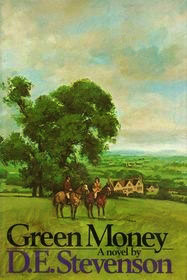
Green Money by D.E. Stevenson ~ 1939. This edition: Collins, 1981. Large Print. Hardcover. ISBN: 0-7089-0649-4. 482 pages.

My rating: 6.5/10. Amusing enough, with an almost Wodehouse-like farce going on in parts, but it was far too long for the content. Zero surprises, every plot twist was telegraphed from miles away and came through loud and clear.

The main reason I rated it as high as I did was for the likeable main character George Ferrier – and his parents – and the very darling Cathie Seeley.

A feel-good romance, requiring little effort to absorb. Literary chocolate pudding with a great big dollop of cream; comfort reading verging on simplistic; nothing daring or terribly complex here; just lick it off the spoon.

*****

Horse-loving countryman George Ferrier is on a bit of an ill-afforded toot in London when he runs across one of his father’s old school friends. Wealthy Mr. Green is now possessed of a motherless daughter, and, on a whim, he asks George to act as one of the trustees of his daughter’s eventual inheritance. The “old men” fulfilling the trustee roles keep dying off, and perhaps a younger man will prove less of a hassle. George, after much convincing, agrees, and returns home not expecting to hear anything more of his role for quite a few years to come.

But then Mr. Green suddenly kicks the bucket, leaving a vast fortune in the hands of four trustees: George, the ancient and doddery Mr. Bennett, and obviously hand-in-glove old cronies Mr. Wicherly and Mr. Millar. George senses something a bit off going on at his first meeting with the others, but allows himself to be soothed and sent away after signing numerous papers authorizing he’s-not-quite-sure-what.

Upon George’s meeting the orphaned “child” the story ramps up another notch; Miss Elma Green turns out to be a lovely eighteen-year-old who has been raised in an atmosphere of strictly Victorian purity. George is quite fascinated by this unexpectedly grown-up yet unworldly ward; he is also a bit shocked by how quickly she embraces the more forward modern behaviours her father has sought to shelter her against.

George ponders the possibility of marrying the delectable Elma to protect her from herself and the wiles of the world, but he can’t quite get over the feeling that she’s not really the woman of his dreams, beautiful though she is. For lurking in the background is his lifelong friend Cathie, whose brother Peter has himself fallen head-over-heels in love with Elma at first sight. The stage is now set for a series of misunderstandings and complications, all of which we see coming and which play out exactly as they should.

Mr. Millar steps in, offering to host Miss Green on a seaside holiday. Elma fully embraces the social whirl of tea parties and dancing till the wee hours, and instantly attracts an entourage of eager young swains, including Mr. Millar’s son Wilfred, who is receiving strong encouragement from his father to snag the heiress.

Meanwhile stalwart George ponders the clues surrounding Mr. Millar’s insistence on cashing in a large chunk of the Green shares to cover death duties, despite the existence of an insurance policy purchased  by Mr. Green to guard against the very scenario. As Peter sulks and pines for the lovely Elma, Cathie sternly tries to prepare herself for news of George’s engagement to another.

What will happen next? How will this story end? Golly, what do you think?

I liked Green Money well enough in a mild way, but I certainly didn’t love it. The story is well set up and the characters George, his mother Paddy, and self-effacing Cathie were nicely rounded out, but many of the other characters felt very one-dimensional. Elma herself comes across as a shallow, self-indulgent bit of fluff; her intelligence is of the self-protective type, and she shows no hesitance in deceiving her admittedly over-protective governess-companion to further a rapid progress into the wider world.

The whole thing went on past my initial interest level. I stuck it out to the end easily enough, but I put this one down with something of a feeling of relief that I could check it off on my D.E. Stevenson reading list.

Read Full Post »

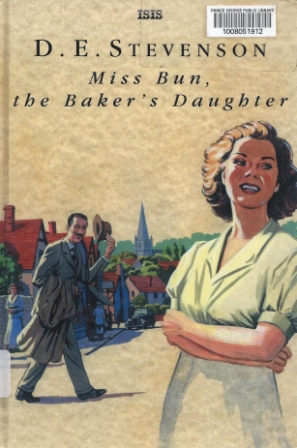
Miss Bun, the Baker’s Daughter by D.E. Stevenson ~ 1939. This edition: Isis Publishing, 2004. ISBN: 0-7531-7083-3. Hardcover. Large Print. 292 pages.

My rating: 8.5/10. Better than expected. Likable main characters gently shine in this sweetly improbable but diverting light read.

*****

In a small Scottish town, Sue Pringle was competently keeping house for her widowed father and younger brother when an unexpected stepmother entered the picture. Now in her twenties, Sue has to bite her tongue at the constant criticisms of the woman who has taken her beloved mother’s place. Worse yet, Sue’s family is pressing for her marriage to a worthy young man working in her grandfather’s grocery business; while Sue likes Bob Hickie well enough in a platonic way she has no interest in him romantically.

When an opportunity to take on a job as a cook for an artist and his wealthy wife arises, Sue decides to make a break and move into Tog’s Mill with the Darnays. She awakens her first morning to find that Mrs. Darnay has left for London taking the single other servant with her, leaving her husband to fend for himself.

Though well aware of the social implications of living unchaperoned in the same house as a young, attractive man, Sue feels guilty about abandoning the unworldly Mr. Darnay to his own limited resources, and she stays on, though her family and the neighbouring villagers look askance at the unorthodox situation.

John Darnay and Sue soon become good friends, sharing a sense of humour and a desire for solitude to pursue their own interests. Immediately nicknamed “Miss Bun” for her father’s occupation (he is town baker), Sue basks in Darnay’s approval, and soon realizes that her feelings for her employer are something stronger than is wise in their situation. She keeps house and cooks and enables Darnay to work on his painting uninterrupted, going so far as to arrange for his growing number of creditors to hold off with their bills, as with Mrs. Darnay gone there is no longer any sort of income coming in, as Mrs. Darnay would really like her husband to return to the city and continue his lucrative trade of painting saleable pictures and society portraits, instead of mucking about experimenting with new techniques and ways to capture his personal “vision”.

The artist is totally oblivious of this situation, until it is brought to his attention by Sue’s grandfather, who, much as he likes Darnay, has some serious qualms about his beloved granddaughter’s obviously doomed affection for a married man, and a penniless artist to boot.

The inevitable happens; the penny drops; and the arrangement at Tog’s Mill comes to an abrupt end, with Darnay leaving for London to work at portrait painting to pay his bills, and Sue seeking refuge with her grandparents while she decides her next step.

Added to the mix are Sue’s younger brother Sandy who suddenly runs away to join the army, a local aristocrat who thinks he just might be Sue’s real father, and a petition for divorce advanced by the absent Mrs. Darnay naming Sue as a co-respondent.

All of these threads twist and turn and eventually come to satisfactory resolutions, but not without a chance for Sue to show what fine and tenacious stuff she’s made of.

An unlikely story, but a grand bit of escapism. I thoroughly enjoyed it. Recommended.

Another brief and favorable review can be found here  .

Read Full Post »

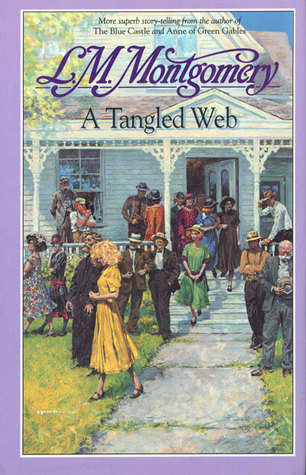
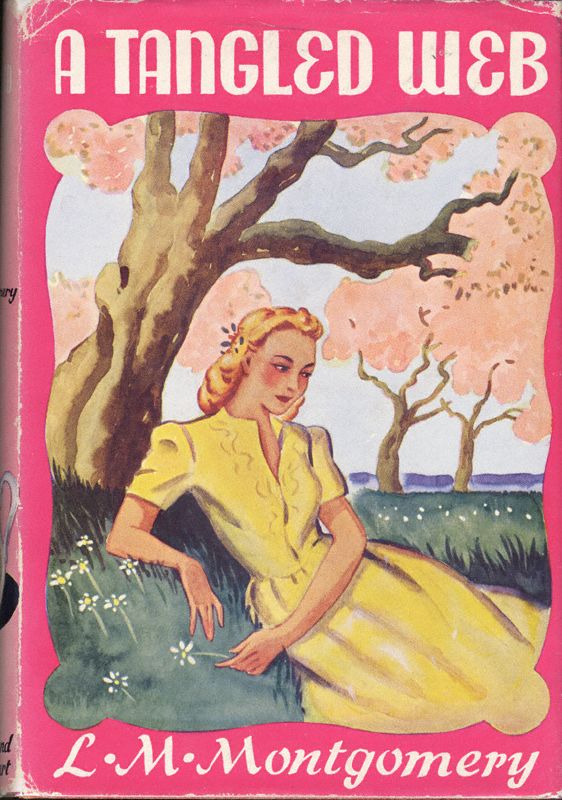
A Tangled Web by L.M. Montgomery ~ 1931. This edition: McClelland and Stewart, 1989. Hardcover. ISBN: 0-7710-6160-9. 306 pages.

My rating: 5/10. This one had its moments, but the confusing set-up, generally unlikable characters, hasty and improbable resolutions to various conflicts and romances, and jaw-dropping (in the most offensive way) final few lines kept me from enjoying it to the full. I would not recommend it.

*****

I am very ready to move on with this novel, so this will be the briefest of reviews. (Coming back to add that it got rather long after all. But it was fast to write, so that counts for soomething.) For more, visit the Goodreads page. I am in the minority with my distaste for this book, but it really left me quite cold. I might re-read it at some point far in the future, but right now all I want to do is return it to the library and wipe it from my brain.

Opinionated, critical, near-death Aunt Becky has called a clan meeting – a “levee” – to discuss who of her vast extended family will inherit a prized hand painted jug, brought from Holland as a marital gift several generations before. She proceeds to read her own obituary and lay out some cutting critiques of everyone present as one last demonstration of her emotional hold over the intertwined Dark and Penhallow families.

She dies soon after, and the reading of her will is attended in full family force. But Aunt Becky has one last trick up her sleeve. There will be a waiting period of a year before the heir to the jug is revealed, and in the meantime, everyone had better be on their best behaviour, or risk losing their chance to inherit.

Something like sixty family intermarriages between the two clans have created a complicated network of relatives and in-laws, and the author tosses us in head first. It took quite a few chapters before I had any sense of who was who, and, it was more work than it was ultimately worth – lay this one down at your peril! I did that and had to start all over again to reacquaint myself with the vast cast of characters.

  • Joscelyn Dark has been estranged from her husband Hugh since their marriage night; only Aunt Becky has been privy to the reason why. What happened that night?
  • Sweet Gay Penhallow is engaged to Noel Gibson, but her vampish flapper cousin Nan has decided to steal Noel away. Roger Penhallow has been secretly in love with Gay for years – should he seize this chance to step in?
  • Orphaned, illegitimate youngster Brian Dark is the abused chore boy on his strict uncle’s farm; even his pet kitten does not escape his uncle’s wrath. Will justice prevail?
  • Peter Penhallow has been off roaming the world, but he surprises everyone, including himself, by falling head over heels in love with his childhood enemy Donna Dark, who has been married and widowed in the meantime. Does Donna return his passion?
  • Margaret Penhallow is a mild, plain-featured, un-sought-after old maid who has one great wish. Will she ever achieve it?
  • The two Sam Darks, Big and Little, are cousins who have lived together in harmony for thirty years. Why have they parted ways over a silly little statue and a ginger cat?

There are more situations brewing and boiling over, but those are the main threads, and the resolutions are a long time in coming in this ambitiously-plotted story.

My impression of the whole thing was that it was a mile wide and an inch deep; there was very little chance to get to know any of the characters, and I found myself annoyed at all of them, except perhaps wee innocent Brian, and quietly good Roger.

The final few sentences of the story were what sealed this novel’s fate with me; the author includes a completely gratuitous and blatantly racist and misogynist exchange between the newly reconciled Sam Darks. I will include it here for you to read for yourself. I’ve whited it out just below; highlight it to read it if you feel the desire. They are speaking of Little Sam’s nude statue of Aurora, “Goddess of the Dawn”, which was the original reason for their quarrel.

“What you bin doing to that old heathen immidge of yours?” demanded Big Sam, setting down half drunk his cup of militant tea with a thud.

“Give her a coat of bronze paint,” said Little Sam proudly. “Looks real tasty, don’t it? Knew you’d be sneaking home some of these long-come-shorts and thought I’d show you I could be consid’rate of your principles.”

“Then you can scrape it off again,” said Big Sam firmly. “Think I’m going to have an unclothed nigger sitting up there? If I’ve gotter be looking at a naked woman day in and day out, I want a white one for decency’s sake.”

The End

Yeah. The end for me, too. This is Lucy Maud at her very worst. I won’t dismiss her many other works, because some of them are beautifully written and deeply moving, but this one bothered me in more ways than one, and the ending passage disgusted me, “consider the times” or not.

Read Full Post »

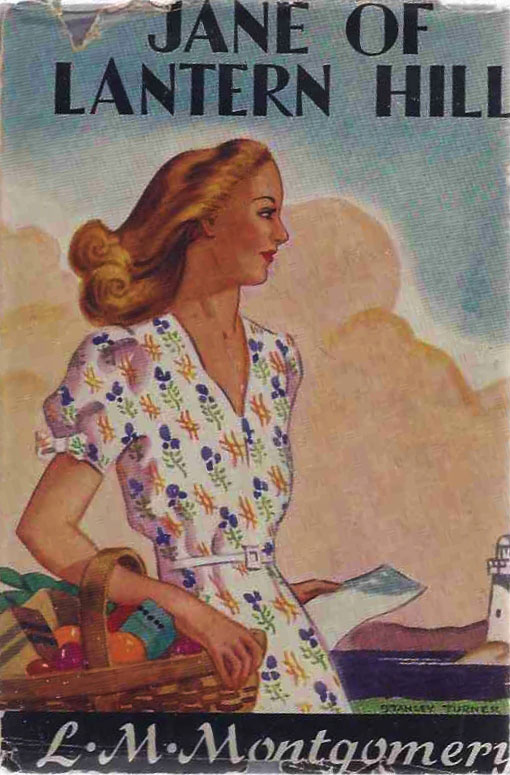
Jane of Lantern Hill by L.M. Montgomery ~ 1937. This edition: Bantam Books (Seal), 1989. Paperback. ISBN: 0-7704-2314-0. 217 pages.

My rating: 8/10. Jane Victoria Stuart is one of the more likeable young heroines in Lucy Maud Montgomery’s repertoire. Great gaps in believability here and there, but overall an engaging tale for romantic souls from youth (say 12-ish) to adult.

*****

Jane Victoria Stuart is eleven years old, and for eight of those years, the years she can remember, she has lived in a huge mansion in Toronto with her extremely wealthy, emotionally frigid grandmother and her delicately beautiful, weak-willed mother. As far as she knows her father is dead. He is never mentioned, except in snidely allusive references by her grandmother to “Victoria’s” tainted ancestry as demonstrated by her “low” tastes – a desire to cook and fraternize with the housekeeper in the warmly cozy kitchen, and a friendship with the young maid-of-all-work in the boarding house next door.

Grandmother makes no secret of her distaste for Jane Victoria – every creature comfort is provided but emotional needs go unfulfilled. Jane, as she secretly calls herself in defiance of her grandmother’s preferred Victoria, shares a deep love with her mother, but open demonstrativeness is impossible – even a glance or a motherly caress is deeply resented by bitter and jealous grandmother, who clings to her own daughter with fierce possessiveness.

The days go by uneventfully, and the future stretches forth relentlessly, until a chance taunt by a schoolmate reveals a secret which has been hidden from Jane by her grandmother and mother. Her father is not dead, but very much alive, and her mother is neither widowed or divorced but rather in a limbo of estrangement, unable to move either forward or back in the restricted social life engineered by the household matriarch.

Jane confronts her mother with the news and asks if it is true, and in one of her rare human moments Grandmother apologizes to Jane for keeping the secret for so long. But now that you know, consider him as dead, she orders Jane, and Jane solemnly and willingly agrees – this man who has abandoned her and made her mother so miserable is best forgotten.

Imagine Jane’s dismay when a letter comes soon after from Prince Edward Island, requesting Jane’s presence at her father’s summer residence over the summer holidays. With great trepidation Jane sets off into the unknown and greatly dreaded wider world.

Needless to say, everything works out, and happy endings abound. But before we get to them there are a number of little dramas which must be worked through, some more unbelievably than others.

A really nice heroine, practical and earnest and well-deserving of the good things which eventually come her way. Give this one to your pre-teen daughters, but don’t forget to read it yourself; mildly melodramatic and ultimately very satisfying.

Might make a good read-aloud, for ages maybe 8 and up. Marital troubles and divorce are central plot themes, as is emotional abuse by Jane’s grandmother, but these are necessary to the building of tension in the storyline. Rather reminiscent of Frances Hodgson Burnett’s A Little Princess in mood, I thought, including the improbable (but most satisfactory) way everything clicks into place in the end. No loose threads – all neat and tidy! Jane would approve.

Disney made a movie of this one a few years back, which I’ve not seen, but apparently it departs wildly from the original story and is not recommended by aficionados of the book.

Read Full Post »

Golden Days: Further Leaves from Mrs. Tim’s Journal by D.E. Stevenson ~ 1934. This edition: Isis Publishing, 2006. Hardcover. Large Print. ISBN: : 0753176139. 241 pages.

My rating: 8.5/10. I must say I liked this one a lot. Total cozy comfort read, and exceedingly predictable in its outcome. Some days that’s a good thing, a little break from thinking too hard!

I found it very similar to one my long-time go-to reads, E.M. Delafield’s Diary of a Provincial Lady. I don’t suggest that the gadabout adventures of Hester Christie (Mrs. Tim Christie) in any way echo the stay-at-home ways of Delafield’s unnamed heroine, but the tone, style and format are exceedingly familiar. I compared publication dates, and see that Delafield’s Provincial Lady was published (and became an immediate bestseller) in 1930-31 (England-U.S.A.), while Stevenson’s first Mrs. Tim book, Mrs. Tim of the Regiment, appeared in 1932, followed by this installment, Golden Days, in 1934. I would have to assume that Stevenson was aware of Delafield’s popular work?

No worries – there’s room in my heart for the two, though until I read more of the Mrs. Tim stories (and they are very much on my wish list), I still hold the Provincial Lady in higher esteem. The humour is more wry – more savage – and the inner examinations much closer to home. Hester is a bit too uniformly “nice”, though she has her moments of critical insight.

Apparently Golden Days is a rather hard to find stand-alone title, as it was only published as a separate title in the very early editions. In later years it was added to Mrs. Tim of the Regiment, with that title comprising both the 1932 and 1934 installments of Mrs. Tim’s diary.

The edition I found through the public library was a very recent (2006) large print edition from Isis (Ulverscroft); there appear to be quite a few D.E. Stevensons in the system in large print format, which perhaps says something about the age, or in any event the perceived age <ahem> of the D.E.Stevenson-readers’ demographic.

*****

This will be a sketchy review; the book has just been returned to the library so is not here in front of me to double-check details and names.

This is, as I already mentioned, the second Mrs. Tim story. It is usually included with the first installment, Mrs. Tim of the Regiment, in the 1940 and later editions, including the currently available reprint from Bloomsbury (2009). There are three more books in the series: Mrs. Tim Carries On (1941), Mrs. Tim Gets a Job (1947), and Mrs. Tim Flies Home (1952), all currently out of print, as far as I am aware.

Here we go.

Mrs. Tim, as our heroine Hester Christie is commonly styled, is married to a an army officer, and the impression we get from Golden Days is that she is often called upon to move house, to “follow the regiment.” At this particular time, Mr. Tim is occupied with his job, Mrs. Tim’s eldest child is off at boarding school, and she and her young daughter are invited on a Scottish holiday, with a dual purpose. First, to relax and enjoy themselves far from home responsibilities, and secondly, to try to bring sense to Mrs. Tim’s hostess’ son who has become involved with an unsuitable girlfriend. Apparently Mrs. Tim has some sort of special influence on the young man in question; in any event, he is prone to listen with flattering attention to what she has to say.

Much loch-fishing, glen-wandering and tea-drinking ensue. The love affair is brought to a satisfactory solution, and Mrs. Tim herself picks up an ardent admirer, though she is too innocent and too much in love with her absent husband to take much notice of her tenaciously persistent swain.

A slight book, and a very quick little read. I’m guessing not more than 150 pages or so if it were in standard-print format. Amusing and very pleasant in all regards. Perhaps just a mite too pleasant? Right there on the borderline, but Mrs. Tim gets a nod and a pass. I’m liking her even better than Miss Buncle , who got a decided pass as well, after some consideration.

I am persisting in making a broader acquaintanceship with D.E. Stevenson, as a number of fellow readers have been singing her praises, and I do see her appeal. But I am not one hundred percent onside quite yet. I am currently gingerly tackling Stevenson’s first novel, Peter West – also in large print, re-published 2007 or thereabouts for those of you wondering how I got my hands on it, as apparently this one is also hard to come by. It is rather too sentimental and flowery for my taste, and I do believe I already know the outcome, and I’m only a few chapters in. But I’ll soldier on, and report at a future date.

Side note: I really don’t care for the wishy-washy watercolour covers of the Isis editions. Too sweetly bland, and a bit embarrassing to be carrying around openly. The lady on the current cover of Golden Days bears no resemblance to my personal imaginary vision of Mrs. Tim – another minor annoyance!

Read Full Post »

Jane’s Parlour by O. Douglas (Anna Buchan) ~ 1937. This edition: Thomas Nelson & Sons, circa 1940s. Hardcover. 381 pages.

My rating: 9/10. Because I am now completely in thrall to Anna Buchan’s small but completely believable literary world, and I so greatly enjoyed spending time with the Rutherfurds and their ever-widening range of acquaintances.

*****

There was only one spot in the whole rambling length of Eliotstoun where Katharyn Eliot felt that she could be sure of being left at peace for any time. That was the small circular room at the end of the passage which contained her bedroom and Tim’s dressing-room; it was called for some unknown reason “Jane’s Parlour.”

No one knew who Jane was. There was no mention of any Jane in the family records: Elizabeths in plenty, Elspeths, Susans, Anns, Carolines, Helens, but never a Jane. But whoever she was Katharyn liked to think that she had been a virtuous soul, for there was always a feeling of peace, a faint, indefinable scent as of some summer day long dead in that rounded room with its three narrow windows (each fitted with a seat and a faded cushion), its satiny white paper, discoloured here and there by winter’s damp, on which hung coloured prints in dark frames. A faded Aubusson carpet lay on the floor, and in one corner stood a harp beside a bureau, and a beautiful walnut settee – these were Jane’s. A capacious armchair (Tim’s) was at one side of the fire, and opposite it, a large writing-table which was Katharyn’s. There was also an overcrowded bookcase, and a comfortable sofa: that was all there was in the room.

(…)

It was here she worked, for in the infrequent quiet times of a busy life Katharyn wrote – and published: it was here she read the writers she loved best, old writers like Donne and Ford and Webster from whom she was never tired of digging gloomy gems…

When Caroline was born Katharyn had made a rule that children and dogs were not to be admitted into Jane’s Parlour, and when Tim protested, replied with steely decision that there must be one peaceful place in the house. Before ten years had passed there were five children at Eliotstoun, and an ever-increasing army of dogs, so that, as Tim acknowledged, it was well to have one place where people’s feet were free of them.

And, because it was forbidden territory it naturally became the Mecca of the family, to enter it their most ardent desire…

This book interweaves a number of lives, most of which we are familiar with from The Proper Place and The Day of Small Things; Jane’s Parlour is very much a continuation of what has come before versus a stand-alone story; the three books belong together to give an ever-widening view of the living tapestry created by the author from her ever more intricately twined strands of individuals’ lives.

Here are Katharyn and Timothy Eliot, and their five children; Alison Lockhart and her beloved nephew George; Barbara and Andrew Jackson, Barbara in the role of antagonist and Andy smoothing down the feathers his wife continually ruffles; a cameo or two by Lady Jackson herself in all her vivid glory; Nicole and Lady Jane Ruthurfurd; and many more.

The main strand of this novel concerns a fairly typical love story, but there is much quiet activity going on at the same time, and we are treated to a series of interconnected vignettes which keep us up to date on what has happened since we last spent time in this lovingly created world. Virtue is rewarded, the wicked are put – for the most part – sternly in their place, joy is embraced and grief accepted. As usual, not much happens, but at the same time everything happens; much like most of our lives if we are lucky enough to live them in a peaceful country in between-great-events times.

The First World War is now long past, and is not often referred to, but the gathering clouds of what will be the Second World War are very much in evidence; this novel was published in 1937 and is a clearly and sensitively drawn period piece which captures the mood of those last few sunset years of relative peace before darkness once again descends.

If you enjoyed The Proper Place and The Day of Small Things, this is a definite must-read. The three novels belong together, and if you can get your hands on the posthumously published anthology-biography-memoir Farewell to Priorsford, you will find therein the first eight chapters of a fourth book, The Wintry Years, which follows the same characters into World War Two. Sadly, Anna Buchan died before that last novel was finished, but those chapters are perfectly composed, letting us turn away from our fictional friends with the feeling that their lives will continue somewhere even though out of our ken; truly the mark of a good author’s skill in world building.

Read Full Post »

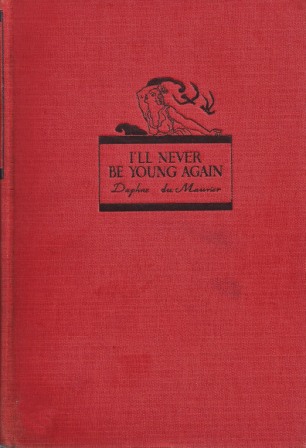
I’ll Never Be Young Again by Daphne du Maurier ~ 1932. This edition: Sundial Press, 1941. Hardcover. 336 pages.

My rating: 8/10 for most of the writing – the woman could certainly put words together, though she falters here and there – see the last paragraphs of the book which I’ve included at the very end of this review – and 4/10 for the plot and characterizations. Averaged out, that makes 6/10, which is still too high, so I’m going to give it a 5/10. Brutal, I know, but it is that hard to read.

I wanted to like this book so much, and was so thrilled when I found it. It starts off so very well, but soon turns into a long, very slow motion (think frame by frame slow) train wreck. I no longer wonder why this title is one of the unremarked silent members of Daphne du Maurier’s otherwise mostly stellar bibliography.

If it were anyone else but Dame Daphne, I would have pitched it about a quarter through, if not sooner. As it was, it took me a very, very long time to work my way through it. Only its nagging presence on my “What I’m Reading” sidebar kept me coming back for more punishment.

*****

The book, Daphne’s second (the first is The Loving Spirit, which I know I have somewhere but seem to remember having set aside many years ago as “unreadable” as well – I need to find it to refresh memory) was published when she was only twenty-four, so we have to give allowances for that. From my own advanced age – okay, I’m not that old, but twenty-four is half a lifetime away for me now – a book written by a twenty-four year old and titled I’ll Never Be Young Again is somehow more than a little ironic.

After finishing, I sat for a while thinking, “Was it the book or was it me? Did I just not get it?” So I did what I always do in cases such as this – I googled other bloggers’ reviews. And look what I found! I’m not alone! Someone else thought the very same thing. (Though she only gave it a 4/10. Ha! – take that, Doleful Dick, you whingy whiner.)

Therefore I have totally copped out and shamelessly stolen this review from Books I Done Read  (tagline: Reading books so you don’t have to) which is a totally awesome, very busy (in more ways than one – you’ll see what I mean when you visit it) little production. I love it. Raych forthrightly says what we’re all secretly thinking. Spend the time on her blog which you would’ve spent crawling through du Maurier’s non-opus, and you’ll be much happier. Says me, from first hand experience of both.

January 28, 2011

This was a difficult one to read.  It has those sort of circular, Catcher-in-the-Rye conversations where the point is not the content but the banality, which makes for good social critique but sloggery reading.  And it’s maybe 99% dialogue, because nothing happens.

Ok so.  Dick is the son of a famous author-slash-shitty father and, not having accomplished anything worthwhile by the ripe old age of maybe 21, Dick is on a bridge about to throw himself off when Jake happens by and is all, Don’t do that.  Exciting! you think.  And then on to page seven, where Jake and Dick go hire horses and ride through the mountains and the fjords for chapters and Jake tries to buck Dick up because Dick is sort of a whiner.  Somewhere in there Dick sleeps with a girl and it is disappointing for everyone involved.

Jake exits scene left about halfway through the book via Unexpected Oceanic Death and Hesta enters, with her large eyes and orange beret, and she and Dick shack up.  And this is where the whole thing gets seedy.  Daphne wanted to write about the uncomfortable relationships between men and women, and she nailed it because this is The Worst.  Dick spends ages trying to convince Hesta to let him nail her, complete with sulks and professions of love and more sulks.  After he finally wears her down he’s all *phew* Now that I’ve had you you can give up your music and come live in my flat with me and I will ignore you while I write the Great English Novel.

So it goes.  After a while (months, say) Hesta is like, I’m bored.  Remember how we used to…you know.  And Dick, who has been busily writing a novel (and a play!  Both sure to be hits!) all this time is like, ‘You mustn’t…you musn’t be like that.  It’s ghastly…it’s making a thing of it, it’s – it’s unattractive.  It’s all right for me to want you, but not for you – at least, never to say.’  Ugh, right?  So that when he goes to London to sell his novel (and play!) and his dad’s publisher is like, I’m sorry, but these are terrible, and he comes home to find that Hesta has left him for literally anyone else you’re all, Huzzah!  Oh and also, The end.

I feel like I need a shower.  It’s We Need To Talk About Kevin all over again.  Du Maurier succeeded in making me feel hideously uncomfortable which, while impressive, is also unpleasant.  I like my characters to be Good or Bad or a Mix but Something.  I don’t like for them to wander around listlessly with no real ideas and a too-large sense of their own importance alternated with a sort of whiny comprehension of how much they actually suck.

Very good, and very skillfully done, but I didn’t like it.

So there you have it. I will leave you with the closing lines of this story, which gives you a firsthand snippet of the banal monologue we’ve had to struggle through. Here’s Dick:

From my window I look down upon the little square. The trees are green in the garden opposite. There is the clean, fresh smell of an evening after rain. Somewhere, on one of the branches of the trees, I can hear a bird singing. A note that sounds from a long way off, sweet and clear, like a whisper in the air. And there is something beautiful about it, and something sad. At first he is lost, and then he is happy again. Sometimes he is wistful, sometimes he is glad.

He seems to be saying: “I’ll never be young again – I’ll never be young again.”

“I’ll never be young again.” Thank heaven for that. Because once she got this one out of her system, Daphne went on to write her next book, The Progress of Julius, which I absolutely adore, and then Jamaica Inn, and Rebecca

Growing pains. So glad she made it through!

Read Full Post »

Green Grows the City by Beverley Nichols ~ 1939. This edition: Jonathan Cape, Ltd., 1939. Hardcover. First edition. 285 pages.

My rating: 8/10. A little lush in the prose department, but ultimately I found this semi-fiction quite a likeable diversion. The chapter devoted to the author’s black, half-Siamese felines, Rose and Cavalier, won me completely over; I had been wavering a bit as the human cattiness of the narrative was sometimes rather too precious. Nichols’ affection for and description of his pets is a lovely bit of writing, appealing to anyone who shares his predilection for cats as the perfect – though endlessly demanding – home and garden companions.

The author makes no pretensions about his preferred role as planner and onlooker rather than a get-dirty, hands-on gardener. A little light watering, the plucking of a few blooms to adorn the breakfast table, maybe a mite of flower arranging to while away a slow morning, while the hired gardener does the heavy stuff under our Mr. Nichols’ interested eye…

Oh, meow! Who’s being catty now?

*****

Beverley Nichols, in his long life (1898-1883) in which he acted out the roles of journalist, author, playwright, composer, lecturer, pianist, and gay (in every sense of the word) man-about-town, alternately amused and infuriated his audience, friends and, I suspect, more than a few enemies. Possessed of a very high opinion of himself, a keenly sarcastic tongue, and a decided willingness to share his lightly censored thoughts in print, Beverley Nichols remains as readable today as he was when first published. Especially popular are his garden books, as among all the chattering nonsense and superfluous frills there are passages of very authentic admiration and insight into the appeal of that cultivated “square of ground” so universally sought after the universal tribe of gardeners, and his portraits of the plants that struck his fey fancy are small treasures of descriptive prose.

Speaking in the chapter regarding ferns,  Rhapsody in Green, in Green Grows the City, of his introduction to the gold and silver ferns (Gymnogramme species) at Kew:

…(A)s I stooped to tie the (shoe)lace, I happened to glance upward. And the underside of this fern was coated with gold, pure gold, that glistened in the sunlight.

Perhaps it may sound silly to say that it was the loveliest thing that has ever come my way since I have seem life through the eyes of a gardener… I knelt down before it. The closer I came, the more lovely did the fern appear. There were no half-measures about the gold-dust with which it was so richly coated. It wasn’t just a yellow powder. It bore no sort of resemblance to the ochre make-up with which the lily is adorned. Nor was the gold dusted merely here and there – it covered every curve and crevice of the frond.

The tiny shoots that were springing up from the base were, if possible, even brighter. Since their leaves had not yet opened, and there was no green about them, they looked like delicate golden ornaments, daintily disposed about the parent plant.

And by the side of it was another excitement. A silver fern! As thickly coated with the metal of the moon as the other had been coated with the metal of the sun. If I had not realized the futility of comparisons at moments such as this, I would have dared to suggest that the silver fern was even more beautiful than the golden. For it seemed actually luminous with this magic dust. And again, there were no half-measures. It was silver. Not just white or grey, not in the least like, say, a centaurea. It was silver, hall-marked, pure and glistening from the inexhaustible mint of Nature.

What gardener could resist such a teasing description? Now in my botanical garden and specialty nursery visits I shall be forever watching for gold and silver ferns…

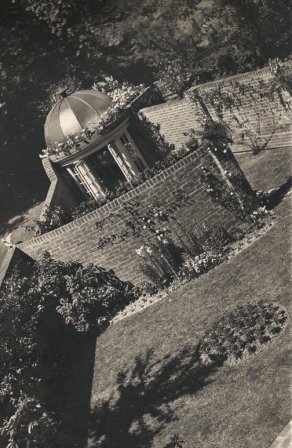
Green Grows the Garden is the fictionalized account of the creation of a very real garden. In 1936, after parting from his beloved country cottage and garden in the village of Glatton, Nichols tried the inner city life, living in a small, gardenless house in the Westminster district of London. Homesick for a bit of green, he tried without success to find a more suitable situation.

I had a hunger for green. I was lonely for the sound of trees by night. I longed to feel the turf beneath my feet, instead of the eternal pavement. Even if it were only a narrow strip of sooty grass, it would be resilient and alive, and would give me some of its own life.

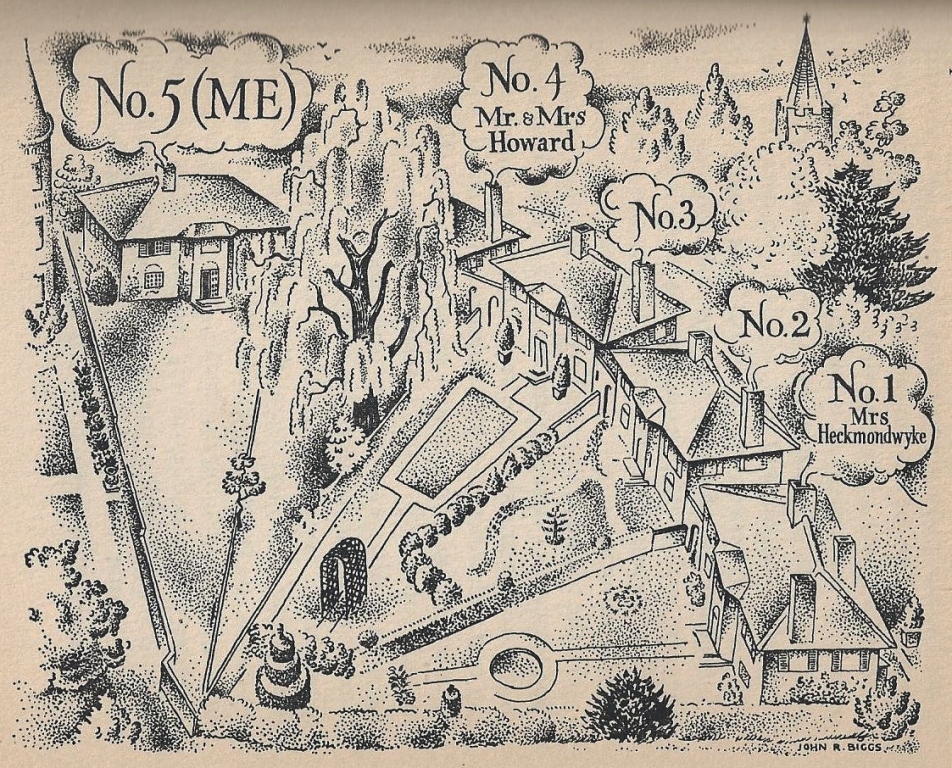
Finally a small semi-detached house is found, in a close in the suburb of Heathstead. There is a garden, of sorts, a triangular-shaped bit of ground which challenges the would-be garden-designer with its peculiar idiosyncracies.

The challenge is accepted, and the transformation begins. Struggles with the site abound, not least of which is the continual protestation of every one of Nichols’ projects by the overbearing “Mrs. Heckmondwyke” of No. 1. The feud between No. 5 and No. 1 drives much of the drama of this microcosmic enterprise, though in the end something of an uneasy truce is attained.

The book is dedicated “To My Friends Next Door”, probably to nip in the bud any idea that any of them were the actual prototype of the overwhelming Mrs. H, and Beverley Nichols quite freely admits, in an evasive forward, that perhaps some of his characters owe more to fiction than to real life. The garden was a real garden, though; as were the cats and the extraordinary, imperturbable, Jeeves-like manservant Gaskin.

As the story draws to a close, the shadow of World War II is looming, and in the last chapter there is sober reference made to the outside world. Watching newsreel footage, Nichols comments:

…Line after line of youths, in brown shirts, black shirts, red shirts, any sort of shirt…marching, always marching. Backwards and forwards, to the North, to the South, to the East and West. Marching with bigger and better guns, to louder and fiercer music. Marching with clenched fists or with outstretched arms, animated by the insane conviction that the fist that is clenched was made for the sole purpose of striking the arm that is outstretched. Marching, always marching, blind to the beauty that is around and above, deaf to all music save the snarl of the drum, marching to a destination that no man knows but all men dread.

And I suspect no one will be found to argue with the often quoted final words of this little book:

…(T)hat if all men were gardeners, the world at last would be at peace.

Read Full Post »

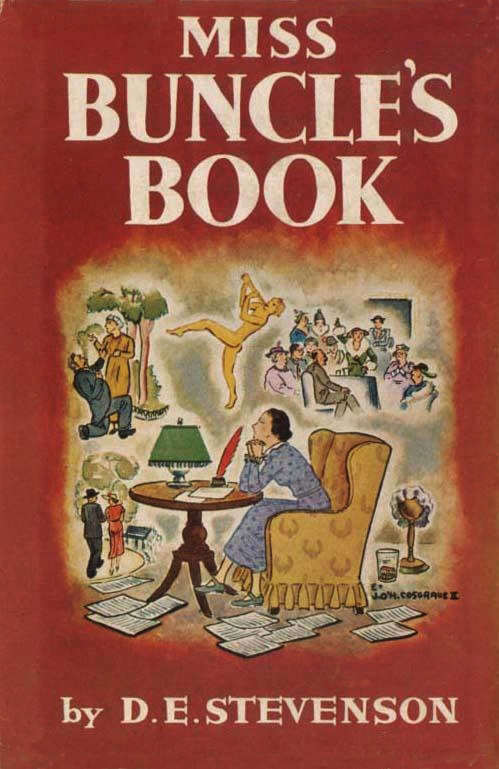
Miss Buncle’s Book by D.E. Stevenson ~ 1934.  This edition: Buccaneer Books, 1983. Hardcover. ISBN: 0-89966-168-8. 224 pages.

My rating: 8/10. A slight work, good for, at most, several evenings’ diversion. I would definitely re-read it after a decent interval, when wanting something “fluff”-ish to take my mind off the frequently depressing nastinesses of the our own 21st century world. Good for what it is – a tale as innocuous and amusing as Miss Buncle’s was intended to be, and not at all “clever”, though, as Miss Buncle herself found, those wishing to project their own imaginations into this simple fairytale could have a field day with hidden meanings, unintended by the author(s), I’m quite certain!

So, after seeing so many enthusiastic reviews of this book (and a few noncommittal “it was okay”s) I did at last manage to track down a library copy. I fall somewhere in between the two camps, but am probably most at home in the “in favour” crowd. I thought the story was light and fun, and I’m going to search out the sequels, Miss Buncle Married and The Two Mrs. Abbots, but I’m in no hurry.  Miss Buncle’s Book was pleasant enough but did not trigger a “must own it” compulsive visit to Amazon and ABE, though I did browse through both hoping to strike a bargain. Not much luck there; inter-library loan it shall be, though I was attracted enough to add D.E.Stevenson to my look-for list for used bookstore shelf scanning. In particular a series of stories concerning a certain “Mrs. Tim”, a soldier’s wife, who seems a good sort to get to know by all reports.

*****

Dowdy, almost-40, kind and peace-loving spinster Miss Barbara Buncle, facing financial difficulties as the dividends from her investments shockingly decrease in the post-WW I years, decides to write a book to gain some spending money. Not having “any imagination”, she draws her characters directly from life, changing only tiny details and, of course, their names. (The village Silverstream becomes Copperfield, Mr Fortnum is now Mr. Mason, Colonel Weatherhead becomes Major Waterfoot, Miss Pretty is Miss Darling, and so on, in a game of renaming by association.) As her tale progresses, she sends her “fictional” friends and neighbours off on some surprising adventures, causing much consternation when the inhabitants of Miss Buncle’s village eventually read the book and recognize themselves.

As the real-life inhabitants of Silverstream-Copperfield meet to decry the parody, and to discover and expose the Judas in their midst, they continually pass over innocuous Miss Buncle, even after she drops broad hints and, in a fit of conscience, even confesses to an unbelieving set of ears. For how could silly Barbara Buncle write even a borrowed epic? She’s not nearly clever enough…

The worm turns with a (mild) vengeance, and Miss Buncle gets the last laugh, as her life takes an unexpecteded turn due to her literary efforts.

Read Full Post »

« Newer Posts - Older Posts »