Here are some more of my decidedly well-appreciated Century of Reading Project books from months ago, as the calendar continues its relentless turning to the close of 2014.
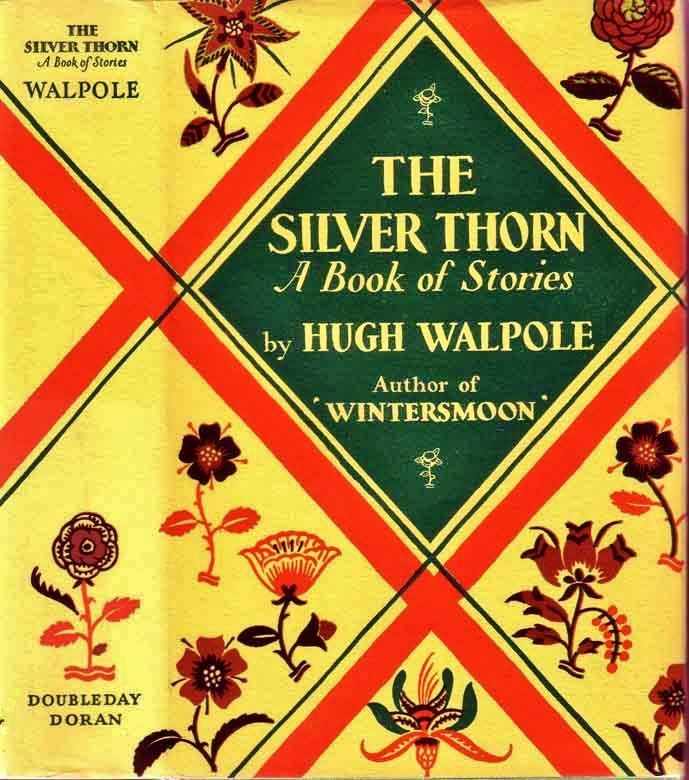
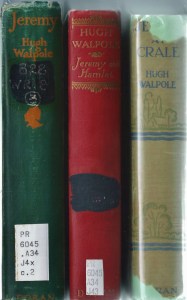 The Jeremy Stories, 1919-1927, by Hugh Walpole.
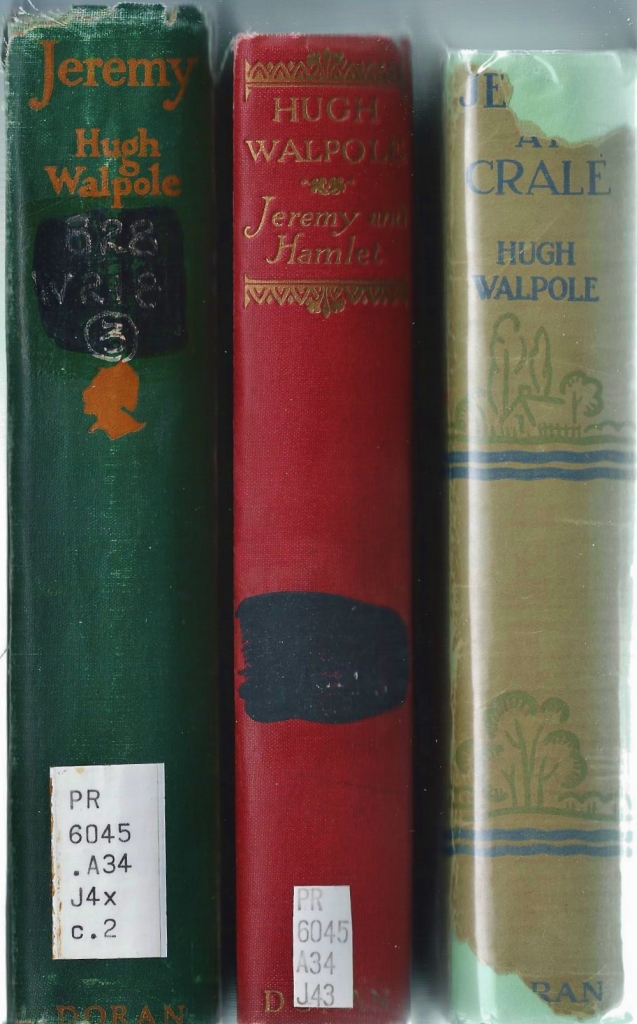
These three novels belong together, being a trilogy of the boyhood adventures of a certain young Jeremy Cole, based on the younger days of the author himself, but with much creative leeway. The setting of the Jeremy books was an imaginary cathedral town, Polchester, which the author created fabricated by combining features of real towns Truro and Durham. Polchester worked so well that Hugh Walpole used it as a setting for a great number of his other novels.
While the Jeremy books are about a child, they are not necessarily children’s books, being written from a decidedly adult perspective of looking back on juvenile thoughts and feelings, and sometimes relating them to the person the child was to become.
Thoughtful, moving, and frequently very funny, these books were tremendously popular in their time, enough so that “Jeremy” enjoyed quite a vogue as a boys’ name in the years after their publication, while Walpole’s authorial star was still on its blazing way up the literary sky.
I believe all three of these titles are available online through Project Gutenberg, though I of course recommend the vintage paper versions as the very best way to savour their goodness.
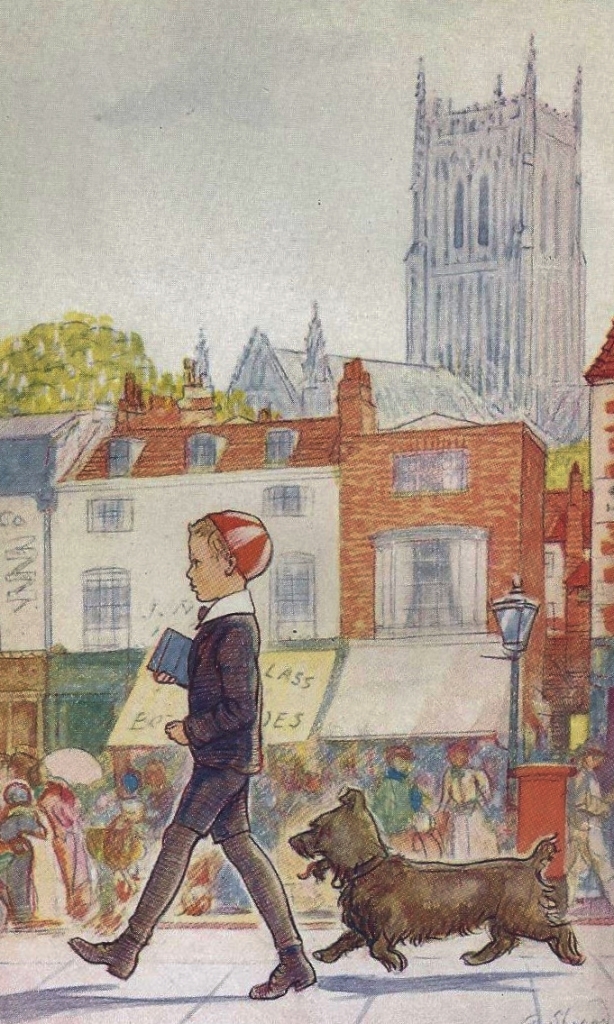
Jeremy and his canine familiar, Hamlet, as portrayed by E.H. Shepard in the 1919 edition of Jeremy.
Jeremy by Hugh Walpole ~ 1919. This edition: George H. Doran Company, 1919. Illustrated by Ernest H. Shepard. Hardcover. 341 pages.
We meet Jeremy on the morning of his eight birthday, December 8, 1892, and follow him through the next year, until his departure for boarding school. This first installment in what would eventually be three books about Jeremy is tremendously autobiographical in nature, with Walpole continuously shifting back and forth from first person descriptions of his own childhood to that of young Jeremy. Jeremy is not, however, Walpole himself; he is instead a slightly separated compatriot, an amalgam of the real and the plausibly imagined. Chapters focussing on Jeremy’s sisters – one older, one younger – add greatly to the narrative.
Jeremy and Hamlet by Hugh Walpole ~ 1923. This edition: George H. Doran Company, 1923. Hardcover. 305 pages.
It is 1894, and Jeremy is now 10 years old. He’s away at school for a goodly portion of this tale, and his mongrel dog Hamlet, a terrier-something-type, acquired during the time of the first book, Jeremy, is left behind at home. Walpole takes a creditable stab at looking at the world from a dog’s eye view, and by and large pulls it off. Jeremy has his trials and tribulations off at school, as Hamlet does back at home, but both win through by applying their pugnacious tenacity to their various challenges.
Jeremy at Crale: His Friends, His Ambitions and His One Great Enemy by Hugh Walpole ~ 1927. This edition: George H. Doran Company, 1927. Hardcover. 356 pages.
Now fifteen, Jeremy is in his third year at his public school, Crale. He’s something of a popular success, finding himself very good indeed at football. He acquires an enemy, whom he meets in schoolboy combat with the expected results. By the end of the tale he is well on the way to adulthood, having staunchly weathered all of the challenges of early adolescence in a boys’ school atmosphere. We part with Jeremy just as he is making tentative advances to a new friend, and we have no doubt that this latest relationship will prove a lasting and mutually beneficial one. This last novel is perhaps the most stereotypical of the lot, as Jeremy submerges much of his quirky personality in order to survive amongst the rather brutal masculine peer group of the school. Walpole reportedly had some rather dismal school experiences, and we do catch a lot of that angst, though Jeremy is thick-skinned enough to survive such encounters as his creator perhaps had more trouble with during his own school days. Favourably compared to Kipling’s Stalky & Co. in contemporary reviews, and I concur, though I’ve never been an early 20th Century British public school boy myself so can only relate at a very far distance. 😉
My collective rating: 9/10. Very much deserving of a more in-depth examination, as I couldn’t find much at all about these appealing and now-obscure books online.
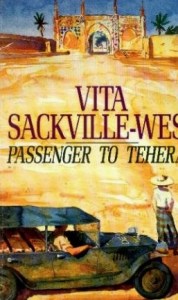 Passenger to Teheran by Vita Sackville-West ~ 1926. This edition: Arrow Books, 1991. Paperback. ISBN: 0-09-973350-1. 128 pages.
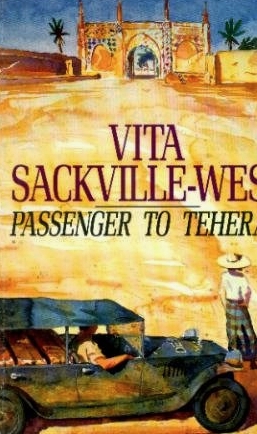
My rating: 8/10
If I could give this opinionated travel memoir a subtitle, I’d rather meanly suggest “People Not Like Us”, because Vita Sackville-West is in full snob mode from start to finish, though to be fair she does call herself on it very briefly at one point, murmuring something to the effect that she realizes the quaint Egyptian peasants are noteworthy mostly because they are “exotic”, and that their compatriots back home in England are viewed as not being worthy of a similar romanticism, being too, too dreary for words, because of overfamiliarity.
Despite the annoyance this writer’s aristocratically-exclusive self-regard always triggers in me, I do like her style and persist in reading her works of fiction and memoir with true pleasure.
In 1926 Vita Sackville-West travelled solo through the Strait of Gibraltar, across the Mediterranean, and through Egypt, Iraq and Persia (as Iran was then called) to the Persian capitol of Teheran, where she was to join her husband, diplomatic counsellor Harold Nicolson, for a long visit which was to include attendance at the coronation of Shah Reza Khan.
Vita’s opening words regarding travel writing to the contrary, this book is a tiny masterpiece of observation, telling us as much about its writer as about the people and places she observes.
Travel is the most private of pleasures. There is no greater bore than the travel bore. We do not in the least want to hear what he has seen in Hong-Kong. Not only do we not want to hear it verbally, but we do not want—we do not really want, not if we are to achieve a degree of honesty greater than that within the reach of most civilised beings—to hear it by letter either. Possibly this is because there is something intrinsically wrong about letters. For one thing they are not instantaneous. If I write home to-day and say (as is actually the fact), “At this moment of writing I am sailing along the coast of Baluchistan”, that is perfectly vivid for me, who have but to raise my eyes from my paper to refresh them with those pink cliffs in the morning light; but for the recipient of my letter, opening it in England at three weeks’ remove, I am no longer coasting Baluchistan; I am driving in a cab in Bagdad, or reading in a train, or asleep, or dead; the present tense has become meaningless…
After the coronation visit and a certain amount of exploration of the Iranian countryside, Vita returned to England by a circuitous route; by train through Russia, Poland, Germany, Holland and then back home to England.
…I forget the name of the German village; I know only that I had three hours’ sleep in a clean little room with an iron bedstead and a blue tin basin, and that we were all in a train again by six the next morning. That day passed in a haze: Königsberg; a long wait there, drinking coffee out of thick cups and looking at photographs in the German papers of the scenes in Warsaw; then another train; the Polish Corridor; East Prussia; Berlin. Farewell to my companions, who were to scatter to their destinations. The efficiency of Berlin; the quick, good taxi, striped black and white like a bandbox; the lighted streets; the polished asphalt; the Kaiserhof. I was travel-stained and tired; the servants at the Kaiserhof looked at me with polite suspicion; I revenged myself on them by sending for the head waiter, ordering the best dinner and the most expensive wine, and by distributing enormous tips out of my wad of American notes. As I had not had a proper meal since leaving Moscow, I took a good deal of trouble over the ordering of that dinner. I was afraid I might have to spend the night in Berlin, but I discovered a train that left for Flushing at ten; next morning found me in Holland. The customs-house officer at the Dutch frontier made me an offer of marriage. Then everything began to rush. Was I on the sea? very rough, too; beautiful, green, white-crested waves; was I at Folkestone? with English voices talking round me? was that Yew Tree Cottage and the path across the fields? Were those the two pistons at Orpington, still going up and down, and still a little wrong? Was I standing on the platform at Victoria, I who had stood on so many platforms? The orange labels dangled in the glare of the electric lamps. PERSIA, they said; PERSIA.
A note on the Arrow Books edition: This does not include any of the photographs from the original publication. If possible, try to attain one of the illustrated editions; the pictures are a fascinating enhancement of the text.
At a mere 128 pages this is a highly condensed version of Vita’s travels, but every word is, as was expected, perfectly placed.
Recommended.
 The Land, The People by Rachel Peden ~ 1966. This edition: Knopf, 1966. Illustrated by Sidonie Coryn. Hardcover. 332 pages.
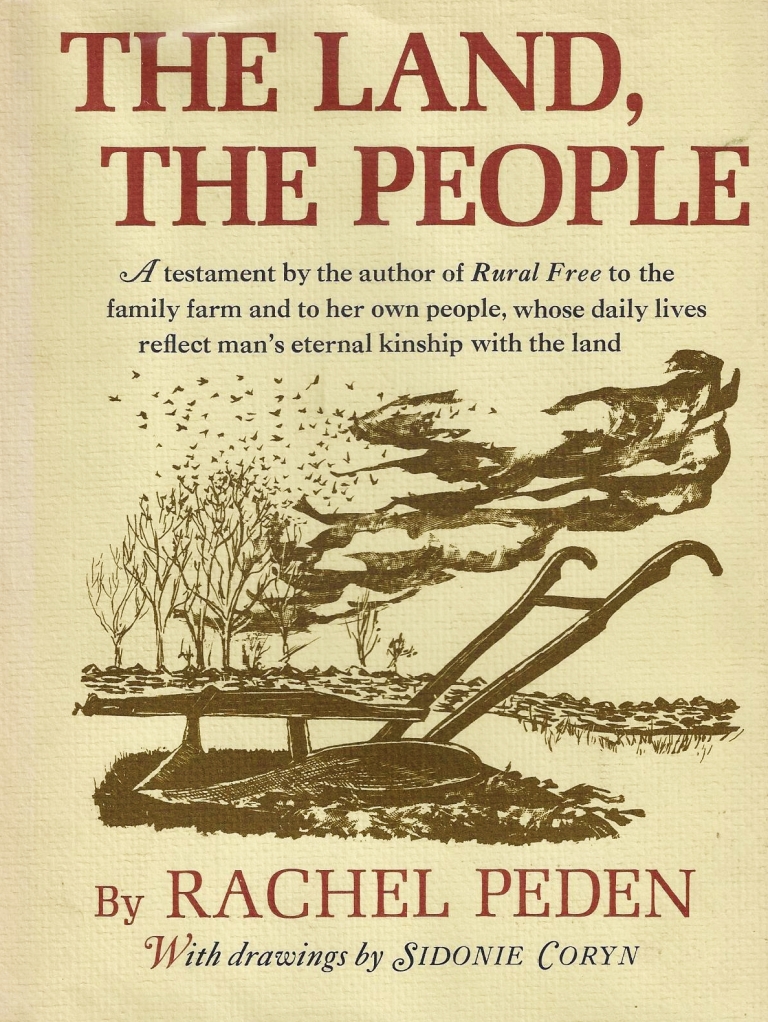
My rating: 10/10
Rachel Peden, in discussing her intent in The Land, the People, written in the later years of her life, and in the third decade of her writing career, had this to say:
I wanted the land to be the main character, and to write about the family farm, its change, survival, character, and of people’s love of the land and need of it as a basic human hunger…To say man is of the earth and that his well-being, even his very survival, depends on an occasional return to it is not enough. It is important to try to find out why this is true…
At first I thought I would start by saying that this book is not for everyone, perhaps, being a quiet yet rock-solid tribute to a particular place and a particular people, but on further pondering I think I am mistaken.
It may appeal most to the country dweller, or to the person who cherishes his or her rural roots, or to the historian of a certain era of American farming in a certain locale, but its message is universal.
Rachel Peden, in this calmly powerful book and in her other two appreciations of farm and country life, Rural Free and Speak to the Earth, and in her thousands of newspaper columns composed and published over four decades, from the 1940s to the mid-1970s, emphasizes over and over again the necessity for even the most dedicated urbanite to occasionally stoop down, as it were, and to touch the Great Mother and for a moment or two remember where we came from, and what ultimately sustains us.
Peden cast her writerly net wide, and caught up a diverse array of characters, incidents and episodes. Her style moves gracefully from the everyday to the poetic and back again with enviable ease; truly a reader’s delight.
Rachel Peden’s personal patch of earth was Monroe County, Indiana. She came from a long line of farm people, married a farmer, and was succeeded, after her death at 74 years of age in 1975, by her son and his family on the family acres. The Land, the People is to a great extent a memoir, her private testament to her own origins, and, on a higher level, a statement of her heartfelt belief in the importance of maintaining a strongly local farming tradition.
Watching the encroachment of urban sprawl, the increased mechanization and consolidation of what once were smallholdings into factory farms, and the casual acceptance of food staples arriving in some of America’s best farming regions from all around the world – lower cost trumping higher quality in many cases, not to mention the associated abandonment of small-plot farming as a viable career in a modern age – Peden calls out to her readers to be very careful as to where they are going, and to look back at where they came from, before it is too late.
Now, this sounds rather serious and dark and gloomy, but I assure you that this is far from being the case. Rachel Peden is no Cassandra; her observations are never full of woe. She never, ever preaches, but appeals instead to us as equals who recognize and appreciate the dilemmas (and not infrequent joys) experienced by farmers and country dwellers everywhere.
Much of the appeal of her writing is in her continual descriptions of the natural wonders which life on the land continually spread before one, from the tiniest of spring flowers to the most venerable of oak trees being toppled by lightning; insects and birds and animals; and, most lovingly, people of all sorts and ages. Community, in its broadest and best sense.
Four episodes make up The Land, the People. Each sets a different tone; each is a grand piece of writing; each makes me wish that Rachel Peden had written more long-form pieces rather than being bound to the conventions of the newspaper articles which made up the vast bulk of her work.
- High Gap Is the Lord’s – Rachel Peden’s father was an accomplished orchardist, and this first piece is both childhood memoir concerning Rachel and her siblings, and a loving remembrance of her perfectionist father and sensitive and practical mother.
- The Starling’s Voice – A short, intense depiction (fictional?) of a man’s obsession with his plot of land.
- Wide and Starry Night – A memoir and fond biography of Rachel’s beloved father-in-law, Walter Peden.
- The Fulness of Maple Grove – Rachel speaks to her own piece of land, and to her role as wife and mother, as well as her vision of herself and her family as custodians of their “borrowed” acres, preserving and increasing their farm’s fertility for future generations.














 Leaves & Pages
Round-Up Post #1-2014: Elizabeth von Arnim, Gene Stratton Porter, Louis Bromfield, Dorothy Canfield Fisher
Posted in 1910s, 1920s, Bromfield, Louis, Century of Books - 2014, Fisher, Dorothy Canfield, Read in 2014, Stratton-Porter, Gene, von Arnim, Elizabeth, tagged Bromfield, Louis, Century of Books 2014, Christopher and Columbus, Fisher, Dorothy Canfield, Her Father's Daughter, Social Commentary, Stratton-Porter, Gene, The Green Bay Tree, The Home-Maker, Vintage Fiction, von Arnim, Elizabeth on April 1, 2014| 12 Comments »
Getting ready to unfurl – leaf buds at University of British Columbia Botanical Garden, late February, 2014.
Well, here we are at the end of March, with the year one quarter over, and there is a largish stack of books read in January-February-March sitting here and nagging at my conscience. They all deserve some sort of mention, ideally a post each all to themselves, but with spring coming and longer daylight hours and some serious gardening projects coming up (meaning somewhat less computer time for me – which is by and large a good thing – hurray!) I know that I will not get to them all.
So I think a series of round up posts is in order, to temporarily clear my desk and my conscience, and to allow me to shelve these ones and recreate a new stack over the next few months, because that pattern or reading/posting is inevitable, it seems.
I’ve been considering how best to present these (there are quite a few) and have sorted them very loosely into sort-of-related groupings. Here’s the first lot, then.
All four of these particular books are linked by general era – just before, during and just after the Great War, and by their vivid reflection of the times they are set in. From playful (Christopher and Columbus) to sincere (The Green Bay Tree and The Home-Maker) to bizarre (Her Father’s Daughter), all help to fill in background details against which to set other books, and all are engrossing fictions in their own disparate ways.
************
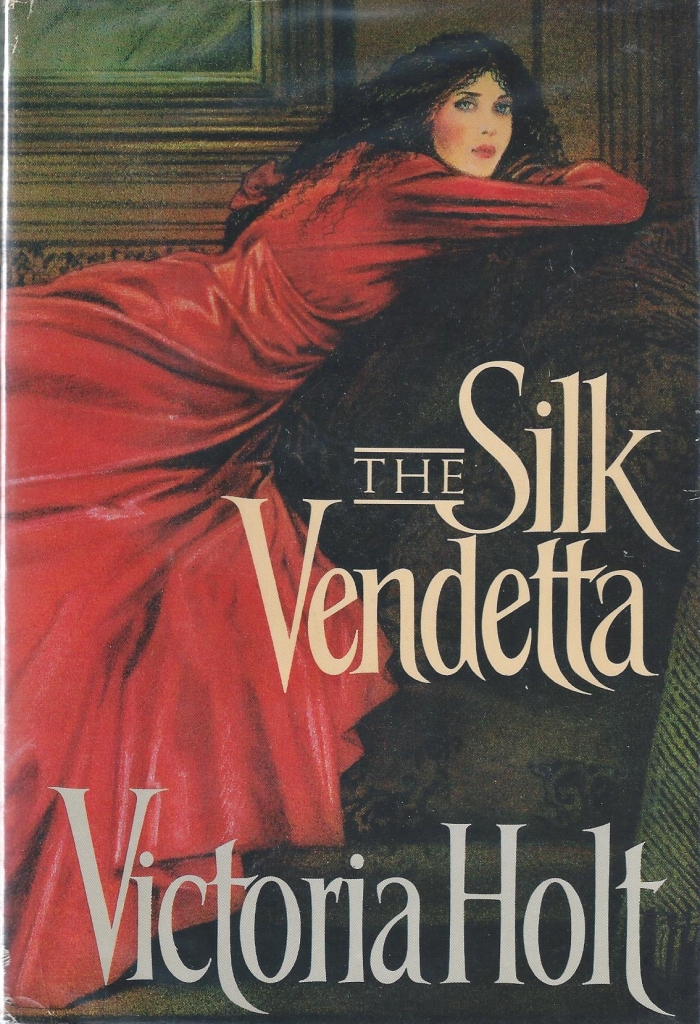
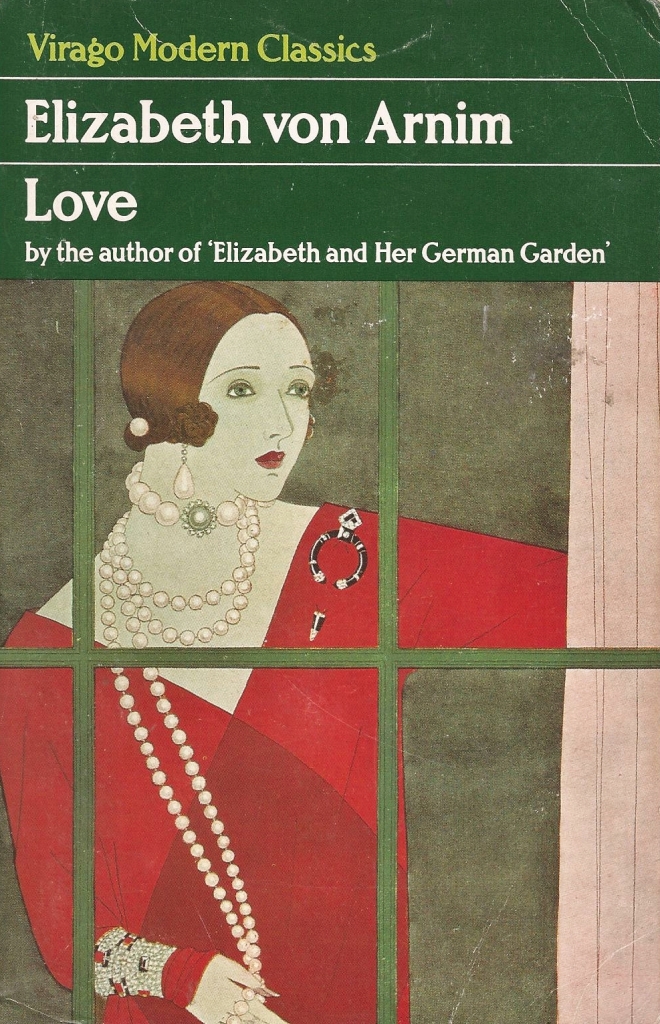
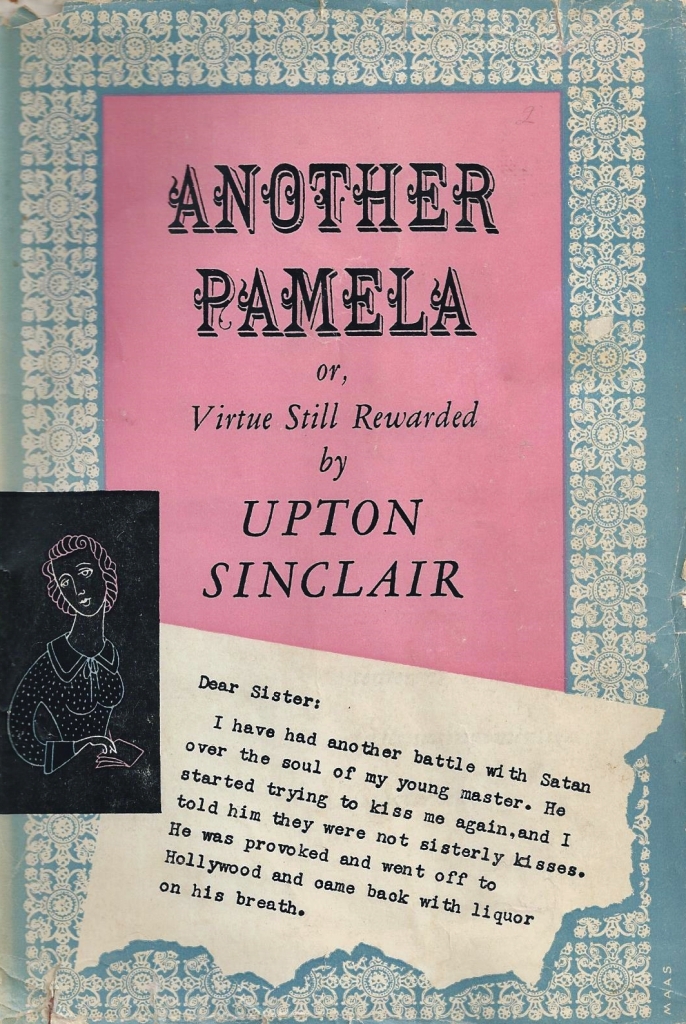
Not my copy – I have a much more recent Virago – but a nice early issue dust jacket depiction too good to not share.
Christopher and Columbus by Elizabeth von Arnim ~ 1919. This edition: Virago, 1994. Paperback. ISBN: 1-85381-748-1. 500 pages.
My rating: 8/10
Charming and playful, with a serious undertone regarding wartime attitudes to “enemy aliens”, set as it is in the early years of the Great War, in England and America.
Total digression – check out the paragraph above. It is ONE sentence. Thank you, E von A, because now I don’t feel quite so bad about my own rambling tendencies!
Ahem. Back to our story. To condense completely, the two Annas, having been rejected by their English connections, are sent off to America (this is before the Americans have joined in the war) to be settled upon some distant acquaintances there. Everything goes awry, but luckily the two girls – they are twins, by the way – have gained a sponsor/mentor/protector in the person of Mr. Twist, a fellow passenger, who just happens to be wealthy young man with a strong maternal streak.
The three adventure across America – the twins getting into continual scrapes and Mr. Twist rescuing them from themselves – eventually ending in California, where they acquire a chaperone and a Chinese cook, and decide to open an English-style teashop. It is a blazing success, but not in the way they had planned…
Very much in the style of The Enchanted April, more than slightly farcical, with romantically tidy endings for all.
Internet reviews abound, and this is happily available at Project Gutenberg: Christopher and Columbus
My rating: 2/10
Talk about contrast between books of a similar vintage, between this one and the previous Elizabeth von Arnim confection. This next book was a shocker, and I disliked it increasingly intensely, forcing myself to keep reading because I was determined to see where the author was going to go with it. (Nowhere very good, as it turns out.)
I already had an uneasy relationship with Gene Stratton-Porter, and though I’d been forewarned by other reviewers about the deeply racist overtones of Her Father’s Daughter, I wasn’t prepared to have the “race issue” as such a major plot point.
Two teenage sisters are orphaned. The elder sister spends their joint income on herself, on her lavish wardrobe and gadding about, while the younger sister is left to her own dismal devices.
Luckily sister # 2, our heroine, Linda, is a young lady of vast resource and apparently limitless talents. She pseudonymously writes and illustrates popular articles on California wild plants and flowers, excels at her high school courses, and has attained the selfless dedication of the family cook/housekeeper, a brogue-inflicted Irishwoman, one Katy. (GS-P’s dialect mangling reaches new heights in this book.)
Linda also tootles about in her late father’s car, a Stutz Bear Cat, driving everywhere fast, and as it goes without saying, better than all the boys. There’s nothing this girl doesn’t excel at, and her acquaintance ooh and ah over her many accomplishments, and chuck their devotion at her feet. She’s ultimately so all-round darned smart and gorgeous and generally desirable – especially once she bullies her sister into ponying up some of Daddy’s cash so she can buy a few new dresses – that she attracts three suitors, two of them older men, and one a high school classmate.
Which brings us to the race angle. For in the high school class the teenage suitor attends, there is a Japanese boy, who is at the top of the class despite all efforts of Linda’s Boyfriend to displace Japanese Guy. So Linda wracks her brains to find a way to help Boyfriend beat “the Jap”. Says she:
And this:
And then this:
Well, Japanese Guy soon realizes that something is up, because suddenly Boyfriend is pulling ahead in Algebra. (Or was it Trigonometry?) All because Linda is now helping Boyfriend study and has given him many words of encouragement. And then Linda and Boyfriend start to suspect that Japenese Guy is not a mere teenager like themselves, but an older man who is dying his hair and using cosmetics to make himself look younger. And then the gloves are off on both sides.
Subplots concerning sister and the inheritance and a friend who is an aspiring architect and more skulduggery concerning both of those scenarios, with the whole thing ending in a murder attempt by Japanese Guy upon Boyfriend, and his (Japanese Guy’s) death at the hand of Linda’s Irish servant Katy. Luckily killing a dirty yellow Jap is all in a day’s work in this neck of the woods:
By the end Linda has nabbed control of the family fortune, the sister has received a severe humbling, and the architect friend wins the prize. (And Japanese Guy is dead and vanished, his body mysteriously spirited away by “confederates”, adding a strange conspiracy theory sort of twist to the saga. All I could think was, “All that for academic standing in a high school class? Really? Really, Gene Stratton-Porter???!”)
Linda predictably finds true love, not with Teenage Boyfriend but with Older Man with Lots of Money and A Very Nice House built up amongst the wildflowers in Linda’s favourite roaming ground. How very handy.
Trying to think what I left this unsettling bit of vintage paranoia two points for. I guess because I did keep reading. But it was thoroughly troubling from start to finish on a multitude of levels – the racist thing being only one of the points that jarred – and even the gushing descriptions of California flora didn’t really salvage it.
Not recommended, unless you are a Gene Stratton-Porter completest. Not a very pretty tale, but if you wish to see for yourself, here it is at Project Gutenberg: Her Father’s Daughter
Will I read more books by this writer? Yes, very probably. For the curiousity factor, if nothing else, because these were hugely popular in their time, and that tells an awful lot (pun intended) about the general attitude of the populace who found these appealing, and they do much to enrich our background picture of an era.
My rating: 7/10
Moving on just a year or two, to this family saga by American writer Louis Bromfield, who served in the French Army during the First World War, and subsequently lived in France for thirteen years, before resettling in the United States and dedicating himself to the improvement of American agriculture by establishing the famous Malabar Farm in Ohio.
Bromfield was a prolific and exceedingly popular writer of his time, winning the Pulitzer Prize in 1927 for his third novel, Early Autumn. 1924’s The Green Bay Tree was his first published work, and it was immediately successful, paving the way for his stellar future writing career.
This is a book which fits neatly into the family saga genre, focussing on one main character, the wealthy and strong-willed Julia Thane, but surrounding her with a constellation of competently drawn characters all carrying on full lives of their own, which we glimpse and appreciate as they bump up against Julia in her blazing progress from the American family mansion surrounded by steel mills to the secluded house in France, where she settles with her secret illegitimate child and remakes her life very much on her terms.
Bromfield, in addition to creating a strong female lead and allowing her much scope for personal activity, also has a sociopolitical angle which he persistently presents, in the major sideplot of ongoing labour unrest in the steel mills surrounding the Shane family mansion, and widening the focus to the greater situation right across industrial America, with the hard-fought battle for workers’ rights and labour unions, and the rise of Russian Communism and its ripple effect which spreads across the globe.
Late in the story Lily Shane is caught up in the German invasion of France at the start of the Great War, and though this section is reasonably well-depicted, it was a bit too conveniently rounded off, with the author fast-forwarding to the end of the war with very few details after Lily’s one big dramatic scene.
It took me a chapter or two to fully enter into the story, but once my attention was caught I cheerfully went along for the ride. Bromfield is a smooth writer, and though this occasionally whispers “first novel” in slight awkwardness of phrasing and sketchiness of scene, by and large it is a nicely polished example of its type.
Bromfield seems to be something of a forgotten author nowadays, which is a shame, as his novels are certainly as engrossing (if not more so) than many of those now heading the contemporary bestseller lists. More on Bromfield in the future, I promise.
My rating: 8.5/10
Saving the best for last, here is a book I had been looking forward to for quite some time, after seeing it featured on the Persephone Press reprint list, and reading such stellar reviews by so many book bloggers.
It was very good indeed, though I found that the ending was vaguely unsatisfactory to me personally, involving as it did an unstated conspiracy between several of the characters to continue with a serious misrepresentation in order to allow a societal blind eye being turned to an unconventional family arrangement. I think I would have preferred an open discussion, rather than a sweeping under the rug sort of conclusion. But that’s just me… This novel must have been rather hard to round off neatly once the author had taken it as far as she thought her audience would swallow, and she decidedly had made her point and was likely ready to move on.
An ineffectually dreamy man labors on at an uncongenial job, while his wife keeps the house polished to the highest standard possible, and receives accolades from all levels of the social hierarchy of the small New England town where the family lives for her obvious achievement of wifely and motherly perfect devotion. Meanwhile the family’s three children are showing very obvious symptoms of psychological distress: excessive shyness (the oldest girl), a perennially wonky digestion (middle boy), and determined naughtiness (youngest boy).
Husband loses his job and on the way home to break the news has a terrible “accident”; he ends up in a wheelchair and the wife forays forth into the working world. And wouldn’t you know it? Suddenly everyone is much happier, and the children’s issues start to resolve “all on their own”. But the husband is healing much more fully than at first it was feared. How will this all end, in 1920s’ small town America, where gender roles are by and large carved in granite?
A lovely book, and extremely readable for its keen examination of the marital relationship it portrays, and its touching details of family life and the woes and joys of childhood.
Where it lost its few points with me was in the unlikely perfection of the wife’s experience in the working world; she waltzed right in and was promoted up the department store ladder of responsibility remarkably easily; even allowing for her detail-freak perfectionism her immediate grasp of her new role in life was a bit hard to swallow, as was her sudden relaxation regarding less than stellar household cleanliness. And I was uncomfortable with the “easy” ending, as I mentioned earlier.
I’ve read a number of other Dorothy Canfield Fisher novels, and they share this same occasional over-simplification as the author hammers her point home – she was something of a crusader in the area of improving family life and giving a fuller and freer role to children – but as she is also a marvelous story teller we can allow her this tiny tendency, I think.
************
Of the four books in this grouping, if I were going to recommend one as a should-read, it would definitely be The Home-Maker.
Followed by Christopher and Columbus, because it is utterly charming, if a bit silly in its premises and occasionally rather wordy. The Green Bay Tree is a perfectly acceptable drama, though nothing extraordinary. As for Her Father’s Daughter, consider yourself forewarned!
Read Full Post »