Archive for the ‘1910s’ Category

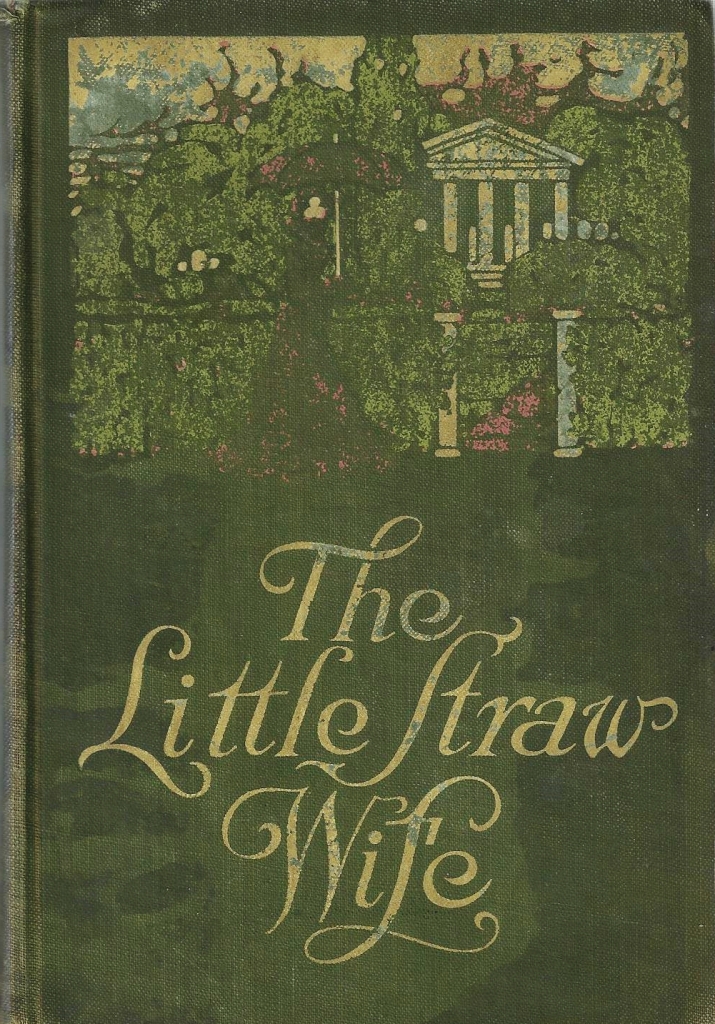
My vintage copy is terribly faded. The cover illustration depicts a female figure in long pink gown holding a pink parasol, against the backdrop of a white-columned mansion. (You may need to use your imagination.)

My vintage copy’s cover is terribly faded. The illustration depicts a female figure in long pink gown holding a pink parasol, against the backdrop of a white-columned mansion. (You may need to use your imagination.)

The Little Straw Wife by Margaret Belle Houston ~ 1914. This edition: The H.K. Fly Co., 1914. Illustrated by F. Graham Cootes. Hardcover. 217 pages.

My rating: 6/10

This fluffy vintage romance attracted my attention because it was the very first published novel by a writer I have been keeping an eye out for: Margaret Bell(e) Houston (the “e” of her middle name was dropped on later books), author of a number of romantic-suspense novels such as 1955’s Yonder (scroll way down, I was rather more rambling than usual that day), which I read last year and gave an enthusiastic rating to. (And, oh, look – there’s Phyllis A. Whitney again!)

Houston’s novels are still in a modest sort of circulation, with a number of them available as scanned e-books (see here for TLSW) and as print-on-demand paper books, but the originals are much more interesting to handle and read, especially when they contain illustrations, as this one does, to add to their period charm.

The Little Straw Wife was published in 1914, when the author was 37 years old; a comparatively venerable age for a first novel, it seems to me. (So many published writers seem to start so early, literally in their teens. I wonder what the average age actually is?)

Margaret Belle Houston was to write another dozen or so novels between 1914 and 1958, as well as short stories and poetry. She was something of a local celebrity in her home state of Texas, the partial setting of The Little Straw Wife and most of her other romance/drama/suspense novels.

This novel charges out of the starting gate with a lot of enthusiasm and dash, which is maintained for quite some time, though it gets a mite winded about three-quarters of the way through, and ends up gasping for breath in the final chapters.

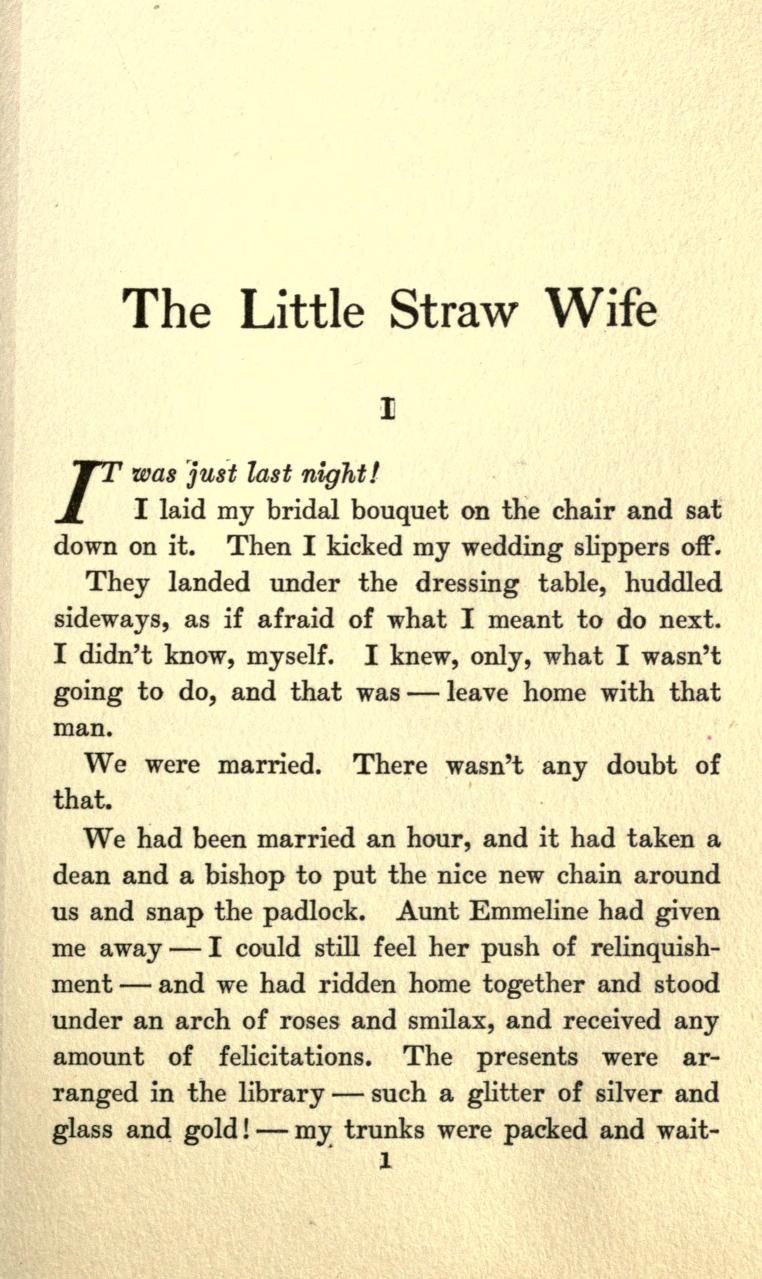
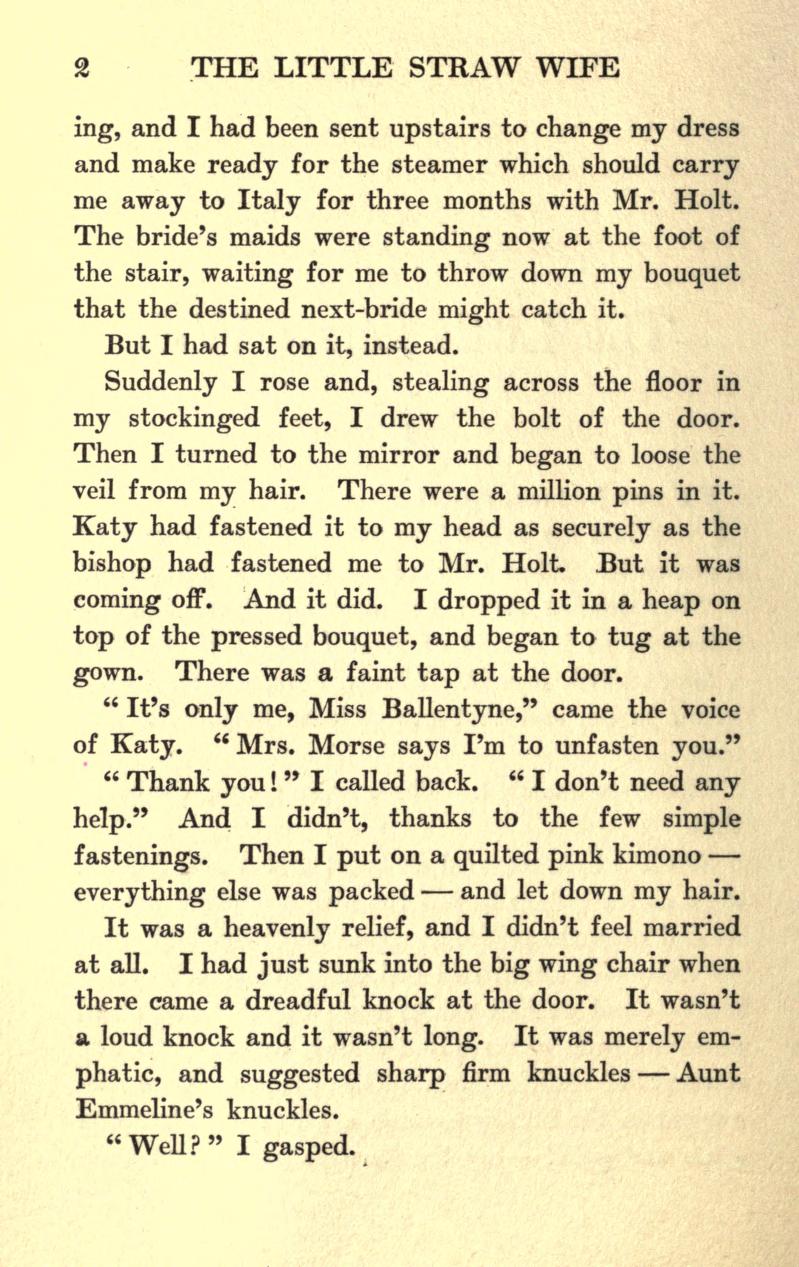
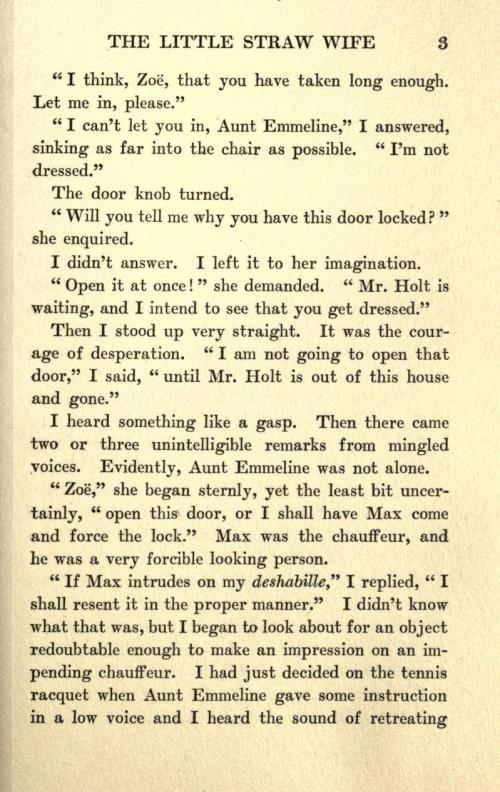
We meet our heroine, Zoë, just as she locks herself in her room and kicks off her shoes and plumps herself down on her wedding bouquet. Obviously something is not going well!

Here, read for yourself:

littlestrawwife00housiala_0013littlestrawwife00housiala_0014littlestrawwife00housiala_0015Our heroine is writing this account in her “Honeymoon Diary” – a gift from one of the bridesmaids, a blank book intended to document the joys of the first nuptial excursion. Instead it is being used to record the reasons behind the bride’s refusal to go through with things – albeit just an hour or two later than the usual cold-feet-at-the-altar cut-and-run.

Apparently Zoë feels that she has married her groom under false pretenses, and she can see nothing for it but to call the whole thing off. The upshot of it all is that she begs her groom to go off on the honeymoon voyage all alone, while she herself attempts to establish her independence away from Aunt Emmeline, who has made no secret of the fact that Zoë is no longer welcome under the familial roof.

Then we are treated to a rather nicely done flashback, as our narrator relates her history, and how she came to be in the situation now before us.

So far, quite enjoyable stuff, and as Zoë goes off to make her way in the world, with her cast-off groom lingering benignly(?) in the shadows waiting for her to come to her senses, the tale unfolds intriguingly, as Zoë casts herself on the hospitality of an old school chum and proceeds to attempt to enter the work force.

Once our Zoë, after a number of false starts, is settled into a suitable occupation – social secretary for an ambitious nouveau riche Texas ex-ranch wife – the tale begins to shed some of its charm, as it turns into what can only be described as a mushy romance. It’s still frequently sweet and funny, and the heroine still has us on her side, keeping us smiling at her odd personal decisions and indecisive agonizings to Dear Diary, but an immense tidal wave of coincidence and Had-I-But-Known drenches this initially clever story in utter cliché. The ending made me blush deeply. It was absolutely too good to be true, all over I-love-you-darlings and happy-ever-afters. Oh dear!

Well, for a first novel it shows a decently polished style, and the woes of Zoë in her quest for financial independence are feelingly portrayed. There is a strong vein of humour throughout; some of the diary entries are a comedic joy to read. If it weren’t for those last few romance-novel chapters, this would be such a thing of joy in general.

As it is, it’s still a fun vintage read despite its almost-fatally-flawed degeneration near the end. I’m glad I went to the trouble of tracking down in the paper, as it were, but I can’t give it a terribly enthusiastic recommendation as a must-read, because it is just too much of a period piece in its ultimate clichés to be truly top notch as a modern reading experience.

My advice, if one is interested, is to try this one gratis in its online e-book version. This scanned edition includes all of the Cootes illustrations, and is as close to reading the original as one can get without shelling out one’s hard-earned dollars for the real thing. Probably not a keeper, unless one is intrigued enough by the progress of Margaret Belle Houston to want to have a full set of her works on the shelf.

I have several more of Houston’s later novels waiting to be read: Bride’s Island (1957) and Cottonwoods Grow Tall (1958), both of which were published after the very acceptable Yonder, and both of which appear to have received good reviews in their time.

I am anticipating some enjoyable reading from these, but am waiting for that elusive “right mood” to strike. I am saving them for a treat, I hasten to assure you, so that will tell you how I really view Margaret Bell(e) Houston’s writing from my small experience of her – full of promise and most likely to prove highly diverting.

Read Full Post »

lady molly of scotland yard baroness orczyLady Molly of Scotland Yard by The Baroness Orczy ~ 1910. This edition: Facsimile of the 1912 edition, The Akadine Press, 1999. Softcover. ISBN: 1-888173-97-1. 344 pages.

My rating: Hmmm. Though doubtless a good example of period fiction and an early precursor to the detective-story genre which so abundantly flourished in the decades after Lady Molly’s publication, for actual reading experience the book was not quite as fabulous as I had hoped.

A perhaps overly generous 5/10 is all I can bring myself to award it right now, though it is the sort of thing one might well become fond of on a re-read for reasons quite unrelated to literary (or detective puzzle) merit. (Or then again, maybe not!)

We meet Lady Molly, in The Ninescore Mystery, first chapter of Lady Molly of Scotland Yard, courtesy Project Gutenberg:

Well, you know, some say she is the daughter of a duke, others that she was born in the gutter, and that the handle has been soldered on to her name in order to give her style and influence.

I could say a lot, of course, but “my lips are sealed,” as the poets say. All through her successful career at the Yard she honoured me with her friendship and confidence, but when she took me in partnership, as it were, she made me promise that I would never breathe a word of her private life, and this I swore on my Bible oath–“wish I may die,” and all the rest of it.

Yes, we always called her “my lady,” from the moment that she was put at the head of our section; and the chief called her “Lady Molly” in our presence. We of the Female Department are dreadfully snubbed by the men, though don’t tell me that women have not ten times as much intuition as the blundering and sterner sex; my firm belief is that we shouldn’t have half so many undetected crimes if some of the so-called mysteries were put to the test of feminine investigation.

Do you suppose for a moment, for instance, that the truth about that extraordinary case at Ninescore would ever have come to light if the men alone had had the handling of it? Would any man have taken so bold a risk as Lady Molly did when–But I am anticipating.

Let me go back to that memorable morning when she came into my room in a wild state of agitation.

“The chief says I may go down to Ninescore if I like, Mary,” she said in a voice all a-quiver with excitement.

“You!” I ejaculated. “What for?”

“What for–what for?” she repeated eagerly. “Mary, don’t you understand? It is the chance I have been waiting for–the chance of a lifetime? They are all desperate about the case up at the Yard; the public is furious, and columns of sarcastic letters appear in the daily press. None of our men know what to do; they are at their wits’ end, and so this morning I went to the chief–”

“Yes?” I queried eagerly, for she had suddenly ceased speaking.

“Well, never mind now how I did it–I will tell you all about it on the way, for we have just got time to catch the 11 a.m. down to Canterbury. The chief says I may go, and that I may take whom I like with me. He suggested one of the men, but somehow I feel that this is woman’s work, and I’d rather have you, Mary, than anyone. We will go over the preliminaries of the case together in the train, as I don’t suppose that you have got them at your fingers’ ends yet, and you have only just got time to put a few things together and meet me at Charing Cross booking-office in time for that 11.0 sharp.”

She was off before I could ask her any more questions, and anyhow I was too flabbergasted to say much. A murder case in the hands of the Female Department! Such a thing had been unheard of until now. But I was all excitement, too, and you may be sure I was at the station in good time.

Holmes to Lady Molly’s Watson (the comparison is inevitable and apt) is our narrator Mary, who started out as Lady Molly’s maid in the days-gone-by continually referred to with much innuendo and mysterious “But I mustn’t talk about that!”

Now Mary and Lady Molly are members of the female division of Scotland Yard’s investigative force, though Mary still seems to be fulfilling many of her old duties in regard to her mistress, as well as some new ones. Messy and boring (and possibly dangerous) investigation to be done – well, let’s send Mary! Though to be fair Lady Molly puts herself in discomfort occasionally. (Very occasionally.) Most of her detecting seems to be done Hercule Poirot/Nero Wolfe style, from the comfort of an armchair while exercising her own Great Big Brain.

My biggest beef: the class distinctions so blatantly demonstrated throughout. Lady Molly is exceedingly high handed with her inferiors (that would be just about everyone she meets, works with and “investigates”) and meek Mary obviously feels that this is just the way it should be. And Lady Molly never explains; she merely orders, and her “partners” (usually Mary, but on occasion fawning members of The Force) scuttle off, sure in their belief that Lady Molly’s womanly (and aristocratic) intuition will bring a solution to the problem of the moment.

There is also a secret reason Lady Molly took up her profession at Scotland Yard; the big reveal happens in the last chapter, with Mary at last spilling all the beans she was forbidden to display previously.

Well, this allows me to tick off 1910 in the Century of Books, and also to satisfy my curiosity as to what Lady Molly was all about; I’ve occasionally seen her referenced in discussions of Golden Age women’s detective fiction; I need wonder no more.

Tasha Brandstatter’s Review echoes my feelings.

As does Stewartry – grand review.

The Wikipedia entry discusses the plot of the first few chapters in vivid, spoiler-laden detail.

And here’s the whole thing on Project Gutenberg.

Read Full Post »

olivia o douglas dj 001Olivia by O. Douglas ~ 1912. Original title: Olivia in India: The Adventures of a Chota Miss Sahib. This edition: Nelson, 1950. Hardcover. 281 pages.

Provenance: Shepherd Books, Victoria B.C., September 2013.

My rating: 7/10

The first published work by Anna Buchan, written under her pen name O. Douglas.

This slight epistolary novel is based on Anna’s own 1907 voyage to India to visit her younger brother William; the characters “Olivia” and “Boggley” are obviously very lightly veiled depictions of Anna and William, and there is even a reference or two to another brother, “John”, who is a highly regarded novelist. John Buchan – of The Thirty-Nine Steps fame – was of course a very real person, and though “Olivia” throughout refers to her family name as “Douglas”, we can’t help but draw the simple conclusion that this is mostly autobiography, presented as fiction.

India in the years of the Raj has been so often and thoroughly documented both in fact and fiction that it exists in our readerly imaginations as a defined time and place with expected characters, settings and situations. Olivia does nothing to further illuminate any of this, merely laying down another layer of sepia-tinted varnish on an already-finished picture.

I found the book enjoyable enough in a mild way; in common with all of the author’s other novels the people are very believable, being a mixture of good and not so good, and the situations are realistically described. It differs from most of O Douglas’s later novels which have a traditional plot structure in that in this one nothing really happens, aside from the expected incidents of domestic adventure and foreign travel.

Olivia journeys about, sightseeing and marking time, all the while writing to an unnamed correspondent back home, whom we are able to identify early on as a person of potentially romantic interest. The nearest thing to a climax occurs at the very end of the book, when the correspondent is given a name, and Olivia commits herself so far as to accept his apparent proposal of an enlargement and formalization of their “friendship” when she returns to England.

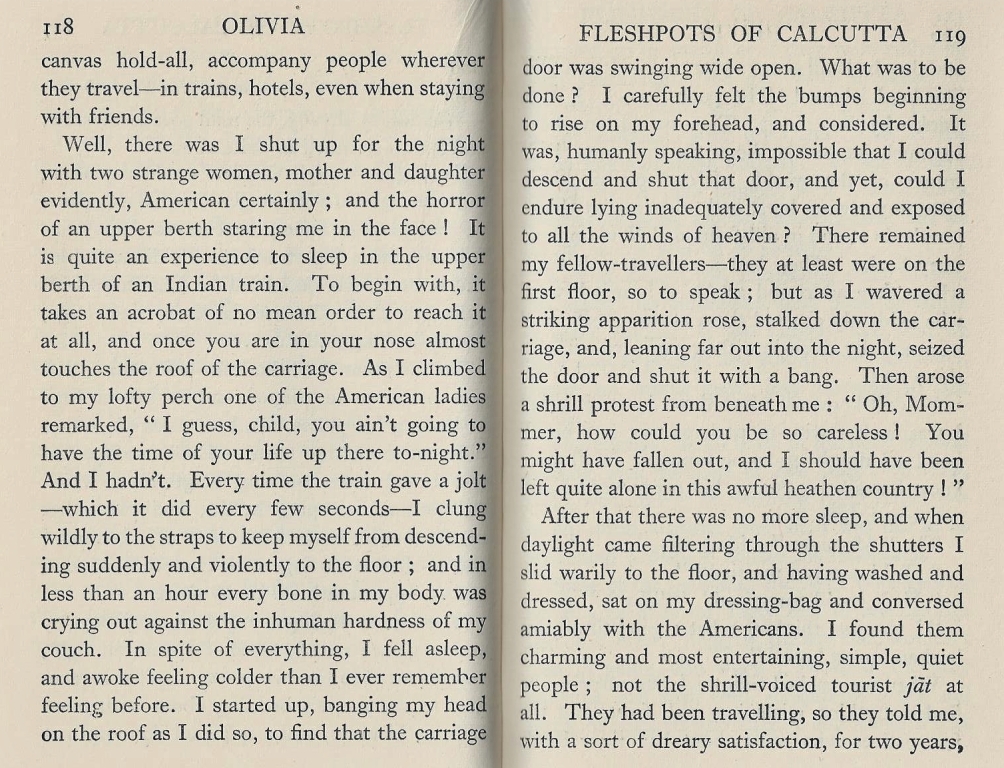
Though it sounds as if I were damning this quiet book with faint praise, it wasn’t actually all that bad. The scenes throughout are engagingly described and occasional vignettes stand out, as when Olivia sees the Himalayas for the first time, after a less-than-comfortable train journey.

Here is a snippet from that journey, with these pages being representative of the style of narrative of the whole. (Click on image to enlarge.)

olivia o douglas excerpt 001

And there are enough references to the political situation and dreadful things going on all about – the poverty of much of the native population and certain of the lower class Europeans and Eurasians, the constant occurrence of sudden death from misadventure and virulent tropical diseases, the occasional “throwing of bombs” by radical demonstrators – to keep the tone from being at all saccharine.

Olivia herself has a rather snobbish attitude to anyone not of her class, race and religion – these being upper, Scottish, and Presbyterian – but she does recognize this tendency in herself and occasionally puts herself out to overcome her prejudices, though to the end of her travels she remains fastidiously suspicious of the natives of the country.

Very much a first book, but, to be fair, quite a good one. It held my interest throughout, though I am sure most of it will fade away quite quickly to join the rest of the era’s Anglo-Indian accounts of chirpy young Great Britain-ites off to visit the exotic Colonial Outposts, before it all fell apart.


Read Full Post »

"The Pet Lamb" - William Henry Lippincott (1849-1920)

“The Pet Lamb” – William Henry Lippincott (1849-1920)

A Child’s Pet

When I sailed out of Baltimore,

With twice a thousand head of sheep,

They would not eat, they would not drink,

But bleated o’er the deep.

Inside the pens we crawled each day

To sort the living from the dead;

And when we reached the Mersey’s mouth

Had lost five hundred head.

Yet every night and day one sheep,

That had no fear of man or sea

Stuck through the bars its pleading face,

And it was stroked by me.

And to the sheep-men standing near,

‘You see,’ I said, ‘this one tame sheep?

It seems a child has lost her pet,

And cried herself to sleep.’

So every time we passed it by

Sailing to England’s slaughterhouse,

Eight ragged sheep-men — tramps and thieves —

Would stroke that sheep’s black nose.

W.H. Davies ~ 1919


Read Full Post »

Getting ready to unfurl - leaf buds at University of British Columbia Botanical Garden, late February, 2014.

Getting ready to unfurl – leaf buds at University of British Columbia Botanical Garden, late February, 2014.

Well, here we are at the end of March, with the year one quarter over, and there is a largish stack of books read in January-February-March sitting here and nagging at my conscience. They all deserve some sort of mention, ideally a post each all to themselves, but with spring coming and longer daylight hours and some serious gardening projects coming up (meaning somewhat less computer time for me – which is by and large a good thing – hurray!) I know that I will not get to them all.

So I think a series of round up posts is in order, to temporarily clear my desk and my conscience, and to allow me to shelve these ones and recreate a new stack over the next few months, because that pattern or reading/posting is inevitable, it seems.

I’ve been considering how best to present these (there are quite a few) and have sorted them very loosely into sort-of-related groupings. Here’s the first lot, then.

All four of these particular books are linked by general era – just before, during and just after the Great War, and by their vivid reflection of the times they are set in. From playful (Christopher and Columbus) to sincere (The Green Bay Tree and The Home-Maker) to bizarre (Her Father’s Daughter), all help to fill in background details against which to set other books, and all are engrossing fictions in their own disparate ways.

************
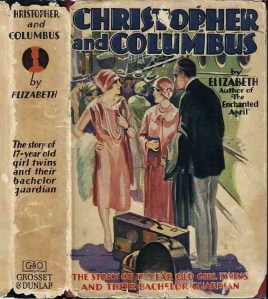
Not my copy - I have a much more recent Virago - but a nice early issue dust jacket depiction.

Not my copy – I have a much more recent Virago – but a nice early issue dust jacket depiction too good to not share.

Christopher and Columbus by Elizabeth von Arnim ~ 1919. This edition: Virago, 1994. Paperback. ISBN: 1-85381-748-1. 500 pages.

My rating: 8/10

Charming and playful, with a serious undertone regarding wartime attitudes to “enemy aliens”, set as it is in the early years of the Great War, in England and America.

Their names were really Anna-Rose and Anna-Felicitas; but they decided, as they sat huddled together in a corner of the second-class deck of the American liner St. Luke, and watched the dirty water of the Mersey slipping past and the Liverpool landing-stage disappearing into mist, and felt that it was comfortless and cold, and knew they hadn’t got a father or a mother, and remembered that they were aliens, and realized that in front of them lay a great deal of gray, uneasy, dreadfully wet sea, endless stretches of it, days and days of it, with waves on top of it to make them sick and submarines beneath it to kill them if they could, and knew that they hadn’t the remotest idea, not the very remotest, what was before them when and if they did get across to the other side, and knew that they were refugees, castaways, derelicts, two wretched little Germans who were neither really Germans nor really English because they so unfortunately, so complicatedly were both,—they decided, looking very calm and determined and sitting very close together beneath the rug their English aunt had given them to put round their miserable alien legs, that what they really were, were Christopher and Columbus, because they were setting out to discover a New World.

Total digression – check out the paragraph above. It is ONE sentence. Thank you, E von A, because now I don’t feel quite so bad about my own rambling tendencies!

Ahem. Back to our story. To condense completely, the two Annas, having been rejected by their English connections, are sent off to America (this is before the Americans have joined in the war) to be settled upon some distant acquaintances there. Everything goes awry, but luckily the two girls – they are twins, by the way – have gained a sponsor/mentor/protector in the person of Mr. Twist, a fellow passenger, who just happens to be wealthy young man with a strong maternal streak.

The three adventure across America – the twins getting into continual scrapes and Mr. Twist rescuing them from themselves – eventually ending in California, where they acquire a chaperone and a Chinese cook, and decide to open an English-style teashop. It is a blazing success, but not in the way they had planned…

Very much in the style of The Enchanted April, more than slightly farcical, with romantically tidy endings for all.

Internet reviews abound, and this is happily available at Project Gutenberg:  Christopher and Columbus
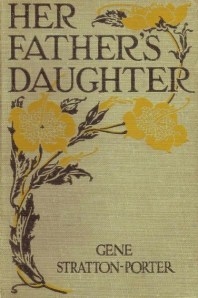
her father's daughter gene stratton porterHer Father’s Daughter by Gene Stratton-Porter ~ 1921. This edition: Doubleday, 1921. Hardcover. 486 pages.

My rating: 2/10

Talk about contrast between books of a similar vintage, between this one and the previous Elizabeth von Arnim confection. This next book was a shocker, and I disliked it increasingly intensely, forcing myself to keep reading because I was determined to see where the author was going to go with it. (Nowhere very good, as it turns out.)

I already had an uneasy relationship with Gene Stratton-Porter, and though I’d been forewarned by other reviewers about the deeply racist overtones of Her Father’s Daughter, I wasn’t prepared to have the “race issue” as such a major plot point.

Two teenage sisters are orphaned. The elder sister spends their joint income on herself, on her lavish wardrobe and gadding about, while the younger sister is left to her own dismal devices.

Luckily sister # 2, our heroine, Linda, is a young lady of vast resource and apparently limitless talents. She pseudonymously writes and illustrates popular articles on California wild plants and flowers, excels at her high school courses, and has attained the selfless dedication of the family cook/housekeeper, a brogue-inflicted Irishwoman, one Katy. (GS-P’s dialect mangling reaches new heights in this book.)

Linda also tootles about in her late father’s car, a Stutz Bear Cat, driving everywhere fast, and as it goes without saying, better than all the boys. There’s nothing this girl doesn’t excel at, and her acquaintance ooh and ah over her many accomplishments, and chuck their devotion at her feet. She’s ultimately so all-round darned smart and gorgeous and generally desirable – especially once she bullies her sister into ponying up some of Daddy’s cash so she can buy a few new dresses – that she attracts three suitors, two of them older men, and one a high school classmate.

Which brings us to the race angle. For in the high school class the teenage suitor attends, there is a Japanese boy, who is at the top of the class despite all efforts of Linda’s Boyfriend to displace Japanese Guy. So Linda wracks her brains to find a way to help Boyfriend beat “the Jap”. Says she:

 “They are quick; oh! they are quick; and they know from their cradles what it is that they have in the backs of their heads. We are not going to beat them driving them to Mexico or to Canada, or letting them monopolize China. That is merely temporizing. That is giving them fertile soil on which to take the best of their own and the level best of ours, and by amalgamating the two, build higher than we ever have. There is just one way in all this world that we can beat Eastern civilization and all that it intends to do to us eventually. The white man has dominated by his color so far in the history of the world, but it is written in the Books that when the men of color acquire our culture and combine it with their own methods of living and rate of production, they are going to bring forth greater numbers, better equipped for the battle of life, than we are. When they have got our last secret, constructive or scientific, they will take it, and living in a way that we would not, reproducing in numbers we don’t, they will beat us at any game we start, if we don’t take warning while we are in the ascendancy, and keep there.”

And this:

“Take them as a race, as a unit—of course there are exceptions, there always are—but the great body of them are mechanical. They are imitative. They are not developing anything great of their own in their own country. They are spreading all over the world and carrying home sewing machines and threshing machines and automobiles and cantilever bridges and submarines and aeroplanes—anything from eggbeaters to telescopes. They are not creating one single thing. They are not missing imitating everything that the white man can do anywhere else on earth. They are just like the Germans so far as that is concerned.”

And then this:

“Linda,” said the boy breathlessly, “do you realize that you have been saying ‘we’? Can you help me? Will you help me?”

“No,” said Linda, “I didn’t realize that I had said ‘we.’ I didn’t mean two people, just you and me. I meant all the white boys and girls of the high school and the city and the state and the whole world. If we are going to combat the ‘yellow peril’ we must combine against it. We have got to curb our appetites and train our brains and enlarge our hearts till we are something bigger and finer and numerically greater than this yellow peril. We can’t take it and pick it up and push it into the sea. We are not Germans and we are not Turks. I never wanted anything in all this world worse than I want to see you graduate ahead of Oka Sayye. And then I want to see the white boys and girls of Canada and of England and of Norway and Sweden and Australia, and of the whole world doing exactly what I am recommending that you do in your class and what I am doing personally in my own. I have had Japs in my classes ever since I have been in school, but Father always told me to study them, to play the game fairly, but to BEAT them in some way, in some fair way, to beat them at the game they are undertaking.”

Well, Japanese Guy soon realizes that something is up, because suddenly Boyfriend is pulling ahead in Algebra. (Or was it Trigonometry?) All because Linda is now helping Boyfriend study and has given him many words of encouragement. And then Linda and Boyfriend start to suspect that Japenese Guy is not a mere teenager like themselves, but an older man who is dying his hair and using cosmetics to make himself look younger. And then the gloves are off on both sides.

Subplots concerning sister and the inheritance and a friend who is an aspiring architect and more skulduggery concerning both of those scenarios, with the whole thing ending in a murder attempt by Japanese Guy upon Boyfriend, and his (Japanese Guy’s) death at the hand of Linda’s Irish servant Katy. Luckily killing a dirty yellow Jap is all in a day’s work in this neck of the woods:

“Judge Whiting, I had the axe round me neck by the climbin’ strap, and I got it in me fingers when we heard the crature comin’, and against his chist I set it, and I gave him a shove that sint him over. Like a cat he was a-clingin’ and climbin’, and when I saw him comin’ up on us with that awful face of his, I jist swung the axe like I do when I’m rejoocin’ a pace of eucalyptus to fireplace size, and whack! I took the branch supportin’ him, and a dome’ good axe I spoiled din’ it.”

Katy folded her arms, lifted her chin higher than it ever had been before, and glared defiance at the Judge.

“Now go on,” she said, “and decide what ye’ll do to me for it.”

The Judge reached over and took both Katherine O’Donovan’s hands in a firm grip.

“You brave woman!” he said. “If it lay in my power, I would give you the Carnegie Medal. In any event I will see that you have a good bungalow with plenty of shamrock on each side of your front path, and a fair income to keep you comfortable when the rheumatic days are upon you.”

By the end Linda has nabbed control of the family fortune, the sister has received a severe humbling, and the architect friend wins the prize. (And Japanese Guy is dead and vanished, his body mysteriously spirited away by “confederates”, adding a strange conspiracy theory sort of twist to the saga. All I could think was, “All that for academic standing in a high school class? Really? Really, Gene Stratton-Porter???!”)

Linda predictably finds true love, not with Teenage Boyfriend but with Older Man with Lots of Money and A Very Nice House built up amongst the wildflowers in Linda’s favourite roaming ground. How very handy.

Trying to think what I left this unsettling bit of vintage paranoia two points for. I guess because I did keep reading. But it was thoroughly troubling from start to finish on a multitude of levels – the racist thing being only one of the points that jarred – and even the gushing descriptions of California flora didn’t really salvage it.

Not recommended, unless you are a Gene Stratton-Porter completest. Not a very pretty tale, but if you wish to see for yourself, here it is at Project Gutenberg: Her Father’s Daughter

Will I read more books by this writer? Yes, very probably. For the curiousity factor, if nothing else, because these were hugely popular in their time, and that tells an awful lot (pun intended) about the general attitude of the populace who found these appealing, and they do much to enrich our background picture of an era.
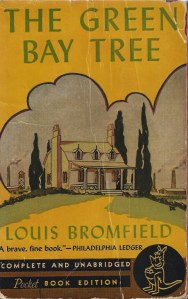
the green bay tree louis bromfield 001The Green Bay Tree by Louis Bromfield ~ 1924. This edition: Pocket Books, 1941. Paperback. 356 pages.

My rating: 7/10

Moving on just a year or two, to this family saga by American writer Louis Bromfield, who served in the French Army during the First World War, and subsequently lived in France for thirteen years, before resettling in the United States and dedicating himself to the improvement of American agriculture by establishing the famous Malabar Farm in Ohio.

Bromfield was a prolific and exceedingly popular writer of his time, winning the Pulitzer Prize in 1927 for his third novel, Early Autumn. 1924’s The Green Bay Tree was his first published work, and it was immediately successful, paving the way for his stellar future writing career.

This is a book which fits neatly into the family saga genre, focussing on one main character, the wealthy and strong-willed Julia Thane, but surrounding her with a constellation of competently drawn characters all carrying on full lives of their own, which we glimpse and appreciate as they bump up against Julia in her blazing progress from the American family mansion surrounded by steel mills to the secluded house in France, where she settles with her secret illegitimate child and remakes her life very much on her terms.

Bromfield, in addition to creating a strong female lead and allowing her much scope for personal activity, also has a sociopolitical angle which he persistently presents, in the major sideplot of ongoing labour unrest in the steel mills surrounding the Shane family mansion, and widening the focus to the greater situation right across industrial America, with the hard-fought battle for workers’ rights and labour unions, and the rise of Russian Communism and its ripple effect which spreads across the globe.

Late in the story Lily Shane is caught up in the German invasion of France at the start of the Great War, and though this section is reasonably well-depicted, it was a bit too conveniently rounded off, with the author fast-forwarding to the end of the war with very few details after Lily’s one big dramatic scene.

It took me a chapter or two to fully enter into the story, but once my attention was caught I cheerfully went along for the ride. Bromfield is a smooth writer, and though this occasionally whispers “first novel” in slight awkwardness of phrasing and sketchiness of scene, by and large it is a nicely polished example of its type.

Bromfield seems to be something of a forgotten author nowadays, which is a shame, as his novels are certainly as engrossing (if not more so) than many of those now heading the contemporary bestseller lists. More on Bromfield in the future, I promise.
the home-maker dorothy canfield fisherThe Home-Maker by Dorothy Canfield ~ 1924. This edition: Harcourt, Brace & Co., 1924. Hardcover. 320 pages.

My rating: 8.5/10

Saving the best for last, here is a book I had been looking forward to for quite some time, after seeing it featured on the Persephone Press reprint list, and reading such stellar reviews by so many book bloggers.

It was very good indeed, though I found that the ending was vaguely unsatisfactory to me personally, involving as it did an unstated conspiracy between several of the characters to continue with a serious misrepresentation in order to allow a societal blind eye being turned to an unconventional family arrangement. I think I would have preferred an open discussion, rather than a sweeping under the rug sort of conclusion. But that’s just me… This novel must have been rather hard to round off neatly once the author had taken it as far as she thought her audience would swallow, and she decidedly had made her point and was likely ready to move on.

An ineffectually dreamy man labors on at an uncongenial job, while his wife keeps the house polished to the highest standard possible, and receives accolades from all levels of the social hierarchy of the small New England town where the family lives for her obvious achievement of wifely and motherly perfect devotion. Meanwhile the family’s three children are showing very obvious symptoms of psychological distress: excessive shyness (the oldest girl), a perennially wonky digestion (middle boy), and determined naughtiness (youngest boy).

Husband loses his job and on the way home to break the news has a terrible “accident”; he ends up in a wheelchair and the wife forays forth into the working world. And wouldn’t you know it? Suddenly everyone is much happier, and the children’s issues start to resolve “all on their own”. But the husband is healing much more fully than at first it was feared. How will this all end, in 1920s’ small town America, where gender roles are by and large carved in granite?

A lovely book, and extremely readable for its keen examination of the marital relationship it portrays, and its touching details of family life and the woes and joys of childhood.

Where it lost its few points with me was in the unlikely perfection of the wife’s experience in the working world; she waltzed right in and was promoted up the department store ladder of responsibility remarkably easily; even allowing for her detail-freak perfectionism her immediate grasp of her new role in life was a bit hard to swallow, as was her sudden relaxation regarding less than stellar household cleanliness. And I was uncomfortable with the “easy” ending, as I mentioned earlier.

I’ve read a number of other Dorothy Canfield Fisher novels, and they share this same occasional over-simplification as the author hammers her point home – she was something of a crusader in the area of improving family life and giving a fuller and freer role to children – but as she is also a marvelous story teller we can allow her this tiny tendency, I think.

************

Of the four books in this grouping, if I were going to recommend one as a should-read, it would definitely be The Home-Maker.

Followed by Christopher and Columbus, because it is utterly charming, if a bit silly in its premises and occasionally rather wordy. The Green Bay Tree is a perfectly acceptable drama, though nothing extraordinary. As for Her Father’s Daughter, consider yourself forewarned!

Read Full Post »
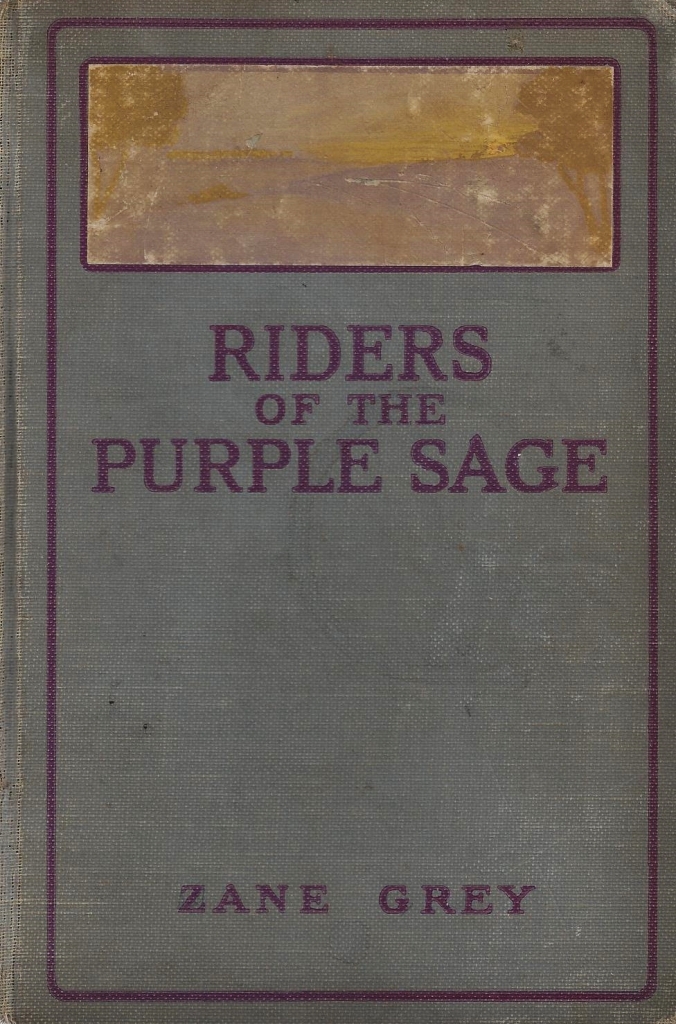
riders of the purple sage zane grey personal copy 001Riders of the Purple Sage by Zane Grey ~ 1912. This edition: Grosset & Dunlap, circa 1920s. Illustrations by Douglas Duer. Hardcover. 335 pages.

My rating: 3.5/10

Oh, Lassiter, you big black-clad gun-slinging hero of this desperately romantic book, if I ever find it within me to start to read this one again, please rise up off the printed page, leap off your amazing blind horse, unholster your big black pistol, and shoot me right away. Don’t just nick a lung, like your buddy Venters did to the virginally beautiful Bess as she trotted past his desperate hideout garbed in her Masked Rider’s disguise, but kill me outright, same as you did Mormon Bishop Dyer, despoiler of your late sister and destroyer of her happy marriage. Except maybe don’t shoot me in the arms first, as you did him, before blasting five more holes in his chest. Just aim for my heart, and make it quick.

Gar. What a book. Wow.

So bad.

What was I thinking?

Oh, yeah, that whole “classic of American literature and mold-maker of the classic Western genre” thing.

I’m not even going to touch the Important Book for Various Reasons argument, but am going to go instead to Pleasure of Reading for a Modern Reader. (Meaning me.) Did I enjoy this book? Mostly, no. The novelty of the plushly purple prose paled quickly, and despite the campy sense of irony I felt as I doggedly waded through the story it wasn’t enough to make it an acceptably good experience.

It’s 1871 in Utah, and the Mormons are well-established, top-dogging it marvellously well with their polygamous colonies headed by manly men wedded to legions of willing wives. So when rich Mormon rancher’s daughter Jane Withersteen spurns the advances of the man chosen for her by the local Mormon bishop and insists on carrying on with her charity to the impoverished Gentile (blanket term for anyone non-Mormon) families of the area and her hiring of Gentile riders to care for her seven thousand head of range cattle, events start to escalate.

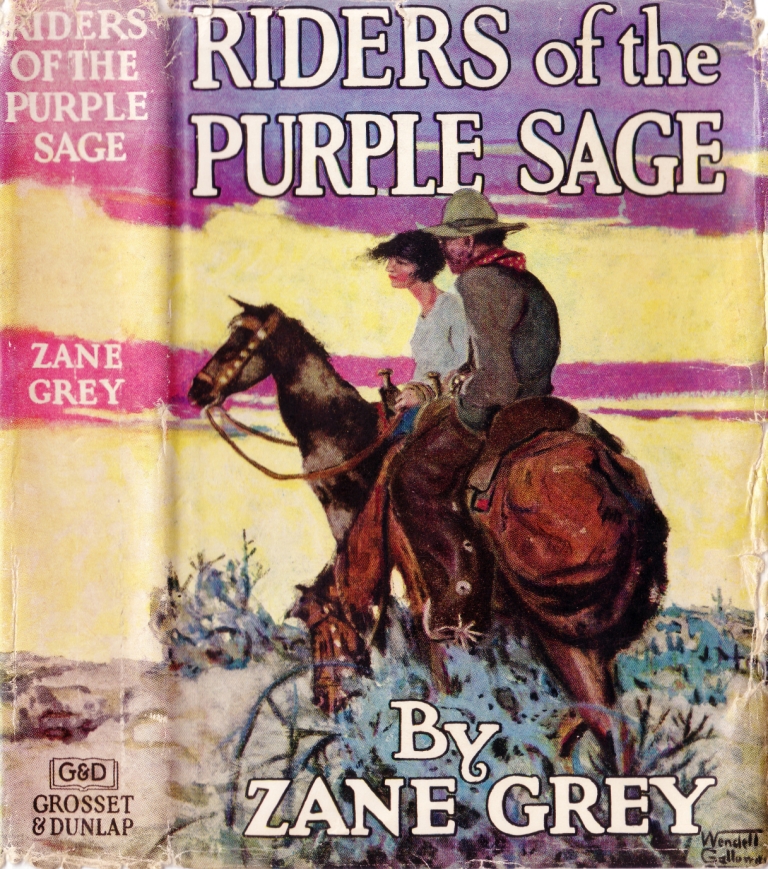
riders purple sage zane grey old djJust as Jane’s chief Gentile Rider, Venters, is about to be hauled off by a posse of Mormons, fate in the guise of black-clad, gun-slinging, Mormon-hating Lassiter arrives in the nick of time. The Mormons withdraw muttering, to go off and devise clever plans of revenge and sabotage against uppish Jane, while she enjoys (for a while) the loving devotion of two passionate men. (Venters and Lassiter.)

“Then I’ll have you whipped within an inch of your life,” replied Tull, harshly. “I’ll turn you out in the sage. And if you ever come back you’ll get worse.”

Venters’s agitated face grew coldly set and the bronze changed to gray.

Jane impulsively stepped forward. “Oh! Elder Tull!” she cried. “You won’t do that!”

Tull lifted a shaking finger toward her.

“That’ll do from you. Understand, you’ll not be allowed to hold this boy to a friendship that’s offensive to your Bishop. Jane Withersteen, your father left you wealth and power. It has turned your head. You haven’t yet come to see the place of Mormon women. We’ve reasoned with you, borne with you. We’ve patiently waited. We’ve let you have your fling, which is more than I ever saw granted to a Mormon woman. But you haven’t come to your senses. Now, once for all, you can’t have any further friendship with Venters. He’s going to be whipped, and he’s got to leave Utah!”

“Oh! Don’t whip him! It would be dastardly!” implored Jane, with slow certainty of her failing courage.

Tull always blunted her spirit, and she grew conscious that she had feigned a boldness which she did not possess. He loomed up now in different guise, not as a jealous suitor, but embodying the mysterious despotism she had known from childhood—the power of her creed.

Lots of stuff then happens, most of it involving the Mormons and Jane’s Gentile champions plus an independent gang of rustlers shooting at each other (frequently fatally), stealing cattle and prize racehorses, befriending a cute little orphan four-year-old (“Duz oo wuv me, Muvver Jane?”), finding a secret hidden valley and thousand-year-old abandoned cliff dwellings (an enjoyable interlude which added on a point or two to my brutally low rating), panning for gold (“washing” gold, nice topical reference), ambushing, wounding and restoring to life a lovely young girl disguised as a boy cattle rustler, charging about on various noble steeds including Lassiter’s original blind steed (who perishes tragically), two black Arabians (Jane and Lassiter) and a rugged yet awesomely sturdy and fast range horse (Wrangle, ridden by Venters) who in turn is stolen by a bad guy and ends up being shot by his loving owner in order to ensure the demise of the bad guy rider.

And much else.

This is a very multi-stranded story with lots going on, and you have to hand it to Zane Grey, he deserves credit for being ambitious with his intentions.

Here’s another snippet of the text:

He lifted her—what a light burden now!—and stood her upright beside him, and supported her as she essayed to walk with halting steps. She was like a stripling of a boy; the bright, small head scarcely reached his shoulder. But now, as she clung to his arm, the rider’s costume she wore did not contradict, as it had done at first, his feeling of her femininity. She might be the famous Masked Rider of the uplands, she might resemble a boy; but her outline, her little hands and feet, her hair, her big eyes and tremulous lips, and especially a something that Venters felt as a subtle essence rather than what he saw, proclaimed her sex.

Western garb and setting aside, Riders of the Purple Sage is purely an über-traditional romance, and the two female love interests – Jane Withersteen and ex-Masked Rider Bess – are both , despite their brief moments of sturdy independence – Jane in standing up to her Church, and Bess in her mastery of horsemanship –  at heart simpering girly-girls all a-dither with love for their manly men, whom they then order hither and yon with feminine whimsy. The menfolk, being blinded by Love, trot willingly to and fro, breaking out occasionally (“Sorry, lost my temper and killed your dad”) and being instantly forgiven (“That’s okay, he wasn’t my real dad, even if he raised me from a tiny baby and gave me total love and devotion and protected me from the wicked men who sought to ruin me and gave me a proper education and everything”) and generally being tweaked about on silken leading strings.

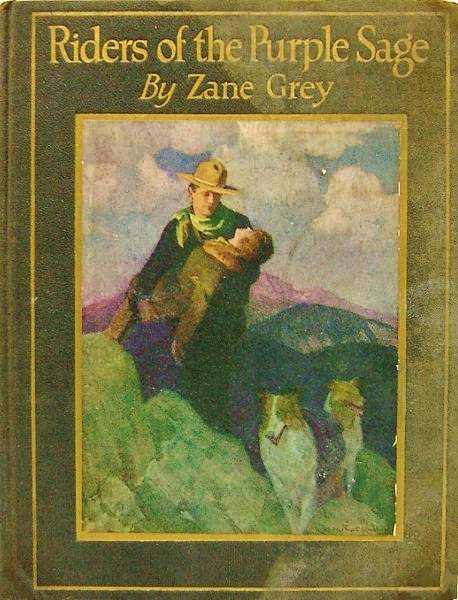
riders purple sage zane grey old illustrated coverAnd despite spending weeks alone with each other – Lassiter and Jane holed up in the ranch house, Venters and Bess in the hidden valley – the most physical they get with each other is the occasional embrace (with the men nobly holding themselves back from the passions engendered by contact with the heaving breasts of the beloved) and a few rather chaste kisses. These guys (and gals) were made of steel! This is romantic fiction at its best, all heaving bosoms and blushes and occasional fainting and manly-passion-held-in-check just a-waiting for a woman’s word and the arrival of a preacher man to hold a marriage ceremony before going any further.

Oh, yes. And then there’s all the “western” dialect:

The rider thundered up and almost threw his foam-flecked horse in the sudden stop. He was a giant form, and with fearless eyes.

“Judkins, you’re all bloody!” cried Jane, in affright. “Oh, you’ve been shot!”

“Nothin’ much Miss Withersteen. I got a nick in the shoulder. I’m some wet an’ the hoss’s been throwin’ lather, so all this ain’t blood.”

“What’s up?” queried Venters, sharply.

“Rustlers sloped off with the red herd.”

“Where are my riders?” demanded Jane.

“Miss Withersteen, I was alone all night with the herd. At daylight this mornin’ the rustlers rode down. They began to shoot at me on sight. They chased me hard an’ far, burnin’ powder all the time, but I got away.”

And the reams of descriptive prose. You can certainly tell that Zane Grey got his start writing pulp fiction which was paid for by the word, because he does pack them in.

Venters … went to the edge of the terrace, and there halted to survey the valley.

He was prepared to find it larger than his unstudied glances had made it appear; for more than a casual idea of dimensions and a hasty conception of oval shape and singular beauty he had not had time. Again the felicity of the name he had given the valley struck him forcibly. Around the red perpendicular walls, except under the great arc of stone, ran a terrace fringed at the cliff-base by silver spruces; below that first terrace sloped another wider one densely overgrown with aspens, and the center of the valley was a level circle of oaks and alders, with the glittering green line of willows and cottonwood dividing it in half. Venters saw a number and variety of birds flitting among the trees. To his left, facing the stone bridge, an enormous cavern opened in the wall; and low down, just above the tree-tops, he made out a long shelf of cliff-dwellings, with little black, staring windows or doors. Like eyes they were, and seemed to watch him. The few cliff-dwellings he had seen—all ruins—had left him with haunting memory of age and solitude and of something past. He had come, in a way, to be a cliff-dweller himself, and those silent eyes would look down upon him, as if in surprise that after thousands of years a man had invaded the valley. Venters felt sure that he was the only white man who had ever walked under the shadow of the wonderful stone bridge, down into that wonderful valley with its circle of caves and its terraced rings of silver spruce and aspens.

The dog growled below and rushed into the forest. Venters ran down the declivity to enter a zone of light shade streaked with sunshine. The oak-trees were slender, none more than half a foot thick, and they grew close together, intermingling their branches. Ring came running back with a rabbit in his mouth. Venters took the rabbit and, holding the dog near him, stole softly on. There were fluttering of wings among the branches and quick bird-notes, and rustling of dead leaves and rapid patterings. Venters crossed well-worn trails marked with fresh tracks; and when he had stolen on a little farther he saw many birds and running quail, and more rabbits than he could count. He had not penetrated the forest of oaks for a hundred yards, had not approached anywhere near the line of willows and cottonwoods which he knew grew along a stream. But he had seen enough to know that Surprise Valley was the home of many wild creatures.

This is a dreadfully silly “review”, but as the internet abounds with discussion of this book, I’m going to quit right here.

I read the thing from cover to cover, I muttered to myself and to my family, I rolled my eyes, I mused over the novel’s place in the American historical literary canon, and I am now ready to gently shelve it way high up and move along. It had its pleasurable moments, duly noted, but it’s ultimately not the book for me.

Read Full Post »

a safety match ian hay penguin cover 1938 001A Safety Match by Ian Hay ~ 1911. This edition: Penguin, 1938. Paperback. 256 pages.

My rating: 3/10

Oh, Century of Books. You are leading me down some strange byways of reading…

Some days ago I wrote with some enthusiasm about a rather charming vintage book by Herbert Jenkins, Patricia Brent, Spinster. I was careful in my review not to reveal the key plot points and the ending, because I felt that this was a book that would reward discovery by a modern-day reader. I am very sad to say that today’s book will not be rewarded the same treatment, because it disappointed me immensely.

Sharp-eyed readers will notice the mending tape on the bottom left hand corner of the book pictured here. That was me. Usually I am very careful about my mending of older books, aiming for non-obtrusive fixes, but in this case I just slapped a piece of Magic tape on there and called it good enough. The whole spine is loose and the text block only just hanging on by a whisp or two of paper – almost as if at some point a previous reader gave this one the toss across the room. Hmmm… (Okay, maybe I’m just being really snarky.)

So, yes, there will be spoilers in the next few paragraphs. (And I’m keeping it shortish, because it’s really not worth spending any more time on.)

It all starts off promisingly enough. Here we have a vicarage family, the widowed Rector Brian Vereker, and his lovely children – literally lovely, as they are famed for their good looks among the local villagers – nineteen-year-old Daphne, doorstepping down through Sebastian Aloysius (“Ally”), Monica Cecila (“Cilly”), Stephen (“Stiffy”), Veronica Elizabeth (“Nicky”) to to the youngest, eleven-year-old Tony. A lively lot they all are, and we are treated to a prolonged domestic interlude which sets up the characters quite nicely, and gives a rather charming picture of English upper-middle-class home life – for the Rector is the youngest son of a youngest son of a peer of the realm –  in the early years of the 20th Century.

Then an abrupt change of scene to a room full of coal mine owners as they meet with labour union leaders in order to negotiate a way out of a possible workers’ strike. Here we become acquainted with our main masculine character, one Lord Carr, also known by his nickname of “Juggernaut” for his overbearing success in always proving his point and coming out on top. In this case Juggernaut succeeds in quelling the potential strike, knocking down the ineffectual union leaders and getting in a few digs about free enterprise and every-man-for-himself-ism which sound forbiddingly close to the spoutings of the far-Right political parties of our current age – not much doubt as to our author’s feelings throughout this book, I’ afraid – he does rather slant towards his brusque hero’s view.

The set-up is to introduce the rather-much-older (forty-five-ish) Lord Carr to the eldest vicarage daughter, the sweet-nineteen Daphne. For of course Lord Carr and Rector Vereker are old school chums, and after squashing the labour uprising in the area, Lord Carr is quite happy to spend a few weeks relaxing among the Vereker clan, where he falls in inarticulate but sincere love with Daphne.

The two marry, Juggernaut for love and Daphne for money – she is motivated by a desire to secure the futures of her brothers and sisters – and for a few years all is quite content. A son is born to Lord and Lady Carr, but as the child grows it becomes apparent that the marriage is, if not actively struggling, becoming a rather pathetic thing. Lord Carr is unable to speak his feelings of devotion to Daphne; she in turn is starting to turn to other companions for amusement, including Lord Carr’s devoted right hand man.

This gets us in quite decent style to the latter bit of the book, where the author completely goes to pieces and gets all darkly dramatic. Daphne and Juggernaut part ways, Daphne fleeing to the old family home with the baby and Juggernaut staying broodingly in London. While they are parted, it dawns on Daphne that perhaps she really does love her masterful though stoic husband, and a reconciliation is affected by way of the right hand man’s revealing that Juggernaut is really just a big softie, supplying food and comforts to the wives and children during the last coal mine strike. “I never knew!” cries Daphne, and she flies to her husband’s sturdy breast, to be clasped there with fervor.

But wait! There’s more!

The workers at the local coal mine go on a wildcat strike, and as a result the workings are sabotaged, resulting in a cave-in which traps a number of our side characters, including Right Hand Man. Juggernaut is front and centre of the rescue mission, and (sob!) is blinded by an explosion after he has personally seen all of the rescued men to safety.

Fast forward a year or two to a scene of domestic bliss, Juggernaut and Daphne all sappily happy with their adorable wee children, love restored and blind Pappa the centre of a scene of cozy cuteness.

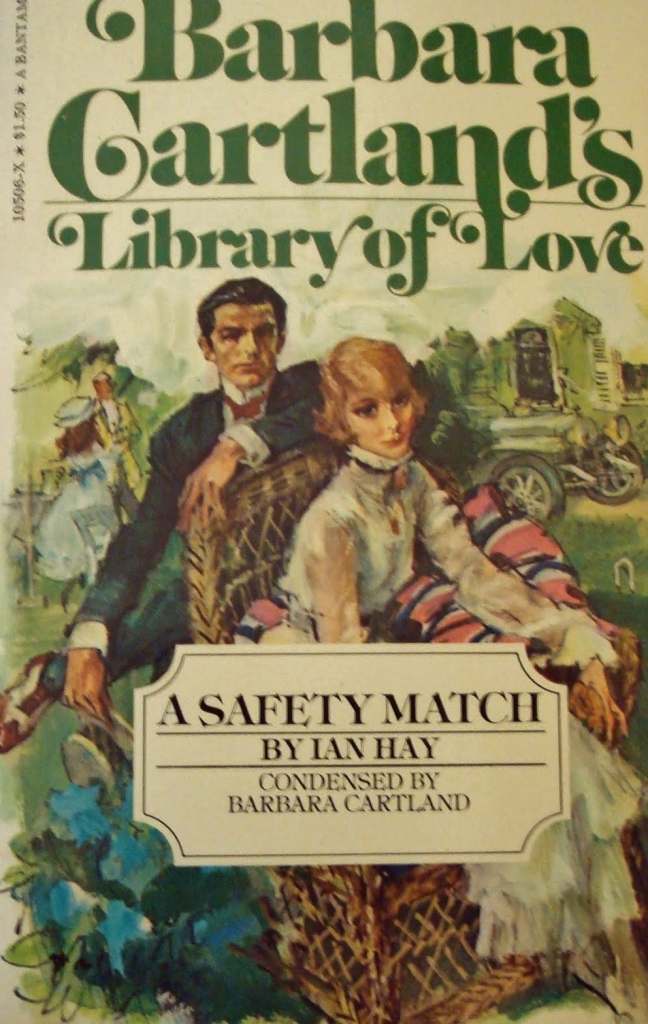
66 years after its first publication, the one-and-only Barbara Cartland  decides that "A Safety Match" is a good addition to her "Library of Love".

66 years after its first publication, the one-and-only Barbara Cartland decides that “A Safety Match” is a good addition to her 1977  “Library of Love”. I am saddened, but not surprised.

What a dreadfully clichéd story. No wonder it was picked up and condensed by Barbara Cartland for her 1977 “Library of Love.”

This novel made me prickly all over. It started out so well, and had so many nice domestic and period details, that I hoped right up until those last few chapters that it would go in a different direction, but nope! – no such luck. It just dissolved into mushy sweetness. Absolutely, deeply, offensively, sugary, syrupy adorableness. Argh.

Not recommended, but if you are very brave and wish to look for yourself, here it is on Gutenberg.

The Safety Match by Ian Hay

Ian Hay, by the way, was quite a well-respected writer of his time. Here is his biography, pasted directly in from Wikipedia. As the man could undoubtedly write, in a modestly competent way, I do find myself curious as to some of his other works, in particular the war-themed The First Hundred Thousand. But as for The Safety Match, I wouldn’t open that again at gunpoint.

Major General John Hay Beith, CBE, (17 April 1876 – 22 September 1952), was a British schoolmaster and soldier, but he is best remembered as a novelist, playwright, essayist and historian who wrote under the pen name Ian Hay.

After reading Classics at Cambridge, Beith became a schoolmaster. In 1907 he published a novel, Pip; its success and that of several more novels enabled him to give up teaching in 1912 to be a full-time author. During the First World War, Beith served as an officer in the army in France. His good-humoured account of army life, The First Hundred Thousand, published in 1915, was a best-seller. On the strength of this, he was sent to work in the information section of the British War Mission in Washington, D.C.

After the war Beith’s novels did not achieve the popularity of his earlier work, but he made a considerable career as a dramatist, writing light comedies, often in collaboration with other authors including P. G. Wodehouse and Guy Bolton. During the Second World War Beith served as Director of Public Relations at the War Office, retiring in 1941 shortly before his 65th birthday.

Among Beith’s later works were several war histories, which were not as well received as his comic fiction and plays. His one serious play, Hattie Stowe (1947), was politely reviewed but had a short run. In the same year he co-wrote a comedy, Off the Record, which ran for more than 700 performances.

I did a fairly thorough internet search, and came up with only one other blog review, from Only Two Rs, whose take was similar to my own.

Read Full Post »

patricia brent, spinster 1 herbert jenkinsPatricia Brent, Spinster by Herbert Jenkins ~ 1918. This edition: Herbert Jenkins, circa 1918. Hardcover. 312 pages.

My rating: 6.5/10

I keep forgetting about this book, even though I only read it a week or so ago. It’s already had the ignominy of being shuffled away into the hall closet with a stack of miscellaneous already-reviewed books, only being rescued several days later when I was delving around in there looking for Christopher and Columbus by Elizabeth von Arnim, which I was hoping would be as great a treat as other bloggers have promised. (It was.)

High expectations were inspired by this opening passage:

“She never has anyone to take her out, and goes nowhere, and yet she can’t be more than twenty-seven, and really she’s not bad-looking.”

“It’s not looks that attract men,” there was a note of finality in the voice; “it’s something else.”  The speaker snapped off her words in a tone that marked extreme disapproval.

“What else?” enquired the other voice.

“Oh, it’s—well, it’s something not quite nice,” replied the other voice darkly, “the French call it being très femme.  However, she hasn’t got it.”

“Well, I feel very sorry for her and her loneliness.  I am sure she would be much happier if she had a nice young man of her own class to take her about.”

Patricia Brent listened with flaming cheeks.  She felt as if someone had struck her.  She recognised herself as the object of the speakers’ comments.  She could not laugh at the words, because they were true. She was lonely, she had no men friends to take her about, and yet, and yet——

“Twenty-seven,” she muttered indignantly, “and I was only twenty-four last November.”

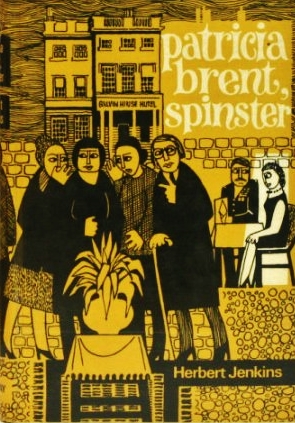
A rather handsome later edition cover. This novel has maintained its popularity well since its publication in 1918.

A rather handsome later edition cover. This playful novel has maintained its popularity well since its publication in 1918.

And by this back-cover précis:

Patricia Brent is a guest, damned by the prefix “paying,” at the Galvin House Residential Hotel. One day she overhears two of her fellow “guests” pitying her for her loneliness and that she “never has a nice young man to take her out.”

In a thoughtless moment of anger she announces that on the following night she is dining at the Quadrant with her fiancé.

She wasn’t, and she hadn’t, but she did.

When in due course she enters the grill-room she finds some of the Galvin House-ites there to watch her. Rendered reckless by the thought of being found out, she goes up to a table at which is seated a young staff-officer, and asks him to help her by “playing up.”

This is how she meets Lieut.-Col. Lord Peter Bowen, D.S.O. Then follow the complications that ensue from Patricia’s thoughtless act.

Patricia’s fast-on-her-feet rescue of her situation definitely sets off a tangle of complications, especially when her “pick-up” proves to be something a little bit different than anything she could have imagined.

I won’t say too much more, plot-wise, because I’m sure some of you will be keen to read this one for yourself, as I was. Already something of a fan of Herbert Jenkins – I cherish a thick compilation of the famous Bindle stories – I was keen to see what he would do with a feminine lead. Not too badly, though I must say that Patricia reads rather like a woman written by a man; there were occasional odd notes, especially to do with clothes.

For Patricia is not a dowdy spinster – oh, no, not at all! She dresses well and with exquisite care, rather surprisingly so, considering her obviously straitened means. Herbert Jenkins tries his hand at this description of Patricia primping to go out on her first adventure, to what she thinks will be a solitary visit to the Quadrant Grill-Room, the “major-man” being at this point merely a figment of her imagination.

As she stood before the mirror, wondering what she should wear for the night’s adventure, she recalled a remark of Miss Wangle’s that no really nice-minded woman ever dressed in black and white unless she had some ulterior motive.  Upon the subject of sex-attraction Miss Wangle posed as an authority, and hinted darkly at things that thrilled Miss Sikkum to ecstatic giggles, and Mrs. Mosscrop-Smythe to pianissimo moans of anguish that such things could be.

With great deliberation Patricia selected a black charmeuse costume that Miss Wangle had already confided to the whole of Galvin House was at least two and a half inches too short; but as Patricia had explained to Mrs. Hamilton, if you possess exquisitely fitting patent boots that come high up the leg, it’s a sin for the skirt to be too long.  She selected a black velvet hat with a large white water-lily on the upper brim.

“You look bad enough for a vicar’s daughter,” she said, surveying herself in the glass as she fastened a bunch of red carnations in her belt.  “White at the wrists and on the hat, yes, it looks most improper.  I wonder what the major-man will think?”

Swift movements, deft touches, earnest scrutiny followed one another. Patricia was an artist in dress.  Finally, when her gold wristlet watch had been fastened over a white glove she subjected herself to a final and exhaustive examination.

“Now, Patricia!”—it had become with her a habit to address her reflection in the mirror—”shall we carry an umbrella, or shall we not?”  For a few moments she regarded herself quizzically, then finally announced, “No: we will not.  An umbrella suggests a bus, or the tube, and when a girl goes out with a major in the British Army, she goes in a taxi.  No, we will not carry an umbrella.”

She still lingered in front of the mirror, looking at herself with obvious approval.

Would a young lady of such obviously strong self-esteem really be so humiliated by the gossipings of some of the nasty old biddies sharing her residential hotel? Apparently so, and once we’ve accepted this slightly shaky premise we might as well go ahead and abandon ourselves to the whole happily romping thing.

It’s all very fluffy, and definitely a farce, though it has its moments of poignancy here and there. Set in the early years of the Great War, some of the characters are present because they are home on leave while recovering from their injuries; the sombre background of affairs in Europe and the bombings in England are a fascinating backdrop to the frivolous antics of the foreground players.

I was fortunate enough to track down a vintage copy of the book, though it took several long months to arrive from the bookseller in England, but here it is in digital format courtesy of the fantastic Project Gutenberg, for your reading pleasure.

Project Gutenberg: Patricia Brent, Spinster

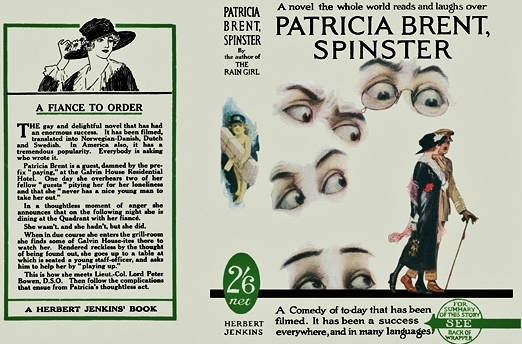
Dust Jacket, early edition.

Dust Jacket, early edition.

Read Full Post »

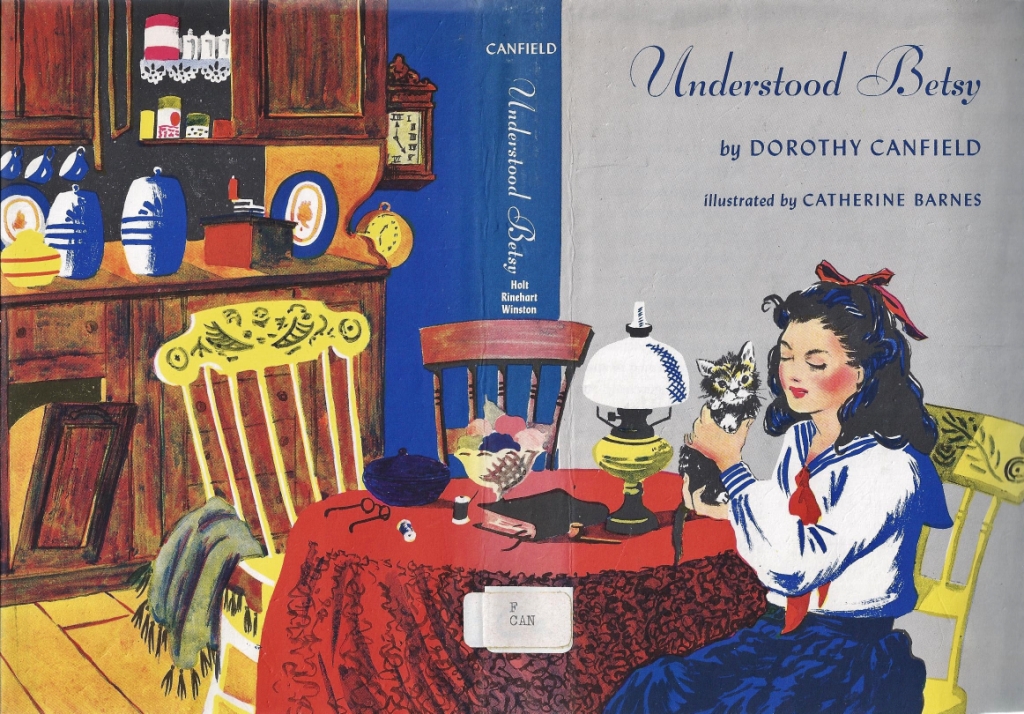
understood betsy dorothy canfield 001

Understood Betsy by Dorothy Canfield ~ 1916. This edition: Holt, Rinehart and Winston, 1964. Illustrated by Catherine Barnes. Hardcover. 213 pages.

My rating: 7.5/10

This is a charming juvenile novel written by Dorothy Canfield Fisher after she had become deeply interested in Maria Montessori’s innovative theories of child rearing and education while on a visit to Italy. The Montessori Method stressed self determination and self regulation in all aspects of a child’s life, and operated under the assumption that if given access to a suitable space with appropriate materials, tools, toys and books, a child would develop a high degree of self motivation and a natural sense of order.

Since Dorothy Canfield was already very involved in women’s rights and educational reform, the Montessori philosophy meshed well with her other interests, and Understood Betsy, which can be read simply as an amusing story, can also be interpreted as an enthusiastic promotion of allowing a child to self-educate and self-regulate, while under a benevolent hands-off adult mentorship.

Little Elizabeth Ann is orphaned at the tender age of six months, and is eagerly adopted by an aunt and great-aunt, Frances and Harriet. Younger Aunt Frances in particular becomes completely wrapped up in mothering the child, lavishing all of her vast reserves of unused adoration on Elizabeth Ann’s tiny person.

 As soon as the baby came there to live, Aunt Frances stopped reading novels and magazines, and re-read one book after another which told her how to bring up children. And she joined a Mothers’ Club which met once a week. And she took a correspondence course in mothercraft from a school in Chicago which teaches that business by mail. So you can see that by the time Elizabeth Ann was nine years old Aunt Frances must have known all that anybody can know about how to bring up children. And Elizabeth Ann got the benefit of it all.

She and her Aunt Frances were simply inseparable. Aunt Frances shared in all Elizabeth Ann’s doings and even in all her thoughts. She was especially anxious to share all the little girl’s thoughts, because she felt that the trouble with most children is that they are not understood, and she was determined that she would thoroughly understand Elizabeth Ann down to the bottom of her little mind. Aunt Frances (down in the bottom of her own mind) thought that her mother had never really understood her, and she meant to do better by Elizabeth Ann. She also loved the little girl with all her heart, and longed, above everything in the world, to protect her from all harm and to keep her happy and strong. and well.

Aunt Frances is well meaning, but her technique is more than questionable.

Aunt Frances was afraid of a great many things herself, and she knew how to sympathize with timidity. She was always quick to reassure the little girl with all her might and main whenever there was anything to fear. When they were out walking (Aunt Frances took her out for a walk up one block and down another every single day, no matter how tired the music lessons had made her), the aunt’s eyes were always on the alert to avoid anything which might frighten Elizabeth Ann. If a big dog trotted by, Aunt Frances always said, hastily: “There, there, dear! That’s a nice doggie, I’m sure. I don’t believe he ever bites little girls. … mercy! Elizabeth Ann, don’t go near him! … Here, darling, just get on the other side of Aunt Frances if he scares you so” (by that time Elizabeth Ann was always pretty well scared), “and perhaps we’d better just turn this corner and walk in the other direction.” If by any chance the dog went in that direction too, Aunt Frances became a prodigy of valiant protection, putting the shivering little girl behind her, threatening the animal with her umbrella, and saying in a trembling voice, “Go away, sir! Go away!”

Or if it thundered and lightened, Aunt Frances always dropped everything she might be doing and held Elizabeth Ann tightly in her arms until it was all over. And at night—Elizabeth Ann did not sleep very well—when the little girl woke up screaming with a bad dream, it was always dear Aunt Frances who came to her bedside, a warm wrapper over her nightgown so that she need not hurry back to her own room, a candle lighting up her tired, kind face. She always took the little girl into her thin arms and held her close against her thin breast. “Tell Aunt Frances all about your naughty dream, darling,” she would murmur, “so’s to get it off your mind!”

She had read in her books that you can tell a great deal about children’s inner lives by analyzing their dreams…

Well, as you  can see from this lengthy excerpt, Aunt Frances is well on her way to creating something of a monster, if timid, terrified, hapless Elizabeth Ann could be labelled with such a horrific term. But things are about to change.

Aunt Harriet takes ill; Aunt Frances must accompany her to a warm climate; there will be no time to spare for or a place to keep Elizabeth Ann. So off in haste she is sent to another branch of the family, efficiently turned away – so much fuss, having to suddenly take on an extra child! – and helter-skelter put on a train to remote Vermont, to be cared for by the country family connections at Putney Farm.

Now Elizabeth Ann is well aware that Aunts Harriet and Frances have always held the Putney relations in deep scorn – such common folk, with no understanding for children – and to think that they had originally wanted to adopt her!

But they (Aunt Harriet and Aunt Frances) thought that they chiefly desired to save dear Edward’s child from the other kin, especially from the Putney cousins, who had written down from their Vermont farm that they would be glad to take the little girl into their family. But “anything but the Putneys!” said Aunt Harriet, a great many times. They were related only by marriage to her, and she had her own opinion of them as a stiffnecked, cold-hearted, undemonstrative, and hard set of New Englanders. “I boarded near them one summer when you were a baby, Frances, and I shall never forget the way they were treating some children visiting there! … Oh, no, I don’t mean they abused them or beat them … but such lack of sympathy, such perfect indifference to the sacred sensitiveness of child-life, such a starving of the child-heart … No, I shall never forget it! They had chores to do … as though they had been hired men!”

Aunt Harriet never meant to say any of this when Elizabeth Ann could hear, but the little girl’s ears were as sharp as little girls’ ears always are, and long before she was nine she knew all about the opinion Aunt Harriet had of the Putneys. She did not know, to be sure, what “chores” were, but she took it confidently from Aunt Harriet’s voice that they were something very, very dreadful.

Elizabeth Ann is about to find out what chores are all about.

Needless to say her transformation from wimpy Elizabeth Ann to sturdy, competent Betsy begins at once. She’s not even at the farmhouse yet before Uncle Henry takes her in hand, by giving her the reins of the team and letting her worry out the techniques of guiding the steady farm horses along the quiet road. I need not go into details, only to say that immediately upon arrival at the farm the child learns to dress herself, comb her own hair, cook, milk a cow, and become wonderfully useful to have about, rather than a “charge”. And there are kittens and maple sugaring time and tug-of-wars at her tiny one-room school, best friends and a trip to the fair all of the usual rural delights to go along with the endless round of chores which make up farm life. And then Aunt Frances shows up to collect her former charge…

A sweetly old-fashioned sort of tale, with the lessons very evident but very easy to swallow. Dorothy Canfield treats her readers as if they too are sensible souls, and complicit in the process of salvaging Betsy from her disastrous first nine years of life, while never outright condemning the well-meaning Frances.

There is a lot of quiet humour in this short tale, and it is not at all a chore for an adult to read. In fact, it is a very nice read-aloud, suitable for the younger set, I would think ages up to 9 or 10 or so. (Older children might find it a mite too mild, and the tone just a bit too old-fashioned.) Betsy is a likeable heroine and as we follow her story we rejoice in her happy transformation.

Readers of Dorothy Canfield Fisher’s much more complex and serious adult novels may enjoy this quick side trip into childhood; a visit as crisply refreshing as its nostalgic Vermont country setting.

And here it is at Gutenberg, though it is very easy to find in book form, too, being almost continuously in print for the hundred or so years since its first publication.

Understood Betsy by Dorothy Canfield

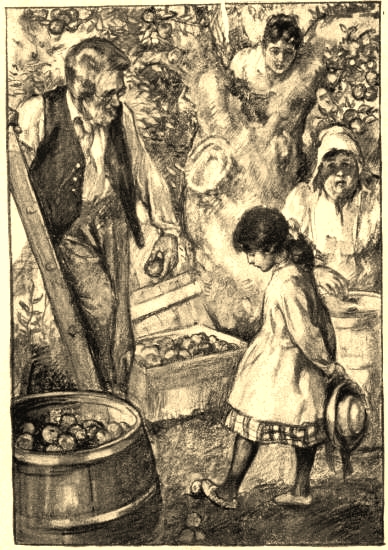
The Putney clan - Uncle Henry, Aunt Abigail and Cousin Ann - with Betsy, illustration by Ada C. Williamson, from the Gutenberg transcription.

The Putney clan – Uncle Henry, Aunt Abigail and Cousin Ann – with Betsy, illustration by Ada C. Williamson, from the Gutenberg transcription.

Read Full Post »

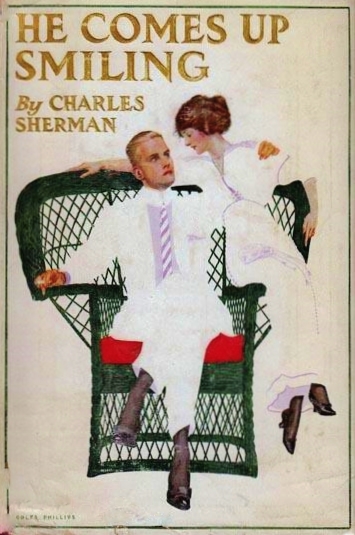
he comes up smiling charles shermanHe Comes Up Smiling by Charles Sherman ~ 1912. This edition: McLeod & Allen, 1912. Hardcover. 351 pages.

My rating: 5/10

Light as a feather and just as fluffy was this century-old bit of humorous fiction.

From the San Francisco Call, February 18, 1912 comes the following commentary.

Once begin this tale… and all thought of everything else will leave you. The tale is absorbing, exciting, clever, amusing and quite unusual… whimsical to a degree. It tells the story of a tramp—not a tramp in disguise, a real tramp, although he has a respectable ancestry and did have some “bringing-up,” though very poor.  He is a lazy, idle hound, and any amount of discomfort is preferable to work. Through a chapter of the most extraordinary occurrences a hero ever had he meets “the” girl, and the remainder of the story is fairly breathless in its excitement. After the reader is once acquainted with “Watermelon,” the affectionate nickname which other tramps call him, it is easy to see why he is a gentleman, though his hands are not clean and he is not above lying and stealing in a small way. He has the quaintest sense of humor and is forever making the most original remarks, always with the prefix “Father says.” A few follow:

  • ”Manners don’t count any more than the good apples on the top of the box to hide the rotten ones beneath.”
  • “If a man reached 40 without becoming a cynic, he was a fool and might never have reached 40.”
  • “A success can be a cynic, for cynicism is simply a pretty good idea of the meanness of human nature and no unfounded expectation of anything especially decent coming from it.”
  • “Nothing is more important than ourselves and what affects us.”
  • “Love is divine, hate devilish and meanness just cussed human nature, and a mixture of the three, in more or less degree, makes man.”
  • “A man who knows life never wrote about it. It would be too painful. It wouldn’t sell.”

Though the reviewer for the SF Call thought this was a grand bit of fiction, I am sorry to say that it did not travel through its ten decades with a whole lot of staying power. It has merit as a literary and cultural curiosity, and the first few chapters are quite delightful, but it petered out midway through and slid gently downhill to end in a well-cushioned and in no way fatal heap, rather like a slow speed accident with one of the vintage cars which the tale is so dependent on.

Three American tramps laze away a sunny summer Sunday morning, and in the course of conversation start a debate as to which of the two younger men would “clean up” better. They propose a beauty contest of sorts, to be judged by the corpulent Mike, and off go James and “Watermelon” (later found to be possessed of a proper name, Jerry, though it is as Watermelon that we follow him through his adventures) to town in search of a shave and brush-up and an upgrade in wearing apparel.

Watermelon is our unlikely hero from the very start, and we follow him into a barber shop where with a clever bit of smooth talking and a pinch of sleight of hand he obtains from the barber – who forks over quite willingly, which demonstrates the magic of Watermelon’s smooth patter – not only a shave, but the contents of the till.

Clothes are a bit more difficult to come by, but here luck is on Watermelon’s side, as he comes across a young man swimming in a small lake, with his elegant clothes placed neatly on the shore. Watermelon there and then “borrows” the improved apparel, hiding his own cast off garments nearby. He fully intends to come back and swap down, but he also wants to keep the naked swimmer in a position not to give pursuit once he returns to shore and realizes his predicament.

Proceeding on his way, now nattily attired in stylish new clothes, Watermelon happens upon a deserted car – obviously that of the oblivious swimmer – and climbs in to relax and daydream a bit. Along comes another car, carrying an elderly gentleman and his middle-aged daughter along with their chauffeur; they impulsively offer to rescue the “stranded” young man, and Watermelon, as is his phlegmatic way, goes along with the assumption that he is an unmechanical rich man out for a jaunt.

One thing leads to another, and when the time comes to make introductions, Watermelon hands over a card from the case in the borrowed suit, “revealing” himself as a certain young stock-broker who has just made a fortune on Wall Street, to great publicity. Taken off to dinner with his new friends, Watermelon is introduced to a “fellow” stock-broker and his lovely daughter, and once Watermelon sets eyes on the lovely Billy his fate is sealed.

Deciding that one afternoon with this angel on earth is worthy of continuing the masquerade for at least a few hours longer – he still intends to return the clothes and make all right with the swimmer – Watermelon makes himself agreeable to all. Little does he know that Billy’s father is hatching a mildly nefarious plot to kidnap the man whom he views as a business rival, and to carry him off for a week in the depths of the country, thereby leaving the coast clear for Billy’s father’s partner to triumph on Wall Street without interference.

And off we go on a farcical romp of mistaken identity, deliberate wrong directions, housebreaking, encounters with the law, much double entendre, hidden yearnings and unspoken but reciprocated love, as Billy has fallen just as hard for Watermelon as he has for her. (He does clean up rather well.)

The humour is relentless and the situations highly contrived, but Watermelon gently winkles his way into the hardest of readers’ hearts as well as that of susceptible Billy.

Billy herself was rather a waste of ink, being a completely frivolous rich girl with no evident depth to her. She’s cute as a button, but that’s about it. The older Henrietta, on the other hand, proves herself to be a witty foil to Watermelon’s quirky comments; I had high hopes that the two were going to dump the silly Billy and further develop their meeting of minds, but sadly this was not to be. (My opinion of the author took a nosedive when he let all three of us down in this way.)

The ending is broadly telegraphed from very early on; we fully expect to see Watermelon ‘fess up and buckle down to a life of honest toil in order to win the fair Billy’s hand. Though he does come clean, the honest toil bit doesn’t look to be in his future; the resolution is rather odd; it felt like the author cheated us of the expected rounding off of this ultra-light tale.

A  rather strange little reading experience, both more enjoyable than it sounds from my dismissive comments above, and less satisfying than it could have been if the author had been a bit braver with his character developments and multiple romantic interests. Definitely a throw-away sort of tale, a momentary diversion at best. Sort of a lightweight American P.G. Wodehouse of the B-list variety.

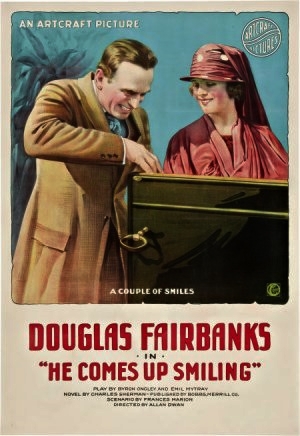
The story was made into a 1914 stage play, and then into a 1918 silent movie starring Douglas Fairbanks as Jerry Martin (the “Watermelon” of the book), though the plot was gingered up to make it more conventionally dramatic.

he comes up smiling 1918 movie poster

Read Full Post »

« Newer Posts - Older Posts »