Posts Tagged ‘Youth’

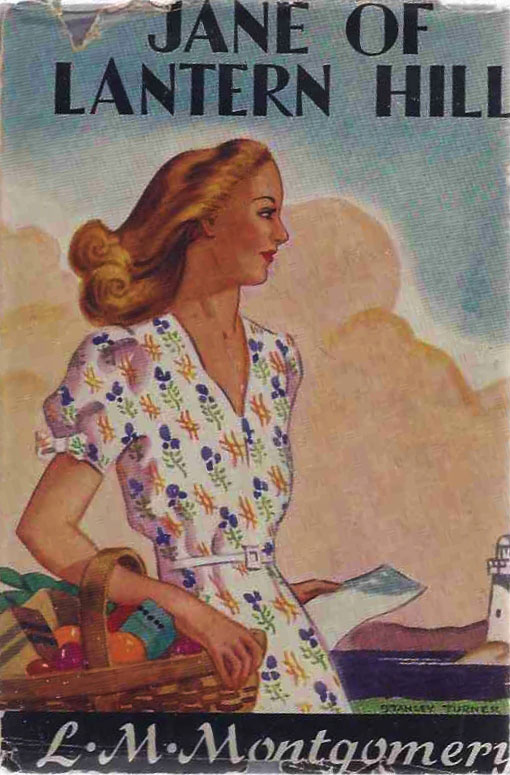
Jane of Lantern Hill by L.M. Montgomery ~ 1937. This edition: Bantam Books (Seal), 1989. Paperback. ISBN: 0-7704-2314-0. 217 pages.

My rating: 8/10. Jane Victoria Stuart is one of the more likeable young heroines in Lucy Maud Montgomery’s repertoire. Great gaps in believability here and there, but overall an engaging tale for romantic souls from youth (say 12-ish) to adult.

*****

Jane Victoria Stuart is eleven years old, and for eight of those years, the years she can remember, she has lived in a huge mansion in Toronto with her extremely wealthy, emotionally frigid grandmother and her delicately beautiful, weak-willed mother. As far as she knows her father is dead. He is never mentioned, except in snidely allusive references by her grandmother to “Victoria’s” tainted ancestry as demonstrated by her “low” tastes – a desire to cook and fraternize with the housekeeper in the warmly cozy kitchen, and a friendship with the young maid-of-all-work in the boarding house next door.

Grandmother makes no secret of her distaste for Jane Victoria – every creature comfort is provided but emotional needs go unfulfilled. Jane, as she secretly calls herself in defiance of her grandmother’s preferred Victoria, shares a deep love with her mother, but open demonstrativeness is impossible – even a glance or a motherly caress is deeply resented by bitter and jealous grandmother, who clings to her own daughter with fierce possessiveness.

The days go by uneventfully, and the future stretches forth relentlessly, until a chance taunt by a schoolmate reveals a secret which has been hidden from Jane by her grandmother and mother. Her father is not dead, but very much alive, and her mother is neither widowed or divorced but rather in a limbo of estrangement, unable to move either forward or back in the restricted social life engineered by the household matriarch.

Jane confronts her mother with the news and asks if it is true, and in one of her rare human moments Grandmother apologizes to Jane for keeping the secret for so long. But now that you know, consider him as dead, she orders Jane, and Jane solemnly and willingly agrees – this man who has abandoned her and made her mother so miserable is best forgotten.

Imagine Jane’s dismay when a letter comes soon after from Prince Edward Island, requesting Jane’s presence at her father’s summer residence over the summer holidays. With great trepidation Jane sets off into the unknown and greatly dreaded wider world.

Needless to say, everything works out, and happy endings abound. But before we get to them there are a number of little dramas which must be worked through, some more unbelievably than others.

A really nice heroine, practical and earnest and well-deserving of the good things which eventually come her way. Give this one to your pre-teen daughters, but don’t forget to read it yourself; mildly melodramatic and ultimately very satisfying.

Might make a good read-aloud, for ages maybe 8 and up. Marital troubles and divorce are central plot themes, as is emotional abuse by Jane’s grandmother, but these are necessary to the building of tension in the storyline. Rather reminiscent of Frances Hodgson Burnett’s A Little Princess in mood, I thought, including the improbable (but most satisfactory) way everything clicks into place in the end. No loose threads – all neat and tidy! Jane would approve.

Disney made a movie of this one a few years back, which I’ve not seen, but apparently it departs wildly from the original story and is not recommended by aficionados of the book.
Read Full Post »

Playing Beatie Bow by Ruth Park ~ 1980. This edition: Puffin (Penguin Australia), 1998. Softcover. 196 pages.

My rating: 8/10

This well-written coming-of-age, historical fiction juvenile novel by New Zealand-born Australian writer Ruth Park is deserving of all the awards and rave reviews it has garnered through the years.

14-year-old Abigail – Abbie – Kirk is still deeply wounded by the separation of her parents four years earlier. In her anger at her beloved father for his desertion, she has changed her name from his chosen Lynette to “an old name, a witch’s name” – Abigail.

Anger seethes within Abbie, though she is learning to hide it. She is

…a girl who wished to be private.

Outside, she was composed, independent, not very much liked. The girls at school said she was a weirdie, and there was no doubt she was an outsider. She looked like a stick in jeans and a tank top; so she would not wear them. If everyone else was wearing her hair over her face, Abigail scraped hers back. She didn’t have a boyfriend, and when asked why she either looked enigmatic as though she knew twenty times more about boys than anyone else, or said she’s never met one who was half-way as interesting as her maths textbook. The girls said she was unreal, and she shrugged coolly. The unreal thing was that she didn’t care in the least what they thought of her. She felt a hundred years older and wiser than this love-mad rabble in her class.

Her chief concern was that no one, not even her mother, should know what she was like inside. Because maybe to adults the turmoil of uncertainties, extravagant glooms, and sudden blisses, might present some sort of pattern or map, so they could say, ‘Ah, so that’s the real Abigail, is it?’

The thought of such trespass made her stomach turn over. So she cultivated an expressionless face, a long piercing glance under her eyelashes that Grandmother called slippery. She carefully laid false trails until she herself sometimes could not find the way into her secret heart. Yet the older she grew the more she longed for someone to laugh at the false trails with, to share the secrets.

What secrets? She didn’t yet know what they were herself.

So Abbie gets on with her everyday life, going to school, helping her mother in her vintage clothing and memorabilia shop, ‘Magpies’, and occasionally babysitting her neighbour’s younger children.

It is while accompanying one of those children to the playground that Abbie first notices a solitary, crop-haired, strangely dressed child lingering in the shadow of a wall, wistfully watching the others at play. Abbie approaches her, but she cries out and runs away. Abbie is intrigued. Who is the child, and why do none of the others, except for her small charge Natalie, seem to see her?

The next time Abbie sees the girl, she again approaches her, but this time as the child flees Abbie follows close behind. Through a the twisting maze of  The Rocks, Sydney’s historical district, they go, until Abbie realizes that she is completely lost – the atmosphere has somehow changed – evening is coming on – and streets are now lit with gas lights, and down a side-street comes a horse-drawn cab. Terrified now, Abbie continues her flight, following glimpses of the only familiar thing she still recognizes, the fluttering fringes of the mysterious child’s shawl.

Of course, by this time, we have realized that somehow Abbie has crossed through a mysterious portal into a previous time and place, the squalid slums district of 1873 Sydney. Rescued and cared for by the little girl’s family, Abbie goes through a transformation of her own, until at last returning to her own time changed, chastened, older (at least in experience) and wiser.

A highly enjoyable, on the whole well-thought-out time-travel tale; the weakest points are the actual time travel sequences – but these are notoriously hard to write, being, of course, purely imaginative with no real-world references to guide the writer. There are elements of  the supernatural – quite a lot of the plot revolves around the passing on of the powers of something like a ‘second sight’ among a family – and there is a certain amount of realistic romance. The ending is possibly a bit too pat, but in general is well-balanced and satisfying, as it ties up all loose ends but leaves the future optimistically open.

I would recommend this for older children, perhaps 12 and up, to adult. The quality of the writing is very high; the story itself is interesting and creatively presented. An intriguing glimpse into contemporary and historical urban Australia (set, as mentioned earlier, in Sydney, New South Wales), as well as a highly sympathetic protagonist.

Read Full Post »

« Newer Posts