Posts Tagged ‘Vintage Fiction’

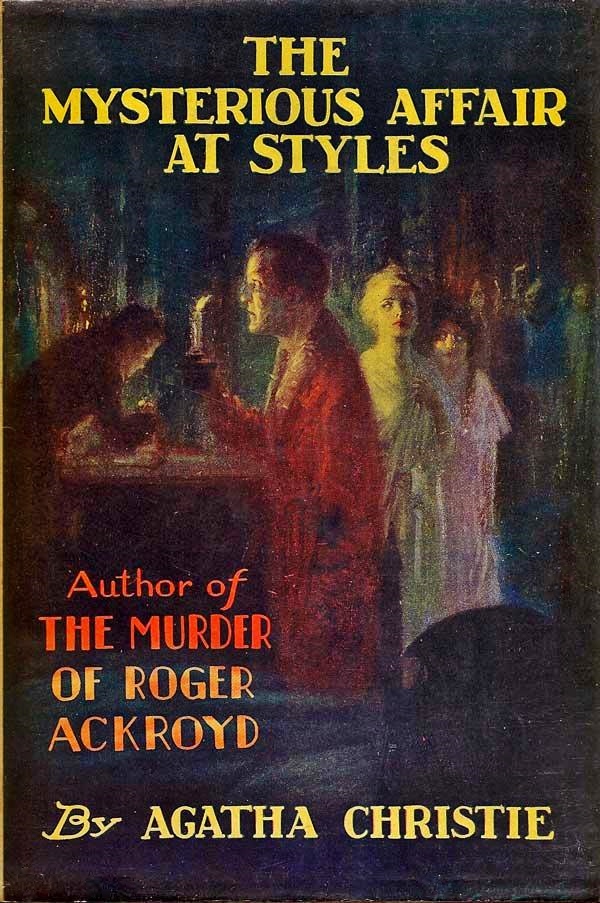
the mysterious affair at styles agatha christie 001The Mysterious Affair at Styles by Agatha Christie ~ 1920. This edition: Grosset & Dunlap, 1927. Fourth printing. Hardcover. 296 pages.

My Rating: 7/10

Setting: An English country House, Styles Court in Essex, sometime during the Great War.

Detection by: HERCULE POIROT, with “assistance” from CAPTAIN HASTINGS (narrator); INSPECTOR JAPP of Scotland Yard is introduced.

Final Body Count: 1

Method(s) of Murder: POISON – strychnine

100 Word Plot Summary:

When wealthy Mrs. Inglethorpe succumbs to a dose of strychnine, suspicion immediately falls upon her much younger (and forbiddingly black-bearded) second husband, Albert. But the philandering Albert has an ironclad alibi, as do all of the other members of the Styles Court ménage. Could it be the sweet young pharmacy assistant, with her easy access to poisons? Or either of Mrs. Inglethorpe’s adult sons, hard up for cash and living on their mother? Her daughter-in-law, cool and unemotional? Her lady housekeeper, outspoken and jealously loyal? Or perhaps the sinister German-Jewish doctor, who just happens to be an expert on poisons?

*****

Agatha Christie’s first published novel. Her very first, a romantic drama set in Cairo and sent out under the working title Snow Upon the Desert, was read and favourably remarked upon but ultimately refused by the publishers she sent it to.  The Mysterious Affair at Styles was inspired by her sister Madge’s comments that Agatha couldn’t possibly write a decent murder mystery. Written while working as a pharmaceutical dispenser during and just after the close of World War I, The Mysterious Affair at Styles is a classic puzzle mystery, with all clues revealed to the reader, and a generosity of suspects. The most unlikely person, of course, might ultimately be revealed as the murderer.

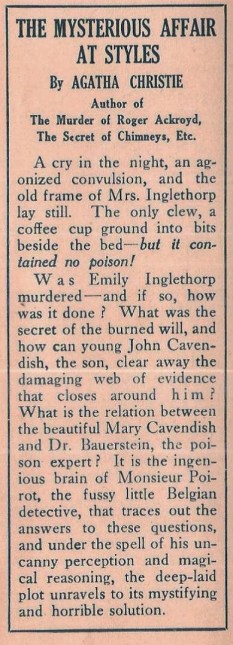
Front fold blurb from 1927 Grosset & Dunlap edition.

Front fold blurb from 1927 Grosset & Dunlap edition.

Narrated by a young Captain Hastings, who has been invalided out of active service, and is recuperating at his friend’s mother’s country home, Styles Court, the novel introduces Hercule Poirot, a finicky and eccentric Belgian ex-policeman. Poirot is living with several other Belgian refugees, and is eager to provide his investigative services when his generous sponsor, Mrs. Inglethorpe, dies mysteriously. Inspector Japp of Scotland Yard is also introduced; he and Poirot already know and like each other, and their collaboration, along with Captain Hastings’ inadvertent contributions, results in the solving of the murder plot.

Though decidedly dated and just a bit awkwardly plotted in spots, this is a very creditable mystery novel. The puzzle is truly hard to sort out; suspicion falls on each of the suspects in turn, and the ending is cleverly worked out. Poirot is not quite solidified into his final form, whom we come to know so well in future years – he was eventually to figure in thirty-three of Christie’s mysteries, and something like fifty short stories. The characters in general are puppet-like; aside from the narrator Hastings, we never get to know any of them – including Poirot – beyond their superficial appearances and stereotypical roles.

The murder itself occurs early on in the narrative, and Mrs. Inglethorpe’s horrible death is quite fully described, as Hastings is one of the witnesses. The brief mourning period for the victim is very soon over as the characters scramble to defend themselves against allegations of wishing for and ultimately causing her demise.

This is not at all a “literary” detective novel, such as those penned only a few years later by the other great “Golden Age” female mystery novelists Dorothy L. Sayers and Josephine Tey, but it is a well-constructed first attempt at the genre, and a grand little period piece, especially when considered in the context of Christie’s astoundingly prolific and successful later body of work.

Dust jacket of the 1927 Grosset and Dunlap edition. Can you see all seven of the suspects?

Dust jacket of the 1927 Grosset and Dunlap edition. Can you see six of the seven suspects? (Captain Hastings is also present, but he is apparently never considered as a possibility, due to lack of motive, I presume.)

Read Full Post »

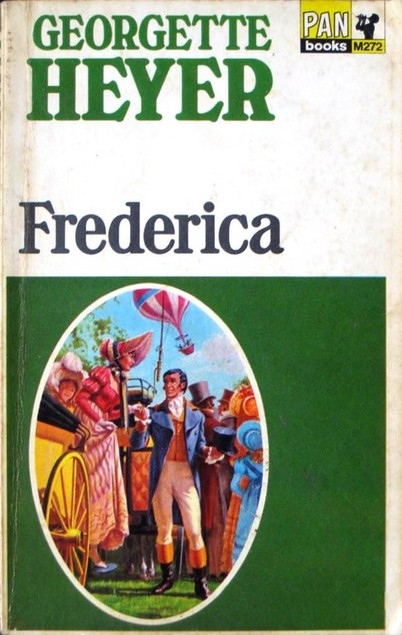
frederica georgette heyer 1Frederica by Georgette Heyer ~ 1965. This edition: Pan, 1968. Paperback. ISBN: 330-20272-3. 330 pages.

My rating: 7.5/10.

This is my fifth ever Georgette Heyer “Regency Romance” title. After bowing to so many recommendations to give the author a try, I must say that I am thoroughly enjoying my explorations of her work. Frederica was, I believe, Heyer’s twenty-ninth Regency novel, in a writing career spanning fifty years, in which she produced a very respectable sixty-plus novels and mystery thrillers.

Here, in Heyer’s own words, is the rather tongue-in-cheek blurb she wrote for the pre-publication promotion of Frederica, at the insistence of her publisher. By this time, in the mid 1960s, the author was a reliable producer of “a book a year”, with a strong contingent of devoted fans clamouring for more.

This book, written in Miss Heyer’s lightest vein, is the story of the adventures in Regency London of the Merriville family: Frederica, riding the whirlwind and directing the storm; Harry, rusticated from Oxford and embarking with enthusiasm on the more perilous amusements pursued by young gentlemen of ton; the divine Charis, too tenderhearted to discourage the advances of her numerous suitors; Jessamy, destined for the Church, and wavering, in adolescent style, between excessive virtue and a natural exuberance of spirits; and Felix, a schoolboy with a passion for scientific experiments. In Frederica, Miss Heyer has created one of her most engaging heroines; and in the Marquis of Alverstoke, a bored cynic who becomes involved in all the imbroglios of a lively family, a hero whose sense of humour makes him an excellent foil for Frederica.

The storyline is as simple as can be. It involves that tried and true pursuit, the husband hunt, and of course its equally vital counterpart, the quest for an acceptable wife.

Frederica, eldest in a family of five recently-orphaned siblings, has, at the advanced age of twenty-four, cheerfully accepted that she is destined for a life of happy spinsterhood. With her oldest brother, Harry, several years her junior, off at Oxford, Frederica is concentrating her energies on her nineteen-year-old sister Charis, who is an adorable young lady, being sweet-natured (though not overly bright), and stunningly beautiful. The little snag is that though the Merrivilles were left with a reasonably adequate income after their late father’s demise, the otherwise desirable Charis will not have much of a marriage portion to accompany her lovely self into a marriage; Frederica is determined to introduce her sister into the highest society and provide her with a chance to attract a high-born (and wealthy) suitor who may overlook her (relative) poverty.

Frederica petitions a remote cousin, Vernon, Marquis of Alverstoke, to sponsor Charis for her London season. Lord Alverstoke, a confirmed cynic and a slightly notorious rake – though forgiven all by fashionable London society out of respect for his massive fortune – is initially dismissive of Frederica’s suggestion, but she so charms him with her candour and sense of humour that he unexpectedly relents and decides to don the mantle of guardian of the Merriville menage for a while, mostly, he tells himself, because his interest in the lovely Charis – a direct competitor in the marriage market to their own daughters – will annoy his snobbish and critical sisters.

Charis does indeed cause a sensation with her loveliness and good nature; suitors reliably materialize, and the story meanders on its way. And we all know who Lord Alverstoke ultimately falls for, don’t we? Though the object of his reluctant devotion remains oblivious, which gives opportunity for the reader to sigh romantically over the reformed rake’s newly awakened and, for the first time in his life, truly heartfelt passion, which – of course! – he cannot share with the woman of his desires, as she shows no signs of reciprocation and would doubtless laugh off any advance…

This novel does rather go on; Georgette Heyer was going through a bout of serious ill health while it was being written and readied for publication, and she stated that though she would have liked to have edited it more strongly and decreased its length, her publisher’s and public’s demands overwhelmed her and she let Frederica go into print as it stood.

It works, though. The characters are interesting, and the dialogue is – overused but apt description – sparkling. The situations Frederica and her two youngest brothers, earnest Jessamy and rambunctious Felix, get themselves into are enjoyably humorous. The period detail is absolutely delicious, and I loved the passing descriptions of dress which Heyer provides, speaking to her readers as though they too were intimately familiar with the fashions of the time period. She informs, but never preaches; this is the type of historical fiction I like the very best. The readers must stretch to take it all in, but the writer assumes her audience is perfectly capable of doing so, and the story moves right along.

Of particular interest were the references to the technological inventions of the day. I was most intrigued by the mention of

… Maillardet’s Automaton … this marvel was a musical lady, who was advertised, rather alarmingly, to perform most of the functions of animal life, and to play sixteen airs upon an organised pianoforte, by the actual pressure of the fingers…

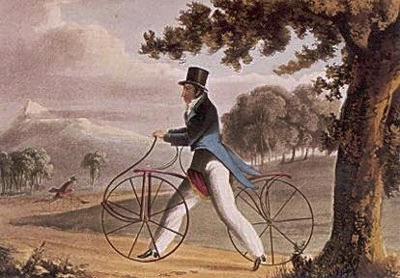
frederica georgette heyer pedestrian curricleAlso the Pedestrian Curricle, a kind of pedal-less precursor to the bicycle, upon which one of the Merriville boys, in company with a steep hill and a canine companion – the boisterous pseudo-“Baluchistan Hound” Lufra –  comes to grief. And then of course there is the ballooning episode which concludes the story with such drama.

A most enjoyable diversion, was cheerful and overwhelmingly good-natured Frederica – book and heroine both – and I savoured every page.

It lost a few points on my personal ratings scale by the rather overdone drama of the ending, which I thought was just a bit over-the-top, is such a criticism can be levelled at a book of this genre.

Looking forward to my next foray in Georgette Heyer’s meticulously depicted Regency world, and to meeting yet more of her dashing heroes and clever heroines.

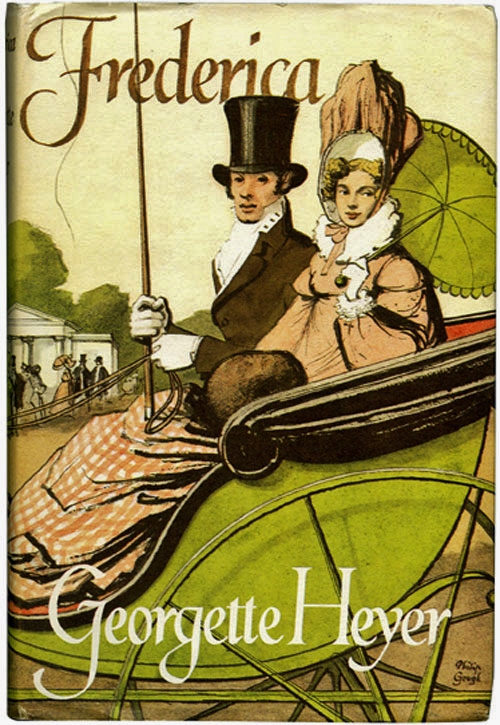
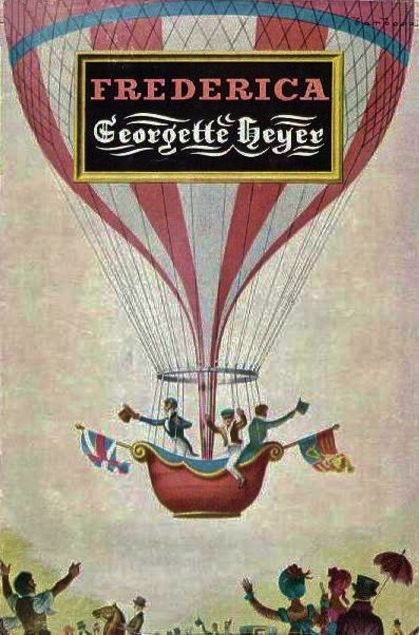
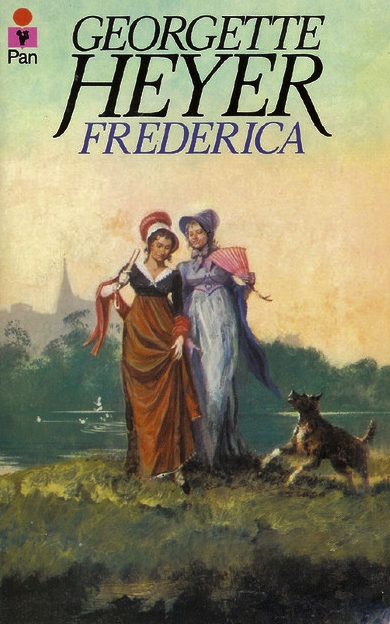
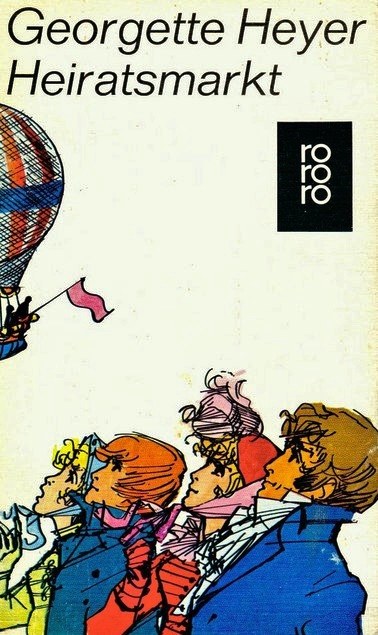
In the meantime, here are some of the covers for Frederica which struck my fancy as I poked about the internet investigating other reviews, of which there are many, most exceedingly enthusiastic.

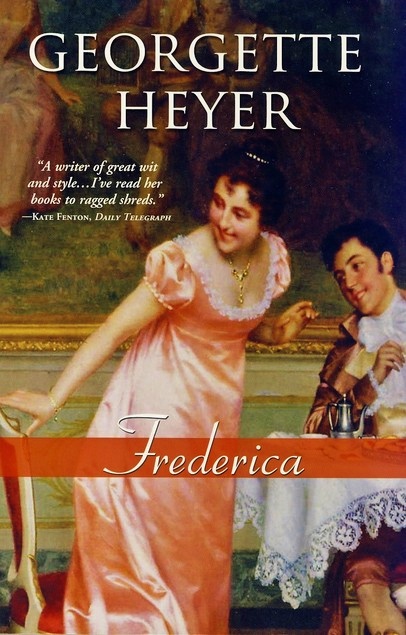
I liked this cover; it has a decided "period" appeal.

I liked this cover; it has a decided “period” appeal.

And this one, focussed on the dramatic balloon episode which brings the tale to a fitting conclusion.

And this one, focussed on the dramatic balloon episode which brings the tale to a fitting conclusion.

And here we have Frederica and Charis, accompanied by their beloved Lufra. I'm not quite sure about that fan, though; would it have been employed in such a way on a daytime stroll in a London park?

And here we have Frederica and Charis, accompanied by their beloved Lufra. I’m not quite sure about that fan, though; would it have been employed in such a way on a daytime stroll in a London park?

Here's a German cover which caught my eye. (Georgette Heyer was apparently very popular in Germany.)  I really like the strong colours and simplicity of the pen-and-ink treatment of this poster-like illustration.

Here’s a German cover which caught my eye. (Georgette Heyer was apparently very popular in Germany.) I really like the strong colours and the striking simplicity of the pen-and-ink treatment of this poster-like illustration. (“Heiratsmarkt” translates to “Marriage Market”.)

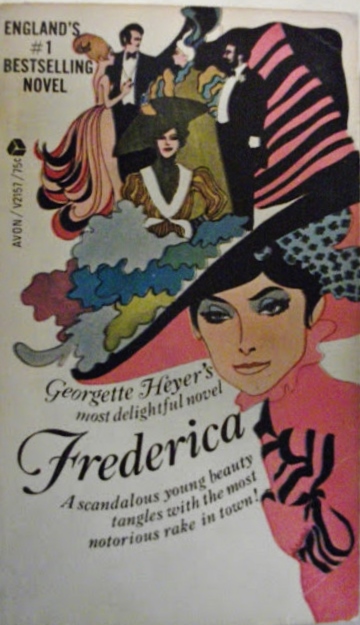
This one is absolutely bizarre, a triumph of misguided misrepresentation.  Who are these people, and why have they strayed from a 1960s costume party onto the cover of a well-mannered Regency-period romance?!

This one is absolutely bizarre, a triumph of misguided misrepresentation. Who are these people, and why have they strayed from a 1960s costume party onto the cover of a well-mannered Regency-period romance?! And who is the “scandalous young beauty” so prominently mentioned? Egads! Did the illustrator read the book? Methinks…NOT.

A more current cover from a recent re-release. This one captures the happy tone of the novel wonderfully well, though the featured female does not really fit my mental picture of Frederica herself.

A more current cover from a recent re-release in 2009. This one captures the happy tone of the novel wonderfully well, though the featured female does not really fit my mental picture of Frederica herself.

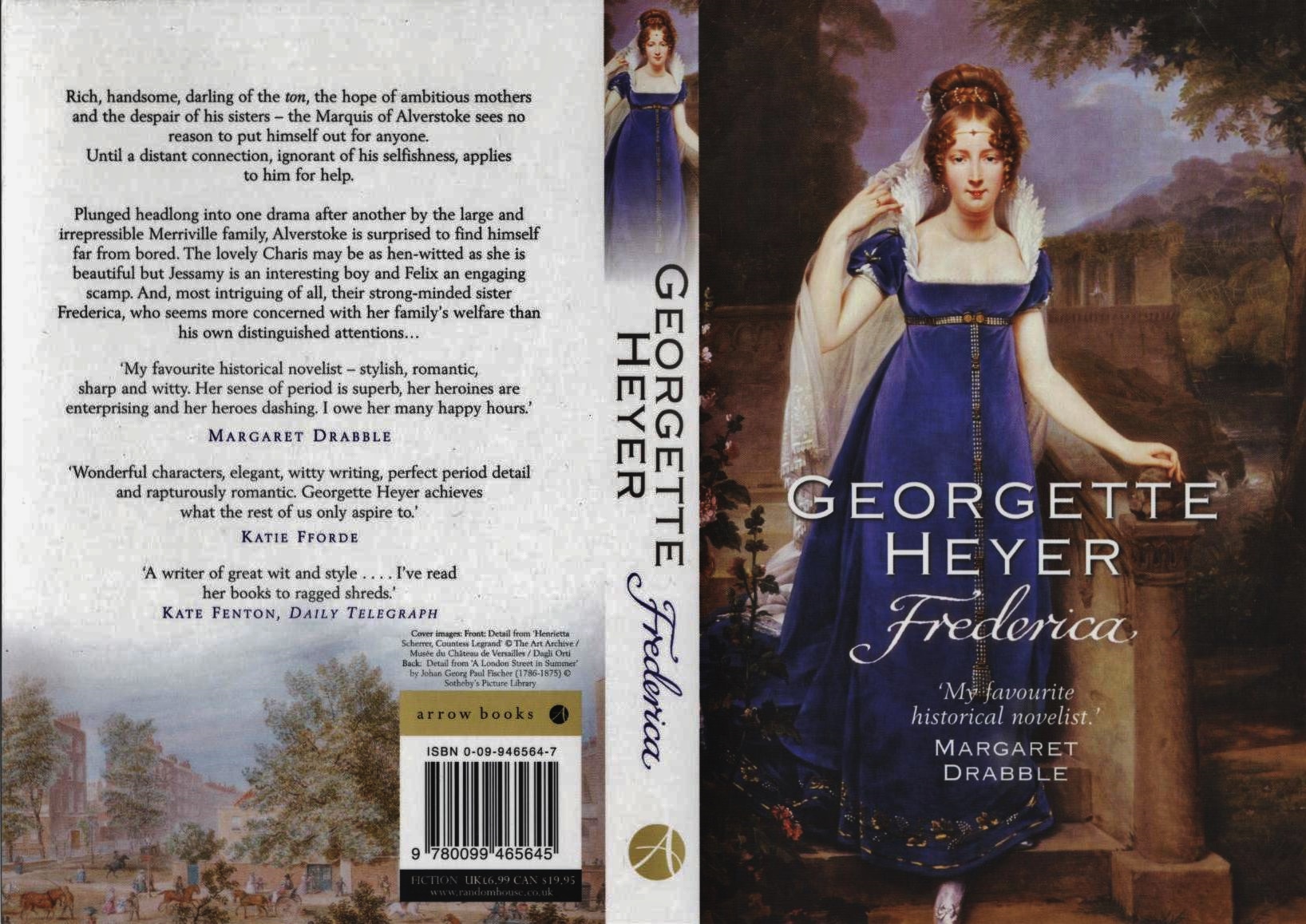
And here is the most recent cover, from 2011. Again, not my mental image of Frederica, but a lovely cover nonetheless.

And here is the most recent cover, from 2011. Again, not my mental image of Frederica, but a lovely cover nonetheless.

Read Full Post »

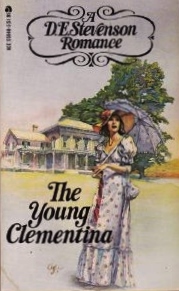
the young clementina d e stevensonThe Young Clementina by D.E. Stevenson ~ 1935. Original/alternate titles: Divorced From Reality and Miss Dean’s Dilemma. This edition: ACE, 1975. Paperback: 0-441-95048-5. 320 pages.

My rating: 9/10.

Completely met expectations, up to and including the blush-inducing ending, which lost the story its single “you’ve got to be kidding!” point. Golly, D.E. Stevenson often bobbles in those last few pages, doesn’t she?!

Well, really, the ending’s not that bad. Just…hmm…maybe just a little bit rushed? And a little too good to be true? But hey! – that’s why I’ve come to quite adore D.E. Stevenson. This story in particular is escape literature at its delicious, romantic, improbable, suspend-your-disbelief for hundreds of pages, period-piece-vintage best.

Okay, here’s a brief overview of the set-up of this novel. It’s very nicely done indeed; one of the author’s melodramatic (versus her more placid and thoughtful) minor masterpieces.

I wonder how a hermit would feel if he had spent twelve years in his cell and were called back to the world to take up the burden of life with its griefs and worries and fears; if he had passed through the fire of rebellion and achieved resignation; if his flesh had been purged by sleepless nights and his mind had found the anodyne of daily work. Would he feel afraid of the world, afraid of the pain awaiting him, afraid of his own inadequacy to deal with his fellow men after his long, long years of solitude? Would he refuse to listen when the world called, when his conscience whispered that his duty lay outside his cell, or would he gird up his loins and go forth, somewhat reluctantly, into the world which had turned its back upon him for twelve years?

My mythical hermit is standing at the parting of the ways, and so am I. Two roads are open to me, one lonely but well known, peaceful and uneventful; the other full of dangers and difficulties which I cannot foresee…

Our narrator is middle-aged Charlotte Dean, inhabitor of a dreary London flat, efficient and self-effacing librarian at a quiet geographical library – repository of “any book that adds to the geographical knowledge of the world” – recluse from that very world. Her only friend, aside from her kind employer, Mr. Wentworth, and her dedicated charwoman, Mrs. Cope, is her diary, in which she records her daily doings as she has done from childhood.

Ah, childhood. Happy days, indeed, when Charlotte was the beloved child of the Parsonage in green and flowery rural Hinkleton, running wild with her bosom friend, Garth Wisdon, equally beloved child of the Manor. Charlotte and Garth were inseparable, and their friendship was not at all disturbed by the advent of Charlotte’s small sister, Clementina – “Kitty”, as she was soon named. Not then, not in childhood. But as the years passed and friendship ripened to something deeper, Kitty had her part to play in the dissolution of the bonds that held Charlotte and Garth together…

The Great War tore Garth away from Hinkleton, and upon his return it is, unexpectedly, Kitty who becomes the new lady of the Manor, while Charlotte remains at home to care for her failing father, and then creeps off to London when his death leaves her alone and penniless.

For some strange reason Charlotte and Kitty are no longer the close friends that they were in childhood, and Garth openly sneers at his once-beloved “Char”. She meets them only occasionally, and so is rather surprised to be asked to act as godmother to her young niece Clementina  – named after her vivacious mother – and to visit at Hinkleton Manor for the occasion. But Garth is still dismissive and sarcastic, and Kitty disturbingly self-centered and complaining, so Charlotte returns to her quiet life with no thought but to regain her hard-won peace of mind, and to leave the dead past buried.

Then, twelve years after her flight to London, Charlotte’s world is turned topsy-turvy by the dramatic re-entry of Kitty into her life, and she faces the dilemma referred to at the start of the story…

For another look at the story, and an enthusiastic recommendation, a visit to Fleur Fisher‘s review will be in order.

I greatly enjoyed this grandly melodramatic and deeply romantic tale. Most engaging and deeply readable, and for that I’ll even forgive the rushed and too, too predictable “surprise” ending, my one perennial gripe with this author’s style. She builds up her story wonderfully well, rockets it along in fine style, and then chops it off with a hurried ending, almost every single time. Grrr. (And do please ignore this complaint; it’s a very minor one, and in no way puts me off reading these books with genuine enjoyment.)

I can see why this novel is so highly thought of by D.E. Stevenson devotees; she’s in fine form throughout. I do believe this one has just been re-released on July 2, 2013, so it should be readily available, just in time for your summer reading pleasure. Here’s the Amazon.com link, which includes an excerpt of the first chapter.

And I’ll say once more, this is a very vintage romance, written in the 1930s, with all of the expected clichés. It is, perhaps, even a bit old-fashioned for its time; it rather reads like something out of the closing years of the century before. With that in mind, enjoy!

Read Full Post »

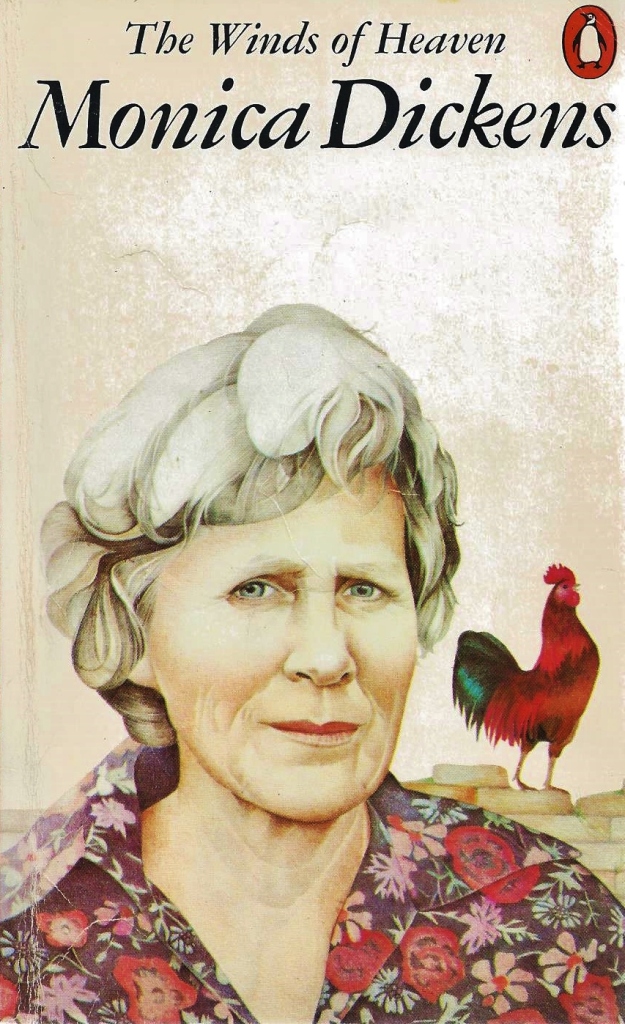
the winds of heaven monica dickens 001The Winds of Heaven by Monica Dickens ~ 1955. This edition: Penguin, 1977. Paperback. ISBN: 0-14-00.1917-0. 239 pages.

My rating: 7/10.

Monica Dickens is one of my pet authors; her books, despite their undoubted flaws, reside prominently on the bedroom bookshelves reserved for our favourite re-reads. And when one is so comfortable with a certain author, isn’t it sometimes hard to step back and realize that not everyone shares either their familiarity or enthusiasm?

I was quite surprised at my own passionate feelings of defensiveness regarding Monica Dickens recently when I read this review of The Winds of Heaven by blogger Rachel of Book Snob. I was half way through reading my own copy of the novel, and Rachel’s comments made me step back a bit and look at the story with new eyes. I’d read it several times previously over the years, and I didn’t really change my views on it with this reading, but it was truly interesting to read with a more critical eye, as if experiencing the novel as a “first” Monica Dickens, and to try to identify what exactly pushed Rachel’s buttons all wrong. Great discussion followed that post; worth reading, so please visit if you haven’t already.

So – taking a deep breath, stepping back, and trying to maintain some sort of distance so I’ll be able to give my own picture of the book in question.

First off, I must say that The Winds of Heaven isn’t, in my opinion, one of this author’s stronger books. Though well up to standard as far as the writing goes, there are others much, much better handled, both in plot and execution. The recent re-issue of this title by Persephone Books leaves me jut a bit bemused; there are others in this writer’s canon which are so much more worthy of that great honour. If this is your first exposure to Monica Dickens, it might well also be your last, and that would be an immense shame, as she has some rather good stories to tell.

I can only assume that Persephone chose this book because of its attention to women’s roles in the mid 20th century. Set in England in the post war years (The Winds of Heaven is set in 1951 and 1952, and was published in 1955), the characters are broadly representative of their time.

When the winds of Heaven blow, men are inclined to throw back their heads like horses, and stride ruggedly into the gusts, pretending to be much healthier than they really are; but women tend to creep about, shrunk into their clothes, and clutching miserably at their hats and hair.

To Louise Bickford, on this late April day, the wind that jostled through the London streets seemed a bitter personal enemy, turning to meet her no matter which way she turned, beating against her small figure in the open stretches, and calling in reserve cohorts to attack her afresh at every corner.

She had intended to walk to the Park and look at the spring flowers, but she was soon so tired of fighting the wind’s fiendish determination to pluck her clothes and hair awry that she turned into a teashop to resettle her hair and recover her breath, until it was time to meet Miriam and the children at Marble Arch.

Miriam was Louise’s eldest daughter. She had borne three daughters, to her surprise, for her husband had set his heart on a son, and Louise was in the habit of giving him everything he asked for. That she failed to give him a boy, with a long conceited nose like his own to look down on the world, had not helped to raise his opinion of his wife’s usefulness to society…

Louis, widowed for just over a year,  is on the cusp of sixty. Her late husband, the supercilious Dudley, has died unexpectedly after a short illness, leaving his financial affairs in a state of great turmoil. Instead of a sedate widowhood financed by a respectable income, Louise is startled to hear that she is, in fact, penniless. Her one resource is a small income from her parents’ estate, barely enough to keep her clothed and fed. Her home and possessions must be sold to repay Dudley’s many debts; Louise has become a bemused and helpless vagabond, thrown out into a world she has been increasingly insulated from during the long years of her difficult marriage.

Louise’s three daughters have stepped in to take on their mother in turn, a situation which all are unprepared for.

Miriam, married to an upwardly mobile barrister, is strongly focussed on the requirements of keeping up a suitable home, entertaining and being entertained by her husband’s business associates, and ensuring her three children are moving ahead in their school and social circles. The most financially prosperous of Louise’s children, it has fallen to Miriam to take on a major part of the responsibility of her mother’s care. Both Louise and Miriam are having a difficult time reconciling themselves to their new relationship. Louise would love to be a fond grandmother figure to Miriam’s three children, but this never quite works out as hoped for. Her closest relationship within the household is to Miriam’s eldest child, Ellen, a dreamy and ineffectual misfit in a household of high achievers. Louise and Ellen are kindred spirits, and Louise’s gentle defense of Ellen serves mostly to irritate, as Miriam sees this as unwarranted interference and an insidious criticism of her mothering skills.

Louise’s second daughter, Eva, an aspiring actress with a hectic personal life, maintains a small flat in London, and good-naturedly tucks her mother into her tiny spare room when it is her turn to host her mother, but her bohemian lifestyle is so at odds with Louise’s conventional nature that the two are never really comfortable together. Eva’s personal affairs are also made more difficult by the presence of her mother in her flat, especially now that she has fallen deeply in love with a married man, and faces her mother’s unspoken but very obvious horror at the situation her daughter has placed herself in.

Louise’s youngest daughter, Anne, has married a struggling market gardener and smallholder. Louise and her practical and kind-natured son-in-law get along well, and Frank has no objection to hosting his wife’s mother. Louise is even becoming rather handy with minor chores about the farm, and she and Frank work well together, with Louise showing increasing competence in practical things under Frank’s relaxed tutelage. Anne herself is the sore point here. Lazy by nature and downright slovenly about the house, Anne finds herself irritated by her mother’s attempts at housecleaning and cooking; those very small efforts at “helping out” seem to Anne to be a personal condemnation of her chosen lifestyle.

So Louise shuttles from daughter to daughter, with a brief respite as a winter resident – at extremely reduced rates –  at an old school friend’s seaside hotel. She increasingly desperately muses over what she should be doing to try to find some sort of solution to her poverty and homelessness. Never expecting to have to support herself, and ineffectual and self-effacing by nature, any initiative she once might have had has been quenched by the late Dudley’s continual verbal criticism. Though Louise has never been physically injured, she is as much a victim of abuse as any battered wife; the way out of her dilemma is lost to her, though well meaning friends try to pep her up and encourage her to find some occupation which might bring in enough income to enable her to maintain some semblance of an independent life.

Then, in a random meeting in a restaurant, Louise becomes friendly with a most unlikely character, department store bed salesman-slash-author of sex-and-murder pulp fiction, Gordon Disher. Gordon is hugely overweight, a severe diabetic who must be extremely careful of what he eats. He’s the never-married middle-aged son of a now-deceased, over-controlling mother, and he is a deeply likeable character, being soft-spoken, kind and deeply compassionate. Louise inspires affection and the longing to protect in Gordon, and their growing relationship winds through the book, increasing in importance until the startling  – but not surprising, given the increasingly melodramatic tone of this minor saga – conclusion.

The Winds of Heaven is “typical” Monica Dickens in that the characters are presented with all flaws fully intact. This is an author who sees every wrinkle, bump and character flaw, and doesn’t hesitate to share them with us. She is adept at showing us that those flaws don’t necessarily completely define her characters, and she generally shows us the positive aspects of each personality as well. She creates her characters, sets them on the stage to play out their various stories, and lets her readers make of everything as they will. I like “not liking” various of her players, and I like the grace that their creator gives by dropping hints of their deeper motivations, and their complex inner lives. Monica Dickens is occasionally sentimental, but only momentarily; her default tone is wryly observant, and her observations are frequently very amusing, in an “Oh my gosh, she’s right, that could be me!” or, “I know that person!” sort of way.

The book ends on a highly ambiguous note. Louise is about to change her life, and future happiness is a strong possibility, but there is a terrible price to pay.

One of my major issues with this novel is the rushed and superficial handling of the ending; after providing such micro-detail throughout, the sketchy handling of final events is something of a let-down, as if the author was really just ready to be done with the story, already.

I don’t personally feel that the author had any statements to make with this tale, much as it could be read as a critique of the treatment of the elderly (though Louise, at a hale and hearty sixty, isn’t really elderly, in the way that we interpret the term today). Every character is presented sympathetically in that we get to see all the facets of their personalities. We may not like how they behave, but we understand why they are like they are.

Yes, Louise’s daughters are selfish, but their creator does not condemn them for it. Louise is just as selfish in her own way, as is Gordon Disher. Everyone has something that they want, some vision that they’re chasing, which affects their relationships with those they are intimate with. It’s plain old human nature, and I appreciate Monica Dickens’ way of presenting each situation with glimpses of motivation and reasoning, and also those moments of reconciliation and affection which are so reflective of real life.

And this is why I love Monica Dickens. She is fully aware of the contradictory aspects of human nature, and forces them upon us in a way that is impossible to dismiss, all the while telling a diverting story. The Winds of Heaven, while not in her top rank, is full of good writing.

And that is all I have to say, at least for now.

I’m hoping to review more of this author’s work, but I find it is rather difficult to step back enough from someone I’ve read and re-read so much and really talk about the book in question while trying to remember that perhaps everyone else reading is not so familiar with the author’s canon. I read The Winds of Heaven quite a way along in my roster of Dickens’ titles; my response to the novel was definitely informed by that circumstance. If it was my first book by her, I very well might never have gone on.

Come to think of it, I’m not quite sure which was my first book by her. That’s sadly lost in the foggy mists of time. I think it was One Pair of Feet; I do remember picking that one up, in a vintage Penguin version, from a used book store in Calgary sometime in the 1980s, and not being quite sure what to expect. Obviously whatever it was that appealed still does!

Read Full Post »

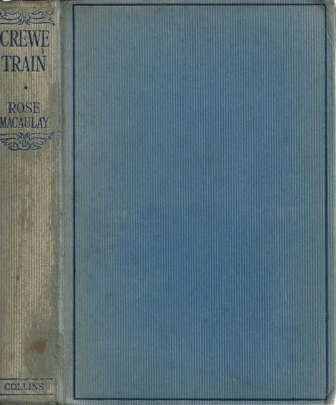
crewe train by rose macaulay 001Crewe Train by Rose Macaulay ~ 1926. This edition: W. Collins Sons & Co., Ltd, 1926. (One Shilling Library Series.) Hardcover. 307 pages.

My rating: A solid 9/10. It’s been several weeks since I read this rather shabby, more than slightly foxed edition of Crewe Train, but the character of Denham has walked beside me ever since.

TO

THE PHILISTINES,

THE BARBARIANS,

THE UNSOCIABLE,

AND

THOSE WHO DO NOT CARE TO TAKE
ANY TROUBLE.

I must admit that after that introduction I was already more than half won over, which was a good thing, for my initial impression of the characters in this quirky novel was that they were sincerely unlikeable. Our heroine in particular.

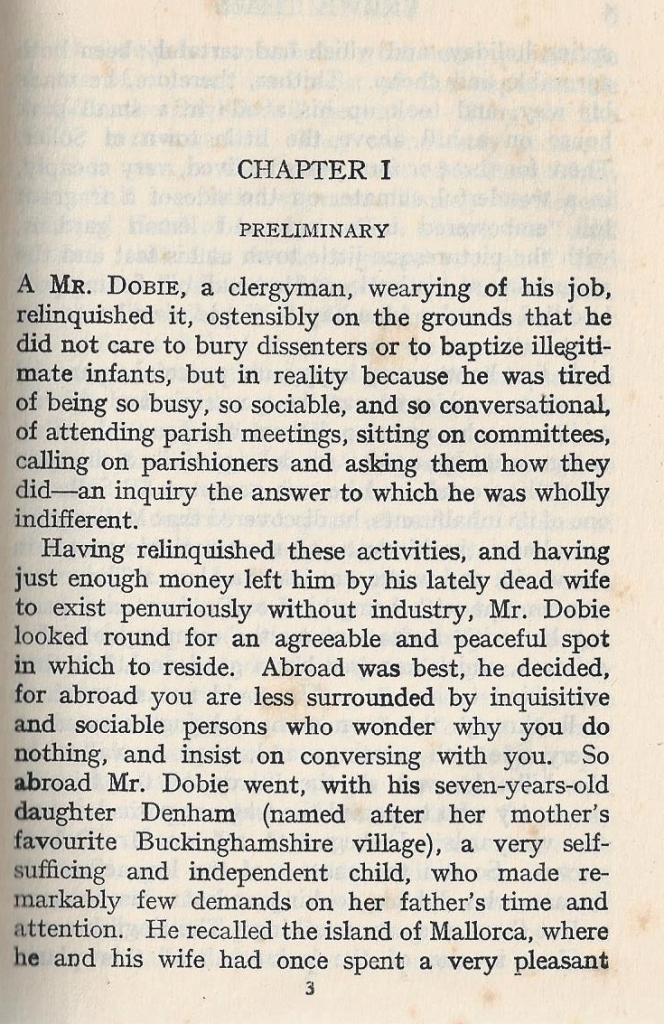
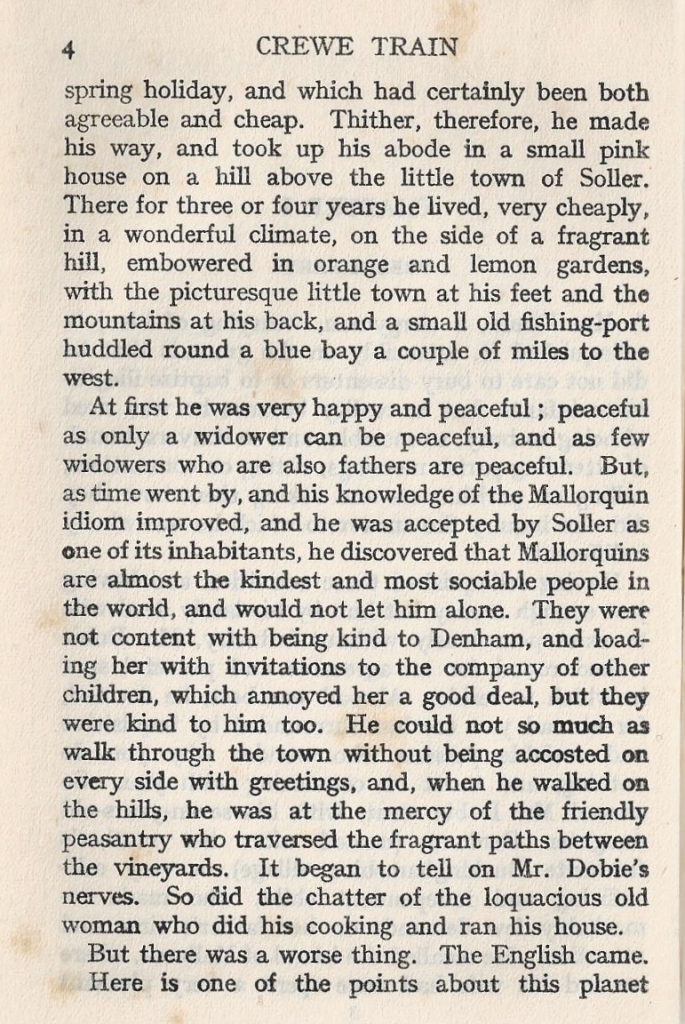
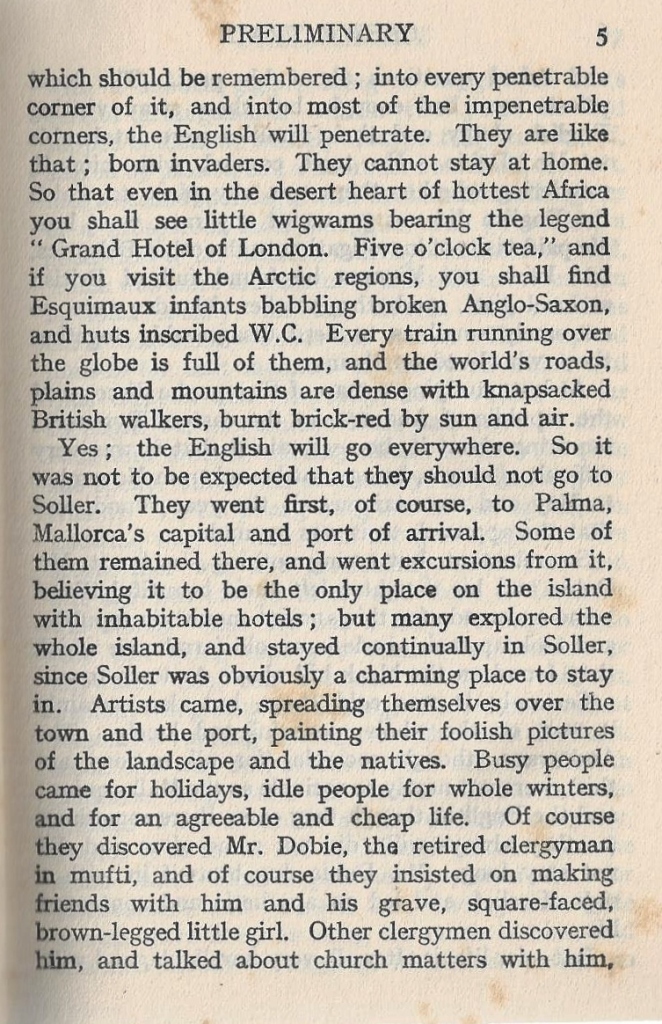
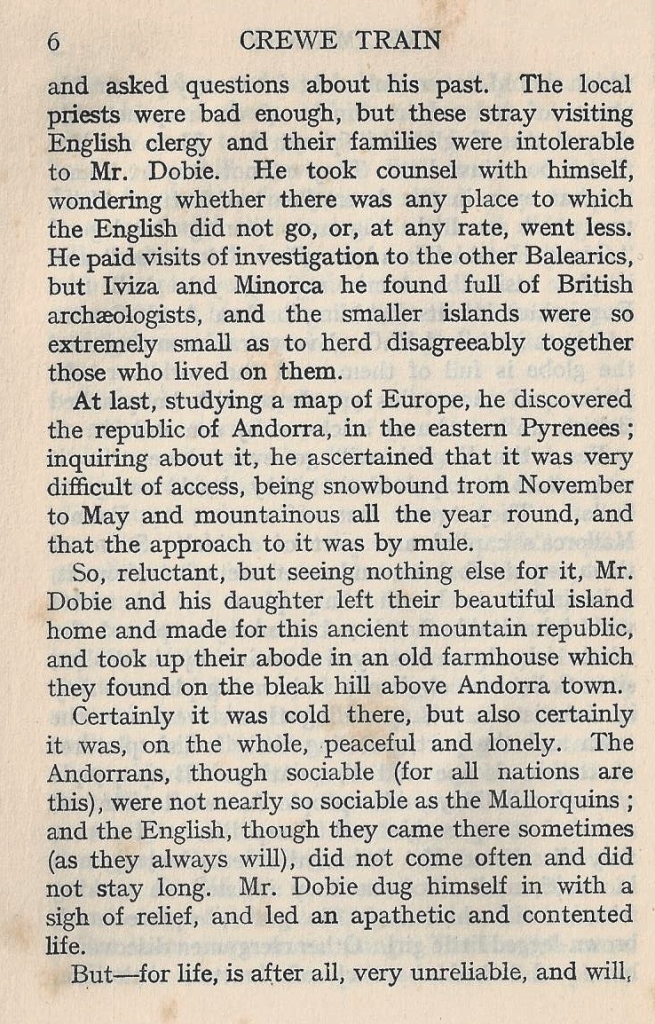
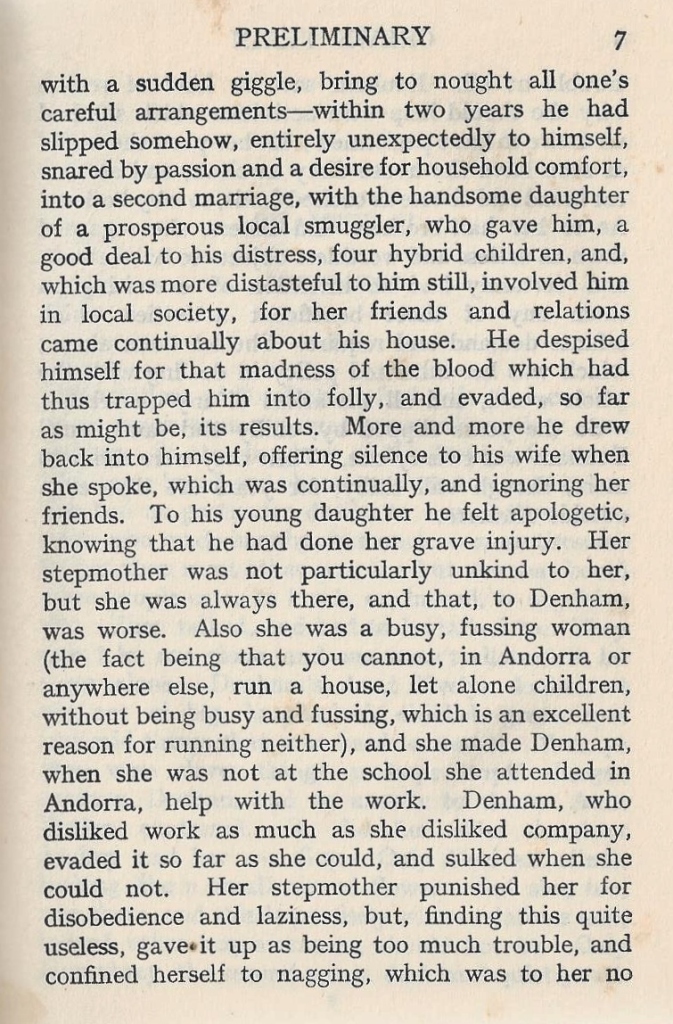
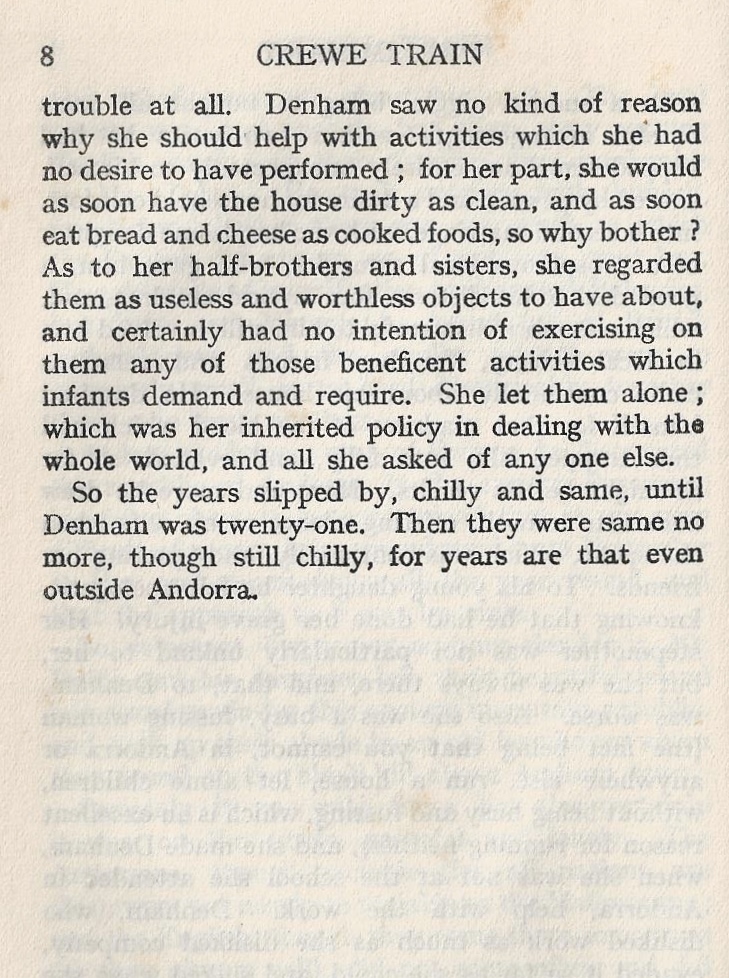
crewe train macaulay page 1 001crewe train macaulay page 2  001crewe train macaulay page 3 001 (2)crewe train macaulay pg 4 001crewe train macaulay pg 5 001 (2)crewe train macaulay pg 6 001And yes, in her twenty-first year, everything changes for Denham. Her father’s in-laws, the Greshams, the family of his first wife, descend upon the Andorran establishment for a visit, and, perhaps brought on by the unwonted stress of having to socialize so strenuously after a self-imposed life of seclusion, Mr. Dobie fatally succumbs to a stroke in the night.

Denham’s stepmother makes no bones about her distaste for her sullen stepdaughter; in her loquacious outpouring of hurt at her new widowhood she presses the responsibility for Denham upon the Gresham family. “You had better take her away with you to England!”

So they do.

Culture shock does not adequately describe Denham’s introduction to English society after her lifetime of relative seclusion. She allows herself to be tidied up and dressed up and trained up in the social conventions; these do not take particularly well though the continually bemused Denham does not actively resist her attempted makeover into a more socially acceptable “young lady”. She merely remains stoic under her Aunt Evelyn’s well-meaning ministrations and her cousins’ continual encouragements. She processes all she’s being exposed to, and does her best in her slow, wordless way to try to live up to the Greshams’ expectations; her success is not noteworthy.

Time moves inexorably on. Denham meets a certain young man, Arnold Chapel, a junior partner in the Gresham family’s publishing firm. Arnold and Denham experience something of a meeting of minds, though Arnold’s quicker intellect runs rings around the plodding progression of Denham’s thought processes. The two embark upon a shared life, and the novel details the peaks and valleys the two must traverse – some literal, most strictly figurative – before coming to a place of joint repose.

A very clever book, this one. I frequently felt much in common with Denham as Macaulay writes her own rings around my own rather plodding (though appreciative) thought process. I identified tremendously well with Denham; I wonder if this is a universal response? Or do the rest of you see her as the unrelateable (though ultimately sympathetic) stranger within the gates of intelligent society?

I suspect we all have something of Denham in us, as onlookers and inner critics of the chatter and occasional excesses perpetuated by the self-proclaimed intellectual classes of our own time. Perhaps this explains the lasting appeal of this mocking (but frequently tender) confection of a tale?

Crewe Train is definitely on my personal short list of “Most Memorable Books of 2013”, even though the year is not quite half over. I am very keen indeed to explore more of Macaulay’s fiction; this novel has wet my appetite for something more of her creative style.

Read Full Post »

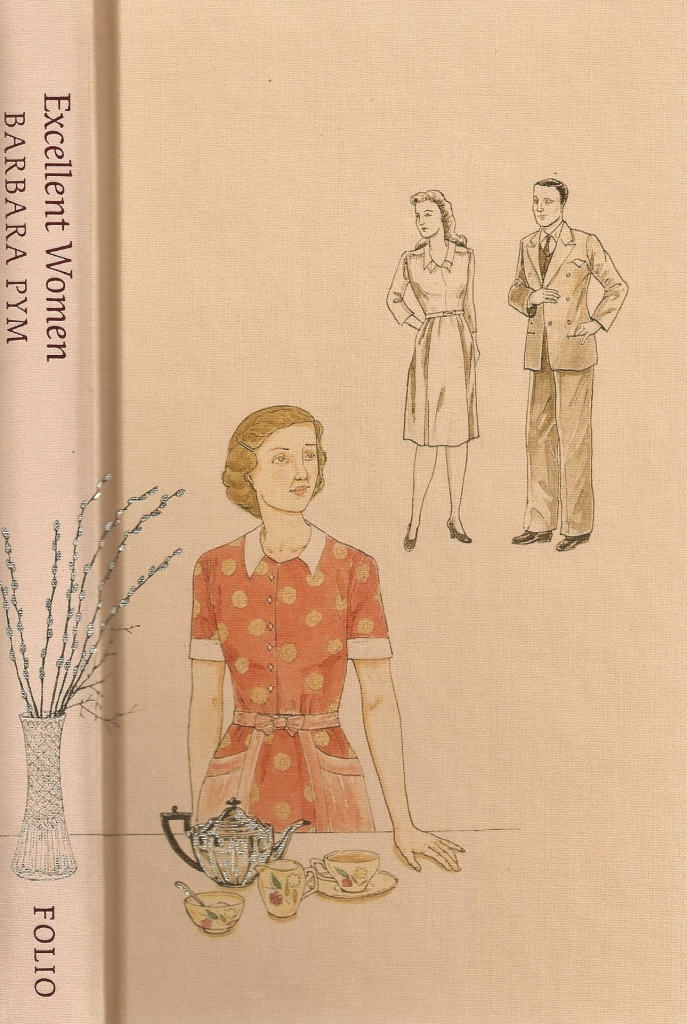
excellent women barbara pym folio front c 001Excellent Women by Barbara Pym ~ 1952. This edition: The Folio Society, 2005. Introduction by A.N. Wilson. Illustrated by Debra McFarlane. 206 pages.

My rating: 10/10.

This is the second time around for this book. My first reading left me gently pleased but not much more; this reading was much more rewarding, and I found I fully appreciated every nuance, every delicious – and occasionally malicious – little scenario.

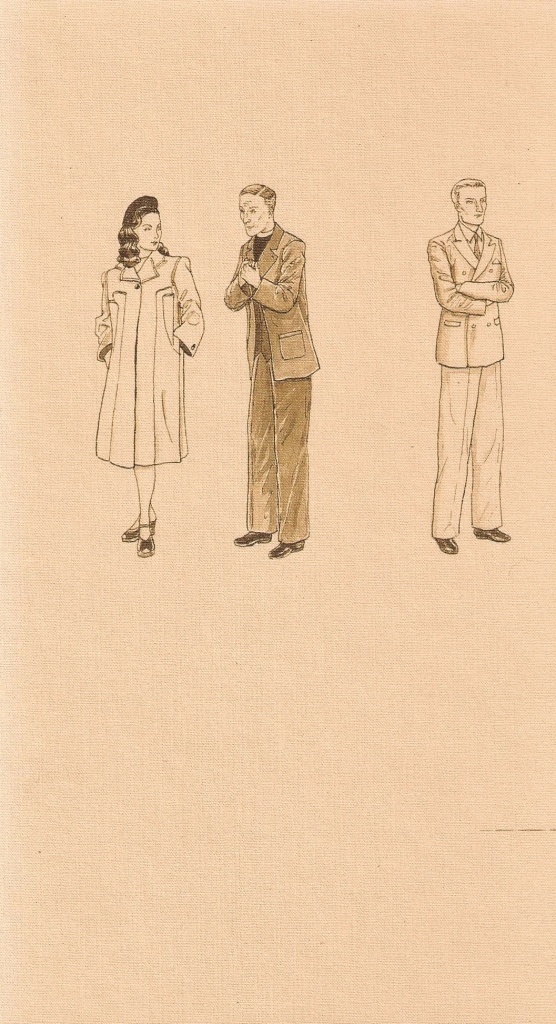
This absolutely beautiful Folio edition certainly added to the experience; my first reading was of a yellowing paperback. I wonder if eyestrain is starting to influence my reading enjoyment? I do notice type clarity (and lack thereof) and font size much more these last few years.

And I must confess I almost passed this one by – “I already have it in paperback and it wasn’t that wonderful” – but am so glad I went back and splurged on this much more aesthetically pleasing book. Every sense was indulged by it! The pussywillows picked out in silver tipped the scales and sealed the impulse buy. I’m a sucker for pussywillows; these stole my heart. (On such small things do my buying decisions sometimes rest!)

Barbara Pym. Read her, and then reread her. Second time around is the key, here, I think. (Much as one needs to do with Diana Wynne Jones.)

*****

At the rather young age of thirty-one, Mildred Lathbury, self-described “spinster” and “clergyman’s daughter” (both of these designations serving to explain her clear-eyed observations of other people’s lives, and her lack of sentiment about her own), is well on her way to becoming one of the titular “excellent women” so dutifully and frequently thanklessly keeping things on an even keel in the bleak post-World War II years. Surplus females of every age, in super-abundance at mid-century after the decimation of their generations’ crops of marriageable men in the two brutal cullings of the previous decades.

“They have nothing better to do,” shrug their “luckier” compatriots, “they might as well make themselves useful, and be grateful for the occupation…”

So they do. Make themselves useful, that is. Though, as Mildred so delicately observes, the gratitude frequently falls short on both sides of the equation.

excellent women barbara pym folio back c 001Read quickly, this is a rather depressing, non-eventful, bleakly dreary minor tale. Not much happens. Mildred gets new neighbours, watches as the vicar of her church is pursued and almost caught by a predacious widow, narrowly escapes being saddled with an unwanted flatmate, and is offhandedly wooed in a most unromantic way by an anthropologist looking for a meek but competent dogsbody to take on the tedious task of editing his notes.

But, oh! – her inner voice! She misses nothing at all, our Mildred, and her wry observations are a joy to read.

I’m going to stop right here. What with it being Barbara Pym’s centenary year, and with the book blogging world full of mostly fulsome praise and beautifully written, thoughtful book reviews of her work (though the occasional dissenting voice is heard from, mostly from mildly querulous folk wondering what all the fuss is about – I can’t say I’ve yet come across anything resembling a brutal denunciation of Miss Pym) anything I have to add to the conversation is rather superfluous, I feel.

I liked this book.  A whole lot. You might, too. My caveat: it might take more than one try.

Here are some excellent reviews, well worth reading. They include all of the excerpts I would have chosen myself.

Well done, all!

You’ve saved me much typing. Well, that, and also, more importantly, you’ve given me the great pleasure of reading your delightful posts. Thank you. A (fresh) wand of mimosa all round! (And a cup of China tea, if that be your desire. Unless you’d prefer a beer? Or a glass of wine, exciting or merely adequate?)

Excellent Women –  Review at The Captive Reader

Excellent Women – Review at Book Snob

Excellent Women – Review at The Indextrious Reader

And there are many more.

Read Full Post »

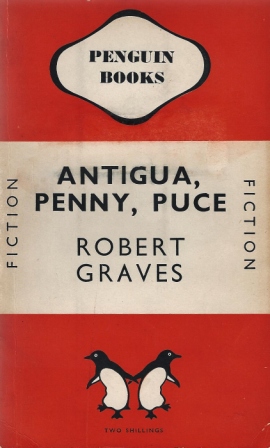
antigua, penny, puce by Robert Graves 001Antigua, Penny, Puce by Robert Graves ~ 1936. This edition: Penguin, 1947. Paperback. 314 pages.

My rating: 8.5/10. Parts of this one – many parts! – were decidedly “10” in quality. I rated it lower only because the author ran a few sections just a bit harder than they could take; I did have to force myself onwards here and there. But it always got interesting again.

I greatly enjoyed this book, and found it playful, amusing and gloriously cynical in parts. Graves has his authorial knife keenly honed and digs it into such things as British prep and public schools, golf, the British upper classes in general (with the hearty sporting types coming in for the most blatant caricaturizations), and, for reasons known only to himself, Jerome K. Jerome’s Three Men in a Boat. I laughed out loud several times while reading; a thing I seldom do.

*****

This is an intricately structured, highly detailed, cleverly framed, humorous and yet deeply cautionary tale about sibling rivalry, and the dangers of pursuing familial tit for tat to extreme lengths. Robert Graves, already a well-established and very prolific writer of “serious” literature and poetry, apparently wrote this atypical farcical novel as a result of a bet that he couldn’t pull off a “modern” bestseller. Graves is, of course, probably best known now for his screen-adapted historical fictions I, Claudius and Claudius the God, among something like 150 other published works, most rather sober and scholarly examinations of the classical world, biography, historical fiction and poetry.

*****

Oliver Price and his younger sister Jane grow up together in an atmosphere of stereotypical English upper-middle-class respectability. Their father is a country vicar who hobnobs on equal terms and with a strong element of rivalry with his wealthy neighbour, Sir Reginald Whitebillet. Their mother, the daughter of a marquess, was cast off by her family for marrying the Castle chaplain, and through her there are connections to the aristocratic Babrahams. These details are important; both the Whitebillet and Babraham connections figure crucially in the saga of the siblings a few years later on.

Oliver, at the age of twelve, is the proud curator of a stamp collection while Jane, a year younger, yearns to participate in her brother’s hobby. Through maternal machinations on behalf of Jane and a set of rather devious circumstances – the mother of the family exhibits a strongly manipulative technique which her daughter fully inherits –  Jane attains a half-interest in the collection, and proceeds to contribute a number of rare and unusual items to the album, including a one-of issue of a purple-brown (“puce”) Antiguan one-penny stamp, the only surviving example of a lot which has gone to the bottom of the sea in a ship wreck.

Aha! That’s the explanation of the rather odd title. Antigua, penny, puce. It’s the description of a postage stamp! I did not grasp this until I started reading, at which point it became as clear as day.

Time marches on, and Oliver and Jane grow up and go their separate ways, with varying degrees of success.

With the assistance of her childhood friend Edith Whitebillet – a scientific prodigy – and her own single-focus ambition, Jane has become first a highly successful actress and then the brilliantly manipulative proprietor of a theatrical company known as Jane Palfrey Amalgamated, consisting of actors whom she has groomed and renamed to each fill a very defined character with a strong appeal to public sentiment of one sort or another.

Oliver has gone through his school career and on to Oxford aiming for and just falling short of his desired goals in every aspect of his endeavours. He only makes the Second Eleven in football, misses the scholarships he aims for, and generally places as an also-ran in everything he does. Now he’s deeply involved in writing his first novel, which he has stellar plans for, but samples we are given  of his prose style make it very clear that in this too Oliver will be less than successful.

Oliver is by nature rather pompous and quickly belligerent; his clever sister runs rings around him now as she did in their younger days. First as a joke engineered to raise his ire so she could examine closely his mannerisms when taunted – one of her stage characters is based on her blustery and rather laughable brother – Jane reminds Oliver of her half-ownership of that childhood stamp collection, and announces her intention of coming to take away every second stamp. Oliver’s subsequent tantrum swings Jane over from merely joking to deadly serious about this intention.

Much devious work on both sides now goes on, as Jane and Oliver are well-matched in their desires to not let the other get the better in any sort of confrontation. A series of wins, losses and draws ensues, with the titular Antiguan stamp as the catalyst of their many explosive altercations.

Robert Graves was nothing if not a well-prepared author. His attention to detail was legendary, and even in this “light” novel he includes a plethora of background information on every subject he touches upon. This article, from a website dedicated to his work, details the research and process of writing Antigua, Penny, Puce. Absolutely fascinating!

As well as being a well researched author, Graves has a strong sense of humour and a very readable, deeply satirical way with words. He examines the real world, translates it into a fictional one, and rather maliciously – though never mean-spiritedly – probes and lays bare the absurdities he finds.

Good stuff.

Little Raven says it well; she approves, too.

Read Full Post »

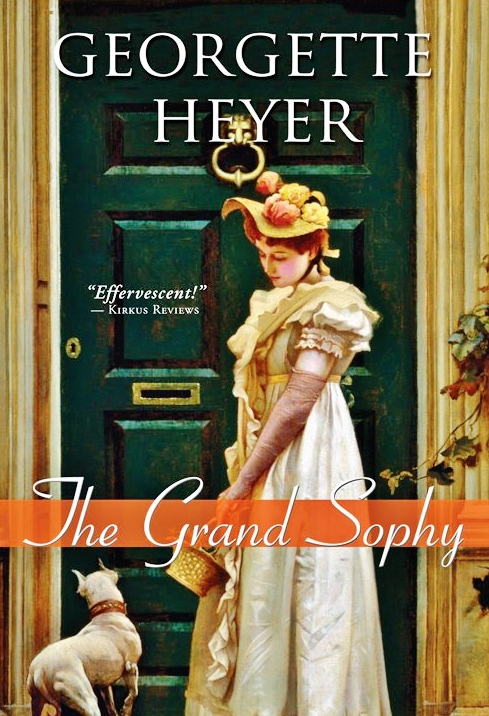
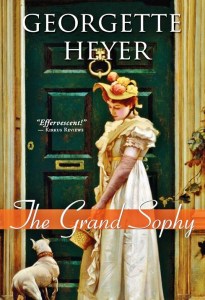
the grand sophy georgette heyerWell, I’ve finally done it. Georgette Heyer has been praised so often and so enthusiastically by so many of the book bloggers whose recommendations I have come to look forward to as decidedly reliable that I have taken the plunge.

I don’t really “do” romance novels as such, though of course most of the books I read incorporate some sort of romance, whether it be traditional male and female or some other sort of love affair (and by this I mean any sort of relationship – platonic friendships are love affairs, as are parent-child relationships, and all of the individuals emotionally invested in some way, whether it be with an idea, an occupation, a house, a garden, a country, a way of life… it’s all about passion and feelings and, yes, “romance” of some sort, isn’t it?)

(And did I just digress? Yes, I think I did!)

Anyway, bodice rippers in the good old Harlequin tradition aren’t really my thing, and the undoubted fact that Georgette Heyer has been republished by Harlequin – I have here on my desk a just-purchased (but as yet unread) copy of The Quiet Gentleman, Harlequin, 2006, with a publisher’s list of other Heyers in the back – was not a point in favor. I’d also read several of Heyer’s mystery stories – she famously wrote one romance novel and one mystery novel each year during a period of financial necessity – and found them no more than mildly diverting. But then there were all those Jane Austen comparisons, and the chatter about her being a seriously underrated writer, and all those comments about her undoubted mastery of her chosen literary period – England’s Regency era, the first few decades of the 19th Century – and all of the lavish praise in the blogosphere…

So I made the decision to give Heyer one more try. Pulling up her name on the library catalogue, I was impressed to see that there was a reasonably large selection of titles, arguing a current popularity (my present public library is very quick to cull and has very few older books in the stacks), some of which I remembered as having received glowing reviews from my blogging peers. Home came Sylvester and The Grand Sophy, as well as a third which appealed because of the plot description on the back, but which I haven’t yet read, Black Sheep. I’m a bit Heyer-saturated at the moment, after reading the first two almost back-to-back, but will definitely be reading the third book well within my alloted three weeks before it needs to be turned back in.

In other words, I liked these. A lot.

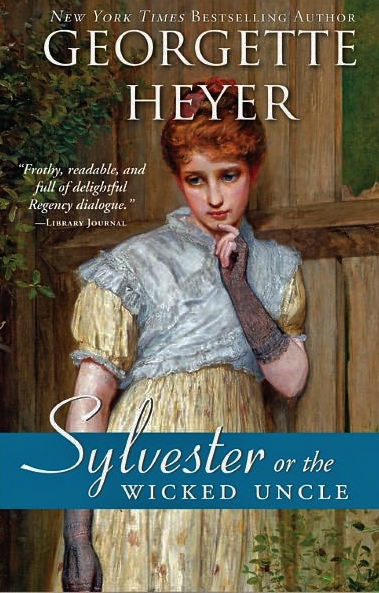
Sylvester: or the Wicked Uncle by Georgette Heyer ~ 1957. This edition: Sourcebooks, 2011. Softcover. ISBN: 978-1-4022-3880-2. 386 pages.sylvester or the wicked uncle georgette heyer
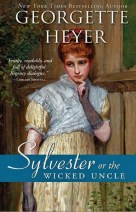
My rating: 9/10.

This story is an absolute hoot. It has everything. Misunderstood heroine – check. Highly intelligent and of an unconventional attractiveness, of course – check. Wicked stepmother – check. Fabulously handsome, wealthy and aristocratic love interest – check. Initial misunderstanding by chief couple and instant dislike of each other – check. Endless complications before true love finds its way – check.

It’s basically Pride and Prejudice with the added bonus of a botched kidnapping (literally), a surreal trip to France, and horses.

You know what? I’m going to stop right here and refer you over to this absolutely excellent blog post by Claire at Captive Reader. It’s the one that convinced me to give this author a go, and the post says absolutely everything I would like to. Anything I could come up with this morning would be a pale shadow of what Claire has said so well. (I am horribly pressed for writing time these days, but cannot let this book pass without a mention. It was so much fun!)

The Captive Reader – Sylvester or the Wicked Uncle

Sylvester more than met my own expectations. The point it lost was right at the very end; I thought the final romantic scene wasn’t quite up to the standard of the rest of the story. But endings are notoriously difficult, and it wasn’t terribly bad or anything. Just not quite… something

But all in all, a very enjoyable read. Great introduction to this author; I’m won over.

*****
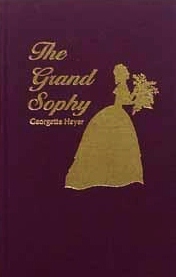
the grand sophy yestermorrow georgette heyerThe Grand Sophy by Georgette Heyer ~ 1950. This edition: Yestermorrow, 1998. No ISBN found. 347 pages.

My rating: 9/10.

Gosh, where to start? Let’s see how good my condensation skills are this morning!

Sir Horace Stanton-Lacy, world-roaming diplomat, drops in on his aristocratic sister Lady Ombersley for a brief visit while en route from Lisbon to Brazil. After racing through the polite preliminaries (Sir Horace is excessively focussed on getting right to the point with the least amount of fuss and trouble to his self-indulged self) the object of his detour becomes apparent.

Could he possibly leave his (motherless) twenty-year-old daughter Sophy with her dear aunt? Brazil, in the early 1800s, is rather rough in places, and even careless Sir Horace has qualms about its suitability for an upper-class English girl’s place of residence, even under the auspices of her important Papa. Sophy – “Dear little soul: not an ounce of vice in her!” exclaims said Papa – is as good as “out”, though the formalities of a Court presentation have been unavoidably omitted, what with living on the Continent and all – and will be a lovely companion for her cousin Cecilia. And while she’s here, dear sister, Sir Horace goes on to say, how about fixing her up with a suitable husband? I’m sure you can manage to arrange that for me…

Lady Ombersley is shocked into agreement, and Sir Horace disappears as quickly as he came, leaving with a promise that Sophy shall be welcomed into the bosom of her extended family. The family, as far as I can remember – there’s a lot of characters in this hectic novel – consists of Lord and Lady Ombersley, their eldest son Charles Rivenhall – who is by way of being head of the family, financially speaking, as he is his recently deceased wealthy grandfather’s heir as Lord Ombersley is an incorrigible gambler who has virtually impoverished his own estate – sober Charles is busy doing damage control while his father continues his dissipated lifestyle on a much more modest scale – the beautiful aforementioned Cecilia, a younger brother, Hubert, at Oxford, another, Theodore, at Eton, and young sisters Amabel and Gertrude.

Sophy shows up quite soon, and far from being the meek and gentle niece and cousin the family was expecting, turns out to be positively Amazonian, a self-assured and shockingly outspoken young lady, looking on her English sojourn as something of an amusing lark, though she’s agreeable to being introduced to some interesting and suitable young men on matrimonial approval, as it were. She throws the household into a turmoil it has never known before, and soon it becomes apparent that Sophy is a born manager of other people for their own good, and that in her staid cousins she has found much scope for her personal hobby.

Charles is engaged to the most prim and proper Eugenia Wraxton, who is looking forward to her upcoming marriage and increase in social status with smug self-satisfaction; it soon becomes apparent that cousin Sophy does not meet with her approval, and Eugenia’s true nature as a sly, prying, manipulative scold is thereby revealed, though Charles appears blind to this, at least initially.

Cecilia has been presented with a suitable young nobleman, Lord Charlbury, as a potential spouse, but has instead become infatuated with Adonis-like Augustus Fawnhope, an aspiring poet. (He instantly reminded me of none other than P.G. Wodehouse’s Madeleine Basset, of “the stars are God’s daisy-chain” fame; subsequent events merely strengthened that comparison.) Hubert has gotten himself embroiled in gambling debts – shades of the paternal situation – and is too terrified to confess to his older brother, and has instead gotten into the clutches of an evil moneylender.

The younger children, luckily, are not much in need of sorting out, so Sophy busies herself with rearranging Charles’, Cecilia’s and Hubert’s lives for them.

Charles is immediately resistant to his lively cousin’s attempts to “manage” his family; he cleaves to the unpleasant Eugenia with commendable loyalty, but cracks soon appear in his iron-hard facade. Eugenia is quickly driven to open criticism of Sophy’s lack of propriety; Sophy seems to delight in shocking and annoying Eugenia; Sophy is marvelously clever at pushing all of Charles’ buttons, and seems to come out ahead in each of their encounters; her and Charles’ continued verbal sparring (and shared love of horses) gives the alert reader the key to the eventual outcome of that particular triangle of personalities!

Cecilia and her poet are all over each other, while Lord Charlbury mopes in the his lonely corner (he’s recovering from the indignity of having had the mumps at a crucial time in the progression of his courtship of Cecilia.) Sophy takes those three in hand as well, giving Lord Charlbury instruction on how best to woo his reluctant prospective spouse, and eventually exposing Augustus Fawnhope’s deep ineffectualness to the no-longer-quite-so-besotted Cecilia.

Hubert’s moneylender is confronted with aplomb, in a scene which received some negative press in the blog world for its deeply stereotypical depiction of a Shylock-like Jewish character. (See here for a fascinating and extended discussion of racial stereotyping in literature, centered on The Grand Sophy, and widening to Heyer in general, then bringing in Agatha Christie, Ngaio Marsh and Dorothy L. Sayers as well; the many comments following this post are thought-provoking; the whole exchange is well worth reading.)

This workaday plot summary leaves out the sparkling dialogue and the deep humour which infuses every page of this lively historical romance; it’s a grand read for a dull day; perfect escape literature, and not to be taken too, too seriously, I think. An amusing romp, with the bonus of being meticulously researched and full of era-correct dialogue, descriptions of food, dress, and the social world of upper classes of post-Waterloo England. If you appreciate Jane Austen and Thackeray’s Vanity Fair, you’ll find much to admire in Georgette Heyer’s detailed and very funny take-offs of the time.

As with Sylvester, The Grand Sophy was a whole lot of fun. More so, really – it is almost antic in its multitude of plot twists, turns and tangles, where Sylvester maintained a certain dignity even in its most absurd moments. But Sophy lost its point in the same place, right at the end. It was a good ending, a proper ending, with loads of predictability and a few (small) surprises, but there was something just a tiny bit rushed over how everything tied itself up so quickly, as if the author, with finish line in view, had pushed herself into one last full-speed-ahead dash of writing. But, as with Sylvester, not a big issue, and easy to forgive.

And I did forgive the author her moneylender; I mulled this over quite a bit, and have held back this review to consider how deeply I wanted to address this issue. I have come down on the side of letting it go in the interests of era-correctness. Yes, the book was published post-World War II, when the horrors of the Holocaust were well-known and fresh in memory, but the treatment of the character in question was completely in line with the 19th Century world it depicted. And The Grand Sophy is something of a parody in its treatment of all of its characters; I don’t believe we are meant to take any of them all that seriously. If one wants to be offended, there’s a lot of scope for that in more than the Jewish moneylender episode. I choose not to be offended, though I see where the offense lies, and will leave it at that. (At least for now. This is a topic which is never really dormant, whether reading vintage or contemporary fiction.)

At the end of the day, I must say that I enjoyed these books, and I’m looking forward to encountering more of Heyer’s delicious romances, but I suspect that they are best taken one at a time, as a sort of self-indulgent literary “rich dessert”; nice as an occasional treat but not really suitable for daily fare!

Read Full Post »

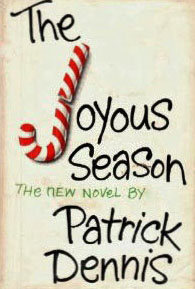
The Joyous SeasonThe Joyous Season by Patrick Dennis ~ 1964. This edition: Harcourt, Brace & World, 1965. Hardcover. 230 pages.
My rating: 9/10.

Ignore the candy cane on the dust jacket, and the internet references you may find to this being a “holiday book.” No, no, no. It is not. Christmas features, but only incidentally. The scope is much broader than that.

“Patrick Dennis,” you’ll possibly be saying to yourself. “Sounds familiar, but ???”

Auntie Mame, darlings!

Ten years after penning his highly successful social satire starring the exuberant Mame and her sedate nephew Patrick, author Edward Tanner – writing under the pseudonym Patrick Dennis – came up with this little  comedic gem. I wasn’t sure what to expect, having only ever previously experienced Mame, but The Joyous Season was absolutely marvelous, and better than I had anticipated. Such a treat!

10-year-old Kerrington – Kerry – is our narrator. He lives in a posh New York apartment with his 6-year-old sister Melissa – Missy – and his parents, both members of the New York “aristocracy”, though his mother’s family is higher up in the strata, and his maternal grandmother never lets his father forget that for a moment. Dad’s a successful architect, and Mom is most definitely one of the ladies-who-lunch, leaving much of the care of her two children to the fifth member of the menage, Lulu.

Lulu’s our nurse. We need a nurse like we need a case of mumps. I mean, hell, I’m ten and eleven twelfths years old and I’ve already smoked over two packs of Tareytons. (They’ve got that extra charcoal filter, you know, for cancer.) Even old Missy can take a bath and get dressed and wipe herself without any help, which is pretty good for six, I guess. But like Mom always said, we can’t go around New York alone because of kidnappers and Dirty Old Men (especially on East Eighty-sixth Street) and types like that. So Lulu drags us across town every day, me to St. Barnaby’s – although she turns me loose at the stationery store so the kids won’t think I’m being hauled around by a nurse at my age – and Missy two blocks further (or farther, whichever it is) to Miss Farthingale’s. Except for that, Lulu hasn’t got much to do except see we go to bed and get up and eat and don’t fight.

Lulu’s quite a character. She’s colored and elderly and has been with us ever since I was born. She’s kind of old fashioned and hates the N.A.A.C.P. and says she doesn’t want to integrate with any white people except Missy and me and that’s only because she gets paid to. Lulu says that after us she needs a rest, if we don’t kill her first, and she wants to retire and move back down South. Gadzeeks, South! I mean I don’t even like Palm Beach, which is supposed to be the next thing to heaven… Give me New York City and keep the rest. Crazy! Anyhow, Lulu tells us real interesting stories and knows every kind of poker there is – except strip – and always lets us have some of her beer and hates Gran’s place in East Haddock almost worse than we do. I mean Lulu is great, even if we don’t need a nurse.

Oh – I forgot one more family member. There’s also Maxl, the incontinent, prone-to-carsickness, full-of-mild-vice dachshund. His escapades run in a kind of sub fusc harmony to the ups and downs of Kerry’s and Missy’s lives, providing a counterpoint to the human drama of this gloriously dramatic tale.

So as the story opens, Kerry, Missy, Lulu and Maxl are reluctantly heading out the door to Gran’s place in East Haddock. Gran is Mom’s mother, and oh boy, is she ever a snooty piece of work! And she’s more or less the reason for the whole darned situation Kerry and Missy are in. To condense greatly, on Christmas morning there was a bit of a situation with Mom and Daddy which saw several kinds of shots fired, much broken glass, some physical violence and some exceedingly blunt words spoken. As a result, Kerr and Missy are poised to become Children of Divorce, much to the delight of meddling Gran. Everyone (except Gran, who openly gloats about the come-uppance of her despised soon-to-be-ex son-in-law) has decided to be Very Civilized About It All, and Not To Make The Children Suffer, but suffering they are indeed, though not perhaps in the way one would expect.

Kerry and Missy, despite all of the adult antics going on in their world, are the epitome of well-adjusted, though no one but Lulu seems to quite get that, and Kerry’s knowing-naive narrative exposes the follies of the grown ups, and New York upper crust society at large, to our appreciative eyes.

Mom is suddenly being courted by her own divorce lawyer, the social-climbing Sam Reynolds, while Daddy is pounced on by the predatory Dorian Glen, a self-invented fashion magazine editor. This gives much glorious scope for satirical commentary, and Kerry is well up to it. His descriptive passages are true works of art, and I found myself wearing a perpetual smile as I willingly gave myself up to the contrivances of the complicated plot.

For example, as this is New York in the 1960s, psychoanalysis is all the rage, and Kerry finds himself saddled with three hours a week with Dr. Epston. The adults in his life just want to ensure that he is coping well, and they are sure that he needs “fixing”, which if nothing else gives Patrick Dennis via Kerry an opportunity to get in some juicy digs at the world of the well-paid New York shrinks.

Dr. Epston’s consulting room is small and dim with a couch to lie on; two easy chairs; Kleenex, for crying into, I guess; a desk and a bookshelf with about a million copies of Tensions in the Metropolitan Adolescent by I. Lorenz Epston. I guess it wasn’t exactly what they call a best seller, but he’s getting rid of the supply bit by bit by making each patient’s family buy a copy (at ten bucks a throw). There are also some pictures on the wall that look like Missy painted them and a framed photograph of Dr. Epston’s three daughters. One is in the upper school at Dalton, one goes to Rudolf Steiner and the littlest one is in the School for Nursery Years – if that gives you some idea of what kind of kids he’s got. They also look like Eskimos. In fact, Dr. Epston’s first question was always, “What are you thinking about right now?” And my answer was always “Eskimos.” But when he’d ask me why, I just couldn’t tell him, because even if he is kind of a boob, I didn’t want to hurt the poor guy’s feelings. So I’d hem and haw and talk about igloos and blubber and wasn’t it interesting that the French spelled Eskimos Esquimaux and like that. So I always got kind of a demerit for being what Dr. Epston called “evasive” (when I was only trying to be polite) and at the end of the first week Mom sent off to Wakefield-Young Books for copies of Nanook of the North and Inyuk and some other suitable reading about the North Pole, when I didn’t care much one way or another.

The first day Dr. Epston made me lie down on the couch and darned if I didn’t drop right off to sleep while he was droning away about trusting him and telling him everything that came into my mind, no matter what. After he woke me up he kept asking me what I was trying to escape from and he wouldn’t believe me when I told him I’d stayed up late the night before watching “The Nurses” (it was all about this dope fiend) and it would have rude to say that also he was kind of a bore. But after that he let me sit up straight in a chair.

And so on, and so on. Kerry certainly does not suffer from lack of things to say; his self-confessed verbosity is what makes this satire such a delight. He’s a truly nice kid, for all the knowingness and the cynical tone he tries to maintain, and his relationship with the volatile Missy is just plain sweet, though they swap sibling-appropriate verbal digs and occasional blows.

Missy is a glorious character in her own right, and it would take me pages and pages to do her proper justice, so I’m not going to even try.

If you liked Auntie Mame, I’ll guarantee that you’ll love The Joyous Season. Highly recommended.

And here, as a bit of a bonus (because I do like to read reviews from the time of publication, and usually try to seek them out to see what those of the time had to say to compare it to my own years-further-on take), is the Kirkus review from October 14, 1965, because it sums things up quite well. I did edit to remove the spoiler; the ending is blatantly given away; that’s such a cheat in a commercial review, don’t you think? Liked the Holden Caulfield reference, because I thought that too, before I ever read the Kirkus review!

The people from the Auntie Mame strata are back under the snickersee of Patrick Dennis. The narrator is 10-year-old Kerrington, scion of a bloodline so inside Society that he yawns at the mere thought. After Daddy’s monumental Christmas hangover, Kerry and his 6-year-old sister, Missy, are slated to become Children of Divorce. Kerry’s prose style would make even a Holden Caulfield blanch, but his reportage is as complete. It seems Mommy and Daddy are going to do the Terribly Civilized bit. The demoniacally wholesome children are taken in on the divorce plans and exposed to the new interests of their wayward parents. Daddy falls victim to a voracious career woman (whose job allows P.D. to vivisect the fashion magazine sub-culture) and Mommy gets stuck with a stuffed shirt (who polarizes the P.D. thunderbolts directed at the nouveau riche). No tribal rite of the East Coast uppercrust, no Southern smarm and no mid-Western gaucherie is sacred … P.D. has picked their milieu to tatters. His full cast of credible caricatures are given dazzlingly funny dialogue. It’s a fair guess that this could easily go the Auntie Mame route — book to play to movie.

I honestly don’t know if this book did ever make it onto stage or screen, but it could well have. All I know is that I’d never heard of it before doing my bit of casual research on the author while reviewing Auntie Mame last year. He was well on my radar as one to watch out for, and when I came across The Joyous Season last week on the bottom shelf of the used book section of a secondhand furniture store in Prince George which I visit every few months “on spec” – for locals, that would be City Furniture right in the core of the scruffy old P.G. downtown on 3rd and Quebec – stacks and stacks of dusty books which I’ve now mined fairly thoroughly but which still contain some occasional vintage “finds” – I grabbed it with a silent shout of glee.

Young Kerry, narrator of the story, could have come across as either cloying or annoying, but Patrick Dennis has nimbly avoided either obnoxious extreme, to create a character whom I found I could completely relate too, after checking my own cynicism at the door, as it were. (Young Kerry’s dialogue occasionally slips to reveal the very adult puppet master handling the authorial strings, but it didn’t matter at all; I was happily and deliberately complicit in my own deception and looked away the few times it happened.)

I liked the likeability of Kerry’s whole family, for though Daddy and Mom were guilty of high tempers and hasty words to each other, they truly came across as loving parents, which was much appreciated; it could so easily have had a sour tone. The in-laws on both sides, and the assorted friends and hangers-on of each of the parents, gave loads of scope for Patrick Dennis to work with; he was bang on the mark with each and every one. Brilliant.

And though I saw the ending coming from just a few pages in, it never ruined things for me to find out I was right. Great “light” escape reading, and definitely a keeper.

I do believe this title is fairly easy to obtain, as it was republished in 2002, and looks to be available as a new softcover through Amazon, or, hopefully, your favourite local bookstore. There are a few vintage copies available through ABE, but these are priced a bit high, up into the $20s and $30s and beyond, so unless you’re a purist and need the original hardcover, I’d say go for the cheapest decent copy you can find, which might well be the 2002 reprint. Or perhaps try the library?

Read Full Post »

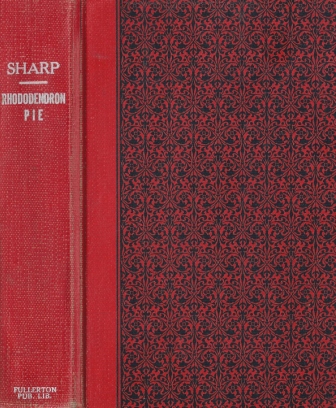
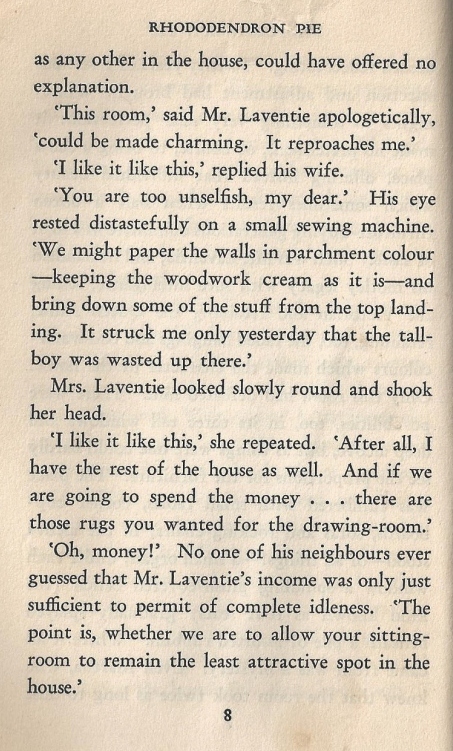
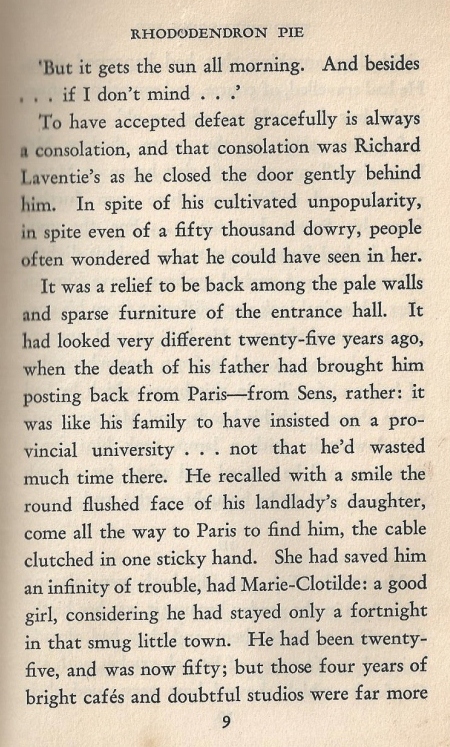
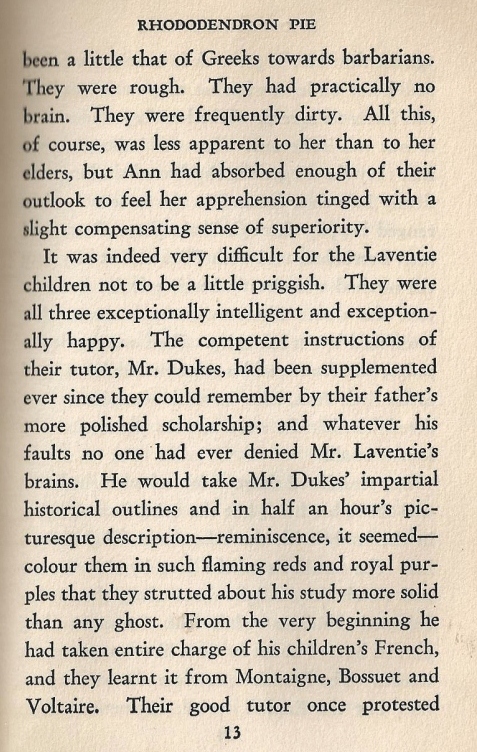
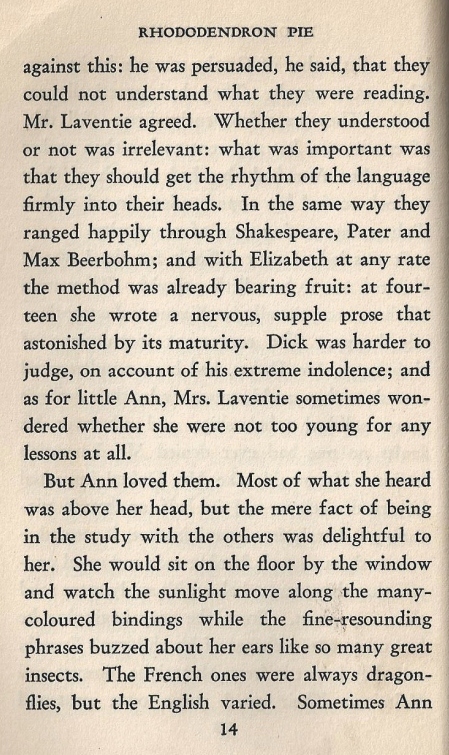
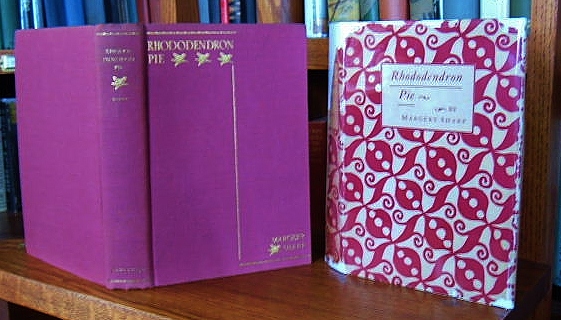
rhododendron pie margery sharp rebound 001Rhododendron Pie by Margery Sharp ~ 1930. This edition: D. Appleton & Co., 1930. 3rd American printing. Hardcover, rebound by library. 359 pages.
My rating: 9.5/10.

The standard set by this first novel is high; Sharp began as she was to go on, moving from strength to strength throughout her long writing career. Even her few “bobbles” in her later works are entertaining; her sheer writing skill and love and mastery of language make her a joy to read, even when the plotline falters. And it doesn’t do that here; this book is very well put together indeed.

This is the depressingly rare first ever Margery Sharp novel, long out of print, and extremely hard to come by. I finally tracked it down through inter-library loan; a complete search of the Canadian library database located one lone copy in Ontario. After paying a $20 borrowing fee, and waiting for what seemed like a terribly long time, it arrived in pieces, held together with several rubber bands, with a note asking me to use extreme caution when handling it.

Not knowing quite what to expect as a reading experience, but having very high hopes, I was more than rewarded for the time and trouble it took to get my hands on a copy of this book, at least temporarily, and I redoubled my efforts to find a copy of my own. This was something of a “take a deep breath” step,  as prices range from a low of $200 to a high of $600; the most copies I’ve ever seen on offer at one time are the current seven on ABE.

I won’t tell you what I ended up paying for my own copy, pictured above, but it was a major investment for someone of my relatively modest resources. Not the most expensive book I’ve ever purchased – that dubious honour goes to the even rarer Fanfare For Tin Trumpets, Margery Sharp’s second (and just a little less stellar) novel. What I will say is that I haven’t regretted it at all. Either of them. But most of Sharp’s later works – she wrote something like twenty-six novels for adults, and a dozen or so juveniles, many starring the mousy “Rescuers”, elegant white Bianca and common brown Bernard (“the Brave”) – are relatively easy to find. She was a best-selling author in her time, with a humourous inflection which transcends time. I love her writing; for me it simply “flows”, carrying me effortlessly along. Each re-reading reveals another layer; I’m far from finished with my exploration and enjoyment of her work.
I do so wish that someone in the publishing world would catch the Margery Sharp bug and reprint her early works! Rhododendron Pie is such an exquisite little gem, with the genuine clarity and sparkle. There are much more pedestrian works being brought back into the marketplace to feed the current hunger for such nostalgic period pieces! I live in hope.

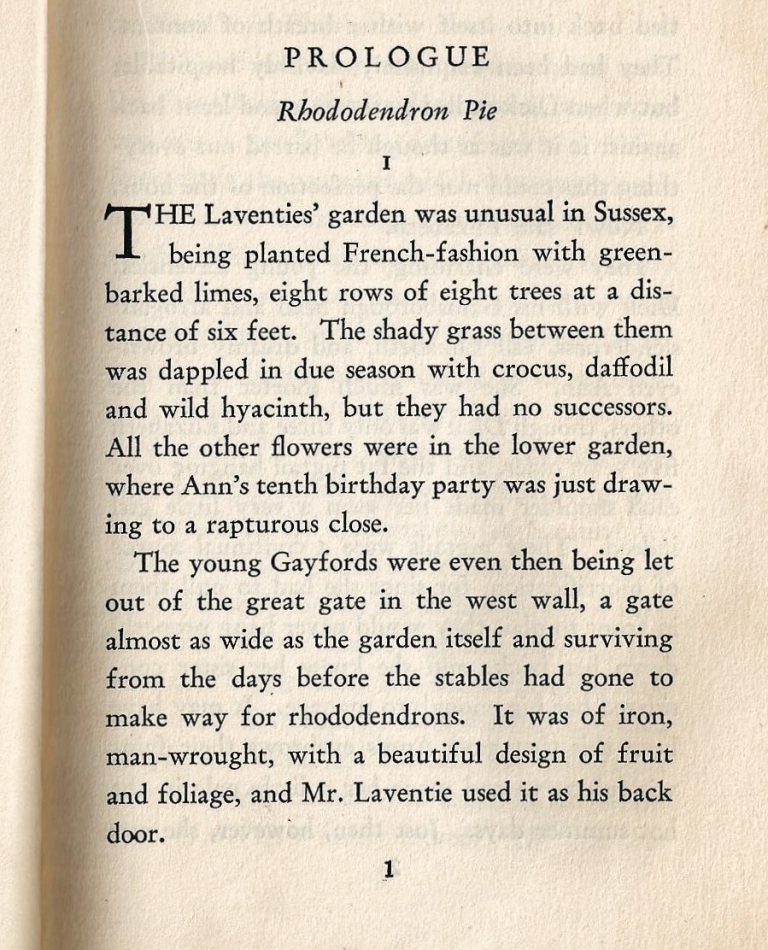
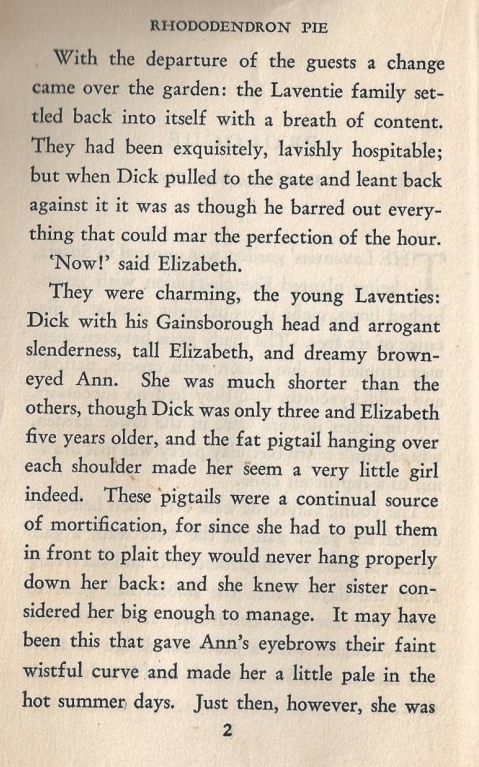
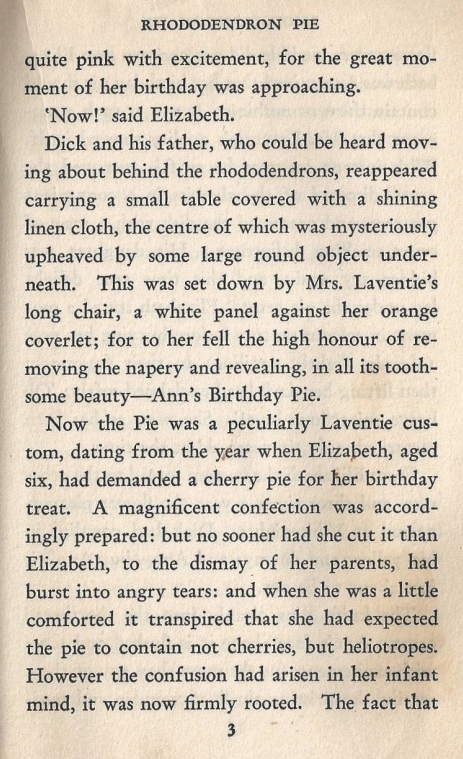
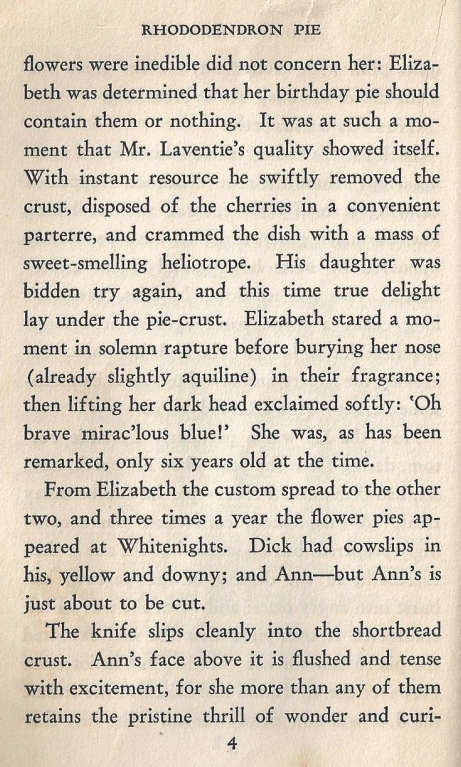
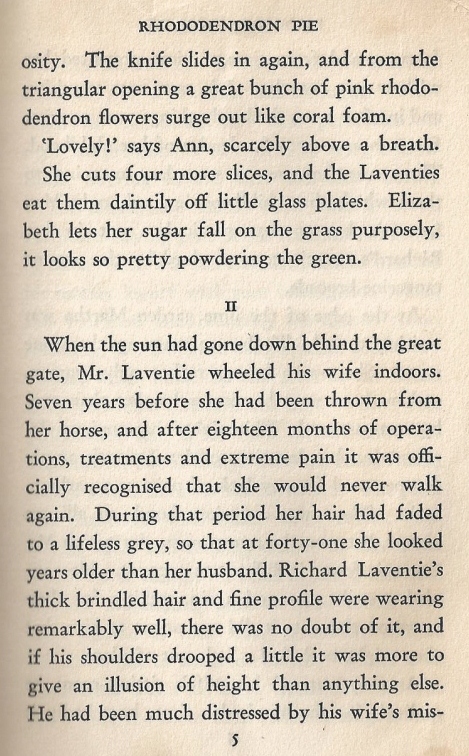
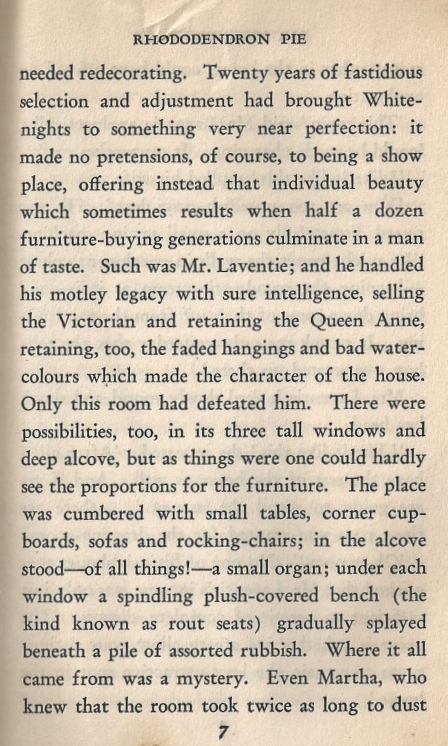
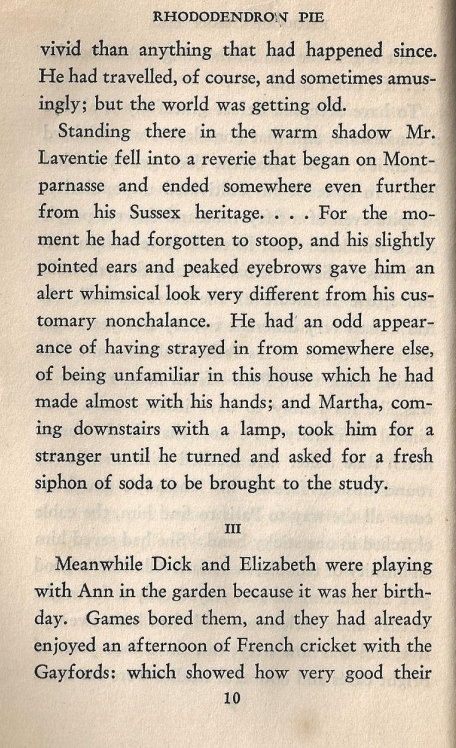
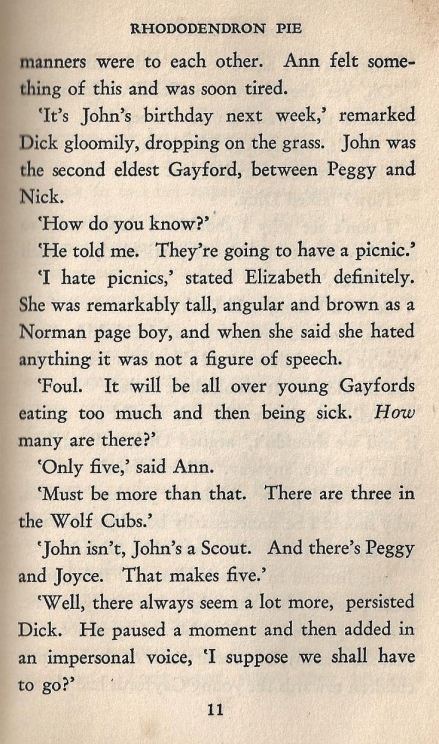
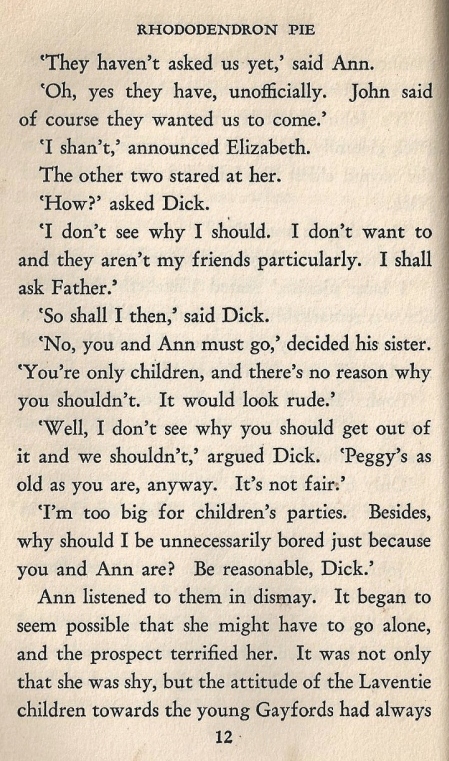
In the meantime, we do what we can. For those of you who are also Margery Sharp fans, and who have not yet gotten your hands on this little prize, I am now posting, as promised way back in August or September, the entire Prologue to Rhododendron Pie. One day, if no publisher blesses us with a reprint, I might be tempted to scan the whole book and turn it into a pdf file, to share with fellow Sharp aficionados. (Or perhaps it might qualify for Project Gutengberg? I thnk it just might be old enough, and long enough after the author’s death.) In the meantime, here’s a sample.
If you enjoy the Prologue, let me assure you that the rest of the novel is ever so much better.

But first, a contemporary review from 1930:

Rhododendron Pie is something more than an amusing and good-natured gibe at literary and artistic snobbery, for all the Laventie family–including the mother, who comes in with a great burst of rhetoric on behalf of the bank clerk at the finish–and the various minor characters are far more than argumentative counters in the attack or defence of aestheticism.  They have all authentic lives of their own, and Miss Sharp is particularly successful in catching the accent of those inhabitants of the modern world who carry a magnificent undergraduate irresponsibility into the affairs of everyday life. – The London Times Literary Supplement

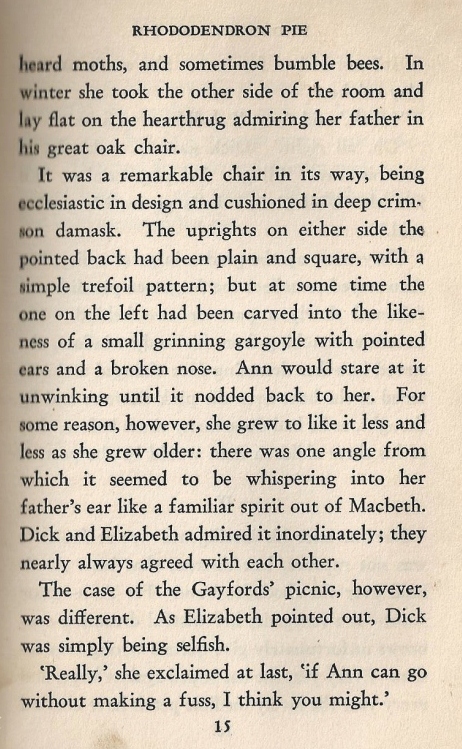
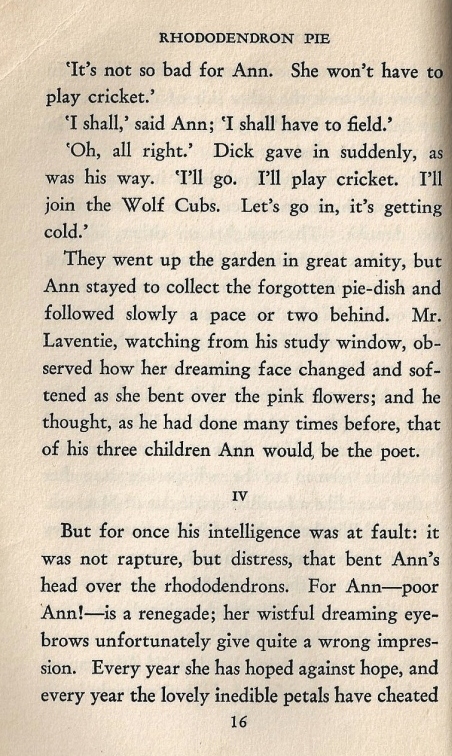
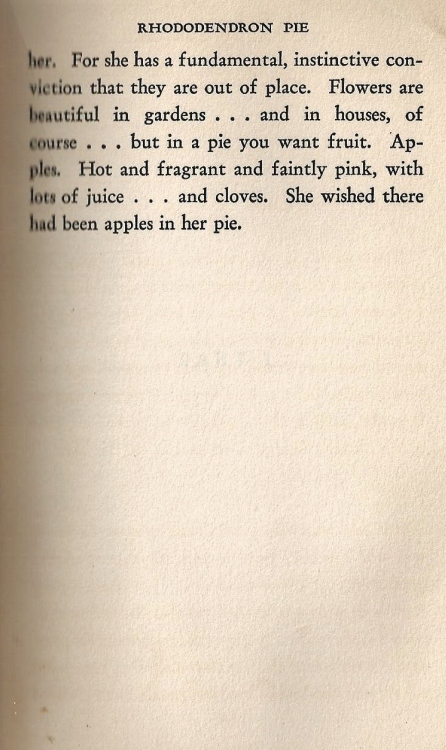
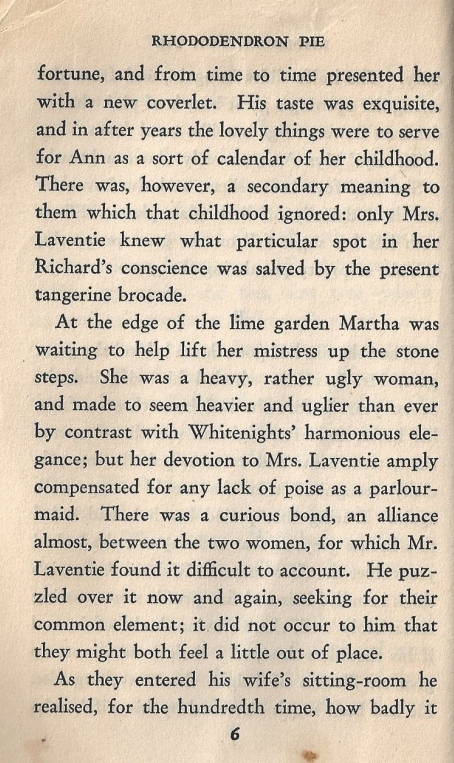
rhododendron pie sharp prologue pg 1 001rhododendron pie sharp prologue pg 2 001rhododendron pie sharp prologue pg 3 001 (2)rhododendron pie sharp prologue pg 4 001rhododendron pie sharp prologue pg 5 001 (2)rhododendron pie sharp pg 6 001rhododendron pie sharp pg 7 001 (2)rhododendron pie sharp prologue pg 8 001rhododendron pie sharp prologue pg 9 001 (2)rhododendron pie sharp prologue pg 10  001rhododendron pie sharp prologue pg 11 001 (2)rhododendron pie sharp prologue pg 12  001rhododendron pie sharp prologue pg 13 001 (2)rhododendron pie sharp prologue pg 14  001rhododendron pie sharp prologue pg 15 001 (2)rhododendron pie sharp prologue pg 16 001rhododendron pie sharp prologue pg 17 001 (2)

The story proper opens ten years later. Our heroine, Ann, is now twenty, and we find her dreaming the summer away, poised on the brink of life. Her brother Dick and sister Elizabeth are busy following their own intense pursuits – Dick as an art student and aspiring sculptor, and Elizabeth as a writer and editor – but Ann has so far found no particular artistic bent of her own to follow. She is mostly merely accomplished at being agreeable, and with her sophisticated family and their many visitors a listening ear and a pleasant, interested expression are much appreciated as the egoists expound and Ann takes it all in. But she has a rich inner life of her own, and she’s busy sorting it all out.

Ann settled down on the grass again with her chin on her fists and one shoe waving in the air. She wasn’t reading really, only pretending to, so that the others wouldn’t talk to her. It was too nice in the garden to talk. How queer to think she was lying on the surface of the world… an enormous warm green ball spinning slowly through space with somewhere, under a lime tree like a sliver of grass, a minute pink dot…

The Gayfords, ten years after we first meet them, are still persisting in being friendly to their uppish neighbours; continual delicate snubs are absorbed and ignored, and Ann has settled into her role as a liaison of sorts between the two worlds, which leads to occasional mockery by Dick, Elizabeth and Mr. Laventie, who assume that Ann is merely “collecting material” for reasons of her own.

But Ann is honestly fond of the happy Gayford clan, and this summer, with Peggy Gayford’s approaching marriage and John’s unchangeable good nature with every brief encounter, Ann is starting to wonder what is wrong with her, to find such healthy, hearty normalcy so attractive. For isn’t life meant to be an endless round of sensation-seeking, with the creation of an exquisite and “individual” persona for the edification of the other elite highbrows one’s chief occupation? So why is Ann having such difficulty working up a properly scornful attitude of her own to the Gayford’s enthusiastic embrace of the comfortable pleasures of upper-middle-class country life. (The Gayford patriarch is the local doctor; John has embarked on a career in banking, and his younger brother Nick is at medical school, in sharp contrast to the general Laventie bent for something more artistic and “fine” than mere useful “labour”.)

Avant-garde filmmaker Gilbert Croy appears on the scene, and with his languid courtship of her, which she warmly responds to, it seems that Ann will embrace the family tradition and rise above her delight in the everyday to take her place among the rarefied intellectuals. But circumstances and Ann’s innate common sense unite to turn things upside down …

Margery Sharp, though she does the conventional “happy ending” thing very well indeed, always seems able to put a twist into her story somewhere. Nothing is completely as it seems, and the clichés fall apart upon closer examination. There are some cleverly well-realized character sketches in Rhododendron Pie, as enjoyable to today’s reader as they would have been to those readers of the time more cognizant of the sly references Sharp has such a grand time making.

On re-reading what I’ve just written, I see that I haven’t done much in the way of detailing the plot, and I’ve completely ignored many characters who wander in and out of Ann’s widening orbit. There’s a lot in this little book; too much to share without giving things away completely, and too complex to detail without making this review even longer than it already is, what with all the images I’ve crammed in!

*****

Sound appealing? If so, this is what you’re looking for in your library book sale and flea market travels. This lovely (and exceedingly rare) first edition with an intact dust jacket will set you back a cool $600, at Old Scrolls. Right now, April 2013, there are 7 copies listed on ABE, from $212 to the aforementioned $600.

There must be a few more out there in dusty corners for the persistent (and lucky) searcher. Particularly in Great Britain, or possibly the U.S.A. Happy hunting!


Read Full Post »

« Newer Posts - Older Posts »