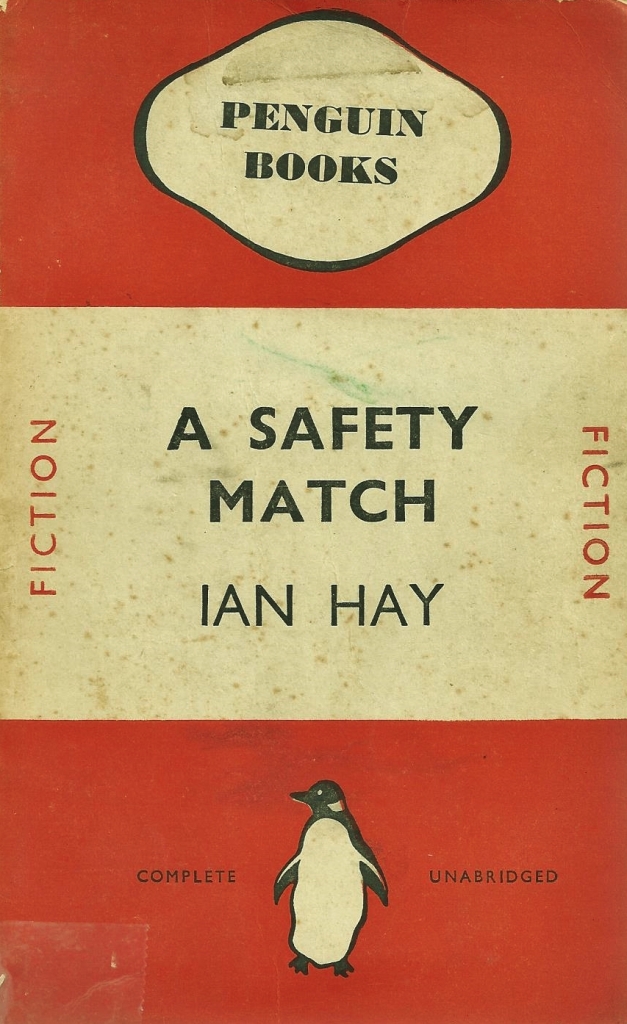
 A Safety Match by Ian Hay ~ 1911. This edition: Penguin, 1938. Paperback. 256 pages.
My rating: 3/10
Oh, Century of Books. You are leading me down some strange byways of reading…
Some days ago I wrote with some enthusiasm about a rather charming vintage book by Herbert Jenkins, Patricia Brent, Spinster. I was careful in my review not to reveal the key plot points and the ending, because I felt that this was a book that would reward discovery by a modern-day reader. I am very sad to say that today’s book will not be rewarded the same treatment, because it disappointed me immensely.
Sharp-eyed readers will notice the mending tape on the bottom left hand corner of the book pictured here. That was me. Usually I am very careful about my mending of older books, aiming for non-obtrusive fixes, but in this case I just slapped a piece of Magic tape on there and called it good enough. The whole spine is loose and the text block only just hanging on by a whisp or two of paper – almost as if at some point a previous reader gave this one the toss across the room. Hmmm… (Okay, maybe I’m just being really snarky.)
So, yes, there will be spoilers in the next few paragraphs. (And I’m keeping it shortish, because it’s really not worth spending any more time on.)
It all starts off promisingly enough. Here we have a vicarage family, the widowed Rector Brian Vereker, and his lovely children – literally lovely, as they are famed for their good looks among the local villagers – nineteen-year-old Daphne, doorstepping down through Sebastian Aloysius (“Ally”), Monica Cecila (“Cilly”), Stephen (“Stiffy”), Veronica Elizabeth (“Nicky”) to to the youngest, eleven-year-old Tony. A lively lot they all are, and we are treated to a prolonged domestic interlude which sets up the characters quite nicely, and gives a rather charming picture of English upper-middle-class home life – for the Rector is the youngest son of a youngest son of a peer of the realm – in the early years of the 20th Century.
Then an abrupt change of scene to a room full of coal mine owners as they meet with labour union leaders in order to negotiate a way out of a possible workers’ strike. Here we become acquainted with our main masculine character, one Lord Carr, also known by his nickname of “Juggernaut” for his overbearing success in always proving his point and coming out on top. In this case Juggernaut succeeds in quelling the potential strike, knocking down the ineffectual union leaders and getting in a few digs about free enterprise and every-man-for-himself-ism which sound forbiddingly close to the spoutings of the far-Right political parties of our current age – not much doubt as to our author’s feelings throughout this book, I’ afraid – he does rather slant towards his brusque hero’s view.
The set-up is to introduce the rather-much-older (forty-five-ish) Lord Carr to the eldest vicarage daughter, the sweet-nineteen Daphne. For of course Lord Carr and Rector Vereker are old school chums, and after squashing the labour uprising in the area, Lord Carr is quite happy to spend a few weeks relaxing among the Vereker clan, where he falls in inarticulate but sincere love with Daphne.
The two marry, Juggernaut for love and Daphne for money – she is motivated by a desire to secure the futures of her brothers and sisters – and for a few years all is quite content. A son is born to Lord and Lady Carr, but as the child grows it becomes apparent that the marriage is, if not actively struggling, becoming a rather pathetic thing. Lord Carr is unable to speak his feelings of devotion to Daphne; she in turn is starting to turn to other companions for amusement, including Lord Carr’s devoted right hand man.
This gets us in quite decent style to the latter bit of the book, where the author completely goes to pieces and gets all darkly dramatic. Daphne and Juggernaut part ways, Daphne fleeing to the old family home with the baby and Juggernaut staying broodingly in London. While they are parted, it dawns on Daphne that perhaps she really does love her masterful though stoic husband, and a reconciliation is affected by way of the right hand man’s revealing that Juggernaut is really just a big softie, supplying food and comforts to the wives and children during the last coal mine strike. “I never knew!” cries Daphne, and she flies to her husband’s sturdy breast, to be clasped there with fervor.
But wait! There’s more!
The workers at the local coal mine go on a wildcat strike, and as a result the workings are sabotaged, resulting in a cave-in which traps a number of our side characters, including Right Hand Man. Juggernaut is front and centre of the rescue mission, and (sob!) is blinded by an explosion after he has personally seen all of the rescued men to safety.
Fast forward a year or two to a scene of domestic bliss, Juggernaut and Daphne all sappily happy with their adorable wee children, love restored and blind Pappa the centre of a scene of cozy cuteness.
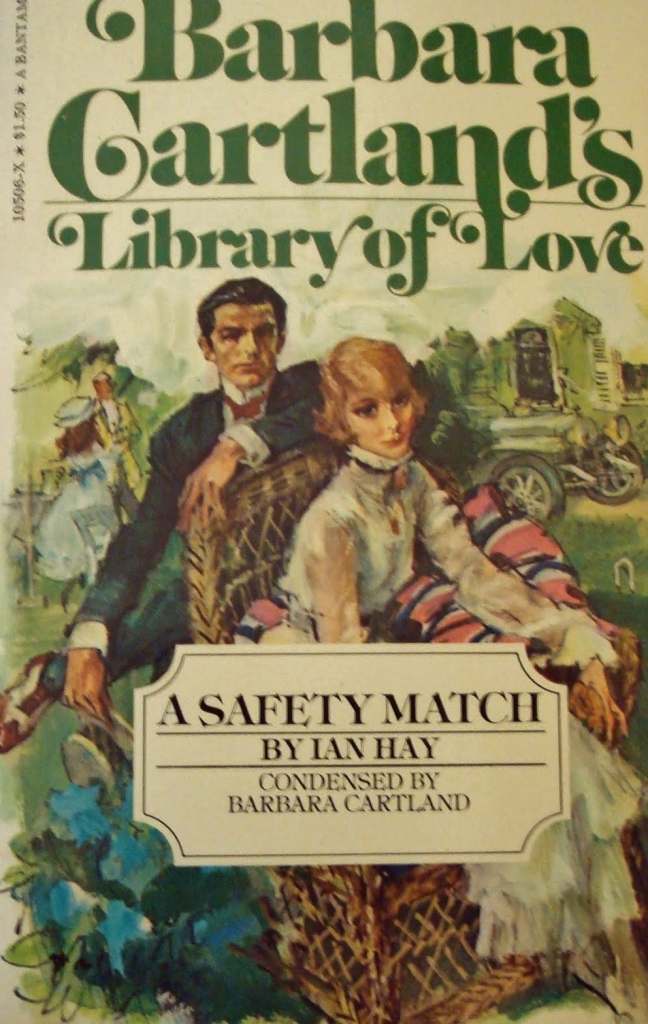
66 years after its first publication, the one-and-only Barbara Cartland decides that “A Safety Match” is a good addition to her 1977 “Library of Love”. I am saddened, but not surprised.
What a dreadfully clichéd story. No wonder it was picked up and condensed by Barbara Cartland for her 1977 “Library of Love.”
This novel made me prickly all over. It started out so well, and had so many nice domestic and period details, that I hoped right up until those last few chapters that it would go in a different direction, but nope! – no such luck. It just dissolved into mushy sweetness. Absolutely, deeply, offensively, sugary, syrupy adorableness. Argh.
Not recommended, but if you are very brave and wish to look for yourself, here it is on Gutenberg.
Ian Hay, by the way, was quite a well-respected writer of his time. Here is his biography, pasted directly in from Wikipedia. As the man could undoubtedly write, in a modestly competent way, I do find myself curious as to some of his other works, in particular the war-themed The First Hundred Thousand. But as for The Safety Match, I wouldn’t open that again at gunpoint.
Major General John Hay Beith, CBE, (17 April 1876 – 22 September 1952), was a British schoolmaster and soldier, but he is best remembered as a novelist, playwright, essayist and historian who wrote under the pen name Ian Hay.
After reading Classics at Cambridge, Beith became a schoolmaster. In 1907 he published a novel, Pip; its success and that of several more novels enabled him to give up teaching in 1912 to be a full-time author. During the First World War, Beith served as an officer in the army in France. His good-humoured account of army life, The First Hundred Thousand, published in 1915, was a best-seller. On the strength of this, he was sent to work in the information section of the British War Mission in Washington, D.C.
After the war Beith’s novels did not achieve the popularity of his earlier work, but he made a considerable career as a dramatist, writing light comedies, often in collaboration with other authors including P. G. Wodehouse and Guy Bolton. During the Second World War Beith served as Director of Public Relations at the War Office, retiring in 1941 shortly before his 65th birthday.
Among Beith’s later works were several war histories, which were not as well received as his comic fiction and plays. His one serious play, Hattie Stowe (1947), was politely reviewed but had a short run. In the same year he co-wrote a comedy, Off the Record, which ran for more than 700 performances.
I did a fairly thorough internet search, and came up with only one other blog review, from Only Two Rs, whose take was similar to my own.









 Leaves & Pages
The Shuttle by Frances Hodgson Burnett
Posted in 1900s, Century of Books - 2014, Read in 2014, tagged American-British Relations, Century of Books 2014, Frances Hodgson Burnett, Nobility & Commoners, Social Commentary, The Shuttle, Vintage Fiction on January 26, 2014| 23 Comments »
My rating: 8.5/10
Coming late to the party with this book, I am. I had added it to my Century of Books must-acquire list because of numerous enthusiastic recommendations from other bloggers, and I am thrilled to be able to report that those who gave it the nod were completely correct. It’s an absolutely grand read.
I understand that the currently in-print edition published by Persephone has been edited somewhat, and I can’t help but wonder what they cut out. I’m not terribly concerned that it would have ruined the story – this is a very long book with abundant authorial wanderings just slightly off-topic here and there – but it was intriguing to read the early, as-published text in this lovely vintage edition and speculate as to where it could be gently trimmed.
And golly, I just realized that the book I’m holding in my hands (well, it’s actually sitting on top of the printer beside the computer, but it was just being held in my hands) is a genuine antique. One hundred and seven years old. That’s rather a pleasant thought. It’s travelled through the decades very well indeed, both in physical condition and in staying power of contents.
If you are one of the few of my readers who hasn’t yet tackled The Shuttle, here is a plot summary of sorts.
There were once, in the later years of the 19th century, two American millionaire’s daughters, eighteen-year-old Rosalie (Rosy) and ten-years-younger Bettina (Betty) Vanderpoel. It was just at the time of the first awareness by impoverished English gentlemen of the nobility – second, third and fourth sons, as it were – that here was a rather well-stocked hunting ground for well-dowered wives, who would be willing to exchange the country of their birth and a goodly portion of their fathers’ wealth for an English title and a stately ancestral home. In the best of these transactions, gone into with eyes wide open, both parties benefitted and a certain degree of happy felicity resulted, but occasionally the meeting of American feminine independence and English masculine traditionalist views on the necessity for a wife to submit to her husband’s superior judgement ended in disaster.
Guess which kind of marriage sweet, frail, loving and deeply innocent Rosy Vanderpoel made?
Falling for the seductive wiles of Sir Nigel Anstruthers, Rosy trots innocently off to England, but the honeymoon voyage is not even half over before she realizes that she has yoked herself to a malicious and sadistically abusive man. Sir Nigel is a rotter through and through. He despises not only his new wife, but her family and her country and her ideas and her expectations of at least a modicum of domestic happiness. His bitter disappointment at Rosy’s father’s insistence at leaving the control of her fortune in her own hands and not in her husband’s has Sir Nigel seething; he has hidden his true nature well, but now that the shores of the new world are receding he is preparing to gain control of Rosy’s share of the Vanderpoel millions for himself.
Competently reducing meek Rosy to a grey shadow of her former self, Sir Nigel succeeds in cutting her completely off from her American family, but for the occasional letter requesting more funds. Three babies are born; the first a son, who is born crippled due to his pregnant mother being physically assaulted by Sir Nigel; two little daughters die young.
Ten years pass.
Back in America, Betty Vanderpoel has never forgotten her beloved older sister, and can’t quite believe that the cessation of relations is by Rosy’s wish. (Betty had never liked Sir Nigel, and he returned the scorn she viewed him with in spades.) Taking her father into her confidence, Betty announces that she is going to go to England and see for herself how Rosy is faring. And off she goes, with her father’s blessing and his millions behind her.
What she finds is beyond her worst expectations. Rosy, aged beyond her years, lives a dreary life shut up in a decrepit mansion staffed by sullen servants, her only companion her hunchbacked ten-year-old son, Ughtred. (Aside to author re: “Ughtred”. What the heck, Frances Hodgson Burnett? That is absolutely bizarre. What were you thinking???!) Anyway, the estate is mouldering away while Sir Nigel pursues his merry way a-spending Rosy’s money on mistresses and riotous living abroad; he returns only to indulge himself in spousal abuse and to browbeat Rosy into sending another brief letter to Papa requesting more money to maintain his little grandson’s estate.
Betty, made of much sterner stuff than Rosy, swoops in like an avenging goddess, and the majority of the rest of the book consists of the rehabilitation of Rosy, Ughtred, the estate and the attached village full of grateful rurals. Sir Nigel reappears to find his despised sister-in-law very much in control of things, and their ensuing battle of wills, Rosy’s deeply good against Sir Nigel’s blackly wicked, is a gloriously entertaining thing.
Oh, and there is a further development. The next estate over belongs to another impoverished nobleman, this one the sole survivor of a long succession of bad eggs. But is Lord Mount Dunstan really as deeply black as his spendthrift, now-deceased elder brother, and the heedless ancestors before him, or is he sullen merely because he feels so darned bad about the decrepit state of his hereditary acres? Any guesses?
I will stop right here, because you can now likely guess the ending from what I’ve just said. Nope, no surprises here. But how the author gets us to the inevitable conclusion is deeply diverting. And how genuinely engaging and interesting her various characters are, from meek Rosy to divinely competent Betty to nasty Sir Nigel and his equally nasty old mother to misunderstood-but-really-deeply-noble Mount Dunstan to random American typewriter salesman G. Selden (who makes up a merry little sideplot himself, what with his precipitous entry via bicycle wreck at the very door of the Anstruther mansion) to busy millionaire Reuben Vanderpoel – what a glorious cast!
I loved this story! It’s a proper saga. Such a treat to have a black and white, good-versus-evil, you know who to root for and who to boo and hiss at sort of thing!
And it does reflect some very real historical happenings, such as the astounding trans-Atlantic traffic in (relatively) poor English noblemen and wealthy American heiresses which took place from the 1860s well into the early 1900s. Fictional Rosy Vanderpoel is represented as being one of the earlier of the transplanted rich girls, and her story is based solidly on fact, though with artistic license in her particular details.
A grand exposition on both American and British social structure of the late nineteenth century, with abundant detail and a whole lot of humour. What a good book, in an old-fashioned novel-ish sort of way. If you haven’t read it already, may I suggest that you consider adding it to your Must-Read list, in any edition you can get your hands on? As the publisher’s poster claims, it is a masterpiece.
Edited to add this note on the heroine’s wee little nephew’s name, Ughtred. At first I thought, “No way! This can’t be a real name.” But then a commenter said something about old Saxon names, and the penny dropped. Of course. A bit of internet research (what did we do before Google?!) turned up just a few references, enough to show that Frances Hodgson Burnett did indeed know her stuff. Here we are, then, references from several genealogy websites. (And I did not bookmark the references; bad researching practice, I know. Don’t tell the teens in my family, as this is a constant refrain from me when they are doing online research: “Reference your sources!”)
and
So there it is. A name with a genuine and quite fascinating history. But I still pity the poor kid in The Shuttle. Crippled from before birth by his wicked father, and then saddled with this. It’s even more eyebrow-raising than Little Lord Fauntleroy’s Cedric. Wonder what his (Ughtred’s) middle name (names) is (are)?
The publisher’s American publicity poster from 1907.
Read Full Post »