Posts Tagged ‘Vintage Fiction’

Getting ready to unfurl - leaf buds at University of British Columbia Botanical Garden, late February, 2014.

Getting ready to unfurl – leaf buds at University of British Columbia Botanical Garden, late February, 2014.

Well, here we are at the end of March, with the year one quarter over, and there is a largish stack of books read in January-February-March sitting here and nagging at my conscience. They all deserve some sort of mention, ideally a post each all to themselves, but with spring coming and longer daylight hours and some serious gardening projects coming up (meaning somewhat less computer time for me – which is by and large a good thing – hurray!) I know that I will not get to them all.

So I think a series of round up posts is in order, to temporarily clear my desk and my conscience, and to allow me to shelve these ones and recreate a new stack over the next few months, because that pattern or reading/posting is inevitable, it seems.

I’ve been considering how best to present these (there are quite a few) and have sorted them very loosely into sort-of-related groupings. Here’s the first lot, then.

All four of these particular books are linked by general era – just before, during and just after the Great War, and by their vivid reflection of the times they are set in. From playful (Christopher and Columbus) to sincere (The Green Bay Tree and The Home-Maker) to bizarre (Her Father’s Daughter), all help to fill in background details against which to set other books, and all are engrossing fictions in their own disparate ways.

************
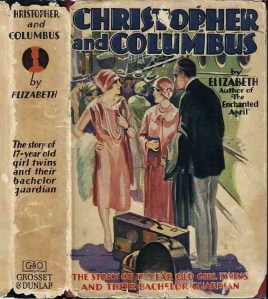
Not my copy - I have a much more recent Virago - but a nice early issue dust jacket depiction.

Not my copy – I have a much more recent Virago – but a nice early issue dust jacket depiction too good to not share.

Christopher and Columbus by Elizabeth von Arnim ~ 1919. This edition: Virago, 1994. Paperback. ISBN: 1-85381-748-1. 500 pages.

My rating: 8/10

Charming and playful, with a serious undertone regarding wartime attitudes to “enemy aliens”, set as it is in the early years of the Great War, in England and America.

Their names were really Anna-Rose and Anna-Felicitas; but they decided, as they sat huddled together in a corner of the second-class deck of the American liner St. Luke, and watched the dirty water of the Mersey slipping past and the Liverpool landing-stage disappearing into mist, and felt that it was comfortless and cold, and knew they hadn’t got a father or a mother, and remembered that they were aliens, and realized that in front of them lay a great deal of gray, uneasy, dreadfully wet sea, endless stretches of it, days and days of it, with waves on top of it to make them sick and submarines beneath it to kill them if they could, and knew that they hadn’t the remotest idea, not the very remotest, what was before them when and if they did get across to the other side, and knew that they were refugees, castaways, derelicts, two wretched little Germans who were neither really Germans nor really English because they so unfortunately, so complicatedly were both,—they decided, looking very calm and determined and sitting very close together beneath the rug their English aunt had given them to put round their miserable alien legs, that what they really were, were Christopher and Columbus, because they were setting out to discover a New World.

Total digression – check out the paragraph above. It is ONE sentence. Thank you, E von A, because now I don’t feel quite so bad about my own rambling tendencies!

Ahem. Back to our story. To condense completely, the two Annas, having been rejected by their English connections, are sent off to America (this is before the Americans have joined in the war) to be settled upon some distant acquaintances there. Everything goes awry, but luckily the two girls – they are twins, by the way – have gained a sponsor/mentor/protector in the person of Mr. Twist, a fellow passenger, who just happens to be wealthy young man with a strong maternal streak.

The three adventure across America – the twins getting into continual scrapes and Mr. Twist rescuing them from themselves – eventually ending in California, where they acquire a chaperone and a Chinese cook, and decide to open an English-style teashop. It is a blazing success, but not in the way they had planned…

Very much in the style of The Enchanted April, more than slightly farcical, with romantically tidy endings for all.

Internet reviews abound, and this is happily available at Project Gutenberg:  Christopher and Columbus
her father's daughter gene stratton porterHer Father’s Daughter by Gene Stratton-Porter ~ 1921. This edition: Doubleday, 1921. Hardcover. 486 pages.

My rating: 2/10

Talk about contrast between books of a similar vintage, between this one and the previous Elizabeth von Arnim confection. This next book was a shocker, and I disliked it increasingly intensely, forcing myself to keep reading because I was determined to see where the author was going to go with it. (Nowhere very good, as it turns out.)

I already had an uneasy relationship with Gene Stratton-Porter, and though I’d been forewarned by other reviewers about the deeply racist overtones of Her Father’s Daughter, I wasn’t prepared to have the “race issue” as such a major plot point.

Two teenage sisters are orphaned. The elder sister spends their joint income on herself, on her lavish wardrobe and gadding about, while the younger sister is left to her own dismal devices.

Luckily sister # 2, our heroine, Linda, is a young lady of vast resource and apparently limitless talents. She pseudonymously writes and illustrates popular articles on California wild plants and flowers, excels at her high school courses, and has attained the selfless dedication of the family cook/housekeeper, a brogue-inflicted Irishwoman, one Katy. (GS-P’s dialect mangling reaches new heights in this book.)

Linda also tootles about in her late father’s car, a Stutz Bear Cat, driving everywhere fast, and as it goes without saying, better than all the boys. There’s nothing this girl doesn’t excel at, and her acquaintance ooh and ah over her many accomplishments, and chuck their devotion at her feet. She’s ultimately so all-round darned smart and gorgeous and generally desirable – especially once she bullies her sister into ponying up some of Daddy’s cash so she can buy a few new dresses – that she attracts three suitors, two of them older men, and one a high school classmate.

Which brings us to the race angle. For in the high school class the teenage suitor attends, there is a Japanese boy, who is at the top of the class despite all efforts of Linda’s Boyfriend to displace Japanese Guy. So Linda wracks her brains to find a way to help Boyfriend beat “the Jap”. Says she:

 “They are quick; oh! they are quick; and they know from their cradles what it is that they have in the backs of their heads. We are not going to beat them driving them to Mexico or to Canada, or letting them monopolize China. That is merely temporizing. That is giving them fertile soil on which to take the best of their own and the level best of ours, and by amalgamating the two, build higher than we ever have. There is just one way in all this world that we can beat Eastern civilization and all that it intends to do to us eventually. The white man has dominated by his color so far in the history of the world, but it is written in the Books that when the men of color acquire our culture and combine it with their own methods of living and rate of production, they are going to bring forth greater numbers, better equipped for the battle of life, than we are. When they have got our last secret, constructive or scientific, they will take it, and living in a way that we would not, reproducing in numbers we don’t, they will beat us at any game we start, if we don’t take warning while we are in the ascendancy, and keep there.”

And this:

“Take them as a race, as a unit—of course there are exceptions, there always are—but the great body of them are mechanical. They are imitative. They are not developing anything great of their own in their own country. They are spreading all over the world and carrying home sewing machines and threshing machines and automobiles and cantilever bridges and submarines and aeroplanes—anything from eggbeaters to telescopes. They are not creating one single thing. They are not missing imitating everything that the white man can do anywhere else on earth. They are just like the Germans so far as that is concerned.”

And then this:

“Linda,” said the boy breathlessly, “do you realize that you have been saying ‘we’? Can you help me? Will you help me?”

“No,” said Linda, “I didn’t realize that I had said ‘we.’ I didn’t mean two people, just you and me. I meant all the white boys and girls of the high school and the city and the state and the whole world. If we are going to combat the ‘yellow peril’ we must combine against it. We have got to curb our appetites and train our brains and enlarge our hearts till we are something bigger and finer and numerically greater than this yellow peril. We can’t take it and pick it up and push it into the sea. We are not Germans and we are not Turks. I never wanted anything in all this world worse than I want to see you graduate ahead of Oka Sayye. And then I want to see the white boys and girls of Canada and of England and of Norway and Sweden and Australia, and of the whole world doing exactly what I am recommending that you do in your class and what I am doing personally in my own. I have had Japs in my classes ever since I have been in school, but Father always told me to study them, to play the game fairly, but to BEAT them in some way, in some fair way, to beat them at the game they are undertaking.”

Well, Japanese Guy soon realizes that something is up, because suddenly Boyfriend is pulling ahead in Algebra. (Or was it Trigonometry?) All because Linda is now helping Boyfriend study and has given him many words of encouragement. And then Linda and Boyfriend start to suspect that Japenese Guy is not a mere teenager like themselves, but an older man who is dying his hair and using cosmetics to make himself look younger. And then the gloves are off on both sides.

Subplots concerning sister and the inheritance and a friend who is an aspiring architect and more skulduggery concerning both of those scenarios, with the whole thing ending in a murder attempt by Japanese Guy upon Boyfriend, and his (Japanese Guy’s) death at the hand of Linda’s Irish servant Katy. Luckily killing a dirty yellow Jap is all in a day’s work in this neck of the woods:

“Judge Whiting, I had the axe round me neck by the climbin’ strap, and I got it in me fingers when we heard the crature comin’, and against his chist I set it, and I gave him a shove that sint him over. Like a cat he was a-clingin’ and climbin’, and when I saw him comin’ up on us with that awful face of his, I jist swung the axe like I do when I’m rejoocin’ a pace of eucalyptus to fireplace size, and whack! I took the branch supportin’ him, and a dome’ good axe I spoiled din’ it.”

Katy folded her arms, lifted her chin higher than it ever had been before, and glared defiance at the Judge.

“Now go on,” she said, “and decide what ye’ll do to me for it.”

The Judge reached over and took both Katherine O’Donovan’s hands in a firm grip.

“You brave woman!” he said. “If it lay in my power, I would give you the Carnegie Medal. In any event I will see that you have a good bungalow with plenty of shamrock on each side of your front path, and a fair income to keep you comfortable when the rheumatic days are upon you.”

By the end Linda has nabbed control of the family fortune, the sister has received a severe humbling, and the architect friend wins the prize. (And Japanese Guy is dead and vanished, his body mysteriously spirited away by “confederates”, adding a strange conspiracy theory sort of twist to the saga. All I could think was, “All that for academic standing in a high school class? Really? Really, Gene Stratton-Porter???!”)

Linda predictably finds true love, not with Teenage Boyfriend but with Older Man with Lots of Money and A Very Nice House built up amongst the wildflowers in Linda’s favourite roaming ground. How very handy.

Trying to think what I left this unsettling bit of vintage paranoia two points for. I guess because I did keep reading. But it was thoroughly troubling from start to finish on a multitude of levels – the racist thing being only one of the points that jarred – and even the gushing descriptions of California flora didn’t really salvage it.

Not recommended, unless you are a Gene Stratton-Porter completest. Not a very pretty tale, but if you wish to see for yourself, here it is at Project Gutenberg: Her Father’s Daughter

Will I read more books by this writer? Yes, very probably. For the curiousity factor, if nothing else, because these were hugely popular in their time, and that tells an awful lot (pun intended) about the general attitude of the populace who found these appealing, and they do much to enrich our background picture of an era.

the green bay tree louis bromfield 001The Green Bay Tree by Louis Bromfield ~ 1924. This edition: Pocket Books, 1941. Paperback. 356 pages.

My rating: 7/10

Moving on just a year or two, to this family saga by American writer Louis Bromfield, who served in the French Army during the First World War, and subsequently lived in France for thirteen years, before resettling in the United States and dedicating himself to the improvement of American agriculture by establishing the famous Malabar Farm in Ohio.

Bromfield was a prolific and exceedingly popular writer of his time, winning the Pulitzer Prize in 1927 for his third novel, Early Autumn. 1924’s The Green Bay Tree was his first published work, and it was immediately successful, paving the way for his stellar future writing career.

This is a book which fits neatly into the family saga genre, focussing on one main character, the wealthy and strong-willed Julia Thane, but surrounding her with a constellation of competently drawn characters all carrying on full lives of their own, which we glimpse and appreciate as they bump up against Julia in her blazing progress from the American family mansion surrounded by steel mills to the secluded house in France, where she settles with her secret illegitimate child and remakes her life very much on her terms.

Bromfield, in addition to creating a strong female lead and allowing her much scope for personal activity, also has a sociopolitical angle which he persistently presents, in the major sideplot of ongoing labour unrest in the steel mills surrounding the Shane family mansion, and widening the focus to the greater situation right across industrial America, with the hard-fought battle for workers’ rights and labour unions, and the rise of Russian Communism and its ripple effect which spreads across the globe.

Late in the story Lily Shane is caught up in the German invasion of France at the start of the Great War, and though this section is reasonably well-depicted, it was a bit too conveniently rounded off, with the author fast-forwarding to the end of the war with very few details after Lily’s one big dramatic scene.

It took me a chapter or two to fully enter into the story, but once my attention was caught I cheerfully went along for the ride. Bromfield is a smooth writer, and though this occasionally whispers “first novel” in slight awkwardness of phrasing and sketchiness of scene, by and large it is a nicely polished example of its type.

Bromfield seems to be something of a forgotten author nowadays, which is a shame, as his novels are certainly as engrossing (if not more so) than many of those now heading the contemporary bestseller lists. More on Bromfield in the future, I promise.
the home-maker dorothy canfield fisherThe Home-Maker by Dorothy Canfield ~ 1924. This edition: Harcourt, Brace & Co., 1924. Hardcover. 320 pages.

My rating: 8.5/10

Saving the best for last, here is a book I had been looking forward to for quite some time, after seeing it featured on the Persephone Press reprint list, and reading such stellar reviews by so many book bloggers.

It was very good indeed, though I found that the ending was vaguely unsatisfactory to me personally, involving as it did an unstated conspiracy between several of the characters to continue with a serious misrepresentation in order to allow a societal blind eye being turned to an unconventional family arrangement. I think I would have preferred an open discussion, rather than a sweeping under the rug sort of conclusion. But that’s just me… This novel must have been rather hard to round off neatly once the author had taken it as far as she thought her audience would swallow, and she decidedly had made her point and was likely ready to move on.

An ineffectually dreamy man labors on at an uncongenial job, while his wife keeps the house polished to the highest standard possible, and receives accolades from all levels of the social hierarchy of the small New England town where the family lives for her obvious achievement of wifely and motherly perfect devotion. Meanwhile the family’s three children are showing very obvious symptoms of psychological distress: excessive shyness (the oldest girl), a perennially wonky digestion (middle boy), and determined naughtiness (youngest boy).

Husband loses his job and on the way home to break the news has a terrible “accident”; he ends up in a wheelchair and the wife forays forth into the working world. And wouldn’t you know it? Suddenly everyone is much happier, and the children’s issues start to resolve “all on their own”. But the husband is healing much more fully than at first it was feared. How will this all end, in 1920s’ small town America, where gender roles are by and large carved in granite?

A lovely book, and extremely readable for its keen examination of the marital relationship it portrays, and its touching details of family life and the woes and joys of childhood.

Where it lost its few points with me was in the unlikely perfection of the wife’s experience in the working world; she waltzed right in and was promoted up the department store ladder of responsibility remarkably easily; even allowing for her detail-freak perfectionism her immediate grasp of her new role in life was a bit hard to swallow, as was her sudden relaxation regarding less than stellar household cleanliness. And I was uncomfortable with the “easy” ending, as I mentioned earlier.

I’ve read a number of other Dorothy Canfield Fisher novels, and they share this same occasional over-simplification as the author hammers her point home – she was something of a crusader in the area of improving family life and giving a fuller and freer role to children – but as she is also a marvelous story teller we can allow her this tiny tendency, I think.

************

Of the four books in this grouping, if I were going to recommend one as a should-read, it would definitely be The Home-Maker.

Followed by Christopher and Columbus, because it is utterly charming, if a bit silly in its premises and occasionally rather wordy. The Green Bay Tree is a perfectly acceptable drama, though nothing extraordinary. As for Her Father’s Daughter, consider yourself forewarned!

Read Full Post »

case of the shoplifter's shoe erle stanley gardner 001The Case of the Shoplifter’s Shoe by Erle Stanley Gardner ~ 1938. This edition: Pocket Books, 1945. Paperback. 230 pages.
My rating: 6/10

Checking out several of the websites dedicated to Erle Stanley Gardner and his lifework, I made a quick count of the Perry Mason titles listed and came up with an incredible 85+, dating from 1933 to 1969, with several published posthumously – ESG died in 1970 – all with names prefixed The Case of –  the Fan Dancer’s Horse, the Black Eyed Blonde, the Drowsy Mosquito, the Crying Swallow, the Vagabond Virgin… you get the drift.

Add to these the numerous other short stories published in the pulp fiction periodicals of the first half of the 20th Century, and the books written under various pseudonyms – A.A. Fair, Kyle Corning, Charles M. Green, Carleton Kendrake, Charles J. Kenny, Les Tillray, Robert Parr – plus various novelettes, compilations and non-fiction articles, guides and memoirs, and suddenly the designation “prolific” seems to not be quite accurate enough. This guy was hyper-prolific.

And with that comes the all-too-understandable label of the “formula” writer, which there is no doubt applies accurately here.

I had once or twice dipped into ESG’s mysteries – or perhaps more accurately, “procedurals” – but they never really took. However, using the excuse of the Century of Books project and the serendipitous acquisition of this wartime issue Pocket Book – “Share this book with someone in uniform” requests a blurb on the back cover; “Books are Weapons in the War of Ideas” on a front endpaper – I decided to give Gardner one more chance, to see if I dismissed him too readily before.

Nope. Still not a fan. Though I can see the appeal, and it wasn’t a chore to read, exactly. Just a bit boring, and not very “deep”, even for something of this “light entertainment” genre.

Here’s the plot description of this particular episode in the ongoing adventures of Perry Mason, lawyer and self-styled investigator and champion of the wrongly-accused:

Perry Mason’s chance encounter with the benign looking, white-haired shoplifter, Sarah Breel, involved him in one of the strangest murder cases of his career. The mysterious disappearance of Mrs. Breel’s brother, of five valuable diamonds, and then of Sarah Breel herself, set Mason to some investigating that didn’t please the police. Then Mrs. Breel reappeared, victim of an automobile accident, with an unaccounted-for blood stain on her shoe, and a gun in her bag. When Austin Cullens, who knew about the diamonds, was found murdered by a bullet from this gun, the police discovered that in addition to a broken leg, Mrs. Breel was suffering from amnesia, and Perry Mason became attorney for the defense with a client who could not – or would not – give him any clues at all.

Luckily Mr. Mason has a wide circle of dedicated helpers who are willing to go to any lengths to assist our fearless investigator, such as his luscious secretary Della Street, pet detective Paul Drake, and tame doctor Charles Gifford, all of whom go above and beyond at the mere crook of Perry Mason’s finger.

Several bodies pop up, a hysterical woman or two, a cool sophisticate with a secret, stray gamblers and jewel thieves, to supply the story with a lavish amount of pinkish herrings and some sketchy side plots which are never really developed. It all ends in a big courtroom scene, where Perry Mason hypnotizes his opposition with his keen wit and suddenly revealed secrets.

Yawn.

I’m sticking with Rex Stout and his creations Nero Wolfe and Archie Goodwin for my fallback formula mystery/investigator stories. (And even those are rather uneven, I’ll readily admit.)

The Perry Mason saga has its merits, not least of all the snippets of period detail, the slang and the clothes and the food and the drink and the MANY references to tobacco products throughout – these people went through a lot of the Demon Leaf – no wonder the men all have hoarsely sinister voices and the women husky whispers.

I had a giggle at the descriptions of the meals, too, and a bit of a blush for Della Street’s forthright concern for her lovely figure. Here are Della and Perry bantering as they sit down for an unplanned lunch at a department store tea room, where they’ve gone to shelter from a sudden rain storm.

“Well, Mr. Mason, since you’re buying the lunch, I’m going to make it my heavy meal.”

“I thought you were going on a diet,” he said, with mock concern.

“I am,” she admitted, “I’m a hundred and twelve. I want to get back to a hundred and nine.”

“Dry whole wheat toast,” he suggested, “and tea without sugar, would…”

“That’ll be fine for tonight,” she retorted, “but as a working girl, I know when I’m getting the breaks. I’ll have cream of tomato soup, avocado and grapefruit salad, a filet mignon, artichokes, shoestring potatoes, and plum pudding with brandy sauce.”

And she does.

Aha! – that’s it! Nero and Archie have rather better sounding food!

Now I’m just being silly…

Well, that’s that for Erle Stanley Gardner. I doubt I’ll be seeking any more of these out, though I’ll happily read them in anthologies and if stuck somewhere with no other reading matter handy.

Onward.

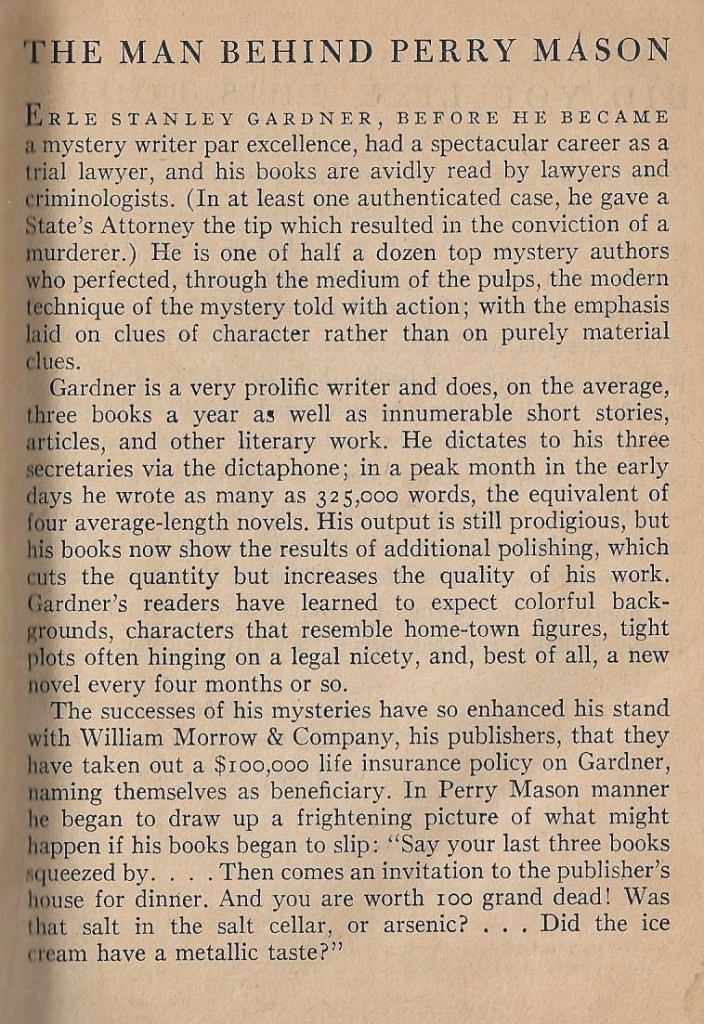
One last thing. Here is the page scan from my old Pocket Book with the publishers being all clever and smugly humorous about their best-selling author:

case of the shoplifter's shoe author bio erle stanley gardner 001


Read Full Post »

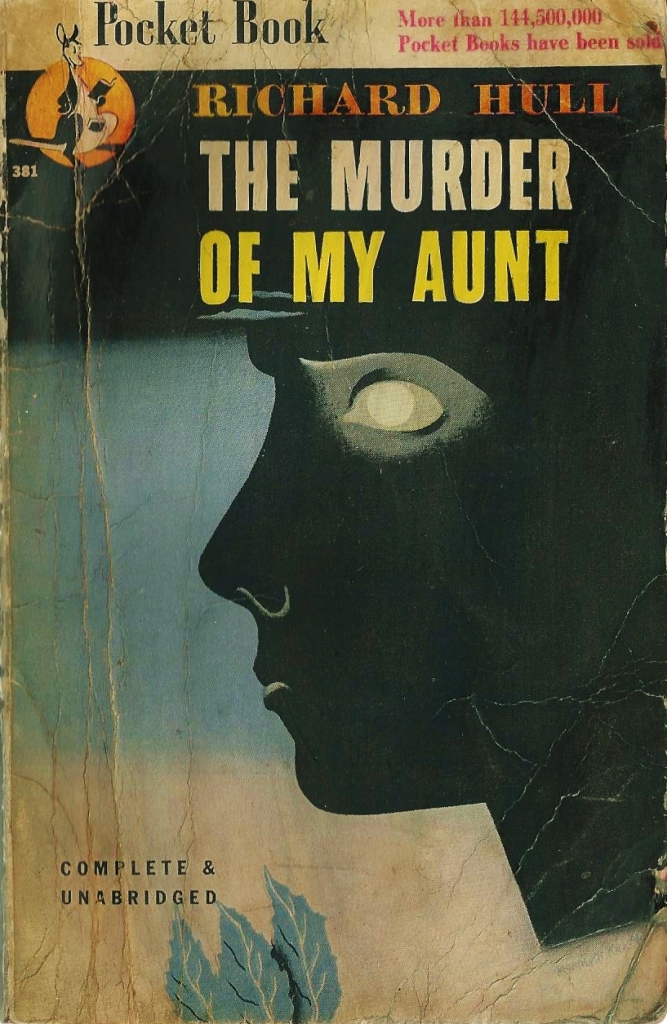
the murder of my aunt (v2) richard hullThe Murder of My Aunt by Richard Hull ~ 1934. This edition: Pocket Books, 1946. Paperback. 184 pages.

My rating: 8.5/10

Absolute piffle, but great fun. If I might be so bold, I propose this as a “must read” for lovers of vintage crime fiction and Wodehousian-style humour alike. A deliciously nasty little tale which defies fitting neatly into its possible genres in much the same way as its narrator dodges attempts to save him from himself.

Edward Powell has been raised by his aunt since the unfortunate (and apparently scandalous) double demise of his parents when he was but a wee tot. Childless Aunt Mildred is happily established at the family estate in rural Wales, but Richard has a hankering for a more sophisticated lifestyle, and is increasingly impatient with his aunt’s attitude that he should find an occupation and become self-supporting, rather than relying on her support.

Now, as spinster Aunt Mildred has no other heirs, Edward can one day expect to inherit her estate, which he fully intends to dispose of as quickly as possible, to facilitate departure for some place more appealing to his sensibilities. Perhaps the Riviera…

But pesky Aunt Mildred looks to be good for quite a few more years. What if her nephew were to hasten her inevitable demise, combining it with a spot of revenge for all of her patronizing comments regarding his dilettante leanings?

As Edward attempts to bring about the “accidental” demise of his sole relative, he confides all in great detail to his private journal, which he keeps locked up between episodes of writing in a small safe in his bedroom. A safe which his aunt has given him. (Hint: Richard isn’t as bright as he thinks himself.)

And never doubt that Aunt Mildred may have a few tricks up her own sleeve…

A nice fast read, and a fine vintage diversion for a quiet evening or a blustery day.

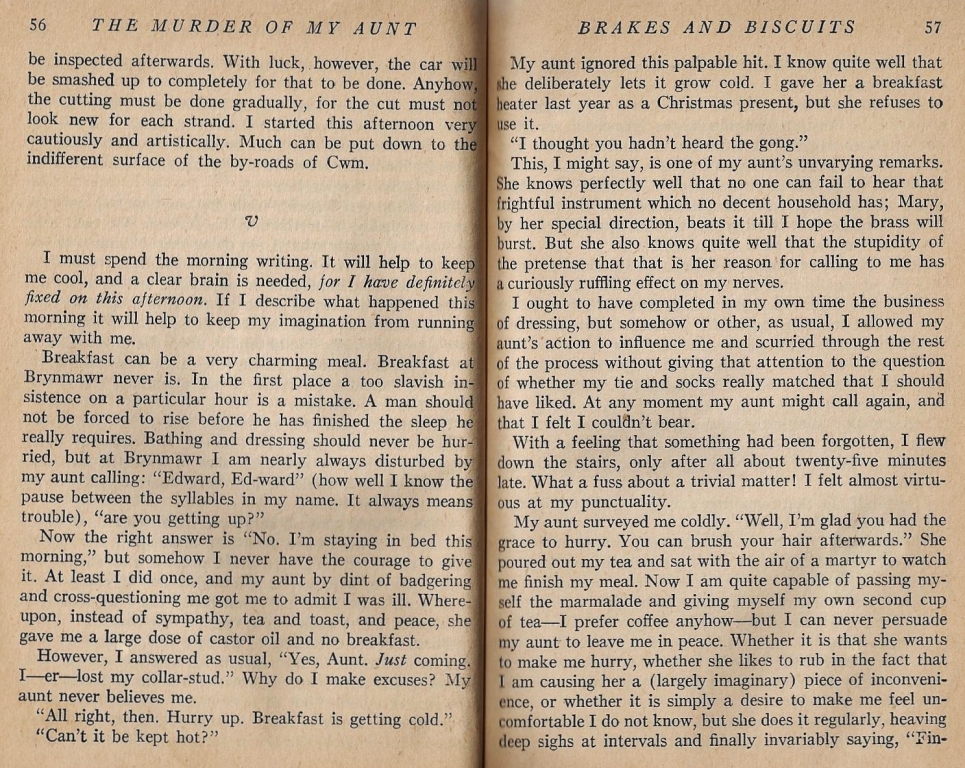
Here’s a sample. (Click the image to enlarge in a new window.)

the murder of my aunt excerpt richard hull 001


Read Full Post »


a lady of quality frances hodgson burnett 001

My spouse guffawed when he saw this cover: “Which child of the author drew that horse?” Well, it *is* eye-catching, even though I suspect it does not quite jive with the stated setting of the story, which starts in 1685.

A Lady of Quality by Frances Hodgson Burnett ~ 1896. This edition: Center Point Publishing, 1999. Hardcover. ISBN: 1-58547-000-7. 317 pages.

My rating: 4.5/10

She gathered all her dying will and brought her hand up to the infant’s mouth.  A wild look was on her poor, small face, she panted and fell forward on its breast, the rattle in her throat growing louder.  The child awakened, opening great black eyes, and with her dying weakness its new-born life struggled.  Her cold hand lay upon its mouth, and her head upon its body, for she was too far gone to move if she had willed to do so.  But the tiny creature’s strength was marvellous.  It gasped, it fought, its little limbs struggled beneath her, it writhed until the cold hand fell away, and then, its baby mouth set free, it fell a-shrieking.  Its cries were not like those of a new-born thing, but fierce and shrill, and even held the sound of infant passion.  ’Twas not a thing to let its life go easily, ’twas of those born to do battle.

Its lusty screaming pierced her ear perhaps—she drew a long, slow breath, and then another, and another still—the last one trembled and stopped short, and the last cinder fell dead from the fire.

It is “a wintry morning at the close of 1685”, and the heroine of our story has almost been smothered by her poor doomed mother. Nine children has poor Lady Daphne borne, all of them daughters, and with each successive childbed disappointment her abusive husband, Sir Jeoffry of Wildairs Hall, has become more and more enraged at his wife’s inability to bring forth a son. Six of the girl children have already perished; two survive, hidden away in a dingy nursery, and they are about to be joined by their baby sister, who survives her doomed mother’s feeble attempt at infanticide, meant to save her last child from a dreadful future fate.

Clorinda – our heroine, the baby-that-almost-was-smothered – is made of much sterner stuff than her mother, and she grows into a fiery-spirited, stunningly beautiful child. Catching her father’s eye by her forceful personality and wicked temper (he can totally relate), Clorinda spends her years until her fifteenth birthday hanging out with her father and his hard-drinking, hard-riding, gambling, womanizing cronies, while the sisters languish in their dismal corner of the Hall.

At fifteen Clorinda suddenly casts of her tomboyish persona and reinvents herself as a proper young lady, forcing herself out into society and making quite a stir what with her flashing eyes, unspeakable beauty, and rapier-sharp wit, not to mention her fairy-like dancing ability and gorgeous clothes.

The transformation continues, with the expected setbacks, including that of a blackmailing shadow from Clorinda’s heedless past. Luckily Clorinda’s elder sister Anne stands by her, and between the two of them Clorinda attains her marriage to the man she loves, and the downfall of her bitter enemy.

An absolutely overwritten almost-gothic romance – and I say “almost-gothic” because though it is set in the late 17th and early 18th centuries it is deeply and awfully Victorian in style, all attempts by its author to set the scene with dramatically archaic language and descriptions of silks and brocades and paduasoys aside.

The occasional humour that enlivens FHB’s other books seems to be almost entirely missing here; there is an absolute earnestness which serves the highlight the improbabilities of Clorinda’s transformation and many successes, and Sister Anne is just as unbelievable in her saintly self-sacrifice; Anne’s deathbed scene at the end of the novel is stunning in its adherence to the stereotype.

An interesting novel in that it rounds out one’s familiarity with this author’s substantial body of work, but otherwise not particularly recommended by me for readers of the current day and age. A just-readable Victorian-age curiousity of a novel rather than a lost treasure or a hidden gem, I’m afraid.


Read Full Post »

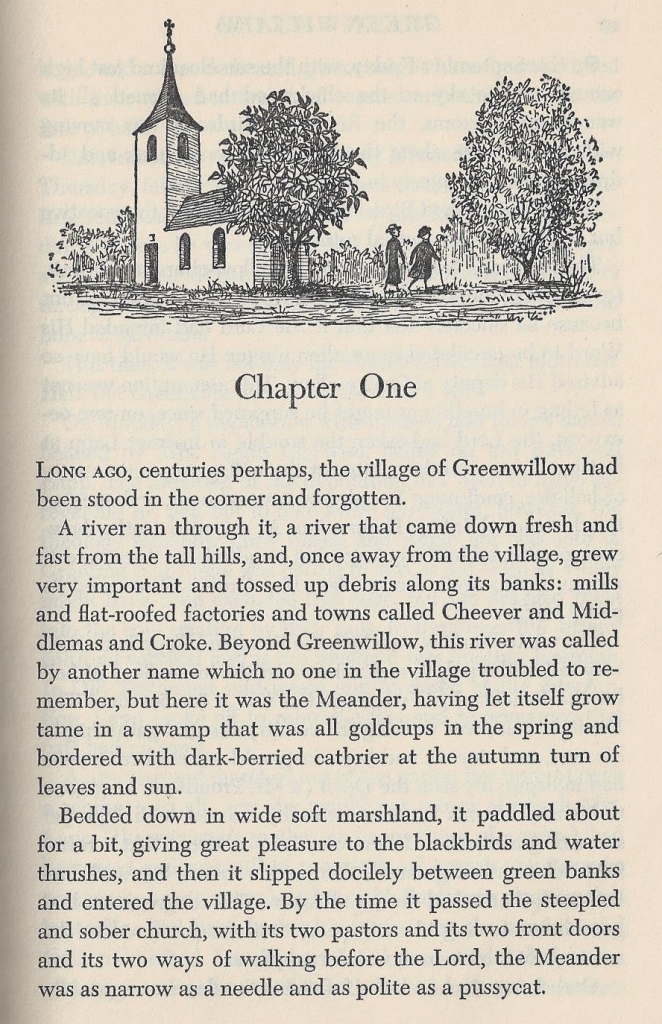
greenwillow hc no dj b j chute 001Greenwillow by B.J. Chute ~ 1956. This edition: E.P. Dutton, 1956. Illustrated at chapter headings by Erik Blegvad. Hardcover. 223 pages.

My rating: Oh, what the heck. It was unexpected, but I mostly loved this one. 9.5/10.

A novel being the story of a village beyond the boundaries of time, no exact location, where people who are kinder and happier than we can be, and whose lives are linked to the rhythm of the seasons…

In the nebulously located village of Greenwillow, the Reverend Lapp preaches hellfire, damnation and the eternal loss of the souls of babies who die before being baptised, and though they stick a bit on that last concept, by and large his congregation puts up with him reasonably cheerfully. And when a certain Reverend Birdsong shows up, sent, so he says, “by the Bishop”, and accompanied by an upside-down umbrella full of hawthorn blossoms, the two preachers compromise by sharing the church, though they cannot bring themselves to share doctrine.

Reverend Lapp sees the Devil everywhere and is an authority on his pervasive influence; Reverend Birdsong is a bit vague on such details, preferring instead to concentrate on the God-given wonders of nature, and by extending encouraging approval to young lovers, kittens and the cultivation and appreciation of flowers.

Both Reverends take an interest in the family of Amos Briggs, famously of a wandering nature, who appears every year or so for a few days, just long enough to give a start to the next addition to the ever-increasing family of young Briggs who scrabble about on their poor but promising farm. The eldest Briggs child, Gideon, lives under the cloud of the family curse: that the first son of the first son will at some point in his young life hear the mysterious “call” and will drop everything and head off into the unknown, abandoning family, friends and livelihood to roam the wide world over –

…hoeing man laid down his hoe, digging man laid down his spade, reaping man laid down his scythe…

Gideon is working frantically to have the farm in a viable condition to leave in the care of his younger siblings when his call comes. He’s also determined to break the family curse once and for all, for though he’s resigned himself to his own fate, he is firmly determined not to marry. He’ll not to leave behind a wife as his own dear mother has been left, though she is gently complaisant with her fate, never losing her original love for her wayward spouse and welcoming him with eager arms for the few days he reappears every year or two. Most of all, Gideon is determined not to have any children of his own.

Which complicates things exceedingly when Gideon meets the eyes of a sterling-natured village maid, one Dorrie – an accomplished cook from a tender age, lover of the afore-mentioned kittens, and of children, in particular the Briggs young ones, which aids in moving the mutual attraction up a notch or two. ) Dorrie is more than ready for a home of her own, and when the two admit their love to one another, we are almost convinced that Gideon will break his personal vow not to ever wed.

Lapp preaches thunder and damnation to Gideon, warning him against heeding the call of the Devil; Birdsong cocks his head sideways and doesn’t say much but exudes encouragement; neither appears to have any influence on Gideon, to sway him from his stubborn (and rather tiresome) insistence that his fate is sealed.

But we have an inkling that it will all come round right in the long run, and it does, though not without a lot of side plots and interferences by all and sundry of the (mostly) well-intentioned villagers and rural folk.

greenwillow page scan page 1 b j chute 001

Did I say “charming” yet? Well, it is. And deeply so. A book I had no previous knowledge of, and which surprised me by its likeable fairy tale atmosphere, and by its assortment of stock rural characters – both human and animal – all with unexpectedly diverting quirks.

This B.J. Chute is rather an amusingly lyrical writer, I concluded well before the happy end of Greenwillow. And this is what I discovered about her. For it turned out to be a her, not a him, as I had somehow assumed. And it also turned out also that I was already acquainted with one of the family, as it were, for B.J.’s sister turns out to be Marchette Chute, historical biographer and children’s author and poet. Who knew?!

From the dust jacket of the first edition of Greenwillow, found pictured online. (My copy is sadly missing its jacket.)

B.J. Chute was born of an American father and an English mother, and she spent most of her life at a country home in Minnesota named “Hazelwood.” There she and her two sisters became familiar with animals and birds and trees., and in their spare time they all made a hobby of writing. In the end all three became professional writers, for one sister, M.G. Chute, is well known for her Saturday Evening Post stories, and the other, Marchette, for her biographies of Chaucer, Shakespeare and Ben Jonson.

B.J. Chute, who is Joy to her family and friends, has written many short stories for major magazines, and this is her third novel. She wrote Greenwillow in a style that would not tie it down to any country or any period, but it was because she was brought up with woods and fields and country people that she knows them so intimately and can write about them so well. Her delight in people is just as evident now that she lives in New York, and in her spare time she does volunteer work with the Police Athletic League and in a shelter in Harlem for temporarily homeless babies.

And from her obituary in the New York Times, September 15, 1987:

Beatrice Joy Chute, a novelist and short-story writer who was also a past president of the PEN American Center and taught for many years at Barnard College, died of a heart attack Sept. 6 at Bellevue Hospital Center. She was 74 years old and lived in Manhattan.

Miss Chute, who was born in Minneapolis in 1913, published her first story in 1931. She wrote many stories for and about adolescent boys for Collier’s, The Saturday Evening Post and other magazines during the 1930’s, and her first book, ”Blocking Back,” was published in 1938. Many of her early works, such as ”Shattuck Cadet” (1940) and ”Camp Hero” (1942), were realistic tales of sports and camp life that captured the relationships and slang of her primarily male teen-age heroes.

Although she continued to write short stories for children and adolescents in the 1940’s, Miss Chute began to concentrate on adult fiction with ”The Fields Are White,” a 1950 book about marriage and manners.

discovery. It was made into a Broadway musical in 1960. Subsequent works included a 1957 anthology called ”The Blue Cup and Other Stories,” ”The Story of a Small Life” (1971) and ”Katie: An Impertinent Fairy Tale” (1978). Her most recent novel, ”The Good Woman” (1986), was a parable about a lonely woman who abandons her home for a journey of spiritual awakening while living on the streets.

Miss Chute – who preferred to be called Joy and signed her books B. J. Chute – moved to New York in the early 1940’s with her mother and two sisters. Over the years, she did volunteer work with poor children and the Police Athletic League. She became an adjunct professor of English at Barnard College in 1964, and taught creative writing there until her death.

She was also director of Books Across the Sea, a division of the English-Speaking Union that promoted American books overseas, and was an active member and one-time president of the American chapter of PEN, the writer’s association.

Provenance, my edition: Rotary Club Book Sale, Williams Lake, B.C., February 2014. Inscription: “Irene Ringland”. First edition, no dust jacket.

Read Full Post »

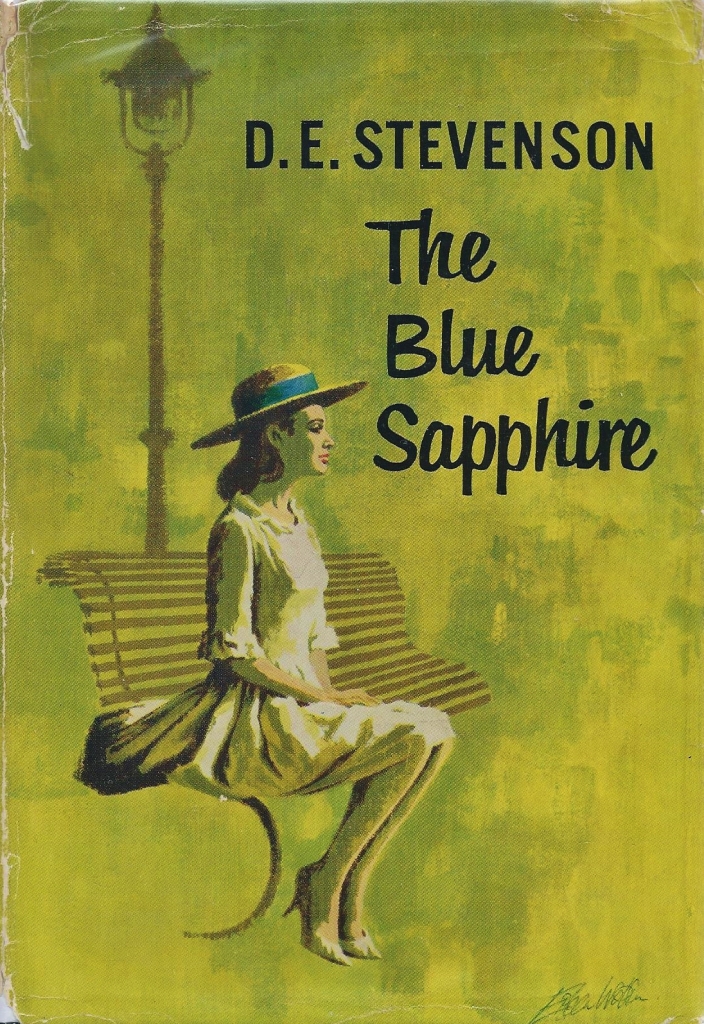
the blue sapphire d e stevenson 001The Blue Sapphire by D.E. Stevenson ~ 1963. This edition: Collins, 1963. Hardcover. 320 pages.

My rating: 9/10

Yesterday’s post was all supercilious and disapproving of D.E. Stevenson’s 1969 novel Gerald and Elizabeth, but happily I am able to balance that with a much more enthusiastic opinion of this also far-fetched but charmingly engaging 1963 effort.

There are several parallels between the two stories, which makes their comparison and my views of one as “good” (The Blue Sapphire) and the other as “not-very-good” (Gerald and Elizabeth) an interesting micro-study in perception and the ambiguities of personal taste. I won’t delve any more deeply into this aspect of these two books, but will zip right into a brief discussion of the book itself.

Dust jacket blurb:

The blue sapphire is a gem which the Ancients called the hyacinthus and which Solinus described as ‘a gem which feels the influence of the air and sympathises with the heavens and does not shine equally if the sky is cloudy or bright’.

On a beautiful spring day, Julia Harburn sat on a seat in Kensington Gardens enjoying the sunshine. She was wearing a white frock and a large straw hat with a sapphire-blue ribbon which exactly matched her eyes – a strange coincidence, as it turned out, for the blue sapphire was to have a far-reaching influence upon her life. So far, her life had been somewhat dull and circumscribed; but quite suddenly her horizons were enlarged. She began to make new friends – and enemies – and she began to discover new strength and purpose in her own nature. This development of her character led her into strange adventures, some amusing, others full of sorrow and distress. The story is itself a blue sapphire story, of clouds and sunshine.

As pretty Julia sits on her park bench waiting for her tardy fiancé Morland to appear for their teatime rendezvous, she is increasingly worried that she will be “annoyed” by the numerous questionable masculine types who have started closing in on her, like hopeful jackals surrounding a tender little gazelle. Luckily a rescuer appears in the person of tall, handsome and very forthcoming Stephen Brett, newly arrived in London after some years away in South Africa overseeing a gemstone mining operation. At first Julia snubs the friendly Stephen, but she soon warms to his innocent cheerfulness, and the two part on mutually appreciative terms just as Morland grumpily hoves into view.

Julia is waiting to break some rather big news to Morland. She has decided to move out of her father’s house and find a job and take a room in a boarding house. Some years ago Julia’s mother had died, and her new stepmother, while not at all cruel, is making it increasingly obvious that she would be happier if she were the only woman in the household.

Morland loftily dismisses Julia’s intentions of independence, but she holds firm, eventually ending up in an attic room in the fabulously Victorian-styled boarding house of the inestimable Miss Martineau, ex-actress and current patroness to “resting” theatrical folk. Miss Martineau takes a shine to Julia, and sets her up in a job at a posh hat shop, where Julia proceeds to thrive, becoming a very special chum to her new boss, the ex-Parisian Madame Claire, to the deep resentment of Julia’s several jealous co-workers.

Meanwhile Stephen Brett pops in and out of Julia’s life, adding some much-needed good humour and friendliness as Julia finds her way as a working girl and tries to cope with Morland’s moodiness and reluctance to set a date for their marriage. Stephen is embroiled in a complicated situation involving a potential sapphire mine back in South Africa; he finds relief from his worries in his growing friendship with Julia.

A turning point in the plot occurs as Julia receives a letter from her father’s estranged brother in Scotland, begging Julia to come and see him before he dies. Off she goes, against Morland’s advice, to find in her Uncle Randal the loving relationship she has never been able to attain with her own father. But Uncle Randal is declining rapidly, and it seems as though Julia will tragically lose him just when she has found him…

Stopping right here, because this is a sweet story which you will want to finish up for yourself. D.E. Stevenson is in her usual form, mixing unlikely scenarios with sunny-natured heroines, grumpy-but-ultimately-innocuous villains, salt-of-the-earth old family retainers, and a knight-in-shining-armour (or two) who appear(s) at just the right time.

The mixture-as-usual, but just what is needed in a book of this gentle genre. Highly recommended to those of you who like this sort of thing; everyone else, tactfully glance away!

Another Look Book liked it, too. As did Claire and Susan, who recommended it to me in the comments to my last year’s post about this other DES, also featuring the incorrigibly snoopy but divinely maternal Miss Martineau, 1966’s The House on the Cliff.

Read Full Post »

gerald and elizabeth d e stevenson 001Gerald and Elizabeth by D.E. Stevenson ~ 1969. This edition: Holt, Rinehart and Winston, 1969. Hardcover. ISBN: 03-066555-8. 245 pages.

My rating: 4/10

I hadn’t noticed a lot of discussion regarding this mild romance-suspense novel by the generally esteemed D.E. Stevenson in my online travels, and as it seemed to be widely available and very reasonably priced (for a DES book) in the second-hand book trade, I rather wondered why.

Well, I wonder no longer. The answer appears quite clear. It is my humble opinion that this book is not very good, and DES fans are keeping a discreet silence, spending their reviewing energies instead on the author’s top end novels.

While it’s sufficiently readable to keep one’s interest gently engaged, and there are charming passages and likeable characters galore, the whole thing is something of a stretch in numerous ways, even allowing for the DES formula of everyone ending up romantically paired up with all “mysteries” neatly resolved.

Dust jacket blurb:

Gerald Brown is young, good-looking, personable, but he holds himself aloof from the other passengers aboard the Ariadne, a small passenger ship returning to London from Cape Town, South Africa. In fact, his behavior is so extremely antisocial that he appears on deck only late at night, rarely venturing from his cabin during the day. Something is troubling him deeply, something that happened while he was working as an engineer in a Cape Town diamond mine that has left him spent and hopeless.

After the Ariadne docks in London, Gerald, desperately in need of a job, decides to contact his sister, the beautiful and famous actress, Elizabeth Burleigh, whose current play is the hit of the London theater season. As he reveals to her his haunting past in South Africa, he learns that she too is suffering, that behind her facade of gaiety and sophistication lurks a nagging suspicion about her mental health that is threatening to destroy her career and her love affair as well.

What are the forces that seem bent on these destroying these young people who have so much to live for? Can the mysteries surrounding their lives be solved – and in time to prevent irreversible consequences?

D.E. Stevenson reveals the answers to these questions in a way that will hold her thousands of fans breathless until the very end…

A glaringly obvious diamond-theft frame-up has our hero fleeing the gossip and speculative glances of South Africa to end up under the protective wing of his older half-sister Elizabeth, star of a rather goofy-sounding London stage play – Elizabeth plays a princess from the planet Venus marooned on Earth, to the delight of the hypothetical crowds who pack each performance during the play’s astoundingly successful run.

But all is not well in Elizabeth’s world either. Though feted by the all and vigorously courted by a kind, handsome and wealthy Scottish shipyard owner, Elizabeth fears that she has inherited the “melancholia” which plagued her long-deceased mother. How can she marry with such a doom hanging over her head? – for naturally it will be passed along to her own children!

As Gerald seeks to make a new start he also strives to delve into the background of Elizabeth’s mother, hoping to make some sort of discovery which will ease his sister’s worries and smooth the rocky path of her romance.

A wartime bombing raid on the night Elizabeth was born and an enterprising maternity nurse hold the key to the actress’s future happiness, and the events surrounding her birth are as spectacularly far-fetched as D.E. Stevenson’s conception of mental illness. Shades of the bizarre insanity scenario of Rochester’s Wife, published thirty years earlier, made me cringe in readerly discomfort for the author’s lack of research and her apparent clinging to archaic superstitions.

The mysteries aren’t very mysterious, and the characters never truly come to life. The author could and did do much better in many of her other novels. In my eyes, this is a book to round out one’s DES collection, but otherwise I feel that it is without a lot of merit. Please don’t give it to a neophyte Dessie; it might endanger one’s contention that this is indeed an author to spend time and energy tracking down!

Read Full Post »

riders of the purple sage zane grey personal copy 001Riders of the Purple Sage by Zane Grey ~ 1912. This edition: Grosset & Dunlap, circa 1920s. Illustrations by Douglas Duer. Hardcover. 335 pages.

My rating: 3.5/10

Oh, Lassiter, you big black-clad gun-slinging hero of this desperately romantic book, if I ever find it within me to start to read this one again, please rise up off the printed page, leap off your amazing blind horse, unholster your big black pistol, and shoot me right away. Don’t just nick a lung, like your buddy Venters did to the virginally beautiful Bess as she trotted past his desperate hideout garbed in her Masked Rider’s disguise, but kill me outright, same as you did Mormon Bishop Dyer, despoiler of your late sister and destroyer of her happy marriage. Except maybe don’t shoot me in the arms first, as you did him, before blasting five more holes in his chest. Just aim for my heart, and make it quick.

Gar. What a book. Wow.

So bad.

What was I thinking?

Oh, yeah, that whole “classic of American literature and mold-maker of the classic Western genre” thing.

I’m not even going to touch the Important Book for Various Reasons argument, but am going to go instead to Pleasure of Reading for a Modern Reader. (Meaning me.) Did I enjoy this book? Mostly, no. The novelty of the plushly purple prose paled quickly, and despite the campy sense of irony I felt as I doggedly waded through the story it wasn’t enough to make it an acceptably good experience.

It’s 1871 in Utah, and the Mormons are well-established, top-dogging it marvellously well with their polygamous colonies headed by manly men wedded to legions of willing wives. So when rich Mormon rancher’s daughter Jane Withersteen spurns the advances of the man chosen for her by the local Mormon bishop and insists on carrying on with her charity to the impoverished Gentile (blanket term for anyone non-Mormon) families of the area and her hiring of Gentile riders to care for her seven thousand head of range cattle, events start to escalate.

riders purple sage zane grey old djJust as Jane’s chief Gentile Rider, Venters, is about to be hauled off by a posse of Mormons, fate in the guise of black-clad, gun-slinging, Mormon-hating Lassiter arrives in the nick of time. The Mormons withdraw muttering, to go off and devise clever plans of revenge and sabotage against uppish Jane, while she enjoys (for a while) the loving devotion of two passionate men. (Venters and Lassiter.)

“Then I’ll have you whipped within an inch of your life,” replied Tull, harshly. “I’ll turn you out in the sage. And if you ever come back you’ll get worse.”

Venters’s agitated face grew coldly set and the bronze changed to gray.

Jane impulsively stepped forward. “Oh! Elder Tull!” she cried. “You won’t do that!”

Tull lifted a shaking finger toward her.

“That’ll do from you. Understand, you’ll not be allowed to hold this boy to a friendship that’s offensive to your Bishop. Jane Withersteen, your father left you wealth and power. It has turned your head. You haven’t yet come to see the place of Mormon women. We’ve reasoned with you, borne with you. We’ve patiently waited. We’ve let you have your fling, which is more than I ever saw granted to a Mormon woman. But you haven’t come to your senses. Now, once for all, you can’t have any further friendship with Venters. He’s going to be whipped, and he’s got to leave Utah!”

“Oh! Don’t whip him! It would be dastardly!” implored Jane, with slow certainty of her failing courage.

Tull always blunted her spirit, and she grew conscious that she had feigned a boldness which she did not possess. He loomed up now in different guise, not as a jealous suitor, but embodying the mysterious despotism she had known from childhood—the power of her creed.

Lots of stuff then happens, most of it involving the Mormons and Jane’s Gentile champions plus an independent gang of rustlers shooting at each other (frequently fatally), stealing cattle and prize racehorses, befriending a cute little orphan four-year-old (“Duz oo wuv me, Muvver Jane?”), finding a secret hidden valley and thousand-year-old abandoned cliff dwellings (an enjoyable interlude which added on a point or two to my brutally low rating), panning for gold (“washing” gold, nice topical reference), ambushing, wounding and restoring to life a lovely young girl disguised as a boy cattle rustler, charging about on various noble steeds including Lassiter’s original blind steed (who perishes tragically), two black Arabians (Jane and Lassiter) and a rugged yet awesomely sturdy and fast range horse (Wrangle, ridden by Venters) who in turn is stolen by a bad guy and ends up being shot by his loving owner in order to ensure the demise of the bad guy rider.

And much else.

This is a very multi-stranded story with lots going on, and you have to hand it to Zane Grey, he deserves credit for being ambitious with his intentions.

Here’s another snippet of the text:

He lifted her—what a light burden now!—and stood her upright beside him, and supported her as she essayed to walk with halting steps. She was like a stripling of a boy; the bright, small head scarcely reached his shoulder. But now, as she clung to his arm, the rider’s costume she wore did not contradict, as it had done at first, his feeling of her femininity. She might be the famous Masked Rider of the uplands, she might resemble a boy; but her outline, her little hands and feet, her hair, her big eyes and tremulous lips, and especially a something that Venters felt as a subtle essence rather than what he saw, proclaimed her sex.

Western garb and setting aside, Riders of the Purple Sage is purely an über-traditional romance, and the two female love interests – Jane Withersteen and ex-Masked Rider Bess – are both , despite their brief moments of sturdy independence – Jane in standing up to her Church, and Bess in her mastery of horsemanship –  at heart simpering girly-girls all a-dither with love for their manly men, whom they then order hither and yon with feminine whimsy. The menfolk, being blinded by Love, trot willingly to and fro, breaking out occasionally (“Sorry, lost my temper and killed your dad”) and being instantly forgiven (“That’s okay, he wasn’t my real dad, even if he raised me from a tiny baby and gave me total love and devotion and protected me from the wicked men who sought to ruin me and gave me a proper education and everything”) and generally being tweaked about on silken leading strings.

riders purple sage zane grey old illustrated coverAnd despite spending weeks alone with each other – Lassiter and Jane holed up in the ranch house, Venters and Bess in the hidden valley – the most physical they get with each other is the occasional embrace (with the men nobly holding themselves back from the passions engendered by contact with the heaving breasts of the beloved) and a few rather chaste kisses. These guys (and gals) were made of steel! This is romantic fiction at its best, all heaving bosoms and blushes and occasional fainting and manly-passion-held-in-check just a-waiting for a woman’s word and the arrival of a preacher man to hold a marriage ceremony before going any further.

Oh, yes. And then there’s all the “western” dialect:

The rider thundered up and almost threw his foam-flecked horse in the sudden stop. He was a giant form, and with fearless eyes.

“Judkins, you’re all bloody!” cried Jane, in affright. “Oh, you’ve been shot!”

“Nothin’ much Miss Withersteen. I got a nick in the shoulder. I’m some wet an’ the hoss’s been throwin’ lather, so all this ain’t blood.”

“What’s up?” queried Venters, sharply.

“Rustlers sloped off with the red herd.”

“Where are my riders?” demanded Jane.

“Miss Withersteen, I was alone all night with the herd. At daylight this mornin’ the rustlers rode down. They began to shoot at me on sight. They chased me hard an’ far, burnin’ powder all the time, but I got away.”

And the reams of descriptive prose. You can certainly tell that Zane Grey got his start writing pulp fiction which was paid for by the word, because he does pack them in.

Venters … went to the edge of the terrace, and there halted to survey the valley.

He was prepared to find it larger than his unstudied glances had made it appear; for more than a casual idea of dimensions and a hasty conception of oval shape and singular beauty he had not had time. Again the felicity of the name he had given the valley struck him forcibly. Around the red perpendicular walls, except under the great arc of stone, ran a terrace fringed at the cliff-base by silver spruces; below that first terrace sloped another wider one densely overgrown with aspens, and the center of the valley was a level circle of oaks and alders, with the glittering green line of willows and cottonwood dividing it in half. Venters saw a number and variety of birds flitting among the trees. To his left, facing the stone bridge, an enormous cavern opened in the wall; and low down, just above the tree-tops, he made out a long shelf of cliff-dwellings, with little black, staring windows or doors. Like eyes they were, and seemed to watch him. The few cliff-dwellings he had seen—all ruins—had left him with haunting memory of age and solitude and of something past. He had come, in a way, to be a cliff-dweller himself, and those silent eyes would look down upon him, as if in surprise that after thousands of years a man had invaded the valley. Venters felt sure that he was the only white man who had ever walked under the shadow of the wonderful stone bridge, down into that wonderful valley with its circle of caves and its terraced rings of silver spruce and aspens.

The dog growled below and rushed into the forest. Venters ran down the declivity to enter a zone of light shade streaked with sunshine. The oak-trees were slender, none more than half a foot thick, and they grew close together, intermingling their branches. Ring came running back with a rabbit in his mouth. Venters took the rabbit and, holding the dog near him, stole softly on. There were fluttering of wings among the branches and quick bird-notes, and rustling of dead leaves and rapid patterings. Venters crossed well-worn trails marked with fresh tracks; and when he had stolen on a little farther he saw many birds and running quail, and more rabbits than he could count. He had not penetrated the forest of oaks for a hundred yards, had not approached anywhere near the line of willows and cottonwoods which he knew grew along a stream. But he had seen enough to know that Surprise Valley was the home of many wild creatures.

This is a dreadfully silly “review”, but as the internet abounds with discussion of this book, I’m going to quit right here.

I read the thing from cover to cover, I muttered to myself and to my family, I rolled my eyes, I mused over the novel’s place in the American historical literary canon, and I am now ready to gently shelve it way high up and move along. It had its pleasurable moments, duly noted, but it’s ultimately not the book for me.

Read Full Post »

I’ve just finished something of a mini-binge of World War II-era spy thrillers, with the first two of what would turn into a handsome list of espionage and suspense thrillers by Helen MacInnes.

Above Suspicion was the first, and published in 1941 in the opening moves of what was to become the prolonged agony of the Second Great War, its urgent and foreboding tone rocketed it to bestseller heights. MacInnes followed her first novel by another even more topically urgent and dark, Assignment in Brittany, in 1942.

Though definitely dated, these suspense novels are decidedly still very readable today, made even more enthralling by the fact that we know what happened in the years after, while MacInnes and her heroic characters are facing a tremendous and forbidding Great Unknown. I’m going to give brief sketches of both in two hundred word snapshots, if I can condense them so tightly – with the strong recommendation that you discover these for yourself if you feel that these might be your thing. These two novels are excellent examples of their genre, though highly dramatized and relying upon those inevitable unlikely coincidences and lucky breaks in order to bring them to a satisfactory conclusion. Though neither has an ending that is neatly rounded off; the settings and times don’t allow it.

I have read Above Suspicion numerous times through the years, but Assignment in Brittany was new to me, and I was pleased at how engaging both of these were, even though in the first I knew the plot inside and out, and the second I guessed at rather successfully all of the way through, except for the rather heartrending (but ultimately optimistic) twist at the very end.

Both books were immediate bestsellers, and remain very readable – and continually in print –  almost seventy-five years after their first publication.

above suspicion helen macinnes 001 (2)

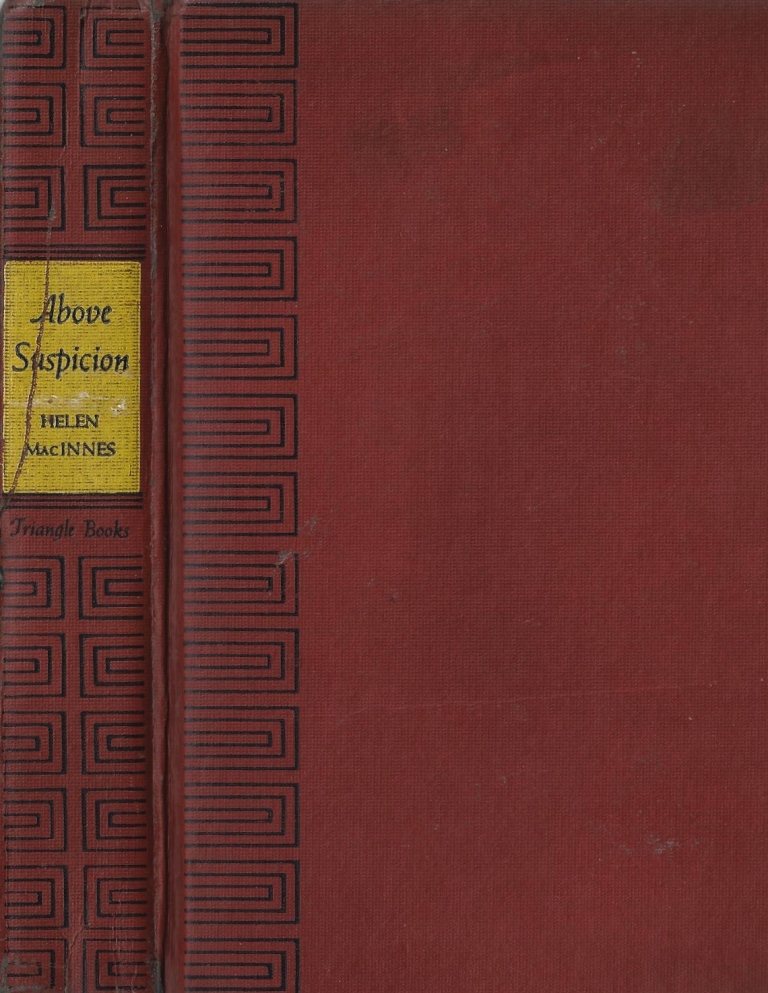
“Because of the acute shortage of regular book cloth under war-time rationing, this book is bound in ‘leatherette,’ a sturdy paper fabric especially designed for this purpose.”

Above Suspicion by Helen MacInnes ~ 1941. This edition: Triangle Books, 1944. Hardcover. 333 pages.

My rating: 8.5/10

Young Oxford University don Richard Myles and his wife Frances are recruited to travel to Europe during summer break in order to discover what has happened to a possibly-compromised chain of British secret service agents. The premise being that the two are so innocent-seeming as to be able to wander at will, from agent to agent, following the links as identified at each contact. In their travels they run in and out of numerous sinister encounters; the Nazis are very much on the ascendant and their evil shadow looms over the lands the Myles visit on their journeyings.

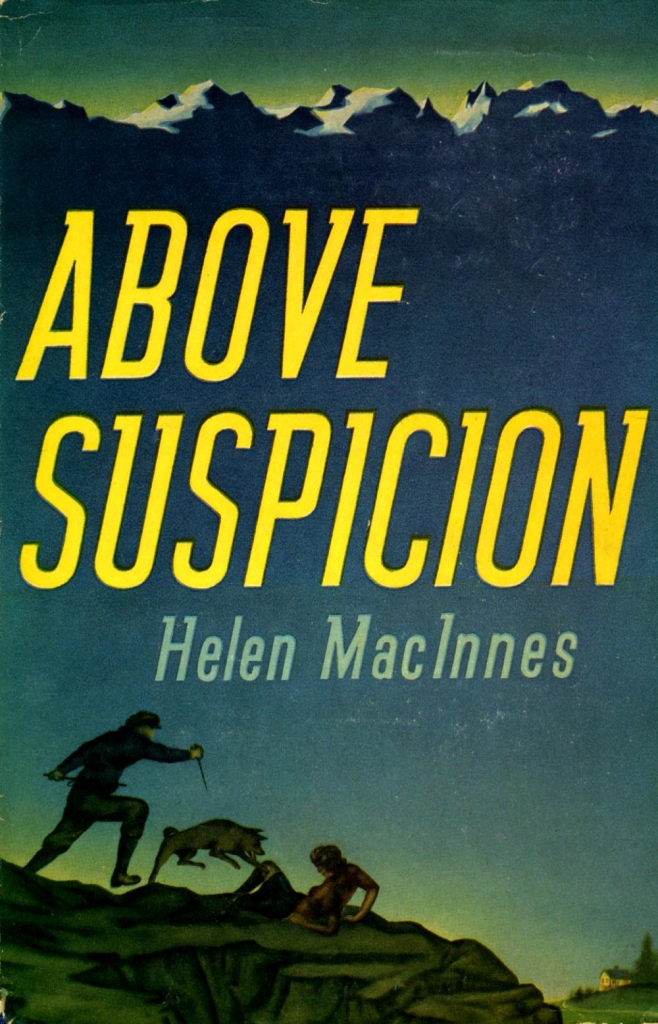
above suspicion helen macinnes  old dj 001 (2)

This dramatic vintage dust jacket illustration illustrates one of the peak moments of this suspense thriller, as the heroine is attacked by the Head Evil Nazi’s killer dog and is rescued by quick deployment of her husband’s handy-dandy sword-stick. Imminently distressing dispatch of the hound aside, isn’t this a gorgeous bit of graphic design?

A novel made most poignant by the time of writing; the last months of peacetime shadowed by foreboding clouds of war. The author draws upon personal experience in telling her tale, and it is an interesting combination of travelogue and suspense thriller, full of asides describing the scenes in which the action is set, and philosophical musings regarding the whys and wherefores of the imminent conflict. The German psyche is searchingly probed by a very British analyst – MacInnes in the guise of her heroic (and autobiographical) married couple – and found to be both blustering and chillingly focussed on military dominion.

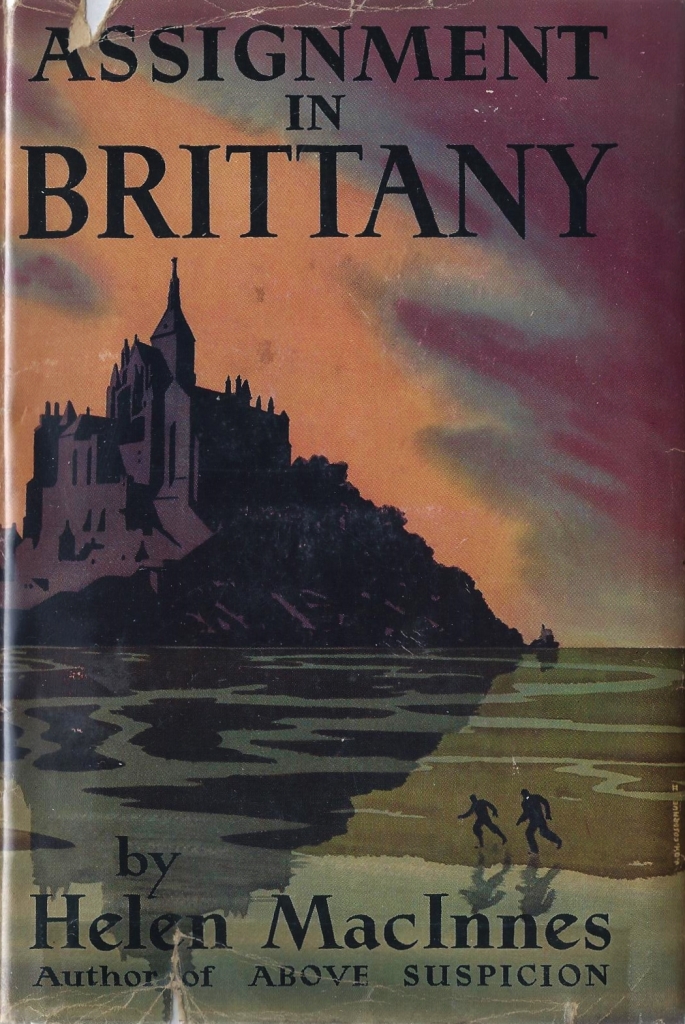
assignment in brittany dj helen macinnes 001

I am fortunate enough to be the possessor of this handsomely dust-jacketed first American edition. An absolutely stellar example of vintage cover art. Wouldn’t this make an amazing wall poster?

Assignment in Brittany by Helen MacInnes ~ 1942. This edition: Little, Brown & Co., 1942. Hardcover. 373 pages.

My rating: 9/10

Martin Hearne is parachuted into Brittany, into the very forefront of the Nazi occupation, in the guise of  his French body double, Bertrand Corlay. Many surprises await Hearne, not least of which is the discovery that his predecessor was less than forthcoming about some of his own activities before his evacuation to England via the Dunkirk debacle. For instance, his pre-marital arrangement with the neighbouring farmer’s daughter, Anne, and his estrangement from his invalid mother, who keeps strictly to her own rooms in the shared household. Who is beautiful and passionately forthcoming Elise? Why do the Nazi occupiers greet “Bertrand Corlay” with warm enthusiasm, while his fellow villagers hiss in cold disgust?

An escaping American journalist sheltering in the Corlay home sets off a string of complications, most notably a dramatic trip to the medieval monastic stronghold of Mont St. Michel, situated at the end of a causeway above tidal flats of quicksand. A return to the Corlay home finds Hearne confronted by steely-eyed Teutons who have discovered their collaborator is not what he seems, in so very many ways. Will Hearne make it back to England with his meticulously written notes and maps, as well as his new-found love?

Good dramatic stuff, rather nicely plotted for its type of thing, though with an exceedingly strong reliance on Hand of Coincidence. The evil Boche are given no ground, and the resident Bretons are depicted as cunning and stubborn survivors, insular to an astounding degree, but in the main resistant to their unwelcome occupiers by a combination of sullen non-cooperation and occasional acts of secret sabotage.

An engaging period thriller, written at the time it depicts, and so a valuable snapshot of the mood and details of its moment in time as well as a very readable diversion.

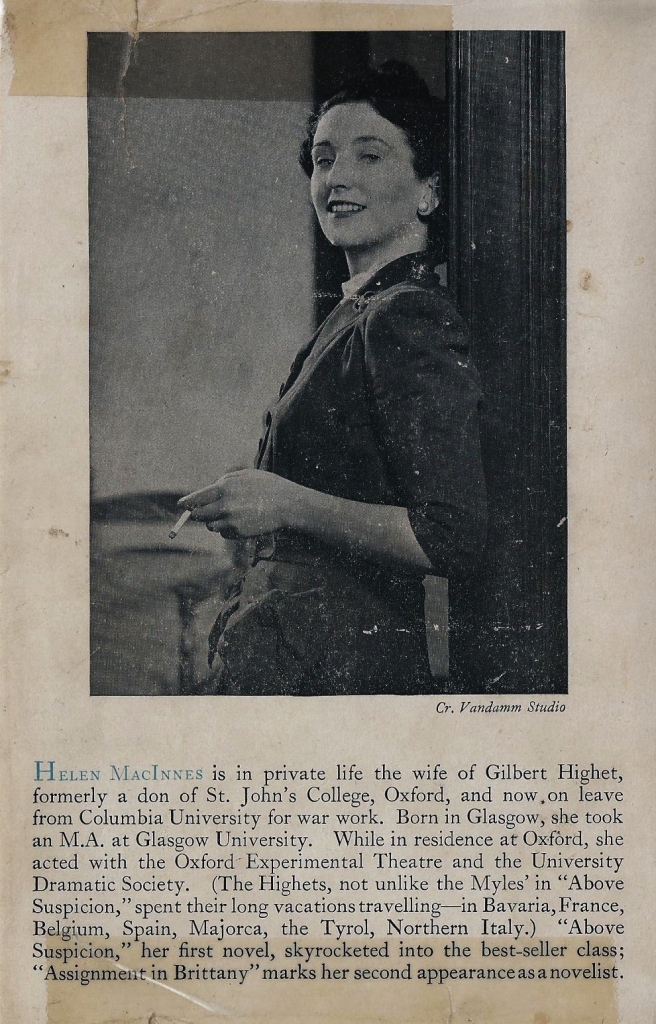
helen macinnes bio dj assignment in brittany dj 001

Author biography from the back cover of “Assignment in Brittany.” Check out the casual cigarette! No doubt the other hidden hand is nonchalantly holding a martini glass…

Read Full Post »

It’s always fascinating to read vintage books aimed at the youth market. The terms “literary snapshots” and “period pieces” apply particularly well to this widely varied genre, though more serious themes tend to be handled in a gentle way, obviously in order to cushion young minds from the harsher realities of the world they live in.

I recently read these two American “juveniles” from the many which have accumulated on our shelves in the past nineteen years of buying books for the younger members of the family, and while neither is an outstanding piece of fiction in any sense of the word, they are both rather interesting in what they have to say about the eras they were written in and about. Footnotes to the period, as it were, which is why I’m including them among the Century of Books fellowship.

*****

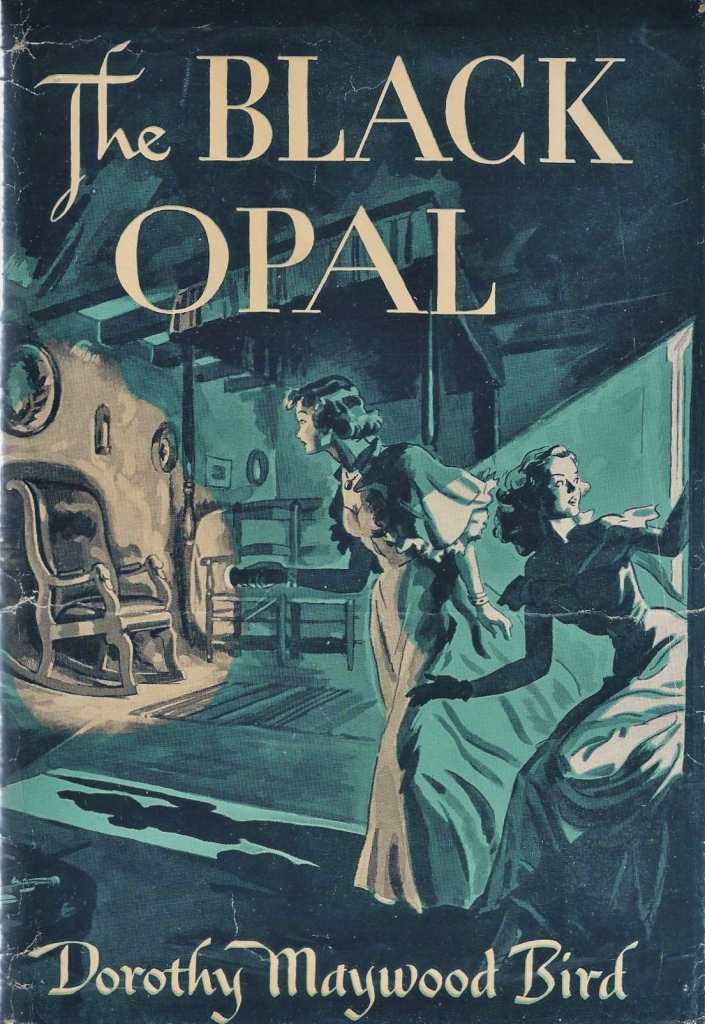
the black opal dorothy maywood bird 001The Black Opal by Dorothy Maywood Bird ~ 1949. This edition: Macmillan, 1962. (Ninth printing.) Hardcover. 202 pages.

My rating: 6/10

Surprisingly likeable was this rather hard to classify light novel, comprised as it was of equal parts college caper, highly contrived mystery, and blossoming romance. All right, maybe not that hard to classify! But the mixture works quite nicely, and the characters are highly appealing, and the whole thing is completely adorable. Decidedly a book aimed at the feminine readership of the junior high schools of its time.

Look, I even found an approving Kirkus review, from October of 1949:

When Laurel went off to the small coeducational college in Michigan which had been her great-great-grandmother’s alma mater, she expected it to be fun — and it was. What she didn’t know was that she would find herself up to the neck in a century old, unsolved murder mystery which was to give her the thrill of establishing the identity of the murdered man and his killer. The mystery theme is well-integrated and companions a satisfying modern college story of dates, term papers and strict house-mothers. There is not only the sinister black opal which Laurel unearths but also the exciting and sparkling diamond with which her One And Only ends the story. Maybe her solution will seem a trifle glib and maybe everything falls in place too smoothly, but no one will care for it is a nice, light entertaining tale with the virtue, highly to be prized, of not following an exact formula.

Laurel Stanwood has decided to do something a bit out of the norm. Instead of going with her high school friends to a college in her native Vermont, Laurel has chosen to attend a school, Colbert College, in far-off Michigan, a decision inspired by the fact that her Great-great-grandmother Caroline Hayes was a student of the precursor to the now co-educational facility, the Colbert Female Seminary, in 1846.

What follows is an absolutely typical account of lively college life. Laurel immediately makes two best friends, and immerses herself in a whirl of activity, where some serious studying is livened up by dramatic football games, campus socials, the ongoing “campus war” between the freshmen/juniors and sophomores/seniors, and some serious battling of the sexes via the two campus newspapers, the Colbert Feminist, under the editorial control of Laurel’s new friend Rue, and the Colbert Iconoclast, presided over by the woman-despising J. Swinton Towne. As an aspiring journalist, Laurel is immediately put to work gathering material for the Feminist; she has high hopes of finding a stunning “scoop” which will allow the Feminist to grind the Iconoclast‘s annoying pretensions to male superiority under its well-clad foot.

Lovely period details abound throughout this book, such as here where the girls are opening their mail at dinner time.

Laurel slit them open with her fork. The first, a circular, ordered her to make reservations at once for that Round-the-World Cruise she’d been eagerly awaiting since before the war. “Lapping waves,” it promised, “soft winds to caress your brow, nights full of wonder.” The second assured her that she could borrow up to three hundred dollars without embarrassing investigation and could pay it back in easy monthly installments. “Why be short?” it demanded. The third looked more hopeful, an expensive ivory envelope addressed in a feminine hand and postmarked Detroit. But the letter inside merely stated that if she planned to invest five hundred and fifty dollars in a genuine blue muskrat coat, she would do well to visit Compere’s Fur Salon first.

“Here’s a card from Mother,” Stacy giggled, “reminding me that if I want my duds to get into the Monday wash I can’t wait till Monday to mail them, and here’s a letter from Kent. Even if I didn’t recognize the scrawl, nobody else would have the nerve to start out ‘Dear Horseface.'”

Laundry sent home by mail for washing, stocking boxes to protect one’s cherished “nylons”, beau parlors to entertain your male guests in, telegrams sent with gay abandon in the same way teens today fire off texts to arrange their dates, having one’s hair washed once a week at the beauty parlor, Sadie Hawkin’s Day dances with both sexes in drag, apple cider socials, and a continual description of the most lovely-sounding clothes are happy period details. Laurel is continually sporting such gems as a “cherry flannel robe”(while filling out her college application form), “white wool gabardine suit” with a white chrysanthemum corsage (to attend a football game), “green silk raincoat” (actually that was Stacy’s, but it sounds quite sharp), “red cambric bolero edged in gold furniture braid” (for dressing up as a Spanish courtier on Sadie Hawkin’s Day), dungarees and sheepskin lined stadium boot (for winter hiking in the snow), a plaid gingham dress giving way to a “heliotrope spun rayon” (dressing for dinner, a must-do in the girl’s dormitory house), a beau’s “electric-blue loafer coat”, a friend’s “magenta taffeta with the bustle” prom dress, and Laurel’s own costume for the high point of the story, prom night topped off by discovery of the “Black Opal” mystery: mist-gray tulle with silver slippers and handbag, and a corsage of forget-me-nots, rosebuds and silver ribbon. Oh, swoon!

The girls, despite their life of strict midnight curfews and beau parlors, are given a wonderful amount of freedom; in most ways they are treated as completely competent adults and are left to sink or swim and make their own decisions in a way that many of the sheltered-but-socially-sophisticated teens of today would be most miffed to asked to do. Failed your Biology exam? Oh, well, guess you should have studied harder! No helicopter-parenting mom or dad in this 1940s’ world is about to confront the Biology prof to demand their pampered offspring’s mark be altered!

The historical murder mystery/mysterious gemstone plot, though prominent in the title and constantly referenced, is a very minor part of this happy little novel, though it forms a uniting thread throughout. It is the least well handled aspect of the book, being utterly predictable, totally fabricated out of unlikely coincidences, and not particularly believable even at its most detailed point. But this I completely forgave, because the rest of the story charmed me completely.

Dorothy Maywood Bird wrote two other similar novels, Granite Harbor and Mystery at Laughing Water, and I would be quietly pleased to get my hands on these at some point, for a little more travelling gently back in time.

*****

the year of the dream jane collier 001The Year of the Dream by Jane Collier ~ 1962. This edition: Funk & Wagnalls, 1962. Hardcover. Illustrated by E. Harper Johnson. 122 pages.

My rating: 4.5/10

This one is aimed at a younger set, the elementary school ages. Another very predictable plot, with rather more cardboardish characters, but again an interesting period piece with some redeeming features.

A middle-class family of five – mother at home baking cookies, father a teacher, thirteen-year-old Dick, twelve-year-old Wendy and younger brother Beanie – have been summering at a lakeside cottage and messing about with rowboats for years. But this year it somehow doesn’t quite satisfy – “If only we had a boat of our own…!” And not just a rowboat, but a proper boat. A cabin cruiser, so Mom can come along and not miss her kitchen(!) – bright red flag, here – first hint of era-correct gender stereotype, but far from the last.

Anyway, it’s decided that this is just a dream, as Dad isn’t exactly wealthy, and even a cheap cabin cruiser would cost thousands to buy. Then a chance conversation puts the family on the track of a derelict boat to be sold as part of an estate settlement. For two thousand dollars they can have it. Lots of work would be needed, but the boat is essentially sound. But where to find the money?

Everyone chips in and the year progresses as the pennies and dollars start to flow into the boat fund. The family decides to holiday at home and put their vacation money in the fund. Dad quits smoking and takes on an evening job, Wendy gives up her riding lessons and takes on babysitting jobs, Dick decides to raise rats to sell for science experiments, and Beanie roams the neighbourhood with his wagon collecting old newspapers to sell for salvage prices – 75 cents per 100 pounds. Even Mom finds something to do – she goes back to work in a law office part time, asking Wendy to step up and help out more at home.

Domestic details of the early sixties include a gee-whiz!-isn’t-it-great! reliance on cake mixes, instant pudding, canned everything, and casseroles of frankfurters and beans. Mom pores over a book called Shipboard Menus, leaving the mechanical and construction details of boat refurbishment up to the menfolk.

The only person not thrilled with the family’s common goal and their pursuit of their dream is Mom’s older sister, Aunt Louise. Louise had raised her younger sister after they were orphaned, and has settled into a prudently conservative spinsterhood. She lives in an apartment above the card and gift shop she has established with persistent self-sacrifice and dogged determination, and though she is the epitome of a self-sufficient woman she is, paradoxically, absolutely livid with Dad for “allowing” Mom to work. Mom, on the other hand, decidedly blossoms as she goes back out into the world, which inspires an interesting line of thought in twelve-year-old Wendy, about who “Mother” really is, and how she appears to herself and to each individual in her family, and what her mother’s own dreams might be, the ones she calmly has put aside to dedicate herself to her family. Inklings of the consciousness-raising going on in the greater world of the 1950s and 60s.

The dream – the cabin cruiser – is tantalizingly close to becoming a reality when catastrophe strikes, as young Beanie is struck and severely injured by a hit-and-run driver as he plods along with a wagonload of newspapers. Everything turns upside down as priorities are instantly re-assessed, with the two older children readjusting their personal ambitions for the boat without a murmur, much to the surprise of the adults in their lives, who have rather assumed that there would be resistance to the idea of letting the dream die.

Expectedly clichéd is the ending, with everyone rallying around and “family comes first” the slogan of the day; my greatest disappointment (from an adult point of view) was the sudden windfall that allowed the dream a new life. Artistically speaking, the sacrifice would have made for a stronger ending, but thinking back to my own juvenile reading days, the happy ending would have been appreciated by my young self, so I’ll let it go.

These sorts of books were a dime a dozen back in my elementary school years, mild dramas with some sort of a message attached, and The Year of the Dream is neither exceptionally good nor dreadfully bad. It’s a very average example of the middle range of juvenile literature of its era, and as such is worthy of a nod of appreciation as it helps to embellish the background against which “better” and more “mature” and “literary” books are set.

**********

I wouldn’t say that Jane Collier’s The Year of the Dream is worth looking for – it’s very much a nonentity of a thing – but for those of you who enjoy “teen girl’s fiction” of the 1940s and early 50s, precursors to the “malt shop” genre, Dorothy Maywood Bird’s three novels may be of some interest.

Read Full Post »

« Newer Posts - Older Posts »