Posts Tagged ‘Vintage Fiction’

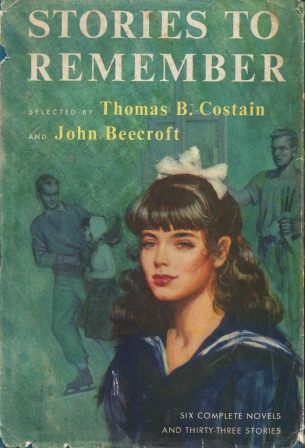
Stories to Remember, Volumes I & II, selected by Thomas B. Costain & John Beecroft ~ 1956. This edition: Doubleday, 1956. Hardcover. Volume I – 409 pages. Volume II – 504 pages.

My rating: 10/10. Excellent anthologies; something for everyone.

I have read the companion Stories to Remember  volumes many times over the years. This anthology was purchased new by my mother in 1956, likely through her long-time Doubleday Book Club involvement, and was some of the first “adult” material I dipped into as I expanded my childhood reading horizons. I still have the original books, and now my own family, adults & teens, re-read and enjoy them. And yes, I remember most, if not all, of the selections with deep fondness!

Looking at this collection with a critical eye 56 years after its publication, I fully suspect that some of the selections might no longer appeal to the average modern audience – would a typical 2012 teenager even “get”, or more to the point, even want to “get” many of the societal and historical references in Alexandre Dumas’ Man Who Lived Four Thousand Years, or Maugham’s Lord Mountdrago? –  but there is enough good stuff in here to keep any reader engaged for quite some time, even if one cherry-picks their way through the collection. Overall, an interesting vintage read containing a number of familiar authors & stories, as well as an introduction (or a remembrance?) of several writers now fallen out of public notice.

I have seen these volumes numerous times in 2nd hand bookshops, generally priced very reasonably. Worth picking up for dipping into, and for leaving on the guest room nightstand, if your guests are the type to appreciate a non-electronic reading experience.

The double-column format and smallish print takes a bit of adjustment on the part of the reader; it appears that the publisher tried to squeeze as much text as possible onto each page to limit the ultimate length of the book while still providing generous content. Occasional nicely rendered realistic line drawings throughout are an attractive feature.

A nice balance of dramatic, humorous and “darker” stories; not at all a depressing collection, which cannot be said for many other short story anthologies of more recent vintage!

Volume I

  • The General’s Ring (complete novel) – Selma Lagerlöf, 1925Written by the first woman to receive the Nobel Prize for Literature, in 1909. This is the first installment in a trilogy concerning a ring given to General Bengt Löwensköld by King Karl VIII of Sweden. After requesting that the very valuable ring be buried with him, it is soon discovered that the ring has been stolen from the General’s grave, with tragic consequences to everyone who subsequently comes in contact with it. A morality tale, a ghost story, and at least one love story make up this intriguing and well-paced novella, set in eighteenth century Sweden.
  • Mowgli’s Brothers Rudyard Kipling, 1894From The Jungle Book. A lost woodcutter’s child is adopted by a wolf family in the Indian jungle.
  • The Gift of the Magi O. Henry, 1906. Most of us will remember this one, stock story of countless anthologies! Della and Jim both sell the thing they love best to buy the perfect Christmas present for each other.
  • Lord Mountdrago W. Somerset Maugham, 1939. Lord Mountdrago consults a psychiatrist to help him deal with disturbing dreams. But are they really just dreams, or is something much more sinister going on?
  • Music on the Muscatatuck and The Pacing Goose (excerpts from The Friendly Persuasion) – Jessamyn West, 1945. Quietly humorous stories concerning Quaker fruit tree nurseryman Jess Birdwell and his Quaker minister wife Eliza.
  • The BirdsDaphne du Maurier, 1952. What if all the birds in the world banded together to revenge themselves on humans for the harm done to their kind throughout their shared history? Chilling. 
  • The Man Who Lived Four Thousand Years (excerpt from The Queen’s Necklace) – Alexandre Dumas, 1850. Count Cagliostro, who claims to have lived four thousand years, predicts the “unbelievable” futures of a group of royals and nobles gathered to dine with Maréchal de Richelieu in 1784.
  • The Pope’s Mule Alphonse Daudet, c. 1894. The humorous fable of a good Pope’s pampered mule, who gets her revenge on a tormentor after seven years’ patient waiting.
  •  The Story of the Late Mr. ElveshamH.G. Wells, c. 1911. The sinister Mr. Elvesham seeks immortality by continually switching bodies. 
  • The Blue CrossG.K. Chesterton, 1938. Clever but often underestimated Father Brown brings a jewel thief to justice. 
  • Portrait of Jennie (complete novel) – Robert Nathan, 1940. A struggling young artist encounters and adopts as a muse a mysterious girl who apparently has been travelling through time.  A ghostly love story.
  • La Grande Bretêche Honoré de Balzac, c. 1831. A convoluted telling of the tragedy of a grand old ruined house and its history regarding a Spanish nobleman, a jealous husband and a betraying wife.
  • Love’s ConundrumAnthony Hope, 1899. An ironically humorous, very short story concerning a self-absorbed scholar who completely misunderstands a confession of love and proposal of marriage.
  • The Great Stone FaceNathaniel Hawthorne, 1889. A young boy, inspired by a legend concerning a cliff resembling a strong human profile, waits his entire life for the human embodiment of the noble edifice to appear. It does, but in a way he has not suspected. (The Great Stone Face was an actual New Hampshire rock formation, known widely as “The Old Man of the Mountain” until its collapse in 2003. This story is one of the more dated tales in this anthology, though it is classic Hawthorne and enjoyable as such.)
  • GermelshausenFriedrich Gerstäcker, c. 1850. A wandering artist stumbles into a remote German village, the cursed Germelshausen; doomed to sink beneath the earth for eternity, only to arise for one day in each century. (This is one of my personal favourites in this anthology.) This story has been credited as the inspiration for the musical Brigadoon, though the setting in that case was changed to Scotland.
  • I am Born (excerpt from David Copperfield) – Charles Dickens, 1850. The title character describes his coming into the world. Irresistable – your next step will be to read the whole novel.
  • The Legend of Sleepy HollowWashington Irving, 1820. Itinerant schoolmaster Ichabod Crane sets his romantic sights on the lovely Katrina and meets a harsh fate for his folly in aiming too high.
  • The Age of MiraclesMelville Davisson Post, 1918. Injustice and retribution. A wronged heiress, a sudden death, and a clever onlooker who sorts it all out.
  • The Long Rifle (excerpt from The Long Rifle, a novel) – Stewart Edward White, 1932. Fictionalized account of the life of the legendary Daniel Boone.
  • The Fall of the House of UsherEdgar Allan Poe, 1939. A gothic horror tale. Roderick Usher and his sister Madeleine are the last of their family; they fulfill a prophecy which predicts their dramatic demise.
  • The Voice of Bugle Ann (complete novel) – MacKinlay Kantor, 1935A very short novella set in contemporary Missouri about an unjust conviction for murder and its surprising resolution. Fox hounds feature strongly.  
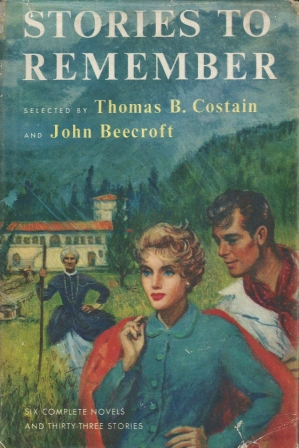
Volume II

  • The Bridge of San Luis Rey (complete novel) – Thornton Wilder, 1928. A suspension bridge in the Peruvian Andes gives way, sending a group of travellers to their demise. Who were they, and what chances of fate led them to their rendezvous with death at San Luis Rey? Excellent story.
  • Basquerie – Eleanor Mercein Kelly, 1927.   A lovely, not-so-young American girl in Europe must decide between love and (possibly?) a more financially wise match. This author is worth further investigation.
  • JudithA.E. Coppard, 1927. Aristocratic Judith meets  and dallies with a handsome young schoolmaster, to his eventual tragic downfall.
  • A Mother in Mannville – Marjorie Kinnan Rawlings, 1936. Touchingly poignant short story about an orphan boy and his integrity and pride.
  • Kerfol Edith Wharton, 1916. The tragic tale of a jealous French nobleman and his faithless wife. Supernatural elements – something of a ghost story.
  • The Last LeafO. Henry, 1905. Platonic love among a group of artists. Touching nd memorable.
  • The Bloodhound Arthur Train, 1923. Shrewd New York lawyer Mr. Tutt defends a client. Badly dated, one of the less memorable stories in this collection.
  • What the Old Man Does is Always RightHans Christian Andersen, 1861. Clever Danish peasants get the better of a condescending Englishman.
  • The Sea of Grass (complete novel) – Conrad Richter, 1936. Feuding between cattlemen and incoming small farmers in New Mexico at the turn of the century. Told from the point of view of the nephew of one of the most outspoken cattlemen, and with a crucial role played by Lutie Cameron, newly arrived from St. Louis to marry into the cattle-baron hierarchy.
  • The Sire de Malétroit’s Door Robert Louis Stevenson, 1877. In cavalier France of 1429, a case of mistaken identity and the equivalent of a shotgun wedding. Vintage Stevenson.
  • The NecklaceGuy de Maupassant, 1884. Vanity and social ambition lead to a young French couple’s downfall. An ironic small masterpiece of a story.
  • By the Waters of BabylonStephen Vincent Benet, 1937. Post-apocalyptic America seen through the eyes of a young man on a quest. A “rebirth of civilization” theme; definitely a precursor to the many similar stories which are hitting high popularity today.
  • A.V. Laider – Max Beerbohm, 1920. A palm-reader forsees the death of four friends, but chooses not to warn them. Or at least that’s his story… Nicely done! 
  • The Pillar of FirePercival Wilde, 1925. A clever method of cheating at cards is discovered and nipped in the bud. A bit rambling.
  • The Strange Will (excerpt from The Man With the Broken Ear) – Edmond About, 1862. The rather macabre tale of bringing a mummified murdered man back to life.
  • The Hand at the Window (excerpt from Wuthering Heights)- Emily Brontë, 1847. A short, decidedly gothic episode from the novel.
  • “National Velvet” (complete novel) – Enid Bagnold, 1935. 14-year-old Velvet Brown wins a horse in a raffle and decides to race him in the Grand National steeplechase. Beautifully written portrait of family life; the horses play second string to the human relationships. Excellent.
Read Full Post »

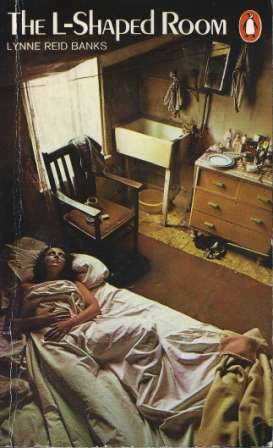
The L-Shaped Room by Lynne Reid Banks ~ 1960. This edition: Penguin, 1983. ISBN: 0-14-00-1913-8. Paperback. 269 pages.

My rating: 5/10. Just barely. It had a few good moments, but I generally did not care for this one.

Widely touted as a ground-breaking, pro-feminist, must-read novel of the early Sixties.

Lynne Reid Banks, born in 1929, and part of the post-war wave of  newly “liberated” women entering the professional workplace in droves, initially pursued a career as a stage actress, then as a television journalist, and, following a demotion, as a television scriptwriter. She took revenge by writing the first draft of this novel “on a company typewriter, on a company paper, on company time.”

http://www.lynnereidbanks.com/interview.html

The novel became an almost instant bestseller, and, with some plot changes to allow for the French accent of the starring actress,  was made into a successful 1962 movie featuring Leslie Caron.

Written very much in the first person, this is the story of twenty-seven-year-old Jane Graham, an ex-aspiring stage actress, who has moved back to her father’s house and is working as an assistant to a London hotel manager. Feeling jaded and dissatisfied with her life, Jane seeks out an old flame, with the idea of consummating their unfulfilled prior romance. The relationship doesn’t take, and, much to her surprise, Jane finds herself pregnant after the single sexual encounter (her first) which doomed the dying romance to its ultimate death.

Jane immediately decides she will keep and raise the baby, without telling her ex-lover, as she feels this is strictly her own affair, and she wants the child to completely belong to her. She is offered an opportunity for an abortion by the doctor whom she consults to confirm her pregnancy, but with high moral purpose, Jane indignantly turns the suggestion down.

She breaks the news to her staid and conservative father, who, in a state of shock and dismay, orders her to leave his house at once. Off Jane goes in a fit of pique, to find herself the most squalid room possible in a slummish part of town. This is the “L-shaped room” of the title, and it is located on the top floor of a decaying boarding house. The other residents are her contradictory landlady Doris; ex-wardobe mistress Mavis (who spies relentlessly on all comings and goings); Toby Coleman, a young writer; West Indian Negro jazz musician John; and two prostitutes in the basement, another Jane and a Hungarian refugee, Sonia.

Jane hides her pregnancy (she thinks) very well from those around her, feeling that to avoid the discussion at all is better somehow than lying about it. Jane eventually loses her job when her condition becomes too obvious to further ignore, but she finds solace in her growing friendships with her fellow tenants, and in a blossoming love affair with Toby.

Though I appreciate that there is some very fine writing in this story, and that it was much more forthright about taboo subjects than others of its era (first sexual encounters, the morality and reality of abortion, unwed motherhood, the physical rigours of pregnancy, sexual and racial prejudice, among others), I cannot say that I particularly enjoyed my reading of it.

Jane’s character, as revealed by our literal reading of her innermost thoughts, is self-centered, supremely egotistical, openly prejudiced against Jews, blacks and homosexuals, and almost offensively “honest”. Though she appears to inspire instant love and dedication in many of those she encounters, I could never quite believe in her widespread attraction to so many disparate people. I sometimes wondered during my reading of the novel, if some of Jane’s convictions of how others viewed her were rather delusions; she continually comments on how she has impressed others with her superiour taste, wit and knowledge.

Perhaps some of my reluctance to fully embrace this story has something to do with the style of the writing, often very much “statement of fact”; almost wooden at times. But mostly I just did not find Jane as worthy of sincere interest and affection as I would have liked; this sort of story, to work for me, has to have a much more deserving-of-my-regard protagonist. I often felt that the fictional Jane created many of her own problems, then moped about stewing in her resultant misery, before being bailed out by various strangely willing “white knights” – her supervisor James, Toby and John, her father (who almost immediately after telling her to leave writes begging her to return), and, most improbably of all,  her eccentric Aunt Addy, who appears out of the blue, after never being previously mentioned, offering succour at the most opportune moment.

Jane carries on a continual internal monologue at how strange and disgusting other people, places and objects are to her. I wondered if author Banks has an ultra-sensitive sense of smell; there are many mentions of offensive odours throughout, including the “strong Negro smell” of John, the cloying perfumes of Mavis and the prostitute Jane, the “bug-infested” odour of the house in general and Jane’s room in particular … over and over Jane makes mention of these, and her frequent nausea and disgust.

On the credit side, Jane does grow somewhat as a person as the story progresses; I found myself wondering if the author made Jane’s inner voice so critical and offensive to highlight how far she had to travel to approach a more tolerant and accepting point-of-view. She hassn’t quite gotten there by the end of the novel, though. Perhaps she progresses more in the next two books of the trilogy?

Improbably pat resolutions to some of the characters’ most pressing issues also jarred my sensibilities. Lots of loose ends tidily tucked away, many more so than would happen in the real world, I felt.

There is no doubt that Lynne Reid Banks has a writing talent of a high degree; as a first novel this shows an advanced ability and voice. Banks went on to write nine more adult novels, including two sequels to L-Shaped Room: The Backward Shadow and Two is Lonely; as well as numerous children’s’ books, most notably The Indian in the Cupboard (1980) and its several sequels.

There are many glowing reviews of The L-Shaped Room; mine, sadly, can not be one of them. I would still recommend the novel, with reservations, as an interesting period piece and for cultural literacy purposes for those interested in popular and/or feminist fiction of the mid-twentieth century. My most serious reservation concerns the continual overt racist comments (whether or not they reflect the author’s true views or are merely, as I rather suspect, an attention-catching plot device).  I felt there were some serious weaknesses in the probabilities of the plot itself.

I have also acquired a copy of the next book in the Jane Graham trilogy, The Backward Shadow, and, glancing through it, I see that the style appears much the same. I am going to read it soon, out of curiousity to see how (and if) Jane becomes more understanding and tolerant of others, and, also, in fairness to this still-popular and often highly regarded author, to give me another chance to try to more deeply appreciate her work.

Read Full Post »

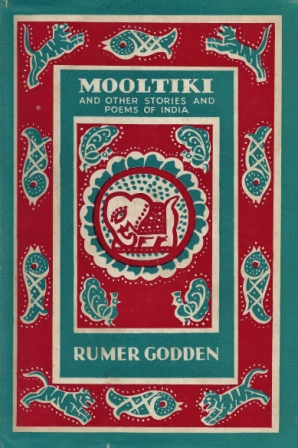
Mooltiki and Other Stories and Poems of India by Rumer Godden ~ 1957.    This edition: Macmillan & Co., 1957. Hardcover. 136 pages.

My rating: 7/10. Rather uneven collection of fair to excellent stories and mostly merely fair poems.

A slender volume of poems and short stories set in India.

BENGAL

  • Bengal River a poem
Nothing can mollify the sky,
the river knows
only its weight and solitude, and heat, sun-tempered cold,
and emptiness and birds; a boat; trees; fine white sand,
and deltas of cool mud; porpoises; crocodiles;
and rafts of floating hyacinth; pools and water-whirls
and, nurtured in blue mussel shells, the sunset river pearls.
                                                                                                            … … …
  • Possession

The rice field lay farthest from the village, nearest the road. On all sides the plain unrolled in the sun with a pattern of white clouds, white pampas grass in autumn and white paddy birds, and glimpses of sky-reflecting water from the jheels or shallow pools. The sky met the horizon evenly all the way round in the flatness of the plain, an immense weight of sky above the little field, but the old peasant Dhandu did not look at the sky, he looked at his field; he did not know that it was little; to him it was the whole world. He would take his small son Narayan by the wrist and walk with him and say, ‘This field belonged to my grandfather and your great-grandfather; to my father and your grandfather; it is mine, it will be yours.’

But life-plans may go horribly awry; Dhandu’s does not follow its anticipated path; in an ironic ending, which I somehow found reminiscent of W.W. Jacob’s The Monkey’s Paw, the field stays with Dhandu but is forever lost to his son.

  • Sister Malone and the Obstinate Man

Sister Malone is a nun in charge of a charity hospital in Calcutta; she is unshaken by the horrible sufferings all around her and does great good with her nursing abilities, but her continual effort to share her religious faith with those she heals goes unheeded. One day Sister Malone meets a man who has truly put all of his trust in God, but she cannot reconcile this with her own conception of what faith should be.

  • The Oyster

Gopal, a Bhramini Hindu student who has travelled abroad to study in England, visits Paris with a friend and is forced to examine the role of compromise in the formation of his own developing character.

HIMALAYAN NOMADS

  • The Goat PeoplePastoral Poems

Nine poems inspired by the nomadic peoples of the Himalayas of Northern India.

The tribes pass all through the spring, pitching their camp at night and lighting their fires under a boulder, a fir tree, or by an ice stream; moving on again at dawn, driving with a peculiar trembling whistle that is their own, something between a hawk’s cry and a flute, harsh, sweet and wild…

… I have tried to make these poems like the people, rough and rhythmical … without symbolism or image, simple and pastoral.

The Meadow

The Caravan

Flowers for the Animals 

The Elders

The Goat Women

The Animals

The Goat Children

The Goat Baby

Moving Downwards

  • Red Doe

A vignette of a young nomad riding up the mountain to fetch his unseen new wife. Sensitive and poignant.

  • The Little Black Ram

An orphan boy, Jassoof,

… a young thief, a bully, noisy, quarrelsome and turbulent, against everyone with everyone against him…

finds his place in the world through his care of a black ram lamb.

KASHMIR

  • The Wild Duck

Another vignette piece, about a young Kashmiri hunter, Khaliq, who, longing for winter to be over, thinks of his time the previous year among the high  mountains hunting ibex.

  • Two Sonnets

Just that; two sonnets. A regretful ode to winter; a joyful ode to spring.

Kashmiri Winter

Spring Sonnet

JUNGLE

  • Mooltiki

This first-person short story (24 pages)  is the jewel of this slight collection. Rumer Godden tells of her experiences in her sister and brother-in-law’s winter camp on the borders of Bhutan. Mooltiki, a small, opinionated elephant, is the “maid-of-all-work” of the camp, fetching firewood and providing transport for odd jobs, such as Rumer Godden’s small jungle explorations. Godden writes an amusing and appreciative ode to Mooltiki and her elephant kin, as well as an extremely evocative description of what if feels like to be involved as an observor in several “blinds” for problem tiger kills.

*****

Mooltiki is an interesting though quite slight collection of fictional short stories (except for the autobiographical title piece, decidedly the best part of the collection) and personal poems; after reading it through several times I must confess that my conclusion is that Godden was a much stronger writer of prose than of poetry!

Nicely done overall, with Godden’s trademark of strong, eloquent characterizations and descriptions of place. Definitely a work any Rumer Godden collector will want to have on the shelf; probably worth a purchase for Mooltiki alone, if it can be found for a reasonable sum.

The biggest fault is the shortness of the book; about an hour`s worth of reading, even if taking one`s time and savouring the beautifully nuanced style of most of the pieces. I thought the poems were the weakest point; some of the stories were excellent (Mooltiki, Red Doe, The Little Black Ram, and possibly Possession, stood out for me), while the others are merely good.

Recommended, with those reservations.

Read Full Post »

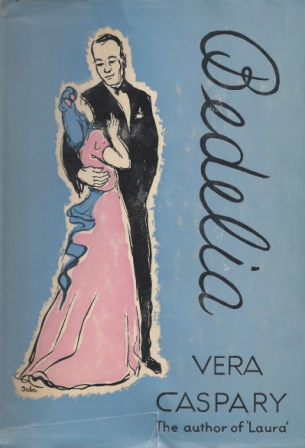
Bedelia by Vera Caspary ~ 1945. This edition: Blakiston, 1st edition, 1945. Hardcover. 187 pages.

My rating: 6/10.

I picked this book up “on spec” a few days ago; my attention caught by the back cover quote by Lionel Barrymore, referring to Caspary’s previous book, Laura:

One of the most intriguing mystery stories of recent years…

Always up for a good mystery story, and since this vintage hardcover would only set me back a few dollars, I took the gamble and brought it home. From the front flyleaf:

Vera Caspary has written a study of a psychopath as fluffy as eiderdown, a kitten whose claws were steel.

Bedelia was everything to please a man – and she pleased many. She was small, cuddly; she smelled nice. She never argued or lost her temper. Her house, like her hair, was shining, her food delicious. She loved to cook, and she adored the gadgets of housekeeping. How strange that a passion for percolators and copper pans should help solve the curious riddle of her past!

Irresistable prospect for an evening’s light read, I thought.

Right from the first page I was a bit disappointed in the quality of the writing; no beautifully put-together passages here. Caspary, if Bedelia is typical of her work, was a straightforward, “then she walked across the room” sort of writer. Just the facts, ma’am. Even the “tense psychological” bits are reported in a straight-faced, take-it-or-leave-it manner.

Bedelia and her new husband (and perhaps prospective victim?) Charlie posture and project all over the place, while I sat off in my spot as a not quite fully engaged spectator, figuratively yawning a bit and wishing they’d just get to the point, already. It felt very much like one of those melodramatic 1940s films where everything is so broadly telegraphed to the audience that we eventually become so hardened to subtle effects, which turns out to be an apt conclusion as I found out later that Vera Caspary was indeed a successful Hollywood screenplay writer from the 1930s to the early 1960s.

Bedelia is the tale of a besotted newly married man, Charlie Horst, and his adored bride, a beautiful and passionate young widow who gratefully clings to him and makes his life oh-so-sweet. She’s a marvelous housekeeper, an accomplished cook, a gracious hostess to his friends, lovely to look at (and smells good, too, as Caspary points out more than a few times) and, to Charlie’s greatest delight, she’s hot stuff in bed.

Charlie is as smug and contented as a well-fed tomcat parked on a fireside hearthrug, until a few too many discrepancies in his wife’s accounts of her past history get him wondering about which version of her story is the real one. When Charlie falls ill with a mysterious ailment his doctor immediately suspects malicious poisoning. But who would want to hurt good old Charlie? Certainly not his sweet little wife…

I later saw this novel referred to as Lady Audley’s Secret in 2oth Century clothes; most apt. While Bedelia left me considerably underwhelmed by the writing style, the plot was reasonably interesting, with a few surprises thrown in.

Charlie, far from being a sympathetic character as we would expect, has numerous flaws of his own, and a personality just as psychopathic in its way as Bedelia’s. His treatment of his childhood friend Ellen, who has long been in love with him (as he fully realizes) is callous in the extreme; she is possibly the only truly innocent and likeable character in the book, and we fear for her future at the close of the story. (At least, I did. Definitely a case of “be careful what you wish for!”)

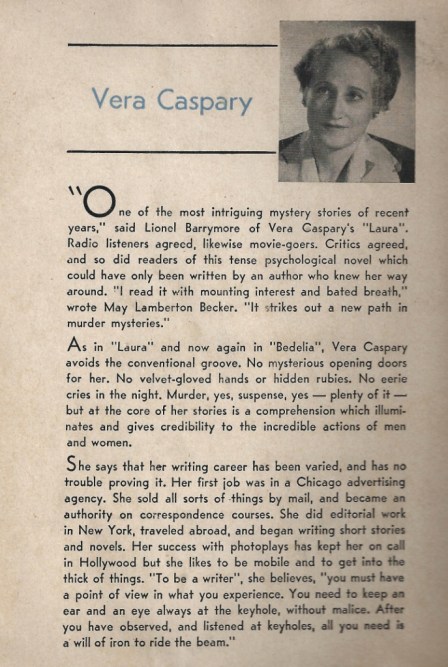
I was curious enough about Caspary and her referenced previous novel Laura (apparently made into a very successful movie, which I confess I have never heard of before) to do a bit of internet research on her.

Vera Caspary (1899-1987) had a full and eventful life. After graduating from business college, she worked as a stenographer and in an advertising agency. To support her widowed mother, she turned her hand to projects such as creating a successful correspondence course in ballet dancing, and one on  charm and deportment. She went on to work in journalism, and as a successful Hollywood screenwriter, and a best-selling novelist and short story writer.

Caspary had strong convictions which she was steadfast in defending; she embraced Communism in its most idealistic form during the 1920s and 30s, but was disgusted by the realties which she found both within the Communist Party in America at the time, and the appalling conditions which she witnessed during a fact-finding visit to Soviet Russia.

Despite eventually renouncing her communist sympathies, she was “blacklisted” in McCarthy-era Hollywood and struggled financially during the post-W.W. II years. Caspary was also an ardent feminist who defended her personal views and also her strong and independent female screenplay protagonists against producers’ attempts to sugar-coat them.

Vera Caspary is a writer whom I will be giving a second chance to, Bedelia‘s “slightness” notwithstanding. I hope to find a copy of Laura (book and film), as well as Caspary’s autobiography, The Secrets of Grown-Ups, published in 1979.

From a quick glance at AbeBooks, it appears that there is are abundant Caspary titles in second-hand circulation at reasonable prices. Not an author I am deeply enthralled with from this first exposure, but intriguing enough to follow up.

Read Full Post »

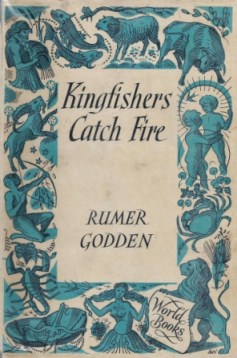
Kingfishers Catch Fire by Rumer Godden ~ 1953. This edition: Reprint Society, 1955. Hardcover. 280 pages.
My rating: 8.5/10.

*****

As kingfishers catch fire, dragonflies draw flame;
As tumbled over rim in roundy wells
Stones ring; like each tucked string tells, each hung bell’s
Bow swung finds tongue to fling out broad its name;
Deals out that being indoors each one dwells;
Selves – goes itself; myself it speaks and spells,
Crying What I do is me: for that I came.


These lines by Gerard Manley Hopkins head the prologue of this disturbing and haunting story.

This vintage Godden novel was new to me. I recently read the first volume of Godden’s autobiography, A Time to Dance, No Time to Weep, and was intrigued by the account of Godden’s three years in retreat in the Kashmir hill country, initially with only her two young daughters and later joined by several other women and children. Kingfishers Catch Fire was inspired by this time, and though the author states that this novel is not autobiographical, many of the incidents are those that Godden herself experienced, living in the actual house Dilkusha, in the Kashmir hills, operating a herb farm and employing the local people in the enterprise.

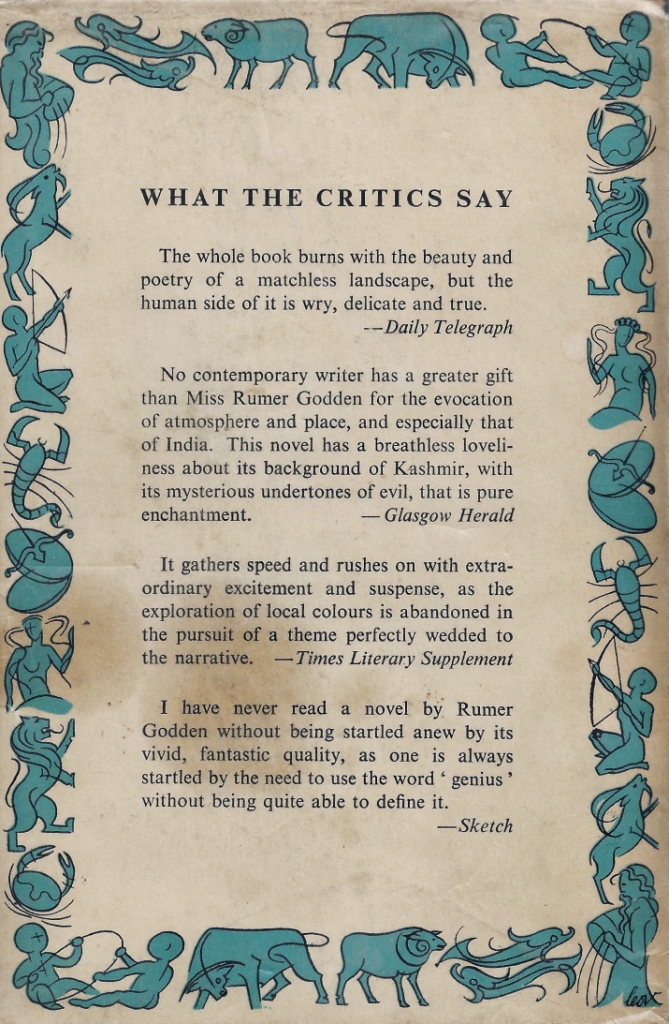
In one of those satisfying occurrences of bookish serendipity, soon after I expressed a desire to find this novel, it came to me all by itself, and in the form I most enjoy – an older hardcover, in its original dust jacket. I had casually ducked into the Salvation Army store to give the book section a quick scan, and had cherry-picked a Rohinton Mistry paperpack (Tales from Firozsha Baag) out from among the mix of ex-bestsellers and inspirational religious books that fill the racks in this particular location. I was turning away to leave when something turquoise-blue and white caught my eye – a promising “older book” dust jacket peeking out from behind the fat paperbacks.  My pulse quickened; after many years of second-hand book searching one seems to develop a sixth sense of when a find is at hand, and this time I was more than right – not only a good book, but  the particular book recently on my mind. I gently pulled it out from the shelf, and there it was, in its gorgeous World Books (Reprint Society) zodiac-themed jacket. About as perfect as it gets!

The story is typical Rumer Godden fare. An Englishwoman living in India (Sophie Barrington-Ward, long separated from her husband and recently widowed) gets herself into an impossible situation, behaves badly, finds redemption and emerges changed for the better; all of the action witnessed and brought into critical focus through the eyes of a child, in this case the Sophie’s young daughter, 8-year-old Teresa. Like a stone thrown into still water, the ripples of each action spread far and touch things on all sides, with unintended and often tragic consequences.

When news of her husband’s death reaches her, Sophie and her two young children are living on a houseboat on the lake at Rawalpindi in the Kashmir region of what would be present-day Pakistan. At first she is conventionally sad but not particularly upset; after all, she has a comfortable private income and her widow’s pension will be coming now as well. She has made a rather unique life for herself where she is, rejecting the British-European social life of the region and instead fraternizing almost exclusively with the locals – the picturesque boatmen, vendors and shopkeepers –  who see in Sophie a well-off patroness who spends generously and lives exclusively to please herself.

Sophie soon finds out that her husband has left huge debts; she manages to settle these but is left impoverished. Rather than returning to England in what she sees as defeat, Sophie ekes out an existence teaching “English to Hindu and Mohammedan ladies and Urdu to English people”.  As the bitter winter goes on, Sophie falls ill and is taken in by the local Mission hospital. When she recovers, she decides to simplify her life even further, to “live local” as a peasant (better a “peasant” than a “poor white”, she tells herself), and moves into a tiny house farther up the mountain.

Sophie’s idea of living like a peasant clashes with the reality of the local population, who are truly poor. Her continual blunders lead to a tragic incident that brings her “simple life” dream crashing down. Her daughter Teresa is a hapless witness to Sophie’s decline into chaos, and is a key player in the climactic ending of the story.

Sophie does wake up from her dream; she does confront her weaknesses; she does at least begin to change, and by the end of the story we have come to view her with a certain admiration if not with whole-hearted affection. Sophie’s initial emotional neglect of Teresa and her younger brother Thomas (“Moo”) is a key factor in making her such an unlikeable protagonist; she is an egotistical reverse-snob who makes snap judgments based on what she’d wish people’s personalities to be, and she sticks firmly to those opinions, even while being repeatedly shown how wrong they are. Sophie’s progression from that person to someone much more unsure of herself is the real drama of the novel.

For a while near the end of the story I thought I was going to be disappointed in my author – it was all coming out a bit too pat – a white knight who has been lurking in the background the whole book reappears to “rescue” Sophie just as she is sorting things out for herself, and Sophie falls into his arms with relief, but Godden ultimately allows Sophie (and Teresa) to walk out of the book with head held high.

An ultimately satisfying story, though not what I would consider a comfort read; the windows it opens into human foolishness and frailty strike close to home, and we are very aware throughout that there is no such thing as a universally happy ending; the most any of us can hope for is reaching some sort of compromise with life, if we are indeed one of the lucky ones.

As always, beautiful descriptions of place; Rumer Godden paints word pictures like no other. The children, Teresa and Moo, are very sympathetically handled; Godden is ever firmly on the side of innocence, though she never hesitates to let her innocents suffer in the interest of moving the narrative along.

This is, in my opinion, one of Godden’s better novels.

Read Full Post »

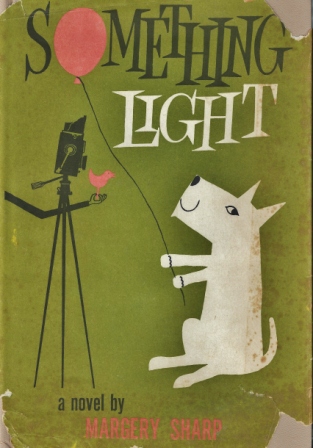
Something Light by Margery Sharp ~ 1960. This edition: Little, Brown & Co., 1960. Hardcover. No ISBN. 216 pages.

My rating: 10/10.

I love the works of Margery Sharp. No exclamation mark needed, merely a sober statement of fact. I am slowly and with deep pleasure building up a collection of her works. In every “Definition of Happiness” there is included “something to look forward to”; I am therefore a happy woman as I look forward with pure anticipation to sitting down with each hard-won out-of-print title by this most excellent forgotten author.

Luckily Margery Sharp was popular enough in her day that her titles are for the most part reasonably available with a bit of on-line searching, though her first two novels, Rhododendron Pie (1930) and A Fanfare For Tin Trumpets (1932),  fetch rather high prices in the used book world; well into the hundreds of dollars. In the meantime I haunt second-hand bookstores at every opportunity, peering hopefully at the faded titles of scruffy vintage hardcovers in eternal hopefulness. I did find two of her works this way, at the same most-excellent used bookstore in Kamloops, on separate occasions several years apart. I paid the princely sum of $5 each and controlled my great glee with difficulty until I was well away from the store. This also freed me up, as I gloatingly explained later to my slightly skeptical husband,  to be able to shell out for several of her other works at much higher prices, because then they all averaged out, and each one of the others wasn’t so ridiculously expensive, etcetera, etcetera.

But I digress.

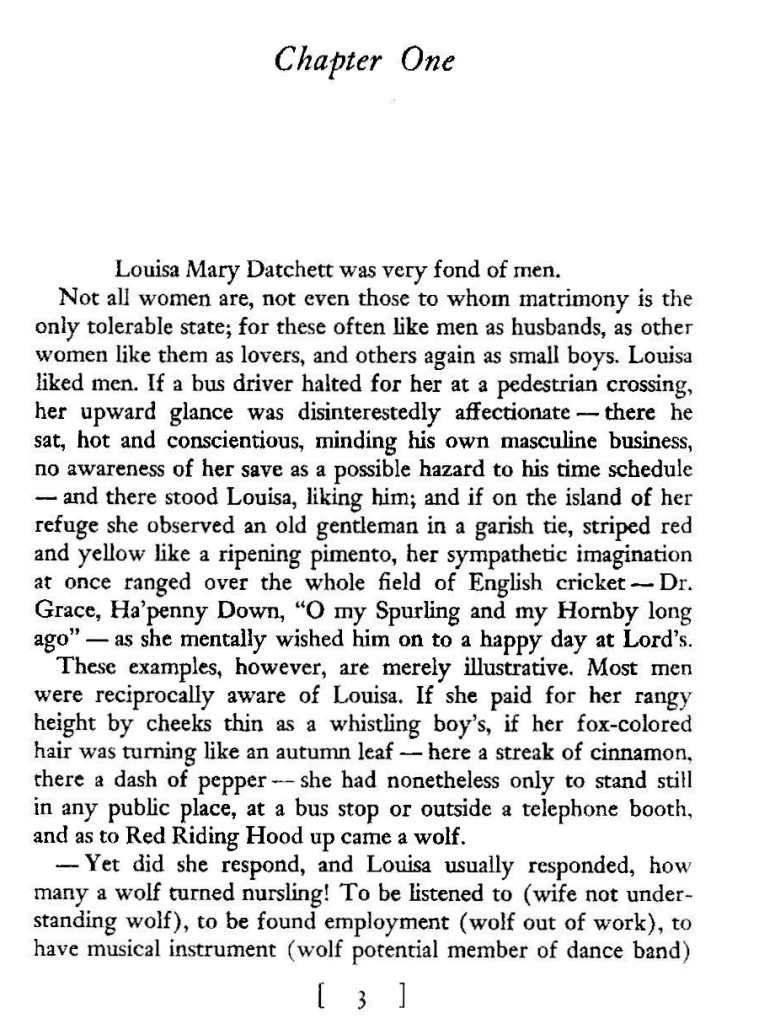
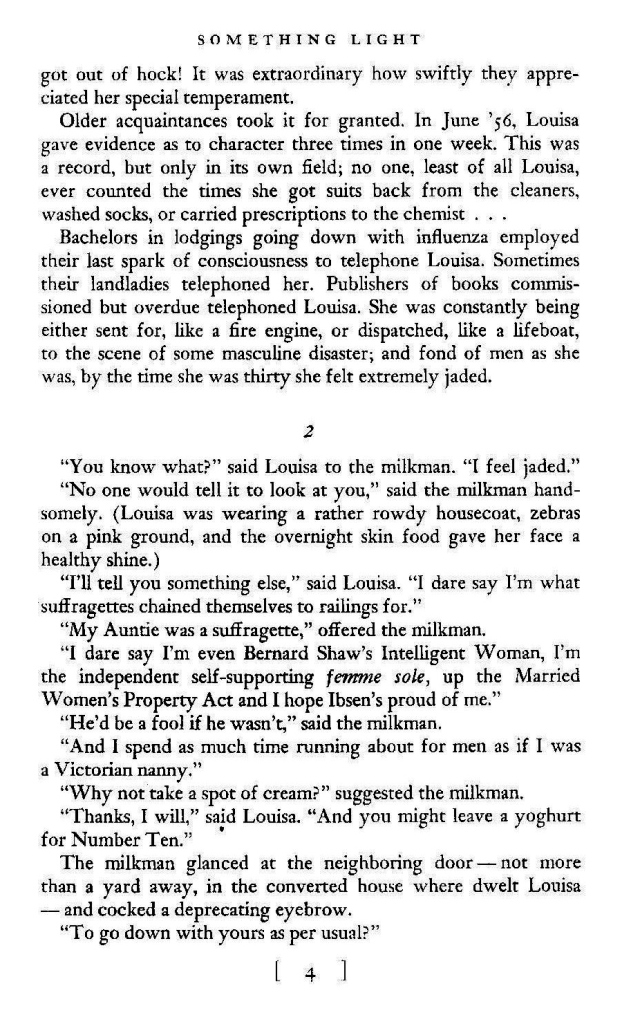
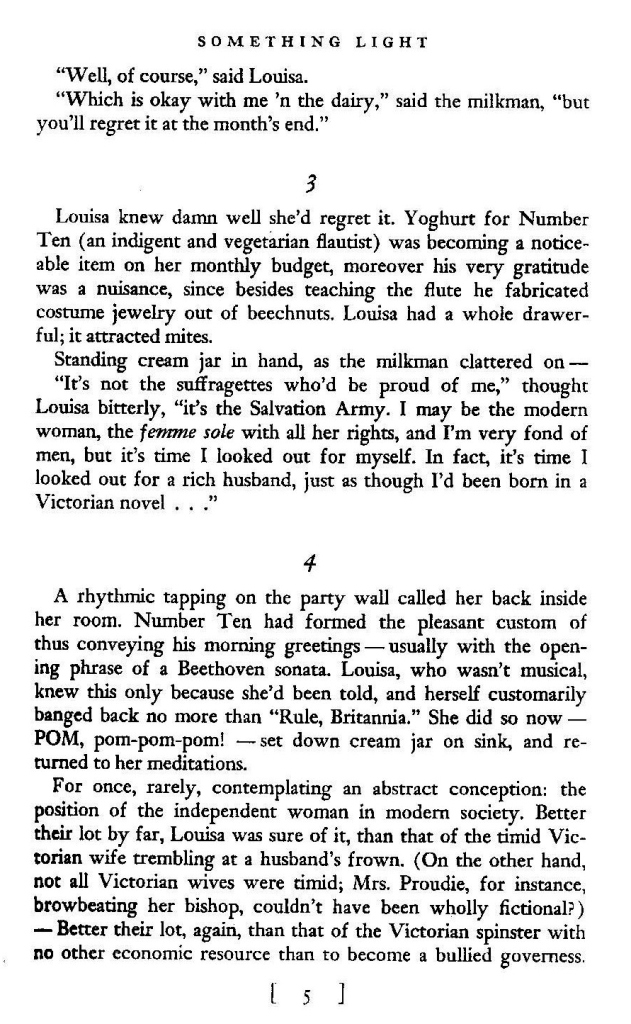
Something Light was my very first Margery Sharp, picked up on a whim at a little second-hand store I occasionally visit to scan through the modest book section. I noticed the book early in my shelf scan, but the faded and foxed dust jacket spine was less than appealing, and it wasn’t until my second pass around the stacks that something made me pull it out for a closer look. Here’s what I saw:

Hmm, I thought to myself. What’s all this, then? And I opened it up, noting that the pages easily turned as though it was used to being handled by a loving owner, and started to read. One, two, three pages. Then I quietly closed the book, walked up to the cash register, paid over my one dollar, tactfully ducked out of a conversation with the chatty proprietor, went out to my car, settled down and kept reading, completely neglecting my grocery and town chores list and stopping reading only when I was overdue to collect my daughter from her dance class. Definitely hooked.

Louisa Datchett likes men. No, not in the way that you’re thinking from that bald statement. Louisa likes men.

Here, read it yourself. A romp of a book,  something light indeed among Sharp’s delicious oeuvre.

Read Full Post »

« Newer Posts