Posts Tagged ‘Vintage Fiction’

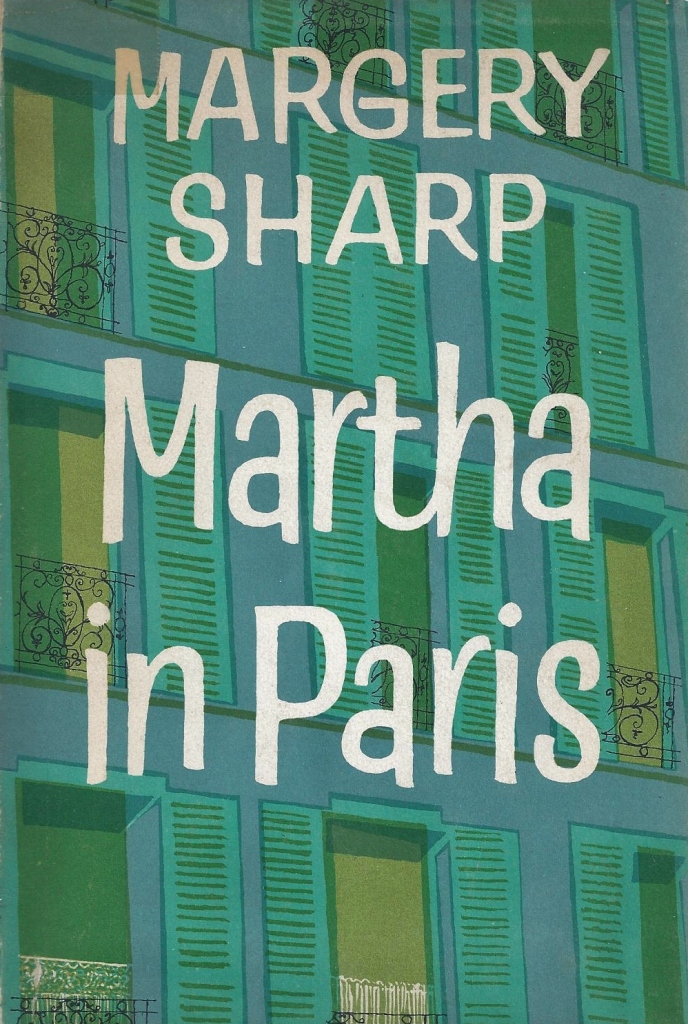
Martha in Paris by Margery Sharp ~ 1962. This edition: Little,Brown, 1962. Hardcover. First American Edition. 166 pages.

My rating: 9/10

From the front flyleaf:

In this “portrait of the artist as a young woman,” Margery Sharp uses all her individual observation – humorous, tender and astringent – to recount a climacteric twelve months in the life of eighteen-year-old Martha, who was sent to Paris to learn to paint, and learned a great deal else besides.

Readers who first met Martha as the stolid, matter-of-fact and altogether memorable child  in The Eye of Love and wondered what would happen to this truly independent spirit when confronted with Life now have an opportunity to find out.

Oblivious to the glamour and temptation of Paris, Martha’s single-minded pursuit of creativity and her matronly appearance seem to protect her from her Aunt Dolores’s delicately-put fear that “Martha might come to some harm…” Once called the Young Pachyderm by a friend back home near Paddington Station, perhaps because he glimpsed something tough-carapaced about her even then, Martha is now Mother Bunch to her fellow art students. Apparently the threat of Paris is to be lost ton her as she at once sets herself up in a doggedly methodical routine of working, eating and sleeping.

But Paris has an outrageous joke to play on Martha. It all begins with her somewhat unconventional adoration of deep, hot baths, after which she always looked her most attractive, or as the French say, “appetizing.” Nice hot baths involve Martha in an experience with a young Englishman (City of London Bank, Paris Branch) which would challenge the resources of a far more sophisticated girl than Martha. How she triumphantly copes with the resulting situation is the them of this engaging novel.

That about sums it up. I greatly enjoyed this next installment in Martha’s life-journey. Margery Sharp has settled into her story nicely; she champions Martha’s artistic cause and incidentally tramples over the gender-based lines of common behaviours; Martha is a true feminist, or perhaps we should say humanist; she has zero tolerance for the conventions which govern the behaviours of more conventional beings. Such as, for instance, her would-be lover Eric, and his doting mother. Their persistence in viewing Martha through their own rose-tinted spectacles of wishful thinking as to her personality and motivations lead to an ironically comedic situation, which Martha single-handedly sorts out in a most pragmatic way.

Martha is a deeply unusual heroine; regardless of her lack of sentiment and socially acceptable behaviour I found myself fully on her side in her Parisian adventures, and have no doubt that her ambitions will be fulfilled.

Highly recommended. If you can at all manage to find these three titles, read them in order. This is the middle book of a trilogy. The preceding book is The Eye of Love; the following book is Martha, Eric and George.

The Eye of Love is presently in print, in softcover from Virago Press. Martha in Paris and Martha, Eric and George are readily available and generally reasonably priced through ABE.

Read Full Post »

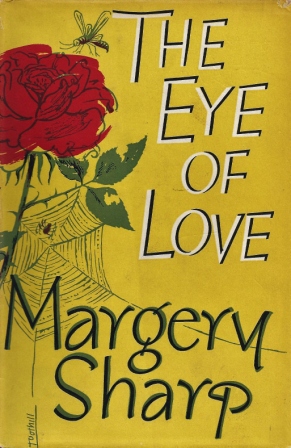
The Eye of Love by Margery Sharp ~ 1957. This edition: Collins, 1957. Hardcover. 1st Edition. 256 pages.

My rating: 9/10

I have been on an unapologetic reading binge these past few days; waking at my husband’s 5 AM alarm to blink the sleep from my tired eyes and reach groggily for the book I laid down the night before –  or, technically, earlier in the morning; too many times it’s been past midnight – foolish me!  A perfectly made cup of tea is always delivered to my bedside or chairside table by a man who values silence above conversation on workday mornings, and is himself stealing some precious reading time over his breakfast before heading out the door at the last possible moment. Our morning exchanges are brief; after thirty years together the pattern is predictably set, and it suits us very well. “What’re you reading?” and “Here, I’m done. You give it a try. Not bad…” and, so often,  “Hey, did you steal my book? I was still working on that one…”

Lately I have had an extravagant number of book-shaped packages from far-flung purveyors, so that like the proverbial child in the candyshop I am overwhelmed by choices and am greedily consuming each treat with an anticipatory eye on the next one. All are light fiction; summer reading at its best.

Trickling in much too slowly are a number of new-to-me vintage books by my beloved Margery Sharp. Margery wrote a trilogy of sorts between 1957 and 1964: The Eye of Love, Martha in Paris, and Martha, Eric and George. Naturally, the third book came first, then the second, with a dreadfully long lag before the first one showed up just a few days ago. I had been nobly holding off on reading them out of sequence, and I’m glad I did. These definitely need to be read in order to get a full appreciation of the journey of our unlikely heroine Martha. I am surprised that these do not appear in an omnibus edition; that would be kindest to the reader, and not unmanageable, as the three books are individually short and quick reads. Having gobbled them up, I will now review them in order, with a probably doomed attempt at brevity, and place them together on my dedicated Margery Sharp shelf in our bedroom (where all the “chuck out the window in case of house fire” treasures reside) to await happy re-reading in future.

Ladies of ambiguous status have by convention hearts of gold, and Miss Diver was nothing if not conventional; but a child in an irregular household is often an embarrassment. It had been wonderfully kind of Miss Diver to save her brother’s child from an orphanage, but not surprising; what was surprising was how well the arrangement had worked out.

It is 1929; Miss Dolores Diver’s widowed brother Richard Hogg has just died, leaving behind nothing of worldly value to his six-year-old-child, Martha, now a bona-fide orphan with an uncertain future. Miss Diver gallantly steps in.

She had never seen the child until an hour earlier; she had never before visited the shabby Brixton lodging-house in whose shabby parlour the thinly-attended wake was being held. – A dozen or so of Richard Hogg’s ex-colleagues from the post office stared inquisitively; this meeting between the two chief mourners provided a touch of drama, something to talk about afterwards, otherwise conspicuously lacking. (As Doctor Johnson might have said, it wasn’t a funeral to invite a man to: only one bottle of sherry and fish-paste sandwiches. Richard Hogg, with his motherless daughter, had lodged two full years in Hasty Street; but a landlady never does these things so wholeheartedly as relations, even with the Burial Club paid up and the next week’s rent in hand.)

Several years pass in complete amiability; young Martha is a rather odd but markedly placid child, and the Diver ménage, financed and patronized by Harry Gibson, head of a small furrier’s establishment, absorbs her without a hitch. Things are about to change, though. Harry’s business is struggling in the depths of the financial depression, and to save it he has contracted to marry one Miranda Joyce, hitherto-unmarriageable daughter of a very successful, upper-end furrier. Her father, in return for getting his daughter finally settled, is willing to re-finance Gibson’s. Harry decides to do the right thing by his prospective fiancé and renounce his mistress and his comfortable routine: five days of the week living quietly with his doting mother, with the weekend secretly spent in the little house with faithful Dolores and a tactful Martha, with the story to the rest of the world that he has continual weekend business in Leeds.

Since their meeting ten years earlier, at a Chelsea Arts Ball, Dolores and Harry have grown even more deeply in love. Now, on the eve of their parting, they cling together and reminisce.

“I’m sorry, Harry, but I can’t bear it,” said Dolores.

She huddled closer against his solid chest. It was his solidness shed always loved, as he her exotic fragility. For ten years they’d given each other what each most wanted out of life: romance. Now both were middle-aged, and if they looked and sounded ridiculous, it was the fault less of themselves than of time.

To be fair to Time, each had been pretty ridiculous even  at the Chelsea Ball. Miss Diver, in her second or third year as a Spanish Dancer, was already known to aficionados as Old Madrid. Mr. Gibson, who had never attended before, found the advertised bohemianism more bohemian than he’s bargained for. To the young devils from the Slade, unwrapping him, [Harry has come dressed as a brown paper parcel],his humiliated cries promised bare buff rather than pyjamas. Naked, indeed, he might have made headlines by being arrested; in neat Vyella, he was merely absurd.

Dolores, Old Madrid, not only pitied his condition but also lacked a partner. She’s have been glad to dance with anyone, all the rest of the night. But though rooted in such unlikely soil their love had proved a true plant of Eden, flourishing and flowering, and shading from the heat of day – not Old Madrid and Harry Gibson, but King Hal and his Spanish rose.

So they had rapidly identified each other – he so big and bluff, she so dark and fragile: as King Hal and his Spanish rose. Of all the couples who danced that night in the Albert Hall, they were probably the happiest.

Off Harry goes, to reluctantly propose to the very willing Miranda.

A quarter of an hour passed long as a century. To an impatient lover it would no doubt have seemed longer: Mr. Gibson was impatient only as a man about to be shot might be impatient. (Why hadn’t he been shot, in ’17?) The bitter parenthesis, by the memories it evoked, nonetheless helped his courage: when at last the door opened, like an officer and a gentleman Mr. Gibson clutched his carnations and stood bravely up to meet the firing squad.

Curiously enough, Miranda Joyce bore a marked physical resemblance to Miss Diver. Both were tall, black-haired, and bony. They were about the same age. Miss Joyce had even certain advantages: her make-up was better, she hadn’t Dolores’ slight moustache, and she was far better dressed. But whereas Mr. Gibson saw Dolores with the eye of love, he saw Miss Joyce as she was, and whereas the aspect of Old Madrid made his heart flutter with delicious emotion, the aspect of Miss Joyce sunk it to his boots.

But Harry Gibson soldiers on. The proposal is duly made and predictably accepted; the necessary conventions are observed.

Kissing her had been like kissing a sea-horse. Mr. Gibson knocked back his drink thankfully. (“I shall turn into a sozzler,” thought Mr. Gibson – dispassionate as a physician diagnosing the course of a disease.)

Fortunately Harry finds consolation in a growing friendship with his father-in-law to be. Mr. Joyce becomes a kindred spirit, and the one bright spot in Harry’s dark night of the soul.

Meanwhile Martha and Dolores are also soldiering on gamely. Dolores soon finds that she is unemployable; her only resource seems to be to let out rooms in her house. Fortunately for aunt and niece, Martha is quick to seize a chance while visiting her old home, and is instrumental in bringing home the perfect boarder. Bachelor Mr. Phillips, clerk of an insurance company, is at first innocuously quiet and reliable with the rent money. However, Dolores’ broken heart and subsequent stand-offish attitude soon have the effect on her boarder of rousing in him a great curiosity as to her personal situation, and, quite soon, a desire to wed this woman whom he very wrongly perceives to be financially independent and a property owner to boot.  What Mr. Phillips doesn’t know is that the house is merely leased, with the term coming up; hence Dolores’ desperate need for Mr. Phillips’ financial contribution, and her reluctance to snub his distasteful though so-far polite advances

The games of in-and-out and false pretences escalate, and while her elders are torturing themselves with emotional gymnastics, young Martha is single-mindedly pursuing her one interest. She is teaching herself to draw. Martha sees the world as a series of shapes; capturing images, fitting them into those categories, and transferring them from her eyes to her mind to paper takes up every waking moment.

Dismissed as merely a scribbling child, Martha stolidly ignores the adult world, and it in turn takes little notice of her. Until one day Mr. Joyce, through a series on coincidences, happens upon Martha drawing a tree. He is a connoisseur of the arts; he recognizes a budding young talent when he sees it. He offers Martha his patronage, and buys her much-desired paper, charcoal and chalks, which she unemotionally accepts while refusing the offer of  a longer-term artistic relationship and sincere, friendly interest which Mr. Joyce extends.

These complicated relationships get more tangled as time goes on; their multiple resolutions are a typically Margery Sharp juggling act. The tale winds up with a combination of most satisfactory endings, and we leave Martha in particular with the hopeful idea that her future, if not exactly easy, will be extremely interesting.

A cleverly written, very smart, satirical, darkly amusing novel. On par with Something Light, though not quite as gentle; the humour of The Eye of Love is decidedly savage at times.

I’m not at all sure if Margery Sharp planned at first to continue Martha’s saga, as The Eye of Love is a decidedly stand-alone novel, but I am so glad she did. Very highly recommended. Next book in the trilogy: Martha in Paris.

Read Full Post »
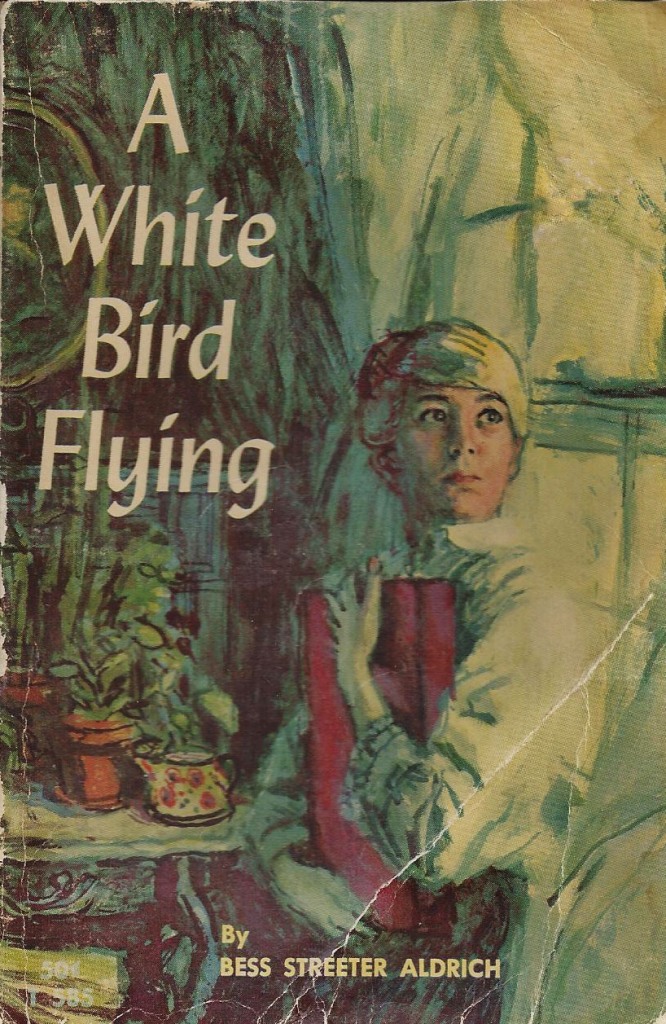
A White Bird Flying by Bess Streeter Aldrich ~ 1931. This edition: Scholastic, 1964. Paperback. 318 pages.

My rating: 5.5/10

American writer Bess Streeter Aldrich (1881-1954) is likely best known for her popular novel, A Lantern in Her Hand, the story of Nebraska pioneer Abbie Deal. I had read and greatly enjoyed that novel, so was quite looking forward to reading A White Bird Flying, which follows Abbie’s granddaughter, Laura Deal, on her own coming-of-age journey.

I am sorry to say that strong Abbie’s granddaughter is a wishy-washy little thing, and that I was generally disappointed in this lightweight  novel. It reminded me of some of the more sentimental twaddle perpetrated by our iconic Canadian author Lucy Maud Montgomery, who wrote in a similar time period and genre; much as I love some of her stronger novels, she was also capable of churning out some dreadful slush; ditto Aldrich.

The first part of the book is perhaps the strongest. Abbie Deal has died and been buried with due ceremony; young Laura stands in her beloved grandmother’s house a few days after the funeral, and tries to come to terms with death and what will happen next. Laura is a deeply emotional, imaginative child; at twelve she already aspires to one day be a writer, and she thinks in those terms.

She was half enjoying herself in an emotional way. There was a sort of gruesome ecstasy in making herself sad with memories. She would like to write about it. “The girl moved about from room to room, touching the things lovingly,” went through her mind. She was in one of those familiar moods when she looked upon life in a detached way as though she herself were not a part of it. She could never talk to anyone about it, but in some vague way she felt withdrawn from the world. She lived with people, but she was not one of them.

Perfectly captures the essence of an introspective adolescence.

Laura goes on her dreamy way, often at odds with her practical, striving mother who is often bewildered by her introverted, sentimental daughter. Laura continues to pursue her private ambition, turning out poems and stories and seeing the world through detached eyes.  She often thinks of her grandmother, and of how Abbie had given up her own ambitions to dedicate herself to full wife- and motherhood; Laura is appalled at the thought of a similar fate for herself and resolves to form her own life quite differently. She decides that she will turn her back on love, and particularly marriage; instead she will dedicate herself to her art and become truly fulfilled in a way a mere housewife can never attain.

Well, the inevitable happens. Laura dreams her way through college, and attracts the attention of a boy from her own home town, Allen Rinemiller, who has strong ambitions to improve the family farm with modern ideas, and has a rather interesting philosophy himself, which Laura scornfully dismisses.

Allen proposes; Laura naturally declines.

“…I can’t think of anything more prosaic than settling down here…and sort of letting the world go by.”

“I don’t call it letting the world go by,” he returned quickly. “I call it tackling a small piece of the world and making something of it. You admit Morton and his bride and all the rest of the old pioneers did a great thing when they crossed he river and started their settlements. You’ve said it was romantic and intensely interesting, and quite worthwhile. You think their own love lay at the bottom of their acts of courage and bravery. All right – did you ever stop to think that maybe we’re pioneers, too? Haven’t you the vision to see that? Why isn’t it something of pioneering that I’m trying to do? Agriculture in most quarters has been a hard, wearisome proposition…I’m pioneering, too – and a whole lot of other young fellows from colleges and universities, we have visions, too – a new outlook on the whole thing…We’re pioneering…starting a new class…the master farmers who are attempting to develop agriculture to the nth degree. Why couldn’t you enter into that in the same spirit your grandmother did? …Because you’re rooted in the soil, need you be a nonentity?”

Allen’s stirring words fall on deaf ears; Laura has already decided to pursue the celibate life, and has even promised her wealthy, childless aunt and uncle that she will remain unmarried and look after them as a daughter would, in return for inheriting their fortune, justifying this strangely unromantic and mercenary agreement by the excuse that it will allow her to pursue her writer’s career without worry and interruption.

The only fly in this particular ointment is that Laura is no prodigy; her talent is modest at best, as she is slowly beginning to realize.

The rest of the story follows its predictable-from-the-first-page path; no surprises here. Laura does marry Allen and dedicate herself to the farm; there are some tough years, but even through these Laura`s issues are not on par with those of her grandmother’s generation. Laura bemoans the fact that she cannot afford new curtains, and a new carpet, and a new dress; Abbie Deal dealt with life and death concerns and had a much more elemental notion of what the truly important things in life were than her grandchild ever faces up to.

I do get the feeling, however, that Aldrich portrays this dichotomy deliberately; the decadence of the descendents of the pioneers, though sympathetically portrayed, is a common undercurrent of her books I’ve read so far. She was obviously very interested in the generational and cultural shifts of the pioneer-to-modern era, and by and large captures the essence of the succeeding generations and their attitudes towards those who came before.

I will be reading more of this author’s works, as opportunity allows, though I doubt I will go to a lot of effort to seek them out. And while White Bird was not a particularly strong novel, it had its generally well-written and thoughtful moments, and I will overlook my vague annoyance at self-centered Laura and her self-created melodramas to classify it merely as a lesser entry into the long-respected Aldrich canon.

I am editing this review to add a Young Adult classification. It was re-published by Scholastic, after all, and the subject matter may be of interest to teenage readers, though I suspect many of them will be as annoyed at Laura as I am.

Read Full Post »

An American Girl in London by Sara Jeannette Duncan ~ 1891. This edition: Rand, McNally & Co., circa 1900. Inscription: “To another American girl – Mary Couch Huntington, Xmas 1900.” Hardcover. 290 pages.

My rating: 7.5/10

This is that most pleasant of things, a book purchased on a whim for a for a minor sum, which turns out to be a grand read, and then, even better, to add another author to the “keep an eye out for” list.

I paid 50 cents for this “genuine antique”; it was half-price book day at the local Sally Ann; I dipped into the gilt-edged, obviously well-read volume and it looked promising, well worth a tiny monetary gamble. I had initially thought that it was a volume of genuine reminiscences, but early in I realized that it was instead a gently satirical fiction. I found myself completely drawn into Miss Mamie Wick’s fresh and frank dialogue, and I eagerly followed her as she solitarily travels from Chicago to New York, and sets sail for England.

What a grand period piece this amusing novel is! Written in the late 1800s, the narrator is not shy of poking gentle fun at herself and the thousands of her American compatriots who are eager to explore England’s historical places and partake of whatever social whirl they can shoehorn themselves into.

Our own Miss Wick is extremely fortunate in her shipboard acquaintances; she makes a strong impression on a young British aristocrat (how strong becomes quite apparent to us early on, and to Mamie herself at long last, near the end of the story), as well as on an initially frosty elderly ladyship who completely unthaws under the influence of Mamie’s unusual charm, with interesting further consequences.

Mamie does all of the typical American tourist things; she visits Madame Tussaud’s, the London Zoo, the Epsom Derby, boat races at Oxford, and all the rest, but her aristocratic acquaintances smooth her way to higher levels and grander experiences than most American tourists ever attain, and she shares every impression with us. I did truly get a vivid picture of what the England of the time (at least in the relatively “higher” circles in which Mamie’s social class moved) looked, sounded and felt like through Mamie’s eyes; the author, while maintaining a delicately cynical tone, obviously had a great fondness for all of the best aspects of contemporary and historical England and her inhabitants.

The protagonist is thoroughly likeable and full of little unexpected insights and surprises; I laughed out loud several times at her philosophizing and her witty internal voice; she doesn’t miss much, but she continually minds her manners and behaves with impeccable politeness, much to her credit, as the same cannot be said of some of the people she encounters.

My only complaint was that the ending was much too sudden; it was the only part of the story that felt a bit forced; but as we could have gone on with Mamie forever I suppose it was a necessary break.

I was so impressed by this story and its unexpected quality that I researched the author. Lo and behold – Sara Jeannette Duncan turns out to be a well-respected and quite well-known turn of the century Canadian author and journalist. Here she is:

http://en.wikipedia.org/wiki/Sara_Jeannette_Duncan

http://www.biographi.ca/009004-119.01-e.php?&id_nbr=7912

Several of Sara Jeannette Duncan’s works are available on Project Gutenberg, and many of her works are still in print; she is apparently a staple of Canadian women’s studies courses at our universities. Who knew?! (Well, obviously a lot of people. Just not me. But I know now!)

And I am mildly thrilled to discover that An American Girl has a sequel,  A Voyage of Consolation. I started reading this on Gutenberg last night, and then decided to quit with that and try instead to find a print copy; I want to read it in perfect comfort, meaning not on a screen, and then place it on my shelf next to my newest antique, ready for re-reading at my leisure.

Sara Jeannette Duncan’s more serious works, fictional and journalistic, are now top of my look-for list, and if these light novels are any indication, she will be a smooth and witty read in any genre.

Bonus: I can add this review as my second entry in the 6th Canadian Book Challenge: http://www.bookmineset.blogspot.ca/2012/06/6th-annual-canadian-book-challenge-what.html

This author is authentically Canadian, despite the title of this piece, which had led me to initially assume she was American, and her body of work reflects her native land, though she did leave Canada both to travel widely in her journalistic career and to accompany her British husband on his postings abroad. Sara Jeannette Duncan died in England in 1922, at the much-too-young age of 62.

Read Full Post »

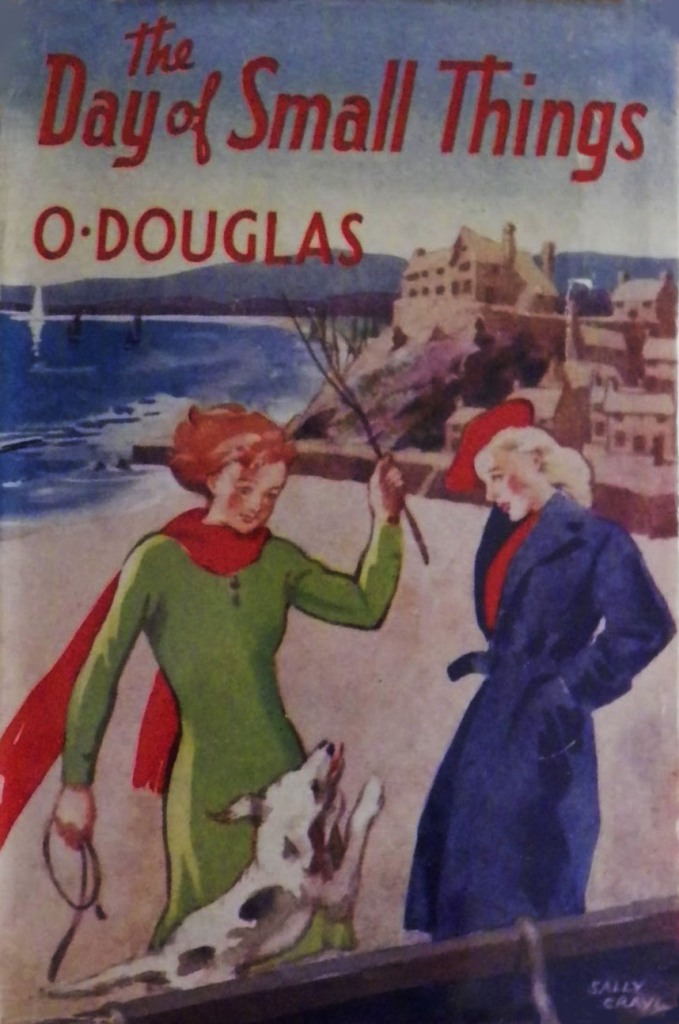
The Day of Small Things by O. Douglas ~ 1930. This edition: Thomas Nelson & Sons, Ltd., no date stated;circa 1950. Hardcover. 286 pages.

My rating: 8/10

Who hath despised the day of small things?

Zechariah, iv. 10

Good things sometimes come in unpromising packages. Check out the cover illustration of this small novel. What would you think?  Perhaps a children’s holiday tale? Given the Biblical-reference title, what about a religious story-tract, one of those saccharine preachy ones so distressingly common in vintage book stacks? Girls’ school story? Luckily, it’s none of the above. Instead, a delightful “character” novel following the lives and thoughts of a group of women in a seacoast town in Scotland between the wars.

I was familiar with O. Douglas only through one of her earlier books, Penny Plain, which, while a pleasant and quaint diversion, was not a masterpiece by any stretch. The Day of Small Things, published 10 years after Penny Plain, is not a masterpiece either, but it is rewarding to see how the author has refined her craft in the years between the two books.  While Penny Plain is generally competently and appealingly written; Small Things is exponentially better.

This book is a sequel to an earlier novel, The Proper Place (1926), concerning an aristocratic Scottish family, the Rutherfurds, forced by circumstances to sell the family estate. Lady Jane has lost both of her sons in the recent Great War; the subsequent death of her husband and unexpected financial hardship prompts her one remaining child, a daughter, Nicole, to suggest their removal to a smaller establishment more within their new means. Accompanying them is Lady Jane’s niece, Barbara, but she has married and is back at Rutherfurd Hall at the opening of Small Things, leaving Lady Jane and Nicole in their new home, Harbour House, close by the sea’s edge in the fictional east coast town of Kirkmeikle.

I found the first few chapters rather confusing, as they continually reference people, places and events that I felt I should have known much more about; such is the nature of a sequel. However, I soon sorted it all out due to the author’s clarity of conversational “sorting out”, and I proceeded on my way, enjoying the story at hand while mentally resolving to read the earlier novel as soon as possible.

In The Day of Small Things, Nicole and Lady Jane have become more than reconciled with their new life; they have made Harbour House a refuge from the world’s storms for themselves and a varied parade of friends. Into their peaceful world comes a disruptive influence in the form of Althea Gort, Lady Jane’s sister-in-law’s niece. Child of a notoriously ill-matched and eventually divorced society couple, nineteen-year-old Althea is now an orphan, and well used to rejection. Her aunt wishes her upon the Rutherfurds hoping they will provide a settling influence, and also to remove Althea from an undesirable lover. While Lady Jane is welcoming, both Nicole and Althea bristle at the thought of sharing a home with each other – their upbringings and personalities are diametrically opposed and they resent each other even before they meet.

The transformation of Althea runs through this novel. There are many interweavings of  personal stories, and a wide array of characters. Those that stand out are the matronly “middle class”  (by her own description) Mrs. Heggie and her brusque but talented poet daughter Joan, and the newly widowed Esmé Jameson, seeking solace in a new home and garden, after nursing her husband through years of pain and suffering caused by his war injuries.

A theme that runs through both this novel and, to a lesser extent, Penny Plain, are the changes in social class and the blurring of societal boundaries since the war. The Rutherfurds are of the old aristocracy, but they also realize that their traditional “time at the top” has come to an end; they are gracious in their ceding to a new social order, while the strivings of the strong and rising “upper middle class” and the nouveau riche incomers are observed with a wry and humorous (but generally benign) eye. As in Penny Plain, wartime recovery, dealing with grief, and drastically changed circumstances also shadow a story mostly concerned with small doings; friends and social rivals drink tea, gossip and jockey either delicately or robustly for position among the evolving small-town cliques.

While one of the love stories in this tale resolves itself in the traditional way, another does not; the circumstances of both are well-handled by the author. There is a lot of emphasis on doing one’s duty and the importance of willing sacrifice of personal desires; again, these unfashionable moralities are handled with sensitivity and humour by the characters.

The narrative is flawed at times; some of the characters are improbably “good” in their thoughts and actions, though all are allowed to show a glimmer of human temper and weakness on occasion, saving the story from blandness.

I enjoyed this book enough to actively seek out more of O. Douglas’s titles; a number are being brought back into print, and several are available through Project Gutenberg, but as I prefer early edition hardcovers I have gone ahead and ordered several through the trusty ABE network; Priorsford, which is the sequel to Penny Plain, and The Proper Place, the prequel to The Day of Small Things.

These are just what I need right now, as in my real life there is a certain amount of emotional turmoil as friends and family deal with health problems and other life-altering challenges; we have very recently lost a dear family member to illness at much too young an age; books such as these are a diversion and something of a comfort as the characters are dealing hopefully and gracefully with similar universal problems.

Read Full Post »

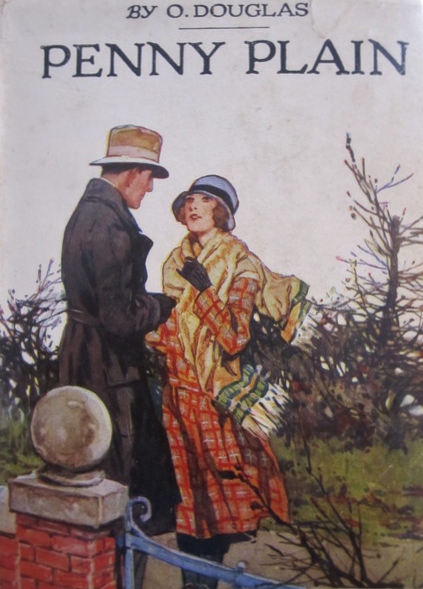
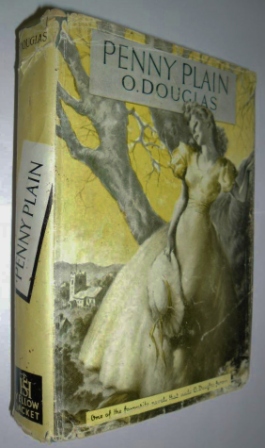
penny plain hc dj o douglasPenny Plain by O. Douglas ~ 1920. This edition: Thomas Nelson & Sons, circa 1950. No publication date can be found, but the flyleaf is inscribed “Christmas 1950”.  Hardcover. 380 pages.

My rating: 7.5/10

I picked up this title many years ago and regularly re-read it but I did not realize until just recently that the author, O. Douglas, still has a popular following, with a number of her books still in print and more planned for re-issue.

O. Douglas is the pseudonym of Anna Buchan, sister of John Buchan  (The Thirty-Nine Steps et al.)  While their works are not at all alike it is perhaps not surprising that a writerly talent would run in the family. O. Douglas was a bestselling author in her own right, as John Buchan was in his.

Penny Plain is a rather innocuous little story, but none the less enjoyable for its quietness; in fact, that would appear to be its intent. Its heroine is a 23-year-old Scottish woman, Jean Jardine, who lives in the small fictional Scottish town of Priorsford. Jean and her two brothers were orphaned at a young age and were brought up by a strictly religious aunt; Jean in particular has had instilled in her a strong sense of morality and duty which balance nicely with her natural exuberance and generosity. The aunt has gone on to her greater reward, and Jean is now the head of a lively household of siblings.

As the story opens, Jean is preparing to send her 19-year-old brother David off to his first term at Oxford. Money is very tight and Jean worries that he will find it a challenge to move as an equal with other students from much wealthier backgrounds. Jean worries a lot, and for a valid reason; she is of a naturally maternal bent, and besides David her responsibilities include another brother, 14-year-old Jock, and an adopted brother, 7-year-old Gervase.

A new neighbour is about to sooth the pain of David’s departure by giving new life to the small community’s social circles. The Honorable Pamela Reston, 40 years old and facing a serious life-altering decision, has decided to make a retreat from the social whirl of her bust London life to quiet Priorsford,  to sort herself out and settle her mind with some musing time. She and her cheerfully outspoken maid Mawson have taken rooms with Miss Bella Bathgate, who, finding herself financially struggling since the war (the story is set several years post-Great War, about 1919-20) has decided to let rooms in her large house. The interplay between dour Scotswoman Miss Bathgate, Cockney Mawson, and English aristocrat Pamela is amusingly presented, and comes off well. O. Douglas bravely tackles several dialects, and the various voices come through loud and clear, though the reader will need to shift mental gears and pay close attention to the Bella-Mawson interchanges..

Pamela and Jean become fast friends upon their first meeting; Pamela is attracted to Jean’s sincere and gentle nature and Jean finds much to admire in Pamela’s outgoing and affable personality. They find they have many tastes in common, though Jean refuses to be patronized by her much wealthier friend and holds her own when her strongly conservative beliefs are challenged. The story progresses at a leisurely pace, describing the society of Priorsford, the tea parties and social encounters and continual interplay between the classes, with glimpses into the strivings, pleasures and pains of each set of characters.

This is what this book does so well. It is a true period piece; a story set in the time it was written, with happenings and emotions drawn from the real experiences and observations of the author. The Great War – World War I – is just over. Many of the characters are dealing with devastating loss – the actual loss of fathers, sons, brothers to the fighting; the loss of peace and emotional security as post-war adjustments are struggled with; and the loss of financial security as the war has affected investments and increased taxation. An undercurrent of grief and longing runs under the happy-go-lucky storyline, and we never lose sight of the gallantry of everyday people putting on brave faces and doing the best they can with what they have left. Few bemoan their fate; it’s all very stiff-upper-lip, but there are many poignant moments to keep the lightheartedness in balance.

The slender plot of the story itself is predictable to the extreme. It is simply boy-meets-girl, part ways, and come together again. Pamela happens to have a younger unmarried brother, Lord Bidborough, who comes to visit her in her self-imposed exile. He is immediately smitten by gentle Jean. Jean is smitten in turn, but her strong sense of duty to her brothers, combined with her fastidious morality which looks askance at the idea of a poor girl “running after” a rich man nips their relationship in the bud, at least temporarily. The Jardines themselves have an older unmarried cousin, Lewis Elliot, who happens to be a childhood acquaintance of Pamela’s; they renew their relationship with predictable results. Add in a mysterious visitor , and the unexpected rewarding of Jean’s good deeds and giving nature, and you have the outline of what could be a saccharine and preachy tale, but which somehow transcends its genre and results in a very likeable little feel-good tale. The author stays true to form and provides an unashamedly happy ending.

This is not an “important” book, but it is surprisingly attractive in its simplicity. I do believe the author succeeded in what she set out to do; to tell a pleasant tale about likeable people coping with difficult times and overcoming their personal challenges. There is no hidden meaning or deeper agenda; it is very much what it appears to be; a few hours of pleasure for readers, to allow them to escape into a fictional world that could very well be real, but where problems are happily resolved and virtue is rewarded; where tragedy is present and recognized, but where people overcome and cope, and where life very much goes on.

I have just come across another O. Douglas novel, The Day of Small Things, and I am looking forward with mild anticipation to reading this, and to exploring this writer’s works a bit more as circumstances allow.

Cover images supplied of two early issues courtesy ABE, though not my own copy, which is a small “austerity” edition with badly damaged black boards. I suspect my copy is wartime (WW II, that is) or immediately post-war issue; there is a list of other books of note and this statement from the publisher: “It is regretted that, while the present paper shortage persists, your bookseller will not always be able to supply the book you want.”

Read Full Post »

The Middle Window by Elizabeth Goudge ~ 1935. This edition: Thomas Nelson & Sons Ltd., 1949. Hardcover. 310 pages.

My rating: 3.5/10

This is a rare negative review. Rare, because if I sincerely dislike a book, I will put it down unfinished and never pick it up again. Since one can’t honestly review a book without reading the whole thing at least once, and spending some mulling-over time on it as well, the situation generally doesn’t arise.

In this case I persevered with The Middle Window (though it took me numerous tries) because it is an early work by an author whom, for all her many literary flaws – frankly purple prose, excessive sentimentality, long passages of vaguely theological navel-gazing, repeated use of the same characters under different guises, and improbably tidy “happy” endings – I generally enjoy, and I was eager to add another title to the growing Elizabeth Goudge section on my shelves. I have at last choked the whole thing down, several years after its much-too-pricey purchase, and at least three aborted previous reading attempts. So I am going to review it, and then tuck it away at the back of the shelf, and move on.

Warning: spoilers follow. If you’re already a die-hard Goudge fan, you won’t be put off by knowing what happens; it’s utterly predictable but you won’t mind that – all of her books follow generally the same pattern, and you’ve already figured that out, right? If you’re just getting started on her books, or are wondering if they’re worth your time, this may help you make up your mind. This author wrote some MUCH better novels – do not start with The Middle Window! Try the Eliot trilogy instead (The Bird in the Tree, The Herb of Grace, The Heart of the Family), or The Scent of Water – my personal favourite.

*****

Spring had jumped straight out of heaven into London. For an eternity coughing, sneezing millions had coughed and sneezed at the centre of a black balloon of fog and dirt, frost and misery. Young and old, rich and poor, fair and ugly, they had all alike choked and shivered and beaten imprisoned hands against that rounded black wall that shut them in. But now, suddenly, between the hours of sunset and sunrise, the miracle had happened. The boy Spring, his arms full of glories stolen from divine treasuries, had strolled to the portal of heaven, had poised tiptoe on the lintel, had spread his wings and jumped. Crash! His feet, pressed together and pointed downwards like a slender arrow, had punctured the black balloon. All that was left of it, torn black scarfs of smoke, evil-smelling wraiths of fog, drifted and coiled into the foul, dark corners of London, while the boy, speeding downwards, flung out his arms and spread his treasures sweeping fanwise over the city.

The crash awakened the millions. Running barefoot to their windows they looked out. Beyond the smoke-grimed panes they were aware of a drifting glory and showers of rainbow light. Some of them, throwing up their windows and thrusting tousled heads out, were just in time to hear a rustle of wings and glimpse the downward gleam of arrowy feet, and a few, a very few, as the sun rays slanted across the sky, saw the shadowed sparkle of a boy’s blue eyes behind the curve of golden lashes.

Whew. First two paragraphs of the novel. Elizabeth Goudge has let her writerly hair down, and that’s just from the prologue.

Beautiful, wealthy and rather spoiled young socialite Judy Cameron is just getting over the flu, and is feeling physically and emotionally fragile as a result. Wandering window-shopping this spring day through the London streets, Judy is inexplicably drawn to a painting in an art gallery window. It is a Scottish scene, mountainside and loch and heather, and as Judy stares into it the traffic sounds fade and she is drawn into a strangely familiar world where, in reality, she has never been before. Luckily her doting fiance, Charles, a cheerful if not particularly intellectual army captain, turns up in time to rescue her from her daze.

Soon Judy is off to Scotland to holiday in a rented estate house, dragging an entourage of doting father, volubly complaining mother, and bemused Charles. (They were supposed to holiday in Bournemouth.) They are heading for what Judy just knows is the original setting of the painting. And, lo and behold, she’s right! Everything is familiar to her, she knows exactly how things will be before she gets there, it’s just as if she was once there in a previous life! How intriguing!

It gets even more intriguing as the estate’s picturesque butler (“Arrr, do ye be the wealthy Sassenach interlopers? Here’s yer tea, then…”) stares deeply into her eyes and calls her “Mistress Judith” with a certain knowing intonation. And look, here’s the young laird himself – a hunky dish named Ian Macdonald – come to welcome her. What is this thrill of mutual recognition, and why does he also stare into Judy’s lovely eyes with such passion, heedless of her looming official lover, Charles?

To condense: Judy and Ian turn out to be the reincarnations of 1700s’ doomed lovers Judith and Ranald Macdonald. Before consummating their wedding night, Ranald tears himself away from his passionate (and passionately frustrated, one must assume) bride to take part in the attempted restoration of Bonnie Prince Charlie to the British throne. And, as we all know, that whole adventure is doomed to end badly. Goudge subjects us to a long and tiresome historical fiction episode in the middle of the story in order to explain all of this. Modern-day Judy puts on dead-and-gone Judith’s dress and suddenly travels back in time (mentally, not physically – in real life she merely faints) where she relives Judith’s experiences.  After the Jacobite rout at Culloden, Ranald sneaks home, after a side trip to help row the prince to Skye, good for another few pages of filler.

Unluckily for Ranald, British soldiers are already there waiting for him; they intend to hang him as a traitor. He manages to duck the soldiers and briefly reunite with Judith, but slides away again to hide nearby until she can get rid of the arresting officers. They know something is up, are not fooled by Judith’s vague excuses, and hang around in ambush mode. Eventually Judith fires a warning shot through her parlour’s “middle window” and fatally wounds Ranald, who was lurking just outside. He dies in her arms, but not before telling her that their great love will be fulfilled in a future generation. Judith is left to linger on, which she does for many years, as the estate falls into ruin and the Scottish mists mingle with the tears in her eyes.

Hence Judy and Ian’s overwhelming mutual adoration. Poor Charles is eventually given the heave-ho, but that’s all right, because Ian’s chipper sister Jean is there to catch him; she’s been giving him the glad eye the whole summer, and she’s a much better fit for him anyway, so all’s well that ends well.

Gar. What a tiresome story this was. I feel all bilious; I think I need to read something crisp and witty to cleanse my emotional palate. Or maybe another Goudge to prove that she can do better (a lot better!) than this overblown romantic mess. The whole reincarnation thing was just downright disturbing. Not that I have a problem with the concept, at least fictionally speaking, but it felt exceedingly contrived in this case. In later novels Goudge tones this idea down, or perhaps “refines” would be a better term, but she still continually trots out the troubled ancestor “coming back” in the contemporary character for some sort of redemption or fulfillment.

Stereotypical characters, predictable plot, overly rambling, and decidedly over-written. This was Goudge’s second published book, following her very popular first novel Island Magic, which I have not yet read; now I’m rather afraid to! She was definitely still very much finding her narrative voice.

*****

Goudge was, in her heyday, a very popular writer of the “inspirational-romantic” genre. Daughter of a noted theologian, Elizabeth Goudge’s strong Christian faith is obvious in every one of her stories, though she also generously allows strong pagan overtones in some of her tales and has a deep tolerance for other religions; some of her best characters are atheists and agnostics. She was all about finding “God” in your own way, not blindly following a laid-out creed; something I must admit I deeply appreciate in many of her works.

While I have a sentimental fondness for Elizabeth Goudge and her often inspirational messages, I have reservations about certain aspects of all of her books. Even in my favourite, The Scent of Water, there are several rambling sections I scan over quickly to get back to the thread of the story. But none of her later books are anything near so dreadfully messy as The Middle Window! Such a relief that this writer’s style evolved.

Read Full Post »

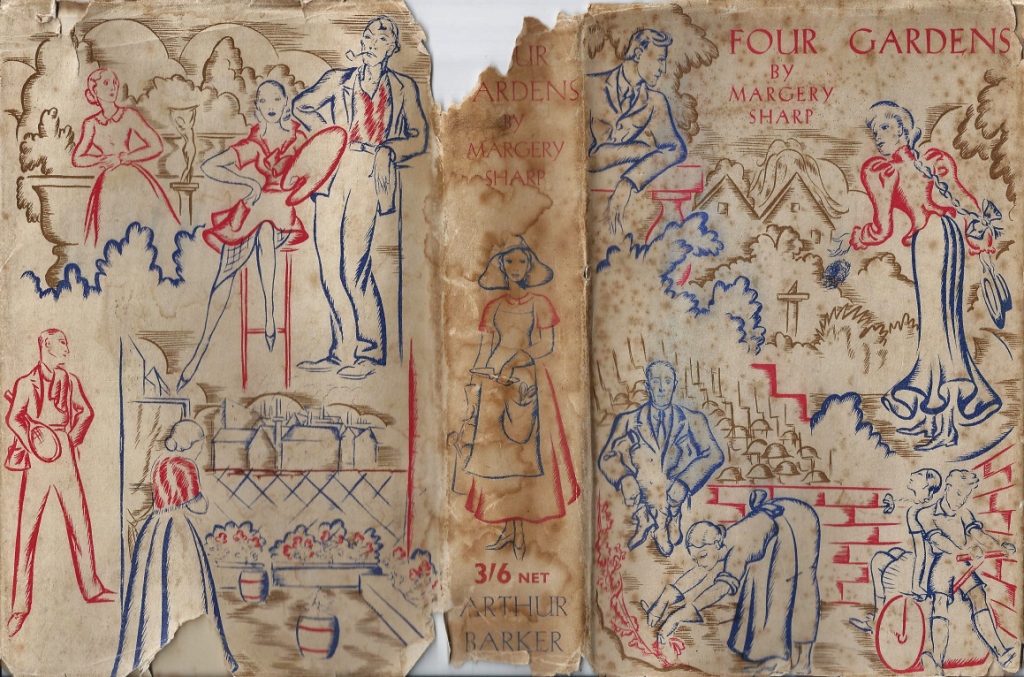
Four Gardens by Margery Sharp ~ 1935. This edition: Arthur Barker Ltd., 1935. Hardcover. 297 pages.

My rating: 10/10

In the early years of the 20th Century, Caroline Smith lives the quiet life of a dutiful middle class daughter with her widowed mother. Walks on the Common, occasional tea parties and church bazaars, helping with the housekeeping and pursuing quiet amusements; such is her life. Occasionally Caroline muses about her place in the world, and wistfully thinks of what her future may hold, but all in all she is of an accepting nature.

Caroline’s one weakness is gardens; on her strolls with her mother she peers through gates and quietly and deeply absorbs what she sees. We pick up Caroline’s story during her seventeenth year, as she takes possession of her first garden; the abandoned wilderness of an empty estate house. Caroline finds a secret way in, and there in the garden she has her first innocent encounter with romance.

Time moves on, and that first garden is lost to Caroline, but after some secret mourning she accepts it as something that must be. She marries a good (though not romantic) man, has two children, and does her duty in all of her relationships even though they are not always what she’d hoped for. The second garden, very different from the first, is a balm to Caroline’s sometimes troubled soul, and is the backdrop of her early wifehood and motherhood, darkly overshadowed by the Great War.

Circumstances change for the better; Caroline is presented with a chance at a new life and a rise in her social position; she gracefully takes it all in stride, though she quietly remains the same thoughtful, uncomplaining soul. Her third garden is one in which a didactic gardener holds sway; Caroline secretly mourns her new distance from physical contact and a real relationship with the plants and the soil, but she does  the correct thing as always and goes forward into this newer, more luxurious world as staunchly as she faced adversity in her younger days.

The fourth garden is the one Caroline creates for herself when her situation again changes; though the smallest and most makeshift, it is perhaps the most satisfying. Life has come full circle, and there is a strong sense of the fitness of things.

This is a gentle but not sentimental book; Margery Sharp keeps it crisp and interesting by allowing us to hear the ongoing commentary of Caroline’s innermost thoughts. Though I continually call Caroline gentle and accepting (and rightly so), she is also keenly perceptive of both her own and others’ motivations and reactions; her inner voice is wry and quietly witty. We are therefore thoroughly on her side as she copes with difficult social situations, troublesome relationships, a well-meaning but emotionally distant husband, and confusingly complex and progressively minded (but by-and-large loving) children.

Not as full of parody as some of Margery Sharp’s works, Four Gardens is a touch more serious and thought-provoking. Beautifully written; often very funny; occasionally very poignant. By the end, the story has become something of a celebration of the quiet satisfaction of dealing well with the not always exciting commonplace life one is dealt by fate, keeping one’s head up, and carrying on.

Very highly recommended.

***

Updated to add a contemporary review I have just discovered, from the New York Times Saturday Review of Books, February 1, 1936

FOUR GARDENS. Margery Sharp. Putnams. 1935. $2.50.

There is refreshment in this book of Margery Sharp’s, a cool sanity that is infinitely restful. She has by nature something of the Jane Austen touch, springing from a detached, quiet power of observation, a delicious, satirical way of relishing affectation, and a respect for sensible, genuine people.

It is a quiet book, the life-story of a woman to whom very little ever happens, a woman as undistinguished as her name of Caroline Smith. But it is a pleasure to read about her and her great good sense; she is lovable in her simplicity, and because of the gentle, irrepressible spark of humor that she possesses. But for all her simplicity she has maturity and wisdom. There is a note of high comedy, rare enough in these days, in the deftness with which she copes with her two ultra-modem children.

All the details are so right and neat, the shades of social difference in the little English town where Caroline lives shown to such nicety, the varying relationships between people set forth with so much exactness and delicacy, that the book makes delightful reading.

***

NoteFour Gardens may be a bit hard to come across, as it was published early in Margery Sharp’s long career and was eclipsed by her later, much more highly publicised works. A few copies show up on AbeBooks, but be prepared to pay a premium price, $40 into the hundreds, for a hardcover in good condition. There appears to have been at least one reissue in paperback in the 1960s, so there should be reasonably priced editions out there in the used book world for a patient collector to track down.

Read Full Post »

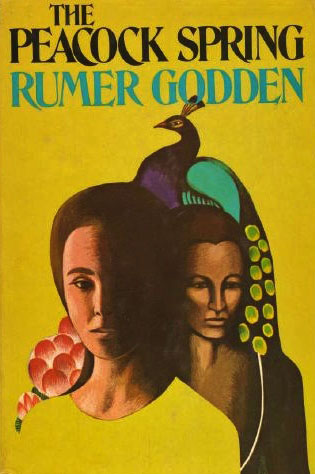
The Peacock Spring by Rumer Godden ~ 1975. This edition: Viking, 1976. Hardcover. 243 pages.

My rating: 7/10

Two English half-sisters are sent from boarding school in England to join their divorced U.N.-diplomat father in India.

15-year-old Una and younger sister Halcyon (Hal) are respectively gifted in mathematical ability and singing; Una in particular worries that their new Eurasian governess-teacher will not be able to teach to the standard required to qualify her for entrance to Oxford. This proves to be the case; Miss Alix Lamont turns out to have other qualities which the girls’ father, Sir Edward Gwithiam, has chosen her for; namely her beauty and personal charms. He is openly infatuated with Alix, and the girls’ presence is meant to give a plausible reason for her inclusion in his household.

Una and Alix find themselves in the position of jockeying for position in Sir Edward’s affections; Alix is strongly entrenched, and Sir Edward intends to marry her. Una, smarting from her father’s rejection (she was always his confidante, but he has distanced himself from both of his daughters since Alix gained his interest), becomes involved with Ravi, a young Indian gardener on attached to the U.N. estate, who is actually a well-born Brahmin student in hiding for his part in a violent political protest. Meanwhile, Hal has become infatuated with the son of a deposed Rajah, Vikram, who is in turn in love with Alix. This seething mass of emotional undercurrents leads to Una’s disastrous flight with Ravi and the laying bare and reworking of all of the relationships thus involved.

Quite a well-done story; generally plausible and sympathetically told. All characters are well-developed and complex, and are treated very fairly by their author in that we see the multiple facets of their personalities and fully understand their motivations. The ending is quite realistic, though not perhaps what one could call “happy”; the various characters move out of our vision with these particular issues resolved but many more looming. All in all I thought it was one of Godden’s better coming-of-age novels; I enjoyed it more than I initially thought I would from the reviews I had read.

Suitable for young adult to adult. Frank but not explicit sexual content including extramarital relationships and the sexual involvement between a schoolgirl and an older man; pregnancy and abortion are discussed though mostly by implication. Rumer Godden in this novel has kept abreast of the times; she was 69 when this novel was published and though a bit dated here and there the tone is generally contemporary.

Read Full Post »

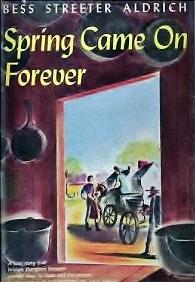
Spring Came on Forever by Bess Streeter Aldrich ~ 1935. This edition: D. Appleton-Century Company, 1935. Hardcover. 333 pages.

My rating: 7.5/10

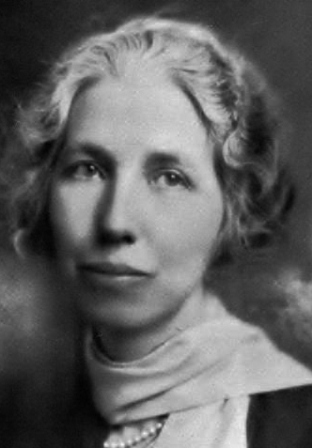
Nebraska writer Bess Streeter Aldrich, 1881-1954, was well-known for her portrayals of Mid-West American pioneer days. Her novels and short stories generally featured strong heroines who met adversity with grace and strength. Aldrich herself knew tribulation and great grief; widowed suddenly at 44 with a family of young children in the midst of the Great Depression, she supported her family with her writing.

Spring Came on Forever is a tale of missed chances and second choices. It follows star-crossed lovers Matthias Meier and Amalia Holmsdorfer as they fall in love, are separated by circumstance, and marry other people. Their descendents’ lives are eventually intertwined, bringing their youthful tragedy to a gently satisfying, much happier conclusion, though they themselves are not aware that they started the chain of events.

Aldrich excels at illustrating the march of progress through the years; her characters both embrace and lament time’s changes; the good and the bad are matter-of-factly portrayed.

An excerpt from the Vachel Lindsay poem The Chinese Nightingale gives the novel its title:

“Years on years I but half-remember…
Man is a torch, then ashes soon,
May and June, then dead December,
Dead December, then again June.
Who shall end my dream’s confusion?
Life is a loom, weaving illusion…
 
One thing, I remember:
Spring came on forever,
Spring came on forever,”
Said the Chinese nightingale.
 

Though often predictable and occasionally straying into melodrama, Aldrich’s novels are quiet works of everday people dealing with the everyday problems. Encouraging and supportive of the trials and rewards of wifehood and motherhood, her novels are as much loved by readers today as when they were published in the 1920s, 30s and 40s. While realistic regarding tragedy and disappointment, Aldrich always highlighted the deep and quiet joys of womanhood, and the inner rewards of “keeping on” through difficult times.

Spring definitely has some flaws as a literary work. The characters are sometimes a bit one-dimensional, and so much is packed into a relatively short story that the years whip by at lightning speed with only small vignettes to mark the many stages of the protagonists’ journeys. However, those vignettes are well presented enough to give us a clear understanding of events as they unfold; by the end of the novel the whole story is spread out before us in all its interweavings, rather like the patchwork quilts Amalia crafts with such care.

An old-fashioned writer of old-fashioned tales, Bess Streeter Aldrich’s often-poignant words still resonate today, particularily with those of us past our first youth and embroiled in our own family affairs. Not to everyone’s taste; a sophisticated modern reader may dismiss Aldrich’s sometimes dated style and storylines; but there are rewards hidden in the pages of her tales for those with the temperament to appreciate them.

Read Full Post »

« Newer Posts - Older Posts »