Posts Tagged ‘Vintage Fiction’

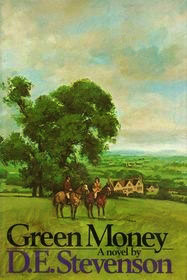
Green Money by D.E. Stevenson ~ 1939. This edition: Collins, 1981. Large Print. Hardcover. ISBN: 0-7089-0649-4. 482 pages.

My rating: 6.5/10. Amusing enough, with an almost Wodehouse-like farce going on in parts, but it was far too long for the content. Zero surprises, every plot twist was telegraphed from miles away and came through loud and clear.

The main reason I rated it as high as I did was for the likeable main character George Ferrier – and his parents – and the very darling Cathie Seeley.

A feel-good romance, requiring little effort to absorb. Literary chocolate pudding with a great big dollop of cream; comfort reading verging on simplistic; nothing daring or terribly complex here; just lick it off the spoon.

*****

Horse-loving countryman George Ferrier is on a bit of an ill-afforded toot in London when he runs across one of his father’s old school friends. Wealthy Mr. Green is now possessed of a motherless daughter, and, on a whim, he asks George to act as one of the trustees of his daughter’s eventual inheritance. The “old men” fulfilling the trustee roles keep dying off, and perhaps a younger man will prove less of a hassle. George, after much convincing, agrees, and returns home not expecting to hear anything more of his role for quite a few years to come.

But then Mr. Green suddenly kicks the bucket, leaving a vast fortune in the hands of four trustees: George, the ancient and doddery Mr. Bennett, and obviously hand-in-glove old cronies Mr. Wicherly and Mr. Millar. George senses something a bit off going on at his first meeting with the others, but allows himself to be soothed and sent away after signing numerous papers authorizing he’s-not-quite-sure-what.

Upon George’s meeting the orphaned “child” the story ramps up another notch; Miss Elma Green turns out to be a lovely eighteen-year-old who has been raised in an atmosphere of strictly Victorian purity. George is quite fascinated by this unexpectedly grown-up yet unworldly ward; he is also a bit shocked by how quickly she embraces the more forward modern behaviours her father has sought to shelter her against.

George ponders the possibility of marrying the delectable Elma to protect her from herself and the wiles of the world, but he can’t quite get over the feeling that she’s not really the woman of his dreams, beautiful though she is. For lurking in the background is his lifelong friend Cathie, whose brother Peter has himself fallen head-over-heels in love with Elma at first sight. The stage is now set for a series of misunderstandings and complications, all of which we see coming and which play out exactly as they should.

Mr. Millar steps in, offering to host Miss Green on a seaside holiday. Elma fully embraces the social whirl of tea parties and dancing till the wee hours, and instantly attracts an entourage of eager young swains, including Mr. Millar’s son Wilfred, who is receiving strong encouragement from his father to snag the heiress.

Meanwhile stalwart George ponders the clues surrounding Mr. Millar’s insistence on cashing in a large chunk of the Green shares to cover death duties, despite the existence of an insurance policy purchased  by Mr. Green to guard against the very scenario. As Peter sulks and pines for the lovely Elma, Cathie sternly tries to prepare herself for news of George’s engagement to another.

What will happen next? How will this story end? Golly, what do you think?

I liked Green Money well enough in a mild way, but I certainly didn’t love it. The story is well set up and the characters George, his mother Paddy, and self-effacing Cathie were nicely rounded out, but many of the other characters felt very one-dimensional. Elma herself comes across as a shallow, self-indulgent bit of fluff; her intelligence is of the self-protective type, and she shows no hesitance in deceiving her admittedly over-protective governess-companion to further a rapid progress into the wider world.

The whole thing went on past my initial interest level. I stuck it out to the end easily enough, but I put this one down with something of a feeling of relief that I could check it off on my D.E. Stevenson reading list.

Read Full Post »

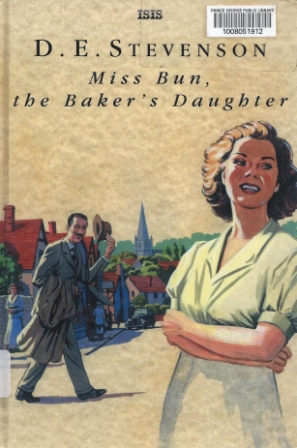
Miss Bun, the Baker’s Daughter by D.E. Stevenson ~ 1939. This edition: Isis Publishing, 2004. ISBN: 0-7531-7083-3. Hardcover. Large Print. 292 pages.

My rating: 8.5/10. Better than expected. Likable main characters gently shine in this sweetly improbable but diverting light read.

*****

In a small Scottish town, Sue Pringle was competently keeping house for her widowed father and younger brother when an unexpected stepmother entered the picture. Now in her twenties, Sue has to bite her tongue at the constant criticisms of the woman who has taken her beloved mother’s place. Worse yet, Sue’s family is pressing for her marriage to a worthy young man working in her grandfather’s grocery business; while Sue likes Bob Hickie well enough in a platonic way she has no interest in him romantically.

When an opportunity to take on a job as a cook for an artist and his wealthy wife arises, Sue decides to make a break and move into Tog’s Mill with the Darnays. She awakens her first morning to find that Mrs. Darnay has left for London taking the single other servant with her, leaving her husband to fend for himself.

Though well aware of the social implications of living unchaperoned in the same house as a young, attractive man, Sue feels guilty about abandoning the unworldly Mr. Darnay to his own limited resources, and she stays on, though her family and the neighbouring villagers look askance at the unorthodox situation.

John Darnay and Sue soon become good friends, sharing a sense of humour and a desire for solitude to pursue their own interests. Immediately nicknamed “Miss Bun” for her father’s occupation (he is town baker), Sue basks in Darnay’s approval, and soon realizes that her feelings for her employer are something stronger than is wise in their situation. She keeps house and cooks and enables Darnay to work on his painting uninterrupted, going so far as to arrange for his growing number of creditors to hold off with their bills, as with Mrs. Darnay gone there is no longer any sort of income coming in, as Mrs. Darnay would really like her husband to return to the city and continue his lucrative trade of painting saleable pictures and society portraits, instead of mucking about experimenting with new techniques and ways to capture his personal “vision”.

The artist is totally oblivious of this situation, until it is brought to his attention by Sue’s grandfather, who, much as he likes Darnay, has some serious qualms about his beloved granddaughter’s obviously doomed affection for a married man, and a penniless artist to boot.

The inevitable happens; the penny drops; and the arrangement at Tog’s Mill comes to an abrupt end, with Darnay leaving for London to work at portrait painting to pay his bills, and Sue seeking refuge with her grandparents while she decides her next step.

Added to the mix are Sue’s younger brother Sandy who suddenly runs away to join the army, a local aristocrat who thinks he just might be Sue’s real father, and a petition for divorce advanced by the absent Mrs. Darnay naming Sue as a co-respondent.

All of these threads twist and turn and eventually come to satisfactory resolutions, but not without a chance for Sue to show what fine and tenacious stuff she’s made of.

An unlikely story, but a grand bit of escapism. I thoroughly enjoyed it. Recommended.

Another brief and favorable review can be found here  .

Read Full Post »

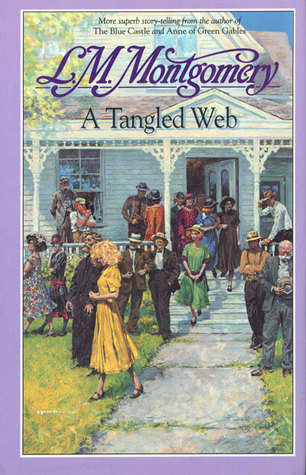
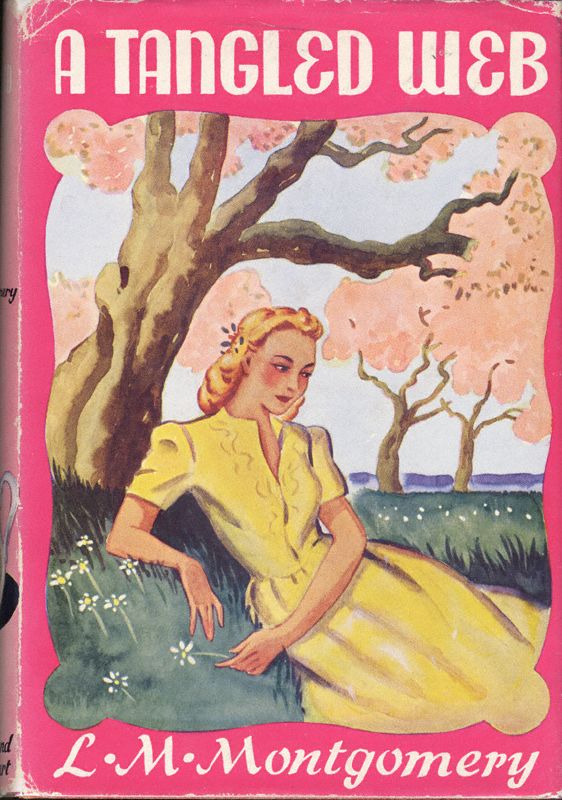
A Tangled Web by L.M. Montgomery ~ 1931. This edition: McClelland and Stewart, 1989. Hardcover. ISBN: 0-7710-6160-9. 306 pages.

My rating: 5/10. This one had its moments, but the confusing set-up, generally unlikable characters, hasty and improbable resolutions to various conflicts and romances, and jaw-dropping (in the most offensive way) final few lines kept me from enjoying it to the full. I would not recommend it.

*****

I am very ready to move on with this novel, so this will be the briefest of reviews. (Coming back to add that it got rather long after all. But it was fast to write, so that counts for soomething.) For more, visit the Goodreads page. I am in the minority with my distaste for this book, but it really left me quite cold. I might re-read it at some point far in the future, but right now all I want to do is return it to the library and wipe it from my brain.

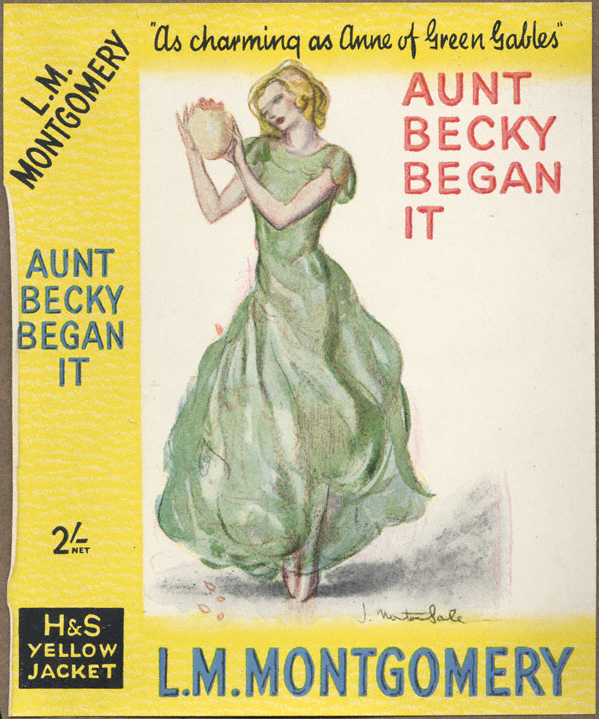
Opinionated, critical, near-death Aunt Becky has called a clan meeting – a “levee” – to discuss who of her vast extended family will inherit a prized hand painted jug, brought from Holland as a marital gift several generations before. She proceeds to read her own obituary and lay out some cutting critiques of everyone present as one last demonstration of her emotional hold over the intertwined Dark and Penhallow families.

She dies soon after, and the reading of her will is attended in full family force. But Aunt Becky has one last trick up her sleeve. There will be a waiting period of a year before the heir to the jug is revealed, and in the meantime, everyone had better be on their best behaviour, or risk losing their chance to inherit.

Something like sixty family intermarriages between the two clans have created a complicated network of relatives and in-laws, and the author tosses us in head first. It took quite a few chapters before I had any sense of who was who, and, it was more work than it was ultimately worth – lay this one down at your peril! I did that and had to start all over again to reacquaint myself with the vast cast of characters.

  • Joscelyn Dark has been estranged from her husband Hugh since their marriage night; only Aunt Becky has been privy to the reason why. What happened that night?
  • Sweet Gay Penhallow is engaged to Noel Gibson, but her vampish flapper cousin Nan has decided to steal Noel away. Roger Penhallow has been secretly in love with Gay for years – should he seize this chance to step in?
  • Orphaned, illegitimate youngster Brian Dark is the abused chore boy on his strict uncle’s farm; even his pet kitten does not escape his uncle’s wrath. Will justice prevail?
  • Peter Penhallow has been off roaming the world, but he surprises everyone, including himself, by falling head over heels in love with his childhood enemy Donna Dark, who has been married and widowed in the meantime. Does Donna return his passion?
  • Margaret Penhallow is a mild, plain-featured, un-sought-after old maid who has one great wish. Will she ever achieve it?
  • The two Sam Darks, Big and Little, are cousins who have lived together in harmony for thirty years. Why have they parted ways over a silly little statue and a ginger cat?

There are more situations brewing and boiling over, but those are the main threads, and the resolutions are a long time in coming in this ambitiously-plotted story.

My impression of the whole thing was that it was a mile wide and an inch deep; there was very little chance to get to know any of the characters, and I found myself annoyed at all of them, except perhaps wee innocent Brian, and quietly good Roger.

The final few sentences of the story were what sealed this novel’s fate with me; the author includes a completely gratuitous and blatantly racist and misogynist exchange between the newly reconciled Sam Darks. I will include it here for you to read for yourself. I’ve whited it out just below; highlight it to read it if you feel the desire. They are speaking of Little Sam’s nude statue of Aurora, “Goddess of the Dawn”, which was the original reason for their quarrel.

“What you bin doing to that old heathen immidge of yours?” demanded Big Sam, setting down half drunk his cup of militant tea with a thud.

“Give her a coat of bronze paint,” said Little Sam proudly. “Looks real tasty, don’t it? Knew you’d be sneaking home some of these long-come-shorts and thought I’d show you I could be consid’rate of your principles.”

“Then you can scrape it off again,” said Big Sam firmly. “Think I’m going to have an unclothed nigger sitting up there? If I’ve gotter be looking at a naked woman day in and day out, I want a white one for decency’s sake.”

The End

Yeah. The end for me, too. This is Lucy Maud at her very worst. I won’t dismiss her many other works, because some of them are beautifully written and deeply moving, but this one bothered me in more ways than one, and the ending passage disgusted me, “consider the times” or not.

Read Full Post »

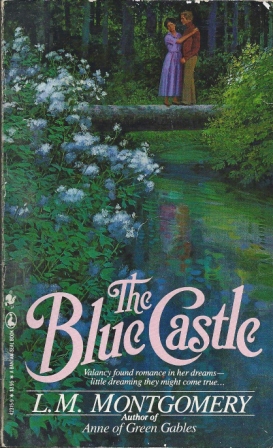
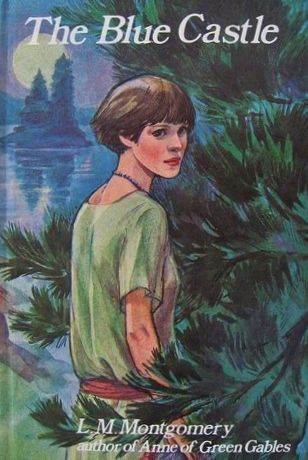
The Blue Castle by L.M. Montgomery ~ 1926. This edition: McClelland-Bantam (Seal), 1988. ISBN: 0-7704-2315-9. Paperback. 218 pages.

My rating: After reading Kilmeny of the Orchard, an easy 10, but stepping back a bit, for general comparison to other novels of this vintage and genre (I’m thinking D.E. Stevenson here, I must admit, because I’ve been discovering her light romantic novels these past few months) how about a nice solid 8/10. Will that do, Blue Castle fans? I did enjoy re-reading this one, after a hiatus of many years.

*****

Though often referred to as one of Lucy Maud Montgomery’s “forgotten” books, the internet abounds with reviews – its page on Goodreads – The Blue Castle  alone has over one thousand reviews, and seven thousand plus ratings. It scores an extremely respectable 4.22/5. This is a well-loved book!

Anything I say here would be superfluous to the discussion; I know others have covered this ground before, often with great eloquence and passionate approval. I’ll put forward my opinion nevertheless.

Montgomery’s stories tend to be full of stuffy matriarchs and patriarchs making life miserable for their cowed extended families; the worm turning sets the narrative in motion and has the reader cheering for the underdog; if all goes well we come to the end with a better appreciation for what makes everyone in that fictional little world tick. The Blue Castle is no exception; it follows the pattern perfectly, and with satisfying results. This story almost defines the comfort read, and I suspect that is how most of its advocates use it, to administer a little boost of fantasy and happy ending to real lives fraught – and whose life is completely free of these? – with anxiety and sadness.

*****

Valancy Stirling is having her twenty-ninth birthday, and her level of depression couldn’t be much lower. Living with her emotionally distant mother and whiny, elderly Cousin Stickles, Valancy’s days are a repetitive round of dusting and duty jobs; the attic chests overflow with the quilts the three have spent their countless hours piecing together, and every moment of Valancy’s time must be accounted for and justified.

Idleness was a cardinal sin in the Stirling household. When Valancy had been a  child she had been made to write down every night, in a small, hated, black notebook, all the minutes she had spent in idleness that day. On Sundays her mother made her tot them up and pray over them.

But Valancy has an even more insistent woe. In a world which values a woman by her achievement of a “good” marriage, Valancy is a confirmed spinster. No man has so much as looked at her with interest, and as her unvoiced desire for love increases with the years, so does her drabness and depression. Valancy is very much on the shelf, an unwanted piece of merchandise, and her large extended family, from her own bullying mother, to her perennially teasing rich bachelor Uncle Benjamin, to her gorgeous, patronizing, engaged-to-be-married cousin Olive, don’t let her forget it for a second.

Valancy’s only escape is into daydreams of a fantasy life.

Valancy, so cowed and subdued and overridden and snubbed in real life, was wont to let herself go rather splendidly in her day-dreams. Nobody in the Stirling clan, or its ramifications, suspected this, least of all her mother and Cousin Stickles. They never knew that Valancy had two homes–the ugly red brick box of a home, on Elm Street, and the Blue Castle in Spain. Valancy had lived spiritually in the Blue Castle ever since she could remember. She had been a very tiny child when she found herself possessed of it. Always, when she shut her eyes, she could see it plainly, with its turrets and banners on the pine-clad mountain height, wrapped in its faint, blue loveliness, against the sunset skies of a fair and unknown land. Everything wonderful and beautiful was in that castle. Jewels that queens might have worn; robes of moonlight and fire; couches of roses and gold; long flights of shallow marble steps, with great, white urns, and with slender, mist-clad maidens going up and down them; courts, marble-pillared, where shimmering fountains fell and nightingales sang among the myrtles; halls of mirrors that reflected only handsome knights and lovely women–herself the loveliest of all, for whose glance men died. All that supported her through the boredom of her days was the hope of going on a dream spree at night. Most, if not all, of the Stirlings would have died of horror if they had known half the things Valancy did in her Blue Castle.

For one thing she had quite a few lovers in it. Oh, only one at a time…At twelve, this lover was a fair lad with golden curls and heavenly blue eyes. At fifteen, he was tall and dark and pale, but still necessarily handsome. At twenty, he was ascetic, dreamy, spiritual. At twenty-five, he had a clean-cut jaw, slightly grim, and a face strong and rugged rather than handsome. Valancy never grew older than twenty-five in her Blue Castle, but recently–very recently–her hero had had reddish, tawny hair, a twisted smile and a mysterious past.

Aha! That last lover has a counterpart in the real world, who shall soon be introduced. In the tradition of all romantic novels, something is about to happen.

In Valancy’s case, the immediate something is her independent decision to go secretly to a doctor for a consultation about her increasingly severe heart pains, which she has kept hidden from her overbearing family. She can’t go to the family doctor, as word would soon be out, so she decides instead to consult old Dr. Trent, a noted heart specialist who lives in the same (fictional) Ontario town of Deerwood as the Stirling clan.

Dr. Trent doesn’t say much during the examination, and while Valancy waits for his return to the consulting room, a phone call sends the doctor rushing away on another emergency. Valancy goes home no more enlightened as to her condition than she was before the appointment, but some weeks later a letter comes from Dr. Trent. He is sorry that he had to leave her hanging, but he has some bad news for her. Miss Sterling has an incurable heart condition, and could die at any moment. She might last a year at most, with extreme care and good luck. In the meantime, avoid all exertion and strong sentiment, and hope for the best. (Those of you with keen eyes will spot a clue in this paragraph. It’s there in the book, too.)

The diagnosis of imminent death sends Valancy over the edge. With nothing to lose, she immediately starts to voice the many thoughts regarding her relatives which she has kept hidden all these years. They are taken aback at mousy little Valancy’s sudden outspokenness. Not sure how to handle her, they retreat into enclaves to murmur “Crazy!”, but by and large they back off and observe her with startled eyes, an improvement of sorts from the previous incessant teasing.

Valancy then goes one further. She decides to move in with a childhood friend who has been a victim of circumstance (summer job away from home, love affair, illegitimate baby which only lives for a year etc.) and is now dying of “consumption” (tuberculosis). The good people of Deerfield have distanced themselves from the sad fate of Cissy Abel, especially since her father just happens to be the town drunk, “Roaring Abel”. The only person who has shown any sympathy for poor Cissy is another social outcast, the mysterious Barney Snaith, who is a reclusive type who lives alone on an island in nearby Lake Mistawis, showing up occasionally to beat around town in his decrepit old car in the company of Abel.

Valancy has only seen Barney twice before, but has been intrigued by his oddly handsome appearance and devil-may-care attitude. Wonder if that means anything? What do you think, dear fellow readers?

So that’s the set-up. (And oops, I forgot to mention that Valancy’s only other emotional outlet in her long, dreary twenty-nine years, other than her Blue Castle daydreams, has been reading the works of a certain John Foster, who writes romantically about the wonders of the natural world. Valancy has whole passages of his works memorized; she has been surreptitiously reading his books for years, as often as she can smuggle them from the sympathetic librarian and past her eagle-eyed mother.)

Poor Cissy dies. The Deerwood townspeople, influenced by the Stirling clan who have decided they need to regularize Valancy’s move to the Abel home by rallying round her, hypocritically show up in great force for the funeral. With Cissy dead and buried, Valancy is now rather at loose ends, and, to prevent having to return to her stifling old life, she comes up with an audacious idea.

And here I will leave you. I’m sure you will be able to make some good guesses as to what happens next. Or maybe not!

*****

Super-sentimental, but with a goodly leaven of outspoken criticism of societal and moral hypocrisies. Valancy speaks out and we cheer her on, wondering only that it took her so long to cast off the shackles of manners to do so. No, that’s not quite right. Valancy stays terribly polite; she merely exposes the sugar-coated – and sometimes blatantly naked – rudeness of the other people who have been immune to comment because of their aggressive superiority.

The plot has some cute twists and turns, and a not very surprising (but perfectly fitting) “surprise” ending.

Valancy’s island cabin to me is much more of a daydream ideal than her lavish Blue Castle in Spain; I sighed a bit over the thought of a cozy, tiny house on an island, with no need to earn an income or worry about the drains,  or deal with obnoxious neighbours or bossy family members (not saying that I have either – oh no! – but Valancy has had them, in spades, so my pleasure in her escape was purely vicarious in that aspect) – anyway – the vision of her island idyll is pure comfortable fantasy and I wish I could go there occasionally in real life versus merely through the escape of reading.

A more mature book in many ways than the earlier novels featuring Anne, Emily and the residents of Avonlea and other P.E.I. environs. It is often mentioned that this was written “for adults”, but there is nothing objectionable which a teen of today couldn’t handle; I’d say age range twelve and upwards would be just right. Definitely a “romance novel”, and could be classified as something of a “girls’/women’s book”,  though the men in my life have read and enjoyed it for the humour and the gently diverting story. Happy ending, in the best fairytale tradition.

And check out this Pinterest page, which I stumbled upon while searching out a picture of the probably fictional Grey Slosson car which Barney drives. Some lovely images collected here which I thought added greatly to this quite charming novel. And look at this lovely cover illustration, found on that page. I thought this was much better than that on the cover of my own paperback copy!

Blue Castle Images – Valancy’s World

Read Full Post »

Kilmeny of the Orchard by L.M. Montgomery ~ 1910. This edition: Ryerson Press, 1968. 5th Canadian Printing. Hardcover. 256 pages.

My rating: 3/10. (And I’m being generous.)

*****

Boo, hiss.

I’m going to say this straight away. I did not like this book. If it were authored by anyone other than the iconic Lucy Maud Montgomery, it would already be in the box out in the porch, heading for the charity shop next trip to town. As it is, I will keep it just because I do like complete collections of things, and I have many (most?) of L.M. Montgomery’s other novels and short story collections, but I will not be re-reading it any time soon, if ever.

Oh, this book is so dismal, in so many ways.

Here I extend an apology to those of you who love this story, and see it as a sweet fairytale, and are able to accept it as a product of the time it was written in. That’s all well and good, and I often do the same, but in this case I look at the author in question, see that this novel was published two years after Anne of Green Gables – which is a very different (and much better) book in every conceivable way – and shake my head at the author. How could she?!

In the interests of full disclosure, I did read a number of reviews before I tackled this story, and I was prompted to read this for the Canadian Book Challenge by these two bloggers, Nan at Letters From a Hill Farm, and Christine at The Book Trunk.

Letters From a Hill Farm Review – Kilmeny of the Orchard

The Book Trunk Review – Kilmeny of the Orchard

Nan and Christine between them eloquently present the “for” and “against” arguments, and I was truly curious to see in which camp I would make my home.

Nan, Kilmeny’s all yours.

Hi there, Christine. Is there room for me by your fire?!

Spoilers follow. If you want to read and judge for yourself without my input stop here.

*****

“Kilmeny looked up with a lovely grace,
        But nae smile was seen on Kilmeny’s face;
        As still was her look, and as still was her ee,
        As the stillness that lay on the emerant lea,
        Or the mist that sleeps on a waveless sea.
        .   .   .   .   .   .   .   .   .   .   .   .   .
        Such beauty bard may never declare,
        For there was no pride nor passion there;
        .   .   .   .   .   .   .   .   .   .   .   .   .
        Her seymar was the lily flower,
        And her cheek the moss-rose in the shower;
And her voice like the distant melodye
        That floats along the twilight sea.”

                                  — _The Queen’s Wake_
                                                 JAMES HOGG

Wonderfully promising start with a quote from James Hogg’s narrative poem about the lovely Kilmeny who spends seven years in fairy land and comes back mutely unable to tell what she has seen. So far, so good.

And the first few chapters are quite promising as well. We meet a young man, Eric Marshall, as he graduates from college one glorious springtime day, and we nod and smile at Montgomery’s flowery description of the scene.

The sunshine of a day in early spring, honey pale and honey sweet, was showering over the red brick buildings of Queenslea College and the grounds about them, throwing through the bare, budding maples and elms, delicate, evasive etchings of gold and brown on the paths, and coaxing into life the daffodils that were peering greenly and perkily up under the windows of the co-eds’ dressing-room.

A young April wind, as fresh and sweet as if it had been blowing over the fields of memory instead of through dingy streets, was purring in the tree-tops and whipping the loose tendrils of the ivy network which covered the front of the main building.  It was a wind that sang of many things, but what it sang to each
listener was only what was in that listener’s heart.  To the college students who had just been capped and diplomad by “Old Charlie,” the grave president of Queenslea, in the presence of an admiring throng of parents and sisters, sweethearts and friends, it sang, perchance, of glad hope and shining success and high achievement.  It sang of the dreams of youth that may never be quite fulfilled, but are well worth the dreaming for all that. God help the man who has never known such dreams–who, as he leaves his alma mater, is not already rich in aerial castles, the proprietor of many a spacious estate in Spain.  He has missed his birthright.

And here’s our young hero:

Eric Marshall, tall, broad-shouldered, sinewy, walking with a free, easy stride, which was somehow suggestive of reserve strength and power, was one of
those men regarding whom less-favoured mortals are tempted seriously to wonder why all the gifts of fortune should be showered on one individual.  He was not only clever and good to look upon, but he possessed that indefinable charm of personality which is quite independent of physical beauty or mental ability.
He had steady, grayish-blue eyes, dark chestnut hair with a glint of gold in its waves when the sunlight struck it, and a chin that gave the world assurance of a chin.  He was a rich man’s son, with a clean young manhood behind him and splendid prospects before him.  He was considered a practical sort of fellow, utterly guiltless of romantic dreams and visions of any sort.

Eric has decided to join his father in the family retail business – his father is a successful department store mogul – much to the dismay of Eric’s older cousin, Dr. David Baker, who feels Eric’s talents would be better used if he were to pursue a law degree. But Eric nobly holds out that his father’s occupation is good enough for him. What a good son, I thought. Attaboy!

But before Eric can settle into his life in business, he receives a letter from a close friend who is working as a teacher on Prince Edward Island. The friend has fallen ill, and must take a leave of absence from his position. Will Eric please come and take over the school for the last part of the term?

Eric happily agrees, and off he goes to the Island. He is much taken by the beauty of the setting, and by the quaint friendliness of the natives. The only jarring note is struck one evening when he sees an elderly man and a young man together.

Eric surveyed them with some curiosity.  They did not look in the least like the ordinary run of Lindsay people.  The boy, in particular, had a distinctly foreign appearance, in spite of the gingham shirt and homespun trousers, which seemed to be the regulation, work-a-day outfit for the Lindsay farmer lads.  He
had a lithe, supple body, with sloping shoulders, and a lean, satiny brown throat above his open shirt collar.  His head was covered with thick, silky, black curls, and the hand that hung down by the side of the wagon was unusually long and slender. His face was richly, though somewhat heavily featured, olive
tinted, save for the cheeks, which had a dusky crimson bloom. His mouth was as red and beguiling as a girl’s, and his eyes were large, bold and black.  All in all, he was a strikingly handsome fellow; but the expression of his face was sullen, and he somehow gave Eric the impression of a sinuous, feline creature basking in lazy grace, but ever ready for an unexpected spring.

The other occupant of the wagon was a man between sixty-five and seventy, with iron-gray hair, a long, full, gray beard, a harsh-featured face, and deep-set hazel eyes under bushy, bristling brows.  He was evidently tall, with a spare, ungainly figure, and stooping shoulders.  His mouth was close-lipped and
relentless, and did not look as if it had ever smiled.  Indeed, the idea of smiling could not be connected with this man–it was utterly incongruous.  Yet there was nothing repellent about his face; and there was something in it that compelled Eric’s attention.

Eric shrugs and moves on. That evening, his landlord fills him in on the story. The elderly man Thomas Gordon, a local farmer, and the boy is an Italian orphan whose mother died at his birth. His father immediately deserted and has not been seen since. He was raised up by the Gordons, bachelor Thomas and his spinster sister Janet, but nature is apparently proving stronger than nurture.

“Anyhow, they kept the baby.  They called him Neil and had him baptized same as any Christian child. He’s always lived there.  They did well enough by him.  He was sent to school and taken to church and treated like one of themselves.  Some folks think they made too much of him.  It doesn’t always do with that kind, for ‘what’s bred in bone is mighty apt to come out in flesh,’ if ‘taint kept down pretty well.  Neil’s smart and a great worker, they tell me.  But folks hereabouts don’t like him.  They say he ain’t to be trusted further’n you can see him, if as far… 

Later this same evening, Eric goes for a walk and stumbles upon an old orchard, trees in full bloom. Wandering through the fragrant dusk, he hears the delicate strains of a violin, and, tracing them to their source, startles a lovely young maiden playing ethereal and perfectly in-tune music among the apple trees. Eric thinks she’s the most beautiful thing he’s ever seen, and eagerly approaches her but the girl gasps in terror and flees, uttering not a word or a sound.

More investigation reveals that this is the mysterious Kilmeny Gordon, niece of the afore-mentioned Thomas and Janet Gordon, and house mate of Italianate Neil. She lives in seclusion and seldom appears in public; apparently she is mute, and also is cursed by being an illegitimate child. Her mother was married to a man, Ronald Fraser, whose first wife was mistakenly thought to be dead; when the first wife showed up very much alive. Ronald abandoned wife number two and went off with wife number one, to die “of a broken heart” shortly thereafter. Kilmeny is born  into an atmosphere of grief and resentment, and has been unable to speak since birth, though apparently her “organs of speech” are normal enough. Kilmeny’s mother is quite a piece of work – sullen and angry at her sad fate, she takes it out on everyone in the family, and I can’t help but think her death, which has occurred three years prior to the opening of the story, was probably a huge relief to all concerned.

I’m going to condense the rest of the story, though you can probably figure out what happens next.

Neil is already in love with Kilmeny. Eric falls in love with her and dismisses the prior claim of the shifty Italian fellow. Kilmeny communicates through the strains of her violin music (Neil, also innately musically gifted by his inborn heritage, apparently only had to show her how to hold the bow and her vast natural ability did the rest) and by writing on a slate hung around her neck. The courtship proceeds with Eric marvelling at this luscious find – a pure, innocent, beautiful girl – all his! Oh, go slow, do not frighten the shy little thing! – and with Kilmeny totally in awe of this handsome, obviously noble, manly man from another world.

And oh yes, the locals all call Eric “Master”, presumably because of his schoolmaster role, but it sounds a little odd in daily conversation, as if it should be accompanied (and it often is) by forelock tugging of the peasant-before-nobility type.

Eric is predictably infatuated with Kilmeny, and persists in haunting the orchard in her company, until his landlady mentions that perhaps it would be nice if Eric would go to Kilmeny’s guardians and mention his interest. “Never thought of that!” says Eric (I’m paraphrasing) and off he goes to immediately win over the dour and suspicious Gordons with his shining goodness and innate nobility. (Neil glowers in the corner.)

What else? Let’s see. Oh – Kilmeny wonders at why Eric is so taken with her – “I’m so ugly!” she moans – oops, sorry – writes on her slate. Turns out that she has never looked in a mirror in her whole eighteen years – her mother broke them all in a fit of pique after her abandonment, and Janet and Thomas have never thought to replace them.

Eric proposes, because despite Kilmeny’s “great affliction” he can’t wait to get his hands on this delectable young creature. Kilmeny refuses him. Scritch, scritch, scritch -“I will only marry you if I gain the power of speech!”

Eric calls in his old friend Dr. Baker, who examines Kilmeny and decides, along with her aunt and uncle, that her affliction has been caused by her mother’s trauma, visited in some mysterious way upon the newborn babe. If a great surge of desire to speak were to come over Kilmeny, she would at long last be able to utter! But as this doesn’t seem likely to happen, Kilmeny and Eric decide to part.

Both mope around, until Eric, unable to withstand the desire to see his love one more time, ventures into the orchard. He passes sullen Neil, building a fence. He sees Kilmeny, and is overcome with grief and sorrow at his imminent loss. Kilmeny sees him, and she sees something else – the hot-blooded Italian is coming up behind Eric with axe upraised!

Do I need to go on?

Voice is achieved. Neil drops the axe in horrified remorse and promptly leaves the Island, removing himself permanently from the picture, to the relief of absolutely everyone. (Poor Neil. He is the one sympathetic character in this whole thing.) The engagement is back on. Eric’s father sees Kilmeny and is immediately smitten with his son’s bucolic sweetheart. Birds sing, etc. etc. etc. and the curtain sweeps shut.

*****

There are so many objectionable elements to this melodrama. The characters are impossibly stereotyped, and the situations are contrived to the nth degree.

What was all the nonsense about Neil and his ethnic “stain”? He was raised from babyhood as a member of the family, but his demotion from Kilmeny’s foster “brother” to merely an inconvenient hired boy is swift and brutal, with no visible consequences except to Neil himself. The xenophobic comments regarding Neil’s heritage come straight from the author, via the mouths of her characters. Nowhere is there any indication that this is a plot device, except for one or two mentions that Neil’s perpetual sullenness is a reaction to the way he is viewed and treated by everyone else in his community. Damned from birth, and by birth.

And poor Kilmeny – she too is damned by birth. Because of her mother’s “sin” – rejection of her dying father’s request for a reconciliation, plus a poor marital choice – the innocent baby is doomed by some supernatural power to muteness. That doesn’t make any sort of sense whatsoever, but all of the characters meekly accept it as a viable reason and a fair enough fate.

Eric’s infatuation with the virginal Kilmeny, and his desire to teach her about love and the world is more than a little creepy, as is his willingness to abandon her because of her “affliction”. I mean, the girl has everything – unearthly beauty, musical ability approaching genius, and perfect (if tiny) handwriting! What’s a mere voice matter when she has so many other sterling qualities and delicious possibilities to offer?

The whole thing creeped me out, and I’m hard pressed to find any excuse for Lucy Maud Montgomery’s authorial sloppiness and moral negligence in this particular effort. It did remind me of some of the more forgettable of her short stories, so all I can think is that she popped it off one thoughtless day and sent it out into the world and had it accepted because of the previous excellence and best-sellerism of Anne of Green Gables and Anne of Avonlea.

Not recommended.

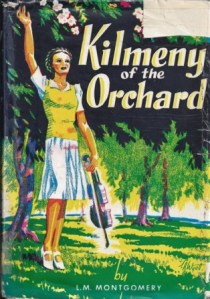
Oh – one more thing. What is with that awful cover, pictured way above? Kilmeny looks dressed for 1940s’ tennis, but for the improbable shoes. This novel was set in horse and buggy times, dear illustrator – it was originally published in 1910! And she looks like a sturdy, athletic Nordic blond – in the book she is a delicately featured, blue-eyed, black-haired, “fairy child”. Apparently a cover illustration with only a tenuous relation to the text within is not a modern phenomenon.

Read Full Post »
Peter West by D.E. Stevenson ~ 1923. This edition: Isis Publishing, 2007. Hardcover. Large Print. ISBN: 978-0-7531-7824-9. 213 pages.

My rating: 6.5/10. Very much reads like a first novel, which it is. The author tries hard, and ultimately succeeds, in telling her soberly romantic little story. I had been warned not to expect much from this obscure first work, but I was pleasantly surprised by its readability once I learned to navigate the flowery language and the bits of Scots dialogue from the local lassies, crones and crofters.

A point off for the constant references to the heroine’s figurative gossamer wings. Urgh!

Also lost a point for excessive use of the convenient plot device of the random hand of death. Deus ex machina, dear author? Please don’t make that a habit!

*****

This was now-esteemed and very collectible romantic fiction writer Dorothy Emily Stevenson’s first published novel. According to the BOOKRIDE rare book guide website, it was first released in magazine serial form.

Bookride, 12 February, 2007:

‘Peter West’ is the first of over 40 novels by the popular writer. Her sister married into the Chambers publishing family, and Ms Stevenson got this novel serialized in ‘The Chambers Journal’, and published by them in book form in 1923, but it wasn’t a success. Dorothy Emily Stevenson was born in Edinburgh in 1892, she was related to Robert Louis Stevenson, who was her father’s first cousin. She was 24 when she married Captain James Reid Peploe of the 6th Gurkha Rifles in 1916. Created the immortal characters Mrs Tim and Miss Buncle published by Herbert Jenkins. Can find nothing on ‘Peter West’ except that it is much wanted and highly elusive.

Almost ten years were to pass before D.E.Stevenson’s second novel was published. Mrs. Tim of the Regiment, 1932, inspired by Stevenson’s personal diary as an army wife,  proved much more successful and is one of the very few of her forty-odd books currently in print.

But we want to talk about Peter West. Apparently it is quite obscure, though the copy before me, obtained from my local library, is a very recent (2007) large print edition from Isis Publishing, so there must be a few of these in circulation. The following review contains spoilers, so if you want to search out Peter West for yourself and be surprised, stop reading now.

*****

Dedication by the author:

Dedicated to all who love Scotland, her tears and smiles, her dark woods and sunlit moors, and the plain and homely folk in the lonely villages of the north.

And the first few paragraphs of the Prologue, to give you a taste of the author’s descriptive style:

Mr. Maclaren loved Kintoul. Ever since he had come there, nigh on twenty years ago, the place had “grown on him,” as the saying goes. It had seemed a paradise of rest and quiet to the town-weary minister – a place where a man might regain health and strength of mind and body; where a man might forget the ugly striving and pushing of the city, and steep his very soul in the peace of God.

It was, on the whole, an easy thing to fall in love with Kintoul. There was something alluring about it, something mysteriously feminine. Even in the depths of winter, when the pure white snow covered all the hill-side, hanging on the pine-trees like fleecy blankets, and the river (the only non-white thing in the whole valley) ran like a narrow snake between jagged ice – even then there was something soft about Kintoul. The hills were friendly sentinels for all their rugged crests; the long dark nights were lighted by misted stars; the very snowflakes seemed to caress one’s cheek as they fell.

When spring came, soft, blustery winds blew primroses and cowslips into the sheltered hollows, still moist and green from the late melting of the snows. Soft white clouds drifted across the blue, blue sky, throwing patches of moving shadows on the newly awakening hills.

Summer brought long. drowsy days – days which seemed to have forgotten how to fade into night; when the emerald turf paled to a soft dun colour, and heather bloomed like a purple mist under the golden sun.

Autumn came as a king in the full panoply of state, and, in a single night of frost the hill-side glowed with colour like the dream of a demented artist. Here rowan and beech, with their clashing tones, mingled harmoniously, and the dark unchanging pines stood like quiet tokens of immortality among the gay but transitory foliage of their neighbours. And over all was the mist, the cool, soft white mist, lying sometimes in the valley hollows, sometimes capping only the hills, eddying hither and thither, and enhancing the beauties of the landscape by revealing them afresh and unexpectedly through rents in its clinging folds.

The stage is set, and in this idyllic scene Mr. Maclaren muses and reminisces about a certain local romance which he has taken a great interest in. Romantic Mary Simpson, lovely young daughter of Mr. Maclaren’s predecessor as Kintoul’s church minister, fell in love with the rough and ruggedly handsome John Kerr, ferryman at the river crossing. Against her parents’ wishes Mary married John, and found all of their dire predictions coming true. Sheltered Mary was unprepared for John’s practical and brusque ways. Mary found herself in the unenviable position of being shunned by her former friends, who felt she had lowered herself by her marriage to a common working man, and viewed with suspicion by the villagers as having stepped down out of her proper class and therefore not adhering to the proper social code. Poor Mary “did her duty” as a wife, had three children, and then died of a decline – a “bruised heart” – when her youngest child, her only daughter, was eight years old.

Elizabeth – Beth – is that daughter, and she is the focus, along with the titular Peter West, of this story. Turns out that Mary, and then Beth, were befriended by a local upper-class Englishwoman, Prudence West, who recognized “something unusual” in the young Beth. When Prudence died, her son Peter, sensitive and gentle, and the possessor of a “bad heart” which precluded normal manly activities, carried on his mother’s patronage of young Beth. (I must add here that I stopped to do the math, and as this story starts Beth is sixteen, and Peter thirty-five. You may wish to remember this as the tale progresses.)

So here we have “sprite-like” Beth and sensitive Peter, thrown together by circumstances with predictable results. Beth’s father John is deeply suspicious of the “meddlings” of Peter, and when the opportunity to arrange his daughter’s marriage to a neighbouring farmer arises, he pushes his daughter into an early wedding. Beth, who has experienced a dawning suspicion of romantic love for Peter, is apathetic and goes to the church without a fuss, because Peter has become romantically involved with another woman, and Beth has witnessed a scene of passion between the two (they kissed!) which has left her stunned and heartbroken.

I’ll back up a bit to explain. Peter is possessed of a bossy elder sister, who occasionally descends upon him and makes a great ruckus and meddlement in his affairs. She has suspected an attachment with the unsuitable village girl, so she has brought along a lovely young woman to distract him; her ultimate goal is to marry Peter off to a bride of her choosing, and she quickly succeeds.

Peter’s new wife, the former Natalie Horner, is not quite the lovely, intelligent, playful creature she appears to be. Apparently she is heir to a family curse of insanity, and she also has a wee bit of a drinking problem. Peter learns of this too late, and he does the best he can with his wife, though her quick descent into full-blown depression shocks and saddens him. Eventually she runs into the night and tragically perishes in the river. Peter returns to his solitary life, giving up hope of romance and steeling himself for whatever the future brings. (The weak heart seems to be ticking along not too badly, by the way.)

Meanwhile Beth’s abusive husband Alec and her harsh-mother-in-law Mrs. Baines have between the two of them almost broken the spirit of sweet little Beth. She eventually runs away and ends up in Peter West’s study, where the two of them have a poignant scene and finally admit their mutual attraction. Beth is offered a way out of her difficult situation by another older man, Brownlow Forth, who was once in love with her mother, Mary, and has since cherished a deep interest in her daughter. Brownlow is in the neighbourhood staying with Mr. Maclaren, and while visiting Peter he becomes enmeshed in the dilemma of Beth’s desertion of her husband, and offers to take her to London to get a job and live independently though under his (Brownlow’s) protection.

So off they go in the night, leaving the village agog with Beth’s mysterious disappearance. Peter is eyed suspiciously, as his affection for Beth and hers for him are naturally well-known to the local gossips, but as Beth is not anywhere in evidence, he stands up to investigation and the rumours die down.

Fast forward a few months, and a flu epidemic strikes peaceful Kintoul. Both Beth’s father and husband are stricken, and Beth, hearing of this, returns at once to care for her now-remorseful father. She pulls him through, but Alec, weakened by his self-indulgent lifestyle, succumbs.

Their first spouses handily disposed of, Peter and Beth are now free to resume their interrupted courtship. The novel’s ending is not quite as expected, though it will satisfy the most romantic-minded of readers, and I will leave that a secret, though I’ve given away most of the high points of the plot already.

A fast little read, and full of melodrama and romantic situations – perfect serial fare.

Rather a solemn story, missing the humorous touches of D.E. Stevenson’s later books, but I thought it a quite respectable first novel, and a more enjoyable read than I had first anticipated. I’m glad it was a short one, though – that was definitely a point in favour!

Recommended for the D.E. Stevenson fan who would like to check off every one of her books from their reading list, but probably not a good sample of her larger bibliography, and not a place to start for the fledgling Stevenson reader, unless they are willing to take a leap of faith and trustily go on to the much more light-hearted Mrs. Tim and her literary descendents.

Read Full Post »

Golden Days: Further Leaves from Mrs. Tim’s Journal by D.E. Stevenson ~ 1934. This edition: Isis Publishing, 2006. Hardcover. Large Print. ISBN: : 0753176139. 241 pages.

My rating: 8.5/10. I must say I liked this one a lot. Total cozy comfort read, and exceedingly predictable in its outcome. Some days that’s a good thing, a little break from thinking too hard!

I found it very similar to one my long-time go-to reads, E.M. Delafield’s Diary of a Provincial Lady. I don’t suggest that the gadabout adventures of Hester Christie (Mrs. Tim Christie) in any way echo the stay-at-home ways of Delafield’s unnamed heroine, but the tone, style and format are exceedingly familiar. I compared publication dates, and see that Delafield’s Provincial Lady was published (and became an immediate bestseller) in 1930-31 (England-U.S.A.), while Stevenson’s first Mrs. Tim book, Mrs. Tim of the Regiment, appeared in 1932, followed by this installment, Golden Days, in 1934. I would have to assume that Stevenson was aware of Delafield’s popular work?

No worries – there’s room in my heart for the two, though until I read more of the Mrs. Tim stories (and they are very much on my wish list), I still hold the Provincial Lady in higher esteem. The humour is more wry – more savage – and the inner examinations much closer to home. Hester is a bit too uniformly “nice”, though she has her moments of critical insight.

Apparently Golden Days is a rather hard to find stand-alone title, as it was only published as a separate title in the very early editions. In later years it was added to Mrs. Tim of the Regiment, with that title comprising both the 1932 and 1934 installments of Mrs. Tim’s diary.

The edition I found through the public library was a very recent (2006) large print edition from Isis (Ulverscroft); there appear to be quite a few D.E. Stevensons in the system in large print format, which perhaps says something about the age, or in any event the perceived age <ahem> of the D.E.Stevenson-readers’ demographic.

*****

This will be a sketchy review; the book has just been returned to the library so is not here in front of me to double-check details and names.

This is, as I already mentioned, the second Mrs. Tim story. It is usually included with the first installment, Mrs. Tim of the Regiment, in the 1940 and later editions, including the currently available reprint from Bloomsbury (2009). There are three more books in the series: Mrs. Tim Carries On (1941), Mrs. Tim Gets a Job (1947), and Mrs. Tim Flies Home (1952), all currently out of print, as far as I am aware.

Here we go.

Mrs. Tim, as our heroine Hester Christie is commonly styled, is married to a an army officer, and the impression we get from Golden Days is that she is often called upon to move house, to “follow the regiment.” At this particular time, Mr. Tim is occupied with his job, Mrs. Tim’s eldest child is off at boarding school, and she and her young daughter are invited on a Scottish holiday, with a dual purpose. First, to relax and enjoy themselves far from home responsibilities, and secondly, to try to bring sense to Mrs. Tim’s hostess’ son who has become involved with an unsuitable girlfriend. Apparently Mrs. Tim has some sort of special influence on the young man in question; in any event, he is prone to listen with flattering attention to what she has to say.

Much loch-fishing, glen-wandering and tea-drinking ensue. The love affair is brought to a satisfactory solution, and Mrs. Tim herself picks up an ardent admirer, though she is too innocent and too much in love with her absent husband to take much notice of her tenaciously persistent swain.

A slight book, and a very quick little read. I’m guessing not more than 150 pages or so if it were in standard-print format. Amusing and very pleasant in all regards. Perhaps just a mite too pleasant? Right there on the borderline, but Mrs. Tim gets a nod and a pass. I’m liking her even better than Miss Buncle , who got a decided pass as well, after some consideration.

I am persisting in making a broader acquaintanceship with D.E. Stevenson, as a number of fellow readers have been singing her praises, and I do see her appeal. But I am not one hundred percent onside quite yet. I am currently gingerly tackling Stevenson’s first novel, Peter West – also in large print, re-published 2007 or thereabouts for those of you wondering how I got my hands on it, as apparently this one is also hard to come by. It is rather too sentimental and flowery for my taste, and I do believe I already know the outcome, and I’m only a few chapters in. But I’ll soldier on, and report at a future date.

Side note: I really don’t care for the wishy-washy watercolour covers of the Isis editions. Too sweetly bland, and a bit embarrassing to be carrying around openly. The lady on the current cover of Golden Days bears no resemblance to my personal imaginary vision of Mrs. Tim – another minor annoyance!

Read Full Post »

Jane’s Parlour by O. Douglas (Anna Buchan) ~ 1937. This edition: Thomas Nelson & Sons, circa 1940s. Hardcover. 381 pages.

My rating: 9/10. Because I am now completely in thrall to Anna Buchan’s small but completely believable literary world, and I so greatly enjoyed spending time with the Rutherfurds and their ever-widening range of acquaintances.

*****

There was only one spot in the whole rambling length of Eliotstoun where Katharyn Eliot felt that she could be sure of being left at peace for any time. That was the small circular room at the end of the passage which contained her bedroom and Tim’s dressing-room; it was called for some unknown reason “Jane’s Parlour.”

No one knew who Jane was. There was no mention of any Jane in the family records: Elizabeths in plenty, Elspeths, Susans, Anns, Carolines, Helens, but never a Jane. But whoever she was Katharyn liked to think that she had been a virtuous soul, for there was always a feeling of peace, a faint, indefinable scent as of some summer day long dead in that rounded room with its three narrow windows (each fitted with a seat and a faded cushion), its satiny white paper, discoloured here and there by winter’s damp, on which hung coloured prints in dark frames. A faded Aubusson carpet lay on the floor, and in one corner stood a harp beside a bureau, and a beautiful walnut settee – these were Jane’s. A capacious armchair (Tim’s) was at one side of the fire, and opposite it, a large writing-table which was Katharyn’s. There was also an overcrowded bookcase, and a comfortable sofa: that was all there was in the room.

(…)

It was here she worked, for in the infrequent quiet times of a busy life Katharyn wrote – and published: it was here she read the writers she loved best, old writers like Donne and Ford and Webster from whom she was never tired of digging gloomy gems…

When Caroline was born Katharyn had made a rule that children and dogs were not to be admitted into Jane’s Parlour, and when Tim protested, replied with steely decision that there must be one peaceful place in the house. Before ten years had passed there were five children at Eliotstoun, and an ever-increasing army of dogs, so that, as Tim acknowledged, it was well to have one place where people’s feet were free of them.

And, because it was forbidden territory it naturally became the Mecca of the family, to enter it their most ardent desire…

This book interweaves a number of lives, most of which we are familiar with from The Proper Place and The Day of Small Things; Jane’s Parlour is very much a continuation of what has come before versus a stand-alone story; the three books belong together to give an ever-widening view of the living tapestry created by the author from her ever more intricately twined strands of individuals’ lives.

Here are Katharyn and Timothy Eliot, and their five children; Alison Lockhart and her beloved nephew George; Barbara and Andrew Jackson, Barbara in the role of antagonist and Andy smoothing down the feathers his wife continually ruffles; a cameo or two by Lady Jackson herself in all her vivid glory; Nicole and Lady Jane Ruthurfurd; and many more.

The main strand of this novel concerns a fairly typical love story, but there is much quiet activity going on at the same time, and we are treated to a series of interconnected vignettes which keep us up to date on what has happened since we last spent time in this lovingly created world. Virtue is rewarded, the wicked are put – for the most part – sternly in their place, joy is embraced and grief accepted. As usual, not much happens, but at the same time everything happens; much like most of our lives if we are lucky enough to live them in a peaceful country in between-great-events times.

The First World War is now long past, and is not often referred to, but the gathering clouds of what will be the Second World War are very much in evidence; this novel was published in 1937 and is a clearly and sensitively drawn period piece which captures the mood of those last few sunset years of relative peace before darkness once again descends.

If you enjoyed The Proper Place and The Day of Small Things, this is a definite must-read. The three novels belong together, and if you can get your hands on the posthumously published anthology-biography-memoir Farewell to Priorsford, you will find therein the first eight chapters of a fourth book, The Wintry Years, which follows the same characters into World War Two. Sadly, Anna Buchan died before that last novel was finished, but those chapters are perfectly composed, letting us turn away from our fictional friends with the feeling that their lives will continue somewhere even though out of our ken; truly the mark of a good author’s skill in world building.

Read Full Post »

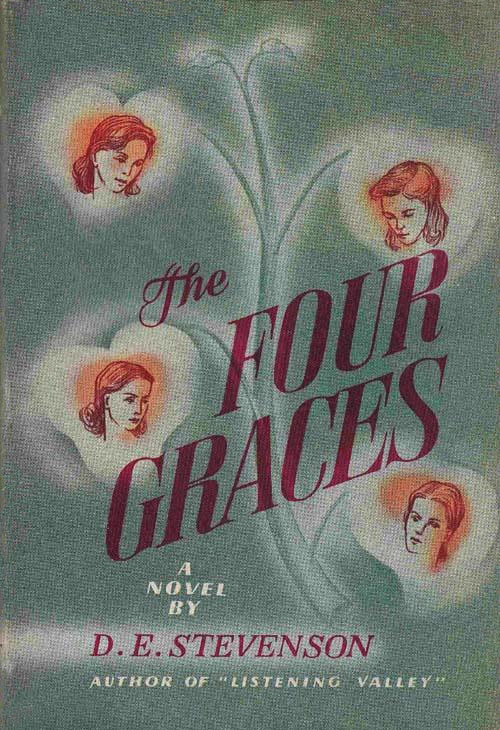
The Four Graces by D.E. Stevenson ~ 1946. This edition: Ulverscroft, 1975. Hardcover. Large Print – 370 pages.

My rating: For purely cozy, exceedingly nostalgic, “English village” escape literature, easily a 9/10. Literary merit – well, we won’t go there! I am actually quite impressed by the assumption that the author makes that her readers are very familiar indeed with the literary greats, as well as the current bestsellers of the day. References and quotations appear without any explanation, with, I’m quite certain, the belief that the reader as well as the characters of the story will “get it” immediately. Rather reminiscent of D.L. Sayers, and her own high-handed assumption that her readers are coming from the same erudite place as she is!

*****

This is my second D.E. Stevenson, after my initial introduction to this author’s esteemed Miss Buncle’s Book . I can understand how Dorothy Emily has garnered such a devoted following over the years. My elderly mother (87) would just love this one. I browsed ABE to see if I could perhaps pick it up for her, but was shocked at what  I thought were astronomical prices for this type of book – $22 and up for worn paperbacks to an unbelievable $246 for an ex-library hardcover. Who knew?!

Someone needs to get going on republishing this author – obviously there is a demand. I know Persephone has recently re-released, in 2009 and 2011 respectively, Miss Buncle’s Book and Miss Buncle Married, but those are the tip of a very large iceberg. According to my research – okay, to be honest, I looked at Wikipedia – this author’s career extended from 1923 to 1970, with a very respectable forty-six titles to her credit.

*****

The Reverend Mr. Grace is Vicar of a country parish, and is blessed with four now-motherless grown-up daughters. Adeline – Addie – the eldest, is a W.A.A.F. officer now living in London, but the three younger sisters remain at home. Matilda (Tilly), Sarah (Sal) and Elizabeth (Liz) all keep extremely busy, both by assisting their father in his many duties and helping with the war effort, for the story is set mid-World War II, and much of its charm is in seeing how the villagers live their lives and gamely make adjustments for the current reality.

Romance enters the sisters’ lives as two suitors suddenly appear – one quite traditionally, and the other much more insidiously. The reader never has a moment of doubt as to the eventual outcome, and though there are gentle setbacks to both romances everything inevitably works out as it should. A very sweet little story, which I found surprisingly appealing. Tiny touches of cynicism and humour kept it from being too saccharine, though it was a rather close thing.

From the Author’s Preface:

The author has been asked whether this is a funny book or true to life, and has some difficulty in answering the question, for life is a funny business altogether (both funny-peculiar and funny-ha-ha, as Elizabeth would say). The story covers less than a year in the life of a family and during this comparatively short period many things happen, some serious and important, others cheerful and gay. It is summertime – a summer during the greatest and most terrible f the wars – but the author felt disinclined to bring such a grave and desperate matter into a light-hearted tale; here, then, are to be found only the lighter side and the small inconveniences of Total War; the larger issues are ignored…

Read Full Post »

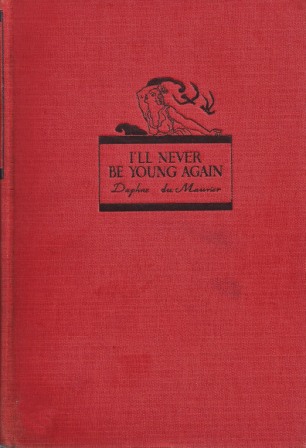
I’ll Never Be Young Again by Daphne du Maurier ~ 1932. This edition: Sundial Press, 1941. Hardcover. 336 pages.

My rating: 8/10 for most of the writing – the woman could certainly put words together, though she falters here and there – see the last paragraphs of the book which I’ve included at the very end of this review – and 4/10 for the plot and characterizations. Averaged out, that makes 6/10, which is still too high, so I’m going to give it a 5/10. Brutal, I know, but it is that hard to read.

I wanted to like this book so much, and was so thrilled when I found it. It starts off so very well, but soon turns into a long, very slow motion (think frame by frame slow) train wreck. I no longer wonder why this title is one of the unremarked silent members of Daphne du Maurier’s otherwise mostly stellar bibliography.

If it were anyone else but Dame Daphne, I would have pitched it about a quarter through, if not sooner. As it was, it took me a very, very long time to work my way through it. Only its nagging presence on my “What I’m Reading” sidebar kept me coming back for more punishment.

*****

The book, Daphne’s second (the first is The Loving Spirit, which I know I have somewhere but seem to remember having set aside many years ago as “unreadable” as well – I need to find it to refresh memory) was published when she was only twenty-four, so we have to give allowances for that. From my own advanced age – okay, I’m not that old, but twenty-four is half a lifetime away for me now – a book written by a twenty-four year old and titled I’ll Never Be Young Again is somehow more than a little ironic.

After finishing, I sat for a while thinking, “Was it the book or was it me? Did I just not get it?” So I did what I always do in cases such as this – I googled other bloggers’ reviews. And look what I found! I’m not alone! Someone else thought the very same thing. (Though she only gave it a 4/10. Ha! – take that, Doleful Dick, you whingy whiner.)

Therefore I have totally copped out and shamelessly stolen this review from Books I Done Read  (tagline: Reading books so you don’t have to) which is a totally awesome, very busy (in more ways than one – you’ll see what I mean when you visit it) little production. I love it. Raych forthrightly says what we’re all secretly thinking. Spend the time on her blog which you would’ve spent crawling through du Maurier’s non-opus, and you’ll be much happier. Says me, from first hand experience of both.

January 28, 2011

This was a difficult one to read.  It has those sort of circular, Catcher-in-the-Rye conversations where the point is not the content but the banality, which makes for good social critique but sloggery reading.  And it’s maybe 99% dialogue, because nothing happens.

Ok so.  Dick is the son of a famous author-slash-shitty father and, not having accomplished anything worthwhile by the ripe old age of maybe 21, Dick is on a bridge about to throw himself off when Jake happens by and is all, Don’t do that.  Exciting! you think.  And then on to page seven, where Jake and Dick go hire horses and ride through the mountains and the fjords for chapters and Jake tries to buck Dick up because Dick is sort of a whiner.  Somewhere in there Dick sleeps with a girl and it is disappointing for everyone involved.

Jake exits scene left about halfway through the book via Unexpected Oceanic Death and Hesta enters, with her large eyes and orange beret, and she and Dick shack up.  And this is where the whole thing gets seedy.  Daphne wanted to write about the uncomfortable relationships between men and women, and she nailed it because this is The Worst.  Dick spends ages trying to convince Hesta to let him nail her, complete with sulks and professions of love and more sulks.  After he finally wears her down he’s all *phew* Now that I’ve had you you can give up your music and come live in my flat with me and I will ignore you while I write the Great English Novel.

So it goes.  After a while (months, say) Hesta is like, I’m bored.  Remember how we used to…you know.  And Dick, who has been busily writing a novel (and a play!  Both sure to be hits!) all this time is like, ‘You mustn’t…you musn’t be like that.  It’s ghastly…it’s making a thing of it, it’s – it’s unattractive.  It’s all right for me to want you, but not for you – at least, never to say.’  Ugh, right?  So that when he goes to London to sell his novel (and play!) and his dad’s publisher is like, I’m sorry, but these are terrible, and he comes home to find that Hesta has left him for literally anyone else you’re all, Huzzah!  Oh and also, The end.

I feel like I need a shower.  It’s We Need To Talk About Kevin all over again.  Du Maurier succeeded in making me feel hideously uncomfortable which, while impressive, is also unpleasant.  I like my characters to be Good or Bad or a Mix but Something.  I don’t like for them to wander around listlessly with no real ideas and a too-large sense of their own importance alternated with a sort of whiny comprehension of how much they actually suck.

Very good, and very skillfully done, but I didn’t like it.

So there you have it. I will leave you with the closing lines of this story, which gives you a firsthand snippet of the banal monologue we’ve had to struggle through. Here’s Dick:

From my window I look down upon the little square. The trees are green in the garden opposite. There is the clean, fresh smell of an evening after rain. Somewhere, on one of the branches of the trees, I can hear a bird singing. A note that sounds from a long way off, sweet and clear, like a whisper in the air. And there is something beautiful about it, and something sad. At first he is lost, and then he is happy again. Sometimes he is wistful, sometimes he is glad.

He seems to be saying: “I’ll never be young again – I’ll never be young again.”

“I’ll never be young again.” Thank heaven for that. Because once she got this one out of her system, Daphne went on to write her next book, The Progress of Julius, which I absolutely adore, and then Jamaica Inn, and Rebecca

Growing pains. So glad she made it through!

Read Full Post »

« Newer Posts - Older Posts »