Posts Tagged ‘Vintage Fiction’

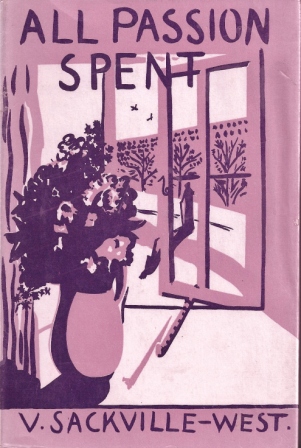
All Passion Spent by Vita Sackville-West ~ 1931. This edition: Hogarth Press, 1965. Hardcover. 297 pages.

My rating: 8.5/10. Excellent. This book nudges me to remember that I should read more of Vita’s literary work. Her garden writing is already personally much prized, and frequently referred to in my “working” plant nursery library.

*****

An unusual piece of literary fiction about an elderly woman’s examination of her life, and her subsequent emancipation from the expectations of others. The emotional freedom thus obtained only lasts for a very short time, but the satisfaction it engenders both in the protagonist and the reader is quite glorious.

Often classified as an example of feminist literature – the Virginia Woolf parallels and comparisons are de rigueur – this novel transcends that earnest label and is also a very fine piece of story-telling, full of keen observation and humour. Vita Sackville-West was undeniably cynical, but stopped shy of coming across as bitter, at least not in this small gem of a tale.

*****

Henry Lyulph Holland, first Earl of Slane, had existed for so long that the public had begun to regard him as immortal. The public, as a whole, finds reassurance in longevity, and, after the necessary interlude of reaction, is disposed to recognize extreme old age as a sign of excellence. The long-liver has triumphed over at least one of man’s initial handicaps: the brevity of life. To filch twenty years from eternal annihilation is to impose one’s superiority on an allotted programme. So small is the scale upon which we arrange our values. It was thus with a start of real incredulity that City men, opening their papers in the train on a warm May morning, read that Lord Slane, at the age of ninety-four, has passed away suddenly after dinner on the previous evening. “Heart failure,” they said sagaciously, though they were actually quoting from the papers; and then added with a sigh, “Well, another old landmark gone.” That was the dominant feeling: another old landmark gone, another reminder of insecurity. All the events and progressions of Henry Holland’s life were gathered up and recorded in a final burst of publicity by the papers; they were gathered together in a handful as hard as a cricket ball, and flung in the faces of the public, from the days of his “brilliant university career,” through the days when Mr. Holland, at an astonishingly early age, had occupied a seat in the Cabinet, to this very last day when as Earl of Slane, K.G., G.C.B., G.C.S.I., G.C.I.E., etc. etc. – his diminishing honours trailing away behind him like the tail of a comet – he had drooped in his chair after dinner, and the accumulation of ninety years had receded abruptly into history. Time seemed to have made a little jump forward, now that the figure of old Slane was no longer there with outstretched arms to dam it back …

In Lord Slane’s imposing London house, his elderly widow – of no slight age herself – eighty-eight – contemplates his dead face with “thoughts which would have greatly surprised her children”, while downstairs in the drawing-room the six Slane “children” – rather elderly, with grandchildren of their own – wait for their mother’s inevitable breakdown, and tentatively feel each other out as to how best to arrange for “wonderful Mother’s” immediate future, for of course she will now need to be “stowed away; housed, taken care of.”

When Lady Slane refuses to be “cared for” and instead makes her own arrangements for her future without familial consultation, her offspring are at first shocked, and then, in most cases, highly resentful. Herbert, Carrie, Charles and William are stiff with disapproval; only the awkward family outsider Edith has an inkling that her mother might have more backbone and brain than the others realize; while Kay is most keenly interested in distancing himself from any conflict or fuss; he enjoys his bachelor existence in his flat crowded with his collection of compasses and astrolabes.

Lady Slane distributes her jewelry, her only private asset, with little regard as to fairness; rather she seems faintly amused at the egotistical frailties this gesture reveals among her offspring and their spouses. With only a small pension as income, she rents a small house in Hampstead which she has secretly been desiring to reside in for the past thirty years, to live alone with her elderly French maid, Genoux, who has been with her since her marriage some seventy years ago. She intends to limit her visitors severely:

“I am going to become completely self-indulgent. I am going to wallow in old age. No grandchildren. They are too young. Not one of them has reached forty-five. No great-grandchildren, either; that would be worse. I want no strenuous young people, who are not content with doing a thing, but must needs know why they do it. And I don’t want them bringing their children to see me, for it would only remind me of the terrible effort the poor creatures will have to make before they reach the end of their lives in safety. I prefer to forget about them. I want no one about me except those who are nearer to their death than to their birth.”

But Lady Slane’s life is not destined to be one of solitude, for she soon attracts a small group of friends, of “followers”. Three elderly men find their way into her life and add richness and a strange variety to her waning days. Mr. Bucktrout, owner of her house, Mr. Gosheron, the builder who has renovated it for her, and millionaire art collector Mr. FitzGeorge, who has retained a deep infatuation with Lady Slane from the time many years ago, when she was the wife of the Viceroy of India (one of Lord Slane’s many prominent postings) and FitzGeorge himself merely one of many anonymous young men who enjoyed the hospitality of the Regency, presided over by the young and very beautiful Deborah Slane.

These three men, along with Genoux and an unexpectedly appearing great-granddaughter, Lady Slane’s namesake Deborah, bring both confusion and reconciliation to Lady Slane’s mind and soul as she strives to put the meaning of her long life into a final context.

The novel ends with Lady Slane’s death, but that is in no way a tragedy, merely an inevitable ending which is kinder than it might have been, and happier than Lady Slane had once anticipated it might be.

*****

Vita Sackville-West portrays her characters with occasional affection and continuous insight mixed with irony. All Passion Spent is short in pages, but dense in thought-provoking passages and situations; love or despise the characters as we may, we find many parallels, often unexpected, between this upper-class “lady” with few “real” problems, and our own less exalted lives. Who has not denied personal ambition at some time or another? Made that difficult compromise between desire and duty? Wished to distance themselves from tiresome people, and be allowed, at the end of one’s days, to sit against the garden wall in the sun and muse?!

Of course, most of us have no Genoux to care for our less delectable functions, to wash and dress us, and minister to our ever-more-demeaning physical failings. If there was one sour note in all of this – and there are several, but this is the main one, to my mind – it was the thoughtless assumption by Lady Slane of Genoux’s infinite capacity for servitude; there is a brief moment of realization and appreciation, but after seventy years together, the servant-mistress position is still firmly in place, with selfishness a prominent quality in Lady Slane’s refusal to fully appreciate Genoux’s parallel existence and to consider her needs and her long-denied desires, whatever those may be.

Very evocative description of the Hampstead house and garden, and of the daily rituals of the elderly Lady Slane as she realizes her last ambition.

A book to re-read. Not without flaws, but those are outweighed by the many excellences of the writer’s narrative and descriptive skills.
Read Full Post »

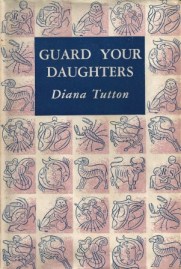
guard your daughters diana tutton 001Guard Your Daughters by Diana Tutton ~ 1953. This edition: The Reprint Society, 1954. Hardcover. 246 pages.

My rating: This is one of the more difficult ratings I’ve had to mull over in the eight months since I’ve started this blog. I’m going to say, after much consideration, 6/10.

That rating may change if I can get my hands on some of the author’s other works; I am curious to see her next developments as a writer.

I thought this was an ambitious and strongly written first novel. There were a few rough patches here and there, and I bogged down a bit about a third of the way through, but the narrative then picked up speed, and I had no trouble staying engaged until the bitter end.

The following review is divided into two sections, the first for those who haven’t yet read the book, and the second for those who have; I have some comments to add to the recent online discussion regarding Guard Your Daughters and, of course, its inevitable comparison to Dodie Smith’s I Capture the Castle.

*****

I’m very fond of my new friends, but I do get angry when they tell me how dull my life must have been before I came to London. We were queer, I suppose, and restricted, and we used to fret and grumble, but the one thing our sort of family doesn’t suffer from is boredom.

So speaks this novel’s narrator, Miss Morgan Harvey, looking back on the circumstances of her nineteenth year, the year when everything changed, and when she and her sisters finally emerged from their mother-woven cocoons and ventured out into the larger world.

“Queer” and “restricted” are apt descriptions of the Harvey ménage. Father is an immensely successful mystery story writer, distantly busy in his study churning out his manuscripts and emerging occasionally to pay the bills and blink short-sightedly at his daughters. Mother is an oddly attractive though emotionally needy and mentally fragile creature whom the other six treat with extreme care tinged with apprehension – “What if something should set her off?” they all whisper to each other – every word and action weighed with care to ensure the avoidance of a quivering, wailing breakdown. Friends are forbidden the house, and indeed the girls do not appear to even have friends; they were not allowed to attend school, and their last governess left four years ago. There is no telephone –  “it worried mother” – and no outings but for the necessary trips to the village shops and to the next door farm for illicit black market acquisitions of butter, cream and eggs (the story is set in post-World War II England, when food rationing was still in effect). And there are, most emphatically, no opportunities to meet young men.

The oldest sister, twenty-two-year-old Pandora, has unexpectedly escaped and been recently married. Now living in London, she’d caught the eye of a visiting young man, grasped her rare opportunity, and speedily carried out a courtship whilst officially occupied teaching Sunday School. To everyone’s surprise, the marriage was accepted relatively quietly by Mrs. Harvey, but the rest of the sisters are now even more aware of their restrictions, and are beginning to cast their glances speculatively around for their own chances to blossom forth.

Thisbe, second eldest, is twenty-ish, Morgan is nineteen, Cressida eighteen, and Teresa fifteen, but they all have the dual personality of the overly sheltered but mentally bright child, a combination of beyond-their-years intellectual sophistication and total social naïvety. Snobbishly proud of their status as daughters of a best-selling author, their good looks, their various “arts”, and above all their determined and deliberate “eccentricity”, they play these points up for all they’re worth when they do have their rare social interactions.

As the narrative starts, Morgan has just captured (apt term!) a young man whose car has broken down at the Harvey gate, and his enforced stay to tea allows us to sum up each sister’s particular persona.

Pandora is absent, though she arrives that evening for a visit and turns out to be wonderfully “normal”; bloomingly happy in her marriage and eager for her sisters to share in her good fortune. Thisbe is proud of her own witty tongue, and delights in shocking people with her cutting comments; she privately pursues the muse of poetry, shutting herself up to write with little care of the boring logistics of helping with household chores. Morgan is musical; she has occasional piano lessons and works away on her own, though not strenuously enough to gain the skill needed for her talked-of concert pianist’s career. Cressida is the handy sister, the practical one; yearning after normalcy and highly aware of her family’s general oddness, she cooks and cleans and mends and tries to keep her careless sisters as decent as she possibly can, to their frequent mild scorn. Teresa is a very young fifteen, and thrilled to have reached the age when the visits of the country education inspector need no longer be feared. She has surrounded herself with books and lives in an intellectually precocious world of her own, while clinging to her mother and indulged by her older sisters; a true baby of the family, talked of and treated as if she were five or six versus on the cusp of young womanhood.

The eventual implosion of the Harveys’ private little world and the true nature of their mother’s “ailment” forms the climax to which this hectic story builds. And though billed as a “social comedy”, there is a much darker undercurrent to the facetious surface story; I was uncomfortable as often as I was amused.

*****

This next bit is addressed to those who’ve read the book – alert to others –  there may be spoilers.

I did enjoy the actual reading of this book; I was drawn into the story and I was decidedly curious as to what was going to happen next; my expectations changed drastically as the narrative moved on, and I began to pick up on darker elements of what initially seemed like merely an amusing “light” novel.

Paradoxically I did not like or admire most of the characters in any sort of personal way, and I found myself getting more and  more uncomfortable as the comically brittle farce turned into something much darker. I think this was a deliberate ploy by the author; in which case she deserves high marks – this novel, if viewed as a dawning-of-an-awful-light portrait of a severely dysfunctional family, is, in my opinion, decidedly a success.

If, on the other hand, I’m reading the author’s intentions completely wrong, and this was indeed meant to be an amusing romp, it fails utterly and dismally. This is not a feel-good book. I felt that the frenetic posturings of the narrator serve initially to hide, and later to sharply accentuate, the misery of her life and the psychological damage to all five of the siblings and their father by the emotional malfunctioning of the family’s mother. In turn, the mother has been deeply emotionally injured in her own earlier life; the five sisters of Guard Your Daughters are classic cases of victims of the victim; the “spiral of abuse” – that handy modern catch-phrase – applies most appropriately here. That the abuse is prompted by love – albeit love gone terribly wrong – in no way lessens its effects on the many victims, though it may excuse the perpetrators of deliberate viciousness and leave them guilty only of the lesser crime of thoughtlessness.

Though some reviewers (see links at the bottom of this post) have felt that this novel is strongly derivative of other stories, I felt that though it may have shared a few vague similarities of plotting with other “classics” of similar genre (and yes, I’m referring here to Dodie Smith’s I Capture the Castle), by and large I felt that it was an original work by a creative mind, not a copycat work by any stretch. There are only so many situations out there; the repetitive themes of young people (in this case young women) yearning after both romantic love and “suitable” mates, and, indeed, the struggle to break free of parental influence and to escape from childhood into the wider world of true maturity, are universal and repeated time after time after time, because writers and readers so strongly identify with them, whatever the era.

The frequent humourous situations were well portrayed, and they did make me smile; but my final impression of Guard Your Daughters is that this was not a happy book; the humour is not the point here, it merely fulfills the part of the curtain that refuses to stay drawn over the utter awfulness of the understory.

The Harvey sisters did not gain my instant affection as did Castle‘s Mortmains; Morgan as narrator was not nearly as charming and individualistic as Cassandra; I never could shake the feeling that I was being overtly manipulated into accepting Morgan’s point of view, while Cassandra’s narrative became an effortlessly absorbed voice in my head for the entire time of the reading of the novel.

While both sets of fictional sisters are snobbish, the Mortmains recognize this and admit it as a failing, while the Harveys revel in their snobbishness and deliberately mock anyone of lower social status who draws their attention, from their departed governess to their lone domestic to the farmer’s wife who sells them their black market eggs to the bookstore owner who promotes their father’s bestsellers.

This continual self-regard and deep snobbishness was what prevented me from embracing the Harvey sisters as truly “lovable” characters. All five had some good points, some complexity of character, but I never felt like we were equals. In their world, I fear very much I would be one of the mocked commoners, with boringly bourgeois views and the wrong ancestors and accent.

The continual selfishness of all of the Guard Your Daughters protagonists is the most difficult trait standing in the way of my sympathy for them; while they occasionally acted in a disinterested way towards the members of their inner circle, their inward-facing focus added to their greater problems; at some point in the story I felt like shaking each and every one of them and hissing “reality check, you fool!” in their silly faces. Morgan most of all!

I’m glad I read Guard Your Daughters, and I’m very curious to read more by this writer, though this novel will definitely not join the “comfort reads” in my personal stacks. I think it might best be placed with the ones on my “love-hate” shelf, alongside Muriel Spark, Margaret Atwood, Jeanette Winterson and their ilk, to be taken in small doses when the need for an emotional shake-up of sorts is desired; literary bitters to add piquancy to a milder, more easily digestible, dare I say, generally more enjoyable everyday reading diet.

*****

I’m not completely happy with my review above; it seems that my after-midnight thoughts have not all quite made it to the page, but I’ll leave it there for now – a new midnight is fast approaching! The following reviews are the ones that started me on this very interesting examination of Guard Your Daughters. If you haven’t already, please visit these for a wider discussion of this slightly controversial read.

Stuck in a Book – thought it was grand!

Jenny’s Books – generally enthusiastic with some reservations.

The Captive Reader – decided it wasn’t her thing.

Book Snob – loved it.

*****

And here, by way of a little bonus, are two teaser reviews for Diana Tutton’s second and much harder to locate novel, Mamma, published in 1955.

From Kirkus, April 1955:

A pleasant autumnal blooming for Joanna Malling has its problems which are fortuitously solved. For Joanna moves to a new house, after a widowhood of twenty years, only to find that she must ready it for her daughter’s (Elizabeth aged 20) wedding to Stephen Pryde, 35 and a Major expecting to be stationed abroad. Joanna, at 41, finds him stolid and slightly inimical. But when his orders do not come through and she must do the necessary and provide a home for them when he is assigned to her locality, she begins to find many things in common with Stephen which Elizabeth can never achieve. Stephen, too, is not unaware. The impasse is resolved when Stephen’s mother dies and there is a home of their own for Elizabeth, now pregnant, and Stephen, so Joanna, rid of her temptation, faces an undisturbed future. A British blend of feminine frailty and domesticity provides an amiable amble.

And from Jet, May 1955:

Attractive Joanna Malling, who at 41 had been a widow for 20 years, is appalled (and pleased) when she finds herself falling in love with the husband of her 20-year-old daughter Libby.

This is the core of Mamma, a novel by Diana Tutton (Macmillan, $3.50). It is a lean English novel that attempts to be “modern” in facing a basically tragic problem that Miss Tutton strains to solve as a “social comedy”.

Before she even met him, Joanna was prepared to dislike Steven Pryde, an English army major, primarily because Libby’s affection for her would be deflected. But when Steven and Libby visited Joanna at her little cottage outside of London, Joanna found her 35-year-old future son-in-law more than attractive. After the marriage, pneumonia felled Steven and Joanna had Libby bring him to her home to recover.

Proximity drew Joanna and Steven together but he never quite gave in to his impulse to take her into his arms. Joanna, on the other hand, plotted to culminate an affair, her conscience all the time reminding her that Steven was her own flesh and blood’s husband. Aching for one last fling, after so many barren years, Joanna almost gives in to indiscretion.

With a woman’s infallible intuition in these matters, Libby is not unaware of what is transpiring, but she makes no over moves, except to conveniently become pregnant before she can tell Joanna that she strongly suspects her of being in love with Steven and trying to steal him.

In what is described as a “social comedy”, Miss Tutton solves this three-pronged problem with cool English efficiency, but the reader is led to expect more than Mamma offers.

Well, are you as curious as I am to investigate this one? Methinks Diana Tutton may have had some “mother issues” of her own which she was working out on the page!

Read Full Post »

Last week I read several reviews of Diana Tutton’s Guard Your Daughters; most, but not all, enthusiastically and favourably comparing it to Dodie Smith’s I Capture the Castle. Now I am not alone in believing there is a special warmth in the sun that shines on the Mortmain family as depicted in that tale, so anything that is compared to it attracts my immediate attention.

After reading Claire’s review on The Captive Reader blog, I commented to her on how much I would like to sample Guard Your Daughters for myself, and Claire, who has decided this one is not a “keeper” for her, immediately popped it in the mail to me. I found a parcel card in my box yesterday, and being Sunday, was unable to collect it as our postmistress had the parcel room locked up tight, but this afternoon my teenage son kindly drove the fifteen minutes back out to our small rural post office to pick it up for me. (He picked up a tub of ice cream, too, as our post office is a tiny room at the back of a small country general store, so it wasn’t completely a disinterested trip!)

My husband is away working a night shift this evening, so I will have no qualms about retiring to bed and reading as late as I want without worrying about the light shining in his eyes. Actually, I think I might bow out early, to give my full attention to the task at hand. Will I love this one, or be disappointed? Either way, I am looking forward with great anticipation to finding out.

Thank you, Claire! An early Christmas present, indeed. A review shall follow post haste.

Book People are The Best!

Read Full Post »

the cutters bess streeter aldrichThe Cutters by Bess Streeter Aldrich ~ 1922. This edition: Grosset & Dunlap, 1926. Hardcover. 276 pages.

My rating: 7.5/10

This novel bookends Mother Mason; both are episodic individual and family portraits; I read them back to back and there were decided similarities of style and content, though each book has enough variation to keep things fresh.

I rated Mother Mason higher; though The Cutters is a charming read as well. However, in this novel, the morals in the little stories within are laid on with a much broader brush.

Motherhood, Home, Family – yes – we understand their importance, dear author, to the fabric of a happy nation, but the insistence that these are the only things which bring fulfillment to a womanly heart jars a bit with our modern-day emancipated female reality!

A tiny bit preachy, and very much a period piece; most obvious perhaps in the chapter on alternative ways of child discipline which ends with the family’s mother soundly thrashing her two naughty sons, with the author’s blatant assumption that this will meet with her readers’ full approval!

*****

This novel depicts a short period in the life of the Cutter family of the fictional small town of Meadows in an unspecified mid-western U.S. state. Father Ed, a successful lawyer; Nell, a busy hausfrau; 12-year-old Josephine; Craig and Nicolas, 7 and 9; baby Leonard; and mild matriarch Grandma Cutter make up the seven points of the Cutter family star.

The time is the early years of the 1920s; the shadows of the coming Depression are faint but ominously lurking. The Cutters struggle financially, and much of Nell’s part of the narrative is driven by her wistful yearnings for things which she can’t quite afford. Her husband teases her with a running joke about champagne tastes on a beer budget; Nell inwardly bristles while admitting to herself that this is indeed one of her personal Waterloos.

The incidents which make up the book are mild and domestically based for the most part. A wealthy client and his wife come to stay for  a few days, throwing the Cutter household into turmoil top to bottom; The Woman’s Club invites a speaker on “Perfect Parenthood, or Trained Motherhood”, whose ideas Nell tries to emulate with less than stellar success; a decision to take a family “dream vacation” reveals some surprising preferences; Josephine’s schoolgirl crush disrupts her young world; Nell’s ambitions for a newer, better, bigger house look like they will finally be realized; Grandma Cutter looks forward to a reunion with all of her far-flung sons; Nell enters a contest to try to win some “easy money”.

Likeable characters; relatable situations, a lot of humour and some very wise words coming from unexpected quarters – Aldrich is truly in fine form here. She bobbles a bit with the last chapter, which jumps ahead several years to the time of Josephine’s wedding, and hurriedly fills us in on how everyone else is turning out. Aldrich didn’t need to do that; she could have left us in the here and now, and it would have been just fine, but I suspect she couldn’t quite resist tidying things up.

Though not quite up to its predecessor, Mother Mason, The Cutters is an ideal nostalgic comfort read. I liked it a lot.

Read Full Post »

Mother Mason by Bess Streeter Aldrich ~ 1916. This edition: Grosset & Dunlap, 1924. Hardcover. 269 pages.

My rating: 9/10. What a sweet book! A fast-reading pick-me-up, full of gentle humour and most likeable characters.

Reminiscent of Lucy Maud Montgomery’s early stories, in the very best way.

*****

Molly Mason sits down at her bedroom dressing table, feeling very much fat, fifty-two and fidgety. She can’t quite put her finger on the reason, though. Her life has evolved along pleasant lines; from humble beginnings her husband has progressed from clerkdom to bank president over the decades of their happy marriage. Molly’s five children, eleven-year-old Junior, sixteen-year-old Eleanor, twenty-one year old Marcia, twenty-two-year-old Katherine, and twenty-five-year-old Bob, are healthy, bright and brimful of fire and ambition in their various very individual ways. A girlhood friend, fallen on hard times, lives in as companion and paid household help; the two get along famously well. Her marriage is deeply happy in a quiet, contented way; her husband doesn’t say much but he’s always ready to support her when needed and obviously loves Molly deeply though undemonstratively.

A happy home life, no money worries, a respected social position, lots of useful and generally pleasant work to occupy her time and energy – what could possibly be causing Molly’s middle-aged angst? Could it be the constant demands on her time both in the family and the community? Complimentary though the people around her are of her constant contributions, Molly is tired of always being the dependable one without whom things just can’t seem to happen. She can’t help herself, though she knows she has a darned good life – right now she feels like running away.

So she does.

Upon her return from several days in the city, which she has spent in a hotel, dining out, visiting the theatre and art gallery and, very briefly, having a tiny bit of dental work done – her erstwhile reason for the trip, misrepresented by Molly as more complicated than it actually is to buy her the time away – she is greeted with a long list of the occasions she was supposed to preside over in her absence; they’ve all been rescheduled so she wouldn’t miss a single one. To do her credit, Molly Mason sees the humour, and ruefully laughs.

This is an example of the mild adventures described in this book. Each chapter follows a member of the Mason household as they face their particular challenges and find a happy resolution.

This is an appealingly written, cleverly humorous domestic drama. It may sound ho-hum described like that, but I found that I enjoyed it greatly. Bess Streeter Aldrich tends to deal with extended flashbacks and rushed narrative to get her characters from the start to the finish of their lives within the period of her books; this book is an exception. It is very much in the here and now, with all activity narrated in the present tense. And it works exceedingly well; a similar approach might have addressed some of the flaws in certain of her other books, which I felt packed too much time-gone-by into too small a narrative package.

A feel-good book, easily polished off in an evening or two. I would recommend it for the L.M. Montgomery fan, or anyone else needing a fictionally gentle trip back in time to an absolutely decent American small town, just post World War I.

The copyright date in this book, 1916, disagrees with the publishing date found elsewhere, usually 1924, which is the latest publication date in my edition, following 1916, 1918, 1919 and 1920; I then discovered that some of these chapters originally appeared as magazine stories, which would explain the episodic nature of the book.

Read Full Post »

canada-reads-2013-panelists-books

Last night, with great self-congratulatory brouhaha, CBC Radio host Jian Ghomeshi introduced the Canada Reads 2013 Shortlist and celebrity panelists. This is an event I’ve watched (well, more accurately, listened to) with mild interest the last few years, but never really embraced.

I confess that I am in general deeply cynical about prizes awarded by popular vote, which is the whole premise of this literary “event”, but this year the shortlist picks seem more intriguing to me than some in the past, so I’ve set myself a personal goal of reading and reviewing all five of them. This will also tie in nicely with my participation in 6th Annual Canadian Book Challenge , hosted by John Mutford of The Book Mine Set .

I may also explore among the picks in the Long List, though I have no intentions of reading all of them. We’ll see what happens. This list will find a home in my library bag, for those days when inspiration needs a little push. I’ve already read a few (a very few) of the picks, though mostly before this blog materialized. I may re-read and review. Or not! Leaving myself wide open here.

This year Canada Reads has a regional theme, which doesn’t really work in my opinion, as there are only five extremely broad regions and geographically and philosophically I think there is more variance in truly regional Canadian literature than these limited categories allow. But no one asked me, so I guess I need to go with it.

Here’s our Long List:

B.C. & Yukon:

The Prairies and North:

Ontario:

Quebec:

Atlantic Canada:

Read Full Post »

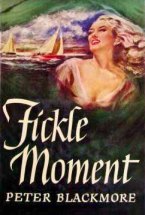
Fickle Moment by Peter Blackmore ~ 1948. This edition: G.P. Putnam’s Sons, 1948. Hardcover. 244 pages.

My rating: 7/10. The epitome of light reading; pure vintage fluff. A nice diversion from the snow whirling round outside!

*****

Elizabeth Portal rather smugly contemplates her thirtieth season as the leading star in the Watermouth Regis amateur operatic and dramatic society. She’s aging marvelously well, looks more youthful than her undeniable fifty, and only an unkind person would raise an eyebrow at Elizabeth’s coming performance as schoolgirl Yum-Yum in The Mikado. But when the other two of the Three Little Maids are Elizabeth’s daughters  Louise and Anna, more than a few sarcastic smiles are hidden behind politely shielding hands.

No matter – Elizabeth is on top of the world. Her eldest daughter, Anna, is about to marry the Watermouth Regis mayor, one Hubert Briggs, a man of varied experience: one-time jockey now turned respected undertaker after a riding accident ended his turf career and sent him back to take over the family business. People like Hubert, hence his election to the mayor’s chair; he’s unremittingly cheerful, and the funerals he presides over rocket right along, a relic (people whisper with a wink) of his sporting career and fondness for speed. Anna’s a bit of a drooper, true, but maybe marriage will pep her up?

Louise already has plenty of pep. A gorgeous young woman with a passion for tennis and swimming, Louise has attracted many admiring glances but so far has not returned the masculine attention of the local swains with anything other than polite amusement. Louise is ripe for love, ready to fall for the right man, who so far hasn’t appeared on her horizon. Or has he?

One day a rather battered sailboat, the Ayacanora, appears from nowhere and anchors just off the Portal’s private beach. Aboard is dashing sailor Richard Hardy, taking a break from his round the world voyaging, hoping to replenish stores and maybe engage in a little amorous relaxation. Lovely Louise swims by, and Richard’s interest is definitely aroused, especially when Louise glances back in her turn. Could something be about to happen?

Young Charlie Rogers, employed under the Portal patriarch Henry’s supervision at the Watermouth Regis town treasurer’s office, shows up to play the piano for the female Portals’ rehearsals. It has suddenly occurred to him that the questions his prospective employer asked him about his piano playing abilities were not so random after all. Charlie sees Louise, and fireworks go off inside his modestly manly heart. But could such a strong and vibrant girl ever look with even the remotest interest on an unathletic, sensitive and insecure (though undeniably good-looking) junior clerk?

Well, I’m thinking you can guess the answers to all of those, and I’m betting you’d be getting them all right. Shake these all together, add a generous handful of eccentric aristocrats and comic townspeople and ex-chorus girls and snobby upper-middle-class matrons, and here you have the ingredients to make a happy few hours reading.

The comeuppance of Elizabeth and the romantic flowering of Louise, plus the side stories of a nicely varied group of secondary characters makes for a narrative which dashes along at a very good pace indeed.

This one was picked up on a whim for the Gilbert and Sullivan quotation on the frontispiece: “Fickle moment, prithee stay!” Having a weakness for Penzancian pirates and Lord High Executioners and the rest of the G and S panoply of characters, my interest was piqued, especially when a closer investigation revealed a publishing date of 1948 and a Wodehousian sparkle of dialogue within.

I must say, if you’re not a devotee of The Mikado, you may find many of the scenes mildly confusing, but if you are, you will snicker along with the townspeople of Watermouth Regis at Elizabeth’s dramatic excesses.

Peter Blackmore was obviously a theatre lover, which assumption was confirmed when I researched him after reading this book and discovered that he was quite a well-known playwright and film screenwriter in the 1940s, 50s and 60s. Fickle Moment also appeared in dramatic form as a play called The Blue Goose, and a play called Miranda, featuring a captivating mermaid being paraded about in a bath chair as an invalid, was made into a very successful comedy movie, detailed here. Most intriguing!

I’d never heard of Peter Blackmore before, but you can bet your sea boots I’ll be watching for his name now. Though I somehow doubt I’ll soon come across another of Blackmore’s books at such a ridiculously low price – 25¢ at the local Salvation Army’s bargain book sale. Perhaps it will average out the next one I just might have to seek out online at a probably much richer price!

I’ll be looking for Miranda on film through the regional library system; this is just the thing that our wonderful librarians like to acquire and share. Please let me know if any of you are familiar with Blackmore; I’m really interested now, and the internet is strangely uninformative, save for the playwright designation, a few Miranda discussions, his dates – 1909 to 1984, and his British nationality.

Read Full Post »

The Story Girl by L.M. Montgomery ~ 1911. This edition: 1st World Library, 2007. Hardcover. ISBN: 978-1-4218-4202-8. 312 pages.

My rating: 9/10. What a delicious period piece. Loved it! Why have I not read this one before?

Beautifully evocative of golden childhood summers in a faraway time. Sweet, but never cloying; the very human children keep it real.

*****

An absolutely charming set piece about a group of cousins and friends spending a mostly idyllic summer together on Prince Edward Island.

The narrator is a grown man, Beverley King, looking back on his childhood, when he and his brother Felix travelled from their home in Toronto to spend the summer on the old family farm while their widowed father travelled to Rio de Janeiro on business. They are to stay with their Aunt Janet and Uncle Alec, and cousins Felicity, Cecily and Dan. Nearby is another motherless cousin, Sara Stanley, living with her Uncle Roger and Aunt Olivia, with a father in Paris. Uncle Roger’s hired boy, Peter Craig, and a neighbourhood friend, Sara Ray, round out the group of children.

Nothing much happens in this book, but the days are nonetheless filled to the brim with interesting incidents. The cousins and friends do their chores, play, squabble and run wild as often as they are able. They are generally good children, but not unreasonably so, and their numerous falls from grace drive the narrative, along with the endless succession of tales told by cousin Sara Stanley, the self-named Story Girl, who has an endless collection of anecdotes from a myriad of sources – local and family fables, legends, fairy tales and Greek myths – something for every occasion. Gifted with a natural dramatic ability, Sara Stanley could “make the multiplication table sound fascinating”, as she does on one memorable occasion.

Observant, restless Bev; chubby, sensitive Felix; self-confident, proud Dan;  beautiful, bossy, domestically talented Felicity; sober, stubborn, peace-loving Cecily; plain, imaginative Sara Stanley; over-protected, tear-prone Sara Ray; self-sufficient, passionate Peter – these are the eight personalities which make up the core group, though other family members and friends – and a few animals – take their part as well. Ranging in age from eleven up into the early teens, glimpses of the young men and women the children will become are very much in evidence, though childhood emotions and interests still hold sway.

Tragic (and joyful) family love affairs, a mysterious locked blue chest filled with a disappointed bride’s prize possessions, magic seeds, poison berries, various “hauntings”, a neighbourhood “witch woman”, reports of the end of the world, a competition regarding dreams, adolescent crushes, a brush or two with death – all of these (and more) serve to add spice to this halcyon summer, looked back on with fond memory by the adult narrator. A few clues as to what the future holds are given – hired boy Peter is deeply in love with beautiful, scornful Felicity; the Story Girl will perform before royalty in Europe – but by and large the narrator stays focussed on that brief time between heedless childhood and care-filled adult life.

*****

This book, along with The Golden Road, The Chronicles of Avonlea and The Further Chronicles of Avonlea, was the basis for a highly successful CBC-Disney television series co-production, Road to Avonlea, which was widely broadcast from 1990 to 1996. I completely missed this one, having by then entered my “no television” years, but reports by L.M. Montgomery aficionados claim that the show departed drastically from the books, both in characters and plot. Canadian actress (and now screenwriter and film director) Sarah Polley played the Story Girl in the series.

The Story Girl is followed by The Golden Road, another Montgomery book which has been on my shelf for some time, but which I have also not yet read – I will be remedying that this winter. If it is as charming and amusing as The Story Girl, I am in for another nostalgic literary treat.

Read-Aloud: The Story Girl would likely work well as a Read-Aloud for ages about 8 and up – there will be some rather long-winded parts here and there as episodes as set up, so you may need to self edit depending on your listeners. A few of the stories are a wee bit gruesome – in one reference a lost child is found the following spring as only a “SKELETON –  with grass growing through it”; ghosts are often referred to; there is a neighbourhood eccentric thought by the children to be a witch – if you are at all concerned over such themes it would be best to read ahead a bit to see if the material is acceptable to your listener’s sensibilities. Many references to and some plots centered on religion. All very era-appropriate. Nothing too extreme, in my opinion, but you may want to preview, especially before starting this with younger children.

Read-Alone: For reading alone, this one is most likely best for older children, say 11 or 12, to adult.

The largest challenge the reader will find themselves faced with, though, is envisioning, or, in the case of a Read Aloud, replicating the Story Girl’s magical talent for tale telling. Good luck! (And enjoy.)

Read Full Post »

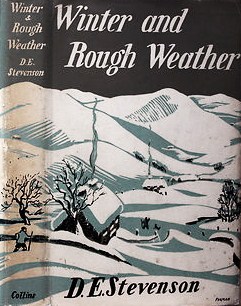
Shoulder the Sky: A Story of Winter in the Hills by D.E. Stevenson ~ 1951. Original British title: Winter and Rough Weather. This edition: Thorndike Press, 1992. Hardcover. Large Print. ISBN: 1-56054-343-4. 407 pages.

My rating: 8.5/10, for the majority of this story. I found myself very keen to get back to it and find out what was about to happen next, the most compelling of D.E. Stevenson’s books in this respect so far.

*****

A few years after the conclusion of the Second World War, a young, newly married couple, Rhoda and James Dering Johnstone, arrive at their isolated farmhouse near the fictional Scottish village of Mureth. Rhoda is an accomplished professional painter, and her husband worries, with some reason, as to how she will adjust to a life as a sheep farmer’s wife, far from the stimulating world she has happily abandoned for true love.

Rhoda drifts for a while, mulling over the dilemma of what she sees as a black and white choice between her perceived role as a wife versus personal fulfillment as an artist. The author handled this theme sensitively and sensibly, though I couldn’t help but think that childless Rhoda, overseeing a small house with the help of a live-in cook-general, had a luxury of a “domestic support system” impossible for those of us in a similar societal-economic position to attain today.

With her husband’s full support, Rhoda returns to the studio, and proceeds to paint a portrait which has far-reaching consequences among the local residents.

Add in several on again-off again love affairs, a missing wife, a bullying neighbour, a misunderstood child, and the challenges of winter storms in an isolated locale, and you have a quietly dramatic novel, and my favourite DES to date. There are two prequels/companions to this title: Vittoria Cottage and Music in the Hills, but Shoulder the Sky works well as a stand-alone; I never felt like I was out of the loop, though there were references to previous events throughout.

My only complaint is the ending seemed a bit rushed. Everything fell into place a little too neatly, and though things were obviously set up for happy resolution, too many plot strands were left hanging.  We were told that everything was now set to work out, so there were no real cliffhangers, but the novel’s abrupt ending felt very unfinished after some of the detail given earlier on. (This seems to be a common failing with most of the D.E. Stevenson books I’ve read to date.)

I greatly enjoyed this novel, aside from its minor but forgivable imperfections. The author has set it up beautifully, and the details she gives both of farm life and the art world appear to come either from personal experience or detailed research. I thought this particular novel was a relatively strong work for this “light romance” author, rather reminiscent of O. Douglas at her best.

Definitely recommended.

Oh! I must make one more comment. The edition I read was the Thorndike Press Large Print version, with a cover of lovely SPRINGTIME honeysuckle flowers. This story is decidedly wintry – a hugely important plot twist is centered on a winter storm, and the atmosphere throughout is shaped by the freezing weather. No mention of honeysuckle or springtime anywhere within – and I was watching for a clue. So a slap on the wrist to Thorndike’s design staff!

This cover is much more appropriate.

And now I must abandon my own cozy nook in the Prince George library, put on my winter jacket, and venture forth into our suddenly frozen world. It’s minus 10 (Celsius) out there and quickly getting colder; clear and crisp with a just-full moon shining on the newly fallen snow.

Grocery shopping, and the long drive home, and then a quiet day at home tomorrow, part of which will most likely be spent constructing the huge bonfire pile which has become a family All Hallows tradition. Or at least providing cocoa and other sustenance for the teens who’ve been plotting the construction of the pyre ever since last year’s spectacular display. (They’re running out of things to burn, having picked up sticks and collected scrap lumber so diligently in previous years that little remains anywhere within easy dragging distance. There was some mention of wanting a chainsaw and the use of a truck. We’ll see what happens. The weather forecast is dismal for October 31st – cold and snowy.)

There might even be a few Roman candles let off, which will shock the complacency of our own farm’s sheep – they definitely do not approve of such changes in routine, and generally wait out the human noisemaking in the shelter of their shed, gently baaing in ovine astonishment at all the fuss.

Happy Hallowe’en to those of you who celebrate it!  And to everyone at the mercy of the present widespread bitter weather, I wish you a respite from the storms, and a chance to catch your breath and regroup before winter sets in in earnest.

Read Full Post »

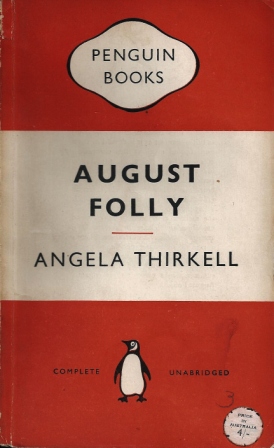
August Folly by Angela Thirkell ~ 1936. This edition: Penguin, 1954. Paperback. 250 pages.

My rating: 7.5/10. Possibly subject to move a bit higher after I’ve had a chance to mull it over more deeply, and have read some more of the author’s other books. Not bad at all, nicely diverting, but it didn’t immediately GRAB me. I have a feeling these might grow on one, though. We’ll see. I’m open to the possibility. I quite enjoy the hunt for obscurish vintage books, as long as there is a reasonable possibility of success, both in finding the quarry, and in finding it worth the trouble once it has been captured.

I have been watching for Thirkell for years in my rambles – as you may have gathered by now I am a used-book enthusiast – but this is the first one I’ve ever stumbled upon. Obviously not terribly popular in our region of B.C.! Must see what the library system offers, now that I’ve dipped my toe in and found the water temptingly warm. Or I could just be brave and go ahead and order some more from the various vendors on Abe, though some of the prices made me gasp a bit when I browsed them this morning, on spec as it were.

*****

Like D.E. Stevenson, whom I’d never even heard of in pre-book-blog-reading days, Angela Thirkell has a deeply devoted following among lovers of the vintage “middlebrow” genre. I’d also read a certain number of negative reviews – “shallow”, “fluff”, “just couldn’t get into them”, “you know the author just whipped these off for the income and rather despised her readers, don’t you?” – stuff like that. So I was cautiously optimistic.

Well, I’ve finally gotten my hands on a Thirkell to sample for myself, and with mixed (but rather high, as the fans decidedly outweighed the critics in blog world)expectations I carefully delved in. Carefully, because the old Penguin I now possess has had a long career already and is gently but persistently shedding pages, as old Penguins are wont to do. It’s been around. The price sticker on the front is from Australia, and inside the front cover the original bookseller has rubber stamped “Angus & Robertson, Melbourne”. It’s now a long way from home, here in the northern interior of British Columbia.

I was initially rather put off by the author’s parody of English village names in the first chapter – we are introduced to these improbabilities: Worsted (that was all right), shortly followed by Winter Overcotes (ack!), Shearings, Winter Underclose (oh, for heaven’s sake, stop already!), Lambton, Fleece, Woolram, Skeyne, Staple Park, and Lamb’s Piece. Rocked me a bit. I hope it’s not going to be one of those books, I thought to myself, a laboured and dated farce full of punning and “in” jokes. But after the starting jolt to get the thing in motion the author settled down to her story, and I settled in to enjoy it.

From The Angela Thirkell Society Website, here is a quick condensation of the plot, with a bonus reading recommendation. I would add, also ideal for reading in a warmly cozy chair with snowflakes drifting down outdoors, which is our present situation. Most conducive to reading about summer!

August Folly. Takes place in Worsted in East Barsetshire.  Most of the plot centers around the rehearsing and production of Euripides’ Hyppolyta, directed by Mrs. Palmer and involving the Deans, Tebbens, and many of the villagers. Highlights: Richard Tebben is infatuated with Rachel Dean, in addition to pouting about his poor showing at Oxford; Betty Dean, Oxford-bound, drives everyone crazy with her know-it-all attitude; Helen Dean is jealous of her favorite brother Laurence’s attentions to Margaret Tebben; Rachel Dean worries about her heart murmur; Charles Fanshawe fears he is too old for Helen Dean; Mrs. Tebben remembers her long-ago and never-expressed fondness for Mr. Fanshawe, who was her tutor; Jessica Dean is rescued from a bull by Richard Tebben. Richard gets a job with Mr. Dean, Laurence wins Margaret, Charles wins Helen.  Outstanding light entertainment, ideal for reading on a shady porch on a hot afternoon in July with strawberry ice cream and tea – which is how I read it!

I must add a note as to how much I appreciated the several brief vignettes featuring Modestine the donkey and Gunnar the tomcat in the midnight pasture. Totally unexpected, but most welcome.

A few minutes earlier Modestine, lounging about in the little shed down in the field that was his summer quarters, saw two points of fire approach.

‘I suppose that’s you as usual,’ he said ungraciously. ‘What’s the news?’

‘Nothing particular,’ said Gunnar, settling himself on some old sacks. ‘The usual dull evening. Some people from the Dower House came to dinner. Now, there they do keep a good kitchen. Chicken nearly every day, so the cat there tells me, young Kitty Dean.’

‘I daresay,’ said Modestine. ‘Some like chicken, some don’t. I don’t.’

‘Know what I did tonight?’ asked Gunnar.

Modestine only went on chewing some grass.

‘Drank all their sherry,’ said Gunnar, who needed no encouragement to talk about himself. ‘They left it in the drawing-room while they ate chicken in the dining-room. Never offered me chicken, so I drank their sherry.’

‘Was it good?’ asked Modestine. ‘I don’t hold with sherry. Give me a nice pail of water, or a good green pond, and I’m perfectly satisfied.’

‘Ignorant, that’s what you are,’ said Gunnar, ‘and prejudiced. Vegetarians always are …’

So there you have it. A restrained enthusiasm for my first Angela Thirkell. Quite curious about the next experience. Any recommendations, those of you who are old Barsetshire hands?

Read Full Post »

« Newer Posts - Older Posts »