Posts Tagged ‘Vintage Fiction’

One. Whole. Year.

I’m surprised it’s gone by so quickly, but yesterday marked the one year anniversary of the Leaves and Pages blog. It’s been fun, and I definitely want to keep going.

So many books, so many books …

So without any further ado, I am announcing a

BOOK GIVE-AWAY

in honour of the occasion, and as a small way of saying “Thank You” to all of the other blog readers and writers who have brought me so much enjoyment this neophyte year.

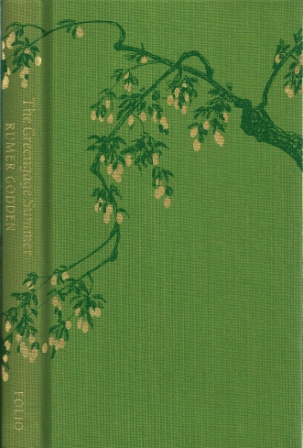
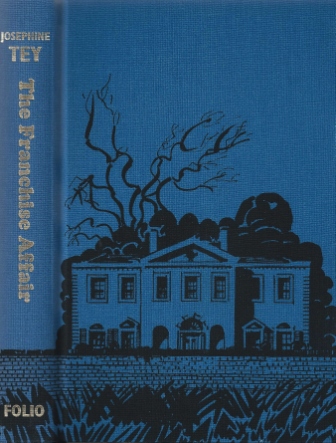
folio giveaway 2013 leaves and pages 001I have acquired three handsome Folio editions of books I’ve read and enjoyed, and much as I am tempted to hoard them away like a miser squirrelling coins, I am going to be all brave and noble and send them out into the world. (That’s why I bought them, after all. And I was thrilled when I found them – “Perfect for the Blog Birthday,” I thought immediately. They were all purchased as “second-hand” but they are crisp and clean and beautiful and all three seem to be unread. These are truly deluxe editions, and I hope they will find good homes where they will be opened up and properly READ.)

So here we go. To take part in the giveaway, simply leave a comment on this post, telling me which book you’d like to try for. I’ll do the draw the old fashioned way, names on slips of paper to be drawn “out of the hat” – the winners will be announced and then we can arrange about addresses to mail them to and so on.

Anyone from anywhere is welcome to participate.

And please do – the more the merrier!

Drumroll, please…

The Father Brown Stories

by G.K. Chesterton

Originally published in 1911 (The Innocence of Father Brown) and 1914 (The Wisdom of Father Brown)

This is the full text of both books, with an Introduction by Colin Dexter and many excellent pen-and-ink illustrations by Val Biro. Clothbound with slipcover. 358 pages.

The Folio Society, 1996

the father brown stories folio giveaway 2013 leaves and pages 001

The Greengage Summer

by Rumer Godden

Originally published in 1958.

Includes a new Preface by the author added in 1993, a Foreword by Jane Murray Flutter, and an Introduction by Jane Asher (who played one of the children in the 1961 film of the novel), as well as illustrations by Aafke Brouwer. Clothbound with slipcover. 171 pages.

The Folio Society, 2000.

greengage summer folio giveaway 2013 leaves and pages 001

The Franchise Affair

by Josephine Tey

Originally published in 1948.

Introduction by Antonia Fraser. Illustrated by Paul Hogarth. Clothbound with slipcover. 254 pages.

The Folio Society, 2001.

franchise affair cover folio giveaway 2013 leaves and pages 001

Good Luck, everyone!

I’ll do the draw on May 1st, so you have a few weeks to enter.

Just a quick comment on this post, letting me know which of these grand books you’d like to own, and you’re in!

Read Full Post »

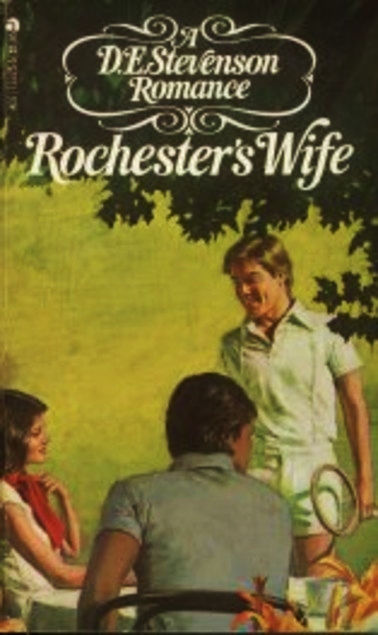
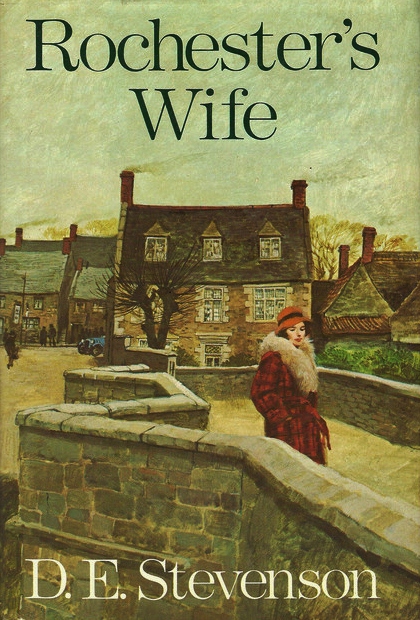
rochester's wife d.e. stevensonRochester’s Wife by D.E. Stevenson ~ 1940. This edition: Ace, circa 1970s. Paperback. ISBN: 978-0441733255. 335 pages.

My rating: 5/10.

*****

This is one of the “secondary” D.E. Stevensons, and, I believe, a “stand-alone” book, as none of the characters seem to reappear in any of the other stories. Though published in 1940, the time frame is pre-W.W. II, as there are only a few references to the “situation in Europe”, and, though the atmosphere is cloudy with foreboding, the focus is on the troubles of the individual characters, versus those of the wider world.

Young (in his late twenties) Dr. Kit Stone has returned to England after four years of travelling round the world seeking adventure. He had long cherished the ambition to become a sailor, but his (widowed) physician father had pressured him into studying medicine instead, with a view to taking over the family practice. The elder Dr. Stone died just as the younger Dr. Stone qualified, and the practice was instead sold, with the proceeds being split between the family’s two sons. The elder brother, Henry, had gone into business as a successful stockbroker and invested his share accordingly, while Kit, suddenly at loose ends, has decided to see something of the world.

Kit’s travels are touched on continually throughout the novel, and sound quite fascinating in and of themselves. He’s been in China, “looking for the war”, and has seen more of it than he had planned for. There is a reference, near the end of the book, to his standing in a marketplace when a shell fragment kills a mother and baby standing next to him; he is “spattered with their blood”, and there is a statement that he has seen quite a lot of blood in his travels. Strong stuff for this mild romance! Another incident, which has more bearing on the eventual plotline, is that Kit has had experience with diagnosing and treating a case of insanity while in America. One would rather like a full itinerary of his wanderings; he seems to have covered quite a lot of ground!

So now Kit is back in England, and though he still feels that he can’t bear to be “tied down”, he allows his brother to persuade him to try out steady employment for a while. Henry’s business partner, Jack Rochester, lives in the village of Minfield, just out of London. Jack’s wife, Mardie, is good friends with the elderly village doctor, who is getting overwhelmed with the demands of his practice, and when she hears of Henry’s brother’s sudden return, puts forward the idea that perhaps Kit might be interested in a position as assistant to the Minfield practice.

So Kit, rather reluctantly, agrees to try out life in an English village. Dr. Peabody welcomes him with gruff suspicion, which we (and Kit) immediately see as merely hiding hte proverbial heart of gold. The Peabody household consists of the elderly doctor, his bitter spinster daughter Ethel, and a grandson, precocious (and exceedingly likeable)young Jem, who is living in England for the “healthy climate” while his parents reside in Ceylon on a tea plantation. They are soon joined by another daughter, Dolly, recently married and, unbeknownst to her family, newly pregnant. Her husband, stationed in Malta, has asked her to stay in England because of her pregnancy, and Dolly’s reluctance to share this news with all and sundry has led to some speculation that perhaps her marriage is already in trouble, because otherwise why wouldn’t she be following her spouse?! Dolly and Ethel are the classic bickering sisters, and their feuding and continual cutting comments to each other add a lot of spice to this rather pedestrian tale.

The heart of the novel is an (apparently) doomed love triangle between Kit, the absolutely beautiful, charming and saintly Mrs. Rochester (Mardie), and her high-strung husband, Jack. Kit is immediately smitten with Mardie; Mardie is deeply in love with Jack; Jack depends on Mardie for emotional support as he deals with his stressful job, and much is made of how happy Mardie and Jack were in the first year or two of their marriage, though now, in year three, things are rather more difficult.

As young Dr. Stone is absorbed into the Minfield world, all seems to be going well with the “settling down” process, but for the unrequited love bit. Kit yearns for his unavailable love, and we start to see little hints that perhaps his passion isn’t exactly unappreciated and unreturned, but of course, there is that rather prominent husband in the picture. Jack, however, is showing signs of what could be charitably described as nervous tension; his personality is deteriorating by the day, and Kit and Dr. Peabody are soon looking up the characteristics of “insanity” in their medical books, and talking of bringing in a specialist.

The ending of this tale is a bit sloppy and unlikely, though everyone ends up neatly paired and with problems happily solved. I’m sorry to say that this is not one of D.E. Stevenson’s better efforts among those I’ve read so far, though there are many diverting situations throughout the book, mostly concerning secondary characters. We have the relationship between the Peabody sisters, young Jem with his brilliant talent for mimicry, an elderly Scottish housekeeper, Hoony, and her illegitimate grandson, Wattie, and, off in the background, the very happy marriage between Henry and his rather liberated wife, Mabel, who dabbles in the stock market quite successfully on her own, with her husband’s proud approval. The relationship between the two brothers, Kit and Henry, is nicely portrayed as well. They do seem a likeable family, with reassuringly human flaws fully recognized and easily forgiven by the reader.

A reasonably decent read, though I found myself groaning and figuratively smacking hand to forehead occasionally, especially regarding the whole “insanity” thing, and the remarkable (!) scenario the author has dreamt up for its resolution. Definitely worth reading as part of the D.E. Stevenson canon, though I’m afraid I closed the book and said farewell to the characters with a feeling more of relief than reluctance!

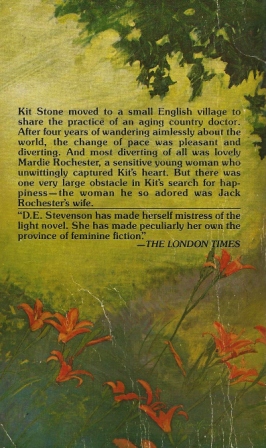
rochester's wife d.e. stevenson daylily detail 001And I must say something about the dreadful paperback cover. (Cover illustrations being, as some of you may have gathered by my continual harping on the subject, something of an issue with me.) Why, oh why do publishing companies insist on putting “current” illustrations on books set in past times? The characters illustrated on the Ace cover are obviously from the 1970s in dress and hairstyle; I cringe when I look at it. The only thing that that I found attractive (and here is the hort in me speaking) is the rather lovely inclusion of a border of tall orange daylilies (probably Hemerocallis fulva ‘Europa’ from the looks of them), in the foreground of the trio of tennis players and extending around the back of the cover.

Much more appropriate is this other coverrochester's wife hc dj d.e. stevenson, which captures the mood and setting exceedingly well.

I am coming to the end of my personal stash of D.E. Stevensons, and the more I read of her the more eager I am to go on with building the collection. It’s going to be an expensive year, I fear. Even the tired old paperbacks are seriously overpriced, but I’m afraid I’m now hooked and will be playing the seeking game to the full extent that my pocketbook allows.

Part of the fun is the glorious awfulness of some of Stevenson’s scenarios – I just now have realized I’ve made no mention of the Jane Eyre references in this particular novel – nothing subtle about that, is there?!

D.E. Stevenson. When she is good, she is very, very good, but when she is bad … maybe she’s even more interesting!

Read Full Post »

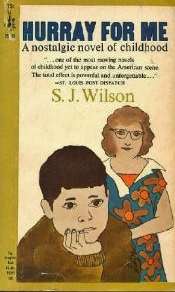
hurray for me s j wilsonHurray for Me by S.J. Wilson ~ 1964. This edition: Pocket Cardinal, 1965. Paperback. 264 pages.

My rating: 5/10.

*****

This is a rather interesting book, written by an author I’d never heard of before. A first novel, very autobiographical in tone, which shows a lot of promise, and is a quite decent read.

The reviews on the back cover are glowing:

“A rare and refreshing book. It is a strong story gently told and I found it a delight to read…”  (Betty Smith, author of A Tree Grows in Brooklyn)

and

“…rings with character and the rhythms of young life. It stays with you for days after you’ve read the last page.” (New York Herald Tribune)

and

“Its innocence and freshness are like a breeze from the sea. What lends it magic is the way it is told, its highly original viewpoint, and the subtle shifts in mood and emotion …” (Saturday Review)

On the front flyleaf of this vintage paperback is this note from a previous owner:

Lake of Bays, July 13/66. Left under my pillow by Mary.

Intriguing!

And from Kirkus, 1963:

A five-year-old’s world which begins and ends with his mother and seem stable is viewed through the eyes of young Bobby Hirshman and told accordingly and lubly. For Bobby is a very verbal child whose tongue is given to twisting (“You’re crazy like a daisy, Fifi-la-la-Libby”). But once you get used to all these nonsense words and name calling, you may share in these scenes of Lower East Side, N.Y.C. and its good-natured schreierei; Mrs. Greneker whose feud with the landlord leads to further protest (garbage, out the window); the expansive Carmella; and the other familiars of the neighborhood. For Bobby, there’s first day at school and the new friend he meets, Johnny Schaefer. This brings many “”tsores”” (troubles) into his own life since Johnny’s mother is very sick, and, at her death, Bobby loses his own immunity to the intimations of mortality. With the loss of that childish certainty – mothers don’t die – Bobby grows up a little and the book closes…. A first novel, true to a time – the early ’30’s, and close to experience – guessably the author’s …

The story is told in first person narrative by young Bobby Hirshman, five years old and learning about life the hard way. Growing up Jewish in Depression-era New York is a theme which we’ve seen fairly frequently, and this poignant tale has the familiarity of repetition, but it is unique in its own way. Occasionally the author breaks character, but by and large the voice is authentic; the child’s-eye view feels true and strong.

I enjoyed this book, but not enough to shelve it with my “keepers”. In my internet browsing, looking for more information about the author, I have seen several comments to the effect that this is a rather hard to come by title. So I’ve decided, instead of just trusting to fate and releasing it via BookCrossing or the Sally Ann box, to pass it along more directly to anyone who wishes to try it. It’s a fairly slender paperback, crisp and clean despite some age-toning and a bit of weakness at the lower spine, and I’d be happy to mail it postpaid to anyone, anywhere. My treat!

This is by way of being an advance on my plan to give away some more books this month in honour of April being my one-year “Blog Birthday”. It’s a bit hard to believe the year has come full circle; I had no real expectations that I would still be so involved with the project, but here I am. Still interested, and hugely enjoying the conversations with other readers from all around the world!

So – if you think you’d like to own Hurray for Me, just drop me a note in the comments, and I’ll message you for your address and send it on its way.

It’s a neat little read, and deserves a good home. My other giveaways will be “draw” style, I think, but this one will be first come-first served.

Thank you, wonderful readers and writers, for a year of pure pleasure. I’m looking forward to what this next year will bring with happy anticipation!

Read Full Post »

I’m going to review these together. They were both quite wonderful, so much so that, pressed for time as I am this week, I cannot let them pass onto the “have read” list without mention. In my opinion, this trilogy, Vittoria Cottage, Music in the Hills, and Shoulder the Sky, have the Miss Buncle books beat all hollow. Good stuff! I can see these going on my treasured keeper shelf.

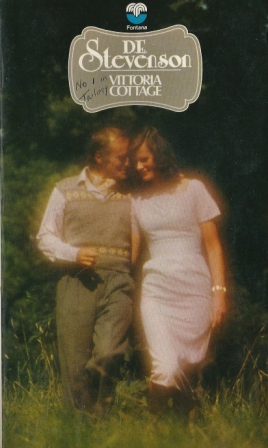
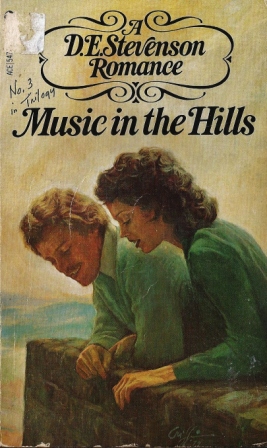
Please try to ignore the desperately ugly covers on these re-released paperback editions. I find them quite embarrassingly inappropriate to the content, which, while “romantic” enough to please the most sentimental, is not cloyingly so as these would lead one to believe. I had some explaining to do to family members who saw me reading these – “What the heck is that?! You’re slipping, old girl …!”

*****

vittoria cottage d e stevensonVittoria Cottage by D.E. Stevenson ~ 1949. This edition: Collins-Fontana, 1974. Paperback. ISBN: 0-00-613-444-0. 191 pages.

My rating: 8.5/10.

Middle-aged Caroline Dering has just been widowed, and, aside from her genuine and seemly sorrow at the death of someone who has shared her life for many years, she is not at all steeped in sorrow. Her lately departed spouse, Arnold Dering, was of a complaining and perpetually malcontented disposition. While  his wife and three children were accepting of his character – Caroline thought that he always meant well, and suspected that at rare moments Arnold recognized and truly regretted his deep pessimism – but by and large enjoyed themselves much more in his absence.

The scene is set for what is to become a series of three novels by descriptions of the village of Ashbridge and the far from cottage-like Vittoria Cottage, ancestral home of the Derings. Though she has merely “married into” the local family, Caroline fits into the local hierarchy almost immediately, and by and large leads a deeply contented life, caring for her children, volunteering for various worthy causes, keeping house and gardening. The children are all grown up, with James away in Malaya, and lovely but discontented Leda (she takes after her father in full) and boisterous Bobbie making their way out into the larger world from the safe haven of their village nest.

To-day Caroline Dering was not working in her garden. She had taken a basket and gone up the road to the gravel-pit to pick blackberries. There was a thicket of brambles, there, and Caroline knew it well. Every year she made this pilgrimage and every year she returned with her harvest of big, black, juicy berries to make into jelly and to bottle for the winter. It was curious (thought Caroline, as she began her task) how the years seemed to telescope when you looked back. Surely there were less than three hundred and sixty-five days between each picking! She remembered the first time she had come. She and Arnold had come together – they had just returned from their honeymoon and settled at Vittoria Cottage – but Arnold had not enjoyed picking blackberries, he had got a thorn in his finger and had torn his trousers on a wild-rose bush and he had suggested that in future they should employ some of the village children to undertake the task. After that Caroline had come alone until James was old enough to help … and then the little girls had joined the party and blackberrying had become an event, a yearly picnic, which took place, weather permitting, upon James’s birthday.

Now, once again, Caroline came alone. The girls had other things to do and Caroline had no use for reluctant assistants. Next year … would James be here? And if he were here would he want to come and pick blackberries on his birthday?

World War II has been over for several years, but England is still very much in coping and recovery mode. Society is fast changing into some sort of new normal, and though things are steadily improving, there is still food and fuel rationing, and a strong atmosphere of “making do”, which makes for some quite fascinating scenarios as we progress through the book and look over Caroline’s shoulder as she goes about her days.

Life in Ashbridge gets suddenly quite interesting with the arrival of the mysterious Mr. Shepperton, who is apparently very reluctant to discuss his past, and who arouses even more suspicion because he appears to have no old belongings or clothing, a real rarity at that place and time, immediately post-war – “everything new!” the village gossips whisper with raised eyebrows.

Caroline’s lovely younger sister Harriet, a successful actress ducking away to her sister’s home for a respite from a difficult and failed recent stage production in London, brings some ex-urban dash and sparkle to village gatherings, and with the unexpectedly sudden return of James from Malaya, and the trials and tribulations of Leda and her fiancé Derek, the local squire’s son, there is plenty of scope for complications, dilemmas, surprises and sometimes unexpected resolutions.

I thought the characters were very well drawn and (mostly) very believable. Caroline is our heroine, but she is not a perfect person by a long shot; her flaws are well on display, but we forgive her them because she is ultimately exceedingly likeable, as is her sister and most of the other players in this excellent domestic drama. It ends quite abruptly, but this served merely to make me keen to get my hands on the next episode in this extended tale, which I was fortunate enough to acquire along with its sister novels recently.

On to Music in the Hills.

________________________________________

Music in the Hills by D.E. Stevenson ~ 1950. This edition: Ace Books, circa 1970. Paperback. ISBN: 0-441-54725-7. 282 pages.music in the hills d e stevenson

My rating: 8/10.

Having more or less settled the fates of Caroline Dering and her sister Harriet Fane in the previous novel, Vittoria Cottage, this next one follows Caroline’s son James, who, at loose ends after his military service and several years spent “chasing terrorists” in Malaya, is looking towards his future.

Deeply in love with his childhood companion Rhoda, he is struggling with her rejection of his marriage proposal. While we suspect that she is in love with James in her own way, Rhoda fears that, as a rising professional painter, marriage would spell the end of her career goals, and that she would be a discontented wife as well as a poorer artist, having to split her focus between two roles, doing neither well.

James takes it very well, all things considered, and hies himself off to the community of Drumburly in Scotland, where he has been invited by his aunt and uncle to reside at the remote Mureth House, a prosperous sheep farm. Jock and Mamie Johnstone have no children of their own, and are hoping that their nephew might be interested enough in farming life to take over Mureth some day. James has always cherished a desire to be a farmer himself, so the situation looks like a success all around; the story follows some of James’s apprenticeship and details the day-to-day occupations of a hill farmer of mid-2oth century Scotland; quite nicely detailed and striking true in the telling.

We have sheep rustlers and romantic entanglements and, of course, more than a few misunderstandings between various parties, all neatly tidied up as the story progresses. Perhaps not as strong a narrative as the preceding Vittoria Cottage, but definitely engaging. I enjoyed it greatly.

The characterizations of the local inhabitants are often well drawn; we all know people just like these.

I’m looking through the book for a snippet to share with you, but am finding nothing really suitable – everything is so enmeshed with the  rest of the story that to take a bit out of context would do it no justice, so you’ll have to take my word for it that this is a well-written post-war domestic drama, with much to recommend it as escape reading in our hectic modern age.

Music in the Hills is followed by a third book to form a trilogy, Shoulder the Sky, also published as Winter and Rough Weather. I’d read this one some months ago, liked it a lot, and reviewed it here: Shoulder the Sky

Reading this trilogy has made me into a confirmed D.E. Stevenson fan. This is good stuff, for which I am ready to forgive some of the less than stellar output by this writer. She definitely had highs and lows in her output, but the Vittoria Cottage trilogy is quite decently lofty.

Read Full Post »

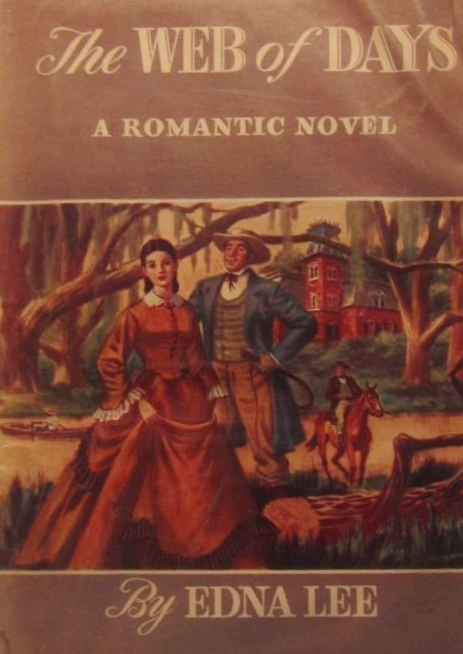
the web of days edna leeThe Web of Days by Edna Lee ~ 1947. This edition: D. Appleton-Century, 1947. Hardcover. 1st edition. 276 pages.

My rating: 3/10. The 3 points is for, um,  something.

Let’s see, now.

The best I can come up with is that it was engaging in that I read it to the end, hoping for some sort of unpredictable plot twist to crank it up a notch. (Sadly, that never happened.)

*****

Every once in a while I read a real clunker, which serves to remind me that all vintage books are not really worth saving.

The Web of Days was mesmerizing in its awfulness; I read it cover to cover, with increasing queasiness. Like the proverbial train wreck, I just couldn’t look away.

In a phrase: Melodramatic Gothic Southern Romance.

Prim, virginal, stunningly beautiful Yankee governess Hester Snow is engaged by the master of the derelict Georgia plantation called Seven Chimneys to care for his young son. The boy’s mother is a hopeless alcoholic, and Miss Snow finds the plantation to be an absolute disaster – the house is filthy, the servants sullen, and the master’s wife and mother viciously scornful of the new governess’s insistence on tidying up and tackling jobs for herself.

Hester immediately sets about fixing everything. Single-handedly she whips the house servants (ex-slaves, as this story takes place just after the end of the American Civil War, in Georgia) into shape, tames her sullen young charge, Rupert, and attempts to save the self-destructive mistress, Lorelie, from herself. She catches the attention of every man who sees her, from the riverboat captain who has delivered her to her new home, to the master of the Seven Chimneys plantation himself, Saint Clair LeGrand. More importantly, she has herself fallen in love with Saint Clair’s estranged half-brother, Roi LeGrand, who gallops in and out of the story on his fiery steed, Sans Foix.

Lorelie conveniently wanders out into the swamp and drowns herself one night, leaving the field open for Hester to marry the new widower, which she promptly does. Roi gallops in, chews on the scenery for a bit, and gallops off, leaving Hester deeply embroiled in a deep dark situation wherein her new husband schemes against her and attempts to engineer the death of young Rupert. It’s all to do with inheritances and such; Hester was assigned under the late Lorelie’s will the care of Seven Chimneys and Rupert, cutting out Saint Clair. (It’s complicated.)

Hester resurrects the plantation by master-minding a return to profitable farming; she also gets pregnant and eventually gives birth to young David, Saint Clair’s son, but widely suspected by all, including Saint Clair, to be Roi’s child. The plot sickens, er, thickens, ending in the violent demise of Saint Clair and the reunion of Hester and true love Roi. (That’s the condensed version. Now you won’t have to read the book! You may thank me for saving you that.)

As an orphan tumbling about in the world trying to make her own way, one would think Hester Snow would be a somewhat sympathetic character, but author Edna Lee has created an absolutely unlikable protagonist, whom I increasingly despised as the book progressed.

My biggest “queasy-making” issue was that the character Hester Snow is viciously misogynistic towards to the many black characters she encounters; I couldn’t help but wonder if this was a reflection of the author’s personal feelings as well. She (Hester Snow) is also very full of herself; self-confidence is an admirable trait, but add to it deep smugness and ruthless ambition, and you get a Scarlett O’Hara-type figure, but with less likeability. Scarlett had her moments where the reader could “get” why she was like she was and sympathize somewhat with her attempts to maintain control of her own life in an unkind world, but I’m afraid Hester never inspired such a feeling in me, much as I wanted her to.

The writing style itself is rather interesting, in that it is has a very nineteenth century feel to it in the phrasing. If deliberate, this is a good conceit on the part of the author, as the story is written in first person narration by Hester Snow herself, and the voice sounds authentic. There’s a fair bit of bodice-rippingly bad sex in a 1940’s style, in that we never really get a description of the act itself, just the prologue and epilogue; the velvet stage curtain swishes shut at the bedroom door.

A real period piece, but “of an inferior period, m’lord”, to paraphrase Bunter in one of the Lord Peter Wimsey tales – a quotation which I adore and use much too much.

Debating the fate of this book, I’m tempted to chuck it onto the giveaway pile, but while doing an internet search on the author I see she has several other “bestsellers” of her time which receive a fair bit of discussion: The Southerners, The Queen Bee, and All That Heaven Allows, among others. The Queen Bee was made into a 1955 film starring Joan Crawford, while All that Heaven Allows was made into a 1955 film starring Jane Wyman and Rock Hudson. (1955 was a good year for Edna Lee, apparently.) Both received a fair bit of popular, if not critical, acclaim, which just goes to show I’m not sure what – maybe that melodrama sells?!

I may tackle Edna Lee again in future. It was an interesting experience, and greatly highlighted the excellence of much of my other vintage reading in comparison to The Web of Days‘s deeply schlocky shlockiness.

Read Full Post »

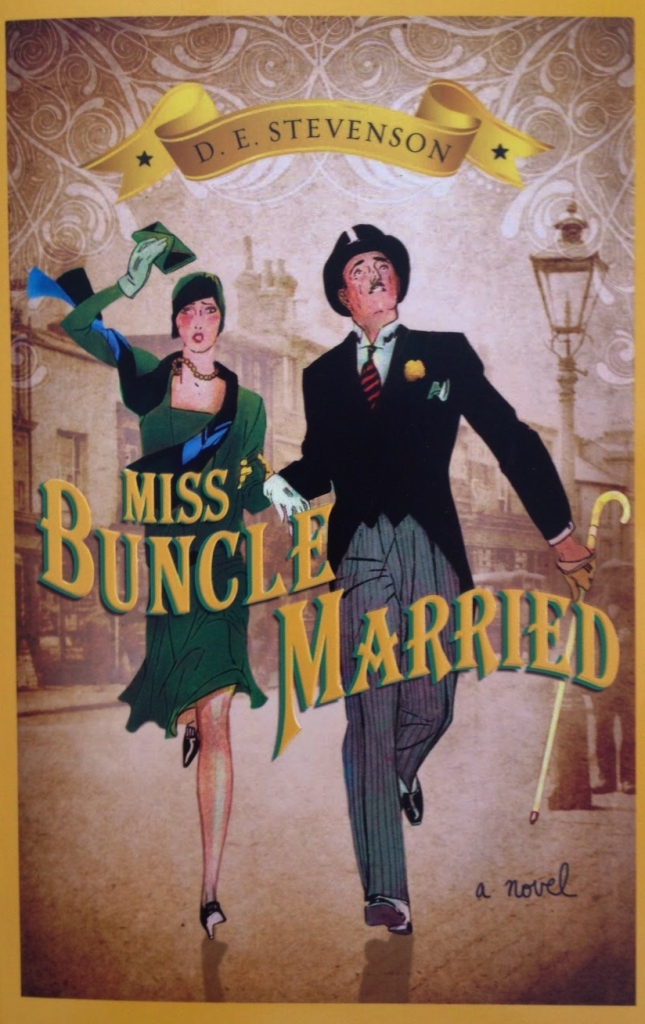
miss buncle married d e stevensonMiss Buncle Married by D.E. Stevenson ~ 1936. This edition: Sourcebooks, 2012. Softcover. ISBN: 978-1-4022-7253-3. 330 pages.

My rating: 6/10.

Readable enough, with a few reasonably memorable moments, but not quite up to the original Miss Buncle’s Book to which this is the sequel. Definitely recommended to those who enjoyed the first Miss Buncle book, and anyone who’s a D.E. Stevenson aficionado, but perhaps not the best place to start with this author. As I explore her works – she’s a very new author to me – I am struck by the wide variance in quality of her plots and prose.

*****

And now for something completely different!

The literary hoopla of Canada Reads 2013 is just over, and my tolerance for angsty Canadiana has been tested fairly stringently. Ending up rather unexpectedly “on the road” for several days this week, I grabbed, on my way out the door, something much more in the way of “light” reading than the sincere Canada Reads candidates: Miss Buncle Married, by D.E. Stevenson.

I had ordered this one, along with Miss Buncle’s Book, and Mrs. Tim of the Regiment, from Book Closeouts just after Christmas, with some of my Christmas “buy yourself a nice book” money. I’d opened the box, briefly admired the crisp new softcovers – that lovely “new book smell”, and the physical pleasure of handling crisp, clean and unworn pages – a very different pleasure from that of handling older books with their unknown histories and traces of prior readers – signatures on the flyleaf, dog-eared pages, marginal notes, the odd old letter, business card, receipt etc. used as a bookmark – now wouldn’t that make a grand post? – the things found in secondhand books!

Oi! I’ve gone completely off track. What was I posting about? Ah, yes. Miss Buncle Married. So, what I started out to say was that D.E. Stevenson was again at the forefront of my awareness, after my recent windfall of a lovely stack of her vintage paperbacks, and after sharing that news of my good luck with my husband, and pressing Mrs. Tim upon him as a “try this author, she’s rather amusing” recommendation, Miss Buncle seemed a logical choice for a light diversion for hotel room reading.

I haven’t yet had a chance to read the first Mrs. Tim myself, though I did read and enjoy one of the follow-up books to that one some time ago, Golden Days: Further Leaves from Mrs. Tim’s Journal, so I’m interested to see what my husband’s reaction will be. I suspect he’ll return a tactful “it was all right”, which, I regret to report, is all that I’m I’m able to give to my own D.E. Stevenson of the moment.

Miss Buncle Married was merely “all right”. It certainly wasn’t an improvement on the original. And though my expectations weren’t terribly inflated, as Miss Buncle’s Book was a pleasant diversionary read and not much more, I was disappointed at how slight this next one turned out to be, despite its hefty 330 pages of physical presence.

Middle-aged (“nearing forty”) though perpetually young-at-heart (in other words, slightly gauche and secretly insecure) Miss Barbara Buncle, after her unexpected success as an author, has married her publisher, Mr. Arthur Abbott. Though the two are deeply in love, and the married state is most satisfactory to both of them, there are thorns becoming most evident in the rose garden of their new life together. An active round of teas, dinners and bridge parties has become the norm, and peaceful evenings by their own fire are few and far between. Neither Barbara nor Arthur want to say anything, each believing the other to be well suited with the social whirl, and, when the penny drops, the two decide that the only thing to do is to move house, to a fresh location, where they can establish themselves anew in a more congenial lifestyle.

After much to-ing and fro-ing, Barbara finds a lovely though exceedingly rundown house in the village of Wandlebury, and she occupies herself for months with the restoration of Archway House and the creation of the ideal habitat for herself and her beloved Arthur. In the meantime, she becomes deeply enmeshed in local happenings. She inadvertently becomes privy to the will of the village’s most wealthy woman, makes friends with the outspoken artist next door and his precocious children, and meets a kindred spirit in the person of young Jeronina Cobbe, the potential recipient, all unbeknownst to her and everyone else except for Barbara and the local lawyers, of the riches to be distributed in the aforementioned will.

There are, of course, numerous twists and turns to the narrative before everyone ends up in a state of bliss, with all dilemmas nicely straightened out, and much optimism for the future.

I felt that Miss Buncle Married started out quite strongly, with much promise, and sadly faded as it went along. It settled into a predictable and very clichéd romance involving Jeronina – Jerry – and Arthur Abbott’s nephew Sam, with every development of their courtship and romantic setbacks telegraphed loud and clear.

Not a bad book, but definitely not as wonderful as it might have been. D.E. Stevenson has her moments of brilliance, but in this case those ran out early on.

I am wondering what the third book in the Miss Buncle saga, The Two Mrs. Abbotts, will be like. Though not eagerly awaiting it, I do look forward to acquiring it at some point once it becomes available, as I hear that it is due to be re-released in softcover by Sourcebooks in 2014.

And here, from Shelf Love, is a much more thoughtful review than my rather scatterbrained assessment  – I plead lack of sleep during this very hectic week – of Miss Buncle Married:

Shelf Love: Miss Buncle Married

Read Full Post »

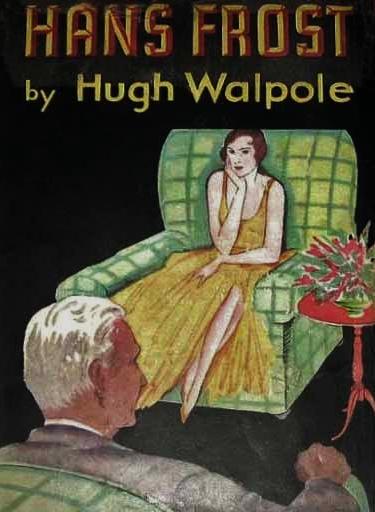
hans frost dj hugh walpoleHans Frost by Hugh Walpole ~1929. This edition: Doubleday, Doran & Co., 1929. Stated First Edition. Hardcover. 356 pages.

My rating: 8.5/10.

*****

No one perhaps in the United Kingdom was quite so frightened as was Nathalie Swan on the third day of November, 1924, sitting in a third-class carriage about quarter to five of a cold, windy, darkening afternoon. Her train was drawing her into Paddington Station, and how she wished that she were dead!

She sat in a corner on the hard, dusty seat, her hands clenched, her heart beating with hot, thick, hammering throbs. She wished that she were dead. She was an orphan. No one in the world needed her. The Proudies whom she was abandoning had been very, very good to her, but certainly did not need her. The famous Mrs. Frost to whom she was going would almost surely not be good to her–and as to needing her . . .

Open upon her lap was a number of that shiny geographically illustrated paper the London News, and among other portraits was one of Hans Frost, and under it was written:

Mr. Hans Frost, whose Seventieth Birthday occurs on November 3. His friends and admirers are marking the occasion with a suitable presentation.

She had had this face in front of her, framed in a neat black frame for the last six years, had carried it with her everywhere, had had it always in her bedroom wherever she might be. For was he not her uncle, her famous, marvellous uncle whom she had never seen but had made her hero, her conception of God, indeed, ever since she could remember?

Nineteen-year-old Nathalie arrives at her Aunt Ruth’s and Uncle Hans’ house, only to find that this is the night of that gala 70th birthday dinner. She’s tremendously relieved that she isn’t expected to attend, and after she is shown to her room, finally breaks down into tears of homesickness and apprehension, after her bags have been unpacked and her dinner delivered on a tray.

Meanwhile Hans Frost, the great writer, has received his guests and graciously accepted the wonderful gift his admirers have pooled together to purchase for him:

And it was a lovely thing! It was a very small oil painting and the artist was Manet.

The picture had for its subject two ladies and a gentleman outside a print shop in Paris. One lady wore a blue crinoline and the other a white; there was a little fuzzy white dog, the glass windows shone in the afternoon light, and beyond the pearl-grey wall of the old house there was a sky of broken blue and swollen white cloud. It was a very lovely little Manet. . . .

“Oh!” cried Hans Frost … He saw only the picture. He had always adored Manet, a painter closer to his soul than any other. He entered into the heart of a Manet at once, as though it had been painted for himself alone. He could be critical about everything else in the world (and was so), but not about Manet. When he was depressed or troubled by his liver he went and looked at Manet. . . . And now he would have a Manet all of his own, his very own–that deep and tender beauty, that blue crinoline, that fuzzy little dog, that white cloud against the gentle blue; these were his forever.

The dinner has been given, kind words have been spoken, Ruth has been a spectacular hostess – as always – but tonight an essential something has changed in Hans Frost’s world. He has unexpectedly met his niece, for, hearing her crying, he has gone into her room and comforted her – something of a surprise to both of them, especially Hans as he had not even known she was coming. The unexpected meeting has affected him strangely, triggering deep within him one of the creative impulses which have in the past led to the some of his best fictional creations. Hans feels like something is about to happen, an immense upheaval of his predictable, comfortable world, and of course, this being a novel, he is completely correct!

Hans, much to Ruth’s dismay, takes Nathalie under his wing and squires her about town. Ruth is deeply jealous of this new interest, this infatuation with the lovely young niece. She had assumed Nathalie would be far below Hans’ notice, and she immediately fears the worst, that the affection Hans feels for Nathalie is romantic, possible even sexual, though Hans has long since laid aside that part of his life, at least as far as Ruth is aware. But the relationship that has sprung into existence is something even more dangerous to Ruth’s peace of mind. Nathalie and Hans find they are true kindred spirits, and an idealized father-daughter, or rather, meeting-of-two-minds-as-equals friendship is quickly evolving.

Hans introduces Nathalie into the rather messy world of the striving writers, musicians and artists which Ruth has always scorned – at least until success and renown add a stamp of respectability to the untidy bohemians. Nathalie soon falls in love with a Russian refugee – London in 1924 is packed with “orphans of the storm” from the recent revolution – and Hans finds himself acting as benevolent advisor and rather bemused sponsor to the young lovers. Meanwhile, his own marriage is in deep trouble, as he decides that the only way he can return to a semblance of his former creativity as a writer is to break away from his comfortable life and his socially ambitious wife and retreat to some place of solitude to await the return of his muse.

Hans and Nathalie solve their respective dilemmas, but not before much drama, most of it involving an offended and officious Ruth. The ending of the story is delicately poignant and emotionally satisfying, and the author has a few surprises for his readers in how he tidies up all his many loose ends.

An engaging story, which I have enjoyed with renewed appreciation each time I’ve read it. Very much a period piece, but of a superior type, in that the modern reader can fully enter into and embrace the world that the author has created and captured for those of us willing to experience it almost a century later.

The author has a well-developed sense of the absurd, which he uses to create satirical observations of the more outrageous characters and habits of the time he’s portraying, all the while maintaining a rather sentimental tone regarding his sympathetic protaganists, while setting up his antagonists for their eventual rout. Walpole maintains a good balance throughout, showing the internal struggles which make even the least likeable characters very understandably human, and worthy of at least a morsel of our sympathy.

I wish I could express in words the special quality of Hugh Walpole’s writing in this novel, and why I find it so appealing, but I won’t bother with over-analysis for fear of destroying my affection for it by too much probing. No deep messages or life-and-death dramas, merely an entertaining tale, competently told, focussing on various human relationships. Not much more – but in this case that is quite enough.

Read Full Post »

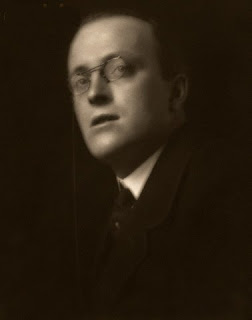
A blog post found in my internet wanderings, and too good not to share with those of you who have expressed an interest in Walpole. We are not alone!

Is it time for a Hugh Walpole revival of sorts?

  Other People's Words: The Quivering Pen Discovers Hugh Walpole

Tuesday, May 25, 2010

Who is Hugh Walpole and Why Has He Invaded My Library?

When I tell you the story of how I met Hugh Walpole, I’d have to start off by saying something grandiose like “It was one of those moments when luck, timing and commerce converged.”

Mr. Walpole, for as much as I know him by now, would appreciate grandiosity, mottled with pomposity.  And, by the way, when I say “met Hugh Walpole,” I am strictly speaking in the biblio sense of the word.  The dude’s been dead for 69 years.

I discovered him on a bookshelf, dirty with neglect, in the garage of a modest house in the foothills of Butte, Montana…

Continued here:

David Abrams Books Blogspot – The Quivering Pen

Enjoy!

Read Full Post »

Tthe joyful delaneys hugh walpolehe Joyful Delaneys by Hugh Walpole ~ 1938. This edition: Doubleday, Doran & Co., 1940. Hardcover. 401 pages.

My rating: 9.5/10.

Lost the half point because of the too-convenient wrap up of the ending. A very minor complaint!

What an enthralling read this was. Much better than expected.

*****

2013 is going to be  good reading year, if this omen is correct. The very first 2013 book, an ancient copy of one of Hugh Walpole’s London novels, The Joyful Delaneys, has been lurking on the edges of my awareness for at least ten years, possibly more. It was purchased at a library book sale, and its tattered condition, many interior stamps – Tulameen and Princeton had enthusiastic librarians! – and dog-eared and marked pages testify to its one-time popularity. This copy at least has been very well read.

Just not by me, until the last few days. The Joyful Delaneys was one of the lonely oddities left behind after my recent tidying of the bedroom bookshelves –  books which are sometimes the sole representatives of their author’s literary line in my collection, books I’m not quite sure about – stay or go? – will I really read this one again? – and books I haven’t read yet, but truly mean to, someday…

On January 1st, 2013, I finally picked up The Joyful Delaneys with the stern instruction to myself to just read this already and decide once and for all if it’s a keeper or a pass-along. Settling down with a mood of grim purpose to that self-imposed task, I was immediately surprised by the very first lines:

‘Happy New Year!’ Fred Delaney said, standing in the doorway and smiling at the in-no-way beautiful person of Mr. Munden.

He had switched on the electric light, and the illumination revealed Patrick Munden lying half in, half out of the bedclothes. No, he was not beautiful, his thin pointed face unshaven, his black hair spread about the pillow, his lean body protected from the cold by pyjamas, grey with blood-red stripes, by no means so fresh as they should be. The light pressed on Munden’s eyes and he opened them, stared wildly about him, then, cursing, buried his face in the pillow.

‘Happy New Year!’ Delaney said again.

‘What the hell–‘

Promising, no? And the serendipitous timing! A book opening with New Years Day, being read by me on New Years Day! A complete and utter unplanned coincidence. Surrendering to the moment, I settled down to my suddenly-not-so-tedious-seeming read. And was rewarded by its general excellence, much more so than I deserved for my previous neglect. Why, oh why, hadn’t I read this one earlier?!

Here’s a bit more, continuing the snippet from the first page.

‘Eight-thirty. You asked me as a special favour to call you.’

Munden raised his head and stared at Delaney. It was not a bad-looking face. The blue eyes were good, the forehead broad and clear, the chin finely pointed. He looked clever and peevish and hungry. He stretched himself, his open pyjama jacket showing a chest skeletonic and hairy. He rubbed his eyes with a hairy wrist.

‘Oh, it’s you, is it? Let me sleep, can’t you?’

Delaney watched him with genial good temper.

‘I’m doing you a favour. You said last night it would be the greatest of your life. You have to see the editor of something or other at ten sharp.’

‘He can go to hell. Turn the light off and let me sleep.’

‘You said I was to drag you out of bed if necessary–that your whole life depended on your getting there at ten.’

‘Well, it doesn’t. Let me sleep, can’t you?’

‘All right. But I’ll leave the light on . . .’

‘No, don’t go.’ Munden sat up, blinking. ‘How damnably fresh you look! It’s revolting. You were up till three, I don’t doubt–‘

‘I was,’ Delaney said cheerfully. ‘I don’t need a lot of sleep.’

‘Well, I do. . . . Oh, blast! Why did I ever tell you anything about it?’

‘You were very serious. Most earnest. You said you must begin the New Year properly.’

‘Speaking of which, can you lend me a fiver?’ Munden asked. ‘Only for a week.’

‘Afraid I haven’t got such a thing,’ Delaney said, laughing.

‘Hang it all, I paid you the rent only a week ago–‘

‘Thanks very much. But those are the terms, you know. If you don’t pay you go. Although we’d hate to lose you.’

Munden sighed.

‘Look in the trousers, old man, will you? They’re hanging over the chair. See if there’s anything there.’

Delaney looked in the trousers and found half a crown, some coppers, a lipstick and a half-filled packet of cigarettes. He laid these things on the dressing-table.

‘You don’t use lipstick, I hope, Patrick?’

‘No, of course not. What do you think I am? How much is there?’

‘Two and ninepence halfpenny.’

‘I’ll make them advance something on the two articles. You wouldn’t like to buy a Chrysler, would you?’

‘A Chrysler? Whatever for?’

‘It’s a marvellous bargain. Ponsonby’s only had it a year and simply not used it at all. He’d let you have it for one-fifty and I’d get a commission.’

Delaney laughed. ‘We go round in our Morris–just as we always have–same old family, same old Morris.’

Munden looked at him with curiosity. ‘I don’t understand you, Fred. You own this house; every bit of it is let to people who pay their rent. You’re none of you what I’d call extravagant and yet you never have any cash.’ He stared resentfully. He went on: ‘You’re a horrid sight–so cheerful and clean and bright. You’re all like that. I ought to hate the lot of you. So unintellectual too. You never read a book, have horrible bourgeois politics, believe in things, in England, beautiful virginal girls, Dickens, cricket, football. . . . Oh, God! You’re vile! I don’t know why I go on living here.’

*****

It seems like I’ve recently been reading authors who have been quite taken with T.S. Eliot – most recently Rumer Godden (in Take Three Tenses: A Fugue in Time) and Diana Wynne Jones (in Fire and Hemlock); here is a third. Hugh Walpole begins this beguiling novel with this quotation from Eliot’s The Rock:

When the Stranger says: ‘What is the meaning of this city ?
Do you huddle close together because you love each other?’
What will you answer? ‘We all dwell together
To make money from each other’? or ‘This is a community’?
And the Stranger will depart and return to the desert.
O my soul, be prepared for the coming of the Stranger,
Be prepared for him who knows how to ask questions.

The answer, ultimately, is that the community wins over commerce, at least in this one instance, at least for a while. But there is a lot of ground to cover before this satisfactory state of affairs comes to pass.

The Delaneys – Frederick and Meg, and grown children Stephen and Kitty – are the financially struggling owners of one of the last houses in their corner of London’s Mayfair – Shepherd Market – which has not been pulled down and built over or converted into modern flats. The house has been in the family two hundred and fifty years; this year, 1934, looks very much like it will see the Delaneys rousted from residence at last.

A precarious existence is made possible by the renting of rooms to a number of similarly situated people – the random waifs and strays, the elderly and the dispossessed of the former upper classes who are now very much down on their luck. A pair of the Delaney tenants, Dodie and ‘Smoke’ Pullet, have exhausted every financial avenue, and are preparing to give notice. Smoke mulls over his bleak future possibilities with Fred, including that of the ultimate escape – suicide.

‘You’ve no idea, old boy, of the kind of life that Dodie and I’ve been leading in the last year. We’ve cadged deliberately on everybody we know. We’ve angled for meals, been everywhere and anywhere with the chance of getting something for nothing. We’ve spent days and nights with the most awful people to be safe for food and drink. It can’t go on for ever…

…Unless something happened Smoke would do just as he said. And perhaps it would be the best thing for him. That was the real problem at the heart of the trouble. There was no place in this present world for the Smoke Pullets unless there was a World War again–then they would be admirable.

Before 1914 they had played a very necessary part; they were a real need in English life and had been so for centuries. They had been the Squire and the Squire’s son; some property, possibly a seat in Parliament, beneficent, tyrannical, understanding in their country community, conforming, traditional, safe and sound. So it had been since the Wars of the Roses; from Agincourt 1415, say, until Serajevo 1914. And now, within the space of twenty years, they had become only a burden, and a wearisome burden at that. There was no future of any kind for Smoke and he without a leg which he had lost in the service of his country. Probably a nice gas-oven would be the best thing.

But Fred Delaney can’t stay grim for long. Along with the pervasive background atmosphere of despair there are plenty of opportunities for love and laughter. He and Meg have long enjoyed what might be termed an “open” marriage, though Meg has not taken advantage of her freedom as her spouse most definitely has. The two deeply and truly love each other, but Fred has indulged his physical desires for other women regularly through the years. Meg knows this, and has made her peace with it, and now at long last is in her turn preparing to indulge in a little fling with an old flame from her youth who has re-entered her life, and who has confessed a lifelong infatuation with Meg, despite his own married state.

Fred is currently pursuing a beautiful though frigid socialite; Kitty makes the acquaintance of a young man clerking in an antique shop; Stephen falls in love with the sixteen-year-old daughter of a dissipated gambler. 1934 promises to be an emotionally charged year in the tight-knit Delaney family enclave, even before their house woes escalate, which they soon do.

Hugh Walpole skilfully weaves together these story strands and half a dozen others into this increasingly absorbing saga. His characters step off the page in living, breathing colour; his descriptions are better than photographs, including as they do sounds and smells and tastes and emotions as well as vivid visual descriptions; he skilfully plays on our feelings by including us as benign fellow voyeurs sharing a god’s-eye view of his fantastical world.

Why has Walpole fallen out of favour? (Or has he? I don’t hear his name much, or see his works in the second-hand book shops.)

I’ve only read a few other things by him, a book I’ve owned for some time, which I’ve just re-read, and which I’m intending to review in the next day or two, Hans Frost, plus a book of short stories which I can’t recall seeing around recently (must be packed away) called A Head in Green Bronze. Hugh Walpole wrote so many more!

The Joyful Delaneys was very, very good. Amusing, thought-provoking, wonderfully evocative of the time and place. I was completely absorbed in the story, much to my surprise. I quite literally growled at any interruption of my rare reading times these past two days, and even sent the teens off to town in my precious car last night, with movie, snack and gas money liberally provided, so I could have a few hours of peace and quiet to finish the book off, even though I had to put aside some “real” work to do so.

Anybody who will name a fictional dachshund “Endless” has my full approval. Hugh Walpole definitely goes onto the 2013 look-for list.

One last note: the dustjacket image above is not from my own copy. Mine is a faded, stained and threadbare, green cloth-bound volume. I couldn’t bring myself to scan it – it’s too terribly tired.

Read Full Post »

the enchanted april elizabeth von arnim 001The Enchanted April by Elizabeth von Arnim ~ 1922. This edition: Simon & Schuster, 1992. Afterword by Terrence de Vere White. Paperback. ISBN: 0-671-86864-0. 316 pages.

My rating: 6/10. I’ve now read this twice, plus watched the lush 1992 movie. Still my least favourite von Arnim, of the three I’ve read.

The others:

*****

I guess the thing to remember with this one, and the thing I had to keep reminding myself of, was that this fluffy little tale is supposed to be a romantic comedy. Or is it? Away from the comical sunniness there are pockets of dark shadow. The decided element of genuine sadness in the four heroines’ circumstances, especially during the first part of the book, jarred with the eventual descent of the tale into musical comedy style farce.

I honestly could not get a true sense of which goal the author was aiming at. There are certainly times when an author, especially one of proven calibre of Elizabeth von Arnim, can successfully blend serious social commentary, light satire, and downright silliness, but I don’t feel that von Arnim pulled it off in this case.

I realize that this book has a tremendously strong following, and I will temper my criticism to say that it was a decent enough read for its genre, which I’m pegging at romantic comedy. Or perhaps serio-comedy? It wasn’t ultimately at all dark, though there were clues early on that it might go that way. If anything, I wish the author would spent more time in the darkness with her creations. I’d have liked her to maintain the initial tone set with the first sensitive depictions of the emotionally troubled lives of Lotty Wilkins and Rose Arbuthnot, which made their yearning for an obligation-free (and husband-less) month in the Italian sun so moving. And the solitary Mrs. Fisher and Lady Caroline – what were the real back stories there? It didn’t feel like we ever really got a handle on those, making their eventual epiphanies on the terraces of San Salvatore contrived to the extreme.

The Enchanted April felt to me to be just a little bit off; I was never quite able to close my inner critic’s eyes enough to wholeheartedly accept the inconsistencies and silly situations of the plot, though many sections of the book were immensely enjoyable to read, despite the cringe-engendering gushings of Lotty once she’s crossed the Italian border. “Tub of love”? Oh, Elizabeth! I wish you’d spared me that!

*****

It began in a Woman’s Club in London on a February afternoon – an uncomfortable club, and a miserable afternoon – when Mrs. Wilkins, who had come down from Hampstead to shop and had lunched at her club, took up The Times from the table in the smoking-room, and running her listless eye down the Agony Column saw this:

To Those Who Appreciate Wistaria and Sunshine.  Small mediaeval Italian Castle on the shores of the Mediterranean to be Let furnished for the month of April.  Necessary servants remain. Z, Box 1000, The Times.

That was its conception; yet, as in the case of many another, the conceiver was unaware of it at the moment.

So entirely unaware was Mrs. Wilkins that her April for that year had then and there been settled for her that she dropped the newspaper with a gesture that was both irritated and resigned, and went over to the window and stared drearily out at the dripping street.

Not for her were mediaeval castles, even those that are specially described as small.  Not for her the shores in April of the Mediterranean, and the wisteria and sunshine.  Such delights were only for the rich.  Yet the advertisement had been addressed to persons who appreciate these things, so that it had been, anyhow addressed too to her, for she certainly appreciated them; more than anybody knew; more than she had ever told.  But she was poor.

***

She turned away from the window with the same gesture of mingled irritation and resignation with which she had laid down The Times, and crossed the room towards the door with the intention of getting her mackintosh and umbrella and fighting her way into one of the overcrowded omnibuses and going to Shoolbred’s on her way home and buying some soles for Mellersh’s dinner – Mellersh was difficult with fish and liked only soles, except salmon – when she beheld Mrs. Arbuthnot, a woman she knew by sight as also living in Hampstead and belonging to the club, sitting at the table in the middle of the room on which the newspapers and magazines were kept, absorbed, in her turn, in the first page of The Times.

Mrs. Wilkins stops and strikes up a conversation with Mrs. Arbuthnot, and as they delicately sound each other out on the desirability of an Italian escapade, the small germ of an idea begins to form. Mrs. Wilkins has a small “nest egg” of ninety pounds; Mrs. Arbuthnot, though she doesn’t come right out and say it, is well-supplied with money by her husband, though she feels guilty about spending it on anything but “good works” – Mrs. Arbuthnot is a devotee of charities for the poor. Eventually the two decide to go ahead and contact the castle’s owner; they also advertise for two more women to share in the holiday, and when only two people respond, the party is made up.

So off to the small castle of San Salvatore in Italy go:

  • Mrs. Wilkins (Lotty) – seeking respite from her scornful husband, Mellersh, who feels that his wife has not exactly improved in the years since their marriage, and is becoming more odd and shy by the day, to the detriment to his flourishing occupation as a popular solicitor.
  • Mrs. Arbuthnot (Rose) – privately despairing that the love she and her husband once felt for each other is long gone, as they cannot agree on moral issues. Mr. Arbuthnot is the best-selling author (under a pseudonym) of salacious biographies of kings’ mistresses; Mrs. Arbuthnot is deeply religious and feels that she is being supported by “dirty” money, hence her many charitable works and contributions to the poor, as a form of penance.
  • Mrs. Fisher – an elderly wealthy widow, who is convinced that the world is a much more inferior place now than when she was a girl. Her father was a friend of many great literary men – Carlyle, Matthew Arnold, Tennyson and the like – and she seeks a place of repose where she can sit alone without worrying about household cares, and remember the glorious past.
  • Lady Caroline Dester  – an extremely lovely, not-too-young socialite (though she’s the “baby” of the party, at twenty-eight) whose only current desire is to have a rest for a month far away from the demands of people who all want something from her – to look at her and talk to her, ask her for things and talk to her, and expect some sort of gracious response. Poor jaded Lady Caroline is at a point in her life where she has some serious decisions to make, including whether she is going to accept an important marriage proposal. A month among innocuous women who will not bother her will be a respite from her frantically hectic life.

As the four settle into their temporary holiday home and work out their relationships with their fellow escapees, they find that the glories of lovely San Salvatore are impacting their very souls in ways which no one could have anticipated.

Lotty spontaneously decides to invite her husband to join the party; Mr. Arbuthnot, ardently pursuing Lady Caroline, unexpectedly arrives without realizing his wife is in residence – Lotty and Rose had both been deliberately vague about their destination to their spouses; San Salvatore’s owner, Mr. Briggs, under the misconception that the gentle Mrs. Arbuthnot is a widow, and rather infatuated with her since their meeting to arrange the renting of the castle, decides to drop in for a “casual” visit. Needless to say, things begin to happen.

If you’ve not yet read the book, stop here. The next bit is addressed to those who’ve already experienced The Enchanted April, so if you haven’t you will be lost among the references. There also may be spoilers!

*****

Things I Really Didn’t Like About This Book:

  • The gushing tone once the magic of the romantic setting started doing its work. “Tub of love” – ack! Made me quiver all over, and not in a happy way, people.
  • The parody of the Italian servants. Was that really necessary? It wasn’t that funny.
  • Mellersh’s reason for joining the party was understandable (hoping to get up close and personal to high society Lady Caroline), but it bothered me a whole big bunch that his attitude towards his wife changed so drastically once he saw on what good terms she was with Lady C. Did she have no other qualities than as a “connection” to someone he was wanting to snag as a client? And his “cute” habit of fondly pulling her ears – oh, please. That was just lame. Ugh. Lotty, oh, Lotty – your poor dear thing – words fail me.
  • Frederick (Mr. Arbuthnot) – gee, where to start? He stumbled into the mix because he was pursuing another woman. Ding ding ding – that was more warning bells going off.
  • Mr. Briggs – wow – the epitome of shallow. He was instantly infatuated with Rose way back in London for her Madonna-like aura and appearance; one glimpse at the even more lovely Lady Caroline and he dropped allegiance to Rose in a heartbeat and transferred over to her companion.
  • Lady Caroline herself. Let’s see. Strange man you’ve never met before falls in love with your profile, so you decide to marry him, though one of the main reasons for your month-long Italian retreat is to mull over a proposal from another man, who now gets wiped off the list of spousal possibilities with nary a backward glance. Umm, okay. That was a deeply thought out decision, and a great thing to base your future happiness on. (Don’t lose your looks, Lady C.)
  • My biggest issue was how the author pushed the whole “pairing off” scenario so strongly. The husbands were all impressed by their new, improved wives. In Frederick’s case, I forgive him fairly easily, as Rose was the one being rather unreasonable in their relationship. But Mellersh is still a jerk. And a deep-dyed snob, and manipulative. Why couldn’t he change? And Lady Caroline and Briggs – maybe just a wee bit contrived? Just maybe? I couldn’t really get any sort of reading on why Briggs would be a grand catch, unless  of course you call hereditary castle ownership an accomplishment.

Things I Quite Liked About This Book:

  • The initial premise, about the escape from dreary London to an enchanted Italian castle. This is probably why this book has garnered its fandom. Oh yes, take me with you!
  • The character portraits of the four leading ladies were a lot of fun. Lotty, so shy and repressed, and so quick to respond to the magic of San Salvatore and blossom into confidence and warmth. Rose, so sincerely good, but so quick on the draw to respond to Mrs. Fisher’s bossy way of assuming hostess status. I loved the mealtime scenes with the counter-offers of passing the goodies and pouring the tea. Mrs. Fisher was so selfishly self-assured – her initial snobbish audaciousness was a treat to eavesdrop on. Lady Caroline – oh, poor lady! – so be so continually misunderstood because of the elegant shape of your face and the melodious sounds of your voice! (Though I felt like she perhaps should have been spanked more as a child, or at least told “no” occasionally by her adoring family; it might have improved her entitled attitude.)
  • The word pictures of the settings, from the dreary London women’s club to glorious San Salvatore. I could easily picture the sequence of bloom and the fragrances wafting about the terraced gardens, though I suspect a reader with less horticultural experience might not get the full picture; it’s basically a listing of flowers. Unless you know nicotiana, or jasmine, or stocks, how could you imagine the glories of their evening aromas? It felt very much like the castle bits were written from life, sitting on the terraces and taking notes, which turned out to be the case, according to the afterword. Elizabeth von Arnim based San Salvatore on a very real Portofino castello, which she had rented with a friend as an April of 1921 writer’s retreat.
  • The happy ending. I know, I know – I moaned on about that aspect earlier. But I did appreciate that both of the troubled marriages were given new life. (I’m all for happy marriages, though not for either spouse being continually downtrodden or repressed to “make it work”.) And of course the new Mrs. Briggs can always invite her friends back to the castle for immersion in the Tub of Love when reality sets in too harshly once again!

Well, there’s my take on this most popular and perennially in-print (and on-stage – it’s an exceedingly popular play among amateur theatrical companies, too) von Arnim. I’m still very much looking forward to reading the rest of her novels, an enjoyment which will I anticipate will stretch ahead for the next few years as I slowly track them all down. No library borrowings here; I’m intending to purchase them all sight unseen, because I’m confident that they will be worthy of owning, even if bits of them occasionally annoy!

Read Full Post »

« Newer Posts - Older Posts »