Posts Tagged ‘Stevenson, D.E.’

Well, here we are. Our regional Performing Arts Festival is all set to go; in less than 24 hours I’ll be back once again in the velvet blackness of the dark theatre, losing myself – for brief moments, in between my official duties as one of the organizers – in the magical world of music and dance. This is one of the high points of my year, and one of the glorious circumstances of parenting a dancer.

Said dancer is keyed up but calm; her solos are as ready as they’re going to be, costumes are coming together but for a few titchy little details we’ll figure out today – sewing gaps together and fixing safety pins in strategic places and double-, triple- and quadruple-checking all the gear we’ll be toting along for the next four days. (Gotta love the farm girl all dolled up with her stage makeup on and her long, gorgeous false eyelashes! – so different from the reality of the other part of her life…)

It’s been stupid-busy this week, and I’ve been dipping into the D.E. Stevenson stash. I started with Kate Hardy, which was enjoyable but not fabulous, pretty standard stuff. Then I chose Anna and Her Daughters – and wow! – so good! – I loved it! I swear there was a tear in my eye at the perfectly lovely ending. <sniffle>

Taking a deep breath, the next grab from the lucky dip brought out Spring Magic. This one started off a bit ho-hum-ish, but I’m now mid-way through, it’s picked up steam, the complications are thrillingly complicated, and I’m completely at a loss as to how it will end. Perfect.

I was mildly interested in D.E. Stevenson before; I do believe I am now becoming something of a fan. Some of these are really very lovely.

I am hoping to get a review or two done up, but no promises. After the dance component of our festival is completed, we have a few days to catch our breath and then another big one – seven days worth – in the big city to the north, so I’ll be living in the theatre and on the road for some time to come. I’ll be back in the daylight the last week of March, frantically transplanting in the nursery and playing catch up as the plant sale season approaches like a freight train …

No big, deep, heavy books for me this month; it’ll be escape lit all the way!

Read Full Post »

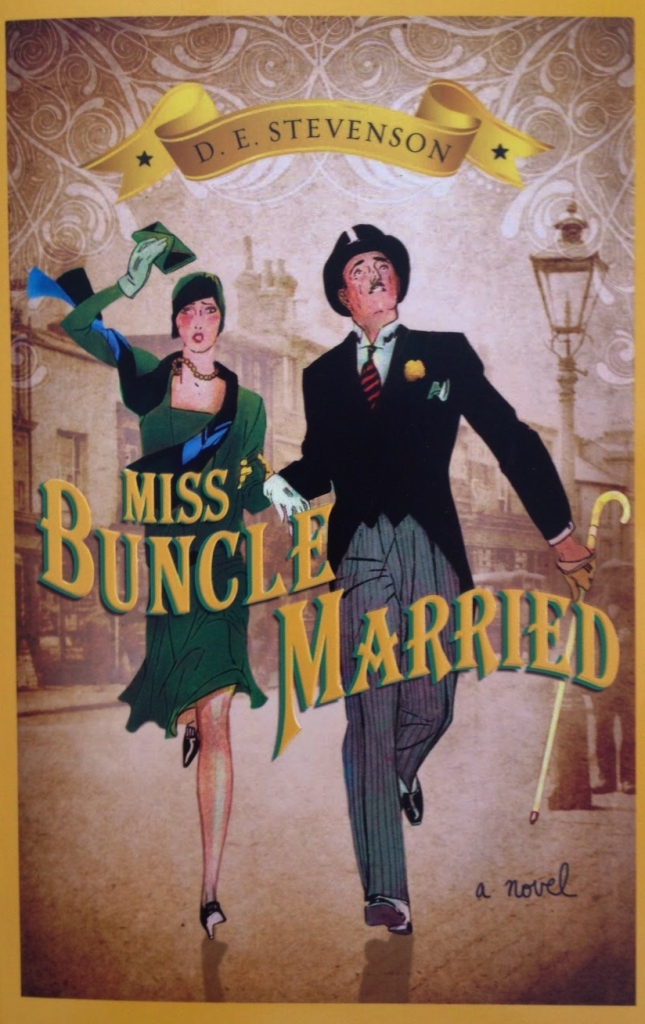
miss buncle married d e stevensonMiss Buncle Married by D.E. Stevenson ~ 1936. This edition: Sourcebooks, 2012. Softcover. ISBN: 978-1-4022-7253-3. 330 pages.

My rating: 6/10.

Readable enough, with a few reasonably memorable moments, but not quite up to the original Miss Buncle’s Book to which this is the sequel. Definitely recommended to those who enjoyed the first Miss Buncle book, and anyone who’s a D.E. Stevenson aficionado, but perhaps not the best place to start with this author. As I explore her works – she’s a very new author to me – I am struck by the wide variance in quality of her plots and prose.

*****

And now for something completely different!

The literary hoopla of Canada Reads 2013 is just over, and my tolerance for angsty Canadiana has been tested fairly stringently. Ending up rather unexpectedly “on the road” for several days this week, I grabbed, on my way out the door, something much more in the way of “light” reading than the sincere Canada Reads candidates: Miss Buncle Married, by D.E. Stevenson.

I had ordered this one, along with Miss Buncle’s Book, and Mrs. Tim of the Regiment, from Book Closeouts just after Christmas, with some of my Christmas “buy yourself a nice book” money. I’d opened the box, briefly admired the crisp new softcovers – that lovely “new book smell”, and the physical pleasure of handling crisp, clean and unworn pages – a very different pleasure from that of handling older books with their unknown histories and traces of prior readers – signatures on the flyleaf, dog-eared pages, marginal notes, the odd old letter, business card, receipt etc. used as a bookmark – now wouldn’t that make a grand post? – the things found in secondhand books!

Oi! I’ve gone completely off track. What was I posting about? Ah, yes. Miss Buncle Married. So, what I started out to say was that D.E. Stevenson was again at the forefront of my awareness, after my recent windfall of a lovely stack of her vintage paperbacks, and after sharing that news of my good luck with my husband, and pressing Mrs. Tim upon him as a “try this author, she’s rather amusing” recommendation, Miss Buncle seemed a logical choice for a light diversion for hotel room reading.

I haven’t yet had a chance to read the first Mrs. Tim myself, though I did read and enjoy one of the follow-up books to that one some time ago, Golden Days: Further Leaves from Mrs. Tim’s Journal, so I’m interested to see what my husband’s reaction will be. I suspect he’ll return a tactful “it was all right”, which, I regret to report, is all that I’m I’m able to give to my own D.E. Stevenson of the moment.

Miss Buncle Married was merely “all right”. It certainly wasn’t an improvement on the original. And though my expectations weren’t terribly inflated, as Miss Buncle’s Book was a pleasant diversionary read and not much more, I was disappointed at how slight this next one turned out to be, despite its hefty 330 pages of physical presence.

Middle-aged (“nearing forty”) though perpetually young-at-heart (in other words, slightly gauche and secretly insecure) Miss Barbara Buncle, after her unexpected success as an author, has married her publisher, Mr. Arthur Abbott. Though the two are deeply in love, and the married state is most satisfactory to both of them, there are thorns becoming most evident in the rose garden of their new life together. An active round of teas, dinners and bridge parties has become the norm, and peaceful evenings by their own fire are few and far between. Neither Barbara nor Arthur want to say anything, each believing the other to be well suited with the social whirl, and, when the penny drops, the two decide that the only thing to do is to move house, to a fresh location, where they can establish themselves anew in a more congenial lifestyle.

After much to-ing and fro-ing, Barbara finds a lovely though exceedingly rundown house in the village of Wandlebury, and she occupies herself for months with the restoration of Archway House and the creation of the ideal habitat for herself and her beloved Arthur. In the meantime, she becomes deeply enmeshed in local happenings. She inadvertently becomes privy to the will of the village’s most wealthy woman, makes friends with the outspoken artist next door and his precocious children, and meets a kindred spirit in the person of young Jeronina Cobbe, the potential recipient, all unbeknownst to her and everyone else except for Barbara and the local lawyers, of the riches to be distributed in the aforementioned will.

There are, of course, numerous twists and turns to the narrative before everyone ends up in a state of bliss, with all dilemmas nicely straightened out, and much optimism for the future.

I felt that Miss Buncle Married started out quite strongly, with much promise, and sadly faded as it went along. It settled into a predictable and very clichéd romance involving Jeronina – Jerry – and Arthur Abbott’s nephew Sam, with every development of their courtship and romantic setbacks telegraphed loud and clear.

Not a bad book, but definitely not as wonderful as it might have been. D.E. Stevenson has her moments of brilliance, but in this case those ran out early on.

I am wondering what the third book in the Miss Buncle saga, The Two Mrs. Abbotts, will be like. Though not eagerly awaiting it, I do look forward to acquiring it at some point once it becomes available, as I hear that it is due to be re-released in softcover by Sourcebooks in 2014.

And here, from Shelf Love, is a much more thoughtful review than my rather scatterbrained assessment  – I plead lack of sleep during this very hectic week – of Miss Buncle Married:

Shelf Love: Miss Buncle Married

Read Full Post »

This week has ended on a nicely high note. As you may have noticed, I’ve been very quiet on the blog posting front recently, because I’ve been deeply involved elsewhere. No worries, the involvement has been with good and enjoyable things, but oh my goodness, time consuming things, they all were.

This week I’ve put in an uncountable number of hours on the upcoming Performing Arts Festival preparations – I’m a member of the organizational committee – plus another 24 hours on the road driving the dancer of the family to classes (twice to Prince George and back, 5 hours driving each time), plus another 5 hours each day waiting around in town for her. That time was spent sitting at the laptop working on Festival stuff, so was not a complete waste of time. Yesterday off we went down to Vancouver to work with her choreographer – more hours waiting around tip-tapping on the laptop in between being summoned to watch progress – and then back home again this afternoon/evening – 14+ hours of driving for that little episode, of the 36 hours we were away. (I’m still moving. Must find my land legs …)

I was rewarded for my Super-Mom-ism when, on our single non-dance-related stop, in Hope for a flying visit to the great little secondhand bookstore there, I scored a tall stack of D.E.Stevenson paperbacks. And even better, guess what I paid? Listen to this. Two dollars each. Unbelievable. They’re all well-read, but in really decent condition.

Where should I start? I’ve read only a few of these before, and though I know these will vary widely in quality, I suspect the process of exploration will be highly enjoyable.

So the first thing I’m doing upon entering my own house and sitting down at the computer, even before checking my stacked-up email, is gloating to you, dear blog readers. I know there will be a few of you who will understand my deep inner thrill at this romantic little jackpot!

Here’s what I brought home:

  • The Baker’s Daughter (read it – loved it)
  • Vittoria Cottage
  • Crooked Adam
  • Shoulder the Sky (read it – very good)
  • Fletcher’s End
  • Rochester’s Wife
  • Green Money (read it – ho-hum)
  • The House on the Cliff
  • The English Air
  • Celia’s House
  • Katherine Wentworth
  • Spring Magic
  • Amberwell
  • Kate Hardy
  • The Four Graces (read it – liked it a lot)
  • Anna and Her Daughters
  • Music in the Hills
  • Smouldering Fire
  • The Tall Stranger

Logging off now, to go to bed. Not to sleep, though. I’ll be dallying for a while with a book, of course. Though not one of the new acquisitions quite yet. Still trying to make it through the Canada Reads books before the debates start on Monday. So far I’ve read Indian Horse and The Age of Hope, am halfway through the brutally tedious Two Solitudes, well into Away, and am frequently glancing hopefully at as-yet-unopened February, which, from all reports by fellow bloggers whose tastes I share, may well be the best of the bunch.

I’m thinking of dumping Two Solitudes unfinished, and concentrating on the other two. I think I’ve got McLennan’s theme figured out in Solitudes, and I honestly don’t really care what happens to any of his boring characters. Might be different in a less busy time, but right now the reading hours are even more precious than usual, and I’m resenting time spent on dullness. Engage me, authors, oh please!

Read Full Post »

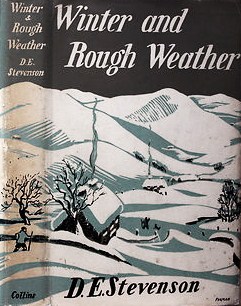
Shoulder the Sky: A Story of Winter in the Hills by D.E. Stevenson ~ 1951. Original British title: Winter and Rough Weather. This edition: Thorndike Press, 1992. Hardcover. Large Print. ISBN: 1-56054-343-4. 407 pages.

My rating: 8.5/10, for the majority of this story. I found myself very keen to get back to it and find out what was about to happen next, the most compelling of D.E. Stevenson’s books in this respect so far.

*****

A few years after the conclusion of the Second World War, a young, newly married couple, Rhoda and James Dering Johnstone, arrive at their isolated farmhouse near the fictional Scottish village of Mureth. Rhoda is an accomplished professional painter, and her husband worries, with some reason, as to how she will adjust to a life as a sheep farmer’s wife, far from the stimulating world she has happily abandoned for true love.

Rhoda drifts for a while, mulling over the dilemma of what she sees as a black and white choice between her perceived role as a wife versus personal fulfillment as an artist. The author handled this theme sensitively and sensibly, though I couldn’t help but think that childless Rhoda, overseeing a small house with the help of a live-in cook-general, had a luxury of a “domestic support system” impossible for those of us in a similar societal-economic position to attain today.

With her husband’s full support, Rhoda returns to the studio, and proceeds to paint a portrait which has far-reaching consequences among the local residents.

Add in several on again-off again love affairs, a missing wife, a bullying neighbour, a misunderstood child, and the challenges of winter storms in an isolated locale, and you have a quietly dramatic novel, and my favourite DES to date. There are two prequels/companions to this title: Vittoria Cottage and Music in the Hills, but Shoulder the Sky works well as a stand-alone; I never felt like I was out of the loop, though there were references to previous events throughout.

My only complaint is the ending seemed a bit rushed. Everything fell into place a little too neatly, and though things were obviously set up for happy resolution, too many plot strands were left hanging.  We were told that everything was now set to work out, so there were no real cliffhangers, but the novel’s abrupt ending felt very unfinished after some of the detail given earlier on. (This seems to be a common failing with most of the D.E. Stevenson books I’ve read to date.)

I greatly enjoyed this novel, aside from its minor but forgivable imperfections. The author has set it up beautifully, and the details she gives both of farm life and the art world appear to come either from personal experience or detailed research. I thought this particular novel was a relatively strong work for this “light romance” author, rather reminiscent of O. Douglas at her best.

Definitely recommended.

Oh! I must make one more comment. The edition I read was the Thorndike Press Large Print version, with a cover of lovely SPRINGTIME honeysuckle flowers. This story is decidedly wintry – a hugely important plot twist is centered on a winter storm, and the atmosphere throughout is shaped by the freezing weather. No mention of honeysuckle or springtime anywhere within – and I was watching for a clue. So a slap on the wrist to Thorndike’s design staff!

This cover is much more appropriate.

And now I must abandon my own cozy nook in the Prince George library, put on my winter jacket, and venture forth into our suddenly frozen world. It’s minus 10 (Celsius) out there and quickly getting colder; clear and crisp with a just-full moon shining on the newly fallen snow.

Grocery shopping, and the long drive home, and then a quiet day at home tomorrow, part of which will most likely be spent constructing the huge bonfire pile which has become a family All Hallows tradition. Or at least providing cocoa and other sustenance for the teens who’ve been plotting the construction of the pyre ever since last year’s spectacular display. (They’re running out of things to burn, having picked up sticks and collected scrap lumber so diligently in previous years that little remains anywhere within easy dragging distance. There was some mention of wanting a chainsaw and the use of a truck. We’ll see what happens. The weather forecast is dismal for October 31st – cold and snowy.)

There might even be a few Roman candles let off, which will shock the complacency of our own farm’s sheep – they definitely do not approve of such changes in routine, and generally wait out the human noisemaking in the shelter of their shed, gently baaing in ovine astonishment at all the fuss.

Happy Hallowe’en to those of you who celebrate it!  And to everyone at the mercy of the present widespread bitter weather, I wish you a respite from the storms, and a chance to catch your breath and regroup before winter sets in in earnest.

Read Full Post »

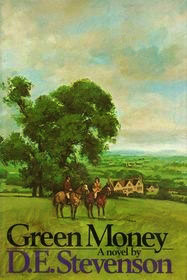
Green Money by D.E. Stevenson ~ 1939. This edition: Collins, 1981. Large Print. Hardcover. ISBN: 0-7089-0649-4. 482 pages.

My rating: 6.5/10. Amusing enough, with an almost Wodehouse-like farce going on in parts, but it was far too long for the content. Zero surprises, every plot twist was telegraphed from miles away and came through loud and clear.

The main reason I rated it as high as I did was for the likeable main character George Ferrier – and his parents – and the very darling Cathie Seeley.

A feel-good romance, requiring little effort to absorb. Literary chocolate pudding with a great big dollop of cream; comfort reading verging on simplistic; nothing daring or terribly complex here; just lick it off the spoon.

*****

Horse-loving countryman George Ferrier is on a bit of an ill-afforded toot in London when he runs across one of his father’s old school friends. Wealthy Mr. Green is now possessed of a motherless daughter, and, on a whim, he asks George to act as one of the trustees of his daughter’s eventual inheritance. The “old men” fulfilling the trustee roles keep dying off, and perhaps a younger man will prove less of a hassle. George, after much convincing, agrees, and returns home not expecting to hear anything more of his role for quite a few years to come.

But then Mr. Green suddenly kicks the bucket, leaving a vast fortune in the hands of four trustees: George, the ancient and doddery Mr. Bennett, and obviously hand-in-glove old cronies Mr. Wicherly and Mr. Millar. George senses something a bit off going on at his first meeting with the others, but allows himself to be soothed and sent away after signing numerous papers authorizing he’s-not-quite-sure-what.

Upon George’s meeting the orphaned “child” the story ramps up another notch; Miss Elma Green turns out to be a lovely eighteen-year-old who has been raised in an atmosphere of strictly Victorian purity. George is quite fascinated by this unexpectedly grown-up yet unworldly ward; he is also a bit shocked by how quickly she embraces the more forward modern behaviours her father has sought to shelter her against.

George ponders the possibility of marrying the delectable Elma to protect her from herself and the wiles of the world, but he can’t quite get over the feeling that she’s not really the woman of his dreams, beautiful though she is. For lurking in the background is his lifelong friend Cathie, whose brother Peter has himself fallen head-over-heels in love with Elma at first sight. The stage is now set for a series of misunderstandings and complications, all of which we see coming and which play out exactly as they should.

Mr. Millar steps in, offering to host Miss Green on a seaside holiday. Elma fully embraces the social whirl of tea parties and dancing till the wee hours, and instantly attracts an entourage of eager young swains, including Mr. Millar’s son Wilfred, who is receiving strong encouragement from his father to snag the heiress.

Meanwhile stalwart George ponders the clues surrounding Mr. Millar’s insistence on cashing in a large chunk of the Green shares to cover death duties, despite the existence of an insurance policy purchased  by Mr. Green to guard against the very scenario. As Peter sulks and pines for the lovely Elma, Cathie sternly tries to prepare herself for news of George’s engagement to another.

What will happen next? How will this story end? Golly, what do you think?

I liked Green Money well enough in a mild way, but I certainly didn’t love it. The story is well set up and the characters George, his mother Paddy, and self-effacing Cathie were nicely rounded out, but many of the other characters felt very one-dimensional. Elma herself comes across as a shallow, self-indulgent bit of fluff; her intelligence is of the self-protective type, and she shows no hesitance in deceiving her admittedly over-protective governess-companion to further a rapid progress into the wider world.

The whole thing went on past my initial interest level. I stuck it out to the end easily enough, but I put this one down with something of a feeling of relief that I could check it off on my D.E. Stevenson reading list.

Read Full Post »

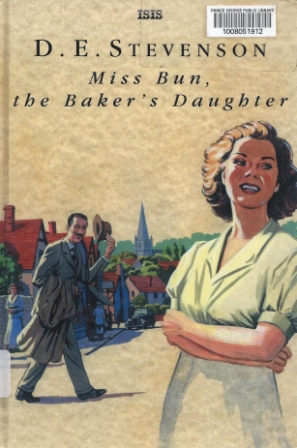
Miss Bun, the Baker’s Daughter by D.E. Stevenson ~ 1939. This edition: Isis Publishing, 2004. ISBN: 0-7531-7083-3. Hardcover. Large Print. 292 pages.

My rating: 8.5/10. Better than expected. Likable main characters gently shine in this sweetly improbable but diverting light read.

*****

In a small Scottish town, Sue Pringle was competently keeping house for her widowed father and younger brother when an unexpected stepmother entered the picture. Now in her twenties, Sue has to bite her tongue at the constant criticisms of the woman who has taken her beloved mother’s place. Worse yet, Sue’s family is pressing for her marriage to a worthy young man working in her grandfather’s grocery business; while Sue likes Bob Hickie well enough in a platonic way she has no interest in him romantically.

When an opportunity to take on a job as a cook for an artist and his wealthy wife arises, Sue decides to make a break and move into Tog’s Mill with the Darnays. She awakens her first morning to find that Mrs. Darnay has left for London taking the single other servant with her, leaving her husband to fend for himself.

Though well aware of the social implications of living unchaperoned in the same house as a young, attractive man, Sue feels guilty about abandoning the unworldly Mr. Darnay to his own limited resources, and she stays on, though her family and the neighbouring villagers look askance at the unorthodox situation.

John Darnay and Sue soon become good friends, sharing a sense of humour and a desire for solitude to pursue their own interests. Immediately nicknamed “Miss Bun” for her father’s occupation (he is town baker), Sue basks in Darnay’s approval, and soon realizes that her feelings for her employer are something stronger than is wise in their situation. She keeps house and cooks and enables Darnay to work on his painting uninterrupted, going so far as to arrange for his growing number of creditors to hold off with their bills, as with Mrs. Darnay gone there is no longer any sort of income coming in, as Mrs. Darnay would really like her husband to return to the city and continue his lucrative trade of painting saleable pictures and society portraits, instead of mucking about experimenting with new techniques and ways to capture his personal “vision”.

The artist is totally oblivious of this situation, until it is brought to his attention by Sue’s grandfather, who, much as he likes Darnay, has some serious qualms about his beloved granddaughter’s obviously doomed affection for a married man, and a penniless artist to boot.

The inevitable happens; the penny drops; and the arrangement at Tog’s Mill comes to an abrupt end, with Darnay leaving for London to work at portrait painting to pay his bills, and Sue seeking refuge with her grandparents while she decides her next step.

Added to the mix are Sue’s younger brother Sandy who suddenly runs away to join the army, a local aristocrat who thinks he just might be Sue’s real father, and a petition for divorce advanced by the absent Mrs. Darnay naming Sue as a co-respondent.

All of these threads twist and turn and eventually come to satisfactory resolutions, but not without a chance for Sue to show what fine and tenacious stuff she’s made of.

An unlikely story, but a grand bit of escapism. I thoroughly enjoyed it. Recommended.

Another brief and favorable review can be found here  .

Read Full Post »

Peter West by D.E. Stevenson ~ 1923. This edition: Isis Publishing, 2007. Hardcover. Large Print. ISBN: 978-0-7531-7824-9. 213 pages.

My rating: 6.5/10. Very much reads like a first novel, which it is. The author tries hard, and ultimately succeeds, in telling her soberly romantic little story. I had been warned not to expect much from this obscure first work, but I was pleasantly surprised by its readability once I learned to navigate the flowery language and the bits of Scots dialogue from the local lassies, crones and crofters.

A point off for the constant references to the heroine’s figurative gossamer wings. Urgh!

Also lost a point for excessive use of the convenient plot device of the random hand of death. Deus ex machina, dear author? Please don’t make that a habit!

*****

This was now-esteemed and very collectible romantic fiction writer Dorothy Emily Stevenson’s first published novel. According to the BOOKRIDE rare book guide website, it was first released in magazine serial form.

Bookride, 12 February, 2007:

‘Peter West’ is the first of over 40 novels by the popular writer. Her sister married into the Chambers publishing family, and Ms Stevenson got this novel serialized in ‘The Chambers Journal’, and published by them in book form in 1923, but it wasn’t a success. Dorothy Emily Stevenson was born in Edinburgh in 1892, she was related to Robert Louis Stevenson, who was her father’s first cousin. She was 24 when she married Captain James Reid Peploe of the 6th Gurkha Rifles in 1916. Created the immortal characters Mrs Tim and Miss Buncle published by Herbert Jenkins. Can find nothing on ‘Peter West’ except that it is much wanted and highly elusive.

Almost ten years were to pass before D.E.Stevenson’s second novel was published. Mrs. Tim of the Regiment, 1932, inspired by Stevenson’s personal diary as an army wife,  proved much more successful and is one of the very few of her forty-odd books currently in print.

But we want to talk about Peter West. Apparently it is quite obscure, though the copy before me, obtained from my local library, is a very recent (2007) large print edition from Isis Publishing, so there must be a few of these in circulation. The following review contains spoilers, so if you want to search out Peter West for yourself and be surprised, stop reading now.

*****

Dedication by the author:

Dedicated to all who love Scotland, her tears and smiles, her dark woods and sunlit moors, and the plain and homely folk in the lonely villages of the north.

And the first few paragraphs of the Prologue, to give you a taste of the author’s descriptive style:

Mr. Maclaren loved Kintoul. Ever since he had come there, nigh on twenty years ago, the place had “grown on him,” as the saying goes. It had seemed a paradise of rest and quiet to the town-weary minister – a place where a man might regain health and strength of mind and body; where a man might forget the ugly striving and pushing of the city, and steep his very soul in the peace of God.

It was, on the whole, an easy thing to fall in love with Kintoul. There was something alluring about it, something mysteriously feminine. Even in the depths of winter, when the pure white snow covered all the hill-side, hanging on the pine-trees like fleecy blankets, and the river (the only non-white thing in the whole valley) ran like a narrow snake between jagged ice – even then there was something soft about Kintoul. The hills were friendly sentinels for all their rugged crests; the long dark nights were lighted by misted stars; the very snowflakes seemed to caress one’s cheek as they fell.

When spring came, soft, blustery winds blew primroses and cowslips into the sheltered hollows, still moist and green from the late melting of the snows. Soft white clouds drifted across the blue, blue sky, throwing patches of moving shadows on the newly awakening hills.

Summer brought long. drowsy days – days which seemed to have forgotten how to fade into night; when the emerald turf paled to a soft dun colour, and heather bloomed like a purple mist under the golden sun.

Autumn came as a king in the full panoply of state, and, in a single night of frost the hill-side glowed with colour like the dream of a demented artist. Here rowan and beech, with their clashing tones, mingled harmoniously, and the dark unchanging pines stood like quiet tokens of immortality among the gay but transitory foliage of their neighbours. And over all was the mist, the cool, soft white mist, lying sometimes in the valley hollows, sometimes capping only the hills, eddying hither and thither, and enhancing the beauties of the landscape by revealing them afresh and unexpectedly through rents in its clinging folds.

The stage is set, and in this idyllic scene Mr. Maclaren muses and reminisces about a certain local romance which he has taken a great interest in. Romantic Mary Simpson, lovely young daughter of Mr. Maclaren’s predecessor as Kintoul’s church minister, fell in love with the rough and ruggedly handsome John Kerr, ferryman at the river crossing. Against her parents’ wishes Mary married John, and found all of their dire predictions coming true. Sheltered Mary was unprepared for John’s practical and brusque ways. Mary found herself in the unenviable position of being shunned by her former friends, who felt she had lowered herself by her marriage to a common working man, and viewed with suspicion by the villagers as having stepped down out of her proper class and therefore not adhering to the proper social code. Poor Mary “did her duty” as a wife, had three children, and then died of a decline – a “bruised heart” – when her youngest child, her only daughter, was eight years old.

Elizabeth – Beth – is that daughter, and she is the focus, along with the titular Peter West, of this story. Turns out that Mary, and then Beth, were befriended by a local upper-class Englishwoman, Prudence West, who recognized “something unusual” in the young Beth. When Prudence died, her son Peter, sensitive and gentle, and the possessor of a “bad heart” which precluded normal manly activities, carried on his mother’s patronage of young Beth. (I must add here that I stopped to do the math, and as this story starts Beth is sixteen, and Peter thirty-five. You may wish to remember this as the tale progresses.)

So here we have “sprite-like” Beth and sensitive Peter, thrown together by circumstances with predictable results. Beth’s father John is deeply suspicious of the “meddlings” of Peter, and when the opportunity to arrange his daughter’s marriage to a neighbouring farmer arises, he pushes his daughter into an early wedding. Beth, who has experienced a dawning suspicion of romantic love for Peter, is apathetic and goes to the church without a fuss, because Peter has become romantically involved with another woman, and Beth has witnessed a scene of passion between the two (they kissed!) which has left her stunned and heartbroken.

I’ll back up a bit to explain. Peter is possessed of a bossy elder sister, who occasionally descends upon him and makes a great ruckus and meddlement in his affairs. She has suspected an attachment with the unsuitable village girl, so she has brought along a lovely young woman to distract him; her ultimate goal is to marry Peter off to a bride of her choosing, and she quickly succeeds.

Peter’s new wife, the former Natalie Horner, is not quite the lovely, intelligent, playful creature she appears to be. Apparently she is heir to a family curse of insanity, and she also has a wee bit of a drinking problem. Peter learns of this too late, and he does the best he can with his wife, though her quick descent into full-blown depression shocks and saddens him. Eventually she runs into the night and tragically perishes in the river. Peter returns to his solitary life, giving up hope of romance and steeling himself for whatever the future brings. (The weak heart seems to be ticking along not too badly, by the way.)

Meanwhile Beth’s abusive husband Alec and her harsh-mother-in-law Mrs. Baines have between the two of them almost broken the spirit of sweet little Beth. She eventually runs away and ends up in Peter West’s study, where the two of them have a poignant scene and finally admit their mutual attraction. Beth is offered a way out of her difficult situation by another older man, Brownlow Forth, who was once in love with her mother, Mary, and has since cherished a deep interest in her daughter. Brownlow is in the neighbourhood staying with Mr. Maclaren, and while visiting Peter he becomes enmeshed in the dilemma of Beth’s desertion of her husband, and offers to take her to London to get a job and live independently though under his (Brownlow’s) protection.

So off they go in the night, leaving the village agog with Beth’s mysterious disappearance. Peter is eyed suspiciously, as his affection for Beth and hers for him are naturally well-known to the local gossips, but as Beth is not anywhere in evidence, he stands up to investigation and the rumours die down.

Fast forward a few months, and a flu epidemic strikes peaceful Kintoul. Both Beth’s father and husband are stricken, and Beth, hearing of this, returns at once to care for her now-remorseful father. She pulls him through, but Alec, weakened by his self-indulgent lifestyle, succumbs.

Their first spouses handily disposed of, Peter and Beth are now free to resume their interrupted courtship. The novel’s ending is not quite as expected, though it will satisfy the most romantic-minded of readers, and I will leave that a secret, though I’ve given away most of the high points of the plot already.

A fast little read, and full of melodrama and romantic situations – perfect serial fare.

Rather a solemn story, missing the humorous touches of D.E. Stevenson’s later books, but I thought it a quite respectable first novel, and a more enjoyable read than I had first anticipated. I’m glad it was a short one, though – that was definitely a point in favour!

Recommended for the D.E. Stevenson fan who would like to check off every one of her books from their reading list, but probably not a good sample of her larger bibliography, and not a place to start for the fledgling Stevenson reader, unless they are willing to take a leap of faith and trustily go on to the much more light-hearted Mrs. Tim and her literary descendents.

Read Full Post »
Golden Days: Further Leaves from Mrs. Tim’s Journal by D.E. Stevenson ~ 1934. This edition: Isis Publishing, 2006. Hardcover. Large Print. ISBN: : 0753176139. 241 pages.

My rating: 8.5/10. I must say I liked this one a lot. Total cozy comfort read, and exceedingly predictable in its outcome. Some days that’s a good thing, a little break from thinking too hard!

I found it very similar to one my long-time go-to reads, E.M. Delafield’s Diary of a Provincial Lady. I don’t suggest that the gadabout adventures of Hester Christie (Mrs. Tim Christie) in any way echo the stay-at-home ways of Delafield’s unnamed heroine, but the tone, style and format are exceedingly familiar. I compared publication dates, and see that Delafield’s Provincial Lady was published (and became an immediate bestseller) in 1930-31 (England-U.S.A.), while Stevenson’s first Mrs. Tim book, Mrs. Tim of the Regiment, appeared in 1932, followed by this installment, Golden Days, in 1934. I would have to assume that Stevenson was aware of Delafield’s popular work?

No worries – there’s room in my heart for the two, though until I read more of the Mrs. Tim stories (and they are very much on my wish list), I still hold the Provincial Lady in higher esteem. The humour is more wry – more savage – and the inner examinations much closer to home. Hester is a bit too uniformly “nice”, though she has her moments of critical insight.

Apparently Golden Days is a rather hard to find stand-alone title, as it was only published as a separate title in the very early editions. In later years it was added to Mrs. Tim of the Regiment, with that title comprising both the 1932 and 1934 installments of Mrs. Tim’s diary.

The edition I found through the public library was a very recent (2006) large print edition from Isis (Ulverscroft); there appear to be quite a few D.E. Stevensons in the system in large print format, which perhaps says something about the age, or in any event the perceived age <ahem> of the D.E.Stevenson-readers’ demographic.

*****

This will be a sketchy review; the book has just been returned to the library so is not here in front of me to double-check details and names.

This is, as I already mentioned, the second Mrs. Tim story. It is usually included with the first installment, Mrs. Tim of the Regiment, in the 1940 and later editions, including the currently available reprint from Bloomsbury (2009). There are three more books in the series: Mrs. Tim Carries On (1941), Mrs. Tim Gets a Job (1947), and Mrs. Tim Flies Home (1952), all currently out of print, as far as I am aware.

Here we go.

Mrs. Tim, as our heroine Hester Christie is commonly styled, is married to a an army officer, and the impression we get from Golden Days is that she is often called upon to move house, to “follow the regiment.” At this particular time, Mr. Tim is occupied with his job, Mrs. Tim’s eldest child is off at boarding school, and she and her young daughter are invited on a Scottish holiday, with a dual purpose. First, to relax and enjoy themselves far from home responsibilities, and secondly, to try to bring sense to Mrs. Tim’s hostess’ son who has become involved with an unsuitable girlfriend. Apparently Mrs. Tim has some sort of special influence on the young man in question; in any event, he is prone to listen with flattering attention to what she has to say.

Much loch-fishing, glen-wandering and tea-drinking ensue. The love affair is brought to a satisfactory solution, and Mrs. Tim herself picks up an ardent admirer, though she is too innocent and too much in love with her absent husband to take much notice of her tenaciously persistent swain.

A slight book, and a very quick little read. I’m guessing not more than 150 pages or so if it were in standard-print format. Amusing and very pleasant in all regards. Perhaps just a mite too pleasant? Right there on the borderline, but Mrs. Tim gets a nod and a pass. I’m liking her even better than Miss Buncle , who got a decided pass as well, after some consideration.

I am persisting in making a broader acquaintanceship with D.E. Stevenson, as a number of fellow readers have been singing her praises, and I do see her appeal. But I am not one hundred percent onside quite yet. I am currently gingerly tackling Stevenson’s first novel, Peter West – also in large print, re-published 2007 or thereabouts for those of you wondering how I got my hands on it, as apparently this one is also hard to come by. It is rather too sentimental and flowery for my taste, and I do believe I already know the outcome, and I’m only a few chapters in. But I’ll soldier on, and report at a future date.

Side note: I really don’t care for the wishy-washy watercolour covers of the Isis editions. Too sweetly bland, and a bit embarrassing to be carrying around openly. The lady on the current cover of Golden Days bears no resemblance to my personal imaginary vision of Mrs. Tim – another minor annoyance!

Read Full Post »

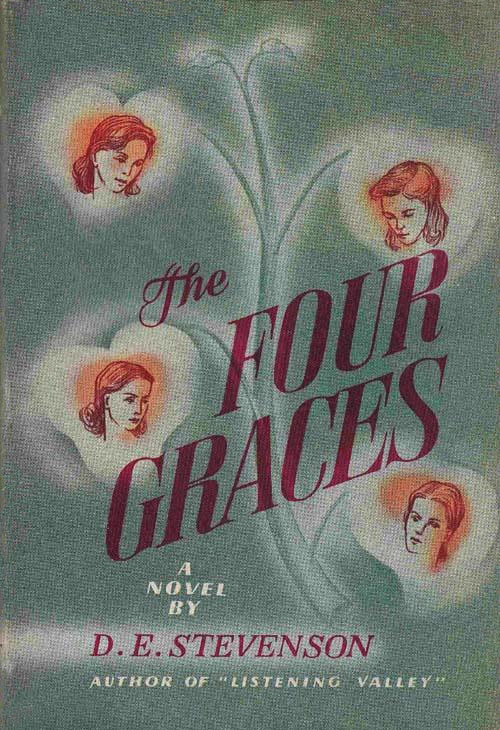
The Four Graces by D.E. Stevenson ~ 1946. This edition: Ulverscroft, 1975. Hardcover. Large Print – 370 pages.

My rating: For purely cozy, exceedingly nostalgic, “English village” escape literature, easily a 9/10. Literary merit – well, we won’t go there! I am actually quite impressed by the assumption that the author makes that her readers are very familiar indeed with the literary greats, as well as the current bestsellers of the day. References and quotations appear without any explanation, with, I’m quite certain, the belief that the reader as well as the characters of the story will “get it” immediately. Rather reminiscent of D.L. Sayers, and her own high-handed assumption that her readers are coming from the same erudite place as she is!

*****

This is my second D.E. Stevenson, after my initial introduction to this author’s esteemed Miss Buncle’s Book . I can understand how Dorothy Emily has garnered such a devoted following over the years. My elderly mother (87) would just love this one. I browsed ABE to see if I could perhaps pick it up for her, but was shocked at what  I thought were astronomical prices for this type of book – $22 and up for worn paperbacks to an unbelievable $246 for an ex-library hardcover. Who knew?!

Someone needs to get going on republishing this author – obviously there is a demand. I know Persephone has recently re-released, in 2009 and 2011 respectively, Miss Buncle’s Book and Miss Buncle Married, but those are the tip of a very large iceberg. According to my research – okay, to be honest, I looked at Wikipedia – this author’s career extended from 1923 to 1970, with a very respectable forty-six titles to her credit.

*****

The Reverend Mr. Grace is Vicar of a country parish, and is blessed with four now-motherless grown-up daughters. Adeline – Addie – the eldest, is a W.A.A.F. officer now living in London, but the three younger sisters remain at home. Matilda (Tilly), Sarah (Sal) and Elizabeth (Liz) all keep extremely busy, both by assisting their father in his many duties and helping with the war effort, for the story is set mid-World War II, and much of its charm is in seeing how the villagers live their lives and gamely make adjustments for the current reality.

Romance enters the sisters’ lives as two suitors suddenly appear – one quite traditionally, and the other much more insidiously. The reader never has a moment of doubt as to the eventual outcome, and though there are gentle setbacks to both romances everything inevitably works out as it should. A very sweet little story, which I found surprisingly appealing. Tiny touches of cynicism and humour kept it from being too saccharine, though it was a rather close thing.

From the Author’s Preface:

The author has been asked whether this is a funny book or true to life, and has some difficulty in answering the question, for life is a funny business altogether (both funny-peculiar and funny-ha-ha, as Elizabeth would say). The story covers less than a year in the life of a family and during this comparatively short period many things happen, some serious and important, others cheerful and gay. It is summertime – a summer during the greatest and most terrible f the wars – but the author felt disinclined to bring such a grave and desperate matter into a light-hearted tale; here, then, are to be found only the lighter side and the small inconveniences of Total War; the larger issues are ignored…

Read Full Post »

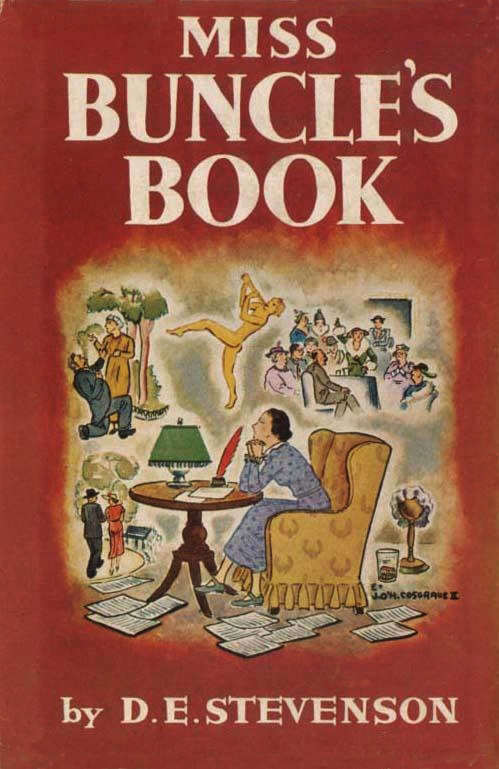
Miss Buncle’s Book by D.E. Stevenson ~ 1934.  This edition: Buccaneer Books, 1983. Hardcover. ISBN: 0-89966-168-8. 224 pages.

My rating: 8/10. A slight work, good for, at most, several evenings’ diversion. I would definitely re-read it after a decent interval, when wanting something “fluff”-ish to take my mind off the frequently depressing nastinesses of the our own 21st century world. Good for what it is – a tale as innocuous and amusing as Miss Buncle’s was intended to be, and not at all “clever”, though, as Miss Buncle herself found, those wishing to project their own imaginations into this simple fairytale could have a field day with hidden meanings, unintended by the author(s), I’m quite certain!

So, after seeing so many enthusiastic reviews of this book (and a few noncommittal “it was okay”s) I did at last manage to track down a library copy. I fall somewhere in between the two camps, but am probably most at home in the “in favour” crowd. I thought the story was light and fun, and I’m going to search out the sequels, Miss Buncle Married and The Two Mrs. Abbots, but I’m in no hurry.  Miss Buncle’s Book was pleasant enough but did not trigger a “must own it” compulsive visit to Amazon and ABE, though I did browse through both hoping to strike a bargain. Not much luck there; inter-library loan it shall be, though I was attracted enough to add D.E.Stevenson to my look-for list for used bookstore shelf scanning. In particular a series of stories concerning a certain “Mrs. Tim”, a soldier’s wife, who seems a good sort to get to know by all reports.

*****

Dowdy, almost-40, kind and peace-loving spinster Miss Barbara Buncle, facing financial difficulties as the dividends from her investments shockingly decrease in the post-WW I years, decides to write a book to gain some spending money. Not having “any imagination”, she draws her characters directly from life, changing only tiny details and, of course, their names. (The village Silverstream becomes Copperfield, Mr Fortnum is now Mr. Mason, Colonel Weatherhead becomes Major Waterfoot, Miss Pretty is Miss Darling, and so on, in a game of renaming by association.) As her tale progresses, she sends her “fictional” friends and neighbours off on some surprising adventures, causing much consternation when the inhabitants of Miss Buncle’s village eventually read the book and recognize themselves.

As the real-life inhabitants of Silverstream-Copperfield meet to decry the parody, and to discover and expose the Judas in their midst, they continually pass over innocuous Miss Buncle, even after she drops broad hints and, in a fit of conscience, even confesses to an unbelieving set of ears. For how could silly Barbara Buncle write even a borrowed epic? She’s not nearly clever enough…

The worm turns with a (mild) vengeance, and Miss Buncle gets the last laugh, as her life takes an unexpecteded turn due to her literary efforts.

Read Full Post »

« Newer Posts