Posts Tagged ‘Social Satire’

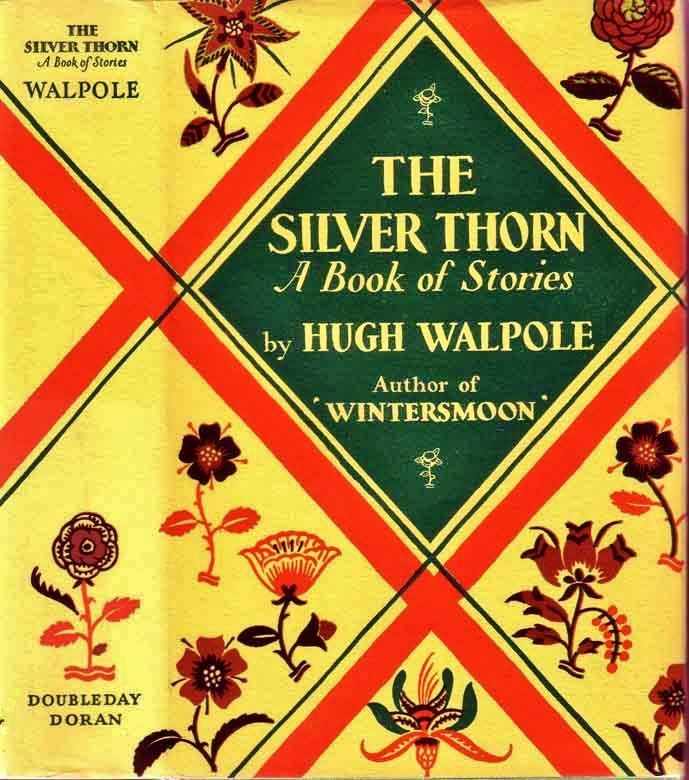
the silver thorn hugh walpoleThe Silver Thorn: A Book of Stories by Hugh Walpole ~ 1928. This edition: Doubleday, Doran and Co., 1928. Hardcover. 333 pages.

My rating: 6.5/10

Fifteen short stories by the prolific Hugh Walpole, originally published in various periodicals between 1922 and 1928. An eclectic mix, including several quietly creepy horror stories: The Tiger, The Tarn, Major Wilbraham, and, in my opinion, for its Kafkaesque atmosphere, The Dove.

A more than readable collection, though I didn’t feel that most of these were “top rank” for the short story genre of their era. They share something of a common theme, of yearning for various things, and of regret for decisions made in the past, and of the inexorability of fate and the urges – with varying degrees of success –  to go against it.

A gentle yet pervasively melancholy mood hovers over these stories, though they have a certain degree of humour and occasional happy resolutions, though always with an ironic twist. Shadows of the recent Great War and its effect on the collective psyche are very apparent in this collection; an interesting example of English literature between the 20th Century’s two world wars.

  • The Little Donkeys with the Crimson Saddles – Two lady-friends keep shop together (fancy work and antiquities) in Silverton-on-Sea, but their happy establishment appears to be about to dissolve when the younger receives a proposal of marriage from a very eligible man.
  • The Tiger – Londoner Homer Brown dreams of being hunted by a tiger in the jungle; the dream accompanies him to New York, where it comes inexorably to a shocking climax.
  • No Unkindness Intended – Elderly, slovenly, ineffectual Mr. Hannaway, vicar of a city parish, is offhandedly dismissed from parlour after parlour, and things look dreary indeed until his path crosses that of a similarly situated small dog.
  • Ecstasy – A modestly successful poet who has been musing about his life and his twenty-year-old marriage and wondering where the ecstasy of the younger years has vanished to spends an afternoon with a tramp and regains hold of the key to contentment.
  • A Picture – Two lovers discover their essential differences over opinions of a small oil painting.
  • Old Elizabeth – A Portrait – An unemotional family, habitually unsentimental, are brought to their figurative knees by an elderly servant.
  • The Etching – Bullying Mrs. Gabriel goes too far when her otherwise meek husband discovers and indulges a passion for collecting old etchings.
  • Chinese Horses – This is one of the star stories of the collection, to my mind, elaborating on the theme of the first story, The Little Donkeys. Middle-aged Miss Henrietta Maxwell has nothing in the world but her beloved house, which she is forced to let due to financial difficulties after the war. An opportunity arises to bring her standard of living back to a higher level, but is it worth the compromises required?
  • The Tarn – The second horror story of the collection, and a very effective one at that. Author Fenwick’s life has always been shadowed by the more successful Foster; now the two are together as Foster seeks conciliation for the bitterness Fenwick feels. Fenwick isn’t really interested in making friends with his rival…
  • Major Wilbraham – An unusual story about a retired army major and his personal religious epiphany and its tragic – or is it truly tragic? – result. I am undecided as to whether this is a supernatural tale, or merely an attempt by the author at a religious allegory of sorts.
  • A Silly Old Fool – A chance remark by a patronizing wealthy parishioner changes Canon Morphew’s life, as he becomes aware of the possibility of seeking and attaining romantic love. But striving is not always rewarded with success…
  • The Enemy – Bookseller Harding is annoyed by the insistence of chatty neighbour Tonks to act as though they are close friends. He really just wants to be left alone to go his solitary way. Or does he?
  • The Enemy in Ambush – Stiff and very proper Captain John Ford boards out in Moscow with a family of emotional Russians, with a view to improving his Russian language skills. Cultures clash, with the stiff upper lip taking precedence, until Mrs. Ford shows up to accompany her husband home.
  • The Dove – In the years after the Great War, society seeks to understand the root causes of the recent conflict. One Percy Alderness-Slumber is inspired to go to Germany to investigate the feelings and emotions of the common people, hoping to gain some insight to bring back to England and share. His meekness and well-meaning lead to his ultimate undoing, as he becomes embroiled in a Kafkaesque scenario with his German landlady. A horror story not involving the supernatural realm, and one I know I will remember with a quiet shudder. Looking over the stories in this collection, I’m wondering if The Dove doesn’t rather stand out, along with Chinese Horses, as my most personally memorable.
  • Bachelors – Harry and his ten-tears-older brother Robin live in single happiness in the cathedral town of Polchester, and are well established as local “characters”. But one day Harry proposes to and is accepted to fluffily vivacious Miss Pinsent, and everything goes sideways for Robin. But is it a quiet personal tragedy, or a chance to live his own life at last?

Read Full Post »

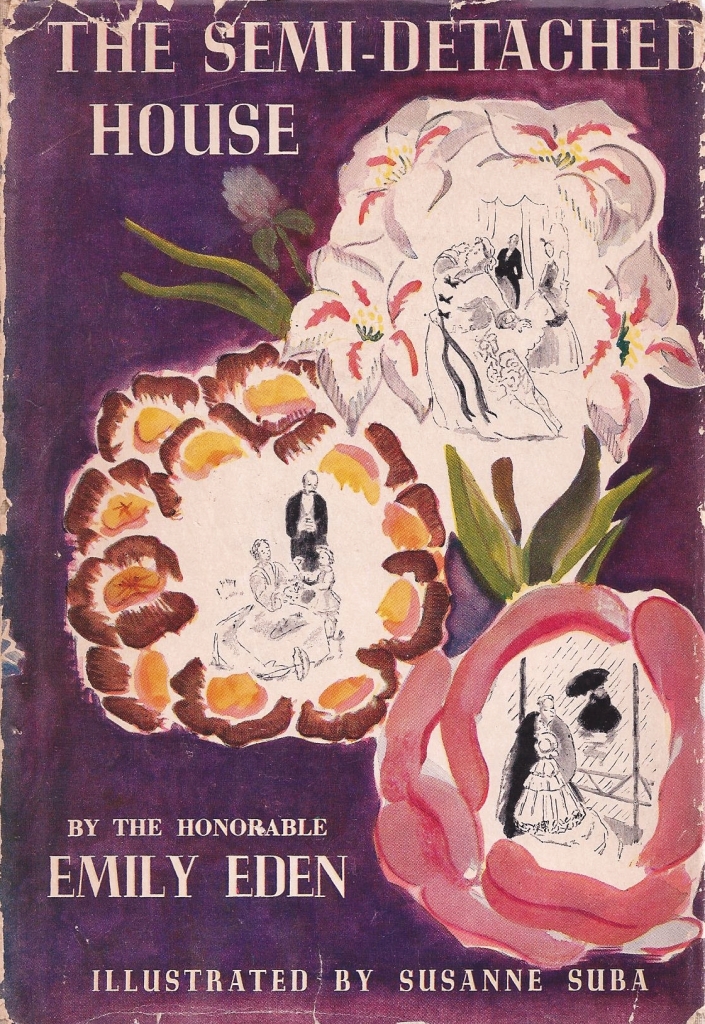
the semi-detached house emily eden 001The Semi-Detached House by Emily Eden ~ 1859.

This edition: Houghton Mifflin, 1948. Illustrated by Susanne Suba. Hardcover. 216 pages.

My rating: 6.5/10

An aristocratic young Lady Chester, Blanche to her intimates, just eighteen and married six months, is bemoaning her husband’s three-month diplomatic assignment in Germany. She has discovered that she is in an “interesting” state of health, and she thinks her husband’s timing could be ever so much better. As well, Lord Chester has taken the advice of Blanche’s doctor and has packed her off to the depths of the suburbs (Dulham), to Pleasance Court, which is in itself quite all right, being a properly fashionable address, but for the smaller semi-detached dwelling at the rear, residence of the decidedly middle-class Hopkinson family. Blanche is a mass of nerves, anticipating all the worst, and dreading meeting her undoubtedly “common” neighbours.

Just across the shared wall, the Hopkinsons are equally as flustered. Rumour has it that the young socialite moving in next door is either the estranged wife of a member of the nobility, or perhaps (shocked hisses) his chère amie. The very respectable Mrs. Hopkinson has barred her shutters, and intends to cut her new neighbour dead.

Luckily both households make a happy acquaintance and quickly become the best of friends, for this is a very friendly novel of manners, and though the gossip flows freely the gossipers are most well-intentioned.

Emily Eden (“The Honorable Emily Eden” as my 1948 edition proudly proclaims) was a great admirer of her predecessor Jane Austen, and deliberately styled her several domestic novels after that literary mentor. Parallels certainly exist, but Emily Eden’s work has a distinctive voice of its own, being gently satirical and full of humorous situations of a time several decades past that of Jane Austen’s fictional world.

A cheerfully fluffy romp, with just the lightest touches of seriousness here and there, and more than a little snobbishness towards the social climbers seeking to scrape acquaintance with the fashionable Chesters. There are love affairs to be sorted out, and the spanking new marriage to be fully settled into, not to mention the excitement of the impending arrival of Blanche’s addition to the English aristocracy.

Nice glimpse at a world familiar to those of us fond of Miss Austen and her compatriots, written by someone who was familiar at first hand with the life described so vivaciously here.

Another novel, The Semi-Attached Couple, preceded this one, and both are succinctly reviewed by Desperate Reader, and by Redeeming Qualities, among others.

The full text of The Semi-Detached House is online for your reading pleasure here, and both novels are available in a Virago double edition as well, though that may now be out of print.
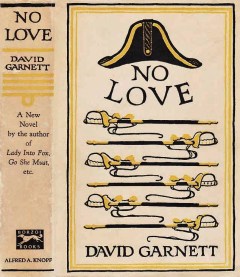
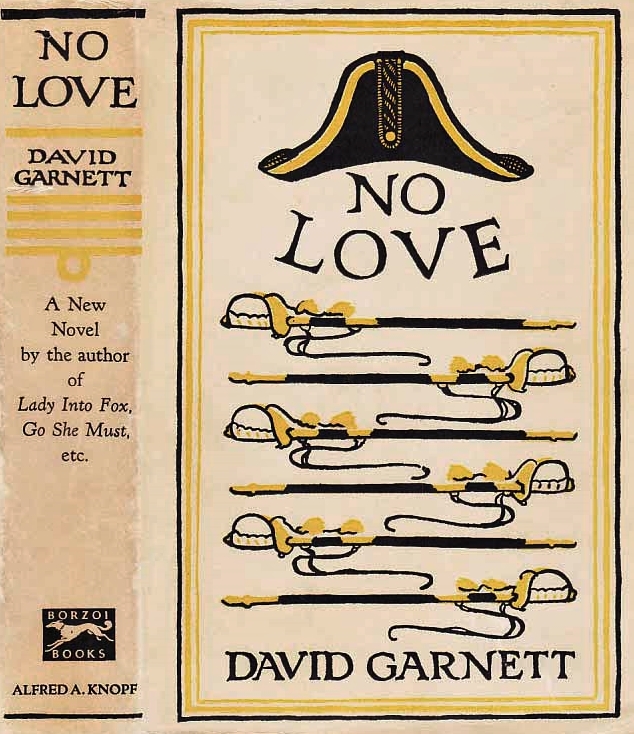
no love david garnett djNo Love by David Garnett ~ 1929.

This edition: Chatto & Windus, 1929. Hardcover. 275 pages.

My rating: 8/10.

What an unexpected and sophisticated novel this one was. I have never read David Garnett before, though of course I have heard quite a lot about Lady Into Fox (which I’m intending to read next year for the Century of Books project) and I now anticipate that reading with even more pleasure, as I  was quite pleased with what I read here. I did an online search to see if I could come up with any other reviews of No Love, but have so far drawn a complete blank, which leaves me rather disappointed. Surely someone else has found this novel worthy of discussion? If you have reviewed it yourself, or know of any others who have, I would be greatly interested to read your thoughts.

When in 1885 Roger Lydiate, the second son of the Bishop of Warrington, and himself a young curate, became engaged to Miss Cross, the marriage was looked on with almost universal disapprobation.

Alice Cross was a very emancipated girl; she was the daughter of the great paleontologist, Norman Cross, the notorious freethinker and friend of Huxley’s, who had poisoned himself deliberately when he was dying of cancer. The poor girl idolised her father’s memory, had been known to justify his suicide in public, and openly maintained, not only the non-existence of God, the non-existence of the human soul, and a rational and mechanistic theory of human consciousness, but also carried the war into the enemy’s country by declaring with her favourite poet Lucretius

Tantum religio potuit suadere malorum.

It was her view, constantly expressed, that it was religion alone that had always prevented the advancement and enlightenment of mankind, that all wars and pestilences could be traced to religious causes, and that but for a mistaken belief in God, mankind would already be living in a condition of almost unimaginable material bliss and moral elevation.

She was, they all said, no wife for a clergyman.

Despite Alice’s “unsuitability”, she and Roger were deeply in love, and they did indeed marry, with Roger ultimately abandoning his curateship and declaring himself an atheist. The Bishop let it be known that he was cutting young Roger out of his will, but what was never known was that he was deeply sympathetic to the young couple, and had quietly given the young bride an astounding ten thousand pounds as a wedding gift.

With this unlooked-for nest egg, the young couple purchased a small island near Chichester, on which was an extensive fruit farm, and settled down to a rural life, and to establishing a home and a new way of life.

There is no happiness and excitement in the lives of a married couple greater than the period when they are choosing themselves a house and moving into it; it is a time far happier than the wedding night or than when children come. A house brings no agony with it; its beauties can be seen at once, whilst both physical love and the children it begets, need time for their beauty to unfold.

Roger and Alice were well suited to each other and their rural occupation, and in time two children were born to them, Mabel and Benedict. Life on the Island proceeded peacefully, until one day in late October, 1897, when Roger rescued a stranded party of boaters and offered them hospitality for the night. These proved to be a certain prominent naval man, Admiral Keltie, his beautiful wife, and their young son Simon, and as the two families felt a certain stirring of mutual attraction, it soon came about that the Kelties purchased a building lot on the island and proceeded to construct a mansion, while between the two families a friendship of sorts developed.

That friendship was soon mixed with a good dose of unspoken jealousy, as the Lydiates see at first hand the extravagance of the wealthy Kelties, and as both husbands cast admiring eyes on the attractions of their neighbour’s spouses. Roger is appreciative of Mrs. Keltie’s cold beauty and brittle wit, while the Admiral is moved by Alice’s obvious intelligence, her deeply passionate nature, and a certain earth-mother quality she exudes.

Simon and Benedict make friends as well, though as they grow up they grow apart, with Simon moving in much more exalted circles, and Benedict going his own quiet way, though the two reconnect time and time again, their meetings often marking the episodes of this narrative.

The novel focusses most strongly on the Lydiate family, and its description of their lives and the changes in their moods and attitudes as the Kelties come and go is beautifully wrought. The years pass, and the Great War sweeps both sons away, but the families remain tenuously connected, however, as Simon and Benedict both have fallen in love with the same woman, and her decision on which one to marry has far-reaching consequences to both families.

This novel appeals on numerous levels, as an exercise in story-telling, as a commentary on the social mores of the time, and as a broader examination of the nature of many different kinds of love. Nicely done, David Garnett. I am looking forward to seeking out and reading more by this author in the years to come.
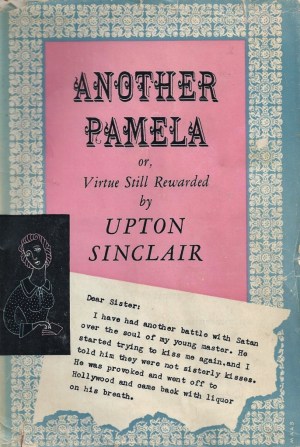
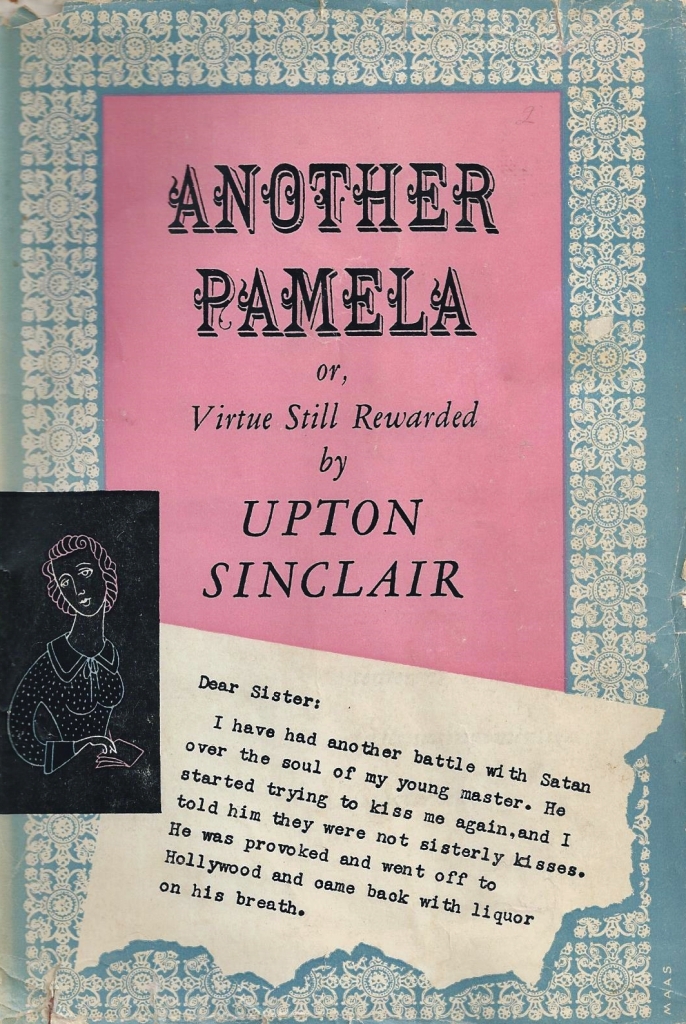
another pamela upton sinclair 001Another Pamela or, Virtue Still Rewarded by Upton Sinclair ~ 1950.

This edition: Viking Press, 1950. Hardcover. 314 pages.

My rating: 7.5/10

And now for something completely different, we move forward in time and to another continent, to this satirical look at social mores in 20th Century California.

Somehow in my travels I have acquired not one but two copies of this slightly obscure novel, a foray into light literature by the famously passionate social activist and best-selling author, Upton Sinclair, perhaps best known for his consciousness-raising, dramatic novel The Jungle.

Having never read Samuel Richardson’s bestselling 1740 epistolary novel, Pamela, about an English serving girl’s trials, tribulations and eventual marriage to the nobleman who tenaciously attempts her seduction, I wasn’t quite sure if I would fully appreciate Upton Sinclair’s parody of the same. It turned out not to matter, as Sinclair helpfully includes generous quotations from the original, having his own heroine read the original as part of her personal development, as she struggles with her own would-be seducer, and the dictates of her conscience and religious upbringing.

Published in 1950, the action of the story is set some years earlier, in the years of the Roaring Twenties, when the fabulously rich of America gave full rein to their imaginative excesses.

The modern Pamela is a child of the early 1900s, being a deeply naïve and (of course!) absolutely lovely young maiden raised in rural poverty in California. She is discovered by a wealthy patroness whose car has broken down in the area of young Pamela’s farm. Upon conversing with Pamela and learning that she is a Seventh Day Adventist with no objection to working on a Sunday (as long as she has Saturday free to devote to her devotions), Mrs. Harris impulsively decides to try the girl out as a parlour maid in her luxurious home, Casa Grande, near Los Angeles.

Pamela is quite naturally overwhelmed by this change in her affairs. Grateful to be able to be sending her pay home to help out her desperately poor family, she is most loquacious in her letters, describing her situation and the other servants and tradespeople she works with, and, increasingly, as she rises in the household hierarchy, the doings of Mrs. Harris herself, who is a lady of many enthusiasms, the main one being the promotion of a rather eclectic form of communism, tweaked to allow for the great disparity between the Harris millions and the theoretical rights of the downtrodden to full equality. (As long as Mrs Harris is not asked to give up her personal comforts, that is.)

And there of course is a “young nobleman” of sorts, one Charles, Mrs Harris’s nephew, a playboy of epic proportions who is completely dependent on his besotted aunt for funds. The Young Master, as Pamela describes him in her letters home, has many vices, not the least of which is his excessive consumption of alcohol, and when Mrs. Harris notices his glances at the lovely Pamela, she encourages the girl to give in to Charles’ pressing invitations to dining out and sightseeing, hoping that this new interest will wean Charles from the demon bottle. (She conveniently turns a blind eye to the possible corruption of her protégé’s morals.)

Charles is decidedly forthcoming; Pamela resists, using her prim and rigid religion as her shield and weapon. Do I need to tell you what happens? Not really, as the title gives the ending away, and as this is a happily satirical tale, we know that Pamela’s eventual fall will be well cushioned.

An enjoyable diversion of a book, with Sinclair getting his digs in at a huge array of social types, all in good fun, with abundant sugar coating the truthful pill within. I wonder if this deserves a “hidden gem” designation? I rather think it does, and I think some of you might find it worthy of a read if you come across it in your travels; it’s an amusingly Americana-ish thing.

Read Full Post »
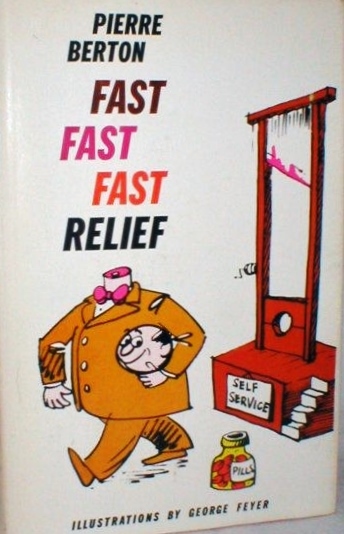
fast fast fast relief pierre berton 1Fast Fast Fast Relief by Pierre Berton ~ 1962. This edition: McClelland and Stewart, 1962. Hardcover. 185 pages.

My rating: 7.5/10

Pierre Berton, Canadian popular historian extraordinaire, began his career as a prolific and well-regarded newspaper columnist. After reading and enjoying an earlier collection of his newspaper articles, 1959’s Just Add Water and Stir , I was happy to acquire a similar 1962 collection. It has lived up to expectation, in providing a widely varied, and, for the most part, smoothly readable collection of serious essays, biographical sketches, social commentary, and satirical fabrications.

Highlights of the collection to me were a series of short, completely serious, “current affairs” articles highlighting social injustices, a number of lyrical essays describing the joys of country life, and a rather goofy collection of humorous short-short stories, extra-heavy on the satire. Of these last, The Waiting Room (Wesbrook Frayme, car racing ace, dies in a crash, gets to Heaven and is shocked to find out that his widow has married twice again; his wife and her other two spouses all appear to confound Wesbrook’s assumptions about his marriage and his wife’s mourning process) and Shakespeare Revises a Play (the Bard of Avon has his work worked over in a most Hollywood-like manner; in his first draft of Hamlet, Ophelia is thirty-two, and the ending involves lovers wandering off hand-in-hand into the sunset; the producer and director have other ideas), are particularly delightful.

A collection worthy of keeping on the night table for dipping into; an ideal guest room book for your fellow Canadian avid readers, especially those appreciative of Berton’s wry, thought-provoking, and occasionally just-plain-silly and boisterous tone.

All in all, over forty short pieces, plus an extensive and most interesting foreword by the author. Comic cartoon-like illustrations by George Feyer are an added touch.

Pure vintage Canadiana, and a good reminder of why Pierre Berton was so highly regarded for so many decades. His more than competent journalistic work brilliantly foretells his subsequent success as a writer of popularly accessible historical books.

Read Full Post »

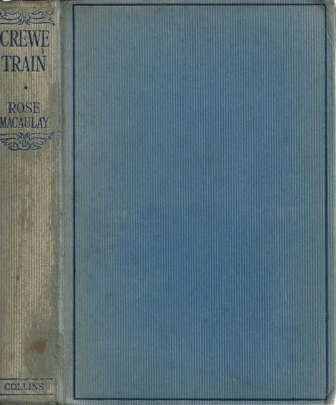
crewe train by rose macaulay 001Crewe Train by Rose Macaulay ~ 1926. This edition: W. Collins Sons & Co., Ltd, 1926. (One Shilling Library Series.) Hardcover. 307 pages.

My rating: A solid 9/10. It’s been several weeks since I read this rather shabby, more than slightly foxed edition of Crewe Train, but the character of Denham has walked beside me ever since.

TO

THE PHILISTINES,

THE BARBARIANS,

THE UNSOCIABLE,

AND

THOSE WHO DO NOT CARE TO TAKE
ANY TROUBLE.

I must admit that after that introduction I was already more than half won over, which was a good thing, for my initial impression of the characters in this quirky novel was that they were sincerely unlikeable. Our heroine in particular.

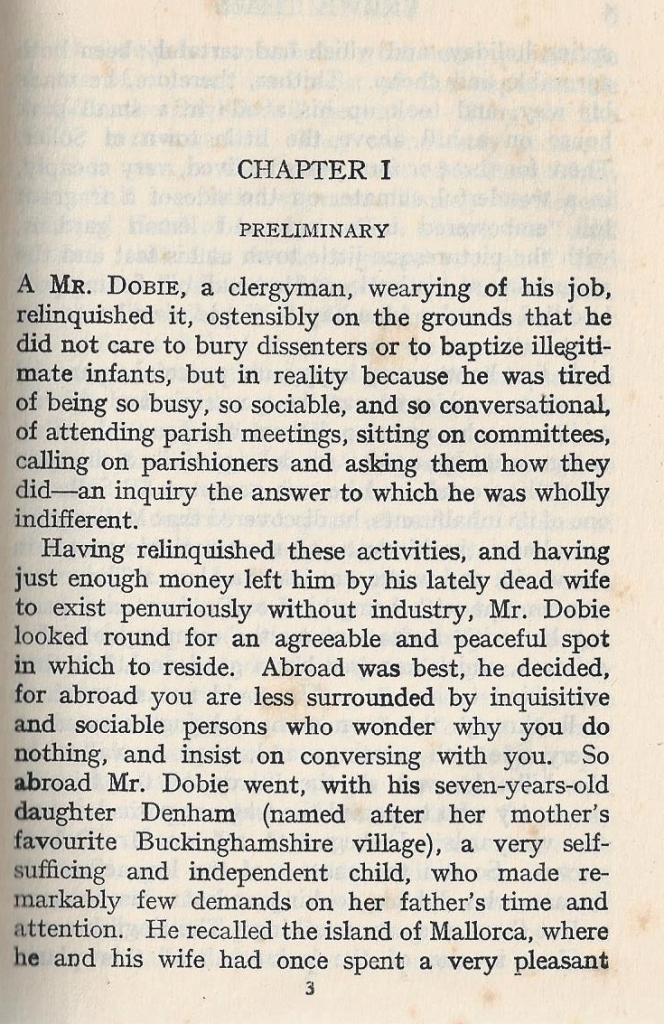
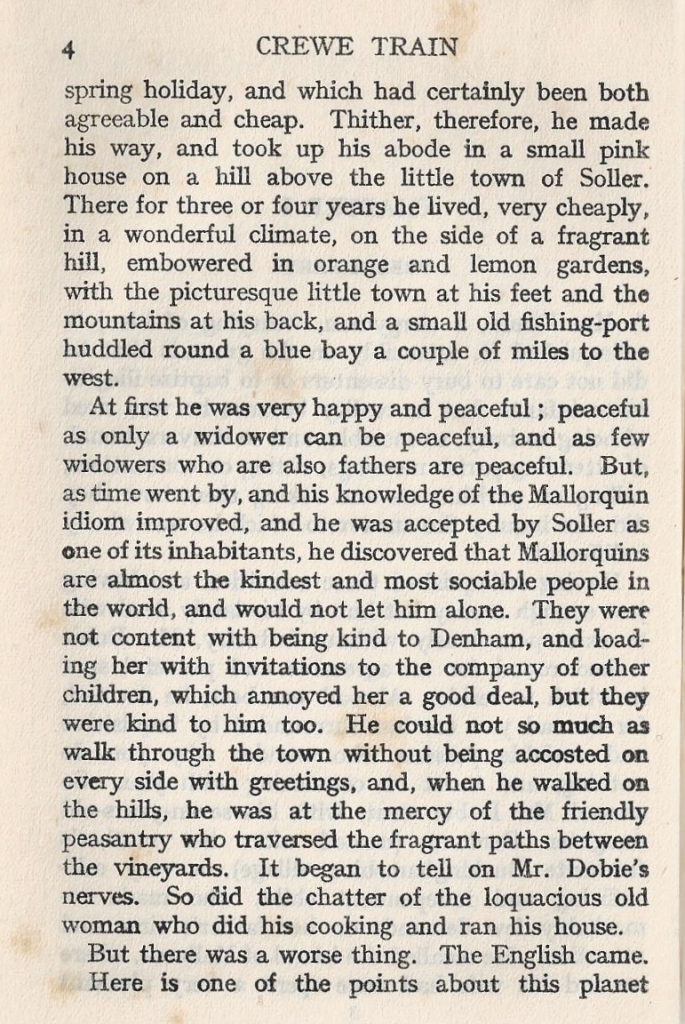
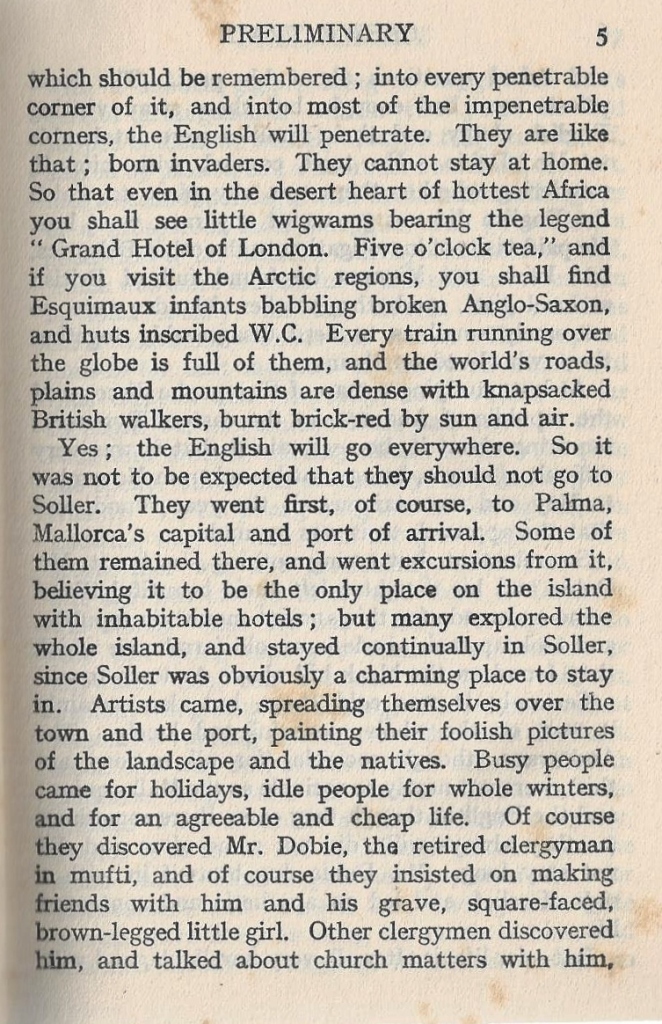
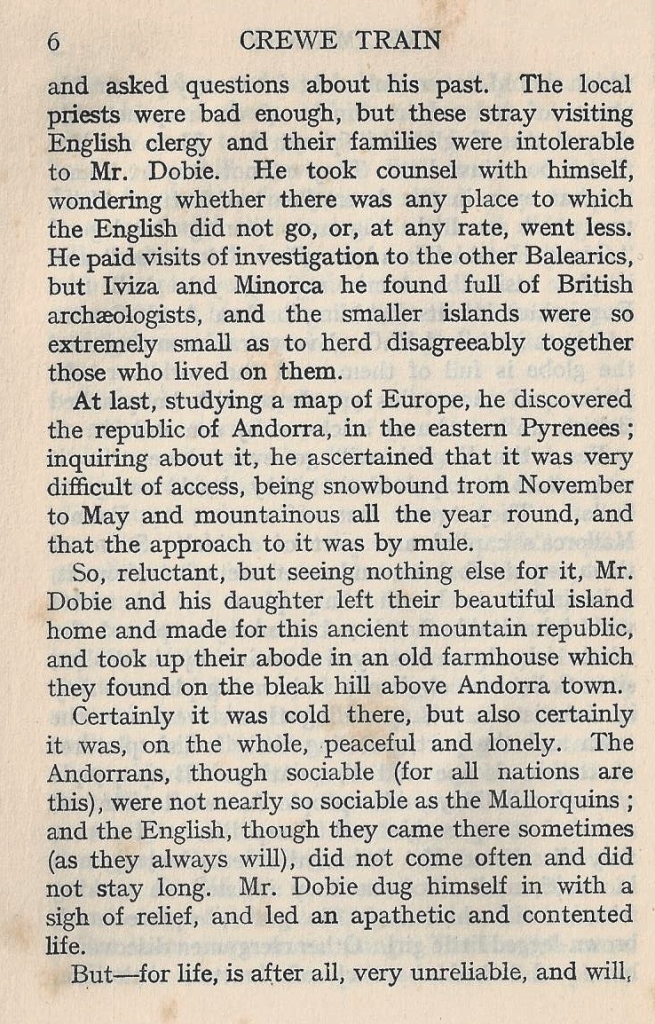
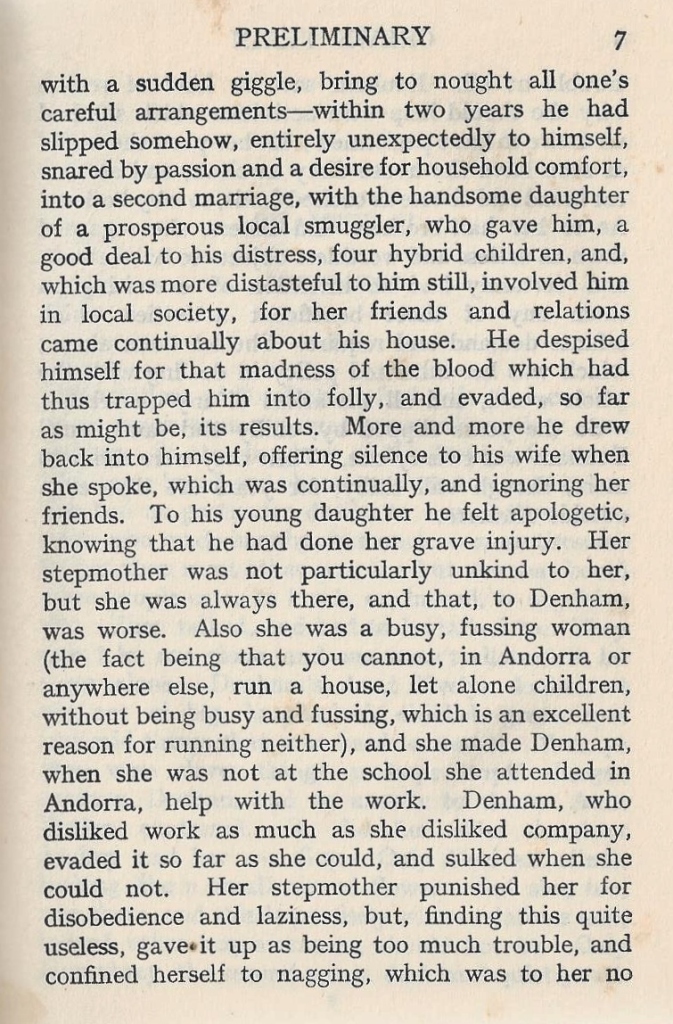
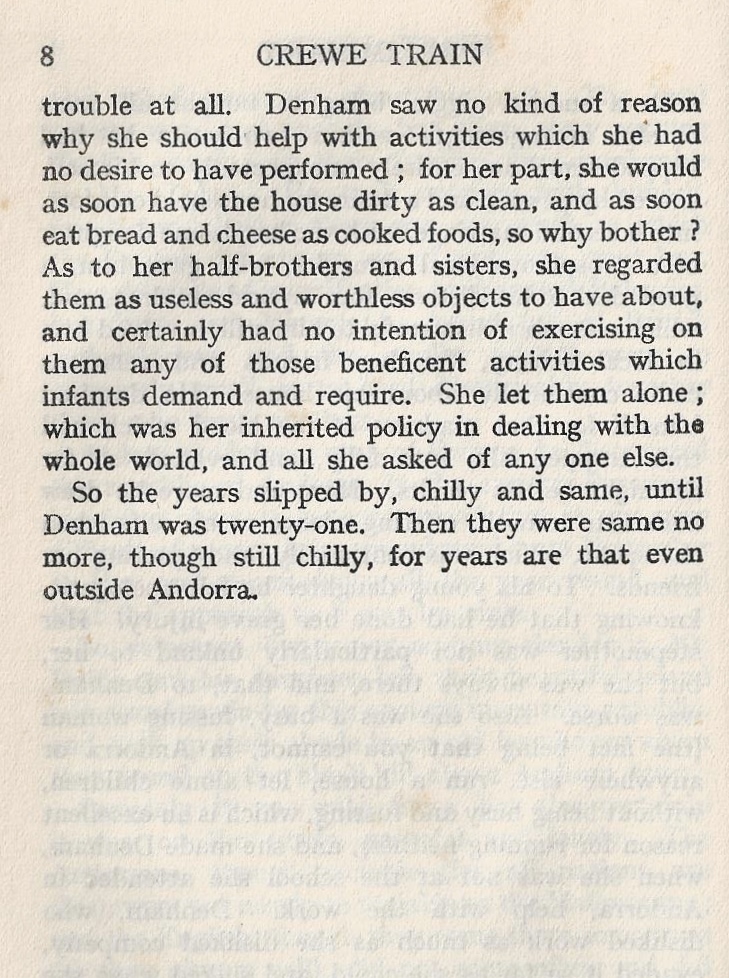
crewe train macaulay page 1 001crewe train macaulay page 2  001crewe train macaulay page 3 001 (2)crewe train macaulay pg 4 001crewe train macaulay pg 5 001 (2)crewe train macaulay pg 6 001And yes, in her twenty-first year, everything changes for Denham. Her father’s in-laws, the Greshams, the family of his first wife, descend upon the Andorran establishment for a visit, and, perhaps brought on by the unwonted stress of having to socialize so strenuously after a self-imposed life of seclusion, Mr. Dobie fatally succumbs to a stroke in the night.

Denham’s stepmother makes no bones about her distaste for her sullen stepdaughter; in her loquacious outpouring of hurt at her new widowhood she presses the responsibility for Denham upon the Gresham family. “You had better take her away with you to England!”

So they do.

Culture shock does not adequately describe Denham’s introduction to English society after her lifetime of relative seclusion. She allows herself to be tidied up and dressed up and trained up in the social conventions; these do not take particularly well though the continually bemused Denham does not actively resist her attempted makeover into a more socially acceptable “young lady”. She merely remains stoic under her Aunt Evelyn’s well-meaning ministrations and her cousins’ continual encouragements. She processes all she’s being exposed to, and does her best in her slow, wordless way to try to live up to the Greshams’ expectations; her success is not noteworthy.

Time moves inexorably on. Denham meets a certain young man, Arnold Chapel, a junior partner in the Gresham family’s publishing firm. Arnold and Denham experience something of a meeting of minds, though Arnold’s quicker intellect runs rings around the plodding progression of Denham’s thought processes. The two embark upon a shared life, and the novel details the peaks and valleys the two must traverse – some literal, most strictly figurative – before coming to a place of joint repose.

A very clever book, this one. I frequently felt much in common with Denham as Macaulay writes her own rings around my own rather plodding (though appreciative) thought process. I identified tremendously well with Denham; I wonder if this is a universal response? Or do the rest of you see her as the unrelateable (though ultimately sympathetic) stranger within the gates of intelligent society?

I suspect we all have something of Denham in us, as onlookers and inner critics of the chatter and occasional excesses perpetuated by the self-proclaimed intellectual classes of our own time. Perhaps this explains the lasting appeal of this mocking (but frequently tender) confection of a tale?

Crewe Train is definitely on my personal short list of “Most Memorable Books of 2013”, even though the year is not quite half over. I am very keen indeed to explore more of Macaulay’s fiction; this novel has wet my appetite for something more of her creative style.

Read Full Post »

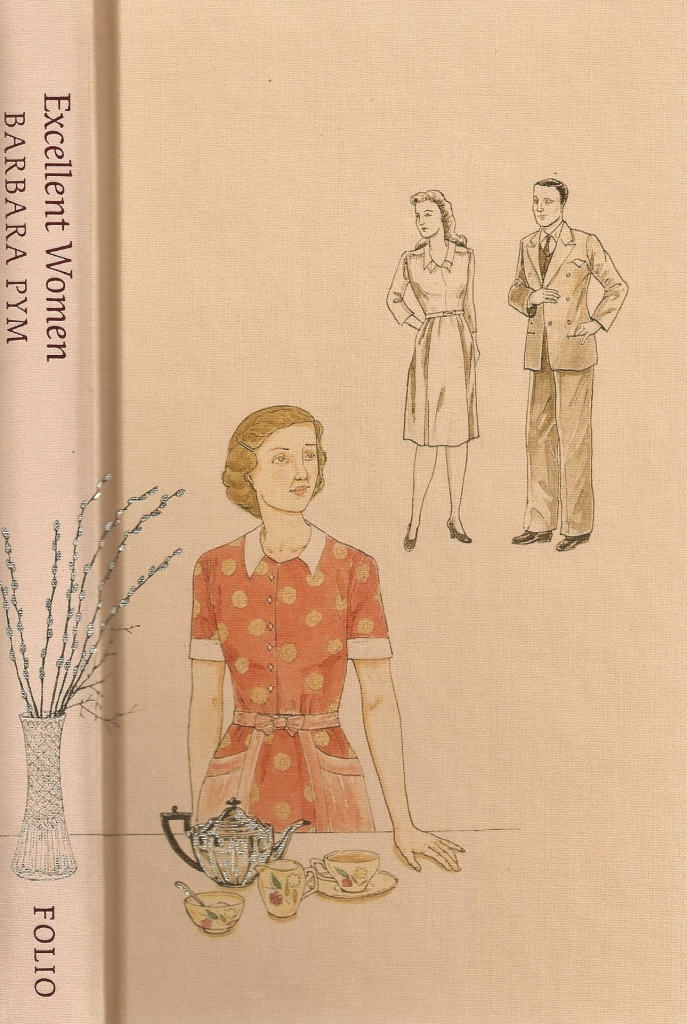
excellent women barbara pym folio front c 001Excellent Women by Barbara Pym ~ 1952. This edition: The Folio Society, 2005. Introduction by A.N. Wilson. Illustrated by Debra McFarlane. 206 pages.

My rating: 10/10.

This is the second time around for this book. My first reading left me gently pleased but not much more; this reading was much more rewarding, and I found I fully appreciated every nuance, every delicious – and occasionally malicious – little scenario.

This absolutely beautiful Folio edition certainly added to the experience; my first reading was of a yellowing paperback. I wonder if eyestrain is starting to influence my reading enjoyment? I do notice type clarity (and lack thereof) and font size much more these last few years.

And I must confess I almost passed this one by – “I already have it in paperback and it wasn’t that wonderful” – but am so glad I went back and splurged on this much more aesthetically pleasing book. Every sense was indulged by it! The pussywillows picked out in silver tipped the scales and sealed the impulse buy. I’m a sucker for pussywillows; these stole my heart. (On such small things do my buying decisions sometimes rest!)

Barbara Pym. Read her, and then reread her. Second time around is the key, here, I think. (Much as one needs to do with Diana Wynne Jones.)

*****

At the rather young age of thirty-one, Mildred Lathbury, self-described “spinster” and “clergyman’s daughter” (both of these designations serving to explain her clear-eyed observations of other people’s lives, and her lack of sentiment about her own), is well on her way to becoming one of the titular “excellent women” so dutifully and frequently thanklessly keeping things on an even keel in the bleak post-World War II years. Surplus females of every age, in super-abundance at mid-century after the decimation of their generations’ crops of marriageable men in the two brutal cullings of the previous decades.

“They have nothing better to do,” shrug their “luckier” compatriots, “they might as well make themselves useful, and be grateful for the occupation…”

So they do. Make themselves useful, that is. Though, as Mildred so delicately observes, the gratitude frequently falls short on both sides of the equation.

excellent women barbara pym folio back c 001Read quickly, this is a rather depressing, non-eventful, bleakly dreary minor tale. Not much happens. Mildred gets new neighbours, watches as the vicar of her church is pursued and almost caught by a predacious widow, narrowly escapes being saddled with an unwanted flatmate, and is offhandedly wooed in a most unromantic way by an anthropologist looking for a meek but competent dogsbody to take on the tedious task of editing his notes.

But, oh! – her inner voice! She misses nothing at all, our Mildred, and her wry observations are a joy to read.

I’m going to stop right here. What with it being Barbara Pym’s centenary year, and with the book blogging world full of mostly fulsome praise and beautifully written, thoughtful book reviews of her work (though the occasional dissenting voice is heard from, mostly from mildly querulous folk wondering what all the fuss is about – I can’t say I’ve yet come across anything resembling a brutal denunciation of Miss Pym) anything I have to add to the conversation is rather superfluous, I feel.

I liked this book.  A whole lot. You might, too. My caveat: it might take more than one try.

Here are some excellent reviews, well worth reading. They include all of the excerpts I would have chosen myself.

Well done, all!

You’ve saved me much typing. Well, that, and also, more importantly, you’ve given me the great pleasure of reading your delightful posts. Thank you. A (fresh) wand of mimosa all round! (And a cup of China tea, if that be your desire. Unless you’d prefer a beer? Or a glass of wine, exciting or merely adequate?)

Excellent Women –  Review at The Captive Reader

Excellent Women – Review at Book Snob

Excellent Women – Review at The Indextrious Reader

And there are many more.

Read Full Post »

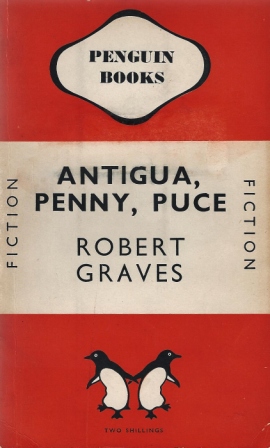
antigua, penny, puce by Robert Graves 001Antigua, Penny, Puce by Robert Graves ~ 1936. This edition: Penguin, 1947. Paperback. 314 pages.

My rating: 8.5/10. Parts of this one – many parts! – were decidedly “10” in quality. I rated it lower only because the author ran a few sections just a bit harder than they could take; I did have to force myself onwards here and there. But it always got interesting again.

I greatly enjoyed this book, and found it playful, amusing and gloriously cynical in parts. Graves has his authorial knife keenly honed and digs it into such things as British prep and public schools, golf, the British upper classes in general (with the hearty sporting types coming in for the most blatant caricaturizations), and, for reasons known only to himself, Jerome K. Jerome’s Three Men in a Boat. I laughed out loud several times while reading; a thing I seldom do.

*****

This is an intricately structured, highly detailed, cleverly framed, humorous and yet deeply cautionary tale about sibling rivalry, and the dangers of pursuing familial tit for tat to extreme lengths. Robert Graves, already a well-established and very prolific writer of “serious” literature and poetry, apparently wrote this atypical farcical novel as a result of a bet that he couldn’t pull off a “modern” bestseller. Graves is, of course, probably best known now for his screen-adapted historical fictions I, Claudius and Claudius the God, among something like 150 other published works, most rather sober and scholarly examinations of the classical world, biography, historical fiction and poetry.

*****

Oliver Price and his younger sister Jane grow up together in an atmosphere of stereotypical English upper-middle-class respectability. Their father is a country vicar who hobnobs on equal terms and with a strong element of rivalry with his wealthy neighbour, Sir Reginald Whitebillet. Their mother, the daughter of a marquess, was cast off by her family for marrying the Castle chaplain, and through her there are connections to the aristocratic Babrahams. These details are important; both the Whitebillet and Babraham connections figure crucially in the saga of the siblings a few years later on.

Oliver, at the age of twelve, is the proud curator of a stamp collection while Jane, a year younger, yearns to participate in her brother’s hobby. Through maternal machinations on behalf of Jane and a set of rather devious circumstances – the mother of the family exhibits a strongly manipulative technique which her daughter fully inherits –  Jane attains a half-interest in the collection, and proceeds to contribute a number of rare and unusual items to the album, including a one-of issue of a purple-brown (“puce”) Antiguan one-penny stamp, the only surviving example of a lot which has gone to the bottom of the sea in a ship wreck.

Aha! That’s the explanation of the rather odd title. Antigua, penny, puce. It’s the description of a postage stamp! I did not grasp this until I started reading, at which point it became as clear as day.

Time marches on, and Oliver and Jane grow up and go their separate ways, with varying degrees of success.

With the assistance of her childhood friend Edith Whitebillet – a scientific prodigy – and her own single-focus ambition, Jane has become first a highly successful actress and then the brilliantly manipulative proprietor of a theatrical company known as Jane Palfrey Amalgamated, consisting of actors whom she has groomed and renamed to each fill a very defined character with a strong appeal to public sentiment of one sort or another.

Oliver has gone through his school career and on to Oxford aiming for and just falling short of his desired goals in every aspect of his endeavours. He only makes the Second Eleven in football, misses the scholarships he aims for, and generally places as an also-ran in everything he does. Now he’s deeply involved in writing his first novel, which he has stellar plans for, but samples we are given  of his prose style make it very clear that in this too Oliver will be less than successful.

Oliver is by nature rather pompous and quickly belligerent; his clever sister runs rings around him now as she did in their younger days. First as a joke engineered to raise his ire so she could examine closely his mannerisms when taunted – one of her stage characters is based on her blustery and rather laughable brother – Jane reminds Oliver of her half-ownership of that childhood stamp collection, and announces her intention of coming to take away every second stamp. Oliver’s subsequent tantrum swings Jane over from merely joking to deadly serious about this intention.

Much devious work on both sides now goes on, as Jane and Oliver are well-matched in their desires to not let the other get the better in any sort of confrontation. A series of wins, losses and draws ensues, with the titular Antiguan stamp as the catalyst of their many explosive altercations.

Robert Graves was nothing if not a well-prepared author. His attention to detail was legendary, and even in this “light” novel he includes a plethora of background information on every subject he touches upon. This article, from a website dedicated to his work, details the research and process of writing Antigua, Penny, Puce. Absolutely fascinating!

As well as being a well researched author, Graves has a strong sense of humour and a very readable, deeply satirical way with words. He examines the real world, translates it into a fictional one, and rather maliciously – though never mean-spiritedly – probes and lays bare the absurdities he finds.

Good stuff.

Little Raven says it well; she approves, too.

Read Full Post »

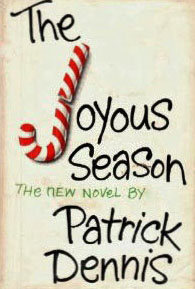
The Joyous SeasonThe Joyous Season by Patrick Dennis ~ 1964. This edition: Harcourt, Brace & World, 1965. Hardcover. 230 pages.

My rating: 9/10.

Ignore the candy cane on the dust jacket, and the internet references you may find to this being a “holiday book.” No, no, no. It is not. Christmas features, but only incidentally. The scope is much broader than that.

“Patrick Dennis,” you’ll possibly be saying to yourself. “Sounds familiar, but ???”

Auntie Mame, darlings!

Ten years after penning his highly successful social satire starring the exuberant Mame and her sedate nephew Patrick, author Edward Tanner – writing under the pseudonym Patrick Dennis – came up with this little  comedic gem. I wasn’t sure what to expect, having only ever previously experienced Mame, but The Joyous Season was absolutely marvelous, and better than I had anticipated. Such a treat!

10-year-old Kerrington – Kerry – is our narrator. He lives in a posh New York apartment with his 6-year-old sister Melissa – Missy – and his parents, both members of the New York “aristocracy”, though his mother’s family is higher up in the strata, and his maternal grandmother never lets his father forget that for a moment. Dad’s a successful architect, and Mom is most definitely one of the ladies-who-lunch, leaving much of the care of her two children to the fifth member of the menage, Lulu.

Lulu’s our nurse. We need a nurse like we need a case of mumps. I mean, hell, I’m ten and eleven twelfths years old and I’ve already smoked over two packs of Tareytons. (They’ve got that extra charcoal filter, you know, for cancer.) Even old Missy can take a bath and get dressed and wipe herself without any help, which is pretty good for six, I guess. But like Mom always said, we can’t go around New York alone because of kidnappers and Dirty Old Men (especially on East Eighty-sixth Street) and types like that. So Lulu drags us across town every day, me to St. Barnaby’s – although she turns me loose at the stationery store so the kids won’t think I’m being hauled around by a nurse at my age – and Missy two blocks further (or farther, whichever it is) to Miss Farthingale’s. Except for that, Lulu hasn’t got much to do except see we go to bed and get up and eat and don’t fight.

Lulu’s quite a character. She’s colored and elderly and has been with us ever since I was born. She’s kind of old fashioned and hates the N.A.A.C.P. and says she doesn’t want to integrate with any white people except Missy and me and that’s only because she gets paid to. Lulu says that after us she needs a rest, if we don’t kill her first, and she wants to retire and move back down South. Gadzeeks, South! I mean I don’t even like Palm Beach, which is supposed to be the next thing to heaven… Give me New York City and keep the rest. Crazy! Anyhow, Lulu tells us real interesting stories and knows every kind of poker there is – except strip – and always lets us have some of her beer and hates Gran’s place in East Haddock almost worse than we do. I mean Lulu is great, even if we don’t need a nurse.

Oh – I forgot one more family member. There’s also Maxl, the incontinent, prone-to-carsickness, full-of-mild-vice dachshund. His escapades run in a kind of sub fusc harmony to the ups and downs of Kerry’s and Missy’s lives, providing a counterpoint to the human drama of this gloriously dramatic tale.

So as the story opens, Kerry, Missy, Lulu and Maxl are reluctantly heading out the door to Gran’s place in East Haddock. Gran is Mom’s mother, and oh boy, is she ever a snooty piece of work! And she’s more or less the reason for the whole darned situation Kerry and Missy are in. To condense greatly, on Christmas morning there was a bit of a situation with Mom and Daddy which saw several kinds of shots fired, much broken glass, some physical violence and some exceedingly blunt words spoken. As a result, Kerr and Missy are poised to become Children of Divorce, much to the delight of meddling Gran. Everyone (except Gran, who openly gloats about the come-uppance of her despised soon-to-be-ex son-in-law) has decided to be Very Civilized About It All, and Not To Make The Children Suffer, but suffering they are indeed, though not perhaps in the way one would expect.

Kerry and Missy, despite all of the adult antics going on in their world, are the epitome of well-adjusted, though no one but Lulu seems to quite get that, and Kerry’s knowing-naive narrative exposes the follies of the grown ups, and New York upper crust society at large, to our appreciative eyes.

Mom is suddenly being courted by her own divorce lawyer, the social-climbing Sam Reynolds, while Daddy is pounced on by the predatory Dorian Glen, a self-invented fashion magazine editor. This gives much glorious scope for satirical commentary, and Kerry is well up to it. His descriptive passages are true works of art, and I found myself wearing a perpetual smile as I willingly gave myself up to the contrivances of the complicated plot.

For example, as this is New York in the 1960s, psychoanalysis is all the rage, and Kerry finds himself saddled with three hours a week with Dr. Epston. The adults in his life just want to ensure that he is coping well, and they are sure that he needs “fixing”, which if nothing else gives Patrick Dennis via Kerry an opportunity to get in some juicy digs at the world of the well-paid New York shrinks.

Dr. Epston’s consulting room is small and dim with a couch to lie on; two easy chairs; Kleenex, for crying into, I guess; a desk and a bookshelf with about a million copies of Tensions in the Metropolitan Adolescent by I. Lorenz Epston. I guess it wasn’t exactly what they call a best seller, but he’s getting rid of the supply bit by bit by making each patient’s family buy a copy (at ten bucks a throw). There are also some pictures on the wall that look like Missy painted them and a framed photograph of Dr. Epston’s three daughters. One is in the upper school at Dalton, one goes to Rudolf Steiner and the littlest one is in the School for Nursery Years – if that gives you some idea of what kind of kids he’s got. They also look like Eskimos. In fact, Dr. Epston’s first question was always, “What are you thinking about right now?” And my answer was always “Eskimos.” But when he’d ask me why, I just couldn’t tell him, because even if he is kind of a boob, I didn’t want to hurt the poor guy’s feelings. So I’d hem and haw and talk about igloos and blubber and wasn’t it interesting that the French spelled Eskimos Esquimaux and like that. So I always got kind of a demerit for being what Dr. Epston called “evasive” (when I was only trying to be polite) and at the end of the first week Mom sent off to Wakefield-Young Books for copies of Nanook of the North and Inyuk and some other suitable reading about the North Pole, when I didn’t care much one way or another.

The first day Dr. Epston made me lie down on the couch and darned if I didn’t drop right off to sleep while he was droning away about trusting him and telling him everything that came into my mind, no matter what. After he woke me up he kept asking me what I was trying to escape from and he wouldn’t believe me when I told him I’d stayed up late the night before watching “The Nurses” (it was all about this dope fiend) and it would have rude to say that also he was kind of a bore. But after that he let me sit up straight in a chair.

And so on, and so on. Kerry certainly does not suffer from lack of things to say; his self-confessed verbosity is what makes this satire such a delight. He’s a truly nice kid, for all the knowingness and the cynical tone he tries to maintain, and his relationship with the volatile Missy is just plain sweet, though they swap sibling-appropriate verbal digs and occasional blows.

Missy is a glorious character in her own right, and it would take me pages and pages to do her proper justice, so I’m not going to even try.

If you liked Auntie Mame, I’ll guarantee that you’ll love The Joyous Season. Highly recommended.

And here, as a bit of a bonus (because I do like to read reviews from the time of publication, and usually try to seek them out to see what those of the time had to say to compare it to my own years-further-on take), is the Kirkus review from October 14, 1965, because it sums things up quite well. I did edit to remove the spoiler; the ending is blatantly given away; that’s such a cheat in a commercial review, don’t you think? Liked the Holden Caulfield reference, because I thought that too, before I ever read the Kirkus review!

The people from the Auntie Mame strata are back under the snickersee of Patrick Dennis. The narrator is 10-year-old Kerrington, scion of a bloodline so inside Society that he yawns at the mere thought. After Daddy’s monumental Christmas hangover, Kerry and his 6-year-old sister, Missy, are slated to become Children of Divorce. Kerry’s prose style would make even a Holden Caulfield blanch, but his reportage is as complete. It seems Mommy and Daddy are going to do the Terribly Civilized bit. The demoniacally wholesome children are taken in on the divorce plans and exposed to the new interests of their wayward parents. Daddy falls victim to a voracious career woman (whose job allows P.D. to vivisect the fashion magazine sub-culture) and Mommy gets stuck with a stuffed shirt (who polarizes the P.D. thunderbolts directed at the nouveau riche). No tribal rite of the East Coast uppercrust, no Southern smarm and no mid-Western gaucherie is sacred … P.D. has picked their milieu to tatters. His full cast of credible caricatures are given dazzlingly funny dialogue. It’s a fair guess that this could easily go the Auntie Mame route — book to play to movie.

I honestly don’t know if this book did ever make it onto stage or screen, but it could well have. All I know is that I’d never heard of it before doing my bit of casual research on the author while reviewing Auntie Mame last year. He was well on my radar as one to watch out for, and when I came across The Joyous Season last week on the bottom shelf of the used book section of a secondhand furniture store in Prince George which I visit every few months “on spec” – for locals, that would be City Furniture right in the core of the scruffy old P.G. downtown on 3rd and Quebec – stacks and stacks of dusty books which I’ve now mined fairly thoroughly but which still contain some occasional vintage “finds” – I grabbed it with a silent shout of glee.

Young Kerry, narrator of the story, could have come across as either cloying or annoying, but Patrick Dennis has nimbly avoided either obnoxious extreme, to create a character whom I found I could completely relate too, after checking my own cynicism at the door, as it were. (Young Kerry’s dialogue occasionally slips to reveal the very adult puppet master handling the authorial strings, but it didn’t matter at all; I was happily and deliberately complicit in my own deception and looked away the few times it happened.)

I liked the likeability of Kerry’s whole family, for though Daddy and Mom were guilty of high tempers and hasty words to each other, they truly came across as loving parents, which was much appreciated; it could so easily have had a sour tone. The in-laws on both sides, and the assorted friends and hangers-on of each of the parents, gave loads of scope for Patrick Dennis to work with; he was bang on the mark with each and every one. Brilliant.

And though I saw the ending coming from just a few pages in, it never ruined things for me to find out I was right. Great “light” escape reading, and definitely a keeper.

I do believe this title is fairly easy to obtain, as it was republished in 2002, and looks to be available as a new softcover through Amazon, or, hopefully, your favourite local bookstore. There are a few vintage copies available through ABE, but these are priced a bit high, up into the $20s and $30s and beyond, so unless you’re a purist and need the original hardcover, I’d say go for the cheapest decent copy you can find, which might well be the 2002 reprint. Or perhaps try the library?

Read Full Post »

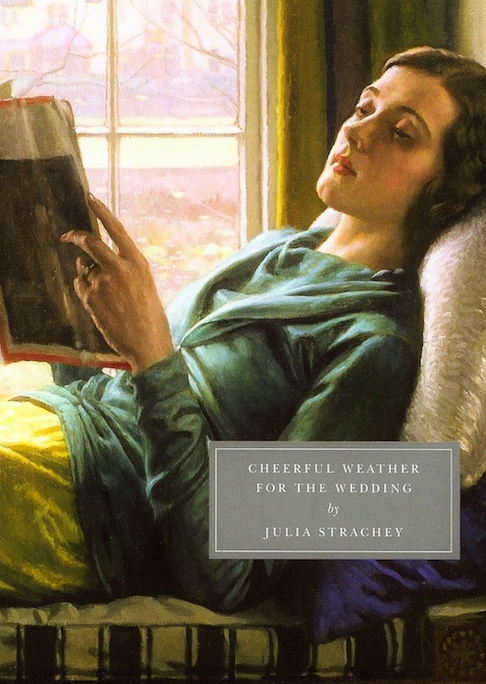
cheerful weather for the wedding  julia stracheyCheerful Weather for the Wedding by Julia Strachey ~ 1932. This edition: Persephone, 2011. Preface by Frances Partridge. Softcover. ISBN: 978-1-906462-07-9. 119 pages.

My rating: 7.5/10

*****

This slender novella read much better the second time around. The initial attempt rather threw me – I wasn’t quite sure what I was dealing with – it was decidedly unexpected. Much more noir than I had anticipated from the other reviews I’d read, and from the Persephone description.

Having sorted things out, I was able to read with more attention to detail the second time around, and to pin down my impressions much more firmly. Though, the more I think about it, the more complicated my responses seem to be!

Dolly Thatcham is getting married in a few hours, and upon meeting her in the opening pages of the book we take a deep breath and hold it for the duration. This book is strung out with tension. Something is going to happen. Something more than a mere marriage ceremony, the veiled implication teases us.

Her mother, whom Dolly appears to tolerate with thinly disguised disgust, is fluttering about micro-managing the action, and confusing the servants by constantly contradicting her impulsive orders. Dolly’s younger sister, Kitty, a brash but deeply insecure seventeen-year-old, barges about and loudly plays the knowing naïf. Dolly’s close friend Evelyn tensely hovers at the edges of the action. The bridegroom is about somewhere, but does not seem to be a prominent player in this drama; it is a very feminine world we are glimpsing: the bride, her sister and mother, her best friend, the inside servants.

Several hours before she is due at the altar, Dolly seems immobilized with a kind of fixated lethargy. On her way through the drawing-room to breakfast, she sits down at the writing-table, and we see the room and Dolly’s face reflected in the clouded surface of an antique mirror.

It was as if the drawing-room reappeared in the mirror as a familiar room in a dream reappears, ghostly, significant, and wiped free of all signs of humdrum and trivial existence,. Two crossed books lying flat, the round top of a table, a carved lizard’s head on a clock, the sofa-top and its arms, shone in the grey light from the sky outside; everything else was in shadow. The transparent ferns that stood massed in the window showed up very brightly and looked fearful. They seemed to have come alive, so to speak. They looked to have just that moment reared up their long backs, arched their jagged and serrated bodies menacingly, twisted and knotted themselves tightly about each other and darted out long forked and ribboning tongues from one to the other; and all as if under some terrible compulsion … they brought to mind travellers’ descriptions of the jungles in the Congo, – of the silent struggles and strangulations that vegetable life there consists in it seems.

To complete the picture, Dolly’s white face, with its thick and heavily curled back lips, above her black speckled wool frock, glimmered palely in front of the ferns, like a phosphorescent orchid blooming alone there in the twilit swamp.

For five or six minutes, the pale and luminous orchid remained stationary, in the centre of the mirror’s dark surface. The strange thing was the way the eyes kept ceaselessly roaming, shifting, ranging, round and round the room. Round and round again … this looked queer – the face so passive and remote seeming, and the eyes so restless.

The light perhaps caught the mirrored eyes at a peculiar angle, and this might have caused them to glitter so uncomfortably, it seemed even so wildly – irresponsibly, – like the glittering eyes of a sick woman who is exhausted, yet feverish.

Is this the portrait of a joyful bride? Obviously not, and as the narrative continues we discover nothing to change this initial impression of the bride as having some serious emotional turmoil going on under her numbly complacent cooperation with those preparing her for her imminent ceremonial change of matrimonial status.

For we soon become aware that this bride has a back story, and that story has another main character, and he is actually in the house, waiting for a chance to speak to Dolly, who in her turn seems most reluctant to encounter him.

Joseph Patten is an anthropology student who is obviously on familiar terms with the Thatcham menage. Apparently he has been a bosom friend of Dolly’s; they spent the previous summer inseparably together, though they have since parted ways. Yet here is Joseph, lurking about, waylaying people as to the whereabouts of Dolly, obviously hoping to speak to her before the ceremony, after which she will be immediately departing with her new husband to embark for South America where the bridegroom has a diplomatic posting.

Dolly is avoiding Joseph, and he whiles away the hours by popping out of rooms and dropping inflammatory comments into the midst of conversations, before retreating into sullen silence which builds until the next outburst.

Dolly makes it into her dress and eventually out the door with the aid of a bottle of rum, which, in a memorable vignette, we see clutched in her hand and swathed in the lace of her antique lace veil as she droops down the stairs in the final moments of her spinsterhood. She and Joseph do connect, but as neither of them can articulate their Great Big Expectations of each other – if indeed they actually have fully formed expectations – the wedding day proceeds as originally planned.

Once the bride and groom are seen off, the dregs of the guests and the family mingle in anticlimactic winding-down mode. Joseph is still hanging about, and he lets go with a shocking but highly suspect account of what Dolly has been up to the summer before while in Albania. Mrs. Thatcham, the target of this bizarre allegation, dismisses it with a fine cold shoulder, and we are left reeling a bit at the swirling undercurrents of this brief and highly disturbing glimpse into this collection of fictional lives.

Julia Strachey has put together a quirky, memorably stylized, very visual bit of fiction with this short novella. The exceedingly unlikable Mrs. Thatcham was based on Strachey’s first mother-in-law, whom she apparently despised; it is a damning character portrait, if that is indeed the case.

I did find myself surprisingly in sympathy with both Dolly and the almost-invisible Owen at the end of the tale; I suspect and hope, from a few tiny clues dropped here and there, that they will create a marriage with some hope of success, once they have escaped the physical bonds of their old lives in England and can recreate themselves in a new world.

Joseph – well – I found myself rather on his side as well. In his “affair” with Dolly, and his failure to further develop their relationship, he’s perhaps had a fortunate escape. The Thatchams in general so obviously scorn him, and Dolly herself is so reluctant to acknowledge any sort of affection or lasting committment to their prior dalliance, that we must accept the obvious. That is, that a Dolly-Joseph alliance was never a real option.

Or possibly not.

Cheerful Weather for the Wedding is a rather gloriously intriguing little bit of literature in that the speculations it spawns are endless. I’m going to quit right here with it, at least for now, but it’s been great fun kicking ideas around regarding what the author intended, and how we’re supposed to read her characters and the seething back story.

Thank you for initiating this discussion, Simon!

And to everyone else who has been much prompter in posting their reviews, your thoughts were most fascinating and beautifully presented. I am in awe of the clever people who post on these topics; you find the most intriguing angles and nooks and crannies to illuminate; thank you all so much for sharing your thoughts!

Here’s the link to the post which kickstarted my discovery of this arcane author:

Stuck-in-a-Book – Cheerful Weather for the Wedding Readalong

Read Full Post »

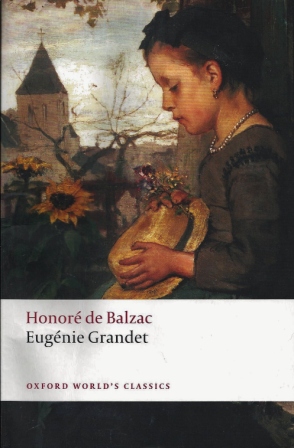
eugenie grandet honore de balzac 001Eugénie Grandet by Honoré de Balzac ~ 1833. This edition: Oxford University Press, 2009. Translated by Sylvia Raphael. Introduction & Notes by Christopher Prendergast. Softcover. ISBN: 978-0-19-955589-5. 192 pages.

My rating: 9/10.

It is difficult to know how to “rate” a book such as Eugénie Grandet, as its status as an early 19th Century “classic” places it in a category of its own when compared to more contemporary books. I ended up judging it against others of a similar era which I am familiar with, such as works by Dickens, Thackeray, Dumas, and, of course, several of Balzac’s other novels in his ambitious “Human Comedy”.

*****

Eugénie Grandet is a short novel, almost a novella, and the action, such as it is, is limited to the four walls of a gloomy stone house in the French village of Saumur, inhabited by the Grandet family: the elderly Monsieur Grandet, his wife Madame Grandet, their only daughter, Eugénie, in her early twenties as the story begins, and their sole servant, Nanon.

The Grandets live in seemingly straightened circumstances. Their house is decaying around them, they subsist on a restricted diet of only the cheapest provisions, with sugar doled out bit by bit, and the table graced only by unsaleable spoiled fruit and sour wine from the Grandet farms and vineyards. Firewood is doled out stick by stick, and the inhabitants of the house huddle around a shared tallow candle in the evening; their clothes and shoes are worn until threadbare.

The reality however, is that Monsieur Grandet is exceedingly wealthy. By a series of lucky inheritances, a marriage which brought a substantial dowry, clever investments and very shrewd trading, he has purchased numerous estates which were seized from their dispossessed noble owners after the recent Revolution. The income from these properties is immediately profitably reinvested, or else converted to gold, which Monsieur Grandet, a former cask and barrel maker, seals up in wooden chests and stores away in his walled-up “office” in the center of the old stone house.

His wife, daughter, and servant, completely subservient to the soft-spoken but cunningly manipulative family patriarch, never question their situation but meekly go about their daily routines, gratefully accepting the few coins which occasionally are doled out – and promptly “borrowed” back – for “extras”. The villagers around them, however, are fully aware of the extent of the Grandet fortunes, and there is something of a competition underway to see who will be the fortunate man to storm the stone walls, marry the beautiful and devout Eugénie, and eventually inherit the riches.

Monsieur Grandet is well aware of this situation, and plays it to his best advantage, in particular by acquiring the unpaid services of the local lawyer and banker – possessed respectively of an eligible nephew and son –  who each hopes that his marital candidate will win out. Imagine the universal dismay among the families with their eyes on the Grandet fortune when an unexpected youing man suddenly arrives who immediately displaces both of the local swains, at least in Eugénie’s eyes. (Her father has secret ambitions for his daughter which involve neither local candidate.) Eugénie’s cousin Charles has been sent to visit his uncle in the country, as, it soon becomes apparent, to get him safely out of the way while his father – Monsieur Grandet’s brother – declares bankruptcy and then proceeds to kill himself, leaving Charles doubly bereft and dishonoured.

Eugénie promptly falls deeply in love with her handsome cousin, who, after sombrely considering his change in fortune, and realizing that his Parisian mistress must be parted from, returns Eugénie’s professions of love with willing good grace. Monsieur Grandet has an inkling of this infatuation, but he doesn’t worry about it at all, instead arranging to remove Charles from the family circle by buying him a passage to Nantes, where Charles will be able to find occupation as a trader to the Indies, and hopefully work his way back into solvency on his own.

Before Charles departs, he and Eugénie swear undying love to each other, and Eugénie, without her father’s knowledge, gives Charles her priceless dowry of gold coins to help him in his endeavours.

Much drama erupts when Monsieur Grandet discovers that his meek daughter has gone ahead and developed some ideas of her own; the subsequent events prove Eugénie to be as strong-willed as her father, though motivated by kinder emotions than ever that corrupt old miser has ever experienced.

In case you are not familiar with how this little domestic drama plays out, I will leave you right there, mid-story. It is well worth reading for yourself to discover how it all ends, though there are really no surprises, unless it is to see how wonderfully well Eugénie’s character holds up under her many woes.

Eugénie Grandet is still a most diverting read a good century and a half after its original publication. The character portrait of Monsieur Grandet is decidedly the strongest of the novel, despite the title featuring Eugénie; she is rather one-dimensional, but ultimately comes out of the drama with all flags flying, showing a purity of character as rare and precious as her father’s beloved gold.

Monsieur Grandet is one of the most gloriously “tight” of all the fictional misers I’ve yet encountered. Clever, adaptive, deeply cunning and immensely avaricious, he struggles to force himself to act decently to his wife, daughter and the truly unique and admirable Nanon, but he is continually undone by his greed. His last action before he dies is to grasp at the priest’s gleaming crucifix as the last rites are performed; we have no doubt as to his eternal destination, though the devout prayers of his daughter may at least gain him a respite in Purgatory!

*****

This book is the my first entry into the Around the World in 12 Books Challenge – 2013, hosted by Shannon at Giraffe Days .

This is my first time participating in this Challenge, and I noticed just now when I went to the site to include the link in this post that there are some questions included to help guide our reviews. I haven’t addressed any of these in my review of Eugénie Grandet, so I’ll answer them now instead. (This feels a bit like a school assignment! But not in a bad way at all. Let’s see … )

1. What did you learn about the country’s culture, history etc. from reading this book? Any new insights, any shifts in your perception, or did it align with what you knew/understood already?

I didn’t learn anything new about France from my reading of Eugénie Grandet, but it did make me mull over the aftereffects of the French Revolution of the 1790s on the general population; the Revolution’s destruction of the French aristocratic classes cleared the way for the rising Bourgeoisie, the shopkeepers, farmers and tradespeople who took advantage of the changing political climate to attain never-before-possible social and economic status. The book has a detailed description of how post-Revolutionary fortunes were made and how the properties of the nobles changed hands in the ensuing social turmoil.

2. How did land, geography, flora and fauna feature in the book? Did it have a distinct feel that helped you visualise and made you feel like you were there, or was the story more focused on plot?

The novel was decidedly plot-focussed, but there are detailed descriptions of the house in the rural village of Saumur where most of the story’s action takes place. There are also descriptions of the flora of the overgrown Grandet garden which allow us to envision the setting of Eugénie and Charles’ surreptitious courtship. I found that I could visualize the physical setting of Eugénie Grandet with great clarity from the “word pictures” drawn by the author.

3. Did the story make you want to visit/revisit the country, or explore it in a new way if you live there already; did it make you want to read more stories set in the country?

The story, being set almost two centuries before the present time, does not lead me to expect a similar world being present in these contemporary days, but the descriptions were very evocative of what one might still discover in isolated French villages. Reading the novel did leave me with a curiousity to discover a little more about the setting, and to perhaps find some pictures of the vineyards of the Loire. I would love the opportunity to visit rural France, though I can’t say that this novel either strengthened or lessened that desire – it merely confirmed for me how fascinating such a visit would be on so many levels – historical, literary and personal. I am looking forward to reading more of Balzac’s stories set in a similar time, to reacquaint myself with and widen my experience of his very entertaining Human Comedy.

Read Full Post »

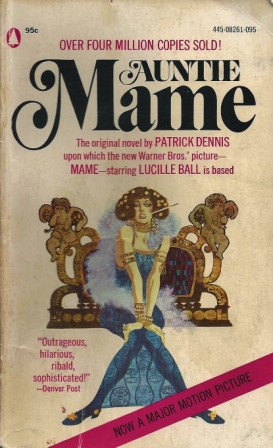
auntie mame patrick dennis 001Auntie Mame by Patrick Dennis ~ 1955. This edition: Popular Library, circa 1974. Paperback. ISBN: 445-08261-095. 254 pages.

My rating: 8/10.

It is what it is – a blissfully easy-to-read, unapologetically American social comedy, with enough perfectly timed, backhanded slaps at social snobbery, racism and anti-Semitism to redeem it from total silliness.

*****

I don’t know quite where she came from, but Auntie Mame appeared one day in a stack of old paperback books I was sorting and putting away. I gave her a rather scornful glance – she was, after all, ensconced between tatty covers emblazoned with movie tie-in headlines, never a particularly endearing feature – and popped her into a box with a bunch of other “maybe someday” books. But not long afterwards she showed up on my night table, brought into the bedroom by (of course) a man, who’d been looking for a diversion, found her intriguing and decided to experience her lavish charms more intimately. After he’d finished with Mame, he left her there to work her charm on me.

“Well, darling,” she whispered to me with a we’re-all-girls-in-here-together-now intonation, “how about it? Don’t you want to find out what Auntie Mame is all about?”

So I read her.

Hotcha!

*****

I’m guessing almost everyone’s either seen one of the two movies based on this 1955 bestseller – the 1958 Rosalind Russell vehicle (pretty darned good), and the 1974 Lucille Ball effort (pretty darned bad) – or one of the countless stage adaptations, or read the actual book itself – printed and reprinted numberless times, most lately in, I believe, 2001. That’s a good half-century of popularity, and I think it’s safe to state that Auntie Mame has a decidedly secure place well up in the top end of the American pop culture archive.

Does she deserve it?

Well, yes, I rather think she does. She’s a deeply lovable creation – with that lovableness outshining her undeniable glamour and her bizarre goings-on as the key reason for my re-reading her spicy “biography” every so often, whenever Mame winningly works herself up to the top of the book stacks, like cream rising to the top of an old-fashioned bottle of milk.

Here’s the basic outline, for those of you who’ve so far been blissfully unaware of the existence of Auntie Mame and her impressionable young nephew, Patrick.

Orphaned at the age of ten in 1929, the very much fictional* Patrick Dennis is sent to live with his wealthy and gloriously extroverted aunt, who is presently holding court (apt term) in a lavish apartment at 3 Beekman Place in Manhattan.

*The author published this book under this pseudonym in order to add verisimilitude to the “memoir” form; after the novel’s success, the pseudonym was maintained for most of the author’s future writings. Edward Tanner is the real name of the author – actually, Edward Everett Tanner III. Mame was inspired by, but was not an accurate depiction of, the author’s real-life aunt, Marion Tanner. Edward Tanner also wrote under the pseudonym “Virginia Rowans”.

Mame welcomes her “own little love” with open arms, and Patrick returns that affection immediately and instinctively, despite his father’s rather foreboding words while making his will the year prior to his sudden demise.

…My father read his will to me in a shaky voice. He said that my Aunt Mame was a very peculiar woman and that to be left in her hands was a fate that he wouldn’t wish a dog, but that beggars couldn’t be choosers and Auntie Mame was my only living relative.

Despite the deathbed wishes of Patrick’s father for his son to receive a conservative upbringing, Mame craftily dodges the stodgy school which Patrick’s trustee, the estimable but strictly conventional Mr. Babcock, has chosen. Instead Patrick ends up in a very avant-garde establishment distinguished by its policy of complete nudity for all, students and staff – and absolute lack of any inhibitions, or actual academic teaching. Mr. Babcock’s visit as the students and their adult mentors are role-playing a school of spawning salmon puts a quick end to the experiment, and lands Patrick in that dreaded boarding school, far away from the influence of his aunt, whom Mr. Babcock regards as the epitome of evil decadence from that moment forward.

Luckily Patrick’s education had already received something of a unorthodox but most useful boost from his aunt’s insistence, from his very first day with her, of Patrick’s carrying a pad of paper with him and writing down any unfamiliar words for future explanation.

I spent that first summer in New York trotting around after Auntie Mame with my vocabulary pad, having Little Morning Chats every afternoon, and being seen and not heard at her literary teas, salons and cocktail parties.

They used a lot of new words, too, and I acquired quite a vocabulary by the end of the summer. I still have some of the vocabulary sheets of odd information picked up at Auntie Mame’s soirees. One, dated July 14, 1929, features such random terms as: Bastille Day, Lesbian, Hotsy-Totsy Club, gang war, Id, daiquiri – although I didn’t sell it properly – relativity, free love, Oedipus complex – another one I misspelled – mobile, stinko – and from here on my spelling went wild – narcissistic, Biarritz, psychoneurotic, Shönberg, and nymphomaniac. Auntie Mame explained all the words she thought I ought to know and then made me put them into sentences which I practiced with Ito, while he did his Japanese flower arrangements and giggled.

Once Patrick is incarcerated in conventional school, his visits to Auntie Mame are restricted to occasional weekends and the holidays. No matter, though, as the two are already bound by a strong and abiding love which will see them through the most outrageous of Mame’s excesses and the rapid ups and downs of her changing fortunes and continual reinventions of herself.

Mame’s fortune is decimated by the Stock Market Crash of October 29, 1929, and she hits the lowest point, financially speaking, of her life, ending up selling roller skates (ineptly) in Macy’s department store, before being rescued at the 11th hour by a wealthy Deep Southern white knight, Beauregard Jackson Pickett Burnside, who sweeps her of her feet and sets her up for the rest of her life, leaving her a seriously large fortune when he dies rather tragically only a few years into the marriage.

Mame sincerely mourns Beau, but continues on her merry way charming and being charmed, and enjoying the attentions both platonic and amorous of a huge range of people, including at one point one of Patrick’s college friends – Mame refuses to let a little thing like age difference stand in the way of her relationships of any sort.

Patrick drifts in and out of Mame’s circle, observing and pithily commenting on her friends and latest fads, which range from the oriental stylings of their first meeting to the Southern belle of the Beau years, to literary pseudo-Irish tweed and brogues, to war-time Friend of England sponsoring some truly horrible Cockney refugee children in a Colonial mansion which they promptly completely destroy.

Patrick falls in and out of numerous relationships on his own, from gold-digging waitress Bubbles, to über-snobbish fiance Gloria Upson, to a poverty-stricken but determinedly aristocratic trio of blue-blooded and stunningly beautiful sisters. He finally finds true love, marries and produces a son of his own, only to have Mame swish in sari-bedecked and trailing a pet swami during her Indian reincarnation period, to carry her latest “little love” off to the orient, thus bringing our tale full circle.

*****

Undeniably funny – though I never did “laugh out loud” as many reviewers report themselves doing – this satirical tale is as full of barbs as a porcupine is of quills. The author uses his humorous platform to trot out his very decided views on the state of middle class American mores, while amusing us with his bitchy delivery – there’s a decidedly contemporary feel to a lot of the humour, despite the book being well into its sixth decade by now.

“Risque” is a word not often used today, but it applies in full force to Auntie Mame – the book and the character. Inhibitions – pshaw! If it feels good and doesn’t harm anyone, go for it! is the credo Mame lives by, and Patrick slips into that attitude easily, though prudishness occasionally rears its head in his case. The innuendo throughout is frequently gloriously bawdy, though there are a few groaningly bad double entendres, as when Patrick reports on his first social occasion at Auntie Mame’s, as an still-innocent ten-year-old. (Needed information: Norah is Patrick’s Irish nurse, and Ito is Mame’s Japanese houseman; Prohibition is in full swing.)

One lady with red hair said that she spent an hour a day on the Couch with her doctor and that he charged her twenty-five dollars every time she came. Norah led me to another part of the room.

The little Japanese man gave Norah a glass and said it was right off the boat and Norah said she wasn’t used to spirits – even though she was always telling me about seeing ghosts and haunts – but this time she’d take a drop of the creature. She seemed to be feeling very happy all of a sudden. And in a little while she asked Ito to give her another Nip.

Oh. My. Goodness. That was pretty dire, Mr. Dennis/Tanner. Had to read this bit twice to make sure I’d seen it correctly. Groan. How many desperately bad puns did the author cram into these few sentences? I think I counted six.

Luckily most of the jibes aren’t quite so deeply awful, but in the interests of full disclosure the prospective reader should be warned of these types of things!

To sum up, I do ultimately enjoy this gloriously campy period piece. Yes, it’s chock full of period-typical stereotypes and attitudes towards women and “foreigners”, but that doesn’t bother me one whit in this one – it’s an innocently era-correct sort of prejudice, and there’s enough social awareness going on of the greater evils in the world of the time to excuse the bits which would be politically incorrect if written today.

It’s a refreshingly easy read, too, as I think I mentioned earlier, and has a very American type of blatantly outrageous humour which appeals in its own way as much as the typically lower key, straight-faced British literary wit does. You do need to pay a certain amount of attention while reading to catch all the nuances, but Auntie Mame romps along at such a good pace that drowsing off in her company is not a danger at all.

(And I’m glad to report that I didn’t use the term “madcap” once in this review. Ha! Points for me!)

Read Full Post »

« Newer Posts