Posts Tagged ‘Sharp, Margery’

The Rescuers by Margery Sharp ~ 1959. Illustrations by Garth Williams. This edition: New York Review of Books, 2011. ISBN: 978-1-59017-460-9. 149 pages.

My rating: 7.5/10 for the story, 10/10 for the illustrations.

This is the first story in what eventually became a series of nine about the mice of the Prisoners’ Aid Society, and in particular the aristocratic white mouse Miss Bianca, and her admirer and co-adventurer, Bernard.

Everyone knows that the mice are the prisoner’s friends – sharing his dry bread crumbs even when they are not hungry, allowing themselves to be taught all manner of foolish tricks, such as no self-respecting mouse would otherwise contemplate, in order to cheer his lonely hours; what is less well-known is how spendidly they are organized. Not a prison in any land but has its own national branch of that wonderful, world-wide system…

In the un-specified (and purely imaginative) country these particular mice live in,

…(a country) barely civilized, a country of great gloomy mountains, enormous deserts, rivers like strangled seas…

… there exists the greatest, the gloomiest, prison imaginable: The Black Castle.

It reared up, the Black Castle, from a cliff above the angriest river of all. Its dungeons were cut in the cliff itself – windowless. Even the bravest mouse, assigned to the Black Castle, trembled before its great, cruel, iron-fanged gate.

And inside the Black Castle, in one of the windowless dungeons, is a prisoner that the Prisoners’ Aid Society has taken a special interest in.

“It’s rather an unusual case,” said Madam Chairwoman blandly. “The prisoner is a poet. You will all, I know, cast your minds back to the many poets who have written favorably of our race – Her feet beneath her petticoats, like little mice stole in and out – Suckling, the Englishman – what a charming compliment! Thus do not poets deserve especially well of us?”

“If he’s a poet, why’s he in jail?” demanded a suspicious voice.

Madam Chairwoman shrugged velvet shoulders.

“Perhaps he writes free verse,” she suggested cunningly.

A stir of approval answered her. Mice are all for people being free, so they too can be freed from their eternal task of cheering prisoners – so they can stay snug at home, nibbling the family cheese, instead of sleeping out in damp straw on a diet of stale bread.

“I see you follow me,” said Madam Chairwoman. “It is a special case. Therefore we will rescue him. I should tell you that the prisoner is a Norwegian. – Don’t ask me how he got here, really no one can answer for a poet! But obviously the first thing to do is to get in touch with a compatriot, and summon him here, so that he may communicate with the prisoner in their common tongue.”

Now, getting to Norway is a bit of a challenge, but the mice have a solution. They decide to call on the famous Miss Bianca, the storied white mouse who is the pamperd pet of the Ambassador’s son. Miss Bianca lives in a Porcelain Pagoda; she feeds on cream cheese from a silver dish; she is elegant and extremely beautiful and far, far removed from common mouse-dom. She also travels by Diplomatic Bag whenever the Ambassador and his family move – abd they have just been transferred to Norway. Perfect!

A pantry mouse in the Embassy, one young Bernard, is assigned the task of contacting Miss Bianca and enlisting her aid in the cause. She is to find “the bravest mouse in Norway”, and send him back to the Prisoners’ Aid Society so he may be briefed on the rescue mission.

Bernard successfully convinces Miss Bianca to assist, and then the real action starts. By a combination of careful planning, coincidence and sheer luck, the Norwegian sea-mouse Nils, Bernard and Miss Bianca venture forth to bring solace and freedom to the Norwegian poet.
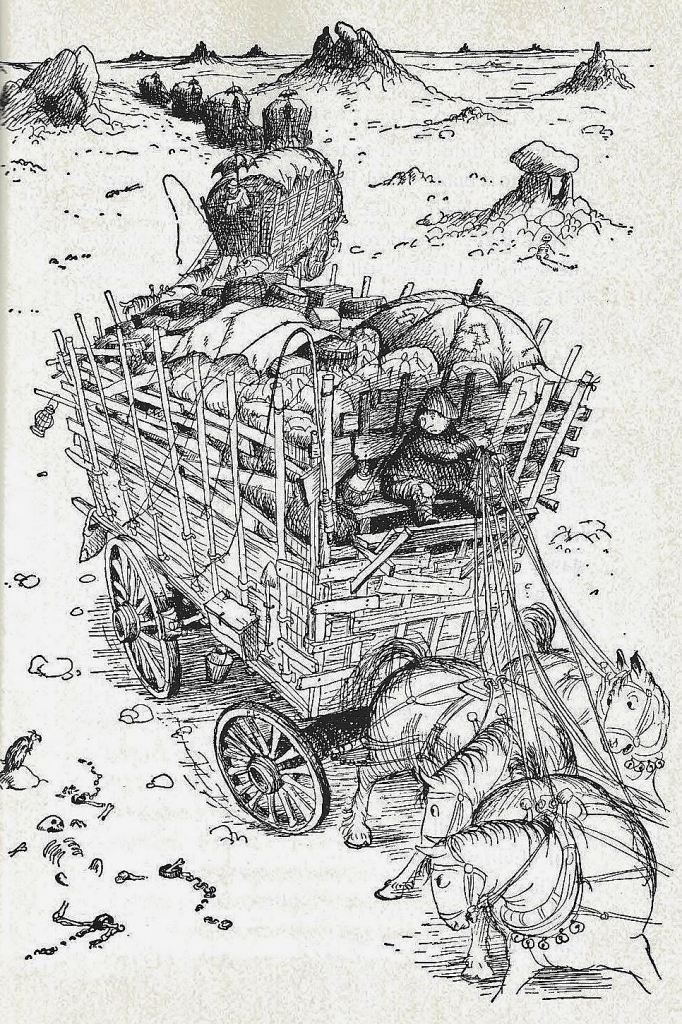
The illustrations by Garth Williams are absolutely perfect. Here is one of my favourites, of the journey to the Black Castle. Look carefully at the expressions on the horses’ faces, the fetters on the skeleton. Brrr! Danger lurks!

And here is Mamelouk, the Head Jailer’s wicked black half-Persian cat, whose favourite pasttime is spitting at the prisoners through the bars, and of course catching and tormenting any mouse who ventures into his dark domain.
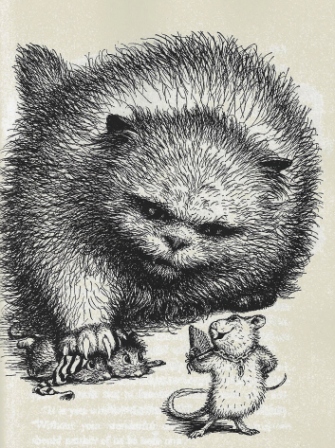
Miss Bianca proves herself more than a match for Mamelouk, utilizing her special bravado and charm. Needless to say, the mission is successfully accomplished, though not without setbacks.

A light, rather silly (in the best possible way), rather enjoyable story.

Miss Bianca is a very “feminine” character, in the most awfully stereotyped way possible, but there are enough little asides by the author that we can see that this is not a reccomendation for behaviour to be copied but rather a portrait of a personality who uses the resources at hand (her charm, her beauty, her effect on others) to get things done.

Bernard is typical yeoman stock, earnest striving and quiet bravery in the face of adversity. He is attracted to Miss Bianca as dull and dusty moth to blazing flame, but quietly accepts that their places in the world are too far apart to ever allow him the audacity to woo her. Or possibly not…

Nils galumphs through the story in his sea boots, “Up the Norwegians!” his Viking cry. A reluctant (or, more appropriately, unwitting) hero, who has had his adventure thrust upon him, Nils typifies dauntless.

Read-Alone: I’m thinking 8 and up. Margery Sharp has written a children’s tale with completely “adult” language and references; a competent young reader will find this challenging but rewarding. Be prepared to clarify occasionally, if your reader is of an inquiring mind. (Hint: Better bone up on Lloyd’s Register of Shipping.)

Read-Aloud: I think this would be a very good read-aloud. Ages 6 and up. Reasonably fast-paced. The first few chapters set the scene and may be a bit slow going, and the dialogue will require careful reading; you’ll need to pay attention while performing this one – no easy ride for the reader! – but I think it could be a lot of fun.

Definitely worth a look. If this is a hit, there are eight more stories in the series. I have previously reviewed the second title here:    Miss Bianca
Read Full Post »

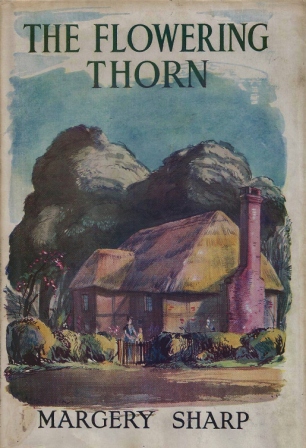
The Flowering Thorn by Margery Sharp ~ 1933. This edition: Little, Brown & Co., 1952. Hardcover. 345 pages.

My rating: 10/10

Margery Sharp’s fourth novel, The Flowering Thorn,  first appeared in England in 1933, with an American edition appearing in 1934, but it attracted little attention in North America until almost twenty years later. The later novels Cluny Brown (made into a 1946 movie of the same name, starring Jennifer Jones and Charles Boyer) and The Nutmeg Tree (used as the inspiration for the popular 1948 movie Julia Misbehaves starring Greer Garson, Walter Pidgeon, Nigel Bruce and a young Elizabeth Taylor) brought Margery Sharp  to the attention of the North American public, who happily bought her books and asked for more.

The reason I mention this is that there are two sets of “first editions” of The Flowering Thorn out there. The first “first” would be the original British 1933 edition published by Arthur Barker, Ltd. Putnam’s American edition followed in 1934. Then in 1952 appears another “first”, so stated in the book, with a stated copyright date of 1934, published by Little, Brown and Co. The dustjacket and front flyleaf of the 1952 Little, Brown edition refers to a number of the Sharp titles published after 1932, and up to 1951 – The Nutmeg Tree, The Stone of Chastity, Cluny Brown, Britannia Mews, The Foolish Gentlewoman, and Lise Lillywhite – giving the game away – but it can be confusing. There were several paperback editions as well. This title is fairly scarce; if you can find a decent-condition hardcover of any edition under $30, grab it. A 1933 true first in good condition will set you back $100 +, going by the May 2012 AbeBooks listings.

(Vintage book collector’s digression now over!)

I would like to call this a gentle, slow-moving examination of a woman’s progress towards true fulfillment and happiness, but Margery Sharp’s always analytical and occasionally tart tone, as well as protagonist Lesley Frewen’s no-nonsense attitude, make “gentle” a somewhat inadequate description.

Lesley is a twenty-nine year old socialite living in London in 1929. Her life is perfectly organized; she lives well, and just within her income, in a high-end, most desirable flat; her interests are the theatre, modern art, literature and music; she moves among the Bright Young Things of the day with aplomb and style. What Lesley suddenly realizes she is missing, after a tactful brush-off by a man she highly admires and has delicately offered herself to, is love.

…there slipped into her mind, already bodied in words, a strange and dreadful notion. She thought,
‘Perhaps I am not a woman that men do love.’
She thought,
‘There are women like that. Attractive women…. And if that is so, and if…that is what I have been waiting for, what am I to do now?’
The intricate daily patchwork was still there to work at, the innumerable dovetailing fragments still lay ready to hand: but it now seemed to her, and for the first time, that her work had no pattern.
‘I want something new,’ said Lesley aloud.
 

And it is in this frame of mind, struggling with her sudden inner turmoil, that Lesley goes to tea with her elderly aunt, who is embroiled of a turmoil of her own: her recently hired companion, a young, widowed Scotswoman, has suddenly died, leaving behind a four-year-old child. There are no relations in sight, and the orphanage looms.

Lesley, who has been watching young Patrick playing on the floor as the conversation regarding his future goes on above his head, is impressed and intrigued by the child’s tenacious attitude and sober demeanour. On a whim, she offers to take him on herself, much to her aunt’s consternation. Lesley immediately regrets her rash offer, but before she can backtrack the child catches her eye; to renounce him would be a betrayal, she suddenly feels. The immediate and very vocal opposition to her proposal by the elderly women present has the contradictory effect of  stiffening Lesley’s resolve, and the wheels are set in motion.

Lesley suddenly finds herself in the position of having to leave her flat (no children allowed) and to take on extra expenses in regards to Patrick’s care. Her careful budget is in tatters, and she decides, on another not particularly well thought out whim, to move into a cottage in a country village in order to live more cheaply. After all, it is only going to be for four years, until Patrick is old enough to send to boarding school, and then Lesley can slide back into her well-organized town life. Her social butterfly friends will surely understand…

Lesley’s new life is not what she had anticipated, but she takes it well in stride, attempting at first to keep up her strict London standards, but, ever-so-slowly, a new Lesley is born, a much more human and ultimately more lovable one.

Something I deeply appreciated about this story was Sharp’s total avoidance of sentiment regarding the relationship between Lesley and Patrick. Lesley is, almost immediately, deeply resentful of Patrick’s demands – both the physical demands of a small child, and the moral demands his presence in her life place upon her stern conscience. Confronted by a friend pushing the option of backing out of the situation, Lesley examines her innermost soul and comes to a surprising conclusion:

She thought, ‘If I don’t see this thing out I shall have something rotten inside me for the rest of my life.’ Rotten like an apple – the brown decaying core under the firm red skin…

Nevertheless, she does not initially feel any sort of affection for the child; to the contrary

…she looked at him with an intensity of dislike so nearly bordering on hatred that her own features, could she have seen them at that moment, would have seemed completely strange to her.  And even without seeing, it was as though she guessed: for in all their enforced companionship she never once spoke to him without consciously masking her face. It was a hatred to be ashamed of, ignoble and unjust: but she did not love him the more for making her ashamed.

The development of a much more positive relationship between the two is the thread that winds through the story, though Lesley in no way concentrates solely on the nurturing of Patrick; she is even more so concerned with working through her own emotional and intellectual growth as her self-imposed exile from her previous world gradually brings her an awareness of the unexpectedly rich and satisfying reward of relationships based on mutual affection and respect versus social expediency.

A thought provoking, often humorous, rather surprising story. Highly recommended.

Read Full Post »

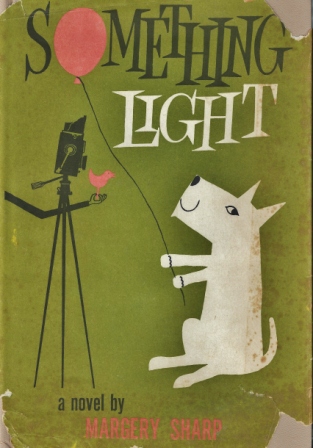
Something Light by Margery Sharp ~ 1960. This edition: Little, Brown & Co., 1960. Hardcover. No ISBN. 216 pages.

My rating: 10/10.

I love the works of Margery Sharp. No exclamation mark needed, merely a sober statement of fact. I am slowly and with deep pleasure building up a collection of her works. In every “Definition of Happiness” there is included “something to look forward to”; I am therefore a happy woman as I look forward with pure anticipation to sitting down with each hard-won out-of-print title by this most excellent forgotten author.

Luckily Margery Sharp was popular enough in her day that her titles are for the most part reasonably available with a bit of on-line searching, though her first two novels, Rhododendron Pie (1930) and A Fanfare For Tin Trumpets (1932),  fetch rather high prices in the used book world; well into the hundreds of dollars. In the meantime I haunt second-hand bookstores at every opportunity, peering hopefully at the faded titles of scruffy vintage hardcovers in eternal hopefulness. I did find two of her works this way, at the same most-excellent used bookstore in Kamloops, on separate occasions several years apart. I paid the princely sum of $5 each and controlled my great glee with difficulty until I was well away from the store. This also freed me up, as I gloatingly explained later to my slightly skeptical husband,  to be able to shell out for several of her other works at much higher prices, because then they all averaged out, and each one of the others wasn’t so ridiculously expensive, etcetera, etcetera.

But I digress.

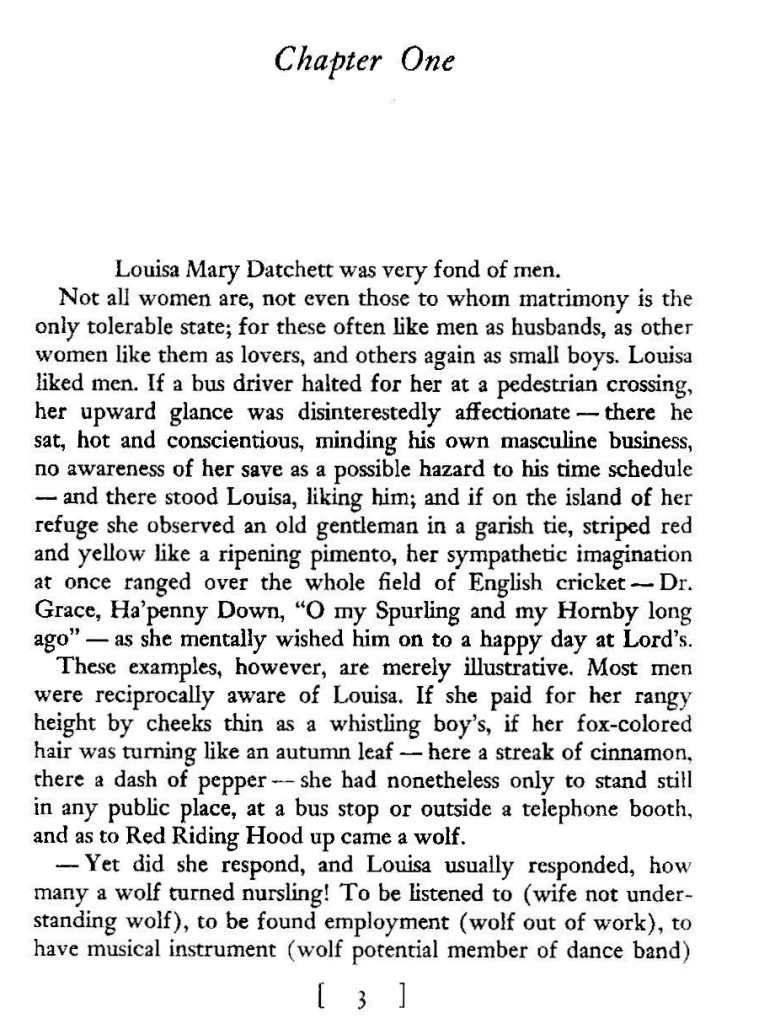
Something Light was my very first Margery Sharp, picked up on a whim at a little second-hand store I occasionally visit to scan through the modest book section. I noticed the book early in my shelf scan, but the faded and foxed dust jacket spine was less than appealing, and it wasn’t until my second pass around the stacks that something made me pull it out for a closer look. Here’s what I saw:

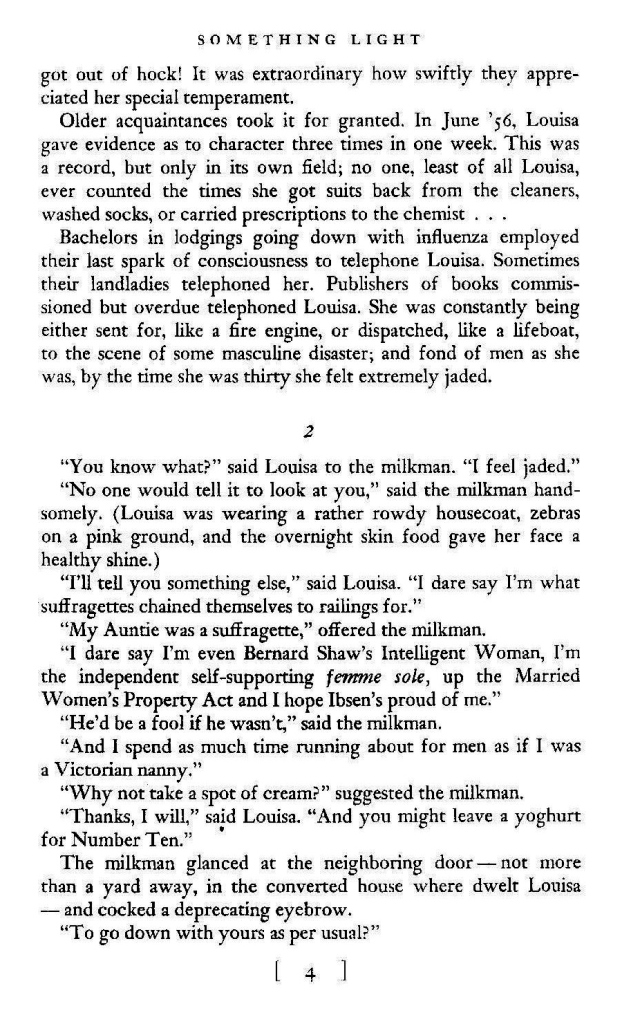
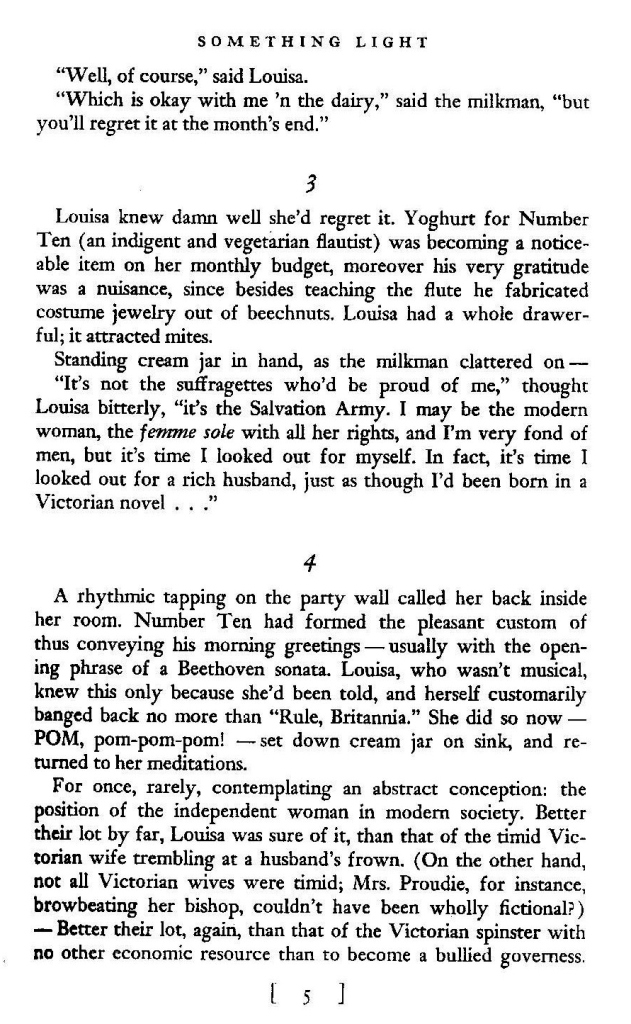
Hmm, I thought to myself. What’s all this, then? And I opened it up, noting that the pages easily turned as though it was used to being handled by a loving owner, and started to read. One, two, three pages. Then I quietly closed the book, walked up to the cash register, paid over my one dollar, tactfully ducked out of a conversation with the chatty proprietor, went out to my car, settled down and kept reading, completely neglecting my grocery and town chores list and stopping reading only when I was overdue to collect my daughter from her dance class. Definitely hooked.

Louisa Datchett likes men. No, not in the way that you’re thinking from that bald statement. Louisa likes men.

Here, read it yourself. A romp of a book,  something light indeed among Sharp’s delicious oeuvre.

Read Full Post »

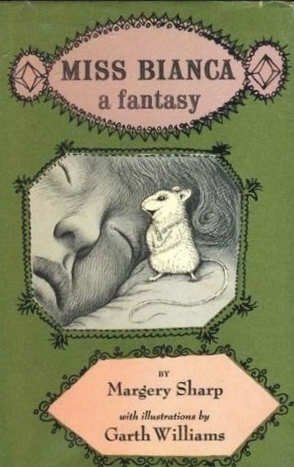
miss bianca margery sharp vMiss Bianca by Margery Sharp ~ 1962. Original title: Miss Bianca: A Fantasy. This edition: Fontana 1977. Paperback. Grand illustrations by Garth Williams. ISBN: 0-00-67-1235-5. 124 pages.

My rating: 7/10. The excellent illustrations raised it a few points.

I have a lot of good things to say about Margery Sharp, and her adult novels are among my most treasured books, but I must admit I have never previously read her once-popular children’s series about the little white mouse, Miss Bianca. The first two stories in the series were the inspiration behind the well-known Disney animated film The Rescuers (voiced, for those of you interested in such trivia, by Eva Gabor in the role of Miss Bianca and Bob Newhart as her partner Bernard) and its sequel. The paperback edition of Miss Bianca I have before me is the movie tie-in edition, with a cover still from the movie and this telling note on the title page:

Featuring characters from the Disney film suggested by the books by Margery Sharp, The Rescuers and Miss Bianca, published by William Collins & Co Ltd.

Don’t you just love that “suggested by” comment? So true! For the record, I am not a fan of the Disney bowdlerizations of otherwise excellent books. Several generations of children have now grown up with the Disney imagery of classic stories such as The Jungle Book, The Little Mermaid, and, heaven help us – The Hunchback of Notre Dame! – firmly in their heads versus the authors’ intended word-pictures.

So my beloved Margery Sharp is among the ranks of Disney’s “suggested” inspirations! I hope she got a generous settlement! It has just occurred to me that many of their take-off-of-classic stories authors were already dead at the time of the movie-making; Margery Sharp was very much alive in 1977, though I remember reading a quotation by her about not really being too interested in what happened during filming of her works (several of her adult novels were made into popular films); that her job was to write and that filmmakers were fine on their own without her input.

Back to the book at hand. A little way in I realized that Miss Bianca has a back story; so many references to what has “just happened” made me scratch my head until I realized that this is the *second* story in the series. The Rescuers is the first. I am thinking I need to get my hands on that one to fill in the gaps, and luckily that shouldn’t be a problem. New York  Review Books has just re-issued The Rescuers in hardcover, after its being out-of-print for ten years; I have several of their other beautifully rendered re-issues and I highly recommend them. Here’s the link: http://www.nybooks.com/books/imprints/childrens/the-rescuers/

So – Miss Bianca, Chairwoman of the Prisoners’ Aid Society (a charitable mousey organization dedicated to the comfort of incarcerated humans), has a new project to suggest. The last daring adventure, the rescue of a Norwegian poet from the infamous Black Castle (pause for ominous music) was obviously a great ego boost to the mice, and they are consequently quite boisterous and full of themselves. Miss Bianca, waiting for the Society’s latest meeting to come to order, muses that

“…their common adventure had given mice an unfortunate taste for flamboyance in welfare work. Not one, now, thought anything of sitting up to beg a prisoner’s crumb – in the long run one of the most useful acts a mouse can perform. Crumb-begging, like waltzing in circles (even with a jailer outside the door), was regarded as mere National Service stuff, barely worth reporting on one’s return from the regulation three weeks’ duty…”

The new mission is the rescue of a little girl who is being held in an abusive situation by the wicked Grand Duchess in the magnificent but icy-cold Diamond Palace. Miss Bianca appeals to the Ladies Guild of the Society to assist her in the daring rescue, and of course things do not go as planned. Miss Bianca is left behind in the general rout of the rest of the mice when the Duchess’ ladies-in-waiting, far from being tender creatures terrified of mice, turn out to be much more “hardened” than planned for!

This is a playful book; Margery Sharp indulged herself with a full flow of flowery and elaborate language, rather a challenge for young readers (but not necessarily a drawback), and the references are aimed rather at their elders over the heads of the child-audience; perhaps this was a book meant to be read aloud, with a nod to the parent as well as the child?

The villains in this little saga are properly villainous; the Duchess’ black-hearted Major-Domo, Mandrake, has committed “…a very wicked crime, of which only the Duchess now had evidence…” and he is her willing (though cringingly obsequious) partner in crime. Even her two unkempt carriage horses “…had criminal records; each having once kicked a man to death…” And so on.

If the story has a flaw (and it does have a few, being a slight work in every sense of the word) it is that the parody and melodrama are a bit too “over the top” for perfect comfort. The wee prisoner, the aptly named Patience,  is the latest in a long line of small children the Duchess has enslaved and apparently killed (!) –  though most children will shiver deliciously at the peril their two heroines find themselves in, my motherly brain says “Killed! Was that really necessary, dear author?!” And I don’t think we ever do get the full story on how the Duchess obtained Patience in the first place.

Ah, well. To sum up: a diverting little parody of an adventure story. I think it should definitely follow The Rescuers to make more sense to the reader; it has a very sequel-ish feel to it, though it could stand alone if need be. Quite nicely written in a very flamboyant voice (to use Miss Bianca’s own word); definitely not dumbed down to a younger audience vocabulary or style-wise.

This book #2 in a series, the first four of which are illustrated by the incomparable Garth Williams. I believe all except the newly re-released The Rescuers (New York Review Books, 2011) are out-of-print. Some are very easy to find second-hand, but the more obscure later titles may require some serious online sleuthing.

  • The Rescuers (1959)
  • Miss Bianca (1962)
  • The Turret (1963)
  • Miss Bianca in the Salt Mines (1966)
  • Miss Bianca in the Orient (1970)
  • Miss Bianca in the Antarctic (1971)
  • Miss Bianca and the Bridesmaid (1972)
  • Bernard the Brave (1977)
  • Bernard into Battle (1978)

Read-Aloud: I think so. Ages 6 and up, perhaps? The prisoner Patience is eight; much is made of her sad life and deceased predecessors and bleeding fingers, but the tone is optimistic – this is, after all, why the child very much needs a heroic rescue! Neatly tied up happy ending, with the mice going off to their next adventure.

Read-Alone: Hmmm. Maybe 8 and up? Or a very strong younger reader. Definitely can be appreciated by an older readership (including adults); Margery Sharp was an accomplished social satirist and this story is full of her wry observations, though they often escalate into full-blown parody much more so than in her adult novels.

Read Full Post »

« Newer Posts