Posts Tagged ‘Romance’

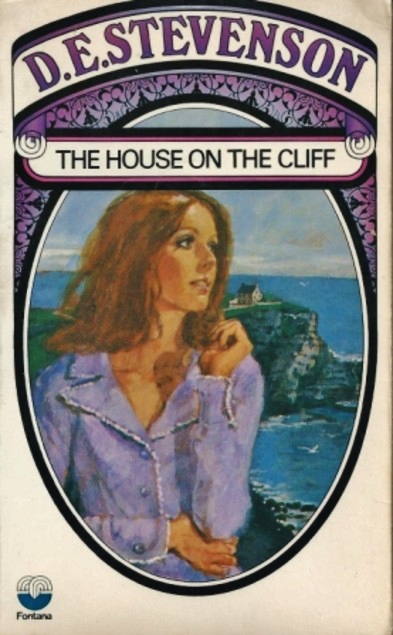
the house on the cliff pb cover d e stevensonThe House on the Cliff by D.E. Stevenson ~ 1966. This edition: Fontana, circa 1960s. Paperback. 224 pages.

My rating: 7.5/10

What a blissfully easy read, second time around this year for The House on the Cliff. Looking at my handy-dandy reading list, I see that I first read it way back in March of this year, while in the throes of dance festival season (my teen daughter was a competitive dance troupe member until this autumn) which seems aeons ago now, as we’re as close as touching to mid-November.

And though I still retained a reasonably accurate memory of the plot line, many of the details were completely erased from my brain. Not such a bad thing in a comfort read, I maintain, because much of the charm in those is their re-readability. I see I rated this one quite highly back in March, and I’ll keep it there, for though it is a slight thing, it is very pleasant, and that has merit enough for me.

Young Elfrida Jane Ware – twenty-one-ish, I believe – is having a rough time of it. Elfrida has grown up as a child of the theatre, accompanying her second-rate actor father and third-rate (despite beauty and intelligence) actress-mother-turned-seamstress from posting to posting, knowing only the backstage world as she grew up, until one day her father disappears, leaving Elfrida to eventually scramble into an acting career herself, in order to help support herself and her frail mother. “Dead”, her mother claims; “Run off!” whispers the theatre community; but no matter which is was, Elfrida has been popped in at the deep end. She’s been working bit parts here and there, but she’s not exactly star stuff herself, though she’s managed to snag a key role in a failing comedy, along with theatre star Glen Siddons, whom she has a serious (though, she thinks, hidden) crush on.

Now her ailing mother has quietly died, and through her grief Elfrida gamely soldiers on, until one day when her benevolent landlady shows her an advertisement in the newspaper asking for news of Marjory Thistlewood – her mother’s maiden name. When Elfrida visits the lawyer’s office named in the advert, she is astounded to find that she has inherited her grandparents’ country house, Mountain Cross, a not-so-shabby two-storey stone-built gentleman’s home on a sea cliff in Devonshire.

the house on the cliff dj d e stevenson

Here is someone’s vision of Elfrida’s house. In the book it is surrounded by neglected gardens, which appear to be missing here, though it does have the appropriate stunning view of the sea. At least there are no couples clinching on this dust jacket, or on the Fontana cover above. For this heroine is very good at standing alone, and avoiding passionate advances with firm grace. Some other covers I’ve seen in my internet travels are rather more trashy, showing the heroine in full embrace with an unspecified male companion. (Coming back to add that there is one passionate embrace, but as it is very much a last page sort of thing, it doesn’t necessarily represent the heroine’s usual habits.)

The search for her mother was meant as an attempt at reconciliation from her estranged parents – Marjory had eloped with Elfrida’s father against all parental advice – and since both of Marjory’s parents and Marjory herself are no longer living, Elfrida gets the estate.

Unluckily there is only the tiniest of cash inheritances, but Elfrida decides to go off anyway and try living in her new possession, hoping to scrape by on her meagre inherited income. In this she is encouraged by one of the junior partners in the law firm, one Ronnie Leighton, who knows Mountain Cross well from his own childhood. Ronnie and Elfrida get along like old pals from the first time they meet; the reader may draw what inference they like from this convenient kindred spirithood!

To Mountain Cross goes our heroine, abandoning her life on the stage with only the briefest moment of regret, and that for the glamorous Glen. She falls in love with her ancestral home, and everyone about falls in love with sweet Elfrida, relieved that she is not some flighty actress, but a new version of her gentle mother, whom everyone remembers fondly.

Everything goes most swimmingly, in fact, until the visit of a cousin from Canada, who has lost out on the inheritance through his own carelessness. Walter Whitgreave is on the hunt for a stamp album which he claims is off sentimental value only, but a search is unsuccessful, and Walter wanders away muttering forebodingly. (Cue dramatic music.)

Then who should show up on Elfrida’s doorstep but Glen Siddons himself, along with his eight-year-old son from his tragically ended youthful  marriage. The child, Patrick, has been fostered out since his mother’s death, but Glen has collected him at last. Though Glen is playing the doting father and  promises to take an interest in Patrick at long last, we sense that this is not going as well as it could be.

The cast of characters includes a slightly fantastical married couple who decide to stay on at Mountain Cross for love alone (Elfrida cannot afford their wages), a handsome local bachelor who has checked out his new neighbour and found her most appealing, and various local characters (“characters” in every sense of the word) who bend over backwards to ease Elfrida into country life. What with the three young men (Ronnie, Glen and neighbour Lucius), not to mention the adorable Patrick – also smitten with our heroine – Elfrida’s retreat is becoming rather full of male presence; we know romance is inevitable, but which one will it be?

I’m not telling, though I did drop a rather obvious clue early on. Oh, and the stamp album reappears, with prefect timing. The villains wander away, leaving Elfrida in possession of her house on the cliff, and her happy new life.

(And there are pigs. And a friendly milk cow. Though no ducks. Read the book, and you’ll get the reference to ducks. A minor note, but I’m rather fond of ducks myself, so their mention piqued my interest.)

How very sweet! <happy sigh>

I wonder if some of the appeal in this not-very-complex story is Elfrida’s gallant disposition, her quiet but witty sense of humour, and her refusal to make a complete fool of herself even while enmeshed with forthcoming and handsome young men? One gets the feeling that this young lady knows a lot more than her swains (bar one) give her credit for. We wish Elfrida well from first to last, enjoying with quiet vicarious pleasure her acquisition of lovely house, thoroughly nice new friends, and well-deserved romantic partner.

Shall I read another, or should I go for something a bit more intellectually demanding? It’s been hectic round here lately – all in a good way – just dreadfully busy – so I suspect another easy-on-the-tired-brain D.E.S. may be coming to bed with me tonight. Which one, though? Hmmm…
Read Full Post »

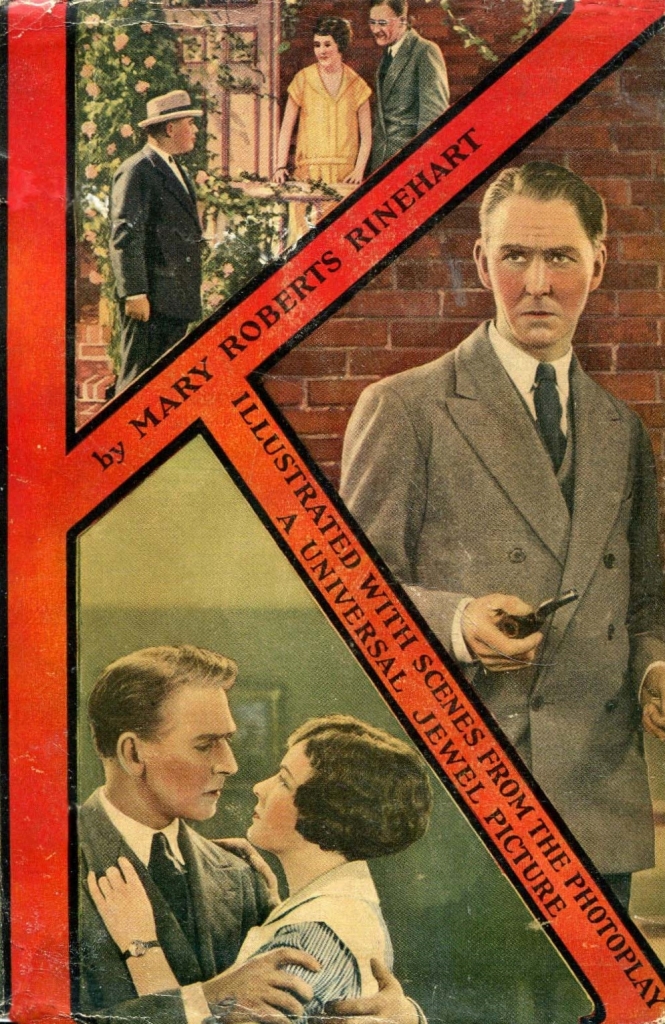
k mary roberts rinehart p

This is not my personal copy, but the dust jacket of an older edition. Apparently “K” was made into a movie at one point.

“K” by Mary Roberts Rinehart ~ 1914. This edition: Blakiston 1944. Hardcover. 407 pages.

My rating: 6.5/10

A melodramatic and exceedingly improbable story of an absolutely perfect heroine – beautiful, morally upright, self-sacrificing, pure through and through – you know the type! – and her three lovers. First is youthful and impetuous Joe, followed by brilliant (and fickle) young surgeon Max, and ultimately (somehow I doubt this will be a spoiler; especially as the cover pictured here completely gives it away) the mysterious “K”.

This vintage read was surprisingly good, considering the ridiculous storyline. The author has a lot to say about roles of women, the roles of marriage and child-bearing in female self-fulfillment, and the hypocrisy of society to those caught out in wrongdoing – the unmarried mother, the bastard child, the alcoholic rich man – and how each is viewed and sometimes excused merely on the basis of social status. How does that old song go? “It’s the same the whole world over, It’s the poor what gets the blame, It’s the rich what gets the pleasure, Ain’t that a blooming’ shame?”

Here we have a lovely young eighteen-year-old girl, Sidney, who decides to turn her back on marriage as offered by the infatuated Joe, and to make a career as a nurse. She is accepted as a probationer, and immediately falls head-over-heels in love with Doctor Max, a brilliant young surgeon whom she has known since childhood, but who has never realized what a lush young thing Sidney is until she pops up under his nose in nurse’s garb. Max is notoriously a lady’s man, with another love interest on the side, so the relationship seems questionable from the start, but Sidney succumbs (partially) to Max’s passionate advances. Her virtue remains intact, however, and she is saved from herself by the intervention of dark horse “K”.

K. Le Moyne – he never gives a first name – shows up one evening at Sidney’s mother’s house to rent a room, and though he is tenaciously reticent about his past, his quiet charm and readiness to help out with a myriad of domestic situations – from nurturing a pet ground squirrel to helping with the cooking – makes him the friend of all.

But what is K hiding? And why does Max reel in shock when the two men finally meet? What are they discussing behind closed doors on their subsequent nightly meetings? Did Sidney really mix up her medications and poison that pathetic young patient? Why is her superior Carlotta (incidentally Max’s main squeeze before Sidney’s entry) so alternately friendly and harsh to Sidney? And where did Joe get that gun?

See? Told you it was melodrama!

The cast of supporting characters is almost more interesting than the interconnected love triangles (quadrangles?) of the main protagonists.

Here we have a couple of middle-aged lovers, one a cook and the other a deaf-and dumb book salesman, communicating by notes to each other as they sit out each evening on the back steps. Another middle-aged spinster goes off to live in sin with a man whose wife is languishing in a mental home; her decision to put herself beyond society’s pale by her last-chance clutching at love is most sympathetically portrayed.

A young woman marries beneath herself socially, to a man with a drinking problem and a history of amorous dalliances; she knows this before she marries, and she knows she doesn’t truly love her husband-to-be, but she goes ahead anyway, to repent at leisure. (Subtext: Is marriage really such a socially desirable state that an intelligent well-off young woman will willingly enter into a questionably wise bond, particularly if love is not there?)

Dr. Ed, Dr. Max’s elder brother, is an old-school practical doctor in contrast to his younger brother’s cutting edge cleverness as a specialized surgeon. Dr. Ed, wiping his scalpel on his pant leg (sterilization dulls the edge, he maintains), proudly admires his brother’s accomplishments, and regards the sacrifice of his own career, his own never-attained wife and family as a worthy price to pay for his brother’s success. Dr. Ed has never married and has spent every penny he’s earned supporting his brilliant brother through medical school; his role in the story is as sort of a benevolent father figure, dispersing wisdom and keeping a high moral standard as an example to his friends and neighbours.

Sidney’s Aunt Harriet is one of my favourites. Long the drab neighbourhood seamstress, Harriet pursues a long-held ambition to design clothes for the local haut monde, and after borrowing money to set herself up, eventually makes it to Paris, from whence she sends engraved circulars to the customers eagerly awaiting her return. I absolutely loved the glimpses of practical yet creative Harriet getting dress-designing inspiration from crocuses in snow, or the colours of the early morning city sunrise. A happy spinster, Harriet, illustrating an independent womanhood and its rewards, in a world which still maintains that marriage and motherhood is a female’s highest calling.

Mary Roberts Rinehart was an exceedingly prolific writer of dramatic novels and mysteries, and a well-known feminist of her time. In “K”, her views on the rights of women come through loud and clear, though mixed rather oddly with this very traditional romance. She does allow her heroine to complete her goal to become a fully fledged nurse, though marriage awaits at the end of her qualification. I rather wonder what the after-story would turn out to be?

Read Full Post »

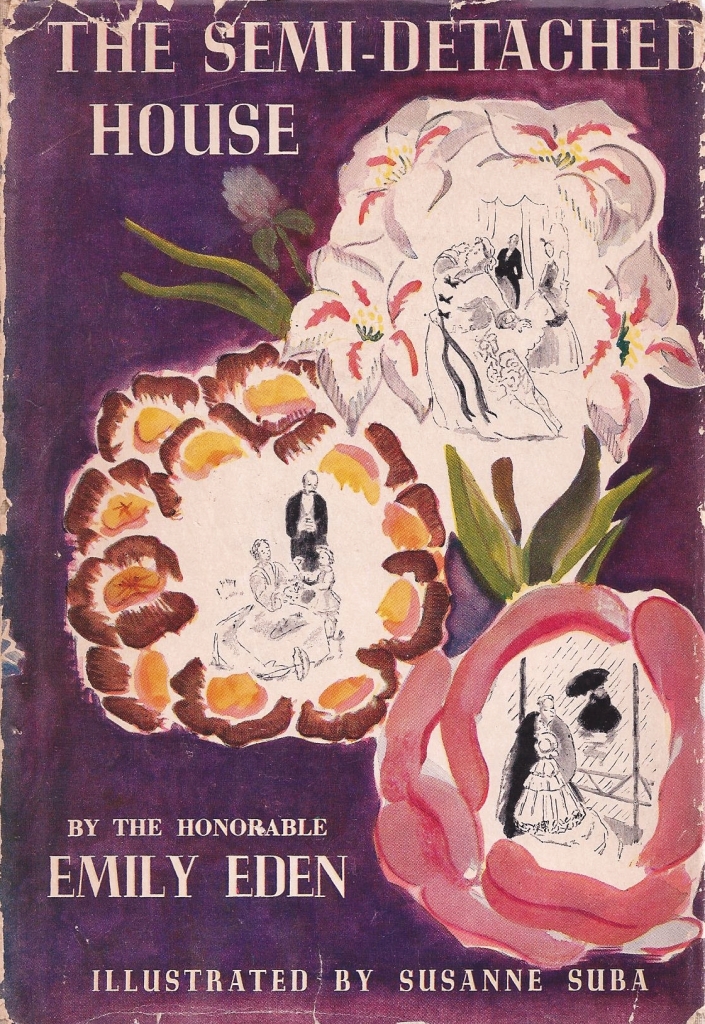
the semi-detached house emily eden 001The Semi-Detached House by Emily Eden ~ 1859.

This edition: Houghton Mifflin, 1948. Illustrated by Susanne Suba. Hardcover. 216 pages.

My rating: 6.5/10

An aristocratic young Lady Chester, Blanche to her intimates, just eighteen and married six months, is bemoaning her husband’s three-month diplomatic assignment in Germany. She has discovered that she is in an “interesting” state of health, and she thinks her husband’s timing could be ever so much better. As well, Lord Chester has taken the advice of Blanche’s doctor and has packed her off to the depths of the suburbs (Dulham), to Pleasance Court, which is in itself quite all right, being a properly fashionable address, but for the smaller semi-detached dwelling at the rear, residence of the decidedly middle-class Hopkinson family. Blanche is a mass of nerves, anticipating all the worst, and dreading meeting her undoubtedly “common” neighbours.

Just across the shared wall, the Hopkinsons are equally as flustered. Rumour has it that the young socialite moving in next door is either the estranged wife of a member of the nobility, or perhaps (shocked hisses) his chère amie. The very respectable Mrs. Hopkinson has barred her shutters, and intends to cut her new neighbour dead.

Luckily both households make a happy acquaintance and quickly become the best of friends, for this is a very friendly novel of manners, and though the gossip flows freely the gossipers are most well-intentioned.

Emily Eden (“The Honorable Emily Eden” as my 1948 edition proudly proclaims) was a great admirer of her predecessor Jane Austen, and deliberately styled her several domestic novels after that literary mentor. Parallels certainly exist, but Emily Eden’s work has a distinctive voice of its own, being gently satirical and full of humorous situations of a time several decades past that of Jane Austen’s fictional world.

A cheerfully fluffy romp, with just the lightest touches of seriousness here and there, and more than a little snobbishness towards the social climbers seeking to scrape acquaintance with the fashionable Chesters. There are love affairs to be sorted out, and the spanking new marriage to be fully settled into, not to mention the excitement of the impending arrival of Blanche’s addition to the English aristocracy.

Nice glimpse at a world familiar to those of us fond of Miss Austen and her compatriots, written by someone who was familiar at first hand with the life described so vivaciously here.

Another novel, The Semi-Attached Couple, preceded this one, and both are succinctly reviewed by Desperate Reader, and by Redeeming Qualities, among others.

The full text of The Semi-Detached House is online for your reading pleasure here, and both novels are available in a Virago double edition as well, though that may now be out of print.

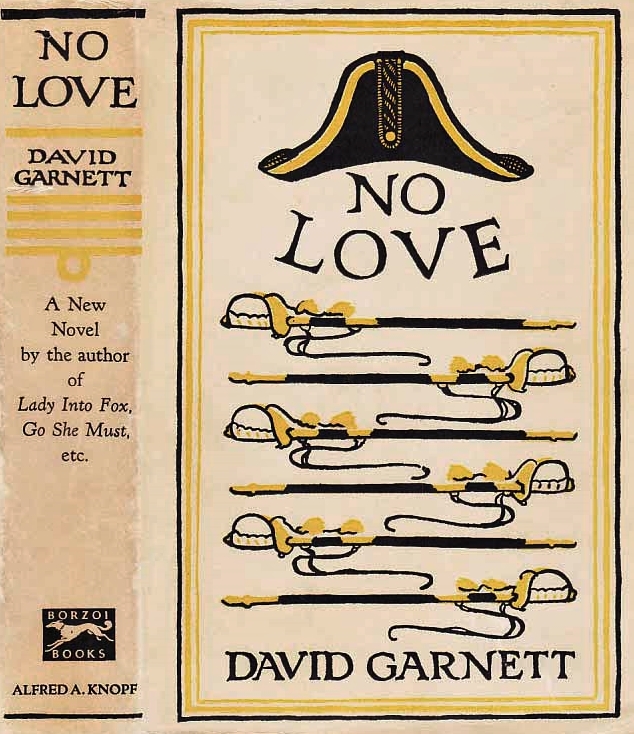
no love david garnett djNo Love by David Garnett ~ 1929.

This edition: Chatto & Windus, 1929. Hardcover. 275 pages.

My rating: 8/10.

What an unexpected and sophisticated novel this one was. I have never read David Garnett before, though of course I have heard quite a lot about Lady Into Fox (which I’m intending to read next year for the Century of Books project) and I now anticipate that reading with even more pleasure, as I  was quite pleased with what I read here. I did an online search to see if I could come up with any other reviews of No Love, but have so far drawn a complete blank, which leaves me rather disappointed. Surely someone else has found this novel worthy of discussion? If you have reviewed it yourself, or know of any others who have, I would be greatly interested to read your thoughts.

When in 1885 Roger Lydiate, the second son of the Bishop of Warrington, and himself a young curate, became engaged to Miss Cross, the marriage was looked on with almost universal disapprobation.

Alice Cross was a very emancipated girl; she was the daughter of the great paleontologist, Norman Cross, the notorious freethinker and friend of Huxley’s, who had poisoned himself deliberately when he was dying of cancer. The poor girl idolised her father’s memory, had been known to justify his suicide in public, and openly maintained, not only the non-existence of God, the non-existence of the human soul, and a rational and mechanistic theory of human consciousness, but also carried the war into the enemy’s country by declaring with her favourite poet Lucretius

Tantum religio potuit suadere malorum.

It was her view, constantly expressed, that it was religion alone that had always prevented the advancement and enlightenment of mankind, that all wars and pestilences could be traced to religious causes, and that but for a mistaken belief in God, mankind would already be living in a condition of almost unimaginable material bliss and moral elevation.

She was, they all said, no wife for a clergyman.

Despite Alice’s “unsuitability”, she and Roger were deeply in love, and they did indeed marry, with Roger ultimately abandoning his curateship and declaring himself an atheist. The Bishop let it be known that he was cutting young Roger out of his will, but what was never known was that he was deeply sympathetic to the young couple, and had quietly given the young bride an astounding ten thousand pounds as a wedding gift.

With this unlooked-for nest egg, the young couple purchased a small island near Chichester, on which was an extensive fruit farm, and settled down to a rural life, and to establishing a home and a new way of life.

There is no happiness and excitement in the lives of a married couple greater than the period when they are choosing themselves a house and moving into it; it is a time far happier than the wedding night or than when children come. A house brings no agony with it; its beauties can be seen at once, whilst both physical love and the children it begets, need time for their beauty to unfold.

Roger and Alice were well suited to each other and their rural occupation, and in time two children were born to them, Mabel and Benedict. Life on the Island proceeded peacefully, until one day in late October, 1897, when Roger rescued a stranded party of boaters and offered them hospitality for the night. These proved to be a certain prominent naval man, Admiral Keltie, his beautiful wife, and their young son Simon, and as the two families felt a certain stirring of mutual attraction, it soon came about that the Kelties purchased a building lot on the island and proceeded to construct a mansion, while between the two families a friendship of sorts developed.

That friendship was soon mixed with a good dose of unspoken jealousy, as the Lydiates see at first hand the extravagance of the wealthy Kelties, and as both husbands cast admiring eyes on the attractions of their neighbour’s spouses. Roger is appreciative of Mrs. Keltie’s cold beauty and brittle wit, while the Admiral is moved by Alice’s obvious intelligence, her deeply passionate nature, and a certain earth-mother quality she exudes.

Simon and Benedict make friends as well, though as they grow up they grow apart, with Simon moving in much more exalted circles, and Benedict going his own quiet way, though the two reconnect time and time again, their meetings often marking the episodes of this narrative.

The novel focusses most strongly on the Lydiate family, and its description of their lives and the changes in their moods and attitudes as the Kelties come and go is beautifully wrought. The years pass, and the Great War sweeps both sons away, but the families remain tenuously connected, however, as Simon and Benedict both have fallen in love with the same woman, and her decision on which one to marry has far-reaching consequences to both families.

This novel appeals on numerous levels, as an exercise in story-telling, as a commentary on the social mores of the time, and as a broader examination of the nature of many different kinds of love. Nicely done, David Garnett. I am looking forward to seeking out and reading more by this author in the years to come.

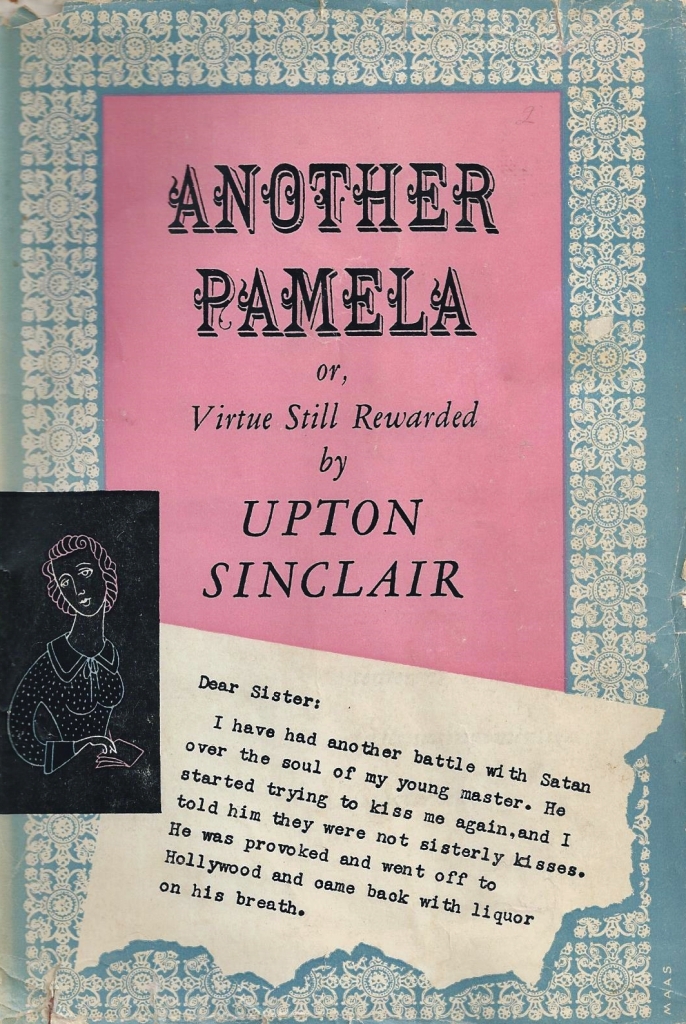
another pamela upton sinclair 001Another Pamela or, Virtue Still Rewarded by Upton Sinclair ~ 1950.

This edition: Viking Press, 1950. Hardcover. 314 pages.

My rating: 7.5/10

And now for something completely different, we move forward in time and to another continent, to this satirical look at social mores in 20th Century California.

Somehow in my travels I have acquired not one but two copies of this slightly obscure novel, a foray into light literature by the famously passionate social activist and best-selling author, Upton Sinclair, perhaps best known for his consciousness-raising, dramatic novel The Jungle.

Having never read Samuel Richardson’s bestselling 1740 epistolary novel, Pamela, about an English serving girl’s trials, tribulations and eventual marriage to the nobleman who tenaciously attempts her seduction, I wasn’t quite sure if I would fully appreciate Upton Sinclair’s parody of the same. It turned out not to matter, as Sinclair helpfully includes generous quotations from the original, having his own heroine read the original as part of her personal development, as she struggles with her own would-be seducer, and the dictates of her conscience and religious upbringing.

Published in 1950, the action of the story is set some years earlier, in the years of the Roaring Twenties, when the fabulously rich of America gave full rein to their imaginative excesses.

The modern Pamela is a child of the early 1900s, being a deeply naïve and (of course!) absolutely lovely young maiden raised in rural poverty in California. She is discovered by a wealthy patroness whose car has broken down in the area of young Pamela’s farm. Upon conversing with Pamela and learning that she is a Seventh Day Adventist with no objection to working on a Sunday (as long as she has Saturday free to devote to her devotions), Mrs. Harris impulsively decides to try the girl out as a parlour maid in her luxurious home, Casa Grande, near Los Angeles.

Pamela is quite naturally overwhelmed by this change in her affairs. Grateful to be able to be sending her pay home to help out her desperately poor family, she is most loquacious in her letters, describing her situation and the other servants and tradespeople she works with, and, increasingly, as she rises in the household hierarchy, the doings of Mrs. Harris herself, who is a lady of many enthusiasms, the main one being the promotion of a rather eclectic form of communism, tweaked to allow for the great disparity between the Harris millions and the theoretical rights of the downtrodden to full equality. (As long as Mrs Harris is not asked to give up her personal comforts, that is.)

And there of course is a “young nobleman” of sorts, one Charles, Mrs Harris’s nephew, a playboy of epic proportions who is completely dependent on his besotted aunt for funds. The Young Master, as Pamela describes him in her letters home, has many vices, not the least of which is his excessive consumption of alcohol, and when Mrs. Harris notices his glances at the lovely Pamela, she encourages the girl to give in to Charles’ pressing invitations to dining out and sightseeing, hoping that this new interest will wean Charles from the demon bottle. (She conveniently turns a blind eye to the possible corruption of her protégé’s morals.)

Charles is decidedly forthcoming; Pamela resists, using her prim and rigid religion as her shield and weapon. Do I need to tell you what happens? Not really, as the title gives the ending away, and as this is a happily satirical tale, we know that Pamela’s eventual fall will be well cushioned.

An enjoyable diversion of a book, with Sinclair getting his digs in at a huge array of social types, all in good fun, with abundant sugar coating the truthful pill within. I wonder if this deserves a “hidden gem” designation? I rather think it does, and I think some of you might find it worthy of a read if you come across it in your travels; it’s an amusingly Americana-ish thing.

Read Full Post »

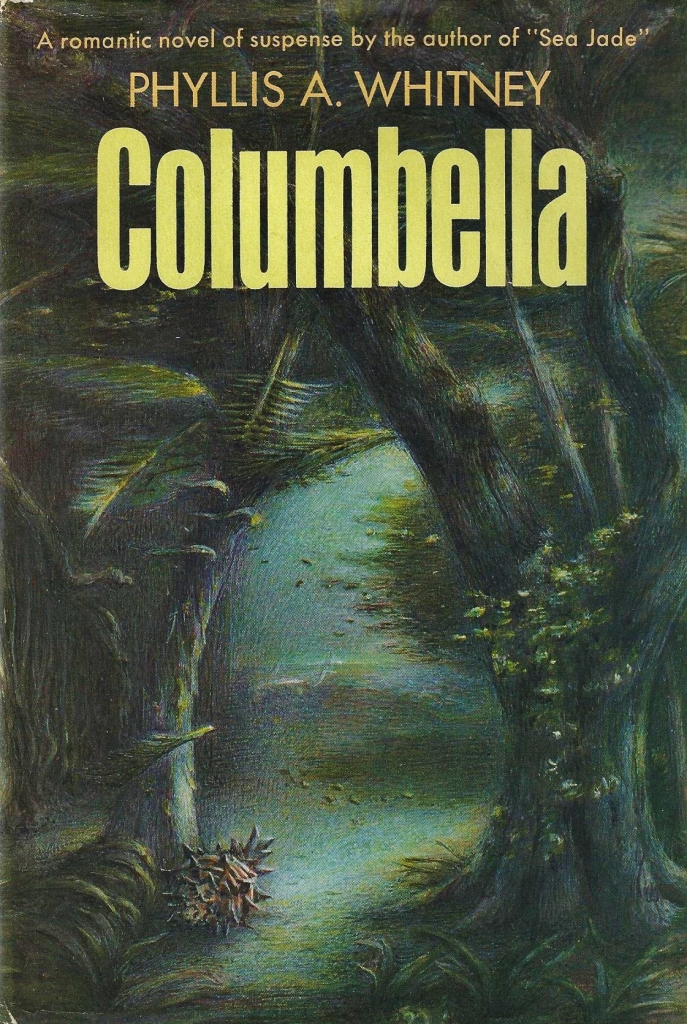
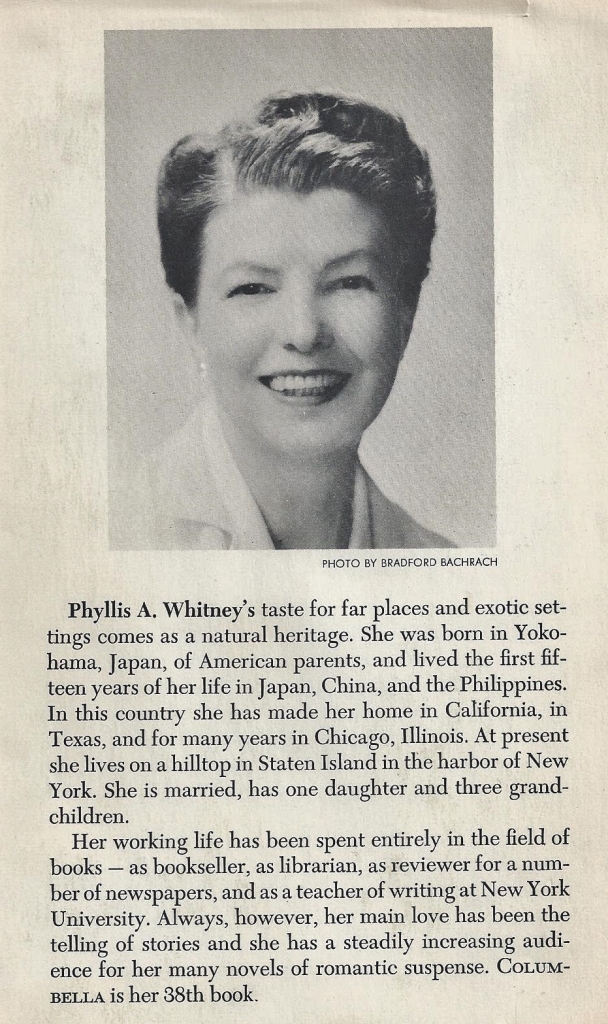
columbella phyllis a whitney 001Columbella by Phyllis A. Whitney ~ 1966. This edition: Doubleday, 1966. Hardcover. 246 pages.

My rating: 3/10

Oh, why did I read this? It was so disappointing. And I have had prior experience with this author – see here  – and went in fully cognizant of what I was about to experience. All I can say then is that hope springs eternal. And that my hope was dashed. Oh, woe!

But don’t you like the mysterious cover illustration, and doesn’t this flyleaf blurb sound promising, for a lightly diverting romantic-suspense thriller type thing?

That was a night of gold and red, with torches flaming on the hilltop and the lights of Charlotte Amalie fanning out around the harbor below. A night of water lily and sweet-smelling cereus. The night of the shell…

Jessica Abbott, fleeing her own past, finds herself the center of a whirlpool of conflict at Hampden House, high on its cliff in the Virgin Islands. She is confronted by Catherine Drew, a woman whose sole purpose is to torment and destroy. Catherine is the wife of a vital, driven man, Kingdon Drew-toward whom Jessica is irresistible drawn. Jessica must defy the beautiful, self-indulgent Catherine, who likes to affect the name of a shell – Columbella. She must fight for the very future of another woman’s child. Above all, she must find the strength to help the man she loves escape the trap Catherine has set for him. Yet each day Catherine seems to mock her in a new way – and win. Until the night of the shell…

Always, the brilliant island sun shines over Hampden House in St. Thomas and over Caprice, the plantation in St. Croix that is crumbling to eerie ruin, guarded by its unicorns. Always the threat of a hurricane looms over this exotic setting, where the past still affects the present.

So. Our lovely heroine Jessica has just lost her own sweet-faced, soft-voiced, utterly poisonous, insidiously controlling mother, and she is seeking to escape her own demons by taking on the role of companion-governess to yet another emotionally-abused girl, the teenage daughter of an architect and the aforementioned Catherine. Jessica falls in love with the hunky, broody Kingdon at first sight, and he himself is overcome with passion for her, which he manfully tamps down until it breaks free of its straining bonds. Lots of scenes of overt jealousy (on Catherine’s part) and apparent dislike (on Kingdon’s part only, for Jessica openly fawns on her employer from the get go) before the two lovers fall into each other’s arms. But there is still that pesky wife…

The final solution is of course a convenient demise – poor Catherine-Columbella! With Kingdon as main suspect, but of course he gets off the hook, thanks to a convenient confession by the true killer, who then is dealt with by the Hand of God (tree falling in a storm, crushing said murderer) and allowing everything to Work Out For The Best.

The best bits in the book were in the details. The setting, St. Thomas in the Virgin Islands, is enthusiastically described, and there are nice touches of verisimilitude in the discussion of the shell-collecting business and the preparation of the specimens for sale.

But the scenarios and the characters – wow! Can something be described as both flat and melodramatic at the same time? If so, our writer has pulled it off. And the passion between Kingdon and Jessica was blush-inducing indeed, but not because of its explicit nature. No, because it was so agonizingly clichéd. I was embarrassed at myself for willingly reading such schlock.

I want to like Phyllis Whitney so very, very much. She has such a promising back story as a writer, and she very obviously goes about her stuff with the best will in the world. She was a bestselling writer in her time, and much beloved by her devoted readers. So I may continue in my occasional investigations of her oeuvre, hoping to find a semi-precious gem or two amidst the very prolific sparkly bits of her vast body of work.

phyllis a whitney bio back dj columbella 001

Read Full Post »

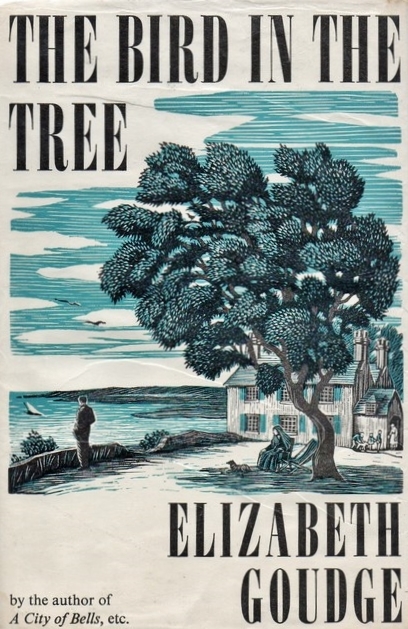
the bird in the tree elizabeth goudgeThe Bird in the Tree by Elizabeth Goudge ~ 1940. This edition: Coronet, 1990. Paperback. ISBN: 0-340-02683-9. 256 pages.

My rating: 6/10

This is the first book of what was to become the well-known “Eliots of Damerosehay” trilogy; three novels centered around a (mostly) artistic and intellectual upper-class family before and just after the World War II years. The setting of the ancient ship-building village in Hampshire, the real-life Buckler’s Hard referred to as Fairhaven, or “The Hard”, consisting of Big Village and Little Village, is lovingly drawn from life. The houses so eloquently described in the books as to be characters in their own right – Damerosehay, and, in the second book, the Herb O’Grace,  were fabricated by the author from memories of similar places important to her in her own retreat from the world to recuperate from her own emotional breakdown following the long illness and traumatic death of her beloved father, which prefaced the writing of this novel.

Visitors to Damerosehay, had they but known it, could have told just how much the children liked them by the particular spot at which they were met upon arrival. If the visitor was definitely disliked the children paid no attention to him until Ellen had forcibly thrust them into their best clothes and pushed them through the drawing-room door at about the hour of five; when they extended limp paws in salutation, replied in polite monosyllables to inquiries as to their well-being, and then stood in a depressed row staring at the carpet, beautiful to behold but no more alive than three Della Robbia cherubs modelled out of plaster. If, on the other hand, they tolerated the visitor, they would go so far as to meet him at the front door and ask if he had bought them anything. If they liked him they would go to the gate at the end of the wood and wave encouragingly as he came towards them. But if they loved him, if he were one of the inner circle, they would go right through the village, taking the dogs with them, and along the coast road to the corner by the cornfield, and when they saw the beloved approaching they would yell like all the fiends of hell let loose for the afternoon…

And as the story opens, the approaching visitor is very well beloved indeed. It is David, grandson of the matriarch of the country home Damerosehay, Lucilla Eliot, and the children referred to are his three young cousins, Ben, Tommy and Caroline, who are living with their grandmother in Hampshire while their father is in India and their mother in London.

As well as gifts for the children, David comes on this visit with some disquieting news for his grandmother. He has fallen in love with the children’s mother, his own aunt-by-marriage Nadine, who has just obtained a divorce from Lucilla’s son George. David and Nadine, despite the vaguely incestuous awkwardness of their relationship and the five year difference in their ages (Nadine is thirty; David twenty-five) propose to marry, and David has screwed up his courage to confront Lucilla with the decision as unalterable.

Lucilla cannot agree; she still hopes that Nadine and George will reunite, and she is utterly appalled at the thought of the trauma which the children will undergo, in particular the sensitive and sickly Ben, who worships his older cousin as well as his absent father; his mother’s proposed marriage will shatter Ben’s fragile peace, and Lucilla refuses to countenance such a thing.

Lucilla fits the pattern of benignant family matriarch wonderfully well. She is a woman of strong personal attractiveness, being both physically beautiful and deeply invested in the interests of her extended family. She had, years ago when the child David was orphaned shortly after the Great War, purchased Damerosehay and built it up as a place of refuge to her children and grandchildren to retreat to for emotional and spiritual healing from the stresses of their workaday lives. And, like all matriarchs, she frequently feels as though she knows best in every situation, regardless of what her family wishes for themselves. So Lucilla sets out to make David and Nadine see the errors of their ways, and to knit together the unravelling family bonds.

Damerosehay itself has a fascinating history, and it is through the discovery of the details of the lives of those who have resided there before the Eliots that Lucilla finds support for her passionate defense of the virtues of loyalty and higher responsibility – to family and God, and to community and society – which she presses upon both David and Nadine as of higher importance than personal happiness.

Elizabeth Goudge was a loquacious describer of both people and places, and her sincere nature-worship and delight in the beauties of the rural world come through loud and clear in this novel. The descriptive passages, though frequently gushing, do paint clear and evocative pictures of the Hampshire countryside and village worlds; her descriptions of the people in her stories are equally well drawn.

If the story has one major fault – and it does have many small ones, too – it is that the conclusion is very obviously contrived and owes much too much to convenient discovery of old manuscripts and vaguely supernatural occurrences including a mysterious blue bird and a phantom mother and child. Capping things off is a well-placed storm and rescue-by-rowboat of an old family retainer with a key part to play in the background tale of Damerosehay’s earlier inhabitants, and its mysterious carved drawing-room mantelpiece, which exerts a strangely compelling influence on everyone who enters the room.

This whole concluding episode is sentimentally melodramatic, and not particularly convincing, unless one accepts the extra-special specialness of the Eliots’ collective hypersensitivity to atmosphere, which selectively is a trait shared among the main characters, in particular Lucilla, David and Ben. And in this case, Nadine, who is temporarily allotted the same sensitivity in order to allow her to benefit from Damerosehay’s special atmosphere. (In later books she goes back to being herself, to my great relief, as she is a breath of sensible, sarcastic fresh air among the dreamy Eliots she finds herself saddled with as in-laws. I personally wish frequently to give David a good hard shake when he starts maundering poetically on in his actor’s way.)

The story has its merits, chief of which is its introduction of the very winsome Eliot children and its value as a back story to the even more sentimental but completely endearing Pilgrim’s Inn, the second book of the trilogy, which is one of my secret comfort reads when I need some moral pepping up. I also greatly enjoy Lucilla’s two adult children who are always steadily there in the background. Saintly Hilary, living in bachelor squalor in the local vicarage, and overworked and underappreciated Margaret, with no fashion sense, plain looks, and little talent for doing things as Lucilla would wish them done in the house, but with a secret life in her glorious garden, both give a refreshing breath of reality to the rarefied Damerosehay atmosphere.

If I seem to be damning this story with faint praise, I do wish to add that I am very fond of Elizabeth Goudge’s novels, and read them through on as regular basis, so my criticisms are those of an old, occasionally querulous, but ultimately well-meaning friend. This is not one of my favourites, but it is very readable despite my quibbles, particularly in context with the two companion books which follow.

This novel has been cursed with a wide array of hideous covers, so instead of sharing the actual Coronet illustration on my edition’s cover I am cheating a bit and using a much more lovely vintage cover, which sadly is inaccurate as to its depiction of Damerosehay overlooking the sea. In the book, the house is set in a sheltered place, set among walled gardens, and separated from the sea by an ancient oak wood. But let that pass; it will suffice.


Read Full Post »

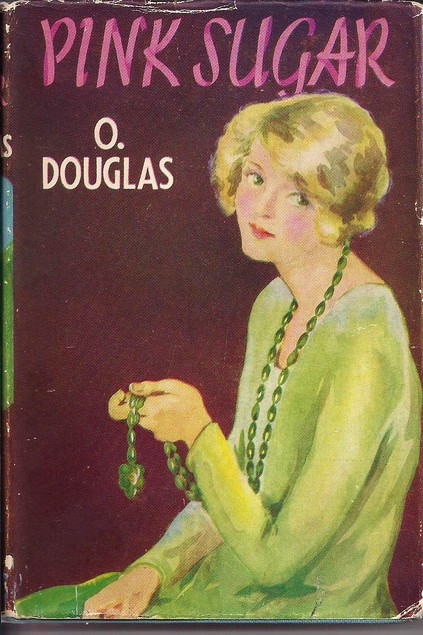
pink sugar o douglas anna buchanPink Sugar by O. Douglas ~ 1924. This edition: Hodder and Stoughton, 1936. Hardcover. 312 pages.

My rating: 7.5/10

A rather sweet book, but not mawkishly so in the way the title suggests. I wasn’t sure what to expect from this one, but I came away feeling beautifully contented, in an “all’s right in that fictional world” sort of way. The heroine sorted herself out nicely, and we have high hopes for her future if she can just retain that hard-won sensibility to the absurdity of playing Lady Bountiful to an oblivious populace!

I guess I should backtrack a bit, and summarize the plot for those of you not already familiar with this gentle novel.

“Spinster without encumbrances” Kirsty Gilmour is thirty and a free woman for the first time in her life, after the recent death of her stepmother, a woman described as “sweet and friendly and quite intolerable”. The second Lady Gilmour was an absolutely selfish creature whom Kirsty has stuck with from charitable impulse and deep inner goodness – Kirsty is the inheritor of her late father’s fortune, and has financially supported and accompanied her stepmother through that woman’s preferred social whirl in the years since Sir Gilmour’s death.

Kirsty’s older friend, Blanche Cunningham, reminisces about the unregretted Lady Gilmour.

Thinking of Lady Gilmour, Blanche was conscious again of the hot wave of dislike that had so often engulfed her when she had come across that lady in life. She remembered the baby-blue eyes, the appealing ways, the smooth sweet voice that could say such cruel things, the too red lips, the faint scent of violets that had clung to all of her possessions, the carefully thought out details of all she wore, her endless insistent care of herself and her own comfort, her absolute carelessness as to the feelings of others…

‘Kirsty,’ Blanche laid her hand on her friend’s arm. ‘However did you stand it all those years? What an intolerable woman she was!’

Kirsty sat looking in front of her.

‘She’s dead,’ was all she said.

‘Well,’ Mrs. Cunningham retorted briskly, ‘being dead doesn’t make people any nicer, does it?’

Now, freed of the superficial social whirl, Kirsty has joyously fled to the country, her true emotional habitat and the place of her birth, to the Borders of Scotland, to the little village of Muirburn, just outside of Priorsford.  (O. Douglas aficionados will recognize the reference.) Here she has rented a house, “Little Phantasy”, on the grounds of a larger estate. The manor house itself, rather quaintly named “Phantasy”,  is the abode of curmudgeonly bachelor Colonel Home, forty-ish and set in his ways, by all accounts. Kirsty doesn’t expect to see much of him, and is rather glad of that.

Kirsty has decided that she will now embrace the country life, and that she will devote herself, in true “good spinsterish” fashion, to “living for others”. Sensible Blanche rolls her eyes at this, and tells Kirsty not to be silly, but Kirsty means this in the very best way, taking under her wing as soon as possible a number of  dependents. First comes elderly Aunt Fanny, mild and gentle and perpetually knitting, and then the three motherless children of Blanche’s sister, for an extended rural stay while their recently widowed father travels abroad “to forget his grief”.

Kirsty’s foray into country life is not as smooth as anticipated, and she soon finds that people don’t necessarily like to be “lived for”; some of her most well-meant patronages are soundly snubbed, but there is enough encouragement that she soldiers on. Her tenacity and truly well-meaning sweet nature win over the most resentful of those around her. Kirsty was initially viewed as a frivolous bit of a thing, merely playing at enjoying her new role as householder and surrogate mother to the adorable Barbara and Specky, and the wickedly appealing “Bad” Bill, but as the months go by it is apparent that Kirsty’s innate inner goodness and staunch Scottish good sense will see her settled down and competently filling an important niche in Muirburn society, though not the role that she initially saw herself in.

There are some lovely character portraits in this appealing tale, and I will pass you along to several other reviewers, who also found much to admire in this pleasing novel. Please visit and read these excellent reviews, if you are at all intrigued by what I have said above. (And browse around the blogs a bit while you’re there – there are many more authors and titles highlighted worthy of rediscovery!)

The Book Trunk – Pink Sugar

Letters From a Hill Farm – Pink Sugar

I Prefer Reading – Pink Sugar

Pink Sugar was republished by Greyladies in 2009, and though that edition appears to be currently out of print, it should still be fairly easy to acquire through the second hand book trade. The novel was very popular in its day – my own copy is a vintage 1936 edition, stating that it is the twenty-first printing – so there are many still circulating around at reasonable prices.

Read Full Post »

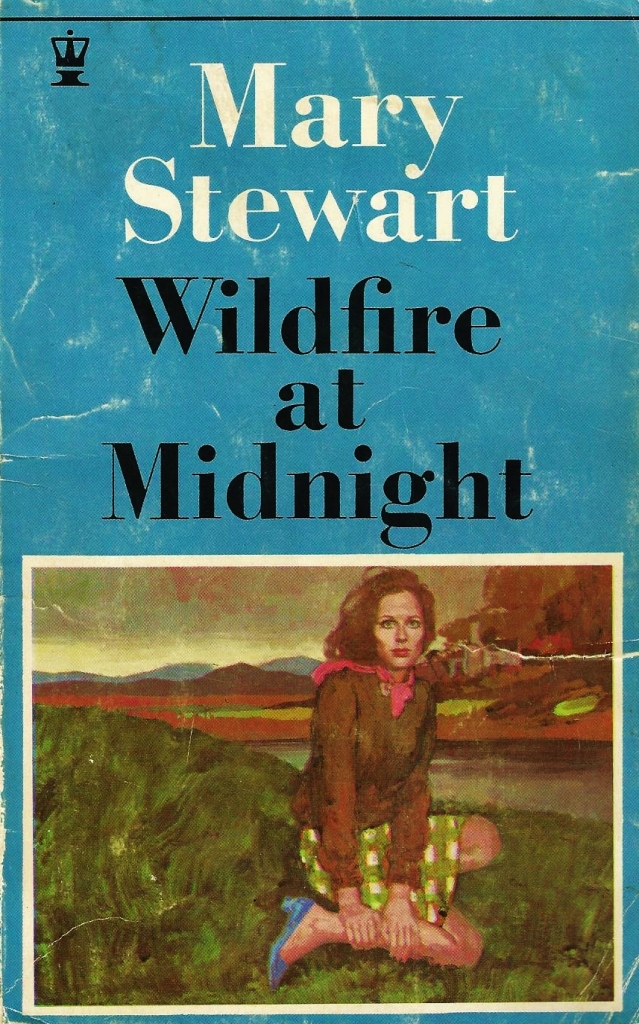
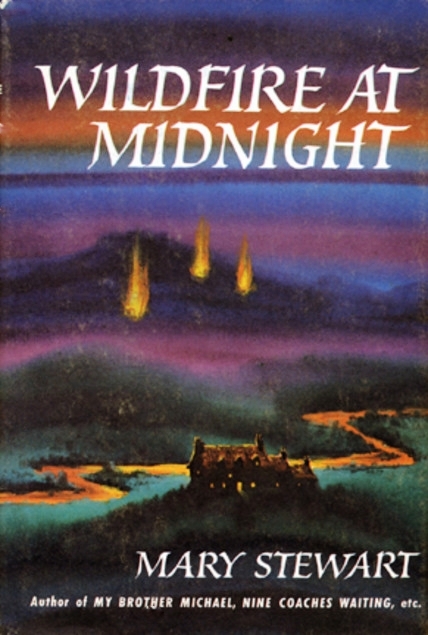
wildfire at midnight paperback dj mary stewart 001Wildfire at Midnight by Mary Stewart ~ 1956. This edition: Hodder, 1970. Paperback. ISBN: 0-340-01945-X. 224 pages.

My rating: 6/10

From the dust jacket of the original edition, 1956:

Most people came to the Isle of Skye to climb the jagged peaks of Blaven or fish the many sparkling streams. Gianetta Brooke came to forget Nicholas Drury—the husband she had painfully divorced. The discovery that Nicholas numbered among the guests at the small inn was the first sign that hers was not to be a typical holiday . . .

Then Gianetta learned that on the treacherous slopes of Blaven, murder had been done . . . and although she had missed the first act of an eerie, unearthly crime, the murderer was to strike again and again before the finale was enacted on the mist-laden mountain—a finale that has Gianetta face-to-face with a madman.

My thought early on while reading Wildfire at Midnight, my fourth recent Mary Stewart read, was “Well here’s something a bit different!” This one is not so much a romance as an out-and-out suspense thriller/murder mystery. Not one, but three people meet their very unpleasant demises in this dark little tale of misplaced devotion. What romance is included is sketchy at best, and telegraphed broadly from very early on.

Beautiful London model Gianetta Drury – Janet, to her intimates – is feeling in need of a break from her busy life. It’s spring of 1953, and the city is getting ready for Queen Elizabeth II’s Coronation ceremony, and, as the excitement builds, so does Janet’s stress. Her career is at its peak; she hobnobs with the rich and famous on a daily basis; life is a constant whirl – but all she really wants is to get away from it all, to relax in some country peace and quiet, far from those who recognize her lovely face.

So off she hies herself to the remote and beautiful Isle of Skye in Scotland, to what she thinks will be a restful retreat. Tea and scones by a glowing peat fire, gentle walks in the heather, gazing at the mountains in the mild Scottish mist…

Ha! You just know this isn’t going to work out as planned, especially when the first person Janet meets as she checks into her hotel is a prominent actress, one Marcia Maling, settled in complete with luxurious convertible and handsome chauffeur. An assortment of fishermen and amateur climbers are also in residence, including famous mountaineer Ronald Beagle, and, to top it off, who should wander in but Janet’s ex. Nicholas Drury, a celebrated author, is visiting Skye to gather local colour for his next bestseller. He is sulkily broody and exceedingly handsome, and Janet’s heart skips a beat when she sees him again, though both pretend to be strangers to each other for the benefit of their fellow guests.

Tension is in the air, and Janet is very tuned in to it, though she is shocked to discover that one of the reasons for the brittle atmosphere is the unsolved murder of a local teenager on her eighteenth birthday just a week or two earlier. The young woman was found with her throat slit on a roaring bonfire halfway up the looming local mountain, Blaven, and though there is a likely suspect, there has been no arrest. (Not yet.)

Two more gruesome murders are on the horizon, with every person in the hotel soon becoming suspect; Janet’s dreamy retreat is now a living nightmare. Who can she really trust? And why is Nicholas taunting her so constantly, and popping up when least expected?

As usual, the physical setting of the story is described with vivid detail. Another nice touch is the ongoing radio broadcasts of Coronation preparations and updates of the ongoing attempt to climb Mount Everest playing in the background; the mountaineers in the group are glued to the radio, and massive bonfire piles are being built to fire on Coronation eve…

Wildfire at Midnight - dust jacket illustration, first edition, 1956.

Wildfire at Midnight – dust jacket illustration, first edition, 1956. Isn’t this great? Much more mood-inducing and appropriate than the various depictions of the scantily clad heroine which most succeeding covers feature.

Here’s my summing-up opinion on Wildfire at Midnight.

While it started off well, and has its moments of deep appeal, the superficial characterizations of every single one of the characters – including our heroine – made this an ultimately less-than-completely-stellar read. The first murder was shocking; the second decidedly unexpected; and the third de trop – just too much to believe. (Plus I really liked that third victim!) And the heroine keeps wandering about in a downright silly manner, considering that there’s a diabolical killer at large. She wanders out alone, or with this gentleman or that into remote corners of the glen, just asking for something nasty to happen.

And it does.

The predictable final chase scene involves both a quivering bog and a craggy mountainside, plus bonus blinding mist. The unmasked murderer is totally creepy (and I guessed the identity correctly), but the far-fetched motive is tissue thin.

Well, acceptable reading for a drizzly October evening, and it was decidedly atmospheric throughout. A keeper, for sure, but of the “so bad it’s good” variety! Definitely dated, this very vintage one, but with some merits too, mostly regarding the fabulous depiction of place, and the real-life events playing out in the background, which become the most believable part of the fictional tale. I loved the image of the characters gathered ’round the radio, waiting for news of the Everest attempt, while their own safe little world is under threat from an unknown assassin!

And here’s a rather grand review, including an excerpt from the story:

Romantic Armchair Traveller Review: Wildfire at Midnight

Read Full Post »

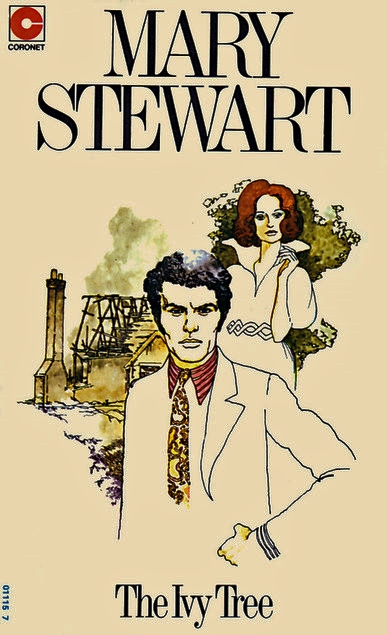
the ivy tree mary stewartThe Ivy Tree by Mary Stewart ~ 1961. This edition: Coronet, 1975. Paperback. ISBN: 0-340-01115-7 319 pages.

My rating: 7.5/10

This was my third Mary Stewart romantic thriller read in the last few weeks, and it was perhaps my favourite to date. Where This Rough Magic (1964) was set in exotic Corfu and referenced the English theatre world, Shakespeare’s Tempest, Communist politics in Albania, and a passionately fast-developing love affair between the heroine and a brooding hero-type, and Airs Above the Ground (1965) was set in the Austrian Alps and concerned itself with a complicated plot involving a happily married heroine, her two male companions, and a group of circus performers, The Ivy Tree is a much more sedate and personality driven story, and much more concerned with psychology rather than straight-out action as in the other two tales.

In this tale of family and inheritance and underhand plotting, the reader is never quite sure who is telling the truth, and what is really going on. The threads of the story wind about this way and that until the tapestry takes shape and the true picture emerges near the end. Told (as are the other two stories) in first person narration by the key female character, we are not quite sure if she is indeed the heroine in the accepted sense, for her actions are unreliable and her inner dialogue frequently less than frank with the reader. And though there were occasional credibility gaps in this story – as in the others – by and large it was an intriguingly detailed mystery.

Here is the basic plot outline, from the flyleaf of a 1962 edition:

Mary Grey had come from Canada to the land of her forebears: Northumberland, where Hadrian built his wall nearly 2000 years ago. As she leaned against the sun-warmed stones, savoring the ordered, spare beauty of England’s northern fells, the silence was shattered by a single name hurled, as it were, like an epithet:

“ANNABEL!”

And there stood one of the angriest, most threatening  young men Mary had ever seen. His name was Connor Winslow, and from his spate of words Mary discovered that he thought she was his cousin–a girl supposedly dead these past eight years. Alive, she would be heiress to an inheritance Con determined to have for himself…

Thus begins the story of an impersonation fraught with the perils of treading present depths without the buoyancy of an innocent past. To it, Mrs. Stewart brings her remarkable ability to create atmosphere be it joyous, brooding, or terrifying. And with her acknowledged talent for characterization, she delineates sharply the savage, ruthless, half-sardonical Con; his drab half-sister, Lisa, firm only in her dedication to Con and his wishes; arrogant Matthew Windlow, a failing tyrant, by tyrant nonetheless where his family was concerned; the ebullient, sometimes rebellious Cousin Julie; and Adam Forrest, the reserved owner of neighboring Forrest Hall,  now a widower, but eight years before, inextricably tied to a hysterical, neurotic wife and tormented by his love for Annabel.

With admirable skill, Mary Stewart practices the full scale of uncertainty while developing a theme embellished with the rich overtones of atmosphere and characterization.

That’s the basic outline, but the story itself is even more complex than this summary would indicate. Though some of the characters – including the true love interest of the heroine – never received much more than a superficial characterization, many of the others were nicely portrayed, showing realistic complexities of good and bad, and delving into motivations, and justifying contradictory behaviours in a most believable way.

Josephine Tey’s Brat Farrar was an obvious inspiration, and the author openly acknowledges that, giving the novel to her characters as a guidebook to their own planned deception; I enjoyed the parallels, as Brat Farrar is one of my favourite Teys (if there can be such a thing – I do love every single one of Josephine Tey’s too-few novels), and Stewart’s take-off of it was different enough to hold my interest.

I won’t say much else; this is a novel that rewards coming to it without too much foreknowledge of the crucial details of the plot.

The “what bugged me” bits were similar to the other Mary Stewarts I’ve just read: a too-convenient disposal of the “bad” character(s), with a rather too-rushed and too-neat conclusion. There were some fairly major holes in the story, and readerly questions left unanswered; I am thinking that one must just put up with this tendency of the author’s and enjoy the enjoyable bits regardless, but it does stop me from rating the books higher on my personal scale.

Last thought: well done. I will be reading this one again; I enjoyed it.

The Ivy Tree was read and reviewed for Mary Stewart Reading Week , September 15th to 21st, celebrating the author’s long career and her 97th birthday on September 17th, 2013. Mary Stewart Reading Week was initiated and hosted by Gudrun’s Tights.

Read Full Post »

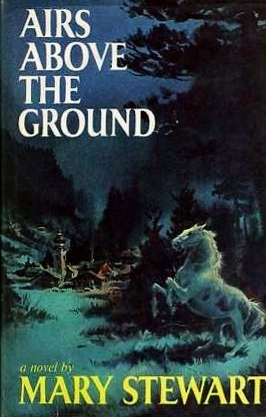
airs above the ground mary stewartAirs Above the Ground by Mary Stewart ~ 1965 . This edition: Mill-Morrow, 1965. Hardcover 286 pages.

My rating: 7/10

This was my second title tackled in honour of Mary Stewart Reading Week , September 15th to 21st, which celebrates the author’s long career and her 97th birthday on September 17th. (MSRW was conceived and hosted by Mary Stewart fan Anbolyn of the excellent book blog Gudrun’s Tights.)

Carmel Lacy is the silliest woman I know, which is saying a good deal. The only reason I was having tea with her at Harrods on that wet Thursday afternoon was that when she rang me up she had been so insistent that it had been impossible to get out of; and besides, I was so depressed anyway that even tea with Carmel Lacy was preferable to sitting alone at home in a room that still seemed to be echoing with that last quarrel with Lewis. That I had been entirely in the right, and that Lewis had been insufferably, immovably, furiously in the wrong was no particular satisfaction, since he was now in Stockholm, and I was still her in London, when by rights we should have been lying on a beach together in the Italian sunshine, enjoying the first summer holiday we had been able to plan together since our honeymoon two years ago. The fact that it had rained almost without ceasing ever since he had gone hadn’t done anything to mitigate his offense; and when, on looking up “Other People’s Weather” in the Guardian each morning, I found Stockholm enjoying a permanent state of sunshine, and temperatures somewhere in the seventies, I was easily able to ignore reports of a wet, thundery August in southern Italy and concentrate steadily on Lewis’s sins and my own grievances…

So when definitely-silly-but-self-indulgently-manipulative Carmel, scenting trouble in Vanessa’s married paradise, drops a seemingly casual comment that she has just seen Lewis in a newsreel clip about a tragic circus fire in Austria, Vanessa is completely floored – Lewis is supposed to be in Sweden, and she has a properly postmarked note from him to prove it, dated the same day as the Austrian incident. She manages to save face by some on-the-fly fabricating, and when Carmel asks Vanessa to accompany her (Carmel’s) nineteen-year-old son Timothy on a flight to Vienna to visit with his father – the Lacys are divorced and not really on speaking terms, hence the difficulties in arranging the travels of their son – Vanessa decides to go along with the plan to find out just what Lewis is up to. Particularly when her own covert perusal of that newsreel shot shows Lewis with his arm around a very beautiful young girl…

It just so happens that Timothy’s visit to his father is not as it seems either, and when he and Vanessa bury their initial resentment at being saddled with each other, they swap information and decide to team up in order to track down the errant Lewis, and allow Timothy to pursue his primary goal in visiting Austria, which is actually to gain an entry of some sort into the stable area of the famed Spanish Riding School. For Timothy is horse-mad, and longs to forge a career among the Lipizzaners, while Vanessa just happens to be a qualified veterinarian, spinning her wheels more than a bit as she has, in era-correct style, put her promising personal career on indefinite hold due to her marriage to the enigmatic, oft-travelling Lewis.

Vanessa and Timothy form one of the most downright adorable platonic couples I’ve come across in my many years of reading; Mary Stewart is on a decidedly playful roll in this novel as she sends them on their bantering way together.

We also have a small family circus full of accomplished artistes, some fabulous horsemen and horsewomen – one of whom happens to be the girl in the newsreel footage, bitter wartime and personal histories, tragedy, intrigue, romance, hidden identities, mysterious packages, jewels (or is that “jewels”?), large quantities of cocaine, brooding mysterious Eastern Europeans, beautiful (and valuable) horses, struggling aristocrats, amazing alpine scenery (described in long-winded detail by our author), a castle, a cog railway, close calls beyond count, threats and violence and brandished pistols and REVENGE. (Am I missing anything?!)

I truly loved most of this unlikely tale, and in particular the three-way relationship between Vanessa and her two male companions. I loved that the heroine was married, and that the mutual affection and physical attraction between her and her husband was portrayed in such a positive way, though I didn’t love the lack of spousal communication from Lewis’s end. But this was redeemed by Vanessa’s forthright dealing with the situations she found herself in, and her cool head and steady hand throughout.

I found myself completely bemused by Lewis’s actual occupation; I ended the story with a great big question mark floating up there in the air above my head, but I waved it away because by that time it didn’t really matter. There was a completely unlikely and over-the-top (pun intended) chase scene across castle rooftops, with the good characters escaping death by mere centimetres and the bad guys meeting their inevitable comeuppance. Oh, and a twist on the maiden-on-the-railway-track scenario, with a suitably last-moment rescue. The horse bits were reasonably well-written, though the Great Big Equine Secret was easy to guess and exceedingly improbable; my willing suspension of disbelief bobbled seriously around that bit, and, along with the rooftop chase scene, knocked my rating down a few points.

All in all, a very diverting vintage read, showing its age throughout, but enjoyable nevertheless. This one will stay on the shelf, though I suspect quite some time will pass before I feel the urge to read it again.

Read Full Post »

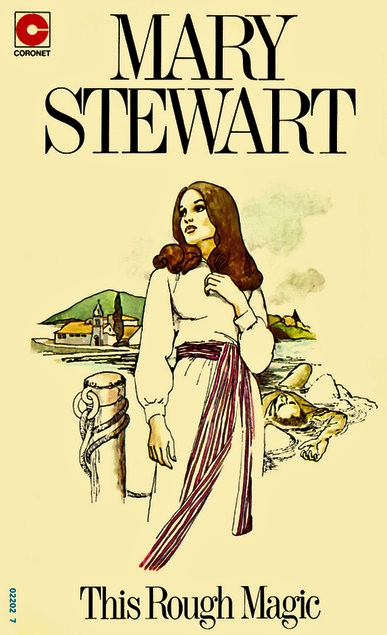
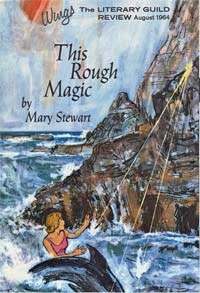
TThis Rough Magic Mary Stewart Coronet paperbackhis Rough Magic by Mary Stewart ~ 1964. This edition: Coronet, 1974. Paperback. ISBN: 0-340-02202-7. 255 pages.

My rating: 6/10

I haven’t read Mary Stewart for absolutely years and years, and now I remember why. This book was so full of action and plot twists that it was positively exhausting! In a mostly good way, but by golly, I had to pay attention.

I have collected a number of Mary Stewart novels in the past few years, as part of the personal circulating library I maintain and continually add to for my housebound elderly mother, but for some reason I have not dipped into them myself, perhaps because I rather overdid it on them in my teen years, and somehow felt I had moved on.

The Mary Stewart Reading Week , September 15th to 21st, celebrating the author’s long career and her 97th birthday which is actually today, September 17th, has been planned and hosted by a fellow book blogger whose site I greatly enjoy, Anbolyn of the intriguingly named Gudrun’s Tights. I share so many of the same tastes as Anbolyn, I was thereby moved to give Mary Stewart another go in honour of this occasion. I’ve just finished This Rough Magic, am well started on Airs Above the Ground (early impression – excellent – I’m really loving this one), and expect to tackle The Ivy Tree next, and possibly Touch Not the Cat, if I can squeeze it into my travelling bag. We’re about to head out on a week-long driving adventure in our very small vintage sports car, so paperbacks are the order of the day, and TNTC is a hefty hardcover, so it might not be allowed.

So here is a quick rundown on This Rough Magic. The clock is ticking loudly this morning, and I need to soon be up and away from the computer. so I’ll see if I can keep it short and to the point. (I do tend to run on…) My husband is in the kitchen making waffles, a special treat though a rather complicated production – he is skilled at a very few particular items, excellent waffles being one of them – but is not the most efficient of cooks, so I have a bit of time. Let’s see what I can do.

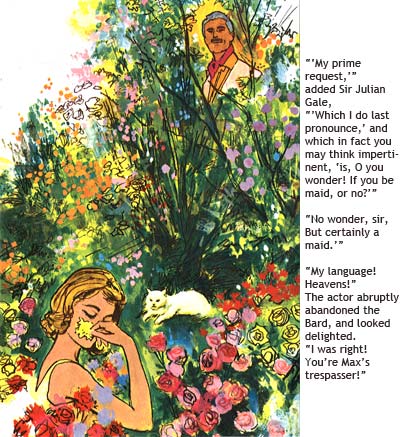
A not much more than mediocre London actress, our heroine and first person narrator, Lucy Waring, is “resting” at her wealthy-by-marriage older sister’s villa on the Greek Island of Corfu. Basking in the sunshine and catching up on news with her beloved sister (who is, incidentally, happily very pregnant with her third child), the sting of the ignominious ending of Lucy’s first big theatrical role is fading fast. And there is a lot to catch up on. A neighbouring villa is temporary home to a certain Godfrey Manning, a wealthy world traveller, author and photographer, who is writing a book about Corfu, while the venerable and famous Julian Gale, a noted Shakespearian actor, is reclusively resident in the rather derelict Castello dei Fiori, accompanied by his son Max, an accomplished composer.

The first inkling that there may be troublesome events brewing to disturb Lucy’s peaceful holiday is when she takes a solitary swim in the bay, and has an initially terrifying encounter with a people-friendly dolphin. She makes the shore, realizes that the dolphin is merely trying to play, and ventures back into the water with him, when her joy at the dolphin’s advances turn to horror as she realizes that someone is shooting at it with a silenced rifle. Catching a glimpse of a figure in the woods above the bay, she storms up to confront the suspected gunman, only to be rudely rebuffed by Max Gale. He denies any knowledge of any shooting, and sneers at Lucy’s allegations, accusing her of being overly dramatic. She comes away feeling that she’s come off poorly in the encounter, which is depressing as she greatly admires Max’s father, and had rather wanted any encounters with the Gale family to be good ones.

The next dramatic thing that happens is the tragic loss at sea of her sister’s maid’s twin brother while out on a nighttime sail with the enigmatic Godfrey Manning, followed soon after by Lucy’s shocking discovery of a drowned body, which she at first thinks is the brother, but who turns out to be a local fisherman rumoured to be involved in the local side industry of smuggling to the nearby closed Communist country of Albania.

Ah, yes, for this is the 1960s, and Communism and the Cold War are at their full-blown peak; something one has to remember when considering the following plot twists and turns.

Lucy tenaciously goes on her way familiarizing herself with Corfu and meeting the locals. She makes friends with Sir Julian, and is casually courted rather by the über-self-confident Godfrey, but does not seem to be making much headway with the glowering and still-hostile Max.

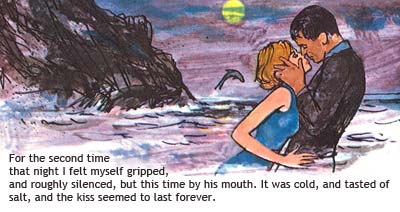
Until, that is, a midnight encounter involving the dolphin, a fabulous diamond ring, and a passionate embrace (page 101) while hip-deep in the phosphorescent sea. Now we’re cooking with gas, as the saying goes, and the action really picks up.

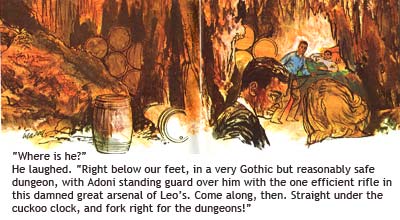
Smugglers, Communist spies, murderers, counterfeit money, mad motorcycle rides, burning kisses, and secrets galore are all involved from here on in; the ending is shockingly explosive (literally) while the heroes and heroines escape relatively unscathed and the bad guys are suitably knocked down to size.

Wow! That was exhausting just to read. <Fanning myself with book.>

But here’s the kicker. Did I really like this book?

Parts of it, definitely. I loved the author’s intelligence and the offhand way she assumes her readers are as literate as she is; continual snippets of quotation pop up both in the chapter headings and throughout the narrative; I caught some and suspect there were others that flew by me. I liked the heroine’s matter-of-fact assessment of her own skills as an actress, and her blunt description of her not-quite-stellar career; I enjoyed her voice for the early part of the story, before she became embroiled in the inevitable romantic entanglements later on.  I enjoyed many of the author’s descriptive passages; she very obviously has experienced and/or intimately researched her setting.

But other parts, particularly towards the end as the suspense builds, I don’t like so much. We can see the passionate response to the brooding mystery man coming from a long, long way away; methinks the lady falls too fast and too hard; her previous self-assessment and obvious sophistication in the ways of the world make her impulsive abandonment of good sense hard to stomach.

The action sequences I found to be overworked and more than slightly unbelievable; the dolphin bits as well as the motorcycle ride and the subsequent cat-and-mouse escapades with the murderous criminal mastermind of the slightly implausible mystery. The whole Tempest connection is overworked (in my opinion) and played out beyond its initial appeal as a clever “hook”. The aging actor’s save-the-day performance was absolutely no surprise to me at all; I suspect that this would pop up at some point, and by golly, how right I was. The convenient demise of the bad guy was too convenient, tidying things up just a bit too suddenly and, if I dare say, too appropriately. The God-like hand of the author is very evident in the dénouement; she might as well have tied a bow on this one; it was decidedly wrapped up at the end! The whole political element continued to confuse me even after I reread key points – such as they were – I felt that it was sketchy all the way through.

I did however enjoy reading the story; it helped a lot to have undertaken it as part of a participatory event, and I will be interested to read others’ thoughts on This Rough Magic, if anyone chooses to read it for the Mary Stewart Reading Week. (Returning to add that I see a few others have indeed done so – excellent!) The good bits were very good; the other bits were acceptable if viewed through “I’m reading a vintage book” lenses; I can see why Mary Stewart is beloved of so many readers, even though I cannot count myself among one of her true fans, at least not quite yet. I am looking forward to reading more of her titles; I feel, after reading This Rough Magic, that the author’s work has more to offer than it at first appears.

Onward then, to Airs Above the Ground, and The Ivy Tree, my other two Mary Stewart Reading Week choices.

Oh – edited to add something – what a find! – several delicious illustrations from the Mary Stewart Novels BlogSpot. I found these when looking for an illustration of my particular copy’s cover; my book is who-knows-where, as I’ve been away from the computer and my desk for eight days, so I am trying to cheat on having to find it to scan it myself.

Enjoy!

This Rough Magic Mary Stewart Illustration 1A Cover Literary Guild ReviewThis Rough Magic Mary Stewart Illustration 1This Rough Magic Mary Stewart Illustration 2This Rough Magic Mary Stewart Illustration 3

Read Full Post »

« Newer Posts - Older Posts »