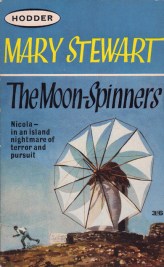
 The Moon-Spinners by Mary Stewart ~ 1962. This edition: Hodder, 1964. Paperback. 264 pages.
My rating: 9/10
I don’t know what it is – perhaps the snowy weather and the early dark evenings – but this book completely hit the spot with me a few nights ago, following through to the next day as I surreptitiously raced to finish it off in between my proper occupations.
Maybe the appeal comes from the sunny setting – the Isle of Crete at Easter, mountains alive with wildflowers – or possibly just the perfectly adorable love interest of our intelligent heroine – he’s slightly mysterious, rather handsome, charming even on his bed of pain, plus he throws himself wholeheartedly into the fray-of-the-moment, particularly if it’s to avenge damage done to his lady-love.
It certainly doesn’t hurt that The Moon-Spinners is quite beautifully written for its genre, in what I’ve come to realize is Mary Stewart’s trademark detailed travelogue style. It assumes a certain degree of intellectual and general knowledge among its readers, and refuses (for example) to reference in-text literary allusions, assuming our familiarity with them, something I always appreciate when done in an appropriate fashion, as a natural part of the narrator’s voice.
The action scenes were relatively short, though no more believable than any of Stewart’s other escapades, and I found I managed to get through them with only a raised eyebrow, not an outright snort of indignation. Let’s see, now. The heroine is attacked once with a knife and once with a fish spear (the spear episode is while in the water, of course, with the heroine scantily attired in her underthings), and she is present while bullets fly about willy-nilly but ultimately harmlessly, and she manages to bring the chief villain to grief at the very end with a spur of the moment intervention. There are two successful murders (well, perhaps more of the lost-my-temper manslaughter-type murders versus deliberate planning) plus at least one attempted murder, all in just the first few days of what was supposed to be a restful botanizing vacation.
Stewart gets the flowers right, and includes a clever Linnaean word-joke or two which I greatly appreciated, being of the horticultural persuasion myself. The whole novel is packed full of heart-racing action and instant romance, which keeps things clipping right along. The side characters – the heroine’s older cousin, the hero’s local-boy sidekick and charming younger brother – are a fabulous addition to the story, and allow for an abundance of humorous repartee. Even the surviving villains are quite a lot of fun, if you’ll forgive my using “fun” in the same breath as “murderous villain”. One is prone to violent loss of temper, the other tiptoes around anything messy with faint disdain – “Well, I’d hate to have to kill you, but you leave me no choice. Oh, better yet, I’ll leave it up to my brutish sidekick here to deal with you. I just don’t want to know!” Together they make a diverting team, in every sense of the word. The murderees themselves are unlikable thug types, so we don’t shed too many tears at their demise.
What else can I say? Loved it. The best Mary Stewart I’ve read yet, though My Brother Michael comes close. (Must also post some thoughts on that one, some day.)
So, the story.
It was the egret, flying out of the lemon-grove, that started it. I won’t pretend I saw it straight away as the conventional herald of adventure, the white stag of the fairy-tale, which, bounding from the enchanted thicket, entices the prince away from his followers, and loses him in the forest where danger threatens with the dusk. But, when the big white bird flew suddenly up among the glossy leaves and the lemon-flowers, and wheeled into the mountain, I followed it. What else is there to do when such a thing happens on a brilliant April noonday at the foot of the White Mountains of Crete; when the road is hot and dusty, but the gorge is green, and full of the sound of water, and the white wings, flying ahead, flicker in and out of deep shadow, and the air is full of the scent of lemon-blossom?
Lovely young Nicola comes on holiday to a remote village in Crete. Arriving a day early for a planned rendezvous with her cousin, she wanders into the hills and is assaulted by a knife-wielding Greek; he then takes her to a hut in which she finds a wounded Englishman, Mark. Much swearing to secrecy results; the hiding-out is because Mark’s fifteen-year-old brother has been kidnapped by a gang of thugs, one of whom shot Mark and left him for dead; Mark and Greek pal (Lambis) have realized that killer is now out searching for the not-quite-as-dead-as-thought Mark, to finish him off. A deadly game of cat-and-mouse keeps tension high as the various characters dash (or limp) from nook to cranny to shepherd’s bothy to niche-in-rock-cliff to ancient temple.
After spending the night nursing Mark, Nicola reluctantly goes off down to the village, plays all innocent, and sleuths away like mad. The small hotel where she is booked to stay is run by an oddly assorted partnership. One is a local man, Stratos, returned from years away in England with a nest egg which he is investing in the hotel; the other is his English partner, Tony, a fabulous cook , darling – and also bar-man and waiter and general manager. Tony is much given to gushing extravagances of speech; his dialogue is well-peppered with italics. I wonder rather if Mary Stewart is trying to portray something more than personal eccentricity here; if this novel were a few decades older Tony would be the quintessential “catty gay guy” we see so frequently in contemporary chick lit. As it is there are one or two possibly double entendre references to Tony not being the heroine’s type, and her older cousin Frances, a sophisticated type herself, is quite catty in regards to Tony, calling him “Cedric” after the literary Little Lord Fauntleroy.
Anyway, Nicola snoops about, discovers that all is not as it seems in this peaceful little village, identifies the villains, discovers the fate of the kidnapped boy, foils the nefarious plottings of the gang of villains, and finds true love. This takes several hundred pages, but they are filled with incident and description and clever conversation and in general are a pleasure to read. A good read indeed, completely effortless and a fabulous diversion from the onset of the Canadian winter.
Oh, and the “moon-spinners” of the title. I thought at first this was a reference to the Cretan windmills, as these are a feature of almost every one of this novel’s cover illustrations I’ve seen. You know, round, like the moon; spinning, because they’re windmills. But though a windmill features importantly in the narrative – hence the illustrations – the moon-spinners referred to are something quite different. Here is Nicola, telling their story:
They’re naiads – water nymphs. Sometimes, when you’re deep in the countryside, you meet three girls, walking along the hill tracks in the dusk, spinning. They each have a spindle, and onto these they are spinning their wool, milk-white, like the moonlight. In fact, it is the moonlight, the moon itself, which is why they don’t carry a distaff. They’re not Fates, or anything terrible; they don’t affect the lives of men; all they have to do is to see that the world gets its hours of darkness, and they do this by spinning the moon down out of the sky. Night after night, you can see the moon getting less and less, the ball of light waning, while it grows on the spindles of the maidens. Then, at length, the moon is gone, and the world has darkness, and rest, and the creatures of the hillsides are safe from the hunter, and the tides are still . . .
Then, on the darkest night, the maidens take their spindles down to the sea, to wash their wool. And the wool slips from the spindles into the water, and unravels in long ripples of light from the shore to the horizon, and there is the moon again, rising above the sea, just a thin curved thread, re-appearing in the sky. Only when all the wool is washed, and wound again into a white ball in the sky, can the moon-spinners start their work once more, to make the night safe for hunted things . .
Worth reading the book, just for the bits like that. I’m liking Mary Stewart more and more!
One more note. Disney made a 1964 movie based on this novel, starring Hayley Mills. It sounds like “loosely based” is more accurate; descriptions of the Disney production show that the plot diverges widely from Mary Stewart’s crisp thriller. Apparently no expense was spared in the making of the film, which was filmed on location in Crete, with Disney rebuilding a war-damaged village and engaging local people as background players. I’ve not seen it myself, and from the sounds of the plot changes, would not find the Disneyfied version of the story terribly appealing, but I would like to see the physical setting. Has anyone both read the book and seen the film? If so, would love to hear your thoughts!
Read Full Post »
 The Rosie Project by Graeme Simsion ~ 2013. This edition: Harper Collins, 2013. Softcover. ISBN: 978-1-44342-266-6. 329 pages.








 Leaves & Pages
The Gilded Ladder by Laura Conway
Posted in 1940s, Century of Books - 2014, Read in 2014, tagged Century of Books 2014, Dorothy Phoebe Ansle, Hebe Elsna, Historical Fiction, Laura Conway, Light Fiction, Relationships, Romance, Social Commentary, The Gilded Ladder, Vintage Fiction on January 23, 2014| 4 Comments »
My rating: 5/10
Found recently among my mother’s stored-away books was this mildly engaging relationship novel. (One can’t really slot it neatly into the romance category as it has larger ambitions, and the love affairs are off on the sidelines as compared to the niece-aunt partnership at the centre of the drama.)
It is just good enough to get a pass from me, though I doubt it will be high on the re-read list. A keeper, I think, though one for the bottom shelf. It pleasantly helped while away the time I spent in the orthodontist’s waiting room yesterday while my son was getting his braces tightened up a few more notches.
Young Lucy Erskine, ten years old in 1888 when this novel opens, is slightly in awe of her Aunt Madelon. Lucy’s mother is dead; her father’s new wife has produced two step-siblings, and Lucy feels rather out of things and appreciates the occasional attention she receives from her father’s rather glamorous unmarried sister who resides in a small suite of antique-furnished rooms in the Erskine family home.
Lucy has a small but genuine talent for music, both for playing the piano and for composing original little melodies, which Madelon notices and files away for future reference as a trait worthy of further encouragement. Madelon herself is fully occupied with hoisting herself up on the social scale – the “gilded ladder” of the title – and she gains each rung by strenuous though hidden exertions and more than a little single-minded plotting.
In Lucy’s tenth summer, all are agog at the upcoming marriage of Madelon’s old school chum, Lady Pamela, to a wealthy young man who cherishes an altruistic interest in slum projects. Lady Pamela hesitates at the thought of David’s plans to turn the major part of their prospective home into a convalescent hospital for ailing factory girls and as Pamela momentarily bobbles, Madelon slinks in and scoops away the fiancé. Marrying in haste, the two decamp on a honeymoon in France, but tragedy strikes and David is killed in a railway accident, leaving Madelon a devastated widow, albeit an exceedingly wealthy one.
Back then to the Erskine family home, where yet more tragedy has occurred, for Lucy’s father has suddenly died. Bereft Madelon, looking about for a new interest to assuage her grief, offers to give a home to young Lucy, and our story is off and running.
Madelon is truly fond of her niece, but can’t resist speculating about the possibilities of Lucy’s mild accomplishments as a minor musical prodigy to gain entry into noble drawing rooms. Tea for auntie, and a command performance from pretty little Lucy is the unspoken “deal” Madelon makes with her acquaintances in the social strata directly above her own, for Madelon’s new wealth, and, ironically, her past friendship with Lady Pamela, have given her a renewed taste for the joys of class climbing.
The novel wends on its way following Madelon’s steady social progress, and detailing Lucy’s growing awareness of her aunt’s manipulative ways, which Lucy starts to quietly confound when they touch upon herself. Lucy’s growing self-awareness and her rather clever provisioning for an life independent of her aunt’s control were rather admirable and renewed my interest in the plot, which had started to flag just a little.
This is a shortish novel, so things do keep moving at a respectable pace right up until the last chapter, where Lucy’s love affair, originally sabotaged by jealous Madelon’s manipulations, promises to finally come out all right. Madelon herself gets a brutally permanent comeuppance: she perishes rather dramatically just as she reaches the pinnacle of her social ambitions.
More irony here, for, as the author delicately informs us, Madelon’s bitterly hard-won ascent up the social scale is about to be rendered obsolete, as mere wealth alone is now becoming the golden ticket to social status. Madelon was born a generation too early; her long-sought-for prize is merely gilded base metal, and her tragedy is only appreciated by Lucy, who has loved her manipulative aunt for the good qualities of her personality, and by Lady Pamela, who has forgiven Madelon for the long-ago treachery of the stolen husband-to-be.
The writing is far from stellar, being rather pedestrian, more tell than show, full of awkwardly-written dialogue from the lower-class characters, and with the characters remaining at arm’s length from the reader. Despite the flaws, it was well-paced and just good enough to hold my interest, though as the climax of the story approached the strands of plot were increasingly predictable. No surprises there, but I have encountered much worse in some of the “bestsellers” of our present day (Rosemary Pilcher, your name springs to mind), and it was a mostly painless reading experience, though I cringed at the pat predictability of the last few pages.
Though The Gilded Ladder is decidedly a formula story, it is a well-polished one. A search of the internet to find out more about the author yielded little in the way of biographical insight, but it did produce some rather startling information.
Laura Conway was one of the pseudonyms of the terrifically prolific Dorothy Phoebe Ansle, who published, between 1928 and 1982, something like one hundred (!) popular novels under a variety of names, including Hebe Elsna, Vicky Lancaster and Lyndon Snow.
A long list appears on the Fantastic Fiction – Hebe Elsna web page, and the titles are surprisingly intriguing. Now I don’t recommend you rush out and acquire any of these. If The Gilded Ladder is a fair example of the author’s output then it is a very average sort of casual romantic fiction aimed at the housewife market (forgive my using that phrase – it’s not meant to be derogatory of actual housewives, of whom I myself am one, merely descriptive of a certain cliché) and certainly not “literary”.
But don’t some of these sound quite fascinating in an “Oops, I didn’t do the dishes as I was too wrapped up in my latest dime novel” sort of way?
What could This Clay Suburb concern? What is a Receipt for Hardness? Is it really true that Women Always Forgive? What happened The First Week of September? Are Marks Upon the Snow as sinister as they sound?
I sadly suspect that the titles may be the best part of many of these…
Read Full Post »