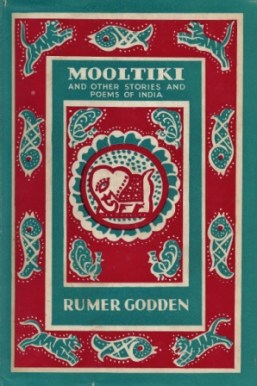
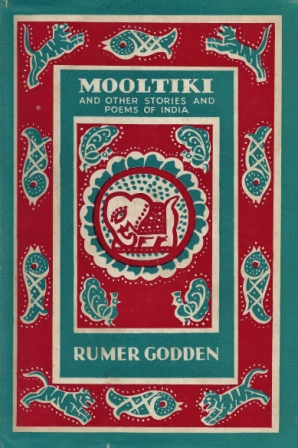
Mooltiki and Other Stories and Poems of India by Rumer Godden ~ 1957. This edition: Macmillan & Co., 1957. Hardcover. 136 pages.
My rating: 7/10. Rather uneven collection of fair to excellent stories and mostly merely fair poems.
A slender volume of poems and short stories set in India.
BENGAL
Nothing can mollify the sky,
the river knows
only its weight and solitude, and heat, sun-tempered cold,
and emptiness and birds; a boat; trees; fine white sand,
and deltas of cool mud; porpoises; crocodiles;
and rafts of floating hyacinth; pools and water-whirls
and, nurtured in blue mussel shells, the sunset river pearls.
… … …
The rice field lay farthest from the village, nearest the road. On all sides the plain unrolled in the sun with a pattern of white clouds, white pampas grass in autumn and white paddy birds, and glimpses of sky-reflecting water from the jheels or shallow pools. The sky met the horizon evenly all the way round in the flatness of the plain, an immense weight of sky above the little field, but the old peasant Dhandu did not look at the sky, he looked at his field; he did not know that it was little; to him it was the whole world. He would take his small son Narayan by the wrist and walk with him and say, ‘This field belonged to my grandfather and your great-grandfather; to my father and your grandfather; it is mine, it will be yours.’
But life-plans may go horribly awry; Dhandu’s does not follow its anticipated path; in an ironic ending, which I somehow found reminiscent of W.W. Jacob’s The Monkey’s Paw, the field stays with Dhandu but is forever lost to his son.
- Sister Malone and the Obstinate Man
Sister Malone is a nun in charge of a charity hospital in Calcutta; she is unshaken by the horrible sufferings all around her and does great good with her nursing abilities, but her continual effort to share her religious faith with those she heals goes unheeded. One day Sister Malone meets a man who has truly put all of his trust in God, but she cannot reconcile this with her own conception of what faith should be.
Gopal, a Bhramini Hindu student who has travelled abroad to study in England, visits Paris with a friend and is forced to examine the role of compromise in the formation of his own developing character.
HIMALAYAN NOMADS
- The Goat People – Pastoral Poems
Nine poems inspired by the nomadic peoples of the Himalayas of Northern India.
The tribes pass all through the spring, pitching their camp at night and lighting their fires under a boulder, a fir tree, or by an ice stream; moving on again at dawn, driving with a peculiar trembling whistle that is their own, something between a hawk’s cry and a flute, harsh, sweet and wild…
… I have tried to make these poems like the people, rough and rhythmical … without symbolism or image, simple and pastoral.
The Meadow
The Caravan
Flowers for the Animals
The Elders
The Goat Women
The Animals
The Goat Children
The Goat Baby
Moving Downwards
A vignette of a young nomad riding up the mountain to fetch his unseen new wife. Sensitive and poignant.
An orphan boy, Jassoof,
… a young thief, a bully, noisy, quarrelsome and turbulent, against everyone with everyone against him…
finds his place in the world through his care of a black ram lamb.
KASHMIR
Another vignette piece, about a young Kashmiri hunter, Khaliq, who, longing for winter to be over, thinks of his time the previous year among the high mountains hunting ibex.
Just that; two sonnets. A regretful ode to winter; a joyful ode to spring.
Kashmiri Winter
Spring Sonnet
JUNGLE
This first-person short story (24 pages) is the jewel of this slight collection. Rumer Godden tells of her experiences in her sister and brother-in-law’s winter camp on the borders of Bhutan. Mooltiki, a small, opinionated elephant, is the “maid-of-all-work” of the camp, fetching firewood and providing transport for odd jobs, such as Rumer Godden’s small jungle explorations. Godden writes an amusing and appreciative ode to Mooltiki and her elephant kin, as well as an extremely evocative description of what if feels like to be involved as an observor in several “blinds” for problem tiger kills.
*****
Mooltiki is an interesting though quite slight collection of fictional short stories (except for the autobiographical title piece, decidedly the best part of the collection) and personal poems; after reading it through several times I must confess that my conclusion is that Godden was a much stronger writer of prose than of poetry!
Nicely done overall, with Godden’s trademark of strong, eloquent characterizations and descriptions of place. Definitely a work any Rumer Godden collector will want to have on the shelf; probably worth a purchase for Mooltiki alone, if it can be found for a reasonable sum.
The biggest fault is the shortness of the book; about an hour`s worth of reading, even if taking one`s time and savouring the beautifully nuanced style of most of the pieces. I thought the poems were the weakest point; some of the stories were excellent (Mooltiki, Red Doe, The Little Black Ram, and possibly Possession, stood out for me), while the others are merely good.
Recommended, with those reservations.
Read Full Post »
 SUMMER SOLSTICE










 Leaves & Pages