Posts Tagged ‘Mystery-Suspense’

the secret adversary agatha christie 2The Secret Adversary by Agatha Christie ~ 1922. This edition: Bantam, 1986. Paperback. ISBN: 0-553-26477-X.  215 pages.

My Rating: 7/10

Setting: Mostly London, with a few excursions into the countryside; immediately post Great War, 1919.

Detection by: Thomas Beresford (TOMMY) and Prudence Cowley (a.k.a. TUPPENCE)

Final Body Count: 2

Method(s) of Murder: POISON – death #1 from an overdose of chloral , and death #2 by cyanide

100 Word Plot Summary:

Who is Jane Finn, and why has she vanished after escaping from the sinking Lusitania with a secret document entrusted to her by its doomed courier? That paper could have changed the course of the war, but why is the British Secret Service still keen to recover it now, 5 years later? Why the competing hunt by a group of Bolshevik anarchists, led by the mysterious “Mr Brown”? Tommy Beresford and “Tuppence” Cowley, newly demobbed and desperate for jobs, join forces and market their services to Jane Finn’s rich American cousin, whose interest in her seems just a little overenthusiastic…

*****

Agatha Christie’s second published work is a slightly more ambitious story than The Mysterious Affair at Styles; and it’s changed in style as well: dramatic thriller rather than sedate country house murder mystery. The tone is breathless, the plot improbable, the villains all degrees of wicked (urbane to thuggish), and the “women in question” suitably mysterious – as well as stunningly beautiful. What a grand little period piece of colourful writing, silly though the whole scenario is.

Here’s the devious (and exotically lovely)  Mrs Vandemeyer, who, incidentally, knows more about “Mr Brown” than is healthy for her long-term survival:

A woman was standing by the fireplace. She was no longer in her first youth, and the beauty she undeniably possessed was hardened and coarsened. In her youth she must have been dazzling. Her pale gold hair, owing a slight assistance to art, was coiled low on her neck, her eyes, of a piercing electric blue, seemed to possess a faculty of boring into the very soul of the person she was looking at. Her exquisite figure was enhanced by a wonderful gown of indigo charmeuse. And yet, despite her swaying grace, and the almost ethereal beauty of her face, you felt instinctively the presence of something hard and menacing, a kind of metallic strength that found expression in the tones of her voice and in that gimlet-like quality of her eyes.

Gimlet eyes and indigo charmeuse; obviously up to no good. Beware!

Young adventurers Tommy and Tuppence are a rollicking change from the pompous Poirot and sober Hastings of her first novel; Agatha Christie was to follow The Secret Adversary with four other books featuring the pair, spaced throughout the years, with the characters aging appropriately.

Though I found this an amusing enough read, with plenty of nostalgia value, I couldn’t quite buy into the whole Bolshevist plot side of things; too many vagaries and improbabilities. (Even at my first reading as a young teenager, I recall a feeling of cynical disbelief; this was never one of my favourite Christies.) But so much scope of course for all sorts of shenanigans – secret identities, people vanishing, other people being tied up in windowless rooms, threats of torture, beautiful girls, invisible ink, car chases, shots fired that just miss our heroes – it’s all in here.

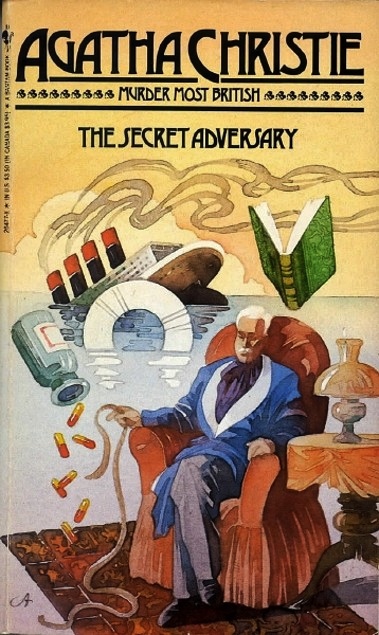
An early dustjacket - possibly from the first edition. Note the red flag and the Russian bear behind the mask of "Mr Brown"!

An early dustjacket – possibly from the first edition*. Note the red flag and the Russian bear behind the mask of “Mr Brown”! (February 2017 – A reader has just commented that this is not the first edition cover; that one apparently has a picture of a woman – presumably Jane Finn? – on it. I’ll keep an eye out for that one in my internet travels.)
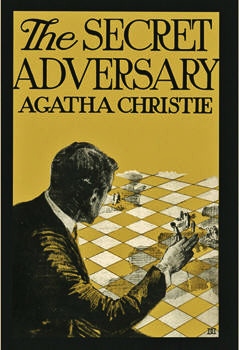
Another early dustjacket, with "Mr Brown" as the chess master moving his human pieces about the board.

Another early dustjacket, with “Mr Brown” as the chess master moving his human pieces about the board.
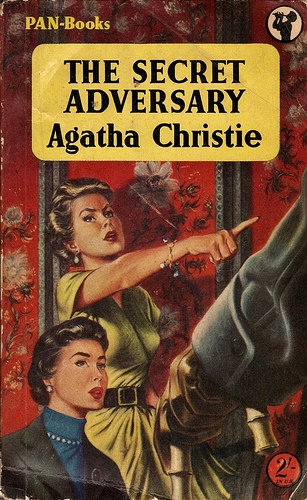
Tuppence with a tidy hairdo and a string of pearls; her companion much more appropriately tousled, considering the revolver covering them both... I'm guessing 1950s for this dramatic paperback jacket.

Tuppence with a tidy hairdo and a sedate string of pearls; her companion just a wee bit more appropriately tousled – though not much, considering the threatening figure in the foreground!  I’m guessing 1950s for this dramatic paperback cover.
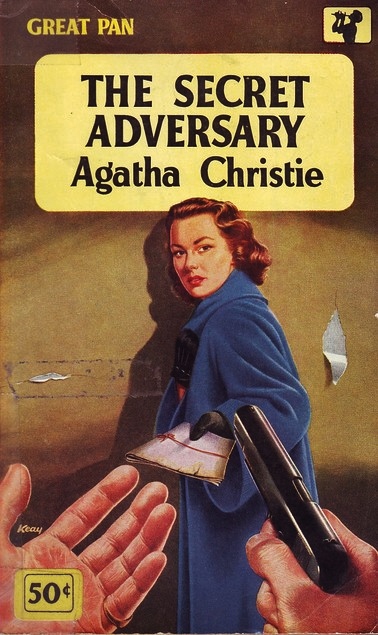
Another view from behind the handgun.

Another Pan paperback, this one for the North American market, and possibly released a few years later than the one just above. Great villains-eye view from behind the handgun.
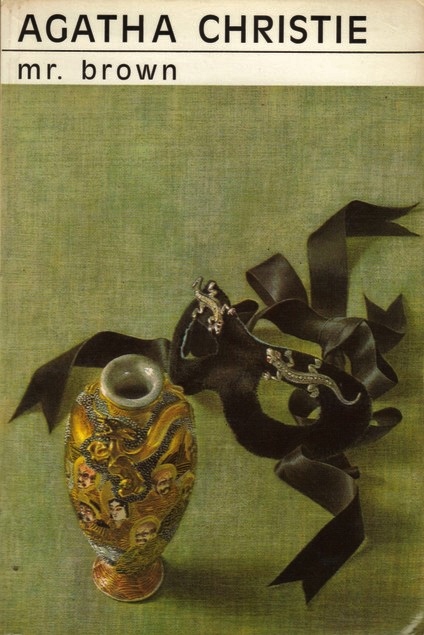
I couldn't resist including this gorgeous paperback cover, from a French edition.

I couldn’t resist including this rather elegant paperback cover, from a more recent (I’m guessing 1970s or 1980s) French edition.
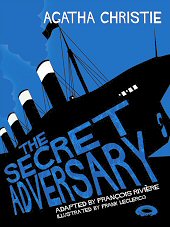
And from 2008, the cover of a graphic novel version, playing up the Lusitania connection.

And from 2008, this attractive poster-like cover of a graphic novel version, playing up the Lusitania connection.

Read Full Post »

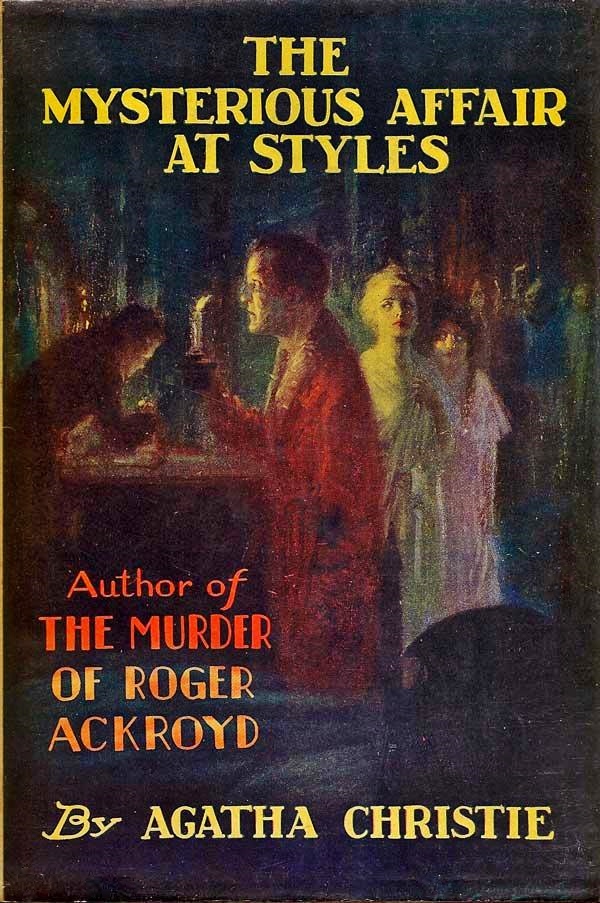
the mysterious affair at styles agatha christie 001The Mysterious Affair at Styles by Agatha Christie ~ 1920. This edition: Grosset & Dunlap, 1927. Fourth printing. Hardcover. 296 pages.

My Rating: 7/10

Setting: An English country House, Styles Court in Essex, sometime during the Great War.

Detection by: HERCULE POIROT, with “assistance” from CAPTAIN HASTINGS (narrator); INSPECTOR JAPP of Scotland Yard is introduced.

Final Body Count: 1

Method(s) of Murder: POISON – strychnine

100 Word Plot Summary:

When wealthy Mrs. Inglethorpe succumbs to a dose of strychnine, suspicion immediately falls upon her much younger (and forbiddingly black-bearded) second husband, Albert. But the philandering Albert has an ironclad alibi, as do all of the other members of the Styles Court ménage. Could it be the sweet young pharmacy assistant, with her easy access to poisons? Or either of Mrs. Inglethorpe’s adult sons, hard up for cash and living on their mother? Her daughter-in-law, cool and unemotional? Her lady housekeeper, outspoken and jealously loyal? Or perhaps the sinister German-Jewish doctor, who just happens to be an expert on poisons?

*****

Agatha Christie’s first published novel. Her very first, a romantic drama set in Cairo and sent out under the working title Snow Upon the Desert, was read and favourably remarked upon but ultimately refused by the publishers she sent it to.  The Mysterious Affair at Styles was inspired by her sister Madge’s comments that Agatha couldn’t possibly write a decent murder mystery. Written while working as a pharmaceutical dispenser during and just after the close of World War I, The Mysterious Affair at Styles is a classic puzzle mystery, with all clues revealed to the reader, and a generosity of suspects. The most unlikely person, of course, might ultimately be revealed as the murderer.

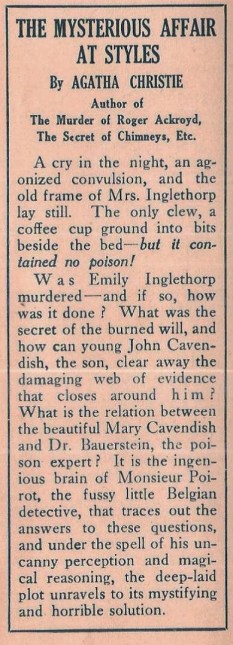
Front fold blurb from 1927 Grosset & Dunlap edition.

Front fold blurb from 1927 Grosset & Dunlap edition.

Narrated by a young Captain Hastings, who has been invalided out of active service, and is recuperating at his friend’s mother’s country home, Styles Court, the novel introduces Hercule Poirot, a finicky and eccentric Belgian ex-policeman. Poirot is living with several other Belgian refugees, and is eager to provide his investigative services when his generous sponsor, Mrs. Inglethorpe, dies mysteriously. Inspector Japp of Scotland Yard is also introduced; he and Poirot already know and like each other, and their collaboration, along with Captain Hastings’ inadvertent contributions, results in the solving of the murder plot.

Though decidedly dated and just a bit awkwardly plotted in spots, this is a very creditable mystery novel. The puzzle is truly hard to sort out; suspicion falls on each of the suspects in turn, and the ending is cleverly worked out. Poirot is not quite solidified into his final form, whom we come to know so well in future years – he was eventually to figure in thirty-three of Christie’s mysteries, and something like fifty short stories. The characters in general are puppet-like; aside from the narrator Hastings, we never get to know any of them – including Poirot – beyond their superficial appearances and stereotypical roles.

The murder itself occurs early on in the narrative, and Mrs. Inglethorpe’s horrible death is quite fully described, as Hastings is one of the witnesses. The brief mourning period for the victim is very soon over as the characters scramble to defend themselves against allegations of wishing for and ultimately causing her demise.

This is not at all a “literary” detective novel, such as those penned only a few years later by the other great “Golden Age” female mystery novelists Dorothy L. Sayers and Josephine Tey, but it is a well-constructed first attempt at the genre, and a grand little period piece, especially when considered in the context of Christie’s astoundingly prolific and successful later body of work.

Dust jacket of the 1927 Grosset and Dunlap edition. Can you see all seven of the suspects?

Dust jacket of the 1927 Grosset and Dunlap edition. Can you see six of the seven suspects? (Captain Hastings is also present, but he is apparently never considered as a possibility, due to lack of motive, I presume.)

Read Full Post »

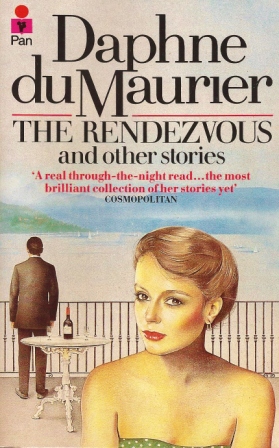
the rendezvous other stories daphne du maurier 001The Rendezvous and other stories by Daphne du Maurier ~ 1980. This edition: Pan, 1981. Paperback. ISBN: 0-330-26554-7. 234 pages.

My rating: The first and last stories in this otherwise rather mild collection elevate my rating to an overall 7/10. Otherwise, probably not more than a 5, or maybe a 6. All are worth reading, but most are not quite top-of-the-line for this particular author.

In the Preface, the author briefly explains her inspirations, and mentions that these stories show her development as a writer. I think a nice addition to this collection would have been dates of writing or of original publication; this would have added much to my own enjoyment as a long-time Daphne du Maurier reader.

*****

Some excellent, some not so much in this 1980 collection of short stories from throughout the author’s long career. All are very well written; the “less excellent” ones are described as such only in comparison to this author’s absolutely brilliant “best”.

  • No Motive ~ Why would a sweet-natured, happily married, expectant mother fatally shoot herself ten minutes after cheerfully ordering new garden furniture? One of the longer stories in this collection, and nicely plotted out. 7/10.
  • Panic ~ A casual love affair goes terribly wrong. Fabulously atmospheric, but ultimately slight. The dénouement comes as no surprise. 5/10.
  • The Supreme Artist ~ An aging actor gives a most superb performance off stage, and comes abruptly to an intimation of his own mortality. 6/10.
  • Adieu Sagesse ~ Two men from the opposite ends of the social spectrum plot their escape from tedious lives. Loved this one; the right people “win”. 8/10.
  • Fairy Tale ~ A slight and unlikely snippet of a story of a ne’er-do-well husband and his adoring wife. “Fairy tale”, indeed! 3/10.
  • The Rendezvous ~ I expected much from the title story of this collection. A successful author who has spent his life in observation finally arranges an “experience” for himself, only to be disappointed at every turn. In general, well done. But I wanted something just a little bit more. 6/10.
  • La Sainte-Vierge ~ Innocence and corruption. A snippet of a story, but very evocative of both. 5/10.
  • Leading Lady ~ Cherchez la femme… Another theatrical setting. Daphne used her eyes and ears well when about the backstage world. 6/10.
  • Escort ~ A maritime ghost story set in World War II. It’s been done before, but this attempt is reasonably decent. Nice detail on board the ghost ship. 5/10.
  • The Lover ~ A damning portrait of a rather vicious “lady’s man”. Didn’t really go anywhere as a story. 4/10.
  • The Closing Door ~ A young man faces up to a dire diagnosis. His lover unknowingly twists the knife. No shortage of symbolic situation in this one; I suspect it is one of the earlier efforts of the author. 5/10.
  • Indiscretion ~ Be careful what you say and who you say it to. Three lives are changed by a single sentence. A mite too contrived for my full enjoyment. 4/10.
  • Angels and Archangels ~ Religion and hypocrisy. The hypocrites win. A bitter little tale. 5/10.
  • Split Second ~ This story is the definite high point of the book. A middle-aged woman goes out for a walk, and comes away from a brush with death to a very different world. Or does she? Brutally pathetic, and perfectly written. 9/10.

Here’s another assessment of this collection:

Savidge Reads – The Rendezvous and other stories

Read Full Post »

some buried caesar rex stoutSome Buried Caesar by Rex Stout ~ 1939. This edition: Contained in All Aces: A Nero Wolfe Omnibus, Viking Press, 1958. Hardcover. Also published as The Red Bull in some editions. 153 pages.

My rating: 8/10.

*****

What with the immense number to choose from, with over seventy novels and novellas to the author’s credit, I’m nowhere close to having read all of Rex Stout’s clever and generally complicated tales starring private investigator Nero Wolfe (the more than slightly eccentric orchid aficionado, world-class gourmet, and superior thinker, with a most well-functioning brain residing in a body famously weighing, as we are often informed, a full one-seventh of a ton – a much rarer bulk back in the 1930s when Wolfe was created by Stout than we are used to today; I am quite sure I have seen a few gentlemen of this poundage and beyond in our nearest large city, though Wolfe would no doubt eschew the shopping mall food courts where many of my sightings have take place) and his trusty Man Friday – as well as Saturday, Sunday, Monday, Tuesday, Wednesday and Thursday – Archie Goodwin. (Note to eagle-eyed readers and red-pencil holders, please forgive this complicated run-on sentence. I bemuse myself sometimes … punctuation scattered at will, stream-of-consciousness posting going full speed ahead …)

I am going to assume everyone reading this is at least generally familiar with Nero Wolfe, by reputation if not from personal experience, and from his rock solid position in the American mystery fiction canon, so I won’t go into too much background detail. Suffice it to say the Nero Wolfe is a superior thinker, doing all of his detective work sitting down, usually with eyes closed after a gourmet meal created by his private chef, Fritz. (Shades of Hercule Poirot’s “little grey cells”, but infinitely more cerebral, if that is possible.) Live-in employee Archie is the legs of the outfit, and, frequently, the eyes, ears and hands as well, especially when a female client calls. While Wolfe has a definite misogynist streak, Archie appreciates all things feminine, though he doesn’t allow a pretty figure and face to distract him from his duties. Well, most of the time, that is …

One thing for certain about Nero Wolfe is that he strongly dislikes having to leave his comfortable 4-story brownstone house in New York. He strongly distrusts the internal combustion engine, and assumes the worst of any vehicle, ascribing a sentient malevolence to the machinery, which mistrust is occasionally borne out, as in Some Buried Caesar. We are rather shocked to realize that not only is Nero Wolfe out and about in a car, but that the occurrence has satisfied his deepest misgivings, and the vehicle has indeed been involved in a crash. Archie is, as always, the narrator of the tale.

That sunny September day was full of surprises.

The first one came when, after my swift realization that the sedan was still right side up and the windshield and windows intact, I switched off the ignition and turned to look at the back seat. I didn’t suppose the shock of the collision would have hurled him to the floor, knowing as I did that when the car was in motion he always had his feet braced and kept a firm grip on the strap; what I expected was the ordeal of facing a glare of fury that would top all records. What I saw was him sitting there calmly on the seat with his massive round face wearing a look of relief – if I knew his face, and I certainly knew Nero Wolfe’s face. I stared at him in astonishment.

He murmured, “Thank God,” as if it came from his heart.

I demanded, “What?”

“I said thank God.” He let go of the strap and wiggled a finger at me. “It has happened, and here we are. I presume you know, since I’ve told you, that my distrust and hatred of vehicles in motion is partly based on my plerophory that their apparent submission to control is illusory and that they may at their pleasure, and sooner or later will, act on whim. Very well, this one has, and we are intact. Thank God the whim was not a deadlier one.”

Did you catch the obscure word  in this passage? Reading Rex Stout is an education all in itself, if you stop to take the time to investigate Nero Wolfe’s arcane terminology. I’ve never come across this one before: plerophory. According to my highly intellectual (ahem) search for a definition (I Googled it), plerophory means “a fullness, especially of conviction or persuasion; the state of being fully persuaded.”

All right, digressions aside, and on to the story. I’ll try to be as concise as possible. (The nice thing about writing up a post about a mystery novel, in my opinion, is that the reviewer shouldn’t really give too much away, so as to preserve the pleasure of discovery for those new to the tale.)

After crashing their car, Archie and Nero head off cross country to look for assistance. (They’re on their way to the big state fair, with a collection of rare albino orchids which Wolfe is planning on showing.) Crossing a pasture, they are distracted by a shouting man brandishing a shotgun, and, moments later, a large and very irate Guernsey bull.

The bull in question is the key player in the mystery to follow. He’s a prize herd sire raised by a neighbourhood farmer from a pup (okay, calf) and purchased by the present owner, entrepreneur owner of a highly successful restaurant chain, for the unheard-of sum of $45,000, as a publicity stunt. The bull is destined to be killed and barbecued and served to a large party of prominent people who are preparing to converge on the country estate in a few days. Needless to say, there is an upswelling of outrage among the farmers of the area, that an animal of such value as a breeder should be sacrificed at such a whim.

The plot gets really messy (literally) when the son of the next-door estate holder, a vocal opponent of the prospective barbecue, who has just advanced a $10,000 bet to the effect that the bull will NOT be killed and eaten, is found dead on the ground in the pasture being pushed around by the bull. Ah – but did the bull actually kill the young man? Nero Wolfe, reluctant witness to the scene, thinks not, and details his reasons.

As well as the (possibly) murderous bull, there are a pair of star-crossed lovers, an anthrax epidemic, a glorious description of a big state fair, and a second mysterious death – this one by pitchfork, so at least the bull is off the hook. This novel, only the sixth in the Nero Wolfe/Archie Goodwin canon, also introduces beautiful, witty, and wealthy socialite Lily Rowan, who figures prominently from here on in as our Archie’s soon-to-be close friend and love interest.

This is a classic vintage mystery read. Rex Stout stands alone; he’s in his own class entirely, though sometimes his stuff can be rather hit-and-miss.  Some Buried Caesar, good though it is, is far from my personal favourite of the Nero Wolfes I’ve read (I think The Mother Hunt might get that designation) – but this is an author worthy of exploration for any mystery lover. If your choice of book falls flat, try another; it may take an attempt or two to really get involved in Wolfe’s world, but once you’re won over, you’ll be a fan for life.

And this is what inspired me to pick up this book, after a Rex Stout hiatus of years. My sister, who recently celebrated a milestone birthday, is fond of orchids and has quite decent luck in keeping them happy and blooming, which can be something of a challenge. As a birthday gift, I gave her this handsome Cymbidium in full bloom, and, as I photographed it against the aqua walls of our newly painted enclosed porch, its temporary home awaiting the birthday party, I suddenly thought of orchidphile extraordinaire Nero Wolfe.

???????????????????????????????

Read Full Post »

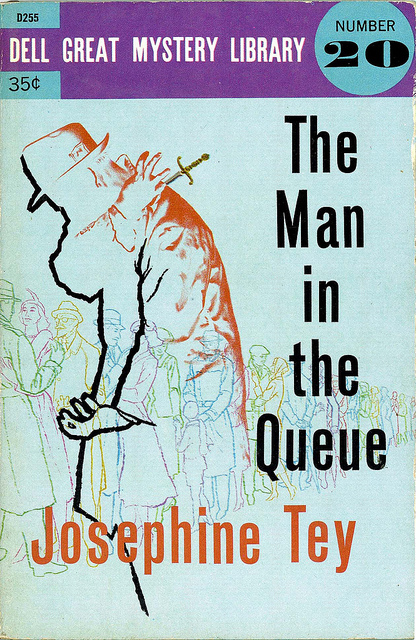
the man in the queue josephine tey b001The Man in the Queue by Josephine Tey ~ 1929. This edition: Berkely Medallion, 1971. Paperback. ISBN: 425-01873-3. 223 pages. Originally published as The Killer in the Crowd by Gordon Daviot, and released with the new title under the Josephine Tey pseudonym after author Elizabeth Macintosh’s death in 1959.

My rating: 7.5/10.

*****

This was Josephine Tey’s (to use the author’s best-known pseudonym, though she apparently preferred “Gordon Daviot”) first full-length book, written very quickly, reputedly in two weeks, according to this internet source,  Josephine Tey: A Very Private Person:

Tey started writing almost as soon as she could walk, according to a note from her literary agent, which also states that “writing was always her greatest amusement.” She published short stories and poems during the late 1920s in Scottish newspapers and in the English Review. Her first novel, The Man in the Queue, was published in 1929. It was reportedly written in two weeks for a competition sponsored by the publisher Methuen.

Tey’s first detective novel, The Man in the Queue – dedicated ‘To Brisena, who actually wrote it’ – Brisena was a nickname she gave to her typewriter – was a highly accomplished piece of work for a beginner.   Winning the Dutton Mystery Prize, it was published in 1929 under the pseudonym of Gordon Daviot—the name by which she preferred to be known, in both public and private.

Considering the time in which it was written, and the time frame it was written in, this novel is an accomplished piece of work, though it is far from flawless. I easily forgive the inconsistencies, because the writing is very good indeed, and I love seeing how the author progresses in her novels from the slight occasional awkwardnesses of this one to the sophistication of something like Brat Farrar, which I’ve just read as well, written twenty years later. This was a writer who continually honed and improved her craft; an admirable – and far from universal – thing.

The Man in the Queue starts out in front of popular London theatre, with a crowded line of hopeful people waiting for hours for a chance to see the most popular musical comedy show of the season, Didn’t You Know?, starring the lovely actress and dancer Ray Marcable (say it out loud – yes, it is what it looks like, though I didn’t twig myself until much later on in the story, when it was explained to me) in her last week of appearing in England before setting sail to try her luck in America.

It was between seven and eight o’clock on a March evening, and all over London the bars were being drawn back from pit and gallery doors. Bang, thud, and clank. Grim sounds to preface an evening’s amusement. But no last trump could have so galvanized the weary attendants on Thespis and Terpsichore standing in patient column of four before the gates of promise. Here and there, of course, there was no column. At the Irving, five people spread themselves over the two steps and sacrificed in warmth what they gained in comfort; Greek tragedy was not popular. At the Playbox there was no one; the Playbox was exclusive, and ignored the existence of pits. At the Arena, which had a three weeks’ ballet season, there were ten persons for the gallery and a long queue for the pit. But at the Woffington both human strings tailed away apparently into infinity. Long ago a lordly official had come down the pit queue and, with a gesture of his outstretched arm that seemed to guillotine hope, had said, “All after here standing room only.” Having thus, with a mere contraction of his deltoid muscle, separated the sheep from the goats, he retired in Olympian state to the front of the theatre, where beyond the glass doors there was warmth and shelter. But no one moved away from the long line. Those who were doomed to stand for three hours more seemed indifferent to their martyrdom. They laughed and chattered, and passed each other sustaining bits of chocolate in torn silver paper. Standing room only, was it? Well, who would not stand, and be pleased to, in the last week of Didn’t You Know? Nearly two years it had run now, London’s own musical comedy, and this was its swan song …

As the theatre doors finally open and the surging queue moves forward, another swan song is played out. A man gently slumps to the ground, having been held up by the press of the crowd. “He’s fainted!” is the murmur from the bystanders, until one of them noticed that between his shoulder-blades gleams the hilt of a silver dagger!the man in the queue josephine tey

And we’re off. For the man in undeniably very dead indeed, and it appears that he has been so for some time. But who could have stabbed him in front of so many potential witnesses, and why didn’t he cry out? Who is the man, anyway, and why is he carrying no identification? And is that a loaded revolver in his pocket?!

Scotland Yard immediately takes charge, and it is up to Inspector Grant, guaranteed dependable and with a certain flair for successfully solving his cases, to identify the victim and inexorably hunt down the missing killer.

An excellent piece of “Golden Age” mystery writing, chock full of appalling-to-the-modern-sensibility racial profiling and sexist commentary, but great fun to any lover of this most engaging genre. I must say I was completely stumped by the surprise ending; I was completely taken with the huge, stinking red herring which the author paraded about to confuse the plot; I did NOT guess the murderer until the final denouncement and explanation.

Inspector Grant, in his first appearance on the page, is rather Holmesian in style, consulting with the examining surgeon and coming up with some rather surprising assumptions, based on appearances alone. “Scientific”? Oh, dear …

“Can you tell me anything about the dead man himself?” asked Grant, who liked to hear a scientific opinion on any subject.

“Not much. Well nourished – prosperous, I should say.”

“Intelligent?”

“Yes, very, I should think.”

“What type?”

“What type of occupation, do you mean?”

“No, I can deduce that for myself. What type of – temperament, I suppose you’d call it?”

“Oh, I see.” The surgeon thought for a moment. He looked doubtfully at his interlocutor. “Well, no one can say that for a certainty – you understand that?” And when Grant had acknowledged this qualification: “but I should call him one of the ‘lost cause’ type.” He raised his eyebrows interrogatively at the inspector and, assured of his understanding, added, “He had practical enough qualities in his face, but his hands were a dreamer’s. You’ll see for yourself.”

Together they viewed the body. It was that of a young man of twenty-nine or thirty, fair-haired, hazel-eyed, slim, and of medium height. The hands, as the doctor had pointed out, were long and slim and not used to manual work …

Nice “scientific” work, you two. And if you thought this was a little too good to be true, just wait until you read about the assumptions made once the murder weapon is considered…

Very good stuff, in a completely “vintage read” sort of way. A definite must-read for the Tey fan, to track where the author came from, as it were, and to realize the huge strides she made in her writing career. Decidedly decent indeed for a first book; the others only get better.

And here, for your enjoyment and further enlightenment, are some grand reviews by other bloggers:

Fleur Fisher – The Man in the Queue

Stewartry ( A Gold of Fish) – The Man in the Queue

Read Full Post »

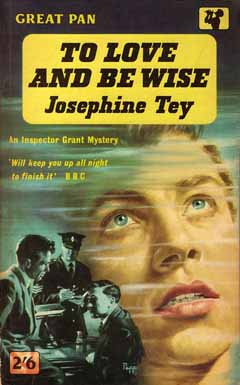
to love and be wise josephine teyTo Love and Be Wise by Josephine Tey ~ 1950. This edition: Pan, 1973. Paperback. ISBN: 0-330-10381-4. 191 pages.

My rating: 8/10.

*****

Who is the unusual young man who catches Inspector Grant’s attention during a brief encounter at a literary cocktail party? Slender and soft-spoken, rather negligible but for his white-blond fairness, Leslie Searle professes to be a professional American photographer on a private trip to England.

Why has Searle insinuated himself into best-selling author Lavina Fitch’s household, focussing his charm on Lavinia’s niece Liz Garroway, and partnering up with Liz’s fiance Water Whitmore, the well-known radio broadcaster, on a suddenly conceived book project?

And why is Mrs. Garroway, Liz’s super-maternal stepmother, so immediately hostile to the personable and perfectly well-mannered Mr. Searle, and why does the local vicar murmur about other-worldly demons after making Mr. Searle’s acquaintance over a placid dinner?

Walter and Leslie head off on their spontaneously planned canoe trip down the twisting Rushmere River, which they are co-documenting in words and photographs, and all seems well until the night when Walter storms out of the pub where he’s been sitting with Leslie. Laughing off Walter’s departure, Leslie is in no hurry to follow, and when he does leave, he placidly walks down the street and out of the village on his way back to the riverside camping spot. And then he disappears into the night. Leslie Searle is never seen again…

What really happened that night, and what dark secrets are hiding behind the many blank, superficially cooperative faces of so many respectable people? Nothing is as it seems, and Inspector Grant of Scotland Yard has his work cut out in attempting to unravel the mysteries surrounding what may just be an exceedingly well-planned murder.

A most satisfactory vintage mystery story, with a traditionally English countryside setting – though what is it with these (purely fictional, I’m always hoping) sedate British villages and their exceedingly high rates of murder and other such mayhem?!  With its nicely detailed character development, and reasonably believable plot twists, Tey’s novel still stands up well more than a half-century after publication, and will provide an evening or two of diverting reading to the modern connoisseur of the genre. If you have not yet discovered Josephine Tey, I recommend her to you with admiration and enthusiasm.

I frequently find it a lot harder to sensibly talk about why I like a book, especially one I’ve read and re-read numerous times with pure enjoyment, than to pan something I’ve reacted to unfavourably and have no intention of ever reading again, as I did in my last review, of Mary Wesley’s The Chamomile Lawn. So though I’ve spent some time mulling over how best to analyze  the appeal of this author, I will merely say that something about her writing just “clicks” in a deeply satisfying way.

If I can compare Josephine Tey to anyone, it would be Ngaio Marsh at her very best, hybridized with the intellectual superiority of D.L. Sayers. This writer treats her readers as full equals, never for a moment talking down to us, and always assuming we are well able to catch all of the nuances of the characters, settings and plots she has created and presented for our enjoyment.

And Tey has a deliciously sly sense of humour as well, which shows that the author had a very keen observational eye on the society and personalities of her time, much as she seems to have been personally rather reclusive in nature. She did move in some interesting circles – the theatre, literary and upper-class society worlds of her time – though she quite cleverly evaded the attentions of the press once her work became widely popular.

I do admire and enjoy Josephine Tey’s clean, intelligent style, especially in her later books, and I deeply regret that her body of work is so slight. There exist only eight mystery novels, of which To Love and Be Wise is the sixth, as well as several “straight” novels, and a number of stage and radio plays.

“Josephine Tey” is a pseudonym, that of Scottish writer Elizabeth Mackintosh. She also published under the pen name “Gordon Daviot” – several of the novels and the dramatic works originally appeared under this name. This accomplished writer died tragically, much too young, of cancer at the age of fifty-six in 1952. For more information on this famously reclusive writer, check out this dedicated website: Josephine Tey.net

It’s been a few years since I’ve read this particular mystery novel, To Love and Be Wise, but now that I have indulged myself by escaping into her fictional world, and renewing my acquaintance with the most likeable Inspector Grant of Scotland Yard, key investigator in five of the mysteries, I am eyeing the rest of the Teys sitting here on the “special books” shelf with anticipation. Time perhaps for yet another single-author reading jag, now that I’ve gleefully polished off most of the D.E. Stevensons I was saving for a treat for myself during this most hectic time of the year.

I believe that Josephine Tey’s mysteries are being currently reprinted in handsome modern editions, but even if you are unable to find new volumes, her most popular titles are in wide abundance in the secondhand book world.

Edited to add this link to an exceedingly excellent review which I’ve stumbled upon in marvelous serendipity while looking for info on the story around the publishing of Tey’s very first mystery, The Man in the Queue. I beg of you, if you’re interested in Tey, please click over here:  A Gold of Fish – To Love and Be Wise

I wish I could write reviews like this. Thank you, Stewartry ! I anticipate much happy reading as I further explore your EXCELLENT blog!

Read Full Post »

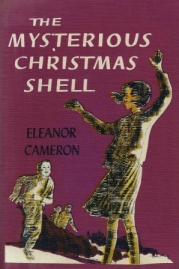
the mysterious christmas shell eleanor cameron 001The Mysterious Christmas Shell by Eleanor Cameron ~ 1961. This edition: Little, Brown & Co., 1961. First edition. Hardcover – Library Binding. Illustrated by Beth & Joe Krush. Library of Congress #: 61-9281. 184 pages.

My rating: 8/10. What a nicely written book this was! It restores my faith in the joys of reading juvenilia, sadly shaken by recent forays into several more modern disappointments in the youth-oriented fiction line.

This one was a recent impulse buy from the ever-changing and happily eclectic selection at the Bibles for Missions thrift store in Prince George. I try to get there once a month or so, and I always come away with a promising mixed bag of reading material. Some goes right back into the giveaway box, but there’ve been some small treasures found there, too.

The cover illustration was what grabbed my attention, though this grubby ex-school-library book showed much evidence of many readers, and was less than appealing at first glance. (It ultimately cleaned up nicely with a triple application of soapy cloth, rubbing alcohol and a tiny dash of benzene – not in combination, I hasten to add, but in delicately selective stages.)

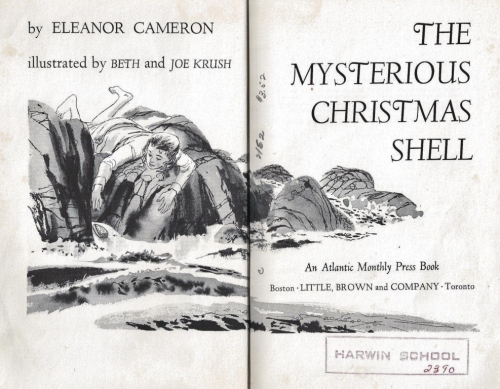
“Those look like Krush children,” I thought to myself, and by golly, my instinct was right. Beth and Joe Krush were a husband-and-wife team of children’s book illustrators working industriously together from the 1950s through the following decades, and their marvelously detailed pen-and-ink-and-wash drawings perfectly depicted the characters of such classics as Mary Norton’s The Borrowers and its sequels, and Elizabeth Enright’s Gone-Away Lake books, among many others.

Here’s a sample. Isn’t this appealing?

the mysterious christmas shell frontispiece eleanor cameron 001

And Eleanor Cameron’s name chimed a little bell, too, though I didn’t really place it until I Googled her after I’d read the book. This is the famed Mushroom Planet creator, though those junior sci-fi fantasies were only one aspect of her widely varied output.

The Mysterious Christmas Shell is very much a plain and simple “domestic adventure” story, and it turns out that it is Cameron’s second book concerning the same brother-sister pair, Tom and Jennifer. Their earlier adventure, The Terrible Churnadryne, was published in 1959.

*****

Five days before Christmas, Jennifer and Tom arrive in the fictional town of Redwood Cove, California, on the Monterey Peninsula, to spend the holidays with their Grandmother Vining, and Aunts Vicky and Melissa. As soon as they walk into their aunts’ house, they realize something is terribly wrong. The tree hasn’t been decorated, the usual garlands are in a heap of green at the foot of the stairs, and everyone has a strained smile; occasionally they catch one or another of the adults huddled in a corner crying.

Turns out that the Vining family has had to sell its treasured piece of ancient redwood-forested seaside property, Sea Meadows, because of the year-ago death of the family partiarch, the children’s grandfather. Some investments have gone wrong, and outstanding debts needed to be paid. The purchaser, a boyhood friend of the family, was thought to want to keep the property unspoiled, to be the site of a single home, but recently troubling word has come that there will instead be major development. Hotels, a shopping centre, and a vacation community are planned; many of the ancient trees will be coming down, and No Trespassing signs will be going up barring the locals from their most pleasant seaside beaches and coves. The local townspeople are up in arms, and are angry at the Vinings for the sale; the Vinings are distraught at the prospective destruction of their well-beloved redwood forest.

An offer to re-purchase the property from the developer has been turned down, and a prospective reprieve of sorts has not come about. Grandfather Vining had intended to change his will to transfer Sea Meadows to the state as a nature reserve, but no one has any record of the will being registered, and no one knows if the envelope containing it was actually sent. If the will was indeed written, it would effectively cancel out the subsequent sale, and the property would go to the state once the buyer’s money was refunded. This seems like a way out of the dilemma, but where, oh where is the will?

As Jennifer and Tom ricochet around Redwood Cove looking for clues, we get a vivid picture of a large, loving family, each member trying to do the best for the others, though occasional misunderstandings occur.

The physical description of the California coastline, with its sea caves and pocket-handkerchief beaches, its tide pools and their glorious variety of sea life, is wonderfully well done; it is obvious that the author held the area in deep affection.

I do have an extra special reason for loving this story, having spent some weeks every year in California as a child, visiting grandparents, aunts, uncles and cousins in the Fresno area, and travelling out to San Jose, Monterey, and Carmel-by-the-Sea to visit family friends and to explore the still-unspoiled seashore along the more remote stretches of coastline. I even had my own similiar near-brush with death, once being washed out into the surf by a rogue wave; my father’s heroic rescue has become a piece of family folklore, and I blame my deep but reasonably well-disguised unease about any body of water much deeper than my knees on that terrifying childhood experience. Tom, Jennifer and Aunt Melissa’s being caught in the waves of the incoming tide sent chills down my spine! I could feel the sand burns …

The familiar setting was a marvelously unexpected surprise, but putting aside nostalgia and concentrating on the writing, I must say I was impressed by the quality of the prose, and by the author’s fine story-telling ability. While this is one of those stories where nothing huge really happens, with the adventures being small ones, and the solution to the mystery very apparent to the reader from early on – the Vinings, on the other hand, struggle on for strangely long time figuring out their clues – I found I couldn’t put the book down until the satisfyingly happy (though rather improbable) ending.

A grand vintage read for adults of a certain age wishing to revisit their youth through the pages of a book, though I’m not sure how much it would appeal to our more sophisticated 21st Century children.

Despite the Christmas-time setting, this is not really a Christmas book as such, though a glass tree ornament from Innsbruck plays a major part. Oops – just gave away a clue!

It was enjoyable to read about Christmas preparations in a place far from snow, and that brought back memories, too. We only spent one Christmas in California when I was a child, as most of our travelling took place in the early spring and the fall, but I remember how surreal it was that one time to be singing carols under the palm trees, with roses still blooming and lemons on the trees in my grandmother’s garden, while back at home, in interior British Columbia, icicles reaching the ground were our parting memory as we’d pulled out of the yard for the marathon three-day drive southwards. (Somewhere I have a picture from that trip of me and my sister standing, in our matching velvet-collared coats, in front of a huge Christmas tree at Disneyland, which was ornamented by coloured glass balls as large as our heads.)

This is an author decidedly worthy of further investigation. Investigating the titles and plots of some of her non-sci-fi “realistic” children’s/teens’ novels, I strongly suspect that I read some of those when I was in grade school, as two or three of the unusual plots sound very familiar, but The Mysterious Christmas Shell was an unfamiliar, unexpected and most welcome find, for all of the reasons detailed above.

*****

Oh – one more serendipitous thing. Eleanor Cameron turns out to be Canadian! She was born in Manitoba, and though she subsequently lived most of her life in California, she is widely identified in all of the material I was able to find online as a Canadian. So – another one, completely out of the blue, for the Canadian Book Challenge!

Read Full Post »

Death by Degrees by Eric Wright ~ 1993. This edition: Bantam/Seal (Doubleday), 1995. Paperback. ISBN: 0-7704-2601-8. 192 pages.

My rating: 5.5/10. A minor effort by well-established Canadian “regional mystery” writer Wright. It has its moments, mostly in the personal narrative sections, and is mildly enjoyable for those already acquainted with Charlie Salter, but that’s about it. I doubt anyone coming to Eric Wright for the first time through this one would be strongly tempted to continue.

*****

From Kirkus, August 1993:

Here, in an outing reminiscent of Final Cut (1991), Toronto Inspector Charlie Salter’s personal life is more absorbing than his caseload–which now includes the murder of moderately unlikable Maurice Lyall, a teacher at Bathurst Community College, and the alibis of various of Lyall’s colleagues on the Search Committee that had just nominated him for Dean of Related Studies. But the case keeps Charlie distracted from his major worry: the progress, or lack of it, that his father is making since suffering a stroke. Days spent listening to academic backbiting and nights spent in a hospital waiting room, peeking in on his dad between stints of writing up a case-in-progress journal, keep Charlie on edge, but a bit of luck narrows the suspect list–just as Charlie’s father’s health rebounds.

Minimalist plot, and few will care about the faculty and its infighting. As a father-son study, however, there’s much to recommend in Charlie’s guilt over not liking his dad, and his sensitive son Seth’s love and liking of both his father and grandfather.

That sums it up well.

This is the tenth installment in the eleven volume Charlie Salter mystery series by Wright, which started with 1984’s award-winning The Night the Gods Smiled. In Salter, Wright has created a flawed but ultimately good protagonist; Charlie’s dilemmas in both his personal and working life are immediately recognizable and relatable to the reader. I find I follow his personal progress through the books with much more interest than the mildly diverting mysteries trigger. A very human and very Canadian hero: conflicted, self-analyzing, often inarticulate, more than mildly cynical, and always polite.

I have never lived in Toronto, so I cannot speak as to the accurate depiction of this book’s setting, but it seems as though the city is as much a character as the humans. The story has its fair share of in-the-know references. Most are easily picked up on, especially if you’ve already read the earlier books in the series, but a non-Ontarian and especially a non-Canadian might well find himself occasionally lost and missing the subtle jokes which abound.

While I appreciated the hospital drama and Charlie’s emotional agony as he faced his father’s potential demise, I initially didn’t care for the lazy solution the author dumped on us. “Oh – he’s recovered surprisingly quickly. You can pick him up tomorrow.” Until I thought about it a little more deeply, and realized that this is indeed what can occur. It has happened to our own family. An elderly person quite literally at death’s door one day – “You should think about making some arrangements” – makes a rather sudden recovery, and without a “Sorry to have worried you so much” apology the dazed relations are informed that the almost-deceased is being released, and needs to be “out of the room by noon – someone else needs the bed.” Charlie’s reaction of confusion and resentment at the offhand attitude of some of the nursing staff, allied with relief at the prospective recovery, and worry about the next stage in the convalescence, now suddenly the family’s responsibility as the medicos turn away, perfectly reflects the real-life scenario we found ourselves in.

Eric Wright was an English professor at Ryerson Polytechnic in Toronto for many years, and he often saves his most satiric “insider” barbs for the educational establishment. I often get the impression that the writer is much more at home in the halls of academe than in the police station with his hero, and that he uses Charlie’s frequent naïvety as an opening to mount his personal hobby-horse and to expound on the ins and outs of the world of “higher education” to his “gee whiz” audience, in this case Salter and by extention the rest of us.

As mentioned above in the Kirkus review, the “mystery” in this mystery is the least of our concerns. The victim is unsympathetic; the murderer, when discovered, faces nothing particularly severe in the way of potential punishment. In general, life goes on.

In the real world, a violent murder such as the one described in this book would have much more traumatic consequences. I know it’s not the fashion for “cozy” murder mysteries to delve too deeply into the after-effects of the murder on everyone concerned, including the neighbours of the murdered man, who seem to view his brutal demise at the hands of what is suspected to be an opportunistic burglar with phlegm verging on cow-like stupidity. In real life, if your neighbour was randomly murdered in the night and if the culprit was still at large, lurking, one would assume, in the same neighbourhood, would you not be a gibbering mass of nerves? I think I would.

Ah well, it’s fiction.

Would I recommend this one? Only to those already interested in the series. Those new to Eric Wright, definitely start at the beginning with The Night the Gods Smiled, and follow along in order. In this case it pays to get to know Charlie Salter and his likeable and sometimes quirky family right from the beginning.

This is a mildly diverting series, for those times when you don’t want to feel too challenged. The violence is generally non-graphic, and though awful things happen we aren’t subjected to too many gruesome details. There’s a bit of sex here and there, often as part of the plot twist, and occasionally as “too much information” about Charlie’s personal life, but again, nothing too graphic. The author drops in a word like “penis” and then immediately shies back, as if in shock at his own temerity in discussing such things.

I keep a stack of Eric Wrights among the huge collection of mystery novels we’ve accumulated over the years, and have no plans on getting rid of them, though if they were to vanish I don’t think I’d be terribly heartbroken, as I would be if I lost my Josephine Tey and Dorothy L. Sayers collections – Wright isn’t anywhere in the same league, though he’s not at all bad reading if your expectations are adjusted suitably.

For those curious about more deeply investigating Eric Wright’s Charlie Salter, here are the books in the series in order of appearance:

  • The Night the Gods Smiled (1984)
  • Smoke Detector (1984)
  • Death in the Old Country (1985)
  • A Single Death (1986)
  • A Body Surrounded by Water (1987)
  • A Question of Murder (1988)
  • A Sensitive Case (1990)
  • Final Cut (1991)
  • A Fine Italian Hand (1992)
  • Death by Degrees (1993)
  • The Last Hand (2002)

Read Full Post »

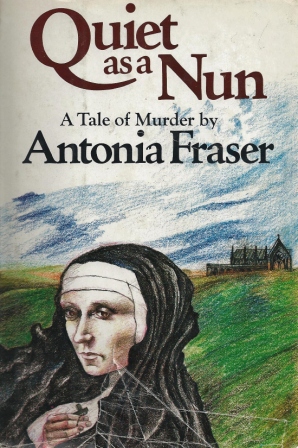
Quiet as a Nun: A Tale of Murder by Antonia Fraser ~ 1977. This edition: Viking Press, 1977. Hardcover. 177 pages.

My rating: 7/10. Not bad at all. I’d definitely read the other mystery novels by this author, and look forward to accumulating the rest of them in my travels, now that I’m on to her, as it were.

*****

Is 1977 “vintage”? Just barely, I suspect, but it was thirty-five years ago – and golly, I remember 1977 clear as a bell – where do the years go? – so I will go ahead and classify it with the oldies.

Antonia Fraser is a well-respected author of scholarly biographies, who branched out into fictional stories with this very novel. From the author’s website:

Since 1969 Antonia Fraser has  written nine acclaimed historical works which have been international  best-sellers.  She began with MARY QUEEN  OF SCOTS (1969) and followed it with CROMWELL: OUR CHIEF OF MEN (1973) and  CHARLES II (1979).  Three books featuring  women’s history came next: THE WEAKER VESSEL: WOMAN’S LOT IN THE SEVENTEENTH  CENTURY (1984); THE WARRIOR QUEENS (1988) and  THE SIX WIVES OF HENRY VIII (1992).  A  study in religious extremism, THE GUNPOWDER PLOT: TERROR AND FAITH IN 1605  (1996) was followed by two books set at the court of Versailles: MARIE  ANTOINETTE: THE JOURNEY (2001) and LOVE AND LOUIS XIV: THE WOMEN IN THE LIFE OF  THE SUN KING (2006).

Antonia  Fraser has also written eight crime novels and two books of short stories  featuring Jemima Shore Investigator.  She  edits the Kings and Queens of England series for Weidenfeld & Nicolson  including her own short illustrated book KING JAMES VI AND I (1974) and the  composite volume KINGS AND QUEENS OF ENGLAND (1975).  She has also edited the following  anthologies: SCOTTISH LOVE POEMS (1974), LOVE LETTERS (1976), HEROES AND  HEROINES (1980) and THE PLEASURE OF READING (1992).

Among  the many awards she has received are the Wolfson Award for History; the James  Tait Black Prize for Biography; the Crimewriters’ Non-Fiction Gold Dagger; the  Franco-British Society Literary Award, and the Norton Medlicott Medallion of  the Historical Association.  She was made  a CBE in 1999.

Antonia Fraser is the eldest child of the Labour politician and prison reformer Lord Longford and the historical biographer Elizabeth Longford. She has six children by her first marriage to Sir Hugh Fraser MP and eighteen grandchildren. She was married to Harold Pinter who died on Christmas Eve 2008.

So that’s the author’s background – rather impressive, so I was expecting great things from this mystery novel. By and large it did not disappoint, though “great” would be an overstatement in reference to this slender diversionary read.

I had hoped for a fairly fast-paced, readable and engaging story, and I had no trouble polishing this one off during the course of one session of lunch break/bedtime/early morning tea break reading. Easy to pick up, easy to put down; the characters stayed fresh and clear in my mind, which is not always the case even during such a short reading span, so that was a point in favour.

From the author’s website:

A nun is dead – her emaciated corpse has been discovered  locked in the tower   of Blessed Eleanor’s  Convent. The tragic consequence of a neurotic young woman committing to a life  of isolation and piety, the inquest concludes. But this young woman held  unusual power over the convent … power she was planning to use.

Jemima Shore tries to keep  her distance from the case, but when her lover cancels their holiday she finds  herself reluctantly getting involved. A violent attack in the dead of night and  another death convinces her that the convent is not the haven of peace it  appears to be. Suspicion and fear hang heavy in the air but how do you solve a  murder no-one will admit happened?

The main character is thirty-something Jemimah Shore, a television investigative reporter who hosts a popular program which touches on various social and cultural topics, and “digs deeper”, hence the tag “Investigator” which has become attached to Jemimah’s name. Widely known through Britain because of her T.V. presence, Jemimah is used to many people from her past reappearing and claiming acquaintance, so she is not terribly surprised when the Mother Superior of her childhood convent school sends her a letter referring in complimentary terms to her present occupation. What does surprise Jemimah is Mother Ancilla’s urgent request that Jemimah visit Blessed Eleanour’s Convent to discuss the recent death of one of Jemimah’s former school companions, who found her vocation and became a nun at the convent after she and Jemimah had parted ways.

Sister Miriam, once the wealthy Rosabelle Powerstock, had apparently died of natural causes, but there is a mystery about her death. Why did she lock herself in the ancient tower attached to the nunnery, and why had she been so insistent that Jemimah be called, before her (Sister Miriam’s) unfortunate demise?

Jemimah is an interesting character, and I thought her a rather admirable private investigator. Cool, calm and collected, thoughtful Jemimah views the world with an eye just the warm side of cynical. No fool, she is well-used to analyzing motivations and actions, and she turns her eye upon herself on occasion with surprising firmness and self-critisism. A non-strident but rock solid feminist, Jemimah gets on with things and has little time or patience for drama in her life, which makes it a bit eye-opening that her romantic involvement is with a firmly married liberal M.P. The relationship is long-lasting and seems stable enough, though we get the strong sense that Jemimah wishes it could be regularized and much more open; it seems well-known among her circle of acquaintances, though the wife of her lover is definitely unenlightened.

The plot itself is a contrived little thing – a missing will, a threat to the convent, and a melodramtically inclined social crusader are all key elements. I figured out the “mystery” almost immediately, though there was a tiny twist at the end which I did not see coming; Jemimah’s reaction was unexpected and made me curious to see what her next mystery will have her doing. (There were eventually ten books in the Jemimah Shore series, written between 1977 and 1995, though and I wonder if that writerly interest is wrapped up; the author’s most recent work is a memoir about her life with the late Harold Pinter, Must You Go?, 2010.)

Thoughtful musings on religion, and the author’s undoubted talent for words raise this novel higher than the plot deserves, to put this first mystery novel nicely into the realm of Patricia Wentworth, and a reasonable compatriot of the slighter works of Margery Allingham, Agatha Christie and Ngaio Marsh. I’ve read much worse.

Read Full Post »

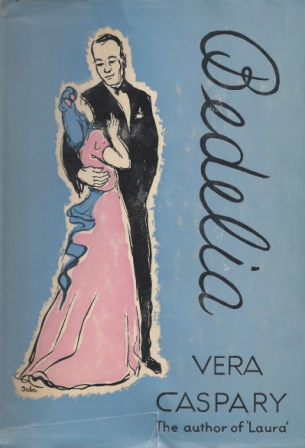
Bedelia by Vera Caspary ~ 1945. This edition: Blakiston, 1st edition, 1945. Hardcover. 187 pages.

My rating: 6/10.

I picked this book up “on spec” a few days ago; my attention caught by the back cover quote by Lionel Barrymore, referring to Caspary’s previous book, Laura:

One of the most intriguing mystery stories of recent years…

Always up for a good mystery story, and since this vintage hardcover would only set me back a few dollars, I took the gamble and brought it home. From the front flyleaf:

Vera Caspary has written a study of a psychopath as fluffy as eiderdown, a kitten whose claws were steel.

Bedelia was everything to please a man – and she pleased many. She was small, cuddly; she smelled nice. She never argued or lost her temper. Her house, like her hair, was shining, her food delicious. She loved to cook, and she adored the gadgets of housekeeping. How strange that a passion for percolators and copper pans should help solve the curious riddle of her past!

Irresistable prospect for an evening’s light read, I thought.

Right from the first page I was a bit disappointed in the quality of the writing; no beautifully put-together passages here. Caspary, if Bedelia is typical of her work, was a straightforward, “then she walked across the room” sort of writer. Just the facts, ma’am. Even the “tense psychological” bits are reported in a straight-faced, take-it-or-leave-it manner.

Bedelia and her new husband (and perhaps prospective victim?) Charlie posture and project all over the place, while I sat off in my spot as a not quite fully engaged spectator, figuratively yawning a bit and wishing they’d just get to the point, already. It felt very much like one of those melodramatic 1940s films where everything is so broadly telegraphed to the audience that we eventually become so hardened to subtle effects, which turns out to be an apt conclusion as I found out later that Vera Caspary was indeed a successful Hollywood screenplay writer from the 1930s to the early 1960s.

Bedelia is the tale of a besotted newly married man, Charlie Horst, and his adored bride, a beautiful and passionate young widow who gratefully clings to him and makes his life oh-so-sweet. She’s a marvelous housekeeper, an accomplished cook, a gracious hostess to his friends, lovely to look at (and smells good, too, as Caspary points out more than a few times) and, to Charlie’s greatest delight, she’s hot stuff in bed.

Charlie is as smug and contented as a well-fed tomcat parked on a fireside hearthrug, until a few too many discrepancies in his wife’s accounts of her past history get him wondering about which version of her story is the real one. When Charlie falls ill with a mysterious ailment his doctor immediately suspects malicious poisoning. But who would want to hurt good old Charlie? Certainly not his sweet little wife…

I later saw this novel referred to as Lady Audley’s Secret in 2oth Century clothes; most apt. While Bedelia left me considerably underwhelmed by the writing style, the plot was reasonably interesting, with a few surprises thrown in.

Charlie, far from being a sympathetic character as we would expect, has numerous flaws of his own, and a personality just as psychopathic in its way as Bedelia’s. His treatment of his childhood friend Ellen, who has long been in love with him (as he fully realizes) is callous in the extreme; she is possibly the only truly innocent and likeable character in the book, and we fear for her future at the close of the story. (At least, I did. Definitely a case of “be careful what you wish for!”)

I was curious enough about Caspary and her referenced previous novel Laura (apparently made into a very successful movie, which I confess I have never heard of before) to do a bit of internet research on her.

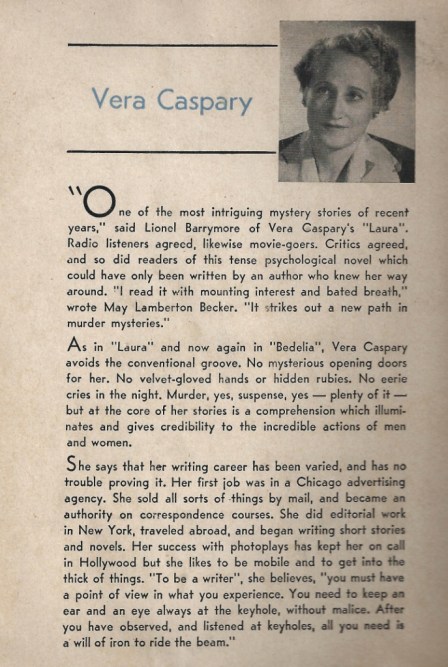
Vera Caspary (1899-1987) had a full and eventful life. After graduating from business college, she worked as a stenographer and in an advertising agency. To support her widowed mother, she turned her hand to projects such as creating a successful correspondence course in ballet dancing, and one on  charm and deportment. She went on to work in journalism, and as a successful Hollywood screenwriter, and a best-selling novelist and short story writer.

Caspary had strong convictions which she was steadfast in defending; she embraced Communism in its most idealistic form during the 1920s and 30s, but was disgusted by the realties which she found both within the Communist Party in America at the time, and the appalling conditions which she witnessed during a fact-finding visit to Soviet Russia.

Despite eventually renouncing her communist sympathies, she was “blacklisted” in McCarthy-era Hollywood and struggled financially during the post-W.W. II years. Caspary was also an ardent feminist who defended her personal views and also her strong and independent female screenplay protagonists against producers’ attempts to sugar-coat them.

Vera Caspary is a writer whom I will be giving a second chance to, Bedelia‘s “slightness” notwithstanding. I hope to find a copy of Laura (book and film), as well as Caspary’s autobiography, The Secrets of Grown-Ups, published in 1979.

From a quick glance at AbeBooks, it appears that there is are abundant Caspary titles in second-hand circulation at reasonable prices. Not an author I am deeply enthralled with from this first exposure, but intriguing enough to follow up.

Read Full Post »

« Newer Posts