Posts Tagged ‘Memoir’

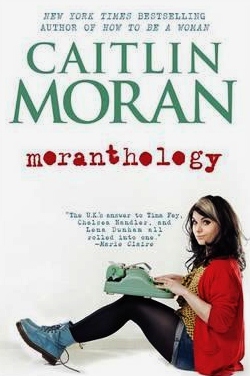
moranthology caitlin moranMoranthology by Caitlin Moran ~ 2012. This edition: Ebury Press, 2012. Softcover. ISBN: 978-0-06-225853-3. 237 pages.

My rating: 9/10.

*****

I searched this one out because of Claire’s intriguing posting about it on The Captive Reader recently. Click this link to read her take, and don’t forget to scroll down into the comments for an interesting side note onto the life of Charles Dickens. Here you go: Moranthology

I had never heard of Caitlin Moran before, but the lack of context was no barrier to enjoying this collection of columns originally published in the London Times. A previous book, How to Be a Woman, gets rave reviews on the back cover of Moranthology, and also, when I did my small bit of “research” for this review, all over the internet. One I may also seek out, because I liked Moran’s brash, cheeky and occasionally heart-rending voice in this later compilation.

Some articles are decidedly stronger than others, but every single one was more than readable. Moran works the pop culture beat, with frequent forays into personal memoir, and anecdotes about her own marriage and family life.

Caitlin Moran apparently had quite a counter-culture childhood and adolescence. Growing up in a self-described family of “hippies”, she frequently mentions her family’s poverty and the heavy-as-lead despair of the slow slide downward; the family lived on Moran’s father’s disability benefit, never quite enough to meet the basic daily needs, let alone afford any sort of advancement in life. Moran refers frequently to her youthful status as one of the lookers-on. As a homeschooled child, she remarks that she had zero experience in fitting in with her more conventional peers, and I suspect that it is this position outside of the norm which has helped make her such a sharp observer of the more ridiculous of the pop culture excesses splashed across our universal consciousness in this age of hyper-information.

There are poignant moments throughout Moranthology which I found most moving, in contrast to the aggressive humour of some of the pop culture critiques. Caitlin limping through London on her first visit there, astounded by the scale of the city and unable to find her way, on foot, to either the British Museum or Buckingham Palace, which she thought she’d just briefly visit before visiting the offices of The Observer; she’s won a “young writers” prize which includes a tour of the newspaper office and a chance to write a youths’ view article for publication. Caitlin and her brothers and sisters squeezed into the cab of their camper van, singing to drown out the sounds of their parents’ lovemaking in the back. Caitlin’s four years as a supremely heavy user of marijuana, and the gap in her life (and memories) this caused.

This is a strong collection with a wide variety of pieces; the range meant that it never blurred for me, as collections of newspaper columns sometimes may.

Outstanding pieces were a rather brutal observation of the ironies of Michael Jackson’s lavish funeral and the public response to it, and two interviews with rock and roll icons, Keith Richards and Paul McCartney. The Keith Richards piece is an absolute stand-out, jaw-droppingly frank and frequently very funny; a must-read for any long-time Stones fan such as myself. I learned nothing new – Keith’s excesses and the sordid details of his frequently wasted (in every sense) life are common knowledge to anyone who has been paying attention to the mesmerizing freak show of the Stones during the various stages of their rock royalty progression – but what Moran observes, and how she reports it makes for a brilliant piece of pop journalism. This article alone makes Moranthology worth buying, but there’s a lot more packed in here, too. Including, I must mention, a visit to a German sex club with Lady Gaga, a surprisingly gentle article which shows a strong affection and admiration for the blatantly controversial main character of the ongoing Gaga Saga.

Switching gears successfully from the pop world to social commentary, Moran also writes compelling, thought-provoking and serious pieces on such diverse topics as the importance of public libraries, the compassionate and economic benefits of a strong public welfare system, and the right of women to access safe abortion.

Cheeky, over-the-top, family-targeted humour abounds. Moran pens a scathing critique of the practice of providing goody bags at children’s’ parties, and gives a spirited defense of the occasional need for parental binge drinking. A slightly more serious, but exceedingly funny piece discusses the changing meaning of the word “special” to something rather dirty – references to “Daddy’s Special Lemonade” (it has limes in it!)  and playground requests for Daddy to “tickle me in my special place” (under the chin, for heaven’s sake!) – bring parental mortification and suspicious glances from other ever-vigilant parents on high alert for any shadow of anything smacking of sexual perversion.

All in all, a most entertaining read. Loved it.

Read Full Post »

moab is my washpot steven fry Moab is my Washpot by Stephen Fry ~ 1997. This edition: Arrow Books, 2011. Softcover. ISBN: 978-0-09-945704-6. 436 pages.

My rating: 9.5/10.

One word: Unexpected.

Elaboration: Unexpectedly frank, unexpectedly kind, unexpectedly excellent. To clarify that last, I did expect it to be excellent, but not quite in the way it was. Almost too much information, with some very graphic sexual details, but it works.

The .5 is lost for various vague reasons. Maybe a bit too graphic?

This is a grandly quirky memoir, which I hugely enjoyed reading.

I’m attempting to work on this review while sitting at a borrowed desk in the office of a dance studio far from home. Above my head, in the rather less than sound proof dance space, my daughter and her choreographer hammer out the last difficult 8-counts of an ambitious lyrical jazz solo, and I find myself caught up in the music, the continual repetition of the same phrases over and over and over. The song they’re working with is Ghosting, by Vancouver band Mother Mother, in case you’re wondering what some of the soundtrack of my life is like this year.

Moab itself is not at hand, so I’m writing this cold, as it were, without the book to check for passages of note. You’ll just have to trust me on this one; the writing is more than competent. Fry can spin the words, on paper as well as in person, oh yes, indeed.

I deeply enjoyed Stephen Fry’s acting before I ever read this biography, and I sought out and purchased the book because of my admiration of his dramatic and comedic performances in the comedic sketches he and Hugh Laurie performed for television in the early 1990s, A Bit of Fry and Laurie. And the Granada Television adaptations of  the seminal P.G. Wodehouse’s Jeeves stories, starring Hugh Laurie as an elegantly simple Wooster, and Stephen Fry as the perfect gentleman’s gentleman, Jeeves, are absolutely brilliant.

The twitch of an eyebrow, a slight inflection of tone, a fragment of a glimpse of body language – Fry as Jeeves merely stiffens and draws in his breath almost imperceptibly, and it hits like a ton of bricks. This guy – these guys, because Hugh Laurie is equally brilliant and deserving of his own rave reviews – are good. Very, very good.

And after reading Moab, I will watch and read Stephen Fry in future with an even stronger appreciation, because of where he’s come from, and what he’s all about.

Critics of his biographical works have mentioned that some of his details are a bit unreliable. It matters not at all to me. For the purposes of artistic and personal appreciation, Fry can tweak away to his heart’s content. Moab has an authentic feel. Truth is, as the cliché goes, frequently stranger than fiction, and this man has led a gloriously strange life.

Moab is my Washpot – such an odd title, I can imagine you saying to yourself, as I did –  comes from a Biblical quote, King James Version, Psalms, Chapter 60, and it make a surprising amount of sense once one has embarked upon the reading of the book.

    1. O God, thou hast cast us off, thou hast scattered us, thou hast been displeased; O turn thyself to us again.
    2. Thou hast made the earth to tremble; thou hast broken it: heal the breaches thereof; for it shaketh.
    3. Thou hast shewed thy people hard things: thou hast made us to drink the wine of astonishment
    4. Thou hast given a banner to them that fear thee, that it may be displayed because of the truth. Selah.
    5. That thy beloved may be delivered; save with thy right hand, and hear me.
    6. God hath spoken in his holiness; I will rejoice, I will divide Shechem, and mete out the valley of Succoth.
    7. Gilead is mine, and Manasseh is mine; Ephraim also is the strength of mine head; Judah is my lawgiver;
    8. Moab is my washpot; over Edom will I cast out my shoe: Philistia, triumph thou because of me.
    9. Who will bring me into the strong city? who will lead me into Edom?
    10. Wilt not thou, O God, which hadst cast us off? and thou, O God, which didst not go out with our armies?
    11. Give us help from trouble: for vain is the help of man.
    12. Through God we shall do valiantly: for he it is that shall tread down our enemies.

 Moab is an account, creatively rendered, about Stephen Fry’s youth and time at boarding school, until his breaking bounds in a most anti-social way in his late teens. He consistently lied, cheated, and stole his way through school; his juvenile life of crime ended spectacularly when he stole credit cards from the father of one of his friends and went on a spending spree which ended in a jail term, at the age of seventeen.

Fry’s personal redemption and his university days and acting career are tales for another book, but there is enough packed into the early years detailed in  Moab to keep the reader more than interested for the duration.

Warning to readers: if you have any issues about homosexuality, you should probably give this one a pass. Or perhaps not. Perhaps you should take it on as prescribed reading. Stephen Fry is gay, and much of this memoir talks exceedingly frankly about what that means to him, and how it influenced his teenage years, and the life he lives now, or, rather, was living at the time of the writing of the biography, sixteen years ago.

This is a kind, clever, amusing, thought-provoking and above all firmly confident gay man’s manifesto: “Here I am, this is me. I don’t have any issues with my sexuality. Why should you?”

Though one might say that the fact that he needs to speak at such length about it argues “issues”…

But, on the other hand, as memoirs of youth and the teen years go, if curiousity about sex and accounts of yearning love were left out of any account by a narrator of any sexuality, the narrative would not ring true.

I deeply appreciated what the author had to say, and I will be reading more by Stephen Fry.

Read Full Post »

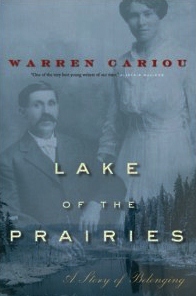
lake of the prairies warren cariouLake of the Prairies: A Story of Belonging by Warren Cariou ~ 2002. This edition: Doubleday Canada, 2002. Hardcover. ISBN: 0-385-25960-3. 318 pages.

My rating: 9/10.

A quite wonderful book, serendipitously unexpected. It’s only (very small) flaw was the very occasional not-quite-so-engaging historical passage, as Cariou delves into some of the histories of his ancestors. A little flat in those spots, a bit too much like sober research. Cariou quickly returned to his engaging anecdotal style. Very close to the perfect 10 of my ideal reading experience.

*****

And it was a real surprise, this one.

It was randomly chosen from the non-fiction stacks in close vicinity to the L.M. Montgomery biographies I was browsing, and I almost returned it without reading, due to the present supremely busy busy-ness of my life. However, quite fortuitously, I had a few minutes to fill while on hold on the phone, and this was the first thing I could reach, so I opened it up for what I assumed would be a mere few moments of casual browsing. Once started, I could not stop. It was much too good to put down unread. It’s taken several days to get through it, reading a chapter here and there, over lunch and tea breaks, but I was never tempted to abandon it, and found it very easy to jump back into each time.

Where do I come from?
 
The potato patch.
God in Heaven.
A falling star.
The stork.
A moonlit night.
A hole in the legs.
You were named for the doctor who delivered you.
 
Where, really?
 
From here. You’re from right here. The town of Meadow Lake, the province of Saskatchewan, the country of Canada, the planet of Earth. Just down the street at the Meadow Lake Union Hospital you were born, and we lived in the Carter Apartments until you were one, and then we moved to this house, and you grew like quackgrass in the backyard.
And that’s the story of you.

A beautifully written personal memoir, and a loving, often very funny, sometimes almost unbearably poignant, but never soppy ode to a town, region, and most importantly, a father and a family. As I was reading I found myself nodding in complete recognition of scenarios so many times. Flipping to the front of the book and examining the author’s information, I was not at all surprised to see that the author was born in 1966, only a year or so later than me; some of his memories of a childhood in rural Saskatchewan are stunningly similar to mine in rural B.C.

I too grew up along the rural fringes of a working class town. Cariou’s Meadow Lake and my own Williams Lake could almost be twin communities, though separated by an immense stretch of Canada. Northern towns, in relation to the cities hugging the 49th parallel, though not, of course, truly northern in a geographic sense, both being situated mid-province. North of us both the true bush country starts.

My town too had its fabulous (in every sense) rodeo, growing from a venue for the local cowboys to show off and celebrate their machismo and skills to another points-and-cash-prizes stop on the long summer tours of the professional rodeo circuit. Timber and ranching built and maintained both of our towns. His town had the Cold Lake military reserve, mine had Riske Creek. His town and mine were – are! –  a mix of “white people” – various European and pan-Asian bloodlines – and “Indians”. Meadow Lake is Cree territory; Williams Lake straddles the Carrier-Chilcotin divide.

The Indian kids chased the white kids in my schoolyard too, chock full of resentment for their demeaned social status of members of the oppressed race, the children of the reserves. Now, forty years later, the whites in both of our towns take open pride in their occasional Indian ancestors, basking in the trendy new cool status of First Nationhood, while in reality not much at all has changed, and the cultural divide betwen the races is as brutally deep as it ever was, with the occasional personal exceptions of individual friendships.

Perhaps this is why I identified so strongly with Cariou’s memoir; the parallels are strong in that and in other ways as well. Even when our general experiences diverged, as they did widely here and there, I remained fully engaged. This writer has a compelling voice.

Discovering as a young man that he was of Metís heritage, Cariou writes of that, and of how it changed all of his perceptions as to who he really was, where he really came from, and it is these passages which seem to have caught the attention of reviewers, making this out to be a book about First Nations identity. It is, and it isn’t.

There is no soapbox here, no grandstand. It remains a deeply personal story, and it feels genuine from start to finish. Those of us “whites” who grew up in similar settings through the ’60s, ’70s, and ’80s know exceedingly well what he is talking about, about our conflicted emotional relationships with the natives whose land we – the ancestral we as the descendants of immigrants and pioneers  – have taken over as our own. The reserve kids huddled at the back of the bus and the classroom, whispering together in indecipherable dialects, peering at the rest of us with well-deserved gleams of pure hatred, and we recognized that,  both the fact of the hatred and the reasoning behind it, and were terrified. Here was something bigger than us as individuals, and older, and more elemental. We’re still pretty scared, us grown-up white people, though we frequently hide it behind carefully political correct words – notice how I am now well-trained to put “Indian” in quotations, even though the “natives” I personally know call themselves “Indians” with no ironic inflection –  and a superficial acceptance and celebration of “First Nations” and “Aboriginal Pride”. Cariou captures that dichotomy brilliantly well.

This is such a small part of the narrative, though it does run through the entire book, as it rightly should. The majority of this memoir is personal reminiscences, gloriously focussed on Cariou’s father, and on the large extended family which sheltered and comforted and challenged and formed its younger generations, sending them out into the world to their various adult destinies with an ever-changing but ultimately supporting familial story behind them. I loved that atmosphere in this book. Cariou lovingly celebrates his family while fully recognizing their flaws, not always an easy task for a writer to pull off. He succeeds.

Here is a short excerpt from an early chapter that made me laugh out loud in joyful recognition. Holey gumboots and bread bags – oh yes, indeed! I have waded joyfully in those as well. “Flamingoed” – brilliant!

We stomped in puddles, waded across ditches, created little rivers between puddles, and sometimes made dams on the trenches that our parents had dug for drainage. We spent most of our time in rubber boots, which were largely ineffectual because either they were full of holes or we waded too deep in the puddles. Sometimes for whole summers we would have to put plastic bread bags on our feet before pulling on our boots. McGavin’s Bread bags were particularly popular for this. But they were prone to leaking, and worst of all, they made your feet slide around inside your boots, which were therefore more likely to slip off at the worst possible moment. The lost boot was a familiar sight: a kid standing one-legged, his bread-bagged foot held out tentatively, balancing himself there and staring back at he empty boot embedded in the muck. It was so common and so comical that we came up with a name for the predicament.

“Andrew flamingoed yesterday in Carlson’s ditch, you shoulda see him there crying for his boot. Lost his sock and his bread back too, and nobody;d get them for him so he had to step in, bare foot and all.”

And here are excerpts from two reviews. This first is by Allan Safarik, from the Books in Canada website.

Warren Cariou’s Lake of the Prairies is a beautifully written memoir about time and place and the nostalgia of a childhood growing up on the edge of the northern prairie in the parkland, a relatively uncelebrated area of Saskatchewan that is mostly dense forests, muskeg, rocky outcrops, marshes and lakes. Cariou’s maternal grandparents were immigrants who came to the harsh country near Meadow Lake and carved out pasture from the raw treed land. His family sank their roots into the place and Cariou grew up with his family legacy, particularly as remembered and influenced by his father, still relatively intact. Cariou is a skillful writer who weaves his father’s anecdotal adventures along with his own to recreate a marvelous pastiche …This is a book about nature as much as about anything. [Cariou] has a powerful lyrical way of describing the atmosphere and the details. He is an observer who is wonderfully educated about nature and as he grows up, he tells about his friendships and his adventures in an increasingly wider realm.

Cariou has given us a personal story about his family, skillfully injecting a second story about the way people live in his community and how they interact with one another. This incredibly crafted Canadian book might be about South Africa or many other countries. But no, this is Canada. Bustling Meadow Lake, Saskatchewan, a small town with big shoulders. Warren Cariou, in his coming-of-age memoir, writes like a naturalist/historian on a mission from God. The result is a distinctive style, a well-paced tale that leaves nothing out. Lake of the Prairie, a superb memoir about place, is also a powerful document about the human condition.

And from a review by Victor J. Raymond, University of Toronto Quarterly, 2004:

Place, family, history, belonging, home. Drawing on such ordinary words, Warren Cariou begins his memoir of growing up in northern Saskatchewan. The stories he recounts seem familiar: fishing, digging for arrowheads, moving to an old farm, learning about one’s family. But there are also deeper truths in these stories, rooted in hidden secrets, lost for generations.

One such story – Cariou’s discovery of his own Metís heritage – is central to the constellation of questions the author raises about identity and knowledge. But there is no thunderclap, no single moment of transition. Cariou’s heritage slowly emerges from his recounting of the stories others tell – his father, his uncles, his aunt, and others in his family. There is little remarkable about his initial self-description; at an early age, he is supposedly from ‘Norwayfrancenglandgermany.’… Interwoven with larger considerations of race and place is the author’s own story of growing up and leaving home. Beginning with his relationship with his parents and uncles, Cariou gradually reveals his own life growing up in Meadow Lake as a youth and then going to university and becoming a writer as an adult. Common life events … help reveal hidden complications of the seemingly easiest questions. Who am I? Where am I from?

Throughout Lake of the Prairies it is this sense of gradual revelation that shapes and reveals the landscape of identity, not only of what you know, but also of what you don’t know about yourself. In that, Lake of the Prairies is itself a story being told about our own identities and how we relate to one another – and we would be wise to listen carefully.

Read Full Post »


1982 jian ghomeshi1982 by Jian Ghomeshi ~ 2012. This edition: Viking, 2012. Hardcover. ISBN: 978-0-670-06648-3. 284 pages.

My rating: 4/10.

Sorry, Jian.

Love the radio show, and you’re a great interviewer, but as far as authoring memoirs goes, well, don’t quit the day job.

*****

Here’s the promotional material that had me all keen to read this memoir by star CBC Radio host Jian Ghomeshi.

In 1982 the Commodore 64 computer was introduced, Ronald Reagan survived being shot, the Falkland War started and ended, Michael Jackson released Thriller, Canada repatriated its Constitution, and the first compact disc was sold in Germany. And that’s not all. In 1982 I blossomed from a naive fourteen-year-old trying to fit in with the cool kids to something much more: a naive eyeliner-wearing, fifteen-year-old trying to fit in with the cool kids.

So writes Jian Ghomeshi in this, his first book, 1982. It is a memoir told across intertwined stories of the songs and musical moments that changed his life. Obsessed with David Bowie (“I wanted to be Bowie,” he recalls), the adolescent Ghomeshi embarks on a Nick Hornbyesque journey to make music the centre of his life. Acceptance meant being cool, and being cool meant being Bowie. And being Bowie meant pointy black boots, eyeliner, and hair gel. Add to that the essential all-black wardrobe and you have two very confused Iranian parents, busy themselves with gaining acceptance in Canada against the backdrop of the revolution in Iran.

It is a bittersweet, heartfelt book that recalls awkward moments such as Ghomeshi’s performance as the “Ivory” in a school production of Michael Jackson and Paul McCartney’s Ebony and Ivory; a stakeout where Rush was rehearsing for its world tour; and a memorable day at the Police picnic of 1982. Music is the jumping-off place for Ghomeshi to discuss young love, young heartache, conformity, and the nature of cool. At the same time, 1982 is an entertaining cultural history of a crazy era of glam, glitter, and gender-bending fads and fashions. And it is definitely the first rock memoir by a Persian-Canadian new waver.

All excited and looking forward to it – I’m a happy Q listener whenever I get the chance, and I too had (have!) a thing for the Thin White Duke – I requested this book for Christmas, and my family tried their best, but it was sold out at the local bookstore. So I was very happy last week to see it on the 7-day express shelf by the library door. (These are popular books available for one-week loan, no renewals. $1 a day for every day over the week, so there’s definitely an incentive to get them back asap.) My week is up on Tuesday, and I’ve made a concerted effort to push through it, but boy oh boy, it was tough going. (On the bright side, my family saved their $30.)

What’s wrong with it, you ask?

One word: Boring.

Boring, boring, boring.

And it wasn’t that Jian didn’t have an interesting teenage life. He did, in a tame sort of middle-class, upwardly mobile, successful immigrant family sort of way. In 1982, the year more or less profiled in this “creative autobiography”, Jian turned fifteen. He was in the throes of young love, was hanging out with a bunch of good friends, and was playing drums in a band – okay, it was the community band, but still… He was listening to all sorts of cool new music, had reinvented himself as a New Wave wannabe, and was having quite a time experimenting with hair dye and styling gel and eyeliner and dressing all in black. He had a loving and supportive family, abundant parental funding, and oodles of positive reinforcement from his teachers and the other adults in his life. He did stuff. He went places. He got into a few interesting situations, and made it through them in one piece. Easily enough stuff to write a memoir about.

A short memoir. A novella-length memoir. Not the almost-300 page thing that I have just gratefully slapped shut. Jian ran every single little incident of that year completely to death. And though it was interesting in bits here and there, ultimately I just couldn’t care.

Small sample of the prose to follow.

I will sacrifice a chunk of my evening and type this out, so you can read a bit and perhaps save yourself the heartbreak of discovering the banality that dwells within the covers of this book. Or, on the other hand, maybe you’ll love it, and wonder why I’m moaning on about the boringness of 1982. The book, that is. Not the year. Because, that would be, like, really tragic. If you like this kind of thing. And then didn’t read it. Because I was, like, panning it. Really badly. For some reason. Yeah.

Oh. No. It is catching. The prose style. You will see what I mean. In a minute. Uh huh.

Okay. Here’s Jian, describing his teenage Ontario home. Or sprinklers. Or middle-aged men. Or all three.

Thornhill was the quintessential suburb. I’ve never lived in any other suburb, but I imagine they all look like Thornhill, with people who act like they did in Thornhill. It was the kind of place where men watch sprinklers on their lawns. Have you ever noticed that men like to watch sprinklers? They do. Or at least, they did. But I think they probably still do.

When suburban men reach a certain age (let’s say, north of thirty-five), they like to stand at the foot of their front lawns and watch their sprinklers distributing water on them. This seems to be a biological need. It may look like a banal exercise, but men take it very seriously. You might expect that these men are involved in another activity while watching the lawn – like thinking. But I’m not so sure they are. I think they’re not thinking. Watching the lawn is like a middle-class, suburban form of meditation for men. It becomes more common as they age. Their heads are empty and they are just watching sprinklers. Sometimes men will rub their bellies while they watch their lawns. Perhaps these men are so tired from a busy week that this is their respite. Or maybe these men feel a sense of accomplishment and worth by looking at their lawns. Maybe, in the moments when their heads aren’t empty, they’re thinking, “This is MY lawn! Look what I’ve done. I’ve got myself a lawn with a working sprinkler! I don’t have to think. My belly feels good. I am feeling my belly.” Maybe that’s what suburban men are thinking…

This goes on, the sprinkler watching monologue, for three pages. It includes a list.

I have made a short list of the lawn sprinklers that were available in Thornhill in 1982:

  • stationary sprinkler
  • rotary sprinkler
  • oscillating sprinkler
  • pulsating(impulse) sprinkler
  • travelling sprinkler

As you can see, there were distinct and varied types of sprinklers to be utilized in the suburbs in the early ’80s…

There are a lot of lists in this book. Many more lists than there were types of sprinklers in Thornhill in 1982. And reading the lists are about as exciting as standing at the bottom of the lawn watching the grass get wet.

Okay, I guess you’ve twigged that I’m pretty underwhelmed by Jian’s little personal saga.

To be fair, it did have a certain time-travel charm; a certain nostalgia factor for those of us who shared that time on the planet with Jian. Yes, we remember Commodore 64s, and rotary dial phones and twisty phone cords, and some of the more intelligible words from the major AC/DC songs. We remember Boy George, and, yes, definitely David Bowie. But we now know, those of us who’ve read your teen years – oops, year – opus, way too much about what went on in your head, way back during the time span of your fifteenth trip round the sun.

Maybe this book is all avante garde ironic, and I’m just not hip enough to appreciate it. Maybe I’m not in the right demographic. It does seems targetted at a younger set of readers, because most of it is all, “Gee whiz, when I was a kid we didn’t have all these iPods and digital cameras and cell phones and stuff. Here, let me tell you about the pathetic technology of 1982.”

But I can’t imagine anyone younger than, say, thirty-five or forty or thereabouts finding it remotely interesting.

Anyone else read this one? Am I completely out of touch? Is is deeply cool and ironic? Or just deeply boring?

*****

I do forgive you, Jian. Just don’t do it again.

No 1983. Please.

(I still like the radio show.)

More reviews:

Goodreads – 1982 by Jian Ghomeshi

National Post – 1982 by Jian Ghomeshi

Read Full Post »

a reading diary alberto manguelA Reading Diary: A Year of Favourite Books by Alberto Manguel ~ 2004. This edition: Knopf, 2004. Hardcover. ISBN: 0-676-97590-9. 253 pages.

My rating: After a certain amount of consideration, 7.5/10.

Now this is a book about books which I would be happy to have on the keeper shelf. It caught my eye during a library browse, and, after standing in the aisle and reading most of the entry regarding Kipling’s Kim, I decided it was worth an even deeper investigation. I was not disappointed.

Alberto Manguel is an Argentine-born writer, anthologist, editor, and translator. He spent his early years in Israel, where his father served as the Argentine ambassador, then back to Argentina, and, once his schooling was completed, working and living in England, France and Tahiti. He moved to Canada in 1982, eventually acquiring Canadian citizenship, though he continues to travel widely, and also maintains a home in rural France.

A Reading Diary is a vanity project of sorts, but a worthwhile one. It consists of the jottings kept over the course of a year as Manguel rereads some of his most treasured books.

It occurred to me that, rereading a book a month, I might complete, in a year, something between a personal diary and a commonplace book: a volume of notes, reflections, impressions of travel, sketches of friends, of events public and private, all elicited by my reading. I made a list of what the chosen books would be. It seemed important, for the sake of balance, that there should be a little of everything. (Since I’m nothing if not an eclectic reader, this wasn’t too difficult to accomplish.)

What has resulted is a book rich with references both everyday and arcane, from the note that the cat is nestled in a towel-lined box looking out at the rain, to the mention of the death of a friend and a reflection on the transience of all things dear to us, to the sombre discussion of the tragedy of the World Trade Centre destruction only a few years earlier, and the subsequent war in Iraq, to warm memories of golden childhood hours spent reading some of the same books that feature in this Diary.

The books chosen are:

  • June ~ The Invention of Morel by Adolfo Bioy Casares
  • July ~ The Island of Dr. Moreau by H.G. Wells
  • August ~ Kim by Rudyard Kipling
  • September ~ Memoirs from Beyond the Grave by François-René de Chateaubriand
  • October ~ The Sign of Four by Sir Arthur Conan Doyle
  • November ~ Elective Affinities by Johann Wolfgang von Goethe
  • December ~ The Wind in the Willows by Kenneth Grahame
  • January ~ Don Quixote by Miguel de Cervantes
  • February ~ The Tartar Steppe by Dino Buzzati
  • March ~ The Pillow-Book by Sei Shonagon
  • April ~ Surfacing by Margaret Atwood
  • May ~ The Posthumous Memoirs of Brás Cubas by Joaquim Maria Machado de Assis

Having only read a few of the books on the list – The Island of Dr. Moreau, Kim, The Sign of Four, The Wind in the Willows, and Don Quixote –  I wondered if I would be completely lost trying to read the chapters concerning the ones new to me, several of which I had never heard of before. As it turned out, this was not at all the case. A Reading Diary is not about the books as much as it is about the thoughts and connections they trigger. Manguel has such a broad experience and so much to say that everything he comes up with is fascinating even though one strains to fit it into the context of a book one hasn’t read.

Open this book up anywhere at random and perfectly crafted snippets of prose rise from the page. Here are some completely random samples.

Perhaps, in order for a book to attract us, it must establish between our experience and that of the fiction – between the two imaginations, ours and that on the page – a link of coincidences.

A brilliant touch: the woman who stains Kim’s skin to darken his colour “for protection” in the great Game (thereby changing his outer identity) is blind.

Contentment requires a certain lack of curiousity.

I feel uncomfortable having other people’s books at home. I want either to steal them or to return them immediately. There is something of the visitor who outstays his welcome in borrowed books. Reading them and knowing that they don’t belong to me gives me the feeling of something unfinished, half-enjoyed. This is also true of library books.

Brilliant sunshine, crisp cold. My neighbour comes over with a gift of fresh eggs and stays for twenty minutes discussing the conflict in Iraq. How strange for an Iraqi farmer half a world away, if he were to know that his fate is the subject of conversation here, in a small, almost invisible French village.

A few days after the tragedy, I heard of someone who had been trapped that morning inside a bookstore close to the World Trade Center. Since there was nothing to do but wait for the dust to settle, he kept on browsing through the books, in the midst of the sirens and the screams. Chateaubriand notes that, during the chaos of the French Revolution, a Breton poet just arrived in Paris asked to be taken on a tour of Versailles. “There are people,” Chateaubriand comments, “who, while empires collapse, visit fountains and gardens.”

My only disappointment, and the reason the book lost a few points with me, is the degree to which Alberto Manguel magnificently name-drops and occasionally pontificates on how dismally uneducated the hoi polloi is compared to him and his intellectually elite cronies. As he makes little effort to pander to those of a less broad experience, I think he might also have left out the occasional thinly veiled sneering. The book will ultimately find its own audience, though its readers may not all be quite what Manguel expects. I must admit my own feelings were bruised by a comment (which I did not bookmark and now, quickly browsing, cannot find) regarding the ignorance of those who only read in English. That would certainly be me, and how many others?

This one complaint aside, A Reading Diary is a fascinating glimpse into the mind of a deeply intellectual book lover, and a prolific and eclectic writer and reader.

Read Full Post »

the strangers next door edith iglauerThe Strangers Next Door by Edith Iglauer ~ 1991. This edition: Harbour Publishing, 1991. Hardcover. ISBN: 1-55017-054-6. 303 pages.

My rating: 10/10 for her subjects – every one truly fascinating. Discounted heavily for the writing style, which I found frequently rather flat. I’m going to give this one a 7.5/10 overall. 10 for content, 5 for style. Worth a look; maybe you’ll find her easier reading than I did. Her topics are worth exploring.

Would I re-read it? Sure, bits and pieces of it. I wouldn’t tackle it cover to cover again, though. Once was enough for many of the articles, though I’m glad I read what Iglauer had to say. I find her prose hard to absorb – it certainly doesn’t “flow”, being more earnest than sparkling – and it’s a lot of work maintaining concentration, though she covers her subjects extremely thoroughly.

I hesitate to say too thoroughly, because I do believe that her tenacious peering into the heart of each of her topics is what enables her to include so many esoteric and absolutely fascinating details. I do wish that she had just a little more flair in her delivery, though.

Edith Iglauer was alive and well – though showing her age a wee bit, at 93 – and still actively writing the occasional article for Geist magazine in 2012. She was living in her own home with her third husband Frank on the B.C. Coast. Here is a vignette featuring Edith and Frank, by Ted Bishop. An inspiring note: Edith and Frank’s combined age was 189 at the time of the article, and they were both very much “with it” in every conceivable way, barring a few physical infirmities related to their age, like bad knees and failing hearing.

*****

Edith Iglauer is an American journalist with a long and varied history of being present during some very interesting times indeed. Born in Ohio in 1917, she decided while in college that she wanted to become a journalist, and persistently pursued that goal until she achieved it. Unable to stomach the requirements of a newspaper reporter’s job – she jibbed at inquiring of grieving parents as to how they felt about their young son’s tragic death earlier the same day – she was advised that free-lance writing might be her forte. Over the next fifty years Edith pursued interesting stories and people, meticulously researching them and becoming intimately familiar with every aspect of her subjects. Her work was published in leading periodicals of the time, such as The New Yorker, Harper’s, Christian Science Monitor, The Atlantic Monthly, Maclean’s, and many others.

The Strangers Next Door is a retrospective look at her long career, including excerpts from key articles and also her books, with added reflections as to how she came to write the pieces, and anecdotes about her subjects.

Several successful and well regarded books grew out of her articles and experiences, most with Canadian settings and themes. Edith travelled widely through Canada, found the country fascinating, and made her home permanently in British Columbia in the early 1970s, though she retained her American citizenship.

From the Introduction to The Strangers Next Door:

Looking over the pieces I have written, I realize that I have been like someone with family in two countries, attempting to acquaint them with one another. I am not just an American journalist writing in Canada for Americans, but a Canadian journalist writing about America for Canadan as well. Both countries, I have discoverd, still regard their neighbors across our common border as “the strangers next door”, and like any concerned relative, I want them to know and respect one another as much as I do.

The Strangers Next Door covers a broad range of topics.

From the 1940s, articles on:

  • Marian Anderson
  • Working in the radio-newsroom of the Office of War Information in Washington, D.C., which included weekly chats with Eleanor Roosevelt.
  • A posting as a post-World War II correspondent in Yugoslavia, during the rise of Marshal Tito
  • The UN Builds Its Home, 1947

From the 1960s, 70s and 80s:

  • The Mounted Men – an indepth look at the training of police horses and mounted policemen in New York City, 1962. (My favourite article in this book.)
  • The Biggest Foundation, 1972. The building of the World Trade Centre complex in New York.
  • Inuit Journey, 1963-1979. The development of Inuit co-operatives for the production and marketing of arts and handicrafts.
  • Baker Lake Art, 1964. A unique style of Inuit art from a remote corner of the Northwest Territories.
  • The Beautiful Day, 1966. A biographical short story inspired by Edith’s father’s death, published in The New Yorker.
  • Denison’s Ice Road, 1975. The article about the men and machines involved in winter-time road building and trucking across a frozen Arctic lake which grew into a bestselling book, and the inspiration for the current “reality” television series, Ice Road Truckers.
  • Don Snowden, 1929-1984. The detailed obituary of a man who worked to alleviate the poverty and hardships faced by Canadian Inuit peoples by helping them develop and profit from their unique skills and knowledge.
  • Prime Minister, 1969. A first-hand look at what makes Pierre Trudeau tick. Eight days travelling with the Prime Minister and countless hours of background research and interviews resulted in this indepth Profile.
  • The Strangers Next Door, 1973. An essay about Canada, for American readers.
  • “Capi” Blanchet. The mysterious author, M. Wylie Blanchet, of a British Columbia classic, the memoir The Curve of Time is researched and profiled for The Rainforest Chronicles # 8.
  • Seven Stones, 1979. A profile of British Columbia architect Arthur Erickson, the man who planned the University of British Columbia campus, and so many more unique structures . This grew into the 1981 book of the same title.
  • Hubert Evans, 1980. Another profile, this one of the esteemed B.C. writer and poet.
  • Bill Reid, 1982. A profile on the iconic Haida carver and goldsmith.
  • Bella Coola, 1975. Anecdotes of a visit to the fjord-side village, unlikely gem of the BC coast.
  • Fishing with John, 1987. An excerpt from the book. In 1974 Edith met and eventually married BC commercial fisherman John Daly. Their happy partnership ended with John’s sudden death only four years later. Fishing with John is Edith’s memorial, started while John was alive as a book about the salmon fishing way of life on the BC coast, and eventually becoming a personal saga.

Read Full Post »

the lonely life bette davis 001The Lonely Life by Bette Davis ~ 1962. This edition: G.P. Putnam’s Sons, 1962. Hardcover. 254 pages.

My rating: 7.5/10.

*****

I’m not a particularly dedicated fan of Bette Davis, though I’ve liked what I’ve seen of her acting – films I can remember watching are Dark Victory, Now, Voyager, Whatever Happened to Baby Jane?, Death on the Nile, and of course, most memorably, that glorious 1950s classic, All About Eve. Probably a few others over the years. But I do like a good autobiography, no matter who it’s about, and this one passed the browse test recently and found its way home.

I’d wavered a bit on it, because of the price (let’s just say “not cheap”) but the bookseller kindly gave my a nice discount – without my asking, because I very seldom dicker, figuring most people in the used book business aren’t exactly getting rich. I already had a generous collection assembled on the front counter, and this particular chap believes in encouraging his repeat customers. (The Final Chapter, downtown on George Street, the block between 4th and 5th Avenue, if you’re ever in Prince George, B.C. Cheerful, chatty owner – a self-confessed “non-reader” <gasp!> – his store has a quite decent selection, affordably priced for the most part. I’ve found some prizes there.)

Back to the bio.

*****

Bette Davis comes across in this tell-all much as she does on the screen – confident, outspoken and decidedly unapologetic. She fixes her eye on the goal, and powers ahead until she gets here, quite happily stepping on as many toes as need be.

The quality of writing is quite good, if a bit choppy in style – lots of short sentences. There often seems to be an assumption that the reader will have prior knowledge of whatever’s being discussed. Fair enough, coming from such a celebrity; this memoir was published at a time when most people reading it would have been fans, with intimate knowledge of the career of this prominent movie star.

Bette Davis was born Ruth Elizabeth Davis in 1908, famously during a thunderstorm, as she relates in The Lonely Life:

I happened between a clap of thunder and a streak of lightning. It almost hit the house and destroyed a tree out front. As a child I fancied that the Finger of God was directing the attention of the world to me … I always felt special – part of a wonderful secret. I was always going to be somebody. I didn’t know exactly what at first … but when my dream became clear, I followed it.

Bette, her younger sister Bobby, and their mother Ruth – “Ruthie” – were deserted by their father and husband when Bette was seven years old. Her mother refused to wallow in self-pity, but set herself to make a successful and prosperous life for herself and her daughters. Ruthie took on a wide variety of jobs, sending the girls to good boarding schools, and always arranging to spend vacation times together in interesting locations.

Bette received an unorthodox but adequate education; she was a great reader, and took singing, piano and dance lessons, apparently excelling at all of these pursuits. At some point she decided that her Great Big Goal was a theatrical career, and several seasons of New England theatre made up Bette’s dramatic apprenticeship.

As we all know, Bette eventually made the jump from dusty New York theatres to California sound stages. Roundly criticized as being homely in appearance and with zero sex appeal, there was paradoxically a certain something about Bette that came across as mesmerizing when she took on a dramatic role, and of course, there were those beautiful eyes.

Bette was never meek or humble. From a very early age she was tremendously focussed and not afraid to set her sights high, though she often fell afoul of fellow actors and her employers for her outspoken ways. She wasn’t afraid to take on unpopular characters, or to look less than glamorous if the role called for it – another characteristic which shocked many in “the business” was her insistence on realism over “pretty”. And though she full well knew what people were saying about her, she brazenly professed not to care.

If you aim high, the pygmies will jump on your back and tug at your skirts.The people who call you a driving female will come along for the ride. If they weigh you down, you will fight them off. It is then that you are called a bitch.

I do not regret one professional enemy I have made. Any actor who doesn’t dare to make an enemy should get out of the business. I worked for my career and I’ll protect it as I would my children – every inch of the way. I do not regret the dust I kicked up.

Speaking of those children, it is very obvious from this book that Bette’s dedication to her family matched her ambition. Frankly and with bitter regret, Bette reports that her first husband convinced her to have an abortion, fearing that a baby would damage her career. Years later, with husband number three, Bette did at last have a child. Barbara Davis Sherry – “B.D.” – was born in 1947, when Bette was 39. Under doctor’s orders to avoid further pregnancies, Bette and her fourth husband later adopted two more children, Michael and Margot. Margot was later found to have been brain-damaged at birth, and after being diagnosed as severely mentally handicapped, was then institutionalized, though she continued to spend much time with her family, and appears prominently in Bette Davis’s family publicity photos.

Bette’s personal life was predictably tumultuous; she was married four times, divorced from three of those husbands, and widowed tragically when her “true love”, her second husband, died suddenly of a blood clot in his brain after collapsing while walking down the street.

The Lonely Life was written in 1961, the year after Bette’s divorce from her fourth and final husband, actor Gary Merrill, her co-star and screen husband in the iconic All About Eve.

The Lonely Life, Bette says, refers to her resolution to live without a man in her life. She’s had rotten luck with husbands; better to go it alone.

After 1962 Bette had a number of career ups and downs and come-backs; she never really retired, never rested on her considerable laurels.

Several other memoirs followed The Lonely Life. Mother Goddam (1974) and This ‘n’ That (1987), continue the tale. Bette Davis died in 1989 from breast cancer, at the age of 81.

bette davis back cover the lonely life 001

Here she is on the back cover of The Lonely Life, aged 54.

I wondered how much of The Lonely Life was actually written by Bette herself; it did have an authentic-sounding ring to it. The dedication gives the answer to this question:

I attribute the enormous research, the persistence of putting together the pieces of this very “crossed”-word puzzle which comprises my life, to Sandford Dody.

Without him this book could never have been! His understanding of my reluctance to face the past was his most valuable contribution. We were collaborators in every sense of the world.

-Bette Davis

March 8, 1962

Sandford Dody was an aspiring actor-turned-writer who ghost-wrote a number of Hollywood memoirs. His own story seems worthy of a follow-up, and my attention was caught by his 2009 obituary in the Washington Post.  Dody’s version of his own life, Giving Up the Ghost (1980), is now on my wish list of future Hollywood memoirs to read.

The Lonely Life was a fast-paced and engaging, once I found my way into the choppy rhythm of the writing style. I particularly enjoyed the  well-depicted childhood and young adulthood reminiscences. My interest faded a bit in the later parts, when Bette Davis talks about her film career and the encounters with studio owners, directors, and fellow stars – lots of name-dropping, and assumptions that we know what she’s going on about. Much of the time it made sense – the names were mostly very recognizable – but occasionally I felt out of the loop.

While Bette is gracious about most of the people in her life – loyalty to her chosen friends is one of her positive traits – it is obvious that there was also a substantial baggage of animosity and bitterness in some of her working and personal relationships.

I don’t necessarily like Bette Davis any more after reading this personal saga, but I did feel like I understood her, and appreciated what she had to say, and why she said it. She was frequently too strident in her self-justification for me to feel that I could really relate to the egoism of the “star” aspect of her personality, but I did feel that she came across as worthy of admiration and respect for her many accomplishments.

The perfectionist little girl with the lofty goals did achieve her ambitious destiny. She stood up for her ideals of artistic integrity her entire career. She was literate, thoughtful and highly intelligent and articulate, and she was a darned hard worker.

I put down this book with the strong inclination to seek out and watch some more of Bette Davis’s films – the ones she spoke favourably of, among the vast array of B-movies she also appeared in – so you may take this as a pleased-with-the-read recommendation.

Read Full Post »

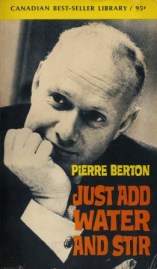
just add water and stir pierre berton 001Just Add Water and Stir by Pierre Berton ~ 1959. This edition: McClelland & Stewart, 1966. Paperback. 221 pages.

My rating: 8.5/10.

*****

Here’s another well-read paperback from my late father’s bookshelves, boxed up and brought home six years ago as my just-widowed, elderly mother was preparing to downsize from a huge, rambling three-story house to a much smaller bungalow. Both homes, incidentally, were built in their entirety by my father, who was a foundation-to-roof master carpenter, among his other jack-of-all-trades and master-of-many accomplishments and interests.

One of his interests was books. Dad did love to read, and I like to think that this collection of mostly humorous, often over-the-top satirical, sometimes sincerely thoughtful short essays made him smile as they did me when I finally read this briskly paced book over the course of this potentially dreary day spent recovering from a brief bout with the latest flu bug.

Being a random collection of satirical essays, rude remarks, used anecdotes, thumbnail sketches, ancient wheezes, old nostalgias, wry comments, limp doggerel, intemperate recipes, vagrant opinions and crude drawings …

So says the front page, and it describes the ensuing contents well. Most of these short pieces appeared as columns in the Toronto Daily Star in the 1950s, and they are definitely indicative of the time in which they were written. As a cynically humorous portrait of the era, this book is an excellent little period piece, but it’s an enjoyable read even for those of us not familiar at first hand with the context of some of the references. Berton’s opinionated prose is seldom dull, and the shortness of each entry makes it good for dip-into reading as well. I read the whole thing in one go, and that likely wasn’t such a great idea, as I’m now feeling a bit light-headed, but I’ll blame that on my current bug as much as on the flippant nature of my reading matter.

The book is arranged into groupings of similarly themed articles and essays. These can be read in order, or sampled at will.

Five Modern Fables ~ Pure over-the-top satire starts us off. Berton skewers modern advertising techniques and ploys in his first three fables, lampoons the vicious cycle of competitive Christmas card lists, and ends with a cautionary tale about not heeding the omens and building too close to the volcano.

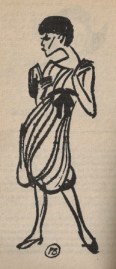
Seven Men and a Girl ~ Brief character portraits of eight people Berton met and interviewed: Ex-convict John Brown, pianist Glenn Gould, aviator Russ Baker, evangelist-turned-politician Charles Templeton, Canadian Communist Joe Salsberg, poet and writer Robert Service, entertainer Milton Berle, and call girl Jacqueline (no last name given).A Woman of "Vogue"

The Wayward Periodical Press ~ “Six periodical publications deserving of comment” – Vogue, Time, Mayfair, Playboy (and the rest of the Bosom Books), Mad, and Justice. What an interesting combination of companions these are. Vogue is, well, Vogue, and it apparently hasn’t changed much at all.

My favourite magazine, next to Screen Stars and Mad, is Vogue. The day it appears, I rush eagerly to the newsstand and, with the help of a couple of weightlifters, lug it off to my den. For sheer escape reading it beats the old Blue Fairy Book hollow. It chronicles a world so foreign and unreal that I would not believe it existed, if there weren’t photographs to prove it.

The women who grace Vogue’s pages are like no women I have ever known. I have tried to sketch one or two of them here, but my brush does not do them justice for their absolute and utter sexlessness defies reproduction. If they came from a far corner of the solar system they could not be more different than the blousy creatures one finds romping through Esquire and Playboy.

Am I all wet in my theory that a bosom craze is sweeping the country? In Vogue, there isn’t a bosom in a carload. These women are all eyes and cheekbones, and they do something with their necks that I haven’t seen since Leona, the Giraffe Girl, went into retirement.

At the end of the neck one finds a face that has overtones of Buchenwald about it – chalk-white and haggard, Vogue women do not have noses, only nostrils. Their eyes are enormous and decadent, their lips are thin and solemn. Their hair is always quite odd. They are shown thrust forward in inscrutable positions that suggest some curious doe-like animal at feeding time.

Time sets off a passionate diatribe in defense of Canadian content in “Canadian” versions of American magazines; Mayfair is a “high society” periodical seething with anachronistic class consciousness. Playboy and the rest of the “men’s magazines” are investigated as to the number and degrees of exposure of female body parts posed artistically for masculine delectation; Berton claims to be overwhelmed by sheer numbers.

The Cult of the Bosom has now reached its zenith in this continent, as a glance at any newsstand will show. In the seventeen magazines I examined, there were 503 photographs of well-endowed young women displaying their endowments.

In 125 of these photographs, many of them in glowing colour, the young ladies’ torsos were entirely exposed. In the remaining 378 photographs there was a certain roguish attempt at concealment.

I did not bother to count any photographs of women dressed for the street, because there were so few.

I did not bother to count any photographs of flat-chested young women, because here were none.

I did, however, make a count of the numbers of photographs of women with no pants on. There were sixty of them.

Mad magazine receives an enthusiastic nod of approval, for the “sophistication of the humour”, while Justice, an arcane periodical dedicated to the practices of sadomasochism and corporal “discipline”, garners strong words of scorn.

The Broadcasting Arts ~ Television and radio – including the already-venerable C.B.C. – come in for their turn in Berton’s critical spotlight.

Verse, Blank and Otherwise ~ Several parodies in verse of current events of the time. The Sixty-Five Days of Christmas struck a modern chord, though nowadays it would need to be retitled The Ninety Days of Christmas to approach a closer accuracy!

Christmas began last Tuesday
Just three days after Hallowe’en,
By which time the big emporiums,
Having disposed of the comic ghosts and candy pumpkins
And having burned all the second-hand witches,
Replaced them with more seasonal symbols:
A reindeer with a crimson nose,
A talking snowman and a terribly cute bear,
Fifty-seven varieties of Santa Claus,
And here and there, an inconspicuous plastic replica of the Christ-child,
 
Entirely non-denominational.
 

Intemperate Recipes ~ A plea for a return to real cooking versus the pre-packaged growing norm in the titular Just Add Water and Stir, and a heartfelt rant against instant coffee, obviously a newly popular abomination in Berton’s world. Plus four quite decent-sounding recipes – or, more accurately, anecdotal instruction pieces on how to best prepare these Berton standbys – Tomato Soup, Baked Beans, Corned Beef Hash, and Clam Chowder. Pierre Berton in the kitchen – what a grand thought!

The Passing Show ~ A satire from the viewpoint of the future, and musings on the status significance of offices and office furnishing, smoking, and divorce. Shopping for a Coffin is thought-provoking and quite serious, while Several Openings for Novels will make the aspiring writer nod in rueful recognition. A few more observations – paying to be published, the confusion of children’s toy assembly instructions, and a modern Red Riding Hood round out this section.

Certain Vagrant Opinions ~ Full rant mode! On Dick and Jane (Berton is against), On Advertising and the Press, On Racial Origins (none of the government’s business), On Thought Control (shades of Orwell’s Nineteen-Eighty-Four), and most passionately, On Flags and Anthem and On Modern Torture (prison reform), which is the most serious piece of the lot, and describes an execution by hanging which Berton was assigned to attend as a young reporter.

Some Old Nostalgias ~ Memoirs, 1927 to 1941, of Berton’s earlier days. Fascinating and charmingly written.

Read Full Post »

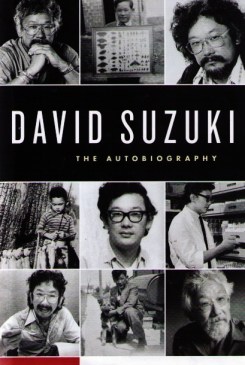
the autobiography david suzukiDavid Suzuki: The Autobiography by David Suzuki ~ 2006. This edition: Greystone Books, 2006. Hardcover. ISBN: 1-55365-156-1. 404 pages.

My rating: 5/10. Interesting to get some of Suzuki’s back story, but sadly my personal regard for this enviro-icon took a small step downward after reading it. It seems like the ego displayed here is as large as the legend.

*****

There’s a little comment someone made in my hearing years ago, which comes to mind right now: “If you want to know how good he is, just ask him”.

Packing a whole bundle of firewood on his shoulder (and understandably so) stemming from his family’s mistreatment during the World War II Japanese-Canadian internments and appropriation of property, David Suzuki grew up feeling like he had something to prove, and he’s succeeded to do just that, in spades. The depth of love/hate public feeling regarding this one soft-spoken and absolutely brilliant man goes to show how influential he has become.

The political right wing hates him, the lefties have made him their god. I tend to swing left, and I deeply admire David Suzuki for the focus on environmentalism he has forced into the public eye, but this autobiography shows all too clearly the god’s feet of clay.

This book looks back briefly to Suzuki’s childhood in B.C. Born in 1936, David Suzuki was six years old when he, his mother and sisters were interned in one of the camps for Japanese-Candians in the Slocan Valley. His father spent the war in a separate labour camp. After the war, the Suzukis moved to Ontario, where David completed his high school education before attending university in the U.S.A., attaining a PhD in Zoology in 1961.

Returning to Canada, Suzuki worked as a professor and researcher in genetics at the University of British Columbia. Branching out to participate in public education, he founded the popular CBC Radio science program Quirks and Quarks in 1974, and the iconic television series The Nature of Things in 1979. David Suzuki was a household name by the mid-70s, and his profile has grown exponentially through the years.

The Autobiography is honest enough in that Suzuki frankly discusses his two marriages and his shortcomings as a less than involved husband and father. His deep dedication to his work and his increasingly hectic public life often separated him from his family, and he freely admits that this is something he now regrets.

Most of this book is a listing of various events Suzuki has been involved in during the past twenty years; plenty of name-dropping of the celebrities he rubbed elbows with – Sting! Buffy St. Marie! John Denver! – and plenty of slightly patronizing commentary on how he brought this, that and the next thing to the public attention. True, so true, but the tone doesn’t feel very kind-spirited at times.

The writing is not the strong point here, either. The subject matter would be much more enthralling if it weren’t dealt with in such a flat “Then I said, then I did, then I said, then I did” manner. There are some personal anecdotes, mostly concerning his parents, and the death of his father, where he lets himself go, and these are the most poignant and memorable of this rather dull book.

I would say “read it” just to get a deeper understanding of this fascinating and frequently self-sacrificing man, but be prepared to come away feeling something like a member of the great unenlightened, living in the dark and waiting for The Master to flick the switch. You really want to know how good David Suzuki is? Read The Autobiography. He’ll tell you.

Read Full Post »

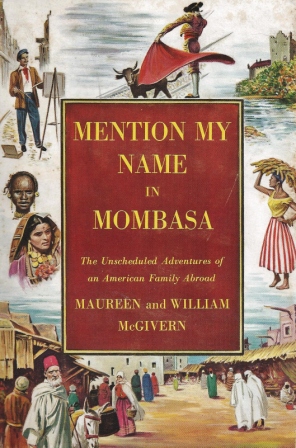
Mention My Name in Mombasa: The Unscheduled Adventures of an American Family Abroad by Maureen Daly McGivern & William McGivern ~ 1958. This edition: Dodd, Mead & Co., 1958. First Edition. Hardcover. 312 pages.

My rating: 7/10.

*****

This is a most interesting read; a travel memoir with a very 1950s’ feel – not surprising, seeing as it is a 1950s’ book! I enjoyed it.

The authors were literary figures of their time, and the travels herein described were, it seems from a few comments here and there, both to fulfill a personal desire for wanderlust and to collect material for future books, including this one.

If the name Maureen Daly rings a bell, it is most likely because of her extremely successful young adult novel, Seventeenth Summer, written when the author was herself just seventeen, and published in 1942. Some years later we find Maureen married to fellow writer William McGivern, a successful writer of crime-mystery novels (The Big Heat, Rogue Cop, war novel Soldiers of ’44, and almost 20 more) and film and television scriptwriter (Kojak, Adam-12, and Ben Casey, among others). They had their two children along, 6-year-old Megan and 2-year-old Patrick, when they left New York on New Year’s Eve to travel to Paris, the start of their extended travels.

Long, detailed and quite enthralling chapters describe the scenery, culture and especially the unique individuals the McGiverns came into contact with. The tone is a mixture of worldly-wise (but never condescending), travel guide (but merely to lay out the scene), and very 1950s’ American superiority (but innocent of bluster so therefore non-jarring – at least for the most part). The McGiverns were very eager to give credit where it was due regarding the superior aspects of their temporary homes and tourist destinations, which included Paris, and then a stay in the tiny fishing village of Torremolinos near Málaga, Spain, just on the verge of its discovery and development as a winter-tourist hotspot.

Then come several chapters on Spanish bullfighting, bullfighters and the ranches which raise and train the bulls. The tone here is journalistically non-judgemental much of the time; I never did get a grasp of whether the McGiverns were fully behind the “sport”, though from the farcical descriptions of a number of stereotypical bullfight aficionados which graces one of the chapters, I suspect they had marginally more sympathy for the bovine members of that elite yet widely populist pastime.

Next is a short visit (and hence a short chapter) in Gibraltar, where the McGiverns are rather disappointed in the elusiveness of the famous apes. On to Iceland, and a very travel-guide chapter this is, with loads of facts thrown at the reader, interspersed with short vignettes of some of the US Army families living on the vast NATO air base, and native Icelanders who opened their homes to our travellers.

Then comes the most memorable chapter of the book. During World War II, William had served as a US Army gunner in the European campaign, and his platoon had ended up entrenched on the mountainside near the tiny Belgian village of Fraipont, where the local people showed such generosity and warmth to their American allies that William had long planned to return in more peaceful times. Just over ten years later that sentimental visit took place, with the villagers overjoyed to recognize William and welcome his family. A poignant reminder that the war was not all that far in the past when this pilgrimage took place.

Back to Spain, and then a four-day voyage to the Canary Islands, a visit which seems not to have quite met the high expectations of the romance of the name. On to Morocco, where the McGiverns have several pleasant surprises regarding the locals, and then to Nigeria, on the cusp of independence as a full member of the British Commonwealth, after decades of colonial occupation.

A safari to Abadjan on the Ivory Coast and then to Fort Lamy in Chad doesn’t quite go as expected, but there are compensations in the people who the McGiverns meet as they wait for their travel visas to gain approval from the local bureaucracy. This does not happen, so back to Spain, through France, Belgium, and over to Ireland, where the Daly family is waiting to welcome their wayward relative and her family for an extended visit. Several months in Dublin follow, and then the trip is wound up, with a return to New York over a year after the original departure.

In this book there is a strong sense of how good it is to be an American at this point in history, and how welcome the traveller from the U.S.A. both feels and is made to feel; the McGiverns travel in their French-bought Citroën plastered with American flags fore and aft, and seldom seem to meet with a cold shoulder. Quite a change in the ensuing fifty years!

This is a fine book, and a literary time capsule of the post-war era, before things started to go wrong for the U.S.A., politically speaking.

I suspect it may be hard to come by (I ordered mine for a rather large sum from an online rare book dealer, for the Maureen Daly connection) but if your library happens to have a copy hidden in the stacks, or if you chance upon it in a used book store, it is well worth delving into.

Read Full Post »

« Newer Posts - Older Posts »