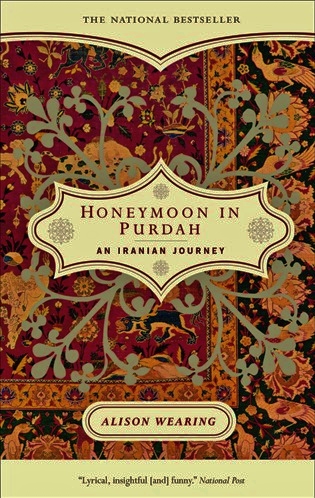
 Honeymoon in Purdah: An Iranian Journey by Alison Wearing ~ 2000. This edition: Vintage Canada, 2001. Softcover. ISBN: 0-676-97362-0. 319 pages.
My rating: 9.5/10
In 1995, a decade and a half after the revolution which resulted in the deposition of the Shah and the establishment of the Islamist fundamentalist government led by Ayatollah Khomeini, a young Canadian woman and her male partner entered Iran on tourist visas. Their official reason: a honeymoon journey. The not so official reason: for Alison Wearing, the chance to explore a country and culture vilified in the Western world as impossibly backwards and more than slightly dangerous for touristing. For her partner Ian, Iran is a second-choice destination. He really wanted to go to Bulgaria, but a fear of travelling alone and, one suspects, Alison’s more focussed drive and tenacious personality, have resulted in this joint trip.
Before taking this trip together … we would spend hours poring over maps, planning long, arduous treks through desolate corners of the earth or road trips across continents.
The only problem was my strong belief in travel as a solitary pursuit. And Ian’s fear of travelling alone… We settled on Iran because it was the only place I couldn’t imagine going on my own. And for a whole stack of other reasons that had nothing to do with our relationship.
The year before we met, I had made my fifth trip to Yugoslavia. I went, in part, to visit friends trapped in the middle of war, but also because the media’s portrait of the place – full of barbarians and void of humanity – made the world seem unlivable. I refused to believe that such a place of unalloyed evil truly existed, that that was the end of the story. I went because I believed that there had to be more. And because I like to look for saints where there are said to be demons.
Iran became our destination for the same reason.
I’m going to share a major spoiler here, one that comes part way through the book. (I don’t feel particularly bound to keep this a secret; it is something of a “first line” in many of the internet reviews I’ve read.)
I have a confession to make. Ian isn’t my husband. We aren’t even lovers, just friends. We forged a marriage certificate just before leaving Montreal using photocopies of his brother and sister-in-laws document, and that is what we are using to get ourselves into hotels. Most proprietors don’t ask and of those that do, two have scrutinized the paper very seriously while holding it upside down, so we needn’t have worried so much about its appearance of authenticity. The thing we should have worried about, perhaps, is the effect that photocopying and whiting out of names on a marriage certificate might have had. By the time Ian and I had reached Iran, his brother’s marriage had collapsed.
…
So Ian, my fussy, gay roommate and I are romping around Iran quite illegally. And not altogether happily, if only because our interests are not as parallel as we had grown to believe. He is primarily concerned with dead things (history, buildings, wars), and I primarily with living things. Sometimes I find myself wishing he would evaporate, which isn’t to say I don’t still find him endearing. It’s just that our differences have become painfully obvious under this desert light…
So that is the explanation of the double entendre title of this exceedingly revealing (yet not quite forthcoming) travel memoir. The author has been rattling around the world quite independently for some time already, a seasoned traveller indeed. But this trip called out for a partnership, because of the difficulties inherent in a woman attempting to move about unchaperoned by a male relative in a very strictly policed, Islamic fundamentalist country. It is doubtful that, alone, Alison would ever have been permitted to cross the border, with only “tourist” as her declared motivation. A honeymoon journey, while raising some eyebrows, is accepted as a valid excuse, especially when Alison, whenever necessary, willingly dons full traditional garb: manteau, headscarf, and all-enveloping chaador.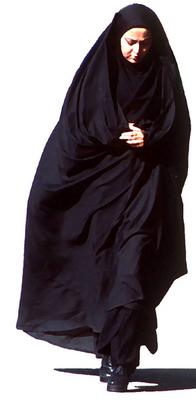
First of all, there is no such thing as “wearing” a chaador. There is only “managing to keep one on.” And I don’t say this as a frustrated novice, but as an observer of scores of women who have been dressing with it most of their lives.
The chaador is a living, wriggling entity, whose preferred habitat is the floor. Any woman trying to cover herself is not only fighting the true nature of the fabric, but also gravity, which has been in cahoots with the chaador since the beginning of time. The moment the chaador is on, wrapped in just the right way, covering all the right things, it begins its dogged descent, squirming along the sleek surface of the hair, hoping to make a clean leap to the neck, where it can secure a foothold for its plummet off the shoulders. An astonishing portion of the wearer’s energy and concentration goes into minimizing the creature’s progress, herding it back into position around her face, leashing it to her fingers and fists, or clamping its skin between her teeth. It doesn’t enjoy being corralled in this way. Thus the constant wrestling. The creature prefers damp, humid surroundings and feeds on sweat.
The literal translation of chaador is “tent”, but from my own camping experience this seems a poor translation. The sack-shaped coat and scarf I have on right now are the tent. The chaador thrown overtop feels more like the fly.
Alison Wearing fully embraces the experience of going – literally – undercover in Iran. Though she is deliciously sarcastic and witty throughout, she is also good-spirited and gracefully positive, describing her impressions on every aspect of her travels from the clothes to the food to the various characters she encounters to her long-suffering travelling companion Ian, whom, incidentally, we don’t really get to know, aside from a few brief vignettes here and there. It is rather as if Alison has chosen to shield Ian from examination, focussing instead on her own emotional and physical journey. It would be most interesting to read a parallel account of the Iranian episode from Ian’s point of view; one suspects his inner voice would consist predominantly of one long, high-pitched scream, triggered by Alison’s continuous flittings off and nonchalant eventual returns: Ian seems to (understandably) spend much of his Iranian time in a state of high anxiety. Alison must have been an utterly exhausting partner for their five months “honeymoon” in Iran.
All criticism aside of the self-indulgence of relatively well-heeled Western travellers sightseeing in troubled Eastern countries – and Alison addresses this dichotomy in her narrative numerous times – this book is an excellent example of a modern travel memoir. It opens a window into a very different culture, and it educates and informs as much as it amuses. And it is very amusing. And poignant, and heart-rending, and – this goes without saying – thought provoking. Well done, Alison Wearing.
Many years have passed since Alison took her Iranian journey and wrote about it so wonderfully well. In the meantime she has married, had a son, and pursued numerous other interests, including the successful production and performance of a one-person stage show based on her childhood, adolescence and young womanhood, much of it centered around the situation of her father’s “coming out” as a gay man – albeit one with a wife and three children – in the 1970s, in conservative Peterborough, Ontario. Confessions of a Fairy’s Daughter is Alison’s second memoir, published just this year, some thirteen years after her first book. I am looking forward to reading it with anticipation; I had thought to add it to my Christmas wish list, but I suspect I will acquire it long before then.








 Leaves & Pages
Review: The Family Nobody Wanted by Helen Doss
Posted in 1950s, Read in 2013, tagged Biography, Memoir, Religion, Social Commentary, Vintage on September 6, 2013| 16 Comments »
My rating: 6/10
Well, this was an interesting read, and I’m still trying to decide what my personal reactions really are.
On the surface it is a simple feel-good memoir about a young childless couple adopting twelve children in the 1940s and 1950s, but there are deeper currents to the tale, especially from a half-century later perspective. In particular, there is a damning sub-text of racial intolerance which is very much a part of why and how this family came together.
So Helen’s husband Carl, driven to distraction by his wife’s continual bemoaning of her barren future, suggests that they adopt a baby. Helen loves the idea, and the two optimistically prepare a room and trot off to the nearest orphanage, where they learn that it isn’t quite as simple as all that. Most of the babies in the orphanage were simply not available, being only in temporary care, or waiting for relations to take them in, and the adoption agencies which are the next resort are not particularly helpful either. Helen and Carl are informed that waiting lists are years long, and that each baby must match its potential parents perfectly in ethnic makeup and family background. And of course the parents must be financially stable, as well as sterling characters in all other aspects.
Carl and Helen are sure their characters are good, but the money thing is definitely an issue, and the waiting list situation seems cruelly stressful. So they set aside their ideas of forming a family and instead decide to pursue other interests. Both enroll in college, Helen to study literature and writing, and Carl to pursue a long-held dream to become a Methodist minister. And then, miraculously, one more attempt at adoption through an agency results in a beautiful blue-eyed baby boy. Helen is ecstatic; Carl more reserved. They can barely feed themselves, so this new addition is a challenge in more ways than one.
Young Donny thrives and grows, and all is well for a while, until Helen starts to brood over the loneliness of the only child. “If only he could have a little sister…” But another child is an impossibility, declares everyone they contact. “Just be happy you managed to get the one.” Unless, of course, they would consider a mixed race child. Lots of those were languishing in adoptive limbo, and, three years after Donny’s adoption, Filipino-Chinese-English-French Laura joins the family. And, only two months later, frail and sickly Susan, undesirable because of her weak constitution and a tumorous red birthmark on her face.
Helen is still thrilled, though she finds three children something of a challenge, but all three thrive, and Helen starts thinking again. Maybe just one more, a brother for Donny…
Eventually, with increasingly strident resistance from Carl, Helen collects a round dozen of children, six boys and six girls. She writes about the family’s experiences, and the tragedy of mixed race children being seen as undesirable by families otherwise desperate to adopt a baby; even though the Filipino, Chinese, Korean, Japanese, Malayan, Burmese, Spanish, French and American Indian children she and Carl eventually acquire are accepted by family and neighbours, a constant refrain is “As least they aren’t Negro!” Carl and Helen do attempt to adopt a part-black child from a German orphanage, child of black American GI father and a German mother, but the transaction is strangled by red tape; their families and friends are loudly vocal in their relief, and one of the most passionate chapters in the book strongly condemns this attitude, and addresses the degrees of racism inherent in American society, and its effect on innocent children along with its part in much greater societal ills.
Helen and Carl come across as truly sincere in their attitudes that colour means nothing, and that human is human; Helen starts writing articles about their “United Nations” family, and the Dosses catch popular attention, being interviewed, photographed and featured on radio and television, as a kind of shining example of American acceptance and tolerance, though in reality the very existence of their family group has come about through blatant American racial discrimination. These are, after all, the children that nobody wanted.
The book ends only twelve years after that first baby, Donny, is adopted, and the tone is happily optimistic, but there are undertones that perhaps all may not be so well in future. Carl is a reluctant participant in the continual enlargement of the Doss family, though he is very willing to tout its benefits for interviewers; Helen persists in collecting children in the face of Carl’s outright “No more” plea, time and time again. The news that the Doss marriage ends in divorce in 1966, twelve years after the publishing of this bestselling book, comes as no surprise, though it is sad; one hopes that the children – some at that time well into adulthood, one must admit – weathered their family breakup with a minimum of trauma, though one doubts that would completely be the case.
Knowing several cross-culturally adopted children who now, as adults, are seeking diligently to reconnect with their birth parents’ heritage, I wonder what happened to those twelve children as they grew up, and what they each personally made of their inclusion in this unique family, and of the publicity which their parents’ outspoken willingness to discuss their adoptive choices attracted.
I do think, both from the tone of Helen Doss’s memoir, and from other reports on the Doss family I read on the internet, that their intentions were, once they started adopting, only the best. And, also, I do tend to think that children deserve a loving family versus being institutionalized, and that if the only fit possible is cross-cultural, so be it. If it were more widely accepted (as it wasn’t in the 1940s and 1950s) then at least the “novelty factor” would not be such an issue.
I’ve tagged this post with a “religion” designation, because it is also very apparent that Helen and Carl Doss were motivated in a great part by their Christian faith. Carl Doss is quoted as saying that
Conflicted as Carl seems to be by his wife’s acquisition of child after child, once they are brought into the family he apparently embraces his fatherhood fully, being as full of latent paternal affection as he is of “radical” Christian ideals.
A thought-provoking memoir, and, as I said, a bit uncomfortable to consider more deeply, given that a whole lot must have been left out. Though I was interested and pleased to see that Helen Doss was very frank about her own motivations of needing children to “complete” her idea of true womanly fulfillment; the ideal of a happy, multi-racial family group seemed to develop as her circumstances changed.
I did my usual look-around the web, and was interested to see how highly this book was rated on Goodreads; a large number of people apparently read and loved it in their school years; the reviews are by and large quite glowing.
It is very readable, and provides a truly fascinating (though superficial) glimpse into the mid-20th Century’s social dilemmas and attitudes towards both adoption and racial and interracial societal division lines. It is also frequently very funny; Helen Doss’s anecdotes of her children’s doing are downright adorable, and well targeted at the sentimental readers who have obviously embraced it as a “sweet tale”. It is a sweet tale; it is also an indictment of the bitter evils of racial discrimination; and a strong advocate of true Christian behaviour; and a revealing portrait of a marriage not without deep personal conflicts, despite its publically positive façade.
For more on the Doss family, these links will be good starting points.
Helen Doss – Obituary
Adoption Topics – The Family Nobody Wanted
Read Full Post »