Posts Tagged ‘Light Fiction’

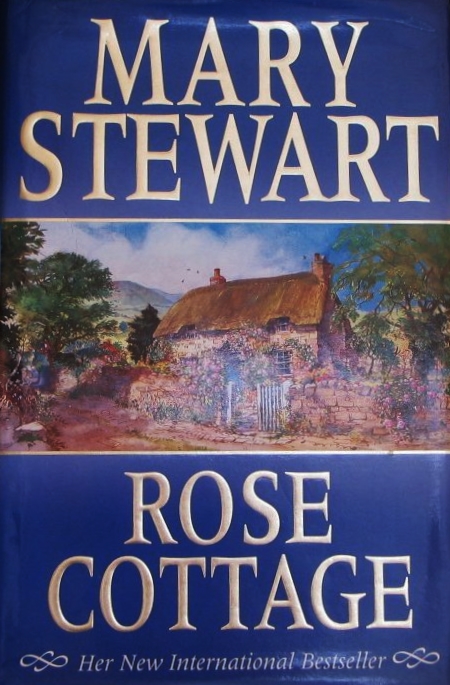
rose cottage mary stewartRose Cottage by Mary Stewart ~ 1997. This edition: Hodder & Stoughton, 1997. Hardcover. ISBN: 0-340-69560-9. 234 pages.

My rating: Honestly, all I want to give is a 4.5/10, upped to a 5 because it is Mary Stewart, and I will be looking for a copy to purchase and add to my collection of gentle books maintained for my mother’s perusal.

I feel absolutely rotten giving this low of a rating to a writer I have come to greatly enjoy, but it is an honest assessment of my reading experience. Rose Cottage is indeed a lovely story, a nostalgic journey into the past, and I do believe that the author meant it to reflect her own pleasant memories, dedicated as it is

To the gentle shades of Henry, George, Patsy, Nip, Rosy, Maudie and Muffin, and all the other friends whom I meet again in my stroll down Memory Lane.

But it was vaguely unsatisfying, and a bit too – dare I say it – mild, with an anticlimactic happy ending and love and flowers and reconciliatory kisses all round and even a kitten.

And how could one not love a kitten? Well, in this case, the kitten felt superfluous, the one adorable straw which caused this particular camel to sag at the knees and subsequently dock several points off the rating scale. Do I feel like a big old meanie discounting the kitten? Oh, yes, I do indeed. But I can’t, in all honesty, recant. Sorry, George-the-kitten.

And sorry, Mary Stewart. I’ve come to admire you greatly these past few months as I read my way through a selection of your novels. But Rose Cottage, though a sweet thing in its own way, is not representative of your work at its peak. It’s a step down and back, a lessening-off, a gentle coda to round off your life-long symphony of written words.

Looking back down the vista of years, Kathy (Kate) Herrick reminisces about the summer of 1947, when her life took an abrupt turn.

Kate was brought up in a tiny thatched cottage – Rose Cottage – attached to the estate where her mother (Lilias) and grandmother were employed as maid and cook. Kate’s mother lost her position when it was discovered that she had become pregnant; Kate has never been told who her unknown father is. Her grandfather dies, and sternly religious Aunt Betsy comes to stay. Aunt Betsy’s bitter disapproval of Kate’s mother’s “fall” results in Lilias leaving for parts unknown when Kate is only six. Some time later word comes that Lilias has been killed in a bus accident; Kate is effectively left an orphan.

Kate grows up in an atmosphere of combined love (Gran) and puritan repression (Aunt Betsy), and, when the war comes, it is not as much a break as it could be when Kate moves away, and then falls in love and marries a bomber pilot. Their short marriage is happy, but ends tragically when her husband is killed in action. Kate takes this in stride in her quiet way, and goes on to keep herself occupied with an interesting job in a plant nursery, though she has been left well-provided for in her late husband’s will.

Then, out of the blue, Kate gets an urgent phone call. Gran has been ill; she has something important she needs Kate to look after for her. Can Kate please come to Scotland, where Gran’s employers have migrated due to the requisition of their English house during the war, and hear what it’s all about?

Aunt Betsy has since died, and Gran’s old home, Rose Cottage, is due to be renovated and sold, but all of Gran’s things are still there. Could Kate please go and pack up Gran’s furniture and small treasures, including the family’s personal papers and the bits of sentimental jewelry and keepsakes hidden in a small wall safe?

So off Kate goes to her childhood home, where she immediately discovers that there has been a recent intruder. The wall safe, which was papered over and known only to household intimates, has been opened, and the contents are gone. Now who would ever have known the safe was there? And what did it really contain?!

Luckily one of Kate’s old school friends, handsome, still-bachelor Davey Pascoe, is more than happy to renew acquaintance with pretty Kate, and to help her solve the mystery.

Many worrisome coincidences and much foreboding evaporate into a purely domestic situation with a prosaically reasonable explanation, and everything is tied up very tidily indeed by the last page. Definitely a feel-good sort of read, a very meek and tame adventure despite the potential of the early events to be worked into something much more melodramatic.

I can’t help but wish there had been some more dramatic developments, even though those sorts of plot twists in Mary Stewart’s earlier novels sometimes made me roll my eyes with readerly disbelief. But I’ve become used to this sort of thing from this author, and her stepping away from drama left me feeling surprisingly let down.

Still and all, a nicely written and completely sweet story. One to give to one’s own granny for gentle entertainment over a nice cup of tea, if one’s relative is of the type to enjoy a non-challenging sort of tale with a blissfully happy ending.
Read Full Post »

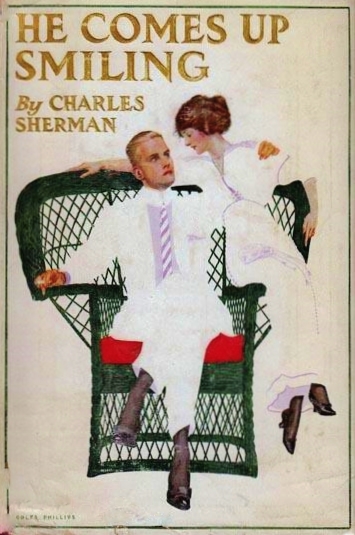
he comes up smiling charles shermanHe Comes Up Smiling by Charles Sherman ~ 1912. This edition: McLeod & Allen, 1912. Hardcover. 351 pages.

My rating: 5/10

Light as a feather and just as fluffy was this century-old bit of humorous fiction.

From the San Francisco Call, February 18, 1912 comes the following commentary.

Once begin this tale… and all thought of everything else will leave you. The tale is absorbing, exciting, clever, amusing and quite unusual… whimsical to a degree. It tells the story of a tramp—not a tramp in disguise, a real tramp, although he has a respectable ancestry and did have some “bringing-up,” though very poor.  He is a lazy, idle hound, and any amount of discomfort is preferable to work. Through a chapter of the most extraordinary occurrences a hero ever had he meets “the” girl, and the remainder of the story is fairly breathless in its excitement. After the reader is once acquainted with “Watermelon,” the affectionate nickname which other tramps call him, it is easy to see why he is a gentleman, though his hands are not clean and he is not above lying and stealing in a small way. He has the quaintest sense of humor and is forever making the most original remarks, always with the prefix “Father says.” A few follow:

  • ”Manners don’t count any more than the good apples on the top of the box to hide the rotten ones beneath.”
  • “If a man reached 40 without becoming a cynic, he was a fool and might never have reached 40.”
  • “A success can be a cynic, for cynicism is simply a pretty good idea of the meanness of human nature and no unfounded expectation of anything especially decent coming from it.”
  • “Nothing is more important than ourselves and what affects us.”
  • “Love is divine, hate devilish and meanness just cussed human nature, and a mixture of the three, in more or less degree, makes man.”
  • “A man who knows life never wrote about it. It would be too painful. It wouldn’t sell.”

Though the reviewer for the SF Call thought this was a grand bit of fiction, I am sorry to say that it did not travel through its ten decades with a whole lot of staying power. It has merit as a literary and cultural curiosity, and the first few chapters are quite delightful, but it petered out midway through and slid gently downhill to end in a well-cushioned and in no way fatal heap, rather like a slow speed accident with one of the vintage cars which the tale is so dependent on.

Three American tramps laze away a sunny summer Sunday morning, and in the course of conversation start a debate as to which of the two younger men would “clean up” better. They propose a beauty contest of sorts, to be judged by the corpulent Mike, and off go James and “Watermelon” (later found to be possessed of a proper name, Jerry, though it is as Watermelon that we follow him through his adventures) to town in search of a shave and brush-up and an upgrade in wearing apparel.

Watermelon is our unlikely hero from the very start, and we follow him into a barber shop where with a clever bit of smooth talking and a pinch of sleight of hand he obtains from the barber – who forks over quite willingly, which demonstrates the magic of Watermelon’s smooth patter – not only a shave, but the contents of the till.

Clothes are a bit more difficult to come by, but here luck is on Watermelon’s side, as he comes across a young man swimming in a small lake, with his elegant clothes placed neatly on the shore. Watermelon there and then “borrows” the improved apparel, hiding his own cast off garments nearby. He fully intends to come back and swap down, but he also wants to keep the naked swimmer in a position not to give pursuit once he returns to shore and realizes his predicament.

Proceeding on his way, now nattily attired in stylish new clothes, Watermelon happens upon a deserted car – obviously that of the oblivious swimmer – and climbs in to relax and daydream a bit. Along comes another car, carrying an elderly gentleman and his middle-aged daughter along with their chauffeur; they impulsively offer to rescue the “stranded” young man, and Watermelon, as is his phlegmatic way, goes along with the assumption that he is an unmechanical rich man out for a jaunt.

One thing leads to another, and when the time comes to make introductions, Watermelon hands over a card from the case in the borrowed suit, “revealing” himself as a certain young stock-broker who has just made a fortune on Wall Street, to great publicity. Taken off to dinner with his new friends, Watermelon is introduced to a “fellow” stock-broker and his lovely daughter, and once Watermelon sets eyes on the lovely Billy his fate is sealed.

Deciding that one afternoon with this angel on earth is worthy of continuing the masquerade for at least a few hours longer – he still intends to return the clothes and make all right with the swimmer – Watermelon makes himself agreeable to all. Little does he know that Billy’s father is hatching a mildly nefarious plot to kidnap the man whom he views as a business rival, and to carry him off for a week in the depths of the country, thereby leaving the coast clear for Billy’s father’s partner to triumph on Wall Street without interference.

And off we go on a farcical romp of mistaken identity, deliberate wrong directions, housebreaking, encounters with the law, much double entendre, hidden yearnings and unspoken but reciprocated love, as Billy has fallen just as hard for Watermelon as he has for her. (He does clean up rather well.)

The humour is relentless and the situations highly contrived, but Watermelon gently winkles his way into the hardest of readers’ hearts as well as that of susceptible Billy.

Billy herself was rather a waste of ink, being a completely frivolous rich girl with no evident depth to her. She’s cute as a button, but that’s about it. The older Henrietta, on the other hand, proves herself to be a witty foil to Watermelon’s quirky comments; I had high hopes that the two were going to dump the silly Billy and further develop their meeting of minds, but sadly this was not to be. (My opinion of the author took a nosedive when he let all three of us down in this way.)

The ending is broadly telegraphed from very early on; we fully expect to see Watermelon ‘fess up and buckle down to a life of honest toil in order to win the fair Billy’s hand. Though he does come clean, the honest toil bit doesn’t look to be in his future; the resolution is rather odd; it felt like the author cheated us of the expected rounding off of this ultra-light tale.

A  rather strange little reading experience, both more enjoyable than it sounds from my dismissive comments above, and less satisfying than it could have been if the author had been a bit braver with his character developments and multiple romantic interests. Definitely a throw-away sort of tale, a momentary diversion at best. Sort of a lightweight American P.G. Wodehouse of the B-list variety.

The story was made into a 1914 stage play, and then into a 1918 silent movie starring Douglas Fairbanks as Jerry Martin (the “Watermelon” of the book), though the plot was gingered up to make it more conventionally dramatic.

he comes up smiling 1918 movie poster

Read Full Post »

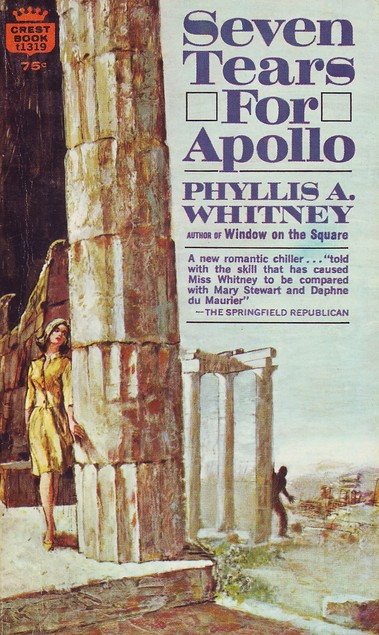
seven tears for apollo phyllis a whitneySeven Tears for Apollo by Phyllis A. Whitney ~ 1963. This edition: Fawcett Crest, 1966. Paperback. 224 pages.

My rating: 5/10

Here’s the back cover blurb on my tattered paperback, relic of one of my high school library’s discard sales way back in the 1970s:

Ever since the sudden, tragic death of her husband, pretty Dorcas Brandt lived in fear. Too many frightening, unexplainable things had begun to happen – the fatal accident to a close friend, the mysterious warnings scrawled on her mirror, her room ransacked.

Dorcas fled to Greece in search of sanctuary. But even on the beautiful island of Rhodes she could never escape the shadows of terror.

Was she just imagining it all?

Had the loss of her husband unhinged her mind?

Or was someone really out to destroy her?

Well, which one of those options would you suppose is the correct one?

If you guessed number three, you’d be bang on target. Dorcas is being persecuted, poor girl, and by a collective at that. Anyone she confides in either openly sneers at her allegations, patronizes her, or steps up the pressure. But why, oh why?

Here’s the story. We start out in the U.S.A., in an unspecified location that might just be New York, or possibly some other major eastern city. Some years back, museum curator’s lovely seventeen-year-old daughter Dorcas made a very bad marriage indeed, to sleek, handsome, half-Greek, half-Italian and all-wrong Gino. He turned out to be deceitful, manipulative, and physically violent; when Dorcas attempts to depart the marriage with baby daughter Beth, one of Gino’s mysterious “friends” pursues her and brings her back, warning her that it would be a very bad idea indeed to cross Gino, as what he owns (inferring Dorcas and Beth) he holds on to. Or else.

Gino’s profession as an art dealer is slightly nebulous but apparently profitable. Dorcas suspects that all of Gino’s transactions are not strictly legal, but she has no real proof, just an uneasy feeling which no one else seems to share, as Gino has a wide circle of influential friends in the arts-and-culture world, including matronly Fernanda, a best-selling author of quirky travel books, who has mothered Gino for years and extends her kindly meant but overbearing patronage to his wife and child.

Now nasty Gino has perished in a plane crash, and Dorcas is attempting to move forward in her life. She’s been having some emotional issues; Gino has had her in a facility for psychological treatment for her alleged neuroses, and Fernanda has been overseeing young Beth’s care. Now, since her widowhood and release from psychiatric care, Dorcas is herself living with Fernanda, acting as Fernanda’s secretary-assistant,  and reacquainting herself with four-year-old Beth. An upcoming trip to the Isle of Rhodes seems to be a positive step for everyone. Fernanda will gather material for her latest book; Dorcas will get a chance to experience Greece and see at first hand the sights that her late father could only dream of; Beth will bond with her mother in the bits in between.

As Dorcas stands in front of the museum copy of a statue of Apollo, steeling herself for the emotional journey she is about to embark upon, tears come to her lovely eyes, as she recalls her first meeting with the man that would become her husband – in front of this very statue, only a few months after her beloved father’s death – and Gino’s mysterious pronouncement that she must weep seven times for Apollo before she could shake the bonds that held her – whatever that had meant, if anything.

Dorcas weeps her way through this novel, with – I’ll give her that – abundant good reason. Gino brutalized her and left her physically traumatized and an emotional wreck; Beth has been virtually adopted by well-meaning Fernanda, with Dorcas’s contact with her daughter being held up as reward for good (meaning calm and rational) behaviour; and people – most notably Fernanda – insist on viewing Dorcas as a bereaved widow, when she is in actuality very relieved to be free of her malicious spouse. Everyone thinks Dorcas is a bit of a mess, and she tends to concur – though with slightly different reasoning.

Lately Dorcas has been finding evidence of a mysterious intruder in her room, with her belongings being ransacked, and a strange symbol being soaped on her mirror, or chalked on the floor – two circles, like the eyes of an owl. What could this mean?! And what is the apparent interest in a cryptic letter Gino had received just before his death, which Dorcas has refused to share with Gino’s associates, and which has now disappeared?

The average reader will be quicker off the mark than lovely, confused, jittering Dorcas. Something is definitely up, and Gino was obviously deeply involved. This trip to Rhodes will no doubt trigger all sorts of happenings. Beware, pretty lady!

The set-up of the novel is fairly promising, though the author drops some immensely broad hints as to what is coming up, first and foremost being that Gino is perhaps not quite as dead as he should be. The cryptic letter is obviously a clue of some sort to Gino’s last uncompleted nefarious transaction. Wee Beth is a perfect pawn, and will no doubt be used at some point to gain her mother’s cooperation by the as-yet-unidentified bad guys. Fernanda’s kindness will have a cost. Markos’s widow will hold a key secret to the affair. And there will be a romantic interest popping up soon. Ah yes, here he is. Johnny Orion, handsome young American schoolteacher, employed by Fernanda to squire her about Rhodes.

When we discover upon reaching Rhodes that the local museum is missing a major piece of ancient sculpture – the head of a boy with a tear on his cheek – we put two and two together. Obviously the Big Dark Secret has something to do with art theft! (At first I thought it might be drug running. But I swear that art theft was my second guess!)

Things get more and more hectic as the tale goes on, until the final dramatic dénouement, which sees our heroine weeping for what we hope will be the very last time.

This story was really not that great, being awkwardly plotted out throughout, and chock full of implausible action scenes and poorly written dialogue. It was head and shoulders better than Sea Jade and Columbella, though, hence its relatively high rating on my personal scale. I’m giving it a pass, at 5, because I think the author tried really hard to create an interesting scenario, and I could tell her heart was in the right place. It’s just too bad that others (Mary Stewart!) have done it so very much better.

Here’s an excellent review which goes into much more detail, plus it has lovely pictures. All of the troubling bits this blogger identified, I completely concur with, and the positive bits, too. Check it out.

Romantic Armchair Traveller – Seven Tears for Apollo

Read Full Post »

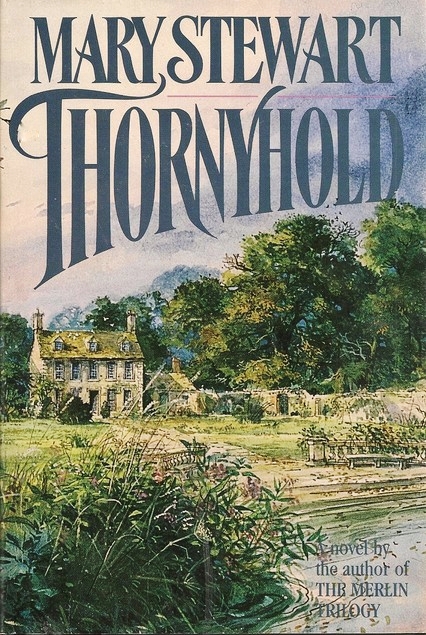
thornyhold dj mary stewartThornyhold by Mary Stewart ~ 1988. This edition: Ballantine/Fawcett Crest, 1989. Paperback. ISBN: 0-449-21712-4. 289 pages.

My rating: 8/10

Three-quarters of this romantic suspense novel was absolutely excellent; the promising plot evaporated just a little disappointingly in the concluding chapters, but on reflection my overall impression is favourable. It’s keeper, and it gets a very decent rating of 8/10 on my personal merit scale.

I do believe I am turning into a Mary Stewart fan; I’m feeling rather ashamed of my prior dismissal of this writer; I’m discovering that she is a more than competent writer; she has full control of her words, and I don’t believe I’ve yet to read an awkward phrase. She can write action scenes in vividly cinematic detail – see any of her romantic-suspense novels written between 1954 and 1976 – and accompany those with lyrical descriptions of the places where the action takes place. In a genre which encompasses some disappointingly sub-par stuff – Phyllis A. Whitney springs to mind for some reason, perhaps because I’ve been reading her this year too, and finding her sadly lacking – Stewart’s prose stands out. It’s not high literature, but it is well done, and most enjoyable to read. So I’m adding Mary Stewart to the shelf beside D.E. Stevenson and Georgette Heyer, as ones to track down, read with pleasure, and keep safe for future re-reads. Thank you, fellow internet book people, for giving me the nudge to explore these writers. You were more than right!

Mary Stewart’s heroines are uniformly well-drawn (so far every book I’ve read by her has been focussed on a leading female character), though they do always seem to share some characteristics. They are always good-looking, instantly attractive to men, and much prone to impulsive behaviour, with expected results. Each one of them does have her own personality, though, her own quirks and talents and weaknesses. The heroines are slightly interchangeable, perhaps – a test of a “stock” character is to imagine him or her in another of the author’s books – I could see Stewart’s young ladies managing quite well wherever they were placed within her fictional settings.

The heroine in Thornyhold is no exception, though the action in this low-key novel is confined to occasional verbal sparring. No drawn knives to avoid, no bullets to dodge, no trains to outrace, no rooftops to clamber over – our author at this point was likely ready to take a bit of an action-scene rest; Thornyhold was published in 1988, when Mary Stewart was a most respectable seventy-two.

Young Geillis – Gilly – Ramsay lives a lonely life, with an oddly assorted pair of parents.

I suppose that my mother could have been a witch if she had chosen to. But she met my father, who was a rather saintly clergyman, and he cancelled her out. She dwindled from a potential Morgan le Fay into an English vicar’s wife, and ran the parish, as one could in those days – more than half a century ago – with an iron hand disguised by no glove at all. She retained her dominance, her vivid personality, a hint of cruelty in her complete lack of sympathy for weakness or incompetence. I had, I think, a hard upbringing.

Gilly grows up; her mother dies, and with the natural mourning there is some relief, for her mother was a difficult person to live under. Gilly abandons her University classes and settles in to housekeep for her father; when he dies in his turn, Gilly is twenty-seven, with no resources to fall back on, and no real idea of what her future holds. Then, lo and behold, on her return from her father’s funeral to the vicarage which she will soon have to vacate, she receives a letter informing her that her godmother, (her older cousin, also Geillis, after whom Gilly has been named) has died and has bequeathed to Gilly a small country house and a very small income. Along with the lawyer’s letter is a note to Gilly from Cousin Geillis, telling her that she will find “everything here that you have most wanted.”

Cousin Geillis was something of a pagan, rejecting the outward trappings of Christianity, which made things just the tiniest bit awkward with her uncle-in-law the vicar. Her neighbours in the country regard her as something of a white witch, with her knowledge of herbalism and her sometimes peculiar behaviour, not to mention her large cat – her familiar? – Hodge. Gilly herself has had occasion to note that her cousin has some unique powers, showing up now and then just when most needed to help her young namesake over emotional hurdles in her life, and on one memorable visit providing Gilly a fleeting glimpse into the future, via crystal ball.

So Gilly steps into the life her cousin has left waiting for her. Needless to say there are some twists in store, chief among them being her cousin’s neighbour, Mrs. Trapp, who seems more at home in Geillis’ house than she should be. She brings Gilly meals, and nags her about finding a certain handwritten notebook she claims Geillis would have wanted her to have, and behind her ready smiles Gilly glimpses a steel-trap disposition which is most unnerving.

And, being a romance, there does in due time appear a man. And because it is a Mary Stewart romance, the man in question is preceded by a charming young son, whom Gilly befriends with no idea at all that the friendship will lead to something much, much more.

There is a certain intensity in the first part of the book which was rather heart-rending; one wonders if some of it is autobiographical? Or perhaps it is just cleverly imagined. The lonesome child Gilly is nicely portrayed, though the tone is carefully unemotional; our narrator telling the story is Gilly herself, some seventy years onward, looking back from her (happy) old age.

With the escalating escapades of scheming Mrs. Trapp, the tale turns towards farce, with the ending sequence – concerning, among other things, a love potion gone awry – striking something of a frivolous note after the emotional seriousness of what has come before.

A well-written book in its way, and one I will no doubt return to when I want something not too challenging to pass an hour or two. Good reading for a waiting room or a journey; easy to pick up and put down; the limited number of characters and the straightforward storyline are easy to keep hold of even with frequent interruptions.

Read Full Post »

« Newer Posts