Posts Tagged ‘Humour’

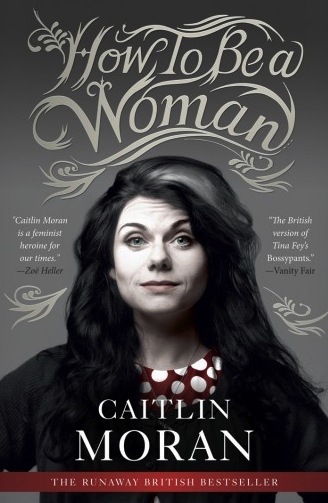
how to be a woman caitlin moranHow to Be a Woman by Caitlin Moran ~ 2011. This edition: Ebury Press, 2011. Softcover. ISBN: 978-0-06-212429-6. 305 pages.

My rating: This one was unrateable.

What can I say? It’s all been said. Multiple times.

Outspoken, thought-provoking, vulgar, romantic, profane, profound, controversial, brave, rude … and very, very funny. This is not a book I would give my mother! But I would leave it where my teenage daughter could find it.

I actually did just that, and she (the teenage daughter) dipped into it, and basically said “Ew. Too much information. And swearing. She’s a bit scary, Mom.” So that didn’t take. Which is just fine. We’ve already had all of the conversations that Caitlin missed with her mother. A lot of this one reads like a cautionary tale, a what-not-do-do manual, at least until Caitlin gets herself all grown up and out in the big world. Though even then her decisions aren’t exactly stellar one hundred percent of the time.

This is a big, bold, brassy memoir of British newspaper columnist and generally funny lady Caitlin Moran’s teenage years right up until the present. She has zero barriers; she discusses everything there is to discuss about being born with on the double X-chromosome side of the human sexual spectrum. This is Caitlin’s take on what it means to be a woman. While frequently prescriptive, it’s best taken with a good dash of salt. As one reviewer quipped, this one should perhaps have been titled How to be Caitlin Moran, because it certainly doesn’t apply – or appeal –  universally. Many are – and will be – sceptical, if not downright appalled, at Moran’s Technicolor rantings.

Menstruation, masturbation, obesity, body hair, pregnancy, childbirth –  full coverage of the biological range. Then there are drugs and alcohol and the over-the-top excesses these can lead too. Bad relationships. Good relationships. Marriage. Children. Abortion. Right along with the ethics of employing a cleaner.

And this is what seems to be getting all the attention in the reviews I’ve been reading. Capital-F Feminism. What it looks like today, and what Caitlin Moran thinks it should look like. In a nutshell, good old Golden Rule stuff. Do as you would be done by. Treat each other well.

I’ve been thinking about how to present this review for a few days now, ever since finishing the book, and since reading fellow blogger Claire’s take over on Captive Reader – How to Be a Woman . What I’ve decided is to not really say all that much about this one. The internet is crowded to overflowing with reviews; this one has received capital-H Hype, and some people are taking it really, really seriously.

Here’s the Goodreads – How to Be a Woman page. 2500 reviews. Go wild!

I’m not taking this one terribly seriously. I found it amusing, and I agreed with Caitlin Moran on her various opinions a good majority of the time. I particularly liked her chapters on marriage and motherhood, and the abortion chapter was something very unusual in its sincerity and refreshing lack of sensationalism. I don’t think I could be so detached and unemotional as Moran was, if it were me facing the same scenario, and my decision would likely have been the exact opposite, but her forthright acceptance of what she did felt genuine.

But I’m not about to bow down to her as our newest Feminist leader, our Womanly Great White Hope, as some enthusiastic fans seem to be. She’s not really breaking any new ground here, just repeating what’s already been said with a lavish dash of shazzam.

Moran is a very funny writer. I literally laughed out loud – a rarity for me when reading –  more than once – most notably during the bra and breastfeeding discussions – spot on! Loved it. I’ll likely purchase the book one day, but I’m in no rush. If I never read it again, no big deal. I’d never heard of the woman until a few weeks ago, and I strongly suspect I’ll not hear too much from her in future, but I’ve at least placed her in my personal “cultural literacy” file and can now nod knowingly if her name comes up.

And that’s good enough for me.

As a parting gift, here are some quotes I lifted from How to Be a Woman, courtesy of Goodreads. If anything here resonates, you’ll probably like this book.

*****

If you want to know what’s in motherhood for you, as a woman, then – in truth – it’s nothing you couldn’t get from, say, reading the 100 greatest books in human history; learning a foreign language well enough to argue in it; climbing hills; loving recklessly; sitting quietly, alone, in the dawn; drinking whisky with revolutionaries; learning to do close-hand magic; swimming in a river in winter; growing foxgloves, peas and roses; calling your mum; singing while you walk; being polite; and always, always helping strangers. No one has ever claimed for a moment that childless men have missed out on a vital aspect of their existence, and were the poorer, and crippled by it.

*****

I cannot understand anti-abortion arguments that centre on the sanctity of life.  As a species we’ve fairly comprehensively demonstrated that we don’t believe in the sanctity of life.  The shrugging acceptance of war, famine, epidemic, pain and life-long poverty shows us that, whatever we tell ourselves, we’ve made only the most feeble of efforts to really treat human life as sacred.

*****

Overeating is the addiction of choice of carers, and that’s why it’s come to be regarded as the lowest-ranking of all the addictions. It’s a way of fucking yourself up while still remaining fully functional, because you have to. Fat people aren’t indulging in the “luxury” of their addiction making them useless, chaotic, or a burden. Instead, they are slowly self-destructing in a way that doesn’t inconvenience anyone. And that’s why it’s so often a woman’s addiction of choice. All the quietly eating mums. All the KitKats in office drawers. All the unhappy moments, late at night, caught only in the fridge light.
Read Full Post »

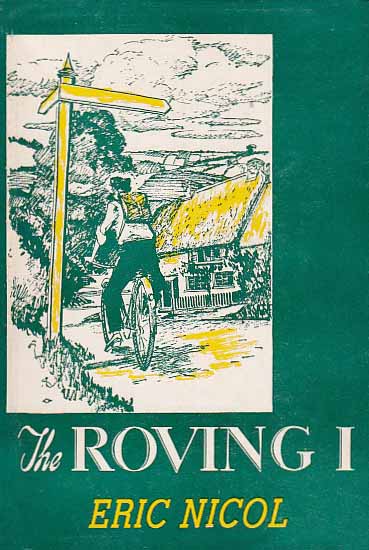
the roving i eric nicolThe Roving I by Eric Nicol ~ 1950. This edition: Ryerson Press, 1951. Hardcover. 134 pages.

My rating: 7/10, after some inner debate.

I  am rather sad to have to say that much of the humour is groaningly dated in this one, but despite that single failing, I have a strong affection for Eric’s comic tale of his year on The Continent, some phrases of which are ingrained deeply into my memory. The more eloquent passages obviously resonated deeply when I first read this at an impressionable age.

The Roving I won the Stephen Leacock Medal for Humour in 1951, which is commendable but not necessarily a guarantee of, well, of anything! The bits of Roving I which I am fondest of are the more serious bits, hidden beneath the sometimes-forced playfulness of the narrative.

Do I date myself when I assume that everyone knows who Eric Nicol is? As a middle-aged, mostly lifelong British Columbia resident, Vancouverite Nicol has somehow always been there, always on the edges of my awareness, a cultural constant. Exceedingly prolific throughout his writerly life, which began in college – he famously started his career by writing in the Ubyssey under the pen name of Jabez – Nicol went on to write more than 6000 newspaper columns for The Vancouver Province, as well as 40-odd books and a number of mostly-comic plays. Eric Nicol died in 2011, at the age of ninety-one, writing up until the end, despite battling the onset of Alzheimer’s. His last book, Script Tease, a collection of typically whimsical articles, was published in 2010.

But we’re going to go way back, to the early days, to Eric’s more youthful days as a young man after his WW II military service – three years in a non-combat role in the R.C.A.F. –  when he was taking advantage of an opportunity to pursue post-graduate studies for a year at the Sorbonne.

Here’s a sampling, from Chapter One: Debut of a Vagrant, at the start of the long train journey eastward to the embarkation point for ship travel to Europe.

The train lurches forward heavily, trying to take us all out by the roots at once. Mine hang on. Mine and those of the old couple across the aisle, who never thought of buying a newspaper because the news of the day was their being on the train, with a rope around their world.

Another good jerk does it. The station begins slowly to glide out under a full sail of flapping handkerchiefs. No, it’s us. We’re rolling. I and the fat lady sitting opposite me, reluctant to admit one another to the sudden vacuum of our existence, stare out the window at a grey and indifferent Vancouver. Oh, Vancouver, that I’ve given the best years of my life to, how can you dismiss me as though I were just another can of salmon? Is this how I’m to remember you, this motorist stymied by the crossing gate and glad to see the last of us? Couldn’t that woman stop hanging out her laundry for a minute? Is there no one to wave to us, on behalf of the city of Greater Vancouver?

Yes, by heaven! There she is. A little girl, a delegate at large, patting the air slowly and solemnly, making it last for the whole train. The fat lady and I wave back, and, relinquishing Vancouver, smile at each other, having in common someone we both said goodbye to…

That’s a fair sampling of Nicol’s style. Though occasionally it drops into sheer silliness, it is usually redeemed by clever, often very funny phrasings; the man did have – overused cliché fully applicable here – a way with words.

Eric Nicol’s books are quite easy to come by here in B.C., and are – here’s another cliché – well worth dipping into if you come across them in your travels, though some I find more enjoyable than others. The more hectic ones do seem to be trying a bit too hard, but there are little gems of delicious prose in each and every one. The Roving I is one of my personal favourites, a slight little period piece which captures a moment of time in a fast-moving world and frequently makes us smile at the infinite absurdities of life.

Read Full Post »

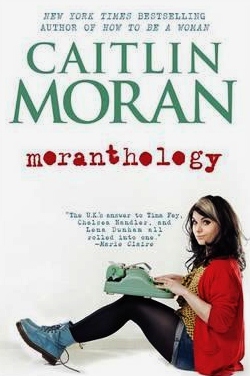
moranthology caitlin moranMoranthology by Caitlin Moran ~ 2012. This edition: Ebury Press, 2012. Softcover. ISBN: 978-0-06-225853-3. 237 pages.

My rating: 9/10.

*****

I searched this one out because of Claire’s intriguing posting about it on The Captive Reader recently. Click this link to read her take, and don’t forget to scroll down into the comments for an interesting side note onto the life of Charles Dickens. Here you go: Moranthology

I had never heard of Caitlin Moran before, but the lack of context was no barrier to enjoying this collection of columns originally published in the London Times. A previous book, How to Be a Woman, gets rave reviews on the back cover of Moranthology, and also, when I did my small bit of “research” for this review, all over the internet. One I may also seek out, because I liked Moran’s brash, cheeky and occasionally heart-rending voice in this later compilation.

Some articles are decidedly stronger than others, but every single one was more than readable. Moran works the pop culture beat, with frequent forays into personal memoir, and anecdotes about her own marriage and family life.

Caitlin Moran apparently had quite a counter-culture childhood and adolescence. Growing up in a self-described family of “hippies”, she frequently mentions her family’s poverty and the heavy-as-lead despair of the slow slide downward; the family lived on Moran’s father’s disability benefit, never quite enough to meet the basic daily needs, let alone afford any sort of advancement in life. Moran refers frequently to her youthful status as one of the lookers-on. As a homeschooled child, she remarks that she had zero experience in fitting in with her more conventional peers, and I suspect that it is this position outside of the norm which has helped make her such a sharp observer of the more ridiculous of the pop culture excesses splashed across our universal consciousness in this age of hyper-information.

There are poignant moments throughout Moranthology which I found most moving, in contrast to the aggressive humour of some of the pop culture critiques. Caitlin limping through London on her first visit there, astounded by the scale of the city and unable to find her way, on foot, to either the British Museum or Buckingham Palace, which she thought she’d just briefly visit before visiting the offices of The Observer; she’s won a “young writers” prize which includes a tour of the newspaper office and a chance to write a youths’ view article for publication. Caitlin and her brothers and sisters squeezed into the cab of their camper van, singing to drown out the sounds of their parents’ lovemaking in the back. Caitlin’s four years as a supremely heavy user of marijuana, and the gap in her life (and memories) this caused.

This is a strong collection with a wide variety of pieces; the range meant that it never blurred for me, as collections of newspaper columns sometimes may.

Outstanding pieces were a rather brutal observation of the ironies of Michael Jackson’s lavish funeral and the public response to it, and two interviews with rock and roll icons, Keith Richards and Paul McCartney. The Keith Richards piece is an absolute stand-out, jaw-droppingly frank and frequently very funny; a must-read for any long-time Stones fan such as myself. I learned nothing new – Keith’s excesses and the sordid details of his frequently wasted (in every sense) life are common knowledge to anyone who has been paying attention to the mesmerizing freak show of the Stones during the various stages of their rock royalty progression – but what Moran observes, and how she reports it makes for a brilliant piece of pop journalism. This article alone makes Moranthology worth buying, but there’s a lot more packed in here, too. Including, I must mention, a visit to a German sex club with Lady Gaga, a surprisingly gentle article which shows a strong affection and admiration for the blatantly controversial main character of the ongoing Gaga Saga.

Switching gears successfully from the pop world to social commentary, Moran also writes compelling, thought-provoking and serious pieces on such diverse topics as the importance of public libraries, the compassionate and economic benefits of a strong public welfare system, and the right of women to access safe abortion.

Cheeky, over-the-top, family-targeted humour abounds. Moran pens a scathing critique of the practice of providing goody bags at children’s’ parties, and gives a spirited defense of the occasional need for parental binge drinking. A slightly more serious, but exceedingly funny piece discusses the changing meaning of the word “special” to something rather dirty – references to “Daddy’s Special Lemonade” (it has limes in it!)  and playground requests for Daddy to “tickle me in my special place” (under the chin, for heaven’s sake!) – bring parental mortification and suspicious glances from other ever-vigilant parents on high alert for any shadow of anything smacking of sexual perversion.

All in all, a most entertaining read. Loved it.

Read Full Post »

moab is my washpot steven fry Moab is my Washpot by Stephen Fry ~ 1997. This edition: Arrow Books, 2011. Softcover. ISBN: 978-0-09-945704-6. 436 pages.

My rating: 9.5/10.

One word: Unexpected.

Elaboration: Unexpectedly frank, unexpectedly kind, unexpectedly excellent. To clarify that last, I did expect it to be excellent, but not quite in the way it was. Almost too much information, with some very graphic sexual details, but it works.

The .5 is lost for various vague reasons. Maybe a bit too graphic?

This is a grandly quirky memoir, which I hugely enjoyed reading.

I’m attempting to work on this review while sitting at a borrowed desk in the office of a dance studio far from home. Above my head, in the rather less than sound proof dance space, my daughter and her choreographer hammer out the last difficult 8-counts of an ambitious lyrical jazz solo, and I find myself caught up in the music, the continual repetition of the same phrases over and over and over. The song they’re working with is Ghosting, by Vancouver band Mother Mother, in case you’re wondering what some of the soundtrack of my life is like this year.

Moab itself is not at hand, so I’m writing this cold, as it were, without the book to check for passages of note. You’ll just have to trust me on this one; the writing is more than competent. Fry can spin the words, on paper as well as in person, oh yes, indeed.

I deeply enjoyed Stephen Fry’s acting before I ever read this biography, and I sought out and purchased the book because of my admiration of his dramatic and comedic performances in the comedic sketches he and Hugh Laurie performed for television in the early 1990s, A Bit of Fry and Laurie. And the Granada Television adaptations of  the seminal P.G. Wodehouse’s Jeeves stories, starring Hugh Laurie as an elegantly simple Wooster, and Stephen Fry as the perfect gentleman’s gentleman, Jeeves, are absolutely brilliant.

The twitch of an eyebrow, a slight inflection of tone, a fragment of a glimpse of body language – Fry as Jeeves merely stiffens and draws in his breath almost imperceptibly, and it hits like a ton of bricks. This guy – these guys, because Hugh Laurie is equally brilliant and deserving of his own rave reviews – are good. Very, very good.

And after reading Moab, I will watch and read Stephen Fry in future with an even stronger appreciation, because of where he’s come from, and what he’s all about.

Critics of his biographical works have mentioned that some of his details are a bit unreliable. It matters not at all to me. For the purposes of artistic and personal appreciation, Fry can tweak away to his heart’s content. Moab has an authentic feel. Truth is, as the cliché goes, frequently stranger than fiction, and this man has led a gloriously strange life.

Moab is my Washpot – such an odd title, I can imagine you saying to yourself, as I did –  comes from a Biblical quote, King James Version, Psalms, Chapter 60, and it make a surprising amount of sense once one has embarked upon the reading of the book.

    1. O God, thou hast cast us off, thou hast scattered us, thou hast been displeased; O turn thyself to us again.
    2. Thou hast made the earth to tremble; thou hast broken it: heal the breaches thereof; for it shaketh.
    3. Thou hast shewed thy people hard things: thou hast made us to drink the wine of astonishment
    4. Thou hast given a banner to them that fear thee, that it may be displayed because of the truth. Selah.
    5. That thy beloved may be delivered; save with thy right hand, and hear me.
    6. God hath spoken in his holiness; I will rejoice, I will divide Shechem, and mete out the valley of Succoth.
    7. Gilead is mine, and Manasseh is mine; Ephraim also is the strength of mine head; Judah is my lawgiver;
    8. Moab is my washpot; over Edom will I cast out my shoe: Philistia, triumph thou because of me.
    9. Who will bring me into the strong city? who will lead me into Edom?
    10. Wilt not thou, O God, which hadst cast us off? and thou, O God, which didst not go out with our armies?
    11. Give us help from trouble: for vain is the help of man.
    12. Through God we shall do valiantly: for he it is that shall tread down our enemies.

 Moab is an account, creatively rendered, about Stephen Fry’s youth and time at boarding school, until his breaking bounds in a most anti-social way in his late teens. He consistently lied, cheated, and stole his way through school; his juvenile life of crime ended spectacularly when he stole credit cards from the father of one of his friends and went on a spending spree which ended in a jail term, at the age of seventeen.

Fry’s personal redemption and his university days and acting career are tales for another book, but there is enough packed into the early years detailed in  Moab to keep the reader more than interested for the duration.

Warning to readers: if you have any issues about homosexuality, you should probably give this one a pass. Or perhaps not. Perhaps you should take it on as prescribed reading. Stephen Fry is gay, and much of this memoir talks exceedingly frankly about what that means to him, and how it influenced his teenage years, and the life he lives now, or, rather, was living at the time of the writing of the biography, sixteen years ago.

This is a kind, clever, amusing, thought-provoking and above all firmly confident gay man’s manifesto: “Here I am, this is me. I don’t have any issues with my sexuality. Why should you?”

Though one might say that the fact that he needs to speak at such length about it argues “issues”…

But, on the other hand, as memoirs of youth and the teen years go, if curiousity about sex and accounts of yearning love were left out of any account by a narrator of any sexuality, the narrative would not ring true.

I deeply appreciated what the author had to say, and I will be reading more by Stephen Fry.

Read Full Post »

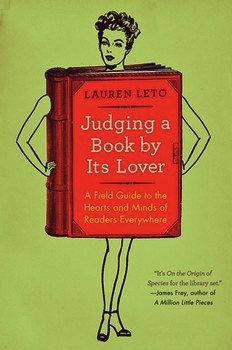
judging book by its lover lauren letoJudging a Book by Its Lover: A Field Guide to the Hearts and Minds of Readers Everywhere by Lauren Leto ~ 2012. This edition: Harper, 2012. Softcover. ISBN: 978-0-06-207014-2. 269 pages.

My rating: 4/10.

Quick verdict: Glad I didn’t buy this. Mildly diverting, but not a keeper.

The author is (apparently) a popular blogger. Fair enough. The chapters would indeed make fine blog posts. Read ’em and forget ’em. (Not that I would extend that attitude to those of you, my marvelous readers, who are also fellow bloggers. No, no, no! But blog posts are, by the very nature of the venue, rather in-the-moment, are they not?)

*****

I was going to condemn this novelty project by calling it pure fluff or something equally dismissive, but fellow-reader compassion for the author, an undoubted book lover, stays my hand. I’m mostly just glad I got this one from the library. It was mildly humorous in a pleasantly snarky way and I did frequently smile. Some sweetly tart anecdotes about a childhood of reading and a gentle ode to her book-loving grandparents enriched the whole.

I easily made it to the end, though I tuned out some at the mention of and rants about authors I’d never even heard of. Who the heck is Susan Wiggs? Chuck Klosterman? Augusten Burroughs?

The publisher is pushing this one with the following:

Want to impress the hot stranger at the bar who asks for your take on Infinite Jest? Dying to shut up the blowhard in front of you who’s pontificating on Cormac McCarthy’s “recurring road narratives”? Having difficulty keeping Francine Prose and Annie Proulx straight?

For all those overwhelmed readers who need to get a firm grip on the relentless onslaught of must-read books to stay on top of the inevitable conversations that swirl around them, Lauren Leto’s Judging a Book by Its Lover is manna from literary heaven! A hilarious send-up of–and inspired homage to–the passionate and peculiar world of book culture, this guide to literary debate leaves no reader or author unscathed, at once adoring and skewering everyone from Jonathan Franzen to Ayn Rand to Dostoyevsky and the people who read them.

Not a particularly broad field of authors covered within, I found, but the author did her best with her limited years of reading experience, for she’s a youngish bright young thing – I quickly googled her and found a reference to her being twenty-four in 2010 – and obviously feels most at home among the American bestseller and college reading list standards.

And that’s all the time I’m going to spend on this one. Should be in abundant supply in the used book stores in the next year or two, as all of the readers who’ve received this for Christmas of 2012 purge their shelves.

Read Full Post »

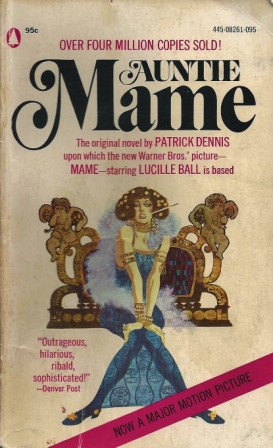
auntie mame patrick dennis 001Auntie Mame by Patrick Dennis ~ 1955. This edition: Popular Library, circa 1974. Paperback. ISBN: 445-08261-095. 254 pages.

My rating: 8/10.

It is what it is – a blissfully easy-to-read, unapologetically American social comedy, with enough perfectly timed, backhanded slaps at social snobbery, racism and anti-Semitism to redeem it from total silliness.

*****

I don’t know quite where she came from, but Auntie Mame appeared one day in a stack of old paperback books I was sorting and putting away. I gave her a rather scornful glance – she was, after all, ensconced between tatty covers emblazoned with movie tie-in headlines, never a particularly endearing feature – and popped her into a box with a bunch of other “maybe someday” books. But not long afterwards she showed up on my night table, brought into the bedroom by (of course) a man, who’d been looking for a diversion, found her intriguing and decided to experience her lavish charms more intimately. After he’d finished with Mame, he left her there to work her charm on me.

“Well, darling,” she whispered to me with a we’re-all-girls-in-here-together-now intonation, “how about it? Don’t you want to find out what Auntie Mame is all about?”

So I read her.

Hotcha!

*****

I’m guessing almost everyone’s either seen one of the two movies based on this 1955 bestseller – the 1958 Rosalind Russell vehicle (pretty darned good), and the 1974 Lucille Ball effort (pretty darned bad) – or one of the countless stage adaptations, or read the actual book itself – printed and reprinted numberless times, most lately in, I believe, 2001. That’s a good half-century of popularity, and I think it’s safe to state that Auntie Mame has a decidedly secure place well up in the top end of the American pop culture archive.

Does she deserve it?

Well, yes, I rather think she does. She’s a deeply lovable creation – with that lovableness outshining her undeniable glamour and her bizarre goings-on as the key reason for my re-reading her spicy “biography” every so often, whenever Mame winningly works herself up to the top of the book stacks, like cream rising to the top of an old-fashioned bottle of milk.

Here’s the basic outline, for those of you who’ve so far been blissfully unaware of the existence of Auntie Mame and her impressionable young nephew, Patrick.

Orphaned at the age of ten in 1929, the very much fictional* Patrick Dennis is sent to live with his wealthy and gloriously extroverted aunt, who is presently holding court (apt term) in a lavish apartment at 3 Beekman Place in Manhattan.

*The author published this book under this pseudonym in order to add verisimilitude to the “memoir” form; after the novel’s success, the pseudonym was maintained for most of the author’s future writings. Edward Tanner is the real name of the author – actually, Edward Everett Tanner III. Mame was inspired by, but was not an accurate depiction of, the author’s real-life aunt, Marion Tanner. Edward Tanner also wrote under the pseudonym “Virginia Rowans”.

Mame welcomes her “own little love” with open arms, and Patrick returns that affection immediately and instinctively, despite his father’s rather foreboding words while making his will the year prior to his sudden demise.

…My father read his will to me in a shaky voice. He said that my Aunt Mame was a very peculiar woman and that to be left in her hands was a fate that he wouldn’t wish a dog, but that beggars couldn’t be choosers and Auntie Mame was my only living relative.

Despite the deathbed wishes of Patrick’s father for his son to receive a conservative upbringing, Mame craftily dodges the stodgy school which Patrick’s trustee, the estimable but strictly conventional Mr. Babcock, has chosen. Instead Patrick ends up in a very avant-garde establishment distinguished by its policy of complete nudity for all, students and staff – and absolute lack of any inhibitions, or actual academic teaching. Mr. Babcock’s visit as the students and their adult mentors are role-playing a school of spawning salmon puts a quick end to the experiment, and lands Patrick in that dreaded boarding school, far away from the influence of his aunt, whom Mr. Babcock regards as the epitome of evil decadence from that moment forward.

Luckily Patrick’s education had already received something of a unorthodox but most useful boost from his aunt’s insistence, from his very first day with her, of Patrick’s carrying a pad of paper with him and writing down any unfamiliar words for future explanation.

I spent that first summer in New York trotting around after Auntie Mame with my vocabulary pad, having Little Morning Chats every afternoon, and being seen and not heard at her literary teas, salons and cocktail parties.

They used a lot of new words, too, and I acquired quite a vocabulary by the end of the summer. I still have some of the vocabulary sheets of odd information picked up at Auntie Mame’s soirees. One, dated July 14, 1929, features such random terms as: Bastille Day, Lesbian, Hotsy-Totsy Club, gang war, Id, daiquiri – although I didn’t sell it properly – relativity, free love, Oedipus complex – another one I misspelled – mobile, stinko – and from here on my spelling went wild – narcissistic, Biarritz, psychoneurotic, Shönberg, and nymphomaniac. Auntie Mame explained all the words she thought I ought to know and then made me put them into sentences which I practiced with Ito, while he did his Japanese flower arrangements and giggled.

Once Patrick is incarcerated in conventional school, his visits to Auntie Mame are restricted to occasional weekends and the holidays. No matter, though, as the two are already bound by a strong and abiding love which will see them through the most outrageous of Mame’s excesses and the rapid ups and downs of her changing fortunes and continual reinventions of herself.

Mame’s fortune is decimated by the Stock Market Crash of October 29, 1929, and she hits the lowest point, financially speaking, of her life, ending up selling roller skates (ineptly) in Macy’s department store, before being rescued at the 11th hour by a wealthy Deep Southern white knight, Beauregard Jackson Pickett Burnside, who sweeps her of her feet and sets her up for the rest of her life, leaving her a seriously large fortune when he dies rather tragically only a few years into the marriage.

Mame sincerely mourns Beau, but continues on her merry way charming and being charmed, and enjoying the attentions both platonic and amorous of a huge range of people, including at one point one of Patrick’s college friends – Mame refuses to let a little thing like age difference stand in the way of her relationships of any sort.

Patrick drifts in and out of Mame’s circle, observing and pithily commenting on her friends and latest fads, which range from the oriental stylings of their first meeting to the Southern belle of the Beau years, to literary pseudo-Irish tweed and brogues, to war-time Friend of England sponsoring some truly horrible Cockney refugee children in a Colonial mansion which they promptly completely destroy.

Patrick falls in and out of numerous relationships on his own, from gold-digging waitress Bubbles, to über-snobbish fiance Gloria Upson, to a poverty-stricken but determinedly aristocratic trio of blue-blooded and stunningly beautiful sisters. He finally finds true love, marries and produces a son of his own, only to have Mame swish in sari-bedecked and trailing a pet swami during her Indian reincarnation period, to carry her latest “little love” off to the orient, thus bringing our tale full circle.

*****

Undeniably funny – though I never did “laugh out loud” as many reviewers report themselves doing – this satirical tale is as full of barbs as a porcupine is of quills. The author uses his humorous platform to trot out his very decided views on the state of middle class American mores, while amusing us with his bitchy delivery – there’s a decidedly contemporary feel to a lot of the humour, despite the book being well into its sixth decade by now.

“Risque” is a word not often used today, but it applies in full force to Auntie Mame – the book and the character. Inhibitions – pshaw! If it feels good and doesn’t harm anyone, go for it! is the credo Mame lives by, and Patrick slips into that attitude easily, though prudishness occasionally rears its head in his case. The innuendo throughout is frequently gloriously bawdy, though there are a few groaningly bad double entendres, as when Patrick reports on his first social occasion at Auntie Mame’s, as an still-innocent ten-year-old. (Needed information: Norah is Patrick’s Irish nurse, and Ito is Mame’s Japanese houseman; Prohibition is in full swing.)

One lady with red hair said that she spent an hour a day on the Couch with her doctor and that he charged her twenty-five dollars every time she came. Norah led me to another part of the room.

The little Japanese man gave Norah a glass and said it was right off the boat and Norah said she wasn’t used to spirits – even though she was always telling me about seeing ghosts and haunts – but this time she’d take a drop of the creature. She seemed to be feeling very happy all of a sudden. And in a little while she asked Ito to give her another Nip.

Oh. My. Goodness. That was pretty dire, Mr. Dennis/Tanner. Had to read this bit twice to make sure I’d seen it correctly. Groan. How many desperately bad puns did the author cram into these few sentences? I think I counted six.

Luckily most of the jibes aren’t quite so deeply awful, but in the interests of full disclosure the prospective reader should be warned of these types of things!

To sum up, I do ultimately enjoy this gloriously campy period piece. Yes, it’s chock full of period-typical stereotypes and attitudes towards women and “foreigners”, but that doesn’t bother me one whit in this one – it’s an innocently era-correct sort of prejudice, and there’s enough social awareness going on of the greater evils in the world of the time to excuse the bits which would be politically incorrect if written today.

It’s a refreshingly easy read, too, as I think I mentioned earlier, and has a very American type of blatantly outrageous humour which appeals in its own way as much as the typically lower key, straight-faced British literary wit does. You do need to pay a certain amount of attention while reading to catch all the nuances, but Auntie Mame romps along at such a good pace that drowsing off in her company is not a danger at all.

(And I’m glad to report that I didn’t use the term “madcap” once in this review. Ha! Points for me!)

Read Full Post »

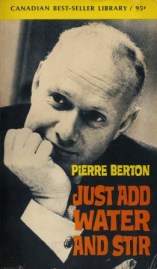
just add water and stir pierre berton 001Just Add Water and Stir by Pierre Berton ~ 1959. This edition: McClelland & Stewart, 1966. Paperback. 221 pages.

My rating: 8.5/10.

*****

Here’s another well-read paperback from my late father’s bookshelves, boxed up and brought home six years ago as my just-widowed, elderly mother was preparing to downsize from a huge, rambling three-story house to a much smaller bungalow. Both homes, incidentally, were built in their entirety by my father, who was a foundation-to-roof master carpenter, among his other jack-of-all-trades and master-of-many accomplishments and interests.

One of his interests was books. Dad did love to read, and I like to think that this collection of mostly humorous, often over-the-top satirical, sometimes sincerely thoughtful short essays made him smile as they did me when I finally read this briskly paced book over the course of this potentially dreary day spent recovering from a brief bout with the latest flu bug.

Being a random collection of satirical essays, rude remarks, used anecdotes, thumbnail sketches, ancient wheezes, old nostalgias, wry comments, limp doggerel, intemperate recipes, vagrant opinions and crude drawings …

So says the front page, and it describes the ensuing contents well. Most of these short pieces appeared as columns in the Toronto Daily Star in the 1950s, and they are definitely indicative of the time in which they were written. As a cynically humorous portrait of the era, this book is an excellent little period piece, but it’s an enjoyable read even for those of us not familiar at first hand with the context of some of the references. Berton’s opinionated prose is seldom dull, and the shortness of each entry makes it good for dip-into reading as well. I read the whole thing in one go, and that likely wasn’t such a great idea, as I’m now feeling a bit light-headed, but I’ll blame that on my current bug as much as on the flippant nature of my reading matter.

The book is arranged into groupings of similarly themed articles and essays. These can be read in order, or sampled at will.

Five Modern Fables ~ Pure over-the-top satire starts us off. Berton skewers modern advertising techniques and ploys in his first three fables, lampoons the vicious cycle of competitive Christmas card lists, and ends with a cautionary tale about not heeding the omens and building too close to the volcano.

Seven Men and a Girl ~ Brief character portraits of eight people Berton met and interviewed: Ex-convict John Brown, pianist Glenn Gould, aviator Russ Baker, evangelist-turned-politician Charles Templeton, Canadian Communist Joe Salsberg, poet and writer Robert Service, entertainer Milton Berle, and call girl Jacqueline (no last name given).A Woman of "Vogue"

The Wayward Periodical Press ~ “Six periodical publications deserving of comment” – Vogue, Time, Mayfair, Playboy (and the rest of the Bosom Books), Mad, and Justice. What an interesting combination of companions these are. Vogue is, well, Vogue, and it apparently hasn’t changed much at all.

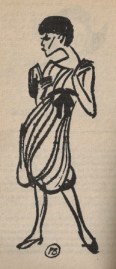
My favourite magazine, next to Screen Stars and Mad, is Vogue. The day it appears, I rush eagerly to the newsstand and, with the help of a couple of weightlifters, lug it off to my den. For sheer escape reading it beats the old Blue Fairy Book hollow. It chronicles a world so foreign and unreal that I would not believe it existed, if there weren’t photographs to prove it.

The women who grace Vogue’s pages are like no women I have ever known. I have tried to sketch one or two of them here, but my brush does not do them justice for their absolute and utter sexlessness defies reproduction. If they came from a far corner of the solar system they could not be more different than the blousy creatures one finds romping through Esquire and Playboy.

Am I all wet in my theory that a bosom craze is sweeping the country? In Vogue, there isn’t a bosom in a carload. These women are all eyes and cheekbones, and they do something with their necks that I haven’t seen since Leona, the Giraffe Girl, went into retirement.

At the end of the neck one finds a face that has overtones of Buchenwald about it – chalk-white and haggard, Vogue women do not have noses, only nostrils. Their eyes are enormous and decadent, their lips are thin and solemn. Their hair is always quite odd. They are shown thrust forward in inscrutable positions that suggest some curious doe-like animal at feeding time.

Time sets off a passionate diatribe in defense of Canadian content in “Canadian” versions of American magazines; Mayfair is a “high society” periodical seething with anachronistic class consciousness. Playboy and the rest of the “men’s magazines” are investigated as to the number and degrees of exposure of female body parts posed artistically for masculine delectation; Berton claims to be overwhelmed by sheer numbers.

The Cult of the Bosom has now reached its zenith in this continent, as a glance at any newsstand will show. In the seventeen magazines I examined, there were 503 photographs of well-endowed young women displaying their endowments.

In 125 of these photographs, many of them in glowing colour, the young ladies’ torsos were entirely exposed. In the remaining 378 photographs there was a certain roguish attempt at concealment.

I did not bother to count any photographs of women dressed for the street, because there were so few.

I did not bother to count any photographs of flat-chested young women, because here were none.

I did, however, make a count of the numbers of photographs of women with no pants on. There were sixty of them.

Mad magazine receives an enthusiastic nod of approval, for the “sophistication of the humour”, while Justice, an arcane periodical dedicated to the practices of sadomasochism and corporal “discipline”, garners strong words of scorn.

The Broadcasting Arts ~ Television and radio – including the already-venerable C.B.C. – come in for their turn in Berton’s critical spotlight.

Verse, Blank and Otherwise ~ Several parodies in verse of current events of the time. The Sixty-Five Days of Christmas struck a modern chord, though nowadays it would need to be retitled The Ninety Days of Christmas to approach a closer accuracy!

Christmas began last Tuesday
Just three days after Hallowe’en,
By which time the big emporiums,
Having disposed of the comic ghosts and candy pumpkins
And having burned all the second-hand witches,
Replaced them with more seasonal symbols:
A reindeer with a crimson nose,
A talking snowman and a terribly cute bear,
Fifty-seven varieties of Santa Claus,
And here and there, an inconspicuous plastic replica of the Christ-child,
 
Entirely non-denominational.
 

Intemperate Recipes ~ A plea for a return to real cooking versus the pre-packaged growing norm in the titular Just Add Water and Stir, and a heartfelt rant against instant coffee, obviously a newly popular abomination in Berton’s world. Plus four quite decent-sounding recipes – or, more accurately, anecdotal instruction pieces on how to best prepare these Berton standbys – Tomato Soup, Baked Beans, Corned Beef Hash, and Clam Chowder. Pierre Berton in the kitchen – what a grand thought!

The Passing Show ~ A satire from the viewpoint of the future, and musings on the status significance of offices and office furnishing, smoking, and divorce. Shopping for a Coffin is thought-provoking and quite serious, while Several Openings for Novels will make the aspiring writer nod in rueful recognition. A few more observations – paying to be published, the confusion of children’s toy assembly instructions, and a modern Red Riding Hood round out this section.

Certain Vagrant Opinions ~ Full rant mode! On Dick and Jane (Berton is against), On Advertising and the Press, On Racial Origins (none of the government’s business), On Thought Control (shades of Orwell’s Nineteen-Eighty-Four), and most passionately, On Flags and Anthem and On Modern Torture (prison reform), which is the most serious piece of the lot, and describes an execution by hanging which Berton was assigned to attend as a young reporter.

Some Old Nostalgias ~ Memoirs, 1927 to 1941, of Berton’s earlier days. Fascinating and charmingly written.

Read Full Post »

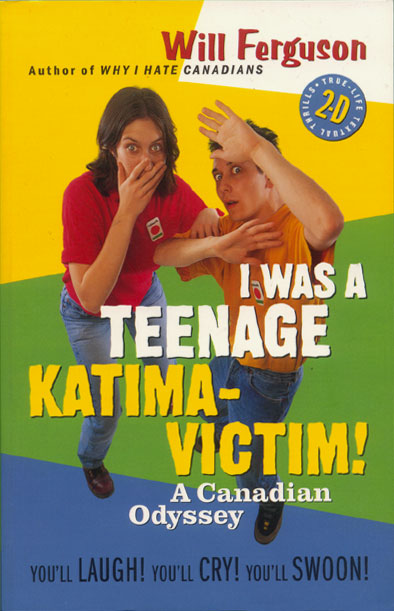
I Was a Teenage Katima-Victim: A Canadian Odyssey by Will Ferguson ~ 1998. This edition: Douglas & McIntyre, 1998. Softcover. ISBN: 1-55054-652-x. 259 pages.

My rating: 9/10.Funny and thought provoking. This is the book that made me a Will Ferguson fan, way back in 1998, when I plucked it off the “New Releases” bookstore shelf solely for the reference to Katimavik. A few minutes browsing and I was sold. Liked it then, like it now. A very Canadian memoir.

*****

Funny, touching, and never maudlin . . .”     – Montreal Gazette

“A rollicking memoir”     – Globe & Mail

“A coming of age story with a fierce and nationalistic bite.”     – January Magazine

With Will Ferguson in the literary spotlight these days, due to his Booker Prize win for 419: A Novel  just a week ago, I felt the urge to dig through the bookshelves and re-read the my first ever Ferguson book, the now-obscure 1998 coming-of-age-Canadian-style memoir, I Was a Teenage Katima-Victim.

Ah, Katimavik! What a well-meaning and ambitious, oh so Canadian idea!

In my Grade 11 year I too went to one of those earnest presentations in the school gym, listened with deep interest to the bubbly recruiter, and, most importantly, mused over what I could do with the thousand dollar pay-off at the end.

I even went so far as to take a brochure home to my parents, who flicked through it with scornful dismissal. The airy-fairy notion of travelling and seeing Canada basically on the taxpayers’ dime was not something to countenance for one of their children. In my father’s eyes such programs were akin to “those deadbeats collecting welfare”, and he quite literally would have starved on the street rather than apply for a government handout, or anything which could be remotely conceived of as such. To top it off, Katimavik was supported by none other than “that Liberal bastard”,  Prime Minister Pierre Trudeau, who my father hated with a black passion, for reasons I’m still not quite clear on.

By the end of my Grade 12 year Katimavik was a distant memory, a momentary what-if? fairytale I had told myself. I had moved out of my parents’ home into a nasty and dank – but blessedly my own – basement suite in town, and was working full-time waitressing (nights and weekends) while struggling to make it through the tatters of my last high school year to collect that all-important graduation diploma. My love life had unexpectedly taken off, and I was deeply occupied in the here and now. The last thing I now wanted was to rip up those tentaively establishing adult roots and travel. But a soft spot remained for the grand ideas embodied in Katimavik, and my ears ever after were sensitive to the sound of the name.

Will Ferguson took the bait, made the plunge, and survived to tell the tale. Here is a 1999 interview in January magazine:

The book … is delightful: a coming of age story with a fierce and nationalistic bite.
To explain the reference, Katimavik was a Canadian government funded and sponsored program that blossomed in the 1970s. Of course. While the program was active, it brought thousands of young Canadians together to do “meaningful work.” Everything from soup kitchens to nature trails to heritage sites: over 20,000 “katima-victims” went through the program. “The scope of the program was staggering,” writes Ferguson. “1400 different communities across Canada, and more than 200,000 people directly involved or affected. For better of worse, Katimavik helped shape an entire generation.”
For the lavish sum of $1 a day and “all the granola you could eat” these 20,000 17 to 21 year-olds were taken far from their home towns for a year to see first-hand the cultural mosaic of which they were – by birth – a part.
“The thinking about Katimavik was that there is something redeeming about manual labor,” says Ferguson. “And the thing is, it just isn’t true at all. Anybody doing manual labor knows that it’s a tough gig and if they had the option not to do it, they wouldn’t. The second notion is that somehow once we get to know each other, we’ll like each other. This is the biggest flaw and it runs right through a lot of thinking. They think that, just because you and I are enemies, if we got to know each other, we’d like each other: that’s a big flawed premise because – quite often – the more you get to know each other, the more you realize that you have nothing in common.”
Despite his misgivings about the program’s principals, “Katimavik worked on a personal level, despite its good intentions. Just because any time you throw someone into something that big and that intense you come out of it with a rounder personality.”
Now 34, Ferguson’s personality is sufficiently rounded to take us along with him on great rollicking rides. Thus far he’s taken us from the wilds of Canada to the back roads of Japan. Whatever he has in store for us next is sure to be fun: and will hopefully raise still more eyebrows. | Linda L. Richards, January Magazine, February 1999

There is a certain irony in the fact that, soon after Ferguson’s participation in the now-iconic Canadian youth travel-service-work-cultural  program, it was axed in 1986 by the newly elected Mulroney Progressive Conservative government. Katimavik was resurrected in a slightly different form in 1994, and just this year, 2012, has been cut again, this time by the Conservative Harper government. Another rescue mission is afoot, to reimagine Katimavik for yet another generation of young Canadians. I hope it succeeds.

This book has been out of print for years, and is unaccountably ignored in most discussions of Ferguson’s work, which is a shame. Despite the graphically appalling cover, the tale told within is worth reading, especially for anyone who has memories of Katimavik in its sincere and slightly loopy heyday. A bit raw in spots – it was, after all, only Will Ferguson’s second published book, following hard on the heels of surprise bestseller Why I Hate Canadians – it nevertheless gets better and better as it goes along. Laugh out loud funny in places, there is a thread of sincerity running through it which is deeply appealing.

More than a mere curiousity piece and a relic of the author’s youth, it’s a rather grand little read. One of those “Proud to be Canadian” feel-good things. Recommended.

And here is link to the Goodreads page.

Read Full Post »

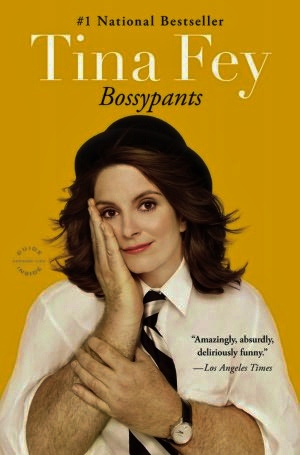
Bossypants by Tina Fey ~ 2011. This edition: Little, Brown & Co., 2012. Softcover. ISBN: 978-0-316-05687-8. 275 pages.

My rating: An easy 9/10. Loved it! Some parts are literally laugh out loud funny. Whips right along – a most enjoyable memoir of the childhood, teen, college and early career years of this exceedingly witty lady, up until the time of her notorious portrayal of Sarah Palin on Saturday Night Live.

*****

Picked this one up for a paltry dollar at the Sally Ann, shortly after I spent a happy ten minutes browsing it in front of its full-price display in one of the mega-marts. I couldn’t quite bring myself to spend the $17.50 sticker price, though I was seriously tempted, so finding it a few days later virtually free was one of those happy little serendipities of haunting the less posh side of the shopping world.

The first half of the book, the childhood-teen-college year memoirs, when Tina Fey was something of a self-described social outcast and romantic failure, is actually quite poignantly sad behind its comic mask. There is something – the only thing –  to be said for having a tortured school life; often it brings out the inner drive to “show them” that leads to stellar success later in life; the bitterness can be usefully channeled into humour, and Tina Fey does that perfectly. She keeps it from being mean-spirited, and I admire her for that; that line is a fine one.

I have only seen Fey’s Palin impersonation in short clips, not having actually owned a television for something over twenty years, but I saw enough to appreciate how darned good it was. The latter part of the book is very focussed on that charade, and I must say Palin herself comes out of it sounding much more likeable than I’d expected. Sarah Palin makes me shudder in real life, in so many ways, but after reading about how graciously she handled being parodied in full prime time view, I get a bit of what her admirers see in her. A very small bit, but it’s there. So Fey has done Palin something of a favour by her mocking portrayal, in my opinion.

This is a keeper; I’ll definitely read it again, which is saying a lot because I tend to be quite out of step on pop culture as a whole, and reading about people you aren’t a particular fan of, or even have much knowledge of, can be a bore. Not guilty in this case. Thumbs up; good read.

Bossypants Review – Time Magazine

Bossypants Review – New York Times

And of course, the Goodreads page, with a gazillion reviews.

Read Full Post »

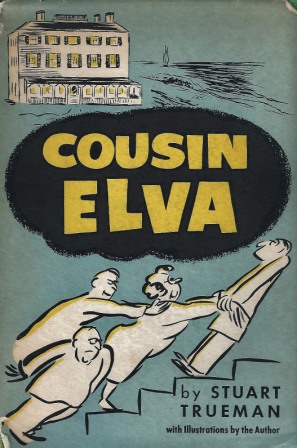
Cousin Elva by Stuart Trueman ~ 1955. This edition: McClelland and Stewart, 1955. First edition. Hardcover. 224 pages.

My rating: This is tough. I almost was going to say un-rateable, but on second thoughts I will give it maybe a 5.5/10. It’s a first book, and the author went on to write many more. There’s nothing really wrong with it, and I did read it with mild enjoyment, but I found it very easy to put down and I had to consciously pick it up and finish it. Probably a keeper, but on the bottom shelf or exiled to the “B”-reads boxes, I’m thinking.

*****

Cousin Elva is a humourous, satirical light novel about a fictional couple, Penelope and Frank Trimble, who purchase a large house in the (also fictional?) community of Quisbis on the Bay of Fundy, and proceed to open a boarding house – “Mr. and Mrs. Trimble’s Tourist Rest Haven”. The only catch is that the house comes with a pre-existing resident, Miss Elva Thwaite, granddaughter of the original owner.

Miss Thwaite, or “Cousin” Elva as she insists on being called, is a blatantly eccentric, sixty-ish,”old maid” who refuses to be put on the shelf, taking an active interest in everyone and everything that crosses her path. She’s also keen to catch herself a man. Hi-jinks ensue as a motley assortment of visitors to Trimble’s Rest Haven fall into Cousin Elva’s clutches.

The humour is, at its best, rather understated and wry, but too often over-the-top farcical. I did enjoy the many regional and Canadian references; those did much to keep me reading when I occasionally got overloaded with the slapstick action.

A well-meaning attempt by an author new to me. The kind of book you perhaps enjoy best when scanning the meagerly stocked shelves at an isolated lakeside cabin in summer. In other words, welcome if you’re fairly desperate for amusement and it’s too far to go to town…

Stuart Trueman (1911-1995) was a Canadian writer from New Brunswick. He won the Steven Leacock Memorial Medal for Humour in 1969. I had never heard of him before picking up this book, but as you can see from his biography he had a long and prolific writing career. I would definitely be interested in reading some of his other work, but only if it was easily obtainable; I don’t think I’d go to a lot of effort to seek it out.

From the New Brunswick Literary Encyclopedia:

Stuart Trueman (writer, editor, historian,  reporter, cartoonist, and humorist) was born in 1911 in Saint John, New Brunswick,  the son of the late John MacMillan and Annie Mae (Roden) Trueman. He was  the husband of Mildred Kate (Stiles) and a father to Mac and Douglas, his two  sons; he was also a grandfather of four, and a great-grandfather to one.  Growing up, he had two sisters and three brothers, along with a countless  number of friends whom he believed shaped him into the man that he was. He  passed away in his home in Saint John,   New Brunswick, on 25 April 1995  after a period of failing health.

Trueman was known  for being a great representative of journalism, and he garnered a lot of  respect and credibility in all that he accomplished. Straight out of high  school, he started out as a cartoonist and reporter at the Telegraph Journal in Saint    John, where he stayed for forty-two years, later  becoming a sports writer. In 1951, Trueman became the editor-in-chief at the Telegraph Journal and Evening Times Globe, a position that he  would hold for the last twenty years of his working career. Upon retirement in  1971, he remained faithful to the newspapers that he had been involved with and  continued to contribute to weekly columns until 1993. He took writing, journalism,  and public speaking seriously, and had a keen insight into human character. He  was also known for being a stickler for details, always following the journalist’s  obsession with the “who,” “what,” “where,” and “how.”

Trueman was often  referred to as “Mr. New Brunswick”  because of his broad knowledge of the history of this province and of its  scenic and cultural attractions. He wrote many books about New Brunswick, its people, and its unique  history. Along with being a well-known author, Trueman was a part of New Brunswick history.  On 19 May 1932, he and co-worker Jack Brayley interviewed Amelia Earhart at the  Saint John Airport  as she was preparing for her historic flight across the Atlantic.  Another accomplishment for Trueman was when he and Brayley took a trip to Moncton, New    Brunswick, where they discovered an attraction that  many are familiar with today: Magnetic Hill. Trueman’s son Mac said that  despite the fame and development that has built up around Magnetic Hill, it was  always his father’s favourite natural phenomenon. The discovery of Magnetic  Hill gave way to the tourism industry within New Brunswick,  and it continues to be one of New    Brunswick’s most popular attractions.

Trueman published  fourteen books and wrote more than three hundred humorous articles for both  Canadian and American magazines. He thought of these articles as “light pieces,”  and although he never claimed they were funny, he was commonly referred to as a  funny man. One of his greatest accomplishments was winning the Stephen Leacock  Memorial Award for humour in 1969 for his book You’re Only as Old as You Act (1968). Other books Trueman produced  include: Cousin Elva (1955); The Ordeal of John Giles: Being an Account  of his Odd Adventures; Strange Deliverances, etc. as a Slave of the Maliseets (1966); An Intimate History of New  Brunswick (1970); My Life as a  Rose-Breasted Grosbeak (1972); The  Fascinating World of New Brunswick (1973); Ghosts, Pirates and Treasure Trove: The Phantoms that Haunt New  Brunswick (1975); The Wild Life I’ve Led (1976); Tall Tales and True Tales from  Down East: Eerie Experiences, Heroic Exploits, Extraordinary Personalities,  Ancient Legends and Folklore from New Brunswick and Elsewhere in the Maritimes (1979); The Colour of New Brunswick (1981); Don’t Let Them Smell the Lobsters Cooking:  The Lighter Side of Growing Up in the Maritimes Long Ago (1982); Life’s Odd Moments (1984); and Add Ten Years to Your Life: A Canadian  Humorist Looks at Florida (1989). Many of his books include light-hearted  stories that have been adapted from Trueman’s popular columns in the Telegraph Journal, Weekend, and the Saturday Evening Post.

Trueman’s wife,  Mildred, played an important role in his overall success as an author in New Brunswick. She  supported him throughout his career, and the couple collaborated on two  cookbooks: Favourite Recipes from Old New Brunswick Kitchens (1983) and Mildred Trueman’s New Brunswick Heritage Cookbook: With  Age-Old Cures and Medications, Atlantic Fishermen’s Weather Portents and  Superstitions (1986).

Amanda Palmer     St. Thomas University

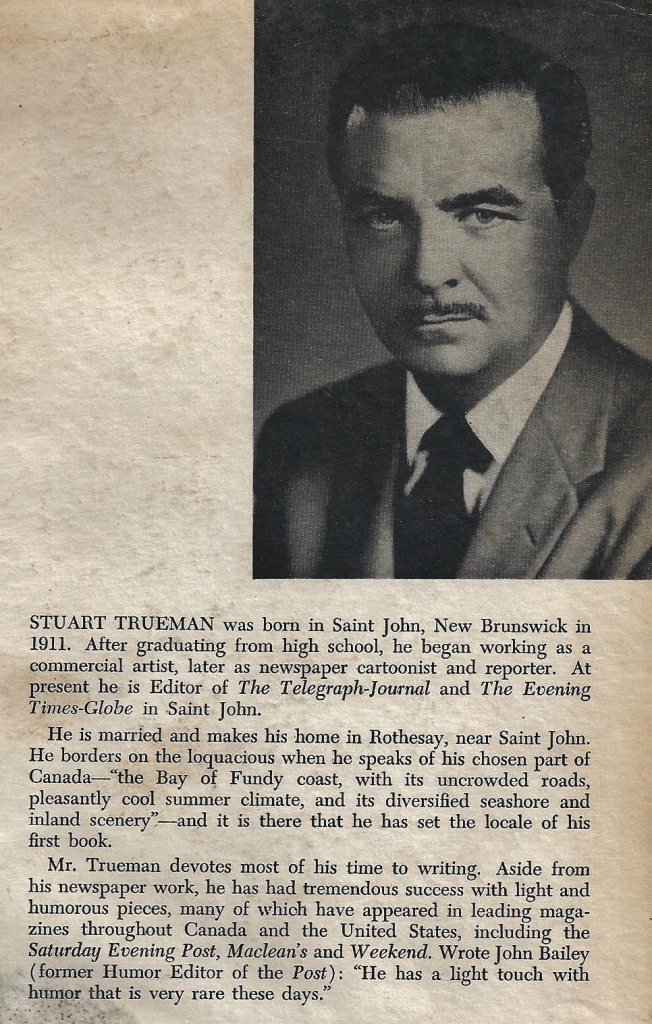
And here is the author photo and biography from the back cover of Cousin Elva:

Read Full Post »

« Newer Posts