Posts Tagged ‘Historical Fiction’

canada-reads-2013-panelists-books

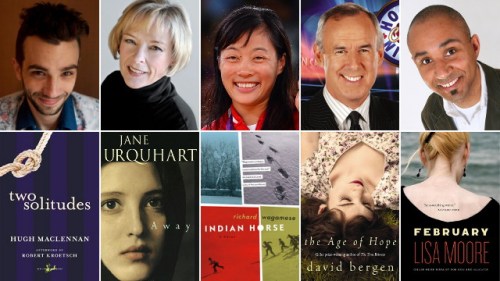
Last night, with great self-congratulatory brouhaha, CBC Radio host Jian Ghomeshi introduced the Canada Reads 2013 Shortlist and celebrity panelists. This is an event I’ve watched (well, more accurately, listened to) with mild interest the last few years, but never really embraced.

I confess that I am in general deeply cynical about prizes awarded by popular vote, which is the whole premise of this literary “event”, but this year the shortlist picks seem more intriguing to me than some in the past, so I’ve set myself a personal goal of reading and reviewing all five of them. This will also tie in nicely with my participation in 6th Annual Canadian Book Challenge , hosted by John Mutford of The Book Mine Set .

I may also explore among the picks in the Long List, though I have no intentions of reading all of them. We’ll see what happens. This list will find a home in my library bag, for those days when inspiration needs a little push. I’ve already read a few (a very few) of the picks, though mostly before this blog materialized. I may re-read and review. Or not! Leaving myself wide open here.

This year Canada Reads has a regional theme, which doesn’t really work in my opinion, as there are only five extremely broad regions and geographically and philosophically I think there is more variance in truly regional Canadian literature than these limited categories allow. But no one asked me, so I guess I need to go with it.

Here’s our Long List:

B.C. & Yukon:

The Prairies and North:

Ontario:

Quebec:

Atlantic Canada:

Read Full Post »

White Mist by Barbara Smucker ~ 1985. This edition: Puffin Books, 1987. Paperback. Includes research bibliography. ISBN: 0-14-032144-6. 157 pages.

My rating: 5/10. Just barely. It’s more like a 4, but I gave the author an extra point because of her well meaning earnestness. The message is a good one, but the presentation is deeply lacking in finesse.

I wonder what a typical nowadays young reader would think of this one? It might be perfectly acceptable; I’ve read much worse “kid lit”. From my adult perspective it was a tough slog, though. The author tried to pack too much into this one; in my opinion she should have let off a bit on the info-dump and paid more attention to the story.

And the “Indian = good, White Man = bad” thing was oversimplified.

*****

I’ve been trying to cull our overwhelming book collection, and this was one that got a second look when I was sorting through several boxes of kids’ books this week.

Barbara Smucker, as you Canadians with children or schoolroom experience may know, is famously the author of the multi-award-winning Underground to Canada, about the legendary “underground railway” system of helpers and safe houses by which black slaves escaped to freedom in Canada in the mid-19th century. I haven’t read Underground for years; not since my own children were quite young, but in my memory it was a well-done juvenile historical fiction. I may need to review that one after reading White Mist, to see if it holds up to my positive memory of it.

Smucker, born  Barbara Claasen, was a New Order Mennonite from Kansas, where she attended college and received a journalism degree in 1939. After graduation, she married a Mennonite minister, Donavan Smucker, and the two of them, and eventually their three children, travelled widely throughout the United States. In the late 1960s, the Smuckers found themselves in Mississippi, where Barbara became deeply interested in the civil rights movement. As Mennonites, the Smuckers were already passionate about peaceful resolution and non-violent solutions, as well as justice and minority rights. These themes run through every one of  Barbara’s subsequent stories.

In 1969 the Smuckers moved to Ontario, and, while working as a public librarian, Barbara’s writing career took off, at the relatively advance age of sixty-two, with Underground to Canada’s 1977 publication. This was followed by Days of Terror in 1979, about a Russo-Mennonite family fleeing the Russian Revolution in 1917, and Amish Adventure in 1983, about the challenges facing the contemporary Amish. White Mist, 1985, deals with ecological issues, as well as First Nations (“Indian”) displacement and rights.

Here is the plot outline of White Mist, from a review written by Susan Ratcliffe in 1986:

Grades 5-6/Ages 10-11.

The message of Barbara Smucker’s newest novel is clearly stated by one of the main characters: “If we destroy the earth, we destroy ourselves. We are one with the earth.” She has chosen a rather unusual, and somewhat awkward narrative method to convey this theme.

May is a young, dark-skinned, dark-haired teenager, abandoned as a baby on the door-step of the Applebys, who subsequently adopted her. She thus has no knowledge of her parentage or heritage, and suffers the teasing of other kids in her Sarnia [Ontario] school. She feels an outcast from their society. Every summer she and her parents go to work in their nursery on the shores of Lake Michigan, but find the lake changed this year. The beaches are dirty and littered with dead fish; the water is smelly and unfit for swimming. This year too, Lee, an Indian boy from the local reserve, comes to work at the nursery. He and May gradually become the captives of a strange, swirling white mist that eventually takes them back to a time when there were virgin forests on the shores of a clean lake, a thriving lumber town, and a village of the Potawatomi Indians. They are absorbed into the village life and learn pride in their native heritage. May even meets her great-grandmother, and gains a sense of family and roots.

The awkwardness comes in the switch from the present to the past. May and Lee are surprisingly knowledgeable about every detail of the area and people of 1835. At several points in the story, one or the other of them has to give the source of their information: “I studied all winter at the Reserve library about the Potawatomi…”. “I read about it in Uncle Steve’s books on local history…”. “Uncle Steve had told her…”. Their interest and historical retention is astonishing for their age.

The messages of the novel are strong and worthwhile; pollution and the environment, and the prejudices against native peoples. The characters are bright and attractive, but the method chosen to tell the story is too contrived and unbelievable. However, Barbara Smucker’s many fans may forgive her, because of the appeal of the themes.

I was interested to read that this reviewer felt the same way that I did; that the novel was awkwardly presented and the young protagonists unrealistically knowledgeable about local history. I also felt that the “Indian” characters whom May and Lee met in their deeply contrived time travel were presented in a very stereotyped way, as almost impossibly good, noble, and completely in touch with nature at all times, in the literary “noble savage” tradition.

I do appreciate the use of First Nations characters in leading roles, and it was sweet to see May’s relationship with her white foster parents so lovingly depicted. May’s confusion about her racial history and quest for a way to balance her origins and her present life was very exaggerated, but it was good to see those topics addressed head on. Lee’s recent tragic history of losing a close friend to suicide on his troubled reserve doesn’t get much discussion, but is presented in a matter-of-fact fashion; this is Lee’s reality, and explains why he is so ready to embrace a more positive past. Lee’s fierce pride in his ancestry, and his impatience with May’s ambiguity towards her ancestors ring true to Lee’s characterization.

While many of the non-First Nations characters are presented in a negative, one-dimensional way, there are several exceptions: May’s foster parents are seen as unreservedly “good”; May in her distressed first days as a time traveller meets with kindness from a pioneer woman, and from a cook in a logging camp; and many of the “white” lakeside dwellers embrace the ecological message when Lee and May return from their blip into the past and make their heartfelt presentation for a crusade against pollution.

I didn’t enjoy this book, though. Its flaws were too many and too glaring to ignore, and I can’t recommend it.

I give the author a decided nod for her good  intentions, but it’s a very faked-up story, and I ultimately couldn’t get past that. Into the giveaway box.

Read Full Post »

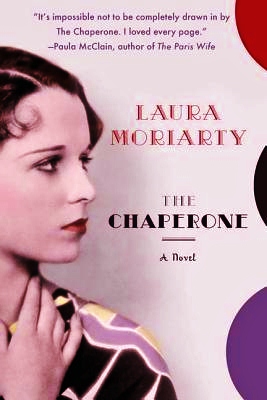
The Chaperone by Laura Moriarty ~ 2012. This edition: Riverhead Books, 2012. First edition. Hardcover. ISBN: 978-1-59448-701-9. 367 pages.

My rating: 6.5/10. You know, the only real surprise I found here was how mild it was. I’d expected something a bit more graphic, from all the hype. The several key sex scenes are safely veiled in allusion. A decently well-written addition to the “women’s fiction” shelf, which, if it feels like damning with faint praise, is how I’m feeling about this one right now.

*****

The Chaperone was all over the bestseller lists earlier this year, but seems to have faded quickly as readers seeking the latest literary thrill gobbled it up, found nothing worth spending much time digesting, and inexorably moved on. To continue with the food analogy, I was going to compare this one to a box of chocolates, or a big slice of layer cake,  but mulling it over just a mite more, I’ve settled on watermelon for my comparison. Sweet and refreshing and welcome while it’s being consumed, but once it’s down to the rind you realize it doesn’t really count as food. And there are always those slightly bothersome seeds…

I quite liked this book – I really did  – but the whole time I was reading I had that “you are being educated” feeling which is dreadfully difficult for the writer of historical fiction to completely avoid. Right from the very first scene, where our protagonist Cora Carlisle appears engaged in one of her civic-improvement projects – this particular one is collecting children’s book donations for the local library – the scene is being set up all around her, figurative stage hands pointing at clues and the authorial chorus monologuing away so we don’t miss a thing.

Here I was going to write out my own version of the plot outline, but, really, life’s too short. From the Goodreads page:

The Chaperone is a captivating novel about the woman who chaperoned an irreverent Louise Brooks to New York City in 1922 and the summer that would change them both.

Only a few years before becoming a famous silent-film star and an icon of her generation, a fifteen-year-old Louise Brooks leaves Wichita, Kansas, to study with the prestigious Denishawn School of Dancing in New York. Much to her annoyance, she is accompanied by a thirty-six-year-old chaperone, who is neither mother nor friend. Cora Carlisle, a complicated but traditional woman with her own reasons for making the trip, has no idea what she’s in for. Young Louise, already stunningly beautiful and sporting her famous black bob with blunt bangs, is known for her arrogance and her lack of respect for convention. Ultimately, the five weeks they spend together will transform their lives forever.

For Cora, the city holds the promise of discovery that might answer the question at the core of her being, and even as she does her best to watch over Louise in this strange and bustling place she embarks on a mission of her own. And while what she finds isn’t what she anticipated, she is liberated in a way she could not have imagined. Over the course of Cora’s relationship with Louise, her eyes are opened to the promise of the twentieth century and a new understanding of the possibilities for being fully alive.

Drawing on the rich history of the 1920s,’30s, and beyond—from the orphan trains to Prohibition, flappers,  and the onset of the Great Depression to the burgeoning movement for equal rights and new opportunities for women—Laura Moriarty’s The Chaperone illustrates how rapidly everything, from fashion and hemlines to values and attitudes, was changing at this time and what a vast difference it all made for Louise Brooks, Cora Carlisle, and others like them.

The Chaperone is crammed with a whole bunch of social issues, with our heroine Cora firmly on the side of right, of course, at least after her consciousness-raising is completed. Racial prejudice and segregation, women’s rights – namely access to contraceptives and care for unwed mothers, with a bit of figurative bra-burning (in this case corset dropping), Prohibition and the repeal of liquor laws,  and eventually gay rights are all featured.

This is an ambitiously crowded book, with the author attempting to cover the entire term of a woman’s life in 357 pages. The few weeks of summer with Louise in New York gets the most screen time, with flashbacks to childhood nicely detailed here and there. The rest of the story is painted with a very broad brush; we are told simply what happens and what Cora thinks of it all, but from an omnipotent distance.

A little way into the book I started thinking, “Hey, this reminds me extremely strongly of another author”, and eventually I had the “aha!” moment. This is a novel very much resembling one of Bess Streeter Aldrich‘s. The same short but detailed periods of a protagonist’s life, with stretches of “then this or that happened and she/he was really sad/happy/confused/vindicated/pick some emotion”, plus very obvious inclusions of historical snippets clumsily inserted to show the bigger picture. Sometimes the characters seem like paper cutouts stuck on a schoolroom timeline.

Possibly the Kansas setting of much of The Chaperone had something to do with it; Aldrich was also a writer devoted to the midwestern states and the decent farmers and gossipy small town denizens thereof. Despite the New York interludes and the growth of Wichita from sleepy town to bustling city in the course of Cora’s life, The Chaperone is at heart just another small town story.

The Louise Brooks connection serves merely as a skeletal framework to build Cora’s story onto; it actually works fairly well, and I must say it left me with a strong desire to learn more about the real life Louise, to see if she was indeed the self-centered egoist she appears to be here. Brook’s own collection of biographical essays, Lulu in Hollywood, is now on my list of things to read next, as is Edith Wharton’s The Age of Innocence (a re-reading, in that case); it is the book which Cora struggles with and is rather offended by throughout her New York summer.

This is not a great review – my thoughts are everywhere – I apologize. It’s been a busy week, with many things going on, and though I’ve stolen some time for reading my writing sessions have been fragmented and often interrupted.

I generally enjoyed The Chaperone and had no trouble keeping my mind engaged; its numerous flaws were slightly annoying but forgivable. Cora Carlisle has some unlikely adventures, and I can’t quite bring myself to completely believe in the complete success of her two lives – the public and the very private – especially as she has to keep a number of other people convinced to play along. I kept expecting her to get busted; she never was. And that’s my biggest spoiler.

Chick lit, but of a superior type. If you liked Kathryn Stockett’s The Help, this one should suit you just fine. Birds of a feather.

Read Full Post »

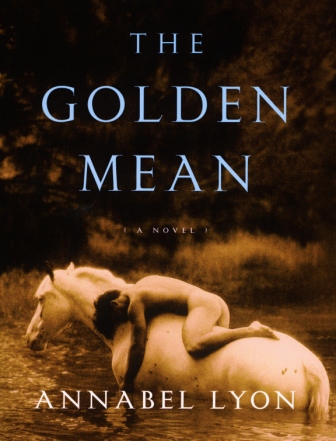
The Golden Mean by Annabel Lyon ~ 2009. This edition: Vintage Canada (Random House), 2010. Softcover. ISBN: 978-0-307-35621-5. 284 pages.

My rating: 9/10. I didn’t give this one a 10, though I considered it,  because it pushed me a bit past my personal comfort level regarding contemporary idiom used in historical fiction. In this particular case, after I got into the story, it worked.

Oh yeah, that, and the very graphic descriptions of sex, and human dissections. But once I was fully engaged, and became comfortable with the “voice” of the narrator, it also worked.

It’s almost a 10. I’m not sure if I’ll re-read it any time soon, but it was genuinely diverting while it was happening, and I’ll be reading the sequel of sorts, The Sweet Girl (2012) when it crosses my path. A keeper.

*****

I came to this book expecting to dislike it, if not downright hate it. After all, my personal standard for ancient Greece era historical fiction is measured by the excellence of Mary Renault‘s works. It is my current opinion that Annabel Lyon, with this book, proves worthy of standing in the same room as Renault. And in her (Lyon’s) acknowledgments she mentions Renault’s stellar Fire From Heaven, so that was another point in favour.

Lyons is no Renault, which isn’t a condemnation. She is a writer of another time altogether, speaking to the readers of her time as Renault spoke to the readers of hers. Whether Annabel Lyon’s work will have the staying power of Renault’s historical fiction classics, time will tell. I suspect perhaps not, but we shall see. I suspect that Lyons will be a writer to watch out for in the years to come, though her blazingly sudden fame (notoriety?) may be something of a detriment to considered reflection of the merit of her subsequent work.

The Golden Mean made the Giller short list in 2009, was plastered all over the mainstream book pages, and was praised for its “sensuous and muscular prose” – it says that right on the front flyleaf – so I was, paradoxically, quite suspicious of what I would find behind that attention-getting cover. (And here’s a snippet of trivia for you: The book was at one point pulled from the shelves of the B.C. Ferries gift shops because of the nudity on the cover. Well, there’s no such thing as “bad” publicity! Personally, I lke the cover, and I “get” why it was chosen. To be completely true to the book though, the horse should be black, and the young man at least partially clothed. But I digress.)

<Several days go by …>

I’m finishing up this review away from home, without the book in front of me. It is, sadly, in the side pocket of my laptop case, which is sitting on the floor next to the kitchen door some 200 kilometers away. I walked out of the house with that naggy “I’m forgetting something” feeling, and was too far to swing back when the penny dropped. Luckily, courtesy of public library internet terminals, I can get onto my WordPress account, and with an hour of time to fill, I’m going to try to get this review off the “waiting” sidebar.

Browsing other readers’ comments in the hopes of freeing up my stuck thought processes, I came upon the review I wish I’d written, by Patricia Robertson on the Canadian Notes and Queries website. Nothing I can come up with this evening can match the scope of this review, so I’m completely cheating and pasting most of it (and it’s long) into this post. Good stuff. I bow in humble admiration. Here’s where the link to the full March, 2010 review: Aristotle Among the Barbarians

And here is a lengthy excerpt. It’s detailed, so I probably should give a possible spoilers warning.

As the book opens, Aristotle is travelling to his homeland of Macedonia after a twenty-five-year absence. “The rain falls in black cords, lashing my animals, my men, and my wife, Pythias, who last night lay with her legs spread while I took notes on the mouth of her sex, who weeps silent tears of exhaustion now, on this tenth day of our journey.” This sentence, the first, functions as a microcosm of the entire novel. The “black cords” that “lash” the little entourage (and Aristotle himself) foreshadow the dark choice he must soon make. When his boyhood friend, King Philip of Macedon, asks him to stay on to tutor his young son Alexander, Aristotle is horrified. He has loftier ambitions: to return to Athens, to the Academy where he was once Plato’s student and which he hopes one day to lead. Compared to the Athenians, the Macedonians are barbarians. Yet how can he refuse Philip?

The same image prefigures Aristotle’s depressive episodes – “his old usual,” he calls it, describing it as “sucking colour from the sky and warmth from the world.” Whether the actual Aristotle suffered from clinical depression, history doesn’t tell us, but Lyon’s intuitive attribution of this disorder to her highly gifted protagonist feels right. As for her wonderful phrase about Aristotle’s notetaking, it can be interpreted two ways: metaphorically – Aristotle the rationalist, making mental notes in the midst of fucking – and literally – Aristotle the empiricist, writing detailed descriptions of the world around him. Already he is a modern, grounding his rationalism in that most modern of enterprises, the scientific method. Poor Pythias, whom he will often treat in the same clinical way, and who (in the same sentence but twenty-four hours later) “weeps silent tears of exhaustion”!

The brilliantly evoked relationship at the heart of the novel is a long way from the Hollywood paradigm – the charismatic and indefatigable instructor who succeeds in catalyzing his pupils against overwhelming odds. Alexander is, sometimes, deeply engaged by Aristotle’s demonstrations of science, drawn in almost against his will by his teacher’s Socratic method. But he’s also of royal birth, destined to rule a kingdom; though he admires Aristotle, he doesn’t (perhaps cannot) flatter him through imitation. To Lyon’s credit she doesn’t pander to contemporary taste by hinting at homosexual attraction, though she makes it clear that homosexual relationships are an accepted norm. (Alexander’s relationship with his lifelong companion Hephaestion is one such.)

The Golden Mean, in fact, shows us just how narrow our dramatic expectations have become. Though sex and intrigue and violence are present, the focus is on two men who exemplify two great life choices: contemplation versus action. Aristotle comes down squarely on the side of apollonian reason against unreason, thinking against unthinking instinct. Early in the book his nephew and apprentice, Callisthenes, recounts an incident from a night out when he’s witnessed the killing of one man by another over a drink. “What kind of a people is that?” he asks his uncle, who says, “You tell me.” “Animals,” Callisthenes answers. “And what separates man from the animals?” asks Aristotle, ever the teacher. “Reason,” Callisthenes dutifully replies. “Work. The life of the mind.” To which Aristotle’s ironic answer – “Out again tonight?” – underlines Callisthenes’ lack of real commitment, in Aristotle’s terms, to being human.

Moments like this – moments that demand full reader engagement to comprehend – occur throughout the novel. We’re forced to pause, to re-read, to think more deeply. Lean, taut, stripped down, The Golden Mean is dense with meaning while also managing to be crisp, direct, and contemporary. Lyon has a poet’s eye without allowing her prose to become poetically languorous. She’s especially good at verbs: “The Athenians sharked up and down the coast,” for example. But she also understands that metaphors in abundance do not make a novel literary – that instead they’re best used sparingly, like salt (a lesson apparently lost on a number of highly acclaimed Canadian writers).

She also rips up the conventions of the historical novel. Instead of the pseudo-realistic “at your service, my liege” school of dialogue, the voices here roar along like a freight train. These are men who use words like “fuck” and “balls” and “bitch,” whose language has the crude vitality it must have had then. Lyon succeeds in making ideas and argument exhilarating, sexy even. She also risks deliberate anachronisms, although occasionally she pushes too hard. “It’s not that he has no boundaries,” Aristotle tells Pythias at one point, speaking of Alexander – using an analyst’s terminology some twenty-odd centuries before Freud! Late in the novel, when Alexander suggests assassinating the new director of the Academy (chosen over Aristotle), Philip’s regent in his absence, a general named Antipater, tells him no. “You are not going alone to Athens to snuff some hundred-year-old egghead with a protractor for a dick. You’re a prince of Macedon. That particular freak show is not for you.” All of this worked for me, except for “freak show.” A matter of individual reader taste, perhaps, but after “snuff” and “egghead” and “dick,” it seemed forced and over the top.

Lyon uses flashback rarely, but late in the book we meet Aristotle as a young man of eighteen when he first entered the Academy. We’re aware of the parallelism here between Aristotle and Alexander, the poignancy of this glimpse of Plato’s potential (but forever thwarted) heir. He’s also a typical adolescent, avid for sexual experience; the chapter ends with “The girl had licked and bitten, licked and bitten, until I didn’t know myself.” It’s a vigour echoed throughout the book, both in Aristotle’s relationship with Pythias, given to him as a gift when she was fifteen – “gods forgive me but I went at her like a stag in rut” – and in his later attraction to Herpyllis, Pythias’s maidservant, whom he marries after his wife’s death.

Lyon’s wonderfully complex Aristotle spends little time simply writing or thinking, apart from those long bouts of depression. He is in the world, even if not always fully of it, as shown by the emotional detachment, almost cruelty, that accompanies his elevation of reason as a virtue above all others. When Pythias is dying, she tells her husband of recurring dreams, sent by the gods, that foreshadow her death. Aristotle, who has never had such dreams – “My mind is too busy in waking,” he tells us, arrogantly, “to suck for fuel during sleep” – treats this as yet another teaching opportunity. He uses scientific explanations rather than affection to comfort her – explanations that, amusingly to us now, are not “scientific” at all. “The body’s sense-organ, the heart, needs natural intermissions, called sleep;… the goal is to give rest to the senses,” he tells her. Pythias, calmed, repeats an earlier lesson about the heavens and “all the spheres, and the outermost sphere that was black but all full of pin-holes, so that the great fire behind shone through as stars.” How foolish, we think condescendingly. And then, as I’m sure Lyon intends, we catch ourselves. What misguided beliefs do we hold today that, centuries hence, will be scoffed at by a more “enlightened” world?

Alexander, too, is a vivid portrait: an impetuous, sulky adolescent, used to getting his own way, yet with a quick and resourceful mind. Along with ethics and rhetoric, astronomy and botany, he studies zoology with Aristotle, who dissects a chameleon for Alexander’s benefit, cutting it open with his surgeon father’s knives. “I detach the bloody nut of the lizard’s heart and hold it out to him. He takes it slowly, looks at me, and puts it in his mouth. ‘I’m sorry I’m late,’ he says. ‘I was with my mother.’ ”

Once again Lyon demonstrates the depth of her characterization and her seamless fusing of image, gesture, and dialogue. How apt that Alexander, in a display of bravado, eats that symbol of courage! And does so while staring defiantly at his teacher, thus undermining his apology. How disturbing, too, that this gesture is linked with his mother, giving his relationship with her an erotic edge. In fact his parents are estranged and he’s been forbidden to see her, so he’s defied his father, too. The same oedipal relationship is played out between Aristotle and Alexander throughout the novel – Alexander wants Aristotle’s approval, yet is ultimately contemptuous of a life of inaction. “You must look for the mean between extremes, the point of balance,” Aristotle tells his student – the golden mean that gives the book its title. But Alexander doesn’t. He chooses an extreme – chooses, in fact, to become his father, as perhaps he must. “I want to fight,” he tells Aristotle, dismissing diplomacy as useless. “War is the greatest means to the greatest end, the glory of Macedon.”

Still, he learns those early lessons all too well. In a searing episode, when Aristotle (for scientific purposes) dissects an enemy corpse after a battlefield victory, Alexander arrives, clearly traumatized by the fighting, and uses those same skills to skin the man’s face. A horrified Philip says to Aristotle, “You teach him this shit. What kind of animal are you, anyway? Who does this to a body?” Another irony, since Philip himself is arguably an animal, a soldier operating not from reason but instinct. And what about Aristotle? Is he self-deluding, just an animal after all? Worst of all, is that what he’s really taught Alexander? It’s clear that the boy, for the second time in the novel, is suffering from post-traumatic stress disorder – “soldier’s heart,” Aristotle calls it. Is it possible to be civilized and a warrior, or does one have to choose? It’s a dilemma we still haven’t resolved.

In real life, Alexander led his father’s troops into battle at sixteen, became king at twenty, and was dead at thirty-two, having conquered Persia and Egypt and reached as far as India. He was also, by then, an alcoholic, prone to depression and fits of violent rage. As for Aristotle, he returned to Athens and founded his own school, the Lyceum, dying in exile on the island of Euboea a year after Alexander, at the age of sixty-one. The novel, however, ends with his departure from Macedonia soon after Philip’s death, with Alexander now king. “No more doctoring, politicking, teaching children; no more dabbling,” Aristotle tells himself. “Soon I’ll be alone in a quiet room where, for the rest of my life, I can float farther and farther out into the world; while my student, charging off the end of every map, falls deeper and deeper into the well of himself.”

Is Aristotle merely justifying his own choices here? Or is he expressing a paradox – that the real act of courage is the journey that leads to knowledge of the Other through engagement with self, while a life of outer engagement leads only to self-entrapment? Perhaps he’s doing both. In any event it’s an apt description of the novelist’s art, that image of floating farther out into the world. But Lyon has already announced her intention, and her novelist’s credo, in the quotation from Plutarch she chooses for the novel’s epigraph. “The most glorious exploits do not always furnish us with the clearest discoveries of virtue or vice in men; sometimes a matter of less moment, an expression or a jest, informs us better of their characters and inclinations, than the most famous sieges, the greatest armaments, or the bloodiest battles whatsoever.

And here are several good web articles about the author, which I found appreciably increased my enjoyment of the book by giving me the background picture of the author’s intentions.

Read Full Post »

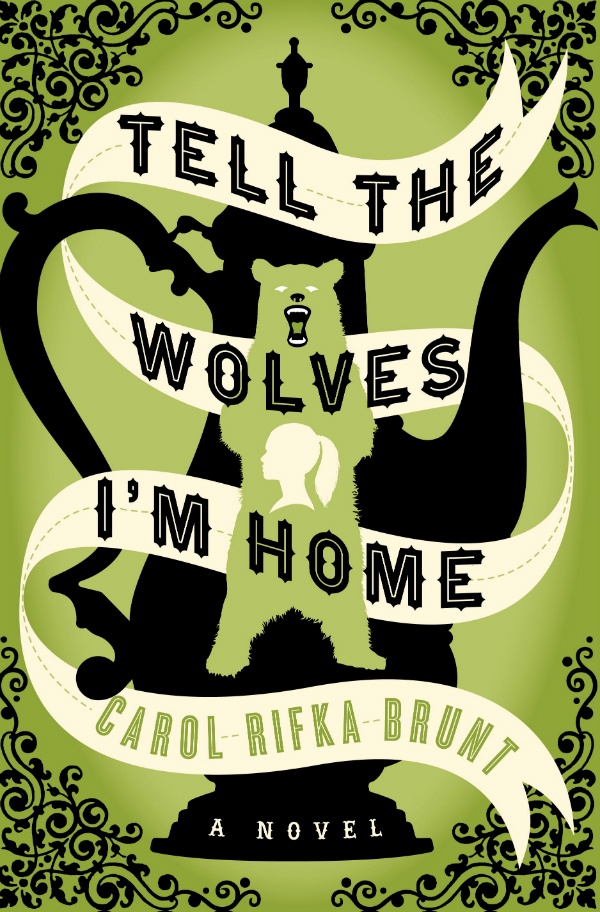
Tell the Wolves I’m Home by Carol Rifka Brunt ~ 2012. This edition: Random House, 2012. Hardcover. ISBN: 978-06796-4419-4. 355 pages.

My rating: 8/10. Very nicely done, especially for a first novel.

I’m sure this one will deeply appeal to the YA crowd, though I found it in the Adult section of the library. There’s nothing here that a modern teen couldn’t handle with one hand tied between her (or his, though this feels rather like a girl’s book, if I may be so bold as to stereotype it) back.

*****

I’m considering tagging this one historical fiction, because the sense of a very particular time is so strong, and it captures those early days of the AIDS epidemic so well, when we were all more than a little scared and confused, and traded rumours in whispers. The story is set in 1987, twenty-five years ago.

The internet is swarming with reviews on this one; I’ll try to keep this simple.

Young June Elbus, fourteen years old and deeply embroiled in the angst of adolescence, has one person she can count on unconditionally, her Uncle Finn. Finn, a renowned painter, now leads a semi-reclusive life in New York; he hasn’t exhibited anything for years, though he is still painting. He’s working, in fact, on a dual portrait of June and her older sister Greta.

The portrait is of supreme importance to everyone concerned; it is likely the last work Finn will ever complete, for he is dying of that mysterious and deadly new disease, AIDS.

Finn’s sister, June’s mother, is brutally shaken by Finn’s death early on in the story, as she has some unfinished business with her brother. She vents her anger at Finn’s lover, the unknown man who she claims has deliberately infected Finn and who is now, in her eyes, his murderer.

June has some baggage of her own. She has been secretly in love – full-blown romantic love – with her uncle, a middle-aged gay man (and June knows this), who, to further complicate things, is June’s godfather. The two share a deeply emotional connection, though Finn has many secrets which June is only to find out about after his death.

With Finn’s demise, and the entry of the mysterious lover, Toby, into the plot, things crank up a notch, and the narrative moves from completely believable to slightly fantastic, in the stretching-of-belief-and-probability sort of fantastic. But it makes for a good story, so allowances can easily be made.

All in all, a very likeable, suitably complex heroine and an interesting plot. I did find it quite predictable in many ways; people did what I thought they would, and the big secrets were telegraphed fairly clearly; clues were distributed with a generous hand.

Beautifully written, with an abundance of heart-tugging emotion. Though I didn’t personally tear up at all, old cynic that I am, as so many of the reviwers over on Goodreads did.

What else?

Good handling of the gay characters; this can be hard to get right without straying, even unintentionally, into parody, and I think Brunt did a very good job with that.

Absolutely gorgeous cover, which reflects the excellent content within. One to share with your teens, and borrow to read yourself.

Read Full Post »

Playing Beatie Bow by Ruth Park ~ 1980. This edition: Puffin (Penguin Australia), 1998. Softcover. 196 pages.

My rating: 8/10

This well-written coming-of-age, historical fiction juvenile novel by New Zealand-born Australian writer Ruth Park is deserving of all the awards and rave reviews it has garnered through the years.

14-year-old Abigail – Abbie – Kirk is still deeply wounded by the separation of her parents four years earlier. In her anger at her beloved father for his desertion, she has changed her name from his chosen Lynette to “an old name, a witch’s name” – Abigail.

Anger seethes within Abbie, though she is learning to hide it. She is

…a girl who wished to be private.

Outside, she was composed, independent, not very much liked. The girls at school said she was a weirdie, and there was no doubt she was an outsider. She looked like a stick in jeans and a tank top; so she would not wear them. If everyone else was wearing her hair over her face, Abigail scraped hers back. She didn’t have a boyfriend, and when asked why she either looked enigmatic as though she knew twenty times more about boys than anyone else, or said she’s never met one who was half-way as interesting as her maths textbook. The girls said she was unreal, and she shrugged coolly. The unreal thing was that she didn’t care in the least what they thought of her. She felt a hundred years older and wiser than this love-mad rabble in her class.

Her chief concern was that no one, not even her mother, should know what she was like inside. Because maybe to adults the turmoil of uncertainties, extravagant glooms, and sudden blisses, might present some sort of pattern or map, so they could say, ‘Ah, so that’s the real Abigail, is it?’

The thought of such trespass made her stomach turn over. So she cultivated an expressionless face, a long piercing glance under her eyelashes that Grandmother called slippery. She carefully laid false trails until she herself sometimes could not find the way into her secret heart. Yet the older she grew the more she longed for someone to laugh at the false trails with, to share the secrets.

What secrets? She didn’t yet know what they were herself.

So Abbie gets on with her everyday life, going to school, helping her mother in her vintage clothing and memorabilia shop, ‘Magpies’, and occasionally babysitting her neighbour’s younger children.

It is while accompanying one of those children to the playground that Abbie first notices a solitary, crop-haired, strangely dressed child lingering in the shadow of a wall, wistfully watching the others at play. Abbie approaches her, but she cries out and runs away. Abbie is intrigued. Who is the child, and why do none of the others, except for her small charge Natalie, seem to see her?

The next time Abbie sees the girl, she again approaches her, but this time as the child flees Abbie follows close behind. Through a the twisting maze of  The Rocks, Sydney’s historical district, they go, until Abbie realizes that she is completely lost – the atmosphere has somehow changed – evening is coming on – and streets are now lit with gas lights, and down a side-street comes a horse-drawn cab. Terrified now, Abbie continues her flight, following glimpses of the only familiar thing she still recognizes, the fluttering fringes of the mysterious child’s shawl.

Of course, by this time, we have realized that somehow Abbie has crossed through a mysterious portal into a previous time and place, the squalid slums district of 1873 Sydney. Rescued and cared for by the little girl’s family, Abbie goes through a transformation of her own, until at last returning to her own time changed, chastened, older (at least in experience) and wiser.

A highly enjoyable, on the whole well-thought-out time-travel tale; the weakest points are the actual time travel sequences – but these are notoriously hard to write, being, of course, purely imaginative with no real-world references to guide the writer. There are elements of  the supernatural – quite a lot of the plot revolves around the passing on of the powers of something like a ‘second sight’ among a family – and there is a certain amount of realistic romance. The ending is possibly a bit too pat, but in general is well-balanced and satisfying, as it ties up all loose ends but leaves the future optimistically open.

I would recommend this for older children, perhaps 12 and up, to adult. The quality of the writing is very high; the story itself is interesting and creatively presented. An intriguing glimpse into contemporary and historical urban Australia (set, as mentioned earlier, in Sydney, New South Wales), as well as a highly sympathetic protagonist.

Read Full Post »

« Newer Posts