Posts Tagged ‘Hidden Gem’

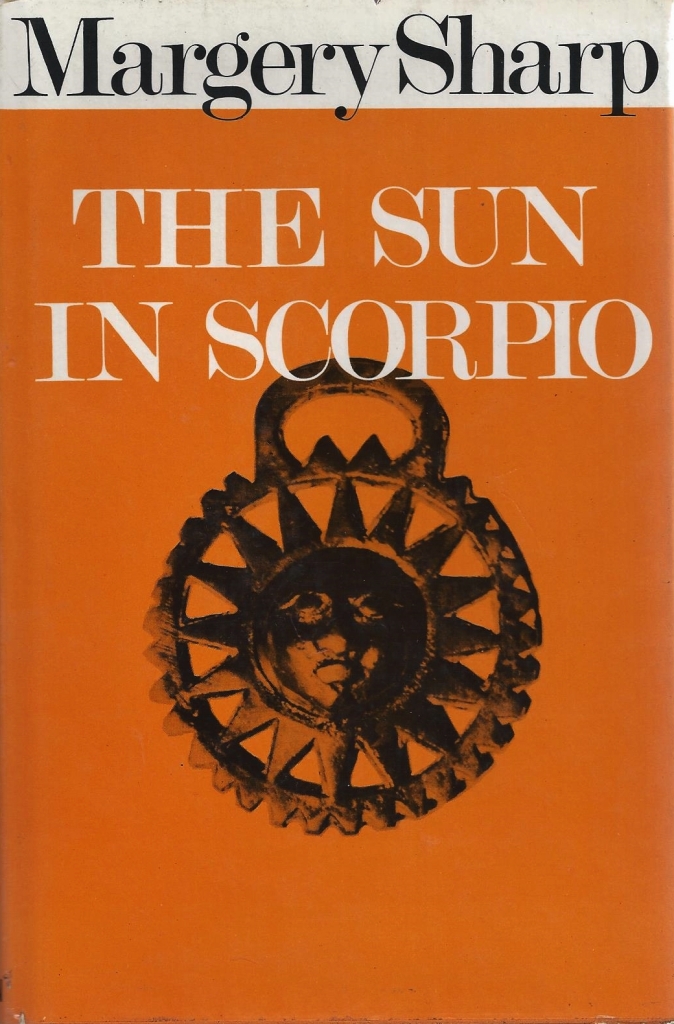
the sun in scorpio margery sharp 001The Sun in Scorpio by Margery Sharp ~ 1965. This edition: Heinemann, 1965. Hardcover. 231 pages.

My rating: 10/10.

She does it again.

Just when I thought I knew everything there was to know about Margery Sharp’s eclectic style, she pulls something new out of the hat. This is an absolutely crisp, clean and elegantly written novel, by a master of her craft, with some attention-catching stylings. I  suspect the author was enjoying herself quietly and deeply while working this out, based as it is on her memories of her childhood years in Malta.

Nice. Very, very, nice.

I’ve been sitting on this post for a few weeks now, waiting for an inspired moment to sit down and really delve into this book, but things are picking up speed in my real life and computer time for blogging is getting a bit pinched, so it’s looking like now or never. A quickie review it will have to be.

Everything sparkled.

Below the low stone wall, beyond the rocks, sun-pennies danced on the blue Mediterranean; so dazzlingly, they could be looked at only between dropped lashes. (In 1913, the pre-sunglass era, light was permitted to assault the naked eye.) Opposite, across the road called Victoria Avenue, great bolts of sunlight struck at the white stone buildings and richocheted off the windows. A puff of dust was a puff of gold-dust, an orange spilled from a basket like a wind-fall from the Hesperides…

Young Cathy Pennon, middle child of three growing up on an outpost of the grand British Empire, on the small island “next-door” to Malta, glories in the sun and basks in its rays. She is soon to leave the scene of her young years, as the growing winds of the Great War unsettle her civilian parents enough to urge a return to safer England. Cathy is soon to discover that she never will be truly warm again; the rainy isle of “Home” being resistant in its mists to the heat of that lost-and-mourned Mediterranean sun.

We follow Cathy, and to a lesser degree, her older sister Muriel and younger brother Alan, as they grow up in England, move into their adult years, and go their separate ways. Muriel is to find a comfortable niche in married domesticity; Alan settles into a happy bachelor existence while dedicating himself to the banking business – he is, ultimately tragically, of just the age to be destined to fight in the next great war – and Cathy drifts into a loosely-defined position as companion-lady’s maid to the aristocratic Lady Jean.

The book is a delicious moving picture of the years of and between the wars; our author touches delicately but succinctly on the many personalities and types of those years of tremendous flux, when the world is continually shaking itself and forming itself again as its inhabitants struggle, with various degrees of success, to come to grips with every new normal.

Cathy survives, though not without some scars, and we leave her at the end of the Second Great War poised for what looks to be the greatest change yet in her four decades of life, contemplating with wild surmise and growing joy the possibility of a return to the sun.

What a very good book this is. Margery Sharp is in absolutely fine form, having created a crisp, clean narrative with beautiful styling and more than a little cynically black ink in her accomplished pen. Cathy is a most human protagonist; full of flaws and not at all likeable a certain amount of the time; she tends to stand back a step from those around her, never fully entering in to the lives of those she bumps up against. A girl and then a woman of unexpected responses, and a few hidden talents…

Read Full Post »

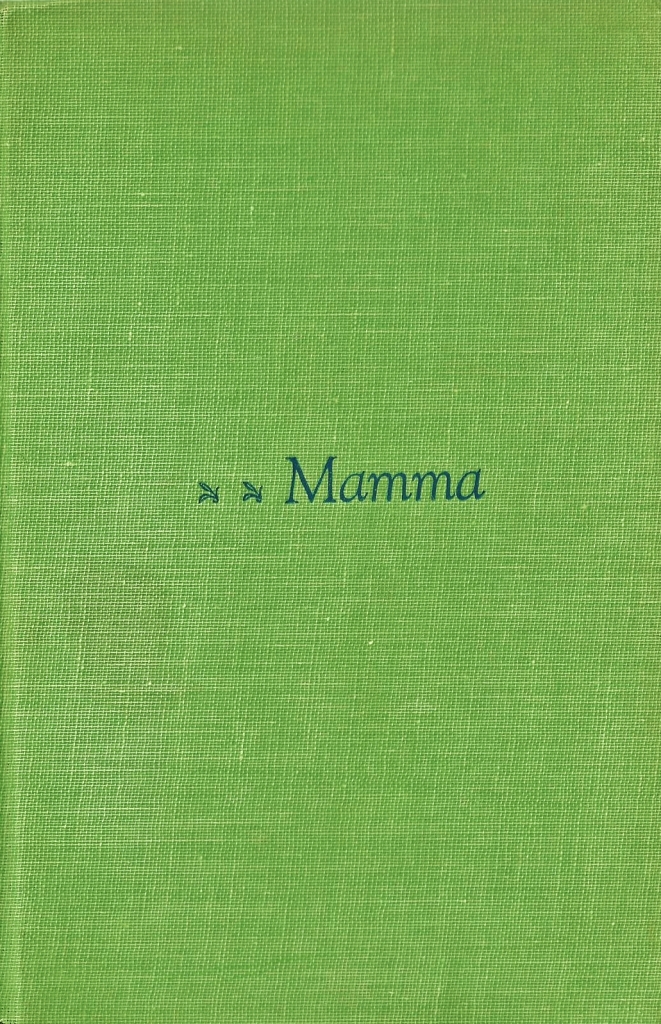
mamma diana tuttonMamma by Diana Tutton ~ 1955. This edition: Macmillan, 1955. Hardcover. 218 pages.

My rating: 8.5/10

Remember the buzz a year or so ago here amongst the book bloggers about Diana Tutton’s Guard Your Daughters?

Many people enthused over this forgotten novel by an elusively obscure writer; a few didn’t feel the love. I fell somewhere in the middle of these reactions, for while the book intrigued me I didn’t outright adore it, but it did make me curious about what else this writer could do. I’ve been watching for copies of her only other two books, 1955’s Mamma and 1959’s The Young Ones, for over a year, and lo and behold, I found one recently through an online book dealer. Mamma is now mine.

And what a happy gamble this was – I enjoyed it greatly. I had expected something either brittle or dreary, and possibly a bit smutty, for I knew ahead of time that it concerned a middle-aged mother plotting a love affair with her daughter’s husband – but in reality it is a rather more delicate thing, and well handled, and full of sly humour, and ultimately more than a little heart-rending. It has an intriguing ending as well, which could go any which way, leaving our main character poised on the verge of the next bit of her life.

Where it lost its 1.5 points – for it came close to being a 10 on my personal rating scale – was in its occasional outspoken snobbishness, something which also disturbed me in Guard Your Daughters. And, as in that novel, I am having a hard time deciding whether it is meant to be a tongue-in-cheek joke by the author, or a real reflection of her feelings, putting her thoughts into her character’s heads. It was just frequent and mean-spirited enough to take the bloom off this otherwise highly diverting concoction.

41-year-old widow Joanna Malling has just bought a house in a country village, a rather decrepit, unattractive house, with potential masked by neglectful decay. With her furniture unloaded, Joanna sinks into a momentary depression, wondering what she has done, and wishing desperately that she had someone to lean on, someone like her beloved husband Jack, who had died suddenly in the first year of their happy marriage, leaving the 21-year-old Joanna utterly bereft and a new mother to boot.

That baby, Elizabeth – Libby – is now a young woman herself, and a lovely, competent, and accomplished one. And also newly engaged. For the very day Joanna moves into her new house, a letter arrives from Libby in London announcing her intent to marry Steven Pryde, a career army officer, fifteen years Libby’s elder.

Joanna is apprehensive, wondering if she and Steven will make friends, and her first meeting with him leaves her cold. Stoic and expressionless, Steven is brusque and almost rude, and Joanna is less than impressed. But as she helps the young couple prepare for their wedding, and as Steven starts to show glimpses of manly chivalry, glints of a sense of humour, and a hidden taste for serious poetry, Joanna starts to see what has caught her daughter’s attention. Steven is also self-centered and frequently brusque, and occasionally dismissive of Libby’s interests and whims, though it is obvious that he also deeply admires her and loves her dearly.

Through a series of unplanned-for occurrences, Steven and Libby end up moving into Joanna’s house several months after their marriage, and the inevitable adjustment period of a brand new marriage finds Joanna caught between her beloved daughter and her enigmatic son-in-law.

I found myself sympathizing most ardently with fictional Joanna. Here she is, trying to make the best of things, and striving to keep out of the newlyweds’ way and allow them privacy, while at the same time dealing with the unexpected upsurge of feelings of grief at her own long-ago loss in her own early days of her marriage. After the first stages of grief had passed, the young Joanna had expected that she would meet another man and would remarry; this has not happened. But Joanna is not soured or embittered by this; she has steadfastly gotten on with her life. For twenty years Joanna has competently coped with her widowhood and single parenthood, sublimating her very real emotional (and sexual) needs in caring for her daughter, housework, and serious gardening. It has been an occasionally fragile balance, though, and it is about to tip, with potentially disastrous consequences.

Steven in only six years younger than Joanna, and the two inevitably find common ground in gently humouring just-out-of-her-teens Libby’s occasionally juvenile enthusiasms, heedless pronouncements, and occasional mood swings. Their shared appreciation of literature and poetry leave Libby far behind; she is not by any stretch an intellectual.  Constant propinquity allows even stronger feelings to develop, and Joanna is horrified to realize that she is falling in love with her daughter’s husband, while he is watching her with something more than dutiful regard.

When Libby at last realizes that the building tension in the three-person household is not her imagination she blazingly accuses Joanna of attempted seduction,  which scenario is very close to the truth. In Joanna’s defense Steven has been allowing himself the same burning glances at his “Mamma”-in-law as she is sending his way, though neither had so far made an overt move to bring their growing mutual attraction to the next stage.

Libby is soothed down and the potentially explosive situation is delicately defused by unspoken agreement between Joanna and Steven. He and Libby move on into their own establishment, but the experience has made Joanna take a deeply introspective look at how closely she allowed herself court disaster. Still a relatively young woman, she must rethink her future and how best to proceed into the second half of her life.

An unusual novel with some mildly unconventional characters. Steven perhaps gets the least authorial attention of the three main protagonists; he remains something of an enigma throughout, despite our glimpses at his secret self. Confident and competent Libby is shown in some detail, though mostly through her mother’s affectionate eyes.

It is Joanna who stands out, and her depiction is sensitive and deeply moving. Having several too-young widowed friends myself, Joanna’s agonizing internal dilemma as to how to best cope with her own needs when all about her prefer to conveniently view her as “beyond all that” strikes true indeed. Joanna has absolutely no one to confide in, and when her own daughter blithely and rather cruelly speculates on the psychological twists of those who are deprived of a satisfactory sex life, without grasping the obvious fact that her own mother is one of those so deprived, we cringe for both of them, but mostly for proud and stoic Joanna.

The gardening references – very important, as Joanna spends a lot of time working away her many frustrations at the end of a trowel – are impeccably plausible; a decided point in favour as this is something I am alert to, and I’ve frequently caught authors out on their lack of detailed horticultural knowledge. Diana Tutton appears to have been a gardener, or at least a garden lover.

Several lower-class characters, namely the two daily helps employed by Joanna, and the unmarried mother-to-be employed as a cook-companion by Steven’s mother, are depicted in the broadest of caricatures and here the Snob Factor again raises its ugly head, leading me to speculate that the dismissive and critical attitude which the upper-class – or, to be more accurate, upper-middle-class – characters show reflects the author’s personal views and is not merely a fictional device. Several scenes concerning these characters degenerate into broad farce; a jarring note in an otherwise well-constructed tale.

That last caveat aside, I’ll repeat that I liked this novel a lot, and am now very keen indeed to get my hands on the third of Diana Tutton’s elusive novels, The Young Ones. Apparently it concerns a woman’s dealing with the incest of her brother and sister. A decidedly eyebrow-raising scenario, but if Mamma is anything to go by, perhaps intriguingly plotted. I’m up for the gamble, but so far have not come across a copy for sale at any price anywhere, despite diligent online searching.

I’ve also been inspired to re-read Guard Your Daughters, and though the annoying bits still make me grit my teeth a bit, I’m enjoying it much more this time round, and may at some point need to revise my review to reflect the second-time-round reading experience.

Back to Mamma, has anyone else read this, and, if so, what did you think? I do believe Simon tackled it at one point, but didn’t write up a review. Any comments most welcome. 🙂

And has anyone come across The Young Ones? And, if so, what’s the word? Worth the hunt?

Read Full Post »
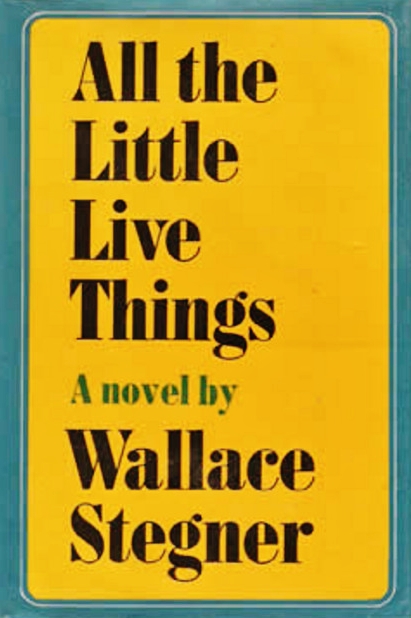
all the little live things wallace stegnerAll the Little Live Things by Wallace Stegner ~ 1967. This edition: Viking Press, 1967. Hardcover. 248 pages.

My rating: 10/10

This attempted review has been simmering away at the back of my mind for months and months. Getting it posted on New Year’s Eve day takes a great weight off of my conscience, even though I am not doing the novel the credit it deserves by this brief discussion.

Since reading the book way back in March of 2013, I have wondered how best to communicate the special quality it has, and its deep appeal, which is much more fundamental than its (highly engaging) storyline. This is where I bemoan my lack of a formal education in writing literary analysis; I know what I want to say but I don’t have the vocabulary to say it, so I fall back on the easy things: I liked the book. It moved me. Beautifully written. Memorable characters. An evocative picture of a time and a place.

These are things I can say of so many books I am fortunate enough to have encountered over an expansive reading life, but which do not at all illuminate the qualities that make this (or any other) book so special, this writer (or any other) so immediately compelling.

So, a review. Where to even start? How about here, with the front flyleaf material of the first edition, to set the story up, and to give me a lead in adding a very few thoughts of my own.

Why does the older generation feel as it does about what is happening in the world today? Wallace Stegner answers the question, with sympathy and understanding, for one good human individual trying to come to terms with his world while retaining his own integrity. In a novel that probes deeply into this and other aspects of contemporary life, he shows his narrative skill, his great gifts of evocation, and his eloquent intelligence at their mature best.

Fulsome praise indeed, even allowing for a publisher’s bias! But yes, in this case, not overstated. The author is addressing one of the Big Questions of his time, the mid 1960s, which is to say, the great divide between the generations; the wide movement of youth (and relative youth) to reject categorically the ethics, morals and social standards of their elders, and to try to remake the world into a new utopia. We’re talking about hippies, here. And the California setting is the seething nerve centre of this societal battleground, full of lines drawn in the sand and unwitting trespasses and deliberate provocations. Change is in the air, and no one is immune to its effects.

Joe Allston and his wife, two Easterners in their sixties, retire to California in search of peace after the death of their wayward son. Their paradise is invaded by various parasites – not only by the gopher and the rose blight, the king snake and the hawk, but also by a neighbour with a bulldozer, bent on “development.” Jim Peck, a bearded young cultist, builds a treehouse on their property and starts a University of the Free Mind, complete with yoga, marijuana, and free-wheeling sex. Most damaging of all, it is invaded by Marian Catlin, an attractive young wife and mother, affirming all the hope and love that the Allstons believe in, who carries within herself seeds as destructive as any in the malevolent nature that surrounds them.

The relationship between the two couples, the older Allstons and the younger Catlins, is beautifully portrayed, and I felt it was one of the most admirable aspects of the novel. Stegner delicately captures the nuances of friendship, unspoken sexual attraction which does not have to be acted upon, and the balance of power between youth and age. Joe and Marian strike sparks off each other, but the relationship never turns ugly; all four spouses are involved in the relationship and each turns to his or her partner for support and comfort as needed. For the core issue of the story is this: Marian is pregnant, with a much-desired second child. (The Catlin’s first child, a young daughter, is very much loved and wanted, and is a charming girl, nicely handled by the author.) Marian also has terminal cancer, and she has rejected treatment in order that she can bring the pregnancy to term.

A difficult plot to see any happy way out of, isn’t it? I’ll tell you right now: no feel-good miracles occur.

Here’s an admirable review which eloquently puts into words my own elusive thoughts on the novel: Bookslut: All the Little Live Things. Please read.

This is my very first Wallace Stegner, and I know full well it won’t be my last.

Read Full Post »

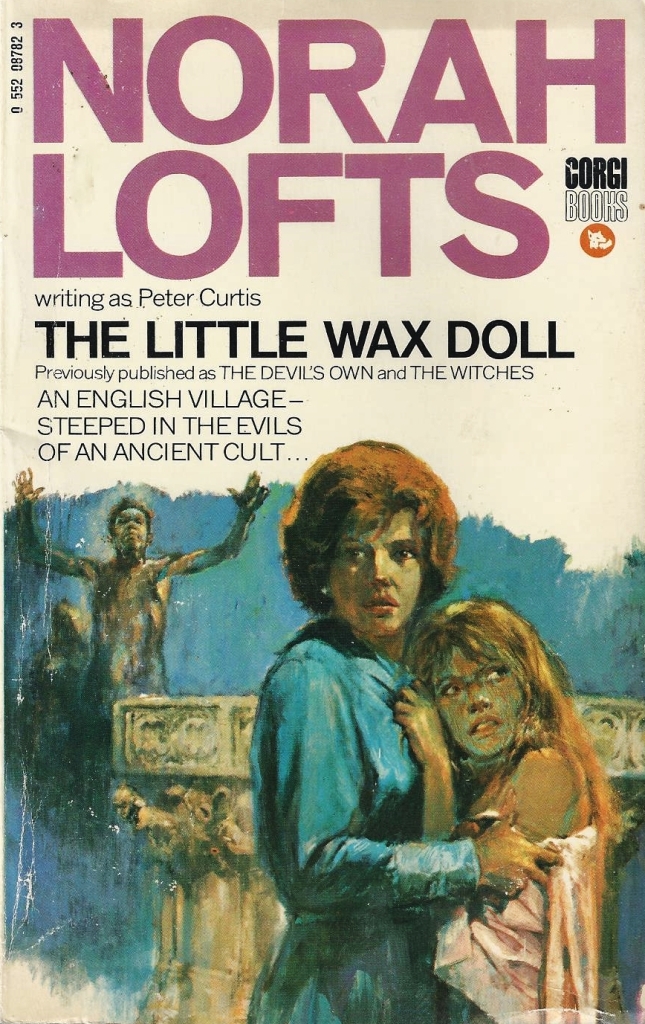
the little wax doll norah lofts 001The Little Wax Doll by Norah Lofts ~ originally published in 1960, and re-released under this title and author’s name in 1970.  Previously published as The Devil’s Own (1960) and The Witches (1966), under the pseudonym Peter Curtis. This edition: Corgi, 1971. Paperback. ISBN: 0-552-08782-3. 255 pages.

My rating: 9/10

This is definitely not a Christmas-time read. Hallowe’en, oh yes, indeed. But I am so tickled by my discovery of it that I’ve bumped down my review of D.E. Stevenson’s Charlotte Fairlie (which is an appropriate Christmas book for reasons I’ll enlarge on when I return to it) to talk about Norah Lofts’ village-with-dark-secrets instead.

I love these sorts of unexpected developments. Norah Lofts, mistress of the art of historical romance, occasionally let herself go in a very different direction and wrote a number of thrillers under the name Peter Curtis, adopting the pseudonym in order to avoid disappointing fans of the romances who would associate her name with a certain type of story.

I must say I would never have picked up this old paperback if it weren’t for Norah Lofts’ name on it; the cover illustration not being at all indicative of what a great read was hidden inside. I had recently read 1964’s How Far to Bethlehem? (with mixed reactions – good writing, but I had issues with the awkwardness of the Bible tie-in plot) so was tuned in to Lofts’ name, as it were, and a casual flip-through was intriguing enough that I squelched my qualms and brought it home.

Forty-something Miss Mayfield, a teacher by profession, is back in England after twenty years working at a friend’s private mission school in a remote part of Africa. She has had some health issues and a vaguely referenced “breakdown” so was sent back to England in the hopes that this would prove beneficial. Her health is better, but she harbours deep misgivings over her ability to cope with the stresses of her new teaching position at an inner city London school. When Miss Mayfield happens upon an advertisement for a teaching headmistress position at a rural private school she decides to try for it, never dreaming that she would be accepted.

An interview with the school’s benevolent sponsor, Canon Thornby of the village of Walyk, sees Miss Mayfield hired on the spot. Off she goes to the rural wilds, to a place very much out of the bustle of the modern world.

Miss Mayfield might want to watch her words when that friendly cat is hanging about...

Miss Mayfield might want to watch her words when that friendly cat is hanging about…

“Too good to be true,” is Miss Mayfield’s first impression of her new home. Not only is she being paid a generous salary, her position includes a wonderful cottage, an instant position of respect in the village hierarchy, and the society of wealthy Canon Thornby and his aristocratic sister. Miss Mayfield’s fellow teacher is competent and friendly, and the school children are polite, willing, and generally intelligent. The cottage even appears to come with an adorable resident cat, who purrs about with a welcoming attitude, and sleeps at the foot of the bed. Miss Mayfield settles in with a feeling of deep appreciation and relief, and counts her blessings every day.

The first inkling that something may not be all as lovely as it appears is when an anonymous note appears among the books on Miss Mayfield’s desk. “Ethel Rigby’s granny treat her something crool.” This shakes Miss Mayfield enough that she decides to investigate the allegation. Said Ethel Rigby is a well-cared for, meek and mild fourteen-year-old whose primary passion seems to be the care of her pet rabbits, and her granny openly dotes on her, having raised Ethel from babyhood, Ethel’s mother having run off and “gone wrong” in her own teenage years.

Though Ethel stoutly defends her grandmother’s innocence of any abuse, Miss Mayfield thinks that the maiden doth protest too much, and she comes away with the idea that Ethel is lying to protect the informer, who proves to be a school friend who claims to have witnessed Ethel’s grandmother push the girl’s hand deliberately into the rollers of a mangle. And Ethel’s hand is all bandaged up, though she insists her own clumsiness was at fault. And when the informing child falls mysteriously ill, only to recover just as mysteriously, and when Miss Mayfield discovers a little wax effigy of the child wrapped up and bandaged together – “healed” – hidden in Ethel’s school desk, the wheels really begin to turn.

Miss Mayfield decides to play detective and to find out what is going on behind all those brightly painted cottage doors. And what she discovers is most disquieting indeed.

What a marvelous heroine Miss Mayfield proved to be. Middle-aged and resigned to her life of perennial spinsterhood (though not unaware of the other sex, and recipient of at least one man’s interested advances) Miss Mayfield is unashamedly dowdy, choosing to focus her energies on doing her job well to the utmost of her ability. She fearlessly delves into the dark secrets of Walyk, is clever and creative in her investigative forays, and even after being brutally sidelined by an “accident” which results in a serious head injury and loss of memory, returns tenaciously to her original goal, which is to protect virginal Ethel from an unpleasant fate at the hands of Walyk’s wicked coven of witches.

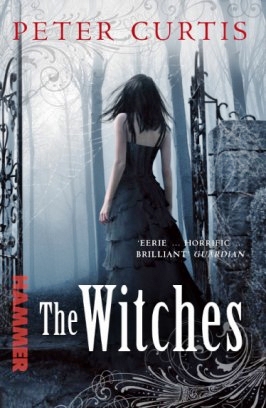
The cover illustration of this 2008 reissue is just a wee bit misleading. I pity the poor teen who picks this one up expecting something Twightish, and instead finds herself sedately accompanying Miss Marple-ish Miss Mayfield on her earnest investigations!

The cover illustration of this 2008 reissue is just a wee bit misleading. I pity the poor teen who picks this one up expecting something Twilightish, and instead finds herself sedately accompanying Miss Marple-ish Miss Mayfield on her earnest investigations!

I was most pleased at the quiet humour throughout; the author appears to be enjoying herself thoroughly as she dashes this melodrama off.

Miss Mayfield, though primly proper even in her innermost thoughts, is not what one could call “prudish” – she is well aware of all elements of human nature, though she chooses to remain aloof from some of those aspects herself.  Even upon witnessing the penultimate scene of a full-blown witch’s Sabbath she mildly wishes that she could just close her eyes and avoid seeing the depravities of her neighbours, but she is not so much shocked as disgusted at their lack of proper dignity, and we never fear that this experience will shake her somewhat frail psyche. If anything, it strengthens her resolve to sort things out and bring everyone back into some semblance of decency, to protect the innocents, and to nobble future abuses and murders. Miss Mayfield’s inner dialogue proves that she is capable of appreciating the ridiculous aspects of the situation she has allowed herself to become embroiled in; we never fear for her sanity, but instead come away feeling that her future will be ever more assured. And as for Ethel, well, let’s just say that she appears well able to look after herself from this point forward!

There is also a perfect little twist at the very end.

This is an enjoyable “entertainment” read, rather nasty plot developments and all. If “Peter Curtis” did as well with “his” other three thrillers, I’m definitely keen to acquire them. Despite the absolutely stereotypical “black magic” theme, the author kept me engaged throughout, guessing a goodish bit of the time, and rather surprised here and there; very nicely done indeed.

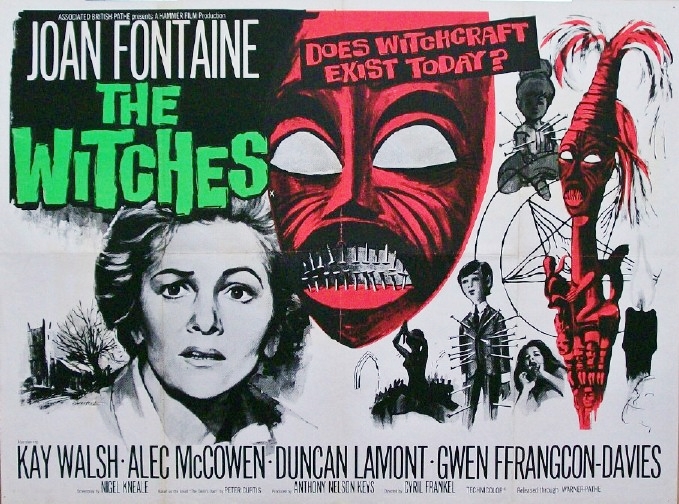
In 1966 the book was turned into a horror-suspense thriller, starring none other than Joan Fontaine as a rather elegant Miss Mayfield. From the plot description and movie stills it appears that the African connection is played up to a greater degree than in the book, and that one of the background characters who leaps into prominence in the last chapter is given a larger early role, and that there is general tweaking of the storyline to make it more dramatic. For those of you with an interest in this vintage film genre, it might well be an enjoyable diversion. (But be sure the read the book as well; it has charms of its own, though the original Miss Mayfield is no Joan Fontaine!)

The Witches horror film peter curtis norah lofts hammer film

And here is a rather detailed synopsis and analysis of both book and movie, containing abundant spoilers. I would suggest you read the book first, because it gives away all of the key twists, but it is most interesting after one is finished.

Necromania BlogSpot: The Witches by Peter Curtis

Read Full Post »

cranford cover elizabeth gaskellCranford by Elizabeth Gaskell (Mrs Gaskell) ~ 1851-53. (It appeared as a serial before being published in book form post-1853.) This edition: Everyman’s Library, 1942. Hardcover. 255 pages.

My rating: 9/10

What a joy this little book was. I cannot believe it has taken me so very long to read it, such an essential part of the “English novel” canon!

Our narrator is one Mary Smith, a young lady of good family, who visits and corresponds with the good ladies of a small (fictional) English village, Cranford, in the early years of the 19th century. Round about the 1830s, to be more exact, from the references to Charles Dickens’ Pickwick Papers being then newly released in their serial form. King William IV and his Queen, Adelaide, reign over the land, soon to be succeeded by the young Victoria. The ladies of Cranford, though far from London in more ways than distance, keep a keen eye cocked on the doings of high society and the nobility, and form their own society accordingly.

In the first place, Cranford is in possession of the Amazons; all the holders of houses above a certain rent are women.  If a married couple come to settle in the town, somehow the gentleman disappears; he is either fairly frightened to death by being the only man in the Cranford evening parties, or he is accounted for by being with his regiment, his ship, or closely engaged in business all the week in the great neighbouring commercial town of Drumble, distant only twenty miles on a railroad.  In short, whatever does become of the gentlemen, they are not at Cranford.  What could they do if they were there?  The surgeon has his round of thirty miles, and sleeps at Cranford; but every man cannot be a surgeon.  For keeping the trim gardens full of choice flowers without a weed to speck them; for frightening away little boys who look wistfully at the said flowers through the railings; for rushing out at the geese that occasionally venture in to the gardens if the gates are left open; for deciding all questions of literature and politics without troubling themselves with unnecessary reasons or arguments; for obtaining clear and correct knowledge of everybody’s affairs in the parish; for keeping their neat maid-servants in admirable order; for kindness (somewhat dictatorial) to the poor, and real tender good offices to each other whenever they are in distress, the ladies of Cranford are quite sufficient…

The Amazons referred to are a select group of upper class ladies who rule Cranford’s restricted society. Spinster sisters Miss Deborah and Miss Matilda (Matty) Jenkyns (rather elderly daughters of the some-years-deceased rector), the know-everything Miss Pole, snobbish Mrs Jamieson (sister-in-law to the late Earl of Glenmire, she’ll be happy if you’ll remember), and quiet Mrs Forrester (genteelly poverty stricken but held locally in highest regard due to her familial ties to the aristocracy) – all these ladies take the leading roles in Cranford’s major occasions.

Mary Smith frequently comes to stay with the Jenkyns sisters, and she is able to comment on the occasional village tempests. A certain Captain Brown and his two daughters, Mary and Jessie, settle in Cranford, and Captain Brown’s attendance at the previously all-female tea parties keeps the ladies on their toes, though he deeply offends Miss Deborah by his preference for the up-and-coming young writer Charles Dickens over the stately Dr. Johnson.

As the years slide by, reports from Cranford show us a peacefully microcosm in a gentle state of flux. Several characters move on or pass out of the worldly sphere altogether, several marriages occur, and a birth or two. Lady Glenmire arrives to the initial glee of her hostess, Mrs Jamieson, but soon confounds that lady by demonstrating some rather “low” tastes; nouveau-riche Mrs Fitz-Adam comes into her own at long last; a burglar alarm has the ladies all in a tizzy; and the failure of Miss Matty’s investments rallies the ladies to new heights of beneficent plotting.

It’s all very low key, but it is gloriously funny, and occasionally deeply pathetic (in a traditionally fictional way), and I am looking forward with interest to reading more of Mrs Gaskell, now that I’ve at last made her first-hand acquaintance.

And, last but not least, the Cranford references I continually come upon in my other reading will no longer leave me feeling quite so dreadfully ignorant of the original. Oh, happy day, indeed!

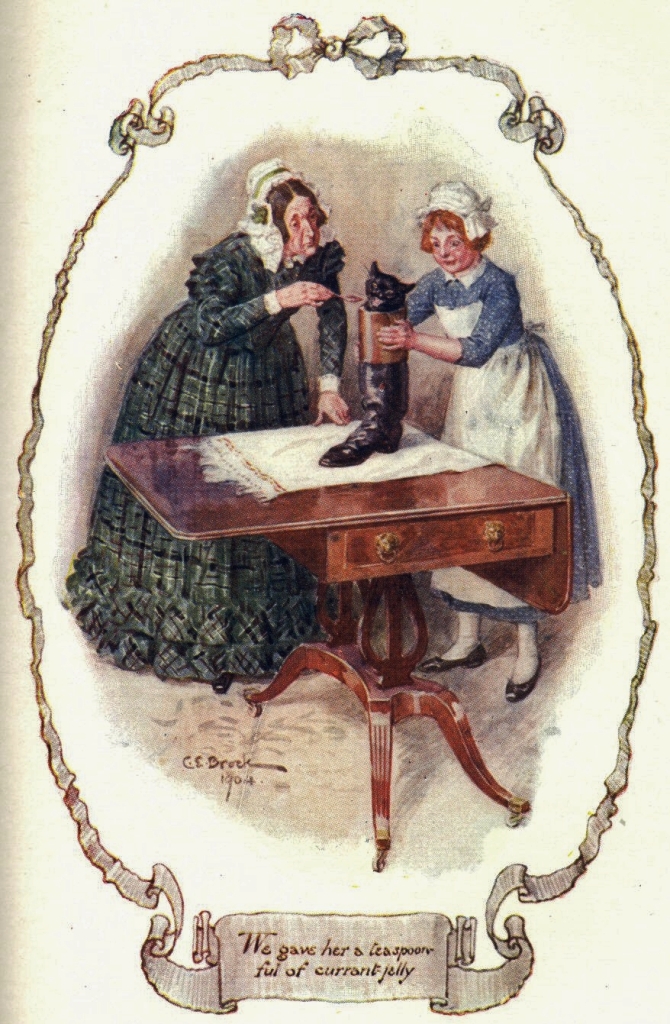
Yes, these women are stuffing a cat into a boot. I shan't tell you why; you will have to read the novel yourself to find out. But I assure you that Kitty comes to no harm, and the "operation" is a decided success! (You'll never guess it; it's a uniquely Cranfordian situation!)

Yes, these women are stuffing a cat into a boot. I shan’t tell you why; you will have to read the novel yourself to find out. But I assure you that Kitty comes to no harm, and that the “operation” is a decided success. (You’ll never guess it; it’s a uniquely Cranfordian situation!)
Illustration is from the 1904 J.M. Dent edition, illustrations by C.E. Brock.
http://www.gutenberg.org/files/394/394-h/394-h.htm


Read Full Post »

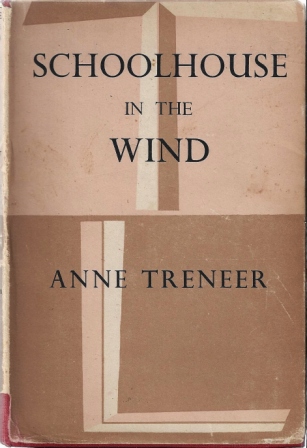
schoolhouse in the wind anne treneer 001Schoolhouse in the Wind by Anne Treneer ~ 1944. This edition: The Travellers’ Library, 1950. Hardcover. 221 pages.
My rating: 8/10.

A slight memoir which leapt into my hand as I was quickly browsing the back room bookshelves housing the “collectibles” during a recent visit to Hope’s lovely used book store, Pages. I’d never heard of Anne Treneer before, but I am so pleased to have made her unexpected acquaintance.

Intrigued initially by the title, and wondering rather why this volume had been shelved among the back room “treasures”, I had no idea what to expect, but a brief dipping-into let me know that this was one of those personal memoirs of childhood which can be such appealing reading, capturing as they do the very essence of an individual’s earliest memories, and frequently memorable glimpses of long-passed time and much-changed place.

*****

He panted to escape but I
As he was winding thin
And narrowly was slipping by
Gasped and drew him in.

~On Catching the Breath

Anne Treneer was born in 1891, in the small village of Gorran in England’s Cornwall (hotbed of so many writers and creative types), the very much unplanned-for sixth child of the family, born after the family of four boys and a longed-for daughter, Anne’s older sister Susan, was thought complete. The baby carriage had long been given away, so Anne was trundled about by her older brothers in whatever other conveyance was handy:

My brothers say they brought me up in a wheelbarrow, and that this accounts for certain bumps in my forehead and generally scrappy appearance. When I was small they used to tell me that old Mrs. Tucker brought me one winter night in a potato sack and left me on the front step; and that I squalled so loud that my father said to my mother, ‘For God’s sake bring the little Devil in and see if she’ll stop that noise’. So in I came and stayed…

Anne’s father was the local schoolmaster, and Schoolhouse in the Wind is an affectionate, humorous and occasionally poignant evocation of a small corner of Cornwall at the juncture of the 19th and 20th centuries.

Gorran School, with a house for ‘master’ glued to it, stood strong and symmetrical, without beauty but not mean, triumphantly facing the wrong way. It might have looked south over the distant Gruda and the sea; but this advantage was forgone in favour of presenting a good face to the road. Master’s room in school, the big room as we called it, caught the north wind while the closets at the back caught the sun. I have heard that Mr. Silvanus Trevail, the architect, who designed many Cornish schools, committed suicide in the end; but whether out of remorse for his cold frontages I do not know.

That last comment at the end of the book’s first paragraph filled me with quiet glee – obviously this was not to be a completely sweetly sentimental memoir, but something with a bit more bite! – and I read on with high expectations. Those expectations were well met and frequently exceeded.

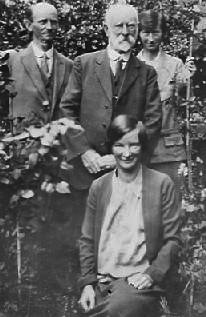
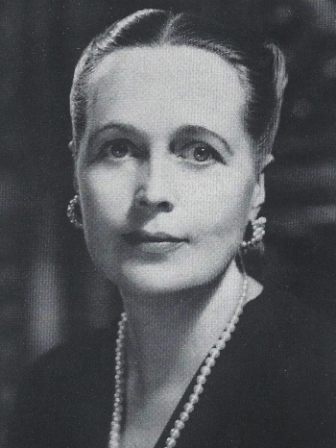
a young Anne Treneer

A young Anne Treneer.

I could go on and quote many excerpts of Anne Treneer’s rather delicious writing, but I won’t. This book was recently (well, in the late 1990s, “recent” in the used book world, I feel) reissued along with its two companion memoirs, Cornish Years and A Stranger in the Midlands, as a one-volume trilogy. It should be fairly readily available in libraries – at least in British ones – and there are a number of copies available through ABE.

A young Anne Treneer (seated) with her father & sister Susan

A young Anne Treneer (seated) with her father & sister Susan

I recommend it on the strength of this first volume of the trilogy, and I will be buying the combined memoirs for my personal library. The first chapter of Schoolhouse in the Wind sets the stage, as it were, introducing the physical setting of the chapters of reminiscence to follow, and though it will perhaps be of greatest interest to those familiar with the area, even to me, a reader who has never visited England, the picture it draws is vivid and memorable. Also vivid are the character portraits the author paints of her family; with a few well chosen words they come alive on the page.

An internet search brought up a very few references to Treneer. Though she is described as a “prolific” writer, there appear to be few of her titles now available, aside from Schoolhouse in the Wind and the other two memoirs. Schoolhouse is also full of brief snippets of poetry; one assumes these are samples of the author’s work. Some are quite lovely; others seemingly aimed at perhaps a juvenile audience, which is understandable as Anne Treneer spent many years as a schoolteacher.

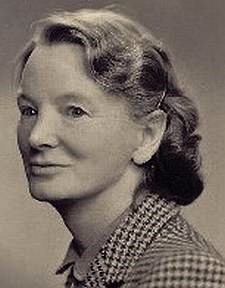
Anne Treneer

Anne Treneer

Anne Treneer never married, and seems to have led a happy and rather individualistic single life, pursuing her many interests with passion and good humour. She died in 1966.

I will leave the subject of Anne Treneer, at least for now, with this excerpt of a short biography from Maurice Smelt’s 2006 book, 101 Cornish lives.

 Anne Treneer pulled off a difficult trick; she wrote an autobiography that succeeds in enthralling despite its almost relentless happiness. Most writers would not even try, reminding themselves that ‘happiness writes white’. It came out as three books over a period of eight years – Schoolhouse in the Wind, Cornish Years, and A Stranger in the Midlands – and it runs from her earliest memories to a day in her late 50s when she went to America to visit her brother.

From her father’s village school she went to St Austell County School, then to a teacher training college in Truro and then taught in various schools in Cornwall. Ambitious to read deeper and wider she took an external course at London University during the First World War, later spent a year at Liverpool University, later still took a postgraduate degree at Oxford as a mature student. Her longest spell at any one school was a seventeen-year stint at King Edward’s in Birmingham, ending in 1946 with a year’s sabbatical leave. She had by then already written Schoolhouse in the Wind two years earlier, and her future was to be a writer, exiled but coming to her beloved Cornwall when she could. In those twenty post-war years she lived mostly in Devon. She was never married and died in 1966.

One reason why her life seems so tranquil is that she was so eccentric, and at the same time so commonsensical that she records what she did as if doing it were the most obvious thing. For example, she loved air with a passion. It is a word of power in her books, her poems especially; there it is, in slight disguise, in the title of Schoolhouse in the Wind. Hence her whizzing about the country in her young days on a Velocette motorbike, the air streaming past her nose like high-speed champagne. As a teacher in Birmingham she spent a summer term commuting (by Velocette) from a tent in Shropshire on Clent Hill. Tents also feature in later summer holidays in Gorran with her sister Susan – three tents, one for each of them and one for the saucepans… Her outdoorsness gave her the keenest eye for the particularity of place, and she could see several worlds in a single Cornish parish.

She claimed to hate crossings-out and third thoughts, but one would never know it as her books are easy reading, usually a sign of art concealing graft…

“Art concealing graft”… what an intriguing comment that one is, as well!

So, if you stumble upon anything by Anne Treneer in your travels, pick it up and peruse it. She has a lot – happily wry and generally unsentimental – to say.

This one gets a “hidden gem” tag.

Read Full Post »

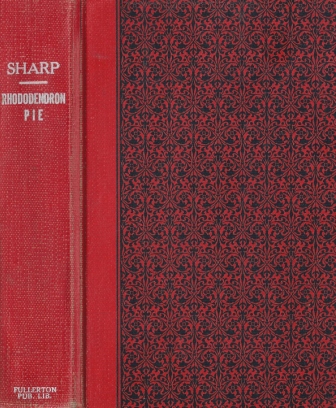
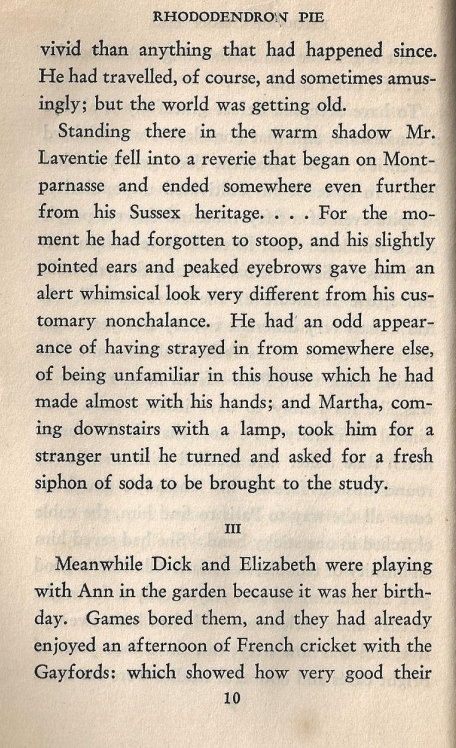
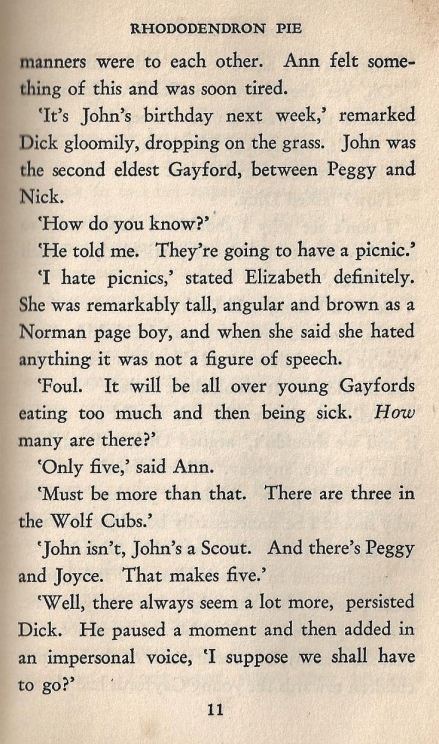
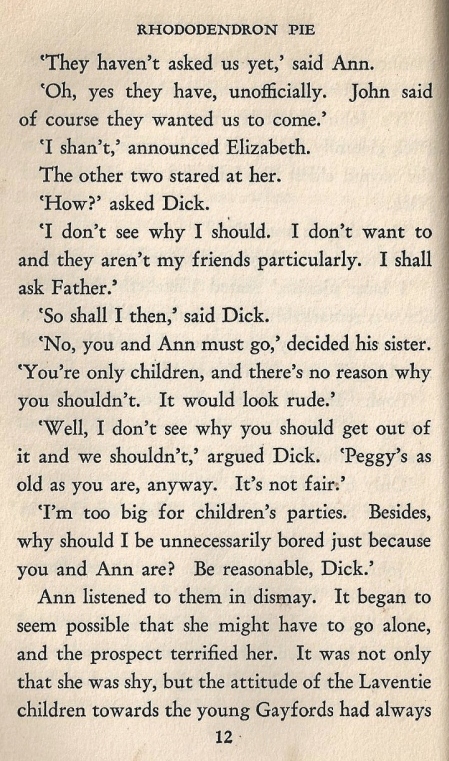
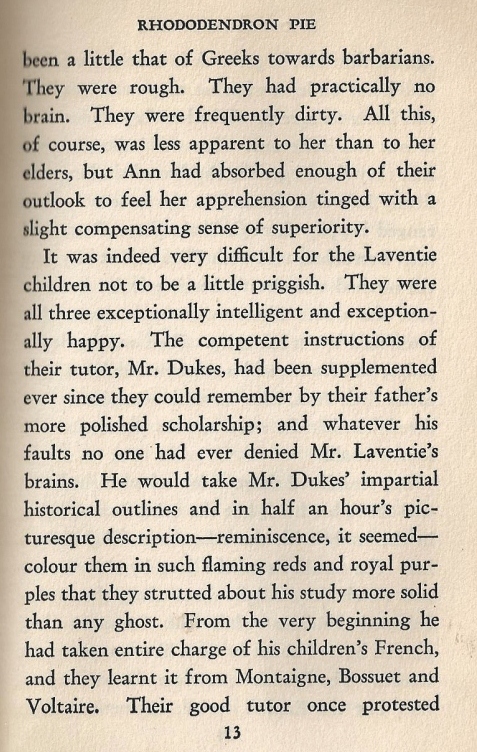
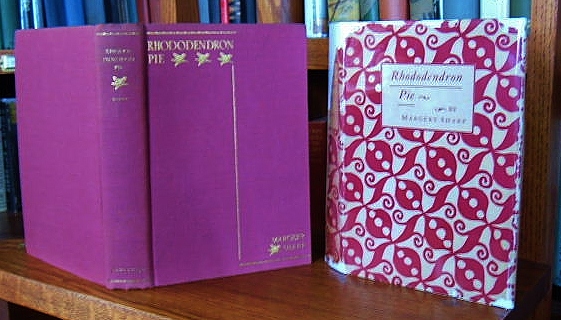
rhododendron pie margery sharp rebound 001Rhododendron Pie by Margery Sharp ~ 1930. This edition: D. Appleton & Co., 1930. 3rd American printing. Hardcover, rebound by library. 359 pages.
My rating: 9.5/10.

The standard set by this first novel is high; Sharp began as she was to go on, moving from strength to strength throughout her long writing career. Even her few “bobbles” in her later works are entertaining; her sheer writing skill and love and mastery of language make her a joy to read, even when the plotline falters. And it doesn’t do that here; this book is very well put together indeed.

This is the depressingly rare first ever Margery Sharp novel, long out of print, and extremely hard to come by. I finally tracked it down through inter-library loan; a complete search of the Canadian library database located one lone copy in Ontario. After paying a $20 borrowing fee, and waiting for what seemed like a terribly long time, it arrived in pieces, held together with several rubber bands, with a note asking me to use extreme caution when handling it.

Not knowing quite what to expect as a reading experience, but having very high hopes, I was more than rewarded for the time and trouble it took to get my hands on a copy of this book, at least temporarily, and I redoubled my efforts to find a copy of my own. This was something of a “take a deep breath” step,  as prices range from a low of $200 to a high of $600; the most copies I’ve ever seen on offer at one time are the current seven on ABE.

I won’t tell you what I ended up paying for my own copy, pictured above, but it was a major investment for someone of my relatively modest resources. Not the most expensive book I’ve ever purchased – that dubious honour goes to the even rarer Fanfare For Tin Trumpets, Margery Sharp’s second (and just a little less stellar) novel. What I will say is that I haven’t regretted it at all. Either of them. But most of Sharp’s later works – she wrote something like twenty-six novels for adults, and a dozen or so juveniles, many starring the mousy “Rescuers”, elegant white Bianca and common brown Bernard (“the Brave”) – are relatively easy to find. She was a best-selling author in her time, with a humourous inflection which transcends time. I love her writing; for me it simply “flows”, carrying me effortlessly along. Each re-reading reveals another layer; I’m far from finished with my exploration and enjoyment of her work.

I do so wish that someone in the publishing world would catch the Margery Sharp bug and reprint her early works! Rhododendron Pie is such an exquisite little gem, with the genuine clarity and sparkle. There are much more pedestrian works being brought back into the marketplace to feed the current hunger for such nostalgic period pieces! I live in hope.

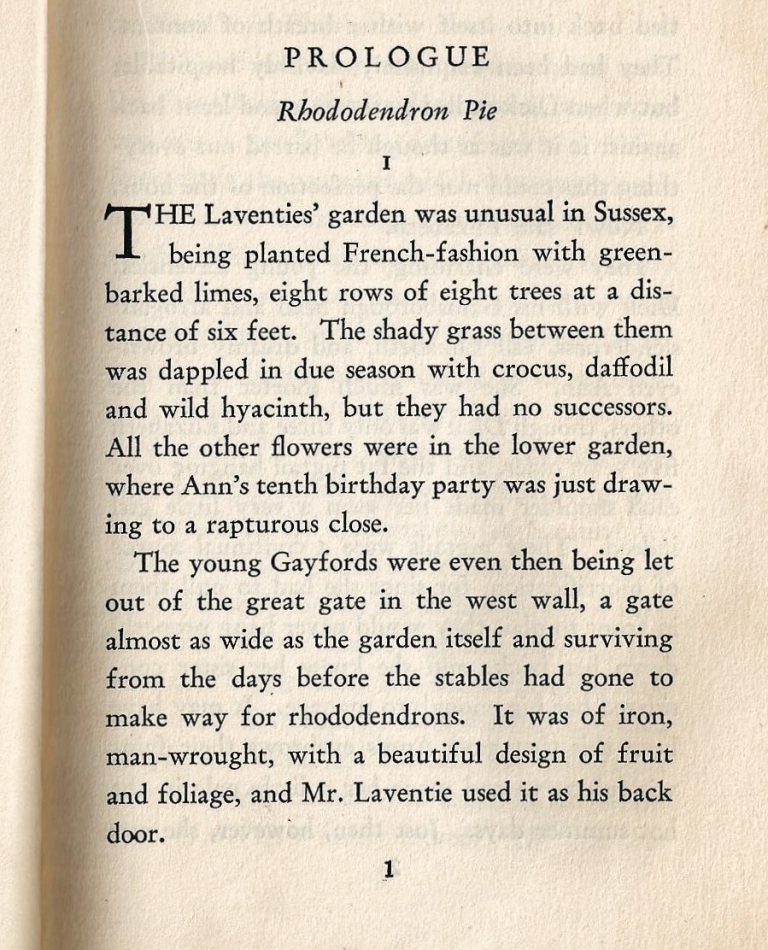
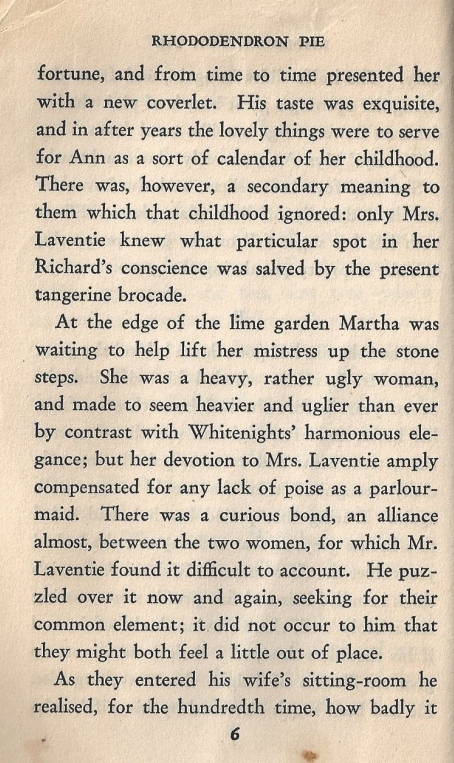
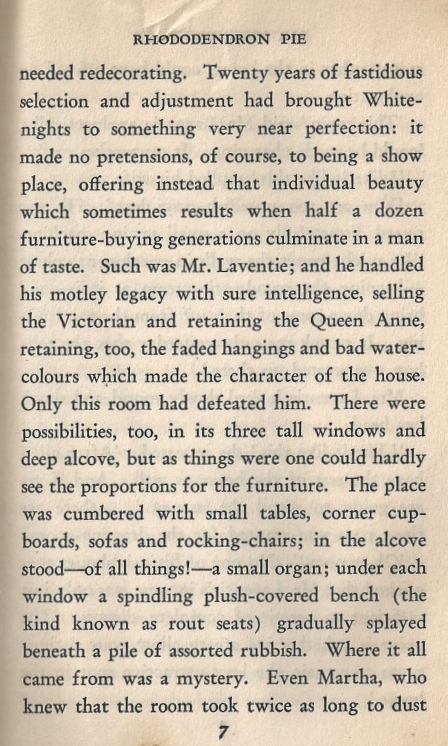
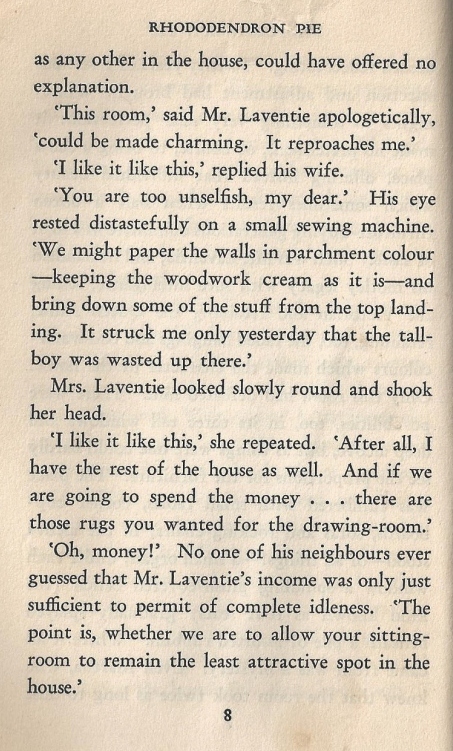
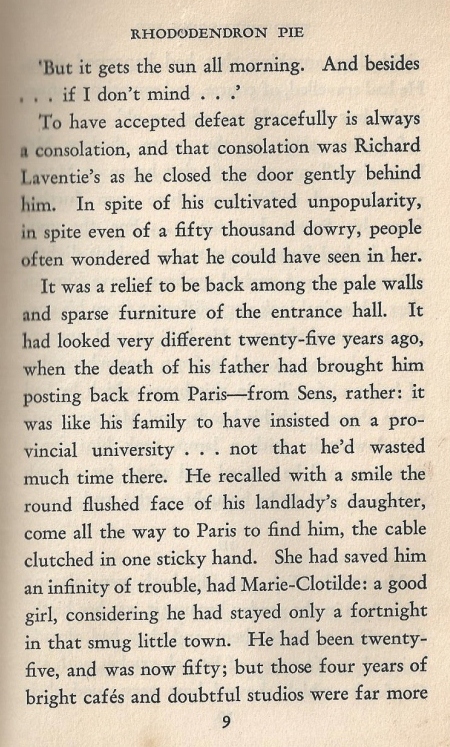
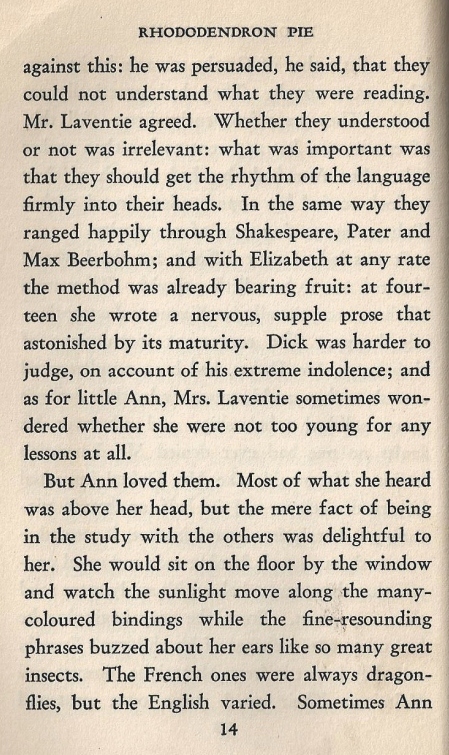
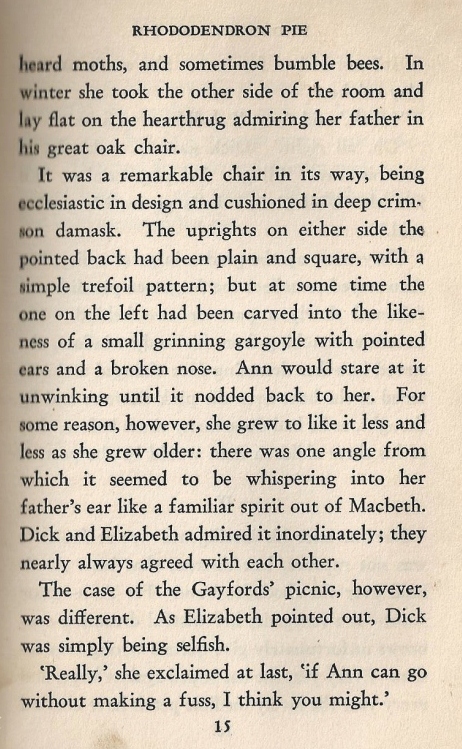
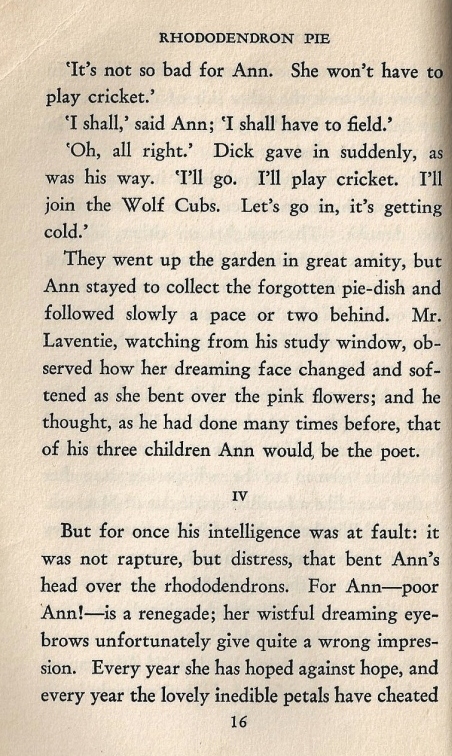
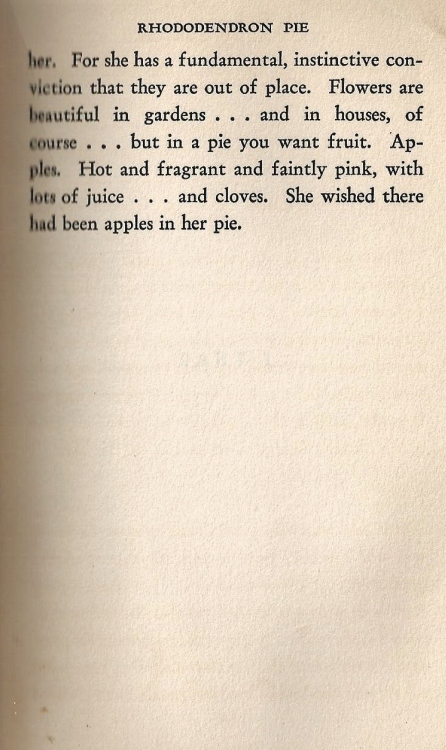
In the meantime, we do what we can. For those of you who are also Margery Sharp fans, and who have not yet gotten your hands on this little prize, I am now posting, as promised way back in August or September, the entire Prologue to Rhododendron Pie. One day, if no publisher blesses us with a reprint, I might be tempted to scan the whole book and turn it into a pdf file, to share with fellow Sharp aficionados. (Or perhaps it might qualify for Project Gutengberg? I thnk it just might be old enough, and long enough after the author’s death.) In the meantime, here’s a sample.

If you enjoy the Prologue, let me assure you that the rest of the novel is ever so much better.

But first, a contemporary review from 1930:

Rhododendron Pie is something more than an amusing and good-natured gibe at literary and artistic snobbery, for all the Laventie family–including the mother, who comes in with a great burst of rhetoric on behalf of the bank clerk at the finish–and the various minor characters are far more than argumentative counters in the attack or defence of aestheticism.  They have all authentic lives of their own, and Miss Sharp is particularly successful in catching the accent of those inhabitants of the modern world who carry a magnificent undergraduate irresponsibility into the affairs of everyday life. – The London Times Literary Supplement

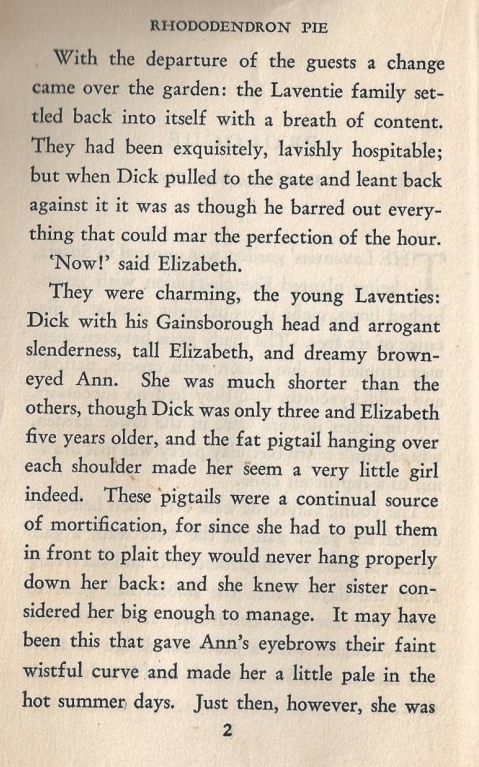
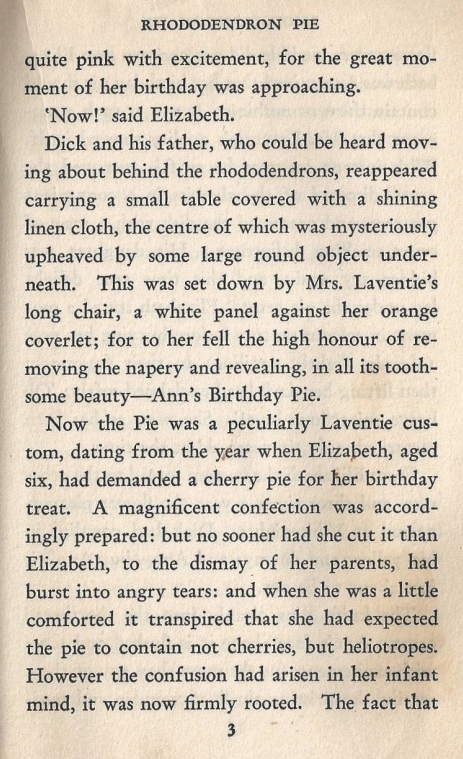
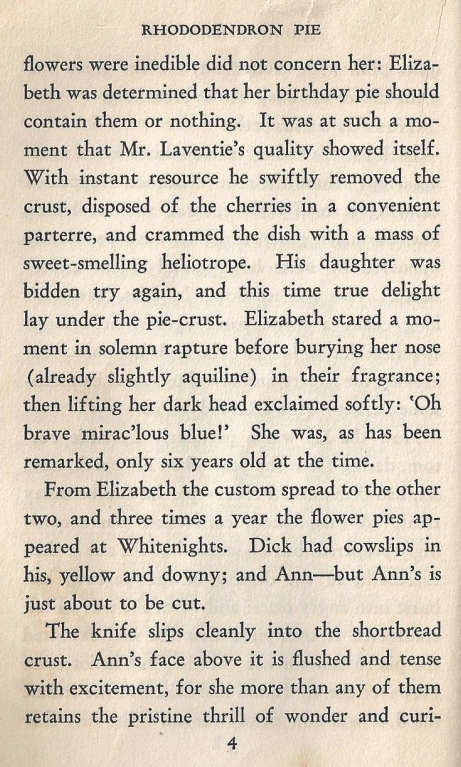
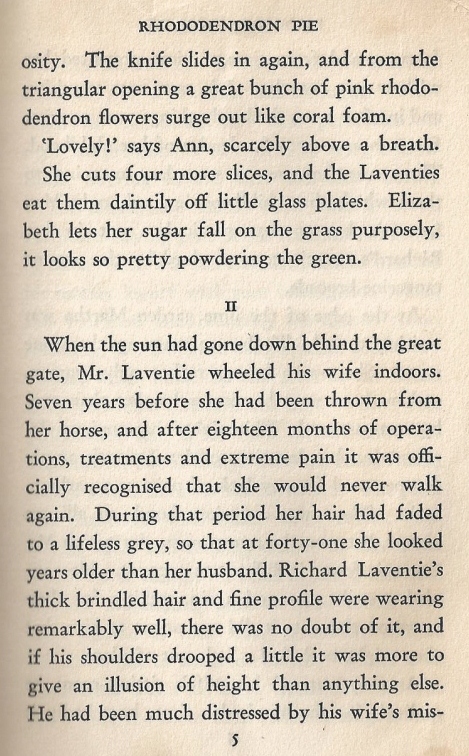
rhododendron pie sharp prologue pg 1 001rhododendron pie sharp prologue pg 2 001rhododendron pie sharp prologue pg 3 001 (2)rhododendron pie sharp prologue pg 4 001rhododendron pie sharp prologue pg 5 001 (2)rhododendron pie sharp pg 6 001rhododendron pie sharp pg 7 001 (2)rhododendron pie sharp prologue pg 8 001rhododendron pie sharp prologue pg 9 001 (2)rhododendron pie sharp prologue pg 10  001rhododendron pie sharp prologue pg 11 001 (2)rhododendron pie sharp prologue pg 12  001rhododendron pie sharp prologue pg 13 001 (2)rhododendron pie sharp prologue pg 14  001rhododendron pie sharp prologue pg 15 001 (2)rhododendron pie sharp prologue pg 16 001rhododendron pie sharp prologue pg 17 001 (2)

The story proper opens ten years later. Our heroine, Ann, is now twenty, and we find her dreaming the summer away, poised on the brink of life. Her brother Dick and sister Elizabeth are busy following their own intense pursuits – Dick as an art student and aspiring sculptor, and Elizabeth as a writer and editor – but Ann has so far found no particular artistic bent of her own to follow. She is mostly merely accomplished at being agreeable, and with her sophisticated family and their many visitors a listening ear and a pleasant, interested expression are much appreciated as the egoists expound and Ann takes it all in. But she has a rich inner life of her own, and she’s busy sorting it all out.

Ann settled down on the grass again with her chin on her fists and one shoe waving in the air. She wasn’t reading really, only pretending to, so that the others wouldn’t talk to her. It was too nice in the garden to talk. How queer to think she was lying on the surface of the world… an enormous warm green ball spinning slowly through space with somewhere, under a lime tree like a sliver of grass, a minute pink dot…

The Gayfords, ten years after we first meet them, are still persisting in being friendly to their uppish neighbours; continual delicate snubs are absorbed and ignored, and Ann has settled into her role as a liaison of sorts between the two worlds, which leads to occasional mockery by Dick, Elizabeth and Mr. Laventie, who assume that Ann is merely “collecting material” for reasons of her own.

But Ann is honestly fond of the happy Gayford clan, and this summer, with Peggy Gayford’s approaching marriage and John’s unchangeable good nature with every brief encounter, Ann is starting to wonder what is wrong with her, to find such healthy, hearty normalcy so attractive. For isn’t life meant to be an endless round of sensation-seeking, with the creation of an exquisite and “individual” persona for the edification of the other elite highbrows one’s chief occupation? So why is Ann having such difficulty working up a properly scornful attitude of her own to the Gayford’s enthusiastic embrace of the comfortable pleasures of upper-middle-class country life. (The Gayford patriarch is the local doctor; John has embarked on a career in banking, and his younger brother Nick is at medical school, in sharp contrast to the general Laventie bent for something more artistic and “fine” than mere useful “labour”.)

Avant-garde filmmaker Gilbert Croy appears on the scene, and with his languid courtship of her, which she warmly responds to, it seems that Ann will embrace the family tradition and rise above her delight in the everyday to take her place among the rarefied intellectuals. But circumstances and Ann’s innate common sense unite to turn things upside down …

Margery Sharp, though she does the conventional “happy ending” thing very well indeed, always seems able to put a twist into her story somewhere. Nothing is completely as it seems, and the clichés fall apart upon closer examination. There are some cleverly well-realized character sketches in Rhododendron Pie, as enjoyable to today’s reader as they would have been to those readers of the time more cognizant of the sly references Sharp has such a grand time making.

On re-reading what I’ve just written, I see that I haven’t done much in the way of detailing the plot, and I’ve completely ignored many characters who wander in and out of Ann’s widening orbit. There’s a lot in this little book; too much to share without giving things away completely, and too complex to detail without making this review even longer than it already is, what with all the images I’ve crammed in!

*****

Sound appealing? If so, this is what you’re looking for in your library book sale and flea market travels. This lovely (and exceedingly rare) first edition with an intact dust jacket will set you back a cool $600, at Old Scrolls. Right now, April 2013, there are 7 copies listed on ABE, from $212 to the aforementioned $600.

There must be a few more out there in dusty corners for the persistent (and lucky) searcher. Particularly in Great Britain, or possibly the U.S.A. Happy hunting!


Read Full Post »

my heart lies south elizabeth borton de trevino 001My Heart Lies South: The Story of My Mexican Marriage by Elizabeth Borton de Treviño ~ 1953. This edition: Thomas Y. Crowell, 1953. Hardcover. 248 pages.
My rating: 8/10.

*****

I found this book among my mother’s boxes in her attic which I was supposed to go through and “deal with” when she downsized from the too-many-staircases rambling family home to the tiny-but-manageable single-level house she’s in now. I almost put it into the Sally Ann box, but something stayed my hand. “Elizabeth Borton de Treviño…. I know that name, somehow,” I thought, and that was enough to put it into my keeper pile instead.

Some years passed (well, six years, to be exact, because Mom moved in 2007, and much of what I brought home is still in “temporary” storage here, still waiting to be “dealt with” – and honestly, the only boxes I’ve cracked open are the ones full of books) and then one day I looked at My Heart Lies South again. And the penny finally dropped.

Elizabeth Borton de Treviño. Of course! I, Juan de Pareja. The 1966 Newbery Award winning historical fiction about the Spanish painter Velazquez and his personal slave, Juan de Pareja. I’d read this some years ago, and found it a well-written juvenile historical fiction, and that was why the name of the author sounded so familiar.

I opened My Heart Lies South, as I should have done six years ago, and started reading bits here and there. Far from being the serious and sober biography I had expected from the rather unprepossessing dustjacket – (“Don’t judge a book by its cover” – I know, I know) –  the passages I read were wry and funny and interesting. And when I settled down to tread it cover to cover, it definitely did not disappoint. Another hidden bookish gem, I think we could safely say.

*****

Elizabeth Borton was born in 1904, in Bakersfield, California, and, encouraged by her parents, started writing at a very young age. After graduating from Stanford University in 1925 with a degree in Latin American History, Elizabeth went on to the Boston Conservatory of Music to study violin. She then worked as a reporter for the Boston Herald, and spent five seasons in Hollywood interviewing film personalities.

With her strong interest in all things Latin American, Elizabeth was continually talking about going to Mexico, and one day, in 1934, her editor broke down and sent her off with a handful of tickets, vouchers and contact lists, telling her to “just write something” once she got there. And with her eventual meeting with the representative of the Monterrey Chamber of Commerce, one Luis de Treviño, Elizabeth’s future, though she didn’t know it at the time, was about to take a very different turn from her life as an independent American career woman.

“Hello Luis!” said Bill. “This is Miss Borton. When you get to Vallecillo, buy her an ice-cold beer.”

Luis laughed nervously. There is nothing he likes better than a cold beer, but the lady he had taken across the border for the Chamber of Commerce two weeks before had resisted the beer with desperation as if it might be the first step in a seduction, and the lady last week had been Dorothy Dix, who was even then rather tired from pushing seventy or so and inclined to be tart with young men eager to waste her time in taverns.

I was turned over to the vaccination, immigration, and customs authorities, and at last, in a car which had been provided by the Chamber of Commerce, complete with chauffeur, we set out for Monterrey. I had my hair tied up in a scarf and I was wearing a large black hat as well as sun glasses. Now the sun began to go down and long violet shadows crept across the plain. I took off my hat.

“Ah,” breathed Luis.

I undid the scarf.

“So?” remarked Luis.

I took off the black glasses.

“Wonderful,” he decided, aloud. He leaned toward me and looked at me soulfully.

“Shall I sing you a song about love?” he asked.

“Why yes,” I agreed, thinking this must be a gag.

But he launched into “Palm Trees Drunk with the Sun,” went on to “The Sea Gulls,” and then sang “The Green Eyes,” in a light baritone voice.

“Very nice,” commented the chauffeur from the front seat. “Now sing ‘Farolito.'”

He sang it. After our beer in Vallecillo, Luis sang other songs. He sang all the way to Monterrey.

I didn’t realize it, but I was being courted.elizabeth borton de trevino 001

As you can see from the photo of the author, taken from the jacket of the book published eighteen years after her marriage, the initial attraction on looks alone is understandable!

Luis shows Elizabeth the attractions of Monterrey, including things definitely off the tourist track, such as his family ranchito, and, significance unknown to Elizabeth at the time, the private parlour of his beloved mother, Mamacita. He also takes her dancing, in company with a respectable engaged couple, a situation that made all of Monterrey society take note…

I was left at my hotel. But a sort of die had been cast. Luis had cast it and with his eyes open. He had taken a strange woman to dance. Just any strange woman, and the incident might have been passed over as a wild oat on the part of the fifth Trevino. But he had taken the strange woman in company with a pareja of his best friends, an engaged couple! Two plus two equals four. Dancing with one girl all evening, with an engaged pareja to make up the party, means something serious! Phones rang in Monterrey; the news went round. Only I was in the dark.

Formally on the afternoon of the next day, I was taken to call on Mamacita. While we sat in the sala, Luis disappeared, to return with a tray on which sat Mamacita’s best small silver liqueur glasses. In each was a thimbleful of sweet vermouth. On a plate there were some little yellow cakes that melted into a puff of flavour when bitten. These were Mamacita’s famous polvorones de maizena (cornstarch puff cookies), the engagement cake… They were a kind of symbol. All unknowing I ate the engagement cakes and tasted the engagement vermouth.

Later Luis brought me a small yellow-striped kitten and dropped it into my lap.

“Oh, the darling! I wish I could have him,” I cried. “But I am leaving tomorrow for Mexico City and I have lots of work to do. I won’t be home in California for weeks.”

Mamacita said calmly, “Galatea has kittens like these every four months. You will have a kitten.”

Paling visibly, Luis scooped up the kitten and left. I wondered what had happened, but it seemed he had only recognized his mother’s acceptance of me. Mamacita had decided that I was to come to Monterrey, marry Luis, and receive a kitten from the fecund Galatea. He had been working toward this, but it was serious, and it sobered him to realize he was practically a married man.

Elizabeth eventually catches on, and with the blessing of both sets of parents, the couple is married and sets up housekeeping in Monterrey, on a shoestring budget. Culture shock hits strong and hard, as Elizabeth is suddenly immersed in traditional Mexican society, and finds herself floundering more than a little in her new role as the wife of an established, upper class Mexican husband. Luckily Mamacita and Papacito, Elizabeth’s new parents-in-law, are firmly behind her, and guide Elizabeth through the maze of “proper” behaviour, and cover up her most blatant mistakes. Of which there are many, reported in full by the author.

I am afraid I am not at all familiar with Mexican society of the time period of the memoir – the 1930s – or even of the present day – but after reading My Heart Lies South I have a clear and mostly positive impression of a world in which family comes before all else, and in which women, though subject to the strictest of behavioural expectations from their menfolk, have an enormous influence and hidden power, which they can wield for either good or ill. Elizabeth’s family, visiting some years after her marriage, shake their heads in wonder and tell Elizabeth that she has wandered into a world frozen in the 1800s. Elizabeth, having carved out her domestic niche after significant struggle, agrees, but states that she is deeply happy, and that she now fully enjoys the more positive aspects of this steeped-in-tradition world.

This full acceptance of uber-traditional female roles may have modern-day feminists grinding their teeth in despair, and it also does appear, from the glowing reviews which this book receives on the “Godly womanhood” websites I’ve stumbled across while researching the author, that the more conservative “right-wing” types have embraced this memoir as an estimable example of true femininity.

I find that I fall somewhere in the middle of these two extremes. Elizabeth and Luis seemed, from all reports I’ve read, to have a most successful and happy marriage, which is an accomplishment worth celebrating, no matter in which society it is achieved. Elizabeth continued with her successful writing career after her marriage, managed to find time to keep up with her music, created a beloved home, and adapted very well to the expectations of her in-laws, while still staying in close contact with her American friends and relations. It seems to me that her life was most reasonably “fulfilled”; she certainly does not come across as downtrodden in any way, and she speaks of her integration into Mexican society with affection and sharp-eyed realism.

All of this to say that I enjoyed this book greatly.

There also exists an expurgated “Young People’s Edition” of My Heart Lies South, got up, I am sure, to piggyback on the perennial success of I, Juan de Pareja. Apparently all the more risqué bits are left out – and there are a few – so I can’t really see the point of that, as when Elizabeth shares some of her more “adult” anecdotes she’s really at her best. So look for the original version, which has been reprinted numerous times, instead. (And to add insult to injury, the cover of the junior version is not at all dignified, and hints at a jolly comedy, which, for all of its humour, this memoir is definitely not.)

My Heart Lies South has two companion memoirs, Where the Heart Is, and The Hearthstone of My Heart. I’m a bit taken aback by the Heart-y-ness of the titles – definitely working the theme to the utmost! –  but I’ll be keeping an eye out for these, as I’m sure they will be worth investigating.

Read Full Post »

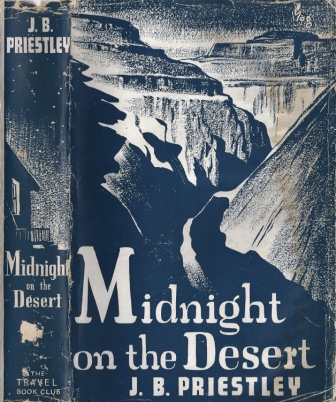
Midnight on the Desert: chapters of autobiography by J.B. Priestley ~ 1937. This edition: Readers’ Union & William Heinemann Ltd., 1940. Hardcover. 312 pages.

My rating: 9.5/10. Extremely hard to classify this book, but I found it completely engaging. The time theories near the end were completely over my head, but I appreciated Priestley’s enthusiasm nonetheless.

*****

I had expected a travel book of sorts, and Midnight on the Desert could certainly fall under that classification, but it is also so very much more. An examination of what it means to be a writer and an artist; a critique of the state of the world in politics, religion, philosophy, architecture and the performing arts; an ode to nature; a manifesto for seeking the good in the world and overcoming adversity and “doing one’s part”; a record of observation by a keen and analytical observer.

I have been spinning out my reading of this marvelously unexpected gem, and have been racking my brains over how best to convey what this unique work is all about and why I found it so compelling. Words do not come easily to me, which is why I’m a reader and not a writer, aside from these attempts at distilling the essence of what I find on the printed page. Perhaps I will let Priestley speak for himself.

First, the “set-up”.

Let me begin with what I can remember quite clearly. It was the end of my stay on the ranch in Arizona, last winter…There was the usual accumulated litter of letters and odd papers to be gone through, and most of it to be destroyed. But that was not all. I had decided during the evening to burn certain chapters, many thousands of words, of the book I had been writing…Yes, thousands and thousands of words would have to go, along with the rubbish; good words, all arranged to make sound sense, and with a cash value in the market, and representing, too, something more than money – time, precious and priceless time, of which, they say, only so much is allotted to each of us. I dare not wait for morning. Midnight was the hour for such a deed.

The first chapter starts with an appreciation and evocation of a place dear to the author’s heart, a small writer’s hut at the edge of the desert on a guest ranch in the Mojave Desert, where Priestley had spent the better part of the winter. He describes the beauty and majesty of the still, clear desert night, and then branches of in a dozen different directions in a sort of free association of ideas – random – oh, yes! – but most clear and sensible – he never loses us in his side trips though we fetch up back at the beginning a mite breathless and dazed at the speed and scope of our journey.

The papers are not yet set alight, though the fire is lit and is roaring in the wood stove, but we are far away now from the desert, back in England, getting ready to set sail for America, at the beginning of this particular trip. The Atlantic is crossed, New York attained, and Priestley is off.

I told myself severely that for once I must take New York quietly, as just another city. I had some work to do – to produce my play – but I must do that work as calmly as if I were at home in London. (I overlooked the fact that it is quite impossible for me to produce a play calmly anywhere; for that mad old witch, the Theatre, tolerates no calmness…)

… All other cities … seem in retrospect like mere huddles of mud huts. Here .. be Babylon and Nineveh in steel and concrete, the island of shining towers, all the urban poetry of our time … I would hurry down these canyons and gulfs they call avenues, cry out as one magnificent vista of towers crowns another, hold my breath at nightfall to see the glittering palaces in the sky, and wonder how I can ever again endure the gloomy and stunted London …

… There is a deep inner excitement, like that of a famished lover waiting for his mistress, that I cannot account for – not when it outlasts the mere novelty of arrival, and goes on week after week … I would begin to feel empty inside. It would be impossible for me to sit still and be quiet. I must go somewhere, eat and drink with a crowd, see a show, make a noise. Time must not merely be killed, but savagely murdered in public. In this mood, which has never missed me yet in New York, I feel a strange apprehension, unknown to me in any other place. The city assumes a queer menacing aspect … I begin to fancy that perhaps it is waiting for some other kind of people – chromium-plated giants without dreams or tenderness – to come along and claim it …

.. I feel like a midget character moving in an early scene of some immense tragedy, as if I had had a glimpse in some dream, years ago, of the final desolation of this city, of sea-birds mewing and nesting in these ruined avenues. Familiar figures of the streets begin to move in some dance of death. That baker outside the Broadway burlesque show, whose voice has almost rusted away from inviting you day and night to step inside and see the girls, now seems a sad demon croaking in Hell. The traffic’s din sounds like the drums in the March to the Gallows of a Symphonie Fantastique infinitely greater, wilder, more despairing than Berlioz’. Yes, this is all very fanciful, of course, the literary mind playing with images; yet the mood behind it, that feeling of spiritual desolation, that deepening despair, are real enough…

That was the distillation of, let’s see, four pages or so, and the man can keep it up indefinitely. He turns the same sort of passionate stream-of-consciousness writing to everything he observes and experiences. Further along in the book we are treated to similar digressions on The Theatre and the experience of working as a novelist-dramatist taking the written word to the stage, and about the challenges of being an author in general, and the quest to both satisfy the inner urge to record and create, and to fulfill the ever-difficult goal of please one’s readers.

Give us, please, you cry, the real world, not some triviality taking place in a pretty-pretty imaginary world, no mere escape stuff. Certainly, madam; certainly, sir. Now what is happening in this real world? The Communists and Fascists are demonstrating and counter-demonstrating, preparing for a fight; the economic system of our fathers is breaking down; Europe is bristling with armaments and gigantic intolerances, Asia is stirring out of her ancient dream, America is bewildered and bitter; one kind of civilization is rapidly vanishing and God-knows-what is taking its place; some men are marching in column of fours, shouting slogans, and making ready to kill and be killed; some men – many of them in exile because their minds are honest and not without distinction – are arguing in a melancholy circle; other men are lining up in hope of finding a little bread, a little work, a little peace of mind.

And Priestley goes on:

But no, no, no, this will not do, you tell us: you want a novel, a fiction to take you out of yourselves, not a newspaper, a fat pamphlet, a slab of propaganda. After all, private life goes on; men still fall in love, women fall out of it; there are entertaining quarrels between the Smiths and the Robinsons; young men are suddenly promoted and girls are given fur coats and diamond bracelets; and there is still plenty of comic stuff about – oh, uproariously comic stuff. This being so, get on with your novel, and don’t give yourself airs, don’t come over the propagandist, the gloomy prophet, over us.

… You may be sure that whatever he [the author] decides, he will be blamed. He may succeed in displeasing everybody. Lucky enough in other respects, I have been unlucky in this. Some years ago, because I had long cherished the plan and was now in the mood to work it out, I wrote a long, comic, picaresque, a fairy-tale sort of novel, called The Good Companions. I am neither prouder nor more ashamed of having written it than I am of having written any of the other books and plays under my name. But it happened to achieve an astonishing popularity. Since then – and this s an exact statement – I do not think I have met or corresponded with five-and-twenty persons who have not blamed me, either for having written this particular novel, or for not having written a lot of other novels just like it. One party denounces me as a hearty, insensitive lowbrow. The other party asks what the devil I mean by turning myself into a gloomy highbrow … I am condemned – and for a long term, it seems – to offend all round … No wonder, then, my new novel needed some thinking out. I was not bored on those trains …

Travelling by train, observing every fellow human being he comes across, from baggage car attendant to well-preserved and painted elderly matron sharing the dining room, Priestley goes off on more tangents, such as the difficulties of being an American woman, never being allowed to drop your eyes from your goal of “keeping up” for a moment; then looking out the window, asit were, to the American landscape itself and the need for painters, writers and poets to develop to capture its unique quality – the processes of developing a regional form of the arts, true to the physical space which inspires the artists.

Odes to the great physical beauty of the American West are in this book – the deserts and mountains, the Grand Canyon, the stark glories of rock and sand and rivers carving out their otherworldly sculptures. Priestley is in love with this aspect of America, and he sings his praises most eloquently well.

What a fascinating book; what a full book. One to read right through without stopping; one to tackle in small bits, to digest and mull over and agree with and occasionally refute. Not all that much autobiography, despite the tag on the title, but many insights into what went on in the mind of this deeply creative and opinionated man.

An excellent read; a grand glimpse into the mind of a master writer.

Read Full Post »

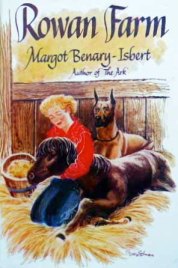
rowan farm margot benary-isbertRowan Farm by Margot Benary-Isbert ~ 1954. This edition: Peter Smith, 1990. Translated from the German by Richard and Clara Winston. Hardcover. ISBN: 0-8446-6475-8. 277 pages.

My rating: 10/10. A sequel/companion piece to The Ark.

A more mature, less “sentimental” book than the also very excellent The Ark, and a classic example of a bildungsroman – a “coming of age” story – set in 1948 and centered on 16-year-old Margret but involving many other characters as well as they react and adjust to their changing situations and the challenges of the immediate post-WW II world of defeated Germany.

*****

Rowan Farm continues the story of the Lechow family, war refugees from Pomerania who have settled into an abandoned and renovated railway carriage located on a rural farm in the Hesse region of Germany (near Frankfurt). The family’s father has made the long journey from the prison camp in Siberia where he has been interned, and the joy of the family’s reunification is still strong, though shadowed by the wartime death of one of the sons, and the emotional and physical damage Dr. Lechow is recovering from.

Other returning soldiers are finding their way home all over Germany, though for many there are literally no homes to return to. An unprecedenting readjustment of the entire population is taking place, as refugees seek a place to settle and get on with their lives, while those fortunate enough to still have their properties often grimly resent the official mandate that they must share their resources and often their homes and land with the incomers.

Bernd Almut, son of matriarch Anni Almut of Rowan Farm, has found his own way home, and having regained some of his physical strength is now trying to fit himself back into the farm life which his mother has capably managed without him for so many years. The eldest Lechow children, 17 year old Matthias and 16 year old Margret, are now integral members of the Rowan Farm hierarchy, Matthias working on the land, with Margret caring for the livestock and the sadly diminished breeding kennel of Great Danes which Rowan Farm was long famous for. Bernd and Matthias have become good friends, but that relationship founders when both become infatuated with lovely Anitra, a city girl on holiday from her studies at Franfurt University.  Margret is nurturing some romantic feelings of her own towards Bernd, and he had apparently returned them until flirtatious Anitra (who can’t be all so fluffy as she looks – she is a Mathematics major) shows up. Margret deeply feels her own intellectual shortcomings; because of the war she has had to leave school some years ago, and no longer even thinks of returning to the world of studies; life has taken her a very different direction, into practical labour with her hands.

Multiple subplots abound in this novel. 11-year-old Andrea is academically gifted and is fortunate enough to be a scholarship student in the Catholic Lyceum in the nearby town; her parents are hoping that she of all of their children will be able to attend university, but Andrea has been bitten by the stage bug and has her heart set on becoming an actress. 8-year-old Joey and now-adopted “twin” brother Hans Ulrich are involved in many boyish pursuits, including raising a family of prized Angora rabbits, and running wild through the countryside every chance they get; a favourite stop is the cottage of solitary and eccentric “bee-witch” Marri, who always has a slice of bread and honey for her young visitors. Marri’s war has been a tragic one. She is the widowed mother of a lone son, a gentle and pacifistic boy; upon conscription he had willingly put on the soldier’s uniform as was his duty, but he ultimately was unable to follow orders to shoot another person, and was court-martialled and executed. Marri’s grief has brought her to the edge of madness. Fearing for her sanity, the Almuts and Lechows have tried to refocus her interest by asking her to take in a returned veteran who has himself lost his wife in a bombing raid, and who is desperately searching for his baby son, who would now be a toddler of three, if he is still alive.

There is also a young, one-armed, returned war veteran schoolmaster who falls afoul of the village mayor by involving his students in establishing a refuge for homeless soldiers; an outspoken and controversial journalist who visits the soldiers’ home and turns out to be a very unexpected individual; a American Quaker aid worker who is interested in both the Great Danes Rowan Farm raises and in the possiblilities of sponsoring the young kennel maid for emigration to the U.S.A.; a gang of black market dealers stealing local livestock; a rescued Shetland pony mare which Margret and her father nurse back to health; and two young ex-soldiers who stay for a short time until suddenly moving on, with tragic results. Musical Dieter and his band of Cellar Rats come and go, bringing a breath of the city with them as they play for the village dances and help with the haying.

Re-reading this story as an adult, I was most impressed by how delicately the author portrayed the difficulties of the returning soldiers such as Dr. Lechow. Parted from his family in the very early days of the war when he was conscripted to serve as a military doctor; finding his beloved family home in Pomerania has been lost forever; losing one of his sons – Margret’s twin brother Christian – all of these are things he takes to heart. His delicate (in his view) wife and helpless (in his mind) children have survived work camps and refugee camps and untold dangers and hardships while he himself has been incarcerated in a brutal Siberian prison camp. He finds his family at last and once he has healed enough to take an interest in their affairs, he is slightly shocked to realize that they have been functioning exceedingly well without him. His occasional attempts to regain his “beneficient patriarch” status, and his wife’s tactful handling of his delicately bruised ego and his confusion at the “new normal” he finds himself coming back to is realistically portrayed.

This story, and its predecessor The Ark, are paeans to the steadfast strength of women throughout and after the war. The men leave, usually not by choice, and either fail to return or come back terribly altered physically and emotionally. The mothers, grandmothers, wives, daughters and girlfriends who have been viewed as secondary citizens – especially in patriarchial Germany – remember that this is the land and the time of the woman’s role being defined as Kinder, Küche, Kirche – children, kitchen, church – have had to take on traditionally male tasks and for the most part have managed exceedingly well. The horrors of the war are more openly referred to in this story, including references to the death camps, and there is very much an atmosphere of both acknowledging what has happened and hoping that the future will be a more just and positive time for the survivors from all segments of German society.

All in all, a sensitive and moving story for older children (possibly 10 and up?) and adults both, inspired by the personal experiences of the author. Very highly recommended. It should follow The Ark for best effect, but can also be read alone.

Read Full Post »

« Newer Posts - Older Posts »