Posts Tagged ‘Children’s Fiction’

friendly gables hilda van stockum 001Friendly Gables by Hilda van Stockum ~ 1960. This edition: Viking Press, 1960. Hardcover. 186 pages.

My rating: 6/10.

An average to good example of the vintage juvenile “domestic drama” genre. I’ve happily re-read this book a few times, though if it disappeared from the shelves I wouldn’t be heartbroken, just mildly regretful.

*****

Living in a large house in Montreal, shortly after a move from the United States, the six Mitchell children, Joan, Patsy, Peter, Angela, Timmy, and Catherine, ranging in age from fifteen (Joan) to three (Catherine), are joined by twin brothers. Their mother has had a hard time with the birth, and is weak and confined to bed, so a strict English nurse, Miss Thorpe, is engaged to care for the babies and help run the household until Mother can recover enough to take on her usual role.

There are immediate conflicts. Only Joan finds favour in Miss Thorpe’s eyes as she proves herself both willing and very capable in helping with the babies and taking on much of the meal preparation; but the younger five are considered much too selfish, rambunctious, noisy, messy and careless by the strict nurse. Father is busy working and is seldom home; cash flow is definitely an issue in the household; which though comfortably middle-class is far from wealthy. There is nothing left for any extras after paying Miss Thorpe’s wages, and several plot lines focus on the children trying to earn enough money for various crucial things they need or desire.

The American Mitchells are still adjusting to life in French Canada. The children attend Catholic school, and their struggles with learning a second language, getting along with the Québécois children who occasionally toss a scornful “You Yankee!” their way, and trying to conform to the strict standards of the nuns and priests at their schools are nicely depicted.

The story focuses on each child in turn, while giving a broader picture of the inner workings of the family. The only child not given a starring role is young Catherine; each of the others has some sort of adventure. Joan falls in love, and attends her first dance; Patsy loses her glasses and disgraces herself deeply with the nuns at school in numerous ways; Peter falls afoul of a schoolmate and in the resulting fisticuffs knocks down and smashes a large plaster statue given by an important supporter of the school; Angela gets lost while attending a maple sugaring-off party; Timmy becomes infatuated with a girl at nursery school, and attempts to come up with a perfect gift for her.

Mother eventually gets better, the twins appear to be thriving after the month or so that we are in touch with the family, peace is made with Miss Thorpe, and we leave the family celebrating at the christening party.

*****

A pleasant though minor story, from an author who then went on to write several more serious and very well-regarded historical fictions set in Holland during World War II – most notably The Borrowed House and The Winged Watchman. Though there are superficial similarities to Elizabeth Enright’s The Saturdays, Friendly Gables does not attain the appeal and overall excellence of Enright’s creation, which defines the genre and deserves every word of its frequent praise.

The formula is also much like that of the Eleanor Estes’ Pye Family books in that it mostly relates a family’s daily life, sometimes in microscopic detail. As with the Pyes, the Mitchells are far from perfect, which is pleasantly reassuring to the reader. The morals in Friendly Gables are predictable but not terribly intrusive. And everything always comes out right in the end.

This story does have some lovely vignettes of parent-child and sibling relationships. Something I particularly appreciated was how independent the children were in sorting out their various dilemmas, and how confident the parents were in their children’s abilities to cope. Occasionally a child would go to Mother of Father to report the current happenings, and perhaps ask for assistance or advice (always cheerfully given), but often it was merely to report that the problem was solved, whereupon the parent would basically say “Well done!” and that would be the end of it – no muss, no fuss.

Friendly Gables is the last book in a series of three about the same family, so there are occasional references to off-stage characters and previous happenings, which left me a bit out of the loop, but those would make perfect sense to someone with access to the whole set. It certainly isn’t a big drawback, as the author sketches in enough information to pin it all together.

Friendly Gables is set in urban Montreal, and was preceded by two other novels about the fictional Mitchell family: The Mitchells, published in 1945 and set in Washington, D.C., and Canadian Summer, set in rural Quebec, published in 1948.

These three books are autobiographical, according to both the author and her now-adult children, and were inspired by and record incidents in the very real Marlin family’s life. Hilda van Stockum published her juvenile books and her many illustrations of other authors’ works under her maiden name, but was in her “everyday” life  Hilda Marlin: accomplished painter, U.S. Civil Service wife, and dedicated mother of six children, all of whom subsequently attained rewarding and creative careers of their own.

Hilda was born in 1908, in Rotterdam, Holland, to a Dutch father and an Irish mother, and spent her youth in both Holland and Ireland. She attended art school, where she apparently received much praise for her realistic paintings. Hilda married her brother’s college roommate, American Ervin Ross Marlin, in 1932, and travelled with him to New York. The couple and their steadily increasing family lived in various cities in the U.S.A.. They then spent six years in Canada, before moving to Ireland, and eventually to England, where Hilda died peacefully at the age of 98, still living in her own home, in 2006.

Hilda, child and grandchild of scientists, artists, philosophers, writers and intellectuals, was raised in an atheist household, but she embraced the Anglican faith in her teen years, converting to Catholicism in adulthood. Her devout faith appears in her books, including Friendly Gables, but more as a background to the story than in a “preachy” manner.

Hilda van Stockum’s strong belief in the importance of family also permeates her writings, making her a decided favourite of those seeking “wholesome” books to share with their children. A number of her titles are still in print, some more than seventy years after their first publication, so there are still eager readers. Hilda van Stockum’s works seem to be particularly in favour with “traditional” homeschoolers, which is understandable due to the author’s positive views on “family values” and religion. And “secular” readers – do not fear! These books can be enjoyed by all.

I’m including this book in the Canadian Book Challenge because of the Quebec setting, though the author is not Canadian, but Dutch-American, and the family in the story is American. National identities and prejudices play an important role in Friendly Gables; the author handles the topic very well.
Read Full Post »

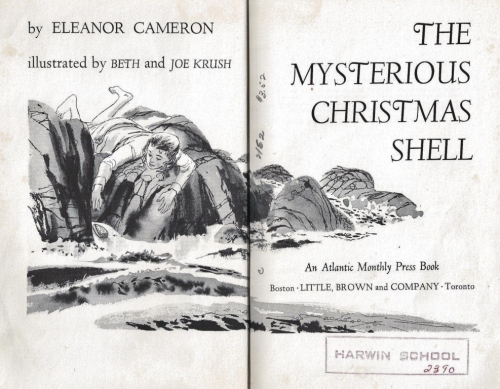
the mysterious christmas shell eleanor cameron 001The Mysterious Christmas Shell by Eleanor Cameron ~ 1961. This edition: Little, Brown & Co., 1961. First edition. Hardcover – Library Binding. Illustrated by Beth & Joe Krush. Library of Congress #: 61-9281. 184 pages.

My rating: 8/10. What a nicely written book this was! It restores my faith in the joys of reading juvenilia, sadly shaken by recent forays into several more modern disappointments in the youth-oriented fiction line.

This one was a recent impulse buy from the ever-changing and happily eclectic selection at the Bibles for Missions thrift store in Prince George. I try to get there once a month or so, and I always come away with a promising mixed bag of reading material. Some goes right back into the giveaway box, but there’ve been some small treasures found there, too.

The cover illustration was what grabbed my attention, though this grubby ex-school-library book showed much evidence of many readers, and was less than appealing at first glance. (It ultimately cleaned up nicely with a triple application of soapy cloth, rubbing alcohol and a tiny dash of benzene – not in combination, I hasten to add, but in delicately selective stages.)

“Those look like Krush children,” I thought to myself, and by golly, my instinct was right. Beth and Joe Krush were a husband-and-wife team of children’s book illustrators working industriously together from the 1950s through the following decades, and their marvelously detailed pen-and-ink-and-wash drawings perfectly depicted the characters of such classics as Mary Norton’s The Borrowers and its sequels, and Elizabeth Enright’s Gone-Away Lake books, among many others.

Here’s a sample. Isn’t this appealing?

the mysterious christmas shell frontispiece eleanor cameron 001

And Eleanor Cameron’s name chimed a little bell, too, though I didn’t really place it until I Googled her after I’d read the book. This is the famed Mushroom Planet creator, though those junior sci-fi fantasies were only one aspect of her widely varied output.

The Mysterious Christmas Shell is very much a plain and simple “domestic adventure” story, and it turns out that it is Cameron’s second book concerning the same brother-sister pair, Tom and Jennifer. Their earlier adventure, The Terrible Churnadryne, was published in 1959.

*****

Five days before Christmas, Jennifer and Tom arrive in the fictional town of Redwood Cove, California, on the Monterey Peninsula, to spend the holidays with their Grandmother Vining, and Aunts Vicky and Melissa. As soon as they walk into their aunts’ house, they realize something is terribly wrong. The tree hasn’t been decorated, the usual garlands are in a heap of green at the foot of the stairs, and everyone has a strained smile; occasionally they catch one or another of the adults huddled in a corner crying.

Turns out that the Vining family has had to sell its treasured piece of ancient redwood-forested seaside property, Sea Meadows, because of the year-ago death of the family partiarch, the children’s grandfather. Some investments have gone wrong, and outstanding debts needed to be paid. The purchaser, a boyhood friend of the family, was thought to want to keep the property unspoiled, to be the site of a single home, but recently troubling word has come that there will instead be major development. Hotels, a shopping centre, and a vacation community are planned; many of the ancient trees will be coming down, and No Trespassing signs will be going up barring the locals from their most pleasant seaside beaches and coves. The local townspeople are up in arms, and are angry at the Vinings for the sale; the Vinings are distraught at the prospective destruction of their well-beloved redwood forest.

An offer to re-purchase the property from the developer has been turned down, and a prospective reprieve of sorts has not come about. Grandfather Vining had intended to change his will to transfer Sea Meadows to the state as a nature reserve, but no one has any record of the will being registered, and no one knows if the envelope containing it was actually sent. If the will was indeed written, it would effectively cancel out the subsequent sale, and the property would go to the state once the buyer’s money was refunded. This seems like a way out of the dilemma, but where, oh where is the will?

As Jennifer and Tom ricochet around Redwood Cove looking for clues, we get a vivid picture of a large, loving family, each member trying to do the best for the others, though occasional misunderstandings occur.

The physical description of the California coastline, with its sea caves and pocket-handkerchief beaches, its tide pools and their glorious variety of sea life, is wonderfully well done; it is obvious that the author held the area in deep affection.

I do have an extra special reason for loving this story, having spent some weeks every year in California as a child, visiting grandparents, aunts, uncles and cousins in the Fresno area, and travelling out to San Jose, Monterey, and Carmel-by-the-Sea to visit family friends and to explore the still-unspoiled seashore along the more remote stretches of coastline. I even had my own similiar near-brush with death, once being washed out into the surf by a rogue wave; my father’s heroic rescue has become a piece of family folklore, and I blame my deep but reasonably well-disguised unease about any body of water much deeper than my knees on that terrifying childhood experience. Tom, Jennifer and Aunt Melissa’s being caught in the waves of the incoming tide sent chills down my spine! I could feel the sand burns …

The familiar setting was a marvelously unexpected surprise, but putting aside nostalgia and concentrating on the writing, I must say I was impressed by the quality of the prose, and by the author’s fine story-telling ability. While this is one of those stories where nothing huge really happens, with the adventures being small ones, and the solution to the mystery very apparent to the reader from early on – the Vinings, on the other hand, struggle on for strangely long time figuring out their clues – I found I couldn’t put the book down until the satisfyingly happy (though rather improbable) ending.

A grand vintage read for adults of a certain age wishing to revisit their youth through the pages of a book, though I’m not sure how much it would appeal to our more sophisticated 21st Century children.

Despite the Christmas-time setting, this is not really a Christmas book as such, though a glass tree ornament from Innsbruck plays a major part. Oops – just gave away a clue!

It was enjoyable to read about Christmas preparations in a place far from snow, and that brought back memories, too. We only spent one Christmas in California when I was a child, as most of our travelling took place in the early spring and the fall, but I remember how surreal it was that one time to be singing carols under the palm trees, with roses still blooming and lemons on the trees in my grandmother’s garden, while back at home, in interior British Columbia, icicles reaching the ground were our parting memory as we’d pulled out of the yard for the marathon three-day drive southwards. (Somewhere I have a picture from that trip of me and my sister standing, in our matching velvet-collared coats, in front of a huge Christmas tree at Disneyland, which was ornamented by coloured glass balls as large as our heads.)

This is an author decidedly worthy of further investigation. Investigating the titles and plots of some of her non-sci-fi “realistic” children’s/teens’ novels, I strongly suspect that I read some of those when I was in grade school, as two or three of the unusual plots sound very familiar, but The Mysterious Christmas Shell was an unfamiliar, unexpected and most welcome find, for all of the reasons detailed above.

*****

Oh – one more serendipitous thing. Eleanor Cameron turns out to be Canadian! She was born in Manitoba, and though she subsequently lived most of her life in California, she is widely identified in all of the material I was able to find online as a Canadian. So – another one, completely out of the blue, for the Canadian Book Challenge!

Read Full Post »

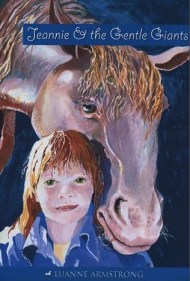
jeannie and the gentle giants luanne armstrongJeannie and the Gentle Giants by Luanne Armstrong ~ 2002. This edition: Ronsdale Press, 2002. Softcover. ISBN: 0-921870-91-4. 150 pages.

My rating: 4/10. A completely typical “problem novel” (single parenthood, mental illness, foster children) packed with contrived situations. An eleven-year-old heroine is placed in foster care after her mother has a mental breakdown.

Sadly this one didn’t quite fly. The horse bits were good – the best part of this novel, in my opinion –  but they couldn’t salvage the rest of the completely predictable, cookie cutter story. Despite the favorable back cover blurb by my up-the-hill neighbour, poet, writer, and horse-logger Lorne Dufour (aha! now here’s an interesting Canadian Reading Challenge author) it just didn’t click with anyone here. Too bad. Jeannie is set in Kelowna, B.C., and as a home-province, B.C. Interior-set youth novel I really wanted to love it. (Plus the cover image is fantastic.)

From the publisher’s website:

Jeannie and the Gentle Giants, a novel for readers eight to fourteen, deals with the problems experienced by children when they are taken from their parents and have to make a new life with foster parents in a new community. In Jeannie’s case, the problems begin when her mother falls ill and can no longer care for her. Taken from her home, placed with foster parents and unable to discover the whereabouts of her ill mother, young Jeannie withdraws into herself and can think only of running away.

Gradually her defences are breached by two immensely large and wonderful workhorses and their perceptive and humorous owner. Through the horses and her work on the farm, Jeannie develops new interests, learns to ride and becomes involved in the daily life of the farm, even helping with horse-logging. In turn, Jeannie learns about friendship, love and trust, and ultimately gains the maturity and self-confidence to accept the challenge of becoming herself a care-giver. In this sensitive and moving story, Luanne Armstrong draws us into a world of pain, growth and fulfilment.

Lorne Dufour’s back cover blurb:

In this story, the Gentle Giants slowly walk right through our hearts. We will forever remember their presence in Jeannie’s life and that the great Gentle Giants never forget.

 ~ Lorne Dufour, horse-logger & award-winning author

The author attempted an ambitious level of complexity here, by involving her young protagonist in a rather tangled combination of situations. We have: mentally ill mother, single-parent family with no father in sight, poverty, social stigma as child of mentally ill mother (handled quite well by author in providing heroine with staunch friends who immediately speak up in her favour to school bullies), foster parents who can’t have children, neighbour couple who find they are expecting a baby mid-way through book, heroine’s questioning as to what a family actually is and her conflicting desires to both be with her mother back in the city and to stay in her new, more fulfilling and interesting country life, doctors refusing to allow child to see ill mother – (this didn’t ring true – felt like a plot element to increase tension – mother was experiencing a psychotic episode, some mention of bipolar disorder/manic depression, but once the mother was capable of sending the first letters, why the heck WOULDN”T she be able to have visits from her daughter – wouldn’t that by emotionally beneficial to BOTH of them) – okay, moving on – learning to handle work horses, learning to ride, dealing with an injured horse all by herself, finding a lost child, guilt guilt guilt because heroine feels she has been the cause of the child being lost, feral stray dog tamed and made into pet …  My goodness, what a busy, busy girl.

As I said earlier, I really wanted to like this book, but it just didn’t ever feel “real”. Too much was chucked into the mix, Jeannie’s reactions were not very well portrayed – we were continually given the same set of outward clues that she was all bummed out – she had a “shy look”, “looked down”, “blinked to hold back tears”. The language throughout is overly simplistic, as if keeping it accessible to “poor readers” was a major goal.

Does this seem too critical? I feel like a big old meanie for picking this one apart, but, in all honesty, these were my thoughts as I read.

For the record, I really don’t care for “problem books”, for readers of any age, but in particular for young readers. “This is a book about DIVORCE! MENTAL ILLNESS! CEREBRAL PALSY! DOWN’S SYNDROME! BULLYING! ANOREXIA! ETHNICITY! PREJUDICE! BEING GAY! blah blah blah… If you, dear person/dear young child with a similar issue in your life, will only read this book you will feel so much better because you will see how this marvelous hero/heroine dealt with it in their fictional world and you won’t feel so alone.”

Dear youth authors: Write a STORY first. If there are side issues, so be it, for if naturally included those always interest, verisimilitude and richness to the mix. But don’t pick an “issue” and write a prescriptive “here’s how to deal with it, dear” contrived moral tale. Kids aren’t stupid. They don’t need to be told what to think in such a poorly written way. Yes, definitely acknowledge and include the issues, but don’t build a weak story around them, for the sake of marketing the book to the school library network! This whole “issue story” genre encourages sub-par story-telling.

In my opinion.

Jeannie and the Gentle Giants pushed a lot of my buttons, and not in a good way.

Rant over. (For today!)

Oh, hang on – not quite. “Foster” parents – I always thought that foster parents were those filling a long-term role in a child’s life. Jeannie is in what I would classify as “temporary care”, so the immediate (within days) placement of Jeannie with a new, albeit temporary, “mom” and “dad” didn’t ring true. It is continuously stated that Jeannie will be reunited with her mother once the doctors get her (mother’s) meds figured out. I mean, the actual family placement is okay, but the whole “this is your new family” thing felt rushed and phony. No wonder the poor kid is a basket case – “Here, Jeannie, meet your new mom!”

And another quibble, this with the publisher’s website and back cover plot outline. It sounds as though Jeannie doesn’t know where her mother is through all of this. She’s in the flipping hospital in Kelowna, people. Did you not read the book?!  Jeannie knows this, her social worker knows this, her “foster parents” know this – they make continual phone calls and Jeannie’s mom writes her letters, for crying out loud! So why is this presented in the promotional material as “child torn away from parent and searching for her”? The kid tries running away to go see her mother, but she knows where her mother is. She’s turned away as she tries to buy a bus ticket to Kelowna, to go to the hospital, to see her mother, because Jeannie knows she’s there.

Okay, now I’ll quit. I’d hesitated to review this book, because it let me down so sadly, but I did say I’d review and post every Canadian book I read, so here goes. There are a few more disappointing titles lined up for review, so a heads-up for those wondering why I’m so crabby today. I’ve just been pushing them back in the queue, but have decided to tick them off my deal-with list before 2013 hits.

Read Full Post »

underground to canada barbara smuckerUnderground to Canada by Barbara Smucker ~ 1977. This edition: Puffin (Penguin), 1999. Introduction by Lawrence Hill. Paperback. ISBN: 0-14-130686-6. 144 pages.

My rating: 9/10  – A very good historical fiction novel for its intended audience, middle grade to young teen readers. Older readers may notice the simplified plotting and some plausibility gaps, but in general a well-written story with a gripping main character and dramatic situations, well-researched and well-presented.

*****

Author’s Note:

The escape from Mississippi to Canada by two fictitious characters, Julilly and Liza, could have happened. It is based on first-hand experiences found in the narratives of fugitive slaves; on a careful study of the Underground Railway routes; and on the activities of two Abolitionists: Alexander M. Ross of Canada and Levi Coffin of Ohio.

Twelve-year-old June Lilly – Julilly – is a slave on Massa Hensen’s Virginia plantation. He’s not a bad slave owner, comparatively speaking, but when he gets ill and can no longer oversee his cotton farm, his slaves are offered to a buyer from Mississippi, where conditions are notoriously the worst in the slave-owning states of the South.

Night music droned through the slave quarters of Jeb Hensen’s Virginia plantation. The words couldn’t be heard but they were there beneath the rise and fall of the melody.

Julilly hummed them as she sat in the doorway of her cabin, waiting for Mammy Sally to come home from cooking in the Big House kitchen. She was as still and as black as the night. The words of the song beat in her head.

When Israel was in Egypt’s land
Let my people go
Oppressed so hard, they could not stand
Let my people go.

Old Massa Hensen didn’t like this song. He said it came when there were whisperings and trouble around. There were whisperings tonight. They murmured beneath the chirping of the crickets. They crept from ear to ear as soundless as the flickering of the fireflies.

When the slave trader does indeed come, Julilly is separated from her mother and is sent with a group of other young slaves to a much harsher owner in Mississippi. When an opportunity to escape arises, Julilly and her new friend Liza grasp their chance and set out on an epic trek north, finding help through the network of the “underground railway”, hoping beyond hope to one day reach the far off land called “Canada”, where slavery is outlawed.

They succeed, but not without many hardships.

The ending of the story was realistic though rather optimistically contrived in its reconciliation scene between Julilly and her mother; I found it hard to accept so much “coincidence” in such widely separated characters reuniting with such apparent ease. That was really my only objection, though. Oh – and the lack of complexity with the secondary characters. Even though others share the stage, this book is very much centered on one character only – Julilly.

Julilly is a quite beautifully drawn character, and I found myself completely engaged with her story, much as I already knew the plot line both from previous readings and from the inevitability of the stereotyped story arc.

One of Barbara Smucker’s best novels for young readers, and the one which made her reputation as a writer. A very Canadian novel, though most of the action takes place in the United States. Canada’s presence as a destination for the escaping slaves, and the involvement of real Canadian Abolitionist Andrew Ross are key plot elements.

This would be good for independent readers 10 and older. This would also make a good Read-Aloud, for all ages, though the subject matter is intense and might not be suitable for sensitive younger listeners. Era appropriate use of the derogatory term “nigger” throughout; Lawrence Hill’s short Introduction is a must-read for its discussion of this aspect. Fast paced and engagingly written.

Recommended.

Read Full Post »

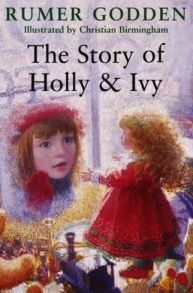
the story of holly and ivy rumer goddenThe Story of Holly and Ivy by Rumer Godden ~ 1958. This edition: Macmillan, 2005. Illustrated by Christian Birmingham. Softcover. ISBN: 0-330-43974-x. 58 pages.

My rating: 10/10. Pretty well perfect.

*****

This is a story about wishing. It is also about a doll and a little girl. It begins with the doll.

Her name, of course, was Holly.

It could not have been anything else, for she was dressed for Christmas in a red dress, and red shoes, though her petticoat and socks were green.

She was ten inches high and carefully jointed; she had real gold hair, brown glass eyes, and teeth like tiny china pearls.

The newest toy in Mr. Blossom’s shop in the village of Appleton, Holly is unpacked the day before Christmas Eve, and she is apprehensive as to what will happen next. The other toys are in a state of high excitement. “We must be sold today!” they whisper to each other, before the shop opens. “Wish, wish, wish!”

“What happens if I’m not sold?” wonders Holly.

“You will be put back into stock,” hisses Abracadabra, the sinister stuffed owl who broods over the store. “It is shut up and dark, and no one will see you or disturb you. You get covered with dust, and I will be there.”

Holly quivers in despair. “I wish, wish, wish for a little girl for Christmas!”

But Christmas Eve is here, and the shop is being closed up, and Holly is still on the shelf…

Meanwhile…

Far away in the city was a big house called St Agnes’s, where thirty boys and girls had to live together, but now, for three days, they were saying ‘Goodbye’ to St Agnes’s. ‘A kind lady – or gentleman – has asked you for Christmas,’ Miss Shepherd, who looked after them all, had told them, and one by one the children were called for or taken to the train. Soon there would be no one left in the big house but Miss Shepherd and Ivy.

Ivy was a little girl, six years old with straight hair cut in a fringe, blue-grey eyes, and a turned-up nose. She had a green coat the colour of her name, and red gloves, but no lady or gentleman had asked for her for Christmas. ‘I don’t care,’ said Ivy.

Sometimes in Ivy there  was an empty feeling, and the emptiness ached; it ached so much that she had to say something quickly in case she cried, and, ‘I don’t care at all,’ said Ivy.

‘You will care,’ said the last boy, Barnabas, who was waiting for a taxi. ‘Cook has gone, the maids have gone, and Miss Shepherd is going to her sister. You will care,’ said Barnabas.

‘I won’t,’ said Ivy, and she said more quickly, ‘I’m going to my grandmother.’

‘You haven’t got a grandmother,’said Barnabas. ‘We don’t have them.’ That was true. The boys and girls at St Agnes’s had no fathers and mothers, let alone grandparents.

‘But I have,’ said Ivy. ‘At Appleton.’

I do not know how that name came into Ivy’s head. Perhaps she had heard it somewhere. She said it again. ‘In Appleton.’

But Ivy is going to the Infants’ Home in the country, as Miss Shepherd must go to her sister, who has influenza. Ivy is loaded onto the train, with “a packet of sandwiches, an apple, a ticket, two shillings, and a parcel that was her Christmas present”, and on to Ivy’s coat was pinned a label with the address of the Infants’ Home.

As soon as Miss Shepherd leaves her, Ivy tears off the label and throws it out the window. ‘I’m going to my grandmother,’ she declares. ‘In Appleton.’ That is in just a few stops, a helpful lady tells her, and sure enough, as the train stops at Appleton station Ivy gets off, leaving her suitcase and her St Agnes-supplied gift – a pencil-case – on the seat, and, unnoticed by the busy ticket inspector, starts out on her quest.

Not far away, in the toyshop, Holly is wishing and wishing and crying out silently, ‘Stop. Stop. Oh, someone, stop.’ But in vain.

Only one person stopped, but it was not a boy or a girl. It was Mrs Jones, the policeman’s wife from down the street. She was passing the toyshop on her way home when Holly’s red dress caught her eye. ‘Pretty!’ said Mrs Jones and stopped.

You and I would have felt Holly’s wish at once, but Mrs Jones had no children and it was so long since she had known a doll that she did not understand; only a feeling stirred in her that she had not had for a long time, a feeling of Christmas, and when she got home she told Mr. Jones, ‘This year we shall have a tree.’

‘Don’t be daft,’ said Mr Jones, but when Mrs Jones had put her shopping away, a chicken and a small plum-pudding for her and Mr Jones’s Christmas dinner, a piece of fish for the cat, and a dozen fine handkerchiefs which were Mr Jones’s present, she went back to the market and bought some holly, mistletoe, and a Christmas tree.

The tree is decorated, but

‘Who is to look at it?’ asked Mr Jones.

Mrs Jones thought for a moment and said, ‘Christmas needs children, Albert.’ Albert was Mr Jones’s name. ‘I wonder,’ said Mrs Jones. ‘Couldn’t we find a little girl?’

‘What’s the matter with you today, my dear?’ said Mr Jones. ‘How could we find a little girl? You’re daft.’ And it was a little sadly that Mrs Jones put holly along the chimney shelf, hung mistletoe in the hall, tied a bunch of holly on the doorknocker, and went back to her housework.

*****

Need I go on? Of course not! You know what eventually happens, don’t you? But the path to wish-fulfillment is never so straight and easy …

This is a deliciously sweet story, perfect for a reasonably accomplished independent reader of 6 or 7 or maybe a bit older (my own daughter read it happily to herself for the first time at 10) and a marvelous Read-Aloud for all ages – it’s fairly text dense, so allow at least three good long sessions.

Ivy is a grand little heroine, misguidedly stubborn and with something of a temper, which makes her eventual fate even more emotionally satisfying. And because this is a fantasy – a Christmas fantasy – we do not worry about her wandering alone through a strange village; we know that she will come to no lasting harm, though an adventure or two may befall her.

Highly recommended, for the children in your life, and for a gentle treat for yourself, too!

*****

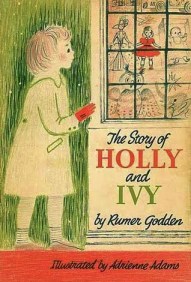
Holly-and-IvyIf you can, try to find the original, long out of print hardcovers illustrated first by Adrienne Adams, and then in another edition by Barbara Cooney. The currently in-print Christian Birmingham version is quite lovely, too, especially if gifting this book, where crisp and new is an issue, though it is without the vintage appeal of the older versions.Holly and Ivy

Read Full Post »

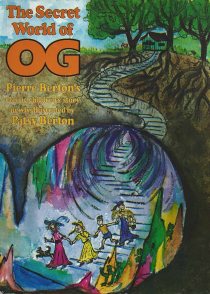
The Secret World of Og by Pierre Berton ~ 1961. This edition: McClelland & Stewart, 1984. Softcover. Illustrated by Patsy Berton. ISBN: 0-7710-1386-8. 159 pages.secret world of og cover pierre berton 001

My rating: 6/10. It has its moments, hence the rather generous “6” rating, but I’ve been exposed to Og three times now and I’m still not a complete convert. Sorry, Pierre. And Patsy. This one is a cute Berton family in-joke, and I appreciate your sharing it with the country at large, but my personal enthusiasm for Og and its viridian denizens remains restrained.

*****

My first exposure to this Canadian children’s “classic” was back in the early 1970s, when a keen grade school teacher read it out loud to our class over a series of afternoon reading breaks.

This tweaks my memory – does anyone else from B.C. remember those after-lunch U.S.S.R. periods – Uninterrupted Sustained Silent Reading? Occasionally these would morph into read-aloud sessions, to the great joy of most of the students in the class, except for those few of us hardcore bookworms who would really have preferred to be left alone to focus openly and with official permission on our own reading choices.

I even remember the book I was sneakily perusing as the teacher read Og. I was deeply engrossed in Jade by Sally Watson – an absolutely marvellous book about an upper-class teenage girl who ends up crewing on a pirate ship, with a desperately swoony captain <ah, sigh>  – a saga which I remember with great fondness and which I always meant to track down for sentimental reasons and to share with my own daughter, but which I haven’t yet gotten my adult hands on. Gosh, Sally Watson was (is! – now in her eighties, she’s still writing away, last time I heard) a wonderful writer. But I totally digress. Back to Mr. Berton’s fantasy-land.

I caught bits and pieces of Og but nothing that made me close my own book and listen with great attention. Little green people in a tunnel. And some dead rabbits. That’s about all that stuck.

Years later, as a mother gleefully equipping a children’s library for my own book-loving youngsters, The Secret World of Og kept showing up on all the “best books to share with your Canadian kids” lists I came across. “Well, why not?” I thought. “So many recommendations can’t be wrong.” So Og was duly acquired, in the great big edition illustrated profusely and with more enthusiasm than finesse (Camberwell Art School regardless) by Pierre Berton’s now grown up daughter Patsy.

secret world of og pierre patsy berton 001

Our own attempted Og read-aloud session died an early death, as the book was replaced after only an evening or two by Kipling’s Just So Stories, which were a much greater hit with the listeners. Og was soon buried in the stacks, and eventually packed away out of sight. I found it again just last week when I was nostalgically going through boxes of children’s artwork and old lesson papers, preparatory to discarding most of them. Og was a the very bottom of a pile of Grade 3 math worksheets, which was quite a few years ago now. We hadn’t even missed it, or thought about it in the meantime, which is a rather telling state of affairs concerning a book in this household.

“Aha!” I thought. “This will be perfect for the Canadian Reading Challenge! Classic Canadian author, quickie-reading kid’s story – how can I go wrong?”

So, third time lucky, I have finally read The Secret World of Og with my full attention focussed on it, fully prepared, after Captive Reader Claire’s enthusiastic review, to find it at long last quite wonderful myself.

Oh, dear. It wasn’t to be. I liked it well enough, and I can see why others love it, but it still didn’t totally 100% click with me.

I happily admit that I laughed out loud at the best bits: the hilarious Lucy Lawless titles, the marvelous relationship between Paul (the Polliwog), his Pablum, and Earless Osdick the cat, and Yukon King, the small dog who thinks he’s a huge husky. A continually witty commentary comes very obviously straight from Father (our Mr. Berton himself), but I just couldn’t bring myself to much very care for those darned annoying children. And Og itself isn’t a much of a fantasy world, nothing like Alice’s rabbit hole, or the secret rooms of Mary Norton’s Borrowers, both of which seem to have influenced this Berton family fairy tale.

Here’s the story in brief.

The five Berton children – Penny, Pamela, Patsy, Peter, and Paul (aka the Pollywog) – have a playhouse in the woods. One day Pamela looks up from her comic book to see a very small, very sharp saw outlining a trapdoor in the playhouse floor. A small green creature pops up, looks at her, and promptly disappears. Pamela, living in a world of imagination most of the time, and well used to the scornful dismissal of those around her to her observations about unlikely things, neglects to tell anyone about this.

Until, that is, the afternoon when the Polliwog is left alone in the playhouse for a few moments, and vanishes, along with Osdick, into what seems to be thin air. Pamela remembers the trapdoor then, and the siblings manage to worry it open and descend into what turns out to be a tunnel leading underground, to a land surrounding a luminescent river and forests of coloured mushrooms, and populated by hundreds of little green people whose only word appears to be “Og”. Pause for much rambling on about the details of all of this.

The cat is destined for the butcher block; the locals think he is some sort of exotic rabbit, (which quadruped they much love to eat, having discovered the gourmet glories of mushrooms with rabbit sauce); the Polliwog is, as usual, in jail. Needless to say a rescue is effected and everyone returns to the surface in one piece. And that is that.

*****

Some of you might remember the headlines a few years ago, shortly before the revered Pierre Berton’s death at the age of 84 in 2004, when he stated, in a CBC television interview, that he had been recreationally smoking marijuana “since the sixties”. Though he insisted that he didn’t use it when he was “working”, the trippy aspect of the World of Og suddenly looks a little suspicious of something more than mere fatherly imagination!

Okay, okay, I apologize for casting such aspersions. (If you could see me, you’d know that I’m grinning like mad in a conciliatory way right now.) Pierre Berton was awesome; he wrote great books, and by and large was a worthy Canadian literary icon. But you have to kind of wonder… 😉

Some bits of this book are absolutely brilliant; much of it is truly very funny. Give it a look, decide for yourself. Me, maybe I’ll pack it far away again and bring it out to try on the (very much speculative at this point in time) grandchildren. Or maybe not. 🙂

Read Full Post »

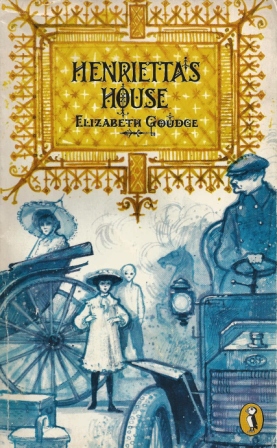
henrietta's house elizabeth goudge 001Henrietta’s House by Elizabeth Goudge ~ 1942Alternate American title: The Blue Hills. This edition: Puffin (Penguin), 1972. Illustrated by Anthony Maitland. Paperback. ISBN: 0-1403.0520-3. 191 pages.

My rating: 8.5/10. I’ve been playing amidst the juvenilia these past few days, and last night settled in to read this much-anticipated slender story. No surprises here, but no disappointments, either. Elizabeth Goudge lets herself go in full imaginative flight in this gentle and beautifully written juvenile adventure/fairy tale/moralistic tale.

Contains elements of her other two better-known juveniles, The Little White Horse, and especially Linnets and Valerians. Best approached with a willingness to surrender disbelief and just go with it! The usual Goudge theological and philosophical debate is present, but in this case makes more sense and is easier to digest than in some of her other books; two statues/church carvings, a laughing imp and a crying child, appear and reappear as analogies to the “mockery of Providence and the cringing human soul”, which sounds rather deep but which makes complete sense as one works one’s way through this multi-layered story.

This is a less common Goudge title, and I went to some trouble to acquire it. I suspect it is much more abundant in British used bookshops and libraries; used paperback copies on ABE start at $20 (with shipping) and hardcovers climb steeply into the $60s and $70s.

A must-read for the Goudge collector; one to share with a bookish child who is open to a good old-fashioned story. The fictional children are gloriously real, all expected flaws and faults fully present, though they are supremely fortunate in the adults in their lives!

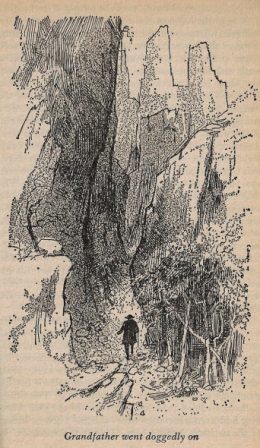
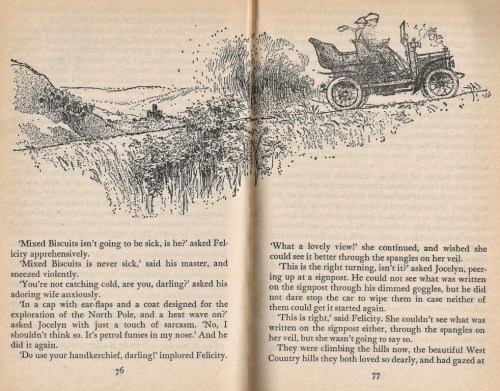
This edition has extremely well drawn pen-and-ink illustrations by Anthony Maitland; I’d love to find this in a larger hardcover one day.

*****

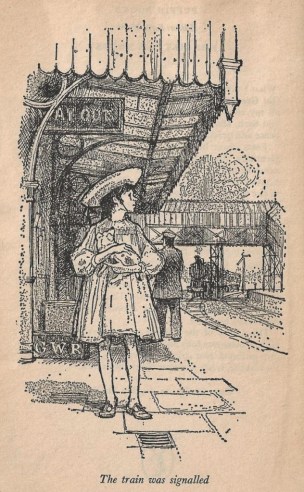
henrietta's house elizabeth goudge 5 001Young Henrietta, first introduced in The City of Bells as a poet’s daughter living with her adopted family in the cathedral city of Torminster – her father is alive and well, but is off roaming the world unencumbered by such prosaic details such as the housing, feeding and clothing of his offspring – is waiting on the railway platform for her beloved companion, Hugh Anthony, to return from his first term at boarding school.

Hugh`s birthday is impending, and a gala rural picnic is planned; what happens on the way to the picnic is told, in vivid detail, in this novel.

The birthday party leaves Torminster in five different equipages, and due to their varying rates of speed, soon lose sight of each other. Only one arrives at the designated rendezvous; the other four parties take the long way round and have some strange adventures before everyone finds each other in a completely unplanned-for common destination. Several extra guests add an unexpected dimension.

And that’s all I’m going to tell you, as the details of the adventures and the reference of the title are best discovered by the reader. Because this is, as the author declares at the close, a fairy tale, everything works out perfectly and a happy ending for all is assured.

Elizabeth Goudge is not for everyone, but if you’ve been exposed and find that she has “taken”, you will appreciate this slightly fantastical outing. A prior acquaintance with the characters (who also appear in The City of Bells and The Sister of the Angels) will add to your appreciation, but is not at all necessary; the story works beautifully as a stand-alone as well.henrietta's house elizabeth goudge 1 001

*****

I am here including a slightly edited review of Henrietta’s House from the Elizabeth Goudge Society website, which gives some background information on the author and the inspiration for the book. This is best read after reading the novel, so the references will make sense.

The dedication reads: ” For Dorothy Pope. There were once two little girls, and one had fair hair and lived in the Cathedral Close of Torminster and the other had dark hair and lived in the Blue Hills above the city, and they were friends. And now that they are grown up they are still friends, and the one who lived in Torminster dedicates this book to the one who lived in the Blue Hills, because it was she who saw the White Fishes in the cave. ”

The fair-haired child who lived in the city is obviously Elizabeth herself, and her friend Dorothy the template for Henrietta. I find it comforting to think that they remained in contact throughout their lives. It is an indication of Elizabeth’s loyalty and commitment. Elizabeth herself says that she never revisited any of the places she lived in because she wanted to remember them how they had been and not how they had become. So perhaps they corresponded with each other as she did with so many friends and admirers, a habit inherited from her Father.

It is a gentle story, a sequel to Sister of Angels and City of Bells, a tapestry woven with words around the charm of an Edwardian summer, when, as Elizabeth says “this story is set at the beginning of the present century, and in those days the world was often silent and sleepy, and not the bustling, noisy place that it is today.” (She is of course referring to the 20th century and not the 21st.)

In 1941 as the story was being written, British troops were fighting in the desert against Rommel, the Germans were taking on the might of Russia and the Americans were about to enter the war after the massacre at Pearl Harbour. A gloomy time, with no end of the war in sight and on the home front the introduction of clothes rationing. What better place and time to escape to than the opulence of Wells in a time before either World Wars had blighted her generation’s life.

The story starts with Henrietta waiting on the platform for Hugh Anthony to return for the holidays from boarding school ending their first separation from each other, and chronicles the delights of a summer in the countryside surrounding the tiny city where Elizabeth lived out the first few years of her life.

It contains many of her childhood memories from the way that hat elastic hurts the chin, to stately picnics in the hills. The story is as pedestrian as the procession of carts that convey the party to the picnic, and therein lies its charm. We are not hurried on to the next piece of drama, but have time to observe that “(t)he canterbury bells, and sweet williams, the roses and the sweet peas, the delphiniums and the syringa were a blaze of colour and scent in the gardens and all the birds were singing.”

Hills for Elizabeth were, as for so many of us, a place of heightened spirituality. They house the gods, myths and legends. They are the place of the solitary, the Hermit, the Wise Man. We ascend above the valleys and plains of every day life and looking back and down are able to see the bigger picture, to view where we have come from and how far we have travelled to get here: “Looking back he could see the great grey rock of the Cathedral and the old twisted roofs of Torminster, dwarfed by distance into a toy town that a child might have played with, and looking ahead, far up against the sky, he could see the blue hills growing in power and might as they drew nearer to them. He felt for a moment gripped between the grey rock of the Cathedral and the grandeur of the hills, two mighty things that time did not touch.”

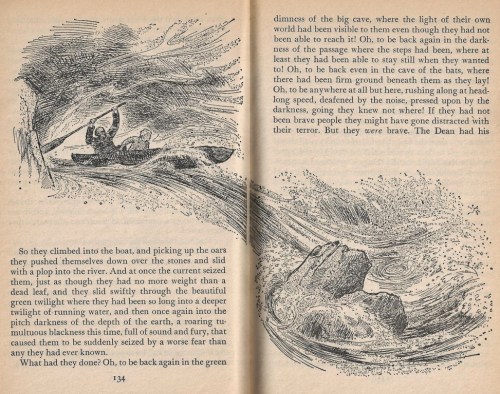
All of the people invited on Hugh Anthony’s birthday picnic end up getting “lost”.  None of them with the exception of Grandmother’s party arrive at their preordained destination. But all of them are enriched by their experiences, they all attain something vital to their well-being, even if, like the Dean, they didn’t at first know that this was necessary.

henrietta's house elizabeth goudge 2 001

The Dean recaptures his innocence and love of his fellow man, Hugh Anthony loses some of his pride and arrogance. Grandfather rescues another soul in distress, Jocelyn and Felicity lose their car and find fairy land, and Henrietta, well – Henrietta finds her heart’s desire.

The strange figures sitting on top of the gateposts are explained as they come from the Cathedral at Wells and must have captured the young Elizabeth’s imagination. The explanation of their meaning given in the story by Henrietta’s Grandfather sounds as if it had originally been told to Elizabeth by her father. “Replicas of those two figures in the chantry in the south choir aisle … the cringing human soul and the mockery of Providence.” Elizabeth herself was to call her future Devonshire home Providence Cottage, so the Symbology obviously stuck with her.

I thought at first that the caves Elizabeth writes about so vividly were the ones at Wookey Hole, especially as the Old Man in the ruined house could have been a metaphor for the Witch of Wookey. with his wax figurines and pins. But there are no recorded sightings of cave fish in Wookey, and the caves themselves weren’t open to the public in the time that Elizabeth lived here.

henrietta's house elizabeth goudge 3 001

Cheddar gorge however is close and one of the caves there is actually called the Cathedral cave for its stunning similarity to a cathedral interior. I love the idea of being able to look up inside rabbit burrows and see the rabbits looking back at you in astonishment, a picture an imaginative child would conjure up. Cheddar too has its underground river complete with little rowing boat, its vast system of unseen caves riddling the Mendip hills like a honeycomb.

I have been unable to find the fish, all sources telling me that the lead content in the water, (the hills have been mined for lead since before the Romans arrived,) is too high for fish to survive. So maybe, the fish were flashes of light reflected back by a carried lamp, a code between friends for a shared magical experience. But I like to think the girls saw them on that long ago Edwardian afternoon. “Look!” cried Hugh Anthony excitedly, kneeling beside the still, inky pool, “There are white fishes here. Quite white. Like Ghosts.” The Dean put his oil lamp on the ground and knelt beside him and together they watched fascinated as the strange white shapes swam round and round in the black water, their ghostly bodies rippling back and forth as though they were weaving some never-ending pattern upon the black loom of the water.”

The story was written at a time when the bells of all the churches and cathedrals of England were silenced, only to be rung in a time of national emergency. They were to signal the devastating news that we had been invaded by Germany. How people must have dreaded the thought of hearing them ring. It would have been an especial sadness for Elizabeth, whose life so far had been lived and to a large extent regulated by the bells of the cathedrals her father worked in. No wonder she wanted to transport herself and her readership back to a time of innocence, when the bells would have rung out for worship and celebration as they were intended to be.

Read Full Post »

Tthere you are joanne taylorhere You Are by Joanne Taylor ~ 2004. This edition: Tundra Books, 2004. Softcover. ISBN: 0-88776-658-7. 199 pages.

My rating: 4.5/10. Well researched and competently written, but missing that special spark.

*****

Almost-twelve-year-old Jeannie Shaw lives with her family in the Margaree Valley of Cape Breton, Nova Scotia in 1952. School is about to start, and this year Jeannie hopes and prays that there will be a friend for her, another girl who she can walk with and talk with, share secrets and dreams with; someone to heal the deep loneliness that Jeannie has had for far too long.

There are several other girls at Jeannie’s small rural school, but they are a grade older and as far as they are concerned that year or two might well be a century. Word is out that a new family has arrived, with a child Jeannie’s age; but to her dismay the longed for girl turns out to be just another boy.

Jeannie and Cap Parker get off very much on the wrong foot together, a situation made worse by their sharing of the same desk in school. And things at home aren’t going well either. Jeannie’s pesky four-year-old sister Pearl is always getting into her things, and their pregnant mother merely pleads for peace and quiet rather than administering any sort of punishment to Pearl.

When Pearl and her small friend Ella disappear while being in Jeannie’s care, she reluctantly finds herself grateful for Cap’s quick wits and good nature in dealing with the days of uncertainty which follow.

While this was a book which tried really hard, it just never really got off the ground for me. The characters were one-dimensional and predictable in all of their thoughts and actions. A certain success was achieved in the description of the time and setting: 1952 in a peaceful, beautiful, rural Cape Breton Valley. Little historical snippets are distributed throughout.  A few horses still share the roads with cars in this peacefully backwoods part of the world; Cap’s father died in World War II, and Jeannie’s father is a returned veteran; the polio epidemic is widely known and deeply dreaded, and is a key part of an incompletely developed plot twist.

There is not enough historical content to make this a proper historical fiction, or enough character development to make this a satisfactory personality-driven novel; the climax is artificially sustained and unrealistically resolved. A very cookie cutter story, imposed on a potentially unique setting.

This is not so much a bad juvenile novel as it is a disappointing one, at least to this reader. I felt it was missing that elusive spark which truly brings a story to life.

This appears to be a minority opinion. There You Are was nominated for the Canadian Library Association’s Children’s Book of the Year Award for 2005, and was a finalist for the 2005/2006 Hackmatack Award, an Atlantic Canadian “Children’s Choice” award.

An acceptable story for the target audience of eight to twelve suggested by the publisher’s promotional blurb, but not recommended by me with any sort of enthusiasm, though Jeannie’s situation will likely garner some sympathy from younger, less critical readers.

Purchased at a recent library book sale, and going back into circulation to try for another home; it’s just been placed gently in the giveaway box.

Read Full Post »

White Mist by Barbara Smucker ~ 1985. This edition: Puffin Books, 1987. Paperback. Includes research bibliography. ISBN: 0-14-032144-6. 157 pages.

My rating: 5/10. Just barely. It’s more like a 4, but I gave the author an extra point because of her well meaning earnestness. The message is a good one, but the presentation is deeply lacking in finesse.

I wonder what a typical nowadays young reader would think of this one? It might be perfectly acceptable; I’ve read much worse “kid lit”. From my adult perspective it was a tough slog, though. The author tried to pack too much into this one; in my opinion she should have let off a bit on the info-dump and paid more attention to the story.

And the “Indian = good, White Man = bad” thing was oversimplified.

*****

I’ve been trying to cull our overwhelming book collection, and this was one that got a second look when I was sorting through several boxes of kids’ books this week.

Barbara Smucker, as you Canadians with children or schoolroom experience may know, is famously the author of the multi-award-winning Underground to Canada, about the legendary “underground railway” system of helpers and safe houses by which black slaves escaped to freedom in Canada in the mid-19th century. I haven’t read Underground for years; not since my own children were quite young, but in my memory it was a well-done juvenile historical fiction. I may need to review that one after reading White Mist, to see if it holds up to my positive memory of it.

Smucker, born  Barbara Claasen, was a New Order Mennonite from Kansas, where she attended college and received a journalism degree in 1939. After graduation, she married a Mennonite minister, Donavan Smucker, and the two of them, and eventually their three children, travelled widely throughout the United States. In the late 1960s, the Smuckers found themselves in Mississippi, where Barbara became deeply interested in the civil rights movement. As Mennonites, the Smuckers were already passionate about peaceful resolution and non-violent solutions, as well as justice and minority rights. These themes run through every one of  Barbara’s subsequent stories.

In 1969 the Smuckers moved to Ontario, and, while working as a public librarian, Barbara’s writing career took off, at the relatively advance age of sixty-two, with Underground to Canada’s 1977 publication. This was followed by Days of Terror in 1979, about a Russo-Mennonite family fleeing the Russian Revolution in 1917, and Amish Adventure in 1983, about the challenges facing the contemporary Amish. White Mist, 1985, deals with ecological issues, as well as First Nations (“Indian”) displacement and rights.

Here is the plot outline of White Mist, from a review written by Susan Ratcliffe in 1986:

Grades 5-6/Ages 10-11.

The message of Barbara Smucker’s newest novel is clearly stated by one of the main characters: “If we destroy the earth, we destroy ourselves. We are one with the earth.” She has chosen a rather unusual, and somewhat awkward narrative method to convey this theme.

May is a young, dark-skinned, dark-haired teenager, abandoned as a baby on the door-step of the Applebys, who subsequently adopted her. She thus has no knowledge of her parentage or heritage, and suffers the teasing of other kids in her Sarnia [Ontario] school. She feels an outcast from their society. Every summer she and her parents go to work in their nursery on the shores of Lake Michigan, but find the lake changed this year. The beaches are dirty and littered with dead fish; the water is smelly and unfit for swimming. This year too, Lee, an Indian boy from the local reserve, comes to work at the nursery. He and May gradually become the captives of a strange, swirling white mist that eventually takes them back to a time when there were virgin forests on the shores of a clean lake, a thriving lumber town, and a village of the Potawatomi Indians. They are absorbed into the village life and learn pride in their native heritage. May even meets her great-grandmother, and gains a sense of family and roots.

The awkwardness comes in the switch from the present to the past. May and Lee are surprisingly knowledgeable about every detail of the area and people of 1835. At several points in the story, one or the other of them has to give the source of their information: “I studied all winter at the Reserve library about the Potawatomi…”. “I read about it in Uncle Steve’s books on local history…”. “Uncle Steve had told her…”. Their interest and historical retention is astonishing for their age.

The messages of the novel are strong and worthwhile; pollution and the environment, and the prejudices against native peoples. The characters are bright and attractive, but the method chosen to tell the story is too contrived and unbelievable. However, Barbara Smucker’s many fans may forgive her, because of the appeal of the themes.

I was interested to read that this reviewer felt the same way that I did; that the novel was awkwardly presented and the young protagonists unrealistically knowledgeable about local history. I also felt that the “Indian” characters whom May and Lee met in their deeply contrived time travel were presented in a very stereotyped way, as almost impossibly good, noble, and completely in touch with nature at all times, in the literary “noble savage” tradition.

I do appreciate the use of First Nations characters in leading roles, and it was sweet to see May’s relationship with her white foster parents so lovingly depicted. May’s confusion about her racial history and quest for a way to balance her origins and her present life was very exaggerated, but it was good to see those topics addressed head on. Lee’s recent tragic history of losing a close friend to suicide on his troubled reserve doesn’t get much discussion, but is presented in a matter-of-fact fashion; this is Lee’s reality, and explains why he is so ready to embrace a more positive past. Lee’s fierce pride in his ancestry, and his impatience with May’s ambiguity towards her ancestors ring true to Lee’s characterization.

While many of the non-First Nations characters are presented in a negative, one-dimensional way, there are several exceptions: May’s foster parents are seen as unreservedly “good”; May in her distressed first days as a time traveller meets with kindness from a pioneer woman, and from a cook in a logging camp; and many of the “white” lakeside dwellers embrace the ecological message when Lee and May return from their blip into the past and make their heartfelt presentation for a crusade against pollution.

I didn’t enjoy this book, though. Its flaws were too many and too glaring to ignore, and I can’t recommend it.

I give the author a decided nod for her good  intentions, but it’s a very faked-up story, and I ultimately couldn’t get past that. Into the giveaway box.

Read Full Post »

The Story Girl by L.M. Montgomery ~ 1911. This edition: 1st World Library, 2007. Hardcover. ISBN: 978-1-4218-4202-8. 312 pages.

My rating: 9/10. What a delicious period piece. Loved it! Why have I not read this one before?

Beautifully evocative of golden childhood summers in a faraway time. Sweet, but never cloying; the very human children keep it real.

*****

An absolutely charming set piece about a group of cousins and friends spending a mostly idyllic summer together on Prince Edward Island.

The narrator is a grown man, Beverley King, looking back on his childhood, when he and his brother Felix travelled from their home in Toronto to spend the summer on the old family farm while their widowed father travelled to Rio de Janeiro on business. They are to stay with their Aunt Janet and Uncle Alec, and cousins Felicity, Cecily and Dan. Nearby is another motherless cousin, Sara Stanley, living with her Uncle Roger and Aunt Olivia, with a father in Paris. Uncle Roger’s hired boy, Peter Craig, and a neighbourhood friend, Sara Ray, round out the group of children.

Nothing much happens in this book, but the days are nonetheless filled to the brim with interesting incidents. The cousins and friends do their chores, play, squabble and run wild as often as they are able. They are generally good children, but not unreasonably so, and their numerous falls from grace drive the narrative, along with the endless succession of tales told by cousin Sara Stanley, the self-named Story Girl, who has an endless collection of anecdotes from a myriad of sources – local and family fables, legends, fairy tales and Greek myths – something for every occasion. Gifted with a natural dramatic ability, Sara Stanley could “make the multiplication table sound fascinating”, as she does on one memorable occasion.

Observant, restless Bev; chubby, sensitive Felix; self-confident, proud Dan;  beautiful, bossy, domestically talented Felicity; sober, stubborn, peace-loving Cecily; plain, imaginative Sara Stanley; over-protected, tear-prone Sara Ray; self-sufficient, passionate Peter – these are the eight personalities which make up the core group, though other family members and friends – and a few animals – take their part as well. Ranging in age from eleven up into the early teens, glimpses of the young men and women the children will become are very much in evidence, though childhood emotions and interests still hold sway.

Tragic (and joyful) family love affairs, a mysterious locked blue chest filled with a disappointed bride’s prize possessions, magic seeds, poison berries, various “hauntings”, a neighbourhood “witch woman”, reports of the end of the world, a competition regarding dreams, adolescent crushes, a brush or two with death – all of these (and more) serve to add spice to this halcyon summer, looked back on with fond memory by the adult narrator. A few clues as to what the future holds are given – hired boy Peter is deeply in love with beautiful, scornful Felicity; the Story Girl will perform before royalty in Europe – but by and large the narrator stays focussed on that brief time between heedless childhood and care-filled adult life.

*****

This book, along with The Golden Road, The Chronicles of Avonlea and The Further Chronicles of Avonlea, was the basis for a highly successful CBC-Disney television series co-production, Road to Avonlea, which was widely broadcast from 1990 to 1996. I completely missed this one, having by then entered my “no television” years, but reports by L.M. Montgomery aficionados claim that the show departed drastically from the books, both in characters and plot. Canadian actress (and now screenwriter and film director) Sarah Polley played the Story Girl in the series.

The Story Girl is followed by The Golden Road, another Montgomery book which has been on my shelf for some time, but which I have also not yet read – I will be remedying that this winter. If it is as charming and amusing as The Story Girl, I am in for another nostalgic literary treat.

Read-Aloud: The Story Girl would likely work well as a Read-Aloud for ages about 8 and up – there will be some rather long-winded parts here and there as episodes as set up, so you may need to self edit depending on your listeners. A few of the stories are a wee bit gruesome – in one reference a lost child is found the following spring as only a “SKELETON –  with grass growing through it”; ghosts are often referred to; there is a neighbourhood eccentric thought by the children to be a witch – if you are at all concerned over such themes it would be best to read ahead a bit to see if the material is acceptable to your listener’s sensibilities. Many references to and some plots centered on religion. All very era-appropriate. Nothing too extreme, in my opinion, but you may want to preview, especially before starting this with younger children.

Read-Alone: For reading alone, this one is most likely best for older children, say 11 or 12, to adult.

The largest challenge the reader will find themselves faced with, though, is envisioning, or, in the case of a Read Aloud, replicating the Story Girl’s magical talent for tale telling. Good luck! (And enjoy.)

Read Full Post »

« Newer Posts - Older Posts »