Posts Tagged ‘Century of Books 2014’

mamma diana tuttonMamma by Diana Tutton ~ 1955. This edition: Macmillan, 1955. Hardcover. 218 pages.

My rating: 8.5/10

Remember the buzz a year or so ago here amongst the book bloggers about Diana Tutton’s Guard Your Daughters?

Many people enthused over this forgotten novel by an elusively obscure writer; a few didn’t feel the love. I fell somewhere in the middle of these reactions, for while the book intrigued me I didn’t outright adore it, but it did make me curious about what else this writer could do. I’ve been watching for copies of her only other two books, 1955’s Mamma and 1959’s The Young Ones, for over a year, and lo and behold, I found one recently through an online book dealer. Mamma is now mine.

And what a happy gamble this was – I enjoyed it greatly. I had expected something either brittle or dreary, and possibly a bit smutty, for I knew ahead of time that it concerned a middle-aged mother plotting a love affair with her daughter’s husband – but in reality it is a rather more delicate thing, and well handled, and full of sly humour, and ultimately more than a little heart-rending. It has an intriguing ending as well, which could go any which way, leaving our main character poised on the verge of the next bit of her life.

Where it lost its 1.5 points – for it came close to being a 10 on my personal rating scale – was in its occasional outspoken snobbishness, something which also disturbed me in Guard Your Daughters. And, as in that novel, I am having a hard time deciding whether it is meant to be a tongue-in-cheek joke by the author, or a real reflection of her feelings, putting her thoughts into her character’s heads. It was just frequent and mean-spirited enough to take the bloom off this otherwise highly diverting concoction.

41-year-old widow Joanna Malling has just bought a house in a country village, a rather decrepit, unattractive house, with potential masked by neglectful decay. With her furniture unloaded, Joanna sinks into a momentary depression, wondering what she has done, and wishing desperately that she had someone to lean on, someone like her beloved husband Jack, who had died suddenly in the first year of their happy marriage, leaving the 21-year-old Joanna utterly bereft and a new mother to boot.

That baby, Elizabeth – Libby – is now a young woman herself, and a lovely, competent, and accomplished one. And also newly engaged. For the very day Joanna moves into her new house, a letter arrives from Libby in London announcing her intent to marry Steven Pryde, a career army officer, fifteen years Libby’s elder.

Joanna is apprehensive, wondering if she and Steven will make friends, and her first meeting with him leaves her cold. Stoic and expressionless, Steven is brusque and almost rude, and Joanna is less than impressed. But as she helps the young couple prepare for their wedding, and as Steven starts to show glimpses of manly chivalry, glints of a sense of humour, and a hidden taste for serious poetry, Joanna starts to see what has caught her daughter’s attention. Steven is also self-centered and frequently brusque, and occasionally dismissive of Libby’s interests and whims, though it is obvious that he also deeply admires her and loves her dearly.

Through a series of unplanned-for occurrences, Steven and Libby end up moving into Joanna’s house several months after their marriage, and the inevitable adjustment period of a brand new marriage finds Joanna caught between her beloved daughter and her enigmatic son-in-law.

I found myself sympathizing most ardently with fictional Joanna. Here she is, trying to make the best of things, and striving to keep out of the newlyweds’ way and allow them privacy, while at the same time dealing with the unexpected upsurge of feelings of grief at her own long-ago loss in her own early days of her marriage. After the first stages of grief had passed, the young Joanna had expected that she would meet another man and would remarry; this has not happened. But Joanna is not soured or embittered by this; she has steadfastly gotten on with her life. For twenty years Joanna has competently coped with her widowhood and single parenthood, sublimating her very real emotional (and sexual) needs in caring for her daughter, housework, and serious gardening. It has been an occasionally fragile balance, though, and it is about to tip, with potentially disastrous consequences.

Steven in only six years younger than Joanna, and the two inevitably find common ground in gently humouring just-out-of-her-teens Libby’s occasionally juvenile enthusiasms, heedless pronouncements, and occasional mood swings. Their shared appreciation of literature and poetry leave Libby far behind; she is not by any stretch an intellectual.  Constant propinquity allows even stronger feelings to develop, and Joanna is horrified to realize that she is falling in love with her daughter’s husband, while he is watching her with something more than dutiful regard.

When Libby at last realizes that the building tension in the three-person household is not her imagination she blazingly accuses Joanna of attempted seduction,  which scenario is very close to the truth. In Joanna’s defense Steven has been allowing himself the same burning glances at his “Mamma”-in-law as she is sending his way, though neither had so far made an overt move to bring their growing mutual attraction to the next stage.

Libby is soothed down and the potentially explosive situation is delicately defused by unspoken agreement between Joanna and Steven. He and Libby move on into their own establishment, but the experience has made Joanna take a deeply introspective look at how closely she allowed herself court disaster. Still a relatively young woman, she must rethink her future and how best to proceed into the second half of her life.

An unusual novel with some mildly unconventional characters. Steven perhaps gets the least authorial attention of the three main protagonists; he remains something of an enigma throughout, despite our glimpses at his secret self. Confident and competent Libby is shown in some detail, though mostly through her mother’s affectionate eyes.

It is Joanna who stands out, and her depiction is sensitive and deeply moving. Having several too-young widowed friends myself, Joanna’s agonizing internal dilemma as to how to best cope with her own needs when all about her prefer to conveniently view her as “beyond all that” strikes true indeed. Joanna has absolutely no one to confide in, and when her own daughter blithely and rather cruelly speculates on the psychological twists of those who are deprived of a satisfactory sex life, without grasping the obvious fact that her own mother is one of those so deprived, we cringe for both of them, but mostly for proud and stoic Joanna.

The gardening references – very important, as Joanna spends a lot of time working away her many frustrations at the end of a trowel – are impeccably plausible; a decided point in favour as this is something I am alert to, and I’ve frequently caught authors out on their lack of detailed horticultural knowledge. Diana Tutton appears to have been a gardener, or at least a garden lover.

Several lower-class characters, namely the two daily helps employed by Joanna, and the unmarried mother-to-be employed as a cook-companion by Steven’s mother, are depicted in the broadest of caricatures and here the Snob Factor again raises its ugly head, leading me to speculate that the dismissive and critical attitude which the upper-class – or, to be more accurate, upper-middle-class – characters show reflects the author’s personal views and is not merely a fictional device. Several scenes concerning these characters degenerate into broad farce; a jarring note in an otherwise well-constructed tale.

That last caveat aside, I’ll repeat that I liked this novel a lot, and am now very keen indeed to get my hands on the third of Diana Tutton’s elusive novels, The Young Ones. Apparently it concerns a woman’s dealing with the incest of her brother and sister. A decidedly eyebrow-raising scenario, but if Mamma is anything to go by, perhaps intriguingly plotted. I’m up for the gamble, but so far have not come across a copy for sale at any price anywhere, despite diligent online searching.

I’ve also been inspired to re-read Guard Your Daughters, and though the annoying bits still make me grit my teeth a bit, I’m enjoying it much more this time round, and may at some point need to revise my review to reflect the second-time-round reading experience.

Back to Mamma, has anyone else read this, and, if so, what did you think? I do believe Simon tackled it at one point, but didn’t write up a review. Any comments most welcome. 🙂

And has anyone come across The Young Ones? And, if so, what’s the word? Worth the hunt?
Read Full Post »

the gilded ladder laura conway hebe elsna 001The Gilded Ladder by Laura Conway ~ 1945. This edition: Collins, 1970. Originally published under author’s name Hebe Elsna. Hardcover. ISBN: 00-233272-8. 159 pages.

My rating: 5/10

Found recently among my mother’s stored-away books was this mildly engaging relationship novel. (One can’t really slot it neatly into the romance category as it has larger ambitions, and the love affairs are off on the sidelines as compared to the niece-aunt partnership at the centre of the drama.)

It is just good enough to get a pass from me, though I doubt it will be high on the re-read list. A keeper, I think, though one for the bottom shelf. It pleasantly helped while away the time I spent in the orthodontist’s waiting room yesterday while my son was getting his braces tightened up a few more notches.

Young Lucy Erskine, ten years old in 1888 when this novel opens, is slightly in awe of her Aunt Madelon. Lucy’s mother is dead; her father’s new wife has produced two step-siblings, and Lucy feels rather out of things and appreciates the occasional attention she receives from her father’s rather glamorous unmarried sister who resides in a small suite of antique-furnished rooms in the Erskine family home.

Lucy has a small but genuine talent for music, both for playing the piano and for composing original little melodies, which Madelon notices and files away for future reference as a trait worthy of further encouragement. Madelon herself is fully occupied with hoisting herself up on the social scale – the “gilded ladder” of the title – and she gains each rung by strenuous though hidden exertions and more than a little single-minded plotting.

In Lucy’s tenth summer, all are agog at the upcoming marriage of Madelon’s old school chum, Lady Pamela, to a wealthy young man who cherishes an altruistic interest in slum projects. Lady Pamela hesitates at the thought of David’s plans to turn the major part of their prospective home into a convalescent hospital for ailing factory girls and as Pamela momentarily bobbles, Madelon slinks in and scoops away the fiancé. Marrying in haste, the two decamp on a honeymoon in France, but tragedy strikes and David is killed in a railway accident, leaving Madelon a devastated widow, albeit an exceedingly wealthy one.

Back then to the Erskine family home, where yet more tragedy has occurred, for Lucy’s father has suddenly died. Bereft Madelon, looking about for a new interest to assuage her grief, offers to give a home to young Lucy, and our story is off and running.

Madelon is truly fond of her niece, but can’t resist speculating about the possibilities of Lucy’s mild accomplishments as a minor musical prodigy to gain entry into noble drawing rooms. Tea for auntie, and a command performance from pretty little Lucy is the unspoken “deal” Madelon makes with her acquaintances in the social strata directly above her own, for Madelon’s new wealth, and, ironically, her past friendship with Lady Pamela, have given her a renewed taste for the joys of class climbing.

The novel wends on its way following Madelon’s steady social progress, and detailing Lucy’s growing awareness of her aunt’s manipulative ways, which Lucy starts to quietly confound when they touch upon herself. Lucy’s growing self-awareness and her rather clever provisioning for an life independent of her aunt’s control were rather admirable and renewed my interest in the plot, which had started to flag just a little.

This is a shortish novel, so things do keep moving at a respectable pace right up until the last chapter, where Lucy’s love affair, originally sabotaged by jealous Madelon’s manipulations, promises to finally come out all right. Madelon herself gets a brutally permanent comeuppance: she perishes rather dramatically just as she reaches the pinnacle of her social ambitions.

More irony here, for, as the author delicately informs us, Madelon’s bitterly hard-won ascent up the social scale is about to be rendered obsolete, as mere wealth alone is now becoming the golden ticket to social status. Madelon was born a generation too early; her long-sought-for prize is merely gilded base metal, and her tragedy is only appreciated by Lucy, who has loved her manipulative aunt for the good qualities of her personality, and by Lady Pamela, who has forgiven Madelon for the long-ago treachery of the stolen husband-to-be.

The writing is far from stellar, being rather pedestrian, more tell than show, full of awkwardly-written dialogue from the lower-class characters, and with the characters remaining at arm’s length from the reader. Despite the flaws, it was well-paced and just good enough to hold my interest, though as the climax of the story approached the strands of plot were increasingly predictable. No surprises there, but I have encountered much worse in some of the “bestsellers” of our present day (Rosemary Pilcher, your name springs to mind), and it was a mostly painless reading experience, though I cringed at the pat predictability of the last few pages.

Though The Gilded Ladder is decidedly a formula story, it is a well-polished one. A search of the internet to find out more about the author yielded little in the way of biographical insight, but it did produce some rather startling information.

Laura Conway was one of the pseudonyms of the terrifically prolific Dorothy Phoebe Ansle, who published, between 1928 and 1982, something like one hundred (!) popular novels under a variety of names, including Hebe Elsna, Vicky Lancaster and Lyndon Snow.

A long list appears on the Fantastic Fiction – Hebe Elsna web page, and the titles are surprisingly intriguing. Now I don’t recommend you rush out and acquire any of these. If The Gilded Ladder is a fair example of the author’s output then it is a very average sort of casual romantic fiction aimed at the housewife market (forgive my using that phrase – it’s not meant to be derogatory of actual housewives, of whom I myself am one, merely descriptive of a certain cliché) and certainly not “literary”.

But don’t some of these sound quite fascinating in an “Oops, I didn’t do the dishes as I was too wrapped up in my latest dime novel” sort of way?

What could This Clay Suburb concern? What is a Receipt for Hardness? Is it really true that Women Always Forgive? What happened The First Week of September? Are Marks Upon the Snow as sinister as they sound?

I sadly suspect that the titles may be the best part of many of these…

Child of Passion (1928) The Third Wife (1928) Sweeter Unpossessed (1929) Study of Sara (1930) We are the Pilgrims (1931) Upturned Palms (1933) Half Sisters (1934) Women Always Forgive (1934) Receipt for Hardness (1935) Uncertain Lover (1935) Crista Moon (1936) You Never Knew (1936) Brief Heroine (1937) People Are So Respectable (1937) Like Summer Brave (1938) Strait-Jacket (1938) This Clay Suburb (1938) The Wedding Took Place (1939) The First Week in September (1940) Everyone Loves Lorraine (1941) Lady Misjudged (1941) None Can Return (1942) Our Little Life (1942) See my Shining Palace (1942) No Fields of Amaranth (1943) Young and Broke (1943) The Happiest Year (1944) I Have Lived To-Day (1944) Echo from Afar (1945) The Gilded Ladder (1945) Cafeteria (1946) Clemency Page (1947) The Dream and the World (1947) All Visitors Ashore (1948) Midnight Matinee (1949) The Soul of Mary Olivane (1949) The Door Between (1950) No Shallow Stream (1950) Happy Birthday to You (1951) The Convert (1952) A Day of Grace (1952) Gail Talbot (1953) A Girl Disappears (1953) Catherine of Braganza (1954) Consider These Women (1954) A Shade of Darkness (1954) The Sweet Lost Years (1955) I Bequeath (1956) Strange Visitor (1956) The Marrying Kind (1957) My Dear Lady (1957) The Gay Unfortunate (1958) Mrs. Melbourne (1958) The Younger Miss Nightingale (1959) Marks Upon The Snow (1960) Time Is – Time Was (1960) The Little Goddess (1961) Lonely Dreamer (1961) Vicky (1961) Beyond Reasonable Doubt (1962) Take Pity Upon Youth (1962) A House Called Pleasance (1963) Minstrel’s Court (1963) Unwanted Wife (1963) Too Well Beloved (1964) The Undying Past (1964) The Brimming Cup (1965) The China Princess (1965) Saxon’s Folly (1966) The Queen’s Ward (1967) The Wise Virgin (1967) Gallant Lady (1968) Heir of Garlands (1968) The Abbot’s House (1969) Pursuit of Pleasure (1969) The Mask of Comedy (1970) Sing for Your Supper (1970) Take Heed of Loving Me (1970) The Love Match (1971) The King’s Bastard (1971) Prelude for Two Queens (1972) Elusive Crown (1973) Mary Olivane (1973) The Cherished Ones (1974) Eldest Daughter (1974) Distant Landscape (1975) Link in the Chain (1975) Cast a Long Shadow (1976) Family Duel (1979) Bid Time Return (1979) Long Years of Loving (1981) Red Headed Bastard (1981) Heiress Presumptive (1981) My Lover – The King (1982)

Read Full Post »

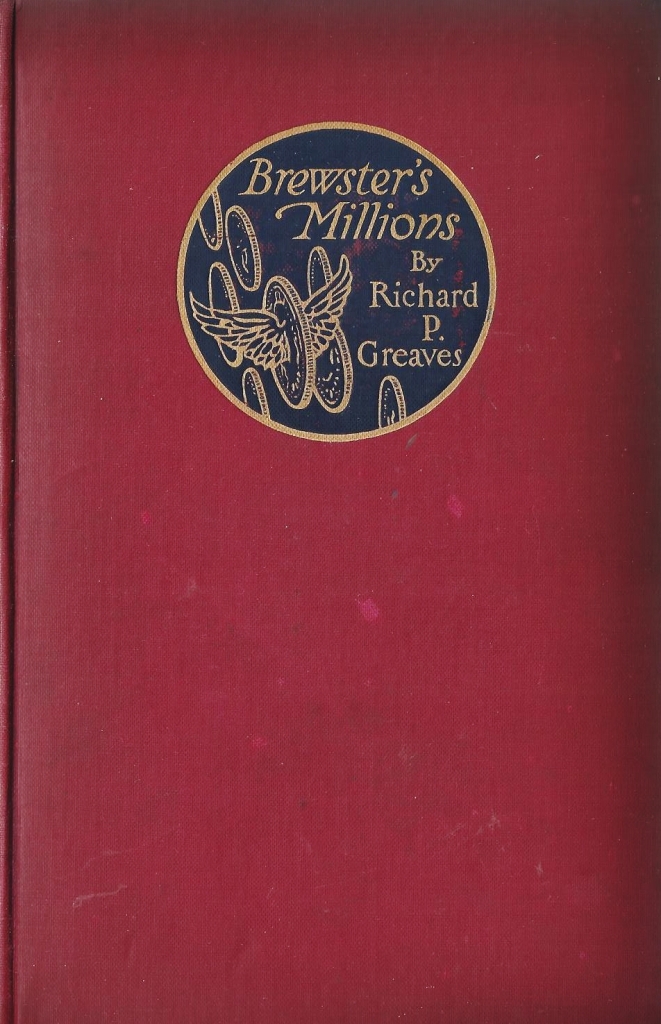
brewster's millions 1902 richard greaves george barr mccutcheonBrewster’s Millions by Richard P. Greaves, pseudonym of George Barr McCutcheon ~ 1903. This edition: Herbert S. Stone & Co., 1903. Hardcover. 325 pages.

My rating: 7.5/10

This was a pleasant light novel which was easily breezed through in several sittings. Nothing here to challenge one; purely diversionary.

Montgomery Brewster is one of the set of young men with expectations, “The Little Sons of the Rich”, who form an informal club for card-playing, wining and dining in turn-of-the-century New York. In Monty’s case, it is his paternal grandfather who provides the expectations; Monty is widely believed to be the millionaire’s heir. This proves to be the case, and Monty’s natural sorrow at his relative’s demise – for Monty has been a ward of the old man since his parents’ untimely deaths – is salved by the news that he has been set down in the will for one million dollars.

Now Monty is gently pleased at this, the more so because he has been a hard-working young man and is not that desperate for the money, though there is no doubt that it will make life much more pleasant. Monty has been working in banking, and is pulling down a respectable salary; he boards with a widowed lady who has been something of a foster mother to him since childhood, and he is good friends with the household’s daughter, Margaret Grey. He is also romantically involved with a vivacious young woman who herself has good prospects, banker’s daughter Barbara Drew. An engagement is expected by both of them – Monty and Barbara – in due course, and all in all life looks fair to be peaceful and prosperous, with no clouds on the horizon.

Then, mere days after the Brewster will is proved, Monty receives a surprising communication from another lawyer. Monty’s late mother’s brother, his Uncle Sedgwick, has just shuffled off into eternity, and he has appointed Montgomery Brewster, son of his beloved sister, his sole heir. With a condition.

Seems that when Monty’s parents were married, a feud of sorts was started between Brewster senior (Monty’s grandfather) and the Sedgwick clan. Unforgivable words were spoken on both sides, and James Sedgwick was left with a bitter hatred towards the Brewsters, Monty excepted. As a sort of twisted revenge, he wanted to turn Monty into his chief heir but without mingling any of his (Sedgwick’s) hard-earned money with that of his enemy’s. Monty must divest himself of the Brewster fortune in a prescribed time, to be left with only the clothes on his body, in order to inherit the Sedgwick cash. And the amount of that legacy makes Monty sit up and take notice: $6,345,000! With projected interest, something like seven times the fortune already in hand.

Will Monty take the gamble?

Well, of course he will! For that is the entire premise of this rather silly story.

The conditions set for divesting himself of the Brewster fortune are stringent. Monty is not allowed to confide in anyone as to why he is ridding himself of his grandfather’s cash, with the deadline being Monty’s twenty-sixth birthday, just under a year in the future.

There was also a clause in which he (Sedgwick) undertook to dictate the conduct of Montgomery Brewster during the year leading up to his twenty-sixth anniversary. He required that the young man should give satisfactory evidence to the executor that he was capable of managing his affairs shrewdly and wisely,—that he possessed the ability to add to the fortune through his own enterprise; that he should come to his twenty-sixth anniversary with a fair name and a record free from anything worse than mild forms of dissipation; that his habits be temperate; that he possess nothing at the end of the year which might be regarded as a “visible or invisible asset”; that he make no endowments; that he give sparingly to charity; that he neither loan nor give away money, for fear that it might be restored to him later; that he live on the principle which inspires a man to “get his money’s worth,” be the expenditure great or small.

So Monty sets out to spend Grandfather Brewster’s cash, which he will need to do, as his calculations have shown him, at an average of almost $3,000 per day. He must demonstrate that he is receiving “value for money”, and he’s not allowed to tell anyone what he’s doing. Let the farcical fun begin!

For Monty’s friends, the other “Little Sons of the Rich”, prove surprisingly unwilling to let Monty squander his cash, and they go to great lengths to limit his expenditures. Early on in the proceedings, Barbara Drew is disgusted by Monty’s profligacy, and withdraws from their informal engagement, giving him pause, but only for a moment. As the year races on, Monty finds it harder and harder to spend fast enough, even adding to his fortune completely unwillingly by several freak occurrences – a second-rate prize fighter knocking out a champion (Monty had bet on the second-rater); a foray into stock trading on a “sure loss” which was turned around due to Monty’s investment; a visit to Monte Carlo ends with a bizarre winning streak – the fellow just can’t lose! Or, as the true case would be, win.

Luckily a financially disastrous yacht trip helps with the final disposal of Monty’s funds, as well as showing him that he has started to develop romantic feelings towards the young woman whom he had previously thought of as a platonic foster-sister, his old chum Margaret Grey. But Monty’s birthday is fast approaching, and suddenly Sedgwick’s executor disappears, and the Sedgwick millions with him. Could Monty have gambled and won, only to have ultimately lost everything through a cruel twist of fate?

Well, what do you think will happen?

I enjoyed this humorous period piece, and I was quite amused as well to learn some of the history behind its writing. I will pass you over to this excellent article by Nathaniel Rich, American Dreams: Brewster’s Millions, from which I’ve excerpted this back story of the author’s own gamble. (And please click over and read the full article; it is excellent.)

Brewster’s Millions, a novel about a bet, was written on a bet. George Barr McCutcheon was visiting his publisher when the subject of bestselling novels came up in conversation.

“The name of the author is what sells the book,” remarked the publisher.

McCutcheon, who the previous year had written his first bestseller—the initial volume in the Graustark series of romantic adventure novels—disagreed.

“I will bet you $100 that it does,” said the publisher.

“I will take that bet,” replied McCutcheon, “and I will write you a story to show you that I am right.”

Six weeks later McCutcheon submitted a manuscript. It was the story of a young man named Monty Brewster who, in order to inherit $7 million, must spend $1 million in a single year. There are, however, strings attached. At the end of the year Monty cannot possess any assets; he is forbidden from telling anybody why he’s spending all his money; and he may only donate a piddling amount to charity. Monty is free to reject the challenge and keep the $1 million, but he accepts the bet without hesitation. He begins his year of spending dangerously by renting the most expensive apartment in Manhattan and leasing four Monets, three cars, two horses, and a chef from Paris.

McCutcheon, needless to say, won his publisher’s bet—in fact he made off nearly as well as Monty Brewster. Brewster’s Millions sold 150,000 copies in its first three months of publication, despite the fact that the author was listed as “Richard Greaves.” (A clerk at the publishing house posed for the press photo.) The novel remains in print 110 years later, and has been adapted for film at least 10 times.

*****

Note: I originally purchased a copy of the book in order to fill in the 1902 spot in my Century of Books reading project, but it appears to me that the book was actually published in 1903. My copy is a first edition, showing the author’s name as Richard P. Greaves on the front cover (later editions replaced the pseudonym with George Barr McCutcheon), and the publication date on the copyright pages states: Issued April 20, 1903. Not a big deal, but it did leave me feeling a bit uneasy about using it for 1902, so I filled that space with Rudyard Kipling’s Just So Stories instead. So if you’re looking for inspiration for this time frame for your own Century project, just an alert that the copyright date of 1902 which appears in almost every reference to Brewster’s Millions that I’ve seen may be slightly incorrect.

Read Full Post »

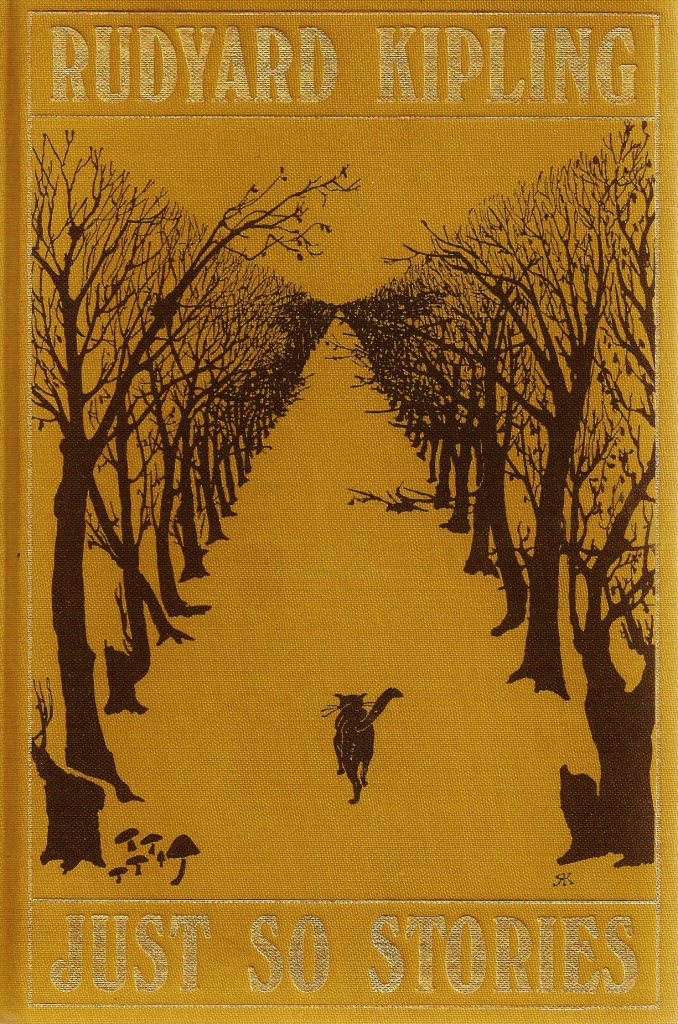
just so stories rudyard kipling folio ed 001Just So Stories by Rudyard Kipling ~ 1902. This edition: The Folio Society, 1991. Illustrated by Rudyard Kipling. Hardcover. 189 pages.

My rating: 7.5/10

Having been familiar with the most popular of these stories since childhood – The Elephant’s Child standing out in my memory, for it was read aloud to me a great number of times; I can clearly hear in my head the words “great, grey-green, greasy Limpopo River” deliciously rolled out in all their alliterative glory in my mother’s quietly precise voice – I of course acquired a volume to read to my own wee children.

And not just any old edition, but this deluxe Folio Society version, complete with the author’s original illustrations, chatty descriptions of the drawings, and abysmally cringe-inducing poems. And obviously unexpurgated, too, which I discovered as I read them aloud, requiring some think-fast editing to deal with little things such as this passage, from How the Leopard Got his Spots. Rolling along nicely, we all are, until we reach the last line in this passage, and oh, golly! – now how to slide through that one?! The clever reader-alouder  becomes adept at looking a little way ahead and editing on the fly after one or two experiences like this.

…Zebra moved away to some little thorn-bushes where the sunlight fell all stripy, and Giraffe moved off to some tallish trees where the shadows fell all blotchy.

‘Now watch,’ said the Zebra and the Giraffe. ‘This is the way it’s done. One—two—three! And where’s your breakfast?’

Leopard stared, and Ethiopian stared, but all they could see were stripy shadows and blotched shadows in the forest, but never a sign of Zebra and Giraffe. They had just walked off and hidden themselves in the shadowy forest.

‘Hi! Hi!’ said the Ethiopian. ‘That’s a trick worth learning. Take a lesson by it, Leopard. You show up in this dark place like a bar of soap in a coal-scuttle.’

‘Ho! Ho!’ said the Leopard. ‘Would it surprise you very much to know that you show up in this dark place like a mustard-plaster on a sack of coals?’

‘Well, calling names won’t catch dinner,’ said the Ethiopian. ‘The long and the little of it is that we don’t match our backgrounds. I’m going to take Baviaan’s advice. He told me I ought to change; and as I’ve nothing to change except my skin I’m going to change that.’

‘What to?’ said the Leopard, tremendously excited.

‘To a nice working blackish-brownish colour, with a little purple in it, and touches of slaty-blue. It will be the very thing for hiding in hollows and behind trees.’

So he changed his skin then and there, and the Leopard was more excited than ever; he had never seen a man change his skin before.

‘But what about me?’ he said, when the Ethiopian had worked his last little finger into his fine new black skin.

‘You take Baviaan’s advice too. He told you to go into spots.’

‘So I did,’ said the Leopard. ‘I went into other spots as fast as I could. I went into this spot with you, and a lot of good it has done me.’

‘Oh,’ said the Ethiopian, ‘Baviaan didn’t mean spots in South Africa. He meant spots on your skin.’

‘What’s the use of that?’ said the Leopard.

‘Think of Giraffe,’ said the Ethiopian. ‘Or if you prefer stripes, think of Zebra. The find their spots and stripes give them perfect satisfaction.’

‘Umm,’ said the Leopard. ‘I wouldn’t look like Zebra—not for ever so.’

‘Well, make up your mind,’ said the Ethiopian, ‘because I’d hate to go hunting without you, but I must if you insist on looking like a sun-flower against a tarred fence.’

‘I’ll take spots, then,’ said the Leopard; ‘but don’t make ’em too vulgar-big. I wouldn’t look like Giraffe—not for ever so.’

‘I’ll make ’em with the tips of my fingers,’ said the Ethiopian. ‘There’s plenty of black left on my skin still. Stand over!’

Then the Ethiopian put his five fingers close together (there was plenty of black left on his new skin still) and pressed them all over the Leopard, and wherever the five fingers touched they left five little black marks, all close together. You can see them on any Leopard’s skin you like, Best Beloved. Sometimes the fingers slipped and the marks got a little blurred; but if you look closely at any Leopard now you will see that there are always five spots—off five fat black finger-tips.

‘Now you are a beauty!’ said the Ethiopian. ‘You can lie out on the bare ground and look like a heap of pebbles. You can lie out on the naked rocks and look like a piece of pudding-stone. You can lie out on a leafy branch and look like sunshine sifting through the leaves; and you can lie right across the centre of a path and look like nothing in particular. Think of that and purr!’

‘But if I’m all this,’ said the Leopard, ‘why didn’t you go spotty too?’

‘Oh, plain black’s best for a nigger,’ said the Ethiopian…

So racist bits aside – and there are a few here and there in many of the stories, in a very era-expected sort of way – these have become so much a part of our popular culture with their instantly recognizable tag lines that they are well worth passing along to children and grandchildren.

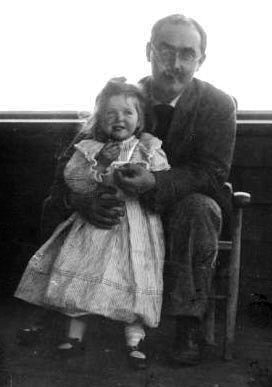
Rudyard Kipling and his eldest daughter (his "Best Beloved" first child) Josephine, at the time of the writing of the first of the Just So stories.

Rudyard Kipling and his eldest daughter (his “Best Beloved” first child) Josephine, at the time of the writing of the first of the Just So stories.

The Just So stories were originally written for Kipling’s young daughter Josephine, who died of pneumonia at the tragically tender age of seven in 1899; several years later the stories, which had been published singly from 1897 onward, were assembled into this collection. They are written as scripted read-aloud narratives; one can hear an avuncular fatherly voice rolling them out; the repetition and slangy contractions are distinctive and memorable, though sometimes a bit hard to read out loud with a straight face and sober tone.

A few of the stories are over-long and rather hard going; this is a collection which requires some serious editing if being shared with a young audience, but it rewards the older reader’s full attention once the little ones have left the room, for its period atmosphere and the vision it gives of the time when the stories were written. Lift a sardonic eyebrow over the worst of the politically incorrect bits, but spare a thought too for the all-too-common sorrow of the bereaved parent; Kipling’s “O Best Beloved” small daughter is a ghostly presence throughout.

  • How the Whale got his Throat ~ Never swallow whole a ship-wrecked Mariner, for he may be a man of infinite-resource-and-sagacity.
  • How the Camel Got his Hump ~ An awful warning to the perpetually scornful, especially those who reside where magic-making Djinn reside. Your “Humph!” may turn into a Horrible Hump, claims our narrator.
  • How the Rhinoceros got his Skin ~ The tale of the cake-loving Parsee, who favours hat which reflects the rays of the sun in more-than-oriental-splendour, and his perfect revenge on the thieving rhinoceros. (One of our favourites.)
  • How the Leopard got his Spots ~ See the excerpt above. A rather glorious tale, but requiring of the parental edit here and there. And I must warn you that if you have the Kipling illustrated version, he comments regarding the illustration that “The Ethiopian was really a negro, and so his name was Sambo.” (!)
  • The Elephant’s Child ~ My childhood favourite, what with the elephant’s child getting his revenge on all of his spanking multi-species relatives. A slightly annoying repetition of ” ‘satiable curtiosity” (yes, the misspelling is deliberate) challenges the reader throughout, but as a treat one gets to roll out “great, grey-green, greasy Limpopo” just as many times.
  • The Sing-Song of Old Man Kangaroo ~ Yellow-Dog Dingo is fated to chase Kangaroo, and Kangaroo had to run and run and run. Neither could stop, they simply “had to!” The moral: Those who wish to be really and truly popular and wonderfully run after may rue their desire.
  • The Beginning of the Armadilloes ~ This was one that was something of a miss. An Amazonian turtle and hedgehog confound a predacious Jaguar by morphing into armadilloes.
  • How the First Letter was Written ~ A Primitive father and daughter – very early Britons indeed – originate hieroglyphic writing, with hilariously confusing consequences.
  • How the Alphabet was Made ~ An extension of the previous story, with detailed descriptions of how the letters of the alphabet were made. Sad to say, perhaps, too long and descriptive. We all lost interest in this one, and as a read-aloud it was a dismal failure, clever illustrations to no avail.
  • The Crab that Played with the Sea ~ A crabby King Crab plays hob with sea levels to the great detriment of all seashore and ocean creatures. The Great Magician disciplines the Crab, and turns responsibility for the rise and fall over to the Moon. A rather good “origin tale”.
  • The Cat that Walked by Himself ~ Our absolute favourite. This was one I read out loud over and over and over. “I am the Cat who walks by himself, and all places are alike to me…” Only to give in to the warmth of the fire and the bowl of milk from the Wife of his Enemy at the end, while still reserving his aloofness, at the cost of  eternal feuding with Man and Dog.
  • The Butterfly that Stamped ~ Written with an eye to the adult audience, Kipling spins a rather preachy homily about how to keep your wife under proper control, with the help of a handy Djinn.
  • The Tabu Tale ~ The father-daughter of First Letter and Alphabet returns with a moralistic lecture on the benefits of growing up, and related responsibilities.
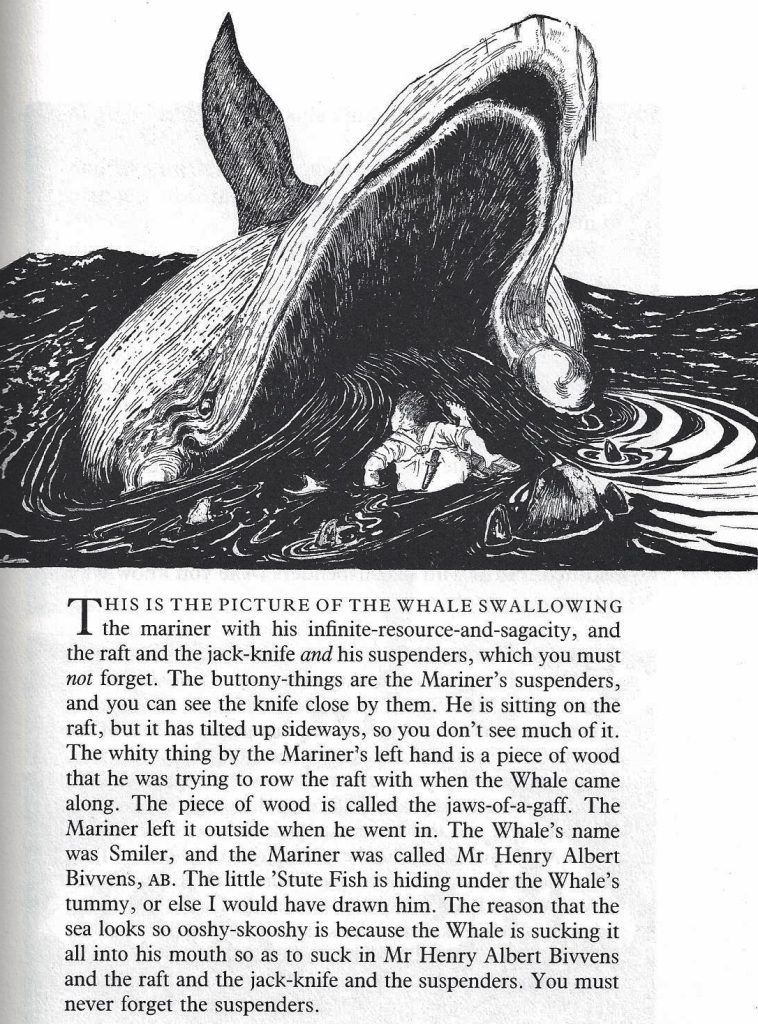
One of the author's much-annotated illustrations for How the Whale got his Throat.

One of the author’s much-annotated illustrations for How the Whale got his Throat.

The illustrations in the Folio Edition of Just So Stories are a delightful addition, but the author’s poetry, of which the following is one of the less objectionable examples, not so much. Just couldn’t get through these with a straight face, and they engendered a certain amount of critical sneering, kiddies and grown-ups of this family alike.

The Camel’s hump is an ugly lump
Which well you may see at the Zoo;
But uglier yet is the hump we get
From having too little to do.

Kiddies and grown-ups too-oo-oo,
If we haven’t enough to do-oo-oo,
We get the hump—
Cameelious hump—
The hump that is black and blue!

We climb out of bed with a frouzly head
And a snarly-yarly voice.
We shiver and scowl and we grunt and we growl
At our bath and our boots and our toys;

And there ought to be a corner for me
(And I know there is one for you)
When we get the hump—
Cameelious hump—
The hump that is black and blue!

The cure for this ill is not to sit still,
Or frowst with a book by the fire;
But to take a large hoe and a shovel also,
And dig till you gently perspire;

And then you will find that the sun and the wind,
And the Djinn of the Garden too,
Have lifted the hump—
The horrible hump—
The hump that is black and blue!

I get it as well as you-oo-oo—
If I haven’t enough to do-oo-oo—
We all get hump—
Cameelious hump—
Kiddies and grown-ups too!

Read Full Post »

a girl of the limberlost gene stratton-porter 001A Girl of the Limberlost by Gene Stratton-Porter ~ 1909. This edition: Grosset & Dunlap, circa 1927. Hardcover. 453 pages.

My rating: 6/10

Spinning my book-discussing wheels somewhat, trying to think of what to say.

An unusual book; definitely memorable for its strong imagery of beautiful Elnora, her white-haired, haunted mother, and the moths that flit in and out of every scene, until popped into the cyanide-filled killing bottle.

You see what I mean? This one made me downright squeamish here and there.

So here we are back in the Limberlost Swamp in Indiana, some years after our previously met fine fellow, Lord Terence something-or-other O’More, a.k.a. Freckles, has quit his timber patrols, married his Swamp Angel, and taken on his aristocratic hereditary mantle. The locals whisper his name with awe, and his benevolent shadow is present throughout the book, along with a more substantial appearance at the end of the tale. But in the meantime, the timber companies have harvested many of the trees, and oil has been discovered in the swamplands, so many of the smallholders on the fringes of the Limberlost are doing very well indeed.

One farm, however, remains untouched. The Widow Comstock’s trees are still standing; no oil pump brings black gold to the surface. Stern Mrs Comstock ekes out a subsistence living by farming, living off the land, and selling butter and eggs to the townfolk. She refuses to let a tree be fallen or an oil well drilled, as she holds the land as a sacred trust in memory of her dearly departed husband, whose acres these were.

Oh, yes. The husband. He perished most unpleasantly by falling into the quicksand swamp just out back of the family home. Mrs Comstock ran to the rescue, but she couldn’t save him because she went into labour right there on the edge of the swamp, and her baby was born as its father glubbed his last. And, get this, because the swamp is “bottomless”, the body is still down there, sixteen years later. No wonder Mrs Comstock’s hair went prematurely white, and she’s more than a little eccentric.

That baby, our heroine Elnora, has grown to sweet-sixteen-hood being deeply resented by her mother, with the only openly expressed love in her life coming from a child-less couple one farm over. (These folks had two daughters, but these perished early on; their parental love is therefore spent on deserving Elnora.)

Okay, this is turning into a saga already, and that’s just the barest setup. Let’s see if I can condense.

Elnora is desperate to continue her education past the country school and go onto high school in town. Off she goes in her clunky shoes and calico dress, only to be immediately and openly scorned by the other teenagers, and shocked to discover that she will need to pay tuition and buy books. Luckily a way opens for her. The kindly neighbours buy her clothes (which she insists on paying them back for out of stern pride) and she discovers that she can earn money by collecting Indian artifacts and nature specimens – arrowheads, rocks, leaves and insects – which she sells through the local naturalist, the Bird Lady. (See Freckles.)

Garbed in her new duds and with her gorgeous red-gold hair fashionably arranged, Elnora instantly becomes the belle of the school, winning over the entire student body. She is also naturally intelligent, and she excels at her studies, graduating at the top of her class. Attracted by some mysterious pull to try her hand at playing a violin left in an unoccupied classroom, Elnora is a virtuoso at first touch of the bow. (Must be heredity, because her dead dad was a dab hand at the violin, too, which is why her mother refuses to countenance an instrument in the house.)

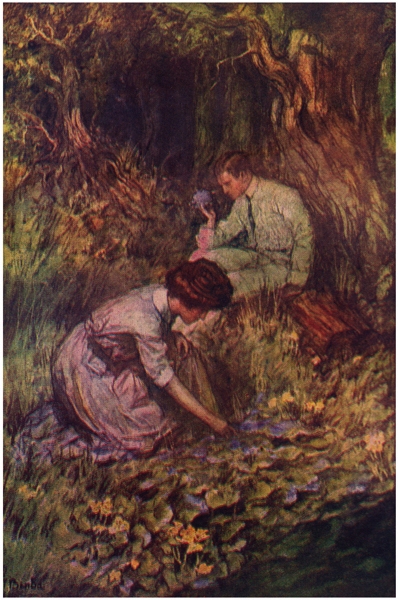
Benda's illustration of Elnora and Phillip girl of the limberlost gene stratton-porter

Lovely Elnora and her wealthy lover, Phillip, dallying amongst the wildflowers. Illustration from the first edition “A Girl of the Limberlost.”

She befriends a trio of pathetic orphans, one of which is adopted by the neighbour couple, and in general is a ray of sunshine about the swamp. Butterflies and moths flock to her outstretched hands, to be caught and killed and then pinned to mounting boards for resale to collectors all over the world. ~ Insert subplot concerning rare moth here. ~

Then love walks in.

A wealthy young man discovers Elnora and falls in love with her, but both deny their feelings for each other because the young man is otherwise engaged. He leaves. She stays. He has a bust  up with his fiancé and returns to pledge his troth to Elnora. Complications ensue; Elnora runs off to spend some time with Freckles and Angel and their winsome brood of perfect children; young man has a spell of “brain fever” and is saved at last minute by his original fiancé’s agonizingly selfless kind deed of telling him where Elnora is hiding out.

Oh, and Mrs Comstock has a complete change of heart part way through, when she finds out that her husband died because he was creeping through the swamp on his way to a rendezvous with another woman, sneakily avoiding being seen by his great-with-child wife. Once that’s cleared up, Mrs Comstock comes to appreciate sweet Elnora, and turns into a model mother immediately.

I didn’t fall in love with Elnora as so many readers have, perhaps because I didn’t become acquainted with her when I was a young reader. My cynical side, which allowed itself to be fairly quiet while revisiting Freckles, surged to the surface while reading Elnora’s melodramatic tale.

Do you know what this book remends me of? Nothing other than L.M. Montgomery’s Kilmeny of the Orchard, which I read and despised last year. Elnora hails from 1909, and Kilmeny from 1910; almost-twin daughters of a style of story-writing just a bit too dated for my full appreciation, I suppose. (Or maybe it’s the common trait of these untrained young girls instantly mastering the violin…)

But sharp-eyed readers of this blog will note that I awarded A Girl of the Limberlost a respectable 6/10. That’s because, despite my rudeness regarding Elnora’s unlikely tale, it was very readable, and it kept me decidedly engaged from first page to last. And I will keep it, and probably reread it, though doubtless while muttering in annoyance here and there.

It’s a rather unique book, in so many ways, and I can see why there are so many fans.

Here are thoughts from a few other readers.

One in favour: Shelf Love: A Girl of the Limberlost

And one not so enamoured: The Book Trunk: A Girl of the Limberlost

I agree with both of these reviews, if that’s possible. To me, Elnora was a too, too “perfect” heroine, but there were glimpses here and there of something rather interesting going on, and I must say I loved Elnora’s mother at her very nastiest; she was the high point of the book, until she had her epiphany and deteriorated into being oh-so-nice and sweetly motherly and sentimentally soppy.

So another conflicted review of Gene Stratton-Porter’s work. Which means I’ll be reading more of her, I’m sure. She intrigues me, in a rather uneasy way.

And her many tempting food descriptions make me hungry. I’ve been thinking longingly since I turned the last page of fragrant spice cake and crispy fried chicken!

Read Full Post »

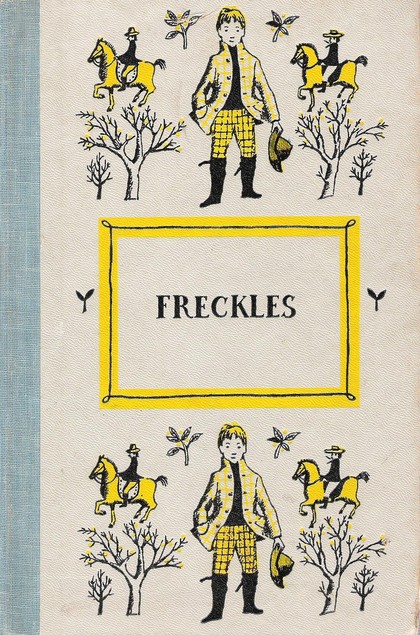
freckles gene stratton porter junior deluxe edition ruth ives illustrationsFreckles by Gene Stratton-Porter ~ 1904. This edition: Doubleday Junior Deluxe Classics, 1967. Hardcover. Illustrated by Ruth Ives. 320 pages.

My rating: It’s complicated.

10/10 for childhood nostalgia and deeply sentimental romance of the boy-girl love affair; about a 2/10 for its cringe-worthy aspects in regards to class distinctions and the strong dependence by the author on the idea that “good birth” and “aristocratic heritage” trumps environment, upbringing, natural intelligence and aspects of genuine personal integrity; another 10/10 for its lovely descriptions of the flora and fauna of the swamp, and for the sharp-shooting, utterly fearless female characters the “Bird Woman” and the “Swamp Angel”; these women aren’t afraid to go about alone, get dirty, pursue their personal interests with complete competence, are respected and admired by everyone they meet – including the scruffiest of the “bad guys” – and at the end of the day go home to a hot bath and a complete change of attire to become “dainty beauties”. Oh, golly, I want to be them! With an ugly-handsome, physically-perfect-yet-interestingly-maimed, sterling-natured, completely devoted lover (such as our titular Freckles) on a silken leading string. Sigh

Where was I? Oh, yes. Rating. Decisions, decisions…

I’d better give it something fairly high, because I do still love this book, despite the squeamishness it stirs within me when I think about it too hard. Here we are, then: 7.5/10.

Time travelling, in several aspects, this reading experience was.

On a personal level, I first read this book back when I was just 11 or 12, and periodically in the years since, and a good percentage of my affection for it is pure nostalgia. That and the fact that the hero and heroine are so darned adorable, and their love story, coming to a climax with the hero being gravely wounded rescuing the heroine from an unpleasantly dramatic death, is of the sort to cause serious heart throbbing in a susceptible young reader.

On a historical level, this is very decidedly a book which deserves the label “period piece.” It is very much a product of its era, and many of the attitudes and assumptions Gene Stratton-Porter captures and espouses so strongly are quite distasteful to this  modern day reader, and though I still feel the appeal of the fairy tale nature of the story and the complete and utter good-ness of its main characters, I can only hold on to that affection by viewing it forgivingly through my rose-tinted “era appropriate” lenses. (Handy categorization, that!)

Oh, golly. Look at the time! Must condense and get on with this. Luckily the World Wide Web is bursting with reviews on this one, if any of you are keen to investigate further. Here’s the barest outline.

Way back at the turn of the 19th Century, Indiana’s 13,000 acre Limberlost Swamp (a real place) was a deeply mysterious, untouched-by-man enclave of flora and fauna. Including some exceedingly valuable trees, both from the everyday “lumbering” aspect and for the incredible value of occasional ancient, huge, furniture-making stand-alone hardwood trees, such as birds-eye maple, black walnut, and golden oak. A timber lease was a valuable business enterprise, and forest guards were routinely employed to patrol the borders of the leases to avoid trespassing and theft of the most valuable of the trees. (A genuine occurrence, which is still common today.)

Our hero, the teenage “Freckles,” brought up in an orphanage from babyhood, is employed as a timber guard by a wealthy timber boss, who looks past Freckles’ shabby clothes and missing hand (cut off in unknown circumstances just before his appearance on the orphanage steps) to his sterling heart within and falls in paternalistic love with the boy at first sight. Freckles makes a success of his timber patrols, pluckily routing the Big Bad Timber Thieves with his cudgel and revolver, and pausing occasionally in his tireless rounds to commune with the flowers and make friends with the little forest animals.

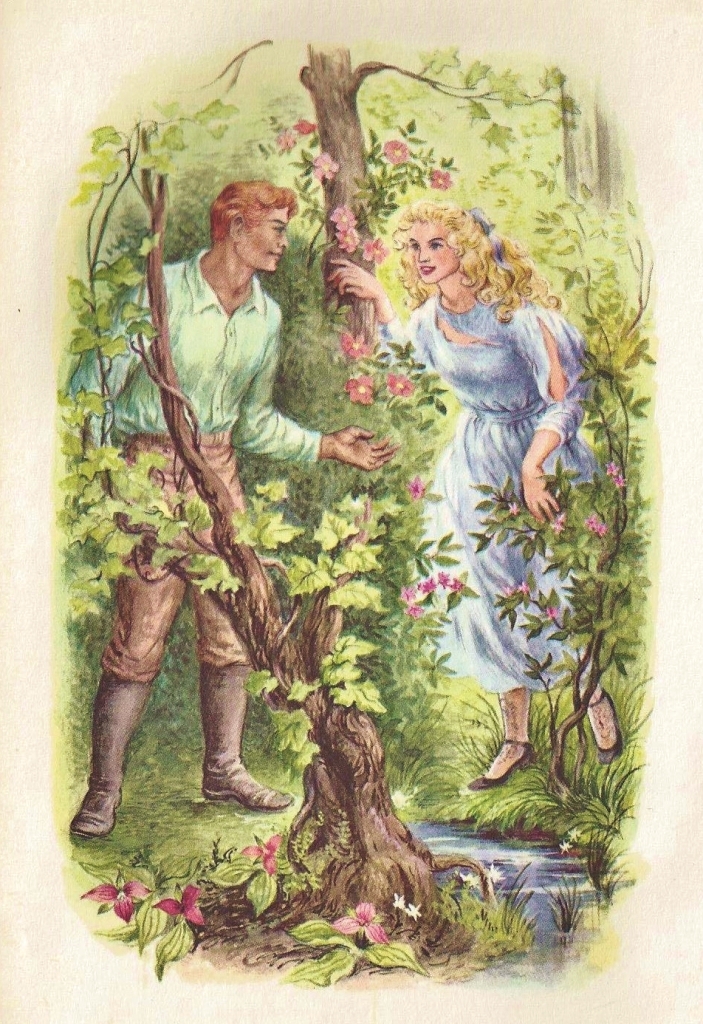
freckles frontispiece ruth ives gene stratton porter 001

Here they are at their first meeting, the manly youth Freckles and the pure and lovely Swamp Angel.

Freckles falls in love with a beautiful sixteen-year-old girl who regularly accompanies an older woman friend into the swamp, the photographer and naturalist known only as the “Bird Woman.”  Many adventures ensue, with encounters with various wild creatures and vanquishing timber thieves, etcetera. The “Swamp Angel,” as Freckles names the lovely girl (we never do find out her real name), returns his love, though he doesn’t realize it until he saves her from being squashed by a falling tree and sustains horrible injuries himself. Swamp Angel rallies her wealthy father to transport Freckles to the best hospital in Chicago, where he is patched together physically, though he threatens to expire because he is so depressed that he will never be able to speak his love to Angel because he is merely a nameless Irish orphan who could not seek to raise his eyes to a child of wealth and good breeding.

Angel trots off to discover Freckles’ heritage, miraculously does so, and Freckles rallies and the birds all sing in celebration (okay, I added that last bit in, but you get the idea), and manly and womanly tears are shed in great abundance (that bit is in the book – they do all cry a lot, men and women both. And people faint fairly frequently, come to think of it…) and everything ends gloriously happily.

That’s pretty well it. Drama, tears, adventures, love at first sight, bad guys, cute forest creatures, pretty flowers, more drama, more tears, happy ending.

Please excuse my flippant tone this morning. This thing really is a sentimental, highly clichéd, occasionally cringe-making bit of romance literature, and though I love it I also feel a bit ashamed of the bad bits, such as the snobbishness of the author regarding class distinctions, and the complete acceptance of it being perfectly all right to raze and drain a unique natural forest while blithering on about how lovely it all is and oh, well, too bad it’s doomed but we do need some nice veneers for our bedroom furniture, and some more acres to grow corn and pasture our mules, and at least we have some specimens of pressed flowers, dead moths, animal skins and photographs to remember it by.

But there is some lovely writing, and it is a rather sweet love story, and the Ruth Ives illustrations in my childhood edition are rather adorable. The author’s love of nature does shine through, though she seems to have no qualms about contemplating the destruction of the Limberlost to the greater profit of the timber companies. Because to be good and rich is an admirable thing, as her wide-eyed, obviously approving descriptions of the wealth of Angel’s family makes very clear.

Yes, I guess I am a bit conflicted.

This book was followed by another much better known, A Girl of the Limberlost, in 1909, which I am halfway through at this point. It’s an interesting read, and I’m just as conflicted by it as I am by Freckles.

I’m sure I’ll have more to say about Gene Stratton-Porter and her fictional characters very soon.

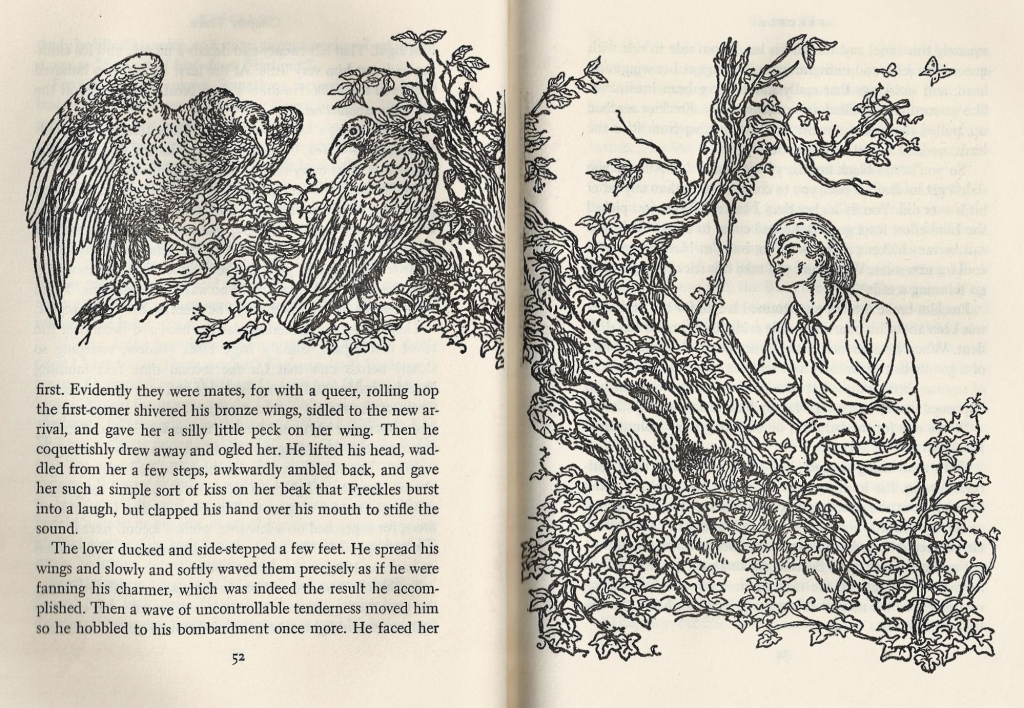
freckles illustration 1 ruth ives gene stratton porter 001

A page scan from “Freckles”, highlighting the best bits of the book, the descriptions of Freckles learning about and interacting with the wild things of the Limberlost Swamp. Ruth Ives illustrations throughout are a definite bonus to the Doubleday edition.

Read Full Post »

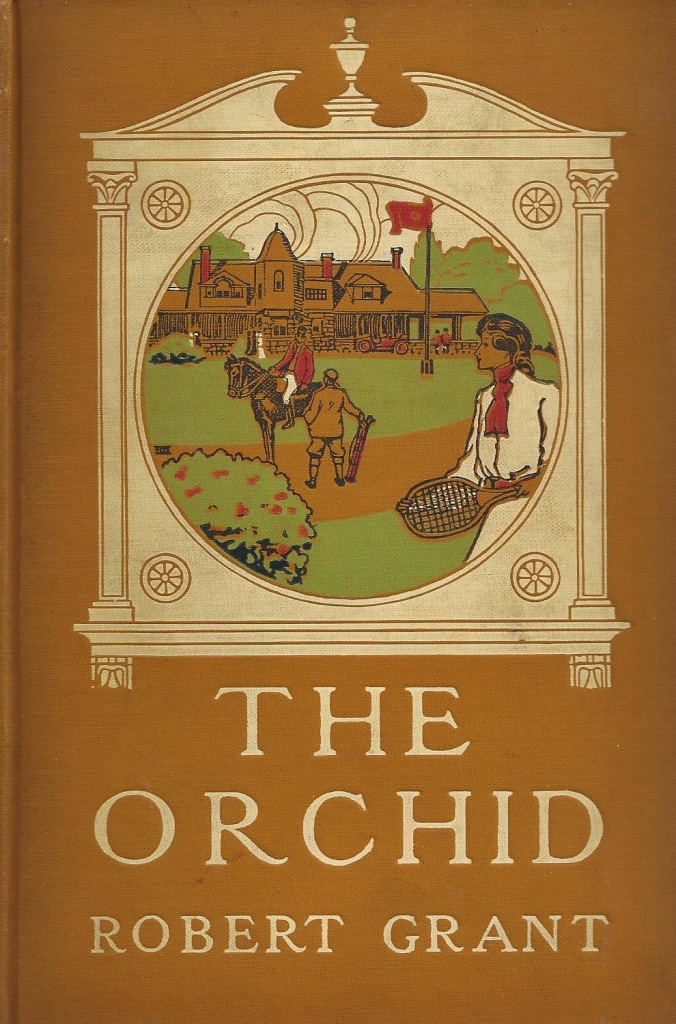
the orchid robert grant 001The Orchid by Robert Grant ~ 1905. This edition: Charles Scribner’s Sons, 1905. Hardcover. 229 pages.

My rating: 6.5/10

In this short novel – really more of a novella, as its 200+ pages are of the “big print, lots of margin and wide line spacings” sort – Robert Grant clothes a barbed comment or two on the hypocrisy of American society in the garb of an amusing light novel.

I was initially a bit disappointed in the superficial nature of the book, having hoped for something as complex as Grant’s ambitious Unleavened Bread , but as I read on I realized that the voice of the writer was still there, still saying the same thing, though here in a minor key.

As I wouldn’t recommend that anyone run out willy-nilly and find this book – it’s very much a minor work, though quite nicely readable – I’ll go ahead and summarize the key points of the tale, which takes place in a fictional American east coast setting – near real-world Boston, perhaps? – with the characters being the wealthy social set, most with two homes, one in the city and the other in the rural retreat of “Westfield”, where the lavish estates of the brash nouveau riche coexist with the more modest homes of the more staid “old money” American aristocrats of the time.

Miss Lydia Arnold is the orphaned just-in-her-early-twenties daughter of a socially prominent but not tremendously wealthy “aristocratic” couple. She is by way of being a shining star amongst the other young women of her set; much admired by everyone for her sharply brilliant wit, athletic ability, and physical beauty. As the story opens, Lydia is about to accept the marriage proposal of Herbert Maxwell, first generation member of the smart set, made acceptable by the wealth backing him from his father’s success in trade.

For Herbert Maxwell was a new man. That is, the parents of the members of the Westfield Hunt Club remembered his father as a dealer in furniture, selling goods in his own store, a red-visaged, round-faced, stubby looking citizen with a huge standing collar gaping at the front. Though he had grown rich in the process, settled in the fashionable quarter of the city and sent his boy to college in order to make desirable friends and get a good education it could not be denied that he smelt of varnish metaphorically of not actually, and that Herbert was, so to speak, on the defensive from a social point of view. Everybody’s eye was on him to see that he did not make some “break,” and inasmuch, as he was commonly, if patronizingly, spoken of as “a very decent sort of chap,” it may be taken for granted that he had managed to escape serious criticism…

Self-contained and luxury-loving Lydia (the “Orchid” of the title, a creature which flourishes best in a hothouse setting, flauntingly beautiful but decidedly touch-me-not) decides to follow the money, and she and Herbert in due course produce a child, the small Guendolen, treated by her mother as a slightly annoying doll to be occasionally dressed up, and by her father as the beloved apple of his eye. I rather enjoyed the nice little aside the author included at Guendolen’s birth, with Lydia’s lady-friends debating the pros and cons of nursing one’s own child, and the social benefits of freeing oneself from constant attendance on an infant by employing wet nurses and “artificial food”, with some holding out for the “old-fashioned” habit of mother-child bonding through breastfeeding, “to give the children the benefit of the doubt as to any possible effect on character by being suckled by a stranger.” (!)

No second baby follows Guen, and Lydia obviously considers that by providing her spouse with a child the great part of her marital bargain has been met. She proceeds to employ herself by pursuit of her sporting interests: riding with the Hunt Club, and the newest craze fresh over from England and Scotland, golfing. Needless to say she excels on the greens as much as she does in the equestrian field, and she soon catches the eye of recently arrived Harry Spencer, one of the “poorer” members of the Westfield social set who has been off travelling for some years.

Handsome Harry has broken hearts by the dozen, but has never succumbed himself, until the sight of lovely Mrs Maxwell undoes him completely. The two come together like steel and magnet, until at last Herbert Maxwell is moved to ask his wife just what the heck is going on. She responds by requesting a separation, commenting that she intends to take little Guen with her. Herbert refuses categorically, and the conjugal fight is on, watched with breathless gossiping interest by the members of the Westfield set.

Then Lydia comes up with what she views as a win-win scheme. For a two million dollar settlement, she will renounce her claim to Guen and allow Herbert to divorce her, and with the money she and Harry will be able to set up house in the manner in which they’d both like to be maintained.

“She’s sold her child!” the Westfield matrons cry, and for a while the skirts are primly twitched back as Lydia passes by. But once she’s safely married to Harry, living in her old house which she has snagged from her ex, and driving a posh new automobile – “bridal white and luxurious” – the society ladies glance at each other out of the corners of their eyes. Will they accept Lydia and Harry back into the fold and attend her tennis party – tennis being the latest craze, trumping that yawningly boring old-fashioned golf – and grand reception?

What do you think?

Robert Grant thinks that they will squash their inconvenient morals, and so they do, with the last hold-out, the stern matriarch of the set, coming round at the end.

“Everyone is going, and most of the nice people are coming from town. So why should I be stuffy and bite my own nose off? Which goes far to prove, my dears,” she added sententiously, “that the only unpardonable social sin in this country is to lose one’s money. Nothing else really counts.”

Indeed.

Plus ça change, plus c’est la même chose…

Read Full Post »

These next two books are proving to be something of a challenge to me.

Well, not actually the books themselves. Reading Miles Franklin’s teenage bestseller, My Brilliant Career, and her publisher-suppressed sequel (and apology to her parents) My Career Goes Bung, has been a fascinating process. My dilemma lies in how best to express what these books are really all about, and how they reflect the strong ideals of their author in her own life, while still inhabiting the fictional realm.

I will try to keep things brief(ish); one could go on for pages and pages and pages. Luckily there are others who have covered this ground before, and I think that if I succeed in piquing your interest in this writer and her books I will have to say, “Good enough.” Biographies and resources are definitely available for further study.

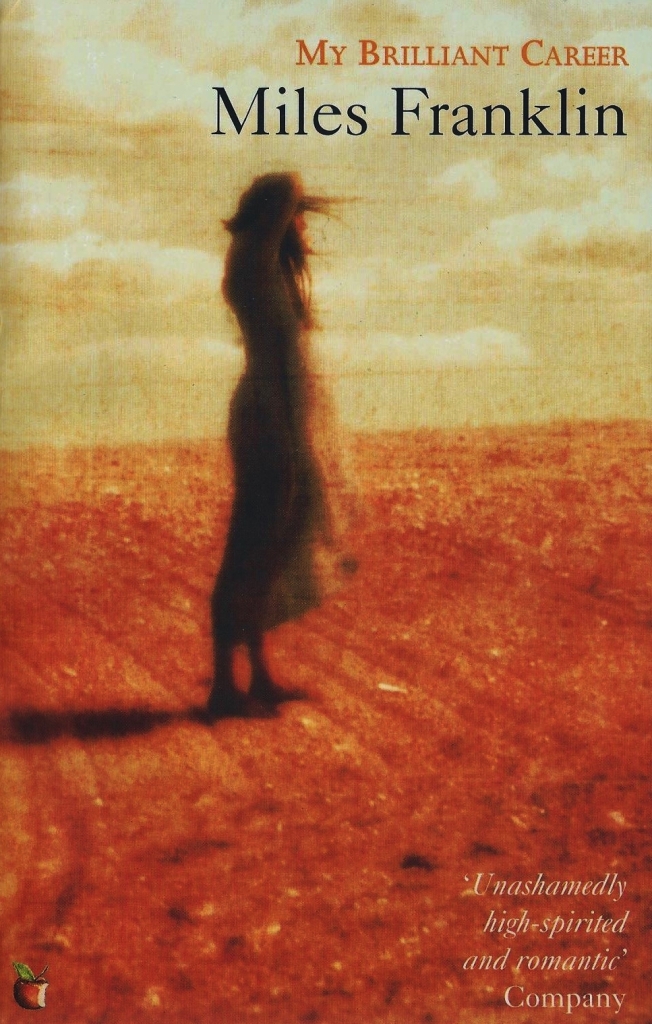
my brilliant career virago press miles franklin 001 (2)My Brilliant Career by Miles Franklin ~ 1901. This edition: Virago, 2002. Introduction by Carmen Callil. Paperback. ISBN: 0-86068-193-9. 232 pages.

My rating: 8.5/10

My sphere in life is not congenial to me. Oh, how I hate this living death which has swallowed all my teens, which is greedily devouring my youth, which will sap my prime, and in which my old age, if I am cursed with any, will be worn away! As my life creeps on for ever through the long toil-laden days with its agonizing monotony, narrowness, and absolute uncongeniality, how my spirit frets and champs its unbreakable fetters—all in vain!

Whoa, steady on, there!

These emotions, from the introduction of My Brilliant Career, written in the voice of fictional autobiographer, almost-seventeen-year-old Sybylla Melvyn, absolutely sob teen angst. Appropriately so, for their real author, Australian Stella Maria Sarah Miles Franklin, was just sixteen herself when she dashed these words off in the late 1900s, and the youth of the author is very evident throughout the story.

The fictional Sybylla starts life as the indulged child of a successful New South Wales landholder and an aristocratic mother. When Sybylla is eight years old, a prolonged drought inspires her father to change his occupation, to that of a stock dealer in nearby dairy-farming region, and the landholdings are sold and the family relocated to a much smaller farm. Sybylla’s father proves to be a very poor businessman, and his escalating failures start him drinking to excess, until the family’s circumstances become reduced to the point of bankruptcy. Sybylla’s mother is predictably soured by all of this, and her frustration with her declining lot in life and with her continually sulking eldest daughter comes to a head. Sybylla is told to get out into the world and earn a living, as the family cannot support either her careless ways or her continued financial drain on family resources. A reprieve comes through an offer by Sybylla’s well-off maternal grandmother to come and live on the family estate.

Sybylla finds life at her grandmother’s very congenial, and she blossoms into something of a local belle, eventually attracting the attention of the district’s wealthiest bachelor, the dashing Harry Beecham. Harry and Sybylla come to a tentative agreement – tentative, anyway, on Sybylla’s part, though ironclad on Harry’s – that she will marry him once she turns twenty-one. As she is just seventeen when this takes place, anything might happen in the ensuing years, and of course it does.

Harry loses his estate and leaves the district in order to re-establish himself; Sybylla’s parents send for her to take on a post as a governess with a family friend who has loaned the Melvyns money; Sybylla’s labors will count towards the interest. This proves to be a squalid and humiliating experience; Sybylla ends up having a nervous and physical breakdown, and returns to her parents’ home to recuperate, much to their combined dismay.

Harry returns, with fortune well on its way to being restored, but Sybylla has developed a deep antipathy to the married state, having observed the brutal physical and emotional effects of even a happy marriage on the women she has been observing as she becomes ever more acquainted with the wider world. Though Harry offers her a deep respect and swears that he will allow her the freedom to pursue her own interests (writing and music), and she is herself more than a little in love with him, she is ultimately unable to commit herself to him, and there Sybylla’s story abruptly ends.

This novel was an immediate bestseller, and brought the young author – Miles Franklin was twenty-one when it appeared – much fame and notoriety, as it was claimed by the publisher to be autobiographical, and the parallels between aspects of the lives of fictional Sybylla and real-life Miles were too obvious to dismiss. Teenage girls thrilled to Sybylla’s emotional outpourings and her desire to make something of herself, to have a “brilliant career”. The melodramatic tone of the tale caught adult readers’ attention, while family friends and neighbours raised querying eyebrows at the “Franklin girl’s” manipulation of the facts, and eagerly purchased the book for its curiousity value.

Despite the welcome income her debut novel brought, Miles Franklin was appalled at how it was received, and by the assumption that her family was accurately portrayed; she had meant it as a fiction. When her publisher inquired as to whether she would allow a second edition, Miles Franklin staunchly refused, and the book went out of print, until it was finally reissued in 1966, twelve years after her death.

The emotions expressed in the novel, chiefly those of frustration at the lack of opportunities for education and professional development for women, resonated with the modern feminists of the 1960s, and My Brilliant Career has been in print ever since, a highly regarded piece of early feminist literature, and a blazing example of a young woman’s refusal to bow to the status quo.

So much for the “meaningful” aspect of this book. Was it a “good” read?

Well, yes. It really was. I enjoyed it greatly.

Sybylla, for all of her over-the-top rantings about the woefulness of her life, early on turns into a very real and relatable character. I found that I was completely drawn in to her rather heart-rending little saga, and though I had moments of wanting to shake her vigorously – my “mother” side coming to the fore, I’m sure – I was completely on her side throughout. I sighed a bit when she turned down Harry Beecham at the very last; he was a wonderful catch, especially for the time and place. It was touch and go there for a bit, until Sybylla’s deeply entrenched intention of lifelong single womanhood got the upper hand!

Fascinating, then, to read the “sequel” to My Brilliant Career, which was written soon after the first book was published, but which was turned down by the publisher because of fear of scandal. More below.

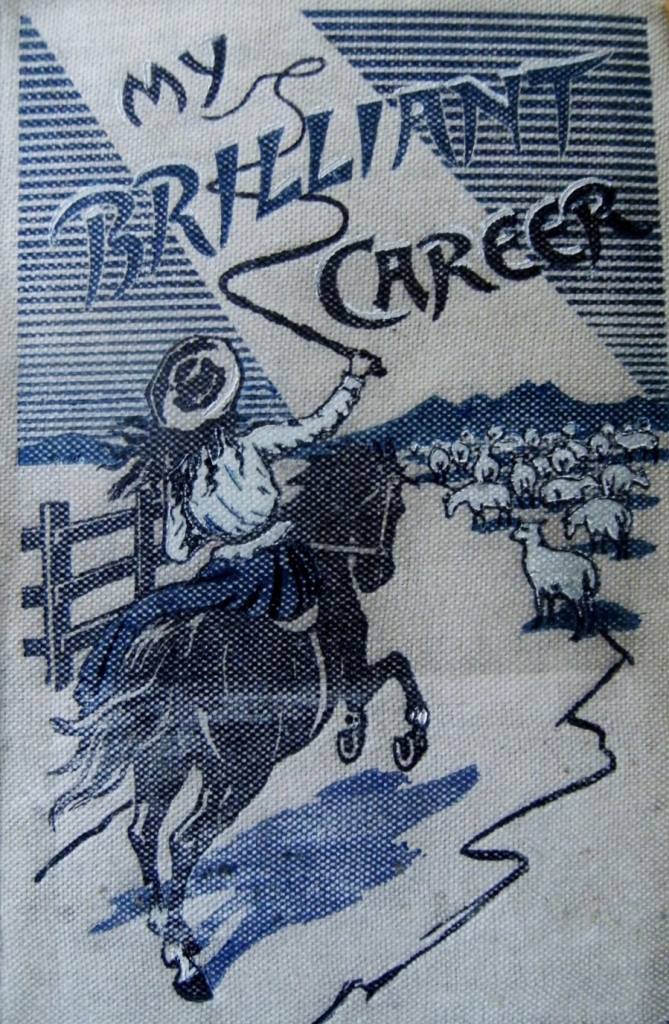
First edition cover of "My Brilliant Career", which is gently mocked in the author's sequel/rebuttal, "My Career Goes Bung".

First edition cover of “My Brilliant Career”, showing the illustration which is gently mocked in the author’s sequel/rebuttal, “My Career Goes Bung”.

my career goes bung virago press miles franklin 001My Career Goes Bung by Miles Franklin ~ 1946. This edition: Virago, 1981. Foreword by Verna Coleman. Paperback. ISBN: 0-86068-220-X. 234 pages.

My rating: 9/10

I bless the serendipity which brought this book to me just before Christmas, when I was assembling books for the Century reading challenge. The name “Miles Franklin” was in the forefront of my awareness, having just purchased her first novel, My Brilliant Career, to represent 1901, and that in combination with the green Virago cover caught my eye.

While My Brilliant Career is something of a curiousity, a teenage writer’s attempt at dramatic fictional autobiography, My Career Goes Bung shows a polish and maturity which make me eager to explore more of this writer’s work.

The back story behind the delayed publication of the novel is fascinating as well. Written in 1902, concurrent with the author’s brief social success in Sydney as an up and coming young writer due to the instant popularity of My Brilliant Career, this next novel was returned by Franklin’s publisher with a terse, “No, thanks!”, citing fears of libel suits as well as concerns about its audacious and “advanced” views on sexuality and women’s rights. Miles Franklin then packed the manuscript away, and for decades believed it to have been destroyed, until the discovery of a second copy in an old trunk of her mother’s led to its publication in 1946.

In My Career Goes Bung, we are introduced to the “real” Sybylla, the young woman who has penned a bestseller based very loosely on fact, but which has been accepted as strictly autobiographical. In My Brilliant Career the fictional Sybylla’s parents and associates are portrayed as much less than admirable, and it is not at all surprising that the young author finds herself humiliated by the whole experience, and deeply apologetic to her parents, who were in actuality supportive of the young Sybylla’s literary strivings.

Peeling away the layers then, we have three characters to consider while reading these books. At the core, the very real person, Miles Franklin. Then her sympathetic alter-ego, the Sybylla Number Two of My Career Goes Bung, and lastly the teenage creation of excessive emotion and high imagination, Sybylla Number One, of My Brilliant Career.

Got that? It’s not all that complicated once one is immersed in the books; it all falls into place quite neatly. (Trust me!)

Sybylla Number Two goes off to Sydney to attempt to take advantage of the hubbub around her bestselling novel and to meet some of the literary stars of the day, with an eye to advancing her writing career. She is greeted with enthusiasm as the novelty of the moment, the little “bush girl” in her simple frocks, very much the innocent abroad, fending off the wolves by her impermeable naïvety in regards to their social manipulations, and in the case of many of the men, their sexual advances.

Sybylla attracts the eye of the handsome, calculating and immensely successful Goring Hardy, a thinly disguised version of the real-life “Banjo” Paterson (Waltzing Matilda, The Man From Snowy River, et al), who finds the virginal Sybylla a tempting prospect for conquest. Sybylla submits to his caresses, but allows no further liberties than some hot and heavy fondling and kissing; at the end of a week of secretive meetings, both parties realize that the relationship is not about to progress any further, and politely part ways. (Miles Franklin did have a short-term relationship of some sort with Paterson, hence the libel suit fears in regard to the fictional version.)

Sybylla is apparently something of a “babe” – in the most modern sense of the term – attracting the lavicious attentions of every many she meets. Another suitor, one Henry Beauchamp, assumed by all to be the original of the dashing Harry Beecham of My Brilliant Career, appears to vigorously woo Sybylla, but she spurns his frequent marriage proposals with steadfast determination. Sybylla then rather scornfully dismisses Sydney society as an artificial and fickle atmosphere antipathetic to true creativity, and returns to her family home more than ever determined to live the life of an independent woman, unshackled by the chains of marriage and childbearing, to pursue her ideals alone.

The End. (With the sound of enthusiastic feminist cheering faintly off on the sidelines.)

The real Miles Franklin stood by her convictions as firmly as did her fictional alter-ego. Though courted by many men, she never married. She continued to further develop her unique literary voice, supporting herself while writing by a variety of occupations, including nursing, housemaiding, and working as a secretary. She adopted the unlikely and picturesque nom-de-plume “Brent of Bin Bin”, avoiding her (modified) real name in order to sidetrack unfavourable comparisons of her subsequent work to My Brilliant Career, and had a modest success in her lifetime as a writer of Australian historical sagas and slightly quirky fictions.

Miles Franklin. I don’t think I’m quite done with her yet. What an interesting writer. Century of Books, you’ve already introduced me to a number of new-to-me mind-broadening reading experiences, of which this one stands out, so early along. I wonder what other happy surprises this reading year will bring?

Project Gutenberg Australia has a number of Miles Franklin’s works represented online, well worth looking at. My Brilliant Career and My Career Goes Bung are widely available in physical book form, in some cases as a combined edition, which I highly recommend. The second book enhances the first, and they greatly reward being read together.

Read Full Post »

the princess priscilla's fortnight elizabeth von arnim 001The Princess Priscilla’s Fortnight by Elizabeth von Arnim ~ 1905. This edition: Smith, Elder & Co., 1906. Hardcover. 329 pages.

My rating: 7.5/10

Her Grand Ducal Highness the Princess Priscilla of Lothen-Kunitz was up to the age of twenty-one a most promising young lady. She was not only poetic in appearance beyond the habit of princesses but she was also of graceful and appropriate behaviour. She did what she was told; or, more valuable, she did what was expected of her without being told. Her father, in his youth and middle age a fiery man, now an irritable old gentleman who liked good food and insisted on strictest etiquette, was proud of her on those occasions when she happened to cross his mind. Her mother, by birth an English princess of an originality uncomfortable and unexpected in a royal lady that continued to the end of her life to crop up at disconcerting moments, died when Priscilla was sixteen. Her sisters, one older and one younger than herself, were both far less pleasing to look upon than she was, and much more difficult to manage; yet each married a suitable prince and each became a credit to her House, while as for Priscilla,—well, as for Priscilla, I propose to describe her dreadful conduct.

German Princess Priscilla is finally facing an appropriately marriageable suitor, a personable prince with a suitably secure income, and all that is left is to arrange the formal engagement. But the princess is suffering from what would vulgarly be called “cold feet”, so she dreams up a plan to escape from her overly lavish courtly surroundings, “where one is never alone”, by taking up an incognito life in an English country cottage with her personal mentor, the elderly ducal librarian, who sympathizes with Priscilla’s secret desire to pursue the beautiful simple life.

Bribing one of Princess Priscilla’s maids to go on ahead and meet them in Cologne, prefatory to travelling through France and crossing the Channel, Priscilla and Herr Fritzing disguise themselves in old clothes, scarves and veils and depart the castle on bicycles. Luck smiles on them; they make a clean getaway, and eventually fetch up in the English countryside, where they turn a sober village upside down by their joint combination of well-meaning naïvety and high-handed snobbishness.

Two young men fall immediately head over heels in love with the oblivious princess, two households are bitterly disrupted, and then the cheerful farce of this improbable adventure turns even more sober when Priscilla’s thoughtlessness and misplaced generosity causes a hitherto honest young woman to turn thief through irresistible temptation, and an elderly woman to be murdered for the money Priscilla has given her.

Once luck deserts the two idealistic German vagabonds, it does so with a vengeance. Their emotional maid, deeply resentful of her lowly position and the assumption that she will take on menial tasks unthought-of in castle days, blackmails Herr Fritzing for his last penny. The indignant mothers of Priscilla’s two local suitors descend upon the household with their respectively outraged and tearful maternal woes, and the local tradespeople send in their bills and refuse to extend any more credit to the suddenly-beleaguered establishment.

Luckily this is by way of being a fairy-tale-ish confection, and a bold rescuer appears from an unexpected direction. Priscilla comes away from her rural fortnight a much sadder and wiser young woman, and the obvious morals are writ large in bold letters all over the concluding chapters.

This playful story with a semi-serious message is a very readable light novel, something along the lines of The Enchanted April and The Jasmine Farm in tone, with a similarly neat and tidy satisfactory ending. Perhaps not one of von Arnim’s best and most complex works, but more than acceptable for cheerful diversion, and charmingly witty, with the author getting her usual digs in at the Germanic patriarchy’s tendency to squelch their women into an acceptable meekness.

Here is Princess Priscilla at Project Gutenberg, and here are several other favorable reviews:

The Captive Reader ~ The Princess Priscilla’s Fortnight

Geranium Cat’s Bookshelf ~ The Princess Priscilla’s Fortnight

Read Full Post »

green mansions 1944 dj w h hudsonGreen Mansions: A Romance of the Tropical Forest by W.H. Hudson ~ 1904. This edition: Random House, 1944. Introduction by John Galsworthy (1915); illustrations by E. McKnight-Kauffer. Hardcover. 303 pages.

My rating: 3.5/10

Memorable and deserving of its status as a literary classic? “Yes” to the first bit – it is definitely memorable – and “Sure, okay, I guess so” to the second. I can see how this one caught people’s attention, with its exotic setting and all. In 1904 deepest darkest Amazonia was still fairly blank on the world map.

Enjoyable reading? I am so sad to say that as far as I’m concerned, this is an emphatic “No!”

Ugh. It’s been a very long time since I read something that repelled me as deeply as did Green Mansions, glowing descriptions of Amazonian flora and fauna and Galsworthy’s effusive foreword aside.

Venezuelan aristocrat Abel gets mixed up in a failed coup and must flee for his life. He ends up in the interior of Guayana, someplace beyond the Orinoco River. As he wanders about, doing a bit of hunting here, a bit of gold prospecting there, he starts to gain an appreciation for the natural wonders of the jungle. He then falls in with a small tribe of “savages” and decides that maybe this would be a cool place to hang out for a while. Impressing the chief savage with the gift of a silver tinderbox, Abel slings his hammock in the corner of the communal shelter and settles down to being waited on by the women in between stints of building himself a guitar and condescendingly teaching the youngsters of the group to fence with wooden foils.

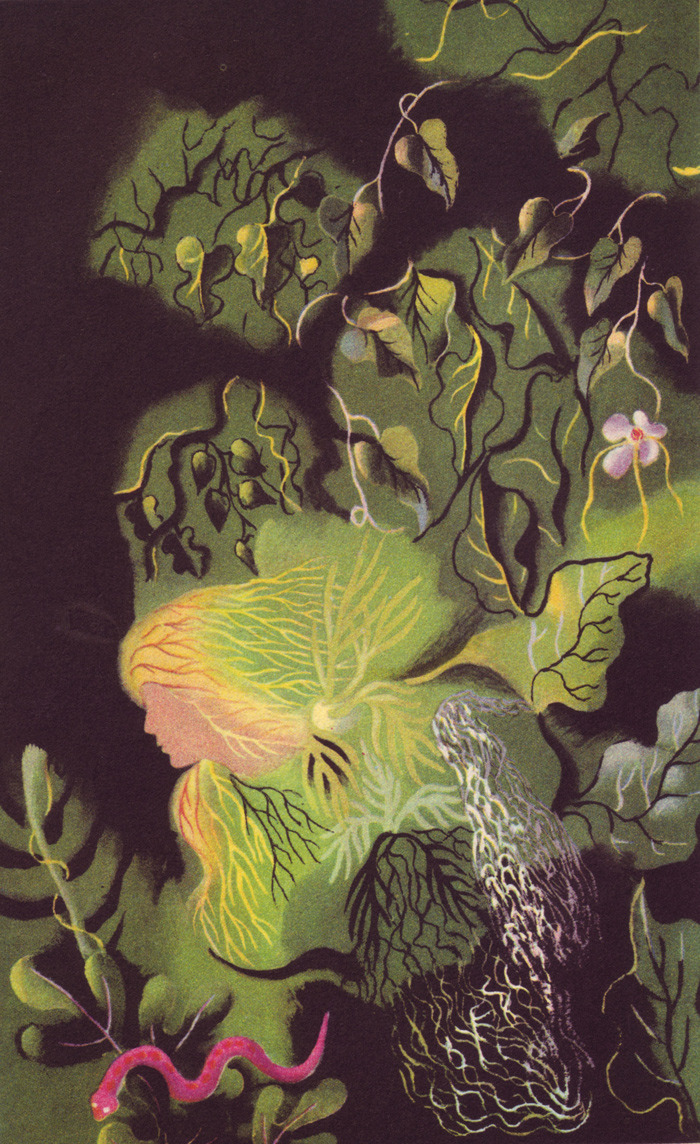
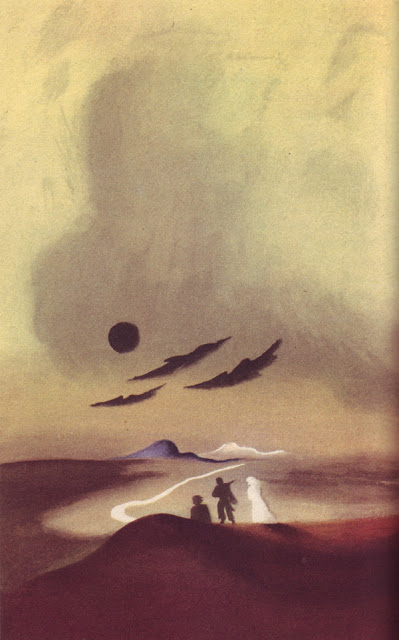
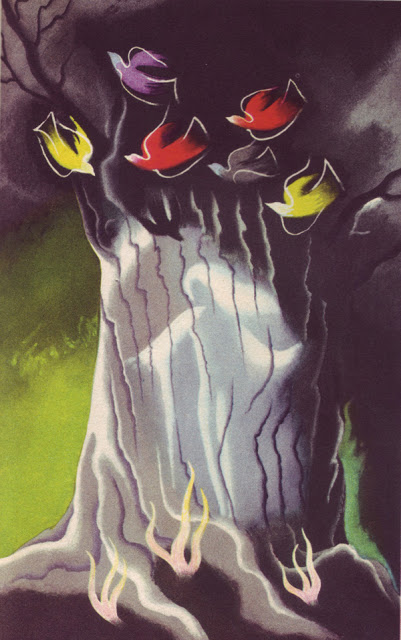
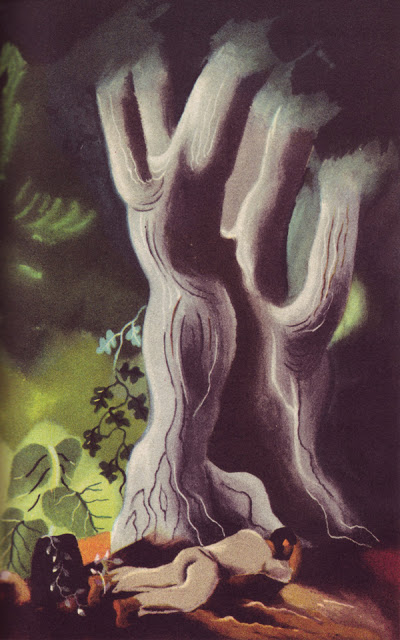
The E. McKnight-Kauffer illustrations in my 1944 edition of this book are lovely; the best part of the book!

The E. McKnight-Kauffer illustrations in my 1944 edition of this book are lovely; the best part of the book! Check out all the symbolic details that the illustrator has included here.

To condense greatly (which I wish the author would have) Abel encounters a mysterious girl in the nearby forest, in the taboo region where his host tribe will not hunt. She teases him with glimpses of her lovely self, all the while whistling and chirping like a mysterious bird. Eventually the two make contact, but as he embraces the elusive creature Abel is bitten by a deadly coral snake. He flees through the forest, expecting death at any moment, stumbles upon the camp of an old European man, and collapses. When he comes to, miraculously on the mend from the snakebite, he finds that he has found Bird Girl’s “grandfather”, a shifty-eyed elderly bearded type named Nuflo.

Much twittering about the forest ensues, Abel lusting after Rima (which turns out to be Bird Girl’s name) and Rima being all ethereal and hard to get. She’s the wood nymph protector of the forest creatures, etcetera. Meanwhile Nuflo daily sneaks off with his two dogs and surreptitiously kills the odd little animal, which he devours in a secret hideaway, joined by Abel who is getting rather famished living on the roots and berries which Rima feels are the only food needed to sustain life.

At some point all three go off to the place “twenty days away” where Nuflo discovered her wounded mother, on a quest to find Rima’s hypothetical vanished tribe. (Nuflo, “grandfather” title to the contrary, is actually no relation, but he had appointed himself guardian of the tiny child when her mother eventually died, some ten years before Abel enters the picture. Rima is now seventeen, making her ripe for love and hence fair game, as the author continually implies.)

Off to find the lost tribe.

Off to find the lost tribe.

Anyway, Abel convinces Rima that her mother’s tribe appears to be truly vanished, and Rima decides to return to the forest, leaving Abel and Nuflo to follow at their own pace, because she’s just so darned marvelous and ethereal (not to mention weather resistant in her spiderweb dress) and not requiring of any boring shelter or cooked food so she can travel so much faster than the menfolk. And she wants to prepare a lovely forest home for herself and Abel, as she has finally agreed to give in to his passionate entreaties, but she wants them to “do it” properly in nice surroundings.

So imagine Abel’s feelings when he and Nuflo come back home to find that the savages have chased Rima to the top of a tall tree and then burned it down, with her plunging to a fiery death. We don’t get to witness this, just hear about it from one of the savages, leading to the false hope that Rima may still be alive out there in the forest. (Spoiler: She isn’t.)

Rima's spirit lives on is the gist of this one, I think.

Rima’s spirit lives on is the gist of this one, I think.

Abel vows revenge, and goes to the next tribe of savages over (who are, naturally, sworn enemies to the first tribe of savages) and sets them to slaughter tribe of savages number one. Once everyone is dead (including Nuflo), Abel scrapes up Rima’s ashes, makes an ornate clay urn to contain them, and returns to civilization, where he spends his time pondering the wickedness of man, the glorious wonder of nature, and the sad fate of his bird girl.

I’m trying to think of one single character who didn’t make me want to vehemently cuff them at some point, but nope, can’t do it. Rima is just plain annoying, with her teasing girlish ways, her glowing red eyes, greyish-ivory skin, cloud of halo-like hair and spiderweb dress. Abel is a lout, living off the locals and rudely critiquing every detail of their morals, intelligence, appearance and lifestyle. Nuflo is shady to the nth degree, and the native tribespeople are paradoxically portrayed as universally unintelligent, deeply superstitious and highly manipulative.

I am glad I finally read this book, as it is so highly regarded by so many and so often referenced in literature, but I am even gladder to have turned the last page, and I have zero intention of ever reading it again.

Onward then, to something more palatable. I deserve something really good, I think, to take the taste of this one away. Let’s see now… maybe something by Elizabeth von Arnim? Of a similar vintage, to restore my faith in authors of this era.

This is how I felt after reading this book. (The illustration is actually from early on in the story, when Abel despairs at getting his hands on the elusive Rima.)

This is how I felt after reading this book. (The illustration is actually from early on in the story, when Abel despairs at getting his hands on the elusive Rima.)

And please don’t let my snarly review put you off. Thousands thrilled to this book, and you might well be among them. Here it is, online at Project Gutenberg.

Green Mansions by W.H. Hudson

Has anyone else read this? Loved it or despised it or felt completely ambiguous about it? Please do share!

Read Full Post »

« Newer Posts - Older Posts »