Posts Tagged ‘Century of Books 2014’

my mother in law celeste andrews seton 001My Mother-in-Law by Celeste Andrews Seton ~ 1954. This edition: Michael Joseph, 1954. Hardcover. 239 pages.

My rating: 8/10

Foreword

Jay Gould died at his home at 579 Fifth Avenue, New York, in 1892. During his lifetime he amassed one of the largest fortunes in the United States. It is estimated that at one time his ownership of stocks and bonds in railways covering 18,000 miles of track, transatlantic cables, mining, land and industrial corporations, totaled over a thousand million dollars.

This story is based on the life of Jay Gould’s eldest daughter, Helen Gould Shepard. Her four adopted children agree that this book s an emotional and spiritual image of their foster-mother. They disagree, however, about some of the facts. Helen Anna says that the sweet peas did not win a prize at the flower show – the lilies did. Finley Jay says he doesn’t remember the flower show at all. Louis will not commit himself. Olivia says she is, frankly, a little fuzzy about it, but doesn’t see what difference it makes…

Attracted by its quietly elegant spine decoration, I pulled this slender hardcover off a crowded shelf in one of Vancouver several deluxe emporiums of used tomes, Lawrence Books (on the corner of Dunbar and 41st). Raising an eyebrow slightly at the pencilled price on the inner flyleaf – this is a store that thinks very highly of its dusty treasures, few bargains to be had here – I nevertheless was charmed enough by a few moments leafing through to add it to my small pile of promising finds.

Upon arriving home, My Mother-in-Law gravitated immediately to my bedside table, providing me with several late nights of soothing diversion during a hectic week full of all sorts of frantic activity.

The daughter-in-law who has penned this loving memoir first met her prospective husband while on vacation with her mother in the Adirondacks. Celeste finds the surprisingly accomplished Louis Seton less than forthcoming about his antecedents, but as she is twenty-one and nicely independent she abandons herself to the course of true love, eventually accepting Louis’ marriage proposal in a New York taxi. Only while preparing to break the news of her betrothal to her bemused parents – “Who is this Louis Seton, and why does his name sound vaguely familiar, even though we’ve never come across his parents in our society visits?” – does Louis rather shamefacedly spill the beans.

He is the foster-son of the richest woman in the United States, Helen Gould Shepard, eldest daughter of the incredibly rich “American robber baron” Jay Gould.

All right, then.

Celeste goes to meet her prospective in-laws with more than a little apprehension, and what she finds when she goes to that first afternoon tea is just a bit unnerving. Louis’ mother is, as Louis warns Celeste, perhaps a tiny bit eccentric.  Mother Shepard not only knows her Bible inside and out, she believes in it as the Literal Truth, and is prone to discuss it at any time, and to prescribe passages to memorize, which she will later examine her visitor upon. Celeste is put on the spot and manages to trot out the 23rd Psalm, the only Bible passage she knows by heart. Mother Shepard gently approves, but her mild manner does not mask her keen eye, and Celeste realizes that she had better brush up on her Bible reading, amongst other things.

Mother Shepard approves of Herbert Hoover – there is a huge jigsaw puzzle of his profile in a state of semi-completion in the parlour – and disapproves of communism. She sadly condemns Celeste’s alma mater, Smith College, as a hotbed of communist plotting: “They have parades there. By torchlight. And they don’t believe in God. It’s too bad…”

Celeste is presented with a peacock-feather quill pen and ordered to sign the massive guest book. She is plied with tea and avocado sandwiches, and watches in wonder as Mother Shepard feeds her Pekinese dog, Chinky, as he reclines on a velvet footstool. (Later we are to learn that this Chinky is merely one of a long line of identically named pets; as each expires from the effects of unsuitable diet and lack of exercise, another takes its place; the name stays the same while the actual dogs succeed each other, victims of a benignly intended but ultimately fatal pampering.)

Upon parting Celeste is presented with a huge corsage of white orchids, grown in one of the fabulous Shepard greenhouses, and she stumbles out into the real world feeling like she has been on another planet. But a most cozy and well-upholstered one, though there is something a bit tense in the atmosphere.

Helen Gould Shepard, unable to have children of her own, had adopted four foster children and raised them in her own unique manner. Though her generosity is boundless, the now-adult children are all still just a tiny bit terrified of their benevolent mother, whose ideas on child-rearing included “punishments” of memorizing poetry and foreign languages and operatic passages. Louis is most accomplished in all of these , as Celeste has already discovered, leading her to speculate uneasily upon the “naughtiness” of his childhood…

Though his foster-mother is exceedingly wealthy, Louis himself is not an heir to the Gould fortune, as Jay Gould’s will included a clause regarding the necessity for his ancestors to be “blood-issue”, but there does appear to be a substantial trust fund, easing Celeste and Louis’ setting up housekeeping in the darkest days of the Depression.

Many visits to the various Shepard residences follow in the years to come, and Celeste, while remaining slightly bemused at her mother-in-law’s thought processes, comes to love Mother Shepard deeply and to admire her sincere urges to do good, even while realizing that occasionally Mother Shepard’s philanthropies are subject to whim and arbitrary judgement.

This is an entertaining, kindly humorous and rather unusual memoir. It presents a one-of-a-kind picture of both a unique personality and of a way of life that was exclusive to only a very tiny percentage of the American population – the wealthiest of the exceedingly wealthy – in their specific moment in history.
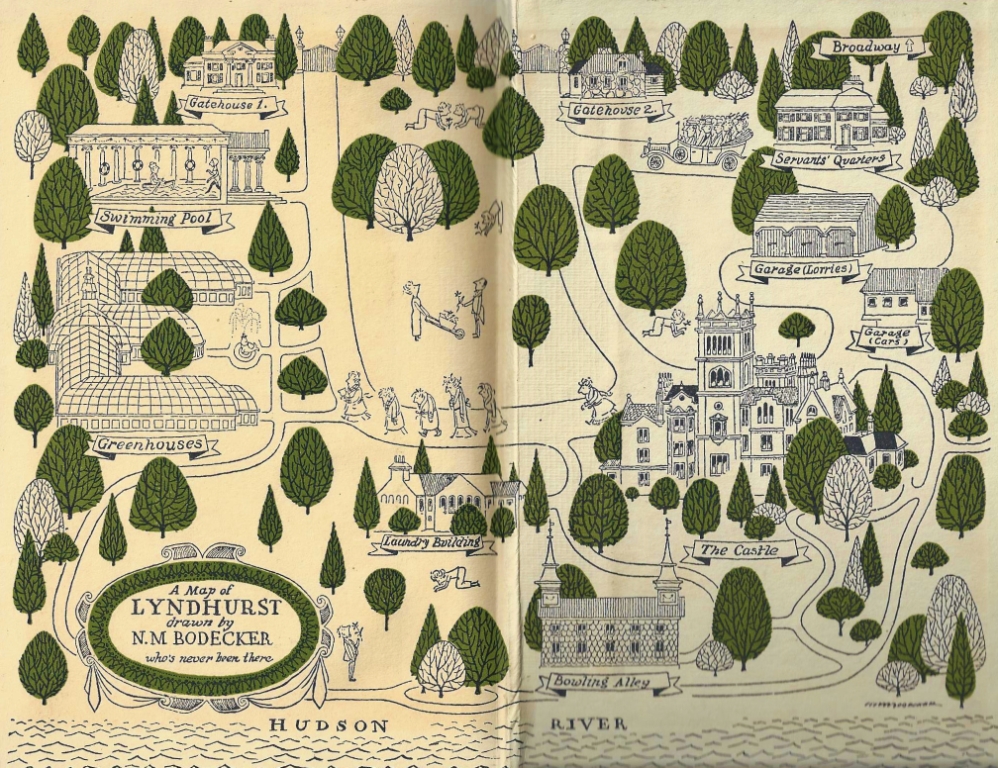
Gorgeous endpaper illustrations show a map of Helen Gould Shepard's favourite "home", the family country estate of Lyndhurst. Small illustrations depict incidents described in the memoir: the nighttime procession of the entire household to see the fabulous night-blooming cereus in the conservatory; grubbing up dandelions in the lawn under Mother Shepard's watchful eye; going to church en masse packed into one of the nine Shepard motorcars; swimming in the Greek-columned pool, watched over by a full-time lifeguard, whose main claim to usefulness was that he had once rescued one of the many Chinkys from a watery death!

The delightful endpaper illustrations show a map of Helen Gould Shepard’s favourite “home”, the family country estate of Lyndhurst. Small illustrations depict incidents described in the memoir: the nighttime procession of the entire household to see the fabulous night-blooming cereus in the conservatory, grubbing up dandelions in the lawn under Mother Shepard’s watchful eye, going to church en masse packed into one of the nine Shepard motorcars, and swimming in the vast Greek-columned pool, watched over by a full-time lifeguard, whose main claim to fame was that he had once rescued one of the many Chinkys from a watery death!
Read Full Post »

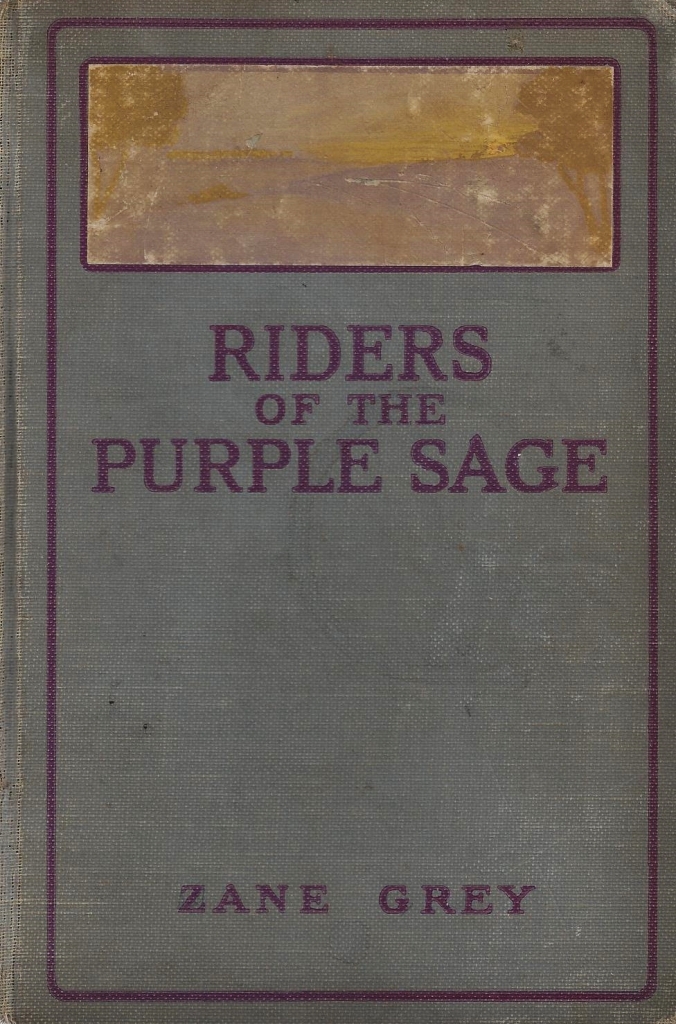
riders of the purple sage zane grey personal copy 001Riders of the Purple Sage by Zane Grey ~ 1912. This edition: Grosset & Dunlap, circa 1920s. Illustrations by Douglas Duer. Hardcover. 335 pages.

My rating: 3.5/10

Oh, Lassiter, you big black-clad gun-slinging hero of this desperately romantic book, if I ever find it within me to start to read this one again, please rise up off the printed page, leap off your amazing blind horse, unholster your big black pistol, and shoot me right away. Don’t just nick a lung, like your buddy Venters did to the virginally beautiful Bess as she trotted past his desperate hideout garbed in her Masked Rider’s disguise, but kill me outright, same as you did Mormon Bishop Dyer, despoiler of your late sister and destroyer of her happy marriage. Except maybe don’t shoot me in the arms first, as you did him, before blasting five more holes in his chest. Just aim for my heart, and make it quick.

Gar. What a book. Wow.

So bad.

What was I thinking?

Oh, yeah, that whole “classic of American literature and mold-maker of the classic Western genre” thing.

I’m not even going to touch the Important Book for Various Reasons argument, but am going to go instead to Pleasure of Reading for a Modern Reader. (Meaning me.) Did I enjoy this book? Mostly, no. The novelty of the plushly purple prose paled quickly, and despite the campy sense of irony I felt as I doggedly waded through the story it wasn’t enough to make it an acceptably good experience.

It’s 1871 in Utah, and the Mormons are well-established, top-dogging it marvellously well with their polygamous colonies headed by manly men wedded to legions of willing wives. So when rich Mormon rancher’s daughter Jane Withersteen spurns the advances of the man chosen for her by the local Mormon bishop and insists on carrying on with her charity to the impoverished Gentile (blanket term for anyone non-Mormon) families of the area and her hiring of Gentile riders to care for her seven thousand head of range cattle, events start to escalate.

riders purple sage zane grey old djJust as Jane’s chief Gentile Rider, Venters, is about to be hauled off by a posse of Mormons, fate in the guise of black-clad, gun-slinging, Mormon-hating Lassiter arrives in the nick of time. The Mormons withdraw muttering, to go off and devise clever plans of revenge and sabotage against uppish Jane, while she enjoys (for a while) the loving devotion of two passionate men. (Venters and Lassiter.)

“Then I’ll have you whipped within an inch of your life,” replied Tull, harshly. “I’ll turn you out in the sage. And if you ever come back you’ll get worse.”

Venters’s agitated face grew coldly set and the bronze changed to gray.

Jane impulsively stepped forward. “Oh! Elder Tull!” she cried. “You won’t do that!”

Tull lifted a shaking finger toward her.

“That’ll do from you. Understand, you’ll not be allowed to hold this boy to a friendship that’s offensive to your Bishop. Jane Withersteen, your father left you wealth and power. It has turned your head. You haven’t yet come to see the place of Mormon women. We’ve reasoned with you, borne with you. We’ve patiently waited. We’ve let you have your fling, which is more than I ever saw granted to a Mormon woman. But you haven’t come to your senses. Now, once for all, you can’t have any further friendship with Venters. He’s going to be whipped, and he’s got to leave Utah!”

“Oh! Don’t whip him! It would be dastardly!” implored Jane, with slow certainty of her failing courage.

Tull always blunted her spirit, and she grew conscious that she had feigned a boldness which she did not possess. He loomed up now in different guise, not as a jealous suitor, but embodying the mysterious despotism she had known from childhood—the power of her creed.

Lots of stuff then happens, most of it involving the Mormons and Jane’s Gentile champions plus an independent gang of rustlers shooting at each other (frequently fatally), stealing cattle and prize racehorses, befriending a cute little orphan four-year-old (“Duz oo wuv me, Muvver Jane?”), finding a secret hidden valley and thousand-year-old abandoned cliff dwellings (an enjoyable interlude which added on a point or two to my brutally low rating), panning for gold (“washing” gold, nice topical reference), ambushing, wounding and restoring to life a lovely young girl disguised as a boy cattle rustler, charging about on various noble steeds including Lassiter’s original blind steed (who perishes tragically), two black Arabians (Jane and Lassiter) and a rugged yet awesomely sturdy and fast range horse (Wrangle, ridden by Venters) who in turn is stolen by a bad guy and ends up being shot by his loving owner in order to ensure the demise of the bad guy rider.

And much else.

This is a very multi-stranded story with lots going on, and you have to hand it to Zane Grey, he deserves credit for being ambitious with his intentions.

Here’s another snippet of the text:

He lifted her—what a light burden now!—and stood her upright beside him, and supported her as she essayed to walk with halting steps. She was like a stripling of a boy; the bright, small head scarcely reached his shoulder. But now, as she clung to his arm, the rider’s costume she wore did not contradict, as it had done at first, his feeling of her femininity. She might be the famous Masked Rider of the uplands, she might resemble a boy; but her outline, her little hands and feet, her hair, her big eyes and tremulous lips, and especially a something that Venters felt as a subtle essence rather than what he saw, proclaimed her sex.

Western garb and setting aside, Riders of the Purple Sage is purely an über-traditional romance, and the two female love interests – Jane Withersteen and ex-Masked Rider Bess – are both , despite their brief moments of sturdy independence – Jane in standing up to her Church, and Bess in her mastery of horsemanship –  at heart simpering girly-girls all a-dither with love for their manly men, whom they then order hither and yon with feminine whimsy. The menfolk, being blinded by Love, trot willingly to and fro, breaking out occasionally (“Sorry, lost my temper and killed your dad”) and being instantly forgiven (“That’s okay, he wasn’t my real dad, even if he raised me from a tiny baby and gave me total love and devotion and protected me from the wicked men who sought to ruin me and gave me a proper education and everything”) and generally being tweaked about on silken leading strings.

riders purple sage zane grey old illustrated coverAnd despite spending weeks alone with each other – Lassiter and Jane holed up in the ranch house, Venters and Bess in the hidden valley – the most physical they get with each other is the occasional embrace (with the men nobly holding themselves back from the passions engendered by contact with the heaving breasts of the beloved) and a few rather chaste kisses. These guys (and gals) were made of steel! This is romantic fiction at its best, all heaving bosoms and blushes and occasional fainting and manly-passion-held-in-check just a-waiting for a woman’s word and the arrival of a preacher man to hold a marriage ceremony before going any further.

Oh, yes. And then there’s all the “western” dialect:

The rider thundered up and almost threw his foam-flecked horse in the sudden stop. He was a giant form, and with fearless eyes.

“Judkins, you’re all bloody!” cried Jane, in affright. “Oh, you’ve been shot!”

“Nothin’ much Miss Withersteen. I got a nick in the shoulder. I’m some wet an’ the hoss’s been throwin’ lather, so all this ain’t blood.”

“What’s up?” queried Venters, sharply.

“Rustlers sloped off with the red herd.”

“Where are my riders?” demanded Jane.

“Miss Withersteen, I was alone all night with the herd. At daylight this mornin’ the rustlers rode down. They began to shoot at me on sight. They chased me hard an’ far, burnin’ powder all the time, but I got away.”

And the reams of descriptive prose. You can certainly tell that Zane Grey got his start writing pulp fiction which was paid for by the word, because he does pack them in.

Venters … went to the edge of the terrace, and there halted to survey the valley.

He was prepared to find it larger than his unstudied glances had made it appear; for more than a casual idea of dimensions and a hasty conception of oval shape and singular beauty he had not had time. Again the felicity of the name he had given the valley struck him forcibly. Around the red perpendicular walls, except under the great arc of stone, ran a terrace fringed at the cliff-base by silver spruces; below that first terrace sloped another wider one densely overgrown with aspens, and the center of the valley was a level circle of oaks and alders, with the glittering green line of willows and cottonwood dividing it in half. Venters saw a number and variety of birds flitting among the trees. To his left, facing the stone bridge, an enormous cavern opened in the wall; and low down, just above the tree-tops, he made out a long shelf of cliff-dwellings, with little black, staring windows or doors. Like eyes they were, and seemed to watch him. The few cliff-dwellings he had seen—all ruins—had left him with haunting memory of age and solitude and of something past. He had come, in a way, to be a cliff-dweller himself, and those silent eyes would look down upon him, as if in surprise that after thousands of years a man had invaded the valley. Venters felt sure that he was the only white man who had ever walked under the shadow of the wonderful stone bridge, down into that wonderful valley with its circle of caves and its terraced rings of silver spruce and aspens.

The dog growled below and rushed into the forest. Venters ran down the declivity to enter a zone of light shade streaked with sunshine. The oak-trees were slender, none more than half a foot thick, and they grew close together, intermingling their branches. Ring came running back with a rabbit in his mouth. Venters took the rabbit and, holding the dog near him, stole softly on. There were fluttering of wings among the branches and quick bird-notes, and rustling of dead leaves and rapid patterings. Venters crossed well-worn trails marked with fresh tracks; and when he had stolen on a little farther he saw many birds and running quail, and more rabbits than he could count. He had not penetrated the forest of oaks for a hundred yards, had not approached anywhere near the line of willows and cottonwoods which he knew grew along a stream. But he had seen enough to know that Surprise Valley was the home of many wild creatures.

This is a dreadfully silly “review”, but as the internet abounds with discussion of this book, I’m going to quit right here.

I read the thing from cover to cover, I muttered to myself and to my family, I rolled my eyes, I mused over the novel’s place in the American historical literary canon, and I am now ready to gently shelve it way high up and move along. It had its pleasurable moments, duly noted, but it’s ultimately not the book for me.

Read Full Post »

I’ve just finished something of a mini-binge of World War II-era spy thrillers, with the first two of what would turn into a handsome list of espionage and suspense thrillers by Helen MacInnes.

Above Suspicion was the first, and published in 1941 in the opening moves of what was to become the prolonged agony of the Second Great War, its urgent and foreboding tone rocketed it to bestseller heights. MacInnes followed her first novel by another even more topically urgent and dark, Assignment in Brittany, in 1942.

Though definitely dated, these suspense novels are decidedly still very readable today, made even more enthralling by the fact that we know what happened in the years after, while MacInnes and her heroic characters are facing a tremendous and forbidding Great Unknown. I’m going to give brief sketches of both in two hundred word snapshots, if I can condense them so tightly – with the strong recommendation that you discover these for yourself if you feel that these might be your thing. These two novels are excellent examples of their genre, though highly dramatized and relying upon those inevitable unlikely coincidences and lucky breaks in order to bring them to a satisfactory conclusion. Though neither has an ending that is neatly rounded off; the settings and times don’t allow it.

I have read Above Suspicion numerous times through the years, but Assignment in Brittany was new to me, and I was pleased at how engaging both of these were, even though in the first I knew the plot inside and out, and the second I guessed at rather successfully all of the way through, except for the rather heartrending (but ultimately optimistic) twist at the very end.

Both books were immediate bestsellers, and remain very readable – and continually in print –  almost seventy-five years after their first publication.

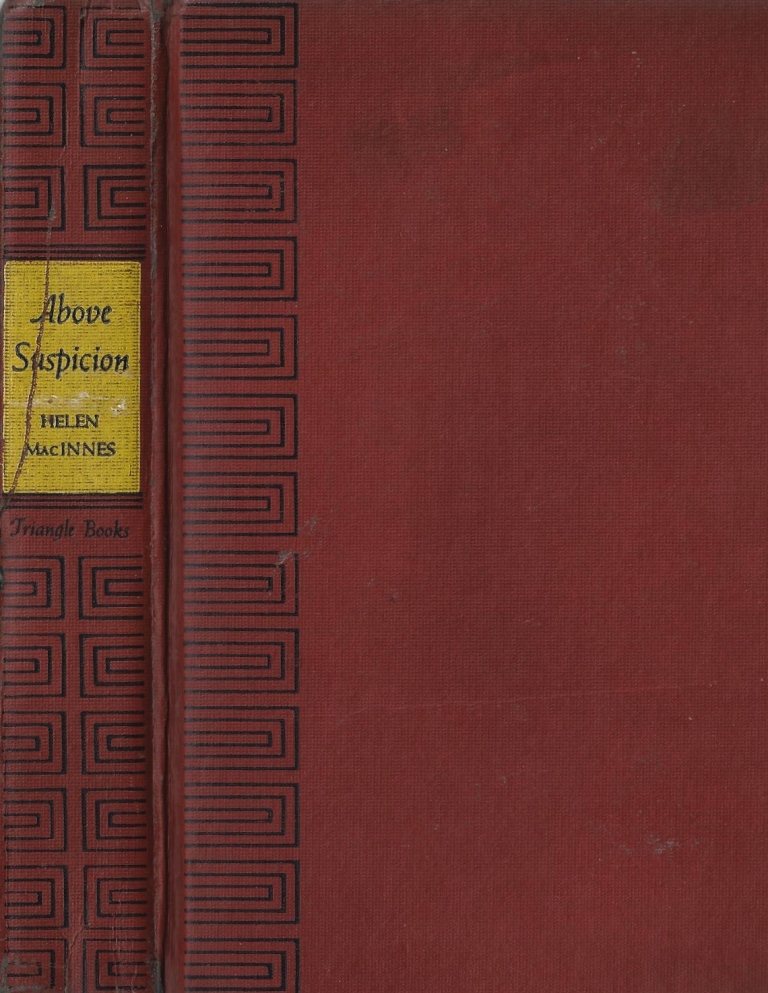
above suspicion helen macinnes 001 (2)

“Because of the acute shortage of regular book cloth under war-time rationing, this book is bound in ‘leatherette,’ a sturdy paper fabric especially designed for this purpose.”

Above Suspicion by Helen MacInnes ~ 1941. This edition: Triangle Books, 1944. Hardcover. 333 pages.

My rating: 8.5/10

Young Oxford University don Richard Myles and his wife Frances are recruited to travel to Europe during summer break in order to discover what has happened to a possibly-compromised chain of British secret service agents. The premise being that the two are so innocent-seeming as to be able to wander at will, from agent to agent, following the links as identified at each contact. In their travels they run in and out of numerous sinister encounters; the Nazis are very much on the ascendant and their evil shadow looms over the lands the Myles visit on their journeyings.

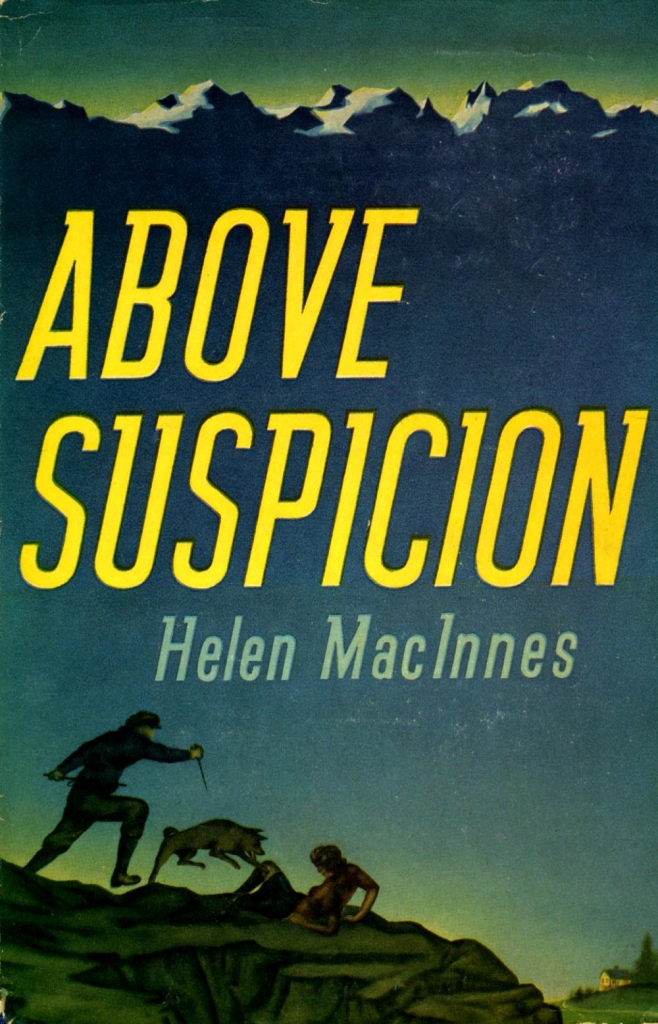
above suspicion helen macinnes  old dj 001 (2)

This dramatic vintage dust jacket illustration illustrates one of the peak moments of this suspense thriller, as the heroine is attacked by the Head Evil Nazi’s killer dog and is rescued by quick deployment of her husband’s handy-dandy sword-stick. Imminently distressing dispatch of the hound aside, isn’t this a gorgeous bit of graphic design?

A novel made most poignant by the time of writing; the last months of peacetime shadowed by foreboding clouds of war. The author draws upon personal experience in telling her tale, and it is an interesting combination of travelogue and suspense thriller, full of asides describing the scenes in which the action is set, and philosophical musings regarding the whys and wherefores of the imminent conflict. The German psyche is searchingly probed by a very British analyst – MacInnes in the guise of her heroic (and autobiographical) married couple – and found to be both blustering and chillingly focussed on military dominion.

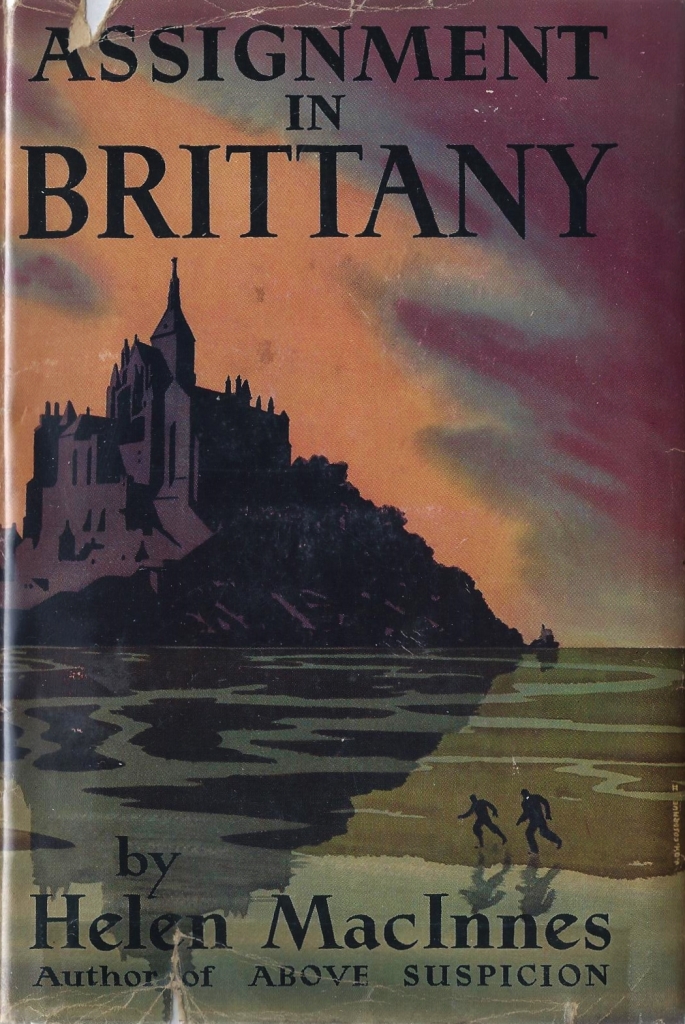
assignment in brittany dj helen macinnes 001

I am fortunate enough to be the possessor of this handsomely dust-jacketed first American edition. An absolutely stellar example of vintage cover art. Wouldn’t this make an amazing wall poster?

Assignment in Brittany by Helen MacInnes ~ 1942. This edition: Little, Brown & Co., 1942. Hardcover. 373 pages.

My rating: 9/10

Martin Hearne is parachuted into Brittany, into the very forefront of the Nazi occupation, in the guise of  his French body double, Bertrand Corlay. Many surprises await Hearne, not least of which is the discovery that his predecessor was less than forthcoming about some of his own activities before his evacuation to England via the Dunkirk debacle. For instance, his pre-marital arrangement with the neighbouring farmer’s daughter, Anne, and his estrangement from his invalid mother, who keeps strictly to her own rooms in the shared household. Who is beautiful and passionately forthcoming Elise? Why do the Nazi occupiers greet “Bertrand Corlay” with warm enthusiasm, while his fellow villagers hiss in cold disgust?

An escaping American journalist sheltering in the Corlay home sets off a string of complications, most notably a dramatic trip to the medieval monastic stronghold of Mont St. Michel, situated at the end of a causeway above tidal flats of quicksand. A return to the Corlay home finds Hearne confronted by steely-eyed Teutons who have discovered their collaborator is not what he seems, in so very many ways. Will Hearne make it back to England with his meticulously written notes and maps, as well as his new-found love?

Good dramatic stuff, rather nicely plotted for its type of thing, though with an exceedingly strong reliance on Hand of Coincidence. The evil Boche are given no ground, and the resident Bretons are depicted as cunning and stubborn survivors, insular to an astounding degree, but in the main resistant to their unwelcome occupiers by a combination of sullen non-cooperation and occasional acts of secret sabotage.

An engaging period thriller, written at the time it depicts, and so a valuable snapshot of the mood and details of its moment in time as well as a very readable diversion.

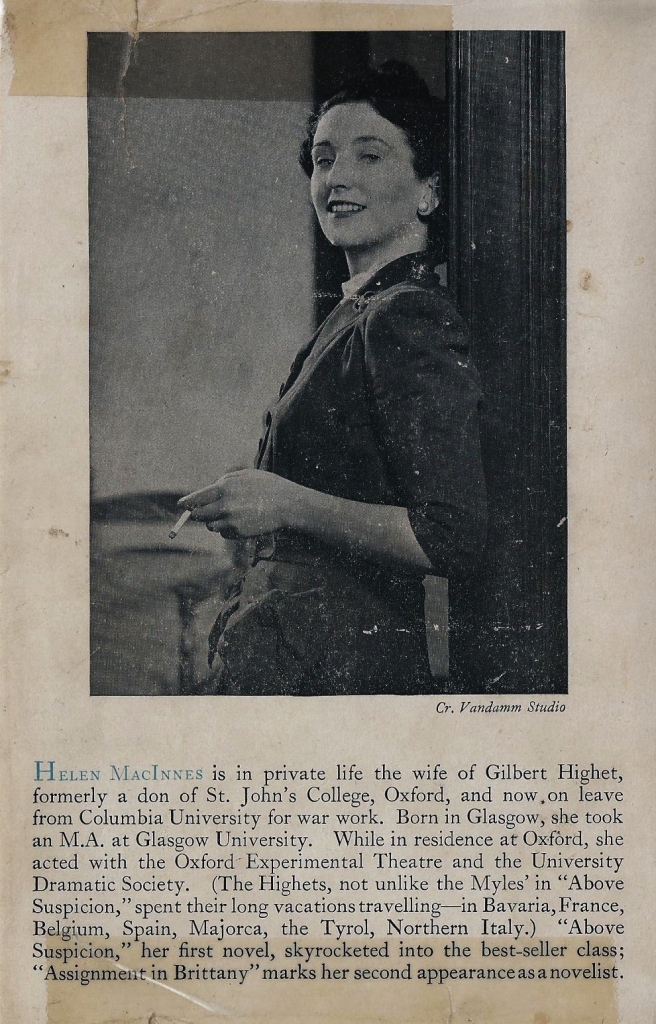
helen macinnes bio dj assignment in brittany dj 001

Author biography from the back cover of “Assignment in Brittany.” Check out the casual cigarette! No doubt the other hidden hand is nonchalantly holding a martini glass…

Read Full Post »

It’s always fascinating to read vintage books aimed at the youth market. The terms “literary snapshots” and “period pieces” apply particularly well to this widely varied genre, though more serious themes tend to be handled in a gentle way, obviously in order to cushion young minds from the harsher realities of the world they live in.

I recently read these two American “juveniles” from the many which have accumulated on our shelves in the past nineteen years of buying books for the younger members of the family, and while neither is an outstanding piece of fiction in any sense of the word, they are both rather interesting in what they have to say about the eras they were written in and about. Footnotes to the period, as it were, which is why I’m including them among the Century of Books fellowship.

*****

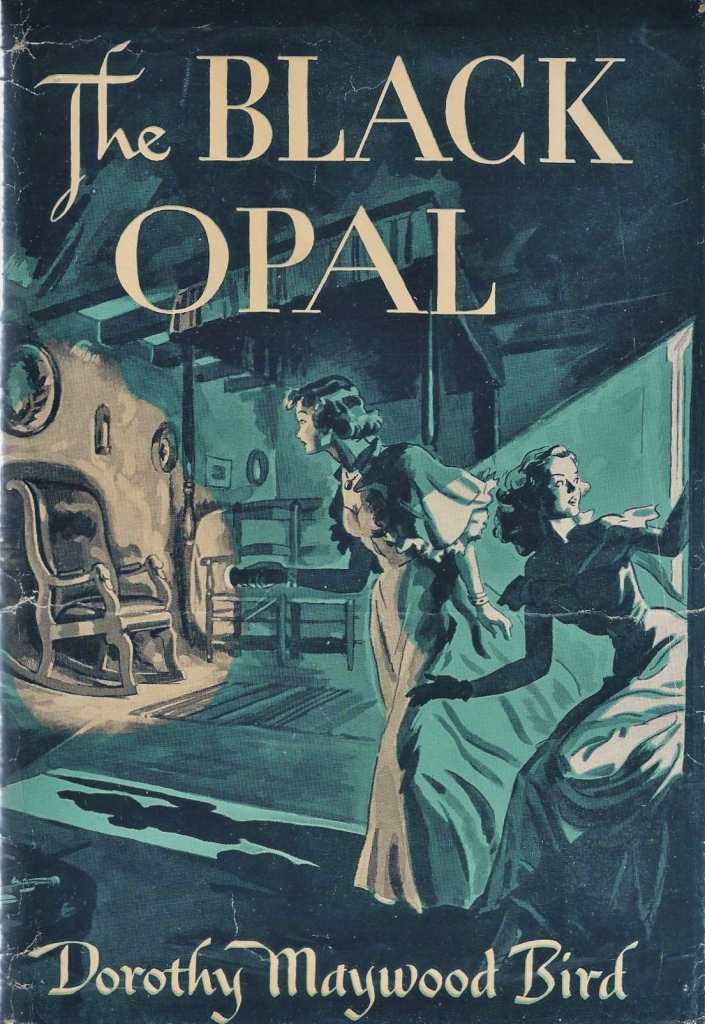
the black opal dorothy maywood bird 001The Black Opal by Dorothy Maywood Bird ~ 1949. This edition: Macmillan, 1962. (Ninth printing.) Hardcover. 202 pages.

My rating: 6/10

Surprisingly likeable was this rather hard to classify light novel, comprised as it was of equal parts college caper, highly contrived mystery, and blossoming romance. All right, maybe not that hard to classify! But the mixture works quite nicely, and the characters are highly appealing, and the whole thing is completely adorable. Decidedly a book aimed at the feminine readership of the junior high schools of its time.

Look, I even found an approving Kirkus review, from October of 1949:

When Laurel went off to the small coeducational college in Michigan which had been her great-great-grandmother’s alma mater, she expected it to be fun — and it was. What she didn’t know was that she would find herself up to the neck in a century old, unsolved murder mystery which was to give her the thrill of establishing the identity of the murdered man and his killer. The mystery theme is well-integrated and companions a satisfying modern college story of dates, term papers and strict house-mothers. There is not only the sinister black opal which Laurel unearths but also the exciting and sparkling diamond with which her One And Only ends the story. Maybe her solution will seem a trifle glib and maybe everything falls in place too smoothly, but no one will care for it is a nice, light entertaining tale with the virtue, highly to be prized, of not following an exact formula.

Laurel Stanwood has decided to do something a bit out of the norm. Instead of going with her high school friends to a college in her native Vermont, Laurel has chosen to attend a school, Colbert College, in far-off Michigan, a decision inspired by the fact that her Great-great-grandmother Caroline Hayes was a student of the precursor to the now co-educational facility, the Colbert Female Seminary, in 1846.

What follows is an absolutely typical account of lively college life. Laurel immediately makes two best friends, and immerses herself in a whirl of activity, where some serious studying is livened up by dramatic football games, campus socials, the ongoing “campus war” between the freshmen/juniors and sophomores/seniors, and some serious battling of the sexes via the two campus newspapers, the Colbert Feminist, under the editorial control of Laurel’s new friend Rue, and the Colbert Iconoclast, presided over by the woman-despising J. Swinton Towne. As an aspiring journalist, Laurel is immediately put to work gathering material for the Feminist; she has high hopes of finding a stunning “scoop” which will allow the Feminist to grind the Iconoclast‘s annoying pretensions to male superiority under its well-clad foot.

Lovely period details abound throughout this book, such as here where the girls are opening their mail at dinner time.

Laurel slit them open with her fork. The first, a circular, ordered her to make reservations at once for that Round-the-World Cruise she’d been eagerly awaiting since before the war. “Lapping waves,” it promised, “soft winds to caress your brow, nights full of wonder.” The second assured her that she could borrow up to three hundred dollars without embarrassing investigation and could pay it back in easy monthly installments. “Why be short?” it demanded. The third looked more hopeful, an expensive ivory envelope addressed in a feminine hand and postmarked Detroit. But the letter inside merely stated that if she planned to invest five hundred and fifty dollars in a genuine blue muskrat coat, she would do well to visit Compere’s Fur Salon first.

“Here’s a card from Mother,” Stacy giggled, “reminding me that if I want my duds to get into the Monday wash I can’t wait till Monday to mail them, and here’s a letter from Kent. Even if I didn’t recognize the scrawl, nobody else would have the nerve to start out ‘Dear Horseface.'”

Laundry sent home by mail for washing, stocking boxes to protect one’s cherished “nylons”, beau parlors to entertain your male guests in, telegrams sent with gay abandon in the same way teens today fire off texts to arrange their dates, having one’s hair washed once a week at the beauty parlor, Sadie Hawkin’s Day dances with both sexes in drag, apple cider socials, and a continual description of the most lovely-sounding clothes are happy period details. Laurel is continually sporting such gems as a “cherry flannel robe”(while filling out her college application form), “white wool gabardine suit” with a white chrysanthemum corsage (to attend a football game), “green silk raincoat” (actually that was Stacy’s, but it sounds quite sharp), “red cambric bolero edged in gold furniture braid” (for dressing up as a Spanish courtier on Sadie Hawkin’s Day), dungarees and sheepskin lined stadium boot (for winter hiking in the snow), a plaid gingham dress giving way to a “heliotrope spun rayon” (dressing for dinner, a must-do in the girl’s dormitory house), a beau’s “electric-blue loafer coat”, a friend’s “magenta taffeta with the bustle” prom dress, and Laurel’s own costume for the high point of the story, prom night topped off by discovery of the “Black Opal” mystery: mist-gray tulle with silver slippers and handbag, and a corsage of forget-me-nots, rosebuds and silver ribbon. Oh, swoon!

The girls, despite their life of strict midnight curfews and beau parlors, are given a wonderful amount of freedom; in most ways they are treated as completely competent adults and are left to sink or swim and make their own decisions in a way that many of the sheltered-but-socially-sophisticated teens of today would be most miffed to asked to do. Failed your Biology exam? Oh, well, guess you should have studied harder! No helicopter-parenting mom or dad in this 1940s’ world is about to confront the Biology prof to demand their pampered offspring’s mark be altered!

The historical murder mystery/mysterious gemstone plot, though prominent in the title and constantly referenced, is a very minor part of this happy little novel, though it forms a uniting thread throughout. It is the least well handled aspect of the book, being utterly predictable, totally fabricated out of unlikely coincidences, and not particularly believable even at its most detailed point. But this I completely forgave, because the rest of the story charmed me completely.

Dorothy Maywood Bird wrote two other similar novels, Granite Harbor and Mystery at Laughing Water, and I would be quietly pleased to get my hands on these at some point, for a little more travelling gently back in time.

*****

the year of the dream jane collier 001The Year of the Dream by Jane Collier ~ 1962. This edition: Funk & Wagnalls, 1962. Hardcover. Illustrated by E. Harper Johnson. 122 pages.

My rating: 4.5/10

This one is aimed at a younger set, the elementary school ages. Another very predictable plot, with rather more cardboardish characters, but again an interesting period piece with some redeeming features.

A middle-class family of five – mother at home baking cookies, father a teacher, thirteen-year-old Dick, twelve-year-old Wendy and younger brother Beanie – have been summering at a lakeside cottage and messing about with rowboats for years. But this year it somehow doesn’t quite satisfy – “If only we had a boat of our own…!” And not just a rowboat, but a proper boat. A cabin cruiser, so Mom can come along and not miss her kitchen(!) – bright red flag, here – first hint of era-correct gender stereotype, but far from the last.

Anyway, it’s decided that this is just a dream, as Dad isn’t exactly wealthy, and even a cheap cabin cruiser would cost thousands to buy. Then a chance conversation puts the family on the track of a derelict boat to be sold as part of an estate settlement. For two thousand dollars they can have it. Lots of work would be needed, but the boat is essentially sound. But where to find the money?

Everyone chips in and the year progresses as the pennies and dollars start to flow into the boat fund. The family decides to holiday at home and put their vacation money in the fund. Dad quits smoking and takes on an evening job, Wendy gives up her riding lessons and takes on babysitting jobs, Dick decides to raise rats to sell for science experiments, and Beanie roams the neighbourhood with his wagon collecting old newspapers to sell for salvage prices – 75 cents per 100 pounds. Even Mom finds something to do – she goes back to work in a law office part time, asking Wendy to step up and help out more at home.

Domestic details of the early sixties include a gee-whiz!-isn’t-it-great! reliance on cake mixes, instant pudding, canned everything, and casseroles of frankfurters and beans. Mom pores over a book called Shipboard Menus, leaving the mechanical and construction details of boat refurbishment up to the menfolk.

The only person not thrilled with the family’s common goal and their pursuit of their dream is Mom’s older sister, Aunt Louise. Louise had raised her younger sister after they were orphaned, and has settled into a prudently conservative spinsterhood. She lives in an apartment above the card and gift shop she has established with persistent self-sacrifice and dogged determination, and though she is the epitome of a self-sufficient woman she is, paradoxically, absolutely livid with Dad for “allowing” Mom to work. Mom, on the other hand, decidedly blossoms as she goes back out into the world, which inspires an interesting line of thought in twelve-year-old Wendy, about who “Mother” really is, and how she appears to herself and to each individual in her family, and what her mother’s own dreams might be, the ones she calmly has put aside to dedicate herself to her family. Inklings of the consciousness-raising going on in the greater world of the 1950s and 60s.

The dream – the cabin cruiser – is tantalizingly close to becoming a reality when catastrophe strikes, as young Beanie is struck and severely injured by a hit-and-run driver as he plods along with a wagonload of newspapers. Everything turns upside down as priorities are instantly re-assessed, with the two older children readjusting their personal ambitions for the boat without a murmur, much to the surprise of the adults in their lives, who have rather assumed that there would be resistance to the idea of letting the dream die.

Expectedly clichéd is the ending, with everyone rallying around and “family comes first” the slogan of the day; my greatest disappointment (from an adult point of view) was the sudden windfall that allowed the dream a new life. Artistically speaking, the sacrifice would have made for a stronger ending, but thinking back to my own juvenile reading days, the happy ending would have been appreciated by my young self, so I’ll let it go.

These sorts of books were a dime a dozen back in my elementary school years, mild dramas with some sort of a message attached, and The Year of the Dream is neither exceptionally good nor dreadfully bad. It’s a very average example of the middle range of juvenile literature of its era, and as such is worthy of a nod of appreciation as it helps to embellish the background against which “better” and more “mature” and “literary” books are set.

**********

I wouldn’t say that Jane Collier’s The Year of the Dream is worth looking for – it’s very much a nonentity of a thing – but for those of you who enjoy “teen girl’s fiction” of the 1940s and early 50s, precursors to the “malt shop” genre, Dorothy Maywood Bird’s three novels may be of some interest.

Read Full Post »

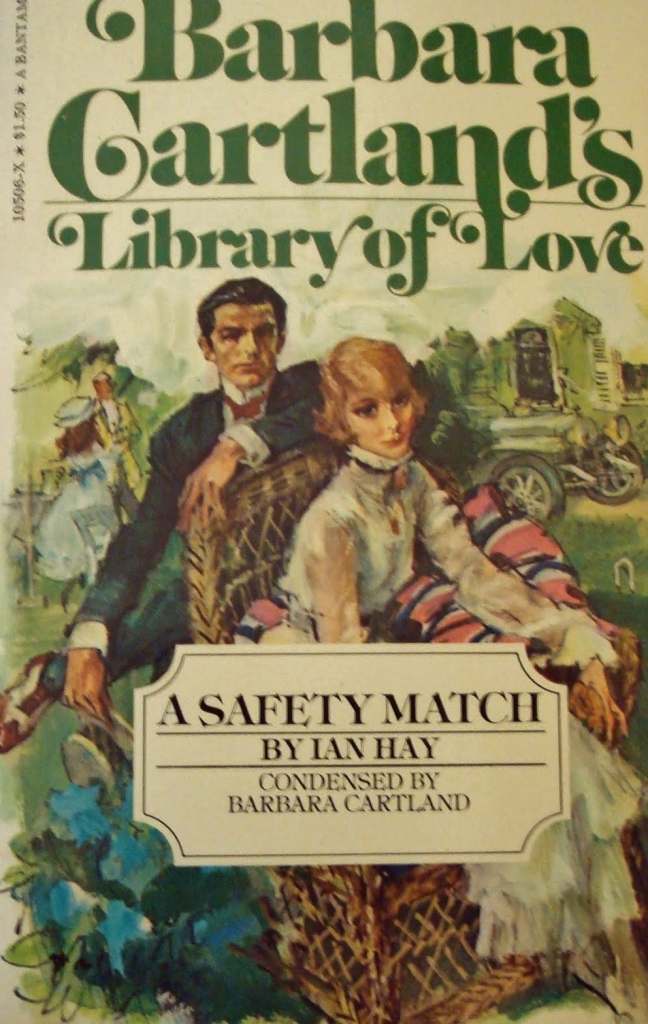
a safety match ian hay penguin cover 1938 001A Safety Match by Ian Hay ~ 1911. This edition: Penguin, 1938. Paperback. 256 pages.

My rating: 3/10

Oh, Century of Books. You are leading me down some strange byways of reading…

Some days ago I wrote with some enthusiasm about a rather charming vintage book by Herbert Jenkins, Patricia Brent, Spinster. I was careful in my review not to reveal the key plot points and the ending, because I felt that this was a book that would reward discovery by a modern-day reader. I am very sad to say that today’s book will not be rewarded the same treatment, because it disappointed me immensely.

Sharp-eyed readers will notice the mending tape on the bottom left hand corner of the book pictured here. That was me. Usually I am very careful about my mending of older books, aiming for non-obtrusive fixes, but in this case I just slapped a piece of Magic tape on there and called it good enough. The whole spine is loose and the text block only just hanging on by a whisp or two of paper – almost as if at some point a previous reader gave this one the toss across the room. Hmmm… (Okay, maybe I’m just being really snarky.)

So, yes, there will be spoilers in the next few paragraphs. (And I’m keeping it shortish, because it’s really not worth spending any more time on.)

It all starts off promisingly enough. Here we have a vicarage family, the widowed Rector Brian Vereker, and his lovely children – literally lovely, as they are famed for their good looks among the local villagers – nineteen-year-old Daphne, doorstepping down through Sebastian Aloysius (“Ally”), Monica Cecila (“Cilly”), Stephen (“Stiffy”), Veronica Elizabeth (“Nicky”) to to the youngest, eleven-year-old Tony. A lively lot they all are, and we are treated to a prolonged domestic interlude which sets up the characters quite nicely, and gives a rather charming picture of English upper-middle-class home life – for the Rector is the youngest son of a youngest son of a peer of the realm –  in the early years of the 20th Century.

Then an abrupt change of scene to a room full of coal mine owners as they meet with labour union leaders in order to negotiate a way out of a possible workers’ strike. Here we become acquainted with our main masculine character, one Lord Carr, also known by his nickname of “Juggernaut” for his overbearing success in always proving his point and coming out on top. In this case Juggernaut succeeds in quelling the potential strike, knocking down the ineffectual union leaders and getting in a few digs about free enterprise and every-man-for-himself-ism which sound forbiddingly close to the spoutings of the far-Right political parties of our current age – not much doubt as to our author’s feelings throughout this book, I’ afraid – he does rather slant towards his brusque hero’s view.

The set-up is to introduce the rather-much-older (forty-five-ish) Lord Carr to the eldest vicarage daughter, the sweet-nineteen Daphne. For of course Lord Carr and Rector Vereker are old school chums, and after squashing the labour uprising in the area, Lord Carr is quite happy to spend a few weeks relaxing among the Vereker clan, where he falls in inarticulate but sincere love with Daphne.

The two marry, Juggernaut for love and Daphne for money – she is motivated by a desire to secure the futures of her brothers and sisters – and for a few years all is quite content. A son is born to Lord and Lady Carr, but as the child grows it becomes apparent that the marriage is, if not actively struggling, becoming a rather pathetic thing. Lord Carr is unable to speak his feelings of devotion to Daphne; she in turn is starting to turn to other companions for amusement, including Lord Carr’s devoted right hand man.

This gets us in quite decent style to the latter bit of the book, where the author completely goes to pieces and gets all darkly dramatic. Daphne and Juggernaut part ways, Daphne fleeing to the old family home with the baby and Juggernaut staying broodingly in London. While they are parted, it dawns on Daphne that perhaps she really does love her masterful though stoic husband, and a reconciliation is affected by way of the right hand man’s revealing that Juggernaut is really just a big softie, supplying food and comforts to the wives and children during the last coal mine strike. “I never knew!” cries Daphne, and she flies to her husband’s sturdy breast, to be clasped there with fervor.

But wait! There’s more!

The workers at the local coal mine go on a wildcat strike, and as a result the workings are sabotaged, resulting in a cave-in which traps a number of our side characters, including Right Hand Man. Juggernaut is front and centre of the rescue mission, and (sob!) is blinded by an explosion after he has personally seen all of the rescued men to safety.

Fast forward a year or two to a scene of domestic bliss, Juggernaut and Daphne all sappily happy with their adorable wee children, love restored and blind Pappa the centre of a scene of cozy cuteness.

66 years after its first publication, the one-and-only Barbara Cartland  decides that "A Safety Match" is a good addition to her "Library of Love".

66 years after its first publication, the one-and-only Barbara Cartland decides that “A Safety Match” is a good addition to her 1977  “Library of Love”. I am saddened, but not surprised.

What a dreadfully clichéd story. No wonder it was picked up and condensed by Barbara Cartland for her 1977 “Library of Love.”

This novel made me prickly all over. It started out so well, and had so many nice domestic and period details, that I hoped right up until those last few chapters that it would go in a different direction, but nope! – no such luck. It just dissolved into mushy sweetness. Absolutely, deeply, offensively, sugary, syrupy adorableness. Argh.

Not recommended, but if you are very brave and wish to look for yourself, here it is on Gutenberg.

The Safety Match by Ian Hay

Ian Hay, by the way, was quite a well-respected writer of his time. Here is his biography, pasted directly in from Wikipedia. As the man could undoubtedly write, in a modestly competent way, I do find myself curious as to some of his other works, in particular the war-themed The First Hundred Thousand. But as for The Safety Match, I wouldn’t open that again at gunpoint.

Major General John Hay Beith, CBE, (17 April 1876 – 22 September 1952), was a British schoolmaster and soldier, but he is best remembered as a novelist, playwright, essayist and historian who wrote under the pen name Ian Hay.

After reading Classics at Cambridge, Beith became a schoolmaster. In 1907 he published a novel, Pip; its success and that of several more novels enabled him to give up teaching in 1912 to be a full-time author. During the First World War, Beith served as an officer in the army in France. His good-humoured account of army life, The First Hundred Thousand, published in 1915, was a best-seller. On the strength of this, he was sent to work in the information section of the British War Mission in Washington, D.C.

After the war Beith’s novels did not achieve the popularity of his earlier work, but he made a considerable career as a dramatist, writing light comedies, often in collaboration with other authors including P. G. Wodehouse and Guy Bolton. During the Second World War Beith served as Director of Public Relations at the War Office, retiring in 1941 shortly before his 65th birthday.

Among Beith’s later works were several war histories, which were not as well received as his comic fiction and plays. His one serious play, Hattie Stowe (1947), was politely reviewed but had a short run. In the same year he co-wrote a comedy, Off the Record, which ran for more than 700 performances.

I did a fairly thorough internet search, and came up with only one other blog review, from Only Two Rs, whose take was similar to my own.

Read Full Post »

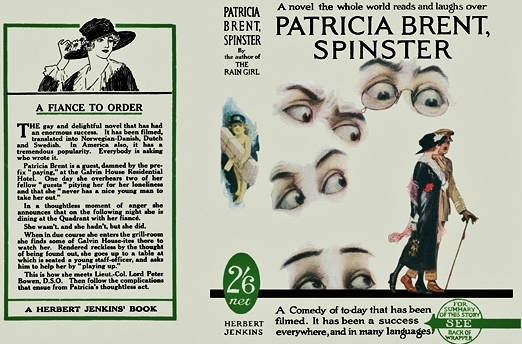
patricia brent, spinster 1 herbert jenkinsPatricia Brent, Spinster by Herbert Jenkins ~ 1918. This edition: Herbert Jenkins, circa 1918. Hardcover. 312 pages.

My rating: 6.5/10

I keep forgetting about this book, even though I only read it a week or so ago. It’s already had the ignominy of being shuffled away into the hall closet with a stack of miscellaneous already-reviewed books, only being rescued several days later when I was delving around in there looking for Christopher and Columbus by Elizabeth von Arnim, which I was hoping would be as great a treat as other bloggers have promised. (It was.)

High expectations were inspired by this opening passage:

“She never has anyone to take her out, and goes nowhere, and yet she can’t be more than twenty-seven, and really she’s not bad-looking.”

“It’s not looks that attract men,” there was a note of finality in the voice; “it’s something else.”  The speaker snapped off her words in a tone that marked extreme disapproval.

“What else?” enquired the other voice.

“Oh, it’s—well, it’s something not quite nice,” replied the other voice darkly, “the French call it being très femme.  However, she hasn’t got it.”

“Well, I feel very sorry for her and her loneliness.  I am sure she would be much happier if she had a nice young man of her own class to take her about.”

Patricia Brent listened with flaming cheeks.  She felt as if someone had struck her.  She recognised herself as the object of the speakers’ comments.  She could not laugh at the words, because they were true. She was lonely, she had no men friends to take her about, and yet, and yet——

“Twenty-seven,” she muttered indignantly, “and I was only twenty-four last November.”

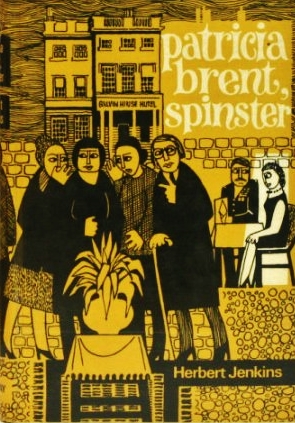
A rather handsome later edition cover. This novel has maintained its popularity well since its publication in 1918.

A rather handsome later edition cover. This playful novel has maintained its popularity well since its publication in 1918.

And by this back-cover précis:

Patricia Brent is a guest, damned by the prefix “paying,” at the Galvin House Residential Hotel. One day she overhears two of her fellow “guests” pitying her for her loneliness and that she “never has a nice young man to take her out.”

In a thoughtless moment of anger she announces that on the following night she is dining at the Quadrant with her fiancé.

She wasn’t, and she hadn’t, but she did.

When in due course she enters the grill-room she finds some of the Galvin House-ites there to watch her. Rendered reckless by the thought of being found out, she goes up to a table at which is seated a young staff-officer, and asks him to help her by “playing up.”

This is how she meets Lieut.-Col. Lord Peter Bowen, D.S.O. Then follow the complications that ensue from Patricia’s thoughtless act.

Patricia’s fast-on-her-feet rescue of her situation definitely sets off a tangle of complications, especially when her “pick-up” proves to be something a little bit different than anything she could have imagined.

I won’t say too much more, plot-wise, because I’m sure some of you will be keen to read this one for yourself, as I was. Already something of a fan of Herbert Jenkins – I cherish a thick compilation of the famous Bindle stories – I was keen to see what he would do with a feminine lead. Not too badly, though I must say that Patricia reads rather like a woman written by a man; there were occasional odd notes, especially to do with clothes.

For Patricia is not a dowdy spinster – oh, no, not at all! She dresses well and with exquisite care, rather surprisingly so, considering her obviously straitened means. Herbert Jenkins tries his hand at this description of Patricia primping to go out on her first adventure, to what she thinks will be a solitary visit to the Quadrant Grill-Room, the “major-man” being at this point merely a figment of her imagination.

As she stood before the mirror, wondering what she should wear for the night’s adventure, she recalled a remark of Miss Wangle’s that no really nice-minded woman ever dressed in black and white unless she had some ulterior motive.  Upon the subject of sex-attraction Miss Wangle posed as an authority, and hinted darkly at things that thrilled Miss Sikkum to ecstatic giggles, and Mrs. Mosscrop-Smythe to pianissimo moans of anguish that such things could be.

With great deliberation Patricia selected a black charmeuse costume that Miss Wangle had already confided to the whole of Galvin House was at least two and a half inches too short; but as Patricia had explained to Mrs. Hamilton, if you possess exquisitely fitting patent boots that come high up the leg, it’s a sin for the skirt to be too long.  She selected a black velvet hat with a large white water-lily on the upper brim.

“You look bad enough for a vicar’s daughter,” she said, surveying herself in the glass as she fastened a bunch of red carnations in her belt.  “White at the wrists and on the hat, yes, it looks most improper.  I wonder what the major-man will think?”

Swift movements, deft touches, earnest scrutiny followed one another. Patricia was an artist in dress.  Finally, when her gold wristlet watch had been fastened over a white glove she subjected herself to a final and exhaustive examination.

“Now, Patricia!”—it had become with her a habit to address her reflection in the mirror—”shall we carry an umbrella, or shall we not?”  For a few moments she regarded herself quizzically, then finally announced, “No: we will not.  An umbrella suggests a bus, or the tube, and when a girl goes out with a major in the British Army, she goes in a taxi.  No, we will not carry an umbrella.”

She still lingered in front of the mirror, looking at herself with obvious approval.

Would a young lady of such obviously strong self-esteem really be so humiliated by the gossipings of some of the nasty old biddies sharing her residential hotel? Apparently so, and once we’ve accepted this slightly shaky premise we might as well go ahead and abandon ourselves to the whole happily romping thing.

It’s all very fluffy, and definitely a farce, though it has its moments of poignancy here and there. Set in the early years of the Great War, some of the characters are present because they are home on leave while recovering from their injuries; the sombre background of affairs in Europe and the bombings in England are a fascinating backdrop to the frivolous antics of the foreground players.

I was fortunate enough to track down a vintage copy of the book, though it took several long months to arrive from the bookseller in England, but here it is in digital format courtesy of the fantastic Project Gutenberg, for your reading pleasure.

Project Gutenberg: Patricia Brent, Spinster

Dust Jacket, early edition.

Dust Jacket, early edition.

Read Full Post »

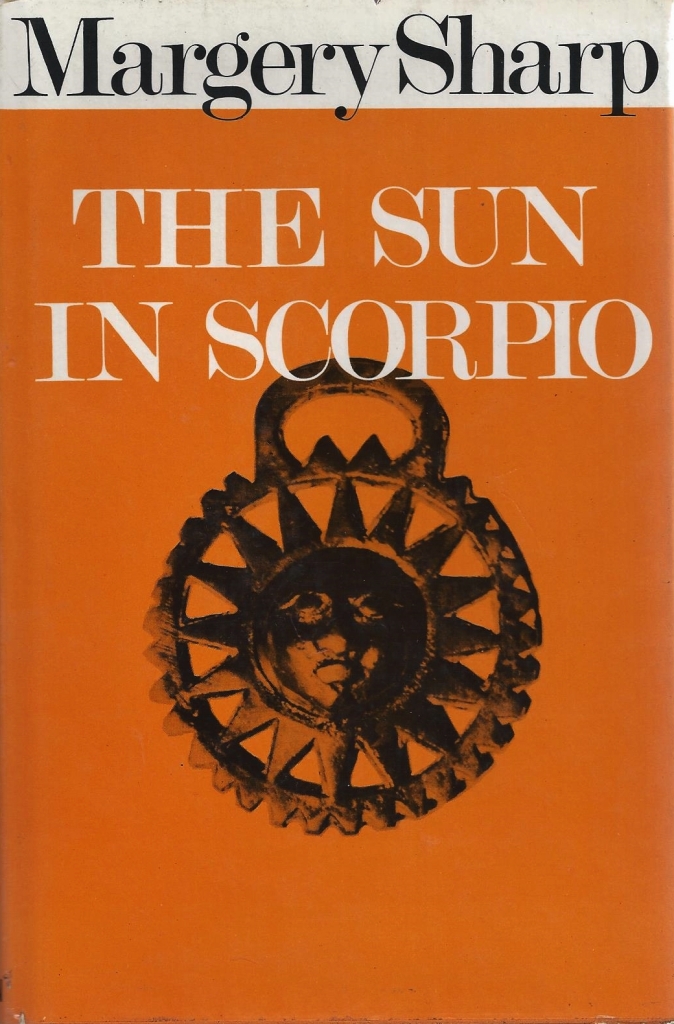
the sun in scorpio margery sharp 001The Sun in Scorpio by Margery Sharp ~ 1965. This edition: Heinemann, 1965. Hardcover. 231 pages.

My rating: 10/10.

She does it again.

Just when I thought I knew everything there was to know about Margery Sharp’s eclectic style, she pulls something new out of the hat. This is an absolutely crisp, clean and elegantly written novel, by a master of her craft, with some attention-catching stylings. I  suspect the author was enjoying herself quietly and deeply while working this out, based as it is on her memories of her childhood years in Malta.

Nice. Very, very, nice.

I’ve been sitting on this post for a few weeks now, waiting for an inspired moment to sit down and really delve into this book, but things are picking up speed in my real life and computer time for blogging is getting a bit pinched, so it’s looking like now or never. A quickie review it will have to be.

Everything sparkled.

Below the low stone wall, beyond the rocks, sun-pennies danced on the blue Mediterranean; so dazzlingly, they could be looked at only between dropped lashes. (In 1913, the pre-sunglass era, light was permitted to assault the naked eye.) Opposite, across the road called Victoria Avenue, great bolts of sunlight struck at the white stone buildings and richocheted off the windows. A puff of dust was a puff of gold-dust, an orange spilled from a basket like a wind-fall from the Hesperides…

Young Cathy Pennon, middle child of three growing up on an outpost of the grand British Empire, on the small island “next-door” to Malta, glories in the sun and basks in its rays. She is soon to leave the scene of her young years, as the growing winds of the Great War unsettle her civilian parents enough to urge a return to safer England. Cathy is soon to discover that she never will be truly warm again; the rainy isle of “Home” being resistant in its mists to the heat of that lost-and-mourned Mediterranean sun.

We follow Cathy, and to a lesser degree, her older sister Muriel and younger brother Alan, as they grow up in England, move into their adult years, and go their separate ways. Muriel is to find a comfortable niche in married domesticity; Alan settles into a happy bachelor existence while dedicating himself to the banking business – he is, ultimately tragically, of just the age to be destined to fight in the next great war – and Cathy drifts into a loosely-defined position as companion-lady’s maid to the aristocratic Lady Jean.

The book is a delicious moving picture of the years of and between the wars; our author touches delicately but succinctly on the many personalities and types of those years of tremendous flux, when the world is continually shaking itself and forming itself again as its inhabitants struggle, with various degrees of success, to come to grips with every new normal.

Cathy survives, though not without some scars, and we leave her at the end of the Second Great War poised for what looks to be the greatest change yet in her four decades of life, contemplating with wild surmise and growing joy the possibility of a return to the sun.

What a very good book this is. Margery Sharp is in absolutely fine form, having created a crisp, clean narrative with beautiful styling and more than a little cynically black ink in her accomplished pen. Cathy is a most human protagonist; full of flaws and not at all likeable a certain amount of the time; she tends to stand back a step from those around her, never fully entering in to the lives of those she bumps up against. A girl and then a woman of unexpected responses, and a few hidden talents…

Read Full Post »

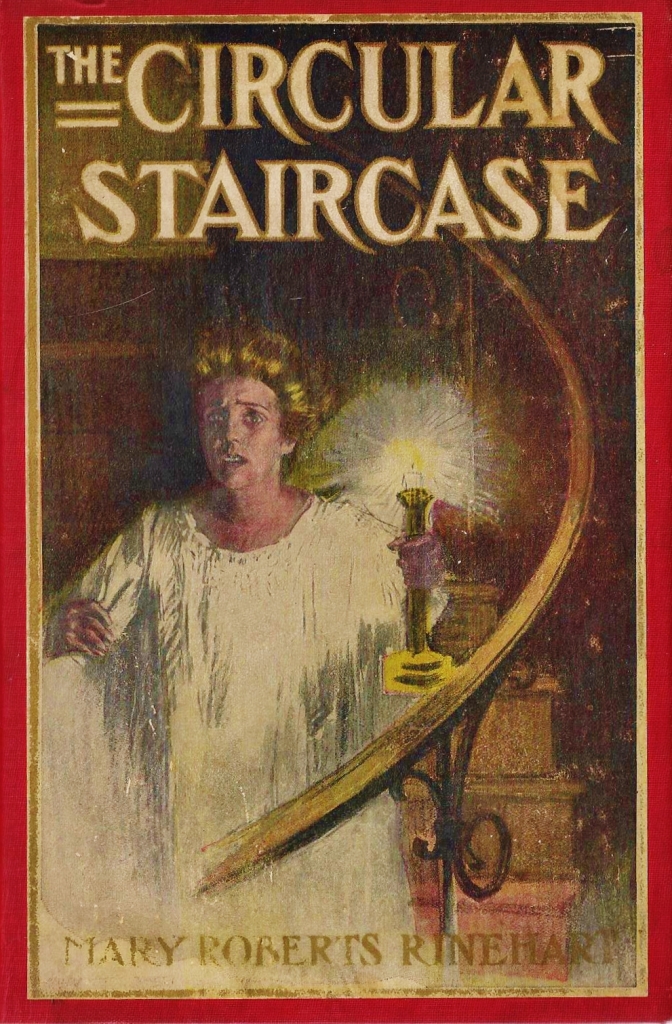
the circular staircase mary roberts rinehart 001The Circular Staircase by Mary Roberts Rinehart ~ 1908. This edition: Grosset & Dunlap, 1908. Hardcover. 362 pages.

My rating: 5.5/10

A decade and a half before Agatha Christie penned her first murder mystery in England, Mary Roberts Rinehart had a stunning success with this book, which established her as bestselling mystery and dramatic fiction writer in North America. It is sometimes claimed that she was the best-paid American author of her time; her book sales were in the millions. So I was looking forward to The Circular Staircase with great anticipation, having read enough of Mary Roberts Rinehart’s work over the years to know that she can indeed spin an engaging tale, usually including a nicely independent and outspoken female lead or two, in keeping with the author’s suffragette and proto-feminist leanings.

And, by and large, The Circular Staircase mostly pleased me, in a low-key way, though it took me absolutely forever to work through. It has an unusual and most engaging narrator, the charmingly independent and opinionated Miss Rachel Innes. It helps with the independent and opinionated character traits that Rachel also seems to be quite wealthy and therefore able to indulge in letting herself speak freely – for who will argue with the lady who pays the bills? She also can be rather high-handed in her dealings with family members and subordinates, though her gently cynical self-mockery keeps us on her side, along with her obvious affection for her adopted niece and nephew and her personal maid Liddy.

This is the story of how a middle-aged spinster lost her mind, deserted her domestic gods in the city, took a furnished house for the summer out of town, and found herself involved in one of those mysterious crimes that keep our newspapers and detective agencies happy and prosperous.  For twenty years I had been perfectly comfortable; for twenty years I had had the window-boxes filled in the spring, the carpets lifted, the awnings put up and the furniture covered with brown linen; for as many summers I had said good-by to my friends, and, after watching their perspiring hegira, had settled down to a delicious quiet in town, where the mail comes three times a day, and the water supply does not depend on a tank on the roof.

Having adopted her orphaned young niece and nephew some thirteen years ago, this summer finds all three of them preparing to settle down in  a rented country house for a few months. Rachel has resigned herself to a disturbance in her long routine in order to indulge the wishes of the younger members of her establishment; she brings along her long-time companion and personal maid, Liddy, against that retainer’s grumbling resistance. Twenty-year-old Gertrude and twenty-four-year old Halsey are expected to flit in and out at will, being popular and well-heeled young people with many friends. Halsey has just purchased an automobile; it will play an important role in the summer of mystery and peril they are all about to embark on.

For Rachel and Liddy are horrified to find, their very first few days in residence, that their idyllic country house has an unsavory reputation among the locals. Belonging to an absent banker, it has been empty for some months, and it turns out that strange noises have been heard and strange lights seen at night. Almost immediately upon arrival Liddy has managed to offend the few servants who were brave enough to take on employment, and Rachel is left servant-less and alone in the house but for jittering Liddy. Luckily she is able to acquire an ally in the person of Thomas.

Liddy wanted to go back to the city at once, but the milk-boy said that Thomas Johnson, the Armstrongs’ colored butler, was working as a waiter at the Greenwood Club, and might come back. I have the usual scruples about coercing people’s servants away, but few of us have any conscience regarding institutions or corporations—witness the way we beat railroads and street-car companies when we can—so I called up the club, and about eight o’clock Thomas Johnson came to see me.  Poor Thomas!

Ah! Note the “Poor Thomas.”

This does not bode well, for Mary Roberts Rinehart in this book is abundantly generous with her broad hints of disaster to come, in what was to become her signature “Had-I-But-Known” mystery writing style. Now this is rather cute when used sparingly, but MMR has her narrator Rachel pop these foreboding hints in way too frequently for readerly comfort. There you are, caught up in the thread of the story, when the insertion of a “HEY! IMPORTANT CLUE COMING RIGHT UP” aside stops you dead in your tracks. Okay then, you think to yourself, what is she talking about? And you tiptoe carefully in to the next few paragraphs, wondering all the while where the clue is hidden. Sometimes it is quite obvious, and you sigh with relieve and get on with things. Other times it is pages – nay, chapters! – ahead, and so many other meaningful asides have been made in the meantime that you are completely lost as to which thing was important to what incident before and what did knowing this have to do with that and on and on and on. Sometimes the clue fails to materialize at all, leading to retrospective confusion as one tries to link it all together, and fails dismally.

And this is what stopped me from loving this book. It is too darned long, and too darned illogical. It had its charms, for certain sure, but it was hard work to keep straight, and it took me well over a week to work through, as I kept putting it down in mild irritation and true confusion and turning to other things much more straight-forward.

Without revealing the mystery of the summer place and its circular staircase (which is really not at that important to the tale in my opinion, and, I thought, something of a red herring supplied by the author) may I just say that the plot involves embezzled money, hidden/mistaken identities (multiple), a wicked doctor, a secret(ish) child, a hidden room, shots fired in the night, and a whole lot of people rushing about and missing their chances to clear important elements of the mystery up by keeping their odd little secrets for just a bit too long. Among other developments I’m already erasing from my short-term memory bank.

Four deaths (at least I think it was four – that bit left me a bit bemused, too – corpses in this novel not always being reliable identified), including that of “poor Thomas” early on, tried my patience severely, mostly because of the generally nonchalant attitude of the survivors. There’s a bit of horror at the thought that “just yesterday a man lay dead right over there  beside the table where the tea tray now sits” but by and large the expected reactions are underplayed. Or overplayed. There’s some of both.

Would I recommend this book? Only to the very patient, and those willing to work through the confusion of the twisty and illogical plot to delight in the witty and self-contained running commentary of our opinionated narrator Rachel.

For further edification, there’s a nice review which echoes my own feelings, from Melody at Redeeming Qualities. (A very cool blog featuring mostly vintage out-of-print books. Take a look around when you’re there – I’ll guarantee that your personal look-for list will get much longer!)

Read Full Post »

the shuttle frances hodgson burnettThe Shuttle by Frances Hodgson Burnett ~ 1906. This edition: Frederick A. Stokes, 1907. Hardcover. 512 pages.

My rating: 8.5/10

Coming late to the party with this book, I am. I had added it to my Century of Books must-acquire list because of numerous enthusiastic recommendations from other bloggers, and I am thrilled to be able to report that those who gave it the nod were completely correct. It’s an absolutely grand read.

I understand that the currently in-print edition published by Persephone has been edited somewhat, and I can’t help but wonder what they cut out. I’m not terribly concerned that it would have ruined the story – this is a very long book with abundant authorial wanderings just slightly off-topic here and there – but it was intriguing to read the early, as-published text in this lovely vintage edition and speculate as to where it could be gently trimmed.

And golly, I just realized that the book I’m holding in my hands (well, it’s actually sitting on top of the printer beside the computer, but it was just being held in my hands) is a genuine antique. One hundred and seven years old. That’s rather a pleasant thought. It’s travelled through the decades very well indeed, both in physical condition and in staying power of contents.

If you are one of the few of my readers who hasn’t yet tackled The Shuttle, here is a plot summary of sorts.

There were once, in the later years of the 19th century, two American millionaire’s daughters, eighteen-year-old Rosalie (Rosy) and ten-years-younger Bettina (Betty) Vanderpoel. It was just at the time of the first awareness by impoverished English gentlemen of the nobility – second, third and fourth sons, as it were – that here was a rather well-stocked hunting ground for well-dowered wives, who would be willing to exchange the country of their birth and a goodly portion of their fathers’ wealth for an English title and a stately ancestral home. In the best of these transactions, gone into with eyes wide open, both parties benefitted and a certain degree of happy felicity resulted, but occasionally the meeting of American feminine independence and English masculine traditionalist views on the necessity for a wife to submit to her husband’s superior judgement ended in disaster.

Guess which kind of marriage sweet, frail, loving and deeply innocent Rosy Vanderpoel made?

Falling for the seductive wiles of Sir Nigel Anstruthers, Rosy trots innocently off to England, but the honeymoon voyage is not even half over before she realizes that she has yoked herself to a malicious and sadistically abusive man. Sir Nigel is a rotter through and through. He despises not only his new wife, but her family and her country and her ideas and her expectations of at least a modicum of domestic happiness. His bitter disappointment at Rosy’s father’s insistence at leaving the control of her fortune in her own hands and not in her husband’s has Sir Nigel seething; he has hidden his true nature well, but now that the shores of the new world are receding he is preparing to gain control of Rosy’s share of the Vanderpoel millions for himself.

Competently reducing meek Rosy to a grey shadow of her former self, Sir Nigel succeeds in cutting her completely off from her American family, but for the occasional letter requesting more funds. Three babies are born; the first a son, who is born crippled due to his pregnant mother being physically assaulted by Sir Nigel; two little daughters die young.

Ten years pass.

Back in America, Betty Vanderpoel has never forgotten her beloved older sister, and can’t quite believe that the cessation of relations is by Rosy’s wish. (Betty had never liked Sir Nigel, and he returned the scorn she viewed him with in spades.) Taking her father into her confidence, Betty announces that she is going to go to England and see for herself how Rosy is faring. And off she goes, with her father’s blessing and his millions behind her.

What she finds is beyond her worst expectations. Rosy, aged beyond her years, lives a dreary life shut up in a decrepit mansion staffed by sullen servants, her only companion her hunchbacked ten-year-old son, Ughtred. (Aside to author re: “Ughtred”.  What the heck, Frances Hodgson Burnett? That is absolutely bizarre. What were you thinking???!) Anyway, the estate is mouldering away while Sir Nigel pursues his merry way a-spending Rosy’s money on mistresses and riotous living abroad; he returns only to indulge himself in spousal abuse and to browbeat Rosy into sending another brief letter to Papa requesting more money to maintain his little grandson’s estate.

Betty, made of much sterner stuff than Rosy, swoops in like an avenging goddess, and the majority of the rest of the book consists of the rehabilitation of Rosy, Ughtred, the estate and the attached village full of grateful rurals. Sir Nigel reappears to find his despised sister-in-law very much in control of things, and their ensuing battle of wills, Rosy’s deeply good against Sir Nigel’s blackly wicked, is a gloriously entertaining thing.

Oh, and there is a further development. The next estate over belongs to another impoverished nobleman, this one the sole survivor of a long succession of bad eggs. But is Lord Mount Dunstan really as deeply black as his spendthrift, now-deceased elder brother, and the heedless ancestors before him, or is he sullen merely because he feels so darned bad about the decrepit state of his hereditary acres? Any guesses?

I will stop right here, because you can now likely guess the ending from what I’ve just said. Nope, no surprises here. But how the author gets us to the inevitable conclusion is deeply diverting. And how genuinely engaging and interesting her various characters are, from meek Rosy to divinely competent Betty to nasty Sir Nigel and his equally nasty old mother to misunderstood-but-really-deeply-noble Mount Dunstan to random American typewriter salesman G. Selden (who makes up a merry little sideplot himself, what with his precipitous entry via bicycle wreck at the very door of the Anstruther mansion) to busy millionaire Reuben Vanderpoel – what a glorious cast!

I loved this story! It’s a proper saga. Such a treat to have a black and white, good-versus-evil, you know who to root for and who to boo and hiss at sort of thing!

And it does reflect some very real historical happenings, such as the astounding trans-Atlantic traffic in (relatively) poor English noblemen and wealthy American heiresses which took place from the 1860s well into the early 1900s. Fictional Rosy Vanderpoel is represented as being one of the earlier of the transplanted rich girls, and her story is based solidly on fact, though with artistic license in her particular details.

A grand exposition on both American and British social structure of the late nineteenth century, with abundant detail and a whole lot of humour. What a good book, in an old-fashioned novel-ish sort of way. If you haven’t read it already, may I suggest that you consider adding it to your Must-Read list, in any edition you can get your hands on? As the publisher’s poster claims, it is a masterpiece.

Edited to add this note on the heroine’s wee little nephew’s name, Ughtred. At first I thought, “No way! This can’t be a real name.” But then a commenter said something about old Saxon names, and the penny dropped. Of course. A bit of internet research (what did we do before Google?!) turned up just a few references, enough to show that Frances Hodgson Burnett did indeed know her stuff. Here we are, then, references from several genealogy websites. (And I did not bookmark the references; bad researching practice, I know. Don’t tell the teens in my family, as this is a constant refrain from me when they are doing online research: “Reference your sources!”)

English: from the rare Old English personal name Uhtred, composed of the elements uht dawn + red counsel, advice. This is a very uncommon given name in the English-speaking world, but remains in use in the Shuttleworth family.

and

The name “Ughtred” is of Saxon origin, and means “early to counsel”. There were several Ughtreds (also spelt Hurard, Uctred, etc), the first (who did not carry the “de Bradshaw” or “of Bradshaw” surname) was, apparently, living near Preston, Lancashire at the time of the Norman Conquest in 1066. He was a “King’s Thane”, that is an trusted retainer of the Saxon King, and he probably held his office by guarding the King’s hunting preserve because he is sometimes called “Forester” or “King’s Sergeant”. He or his son, or grandson, had a brother named Alan de Bradshaw, who held lands in Harwood, near Bradshaw Village. One early descendant was Robert de Bradshaw, a Crusader who died under the wall at Acre, in the Holy Land, circa 1189 A.D…

So there it is. A name with a genuine and quite fascinating history. But I still pity the poor kid in The Shuttle. Crippled from before birth by his wicked father, and then saddled with this. It’s even more eyebrow-raising than Little Lord Fauntleroy’s Cedric. Wonder what his (Ughtred’s) middle name (names) is (are)?

The publisher's American publicity poster from 1907.

The publisher’s American publicity poster from 1907.

Read Full Post »

the english air d e stevenson 001The English Air by D.E. Stevenson ~ 1940. This edition: Farrar and Rinehart, 1940. Hardcover. 317 pages.

My rating: 9/10

I liked this novel a lot. It’s hard to believe it was written at the roughly the same time as the melodramatic Crooked Adam (1942), as it is a much more sober and thoughtful sort of thing, reflective no doubt of the author’s own musings in the years leading up to the start of World War II. It is wonderfully atmospheric from start to finish, and the characters pleased me greatly, from the gorgeous blonde Aryan “super-man” and ex-Hitler Youth Franz to fluffy-but-ultimately-wise Sophie and fragile-seeming but tough-as-nails Wynne.

This book is fairly common, and I don’t want to spoil it for those of you still to read it, so I’ll keep this review brief and avoid any spoilers.

It is the spring of 1938, and half-German, half-English Franz has suddenly invited himself to stay with his English semi-cousins, the Braithwaites. No one is quite sure what to make of Franz’s out-of-the-blue advances, and when he arrives their initial reaction is uneasy. Franz is a tall young golden-haired “Greek god” figure of a man, with stiffly formal manners and no apparent sense of humour. After the initial whispered consultations: “I wonder if he’s a Nazi? Don’t talk about politics!” everyone unbends a bit, and as the days pass Franz is seen to make a real effort to find common ground with his English hosts.

Especially lovely Wynne, the Braithwaite daughter, who has been tenaciously trying to get through Franz’s Teutonic reserve while educating him in the niceties of the English sense of humour, common slang, and recognition of and appropriate responses to friendly teasing.

But Dane Worthington, Wynne’s uncle, who has been her legal guardian since her father’s untimely death, cocks a cynical eyebrow in Franz’s direction. Why is he really so keen to immerse himself in English domestic life? For Dane knows, through certain connections of his own, that Franz’s father is a highly-placed official in the Nazi party, and one of Hitler’s personal advisers.

There are many secrets afoot, this golden last summer of peace before the start of the war…

A rather nicely plotted story – though we do get some major clues throughout as to what is really going on – and well up there in D.E. Stevenson’s oeuvre. The themes are serious and treated with respect without being dreary; in places this one reads rather like an O. Douglas novel, unsensational and matter-of-fact, and deeply appealing in a quietly memorable way. Occasionally things slip into melodrama, but all in all the author does a grand job here; it is one of my new favourites of the many DES stories I’ve now read.

I particularly enjoyed the author’s discussion of patriotism, and thought it well-balanced and insightful, though by the time of the writing of Crooked Adam in 1942 the mood had obviously changed to something much more reactive and extreme, on both sides of the ongoing conflict.

The English Air was finished in February, 1940, and, as well as being a diverting light novel, is an intriguing eyewitness snapshot of a specific time and place in the last year of peace and the first year of war.

Read Full Post »

« Newer Posts - Older Posts »