 Greenwillow by B.J. Chute ~ 1956. This edition: E.P. Dutton, 1956. Illustrated at chapter headings by Erik Blegvad. Hardcover. 223 pages.
My rating: Oh, what the heck. It was unexpected, but I mostly loved this one. 9.5/10.
A novel being the story of a village beyond the boundaries of time, no exact location, where people who are kinder and happier than we can be, and whose lives are linked to the rhythm of the seasons…
In the nebulously located village of Greenwillow, the Reverend Lapp preaches hellfire, damnation and the eternal loss of the souls of babies who die before being baptised, and though they stick a bit on that last concept, by and large his congregation puts up with him reasonably cheerfully. And when a certain Reverend Birdsong shows up, sent, so he says, “by the Bishop”, and accompanied by an upside-down umbrella full of hawthorn blossoms, the two preachers compromise by sharing the church, though they cannot bring themselves to share doctrine.
Reverend Lapp sees the Devil everywhere and is an authority on his pervasive influence; Reverend Birdsong is a bit vague on such details, preferring instead to concentrate on the God-given wonders of nature, and by extending encouraging approval to young lovers, kittens and the cultivation and appreciation of flowers.
Both Reverends take an interest in the family of Amos Briggs, famously of a wandering nature, who appears every year or so for a few days, just long enough to give a start to the next addition to the ever-increasing family of young Briggs who scrabble about on their poor but promising farm. The eldest Briggs child, Gideon, lives under the cloud of the family curse: that the first son of the first son will at some point in his young life hear the mysterious “call” and will drop everything and head off into the unknown, abandoning family, friends and livelihood to roam the wide world over –
…hoeing man laid down his hoe, digging man laid down his spade, reaping man laid down his scythe…
Gideon is working frantically to have the farm in a viable condition to leave in the care of his younger siblings when his call comes. He’s also determined to break the family curse once and for all, for though he’s resigned himself to his own fate, he is firmly determined not to marry. He’ll not to leave behind a wife as his own dear mother has been left, though she is gently complaisant with her fate, never losing her original love for her wayward spouse and welcoming him with eager arms for the few days he reappears every year or two. Most of all, Gideon is determined not to have any children of his own.
Which complicates things exceedingly when Gideon meets the eyes of a sterling-natured village maid, one Dorrie – an accomplished cook from a tender age, lover of the afore-mentioned kittens, and of children, in particular the Briggs young ones, which aids in moving the mutual attraction up a notch or two. ) Dorrie is more than ready for a home of her own, and when the two admit their love to one another, we are almost convinced that Gideon will break his personal vow not to ever wed.
Lapp preaches thunder and damnation to Gideon, warning him against heeding the call of the Devil; Birdsong cocks his head sideways and doesn’t say much but exudes encouragement; neither appears to have any influence on Gideon, to sway him from his stubborn (and rather tiresome) insistence that his fate is sealed.
But we have an inkling that it will all come round right in the long run, and it does, though not without a lot of side plots and interferences by all and sundry of the (mostly) well-intentioned villagers and rural folk.
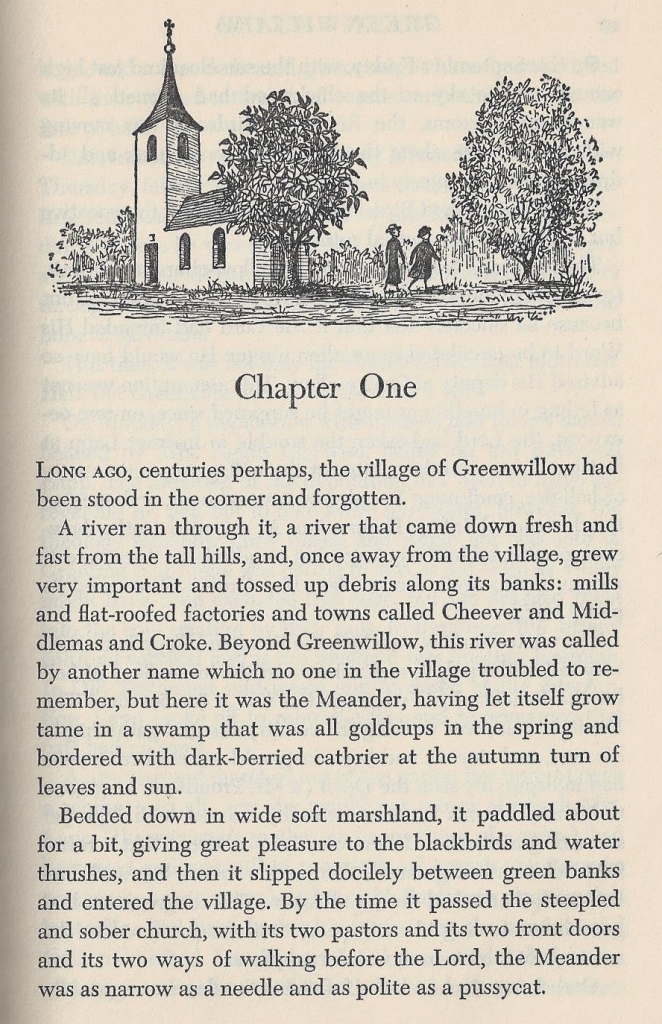
Did I say “charming” yet? Well, it is. And deeply so. A book I had no previous knowledge of, and which surprised me by its likeable fairy tale atmosphere, and by its assortment of stock rural characters – both human and animal – all with unexpectedly diverting quirks.
This B.J. Chute is rather an amusingly lyrical writer, I concluded well before the happy end of Greenwillow. And this is what I discovered about her. For it turned out to be a her, not a him, as I had somehow assumed. And it also turned out also that I was already acquainted with one of the family, as it were, for B.J.’s sister turns out to be Marchette Chute, historical biographer and children’s author and poet. Who knew?!
From the dust jacket of the first edition of Greenwillow, found pictured online. (My copy is sadly missing its jacket.)
B.J. Chute was born of an American father and an English mother, and she spent most of her life at a country home in Minnesota named “Hazelwood.” There she and her two sisters became familiar with animals and birds and trees., and in their spare time they all made a hobby of writing. In the end all three became professional writers, for one sister, M.G. Chute, is well known for her Saturday Evening Post stories, and the other, Marchette, for her biographies of Chaucer, Shakespeare and Ben Jonson.
B.J. Chute, who is Joy to her family and friends, has written many short stories for major magazines, and this is her third novel. She wrote Greenwillow in a style that would not tie it down to any country or any period, but it was because she was brought up with woods and fields and country people that she knows them so intimately and can write about them so well. Her delight in people is just as evident now that she lives in New York, and in her spare time she does volunteer work with the Police Athletic League and in a shelter in Harlem for temporarily homeless babies.
And from her obituary in the New York Times, September 15, 1987:
Beatrice Joy Chute, a novelist and short-story writer who was also a past president of the PEN American Center and taught for many years at Barnard College, died of a heart attack Sept. 6 at Bellevue Hospital Center. She was 74 years old and lived in Manhattan.
Miss Chute, who was born in Minneapolis in 1913, published her first story in 1931. She wrote many stories for and about adolescent boys for Collier’s, The Saturday Evening Post and other magazines during the 1930’s, and her first book, ”Blocking Back,” was published in 1938. Many of her early works, such as ”Shattuck Cadet” (1940) and ”Camp Hero” (1942), were realistic tales of sports and camp life that captured the relationships and slang of her primarily male teen-age heroes.
Although she continued to write short stories for children and adolescents in the 1940’s, Miss Chute began to concentrate on adult fiction with ”The Fields Are White,” a 1950 book about marriage and manners.
discovery. It was made into a Broadway musical in 1960. Subsequent works included a 1957 anthology called ”The Blue Cup and Other Stories,” ”The Story of a Small Life” (1971) and ”Katie: An Impertinent Fairy Tale” (1978). Her most recent novel, ”The Good Woman” (1986), was a parable about a lonely woman who abandons her home for a journey of spiritual awakening while living on the streets.
Miss Chute – who preferred to be called Joy and signed her books B. J. Chute – moved to New York in the early 1940’s with her mother and two sisters. Over the years, she did volunteer work with poor children and the Police Athletic League. She became an adjunct professor of English at Barnard College in 1964, and taught creative writing there until her death.
She was also director of Books Across the Sea, a division of the English-Speaking Union that promoted American books overseas, and was an active member and one-time president of the American chapter of PEN, the writer’s association.
Provenance, my edition: Rotary Club Book Sale, Williams Lake, B.C., February 2014. Inscription: “Irene Ringland”. First edition, no dust jacket.













 Leaves & Pages
Slighty Soporific: The Shapes of Sleep by J.B. Priestley
Posted in 1960s, Century of Books - 2014, Priestley, J.B., Read in 2014, tagged 1962 Novel, Century of Books 2014, Cold War Paranoia, Mystery-Suspense, Priestley, J.B., Social Commentary, Social Engineering & Brainwashing, The Shapes of Sleep on March 24, 2014| 4 Comments »
My rating: 5/10
Close call, J.B. You almost didn’t make that 5, but my enduring fondness for your many years’ worth of earnest and good-humoured novels and essays and memoirs tipped the balance.
This is not so much a baddish book as a terminally undecided one. It reads like the author can’t quite decide on some rather major plot developments so has decided to make it up as he goes. Which can work, but in this case means false starts, dropped threads, and a general lack of a sturdy backbone to build the story upon.
And J.B. Priestley has tried his hand here at writing sexy, but it reads very much like the author is extremely uneasy with the style, and the hands-on-breasts and rigid (or not rigid) nipple descriptions are much more embarrassing for the reader than titillating. At least I found them so. I absolutely cringed, and mostly because it made the writer look inept and out of his comfort zone, style-wise. This is Priestley, after all, and you’d expect a higher level of capability in handling a scene. Any sort of scene.
Following closely on the heels of 1961’s uneven “suspense-thriller” Saturn Over the Water, Priestley further experiments with the genre, using the action to sugar coat some intellectual musings about the continual deterioration of societal mores, the dangers of state-sponsored paranoia (this is smack dab in the middle of the Cold War), and the status of women inside and outside of marriage. There are some fairly substantial shades of proto-feminism here, with Priestley trying his darnedest to articulate his support and appreciation for the “other side” from his masculine point of view.
So, regarding the actual story.
Here we have a freelancer journalist, Ben Sterndale, on the declining end of what was apparently a stellar career. He is offered a small job which will require him to use his investigative skills rather than his writing ability. A pale green piece of paper covered in mysterious figures and foreign handwriting has gone missing from an advertising agency office. Strayed or stolen, it is wanted back. Luckily there is a tiny corner of the paper left behind, with a few word ends which Ben interprets to be of German origin, and the investigation is on.
People with guns and sinister accents pop in and out, as well as a female person who is rather obviously not what she seems. Ben tenaciously follows every little lead, and by a combination of sheer bullheadedness and a fair bit of luck (courtesy our old fictional friend, the blissful coincidence) tracks down the secret behind the green paper as well as the girl.
A Helen MacInnes-like hectic tour of Germany plays a central role in the story; Ben-voiced-over-by-Priestley does not care for the Germans much – as I already sort of had gathered from his (Priestley’s) jibes in Saturn Over the Water – which adds an uneasy element to his adventurings in that country.
The mysterious paper and the secret it holds the key to are the least important thing going on here; so much so that even when we get a firsthand description of the “shapes of sleep” and their sinister inferences (spoiler: this would apparently be brainwashing and social engineering, to be delivered via subliminal messaging/advertising), we can’t quite believe that they are worth killing and being killed for, and they fade away completely in the last scene of Ben/Priestley mulling over the deteriorating state of the world and the changing status of women and their vital importance to future “peace and prosperity.”
I couldn’t help but wonder how much of this was due to Priestley’s private life influencing his writing. When The Shapes of Sleep was written, Priestley was sixty-eight years old, and just a few years into his third marriage, with archeologist/researcher and fellow writer (and Priestley’s co-writer in their 1955 collection of travel and opinion essays, Journey Down a Rainbow) Jacquetta Hawkes.
All in all, a rather unsatisfactory book, mostly interesting to this “fan” to enable me to check off another entry in Priestley’s widely-varied oeuvre. I may read it again one day to see if my impressions can be revised; then again, I may not.
Here, see Kirkus for its take, from June 15, 1962. I was amused to read this briefly cynical review after I had formulated my own, and to see that I was not alone in my disenchantment regarding this novel.
Read Full Post »