Posts Tagged ‘Century of Books 2014’

lovers all untrue norah lofts 1970 001Lovers All Untrue by Norah Lofts ~ 1970. This edition: Doubleday, 1970. Hardcover. 252 pages.

My rating: 7.5/10

Well, this was unexpected. And unexpectedly good.

I quite like what this author does when she turns away from the historical romantic fiction and creative biography she was so much better known for, such as her best-selling depiction of Anne Boleyn in The Concubine, and her somewhat sappy retelling of the Nativity in How Far to Bethlehem?, and lets herself go a bit over-the-top into the realm of domestically set macabre fiction. I’m catching glimmers of a Shirley Jackson-like mindset here, and it’s a treat.

Some time ago I read and was surprised and pleased by another of Norah Lofts’ odd little stories, The Little Wax Doll. Lovers All Untrue will definitely join it on the shelf of keepers. And I am wondering what else the prolific author produced in this style. Time for a bit of delving, I think.

The September, 1970 Kirkus Review call this “a lamplit tale of murder and madness in a Victorian doll house”, and goes on to end its spoiler-laden review (which I refuse to link for that reason) with this perfectly apt recommendation: “A fine horrid tale for matronly secret liberationists.” Yes, indeed, to both of those summations.

The well-off, upper-middle-class Draper family resides in respectable Victorian comfort in a slightly cramped but ever-so-appropriately located, furnished and staffed London house, on Alma Street. The family consists of fifty-year-old Papa (head of a nebulous family business in the City; I don’t think we ever do find out what it exactly is that the firm is all about), the slightly younger Mamma, and daughters 17-year-old Marion and 16-ish Ellen.

Papa is most decidedly the patriarch of the household, and holds unchangeable views as to the proper conduct of the women of his family. Mamma was once a brilliantly talented pianist, but as her more emotional pieces are unsuitably dramatic in her husband’s opinion, she has been squelched into concentrating her musical skills onto mild drawing-room-acceptable sentimental ballads instead of stormy Lizt concertos. Marion, of considerable intellect, has been abruptly withdrawn from the school where she excelled at academics, because Papa Draper felt that the views of the headmistress were unsuitably liberal in the encouragement of young ladies to consider advanced personal and intellectual development and (fatherly shudder) even careers. Ellen is the smiled-upon child, being peaceful, unambitious, and deeply domestic: the epitome of desirable feminine deportment, in Papa’s eyes.

Papa Draper is a marvelous villain, with absolutely no redeeming features, gloriously secure in his masculine superiority.

Mamma, destroyed herself by her husband’s sheer imperviousness to any sort of female ambition, abandons her daughters to their father’s brutally unimaginative plan for their future: he envisions two devoted (and needless to say unmarried) acolytes to his perpetual male glory, with Marion and Ellen functioning as (sexless) adjuncts to their mother in ensuring that domestic comfort is ceaselessly maintained.

Needless to say, despite Papa’s refusal to countenance such a thing, sex relentlessly enters the picture, with Marion in particular proving deeply passionate beneath her stoic exterior. And even mild Ellen and meek Mamma cherish a few secret desires of their own…

Marion seethes quietly under her repression, and breaks out in the expected way, by acquiring a secret (and decidedly lower class) lover with the expected results. However, events take on some dramatic twists and turns, with Marion showing unexpectedly resourceful attempts to free herself from Papa’s grasp. As Mamma recedes ever deeper into her passive state of non-resistance to Papa’s demands, and Ellen feebly attempts to play peacemaker, Marion finds herself (temporarily) committed to a facility for the mentally troubled, where Papa hopes she will find her outrageously forward impulses tamed.

No one in this oddly mesmerizing tale comes out particularly well; even as the nominal heroine Marion is chock full of too-human flaws, and some of her decisions are decidedly cringe-worthy. So her eventual fate is artistically quite perfect, even though it is rather unexpected. The author was brave in her ending; I applauded her decision to not …well…I’m not going to say what she did here with Marion and Ellen and Mamma. Just that it made me quite satisfied, in multiple ways.

Decidedly feminist themes throughout keep us rooting for the downtrodden women while happily hissing at the stupid, stupid men. Bonus points too for introduction of a scheming lesbian, all done up as another period stereotype just as bizarre as that of Papa’s set piece, whom Lofts has a bit of authorial fun with.

All in all, the author did seem to be rather enjoying herself here, with a good deal of humour glinting out from among the velvety shadows of this mildly horrific, darkish little tale.
Read Full Post »

I’m getting back on the posting pony, after having been tumbled to the ground by recent events, and aren’t I lucky this morning, because look at this! – I found a draft post from mid-May that I never did publish. I think I was going to add a Bill Bryson (I’m a Stranger Here Myself) to the line-up, but I’m sure no one will mind giving my thoughts on Our Mr. Bryson a miss (short verdict: in general, I like his stuff quite a lot), because he’s hardly under-reviewed and I haven’t anything new and stunning to say about his earnestly (relentlessly?) humorous ramblings.

Quickie reviews only, I’m afraid, but operating on the premise that a little something is better than nothing, here we go.

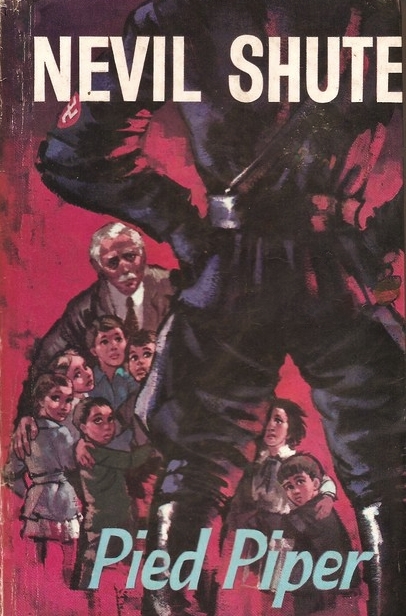
pied piper nevil shutePied Piper by Nevil Shute ~ 1942. This edition: Heinemann, 1962. Hardcover. 303 pages.

My rating: 9/10

A ripping yarn, indeed, and typical of Nevil Shute at his best.

Elderly (70-ish) John Howard, not needed for war-related work due to his age, and mourning the loss of his pilot son in the early days of the Second World War, decides to take a quiet fishing trip to eastern France, despite the menacing activities of the German forces in other parts of Europe. Unwittingly caught out by the swiftness of the unstoppable German invasion, Howard finds himself escorting two young English children in an increasingly desperate attempt to return to England. His entourage increases child by child as he collects various waifs and strays, as well as a young French woman who has an unexpected connection to the Howard family.

The coast is reached, and transport across the Channel seems to be coming together nicely when the local Nazi commander intercepts Howard and accuses him of espionage – a charge which carries a brutal penalty…

A fast-moving story with a slightly unusual cast of characters. The children are mostly believable, and John Howard himself is the epitome of quiet heroism. The invading Nazis are brutish and brutal, in between their attempts at placating the locals by benevolent establishment of soup kitchens and the like; the English who are caught in the turmoil are universally likeable and high-minded; the French locals are mostly portrayed as a combination of bovinely stoic, and (paradoxically) boldly sly.

Pied Piper is rather obviously (and expectedly so given its time of writing) something of a fervent propaganda novel, celebrating as it does the sterling nature of the British Everyman in the face of the Teutonic War Machine, but with enough departure from the clichés here and there to keep it engaging. Nevil Shute brushes over some vital details as he keeps his story moving right along, but those he includes add clarity and verisimilitude to this gripping and very readable tale.

something wholesale eric newbySomething Wholesale by Eric Newby ~1962. This edition (revised 1970 and 1985): Picador, 1985. Softcover. ISBN: 978-0-00-736751-1. 228 pages.

My rating: 6.5/10

Ever since a teaser in the early part of A Short Walk in the Hindu Kush I have been deeply curious as to Eric Newby’s “time in the rag trade”, as he so facetiously terms his years as a apprentice of sorts in the family business, Lane and Newby Limited, a wholesale women’s fashion house situated in London. By the time Eric darkened its door in 1945, after his return to England after a traumatic wartime of special forces service, time on the run from capture, and prison camp incarceration (see Love and War in the Apennines/When the snow comes they will take you away), the once-thriving business was in the first stages of what would prove to be its death throes.

The rationing of cloth was still in effect for some years after the end of the war, and this created serious difficulties for Great Britain’s dress-making firms, but of more serious impact was the resurgence of the very competitive French fashion houses, in particular Dior, whose hyper-feminine New Look (incidentally requiring vast yardages to make up, putting the struggling English firms at a severe logistical disadvantage) was a jaw-dropping success on the 1947 haute couture scene.

As Eric becomes more and more enmeshed in the garment trade – quite literally, as one will learn from the anecdotes in Something Wholesale – he records with a keen eye to detail the absurdities of that arcane world, and the many eccentric characters he came up against, from flirtatious “outsize” models intent on playing under-the-table footsie with the boss’s son (Eric, of course), to various department store buyers, commercial travellers and contract seamstresses.

In general I enjoyed this memoir, though the humour is of the determined type and not particularly funny after a certain point – pseudonymous names such as Throttle and Fumble (a retailer of Lane and Newby’s output), and the Misses Axhead and Stallybrass being examples of the sort of heavy-handed fun which Eric Newby resorts to for much of the book.

But here and there the narrative strikes pure gold, and some bits are sarcastic gems of prose and really quite perfect. And though he refuses to be completely serious for much of the tale, Eric Newby’s ultimately loving depiction of his parents and their dedication to the firm is perhaps the most gentle and poignant aspect of this uneven memoir.

Lane and Newby went down for the third and final time in 1956, winding up its affairs after the death of Eric’s father, but Eric himself stayed employed in the garment business until 1963 – taking off for an occasional expedition during holidays and writing the odd book and magazine article here and there in his spare time – when he finally managed to find full-time employment in a career much more suited to his tale-telling aptitude, journalism.

Read Full Post »

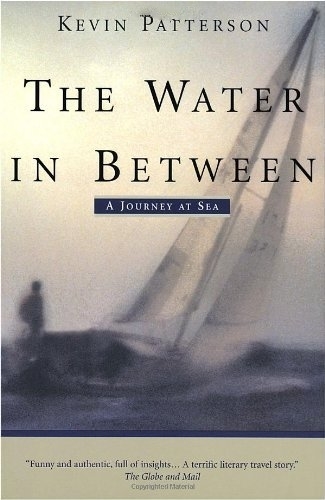
the water in between kevin pattersonThe Water in Between: A Journey at Sea by Kevin Patterson ~ 1999. This edition: Vintage Canada, 2000. Softcover. ISBN: 0-679-31054-1. 289 pages.

My rating: 9.5/10

Breaking the too-long posting silence because this book was too good not to mention. I thoroughly enjoyed it, and its references to Chatwin and Theroux (that would be Bruce and Paul, respectively) have me mulling over just which boxes those authors’ works are tucked away in – I cleared a whole bank of bookshelves to facilitate repainting some time ago, and am starting to get jittery at my lack of easy access to a favourite segment of our personal non-fiction/travel library. (The bookshelves still need their paint, too. Maybe this will trigger a start to that project?)

It seemed at first like just another one of those “Hey, my life was so messed up that I decided to go off and so something completely out of character, and in the meantime I discovered the secret of the universe, and golly, it’s great I kept notes because here I am with this book deal…” things. But it turned quickly into something rather unexpected, a non-adventurous adventure story. And the Great Big Reason for Being – well, that didn’t materialize, though Patterson spent a lot of time (all those becalmed days in the Horse Latitudes) trying to wrap his head around his personal issues, with some success.

So – a young, complete non-sailor, ex-army doctor, desperately unlucky in love and feeling that life is flat, stale and unprofitable, buys a small sailboat on Vancouver Island and sets off across the Pacific heading for Tahiti, accompanied by an experienced sailor, another emotionally desolate man, whose marriage has recently imploded and whose personal life is understandably in tatters. The two of them have never met before, and an instant friendship does not spring to life, nor do they hate each other by the time they reach Hawaii. They just kind of rub along in a very Canadian way, being tactful and not over-sharing, but listening when the other guy has a moment of cathartic release, and (apparently) never, ever giving relationship advice.

Backtracking to the non-adventurous adventure story bit. What I liked – no – LOVED – about Patterson’s saga was that he refused to build up his adventures into anything out of the ordinary. Sure, for him, Manitoba boy, setting out in a sailboat on the ocean was legitimately a leap far beyond the comfort zone, and he talks about that. Quite a lot. But there is a continual pragmatic tone to Patterson’s navel gazing which keeps his musings from straying into that self-indulgent “aren’t-I-wonderful” mode that so very many of his autobiographical-adventure peers seem to default to.

And I learned a lot, completely effortlessly. About small boats, sailing, the Pacific Ocean and its natural and human history.

Kevin Patterson wasn’t afraid to document the squalor of his own life, and the rose-coloured glasses were seldom donned regarding other people’s, either, even those souls residing in the paradisiacal South Sea isles which he finally reached, albeit after a very slow journey.

From Christopher Buckley’s May 28, 2000 New York Times book review:

 “In August of 1994, I bought a 20-year-old ferrocement ketch on the coast of British Columbia. I did this in an effort to distract myself – at the time I was so absorbed in self-pity that my eyes were crossed.” So begins this tale of sailing back and forth across the Pacific by Kevin Patterson, who at the age of 29 found himself loveless, directionless and as sour as Hamlet after three dreary years as a Canadian Army doctor posted to an artillery base in Manitoba…He conceived the idea of refreshing his soul by sailing to Tahiti, that ever-beckoning paradise, never mind that he had never been in a sailboat before and could barely tell a rudder from a bowsprit. Acedia, incompetence and ferrocement – all the makings of a decent sea yarn. Add to those literary skills, wide reading, a decent humanity, humor, a Global Positioning Satellite receiver, a Force 9 gale and you have ”The Water In Between,” a delightful, finely written and, in the end, wise book.

It succeeds against a number of odds. First, there is no longer much novelty left in the genre. The damp, drizzly November-in-my-soul impetus to go to sea has been around since Ishmael started knocking the hats off people he passed. And it’s been over a century now since Joshua Slocum, the grandfather of modern nautical literary types, completed the circumnavigation that resulted in his masterpiece and best seller, ”Sailing Alone Around the World.” All books since on the theme of putting to sea in small sailboats – alone or not – are footnotes to Slocum. Patterson himself freely admits that no one, really, has equaled the old New Englander’s nautical or literary accomplishments…

I highly recommend that you read the rest of this review here; it is a thoughtful and clever summary and analysis of The Water In Between’s unexpectedly deep appeal.

I was myself born and raised in a relatively landlocked part of the world – hundreds of miles from the nearest seacoast – and I’m a dedicated landlubber. Beyond the fringes of the seashore I yearn not to travel; the ocean quite frankly terrifies me. Nothing I read in Patterson’s book has tempted me to revisit this notion. In fact, it has strengthened my resolve not to even toy with the idea of small-boat ocean travel, much as accounts of mountaineering reinforce my desire to stay safely on non-vertical ground.

But it’s absolutely fascinating reading about such exploits, especially when the writer is so articulate. Patterson references all the standard gurus of travel writing and solo adventuring, including a few I’ve not yet read myself, and may well have placed himself among them in a low key but more than competent way by this excellent first work.

Kevin Patterson has since gone on to publish more non-fiction (Outside the Wire: The War in Afghanistan in the Words of its Participants, 2008), a novel (Consumption, 2006),  and a collection of linked short stories (Country of Cold, 2003), and he still practices medicine, as of 2013 in Nanaimo, B.C.


Read Full Post »

the gabriel hounds coronet mary stewartThe Gabriel Hounds by Mary Stewart ~ 1967. This edition: Coronet, 1974. Paperback. ISBN: 0-340-04353-9. 256 pages.

Oh. My. Goodness. This was utterly over-the-top, and if it had been written by anyone lesser (say Phyllis A. Whitney) I would have savagely panned it. But I’ve now embraced this author fully, and therefore completely forgave her the bizarre plot and the very weird and unlikely “drugging” scenes. (And the slightly ick-inducing cousinly love.)

Drum roll, please (or you may substitute the snarl of an accelerating Porsche engine here) …

My rating: 9.5/10

Loved it.

Okay, this isn’t even going to be a “proper” review, because I want you to come to it with no idea of where the plot would go, like I did. I will instead throw out these teasers. This story contains:

  • A lovely, unapologetically wealthy, 22-year-old sophisticated world traveller as the heroine.
  • An eccentric old lady who has completely channeled Lady Hester Stanhope and has created her own legend in a decaying Lebanese castle.
  • A ne’er-do-well young Englishman, handsome and intelligent but fatally weak-willed, who has gotten into a situation very much over his head; perks being the privilege of enjoying the favours of a dusky local maiden and galloping about the countryside on a beautiful Arab horse, accompanied by two gorgeous saluki hounds.
  • A scene in which the heroine unwittingly (???) smokes three “marihuana” cigarettes and only succumbs to their “self-will erasing effect” until the end of the third one, after which she is unable to walk and is carried away giggling.
  • A dastardly villain who eventually confesses absolutely EVERYTHING in a long, rambling monologue.
  • A handsome young man who can scale steep cliffs (and crumbling castle walls) without benefit of climbing gear, and who (bonus feature!) drives a white Porsche 911 S with utter aplomb and finesse.
  • Oh, and a fabulously unique and valuable ruby ring, which no one of the evil-doers seems to be able to recognize for what it is. (Among other priceless heirlooms which they casually dismiss and bundle away as “junk”. Hmmm, not quite as sophisticated as all that, then, these out-for-the-main-chance types.)

There. How can one resist all of that? And there’s more. Oh yes, much, much more!

Enjoy!

Couldn't find a white Porsche 911 S, but here's a 1966 in an elegant shade of sand, suitably posed against a Mediterranean-looking setting. How'd you like to tootle about the Levant driving this?

Couldn’t find a white 1966 Porsche 911 S, but here’s one in an elegant shade of cream, suitably posed against a Mediterranean-looking setting. How’d you like to tootle about the Levant driving this?


Read Full Post »

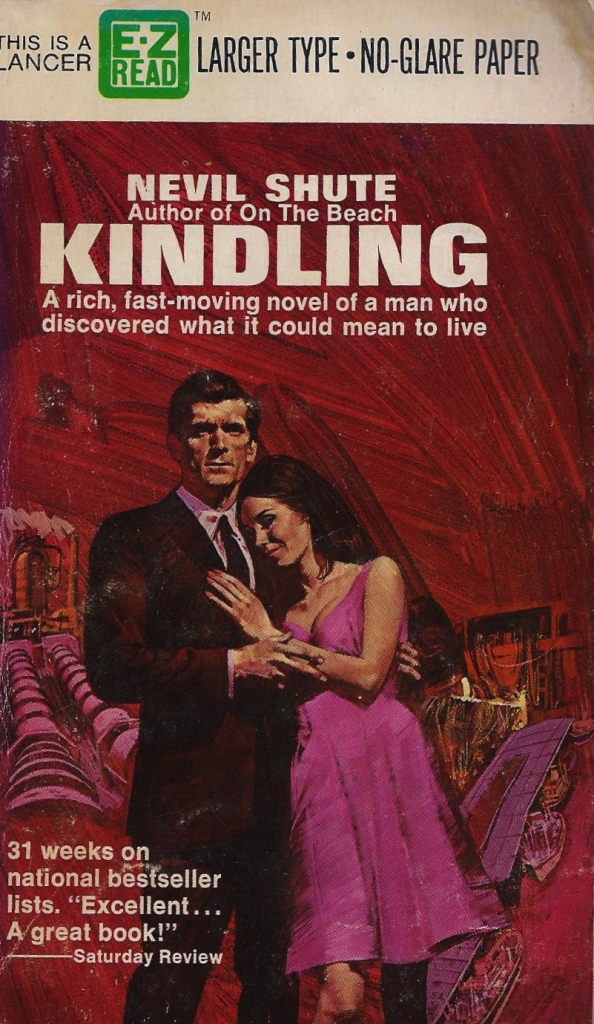
kindling nevil shute 001Kindling by Nevil Shute ~ 1938. Original British title: Ruined City. This American edition: Lancer, 1967. Paperback. 319 pages.

My rating: 6.5/10

I’m starting to fall out of the routine of posting, what with springtime’s long days and the utter luxury of being able to spend long hours out in the garden. The sabbatical year is going well, aside from the anticipated pinch of much less cash flow.

(For those of you who don’t know my back story, I generally operate a small specialty plant nursery and this year have shut up shop in order to refocus and take care of some outstanding personal farm and garden jobs which can only be properly tackled in the spring. I’m starting to think two years off might be even better, as there is no way I’ll get everything on The List finished this time round…)

Well, I’ve still been reading, though at a slower rate, and mostly in bed at night, so I notice I’ve been gravitating towards slighter novels, the kind one can finish off in an evening or two. No complicated sagas in the springtime! The brain is much too full of other stuff to make sense of anything too challenging.

Which makes Nevil Shute quite a good choice, as one can’t call books such as this last read, Kindling, at all complex. If anything, it was a bit too simplified, and I found myself occasionally annoyed at how briefly the author touched on some major plot developments, and how he introduced some promising characters and then dropped them cold, never to be seen again.

It is the mid-1930s, in England, and the long agony of the worldwide financial depression is grinding away at the status quo. It has even started affecting the very wealthy business class, who are, by and large, dealing fairly well with the money market difficulties, though those lower in the hierarchy are losing their grip.

Competently keeping his feet at the top of a shifting pile of lesser men, we have the successful, middle-aged merchant banker, Henry Warren, who deftly keeps in order a whole puppet show of various enterprises, handling staid English investors and dramatic Balkan politicians with absolutely level-headed aplomb. This involves frequent long nights in London, and many trips abroad, and Henry seems never to be home at the same time his wife is, what with the two of them leading fully separate lives and only meeting infrequently when their respective circles of activity brush against each other.

Serious problems are brewing, and not only on the home front, though things there have imploded with a sullen bang. Mrs. Warren has become romantically involved with a wealthy Arab sheik, and the gossip has surpassed the whisper stage. Henry is reluctantly forced to take notice, especially when he finds himself staying at the same French hotel as his wife and her lover. A divorce is the inevitable solution, after Henry’s ultimatum of a new sort of arrangement of reduced jet-setting and poshly-cushioned rural solitude for his wife is spiritedly rejected.

Henry sets his lawyers to work getting his divorce tidied up, and goes back to his wheeling and dealing, pausing only briefly to mull over the reasons behind the failure of his marriage. The major thing being, he concludes, that his wife’s financial independence has made it too easy for her to neglect the homemaking aspect of things. When a wife is dependent upon her husband financially, Henry muses, she has much more incentive to dedicate herself to her job, which is the home and family, while the husband’s half of the deal is to provide the money and the house.

He always felt helpless in his dealings with Elise. In most marriages, he thought, the economic tie must make things easier: the wife had her job for which she drew her pay; she could not lightly give it up. Both husband and wife then had to work, he in the office and she in the home. With Elise it was different. She had her own money – plenty of it; a dissolution of their marriage would mean no material loss to her, no unavoidable discomfort. She was not dependent on her job for her security, therefore she took it lightly…

But though he seems to recover quite quickly from the shock of the failure of his marriage, Henry Warren is riding for a fall. His overworked physique is about to let him down, and when it does, it is in quite an unexpected way. Henry ends up an incoherent patient in an overcrowded hospital in a depressed small city which has lost its only industry, that of a shipyard, some five years before. He is assumed to be an indigent wanderer, and, once he has recovered from abdominal surgery, he plays along with the charade, for he has become interested in how desperate the straits are of an entire community of unemployed men, and of how the progression of their loss of hope has affected them and their families.

If only one could bring back industry to the town, he muses…

What follows is a description of how Henry Warren manages to arrange financing to reopen the shipyard, which requires some intricate and not-quite-above-board dealings with the afore-mentioned Balkan politicians, and some at-home clever negotiations to bring some British investors into the deal.

But Henry has let his emotion in this case override his common sense, and has resorted, for the very first time in his financial career, to some shady practices which won’t stand up to investigation. And he has inadvertently made an enemy, who is in possession of a damning set of documents…

Of course there is a love interest, this time a properly womanly woman, the utter opposite of the ex-Mrs. Warren, who has departed the scene to live with her “black” paramour.

One of the sticky bits in this novel, even greater than the casual sexism, was the offhand racism exhibited throughout. The Arab lover is referred quite commonly as being “black”, and “a n*gger”, and Henry notes the “swarthiness” and the “olive texture” of Prince Ali Said’s skin, which “darkens to brown” – one would assume with a hidden blush? – when Henry lightly insults him. And the Jews in Henry’s circle get much the same treatment, though here and there one is given the nod as a “good man” despite his Jewishness and the associated stereotypes of appearance and behaviour this implies.

This aspect of Shute’s writing, even given its “era expectedness”, was a hurdle I had to crawl labouriously over, but once I made up my mind to go on, I found myself quite taken up in the story of Henry Warren’s new obsession, that of the rehabilitation of a town and its population. Henry puts the philanthropic desires of his heart before the sensible qualms of his brain, and in stepping out of bounds in a completely uncharacteristic way, makes himself an unlikely hero.

I mostly bought into it, and though the author’s philosophical soapbox was evident throughout, he told an engaging enough tale that I was held until it was all told out. Not much in the way of nuances here; we are told throughout exactly how we are expected to react and think, and I found myself meekly following Shute’s direction, though I gave myself a little shake when it was all over, to get myself tuned back in to the here-and-now.

I think “vintage” is an apt summation of the experience as a whole. The details of the financial planning are rather intriguing, being based on Nevil Shute’s own involvement in establishing a pre-war aircraft factory, which was, after many set-backs, successful.

One final note, and this on the cover. The story is set in the 1930s, and there are no passionate embraces with lightly clad women within. Henry Warren’s post-marital love affair is carried out with the strictest decorum, and though he does associate with an exotic Corsican dancer during some of his Balkan scheming, that relationship is apparently quite platonic. So the cover art is mostly imaginary, and obviously designed to catch the eye of the jaded businessman, who is (I suspect) the intended audience for Shute’s masculine romances.


Read Full Post »

the blank wall elisabeth sanxay holdingThe Blank Wall by Elisabeth Sanxay Holding ~ 1947. This edition: Persephone, 2003. Softcover. ISBN: 1-903155-320. 231 pages.

My rating: 9.5/10

Hardboiled is about toughness. Noir is about weakness.

All crime fiction is about moral transgression. Most mysteries put us on the side of the person trying to expose the transgression. Noir, though, puts us on the side of the person who is trying to hide the transgression.

~ Jake Hinkson (In interview with Mike Monson here.)

The reading lately has been overwhelmingly rewarding; a recent foray to the small B.C. Okanagan city of Vernon having netted me a substantial number of promising books, among them an astounding six (!) beautiful and pristine Persephone Press reprints – rare as hen’s teeth in the used book trade in this part of the world, as no doubt most of the people who go to the trouble to acquire them cling like mad to their precious editions.

There was this one, and also The Making of a Marchioness by Frances Hodgson Burnett, Little Boy Lost by Marghanita Laski, William – An Englishman by Cicely Hamilton, Good Evening, Mrs. Craven by Mollie Panter-Downes, and last but decidedly not least, They Knew Mr. Knight by Dorothy Whipple. (I left behind a single one, Mariana by Monica Dickens, because I already own several copies. But later, on the long drive home, I was rather surprised to find myself mentally berating myself for not snagging it as well. The dove-grey books being so beautifully produced.) Plus an early (pre-Persephone) edition of Heat Lightning by Helen Hull, among much else. The dusty-old-books treasure hunt was blissfully successful this time round!

This digression is really just me stalling for time, because I am waffling about how best to discuss The Blank Wall. It was good. Very, very good. But in an unusual sort of way, because it is that so-hard-to-get-just-right thing, “a novel of suspense”, and much of the thrill of reading it was coming to it with no prior knowledge beyond the brief flyleaf excerpt.

She got a book and read it in bed with stubborn determination. It was a mystery story she had got out of the lending library for her father, and she was not fond of mystery stories. Nobody in them ever seemed to fell sorry about murders, she had said. They’re presented as a problem m’dear, her father said. What’s more, they generally show the murdered person as someone you can’t waste any pity on. I’m sorry for them, she said, I hate it when they’re found with daggers sticking in them and their eyes all staring from poison and things like that.

Yet how little pity did she feel for Ted Darby! I really did that, she thought amazed. I concealed a body. Anyhow I took it away. And when I came back – after that – nobody could see anything wrong with me – anything queer. Maybe I haven’t got so much feeling, after all. Maybe I’m rather too tough.

I’d better be, too, she thought, as she rose and started to dress.

It’s well into World War II, and Lucia Holley, middle-aged housewife, is holding down the fort on the home front in rural New York state while her husband Tom is off “somewhere in the Pacific.” Lucia has recently rented a lakeside house, where she quietly resides with her elderly father (Mr. Harper), 15-year-old son (David), 17-year old daughter (Beatrice a.k.a. Bee), and long-time maid (Sibyl).

War-time rationing is in full force, making the everyday business of acquiring such household essentials such as butter, cheese, meat and laundry soap something of a challenge – interesting side plot regarding how best to lay out one’s “points” – and cigarettes and gasoline are virtually unobtainable. Rather than driving private cars, people are now frequently using taxis for their transportation – another fascinating period detail which becomes an intertwining plot device as the story convolutes to its end.

Bee, in the full throes of impatient post-adolescent rebellion, has decided to attend “art school” in the city. There she has become involved with a much older man, to the deep dismay of Lucia, who is completely involved in overseeing and nurturing her family, having apparently completely subjugated herself to the role of perfect daughter, wife and mother. Only Sibyl knows that the façade is sometimes just that, and she quietly covers up for her employer’s inefficiencies; the two women are complicit in their joint creation of the domestic fable of Lucia’s complete competence.

However, Lucia is no fool, though her children increasingly think her so. And as she finds her life spiralling into absolute disaster, she finds that she has an inner fortitude unsuspected during her previously sheltered and very tame life.

Bee is particularly snotty with her mother, informing her time after time that she (Lucia) has wasted her life, has no ambition, has no concept of how to properly live and no ability to analyze people; that someone of Lucia’s generation and social status (upper middle class) is basically dead from the neck up, and should be kept firmly in their proper place. Which is, apparently, as a provider of a nice place of live and a ready source of funds to allow those more capable of truly appreciating Life to get on with things. Meaning Bee. Who is an utterly nasty creature, in a perfectly “nice” way.

David is a miniature version of the all-knowing Man-of-the-Family, and has ruthlessly placed himself in that role, obviously compensating for his father’s absence with a juvenile version of misanthropic superiority to, well, just about everyone he meets. But in particular his doting mother, whose activities he oversees and critiques and occasionally forbids. And while Lucia meekly complies with his bossiness in the interests of domestic harmony, she is getting increasingly annoyed at her son’s pompous attitudes and assumptions.

When Bee’s shady lover turns up demanding a personal interview, Mr. Harper deals with him in his own way, and blissfully reports to his daughter that the problem of Bee’s love affair has been solved. Just how permanently is soon discovered by Lucia, when she sneaks away from the house the next morning in pursuit of an illicit (meaning forbidden by David) solitary swim…

I’ll throw out some more teasers. The rest of the tale involves blackmail, small-time thuggery, black marketers, racial prejudice, diverse people failed by the justice system, an unlikely (and sexually pure) passion, the yacht club set and social snobbery, multiple deceptions all around, and brutal death.

Definitely not a “cozy”!  A deeply disturbing story in multiple ways. The ending was exceedingly thought-provoking, and I’d love to divulge my thoughts, but in the interests of you all experiencing this one properly, I won’t.

If you are into domestic noir (think Patricia Highsmith and her ilk) – or even if you aren’t but are willing to take a chance on something rather dark – read it.

Absolutely excellent.

Heading off now to ABE, to investigate the availability of Elisabeth Sanxay Holding’s 17 other suspense novels.


Read Full Post »

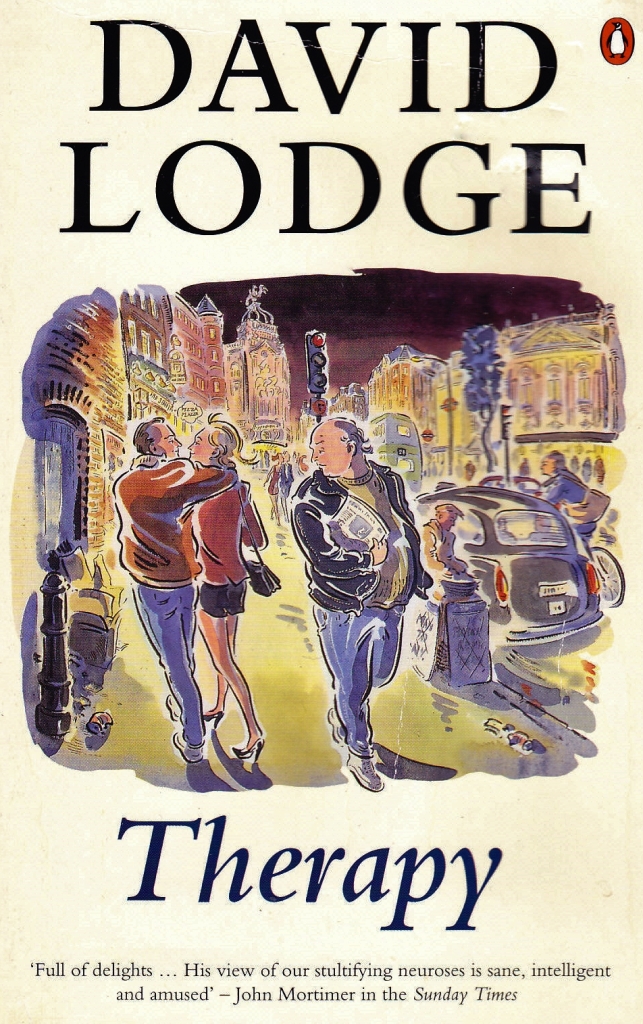
therapy david lodge v2Therapy by David Lodge ~ 1995. This edition: Penguin, 1996. Softcover. ISBN: 0-14-025358-0. 321 pages.

My rating: 7/10

I still do not unreservedly love David Lodge.

In fact, until just a few mornings ago, when I set aside what I should have been doing in order to finish up this book, I was more than a little ambiguous about his work, having previously read Changing Places and Nice Work with no more than mild pleasure and a fair bit of tuning out in the more long-winded bits.

This confession out of the way, I must say that I really like what he has done here. Therapy has struck an appealing chord with me, despite its narrator being of the wallowing sort, mired in his narcissistic bog, gazing pensively at his own reflection even as he continues to sink further and further down into a stinking morass of his own making.

Laurence “Tubby” Passmore, serendipitously successful writer of a long-running sitcom, The People Next Door, is feeling down. Really, really down. There’s no logical reason for it, as he continually reminds himself. He’s making more money than he can spend; his thirty-year-old marriage is placid and his university professor wife is keen on keeping up their sex life; his grown children are well launched; he has an outlet for sharing his thoughts with his platonic “mistress” in London, where he keeps a pleasantly-appointed luxury flat for overnight stays; his rural home is a welcome haven after days spent in the city; his posh silver car (the “Richmobile”, of unspecified Japanese make) is absolutely fabulous; and his various therapists – Miss Wu for acupuncture, Dudley for aromatherapy, Roland for physio, and Alexandra the cognitive behaviour therapist –  are solicitously caring and even somewhat helpful, giving short periods of relief from his overwhelming emotional blah-ness.

To be sure, there is that nasty thing with his knee, those occasional searing twinges of excruciating pain which occur at random and which have defied surgery, but surely that can’t account for the pervasive feeling of gloom which has settled around him, his eternal angst-ridden state, his abstraction which is starting to affect all of his relationships. But at least things are stable on the home front. For, after all, with three decades of marriage one comes to rather rely on one’s loyal spouse for eternal acceptance and understanding…

While mulling over his own personal Existentialist Dread, and doing a bit of research on the topic as a whole, Laurence happens upon the name of Søren Kierkegaard, the Danish philosopher, and, upon delving into Kierkegaard’s Journal, becomes obsessed with the man, finding – or perhaps more accurately, fabricating – parallels between their two dissimilar lives. As he becomes more and more emotionally involved with the philosopher, Laurence’s grip on his real life loosens even further, which is perhaps why his wife’s calm statement that she is leaving him comes as such an unexpected shock.

Therapy is a lot of fun to read, cringe-worthy narrator and all.

It is divided into four segments, the first being a straightforward, tell-all journal, with Laurence’s musings on the various structures and forms of writing obviously (and most interestingly) reflective of David Lodge’s own thoughts on the topic. The second section of the book is a collection of character portraits of Laurence written by him from the perspective of a number of his intimate associates, followed by a poignant flashback episode to Laurence’s teen years and his first love, the virginal (and staunchly Catholic) Maureen. Here is where the narrative takes an interesting though rather predictable twist, leading into the fourth section, which serves to bring Laurence’s narrative to a conclusion by sending him on a very personal pilgrimage along the road to Santiago de Compostela.

David Lodge is a very engaging writer, being just crude enough in his humour to elicit a certain amount of vulgar snickering, and then soaring away from the muck with some truly poignant bits of prose regarding the human condition and our universal quest for self-knowledge and the eternal why-are-we-here. Occasionally the navel-gazing gets a bit intense, but if one can soldier on one is rewarded by some gloriously funny bits, and some rather terribly true and relatable reminders of the absurdities of interpersonal relationships. (And the actual therapy episodes – of all sorts – are tellingly described and possibly the most deeply humorous bits of the book.)

I found myself mostly in sympathy with Laurence Passmore, despite the ick-factor of Lodge’s detailed descriptions of his sexual woes – for what with Laurence’s age (late fifties), physical condition (not great), and emotional turmoil (excessive), things are getting a bit difficult to, um, sustain in that department – which were kept from being too off-putting by the aforementioned humour of the author. (Though I’ll never be able to look at a bottle of Paul Newman’s Salad Dressing in quite the same innocent way again…)

Laurence/Tubby hits rock bottom, but struggles to his feet, and his redemption, though utterly predictable, left me feeling downright cheerful.

What else? Let’s see…

Grand glimpses of the actual process of creating sit-com episodes; the television studio bits are nicely done.

I rather liked the flashback sequence to Laurence’s teen days and his first love Maureen. Rather sweet, and an interesting excursion into a more innocent(ish) past, teen courtship-wise.

All in all, a decent read in a modern-light-novel sort of way, with the bonus of a mini-course in Kierkegaardian philosophy, delivered quite painlessly.

I do believe I may be reading more of David Lodge in the future, though I will allow a decent interval to pass before tackling him again. Enjoyable as I ultimately found it, I was very ready to be done with this book when I did close the last page; at over 300 pages it was a significant investment of reading time and attention, and there was a certain amount of authorial musing here and there which took some concentration to properly absorb.


Read Full Post »

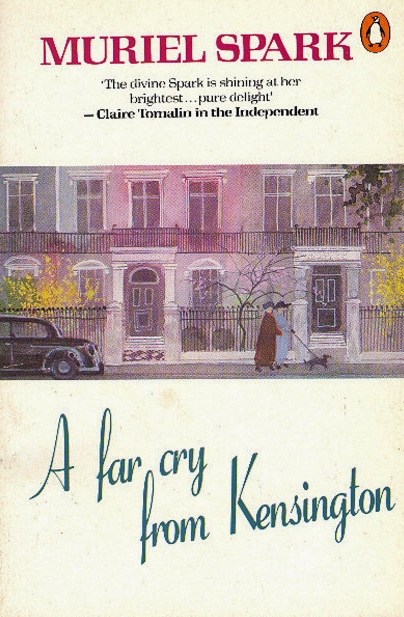
a far cry from kensignton pb muriel sparkA Far Cry From Kensington by Muriel Spark ~ 1988. This edition: Penguin, 1989. Softcover. ISBN: 0-14-010874-2. 189 pages.

My rating: 8.5/10

I am breaking my several-weeks’ book-discussing silence to applaud this brief novel by the increasingly enjoyable Muriel Spark.

Isn’t it interesting that there sometimes seems to be a proper time for certain writers in a reader’s life? I think I may have entered into a deliciously Spark-ling phase of my own, for recently I found The Mandelbaum Gate to be unexpectedly good, as is this other nicely crafted thing.

A Far Cry From Kensington turned out to be happily mesmerizing, being a tightly written tragi-comedy narrated by once-obese Mrs Hawkins – I mention the obesity because it is crucial to the plot in a most bizarre way – looking back three decades to her life in 1954-55.

At the period of time which is the focus of her reminiscences, Mrs Hawkins works “in publishing” – she is employed as an editor at a soon-to-be-doomed small press situated in Kensington – and throughout the novel we get intriguing glimpses of the workaday side of the flourishing-yet-troubled literary scene of London in the 1950s, an era and an atmosphere which Muriel Spark knew in intimate detail.

Widowed soon after her impetuous wartime marriage, Agnes (“Nancy”) Hawkins, always a large girl, has effortlessly transformed into a cheerfully fat woman, “massive in size, strong-muscled, huge-bosomed, with wide hips, hefty long legs, a bulging belly and fat backside; I carried an ample weight with my five-foot-six of height, and was healthy with it.” And people confided in Mrs Hawkins: “I looked comfortable. Photographs of the time show me with a moon-face, two ample chins and sleepy eyes… It was not until later, when I decided to be thin, that right away I noticed that people didn’t confide their thoughts to me as much, neither men nor women…”

Living in a rooming house presided over by the warmly maternal and personally high-principled Milly, Mrs Hawkins is fortunate in her housemates, whom she describes with concise but living detail: the ultra-respectable and preternaturally quiet married couple, the Carlins – he an accountant, she a nursery school teacher; the cleanliness-obsessed district nurse Kate; the gloomy and excessively emotional Polish seamstress Wanda; the young and vivacious post-deb Isobel, trying out her downy wings in London as a secretary, though in constant close contact with her doting father via a private telephone of her very own; and, not least in eventual importance to Mrs Hawkins’ personal story, the brilliantly promising, dragged-up-by-his-own-bootstraps medical student William Todd.

All of these lives are intertwined with that of Mrs Hawkins; some exceedingly closely, as we will discover later in the narrative, though Muriel Spark frequently dangles just the briefest, most tantalizing fragments of information in front of us in the course of Mrs Hawkins’ tale.

Mrs Hawkins is prone to giving advice, much of it quite good, as it turns out. Pragmatic common-sense spiced with opinionism is Mrs Hawkins’ style. We learn how simple it is to lose weight (eat just half of your regular portions, and then, when the willpower is adjusted, half again); to control rheumatism (eat a banana a day, as advised by “an American negress met on a bus”); to write an engaging narrative (pretend one is writing to a single close friend); to attain concentration (acquire a cat).

This last was one of my favourite asides in this vignette-rich novel. At a dinner party, Mrs Hawkins meets a gruff, red-faced, retired Brigadier General, who mentions that he “could write a book” about his life.

‘Why don’t you?’

‘Can’t concentrate.’

‘For concentration’ I said, ‘you need a cat. Do you happen to have a cat?’

‘Cat? No. No cats. Two dogs. Quite enough.’

So I passed him some very good advice, that if you want to concentrate deeply on some problem, and especially some piece of writing or paper-work, you should acquire a cat. Alone with the cat in the room where you work, I explained, the cat will invariably get up on your desk and settle placidly under the desk-lamp. The light from a lamp, I explained, gives a cat great satisfaction. The cat will settle down and be serene, with a serenity that passes all understanding. And the tranquillity of the cat will gradually come to affect you, sitting there at your desk, so that all the excitable qualities that impede your concentration compose themselves and give your mind back the self-command it has lost. You need not watch the cat all the time. Its presence alone is enough. The effect of a cat on your concentration is remarkable, very mysterious.

The Brigadier listened with deep interest as he ate, his glaring eyes turning back and forth between me and his plate. Then he said, ‘Good. Right. I’ll go out and get a cat.’ (I must tell you here that three years later the Brigadier sent me a copy of his war memoirs…On the jacket cover was a picture of himself at his desk with a large alley-cat sitting inscrutably beside the lamp. He had inscribed it ‘To Mrs Hawkins, without whose friendly advice these memoirs would never have been written – and thanks for introducing me to Grumpy.’ The book itself was exceedingly dull. But I had advised him only that the cat helps concentration, not that the cat writes the book for you.’

Ha!

If you smiled sympathetically at this excerpt, this book is for you.

Read it, then, and discover just what a pisseur de copie is, and what significance The Box in the esoteric (and deeply weird) practice of radionics holds, and just what Muriel Spark really thought about one of her ex-lovers, here immortalized as the deeply dislikeable Hector Bartlett.

And, for another agreeable opinion, click on over to His Futile Preoccupations, one of many other favourable reviews of this quietly malicious minor masterpiece.

Read Full Post »

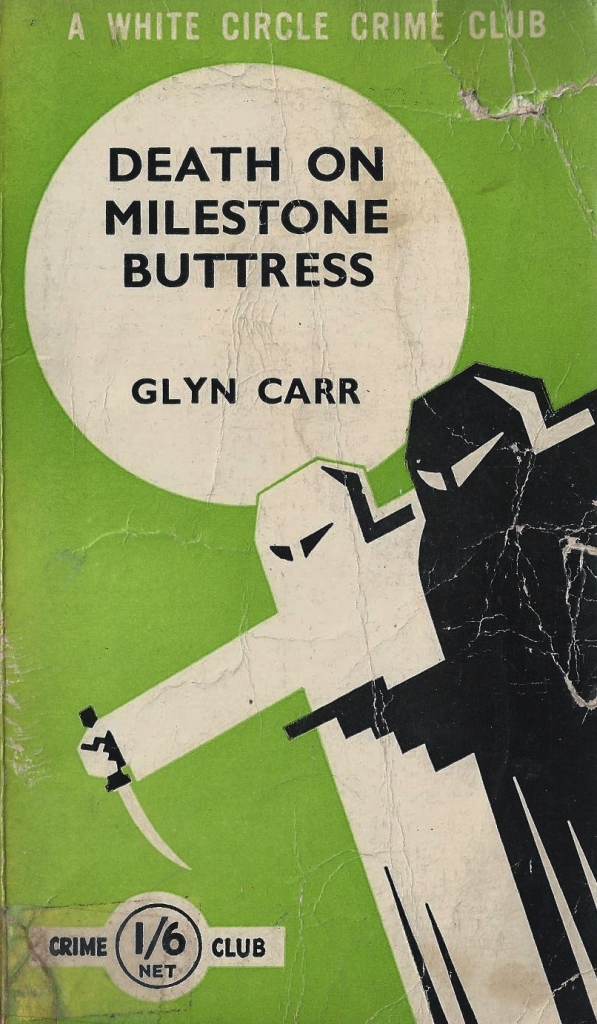
death on milestone buttress glyn carr 001Death on Milestone Buttress by Glyn Carr ~ 1951. This edition: The Crime Club, 1951. Paperback. 256 pages.

Provenance: Quesnel Family Thrift Store, October 2013. Previous book owner: Rebecca Lund, who enthusiastically rubber-stamped her name and address on all of her books, in numerous places. I know this because I have acquired a large number of them over the past few years; we obviously share a similar taste in books.

Or perhaps shared is more correct; I strongly suspect that Ms. Lund has passed on and that her books were subsequently donated to the thrift store; there do seem to be an awful lot of them, and they do look like they were carefully collected over a number of years by a dedicated reader. (Note to self: write codicil in will regarding which favourite second hand bookseller shall be the recipient of my own collection…)

My rating: 4.95/10 – I can’t quite put this at a 5 on my personal “enjoyment level” rating scale, and while it’s a very much okay specimen of its genre it’s not quite special enough to inspire me to seek out any more by this author.

Though perhaps I dismiss Glyn Carr too soon; he did go on to write fourteen more mysteries starring his stately, erudite and multi-talented Shakespearian actor/mountaineer amateur detective, Abercrombie Lewker.

Here’s the rundown on the plot, courtesy Rue Morgue Press, which has recently republished this vintage mystery, among many others. Check out their website – what a treasure trove of information on the genre! Rue Morgue Press republishes obscurish vintage mystery novels, and also deals in used copies of rare and out-of-print detective fiction.

Abercrombie (“Filthy”) Lewker was looking forward to a fortnight of climbing in Wales after a grueling season touring England with his Shakespearean company. Young Hilary Bourne thought the fresh air would be a pleasant change from her dreary job at the bank, as well as a chance to renew her acquaintance with a certain young scientist. Neither one expected this bucolic outing to turn deadly, but when one of their party is killed in an apparent accident during what should have been an easy climb on the Milestone Buttress, Filthy and Hilary turn detective. Nearly every member of the climbing party had reason to hate the victim, but each one also had an alibi for the time of the murder. Working as a team, Filthy and Hilary retrace the route of the fatal climb before returning to their lodgings where, in the grand tradition of Nero Wolfe, Filthy confronts the suspects and points his finger at the only person who could have committed the crime. Filled with climbing details sure to appeal to both expert climbers and armchair mountaineers alike, Death on Milestone Buttress was published in England in 1951, the first of fifteen detective novels in which Abercrombie Lewker outwitted murderers on peaks scattered around the globe.

And while we’re over cribbing info from the Rue Morgue Press site, here’s a snippet of their Glyn Carr Author Biography. (Much expanded on the site – please click through to read the rest.)

If you look upon a mountain climb as taking place in a large, open-air locked room, then Showell Styles was right to choose Glyn Carr as his pseudonym for fifteen detective novels featuring Abercrombie Lewker, all of which concern murders committed among the crags and slopes of peaks scattered around the world. There’s no doubt that John Dickson Carr, the king of the locked room mystery, would have agreed that Styles managed to find a way to lock the door of a room that had no walls and only the sky for a ceiling. In fact, it was while Styles was climbing a pitch on the classic Milestone Buttress on Tryfan in Wales that it struck him “how easy it would be to arrange an undetectable murder in that place, and by way of experiment I worked out the system and wove a thinnish plot around it.”

That book was, of course, Death on Milestone Buttress

So – what am I going to say about this fairly standard issue mystery tale? Perhaps I’ll just note some likes and dislikes, and leave it at that.

I liked:

  • The characterizations of both of the leading characters, Shakespearian actor Abercrombie Lewker and bank “calculating machine operator” Hilary Bourne. Both are nicely presented and sympathetically portrayed, though as the book progresses it is Hilary who stays much more real, while Lewker becomes a parody of the Hercule Poirot/Nero Wolfe type of detective, easily analyzing esoteric information with his great big superior brain, as it were. Though he is much more active physically than both of his fictional counterparts, being an accomplished amateur climber despite his less than boyish figure.
  • The mountaineering details and the descriptions of the Welsh setting, which seemed sincere and plausible.
  • The parody-like period setting, with the several sincere Communists being viewed by their acquaintances as slightly eccentric, mostly harmless, and generally rather figures of fun. The scientists who also play main roles (one is eventually the murderee) are of course working on a Great Big (not very secret) Secret Project, which when completed will apparently be The Weapon To Beat The Atomic Bomb. Quite ridiculous, the whole thing, and it rather felt like that was intentional. In any event, that’s how I viewed it, and it helped me make it through even when I found the complications of the plot rather uphill going.

I disliked:

  • The grotesque attempts at slang and dialect which were completely incomprehensible and too over-the-top, even given that the speakers of the garbled dialogue were generally meant to be figures of fun.
  • The predictability of the plot. I guessed the murderer very early on, and the red herrings provided were small and not particularly enticing.
  • The absolute unlikableness of the murderee. He had no redeeming traits whatsoever, except for his intellectual abilities as a scientist. No one cries when he dies. (Not for his loss, anyway. Though there are tears because of the multiple situations created by his death.) Created by the writer to be blithely killed off, one rather feels.
  • The love affair between Hilary and one of her fellow vacationers – absolutely meh.
  • The whole “smarter than the police” thing. Lewker takes on the mantle of Nemesis without official sanction, and all of the other players meekly fall into order without a whisper of protest. Including the murderer, who then goes on to an über-predictable end, with detective story justice thus being served with no boring paperwork to fill out or tedious trials to sit through

And that is all I have to say about Death on Milestone Buttress. Here is a rather more even-handed discussion on the Dust and Corruption blog, worth taking a look at.

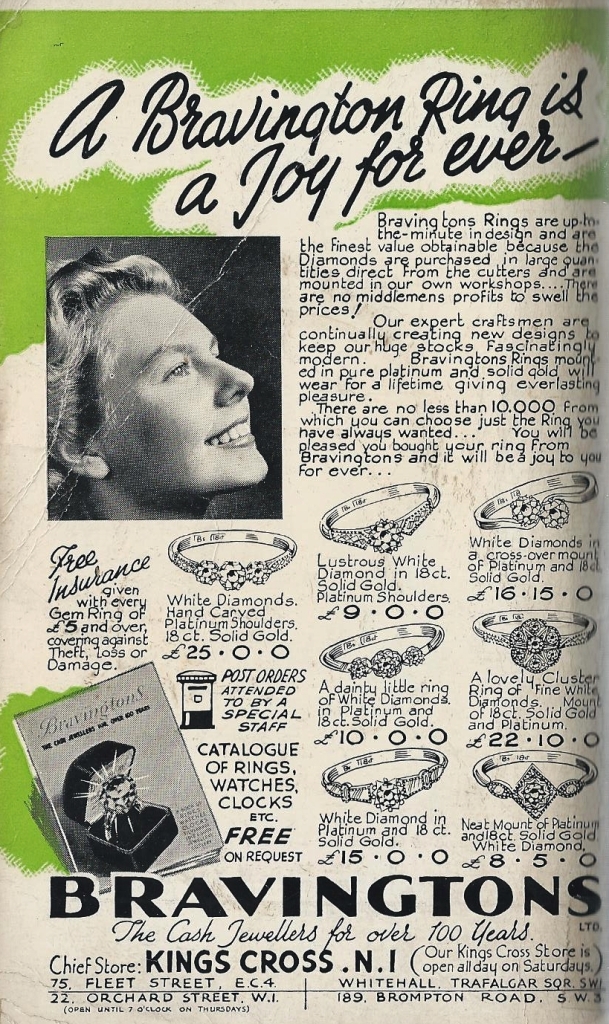
Oh – there was one more thing. Check out the back cover of my paperback, which features yet more rocks, these with gold and platinum settings. How’s this for period appeal? Check out the ad copy, and those prices!

death on milestone buttress glyn carr back cover advert 001

Read Full Post »

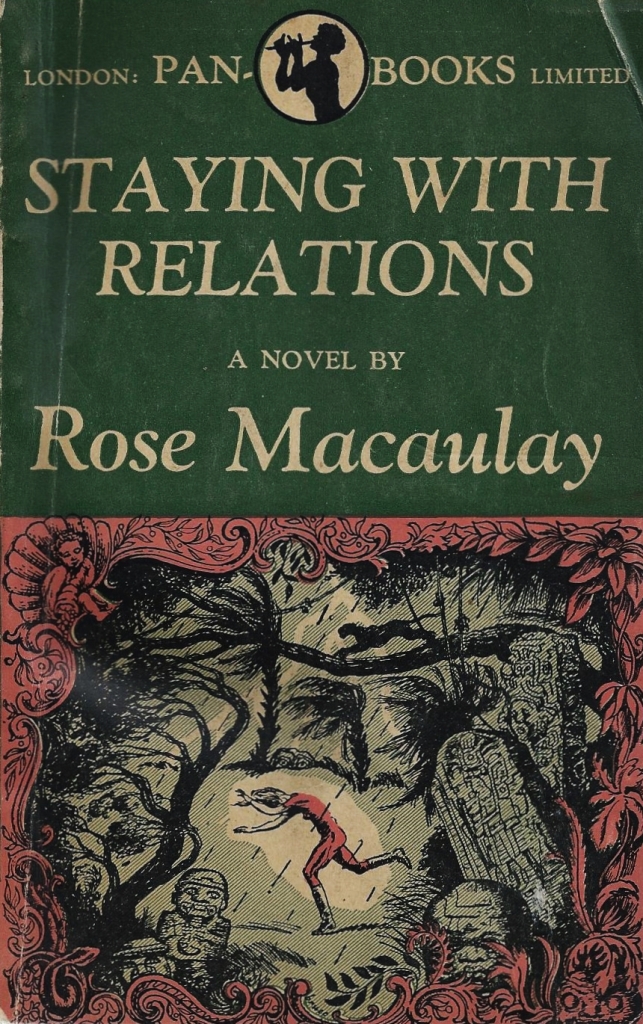
staying with relations rose macaulay 001Staying with Relations by Rose Macaulay ~ 1930. This edition: Pan, 1947. Paperback. 224 pages

Provenance: The Book Man, Chilliwack, February 2014.

My rating: 7/10

What did I just read?

My fourth encounter with the brilliant but unsettling fiction of Rose Macaulay – the others so far being Crewe Train, The Towers of Trebizond, and The World My Wilderness.

Of these, The World My Wilderness was closest to being a “plausible” story; the others were decidedly surreal. One cannot apparently read Macaulay on complacent auto-pilot; she takes a straightforward narrative and gives it the occasional twist sideways, just enough to catch the reader off guard.

Un-credited poem, one would then assume to be by Rose Macaulay herself, on frontispiece page.

Un-credited poem, which I assume to be by Rose Macaulay herself, on frontispiece page.

Among other disconnects from reality on this latest addition to my small Macaulay collection, it was the mention of tigers in the Central American jungle that caused me my greatest bemusement. I could handle all of the other scenarios – the luxuriantly roccoco villa built upon an ancient Mayan temple/Spanish monastery, the sophisticated love lives of the family of English step-brothers, -sisters and cousins living lives of lazy pleasure financed by their older relations, the American con-man with his uncanny knowledge of hidden treasure and his bizarre plot to attain such – but the tigers threw me off my stride.

At first I thought they were merely hypothetical tigers, and that the man referencing them was harking back to years spent in India, but they popped up again (figuratively speaking), apparently as a threat as “real” as the stalking jaguars which lurk in the overgrown Guatemalan forest. Had to stop and do a bit of research, it bothered me so much, and no, there do not appear to be actual tigers endemic to this region of the world. Such a relief! – I thought not, but there was that tiny bit of niggling doubt…

Okay, I’m going off on a strange tangent. Well, perhaps rightly so. This is a rather odd and slightly unsatisfactory tale.

It starts off conventionally enough. This is what the back cover of my old Pan paperback says:

Staying with Relations is about a family who live in a baroque, Maya mansion in the heart of the Central American forest. A young woman novelist goes from England to visit her relatives in Guatemala. Theft, kidnapping and hunting for treasure left there long ago by Spanish priests occur. There is an earthquake; a girl is lost in the jungle while escaping from kidnappers; unexpected aspects of the characters of the dramatis personae emerge. Rose Macaulay has enjoyed in this book the three pleasures of relating adventures, describing exotic scenery, and writing about people…She wrote this book largely as compensation for not having, in a tour of Central America, reached Guatemala and seen its ancient temples buried in jungle…

Macaulay dips her pen deeply into the satirical ink well; she jabs away at herself as much as at her invented characters, being continually cutting about the phenomenon of the English woman novelist and her apparently universal habits. Well, the writer should know.

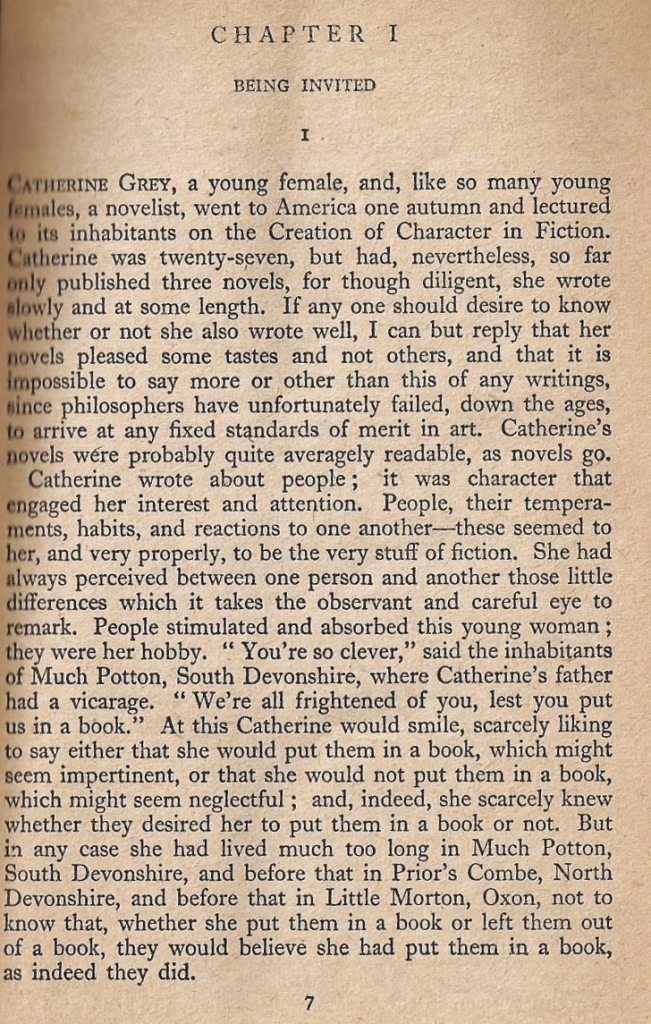
staying with relations rose macaulay excerpt 001 (2)

Once we get this sort of thing out of the way, the novel proceeds on its way detailing the adventures of the not particularly sympathetic cast of characters. Though Catherine-the-lady-novelist at first seems to be the main character, with the action viewed through her eyes, the point-of-view increasingly shifts until we realize, with something of a shock, that we don’t really know any of these people at all. And certainly not Catherine!

As Macaulay puts her puppets through their paces, one strains to see what her intent is; what is she really going on about? And I wish I could say that I figured this out for myself, but I must give credit elsewhere. It was a comment by Simon at Stuck in a Book , in a discussion of The World My Wilderness, that clicked on the light:

‘Reliable’ is just another word for ‘consistent’, really, and Macaulay does seem to write in a consistently dry, almost satirical style, pursuing a similar theme in each novel – albeit a theme so broad that she could have written two thousand novels and never needed to approach it from the same angle twice.  It is dangerous to summarise thus (and others may have said this before me…) but I believe Macaulay’s broad theme across her novels is: ‘What does it mean to be civilised?’

Once one views the novel with this thought in mind, it all begins to make much more sense. Macaulay is continually discussing, both by the dialogue of her characters and her scene setting, the difference between the “barbarians” and the “civilized” folk. No conclusion is committed to, but the concept of “civilization” trumps all of the other scurryings to and fro which make up the conventional skeleton of the story.

I enjoyed this book as much as one can when one feels as if the author is speaking rather over one’s head. As a dramatic fiction it is as unnervingly just off normal in the same way as something like Evelyn Waugh’s satirical novel The Loved One is, or his slyly funny Decline and Fall. (Though Waugh is rather more accessible, in my opinion; Macaulay can be downright obscure, giving her readers very little help at all.)

I should probably quit now, having not really talked about the plot or any of the details of the story, and digging myself deeper with every sentence into a situation which I am going to have a hard crawling back out of. A veritable tiger-pit of a post, as it were!

For those who are already Macaulay aficionados, Staying with Relations will be a most interesting read. But I wouldn’t start here for my first introduction to this unique novelist. Perhaps try Crewe Train instead; it is just as satirically twisted but there are less characters to keep track off, and a more clearly defined heroine. Who is also, now that I come to think of it, “staying with relations”…


Read Full Post »

« Newer Posts - Older Posts »