Posts Tagged ‘Canadian Book Challenge 6’

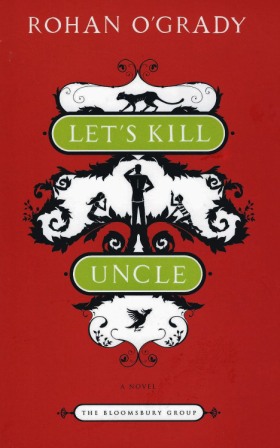
Let’s Kill Uncle by Rohan O’Grady ~ 1963. This edition: Bloomsbury Press, 2011. Softcover. ISBN: 978-1-60819-511-4. 279 pages.

My rating: 7.5/10. Extra points for the creepy and darkly humorous plot, the very thoughtful and poignant musings of Sergeant Coulter, and the grand British Columbia Gulf Island setting, apparently based on the author’s visit to Saltspring Island. (I chuckled at the naming of Benares; shades of Ganges and Vesuvius on Saltspring!) Points off for the cardboard cutout characterizations of most of the characters. Points off for the occasional swearing, which, though mild, felt out-of-place, even if this story was aimed at an adult audience. Extra points for letting the cougar finally ultimately be a cougar, and for letting the villain be purely evil with no redeeming qualities! Far from a flawless effort, but I liked it much more than I didn’t.

*****

You’ll find lots of reviews on this one; its reissue by Bloomsbury a year ago brought it into high profile.

This was a weird little book. I had read quite a few reviews before I ordered it, so I knew what to expect, but heaven help the innocent reader who thought they were picking up a mild children’s tale! Nothing innocent here; chock full of the darkest human flaws and emotions; the humour (of which there is a lot, all intentional) shades from gray to ebony black.

Two 10-year-old children from very different backgrounds are sent to stay on an isolated, and, incidentally, long-childless island. (Every son from the past generation has gone away to war and thus perished, except for one: the island’s Royal Canadian Mounted Police officer, Sergeant Albert Coulter. The bereft parents and grandparents view him with a certain resentment and suspicion making for a bitter underplot.)

Orphaned Barnaby is the heir to a ten million dollar fortune; he is coming to spend the summer with his uncle at a rural retreat. Christie is the sickly daughter of a struggling more-or-less single mother. Her parents are separated; her father is a good-for-nothing drunkard; her selfless mother is working extra hours to pay for Christie’s country holiday with Mrs. Nielsen, the island’s “goat-lady.”

The children meet on the ferry ride to the island; it is hate at first sight, but that doesn’t prevent them ganging up, running wild and wreaking havoc the entire trip. They are gratefully off-loaded, and the first person that makes an impression on them is the local Mountie, Sergeant Coulter. Luckily both children are struck with hero-worship at first sight, and Sergeant Coulter’s calming influence starts their personal transformations from brats to pleasant children.

Turns out that Barnaby’s Uncle Sylvester is not the mild, mannerly and caring man he appears to be. He is a psychotic murderer with a long history of killing for pleasure and profit; Barnaby is pegged as his next victim, and soon Christie is doomed as well. The children are on to him, and unite to plot right back, deciding to strike first to save their lives. Uncle foils them at every turn. Enter a surprise ally, an outlaw cougar, One-Ear, livestock and child killer, who is hiding out in the underbrush. One-Ear tolerates the two children associating with him, sparing their annoying lives only because he can’t afford to draw attention to himself; the three end in working together to act as Nemesis to stop this wickedest of uncles.

Nothing in this story is quite as expected; the ground continually shifts under our feet as we think we know what the author is going to have her characters do and say next; we often predict completely wrong. Sergeant Coulter is one of the most surprising characters. Initially he is a figure of fun, a slightly blustering, generally disregarded, musical-comedy type policeman. But the Sergeant has hidden depths. He writes long letters to his unaware (and happily married) love interest, rips them up and casts them on the waves. He has survived being a prisoner of war, and, in the novel’s very serious thread which runs through all the farcical nonsense of the murder plot, condemns the political forces that send young men away to kill and be killed, destroys innocent civilians, and allow the evil of the Jewish Holocaust to happen. A few incidents involving First Nations people, or, as 1963 lingo describes them, “Indians”, would likely not get past today’s politically correct censors.

There are quite a number of parallel stories going on in this novel; the author competently intertwines them and brings them to their rightful conclusions. A highly moral tale, when all is said and done.

Let’s Kill Uncle has a superficial feel of being a children’s story, and it definitely works on that level as a straightforward if morbidly fantastical adventure, but I finished with the strong feeling that the intended audience was very much the adults, and the message much more sophisticated than the plot description allows for.

The author’s name, Rohan O’Grady, is the pseudonym of June Skinner, a Vancouver writer who published five novels between 1961 and 1970, of which 1963’s Let’s Kill Uncle seems to be the best known. The others are:

  • O’Houlihan’s Jest, 1961.
  • Pippin’s Journal; Or, Rosemary Is for Remembrance, 1962.  (Also published as The Curse of the Montrolfes and The Master of Montrolfe Hall.)
  • Bleak November, 1970. Michael Joseph, London, 1971.
  • The May Spoon, 1981. (Published under the pseudonym A. Carleon.)
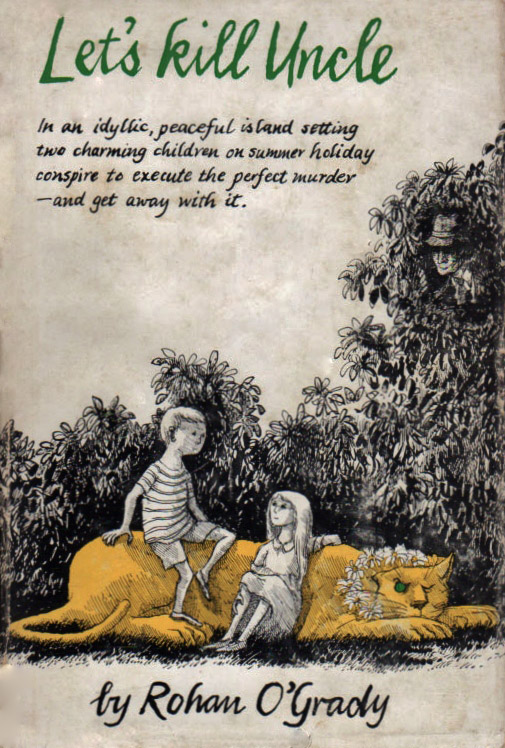
Edward Gorey illustrated Let’s Kill Uncle; I regret that the Bloomsbury reprint contains no art except for a rendition of the original cover on the title page.

This is a very hard book to classify. I’m trying to think of another similar book to compare it to; A Series of Unfortunate Events has been suggested as its natural successor, but Let’s Kill Uncle is a much more complex work than the contemporary Lemony Snicket series.

I enjoyed this quick read; it will be even better the second time around. Recommended.
Read Full Post »

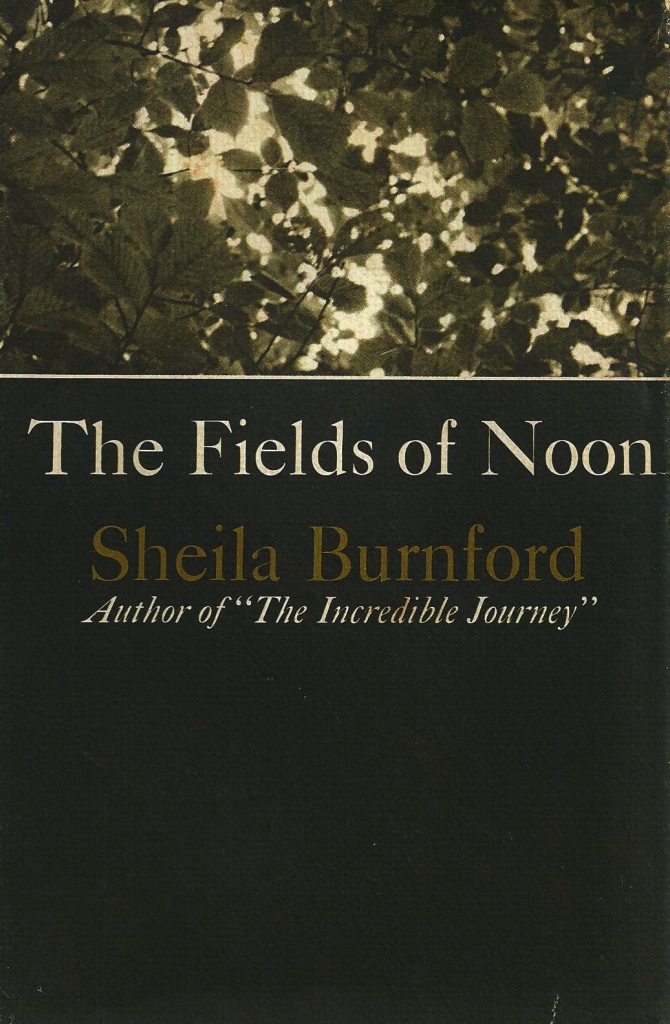
The Fields of Noon by Sheila Burnford ~ 1964. This edition: Little, Brown & Co., 1964. Hardcover. 175 pages.

My rating: 10/10

This quiet, elegant, and often very funny book is one I keep  in my ‘favourites’ collection, and regularly reread with great enjoyment.

The Fields of Noon is a memorable collection of autobiographical essays by Scottish-born Canadian writer Sheila Burnford, better known for her bestselling fictional book The Incredible Journey, a story of two dogs and a Siamese cat who together embark on a 300-mile journey through the northern Ontario wilderness. Disneyfied and popularized, The Incredible Journey might be dismissed without further attention by the discerning reader, but it was intended to be an adult book, was based on actual pets of the Burnford family, and is quite a lovely little piece of work with its own merit. Ignore the sentimental movies, please! (Perhaps I should re-read and review The Incredible Journey as an entry into the 2012-13 Canadian Book Challenge …)

Sheila Burnford, if these highly personal essays are any indication, must have been a fascinating woman to know; her writerly voice is warm and intimate, highly intelligent and self-deprecatingly humorous.

To give you a taste of the tone of this collection, here is an excerpt from the essay Time Out of Mind, concerning Sheila’s interest in archaeology and anthropology, and her subsequent attempts to learn the art of flint-knapping.

The first story I ever remember having read to me was Robinson Crusoe, and later I read and reread it myself, starting again at the beginning the moment it was finished, just like painting the Forth bridge. The Swiss Family Robinson was even better; not the shortened version so often found today but a wonderfully fat volume, profusely illustrated and complete in every last moralization (and every gruesome detail of poor Grizzle’s demise in the folds of the boa constrictor and subsequent mastication; five hours from ear to hoof – Papa Robinson timed it; children were apparently credited with stronger stomachs in those days) and its pages crammed with useful tidbits of information on how to improve one’s lot and live more graciously on desert islands. I used to spend hours daydreaming of starting from scratch on my island utopia and putting all this practical information to the test. Thanks to Mr. Robinson, that bottomless well of How To Do It lore, I knew how to make a Unique Machine for boiling whale blubber; I could construct a sun or sand clock, train ostriches, open oysters and manufacture sago; if a sturgeon had been caught in my coconut fiber fishnet I knew just how to make isinglass windows from its bladder. I could even – and as I write I feel the urge to do so – make waterproof boots (beloved, familiar gumboots), with a clay mold, taken from my sand-filled socks, then painted over with layers of latex tapped from the nearest rubber tree. It would have been a luckless Man Friday who made his imprint on my solitary sands, for I would have been a fearful bore to live with: like Papa Robinson, one innocent question would have released a pedantic torrent of information.

This childhood preoccupation with carving out an existence by my own unaided efforts used to end, invariably, I remember, with that baffled, mind-boggling feeling that used to overcome me – and still does – when staring up at a cloudless blue sky and trying to make my small limited mind grasp that the blue is a void, endless infinity, nothing, not even omega. For, sooner or later, a fearful nagging doubt insinuated itself into every castaway installment of my self-told story: What if one did not have a knife, or a goat, or a gun to start with? Or, worse still, had not read Swiss Family Robinson? How on earth did one go about forging steel for that most necessary knife (what, for that matter, was steel?), substitute for a goat, manufacture a gun, or any kind of weapon?

*****

  • Canadian Spring – a trip with an artist friend to an isolated lakeside cabin during spring ice break-up.
  • Walking: Its Cause, Duration and Effect – reflections on a Scottish childhood spent largely out-of-doors.
  • The Peaceful Pursuit – the joys and occasional pitfalls of wild mushroom hunting.
  • Confessions of a Noisemaker – how to shed one’s vocal inhibitions while accompanied on a solitary expedition by a patient dog and four inflatable duck decoys.
  • Time Out of Mind – the deceptively steep learning curve of the paleolithic flint-knapper.
  • Inclinations to Fish – the consideration of large bodies of water as primarily “fish containers”, and the joys of a lifetime of attempting to bring those fish to shore.
  • Tom – a touching ode to a feral tom cat.
  • With Claud Beneath the Bough… – caring for a solitary canary.
  • Pas Devant le Chien – a sober-minded dog becomes firmly convinced that an electric heater contains a small, living inhabitant.
  • William – the last day of life and the death of a beloved bull terrier.

Read Full Post »

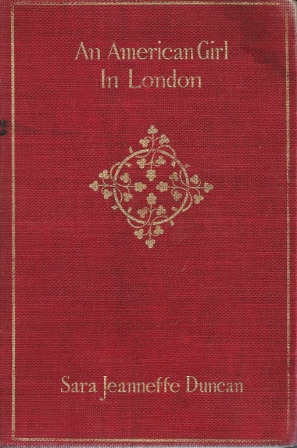
An American Girl in London by Sara Jeannette Duncan ~ 1891. This edition: Rand, McNally & Co., circa 1900. Inscription: “To another American girl – Mary Couch Huntington, Xmas 1900.” Hardcover. 290 pages.

My rating: 7.5/10

This is that most pleasant of things, a book purchased on a whim for a for a minor sum, which turns out to be a grand read, and then, even better, to add another author to the “keep an eye out for” list.

I paid 50 cents for this “genuine antique”; it was half-price book day at the local Sally Ann; I dipped into the gilt-edged, obviously well-read volume and it looked promising, well worth a tiny monetary gamble. I had initially thought that it was a volume of genuine reminiscences, but early in I realized that it was instead a gently satirical fiction. I found myself completely drawn into Miss Mamie Wick’s fresh and frank dialogue, and I eagerly followed her as she solitarily travels from Chicago to New York, and sets sail for England.

What a grand period piece this amusing novel is! Written in the late 1800s, the narrator is not shy of poking gentle fun at herself and the thousands of her American compatriots who are eager to explore England’s historical places and partake of whatever social whirl they can shoehorn themselves into.

Our own Miss Wick is extremely fortunate in her shipboard acquaintances; she makes a strong impression on a young British aristocrat (how strong becomes quite apparent to us early on, and to Mamie herself at long last, near the end of the story), as well as on an initially frosty elderly ladyship who completely unthaws under the influence of Mamie’s unusual charm, with interesting further consequences.

Mamie does all of the typical American tourist things; she visits Madame Tussaud’s, the London Zoo, the Epsom Derby, boat races at Oxford, and all the rest, but her aristocratic acquaintances smooth her way to higher levels and grander experiences than most American tourists ever attain, and she shares every impression with us. I did truly get a vivid picture of what the England of the time (at least in the relatively “higher” circles in which Mamie’s social class moved) looked, sounded and felt like through Mamie’s eyes; the author, while maintaining a delicately cynical tone, obviously had a great fondness for all of the best aspects of contemporary and historical England and her inhabitants.

The protagonist is thoroughly likeable and full of little unexpected insights and surprises; I laughed out loud several times at her philosophizing and her witty internal voice; she doesn’t miss much, but she continually minds her manners and behaves with impeccable politeness, much to her credit, as the same cannot be said of some of the people she encounters.

My only complaint was that the ending was much too sudden; it was the only part of the story that felt a bit forced; but as we could have gone on with Mamie forever I suppose it was a necessary break.

I was so impressed by this story and its unexpected quality that I researched the author. Lo and behold – Sara Jeannette Duncan turns out to be a well-respected and quite well-known turn of the century Canadian author and journalist. Here she is:

http://en.wikipedia.org/wiki/Sara_Jeannette_Duncan

http://www.biographi.ca/009004-119.01-e.php?&id_nbr=7912

Several of Sara Jeannette Duncan’s works are available on Project Gutenberg, and many of her works are still in print; she is apparently a staple of Canadian women’s studies courses at our universities. Who knew?! (Well, obviously a lot of people. Just not me. But I know now!)

And I am mildly thrilled to discover that An American Girl has a sequel,  A Voyage of Consolation. I started reading this on Gutenberg last night, and then decided to quit with that and try instead to find a print copy; I want to read it in perfect comfort, meaning not on a screen, and then place it on my shelf next to my newest antique, ready for re-reading at my leisure.

Sara Jeannette Duncan’s more serious works, fictional and journalistic, are now top of my look-for list, and if these light novels are any indication, she will be a smooth and witty read in any genre.

Bonus: I can add this review as my second entry in the 6th Canadian Book Challenge: http://www.bookmineset.blogspot.ca/2012/06/6th-annual-canadian-book-challenge-what.html

This author is authentically Canadian, despite the title of this piece, which had led me to initially assume she was American, and her body of work reflects her native land, though she did leave Canada both to travel widely in her journalistic career and to accompany her British husband on his postings abroad. Sara Jeannette Duncan died in England in 1922, at the much-too-young age of 62.

Read Full Post »

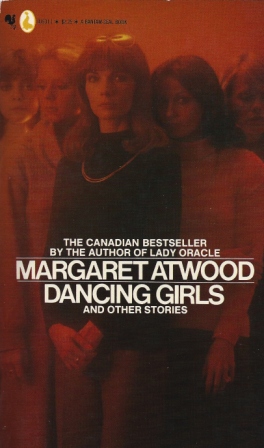
Dancing Girls by Margaret Atwood ~1977. This edition: Bantam Seal, 1978. Paperback. ISBN: 0-7704-1531-1. 245 pages.

My rating: 5.5/10. A few too many misses for a really high rating.

*****

A collection of short stories written early in the career of Canadian icon Atwood.

I have an ambiguous relationship with Margaret Atwood, or, rather, her work. I greatly admire the real person; Atwood has become an outspoken and lucid critic of much of what is troublesome about Canadian societal, political and environmental issues. I have heard many of her interviews and lectures via our venerable CBC Radio, lifeline of many Canadian rural dwellers far from the bright lights of the cities which have absorbed the majority of the population in this vast and still-wilderness-filled land. Just thinking about her, Atwood’s distinctive voice fills my head; nasal, cynical, with a deadpan delivery that would make her a knock-out stand-up comic if she were ever to desire to switch careers at this late date.

But… I am not completely comfortable with much of her written work. I’ve read all the novels dutifully as they’ve appeared through the years, as a typical middle-aged, literate, Canadian liberal feminist (as good a description of my demographic as any) should. I can nod and smile knowingly during literary discussions with the local intelligentsia, though I add little to the conversation myself; I am very aware of my value as an audience to my much more vocal acquaintances and have no real desire to step into the conversational limelight myself much of the time; it’s simpler to stand by and listen…but I digress.

Atwood. How to describe my feelings? Well… ambiguous… I guess. There is no doubt that the woman can write. Her words flow, dance, surprise, shock – grand stuff indeed! But too often I put down the latest Atwood feeling a vague dissatisfaction. Are things really that bad? Are all of our relationships – friendly, familial, societal and particularly sexual and marital – as deeply flawed as Atwood continually portrays? A course of Margaret Atwood often drives me to the other extreme; to the literary arms of, say, Elizabeth Goudge, with her encouragements of perseverance and sacrifice rewarded, versus Atwood’s cynical view that it doesn’t really matter how hard you try, you’re pretty well screwed from the get-go. (I rather agree, but all in all, it’s not that bad; most of us muddle along with a fair amount of happiness despite the inevitable rough bits. Don’t we?)

But this woman can write.

Here is what you’ll find in Dancing Girls.

***  =  the ones I greatly enjoyed.

*  =  Worth reading.

The rest I rather wish I hadn’t subjected myself to, though opinions obviously will differ.

  • The War in the Bathroom – A week in the life of a woman who has apparently descended into some form of mental illness; she has split into two personalities; the intellectual (controlling) and the physical (responding). Typically depressing; not one of the gems of this collection.
  • ***The Man From Mars – An unattractive student is targeted by a stalker, “a person from another culture”.  I liked this one. Melancholy (of course!) but very well presented; cynically amusing; I can hear Atwood’s best voice loud and clear.
  • Polarities – A woman goes slowly mad. Dreary as the winter setting and the doomed relationships it describes.
  • Under Glass – Another doomed love affair. Sad, sad, sad.
  • The Grave of the Famous Poet – A journey becomes a metaphor for another imploding relationship.
  • ***Rape Fantasies – This one story is probably worth buying the book for. Four young women discuss rape fantasies. Atwood at her wickedly humorous best.
  • ***Hair Jewellery – Beautifully written. Another relationship unravelling, but the protagonist moves successfully on. Or at least so we think.
  • ***When It Happens – An elderly woman prepares for the end of the world. Haunting.
  • A Travel Piece – A travel writer on a trip that goes terribly wrong. Taps into all of my worst-case flight scenario fears. Wish I hadn’t read this one – personal nightmare stuff!
  • The Resplendent Quetzal – Too many details about an unhappy marriage and the petty meannesses that bitter people resort to.
  • *Training – A young man examines his motivations and innermost feelings as he deals with his family’s and his own expectations for his future.
  • *Lives of the Poets – This one feels autobiographical. Another relationship tragedy, enhanced by the futility of struggling artistic careers.
  • *Dancing Girls – Culture clashes in a rooming house.
  • ***Giving Birth – The ambiguities of expectant and new motherhood. Excellent.

Read Full Post »

The 6th Annual Canadian Book Challenge

The 6th Annual Canadian Book Challenge

13 (or more) Canadian books in 365 days – Read, Review and Share

I’m in!

Read Full Post »

« Newer Posts