Posts Tagged ‘Canadian Book Challenge 6’

the best thing for you annabel lyon 001The Best Thing for You by Annabel Lyon ~ 2004. This edition: McClelland & Stewart, 2004. Softcover. ISBN: 0-7710-5397-5. 322 pages.

My rating: 10/10

Annabel Lyon is absolutely fearless in where she’s willing to go with these novellas, and there wasn’t a single jarring note anywhere. I am in awe.

I liked this collection in the same way I liked her high-profile Giller and Governor General’s Award nominee, and Rogers Writers’ Trust Fiction Prize winner, 2009’s The Golden Mean – sometimes I was deeply disturbed – and occasionally almost offended – by the images she conjured up, but I never, ever – even briefly – looked away. She kept me fully engaged the whole breathless trip.

This woman can write, people. If you haven’t already, you need to check her out.

Highly recommended.

*****

The Best Thing For You is a collection of three novellas. This is a form which I don’t see used much any more, but in this case it works wonderfully well, allowing an ambitious complexity of content and keeping the pace fast without the inevitable fluctuation in energy which occurs in a longer novel.

All three stories are set in Vancouver, British Columbia, the home of the author. The first two are set in contemporary times and the third is set during the ending days of World War II; the celebration triggered by the announcement of the end of the war plays an important part in the narrative.

Be prepared to pace yourself when reading through this one. Each novella deserves as much attention as a novel would; I found that I stopped cold after each one and only was able to turn my full attention to the next after digesting what I’d read for a few days. I wouldn’t recommend reading these in one fell swoop; I personally would have found that overwhelming. This is a collection that deserves – demands! – the reader’s full attention.

  • No Fun – A conventional enough narrative about a respectable middle class family, mother a doctor, father a university professor, well-adjusted, perfectly normal teenage son in high school. That’s the surface picture. When the son is involved (possibly? probably?) and criminally charged in connection with the brutal beating of a mentally handicapped man, the picture perfect impression dissolves into a dramatically realistic portrait of three people in personal crisis. As the mother of a teen boy myself, this novella (cliché alert!) touched me deeply in a very personal way. It made me smile in recognition, it frequently made me laugh, and it made me feel less alone in my occasional confused dismay at what our beautiful babies evolve into without our maternal permission (damn it anyway!) Lyons gets it so very right; how does she do that? The portrait of a marriage going on behind the issues brought about by the child is exceedingly well drawn as well.
  • The Goldberg Metronome – a young couple find a mysterious package taped to the pipes under the bathroom sink in their newly rented apartment. In it is a midnight blue, broken antique metronome. The story of the metronome’s history interweaves with the stories of the lives of the people it has joined tenuously in a thread of possession, passion, desire and loss. Gorgeous story.
  • The Best Thing For You – The strongest (of a strong three) and most elaborately plotted (of a beautifully complex three) of these novellas. A discontented young married woman involves a teenage delivery boy first in an adulterous affair and then in something much deeper and darker. Another teenager in the periphery of the events becomes deeply involved in a very different way. Cleverly noir, I thought as I read; I was vindicated in this assessment by reading in an interview here that film noir was indeed Lyon’s inspiration for the story:

I like film noir, and was interested in creating a femme fatale who’s both less and more than she seems.  Anna is a black-eyed adulteress who murders her husband for his life insurance, but she’s also bookish and melancholy and doesn’t really enjoy sex with her lover.  She’s also curious.  That’s one of her defining characteristics for me.  She doesn’t want to close her eyes and act as though everything’s all right when clearly–as a young woman with little formal education, no job, and no prospects, who is perceived basically as a sexually precocious child by everyone around her–her life looks quite grim.  She doesn’t want to play along, to pretend.  She wants to confront.

I guess the tone of the novella came about because I was constantly thinking about film.  I tried to keep the action quite external, to start scenes in the middle, to cut, to use dialogue in the slightly stylized manner of movies from the forties, and also to convey a sense of black and white through the prose yet with a complexity of texture that is a hallmark of some of the great movies from that era.

Again, here’s the interview link: Book Clubs. ca. Short, but well worth a read after you’ve enjoyed the collection. It added another dimension to my respect for the depth and general excellence of this author’s work.

Read Full Post »

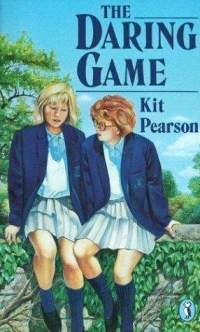
the daring game kit pearsonThe Daring Game by Kit Pearson ~ 1986. This edition: Puffin(Penguin), 1987. Paperback, ISBN: 0-14-031932-8. 225 pages.

My rating: 6.5/10. Rather pedestrian writing, but a decent “school story” with a strongly depicted Canadian setting. The intended audience would likely be preteen girls.

*****

Eleven-year-old Elizabeth – Eliza – Chapman has always dreamed of going to boarding school. She’s been reading English school stories for years, and thinks that wearing a uniform, living in a dormitory, and eluding Matron while having midnight feasts would be much more exciting than going to her boring old Edmonton day school. Her parents’ transfer to Toronto for a year seems like a grand opportunity to fulfill her dream. After much persuasion, Eliza is enrolled in Vancouver’s Ashdown Academy for her Grade Seven year, and with only a minor bout of homesickness enters into communal life with great enthusiasm.

Her fellow roommates are a widely varied lot: prim and bossy Pam, meek and gentle Jean, friendly Carrie and rambunctious, unpopular Helen. Alternately horrified by and attracted to Helen, Eliza finds herself drawn into a friendship which will have some serious consequences before the year is out. The “Daring Game” of the title is invented by Helen, and though some of the dares are simple enough to carry out, the last one goes very wrong and embroils Eliza in an impossible dilemma: stand up for a friend, or tell strict the Headmistress, Miss Tavistock, what is going on.

This was B.C. librarian and veteran kidlit author Kit Pearson’s first novel, and was inspired by her own teenage years at a Vancouver private school. It’s a decent enough middle grade novel, though my own daughter set it aside after the first chapter when I brought it home for her to read during her own Grade Seven year. I read it then and wasn’t terribly enthralled either, and this second reading for the purposes of writing this review (and possibly culling the book from our shelves) hasn’t really changed my mind.

Published in 1986, but set in 1964, The Daring Game attempts to reflect the scene of twenty years earlier, and though all the references are indeed correct, perhaps not enough time had passed to make it truly interesting from a historical point of view. The characters and the situations are competently presented, but this novel remained, to my mind, rather unexceptional from first page to last. Eliza goes through all the motions, but at the end of the story I found I was more than ready to bit her an easy farewell with nary a thought about what was to come next for her.

Kit Pearson has gone on to write a number of other well-regarded juvenile novels, including  the “Guests of War” trilogy involving British children sent to Canada during World War II: The Sky is Falling, Looking at the Moon, and The Lights Go On Again, which I’ve dipped into but not read in their entirety, and a time travel story, Awake and Dreaming, which I read and enjoyed. She’s an author worth keeping in mind if you have middle grade readers looking for something with strong Canadian content and thoughtfully (but not graphically depicted) challenging situations.

While I’m not tremendously enthusiastic about The Daring Game, I will give it a mild “okay”. Worth a try; might be just what your own young reader is looking for. I’m not quite ready to pitch it yet – see why our shelves are groaning! – but will try to read a few other titles by this author before deciding if she’s indeed a general “keeper”. The B.C. connection makes it hard to be heartless, though Pearson’s titles are abundant in local libraries and bookstores, and should be easy to find for the forseeable future even if I relinquish ownership of my personal copies.

Read Full Post »

Tthere you are joanne taylorhere You Are by Joanne Taylor ~ 2004. This edition: Tundra Books, 2004. Softcover. ISBN: 0-88776-658-7. 199 pages.

My rating: 4.5/10. Well researched and competently written, but missing that special spark.

*****

Almost-twelve-year-old Jeannie Shaw lives with her family in the Margaree Valley of Cape Breton, Nova Scotia in 1952. School is about to start, and this year Jeannie hopes and prays that there will be a friend for her, another girl who she can walk with and talk with, share secrets and dreams with; someone to heal the deep loneliness that Jeannie has had for far too long.

There are several other girls at Jeannie’s small rural school, but they are a grade older and as far as they are concerned that year or two might well be a century. Word is out that a new family has arrived, with a child Jeannie’s age; but to her dismay the longed for girl turns out to be just another boy.

Jeannie and Cap Parker get off very much on the wrong foot together, a situation made worse by their sharing of the same desk in school. And things at home aren’t going well either. Jeannie’s pesky four-year-old sister Pearl is always getting into her things, and their pregnant mother merely pleads for peace and quiet rather than administering any sort of punishment to Pearl.

When Pearl and her small friend Ella disappear while being in Jeannie’s care, she reluctantly finds herself grateful for Cap’s quick wits and good nature in dealing with the days of uncertainty which follow.

While this was a book which tried really hard, it just never really got off the ground for me. The characters were one-dimensional and predictable in all of their thoughts and actions. A certain success was achieved in the description of the time and setting: 1952 in a peaceful, beautiful, rural Cape Breton Valley. Little historical snippets are distributed throughout.  A few horses still share the roads with cars in this peacefully backwoods part of the world; Cap’s father died in World War II, and Jeannie’s father is a returned veteran; the polio epidemic is widely known and deeply dreaded, and is a key part of an incompletely developed plot twist.

There is not enough historical content to make this a proper historical fiction, or enough character development to make this a satisfactory personality-driven novel; the climax is artificially sustained and unrealistically resolved. A very cookie cutter story, imposed on a potentially unique setting.

This is not so much a bad juvenile novel as it is a disappointing one, at least to this reader. I felt it was missing that elusive spark which truly brings a story to life.

This appears to be a minority opinion. There You Are was nominated for the Canadian Library Association’s Children’s Book of the Year Award for 2005, and was a finalist for the 2005/2006 Hackmatack Award, an Atlantic Canadian “Children’s Choice” award.

An acceptable story for the target audience of eight to twelve suggested by the publisher’s promotional blurb, but not recommended by me with any sort of enthusiasm, though Jeannie’s situation will likely garner some sympathy from younger, less critical readers.

Purchased at a recent library book sale, and going back into circulation to try for another home; it’s just been placed gently in the giveaway box.

Read Full Post »

canada-reads-2013-panelists-books

Last night, with great self-congratulatory brouhaha, CBC Radio host Jian Ghomeshi introduced the Canada Reads 2013 Shortlist and celebrity panelists. This is an event I’ve watched (well, more accurately, listened to) with mild interest the last few years, but never really embraced.

I confess that I am in general deeply cynical about prizes awarded by popular vote, which is the whole premise of this literary “event”, but this year the shortlist picks seem more intriguing to me than some in the past, so I’ve set myself a personal goal of reading and reviewing all five of them. This will also tie in nicely with my participation in 6th Annual Canadian Book Challenge , hosted by John Mutford of The Book Mine Set .

I may also explore among the picks in the Long List, though I have no intentions of reading all of them. We’ll see what happens. This list will find a home in my library bag, for those days when inspiration needs a little push. I’ve already read a few (a very few) of the picks, though mostly before this blog materialized. I may re-read and review. Or not! Leaving myself wide open here.

This year Canada Reads has a regional theme, which doesn’t really work in my opinion, as there are only five extremely broad regions and geographically and philosophically I think there is more variance in truly regional Canadian literature than these limited categories allow. But no one asked me, so I guess I need to go with it.

Here’s our Long List:

B.C. & Yukon:

The Prairies and North:

Ontario:

Quebec:

Atlantic Canada:

Read Full Post »

White Mist by Barbara Smucker ~ 1985. This edition: Puffin Books, 1987. Paperback. Includes research bibliography. ISBN: 0-14-032144-6. 157 pages.

My rating: 5/10. Just barely. It’s more like a 4, but I gave the author an extra point because of her well meaning earnestness. The message is a good one, but the presentation is deeply lacking in finesse.

I wonder what a typical nowadays young reader would think of this one? It might be perfectly acceptable; I’ve read much worse “kid lit”. From my adult perspective it was a tough slog, though. The author tried to pack too much into this one; in my opinion she should have let off a bit on the info-dump and paid more attention to the story.

And the “Indian = good, White Man = bad” thing was oversimplified.

*****

I’ve been trying to cull our overwhelming book collection, and this was one that got a second look when I was sorting through several boxes of kids’ books this week.

Barbara Smucker, as you Canadians with children or schoolroom experience may know, is famously the author of the multi-award-winning Underground to Canada, about the legendary “underground railway” system of helpers and safe houses by which black slaves escaped to freedom in Canada in the mid-19th century. I haven’t read Underground for years; not since my own children were quite young, but in my memory it was a well-done juvenile historical fiction. I may need to review that one after reading White Mist, to see if it holds up to my positive memory of it.

Smucker, born  Barbara Claasen, was a New Order Mennonite from Kansas, where she attended college and received a journalism degree in 1939. After graduation, she married a Mennonite minister, Donavan Smucker, and the two of them, and eventually their three children, travelled widely throughout the United States. In the late 1960s, the Smuckers found themselves in Mississippi, where Barbara became deeply interested in the civil rights movement. As Mennonites, the Smuckers were already passionate about peaceful resolution and non-violent solutions, as well as justice and minority rights. These themes run through every one of  Barbara’s subsequent stories.

In 1969 the Smuckers moved to Ontario, and, while working as a public librarian, Barbara’s writing career took off, at the relatively advance age of sixty-two, with Underground to Canada’s 1977 publication. This was followed by Days of Terror in 1979, about a Russo-Mennonite family fleeing the Russian Revolution in 1917, and Amish Adventure in 1983, about the challenges facing the contemporary Amish. White Mist, 1985, deals with ecological issues, as well as First Nations (“Indian”) displacement and rights.

Here is the plot outline of White Mist, from a review written by Susan Ratcliffe in 1986:

Grades 5-6/Ages 10-11.

The message of Barbara Smucker’s newest novel is clearly stated by one of the main characters: “If we destroy the earth, we destroy ourselves. We are one with the earth.” She has chosen a rather unusual, and somewhat awkward narrative method to convey this theme.

May is a young, dark-skinned, dark-haired teenager, abandoned as a baby on the door-step of the Applebys, who subsequently adopted her. She thus has no knowledge of her parentage or heritage, and suffers the teasing of other kids in her Sarnia [Ontario] school. She feels an outcast from their society. Every summer she and her parents go to work in their nursery on the shores of Lake Michigan, but find the lake changed this year. The beaches are dirty and littered with dead fish; the water is smelly and unfit for swimming. This year too, Lee, an Indian boy from the local reserve, comes to work at the nursery. He and May gradually become the captives of a strange, swirling white mist that eventually takes them back to a time when there were virgin forests on the shores of a clean lake, a thriving lumber town, and a village of the Potawatomi Indians. They are absorbed into the village life and learn pride in their native heritage. May even meets her great-grandmother, and gains a sense of family and roots.

The awkwardness comes in the switch from the present to the past. May and Lee are surprisingly knowledgeable about every detail of the area and people of 1835. At several points in the story, one or the other of them has to give the source of their information: “I studied all winter at the Reserve library about the Potawatomi…”. “I read about it in Uncle Steve’s books on local history…”. “Uncle Steve had told her…”. Their interest and historical retention is astonishing for their age.

The messages of the novel are strong and worthwhile; pollution and the environment, and the prejudices against native peoples. The characters are bright and attractive, but the method chosen to tell the story is too contrived and unbelievable. However, Barbara Smucker’s many fans may forgive her, because of the appeal of the themes.

I was interested to read that this reviewer felt the same way that I did; that the novel was awkwardly presented and the young protagonists unrealistically knowledgeable about local history. I also felt that the “Indian” characters whom May and Lee met in their deeply contrived time travel were presented in a very stereotyped way, as almost impossibly good, noble, and completely in touch with nature at all times, in the literary “noble savage” tradition.

I do appreciate the use of First Nations characters in leading roles, and it was sweet to see May’s relationship with her white foster parents so lovingly depicted. May’s confusion about her racial history and quest for a way to balance her origins and her present life was very exaggerated, but it was good to see those topics addressed head on. Lee’s recent tragic history of losing a close friend to suicide on his troubled reserve doesn’t get much discussion, but is presented in a matter-of-fact fashion; this is Lee’s reality, and explains why he is so ready to embrace a more positive past. Lee’s fierce pride in his ancestry, and his impatience with May’s ambiguity towards her ancestors ring true to Lee’s characterization.

While many of the non-First Nations characters are presented in a negative, one-dimensional way, there are several exceptions: May’s foster parents are seen as unreservedly “good”; May in her distressed first days as a time traveller meets with kindness from a pioneer woman, and from a cook in a logging camp; and many of the “white” lakeside dwellers embrace the ecological message when Lee and May return from their blip into the past and make their heartfelt presentation for a crusade against pollution.

I didn’t enjoy this book, though. Its flaws were too many and too glaring to ignore, and I can’t recommend it.

I give the author a decided nod for her good  intentions, but it’s a very faked-up story, and I ultimately couldn’t get past that. Into the giveaway box.

Read Full Post »

Randy Bachman’s Vinyl Tap Stories by Randy Bachman ~ 2011. This edition: Penguin Canada, 2011. First edition. Hardcover. ISBN: 978-0-670-06579-0. 224 pages.

My rating: Oh boy. Another toughie to rate.

Because I’m already something of a Vinyl Tap fan, admittedly for Randy’s rambling anecdotes more so than some of the actual songs, and I’ve heard some – a lot! – of these stories before. The book perfectly captures his long-winded, continually-sidetracked, “Hey – I played with everyone you ever heard of” – and of course he did, he really DID! – very Canadian, very polite, and very funny style. I could hear his voice say every word I read.

Anyway, the rating. If I’d never heard a single episode of Vinyl Tap, I’d have to say a 6 or possibly a 7. Lot’s of name dropping, lots of references to both now-forgotten musicians and still-legendary rock stars, lots of eyes-glaze-over arcane musical stuff. As it is, and because I really like and admire Randy on a personal level – though I’ve never met the guy, and was definitely not a real fan of his music when growing up, except for the few chart toppers I inadvertently listened to – “American Woman”, “No Sugar Tonight” – you know, the standards – (I was always more into the Brits, like The Stones and The Who and Bowie and T. Rex, with a parallel affection for Jonie Mitchell and Bob Dylan and their ilk) – anyway, his voice on CBC Radio is a ton of fun to listen to, and the man seems genuinely nice.

Nice is good. We need way more nice in the world. And he’s a kid from Winnipeg. Who now lives in B.C. So he gets an 8.5/10. Rock on, Randy! Long may you ramble.

*****

I think maybe I already wrote my review. Let’s see, maybe a bit of background info for those of you Canadians who haven’t inadvertently or deliberately tuned into CBC Radio on a Saturday night driving along in the dark.

The Guess Who. Bachman Turner Overdrive. Ring any bells? If so, you may be a Canadian of a certain age.

Randy Bachman’s musical life started way back in his childhood, with violin lessons from the age of five. That was in the 1940s, and by the ’50s Randy had discovered another stringed instrument, the guitar – in particular the rock’n’roll guitar – and his future was set. Blessed with a hear-it-once-and-play-it mind – Randy calls it his “phonographic memory” – Randy forged ahead single-mindedly absorbing every new lick and chord and riff, and hanging out with the rest of the young wannabees in Winnipeg’s surprisingly fertile breeding ground for the rockers of the next few decades.

Teenage garage bands evolved and moved on, and the young musicians traded high school gyms for recording studios, doggedly saving their money to produce demos and singles and eventually albums, and one day, not too far into his musical journey, Randy found himself playing among the greats. Having converted to Mormonism when wooing his first wife, Randy was that rare figure: a rocker who embraced the third element of the stereotypical sex, drugs and rock’n’roll lifestyle while remaining a sober observer of the excesses of his compatriots in the first two departments. Perhaps that’s why his memory is so darned good?

And it – his memory – is amazing. The guy is a fount of trivial detail and anecdotes galore. To listen to him chatting away on Vinyl Tap, picking on his guitar to illustrate the details of what chord so-and-so played on his/her greatest hit/forgotten classic is mesmerizing. The guy is a literal sponge. He’s soaked up everything he’s ever heard or seen, music-wise. I repeat – amazing.

This book is a collection of Randy Bachman’s Vinyl Tap radio show monologues, expanded and cross referenced and generally polished up, with playlists of referenced songs at each chapter end, apparently available as collections on iTunes. (I haven’t checked this out personally, but I read that somewhere in the book end notes. It’s not prominently mentioned – a point in favour, in my opinion.) Another cool feature is the themed lists of songs at the end of the book, reflecting the themed Vinyl Tap shows where the featured “common thing” among diverse songs highlighted by Randy may be, say, cowbells, or songs for your funeral – how about “I Shall Be Released” by The Band, or “Wasn’t That a Party?” by the Irish Rovers, or “Another One Bites the Dust” by Queen, among all the sad and sobby tearjerkers also listed –  or food songs (“Catfish Blues”, “Cheeseburger in Paradise”, “I Want Candy”.) Sometimes a little bit silly, but a whole lot of fun.

Speaking of food, Randy shares some deep down and personal stuff here as well, like how his own appetite led him to the point where he weighed almost 400 pounds a few years ago, and his resolve to turn his life around. He opted for gastric bypass surgery, and it appears to have done wonders for him; he’s downright svelte in his later photos.

All in all, an interesting book for a Randy Bachman fan or a guitar aficionado – the guy’s a guitar monomaniac too, and there is a long, super-detailed chapter on rock guitars and their ins and outs and how to get various details of sound which, though fascinating in an “I’ll never use this information but it’s cool to see someone so passionate about it” way is something that was mostly lost on me, as I suspect it would be on most of us who aren’t aspiring rock band guitarists.

Would I recommend it? Hmm. Maybe one to check out from the library before buying it, though the song playlists are maybe worth having around, for those days with too much time on your hands and an iTunes gift card handy.

And here are some good links to recent interviews with Randy Bachman:

National Post – Randy Bachman Talks & Writes Vinyl Tap

Georgia Straight – Randy Bachman Remembers

Guitar International – Randy Bachman on Canadian Rock & Collecting Guitars

Read Full Post »

The Golden Mean by Annabel Lyon ~ 2009. This edition: Vintage Canada (Random House), 2010. Softcover. ISBN: 978-0-307-35621-5. 284 pages.

My rating: 9/10. I didn’t give this one a 10, though I considered it,  because it pushed me a bit past my personal comfort level regarding contemporary idiom used in historical fiction. In this particular case, after I got into the story, it worked.

Oh yeah, that, and the very graphic descriptions of sex, and human dissections. But once I was fully engaged, and became comfortable with the “voice” of the narrator, it also worked.

It’s almost a 10. I’m not sure if I’ll re-read it any time soon, but it was genuinely diverting while it was happening, and I’ll be reading the sequel of sorts, The Sweet Girl (2012) when it crosses my path. A keeper.

*****

I came to this book expecting to dislike it, if not downright hate it. After all, my personal standard for ancient Greece era historical fiction is measured by the excellence of Mary Renault‘s works. It is my current opinion that Annabel Lyon, with this book, proves worthy of standing in the same room as Renault. And in her (Lyon’s) acknowledgments she mentions Renault’s stellar Fire From Heaven, so that was another point in favour.

Lyons is no Renault, which isn’t a condemnation. She is a writer of another time altogether, speaking to the readers of her time as Renault spoke to the readers of hers. Whether Annabel Lyon’s work will have the staying power of Renault’s historical fiction classics, time will tell. I suspect perhaps not, but we shall see. I suspect that Lyons will be a writer to watch out for in the years to come, though her blazingly sudden fame (notoriety?) may be something of a detriment to considered reflection of the merit of her subsequent work.

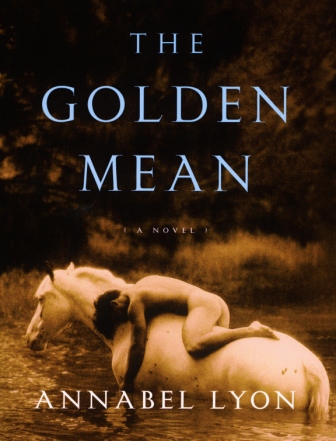
The Golden Mean made the Giller short list in 2009, was plastered all over the mainstream book pages, and was praised for its “sensuous and muscular prose” – it says that right on the front flyleaf – so I was, paradoxically, quite suspicious of what I would find behind that attention-getting cover. (And here’s a snippet of trivia for you: The book was at one point pulled from the shelves of the B.C. Ferries gift shops because of the nudity on the cover. Well, there’s no such thing as “bad” publicity! Personally, I lke the cover, and I “get” why it was chosen. To be completely true to the book though, the horse should be black, and the young man at least partially clothed. But I digress.)

<Several days go by …>

I’m finishing up this review away from home, without the book in front of me. It is, sadly, in the side pocket of my laptop case, which is sitting on the floor next to the kitchen door some 200 kilometers away. I walked out of the house with that naggy “I’m forgetting something” feeling, and was too far to swing back when the penny dropped. Luckily, courtesy of public library internet terminals, I can get onto my WordPress account, and with an hour of time to fill, I’m going to try to get this review off the “waiting” sidebar.

Browsing other readers’ comments in the hopes of freeing up my stuck thought processes, I came upon the review I wish I’d written, by Patricia Robertson on the Canadian Notes and Queries website. Nothing I can come up with this evening can match the scope of this review, so I’m completely cheating and pasting most of it (and it’s long) into this post. Good stuff. I bow in humble admiration. Here’s where the link to the full March, 2010 review: Aristotle Among the Barbarians

And here is a lengthy excerpt. It’s detailed, so I probably should give a possible spoilers warning.

As the book opens, Aristotle is travelling to his homeland of Macedonia after a twenty-five-year absence. “The rain falls in black cords, lashing my animals, my men, and my wife, Pythias, who last night lay with her legs spread while I took notes on the mouth of her sex, who weeps silent tears of exhaustion now, on this tenth day of our journey.” This sentence, the first, functions as a microcosm of the entire novel. The “black cords” that “lash” the little entourage (and Aristotle himself) foreshadow the dark choice he must soon make. When his boyhood friend, King Philip of Macedon, asks him to stay on to tutor his young son Alexander, Aristotle is horrified. He has loftier ambitions: to return to Athens, to the Academy where he was once Plato’s student and which he hopes one day to lead. Compared to the Athenians, the Macedonians are barbarians. Yet how can he refuse Philip?

The same image prefigures Aristotle’s depressive episodes – “his old usual,” he calls it, describing it as “sucking colour from the sky and warmth from the world.” Whether the actual Aristotle suffered from clinical depression, history doesn’t tell us, but Lyon’s intuitive attribution of this disorder to her highly gifted protagonist feels right. As for her wonderful phrase about Aristotle’s notetaking, it can be interpreted two ways: metaphorically – Aristotle the rationalist, making mental notes in the midst of fucking – and literally – Aristotle the empiricist, writing detailed descriptions of the world around him. Already he is a modern, grounding his rationalism in that most modern of enterprises, the scientific method. Poor Pythias, whom he will often treat in the same clinical way, and who (in the same sentence but twenty-four hours later) “weeps silent tears of exhaustion”!

The brilliantly evoked relationship at the heart of the novel is a long way from the Hollywood paradigm – the charismatic and indefatigable instructor who succeeds in catalyzing his pupils against overwhelming odds. Alexander is, sometimes, deeply engaged by Aristotle’s demonstrations of science, drawn in almost against his will by his teacher’s Socratic method. But he’s also of royal birth, destined to rule a kingdom; though he admires Aristotle, he doesn’t (perhaps cannot) flatter him through imitation. To Lyon’s credit she doesn’t pander to contemporary taste by hinting at homosexual attraction, though she makes it clear that homosexual relationships are an accepted norm. (Alexander’s relationship with his lifelong companion Hephaestion is one such.)

The Golden Mean, in fact, shows us just how narrow our dramatic expectations have become. Though sex and intrigue and violence are present, the focus is on two men who exemplify two great life choices: contemplation versus action. Aristotle comes down squarely on the side of apollonian reason against unreason, thinking against unthinking instinct. Early in the book his nephew and apprentice, Callisthenes, recounts an incident from a night out when he’s witnessed the killing of one man by another over a drink. “What kind of a people is that?” he asks his uncle, who says, “You tell me.” “Animals,” Callisthenes answers. “And what separates man from the animals?” asks Aristotle, ever the teacher. “Reason,” Callisthenes dutifully replies. “Work. The life of the mind.” To which Aristotle’s ironic answer – “Out again tonight?” – underlines Callisthenes’ lack of real commitment, in Aristotle’s terms, to being human.

Moments like this – moments that demand full reader engagement to comprehend – occur throughout the novel. We’re forced to pause, to re-read, to think more deeply. Lean, taut, stripped down, The Golden Mean is dense with meaning while also managing to be crisp, direct, and contemporary. Lyon has a poet’s eye without allowing her prose to become poetically languorous. She’s especially good at verbs: “The Athenians sharked up and down the coast,” for example. But she also understands that metaphors in abundance do not make a novel literary – that instead they’re best used sparingly, like salt (a lesson apparently lost on a number of highly acclaimed Canadian writers).

She also rips up the conventions of the historical novel. Instead of the pseudo-realistic “at your service, my liege” school of dialogue, the voices here roar along like a freight train. These are men who use words like “fuck” and “balls” and “bitch,” whose language has the crude vitality it must have had then. Lyon succeeds in making ideas and argument exhilarating, sexy even. She also risks deliberate anachronisms, although occasionally she pushes too hard. “It’s not that he has no boundaries,” Aristotle tells Pythias at one point, speaking of Alexander – using an analyst’s terminology some twenty-odd centuries before Freud! Late in the novel, when Alexander suggests assassinating the new director of the Academy (chosen over Aristotle), Philip’s regent in his absence, a general named Antipater, tells him no. “You are not going alone to Athens to snuff some hundred-year-old egghead with a protractor for a dick. You’re a prince of Macedon. That particular freak show is not for you.” All of this worked for me, except for “freak show.” A matter of individual reader taste, perhaps, but after “snuff” and “egghead” and “dick,” it seemed forced and over the top.

Lyon uses flashback rarely, but late in the book we meet Aristotle as a young man of eighteen when he first entered the Academy. We’re aware of the parallelism here between Aristotle and Alexander, the poignancy of this glimpse of Plato’s potential (but forever thwarted) heir. He’s also a typical adolescent, avid for sexual experience; the chapter ends with “The girl had licked and bitten, licked and bitten, until I didn’t know myself.” It’s a vigour echoed throughout the book, both in Aristotle’s relationship with Pythias, given to him as a gift when she was fifteen – “gods forgive me but I went at her like a stag in rut” – and in his later attraction to Herpyllis, Pythias’s maidservant, whom he marries after his wife’s death.

Lyon’s wonderfully complex Aristotle spends little time simply writing or thinking, apart from those long bouts of depression. He is in the world, even if not always fully of it, as shown by the emotional detachment, almost cruelty, that accompanies his elevation of reason as a virtue above all others. When Pythias is dying, she tells her husband of recurring dreams, sent by the gods, that foreshadow her death. Aristotle, who has never had such dreams – “My mind is too busy in waking,” he tells us, arrogantly, “to suck for fuel during sleep” – treats this as yet another teaching opportunity. He uses scientific explanations rather than affection to comfort her – explanations that, amusingly to us now, are not “scientific” at all. “The body’s sense-organ, the heart, needs natural intermissions, called sleep;… the goal is to give rest to the senses,” he tells her. Pythias, calmed, repeats an earlier lesson about the heavens and “all the spheres, and the outermost sphere that was black but all full of pin-holes, so that the great fire behind shone through as stars.” How foolish, we think condescendingly. And then, as I’m sure Lyon intends, we catch ourselves. What misguided beliefs do we hold today that, centuries hence, will be scoffed at by a more “enlightened” world?

Alexander, too, is a vivid portrait: an impetuous, sulky adolescent, used to getting his own way, yet with a quick and resourceful mind. Along with ethics and rhetoric, astronomy and botany, he studies zoology with Aristotle, who dissects a chameleon for Alexander’s benefit, cutting it open with his surgeon father’s knives. “I detach the bloody nut of the lizard’s heart and hold it out to him. He takes it slowly, looks at me, and puts it in his mouth. ‘I’m sorry I’m late,’ he says. ‘I was with my mother.’ ”

Once again Lyon demonstrates the depth of her characterization and her seamless fusing of image, gesture, and dialogue. How apt that Alexander, in a display of bravado, eats that symbol of courage! And does so while staring defiantly at his teacher, thus undermining his apology. How disturbing, too, that this gesture is linked with his mother, giving his relationship with her an erotic edge. In fact his parents are estranged and he’s been forbidden to see her, so he’s defied his father, too. The same oedipal relationship is played out between Aristotle and Alexander throughout the novel – Alexander wants Aristotle’s approval, yet is ultimately contemptuous of a life of inaction. “You must look for the mean between extremes, the point of balance,” Aristotle tells his student – the golden mean that gives the book its title. But Alexander doesn’t. He chooses an extreme – chooses, in fact, to become his father, as perhaps he must. “I want to fight,” he tells Aristotle, dismissing diplomacy as useless. “War is the greatest means to the greatest end, the glory of Macedon.”

Still, he learns those early lessons all too well. In a searing episode, when Aristotle (for scientific purposes) dissects an enemy corpse after a battlefield victory, Alexander arrives, clearly traumatized by the fighting, and uses those same skills to skin the man’s face. A horrified Philip says to Aristotle, “You teach him this shit. What kind of animal are you, anyway? Who does this to a body?” Another irony, since Philip himself is arguably an animal, a soldier operating not from reason but instinct. And what about Aristotle? Is he self-deluding, just an animal after all? Worst of all, is that what he’s really taught Alexander? It’s clear that the boy, for the second time in the novel, is suffering from post-traumatic stress disorder – “soldier’s heart,” Aristotle calls it. Is it possible to be civilized and a warrior, or does one have to choose? It’s a dilemma we still haven’t resolved.

In real life, Alexander led his father’s troops into battle at sixteen, became king at twenty, and was dead at thirty-two, having conquered Persia and Egypt and reached as far as India. He was also, by then, an alcoholic, prone to depression and fits of violent rage. As for Aristotle, he returned to Athens and founded his own school, the Lyceum, dying in exile on the island of Euboea a year after Alexander, at the age of sixty-one. The novel, however, ends with his departure from Macedonia soon after Philip’s death, with Alexander now king. “No more doctoring, politicking, teaching children; no more dabbling,” Aristotle tells himself. “Soon I’ll be alone in a quiet room where, for the rest of my life, I can float farther and farther out into the world; while my student, charging off the end of every map, falls deeper and deeper into the well of himself.”

Is Aristotle merely justifying his own choices here? Or is he expressing a paradox – that the real act of courage is the journey that leads to knowledge of the Other through engagement with self, while a life of outer engagement leads only to self-entrapment? Perhaps he’s doing both. In any event it’s an apt description of the novelist’s art, that image of floating farther out into the world. But Lyon has already announced her intention, and her novelist’s credo, in the quotation from Plutarch she chooses for the novel’s epigraph. “The most glorious exploits do not always furnish us with the clearest discoveries of virtue or vice in men; sometimes a matter of less moment, an expression or a jest, informs us better of their characters and inclinations, than the most famous sieges, the greatest armaments, or the bloodiest battles whatsoever.

And here are several good web articles about the author, which I found appreciably increased my enjoyment of the book by giving me the background picture of the author’s intentions.

Read Full Post »

Death by Degrees by Eric Wright ~ 1993. This edition: Bantam/Seal (Doubleday), 1995. Paperback. ISBN: 0-7704-2601-8. 192 pages.

My rating: 5.5/10. A minor effort by well-established Canadian “regional mystery” writer Wright. It has its moments, mostly in the personal narrative sections, and is mildly enjoyable for those already acquainted with Charlie Salter, but that’s about it. I doubt anyone coming to Eric Wright for the first time through this one would be strongly tempted to continue.

*****

From Kirkus, August 1993:

Here, in an outing reminiscent of Final Cut (1991), Toronto Inspector Charlie Salter’s personal life is more absorbing than his caseload–which now includes the murder of moderately unlikable Maurice Lyall, a teacher at Bathurst Community College, and the alibis of various of Lyall’s colleagues on the Search Committee that had just nominated him for Dean of Related Studies. But the case keeps Charlie distracted from his major worry: the progress, or lack of it, that his father is making since suffering a stroke. Days spent listening to academic backbiting and nights spent in a hospital waiting room, peeking in on his dad between stints of writing up a case-in-progress journal, keep Charlie on edge, but a bit of luck narrows the suspect list–just as Charlie’s father’s health rebounds.

Minimalist plot, and few will care about the faculty and its infighting. As a father-son study, however, there’s much to recommend in Charlie’s guilt over not liking his dad, and his sensitive son Seth’s love and liking of both his father and grandfather.

That sums it up well.

This is the tenth installment in the eleven volume Charlie Salter mystery series by Wright, which started with 1984’s award-winning The Night the Gods Smiled. In Salter, Wright has created a flawed but ultimately good protagonist; Charlie’s dilemmas in both his personal and working life are immediately recognizable and relatable to the reader. I find I follow his personal progress through the books with much more interest than the mildly diverting mysteries trigger. A very human and very Canadian hero: conflicted, self-analyzing, often inarticulate, more than mildly cynical, and always polite.

I have never lived in Toronto, so I cannot speak as to the accurate depiction of this book’s setting, but it seems as though the city is as much a character as the humans. The story has its fair share of in-the-know references. Most are easily picked up on, especially if you’ve already read the earlier books in the series, but a non-Ontarian and especially a non-Canadian might well find himself occasionally lost and missing the subtle jokes which abound.

While I appreciated the hospital drama and Charlie’s emotional agony as he faced his father’s potential demise, I initially didn’t care for the lazy solution the author dumped on us. “Oh – he’s recovered surprisingly quickly. You can pick him up tomorrow.” Until I thought about it a little more deeply, and realized that this is indeed what can occur. It has happened to our own family. An elderly person quite literally at death’s door one day – “You should think about making some arrangements” – makes a rather sudden recovery, and without a “Sorry to have worried you so much” apology the dazed relations are informed that the almost-deceased is being released, and needs to be “out of the room by noon – someone else needs the bed.” Charlie’s reaction of confusion and resentment at the offhand attitude of some of the nursing staff, allied with relief at the prospective recovery, and worry about the next stage in the convalescence, now suddenly the family’s responsibility as the medicos turn away, perfectly reflects the real-life scenario we found ourselves in.

Eric Wright was an English professor at Ryerson Polytechnic in Toronto for many years, and he often saves his most satiric “insider” barbs for the educational establishment. I often get the impression that the writer is much more at home in the halls of academe than in the police station with his hero, and that he uses Charlie’s frequent naïvety as an opening to mount his personal hobby-horse and to expound on the ins and outs of the world of “higher education” to his “gee whiz” audience, in this case Salter and by extention the rest of us.

As mentioned above in the Kirkus review, the “mystery” in this mystery is the least of our concerns. The victim is unsympathetic; the murderer, when discovered, faces nothing particularly severe in the way of potential punishment. In general, life goes on.

In the real world, a violent murder such as the one described in this book would have much more traumatic consequences. I know it’s not the fashion for “cozy” murder mysteries to delve too deeply into the after-effects of the murder on everyone concerned, including the neighbours of the murdered man, who seem to view his brutal demise at the hands of what is suspected to be an opportunistic burglar with phlegm verging on cow-like stupidity. In real life, if your neighbour was randomly murdered in the night and if the culprit was still at large, lurking, one would assume, in the same neighbourhood, would you not be a gibbering mass of nerves? I think I would.

Ah well, it’s fiction.

Would I recommend this one? Only to those already interested in the series. Those new to Eric Wright, definitely start at the beginning with The Night the Gods Smiled, and follow along in order. In this case it pays to get to know Charlie Salter and his likeable and sometimes quirky family right from the beginning.

This is a mildly diverting series, for those times when you don’t want to feel too challenged. The violence is generally non-graphic, and though awful things happen we aren’t subjected to too many gruesome details. There’s a bit of sex here and there, often as part of the plot twist, and occasionally as “too much information” about Charlie’s personal life, but again, nothing too graphic. The author drops in a word like “penis” and then immediately shies back, as if in shock at his own temerity in discussing such things.

I keep a stack of Eric Wrights among the huge collection of mystery novels we’ve accumulated over the years, and have no plans on getting rid of them, though if they were to vanish I don’t think I’d be terribly heartbroken, as I would be if I lost my Josephine Tey and Dorothy L. Sayers collections – Wright isn’t anywhere in the same league, though he’s not at all bad reading if your expectations are adjusted suitably.

For those curious about more deeply investigating Eric Wright’s Charlie Salter, here are the books in the series in order of appearance:

  • The Night the Gods Smiled (1984)
  • Smoke Detector (1984)
  • Death in the Old Country (1985)
  • A Single Death (1986)
  • A Body Surrounded by Water (1987)
  • A Question of Murder (1988)
  • A Sensitive Case (1990)
  • Final Cut (1991)
  • A Fine Italian Hand (1992)
  • Death by Degrees (1993)
  • The Last Hand (2002)

Read Full Post »

I Was a Teenage Katima-Victim: A Canadian Odyssey by Will Ferguson ~ 1998. This edition: Douglas & McIntyre, 1998. Softcover. ISBN: 1-55054-652-x. 259 pages.

My rating: 9/10.Funny and thought provoking. This is the book that made me a Will Ferguson fan, way back in 1998, when I plucked it off the “New Releases” bookstore shelf solely for the reference to Katimavik. A few minutes browsing and I was sold. Liked it then, like it now. A very Canadian memoir.

*****

Funny, touching, and never maudlin . . .”     – Montreal Gazette

“A rollicking memoir”     – Globe & Mail

“A coming of age story with a fierce and nationalistic bite.”     – January Magazine

With Will Ferguson in the literary spotlight these days, due to his Booker Prize win for 419: A Novel  just a week ago, I felt the urge to dig through the bookshelves and re-read the my first ever Ferguson book, the now-obscure 1998 coming-of-age-Canadian-style memoir, I Was a Teenage Katima-Victim.

Ah, Katimavik! What a well-meaning and ambitious, oh so Canadian idea!

In my Grade 11 year I too went to one of those earnest presentations in the school gym, listened with deep interest to the bubbly recruiter, and, most importantly, mused over what I could do with the thousand dollar pay-off at the end.

I even went so far as to take a brochure home to my parents, who flicked through it with scornful dismissal. The airy-fairy notion of travelling and seeing Canada basically on the taxpayers’ dime was not something to countenance for one of their children. In my father’s eyes such programs were akin to “those deadbeats collecting welfare”, and he quite literally would have starved on the street rather than apply for a government handout, or anything which could be remotely conceived of as such. To top it off, Katimavik was supported by none other than “that Liberal bastard”,  Prime Minister Pierre Trudeau, who my father hated with a black passion, for reasons I’m still not quite clear on.

By the end of my Grade 12 year Katimavik was a distant memory, a momentary what-if? fairytale I had told myself. I had moved out of my parents’ home into a nasty and dank – but blessedly my own – basement suite in town, and was working full-time waitressing (nights and weekends) while struggling to make it through the tatters of my last high school year to collect that all-important graduation diploma. My love life had unexpectedly taken off, and I was deeply occupied in the here and now. The last thing I now wanted was to rip up those tentaively establishing adult roots and travel. But a soft spot remained for the grand ideas embodied in Katimavik, and my ears ever after were sensitive to the sound of the name.

Will Ferguson took the bait, made the plunge, and survived to tell the tale. Here is a 1999 interview in January magazine:

The book … is delightful: a coming of age story with a fierce and nationalistic bite.
To explain the reference, Katimavik was a Canadian government funded and sponsored program that blossomed in the 1970s. Of course. While the program was active, it brought thousands of young Canadians together to do “meaningful work.” Everything from soup kitchens to nature trails to heritage sites: over 20,000 “katima-victims” went through the program. “The scope of the program was staggering,” writes Ferguson. “1400 different communities across Canada, and more than 200,000 people directly involved or affected. For better of worse, Katimavik helped shape an entire generation.”
For the lavish sum of $1 a day and “all the granola you could eat” these 20,000 17 to 21 year-olds were taken far from their home towns for a year to see first-hand the cultural mosaic of which they were – by birth – a part.
“The thinking about Katimavik was that there is something redeeming about manual labor,” says Ferguson. “And the thing is, it just isn’t true at all. Anybody doing manual labor knows that it’s a tough gig and if they had the option not to do it, they wouldn’t. The second notion is that somehow once we get to know each other, we’ll like each other. This is the biggest flaw and it runs right through a lot of thinking. They think that, just because you and I are enemies, if we got to know each other, we’d like each other: that’s a big flawed premise because – quite often – the more you get to know each other, the more you realize that you have nothing in common.”
Despite his misgivings about the program’s principals, “Katimavik worked on a personal level, despite its good intentions. Just because any time you throw someone into something that big and that intense you come out of it with a rounder personality.”
Now 34, Ferguson’s personality is sufficiently rounded to take us along with him on great rollicking rides. Thus far he’s taken us from the wilds of Canada to the back roads of Japan. Whatever he has in store for us next is sure to be fun: and will hopefully raise still more eyebrows. | Linda L. Richards, January Magazine, February 1999

There is a certain irony in the fact that, soon after Ferguson’s participation in the now-iconic Canadian youth travel-service-work-cultural  program, it was axed in 1986 by the newly elected Mulroney Progressive Conservative government. Katimavik was resurrected in a slightly different form in 1994, and just this year, 2012, has been cut again, this time by the Conservative Harper government. Another rescue mission is afoot, to reimagine Katimavik for yet another generation of young Canadians. I hope it succeeds.

This book has been out of print for years, and is unaccountably ignored in most discussions of Ferguson’s work, which is a shame. Despite the graphically appalling cover, the tale told within is worth reading, especially for anyone who has memories of Katimavik in its sincere and slightly loopy heyday. A bit raw in spots – it was, after all, only Will Ferguson’s second published book, following hard on the heels of surprise bestseller Why I Hate Canadians – it nevertheless gets better and better as it goes along. Laugh out loud funny in places, there is a thread of sincerity running through it which is deeply appealing.

More than a mere curiousity piece and a relic of the author’s youth, it’s a rather grand little read. One of those “Proud to be Canadian” feel-good things. Recommended.

And here is link to the Goodreads page.

Read Full Post »

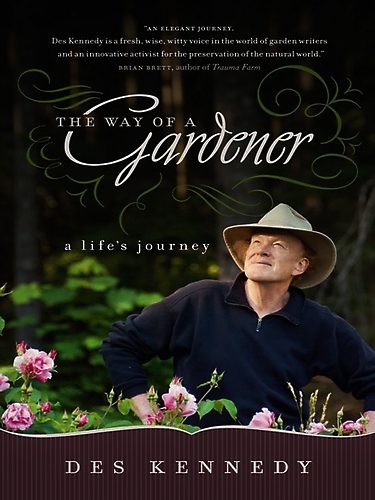
The Way of a Gardener: a life’s journey by Des Kennedy ~ 2010. This edition: Greystone Books, 2010. Softcover. ISBN: 978-1-55365-417-9. 271 pages.

My rating: 8/10. Beautifully written, but I found myself occasionally tuning out – just a tiny bit – in the later chapters. The author’s life has been so full that he just barely touches on many of the events in his later years. I would love to have seen this as a volume one of a multi-volume biography, ending at his leaving the seminary, or settling on Denman Island (one of the Gulf Islands in British Columbia’s Georgia Strait, between southern Vancouver Island and the mainland), because I think the last four decades on Denman plus all the environmental involvement could easily fill a book of its own.

*****

I remember when Des Kennedy first blipped onto my radar, through his 1990s columns in Gardens West magazine, a Canadian publication which is de rigueur reading in my fellow gardeners’ social circle. This was soon followed by my purchase of Kennedy’s first book, a collection of essays on unloved creatures – think rats, slugs, spiders and their ilk – called Nature’s Outcasts: Living Things We Love to Hate (1993),and the rest of his gardening books as they were published, the most recent, before this one, being 2008’s An Ecology of Enchantment, which hints at some of the backstory detailed in this current memoir.

He popped up here and there, speaking at a garden show, authoring an article in a gardening magazine, leading a well-advertised garden tour to Ireland – an instantly recognizable figure with his halo of unruly red hair, and his confident gaze straight into the camera.

Much has been made of his time spent as a Catholic seminarian and novice monk; Kennedy left the monastery before he took full vows after continually clashing with his superiors in matters concerning involvement with the secular and artistic world. (Kennedy was in favour of a degree of inter-mingling between the seminarians and the local population of artists, poets and musicians; his immediate supervisors were not.)

From the Greystone Books website:

A personal and revealing exploration of a life lived close to the earth, from one of Canada’s best-loved gardeners.

Called “a green-thumb rogue” (Star Tribune, Minneapolis), accomplished novelist, satirist, and garden writer Des Kennedy describes his life journey from a childhood of strict Irish Catholicism in Britain to a charmed existence amid the gardens of his Gulf Island home in British Columbia.

From his appearance as an innocent dressed in white for his First Holy Communion to his days as a young seminarian in black habit, through the Beat poetry scene in New York City and the social upheavals of the 1960s, this monk-turned-pilgrim pursues a quest for meaning and purpose.

After leaving monastic life and moving west, Kennedy takes up a new vocation in what has been called the Church of the Earth. On a rural acreage, he and his partner build their home from recycled and hand-hewn materials and create gardens that provide food as well as a symbiosis with the earth that is as profoundly spiritual as past religious rituals. Spiced with irreverence and an eye for the absurd, The Way of a Gardener ranges over environmental activism, Aboriginal rights, writing for a living, amateur wood butchery, the protocols of small community living, and the devilish obscenity of a billy goat at stud.

This book describes Kennedy’s childhood years in Liverpool, before his emigration with his family to Canada at the age of ten in 1955. Growing up in a strongly religious Roman-Catholic family, Kennedy convinced himself that a religious career was his vocation; he spent eight years studying and working towards this goal, and eventually graduated with a degree in Philosophy from the Passionist Monastic Seminary in New York in 1968.

He then left the religious life and drifted and travelled for a time, ending in Vancouver as a school teacher and social worker. There he met the love of his life, Sandy Lesyk, who has been his companion and partner ever since. In 1972 the couple moved to a rural acreage on quiet Denman Island, where they proceeded to pursue the not-terribly-simple “simple” life, building a house from salvaged materials and clearing the land to establish a large garden. The couple still live there today, and still pursue the same lifestyle, though the vegetables now share space with a unique and individualistic mature ornamental garden which has received many praises and was the site of a weekly television show in the 1990s.

Despite the title, this is most emphatically not a book about gardening. It is a highly personal memoir about the time before the gardener emerged, and a look backwards at the sometimes rough and twisted path the author travelled, before the arrival at the gates of the present very earthly “Eden”.

Those coming cold to this book, without knowing who the heck Des Kennedy is now, may wonder what it’s all about. I must confess that if I had not already had the context of knowing about the writer, I might not have found this partial autobiography as interesting as I did.

Definitely recommended for those already familiar with this author, as it gives a marvelous insight into the background of this mesmerizing British Columbia gardening and environmentally “green” figure.

Read Full Post »

« Newer Posts - Older Posts »