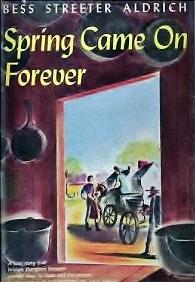
Spring Came on Forever by Bess Streeter Aldrich ~ 1935. This edition: D. Appleton-Century Company, 1935. Hardcover. 333 pages.

My rating: 7.5/10

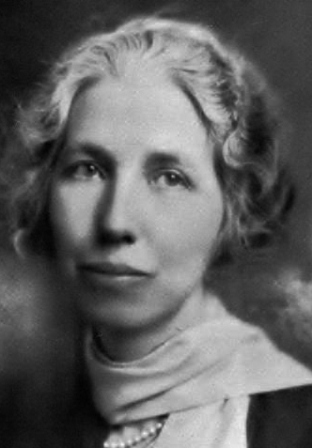
Nebraska writer Bess Streeter Aldrich, 1881-1954, was well-known for her portrayals of Mid-West American pioneer days. Her novels and short stories generally featured strong heroines who met adversity with grace and strength. Aldrich herself knew tribulation and great grief; widowed suddenly at 44 with a family of young children in the midst of the Great Depression, she supported her family with her writing.

Spring Came on Forever is a tale of missed chances and second choices. It follows star-crossed lovers Matthias Meier and Amalia Holmsdorfer as they fall in love, are separated by circumstance, and marry other people. Their descendents’ lives are eventually intertwined, bringing their youthful tragedy to a gently satisfying, much happier conclusion, though they themselves are not aware that they started the chain of events.

Aldrich excels at illustrating the march of progress through the years; her characters both embrace and lament time’s changes; the good and the bad are matter-of-factly portrayed.

An excerpt from the Vachel Lindsay poem The Chinese Nightingale gives the novel its title:

“Years on years I but half-remember…
Man is a torch, then ashes soon,
May and June, then dead December,
Dead December, then again June.
Who shall end my dream’s confusion?
Life is a loom, weaving illusion…
 
One thing, I remember:
Spring came on forever,
Spring came on forever,”
Said the Chinese nightingale.
 

Though often predictable and occasionally straying into melodrama, Aldrich’s novels are quiet works of everday people dealing with the everyday problems. Encouraging and supportive of the trials and rewards of wifehood and motherhood, her novels are as much loved by readers today as when they were published in the 1920s, 30s and 40s. While realistic regarding tragedy and disappointment, Aldrich always highlighted the deep and quiet joys of womanhood, and the inner rewards of “keeping on” through difficult times.

Spring definitely has some flaws as a literary work. The characters are sometimes a bit one-dimensional, and so much is packed into a relatively short story that the years whip by at lightning speed with only small vignettes to mark the many stages of the protagonists’ journeys. However, those vignettes are well presented enough to give us a clear understanding of events as they unfold; by the end of the novel the whole story is spread out before us in all its interweavings, rather like the patchwork quilts Amalia crafts with such care.

An old-fashioned writer of old-fashioned tales, Bess Streeter Aldrich’s often-poignant words still resonate today, particularily with those of us past our first youth and embroiled in our own family affairs. Not to everyone’s taste; a sophisticated modern reader may dismiss Aldrich’s sometimes dated style and storylines; but there are rewards hidden in the pages of her tales for those with the temperament to appreciate them.

The New Moon with the Old by Dodie Smith ~ 1963. This edition: Atlantic – Little, Brown, 1963. Hardcover. 367 pages.

My rating: 6.5/10

I have just laid down The New Moon with the Old with something like a delicate revulsion; I am subsequently wrestling with the dilemma of how best to describe this fantastic tale. “Fantastic” in this case meaning contrived and highly improbable.

That said, damning as it is, I’m going to keep this book, and I know I will re-read it, both to give it a second chance to redeem my first impression of its awfulness and because, despite that very awfulness, it has frequent moments of a quite appealing charm and clever turns of phrase that almost (almost!) redeem the awefully (fantastically!) bad bits.

Confused yet? If so, we’re on the same page.

Dodie Smith’s first novel, I Capture the Castle, is, in my frank opinion, more than a minor masterpiece of the “light novel” genre. There is so much that I like about that work that I have been eager to get my hands on some of Smith’s other, much more obscure titles, hoping that they would have something of the same delicate touch and deep appeal of Castle.  Sadly, New Moon did not meet expectations.

The New Moon with the Old is set in contemporary times, the early 1960s, though the heady atmosphere of that change-filled era is nowhere apparent in the story. A young woman, Jane Minton, has just been engaged as an assistant to wealthy Rupert Carrington. Her duties will be to act as occasional secretary and general overseer of the domestic arrangements at his country home, Dome House. Also in residence are Rupert’s four children: 14-year-old schoolgirl Merry, who is actively planning a stellar acting career; 20-year-old Drew, an aspiring “Edwardian-era” novelist; twenty-something Clare, unsure of her natural bent but toying with the romantic idea of being a “mistress to a king”; and slightly older Richard, a musician and neophyte composer. Two devoted elderly sisters acting as cook and general maid round out the cast of characters.

Jane arrives at Dome House and is immediately impressed by the quiet luxury which surrounds her. Absentee lord of the manor Rupert is more than generous in his provision for his dependents, but this is very soon to change. On her first full day in residence, alone in the house, Jane is surprised by Rupert’s sudden clandestine appearance. He hurriedly explains that there is suddenly no more money to pay for his family’s luxurious lifestyle, and he asks her (or, rather, she spontaneously volunteers, due to her unspoken crush on Rupert) to look after the young Carringtons and try to launch them into their careers. Rupert himself is about to flee the country to avoid prosecution for some undefined financial transgression related to his handling of his clients’ affairs. Jane, who fell in love at first sight with Rupert at her job interview and now welcomes a chance to openly show her rather sudden devotion, jumps in to the situation cheerfully, going so far as to seek outside employment so she can assist with Dome House’s operating costs.

After this sketchy set-up, the story continues as a series of multi-chapter interludes, following each Carrington as he or she attempts to pursue each driving ambition, or, in Clare’s case, to find an ambition to pursue.

The characterizations of Jane, Rupert, and the two maids are extremely superficial; the author insists on telling rather than showing the reasons for their actions, and, in the case of Jane and the maids, their over-the-top dedication to a rather offhand employer and his ineffectual, over-indulged (though endlessly sweet and charming) brood. The four young Carringtons are better presented; we do get more of a chance to get inside their heads as we follow them on their precipitous fledgling flights from Dome House.

The story takes off (as much as it ever does) with the first decision by the youngest child (Merry) to seek her fortune elsewhere. The adventures of Merry and her three siblings  are rather unusual and require a serious suspension of disbelief from the reader. New Moon’s world is one in which love at first sight is a commonplace, and serendipity and coincidence reign supreme. Great wealth, often unsuspected, abounds to save the questing characters from more than superficial worry and discomfort.

This collection of vignettes is tacked together by visits back to Dome House to see how Jane, the maids, and the rest of the family are making out; as the characters move out of their downy nest they generally fall into others even more generously feathered, much to this reader’s perpetual annoyance.

Near the end of the novel,  after waiting in vain  for the whole thing to jell into something a little more cohesive, the author did provide a spot of conversation between several of the main characters wherein they admit their own anachronistic traits, and poke a bit of fun at themselves. This went far with me to renew my flagging interest. I thought, “Aha! Dodie Smith realizes what a mess these people are, and she’s deliberately allowing them this exposition with a view to a stronger, more artistically satisfying and marginally more realistic ending.” But it was not to be.

By the novel’s end, everyone is neatly paired off with a friendly and/or romantic interest; everyone has found a solution to their financial woes. Though reasonably open-ended, the conclusion is quite clear in its optimistic tone for all concerned, most appropriate to this fluffy little fairytale.

I see that this title, as well as two others, The Town in Bloom and It Ends with Revelations, have been reissued in March, 2012. If the other two titles are at all like The New Moon with the Old in tone and complexity (or lack thereof) I would think that here we have nothing more than a trio of nice little beach or lawn chair reads, of value for several hours of light entertainment and inventive nostalgia.

The New Moon with the Old serves to display the perfection of I Capture the Castle as a diamond among literary rhinestones. Rhinestones being pretty enough for a bit of shine and dazzle, as long as they aren’t confused with the genuine thing!

And a bit of a heads-up here for the reader expecting a story as morally upright as I Capture the Castle turns out to be. New Moon shows Dodie Smith in a much more laissez-faire moral mood. She uses as a rather feeble plot device Rupert Carrington’s financial dishonesty, and she ignores the reality that his actions have doubtlessly injured many innocent parties; she offhandedly arranges for him to be bailed out of his disgrace by a wealthy connection who can afford the best lawyers and counsel; and her characters have surprisingly permissive views on sex and sexual arrangements. One of the most off-putting passages (to me) was near the story’s conclusion where Jane is scorned for her “frigidity” concerning extramarital sex: “No wonder she hasn’t been able to catch a man!” is implied. But I wasn’t shocked so much by the sophistication of the characters’ amoral sex lives as by their offhand acceptance of the “easy ride” that money brings; all concerned seem quite happy to act as sweetly smiling and endlessy charming parasites on various wealth-engorged hosts.

A strange little novel in so many ways.

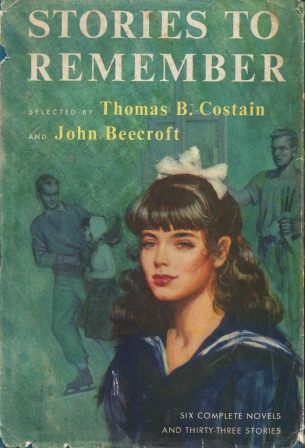
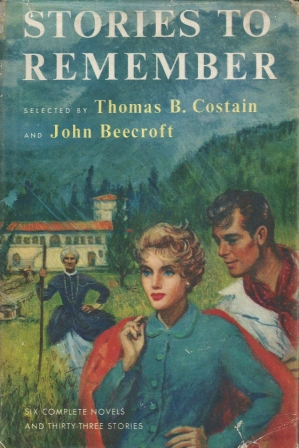
Stories to Remember, Volumes I & II, selected by Thomas B. Costain & John Beecroft ~ 1956. This edition: Doubleday, 1956. Hardcover. Volume I – 409 pages. Volume II – 504 pages.

My rating: 10/10. Excellent anthologies; something for everyone.

I have read the companion Stories to Remember  volumes many times over the years. This anthology was purchased new by my mother in 1956, likely through her long-time Doubleday Book Club involvement, and was some of the first “adult” material I dipped into as I expanded my childhood reading horizons. I still have the original books, and now my own family, adults & teens, re-read and enjoy them. And yes, I remember most, if not all, of the selections with deep fondness!

Looking at this collection with a critical eye 56 years after its publication, I fully suspect that some of the selections might no longer appeal to the average modern audience – would a typical 2012 teenager even “get”, or more to the point, even want to “get” many of the societal and historical references in Alexandre Dumas’ Man Who Lived Four Thousand Years, or Maugham’s Lord Mountdrago? –  but there is enough good stuff in here to keep any reader engaged for quite some time, even if one cherry-picks their way through the collection. Overall, an interesting vintage read containing a number of familiar authors & stories, as well as an introduction (or a remembrance?) of several writers now fallen out of public notice.

I have seen these volumes numerous times in 2nd hand bookshops, generally priced very reasonably. Worth picking up for dipping into, and for leaving on the guest room nightstand, if your guests are the type to appreciate a non-electronic reading experience.

The double-column format and smallish print takes a bit of adjustment on the part of the reader; it appears that the publisher tried to squeeze as much text as possible onto each page to limit the ultimate length of the book while still providing generous content. Occasional nicely rendered realistic line drawings throughout are an attractive feature.

A nice balance of dramatic, humorous and “darker” stories; not at all a depressing collection, which cannot be said for many other short story anthologies of more recent vintage!

Volume I

  • The General’s Ring (complete novel) – Selma Lagerlöf, 1925Written by the first woman to receive the Nobel Prize for Literature, in 1909. This is the first installment in a trilogy concerning a ring given to General Bengt Löwensköld by King Karl VIII of Sweden. After requesting that the very valuable ring be buried with him, it is soon discovered that the ring has been stolen from the General’s grave, with tragic consequences to everyone who subsequently comes in contact with it. A morality tale, a ghost story, and at least one love story make up this intriguing and well-paced novella, set in eighteenth century Sweden.
  • Mowgli’s Brothers Rudyard Kipling, 1894From The Jungle Book. A lost woodcutter’s child is adopted by a wolf family in the Indian jungle.
  • The Gift of the Magi O. Henry, 1906. Most of us will remember this one, stock story of countless anthologies! Della and Jim both sell the thing they love best to buy the perfect Christmas present for each other.
  • Lord Mountdrago W. Somerset Maugham, 1939. Lord Mountdrago consults a psychiatrist to help him deal with disturbing dreams. But are they really just dreams, or is something much more sinister going on?
  • Music on the Muscatatuck and The Pacing Goose (excerpts from The Friendly Persuasion) – Jessamyn West, 1945. Quietly humorous stories concerning Quaker fruit tree nurseryman Jess Birdwell and his Quaker minister wife Eliza.
  • The BirdsDaphne du Maurier, 1952. What if all the birds in the world banded together to revenge themselves on humans for the harm done to their kind throughout their shared history? Chilling. 
  • The Man Who Lived Four Thousand Years (excerpt from The Queen’s Necklace) – Alexandre Dumas, 1850. Count Cagliostro, who claims to have lived four thousand years, predicts the “unbelievable” futures of a group of royals and nobles gathered to dine with Maréchal de Richelieu in 1784.
  • The Pope’s Mule Alphonse Daudet, c. 1894. The humorous fable of a good Pope’s pampered mule, who gets her revenge on a tormentor after seven years’ patient waiting.
  •  The Story of the Late Mr. ElveshamH.G. Wells, c. 1911. The sinister Mr. Elvesham seeks immortality by continually switching bodies. 
  • The Blue CrossG.K. Chesterton, 1938. Clever but often underestimated Father Brown brings a jewel thief to justice. 
  • Portrait of Jennie (complete novel) – Robert Nathan, 1940. A struggling young artist encounters and adopts as a muse a mysterious girl who apparently has been travelling through time.  A ghostly love story.
  • La Grande Bretêche Honoré de Balzac, c. 1831. A convoluted telling of the tragedy of a grand old ruined house and its history regarding a Spanish nobleman, a jealous husband and a betraying wife.
  • Love’s ConundrumAnthony Hope, 1899. An ironically humorous, very short story concerning a self-absorbed scholar who completely misunderstands a confession of love and proposal of marriage.
  • The Great Stone FaceNathaniel Hawthorne, 1889. A young boy, inspired by a legend concerning a cliff resembling a strong human profile, waits his entire life for the human embodiment of the noble edifice to appear. It does, but in a way he has not suspected. (The Great Stone Face was an actual New Hampshire rock formation, known widely as “The Old Man of the Mountain” until its collapse in 2003. This story is one of the more dated tales in this anthology, though it is classic Hawthorne and enjoyable as such.)
  • GermelshausenFriedrich Gerstäcker, c. 1850. A wandering artist stumbles into a remote German village, the cursed Germelshausen; doomed to sink beneath the earth for eternity, only to arise for one day in each century. (This is one of my personal favourites in this anthology.) This story has been credited as the inspiration for the musical Brigadoon, though the setting in that case was changed to Scotland.
  • I am Born (excerpt from David Copperfield) – Charles Dickens, 1850. The title character describes his coming into the world. Irresistable – your next step will be to read the whole novel.
  • The Legend of Sleepy HollowWashington Irving, 1820. Itinerant schoolmaster Ichabod Crane sets his romantic sights on the lovely Katrina and meets a harsh fate for his folly in aiming too high.
  • The Age of MiraclesMelville Davisson Post, 1918. Injustice and retribution. A wronged heiress, a sudden death, and a clever onlooker who sorts it all out.
  • The Long Rifle (excerpt from The Long Rifle, a novel) – Stewart Edward White, 1932. Fictionalized account of the life of the legendary Daniel Boone.
  • The Fall of the House of UsherEdgar Allan Poe, 1939. A gothic horror tale. Roderick Usher and his sister Madeleine are the last of their family; they fulfill a prophecy which predicts their dramatic demise.
  • The Voice of Bugle Ann (complete novel) – MacKinlay Kantor, 1935A very short novella set in contemporary Missouri about an unjust conviction for murder and its surprising resolution. Fox hounds feature strongly.  

Volume II

  • The Bridge of San Luis Rey (complete novel) – Thornton Wilder, 1928. A suspension bridge in the Peruvian Andes gives way, sending a group of travellers to their demise. Who were they, and what chances of fate led them to their rendezvous with death at San Luis Rey? Excellent story.
  • Basquerie – Eleanor Mercein Kelly, 1927.   A lovely, not-so-young American girl in Europe must decide between love and (possibly?) a more financially wise match. This author is worth further investigation.
  • JudithA.E. Coppard, 1927. Aristocratic Judith meets  and dallies with a handsome young schoolmaster, to his eventual tragic downfall.
  • A Mother in Mannville – Marjorie Kinnan Rawlings, 1936. Touchingly poignant short story about an orphan boy and his integrity and pride.
  • Kerfol Edith Wharton, 1916. The tragic tale of a jealous French nobleman and his faithless wife. Supernatural elements – something of a ghost story.
  • The Last LeafO. Henry, 1905. Platonic love among a group of artists. Touching nd memorable.
  • The Bloodhound Arthur Train, 1923. Shrewd New York lawyer Mr. Tutt defends a client. Badly dated, one of the less memorable stories in this collection.
  • What the Old Man Does is Always RightHans Christian Andersen, 1861. Clever Danish peasants get the better of a condescending Englishman.
  • The Sea of Grass (complete novel) – Conrad Richter, 1936. Feuding between cattlemen and incoming small farmers in New Mexico at the turn of the century. Told from the point of view of the nephew of one of the most outspoken cattlemen, and with a crucial role played by Lutie Cameron, newly arrived from St. Louis to marry into the cattle-baron hierarchy.
  • The Sire de Malétroit’s Door Robert Louis Stevenson, 1877. In cavalier France of 1429, a case of mistaken identity and the equivalent of a shotgun wedding. Vintage Stevenson.
  • The NecklaceGuy de Maupassant, 1884. Vanity and social ambition lead to a young French couple’s downfall. An ironic small masterpiece of a story.
  • By the Waters of BabylonStephen Vincent Benet, 1937. Post-apocalyptic America seen through the eyes of a young man on a quest. A “rebirth of civilization” theme; definitely a precursor to the many similar stories which are hitting high popularity today.
  • A.V. Laider – Max Beerbohm, 1920. A palm-reader forsees the death of four friends, but chooses not to warn them. Or at least that’s his story… Nicely done! 
  • The Pillar of FirePercival Wilde, 1925. A clever method of cheating at cards is discovered and nipped in the bud. A bit rambling.
  • The Strange Will (excerpt from The Man With the Broken Ear) – Edmond About, 1862. The rather macabre tale of bringing a mummified murdered man back to life.
  • The Hand at the Window (excerpt from Wuthering Heights)- Emily Brontë, 1847. A short, decidedly gothic episode from the novel.
  • “National Velvet” (complete novel) – Enid Bagnold, 1935. 14-year-old Velvet Brown wins a horse in a raffle and decides to race him in the Grand National steeplechase. Beautifully written portrait of family life; the horses play second string to the human relationships. Excellent.

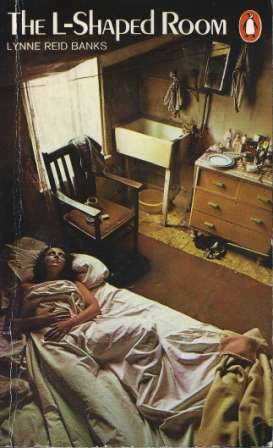
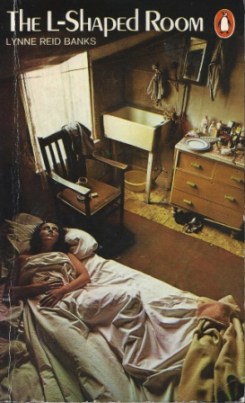
The L-Shaped Room by Lynne Reid Banks ~ 1960. This edition: Penguin, 1983. ISBN: 0-14-00-1913-8. Paperback. 269 pages.

My rating: 5/10. Just barely. It had a few good moments, but I generally did not care for this one.

Widely touted as a ground-breaking, pro-feminist, must-read novel of the early Sixties.

Lynne Reid Banks, born in 1929, and part of the post-war wave of  newly “liberated” women entering the professional workplace in droves, initially pursued a career as a stage actress, then as a television journalist, and, following a demotion, as a television scriptwriter. She took revenge by writing the first draft of this novel “on a company typewriter, on a company paper, on company time.”

http://www.lynnereidbanks.com/interview.html

The novel became an almost instant bestseller, and, with some plot changes to allow for the French accent of the starring actress,  was made into a successful 1962 movie featuring Leslie Caron.

Written very much in the first person, this is the story of twenty-seven-year-old Jane Graham, an ex-aspiring stage actress, who has moved back to her father’s house and is working as an assistant to a London hotel manager. Feeling jaded and dissatisfied with her life, Jane seeks out an old flame, with the idea of consummating their unfulfilled prior romance. The relationship doesn’t take, and, much to her surprise, Jane finds herself pregnant after the single sexual encounter (her first) which doomed the dying romance to its ultimate death.

Jane immediately decides she will keep and raise the baby, without telling her ex-lover, as she feels this is strictly her own affair, and she wants the child to completely belong to her. She is offered an opportunity for an abortion by the doctor whom she consults to confirm her pregnancy, but with high moral purpose, Jane indignantly turns the suggestion down.

She breaks the news to her staid and conservative father, who, in a state of shock and dismay, orders her to leave his house at once. Off Jane goes in a fit of pique, to find herself the most squalid room possible in a slummish part of town. This is the “L-shaped room” of the title, and it is located on the top floor of a decaying boarding house. The other residents are her contradictory landlady Doris; ex-wardobe mistress Mavis (who spies relentlessly on all comings and goings); Toby Coleman, a young writer; West Indian Negro jazz musician John; and two prostitutes in the basement, another Jane and a Hungarian refugee, Sonia.

Jane hides her pregnancy (she thinks) very well from those around her, feeling that to avoid the discussion at all is better somehow than lying about it. Jane eventually loses her job when her condition becomes too obvious to further ignore, but she finds solace in her growing friendships with her fellow tenants, and in a blossoming love affair with Toby.

Though I appreciate that there is some very fine writing in this story, and that it was much more forthright about taboo subjects than others of its era (first sexual encounters, the morality and reality of abortion, unwed motherhood, the physical rigours of pregnancy, sexual and racial prejudice, among others), I cannot say that I particularly enjoyed my reading of it.

Jane’s character, as revealed by our literal reading of her innermost thoughts, is self-centered, supremely egotistical, openly prejudiced against Jews, blacks and homosexuals, and almost offensively “honest”. Though she appears to inspire instant love and dedication in many of those she encounters, I could never quite believe in her widespread attraction to so many disparate people. I sometimes wondered during my reading of the novel, if some of Jane’s convictions of how others viewed her were rather delusions; she continually comments on how she has impressed others with her superiour taste, wit and knowledge.

Perhaps some of my reluctance to fully embrace this story has something to do with the style of the writing, often very much “statement of fact”; almost wooden at times. But mostly I just did not find Jane as worthy of sincere interest and affection as I would have liked; this sort of story, to work for me, has to have a much more deserving-of-my-regard protagonist. I often felt that the fictional Jane created many of her own problems, then moped about stewing in her resultant misery, before being bailed out by various strangely willing “white knights” – her supervisor James, Toby and John, her father (who almost immediately after telling her to leave writes begging her to return), and, most improbably of all,  her eccentric Aunt Addy, who appears out of the blue, after never being previously mentioned, offering succour at the most opportune moment.

Jane carries on a continual internal monologue at how strange and disgusting other people, places and objects are to her. I wondered if author Banks has an ultra-sensitive sense of smell; there are many mentions of offensive odours throughout, including the “strong Negro smell” of John, the cloying perfumes of Mavis and the prostitute Jane, the “bug-infested” odour of the house in general and Jane’s room in particular … over and over Jane makes mention of these, and her frequent nausea and disgust.

On the credit side, Jane does grow somewhat as a person as the story progresses; I found myself wondering if the author made Jane’s inner voice so critical and offensive to highlight how far she had to travel to approach a more tolerant and accepting point-of-view. She hassn’t quite gotten there by the end of the novel, though. Perhaps she progresses more in the next two books of the trilogy?

Improbably pat resolutions to some of the characters’ most pressing issues also jarred my sensibilities. Lots of loose ends tidily tucked away, many more so than would happen in the real world, I felt.

There is no doubt that Lynne Reid Banks has a writing talent of a high degree; as a first novel this shows an advanced ability and voice. Banks went on to write nine more adult novels, including two sequels to L-Shaped Room: The Backward Shadow and Two is Lonely; as well as numerous children’s’ books, most notably The Indian in the Cupboard (1980) and its several sequels.

There are many glowing reviews of The L-Shaped Room; mine, sadly, can not be one of them. I would still recommend the novel, with reservations, as an interesting period piece and for cultural literacy purposes for those interested in popular and/or feminist fiction of the mid-twentieth century. My most serious reservation concerns the continual overt racist comments (whether or not they reflect the author’s true views or are merely, as I rather suspect, an attention-catching plot device).  I felt there were some serious weaknesses in the probabilities of the plot itself.

I have also acquired a copy of the next book in the Jane Graham trilogy, The Backward Shadow, and, glancing through it, I see that the style appears much the same. I am going to read it soon, out of curiousity to see how (and if) Jane becomes more understanding and tolerant of others, and, also, in fairness to this still-popular and often highly regarded author, to give me another chance to try to more deeply appreciate her work.
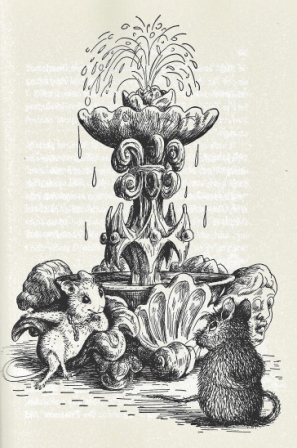
The Rescuers by Margery Sharp ~ 1959. Illustrations by Garth Williams. This edition: New York Review of Books, 2011. ISBN: 978-1-59017-460-9. 149 pages.

My rating: 7.5/10 for the story, 10/10 for the illustrations.

This is the first story in what eventually became a series of nine about the mice of the Prisoners’ Aid Society, and in particular the aristocratic white mouse Miss Bianca, and her admirer and co-adventurer, Bernard.

Everyone knows that the mice are the prisoner’s friends – sharing his dry bread crumbs even when they are not hungry, allowing themselves to be taught all manner of foolish tricks, such as no self-respecting mouse would otherwise contemplate, in order to cheer his lonely hours; what is less well-known is how spendidly they are organized. Not a prison in any land but has its own national branch of that wonderful, world-wide system…

In the un-specified (and purely imaginative) country these particular mice live in,

…(a country) barely civilized, a country of great gloomy mountains, enormous deserts, rivers like strangled seas…

… there exists the greatest, the gloomiest, prison imaginable: The Black Castle.

It reared up, the Black Castle, from a cliff above the angriest river of all. Its dungeons were cut in the cliff itself – windowless. Even the bravest mouse, assigned to the Black Castle, trembled before its great, cruel, iron-fanged gate.

And inside the Black Castle, in one of the windowless dungeons, is a prisoner that the Prisoners’ Aid Society has taken a special interest in.

“It’s rather an unusual case,” said Madam Chairwoman blandly. “The prisoner is a poet. You will all, I know, cast your minds back to the many poets who have written favorably of our race – Her feet beneath her petticoats, like little mice stole in and out – Suckling, the Englishman – what a charming compliment! Thus do not poets deserve especially well of us?”

“If he’s a poet, why’s he in jail?” demanded a suspicious voice.

Madam Chairwoman shrugged velvet shoulders.

“Perhaps he writes free verse,” she suggested cunningly.

A stir of approval answered her. Mice are all for people being free, so they too can be freed from their eternal task of cheering prisoners – so they can stay snug at home, nibbling the family cheese, instead of sleeping out in damp straw on a diet of stale bread.

“I see you follow me,” said Madam Chairwoman. “It is a special case. Therefore we will rescue him. I should tell you that the prisoner is a Norwegian. – Don’t ask me how he got here, really no one can answer for a poet! But obviously the first thing to do is to get in touch with a compatriot, and summon him here, so that he may communicate with the prisoner in their common tongue.”

Now, getting to Norway is a bit of a challenge, but the mice have a solution. They decide to call on the famous Miss Bianca, the storied white mouse who is the pamperd pet of the Ambassador’s son. Miss Bianca lives in a Porcelain Pagoda; she feeds on cream cheese from a silver dish; she is elegant and extremely beautiful and far, far removed from common mouse-dom. She also travels by Diplomatic Bag whenever the Ambassador and his family move – abd they have just been transferred to Norway. Perfect!

A pantry mouse in the Embassy, one young Bernard, is assigned the task of contacting Miss Bianca and enlisting her aid in the cause. She is to find “the bravest mouse in Norway”, and send him back to the Prisoners’ Aid Society so he may be briefed on the rescue mission.

Bernard successfully convinces Miss Bianca to assist, and then the real action starts. By a combination of careful planning, coincidence and sheer luck, the Norwegian sea-mouse Nils, Bernard and Miss Bianca venture forth to bring solace and freedom to the Norwegian poet.

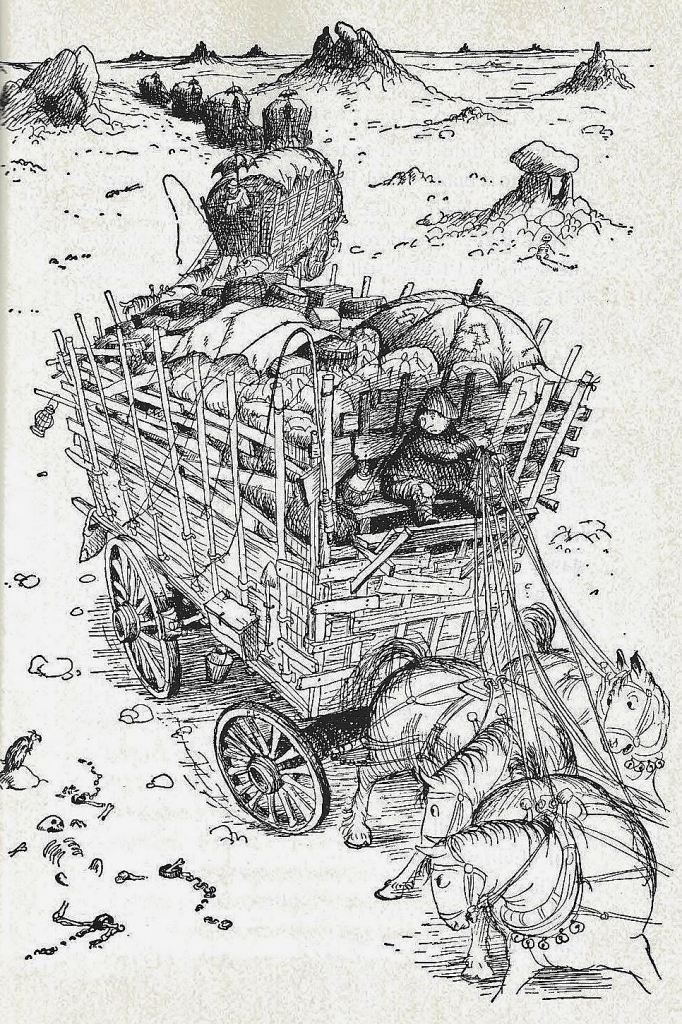
The illustrations by Garth Williams are absolutely perfect. Here is one of my favourites, of the journey to the Black Castle. Look carefully at the expressions on the horses’ faces, the fetters on the skeleton. Brrr! Danger lurks!

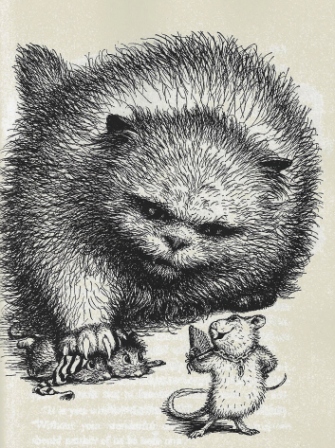
And here is Mamelouk, the Head Jailer’s wicked black half-Persian cat, whose favourite pasttime is spitting at the prisoners through the bars, and of course catching and tormenting any mouse who ventures into his dark domain.

Miss Bianca proves herself more than a match for Mamelouk, utilizing her special bravado and charm. Needless to say, the mission is successfully accomplished, though not without setbacks.

A light, rather silly (in the best possible way), rather enjoyable story.

Miss Bianca is a very “feminine” character, in the most awfully stereotyped way possible, but there are enough little asides by the author that we can see that this is not a reccomendation for behaviour to be copied but rather a portrait of a personality who uses the resources at hand (her charm, her beauty, her effect on others) to get things done.

Bernard is typical yeoman stock, earnest striving and quiet bravery in the face of adversity. He is attracted to Miss Bianca as dull and dusty moth to blazing flame, but quietly accepts that their places in the world are too far apart to ever allow him the audacity to woo her. Or possibly not…

Nils galumphs through the story in his sea boots, “Up the Norwegians!” his Viking cry. A reluctant (or, more appropriately, unwitting) hero, who has had his adventure thrust upon him, Nils typifies dauntless.

Read-Alone: I’m thinking 8 and up. Margery Sharp has written a children’s tale with completely “adult” language and references; a competent young reader will find this challenging but rewarding. Be prepared to clarify occasionally, if your reader is of an inquiring mind. (Hint: Better bone up on Lloyd’s Register of Shipping.)

Read-Aloud: I think this would be a very good read-aloud. Ages 6 and up. Reasonably fast-paced. The first few chapters set the scene and may be a bit slow going, and the dialogue will require careful reading; you’ll need to pay attention while performing this one – no easy ride for the reader! – but I think it could be a lot of fun.

Definitely worth a look. If this is a hit, there are eight more stories in the series. I have previously reviewed the second title here:    Miss Bianca

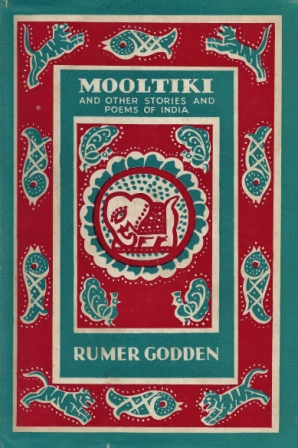
Mooltiki and Other Stories and Poems of India by Rumer Godden ~ 1957.    This edition: Macmillan & Co., 1957. Hardcover. 136 pages.

My rating: 7/10. Rather uneven collection of fair to excellent stories and mostly merely fair poems.

A slender volume of poems and short stories set in India.

BENGAL

  • Bengal River a poem
Nothing can mollify the sky,
the river knows
only its weight and solitude, and heat, sun-tempered cold,
and emptiness and birds; a boat; trees; fine white sand,
and deltas of cool mud; porpoises; crocodiles;
and rafts of floating hyacinth; pools and water-whirls
and, nurtured in blue mussel shells, the sunset river pearls.
                                                                                                            … … …
  • Possession

The rice field lay farthest from the village, nearest the road. On all sides the plain unrolled in the sun with a pattern of white clouds, white pampas grass in autumn and white paddy birds, and glimpses of sky-reflecting water from the jheels or shallow pools. The sky met the horizon evenly all the way round in the flatness of the plain, an immense weight of sky above the little field, but the old peasant Dhandu did not look at the sky, he looked at his field; he did not know that it was little; to him it was the whole world. He would take his small son Narayan by the wrist and walk with him and say, ‘This field belonged to my grandfather and your great-grandfather; to my father and your grandfather; it is mine, it will be yours.’

But life-plans may go horribly awry; Dhandu’s does not follow its anticipated path; in an ironic ending, which I somehow found reminiscent of W.W. Jacob’s The Monkey’s Paw, the field stays with Dhandu but is forever lost to his son.

  • Sister Malone and the Obstinate Man

Sister Malone is a nun in charge of a charity hospital in Calcutta; she is unshaken by the horrible sufferings all around her and does great good with her nursing abilities, but her continual effort to share her religious faith with those she heals goes unheeded. One day Sister Malone meets a man who has truly put all of his trust in God, but she cannot reconcile this with her own conception of what faith should be.

  • The Oyster

Gopal, a Bhramini Hindu student who has travelled abroad to study in England, visits Paris with a friend and is forced to examine the role of compromise in the formation of his own developing character.

HIMALAYAN NOMADS

  • The Goat PeoplePastoral Poems

Nine poems inspired by the nomadic peoples of the Himalayas of Northern India.

The tribes pass all through the spring, pitching their camp at night and lighting their fires under a boulder, a fir tree, or by an ice stream; moving on again at dawn, driving with a peculiar trembling whistle that is their own, something between a hawk’s cry and a flute, harsh, sweet and wild…

… I have tried to make these poems like the people, rough and rhythmical … without symbolism or image, simple and pastoral.

The Meadow

The Caravan

Flowers for the Animals 

The Elders

The Goat Women

The Animals

The Goat Children

The Goat Baby

Moving Downwards

  • Red Doe

A vignette of a young nomad riding up the mountain to fetch his unseen new wife. Sensitive and poignant.

  • The Little Black Ram

An orphan boy, Jassoof,

… a young thief, a bully, noisy, quarrelsome and turbulent, against everyone with everyone against him…

finds his place in the world through his care of a black ram lamb.

KASHMIR

  • The Wild Duck

Another vignette piece, about a young Kashmiri hunter, Khaliq, who, longing for winter to be over, thinks of his time the previous year among the high  mountains hunting ibex.

  • Two Sonnets

Just that; two sonnets. A regretful ode to winter; a joyful ode to spring.

Kashmiri Winter

Spring Sonnet

JUNGLE

  • Mooltiki

This first-person short story (24 pages)  is the jewel of this slight collection. Rumer Godden tells of her experiences in her sister and brother-in-law’s winter camp on the borders of Bhutan. Mooltiki, a small, opinionated elephant, is the “maid-of-all-work” of the camp, fetching firewood and providing transport for odd jobs, such as Rumer Godden’s small jungle explorations. Godden writes an amusing and appreciative ode to Mooltiki and her elephant kin, as well as an extremely evocative description of what if feels like to be involved as an observor in several “blinds” for problem tiger kills.

*****

Mooltiki is an interesting though quite slight collection of fictional short stories (except for the autobiographical title piece, decidedly the best part of the collection) and personal poems; after reading it through several times I must confess that my conclusion is that Godden was a much stronger writer of prose than of poetry!

Nicely done overall, with Godden’s trademark of strong, eloquent characterizations and descriptions of place. Definitely a work any Rumer Godden collector will want to have on the shelf; probably worth a purchase for Mooltiki alone, if it can be found for a reasonable sum.

The biggest fault is the shortness of the book; about an hour`s worth of reading, even if taking one`s time and savouring the beautifully nuanced style of most of the pieces. I thought the poems were the weakest point; some of the stories were excellent (Mooltiki, Red Doe, The Little Black Ram, and possibly Possession, stood out for me), while the others are merely good.

Recommended, with those reservations.

Playing Beatie Bow by Ruth Park ~ 1980. This edition: Puffin (Penguin Australia), 1998. Softcover. 196 pages.

My rating: 8/10

This well-written coming-of-age, historical fiction juvenile novel by New Zealand-born Australian writer Ruth Park is deserving of all the awards and rave reviews it has garnered through the years.

14-year-old Abigail – Abbie – Kirk is still deeply wounded by the separation of her parents four years earlier. In her anger at her beloved father for his desertion, she has changed her name from his chosen Lynette to “an old name, a witch’s name” – Abigail.

Anger seethes within Abbie, though she is learning to hide it. She is

…a girl who wished to be private.

Outside, she was composed, independent, not very much liked. The girls at school said she was a weirdie, and there was no doubt she was an outsider. She looked like a stick in jeans and a tank top; so she would not wear them. If everyone else was wearing her hair over her face, Abigail scraped hers back. She didn’t have a boyfriend, and when asked why she either looked enigmatic as though she knew twenty times more about boys than anyone else, or said she’s never met one who was half-way as interesting as her maths textbook. The girls said she was unreal, and she shrugged coolly. The unreal thing was that she didn’t care in the least what they thought of her. She felt a hundred years older and wiser than this love-mad rabble in her class.

Her chief concern was that no one, not even her mother, should know what she was like inside. Because maybe to adults the turmoil of uncertainties, extravagant glooms, and sudden blisses, might present some sort of pattern or map, so they could say, ‘Ah, so that’s the real Abigail, is it?’

The thought of such trespass made her stomach turn over. So she cultivated an expressionless face, a long piercing glance under her eyelashes that Grandmother called slippery. She carefully laid false trails until she herself sometimes could not find the way into her secret heart. Yet the older she grew the more she longed for someone to laugh at the false trails with, to share the secrets.

What secrets? She didn’t yet know what they were herself.

So Abbie gets on with her everyday life, going to school, helping her mother in her vintage clothing and memorabilia shop, ‘Magpies’, and occasionally babysitting her neighbour’s younger children.

It is while accompanying one of those children to the playground that Abbie first notices a solitary, crop-haired, strangely dressed child lingering in the shadow of a wall, wistfully watching the others at play. Abbie approaches her, but she cries out and runs away. Abbie is intrigued. Who is the child, and why do none of the others, except for her small charge Natalie, seem to see her?

The next time Abbie sees the girl, she again approaches her, but this time as the child flees Abbie follows close behind. Through a the twisting maze of  The Rocks, Sydney’s historical district, they go, until Abbie realizes that she is completely lost – the atmosphere has somehow changed – evening is coming on – and streets are now lit with gas lights, and down a side-street comes a horse-drawn cab. Terrified now, Abbie continues her flight, following glimpses of the only familiar thing she still recognizes, the fluttering fringes of the mysterious child’s shawl.

Of course, by this time, we have realized that somehow Abbie has crossed through a mysterious portal into a previous time and place, the squalid slums district of 1873 Sydney. Rescued and cared for by the little girl’s family, Abbie goes through a transformation of her own, until at last returning to her own time changed, chastened, older (at least in experience) and wiser.

A highly enjoyable, on the whole well-thought-out time-travel tale; the weakest points are the actual time travel sequences – but these are notoriously hard to write, being, of course, purely imaginative with no real-world references to guide the writer. There are elements of  the supernatural – quite a lot of the plot revolves around the passing on of the powers of something like a ‘second sight’ among a family – and there is a certain amount of realistic romance. The ending is possibly a bit too pat, but in general is well-balanced and satisfying, as it ties up all loose ends but leaves the future optimistically open.

I would recommend this for older children, perhaps 12 and up, to adult. The quality of the writing is very high; the story itself is interesting and creatively presented. An intriguing glimpse into contemporary and historical urban Australia (set, as mentioned earlier, in Sydney, New South Wales), as well as a highly sympathetic protagonist.

A Time to Dance, No Time to Weep by Rumer Godden ~ 1987. This edition: Beech Tree Books (William Morrow), 1987. Hardcover. ISBN: 0-688-07421-9. 243 pages.

My rating: 10/10

A must-read for anyone with an acquaintance with  Rumer Godden’s body of work, and a fascinating stand-alone autobiography that will send the reader unfamiliar with her titles on a search to find out more. The first half of her two-volume autobiography, it covers the years 1907 to 1946; Rumer’s childhood in India and her various travels up until her ultimate return to England in 1946.

There is so much packed into this book, as there was in Godden’s life, that I will not attempt to give a detailed overview, merely a blanket recommendation – very good reading.

Rumer Godden was a complex personality; her novels and stories are often drawn directly from her own life and experiences. She could not have been an easy woman to be around, being one of the “driven” writers; she fully acknowledges this in this memoir; in many ways it feels somewhat like an apology to her family and her friends.

The latter part of the book, concerning Godden’s time living at Dove House in the Kashmir hills, was the basis for the novel Kingfishers Catch Fire. The reality was even more intense than the fictional account that it inspired; Godden delves deep into her motivation for that socially astounding retreat from the “proper” Anglo-Indian community, and she comments as well on the effects of that self-imposed isolation on her two young children. Jane and Paula were at that time, I believe, seven and five years old, and it would be fascinating to hear their own childhood memories of their wandering life with their mother. I am wondering if either of them has written about their lives in their turn. Vaguely I am thinking that there is a daughter’s memories of Rumer Godden out there somewhere.

This memoir reads like a novel, only it is so much better than anything fictional Godden wrote, because it is a personal examination of experiences, thoughts and emotions based on the writer’s “truth” (always stranger and richer than fiction), and it therefore shines a radiant light on both the personal life of this extremely talented and passionate writer, as well as showing the framework of her subsequent stories. Keep in mind that this is one person’s version of events, as Godden herself comments in the dedication:

For Jane and Paula.

This book is my life as a young writer; to me and my kind life itself is a story and we have to tell it in stories – that is the way it falls. I have told the truth and nothing but the truth, yet not the whole truth, because that would be impossible.

Most highly recommended.

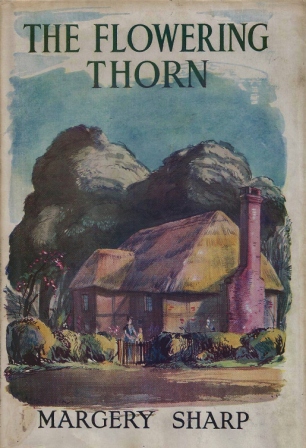
The Flowering Thorn by Margery Sharp ~ 1933. This edition: Little, Brown & Co., 1952. Hardcover. 345 pages.

My rating: 10/10

Margery Sharp’s fourth novel, The Flowering Thorn,  first appeared in England in 1933, with an American edition appearing in 1934, but it attracted little attention in North America until almost twenty years later. The later novels Cluny Brown (made into a 1946 movie of the same name, starring Jennifer Jones and Charles Boyer) and The Nutmeg Tree (used as the inspiration for the popular 1948 movie Julia Misbehaves starring Greer Garson, Walter Pidgeon, Nigel Bruce and a young Elizabeth Taylor) brought Margery Sharp  to the attention of the North American public, who happily bought her books and asked for more.

The reason I mention this is that there are two sets of “first editions” of The Flowering Thorn out there. The first “first” would be the original British 1933 edition published by Arthur Barker, Ltd. Putnam’s American edition followed in 1934. Then in 1952 appears another “first”, so stated in the book, with a stated copyright date of 1934, published by Little, Brown and Co. The dustjacket and front flyleaf of the 1952 Little, Brown edition refers to a number of the Sharp titles published after 1932, and up to 1951 – The Nutmeg Tree, The Stone of Chastity, Cluny Brown, Britannia Mews, The Foolish Gentlewoman, and Lise Lillywhite – giving the game away – but it can be confusing. There were several paperback editions as well. This title is fairly scarce; if you can find a decent-condition hardcover of any edition under $30, grab it. A 1933 true first in good condition will set you back $100 +, going by the May 2012 AbeBooks listings.

(Vintage book collector’s digression now over!)

I would like to call this a gentle, slow-moving examination of a woman’s progress towards true fulfillment and happiness, but Margery Sharp’s always analytical and occasionally tart tone, as well as protagonist Lesley Frewen’s no-nonsense attitude, make “gentle” a somewhat inadequate description.

Lesley is a twenty-nine year old socialite living in London in 1929. Her life is perfectly organized; she lives well, and just within her income, in a high-end, most desirable flat; her interests are the theatre, modern art, literature and music; she moves among the Bright Young Things of the day with aplomb and style. What Lesley suddenly realizes she is missing, after a tactful brush-off by a man she highly admires and has delicately offered herself to, is love.

…there slipped into her mind, already bodied in words, a strange and dreadful notion. She thought,
‘Perhaps I am not a woman that men do love.’
She thought,
‘There are women like that. Attractive women…. And if that is so, and if…that is what I have been waiting for, what am I to do now?’
The intricate daily patchwork was still there to work at, the innumerable dovetailing fragments still lay ready to hand: but it now seemed to her, and for the first time, that her work had no pattern.
‘I want something new,’ said Lesley aloud.
 

And it is in this frame of mind, struggling with her sudden inner turmoil, that Lesley goes to tea with her elderly aunt, who is embroiled of a turmoil of her own: her recently hired companion, a young, widowed Scotswoman, has suddenly died, leaving behind a four-year-old child. There are no relations in sight, and the orphanage looms.

Lesley, who has been watching young Patrick playing on the floor as the conversation regarding his future goes on above his head, is impressed and intrigued by the child’s tenacious attitude and sober demeanour. On a whim, she offers to take him on herself, much to her aunt’s consternation. Lesley immediately regrets her rash offer, but before she can backtrack the child catches her eye; to renounce him would be a betrayal, she suddenly feels. The immediate and very vocal opposition to her proposal by the elderly women present has the contradictory effect of  stiffening Lesley’s resolve, and the wheels are set in motion.

Lesley suddenly finds herself in the position of having to leave her flat (no children allowed) and to take on extra expenses in regards to Patrick’s care. Her careful budget is in tatters, and she decides, on another not particularly well thought out whim, to move into a cottage in a country village in order to live more cheaply. After all, it is only going to be for four years, until Patrick is old enough to send to boarding school, and then Lesley can slide back into her well-organized town life. Her social butterfly friends will surely understand…

Lesley’s new life is not what she had anticipated, but she takes it well in stride, attempting at first to keep up her strict London standards, but, ever-so-slowly, a new Lesley is born, a much more human and ultimately more lovable one.

Something I deeply appreciated about this story was Sharp’s total avoidance of sentiment regarding the relationship between Lesley and Patrick. Lesley is, almost immediately, deeply resentful of Patrick’s demands – both the physical demands of a small child, and the moral demands his presence in her life place upon her stern conscience. Confronted by a friend pushing the option of backing out of the situation, Lesley examines her innermost soul and comes to a surprising conclusion:

She thought, ‘If I don’t see this thing out I shall have something rotten inside me for the rest of my life.’ Rotten like an apple – the brown decaying core under the firm red skin…

Nevertheless, she does not initially feel any sort of affection for the child; to the contrary

…she looked at him with an intensity of dislike so nearly bordering on hatred that her own features, could she have seen them at that moment, would have seemed completely strange to her.  And even without seeing, it was as though she guessed: for in all their enforced companionship she never once spoke to him without consciously masking her face. It was a hatred to be ashamed of, ignoble and unjust: but she did not love him the more for making her ashamed.

The development of a much more positive relationship between the two is the thread that winds through the story, though Lesley in no way concentrates solely on the nurturing of Patrick; she is even more so concerned with working through her own emotional and intellectual growth as her self-imposed exile from her previous world gradually brings her an awareness of the unexpectedly rich and satisfying reward of relationships based on mutual affection and respect versus social expediency.

A thought provoking, often humorous, rather surprising story. Highly recommended.

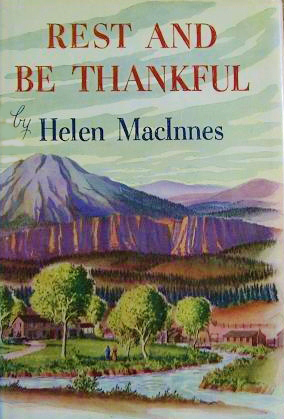
Rest and Be Thankful by Helen MacInnes ~ 1949. This edition: Little, Brown & Co., 1949. Hardcover. 368 pages.

My rating: 9/10

Every so often I find myself re-reading, with great enjoyment, this pleasant, humorous and thoughtful romantic novel by an author better known for her suspense and spy-versus-spy World War II and Cold War-era thrillers.

After almost twenty years living as expatriates in the literary and artistic circles of Europe, Margaret Peel and Sarah Bly are reacquainting themselves with their native America by taking a cross-country road trip in their 1933 Bugatti (purchased new in Rome in those faraway, idyllic times) with their Hungarian chauffeur Jackson. Living in France at the outbreak of the war, Margaret and Sarah had turned their abundant energy from sponsoring and promoting struggling poets to using their private printing press to create clandestine Free French materials, until their betrayal to the German occupying forces in 1941 forced their precipitous flight to eventual haven in England.

The war is over, Margaret and Sarah are back in the U.S.A. and are feeling rather untethered. They are hoping the road trip will give them time to think and refocus and decide on their next project. Heading for California, straying off the highway via a shortcut gone wrong, the trio find themselves lost in the Wyoming mountains with evening coming on. They encounter a group of cowboys, led by ex-soldier Jim Brent, and end up spending the night at his remote ranch house, “Rest and be Thankful”, nestled among tall cottonwoods on the banks of twisting Crazy Creek.

Immediately smitten by their beautiful surroundings, which they favourably compare to the Dolomites and the Alps, Margaret and Sarah concoct a scheme to set up a literary retreat at the ranch, to nurture and encourage struggling authors.

Margaret was a best-selling author before the war, though her most financially successful work, a “non-literary” romance, was written under a secret pseudonym, and she thinks her capital will be sufficient to support the scheme. Sarah, soon finding herself  renamed”Sally” as the simpler charms of Wyoming country life work their magic, has some funds left from her pre-War travel and cookbook sales. With this new project in hand, Margaret and Sally spread the word amongst the New York literary community, and the writers’ retreat is soon underway with “six authors in search of a character”.

And a disparate and difficult lot they prove themselves to be! Helen MacInnes has written a tongue-in-cheek expose, sometimes straying into parody, of stock New York literary characters of the 1940s, and their varied reactions to the “simple locals” of rural Wyoming. Those locals are handled with a much gentler tone; MacInnes obviously had some experience with and a deep fondness and respect for the ranching community of the area she writes about in this novel; though sometimes stereotyped and parodied she presents them in an overall very admirable light. (The book is dedicated “To Gilbert and Keith, my favorite cowboys”, so I suspect a back story is involved in the setting of this tallish tale.)

I also have a strong feeling that Helen MacInnes had a most enjoyable time writing this book. She has some cutting comments to make about various characters in the “high literary” world, which I suspect were based on people MacInnes personally knew. There is much discussion about the dangers of Communism; the Cold War is looming and MacInnes is keenly and vocally aware of the European and American political situation; themes she elaborates on in her later spy thrillers are very evident here.

But ultimately, for all the trimmings, this is a simple romance – or, more accurately, two or three – a love story lies at the heart of this appealing novel.

Flaws? Oh, yes – many! Very much a period piece, and should be read with this in mind. Stereotypical characters and situations abound, but these are balanced, in most cases, by the author’s open acknowledgment that she is writing something of a satire, and she generally allows her most outrageous characters and comments the grace of an explanation as to why they appear as they do.

Final verdict: an enjoyable vintage novel, of interest to fans of MacInnes’ thrillers and to those seeking an intelligently written comfort read.