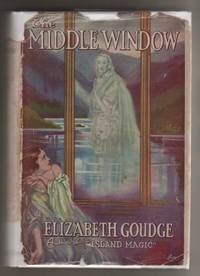
The Middle Window by Elizabeth Goudge ~ 1935. This edition: Thomas Nelson & Sons Ltd., 1949. Hardcover. 310 pages.

My rating: 3.5/10

This is a rare negative review. Rare, because if I sincerely dislike a book, I will put it down unfinished and never pick it up again. Since one can’t honestly review a book without reading the whole thing at least once, and spending some mulling-over time on it as well, the situation generally doesn’t arise.

In this case I persevered with The Middle Window (though it took me numerous tries) because it is an early work by an author whom, for all her many literary flaws – frankly purple prose, excessive sentimentality, long passages of vaguely theological navel-gazing, repeated use of the same characters under different guises, and improbably tidy “happy” endings – I generally enjoy, and I was eager to add another title to the growing Elizabeth Goudge section on my shelves. I have at last choked the whole thing down, several years after its much-too-pricey purchase, and at least three aborted previous reading attempts. So I am going to review it, and then tuck it away at the back of the shelf, and move on.

Warning: spoilers follow. If you’re already a die-hard Goudge fan, you won’t be put off by knowing what happens; it’s utterly predictable but you won’t mind that – all of her books follow generally the same pattern, and you’ve already figured that out, right? If you’re just getting started on her books, or are wondering if they’re worth your time, this may help you make up your mind. This author wrote some MUCH better novels – do not start with The Middle Window! Try the Eliot trilogy instead (The Bird in the Tree, The Herb of Grace, The Heart of the Family), or The Scent of Water – my personal favourite.

*****

Spring had jumped straight out of heaven into London. For an eternity coughing, sneezing millions had coughed and sneezed at the centre of a black balloon of fog and dirt, frost and misery. Young and old, rich and poor, fair and ugly, they had all alike choked and shivered and beaten imprisoned hands against that rounded black wall that shut them in. But now, suddenly, between the hours of sunset and sunrise, the miracle had happened. The boy Spring, his arms full of glories stolen from divine treasuries, had strolled to the portal of heaven, had poised tiptoe on the lintel, had spread his wings and jumped. Crash! His feet, pressed together and pointed downwards like a slender arrow, had punctured the black balloon. All that was left of it, torn black scarfs of smoke, evil-smelling wraiths of fog, drifted and coiled into the foul, dark corners of London, while the boy, speeding downwards, flung out his arms and spread his treasures sweeping fanwise over the city.

The crash awakened the millions. Running barefoot to their windows they looked out. Beyond the smoke-grimed panes they were aware of a drifting glory and showers of rainbow light. Some of them, throwing up their windows and thrusting tousled heads out, were just in time to hear a rustle of wings and glimpse the downward gleam of arrowy feet, and a few, a very few, as the sun rays slanted across the sky, saw the shadowed sparkle of a boy’s blue eyes behind the curve of golden lashes.

Whew. First two paragraphs of the novel. Elizabeth Goudge has let her writerly hair down, and that’s just from the prologue.

Beautiful, wealthy and rather spoiled young socialite Judy Cameron is just getting over the flu, and is feeling physically and emotionally fragile as a result. Wandering window-shopping this spring day through the London streets, Judy is inexplicably drawn to a painting in an art gallery window. It is a Scottish scene, mountainside and loch and heather, and as Judy stares into it the traffic sounds fade and she is drawn into a strangely familiar world where, in reality, she has never been before. Luckily her doting fiance, Charles, a cheerful if not particularly intellectual army captain, turns up in time to rescue her from her daze.

Soon Judy is off to Scotland to holiday in a rented estate house, dragging an entourage of doting father, volubly complaining mother, and bemused Charles. (They were supposed to holiday in Bournemouth.) They are heading for what Judy just knows is the original setting of the painting. And, lo and behold, she’s right! Everything is familiar to her, she knows exactly how things will be before she gets there, it’s just as if she was once there in a previous life! How intriguing!

It gets even more intriguing as the estate’s picturesque butler (“Arrr, do ye be the wealthy Sassenach interlopers? Here’s yer tea, then…”) stares deeply into her eyes and calls her “Mistress Judith” with a certain knowing intonation. And look, here’s the young laird himself – a hunky dish named Ian Macdonald – come to welcome her. What is this thrill of mutual recognition, and why does he also stare into Judy’s lovely eyes with such passion, heedless of her looming official lover, Charles?

To condense: Judy and Ian turn out to be the reincarnations of 1700s’ doomed lovers Judith and Ranald Macdonald. Before consummating their wedding night, Ranald tears himself away from his passionate (and passionately frustrated, one must assume) bride to take part in the attempted restoration of Bonnie Prince Charlie to the British throne. And, as we all know, that whole adventure is doomed to end badly. Goudge subjects us to a long and tiresome historical fiction episode in the middle of the story in order to explain all of this. Modern-day Judy puts on dead-and-gone Judith’s dress and suddenly travels back in time (mentally, not physically – in real life she merely faints) where she relives Judith’s experiences.  After the Jacobite rout at Culloden, Ranald sneaks home, after a side trip to help row the prince to Skye, good for another few pages of filler.

Unluckily for Ranald, British soldiers are already there waiting for him; they intend to hang him as a traitor. He manages to duck the soldiers and briefly reunite with Judith, but slides away again to hide nearby until she can get rid of the arresting officers. They know something is up, are not fooled by Judith’s vague excuses, and hang around in ambush mode. Eventually Judith fires a warning shot through her parlour’s “middle window” and fatally wounds Ranald, who was lurking just outside. He dies in her arms, but not before telling her that their great love will be fulfilled in a future generation. Judith is left to linger on, which she does for many years, as the estate falls into ruin and the Scottish mists mingle with the tears in her eyes.

Hence Judy and Ian’s overwhelming mutual adoration. Poor Charles is eventually given the heave-ho, but that’s all right, because Ian’s chipper sister Jean is there to catch him; she’s been giving him the glad eye the whole summer, and she’s a much better fit for him anyway, so all’s well that ends well.

Gar. What a tiresome story this was. I feel all bilious; I think I need to read something crisp and witty to cleanse my emotional palate. Or maybe another Goudge to prove that she can do better (a lot better!) than this overblown romantic mess. The whole reincarnation thing was just downright disturbing. Not that I have a problem with the concept, at least fictionally speaking, but it felt exceedingly contrived in this case. In later novels Goudge tones this idea down, or perhaps “refines” would be a better term, but she still continually trots out the troubled ancestor “coming back” in the contemporary character for some sort of redemption or fulfillment.

Stereotypical characters, predictable plot, overly rambling, and decidedly over-written. This was Goudge’s second published book, following her very popular first novel Island Magic, which I have not yet read; now I’m rather afraid to! She was definitely still very much finding her narrative voice.

*****

Goudge was, in her heyday, a very popular writer of the “inspirational-romantic” genre. Daughter of a noted theologian, Elizabeth Goudge’s strong Christian faith is obvious in every one of her stories, though she also generously allows strong pagan overtones in some of her tales and has a deep tolerance for other religions; some of her best characters are atheists and agnostics. She was all about finding “God” in your own way, not blindly following a laid-out creed; something I must admit I deeply appreciate in many of her works.

While I have a sentimental fondness for Elizabeth Goudge and her often inspirational messages, I have reservations about certain aspects of all of her books. Even in my favourite, The Scent of Water, there are several rambling sections I scan over quickly to get back to the thread of the story. But none of her later books are anything near so dreadfully messy as The Middle Window! Such a relief that this writer’s style evolved.

PIED BEAUTY

Glory be to God for dappled things –
   For skies of couple-colour as a brinded cow;
      For rose-moles all in stipple upon trout that swim;
Fresh-firecoal chestnut-falls; finches’ wings;
   Landscape plotted and pieced – fold, fallow, and plough;
      And all trades, their gear and tackle and trim.


All things counter, original, spare, strange;
   Whatever is fickle, freckled (who knows how?)
      With swift, slow; sweet, sour; adazzle, dim;
He fathers-forth whose beauty is past change:
                                Praise him.


Gerald Manley Hopkins, 1877

I have always loved this short poem (sonnet?), having personally a strong admiration for variegated plants and dappled horses, among other things. Here is one of my handsome lungworts putting out lush growth in June; the lovely blooms are eclipsed by the freckled leaves, all adazzle and lighting up the shade under the ancient lilacs.

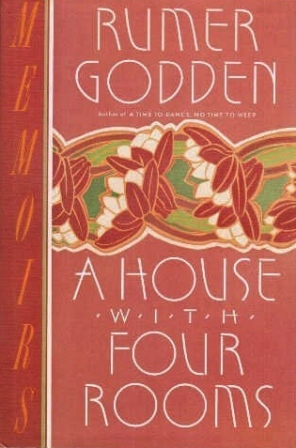
A House with Four Rooms by Rumer Godden ~ 1989. This edition: William Morrow, 1989. Hardcover. ISBN: 0-688-08629-2. 319 pages.

My rating: 7/10

A must-read for any Rumer Godden fan, though in my opinion not nearly as gripping as her first memoir, A Time to Dance, No Time to Weep.

Four Rooms starts with Godden’s permanent return to England, and follows her through her ongoing struggles as a divorced mother of two young children, working to support them with her pen.

Lots of name-dropping ensues as Rumer Godden’s books increasingly grow in popularity and she starts to move in exalted literary and film-making circles; while not terribly offensive this occasionally feels a bit gratuitous. But it was the reality of her life; she did truly gain the high stature her celebrity friends and compatriots suggest, and those circles became her natural habitat, so to pretend she was still a simple soul in a country cottage would be misleading.

She describes the long courtship by her second husband, and her emotional difficulties committing to a second marital experience after the abysmal disaster of her first tragic marriage. The second union had its ups and downs but Godden’s description of James’ final years and death is poignantly sorrowful, if rather briefly referred to. I certainly felt that her love and grief were sincere.

Fascinating glimpses into the backgrounds of many of the novels from The River onwards, plus details of Godden’s growing stature as a children’s writer and advocate for literacy which was a major interest in her later years. She also refers to her conversion to the Roman Catholic faith, and her sincere admiration for the Anglican and Catholic nuns, brothers and priests she met throughout her life, and those she came to know intimately during her research into her masterwork, In This House of Brede.

All in all an enlightening and extremely readable memoir by a gifted and memorable writer. And I do believe she was often her own harshest critic, seeing her work with true clarity, though she occasionally bridled at negative comments from reviewers on the “slightness” of some of her books.

Rumer Godden’s life spanned nearly the whole 20th Century. Born in 1907, she died at the age of 90 in 1998, actively writing almost until the very end. Her last novel, Cromartie vs. the God Shiva, was published in 1997, less than a year before her death. A fascinating and gallant woman, who weathered many personal storms, some of her own creation.

Rumer Godden’s much-quoted words sum up her philosophy in the mature years of her long and creative life:

There is an Indian proverb or axiom that says that everyone is a house with four rooms, a physical, a mental, an emotional, and a spiritual. Most of us tend to live in one room most of the time but, unless we go into every room every day, even if only to keep it aired, we are not a complete person.

SUMMER SOLSTICE

I wanted to see where beauty comes from
without you in the world, hauling my heart
across sixty acres of northeast meadow,
my pockets filling with flowers.
Then I remembered,
it’s you I miss in the brightness
and body of every living name:
rattlebox, yarrow, wild vetch.
You are the green wonder of June,
root and quasar, the thirst for salt.
When I finally understand that people fail
at love, what is left but cinquefoil, thistle,
the paper wings of the dragonfly
aeroplaning the soul with a sudden blue hilarity?
If I get the story right, desire is continuous,
equatorial. There is still so much
I want to know: what you believe
can never be removed from us,
what you dreamed on Walnut Street
in the unanswerable dark of your childhood,
learning pleasure on your own.
Tell me our story: are we impetuous,
are we kind to each other, do we surrender
to what the mind cannot think past?
Where is the evidence I will learn
to be good at loving?
The black dog orbits the horseshoe pond
for treefrogs in their plangent emergencies.
There are violet hills,
there is the covenant of duskbirds.
The moon comes over the mountain
like a big peach, and I want to tell you
what I couldn’t say the night we rushed
North, how I love the seriousness of your fingers
and the way you go into yourself,
calling my half-name like a secret.
I stand between taproot and treespire.
Here is the compass rose
to help me live through this.
Here are twelve ways of knowing
what blooms even in the blindness
of such longing. Yellow oxeye,
viper’s bugloss with its set of pink arms
pleading do not forget me.
We hunger for eloquence.
We measure the isopleths.
I am visiting my life with reckless plenitude.
The air is fragrant with tiny strawberries.
Fireflies turn on their electric wills:
an effulgence. Let me come back
whole, let me remember how to touch you
before it is too late.

Stacie Cassarino, 2009.

From Zero at the Bone, New Issues Press.

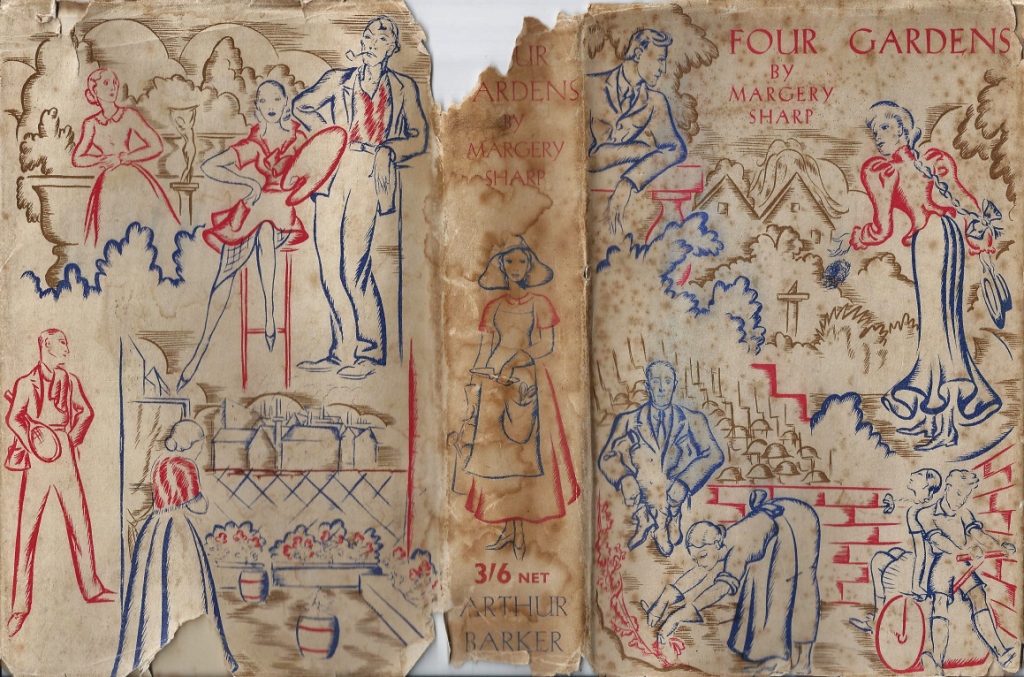
Four Gardens by Margery Sharp ~ 1935. This edition: Arthur Barker Ltd., 1935. Hardcover. 297 pages.

My rating: 10/10

In the early years of the 20th Century, Caroline Smith lives the quiet life of a dutiful middle class daughter with her widowed mother. Walks on the Common, occasional tea parties and church bazaars, helping with the housekeeping and pursuing quiet amusements; such is her life. Occasionally Caroline muses about her place in the world, and wistfully thinks of what her future may hold, but all in all she is of an accepting nature.

Caroline’s one weakness is gardens; on her strolls with her mother she peers through gates and quietly and deeply absorbs what she sees. We pick up Caroline’s story during her seventeenth year, as she takes possession of her first garden; the abandoned wilderness of an empty estate house. Caroline finds a secret way in, and there in the garden she has her first innocent encounter with romance.

Time moves on, and that first garden is lost to Caroline, but after some secret mourning she accepts it as something that must be. She marries a good (though not romantic) man, has two children, and does her duty in all of her relationships even though they are not always what she’d hoped for. The second garden, very different from the first, is a balm to Caroline’s sometimes troubled soul, and is the backdrop of her early wifehood and motherhood, darkly overshadowed by the Great War.

Circumstances change for the better; Caroline is presented with a chance at a new life and a rise in her social position; she gracefully takes it all in stride, though she quietly remains the same thoughtful, uncomplaining soul. Her third garden is one in which a didactic gardener holds sway; Caroline secretly mourns her new distance from physical contact and a real relationship with the plants and the soil, but she does  the correct thing as always and goes forward into this newer, more luxurious world as staunchly as she faced adversity in her younger days.

The fourth garden is the one Caroline creates for herself when her situation again changes; though the smallest and most makeshift, it is perhaps the most satisfying. Life has come full circle, and there is a strong sense of the fitness of things.

This is a gentle but not sentimental book; Margery Sharp keeps it crisp and interesting by allowing us to hear the ongoing commentary of Caroline’s innermost thoughts. Though I continually call Caroline gentle and accepting (and rightly so), she is also keenly perceptive of both her own and others’ motivations and reactions; her inner voice is wry and quietly witty. We are therefore thoroughly on her side as she copes with difficult social situations, troublesome relationships, a well-meaning but emotionally distant husband, and confusingly complex and progressively minded (but by-and-large loving) children.

Not as full of parody as some of Margery Sharp’s works, Four Gardens is a touch more serious and thought-provoking. Beautifully written; often very funny; occasionally very poignant. By the end, the story has become something of a celebration of the quiet satisfaction of dealing well with the not always exciting commonplace life one is dealt by fate, keeping one’s head up, and carrying on.

Very highly recommended.

***

Updated to add a contemporary review I have just discovered, from the New York Times Saturday Review of Books, February 1, 1936

FOUR GARDENS. Margery Sharp. Putnams. 1935. $2.50.

There is refreshment in this book of Margery Sharp’s, a cool sanity that is infinitely restful. She has by nature something of the Jane Austen touch, springing from a detached, quiet power of observation, a delicious, satirical way of relishing affectation, and a respect for sensible, genuine people.

It is a quiet book, the life-story of a woman to whom very little ever happens, a woman as undistinguished as her name of Caroline Smith. But it is a pleasure to read about her and her great good sense; she is lovable in her simplicity, and because of the gentle, irrepressible spark of humor that she possesses. But for all her simplicity she has maturity and wisdom. There is a note of high comedy, rare enough in these days, in the deftness with which she copes with her two ultra-modem children.

All the details are so right and neat, the shades of social difference in the little English town where Caroline lives shown to such nicety, the varying relationships between people set forth with so much exactness and delicacy, that the book makes delightful reading.

***

NoteFour Gardens may be a bit hard to come across, as it was published early in Margery Sharp’s long career and was eclipsed by her later, much more highly publicised works. A few copies show up on AbeBooks, but be prepared to pay a premium price, $40 into the hundreds, for a hardcover in good condition. There appears to have been at least one reissue in paperback in the 1960s, so there should be reasonably priced editions out there in the used book world for a patient collector to track down.

A RIVER

 
In Madurai,
city of temples and poets,
who sang of cities and temples,
every summer
a river dries to a trickle
in the sand,
baring the sand ribs,
straw and women’s hair
clogging the watergates
at the rusty bars
under the bridges with patches
of repair all over them
the wet stones glistening like sleepy
crocodiles, the dry ones
shaven water-buffaloes lounging in the sun
The poets only sang of the floods.
 
 
He was there for a day
when they had the floods.
People everywhere talked
of the inches rising,
of the precise number of cobbled steps
run over by the water, rising
on the bathing places,
and the way it carried off three village houses,
one pregnant woman
and a couple of cows
named Gopi and Brinda as usual.
 
 
The new poets still quoted
the old poets, but no one spoke
in verse
of the pregnant woman
drowned, with perhaps twins in her,
kicking at blank walls even before birth.
 
 
He said:
the river has water enough
to be poetic
about only once a year
and then
it carries away
in the first half-hour
three village houses,
a couple of cows
named Gopi and Brinda
and one pregnant woman
expecting identical twins
with no moles on their bodies,
with different coloured diapers
to tell them apart.
 

A.K. Ramanuja

*************

Our own river, the mighty Fraser, in flood.

June 19, 2012.

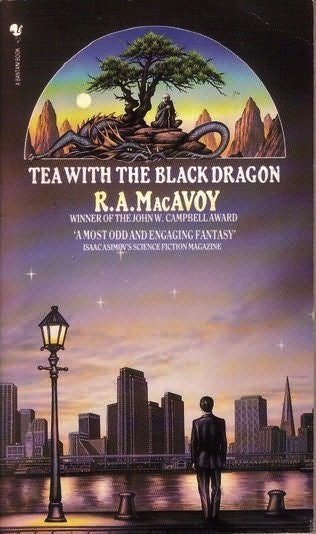
Tea with the Black Dragon by R.A. MacAvoy ~1983. This edition: Bantam, 1987. Paperback. ISBN: 0-553-23205-3. 166 pages.

My rating: 7.5/10

My first introduction to contemporary fantasy writer Roberta Ann (R.A.) MacAvoy was through her alternative world fantasy, Lens of the World (1990). That novel was so satisfactory that I went on to seek out the other two books in the Nazhuret trilogy, King of the Dead (1991) and The Belly of the Wolf (1993).

Now actively chasing down MacAvoy’s work, I was more than pleased with her lone science fiction attempt, the imaginative The Third Eagle (1989), and her epic alternative-Renaissance fantasy trilogy published in 1983-84: Damiano, Damiano’s Lute, and Raphael. Then followed the Celtic-themed  The Grey Horse (1987), and The Book of Kells (1985).

Eventually, going back to the beginning at the end, as it were,  I finally read MacAvoy’s 1983 debut novel (and likely her best-known work), Tea with the Black Dragon, and its 1986 companion, Twisting the Rope.

Then, after that creative 1983-1993 decade, nothing, except for a brief 2005 novella, The Go-Between (re-published in slightly different form in 2009 as In Between), both of which I have sporadically searched for but so far have been unable to obtain.

Doing another routine online search this past month hoping to perhaps come across a printed copy of either of those titles, MacAvoy’s name lit up the page. She’s back in the game, with a brand-new full-length novel: Death and Resurrection, December 2011, in softcover or ebook from fantasy, science fiction and “cross-genre” publisher, Prime Books. Death and Resurrection apparently includes The Go-Between as its first episode, so I can now neatly round off my to-date R.A. MacAvoy collection.

Bibliographical introduction over, I will now focus (briefly! – I need to learn to condense these rambling reviews somewhat – I do tend to run on) on Tea with the Black Dragon, which I have just re-read for the somethingth time with the usual quiet enjoyment. It is not my favourite MacAvoy work by a long shot – that position is jointly filled by Lens of the World and The Third Eagle, which I cannot choose between – I love them both equally for very different reasons – but a few hours spent with Oolong and Martha is never a bad thing.

The internet abounds with longer reviews so anything I say will have already been said, and often much more cleverly, elsewhere. Here is my take.

Middle-aged Martha Macnamara, classical violinist turned Celtic fiddler, has been sent for by her grown daughter, Elizabeth (Liz), with an urgent request for them to meet and talk.

Landing in San Francisco after her flight “racing the sun” from New York, Martha is mystified to find that though her own room in a luxurious hotel is booked and paid for, her daughter has apparently vanished. Not sure how to proceed, and not knowing anything of the pressing concern which Liz wanted to share, Martha falls into an acquaintanceship with a mysterious silk-suited, Eurasian-appearing older gentleman staying at the same hotel, one Mayland Long.

An immediate positive chemistry results, and the two are off on a quest to find Liz which results in a delving into the fledgling 1980s’ computer subculture of Southern California, and encounters with several unlikely gun-toting villains.

More of a suspense thriller than a classic fantasy, the world of Black Dragon is instantly recognizable, if somewhat dated by its 1980s’ references. The fantasy element comes into play as we find out that the mysterious Mr. Long is (perhaps?) the human form of an ancient Chinese Imperial Dragon, with unexpected but rather useful abilities.

An unlikely but perfectly satisfying love story is at the heart of this novel, and that is what we are left with, long after the rather forgettable computer-fraud plot and gunshots and car chases are forgotten. Intriguing Zen references (Martha is a zazen practitioner; Mayland has a long history of association with Buddhist Zen masters) added to the quirky tone (in the very best sense) of the story.

Very much a first novel, with the expected flaws, but there is a certain something about this story that keeps it close to the front of the book stacks. In interview, MacAvoy has said that plot does not interest her as much as characterization and conversation. One can definitely see that in all of her books, what gaps there are tend to be plot-related, nowhere quite as evident, though, as in Black Dragon; the plot is decidedly contrived, and it is interesting to see how this author has dealt with her predilection to concentrate on character in her subsequent novels.

This novel seems to have a very strong fan base on internet book review sites; a bit puzzling as there is not much there; it’s a slender piece of  what might be classified as “urban fantasy” mixed with old-style “thriller”. But it shows this author’s strong promise and unique literary voice, more than fulfilled in her later works. A very thoughtful writer, with a strong sense of humour, though she unflinchingly puts her later characters into positions of deep despair and is not afraid to realistically portray tragedy.

For those of you interested in “official” opinions, Tea with the Black Dragon was nominated for the Phillip K. Dick, Nebula, and World Fantasy awards. MacAvoy won the John W. Campbell Award for Best New Science Fiction/Fantasy writer in 1984.

Recommended, with the reservation that this is not MacAvoy’s strongest work despite the (sometimes) gushing fan base.

Dirge Without Music

I am not resigned to the shutting away of loving hearts in the hard ground.
So it is, and so it will be, for so it has been, time out of mind:
Into the darkness they go, the wise and the lovely.  Crowned
With lilies and with laurel they go; but I am not resigned.
 
 
Lovers and thinkers, into the earth with you.
Be one with the dull, the indiscriminate dust.
A fragment of what you felt, of what you knew,
A formula, a phrase remains,—but the best is lost.
 
 
The answers quick and keen, the honest look, the laughter, the love,—
They are gone.  They are gone to feed the roses.  Elegant and curled
Is the blossom.  Fragrant is the blossom.  I know.  But I do not approve.
More precious was the light in your eyes than all the roses in the world.
 
 
Down, down, down into the darkness of the grave
Gently they go, the beautiful, the tender, the kind;
Quietly they go, the intelligent, the witty, the brave.
I know.  But I do not approve.  And I am not resigned.
 

Edna St. Vincent Millay, 1928

TIME

‘Established’ is a good word, much used in garden books,
‘The plant, when established’ . . .
Oh, become established quickly, quickly, garden
For I am fugitive, I am very fugitive – – –
 
Those that come after me will gather these roses,
And watch, as I do now, the white wistaria
Burst, in the sunshine, from its pale green sheath.
 
Planned. Planted. Established. Then neglected,
Till at last the loiterer by the gate will wonder
At the old, old cottage, the old wooden cottage,
And say ‘One might build here, the view is glorious;
This must have been a pretty garden once.’
 

Mary Ursula Bethell

From a Garden in the Antipodes, 1929

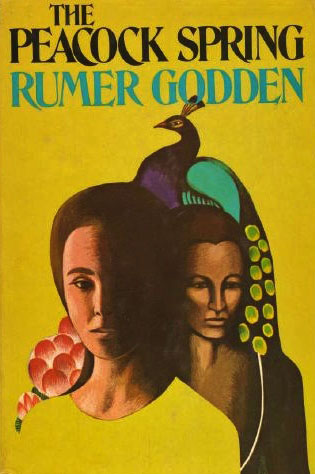
The Peacock Spring by Rumer Godden ~ 1975. This edition: Viking, 1976. Hardcover. 243 pages.

My rating: 7/10

Two English half-sisters are sent from boarding school in England to join their divorced U.N.-diplomat father in India.

15-year-old Una and younger sister Halcyon (Hal) are respectively gifted in mathematical ability and singing; Una in particular worries that their new Eurasian governess-teacher will not be able to teach to the standard required to qualify her for entrance to Oxford. This proves to be the case; Miss Alix Lamont turns out to have other qualities which the girls’ father, Sir Edward Gwithiam, has chosen her for; namely her beauty and personal charms. He is openly infatuated with Alix, and the girls’ presence is meant to give a plausible reason for her inclusion in his household.

Una and Alix find themselves in the position of jockeying for position in Sir Edward’s affections; Alix is strongly entrenched, and Sir Edward intends to marry her. Una, smarting from her father’s rejection (she was always his confidante, but he has distanced himself from both of his daughters since Alix gained his interest), becomes involved with Ravi, a young Indian gardener on attached to the U.N. estate, who is actually a well-born Brahmin student in hiding for his part in a violent political protest. Meanwhile, Hal has become infatuated with the son of a deposed Rajah, Vikram, who is in turn in love with Alix. This seething mass of emotional undercurrents leads to Una’s disastrous flight with Ravi and the laying bare and reworking of all of the relationships thus involved.

Quite a well-done story; generally plausible and sympathetically told. All characters are well-developed and complex, and are treated very fairly by their author in that we see the multiple facets of their personalities and fully understand their motivations. The ending is quite realistic, though not perhaps what one could call “happy”; the various characters move out of our vision with these particular issues resolved but many more looming. All in all I thought it was one of Godden’s better coming-of-age novels; I enjoyed it more than I initially thought I would from the reviews I had read.

Suitable for young adult to adult. Frank but not explicit sexual content including extramarital relationships and the sexual involvement between a schoolgirl and an older man; pregnancy and abortion are discussed though mostly by implication. Rumer Godden in this novel has kept abreast of the times; she was 69 when this novel was published and though a bit dated here and there the tone is generally contemporary.