Caught in the rain; vignettes in my July garden. Every afternoon a thunderstorm this past week…
SUMMER STORM
The summer storm comes
Bolting white lightning; it goes
Muttering thunder.
Rebecca Caudill, 1976


Caught in the rain; vignettes in my July garden. Every afternoon a thunderstorm this past week…

Posted in 1970s, My World, Poetry | Tagged My World, Poetry | Leave a Comment »
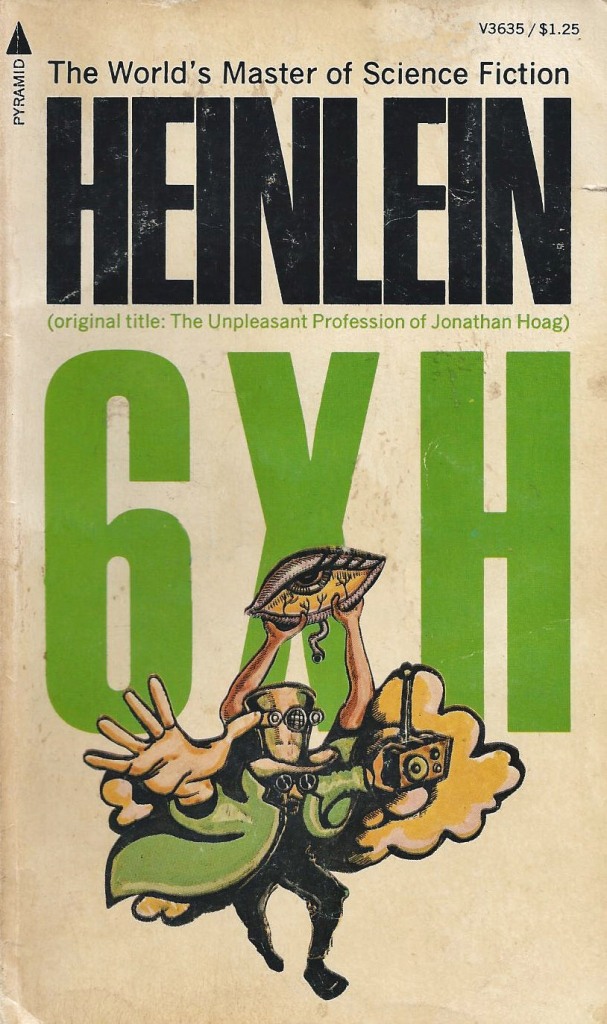 6 X H – Six Stories by Robert A. Heinlein ~ 1959. Original Title: The Unpleasant Profession of Jonathan Hoag. This edition: Pyramid Books, 1975. ISBN: 0-515-03635-0. Paperback. 219 pages.
My rating: 5/10. More or less.
I discovered the vast, strange, swirling ocean of science fiction in high school, and have dabbled happily along the edges of that varied genre ever since. That time being in the 1970s, the prolific Robert A. Heinlein was still front and centre of the revolving sci-fi paperback rack in the school library, and his books were readily available at our town’s rather dingy little secondhand bookstore, located down a precipitous set of stairs in the cramped basement of a main street store.
This volume is a relic of that era. Definitely not built to last, the pages are yellowing and loose in the binding, the glue having long since reached its expiry date. The smell of the dusty pages takes me instantly back to those high school days. Newly employed at a part-time job waiting tables at our town’s Chinese restaurant, I had money of my own for the first time in my life, and after putting aside most of it into a savings fund targeted for buying my own car, I splurged my tips on books, books, books – a few new, but most secondhand; you could get more for your money that way, and the selection, then as now, was vastly superior.
That first car, a bright red ’72 Mustang, was purchased the summer I turned 15, for $800 cash, from a quiet young man with a highly pregnant wife (looking back over the years, I suddenly realize the significance of that situation, and my heart bleeds a bit for both of them, but at the time all I felt was sheer selfish desire, no room for empathy in my egotistical teenage heart) – and, oh! – how many hours of sore feet and cigarette smoke and ever-greasy uniforms – remember the hideous waitress garb of the time? – none of this “wear your own clothes” stuff that today’s “servers” get away with – how many early morning and late night hours at $2.65 an hour (before deductions) did this translate to?! – always doing homework frantically during a much-too-short meal break…
My father co-signed the papers for me (I was underage for a legal transaction) against my mother’s most strenuous objections, and after that most of my money went for gas, for despite not yet having a driver’s license I managed to put a lot of miles on that beautiful beast. Different times, different times…
My sweet first ride is sadly long gone, but many of the books of those halcyon teenage summers remain in my now-massive book collection, triggering little episodes of nostalgia which I savour for a moment before turning back to my present-day world. (Which happens to include this book blog, so here I go, digression over, with my review.)
This is an odd collection even for all-over-the-map Heinlein, and it’s probably been a good thirty years since I read it; I had no memory of most of the stories and it’s definitely not in the favourites pile. Sorting out the last few boxes of my old possessions from my mom’s attic, I found this and immediately put it aside, thinking my sci-fi buff teenage son might like it; he read it and passed it back to me with that current expression signifying mild disinterest – “Meh!”
“No way, it’s Heinlein, must be something good in there!” I declared, and promptly read it myself. And, sorry to say, I guess this time he was more or less right. As he usually is. Quite a lot of fun, actually, having a teen sharing some of my reading tastes. Great excuse to pick up yet more books, equipping the kid with his own library, for when he moves out, you know… For what it’s worth, he’s already on his second car. Nowhere near as cool (hot?) as his mom’s first one, though.
Okay – FOCUS.
Six short stories, more fantasy than science fiction.
It starts promisingly enough:
“Is it blood, doctor?” Jonathan Hoag moistened his lips with his tongue and leaned forward in the chair, trying to see what was written on the slip of paper the medico held.
Dr. Potbury brought the slip of paper closer to his vest and looked at Hoag over his spectacles. “Any particular reason,” he asked, “why you should find blood under your fingernails?”
“No. That is to say – Well, no – there isn’t. But it is blood – isn’t it?”
“No,” Potbury said heavily. “No, it isn’t blood.”
Hoag knew that he should have felt relieved. But he was not. He knew in that moment that he had clung to the notion that the brown grime under his fingernails was dry blood rather than let himself dwell on other, less tolerable, ideas.
The fastidious Mr. Hoag has a problem. His evenings, nights and mornings are normal enough; he arrives home from work, socializes normally enough, goes to bed, sleeps and risess – but he has absolutely no memory of how he spends his days; no idea what his profession is; the only clue is the brownish-red residue under his fingernails, and a deep sense of foreboding that he is involved in something terrible.
After being turned away with no satisfactory answer by the brusque Dr. Potbury, Mr. Hoag decides to have himself followed. He contacts the firm of Randall & Craig, Confidential Investigators, who turn out to be a husband and wife team working out of their home. Edward and Cynthia (Craig) Randall are well experienced in everyday investigations; after some debate they agree to take on Mr. Hoag’s case, and the plot immediately thickens.
Up to this point the story is engaging and very nicely written; the mood is very 1940’s noir; we’ve all been there before, and we look forward with anticipation to the next logical step. And this is where Heinlein mixes things up. A straightforward “tailing” apparently is successful but goes strangely awry; Edward easily follows Jonathan Hoag to his workplace, a commercial jeweler’s workshop on the 13th floor of a city office building, and talks to Mr. Hoag’s employer. The mysterious red powder turns out to be jeweler’s rouge; Mr Hoag polishes gemstones. Case closed.
But hang on… why did Cynthia see Edward stop and talk to Jonathan, and why does Edward insist they never made contact? Why, when they both retrace Edward’s steps, do they find that there is no 13th floor in the building, and no record of a jeweler’s workshop? And why do none of Jonathan’s contacts and references seem to exist, and why doesn’t he have fingerprints?
Not content to those questions unanswered, to give Mr. Hoag the easy and plausible explanation of the jewel polishing job, and take his hefty fee, Cynthia and Edward decide to push further. And this is where things get really odd. Suddenly things are far from normal in the Randall & Craig world. Mirrors become portals into another reality; strange men with other-worldly powers enter and leave and drag Edward and Cynthia along. The threatening “Sons of the Bird” warn them to drop Mr. Hoag’s case and forget they ever heard about him, or face dire consequences.
After much hocus pocus and mumbo jumbo, Edward and Cynthia more or less get to the bottom of the strange situation, which is more than this reader ever really did. I had to go back and reread the last half of the story, and I was still confused. Something about alternative worlds improperly erased, with Mr. Hoag as a sort of unwitting Nemesis controlling rogue members of a previous world. I think.
Some great writing in this story; Heinlein struts his storyteller’s stuff here, but the plot was crazy-confusing for better than half of it, and the whole thing dragged on way too long. The main characters, aside from the mysterious Mr. Hoag, are Cynthia and Edward, and their close relationship is very well handled; their offhand manner to each other and continual wise cracking hide a deep and abiding love for each other which ultimately allows them to escape from the disaster their meddling has precipitated.
The ending of the story is as mysterious as the beginning, and I won’t really give too much away by sharing it here.
When he goes out to the vegetable patch, or to the fields, she goes along, taking with her such woman’s work as she can carry and do in her lap. If they go to town, they go together, hand in hand – always.
He wears a beard, but it is not so much a peculiarity as a necessity, for there is not a mirror in the entire house. They do have one peculiarity which would mark them as odd in any community, if anyone knew about it, but it is of such a nature that no one else would know.
When they go to bed at night, before he turns out the light, he handcuffs one of his wrists to one of hers.
Good work, front and back of this novella. Some slippage there in the middle, Mr. Heinlein!
I would be interested to hear from anyone else who has their own ideas about this tale.
This is a rather sweet, very nostalgic, Ray Bradbury-ish tale of a retired traveling salesman and his ultimate destination. Something of an ode to the mid-century tradition of local exhibitions and fairs, and all the best things about them. I won’t say too much about this one; there’s not much to it, just a gently sentimental little fantasy. Not a masterpiece, but rather enjoyable in its own small way. There’s an old dog, too. Need I say more? It works.
Time travel and a sex change operation and some cheeky acronyms – see if you can get the connection between the “service” organizations Women’s Emergency National Corps, Hospitality & Entertainment Section, and Women’s Hospitality Order Refortifying & Encouraging Spacemen. (I know – GROAN. This is why, despite his many flaws, I like Heinlein – he makes me laugh despite my better judgement! The guy sure had a thing for acronyms – he was my introduction to TANSTAAFL, among others.)
A weird little “future tale”; pure Heinlein fantasy. Rather offensive and not as funny as the author obviously thinks it is, but it has a few points. A temporal agent on a recruiting mission with the cover profession of bartender – cute concept. For 1959. This one shows its age. And I’m surprised it wasn’t first published in Playboy. Definitely adult in theme!
A rather Kafkaesque story concerning a man who is being held in confinement of some sort (mental institution? hospital?) because of his extreme paranoia – he insists that he is surrounded by a conspiracy to deceive him as to the true state of the world, and that his is the only “reality” he can be sure of. But is it paranoia if it’s true? One of Heinlein’s experiments in defining solipsism – the philosophy that one can only be sure of one’s own mind; everything else may only be a creation of that mind.
A bit too deep for me. Well written, with a good twist in the end, but overall – “Meh.”
An odd little urban fantasy. A sentient, apparently feminine whirlwind – yes – the kind of whirlwind that swirls about picking up dust and bits of rubbish – named, of all things, “Kitten” by “her” friend Pappy, an old parking lot attendant, plays a part in bringing corrupt city officials to justice. A playful farce of a story; I’ll grant points in that it’s kind of a fun concept; but my reaction was “read it quick and move on”.
“-And He Built a Crooked House-“. Astounding magazine, February, 1941.
A uncategorizable story (probably closer to sci-fi than fantasy… or vice versa – can’t decide!) about a California architect who designs and builds a three-dimensional house based on a four-dimensional tesseract. The whole concept made my head hurt; math and science geeks will no doubt fully “get” this, though. Anyway, an earthquake shifts the house fully into the fourth dimension, while being toured by the architect and his clients.
Heinlein, a quite brilliant mathematician in his own right, obviously indulged his arcane sense of humour here. Farcical and clever and probably best appreciated by like-minded sorts. I mildly chuckled, but mostly was just happy the book was finally over.
So – final verdict? It was an interesting excursion into the long-ago world of Heinlein’s literary B-sides, but it can safely go back into the box. Maybe in another thirty years it will bring my grownup kid some $$$ as he flogs the excess of my book collection on the future equivalent of eBay!
If you see it cheap cheap cheap in the used book by-the-door bins, go ahead & pick it up. In my opinion, not really worth more than a dollar or two, unless you’re a dedicated Heinlein collector.
Posted in 1950s, Heinlein, Robert A., Read in 2012, Short Stories | Tagged 1959 Short Stories, 6 X H, Heinlein, Robert A., Sci-Fi, Short Stories, The Unpleasant Profession of Jonathan Hoag | 2 Comments »
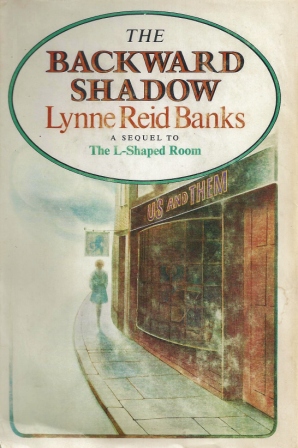 The Backward Shadow by Lynne Reid Banks ~ 1970. This edition: Simon & Shuster, 1970. Hardcover. 246 pages.
This is a failed review; a non-review; an unreview. I have been trying and trying to finish this book, but have found myself at a dead stop in interest level. Maybe during another time in my life? I need to get this off my desk, and off my conscience, so I’m going to shelve it now, along with its prequel, The L-Shaped Room (which I did manage to read and review, hence the presence of the sequel on my to-read list), and with all the sombre Margaret Atwoods et al which I also have trouble getting thrilled about at this point. Life changes; our reading choice ebb and flow and evolve. Someday, perhaps, “Jane Graham’s” tale will be of interest to me, but certainly not now.
It’s not that it’s a “bad” book; there is a certain style and flow to Banks’ writing that is decidedly appealing, and I can see that her heroine might be someone whom the reader could make friends with, if the reader is in that place in their life where they can identify and sympathize with Jane and her endeavours.
In the meantime, here is the flyleaf description, for the record. I fully agree with the facts of this blurb (okay, maybe not the “glowing achievment” bit, but I agree in general), but just can’t get past my personal annoyance at Jane’s irritatingly navel-gazingish personna; I know constant self-examination is a good thing and all, but this gal takes it to a high level. I’m just one person, though – others feel much more enthusiastic! You’ll have to try it for yourself.
Here’s a link to the Goodreads page:
http://www.goodreads.com/book/show/1916493.The_Backward_Shadow
And from the flyleaf:
From the author of the memorable The L-Shaped Room comes this powerful, disturbing, bittersweet sequel – a complete novel by itself, which continues the story of Jane, now living in an English country cottage with her illegitimate child, determined to forge a viable, independent future. She still loves Toby, her past lover but not the father of her child, but she has an obstinate conviction that she must not burden is writing career by saddling him with her situation.
Tough and resilient though Jane is in many respects, the intensity with which she loves her child is not enough to conceal from her the recognition of her essential loneliness in her isolated country life. She resolves to meet the challenges in her own way and, as readers of The L-Shaped Room will remember fondly, Jane’s way is one of honesty, humor, and unsentimental insight.
Rarely in fiction does the sequel to a celebrated novel measure up to its predecessor in impact and originality, but The Backward Shadow is in every way as glowing an achievement as Lynne Reid Bank’s first book…
And here is the Kirkus Reviews take, from 1970:
This is an extension of The L-Shaped Room (better remembered as a film?) in which unwed mother Jane has retired to Surrey with her infant, David, and is still in love with Toby (not his father). Toby comes down from London to see her now and again before he gets attached elsewhere and Jane learns too late that being an independent woman (not in the current sense) has a premium. With Dottie, an old friend, she starts a gift shop which is subsidized by Henry, Dottie’s contact. Before they’re through “the backward shadow” has darkened all their lives: Dottie’s is loneliness; Jane’s is the problem of getting along and bringing up David; Henry’s is “dying well”–which he does, although Jane and Dottie cry a great deal. . . . Essentially it’s a soft-shelled woman’s story–a term which has been discredited rather than the fact. There will be readers.
Posted in 1970s, Banks, Lynne Reid, Read in 2012 | Tagged Vintage Fiction | 3 Comments »
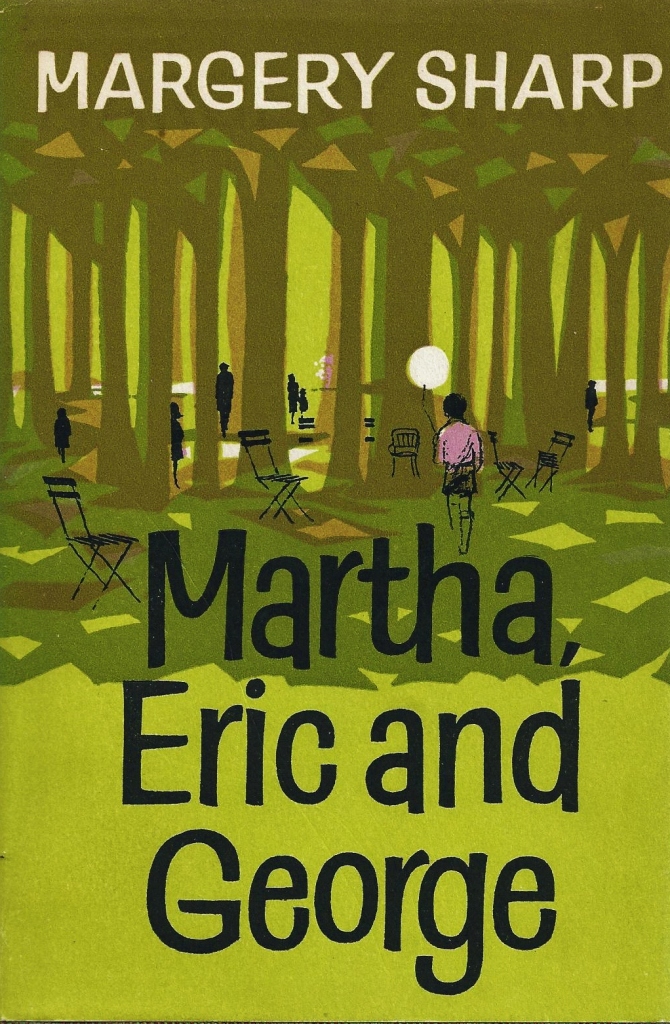 Martha, Eric and George by Margery Sharp ~ 1964. This edition: Collins, 1964. First Edition. Hardcover. 160 pages.
My rating: 9/10
From the flyleaf:
‘Why should it always be the woman,’ asked Martha, ‘who’s landed with the little illegit?’
Putting principle into practice, she thus deposited a two-weeks-old infant on the paternal door-step and returned carefree to her proper business of painting masterpieces: vanishing so successfully, indeed, from the lives of both lover and son, that ten years elapsed before the consequences of her misbehaviour caught up with her…
Why, indeed?
Martha strikes a blow for her sex as she neatly turns the tables on her partner in procreation. Her child, result of a brief dalliance with the illicit pleasures of physical passion (and not to be repeated, as, though most enjoyable, it makes her too tired to get up early and paint) has safely entered the world. Providing him with a layette, a carry-cot and a recipe for formula, Martha proceeds to take her ex-lover Eric at his word – “I want to shoulder all your burdens for you,” Eric has declared in his (scorned) proposal of marriage – and drops this small burden off on the Parisian doorstep of British expatriate Eric and his doting mother.
Eric Taylor, returning home to lunch, after the French fashion, from his morning’s work at the City of London (Paris branch) Bank, paused as usual outside the concierge’s lodge. The flat occupied by himself and his mother was on the fourth floor; tradespeople in a hurry frequently left parcels below – also Mme Leclerc the concierge seldom troubled to carry up a letter unless she suspected it to contain bad news. The pause at the lodge was part of Eric’s routine, his words ritual.
“Anything for me to take up, Mme Leclerc?”
For once, a rare smile curved the thin lips. Employing all her fine Gallic gifts of drama, irony and concision –
“Apparently yes, monsieur,” replied Mme Leclerc; and issuing burdened from her lodge planted in his arms a carry-cot containing a two-weeks-old infant.
Poor Eric! One does feel for him in his sudden comeuppance, though of course he had no idea that his brief dalliance with Martha had had fruitful results; he did inquire as to Martha’s state once the fling was over, and she brushed him off in typical Martha-manner, so I rather think his disgruntled reaction is justified. If we weren’t clear on the farcical nature of this series before, we certainly get the full picture in this last installment. Eric carries the baby up to his mother, who is, quite naturally, completely blindsided.
Out from the covers pushed a tiny, grasping fist like a very small octopus. The nearest object at hand being Mrs. Taylor’s ring-finger, about it the small octopus twined.
Now it was her turn to be struck dumb. For what seemed like an age, while the clock on the mantelshelf ticked, while on the table the liver-and-bacon congealed, mother and son gazed at each other in equal silence, equal consternation, indeed equal incredulity. (Disbelief: the instinctive, protective human reaction before disaster.) But the small octopus-hand insisted. Mrs. Taylor stooped; pulled a lap of blanket aside; and raised a face white as her son’s.
“Eric!” breathed Mrs. Taylor. “Whose is it?”
Actually the question was superfluous. It is an accepted if inexplicable fact that an infant during the very first weeks of its existence may show a marked resemblance to one or other parent. In this case, the tiny countenance now revealed was an uncanny, crumpled miniature of Eric’s own. It simply looked much older: an image of Eric in toothless senility. – Not that the latter more than glanced: by this time he was … sure.
“It’s mine all right,” agreed Eric Taylor.
Now Mrs. Taylor surprises us by her reaction. Rather than being appalled by this incontrovertible evidence of her son’s amorous activities, she is instead thrilled to the core “Oh, my darling, it’s a boy!” she cries in delight. And, “Gran’s little treasure!” she croons, to Eric’s deep disgust and abiding dismay. Here we get another glimpse of Margery Sharp’s cynical wit.
The moment was far too delightful to spoil by thinking about Martha, so Mrs. Taylor didn’t. This involved no particular feat of will-power, merely a complete if unconscious surrender to wishful thinking. To possess a grandchild without the encumbrance of a daughter-in-law is many a grandmother’s unadmitted dream. “Dear Anne, dear Lucy, dear Susan!” cry the grandmothers – happy to welcome with small bottles of Chanel No. 5 at Christmas each necessary transmitter of a family face; but even happier to water with easy tears a rose-bush on an early grave…
Certainly Mrs. Taylor didn’t hope Martha was dead, even though she’d never really liked the girl. (In any case, as she’d learned from Mme Leclerc, Martha was obviously alive that morning. It would have had to be a very sudden accident.) Mrs. Taylor simply forgot Martha: indeed, so all-absorbing was the sheer physical pleasure of holding a baby again…
So the stage is set. Martha’s baby, quickly named George, is well provided for. His father becomes very much a background figure; in a turning of tables, the unmarried father takes on a role usually reserved for the mother in such a situation. A figure of mildly ribald amusement among his compatriots, Eric faces social ostracism, and, worse yet, is passed over for his expected promotion. He is no longer seen as quite so “above reproach” to qualify for a higher position in the Bank of London (Paris branch), though fortunately for him there is no thought of terminating his employment entirely.
Martha has returned to England, there to hone her artistic skills and single-mindedly become an accomplished mistress of her art. Still sponsored and nurtured by paternal Mr. Joyce, Martha’s genuine genius blossoms. Ten years of hard, creative work pass by, and at last Martha is deemed ready to risk a solo exhibition in that mecca of the art world, Paris.
The reunion of Martha and Eric, and young George, fully meets our expectations, but there are a few surprises in store. The ending is delicately poignant; Martha redeems herself, emotionally speaking, by showing that she does have a certain sensitivity hidden by her brusque exterior. A most satisfying conclusion, despite the deathbed scene.
I hugely enjoyed this trilogy. (I still think this should be published as an omnibus; too cruel if you can’t get your hands on the complete set!) Highly recommended for the Margery Sharp fan, or anyone desiring a cleverly satirical literary diversion.
Side note: I love the cover illustration of this edition. Jillian Willet captures perfectly a rather mysterious and moody feeling of foreboding; the child in the foreground (young George?) strides sturdily towards the vaguely menacing figures partially obscured by the park’s trees. The geometric shadowing pays homage to Martha’s vision of the world as a series of shapes; the whole is a deeply satisfying composition.
Posted in 1960s, Read in 2012, Sharp, Margery | Tagged Vintage Fiction | 2 Comments »
Here’s another Martin Armstrong poem I remembered when searching out the “Honey” poem. Marked in another one of our rather embarrasssingly large collection of vintage poetry anthologies is this gently humorous narrative poem. Some years ago we “collected” a number of Martin Armstrong poems and read them aloud to each other; Miss Thompson was a favourite.
The time we spent together taking turns reading aloud is one of my favourite memories and one of the greatest joys of our homeschooling time. As everyone is now very much going their separate ways, read-aloud times are a thing of the past; I will need to wait for grandchildren now, I suppose… Hopefully some years in the future, but I find myself pleasantly anticipating a new audience of small rapt listeners, begging for “one more chapter!” Until then, I’m still adding to the story and poetry collections. But I think I may track down a family member or two and see if they would like to indulge in a nostalgic read-aloud session, just to humour their sentimental mom…
 MISS THOMPSON GOES SHOPPING
Miss Thompson at Home
In her lone cottage on the downs,
With winds and blizzards and great crowns
Of shining cloud, with wheeling plover
And short grass sweet with the small white clover,
Miss Thompson lived, correct and meek,
A lonely spinster, and every week
On market-day she used to go
Into the little town below,
Tucked in the great downs’ hollow bowl
Like pebbles gathered in a shoal.
She goes a-Marketing
So, having washed her plates and cup
And banked the kitchen-fire up,
Miss Thompson slipped upstairs and dressed,
Put on her black (her second best),
The bonnet trimmed with rusty plush,
Peeped in the glass with simpering blush,
From camphor-smelling cupboard took
Her thicker jacket off the hook
Because the day might turn to cold.
Then, ready, slipped downstairs and rolled
The hearthrug back; then searched about,
Found her basket, ventured out,
Snecked the door and paused to lock it
And plunge the key in some deep pocket.
Then as she tripped demurely down
The steep descent, the little town
Spread wider till its sprawling street
Enclosed her and her footfalls beat
On hard stone pavement, and she felt
Those throbbing ecstasies that melt
Through heart and mind, as, happy, free,
Her small, prim personality
Merged into the seething strife
Of auction-marts and city life.
She visits the Boot-maker.
Serenely down the busy stream
Miss Thompson floated in a dream.
Now, hovering bee-like, she would stop
Entranced before some tempting shop,
Getting in people’s way and prying
At things she never thought of buying:
Now wafted on without an aim,
Until in course of time she came
To Watson’s bootshop. Long she pries
At boots and shoes of every size —
Brown football-boots with bar and stud
For boys that scuffle in the mud,
And dancing-pumps with pointed toes
Glossy as jet, and dull black bows;
Slim ladies’ shoes with two-inch heel
And sprinkled beads of gold and steel —
‘How anyone can wear such things!’
On either side the doorway springs
(As in a tropic jungle loom
Masses of strange thick-petalled bloom
And fruits mis-shapen) fold on fold
A growth of sand-shoes rubber-soled,
Clambering the door-posts, branching, spawning
Their barbarous bunches like an awning
Over the windows and the doors.
But, framed among the other stores,
Something has caught Miss Thompson’s eye
(O worldliness! O vanity!),
A pair of slippers — scarlet plush.
Miss Thompson feels a conscious blush
Suffuse her face, as though her thought
Had ventured further than it ought.
But O that colour’s rapturous singing
And the answer in her lone heart ringing!
She turns (O Guardian Angels, stop her
From doing anything improper!)
She turns; and see, she stoops and bungles
In through the sand-shoes’ hanging jungles,
Away from light and common sense,
Into the shop dim-lit and dense
With smells of polish and tanned hide.
Mrs. Watson
Soon from a dark recess inside
Fat Mrs. Watson comes slip-slop
To mind the business of the shop.
She walks flat-footed with a roll —
A serviceable, homely soul,
With kindly, ugly face like dough,
Hair dull and colourless as tow.
A huge Scotch pebble fills the space
Between her bosom and her face.
One sees her making beds all day.
Miss Thompson lets her say her say:
‘So chilly for the time of year.
It’s ages since we saw you here.’
Then, heart a-flutter, speech precise,
Describes the shoes and asks the price.
‘Them, Miss? Ah, them is six-and-nine.’
Miss Thompson shudders down the spine
(Dream of impossible romance).
She eyes them with a wistful glance,
Torn between good and evil. Yes,
Wrestles with a Temptation;
For half-a-minute and no less
Miss Thompson strives with seven devils,
Then, soaring over earthly levels
And is Saved
Turns from the shoes with lingering touch —
‘Ah, six-and-nine is far too much.
Sorry to trouble you. Good day!’
She visits the Fish-monger
A little further down the way
Stands Miles’s fish-shop, whence is shed
So strong a smell of fishes dead
That people of a subtler sense
Hold their breath and hurry thence.
Miss Thompson hovers there and gazes:
Her housewife’s knowing eye appraises
Salt and fresh, severely cons
Kippers bright as tarnished bronze:
Great cods disposed upon the sill,
Chilly and wet, with gaping gill,
Flat head, glazed eye, and mute, uncouth,
Shapeless, wan, old-woman’s mouth.
Next a row of soles and plaice
With querulous and twisted face,
And red-eyed bloaters, golden-grey;
Smoked haddocks ranked in neat array;
A group of smelts that take the light
Like slips of rainbow, pearly bright;
Silver trout with rosy spots,
And coral shrimps with keen black dots
For eyes, and hard and jointed sheath
And crisp tails curving underneath.
But there upon the sanded floor,
More wonderful in all that store
Than anything on slab or shelf,
Stood Miles, the fishmonger, himself.
Mr. Miles
Four-square he stood and filled the place.
His huge hands and his jolly face
Were red. He had a mouth to quaff
Pint after pint: a sounding laugh,
But wheezy at the end, and oft
His eyes bulged outwards and he coughed.
Aproned he stood from chin to toe.
The apron’s vertical long flow
Warped grandly outwards to display
His hale, round belly hung midway,
Whose apex was securely bound
With apron-strings wrapped round and round.
Outside, Miss Thompson, small and staid,
Felt, as she always felt, afraid
Of this huge man who laughed so loud
And drew the notice of the crowd.
Awhile she paused in timid thought,
Then promptly hurried in and bought
‘Two kippers, please. Yes, lovely weather.’
‘Two kippers? Sixpence altogether:’
And in her basket laid the pair
Wrapped face to face in newspaper.
Relapses into Temptation
Then on she went, as one half blind,
For things were stirring in her mind;
Then turned about with fixed intent
And, heading for the bootshop, went
And Falls.
Straight in and bought the scarlet slippers
And popped them in beside the kippers.
She visits the Chemist
So much for that. From there she tacked,
Still flushed by this decisive act,
Westward, and came without a stop
To Mr. Wren the chemist’s shop,
And stood awhile outside to see
The tall, big-bellied bottles three —
Red, blue, and emerald, richly bright
Each with its burning core of light.
The bell chimed as she pushed the door.
Spotless the oilcloth on the floor,
Limpid as water each glass case,
Each thing precisely in its place.
Rows of small drawers, black-lettered each
With curious words of foreign speech,
Ranked high above the other ware.
The old strange fragrance filled the air,
A fragrance like the garden pink,
But tinged with vague medicinal stink
Of camphor, soap, new sponges, blent
With chloroform and violet scent.
Mr. Wren.
And Wren the chemist, tall and spare,
Stood gaunt behind his counter there.
Quiet and very wise he seemed,
With skull-like face, bald head that gleamed;
Through spectacles his eyes looked kind.
He wore a pencil tucked behind
His ear. And never he mistakes
The wildest signs the doctor makes
Prescribing drugs. Brown paper, string,
He will not use for any thing,
But all in neat white parcels packs
And sticks them up with sealing-wax.
Miss Thompson bowed and blushed, and then
Undoubting bought of Mr. Wren,
Being free from modern scepticism,
A bottle for her rheumatism;
Also some peppermints to take
In case of wind; an oval cake
Of scented soap; a penny square
Of pungent naphthaline to scare
The moth. And after Wren had wrapped
And sealed the lot, Miss Thompson clapped
Them in beside the fish and shoes;
‘Good day,’ she says, and off she goes.
Is Led away to the Pleasure of the Town,
Beelike Miss Thompson, whither next?
Outside, you pause awhile, perplext,
Your bearings lost. Then all comes back
Such as Groceries and Millinery,
And round she wheels, hot on the track
Of Giles the grocer, and from there
To Emilie the milliner,
There to be tempted by the sight
Of hats and blouses fiercely bright.
(O guard Miss Thompson, Powers that Be,
From Crudeness and Vulgarity.)
And other Allurements
Still on from shop to shop she goes
With sharp bird’s-eye, enquiring nose,
Prying and peering, entering some,
Oblivious of the thought of home.
The town brimmed up with deep-blue haze,
But still she stayed to flit and gaze,
Her eyes ablur with rapturous sights,
Her small soul full of small delights,
Empty her purse, her basket filled.
But at length is Convinced of Indiscretion
The traffic in the town was stilled.
The clock struck six. Men thronged the inns.
Dear, dear, she should be home long since.
And Returns Home
Then as she climbed the misty downs
The lamps were lighted in the town’s
Small streets. She saw them star by star
Multiplying from afar;
Till, mapped beneath her, she could trace
Each street, and the wide square market-place
Sunk deeper and deeper as she went
Higher up the steep ascent.
And all that soul-uplifting stir
Step by step fell back from her,
The glory gone, the blossoming
Shrivelled, and she, a small, frail thing,
Carrying her laden basket. Till
Darkness and silence of the hill
Received her in their restful care
And stars came dropping through the air.
But loudly, sweetly sang the slippers
In the basket with the kippers;
And loud and sweet the answering thrills
From her lone heart on the hills.

Posted in 1920s, My World, Poetry | Tagged My World, Poetry, Read-Aloud | 10 Comments »
 HONEY HARVEST
Late in March, when the days are growing longer
And sight of early green
Tells of the coming spring and suns grow stronger,
Round the pale willow-catkins there are seen
The year’s first honey-bees
Stealing the nectar: and bee-masters know
This for the first sign of the honey-flow.
Then in the dark hillsides the Cherry-trees
Gleam white with loads of blossom where the gleams
Of piled snow lately hung, and richer streams
The honey. Now, if chilly April days
Delay the Apple-blossom, and the May’s
First week come in with sudden summer weather,
The Apple and the Hawthorn bloom together,
And all day long the plundering hordes go round
And every overweighted blossom nods.
But from that gathered essence they compound
Honey more sweet than nectar of the gods.
Those blossoms fall ere June, warm June that brings
The small white Clover. Field by scented field,
Round farms like islands in the rolling weald,
It spreads thick-flowering or in wildness springs
Short-stemmed upon the naked downs, to yield
A richer store of honey than the Rose,
The Pink, the Honeysuckle. Thence there flows
Nectar of clearest amber, redolent
Of every flowery scent
That the warm wind upgathers as he goes.
In mid-July be ready for the noise
Of million bees in old Lime-avenues,
As though hot noon had found a droning voice
To ease her soul. Here for those busy crews
Green leaves and pale-stemmed clusters of green strong flowers
Build heavy-perfumed, cool, green-twilight bowers
Whence, load by load, through the long summer days
They fill their glassy cells
With dark green honey, clear as chrysoprase,
Which housewives shun; but the bee-master tells
This brand is more delicious than all else.
In August-time, if moors are near at hand,
Be wise and in the evening-twilight load
Your hives upon a cart, and take the road
By night: that, ere the early dawn shall spring
And all the hills turn rosy with the Ling,
Each waking hive may stand
Established in its new-appointed land
Without harm taken, and the earliest flights
Set out at once to loot the heathery heights.
That vintage of the Heather yields so dense
And glutinous a syrup that it foils
Him who would spare the comb and drain from thence
Its dark, full-flavoured spoils:
For he must squeeze to wreck the beautiful
Frail edifice. Not otherwise he sacks
Those many-chambered palaces of wax.
Then let a choice of every kind be made,
And, labelled, set upon your storehouse racks —
Of Hawthorn-honey that of almond smacks:
The luscious Lime-tree-honey, green as jade:
Pale Willow-honey, hived by the first rover:
That delicate honey culled
From Apple-blossom, that of sunlight tastes:
And sunlight-coloured honey of the Clover.
Then, when the late year wastes,
When night falls early and the noon is dulled
And the last warm days are over,
Unlock the store and to your table bring
Essence of every blossom of the spring.
And if, when wind has never ceased to blow
All night, you wake to roofs and trees becalmed
In level wastes of snow,
Bring out the Lime-tree-honey, the embalmed
Soul of a lost July, or Heather-spiced
Brown-gleaming comb wherein sleeps crystallised
All the hot perfume of the heathery slope.
And, tasting and remembering, live in hope.

After waiting many years for its maturing enough to finally blossom, the linden tree we planted to commemorate our teenage daughter’s birth is loaded with clusters of intoxicatingly fragrant “lime-flowers”. It is also alive with insects – honey-, bumble- and other wild bees; ants, wasps, and butterflies- a veritable cloud of sound and activity. Today it hit 32°Celsius measured in the shade – very high summer indeed, and all of the honey makers and nectar drinkers are out in full force.
My son works with a local beekeeper, and we are so very fortunate in our ready access to the very freshest and most delectable local honey. Here is a photo they snapped a few weeks ago at the peak of the dandelion nectar flow; I thought it was appropriate to this favourite old poem. An ode to the abiding mystery of honeybees, and the product of their diligent labours!
Posted in 1920s, My World, Poetry | Tagged My World, Poetry | Leave a Comment »
 The Fields of Noon by Sheila Burnford ~ 1964. This edition: Little, Brown & Co., 1964. Hardcover. 175 pages.
My rating: 10/10
This quiet, elegant, and often very funny book is one I keep in my ‘favourites’ collection, and regularly reread with great enjoyment.
The Fields of Noon is a memorable collection of autobiographical essays by Scottish-born Canadian writer Sheila Burnford, better known for her bestselling fictional book The Incredible Journey, a story of two dogs and a Siamese cat who together embark on a 300-mile journey through the northern Ontario wilderness. Disneyfied and popularized, The Incredible Journey might be dismissed without further attention by the discerning reader, but it was intended to be an adult book, was based on actual pets of the Burnford family, and is quite a lovely little piece of work with its own merit. Ignore the sentimental movies, please! (Perhaps I should re-read and review The Incredible Journey as an entry into the 2012-13 Canadian Book Challenge …)
Sheila Burnford, if these highly personal essays are any indication, must have been a fascinating woman to know; her writerly voice is warm and intimate, highly intelligent and self-deprecatingly humorous.
To give you a taste of the tone of this collection, here is an excerpt from the essay Time Out of Mind, concerning Sheila’s interest in archaeology and anthropology, and her subsequent attempts to learn the art of flint-knapping.
The first story I ever remember having read to me was Robinson Crusoe, and later I read and reread it myself, starting again at the beginning the moment it was finished, just like painting the Forth bridge. The Swiss Family Robinson was even better; not the shortened version so often found today but a wonderfully fat volume, profusely illustrated and complete in every last moralization (and every gruesome detail of poor Grizzle’s demise in the folds of the boa constrictor and subsequent mastication; five hours from ear to hoof – Papa Robinson timed it; children were apparently credited with stronger stomachs in those days) and its pages crammed with useful tidbits of information on how to improve one’s lot and live more graciously on desert islands. I used to spend hours daydreaming of starting from scratch on my island utopia and putting all this practical information to the test. Thanks to Mr. Robinson, that bottomless well of How To Do It lore, I knew how to make a Unique Machine for boiling whale blubber; I could construct a sun or sand clock, train ostriches, open oysters and manufacture sago; if a sturgeon had been caught in my coconut fiber fishnet I knew just how to make isinglass windows from its bladder. I could even – and as I write I feel the urge to do so – make waterproof boots (beloved, familiar gumboots), with a clay mold, taken from my sand-filled socks, then painted over with layers of latex tapped from the nearest rubber tree. It would have been a luckless Man Friday who made his imprint on my solitary sands, for I would have been a fearful bore to live with: like Papa Robinson, one innocent question would have released a pedantic torrent of information.
This childhood preoccupation with carving out an existence by my own unaided efforts used to end, invariably, I remember, with that baffled, mind-boggling feeling that used to overcome me – and still does – when staring up at a cloudless blue sky and trying to make my small limited mind grasp that the blue is a void, endless infinity, nothing, not even omega. For, sooner or later, a fearful nagging doubt insinuated itself into every castaway installment of my self-told story: What if one did not have a knife, or a goat, or a gun to start with? Or, worse still, had not read Swiss Family Robinson? How on earth did one go about forging steel for that most necessary knife (what, for that matter, was steel?), substitute for a goat, manufacture a gun, or any kind of weapon?
*****
Posted in 1960s, Canadian Book Challenge #6, Read in 2012 | Tagged Animals, Biography, Canadian, Canadian Book Challenge 6, Essays, Memoir | 4 Comments »
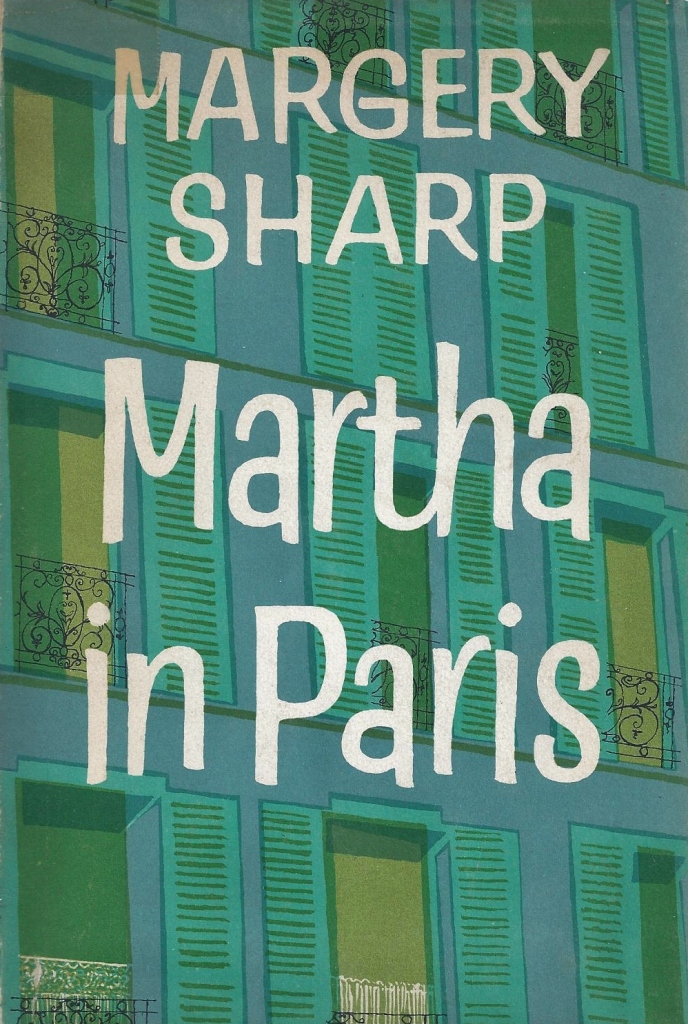 Martha in Paris by Margery Sharp ~ 1962. This edition: Little,Brown, 1962. Hardcover. First American Edition. 166 pages.
My rating: 9/10
From the front flyleaf:
In this “portrait of the artist as a young woman,” Margery Sharp uses all her individual observation – humorous, tender and astringent – to recount a climacteric twelve months in the life of eighteen-year-old Martha, who was sent to Paris to learn to paint, and learned a great deal else besides.
Readers who first met Martha as the stolid, matter-of-fact and altogether memorable child in The Eye of Love and wondered what would happen to this truly independent spirit when confronted with Life now have an opportunity to find out.
Oblivious to the glamour and temptation of Paris, Martha’s single-minded pursuit of creativity and her matronly appearance seem to protect her from her Aunt Dolores’s delicately-put fear that “Martha might come to some harm…” Once called the Young Pachyderm by a friend back home near Paddington Station, perhaps because he glimpsed something tough-carapaced about her even then, Martha is now Mother Bunch to her fellow art students. Apparently the threat of Paris is to be lost ton her as she at once sets herself up in a doggedly methodical routine of working, eating and sleeping.
But Paris has an outrageous joke to play on Martha. It all begins with her somewhat unconventional adoration of deep, hot baths, after which she always looked her most attractive, or as the French say, “appetizing.” Nice hot baths involve Martha in an experience with a young Englishman (City of London Bank, Paris Branch) which would challenge the resources of a far more sophisticated girl than Martha. How she triumphantly copes with the resulting situation is the them of this engaging novel.
That about sums it up. I greatly enjoyed this next installment in Martha’s life-journey. Margery Sharp has settled into her story nicely; she champions Martha’s artistic cause and incidentally tramples over the gender-based lines of common behaviours; Martha is a true feminist, or perhaps we should say humanist; she has zero tolerance for the conventions which govern the behaviours of more conventional beings. Such as, for instance, her would-be lover Eric, and his doting mother. Their persistence in viewing Martha through their own rose-tinted spectacles of wishful thinking as to her personality and motivations lead to an ironically comedic situation, which Martha single-handedly sorts out in a most pragmatic way.
Martha is a deeply unusual heroine; regardless of her lack of sentiment and socially acceptable behaviour I found myself fully on her side in her Parisian adventures, and have no doubt that her ambitions will be fulfilled.
Highly recommended. If you can at all manage to find these three titles, read them in order. This is the middle book of a trilogy. The preceding book is The Eye of Love; the following book is Martha, Eric and George.
The Eye of Love is presently in print, in softcover from Virago Press. Martha in Paris and Martha, Eric and George are readily available and generally reasonably priced through ABE.
Posted in 1960s, Read in 2012, Sharp, Margery | Tagged Sharp, Margery, Vintage Fiction | 4 Comments »
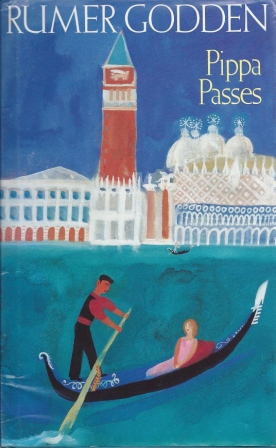 Pippa Passes by Rumer Godden ~ 1994. This edition: Macmillan, 1994. First Edition. Hardcover. ISBN: 0-333-60817-8. 172 pages.
My rating: 5/10
This was a really quick read, so I’ll give it a really quick review.
Seventeen-year-old Phillipa, “Pippa”, is a ballet dancer in a British troupe visiting Venice. Über-talented both in dance and voice, Pippa has led the sheltered life of a cloistered and protected performing arts student, so her first trip abroad, and to romantic Venice at that, finds her wide-eyed and naïve. She immediately encounters a handsome young gondolier, and falls deeply in love. He is attracted in turn, but his motivations are slightly different than purely romantic.
In the meantime, Pippa’s ballet mistress has become infatuated with her, leading to much scheming and heartache and culminating in an attempted lesbian rape scene; a bit of a shocker from this particular author, but in retrospect not all that surprising; Rumer Godden was never shy of acknowledging the power of sex and using it as a motivator for her characters over the years; I think that the fairly graphic incident here is merely the well-experienced 87-year-old author keeping up with the times.
This was Godden’s second to last published novel before her death in 1998, and while not one of her top-rank tales it is certainly competently written and acceptable as a light read. Don’t expect another House of Brede, though! This one is fluff straight through.
Very nice evocation of Venice; as usual Godden handles her setting with great skill.
Weakest point, aside from the rather lame plot, is that the characters are all quite one-dimensional. We are continually told that Pippa is wonderfully talented and oh-so-special; we must take the author at her word as we never really get too close to Pippa herself. Things seem to happen just a little too easily throughout; there is a lot of glossing over of motivations and actions. This almost feels like a moderately fleshed-out outline of what could perhaps be a much longer and more interesting story.
I wouldn’t recommend this novel as anything but a momentary diversion. It definitely belongs in a Godden collection, and is interesting enough to have limited re-read status, but it really isn’t up to the standard of some of Godden’s masterworks. As I’ve said before, Godden had a great range in her stories; this is on the pallid end of the spectrum. Still better than some of the present-day chick lit I’ve attempted, so extra points for that. Even at her worst, Godden is still good. If you can get this one cheap, take it to the beach, but don’t forget to tuck something else in your bag as well, because slight little Pippa, at less than 200 pages, will pass by very quickly!
Posted in 1990s, Godden, Rumer, Read in 2012 | Tagged Godden, Rumer | 8 Comments »
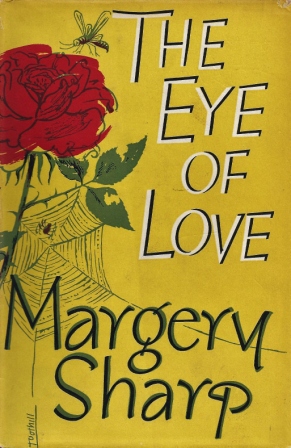 The Eye of Love by Margery Sharp ~ 1957. This edition: Collins, 1957. Hardcover. 1st Edition. 256 pages.
My rating: 9/10
I have been on an unapologetic reading binge these past few days; waking at my husband’s 5 AM alarm to blink the sleep from my tired eyes and reach groggily for the book I laid down the night before – or, technically, earlier in the morning; too many times it’s been past midnight – foolish me! A perfectly made cup of tea is always delivered to my bedside or chairside table by a man who values silence above conversation on workday mornings, and is himself stealing some precious reading time over his breakfast before heading out the door at the last possible moment. Our morning exchanges are brief; after thirty years together the pattern is predictably set, and it suits us very well. “What’re you reading?” and “Here, I’m done. You give it a try. Not bad…” and, so often, “Hey, did you steal my book? I was still working on that one…”
Lately I have had an extravagant number of book-shaped packages from far-flung purveyors, so that like the proverbial child in the candyshop I am overwhelmed by choices and am greedily consuming each treat with an anticipatory eye on the next one. All are light fiction; summer reading at its best.
Trickling in much too slowly are a number of new-to-me vintage books by my beloved Margery Sharp. Margery wrote a trilogy of sorts between 1957 and 1964: The Eye of Love, Martha in Paris, and Martha, Eric and George. Naturally, the third book came first, then the second, with a dreadfully long lag before the first one showed up just a few days ago. I had been nobly holding off on reading them out of sequence, and I’m glad I did. These definitely need to be read in order to get a full appreciation of the journey of our unlikely heroine Martha. I am surprised that these do not appear in an omnibus edition; that would be kindest to the reader, and not unmanageable, as the three books are individually short and quick reads. Having gobbled them up, I will now review them in order, with a probably doomed attempt at brevity, and place them together on my dedicated Margery Sharp shelf in our bedroom (where all the “chuck out the window in case of house fire” treasures reside) to await happy re-reading in future.
Ladies of ambiguous status have by convention hearts of gold, and Miss Diver was nothing if not conventional; but a child in an irregular household is often an embarrassment. It had been wonderfully kind of Miss Diver to save her brother’s child from an orphanage, but not surprising; what was surprising was how well the arrangement had worked out.
It is 1929; Miss Dolores Diver’s widowed brother Richard Hogg has just died, leaving behind nothing of worldly value to his six-year-old-child, Martha, now a bona-fide orphan with an uncertain future. Miss Diver gallantly steps in.
She had never seen the child until an hour earlier; she had never before visited the shabby Brixton lodging-house in whose shabby parlour the thinly-attended wake was being held. – A dozen or so of Richard Hogg’s ex-colleagues from the post office stared inquisitively; this meeting between the two chief mourners provided a touch of drama, something to talk about afterwards, otherwise conspicuously lacking. (As Doctor Johnson might have said, it wasn’t a funeral to invite a man to: only one bottle of sherry and fish-paste sandwiches. Richard Hogg, with his motherless daughter, had lodged two full years in Hasty Street; but a landlady never does these things so wholeheartedly as relations, even with the Burial Club paid up and the next week’s rent in hand.)
Several years pass in complete amiability; young Martha is a rather odd but markedly placid child, and the Diver ménage, financed and patronized by Harry Gibson, head of a small furrier’s establishment, absorbs her without a hitch. Things are about to change, though. Harry’s business is struggling in the depths of the financial depression, and to save it he has contracted to marry one Miranda Joyce, hitherto-unmarriageable daughter of a very successful, upper-end furrier. Her father, in return for getting his daughter finally settled, is willing to re-finance Gibson’s. Harry decides to do the right thing by his prospective fiancé and renounce his mistress and his comfortable routine: five days of the week living quietly with his doting mother, with the weekend secretly spent in the little house with faithful Dolores and a tactful Martha, with the story to the rest of the world that he has continual weekend business in Leeds.
Since their meeting ten years earlier, at a Chelsea Arts Ball, Dolores and Harry have grown even more deeply in love. Now, on the eve of their parting, they cling together and reminisce.
“I’m sorry, Harry, but I can’t bear it,” said Dolores.
She huddled closer against his solid chest. It was his solidness shed always loved, as he her exotic fragility. For ten years they’d given each other what each most wanted out of life: romance. Now both were middle-aged, and if they looked and sounded ridiculous, it was the fault less of themselves than of time.
To be fair to Time, each had been pretty ridiculous even at the Chelsea Ball. Miss Diver, in her second or third year as a Spanish Dancer, was already known to aficionados as Old Madrid. Mr. Gibson, who had never attended before, found the advertised bohemianism more bohemian than he’s bargained for. To the young devils from the Slade, unwrapping him, [Harry has come dressed as a brown paper parcel],his humiliated cries promised bare buff rather than pyjamas. Naked, indeed, he might have made headlines by being arrested; in neat Vyella, he was merely absurd.
Dolores, Old Madrid, not only pitied his condition but also lacked a partner. She’s have been glad to dance with anyone, all the rest of the night. But though rooted in such unlikely soil their love had proved a true plant of Eden, flourishing and flowering, and shading from the heat of day – not Old Madrid and Harry Gibson, but King Hal and his Spanish rose.
So they had rapidly identified each other – he so big and bluff, she so dark and fragile: as King Hal and his Spanish rose. Of all the couples who danced that night in the Albert Hall, they were probably the happiest.
Off Harry goes, to reluctantly propose to the very willing Miranda.
A quarter of an hour passed long as a century. To an impatient lover it would no doubt have seemed longer: Mr. Gibson was impatient only as a man about to be shot might be impatient. (Why hadn’t he been shot, in ’17?) The bitter parenthesis, by the memories it evoked, nonetheless helped his courage: when at last the door opened, like an officer and a gentleman Mr. Gibson clutched his carnations and stood bravely up to meet the firing squad.
Curiously enough, Miranda Joyce bore a marked physical resemblance to Miss Diver. Both were tall, black-haired, and bony. They were about the same age. Miss Joyce had even certain advantages: her make-up was better, she hadn’t Dolores’ slight moustache, and she was far better dressed. But whereas Mr. Gibson saw Dolores with the eye of love, he saw Miss Joyce as she was, and whereas the aspect of Old Madrid made his heart flutter with delicious emotion, the aspect of Miss Joyce sunk it to his boots.
But Harry Gibson soldiers on. The proposal is duly made and predictably accepted; the necessary conventions are observed.
Kissing her had been like kissing a sea-horse. Mr. Gibson knocked back his drink thankfully. (“I shall turn into a sozzler,” thought Mr. Gibson – dispassionate as a physician diagnosing the course of a disease.)
Fortunately Harry finds consolation in a growing friendship with his father-in-law to be. Mr. Joyce becomes a kindred spirit, and the one bright spot in Harry’s dark night of the soul.
Meanwhile Martha and Dolores are also soldiering on gamely. Dolores soon finds that she is unemployable; her only resource seems to be to let out rooms in her house. Fortunately for aunt and niece, Martha is quick to seize a chance while visiting her old home, and is instrumental in bringing home the perfect boarder. Bachelor Mr. Phillips, clerk of an insurance company, is at first innocuously quiet and reliable with the rent money. However, Dolores’ broken heart and subsequent stand-offish attitude soon have the effect on her boarder of rousing in him a great curiosity as to her personal situation, and, quite soon, a desire to wed this woman whom he very wrongly perceives to be financially independent and a property owner to boot. What Mr. Phillips doesn’t know is that the house is merely leased, with the term coming up; hence Dolores’ desperate need for Mr. Phillips’ financial contribution, and her reluctance to snub his distasteful though so-far polite advances
The games of in-and-out and false pretences escalate, and while her elders are torturing themselves with emotional gymnastics, young Martha is single-mindedly pursuing her one interest. She is teaching herself to draw. Martha sees the world as a series of shapes; capturing images, fitting them into those categories, and transferring them from her eyes to her mind to paper takes up every waking moment.
Dismissed as merely a scribbling child, Martha stolidly ignores the adult world, and it in turn takes little notice of her. Until one day Mr. Joyce, through a series on coincidences, happens upon Martha drawing a tree. He is a connoisseur of the arts; he recognizes a budding young talent when he sees it. He offers Martha his patronage, and buys her much-desired paper, charcoal and chalks, which she unemotionally accepts while refusing the offer of a longer-term artistic relationship and sincere, friendly interest which Mr. Joyce extends.
These complicated relationships get more tangled as time goes on; their multiple resolutions are a typically Margery Sharp juggling act. The tale winds up with a combination of most satisfactory endings, and we leave Martha in particular with the hopeful idea that her future, if not exactly easy, will be extremely interesting.
A cleverly written, very smart, satirical, darkly amusing novel. On par with Something Light, though not quite as gentle; the humour of The Eye of Love is decidedly savage at times.
I’m not at all sure if Margery Sharp planned at first to continue Martha’s saga, as The Eye of Love is a decidedly stand-alone novel, but I am so glad she did. Very highly recommended. Next book in the trilogy: Martha in Paris.
Posted in 1950s, Read in 2012, Sharp, Margery | Tagged Sharp, Margery, Vintage Fiction | 5 Comments »

Progress Report: 6/100






 Leaves & Pages