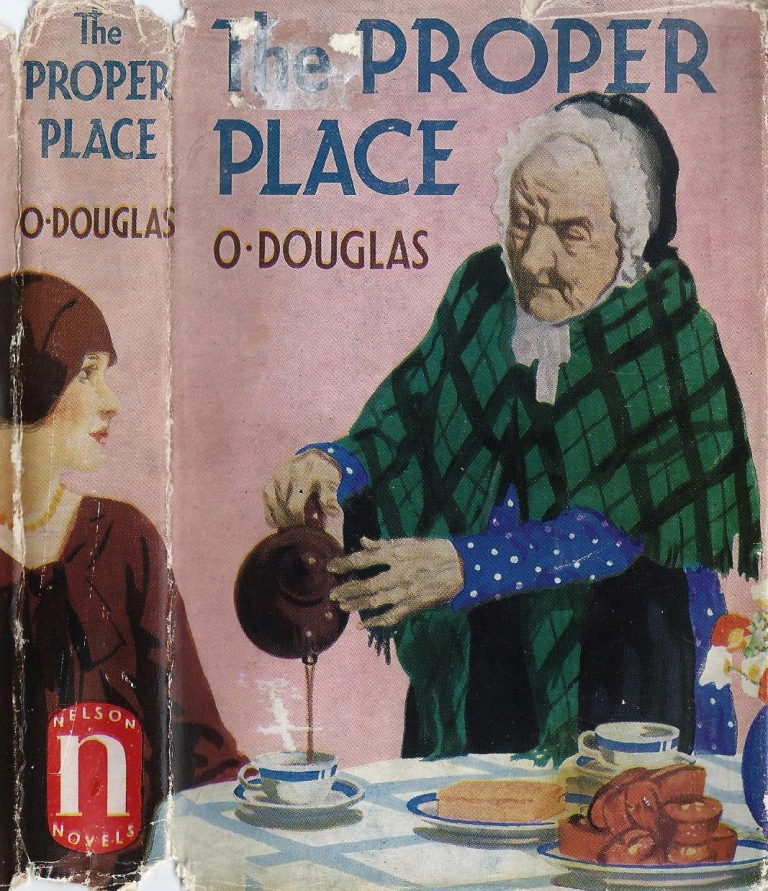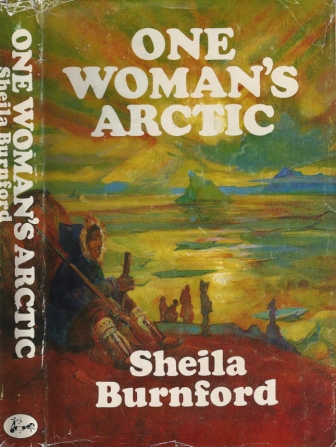
One Woman’s Arctic by Sheila Burnford ~ 1973. This edition: McClelland and Stewart, 1973. Hardcover. ISBN: 0-7710-1825-8. 222 pages.

My rating: 7/10.

This is the account of writer Sheila Burnford’s personal impressions of two summers spent in and around Pond Inlet on Baffin Island, in 1971 and 1972. Burnford had received a Canada Council of the Arts grant to gather material for a book; she accompanied celebrated artist Susan Ross who had been commissioned by the Royal Ontario Museum to create work for an exhibition of art depicting Indian and Eskimo life. The two were longtime friends and travelling companions, having previously spent time living together among the Ojibway of northern Ontario, which she wrote about in 1969’s Without Reserve.

This was a time of cultural shift, as the Inuit embraced and were influenced by modern culture and innovations, while still practicing their traditional way of life to a great extent. Burnford describes her personal impressions, and occasionally tries to pat the larger picture into context, but this is exactly what it says it is in the title – one person’s take on a place too large and complex for generalities to be made, though of course the author occasionally writes as though her observations and conclusions about this small piece of the Arctic apply more broadly. In general, the author keeps to her mandate, which is to tell us about her impressions during her short excursion into the far northern world.
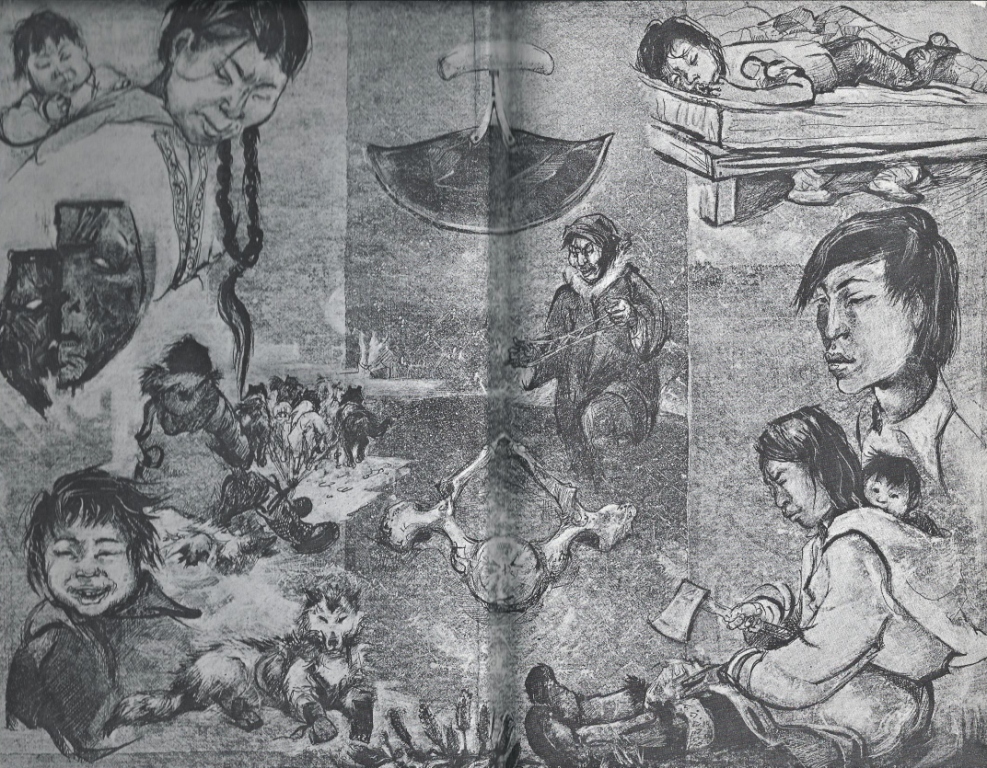
Though it took me a while to work my way through it, now that I’ve completed it I find that ultimately I liked this book, and I enjoyed filling in a few more of the pieces of the author’s life. But it could have been better. What Burnford did so well in The Fields of Noon, though, was talk about herself, her life, her childhood, her family; always in reference to her subject, which made that collection of memoirs so very readable. In One Woman’s Arctic there seems to be more distance between writer and subject, while at the same time the tone is uneven – we’re never sure what “voice” the writer is using because she shifts around so much.

Burnford sometimes maintains an onlooker’s dispassionate view, describing the landscape and the animals and the indigenous people of the small part of the Arctic she visits with a writer’s eye, painting pictures with words. These episodes are very nicely done indeed, and I found that my vision of the scenes from her words were borne out by the pictures I later searched out of the places she visited. Burnford had a rare ability to capture the visual in words.

The weakest parts of the book were when Burnford left the realm of observation and description and ventured into the difficult area of analysis of what she is seeing in regards to the behaviours and motivations of the Inuit (“Eskimos”) she came into brief contact with, or, in the case of the two white mens’ graves at Quilalukan, researched in some depth. Sometimes, as John Mutford points out in his own not particularly favorable review of this book – One Woman’s Arctic by Sheila Burnford – The Book Mine Set Review – the writer falls into the “white man bad/Eskimo good by default” trap. But I felt that she salvaged the situations where she did this by continually acknowledging that she didn’t know if her interpretation was correct; that she was mulling over the situation and trying to make sense of it from her perspective as a very superficial onlooker, and a member of the invading, paternally patronizing race. Burnford never seems to lose sight of the fact that she is a visitor in an alien landscape, and that her comfort and safety rely on the kindness of others.

The episodes I enjoyed the most were when Burnford described the individuals she travelled and stayed with and got to know more intimately. The residents of Pond Inlet, where Burnford and her companion, artist Susan Ross, made their home base in the community’s kindergarten building, are described in lively anecdotal style; Burnford remarks on the fact that no one seems to have anything bad to say about each other, and that she thinks that this is the result of conscious effort on their parts. Referring to the non-Inuit residents of Pond Inlet, the group she and Ross associated with and socially fit in with:

Those who lived here all year round whether teacher, nurse, game warden, R.C.M.P. or administrator, had seemingly developed a safe preservation of peace (outwardly, anyway) attitude to their fellows. One very, very seldom heard any criticism of personalities, but only he/she is so nice/does so much/is wonderful at/ – etc. Occasionally, because one’s antennae were more acutely tuned through being an outsider, one was conscious of tension between certain individuals, but this was rare. I gathered that they had all worked it out during the six months of twenty-four hour darkness…Activities, such as bridge, over which people in cities can tend to become rather maniacal sometimes, were recognized as potential trouble-makers and avoided; and anything involving competition. A good, safe activity, capable of being shared, arousing no jealousy or competition, was that of photography: practically everyone was madly interested in this, and many did their own developing and printing. I have never seen such an impressive array of Hasselblads, Pentaxes, Leicas, etc. as I had up there.

Another contributing factor of harmony – which of course had its overall impact on the general community – was the average age, which was around thirty or under. An age more exposed to today’s precepts of ‘doing your own thing’ and Make Love Not War – precepts very much more in line with the outlook of the Inuit, who have always been a non-aggressive people; and also an age which avoids that difficult menopausal age group, universal elsewhere among those who have made it up to positions of authority, during which strife is commonplace and mayhem (verbal or otherwise) frequent…
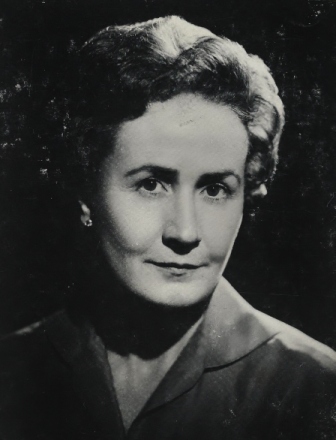
An interesting take on the situation, especially as Burnford and Ross were older than the Pond Inlet “white person” average, being in their mid-fifties; one wonders if the menopausal comment was coming from personal experience, or merely through prior observations in the southern world!

Also very readable were the descriptions of the archeological dig at Button Point on Bylot Island under the auspices of the venerable Father Guy Mary-Rousselière; Burnford was present at the discovery of the second Dorset culture (A.D. 500-1000) shaman’s mask found at that site and vividly describes the unique challenges of archaeological exploration in a permafrost zone. Dorset Masks – Canadian Museum of Civilization Treasures Gallery

I found One Woman’s Arctic to be interesting read from my perspective as someone who has never personally experienced the Arctic, though I found it easier to lay aside and read other things concurrently than I did with her other memoirs, Without Reserve and The Fields of Noon. Even though it has some unresolved and unsatisfactory conclusions about northern life and Inuit culture, I think there is much to learn from Burnford’s observations, purely on the natural history aspect of the area she visited. Her descriptions of the human impact on the area, both Inuit and white, are frank and outspoken; Burnford may be looking through wishful rose-coloured glasses occasionally, but she mostly has them off, the better to turn a sharp eye on the details of her surroundings, and she is not afraid to share what she sees.

A snapshot of a time and place now lost in time, from the perspective of a thoughtful and very individual observer. The quality of the writing is excellent through most of the book, though there are occasional awkward phrasings and strangely punctuated passages which I suspect point to lapses on the editor’s part; Burnford, from my past experience with her work, is an accomplished writer not prone to sloppiness.

I would recommend this book to anyone interested in exploring the different regions of Canada, and in particular the far north, though with a reminder that it should be kept in context as one individual’s impressions, and is, unavoidably, now very dated, being written forty years ago.
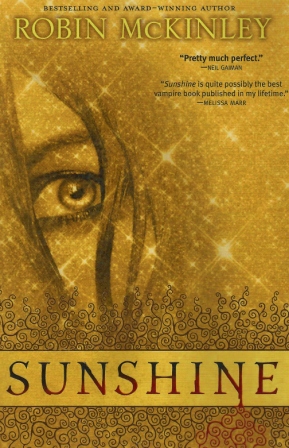
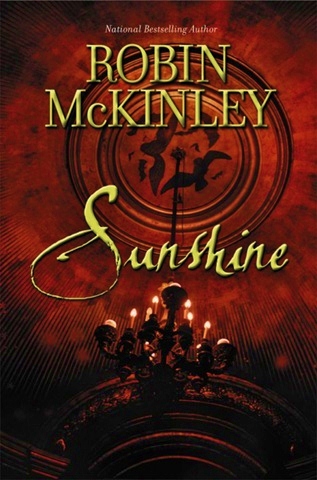
Sunshine by Robin McKinley ~ 2003. This edition: Penguin Speak, 2010. Softcover. ISBN: 978-0-14-241110-0. 405 pages.

My rating: 8/10. Points lost because it tends to ramble; points added because the author unapologetically lets herself go on rambling! And because the vampires perish messily and satisfactorily in sunlight. My son and I, both McKinley aficionados, like to refer to this one as the “anti-Twilight” – no sparkling vampires here, though Sunshine’s heroine gets all silly about her undead crush occasionally, which we agreed was one of our our biggest objections to Twilight – Bella’s sheer stupidity regarding the worst choice ever for boyfriend material. (That, and the terrible writing. And the sparkling.) But, as usual, I digress.

Ah, Robin McKinley. Something of a comfort read author for me, ever since I first read the Damar stories, The Blue Sword(1982) and The Hero and the Crown(1985) quite a few years ago. I have lost track of the number of times I have now read these two books, and I’ve also read everything else she’s ever produced with varying degrees of enthusiasm, with the lone exception of her 2010 novel, Pegasus. I might be losing a bit of my enthusiasm for McKinley’s more recent stuff; her editors are letting her spread herself out a bit too much, the drawback to being such a huge bestseller-producer;  too many times quantity becomes confused with quality, when what they really need to do is refine, cut, and tighten things up. (Someday I will share my opinions on J.K. Rowling and the later Harry Potter books…)

The internet abounds in reviews of all of McKinley’s works; Sunshine is no exception. If you want to see a various range of opinions, just check out the Goodreads page: Goodreads – Sunshine by Robin McKinley  Over 2000 reviews! So I don’t think I need to add to this in any substantial way.

McKinley creates an interesting alternative world to Earth as we know it; she uses much of what we are already familiar with and tweaks it just enough to keep us paying attention – a technique she uses in all of her novels. Her heroine is a bit of a loner and a social misfit – no surprises here – and she also owes some unsuspected abilities to her ancestral bloodlines, which no one has seen fit to tell her about, leaving her to discover her powers for herself. Again, very much a McKinley trademark. The setting is almost dystopian, but people have adapted to the new, post-apocalyptic normal, and go about their business for the most part cheerfully and optimisically, which is something else I like about this tale.

The first time I read Sunshine I was totally engrossed – it was a “stay up till it’s finished” enterprise; this week’s reading was my third, and I am now seeing flaws and tweakable bits here and there, but all in all the story is holding its own.

A heads-up to those familiar with McKinley’s earlier “young adult” novels. Sunshine has lots of sex, some of it graphic. Probably best for the older teenage crowd, and of course McKinley’s legions of adult fans. Oh, and lots of blood. And chocolate! Kind of a weird book, in retrospect. But I’m still a fan.

The cover at the top is from the latest edition, obviously aimed at the teen girl market. I much prefer the original cover art, which I’ve included here as well.

The Benefactress by Elizabeth von Arnim ~ 1901. This edition: Dodo Press, 2012. Softcover. ISBN: 978-1-4099-8059-9. 338 pages.

My rating: 9/10. Or maybe even 9.5? Very good stuff.

I searched out this book on the recommendation of Claire at The Captive Reader, and I am ever so pleased that I did. It was a most delightful read during my recent trip to “The Coast” – Interior British Columbia code for “The Lower Mainland” or “Vancouver”, for you non-Canadians and Easterners. (For of course most of Canada is East of B.C., something we like to smugly tease our friends from Alberta about as they go on about “The West thinks…” this and that, though they rather rudely reply with comments to the effect that the Rocky Mountains were put there for a reason, to keep the eccentric inhabitants of B.C. safely segregated from the rest of Canada!)

My daughter was attending a dance intensive and working with a choreographer; I spent a fair bit of time parked outside her venue waiting for the brief breaks which required sporadic maternal nurturing in the area of rides back to the hotel for showers, food, band aids and sympathy. She was, as happens every summer, feeling the pain of strenuous dancing after relaxing a bit too much over the previous month of home-studio summer break, and, yes, the maternal words “I told you so!” did leave my lips occasionally, but she easily ducked under them – water off a duck’s sweaty little back – we’ve been doing this a long, long time and we both know our roles inside and out and could run this perennial dialogue in our sleep!

The Benefactress was a perfect car-in-parking-lot and hotel room read; just engrossing enough that it was easy to re-enter at a moment’s notice and just complex enough that I could happily mull it over as I crouched meekly in the darkest corner of the dance space waiting for my cues to videotape the completed choreo as it progressed.

I am feeling a bit behind on reviews this week – a minor bobbling as I reach to attain my self-imposed goals. I spent way too much time reading, and driving – the trip to the coast, one-way, takes a good seven hours, not counting stops to refuel and stretch our car-cramped legs. Time out to visit a few secondhand bookstores in the towns we pass through is built into our itinerary; my daughter is the perfect travelling and book-browsing companion and I am relishing this year in her company; our next-to-last dance season together before she moves on to the bigger world of college and work and her ensuing “adult” life.

We’re back home now, with a stack of new-to-us books which I’m gleefully looking forward to exploring and talking about, so I’m going to cheat a bit on this review and refer you straight to Claire. Her take on The Benefactress is spot-on; I don’t feel like I could add to it in any way except to repeat that I loved this book and it was well worth seeking out.  Very highly recommended.

The Benefactress Review from The Captive Reader

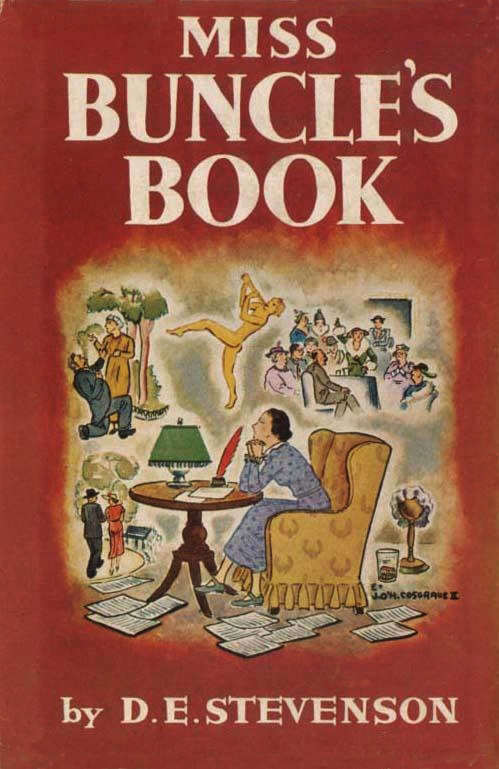
Miss Buncle’s Book by D.E. Stevenson ~ 1934.  This edition: Buccaneer Books, 1983. Hardcover. ISBN: 0-89966-168-8. 224 pages.

My rating: 8/10. A slight work, good for, at most, several evenings’ diversion. I would definitely re-read it after a decent interval, when wanting something “fluff”-ish to take my mind off the frequently depressing nastinesses of the our own 21st century world. Good for what it is – a tale as innocuous and amusing as Miss Buncle’s was intended to be, and not at all “clever”, though, as Miss Buncle herself found, those wishing to project their own imaginations into this simple fairytale could have a field day with hidden meanings, unintended by the author(s), I’m quite certain!

So, after seeing so many enthusiastic reviews of this book (and a few noncommittal “it was okay”s) I did at last manage to track down a library copy. I fall somewhere in between the two camps, but am probably most at home in the “in favour” crowd. I thought the story was light and fun, and I’m going to search out the sequels, Miss Buncle Married and The Two Mrs. Abbots, but I’m in no hurry.  Miss Buncle’s Book was pleasant enough but did not trigger a “must own it” compulsive visit to Amazon and ABE, though I did browse through both hoping to strike a bargain. Not much luck there; inter-library loan it shall be, though I was attracted enough to add D.E.Stevenson to my look-for list for used bookstore shelf scanning. In particular a series of stories concerning a certain “Mrs. Tim”, a soldier’s wife, who seems a good sort to get to know by all reports.

*****

Dowdy, almost-40, kind and peace-loving spinster Miss Barbara Buncle, facing financial difficulties as the dividends from her investments shockingly decrease in the post-WW I years, decides to write a book to gain some spending money. Not having “any imagination”, she draws her characters directly from life, changing only tiny details and, of course, their names. (The village Silverstream becomes Copperfield, Mr Fortnum is now Mr. Mason, Colonel Weatherhead becomes Major Waterfoot, Miss Pretty is Miss Darling, and so on, in a game of renaming by association.) As her tale progresses, she sends her “fictional” friends and neighbours off on some surprising adventures, causing much consternation when the inhabitants of Miss Buncle’s village eventually read the book and recognize themselves.

As the real-life inhabitants of Silverstream-Copperfield meet to decry the parody, and to discover and expose the Judas in their midst, they continually pass over innocuous Miss Buncle, even after she drops broad hints and, in a fit of conscience, even confesses to an unbelieving set of ears. For how could silly Barbara Buncle write even a borrowed epic? She’s not nearly clever enough…

The worm turns with a (mild) vengeance, and Miss Buncle gets the last laugh, as her life takes an unexpecteded turn due to her literary efforts.

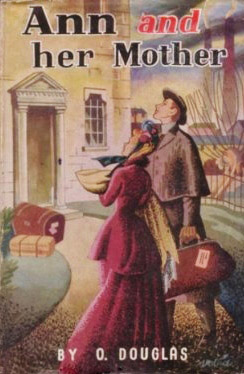
Ann and Her Mother by O. Douglas (pseudonym of Anna Buchan) ~ 1922. This edition: Nelson, circa 1940s. Hardcover. 283 pages.

My rating: 8/10.

This is Anna Buchan’s literary tribute to her beloved mother. The story is almost completely biographical; the author has written it in the form of a fictional conversation between daughter and mother as the daughter is attempting to record the mother’s memoirs. Though a little awkward at times as one shifts between past and present, on the whole it works quite well. I found it a very moving story; the Buchans were a very close family with a strong moral sense and, to leaven that morality, a keen sense of humour.

The family had its share of tragedies, including the deaths of their adored daughter Violet at the age of 5, eldest son William in India of illness at the age of 32, and youngest son Alistair killed in action in France in 1917, aged 22. Anna’s father died suddenly in 1911 at the age of 64, leaving his widow and surviving children Anna, John and James to sincerely mourn his passing.

Ann and Her Mother takes place some years after Reverend John Buchan’s death. Nostalgic flashbacks detail the courtship and marriage of “Ann’s” parents and her father’s establishment as a respected and beloved Scottish Free Church minister, and the childhood of their five children.

A very quiet story, probably best appreciated by those already familiar with Anna Buchan’s more obviously fictional tales, though she was frank in declaring that she was an observational writer and her fictions were drawn very directly from real life and the people she knew. This gives a background setting to the life of the novelist herself, and I recognized the inspirations for many of the incidents and characters portrayed in her other works.

Anna Buchan also wrote about her father’s life in fictionalized form in her novel The Setons.

Let’s Kill Uncle by Rohan O’Grady ~ 1963. This edition: Bloomsbury Press, 2011. Softcover. ISBN: 978-1-60819-511-4. 279 pages.

My rating: 7.5/10. Extra points for the creepy and darkly humorous plot, the very thoughtful and poignant musings of Sergeant Coulter, and the grand British Columbia Gulf Island setting, apparently based on the author’s visit to Saltspring Island. (I chuckled at the naming of Benares; shades of Ganges and Vesuvius on Saltspring!) Points off for the cardboard cutout characterizations of most of the characters. Points off for the occasional swearing, which, though mild, felt out-of-place, even if this story was aimed at an adult audience. Extra points for letting the cougar finally ultimately be a cougar, and for letting the villain be purely evil with no redeeming qualities! Far from a flawless effort, but I liked it much more than I didn’t.

*****

You’ll find lots of reviews on this one; its reissue by Bloomsbury a year ago brought it into high profile.

This was a weird little book. I had read quite a few reviews before I ordered it, so I knew what to expect, but heaven help the innocent reader who thought they were picking up a mild children’s tale! Nothing innocent here; chock full of the darkest human flaws and emotions; the humour (of which there is a lot, all intentional) shades from gray to ebony black.

Two 10-year-old children from very different backgrounds are sent to stay on an isolated, and, incidentally, long-childless island. (Every son from the past generation has gone away to war and thus perished, except for one: the island’s Royal Canadian Mounted Police officer, Sergeant Albert Coulter. The bereft parents and grandparents view him with a certain resentment and suspicion making for a bitter underplot.)

Orphaned Barnaby is the heir to a ten million dollar fortune; he is coming to spend the summer with his uncle at a rural retreat. Christie is the sickly daughter of a struggling more-or-less single mother. Her parents are separated; her father is a good-for-nothing drunkard; her selfless mother is working extra hours to pay for Christie’s country holiday with Mrs. Nielsen, the island’s “goat-lady.”

The children meet on the ferry ride to the island; it is hate at first sight, but that doesn’t prevent them ganging up, running wild and wreaking havoc the entire trip. They are gratefully off-loaded, and the first person that makes an impression on them is the local Mountie, Sergeant Coulter. Luckily both children are struck with hero-worship at first sight, and Sergeant Coulter’s calming influence starts their personal transformations from brats to pleasant children.

Turns out that Barnaby’s Uncle Sylvester is not the mild, mannerly and caring man he appears to be. He is a psychotic murderer with a long history of killing for pleasure and profit; Barnaby is pegged as his next victim, and soon Christie is doomed as well. The children are on to him, and unite to plot right back, deciding to strike first to save their lives. Uncle foils them at every turn. Enter a surprise ally, an outlaw cougar, One-Ear, livestock and child killer, who is hiding out in the underbrush. One-Ear tolerates the two children associating with him, sparing their annoying lives only because he can’t afford to draw attention to himself; the three end in working together to act as Nemesis to stop this wickedest of uncles.

Nothing in this story is quite as expected; the ground continually shifts under our feet as we think we know what the author is going to have her characters do and say next; we often predict completely wrong. Sergeant Coulter is one of the most surprising characters. Initially he is a figure of fun, a slightly blustering, generally disregarded, musical-comedy type policeman. But the Sergeant has hidden depths. He writes long letters to his unaware (and happily married) love interest, rips them up and casts them on the waves. He has survived being a prisoner of war, and, in the novel’s very serious thread which runs through all the farcical nonsense of the murder plot, condemns the political forces that send young men away to kill and be killed, destroys innocent civilians, and allow the evil of the Jewish Holocaust to happen. A few incidents involving First Nations people, or, as 1963 lingo describes them, “Indians”, would likely not get past today’s politically correct censors.

There are quite a number of parallel stories going on in this novel; the author competently intertwines them and brings them to their rightful conclusions. A highly moral tale, when all is said and done.

Let’s Kill Uncle has a superficial feel of being a children’s story, and it definitely works on that level as a straightforward if morbidly fantastical adventure, but I finished with the strong feeling that the intended audience was very much the adults, and the message much more sophisticated than the plot description allows for.

The author’s name, Rohan O’Grady, is the pseudonym of June Skinner, a Vancouver writer who published five novels between 1961 and 1970, of which 1963’s Let’s Kill Uncle seems to be the best known. The others are:

  • O’Houlihan’s Jest, 1961.
  • Pippin’s Journal; Or, Rosemary Is for Remembrance, 1962.  (Also published as The Curse of the Montrolfes and The Master of Montrolfe Hall.)
  • Bleak November, 1970. Michael Joseph, London, 1971.
  • The May Spoon, 1981. (Published under the pseudonym A. Carleon.)

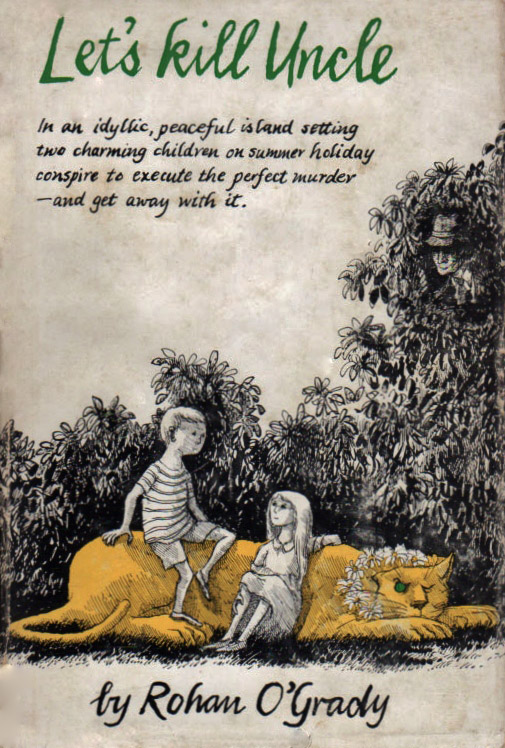
Edward Gorey illustrated Let’s Kill Uncle; I regret that the Bloomsbury reprint contains no art except for a rendition of the original cover on the title page.

This is a very hard book to classify. I’m trying to think of another similar book to compare it to; A Series of Unfortunate Events has been suggested as its natural successor, but Let’s Kill Uncle is a much more complex work than the contemporary Lemony Snicket series.

I enjoyed this quick read; it will be even better the second time around. Recommended.

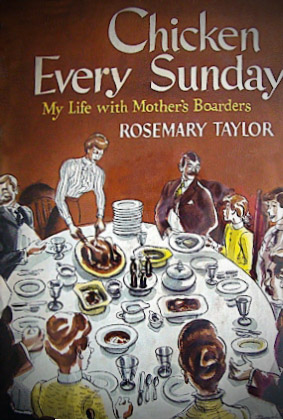
Chicken Every Sunday: My Life with Mother’s Boarders by Rosemary Taylor ~ 1943. This edition: Blakiston, 1945. Hardcover. Illustrated by Donald McKay. 307 pages.

My rating: 6.5/10.

A nostalgic trip down memory lane. This fictionalized autobiography fits well into the “humorous memoir” genre so popular a half-century ago. If you enjoyed Cheaper by the Dozen (Galbraith), and The Egg an I (MacDonald) you will find this a pleasing read. The rating feels a bit low, but it’s not meant to be a snub, just a reflection of where this book fits in with other similar works which I have read and enjoyed over the years. It’s pleasant enough and I will happily recommend it if you come across it “cheap and easy”, but I doubt I would deliberately search it down unless I were particularly interested in the era and setting.

*****

I purchased this old hardcover recently, for a reasonable $5, at Second Glance in Kamloops, B.C. – a WONDERFUL secondhand bookstore, by the way, for any of us local enough to visit it in person. The title rang a faint bell in deepest memory, and once I dipped into it I realized that I had indeed read it years ago. It must have been as part of my mother’s library, though she no longer owns it – it obviously did not survive her many give-ways as she prepared to move from her huge house (two stories plus a packed-full attic) to the much tinier “granny house” she lives in now.

I’m a bit mystified as to why Mom parted with it, as it is just the kind of light memoir she generally enjoys, so I’m going to surprise her with it the next trip in to town with a box of books. At a physically frail 87, one of her few remaining pleasures is reading, and she keeps me busy searching my own shelves and scouting the secondhand emporiums for reading material; a chore I must admit I take on with great pleasure – an excuse to book shop! How much better does it get than having permission from your mother?!

The setting is Tuscon, Arizona, during the first decade of the 2oth Century; the boarding house that the author’s mother ran with such success was built in 1906, “far out in the country”, though, as predicted, the city soon came out to surround it during the boom times of the “roaring twenties”.

The father of the family was quite the wheeler-dealer; finances swung like a pendulum as deals succeeded or fell through; the mother decided to take matters into her own hands to ensure a steady enough income to feed the family, so she began to take in boarders. The book details the succession of quirky characters that passed through the Drachman family doors, as seen through the eyes of young Rosemary.

The incidents are well-presented and the characters are well-portrayed; I did enjoy reading this period piece and I will be keeping it (once my mother finishes with it) with my largish collection of similar works. The humor works most of the time; I smiled (rather than full-out laughed) throughout; the writing is more than competent. The author wrote another book of memoirs focussed on her father’s many enterprises (Ridin’ the Rainbow: Father’s Life in Tuscon, 1944), and several novels.

Apparently very popular at its time of publication, the book inspired a comedic 1944 stage play and then a 1949 movie of the same title, starring Dan Dailey, Celeste Holm, and a young Natalie Wood. (I see that the movie gets lackadaisical reviews on the few online sites I browsed through; I’ve never seen it and don’t plan on searching it out, so that’s all I can tell you.)

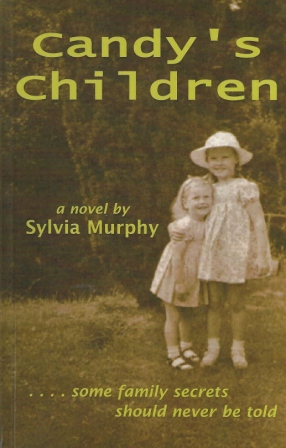
Candy’s Children by Sylvia Murphy ~ 2007. This edition: S.A. Greenland, 2007. ISBN: 978-0-9550512-1-0. Softcover. 316 pages.

My rating: 7/10. Possibly generous, but I liked it on several different levels, and thought its flaws were mostly editorial. It feels rather like a next-to-last draft, still very raw and not quite completely tweaked and perfected, but overall reasonably well done.

*****

Don’t judge a book by its cover. This is a brutal story and this is an ironic cover; the two little girls are symbolic of the superficial sweetness which hides all sorts of dark emotions and human wickedness.

This book made me uncomfortable on a lot of different levels, but I read through regardless; Sylvia Murphy is a natural storyteller, and despite the flaws in this ambitious book (flaws which I feel could have easily been fixed by an interested editor) it held me to the very end, and surprised me often enough that I sat up and paid attention. Murphy does predictable with a twist than can leave you  shocked and appalled but still engaged; though I figuratively turned my eyes away a few times I readily turned them back.

Young Candice Hargreaves has grown up in pre-WW II Palestine, child of British expatriates. While the family is materially well-off, due to her father’s fruit importation business, and life is in the main easy and pleasant, there is a dark cloud forming over their fragile world. The political atmosphere was charged and ready to explode as the pro-Zionist movement which was eventually to see the annexation of Palestinian territory for the creation of Israel gained power. The British civil government of the region was increasingly challenged by grassroots Palestinian protest groups; open violence is a hairbreadth away.

The Hargreaves family, though outwardly normal enough, is deeply dysfunctional on an emotional level. Candice’s youthful troubles find no sympathy from her distant parents; as she reaches adolescence she turns more and more for comfort to her Palestinian nurse Leila, and, inevitably, to Leila’s handsome teenage son, Naseem, who works as the family’s houseboy. Candice and Naseem become infatuated with each other with predictable results; Candice’s passionate assertion that she wants to marry Naseem and settle down in the countryside to raise his babies engenders an unexpectedly violent response.

Candice – Candy – is very much a victim of circumstance for the rest of her life, but she refuses to acknowledge defeat; she’s a survivor. Her life turns and twists and ends up in unlikely places, but I found I readily suspended my disbelief and became fully engaged in seeing where this troubled heroine would end up next.

Not a masterpiece, but definitely a diverting read. I wouldn’t call it “pleasant” – graphic depictions of violence and sex (including rape) keep this from being a complacent read – but the actions fit the times and their inclusion took this tale to the next level. An interesting, seldom used setting. Boundary-pushing topics, including emotional and physical abuse of children and incest (though the incest is not at all what you’d expect, and is delicately handled.) I often found the characters a bit awkward and over-the-top; a good editor could have helped with that. We are “told” rather than “shown” a lot of the time; the novel’s best passages are those in which the author lets events flow without telling us what we should be thinking about them. The plot has enough twists to keep it from being totally predictable; I appreciated the boldness of the author in taking her heroine to the extremes that she did.

This is now the third book I’ve read by this author, the others being The Complete Knowledge of Sally Fry (reviewed earlier), and The Life and Times of Barly Beach, and I still hold her in high regard. Her voice is individual, wry, and often savagely funny. She has a lot to say, and I quite enjoy her perspective. I think that with a little backing from her early publishers she could easily have become a bestseller; she seems to have just barely missed a few of the final steps which would take her there, which is a shame, as she has an individual, quirky voice which appeals on numerous levels.

Here is the novel summary from the author’s website, sylviamurphy.co.uk/candys-children :

A wealthy Palestinian businessman, a middle-aged rock star, an Australian university lecturer, a nun, and an English aristocrat – why are these five ill-assorted people meeting up in a stately home in Yorkshire?

They are the children of Candy Price, one time film star and recently dowager Countess of Penmore. She has been murdered by an assassin’s bomb on a mysterious visit to Tel Aviv and they are gathering for her funeral  – an event that will change all their lives one way or another.  For they all have personal issues to resolve as a result of their mother’s colourful and defiant life. This has stretched from the partition of Palestine, through World War II in England and a miserable marriage to a fighter pilot, to being married to a Hollywood film star in the sixties, to having an affair with the heir to the Penmore title.

The story is told through action before, during and after the funeral. The five offspring have never all been gathered together before, as the Countess was prone to lose custody battles which led to her children being brought up by their different fathers. As we learn more about their disparate lives, it becomes apparent that each of the children has a different perception of their mother as a result of their upbringing.

And here is the author’s note:

Why did I write Candy’s Children?

Candy’s Children is a story that has haunted me for years, ever since, as a growing child, I listened to stories told by my grandparents, my mother and her sister, about events in Palestine before World War II. It was only when I was a grown woman that I realised how closely those events might have affected my life, and saw a way to write the story that was being related to me. This story is based on a true one about a British family of fruit importers who, by chance, had left for their annual leave in England just as the early months of the war began to affect the expatriate communities of the Middle East. These expatriate Europeans lived a comfortable life, either engaged in commerce or in the armed forces, and had very little idea of what was to come with the onset of the World War, and the implementation of the post-1918 agreement to turn Palestine into Israel. It became dangerous to go to parties, or to spend too much time at the lido – the part of the shore they made their own by anchoring two swimming rafts off the beach and installing a well-stocked bar on the landward side. How do I know? I have photographs and cine films of myself and about a dozen other suntanned toddlers laughing in the shallows, watched over by mothers and nurses. It was all fun and laughter until the time came when their cars were wrecked in riots (more photographs); British policemen were kidnapped and flayed alive; Palestinians who associated with Jewish people found their property looted.

Here my imagination takes over. In the midst of this chaos a young British girl, Candice Hargreaves, falls in love and becomes embroiled in events she doesn’t understand. The result is a still-born child, then a horrific war-time sea voyage to Liverpool, arriving in a country where nobody cares about her, or knows who she is. Abandoned by her awful family she learns to make her own way in a world that offers little in the way of comfort or security.

The next part of the story follows Candy through the years of World War II. The events are still picked out of the memories and stories that were told to me years later – sheltering from bombs under the table in Reading Station waiting room, life in the WAAF, a diet of potatoes, sharing lipsticks and nylons, wrecking a parked bomber with a carelessly driven lorry – it’s all true. And the tragedy of how the services dealt with the “welfare” of the girls who became pregnant by pilots who never came back.

Also true is the post-war period when Candy sets about making a fatherless family unit work, only to have it destroyed by the return of the father of her wartime child. There really was a job in a film studio, with all the attendant glamour and excitement, leading to a divorce and a new marriage and a life in Hollywood – okay, I made a lot of that part up, but we did know the film stars and directors personally – I still have their autographed photographs.

I didn’t have to make up London in the sixties, rock bands and music festivals, new styles of clothes, or the increasing muddle and terror in the Middle East that drove refugees like young Naseem Fahy to England. I did make up the identity of a young viscount who fell in love with a film star, but not the type – London was full of them as well – well-meaning, well-educated, dazzled, led astray…

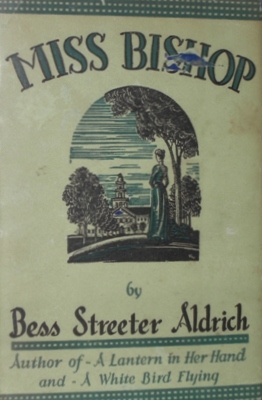
Miss Bishop by Bess Streeter Aldrich ~ 1933. This edition: Grosset & Dunlap, circa 1940s. Hardcover. 337 pages.

My rating: 5.5/10

This book started with such promise, and I raced through the first chapters happily, but as the story passed the midpoint I found I was losing my enthusiasm; something had changed. Now maybe that is just the author’s “genius”, in changing the mood to follow the life-path of the main character, Ella Bishop, from optimistic youth to dreary old age, but somehow I think that is too generous an assessment. I think rather that it is the author’s fault, in retelling her same old story with a different character. I thought that this book was very reminiscent of both A White Bird Flying, and Spring Comes On Forever, sharing the theme that “it is sad but noble to sacrifice your dreams as long as the sacrifice benefits the future generations”.

Miss Ella Bishop is one of the first class of students at the newly established Midwestern College in the growing town of Oak River, in an unspecified mid-western prairie state. The year is 1876, and the mood is of optimism and enthusiasm as progress strides across the prairie, bringing culture and higher education into the hitherto culturally isolated farming communities of the region.

Ella Bishop is that character beloved of novelists, the poor but bright and winsome orphan, or in this case, semi-orphan; Ella’s father has just died, and she and her ineffectual mother are just barely getting by; college fees are, as is the inevitable case in this genre, a challenge to meet. Ella of course does wonderfully well in college and graduates high in her class; she is now well-trained and ready to take on a job as a teacher, the only real choice of profession (other than shop clerk or seamstress) open to a young lady of her generation.

This was the best part of the book, in my opinion. The author captures wonderfully well the heady atmosphere of the new college and its small group of professors and students. The boys and girls attending the school are mostly children of immigrants, proud of their various distinctive heritages while identifying firmly as modern Americans. The glimpses into the homes and lives of the students, and the physical descriptions of the prairie in its state of being transformed into “civilization” are beautifully handled and a joy to read.

But all is not well in Ella Bishop’s world; her youthful optimism is about to take a hit. A bit of a heads-up here: there will be major spoilers in this review. If you are wanting to discover Ella’s trials and tribulations for yourself, it is time to click away. Otherwise, you’re going to get the condensed version of this soap opera of a tale.

Ella graduates and is offered a job teaching grammar at the selfsame college she has just been a student at; gratefully, she accepts; she is now able to support her frail mother, and teaching will do fine as an interesting occupation for the next year or two, until her true vocation comes along.

As well as she liked her teaching, – to have a husband and home and children, – these were better. These were the things for which her healthy young body and warm heart were intended. She knew.

Eventually Ella’s white knight trots into town. She meets young Delbert Thompson, a newly arrived junior partner in the town’s law. All is wonderful; the wedding date is set, the dress is being made, when into Ella’s shiny happy world a small dark shadow comes. An eighteen-year-old cousin has been orphaned and asks to come and stay for a while to get over her grief and plan her next move; young Amy has just found out that she is penniless as well as bereft of her parents. The perfumed note gives us our first inkling of disaster to come; Ella is mildly annoyed at having to give a thought to another body in the house just when she is getting ready to bring a new husband home, but she nobly does the right thing and welcomes Amy with cordiality and grace.

Oh no! Wrong thing to do! Amy is tiny and cute and flirtatious, and soon a circle of other girls’ beaux are attracted like bumbling moths to Amy’s bright little flame. Including Delbert. With the wedding mere weeks away, Amy sets her sights on her cousin’s attractive fiancé. Ella proudly refuses to interfere; the worst happens, and Delbert now “must” marry Amy, as he has fallen into the trap she has set baited with her delectable, willing little body. Off they go, leaving Ella in a state of despair. Going to her mother for comfort, that is denied to her as well, as her self-centered parent is so upset by the situation that Ella ends in burying her own emotions to administer to her mother’s hysteria. Better get used to it, Ella, it’s going to be the pattern of the rest of your sorry life.

Nine months later, in the depths of winter, a foreboding stranger appears, bearing a passionate letter from Delbert. He is on his deathbed; time is short; he begs Ella to come and see him. Off she goes, to find Delbert, as advertised, indeed on his deathbed from some unspecified illness. The highly pregnant Amy is creeping around helplessly; with his dying breath Delbert begs Ella to take Amy home with her and care for her until the child is born. “I’m ever so sorry, Ella, and it was such a mistake, but here we all are, and I’m counting on you…”

And Ella nobly steps up. Amy is rescued once again and brought back into the Bishop fold, where she promptly gives birth to a baby girl before blinking out of life herself a few hours later. And there is Ella, left holding the baby, child of her one true love and her deceptive cousin. What else to do but adopt the child as her own and lavish all her pent-up love on the helpless little thing? She even names the child, ever so predictably, “Hope”.

Ella divides her life into two; in one part she is the dedicated college teacher, loved and respected by students and fellow instructors; in the other she is the devoted surrogate mother to young Hope and the endlessly patient daughter to her increasingly needy mother. Luckily she has picked up a stalwart Danish girl even more selfless than herself to keep the home fires burning and the old lady and young girl cared for while Ella is out working to support them all. Stena has lost her own lover and baby, and is a godsend to the Bishop ménage, so grateful for a roof over her own head that she quickly becomes an indispensable member of the all-female household.

The years roll by, and Ella gets another chance at love when Professor John Stevens arrives to teach English literature. The two hit it off immediately; friendship warms to something much deeper, and all systems are “go” except for one small glitch – the pre-existing Mrs. Stevens, an unattractive, unintellectual, querulous kleptomaniac. Ella and John are tempted to ditch the unlucky Mrs. Stevens and take their true love elsewhere, but both decide to do the right thing, renouncing their passion unrequited. John moves on with his cranky wife, leaving Ella to take comfort in her role as noble teacher:

A flaming torch…meant to light the paths of boys and girls along the rugged way!

I was already teetering a bit about this story but this is where Aldrich finally lost me. The woman is a grammar teacher in a small prairie college. A grammar teacher. Useful enough, and with the power to inspire students to a great degree, but not really of flaming torch importance. Nice that she can embrace her vocation in place of her tragically doomed romantic life, but please. This pushes all of my cynical buttons; I figuratively roll my eyes and wish that Miss Bishop would just hop into bed with the Professor already and get it out of her system. But no, that would betray her pure life and her flaming dedication to her career. (Golly, am I overreacting here? Maybe. I liked Ella so much at the start of the story that I want her to get a bit of fun out of life, I think. But she keeps piling on self-denial after self-denial. She’s getting a bit inhuman in her steadfast nobility.)

The rest of the story I read in a state of “come on, what else can this poor old girl take?” And she does not disappoint.

Hope is duly launched, with several expensive (and ultimately wasted) years of college and a speedy marriage soon after, and Ella feels like she can concentrate on herself at long last. She plans a longed-for trip to Europe with her fellow professors, scrimps and saves, and is ready to go when her already fragile mother finally slips into full-blown dementia. Though the stalwart Stena is perfectly willing to take on full responsibility and encourages Ella to go, Ella decides to abandon her cherished travelling ambition to stay home on the off-chance that her mother will return, even briefly, to a state of lucidity. Doesn’t happen, and Mother Bishop lingers on, to die quietly some years later.

Ella sees one last chance, plans the European trip again, and is poised to go when Hope’s eighteen-year-old daughter Gretchen falls in love with a hopelessly unsuitable older married man. Ella gives over her savings so Gretchen can go to Europe and forget her lover; Gretchen comes back “cured” with an offhand “Thanks, Granny!” and finds a more available man to marry. It is at this point that Ella suddenly realizes that her earning years are coming to an end, and her savings are not what they should be; the expenses of caring for her mother, Stena’s wages, Hope’s college and Gretchen’s trip seemed like worthwhile expenditures at the time but one woman’s resources are decidedly limited.

Another blow falls. A restructuring takes place within the college. The instructors are asked to take a twenty percent pay cut. Ella soldiers on. And then Ella discovers that her bank is in difficulties, and she loses a portion of her meager remaining savings, and finds she will only be able to withdraw twelve percent of the remainder each year. Ella is now seventy, and had hoped to retire in some sort of comfort, but stark reality faces her; she must continue to work to live. “Only three more years,” she tells herself. “I’ll cut back, and scrimp and save, and get by somehow.”

But she won’t even have those three more years. Out-of-the-blue, a note arrives from the college president. Some changes in the faculty are being planned. Just a heads-up, Miss Bishop, that you might want to hand in your resignation before the college board meeting…

Yet again, Ella faces despair.

There was nothing now to look forward to – but death. Death! How little thought she had ever given to it! So full of living, – her hands so filled with duties, – she had existed only day-to-day, doing the hour’s tasks as well as she could.

But wait! – What about the Alumni banquet to close out the school year. Don’t you want to attend one last time, Miss Bishop? Reluctantly Ella decides she will close out her teaching career in style, so off she goes, to be greeted by a packed house and a ceremony of honour to recognize her lifetime of dedication to the college. Suddenly Ella sees her life in whole; the good and the bad laid out together; every sacrifice having its reason in the great scheme of things; her main importance being in furthering the ambitions of the coming generations. Tomorrow she will again be old and poor, but tonight she is being lauded, and that is enough reward…

*****

I found myself getting increasingly cynical, especially as first Hope and then Gretchen acted so selfishly in regards to their foster-mother and grandmother, taking heedlessly what she selflessly offered on the altar of youth’s desires’ (not needs, but desires) coming first. I felt like shaking Miss Bishop – “Be occasionally selfish, you fool!”

This book is lauded as a “salute to dedicated teachers”, and I get that, but by the end my overwhelming emotion was annoyance. And I’m all about “family first” and “sacrificing” for our children, having done my fair share of tamping down of own desires while raising babies and fully embracing the numerous challenges of motherhood, but there is a limit. Miss Bishop went past the reasonable point into martyr territory, and the author lauds her for it. To be fair, Ella herself in her musings at the end of the book recognizes that the larger picture was not evident to her at the time, that she just went on day-to-day, tackling each issue as she needed to, a very realistic assessment of how most of our lives work!

I’ve also heard this story referenced as the “female, American Mr. Chips“. Recently reread that one, too, and cynically thought James Hilton’s opus was a mite overrated, though when I first read it as a teen I mentally filed it as a pleasant enough story. Now, with many more years to my credit, my opinion is that both Mr. Chips and Miss Bishop were a bit too focussed on their school worlds at the expense of their inner lives. The authors excused their protagonists’ narrow lives by lauding their personal sacrifices for their students. Admirable in a way, but excessive, needless sacrifice is cloying in a fictional character after a certain point; the delicate balance between pleasant story and moral tale is compromised.

This is a rather crabby review, but it reflects my feeling in the here and now regarding the book in question. It might well be different at another time in my life! I would like to emphasize that there is much to admire in Aldrich’s writing, and she is highly regarded by many. She’s a great author for capturing the atmosphere of the times she writes about, and I definitely will continue to read her works as they cross my path. However, I think I might need to re-read A Lantern in Her Hand to see if it can restore my cheerfulness in regards to this author’s work. I feel like the über-predictable Miss Bishop rather let me down.

The Proper Place by O. Douglas (Pseudonym of Anna Buchan) ~ 1926. This edition: Nelson, no date, circa 1940s. Hardcover. 378 pages.

My rating: 9.5/10

This has been a week for seeking out “comfort reads”, and who better to provide such than the low-key Scottish writer, Anna Buchan. She wrote under the pseudonym O. Douglas, in order to modestly distance herself from her more prominent brother, the renowned thriller writer (and Governor-General of Canada from 1935 to 1940, when he died in office) John Buchan, a.k.a. Lord Tweedsmuir.

I am therefore dusting off and slightly editing this old post from July of 2012, in which I talk about one of my favourite O. Douglas novels, The Proper Place.

This is my favourite of Anna (writing as O. Douglas) Buchan’s  books which I’ve read to date. The first time I read this, I had already read the sequel, The Day of Small Things, so I knew what had happened to a great extent before the characters did, if that makes sense. But I think it enhanced rather than detracted from my reading experience; I came to the story with a pre-existing knowledge of and fondness for the characters and greatly enjoyed expanding my acquaintance with them.

As the story opens, the sole surviving offspring of the aristocratic Scottish Rutherfurd family, Nicole, is showing the family home to a prospective buyer. Of its twenty bedrooms, “twelve quite large, and eight small”, only three are now occupied; with Nicole’s two brothers perished in the Great War and her father dead soon after, the family now consists only of Nicole, her mother, Lady Jane, and a orphaned cousin, Barbara Burt, who was raised by Lady Jane from childhood.

The three women are finding it impossible to carry on financially, and have reluctantly but sensibly decided that their only option is to sell the Rutherfurd estate and establish themselves in more modest accommodations. Lady Jane has retreated into a gently passive acceptance of her fate; Barbara is resentful but more or less compliant, and Nicole is very much making the best of things and looking hard for a silver lining in their cloud of sorrow and difficult circumstances.

The prospective buyers, Mr. and Mrs. Jackson of Glasgow, having attained great wealth after many years of striving, are ready for the next step in their social advancement, and hope with their purchase of Rutherfurd Hall to establish their son Andy as a “county” gentleman.

This is where the story departs a bit from the expected norm. One would expect the nouveau riche Jacksons to be portrayed as interlopers and figures of mild scorn; instead we find that the author takes us into their world for a bit and gives an insight into their motivations and intentions that puts us fully on their side. Nicole herself, after her initial, well-hidden resentment, finds herself viewing out-spoken Mrs. Jackson first with quiet humour and soon after with sincere affection, with interesting repercussions further along in the story.

The Rutherfurds find a new home in the seaside town of Kirmeikle, and rent the old and stately but much more reasonably sized Harbour House for a year to see if they will adapt to the life of the town dweller, and to give themselves a bit of breathing space to ponder their futures. They are still very well-off, with sizeable incomes coming from their investments, and they enter easily into the upper strata of Kirkmeikle society.

For a story in which not much really happens, the author packs it full of likeable, often amusing characters, and quietly intriguing situations. Though the tone is relentlessly optimistic, somehow this tale escapes being “too sweet” by the pervasive presence of loss, grief and hardship resulting from the war, and by the occasionally pithy observations of many of the characters.

Nicole and Lady Jane are most decidedly our heroines throughout; Barbara is perhaps the least likeable character due to her deep-seated snobbishness and condescending attitude, but we get to know her well enough to understand the basis of her sometimes negative outlook. O. Douglas is a very fair-minded author; she always allows her characters the grace of a deep enough glimpse into their lives and thoughts to allow us to place their words and actions in full context; something I fully appreciated in this story.

I greatly enjoyed this book.

Another, very nicely written, much more detailed review is here, from the I Prefer Reading  blog of Lyn, from Melbourne, Australia. Lyn says everything I wanted to say, and much better!

http://preferreading.blogspot.ca/2010/09/proper-place-o-douglas.html